
Romans 1:23

Greek (Tischendorf 8th ed.) Romans 1:23 appears in the Greek New Testament. The text above is from the Tischendorf 8th edition. Each word links to its Strong’s number and a concise gloss. Click any word for its full Thayer’s Greek Lexicon entry.
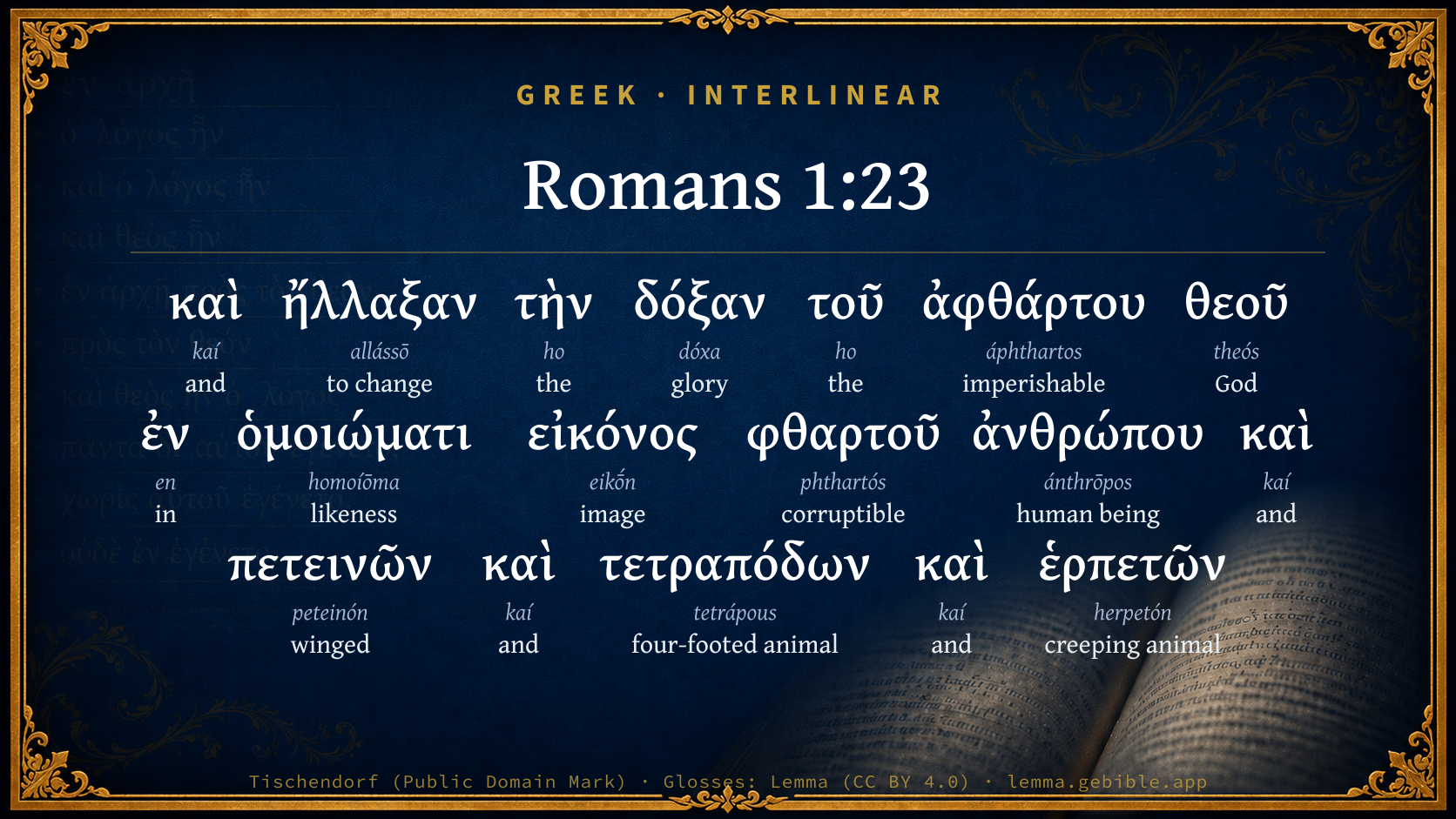
Download image
Cite this verse

Romans 1:23 (World English Bible). Public Domain. Lemma interlinear Bible study tool, https://lemma.gebible.app/v/romans/1/23.

Show BibTeX & RIS
BibTeX
RIS
English Translation
and traded the glory of the incorruptible God for the likeness of an image of corruptible man, and of birds, and four-footed animals, and creeping things.
World English Bible · Public Domain
Highlights
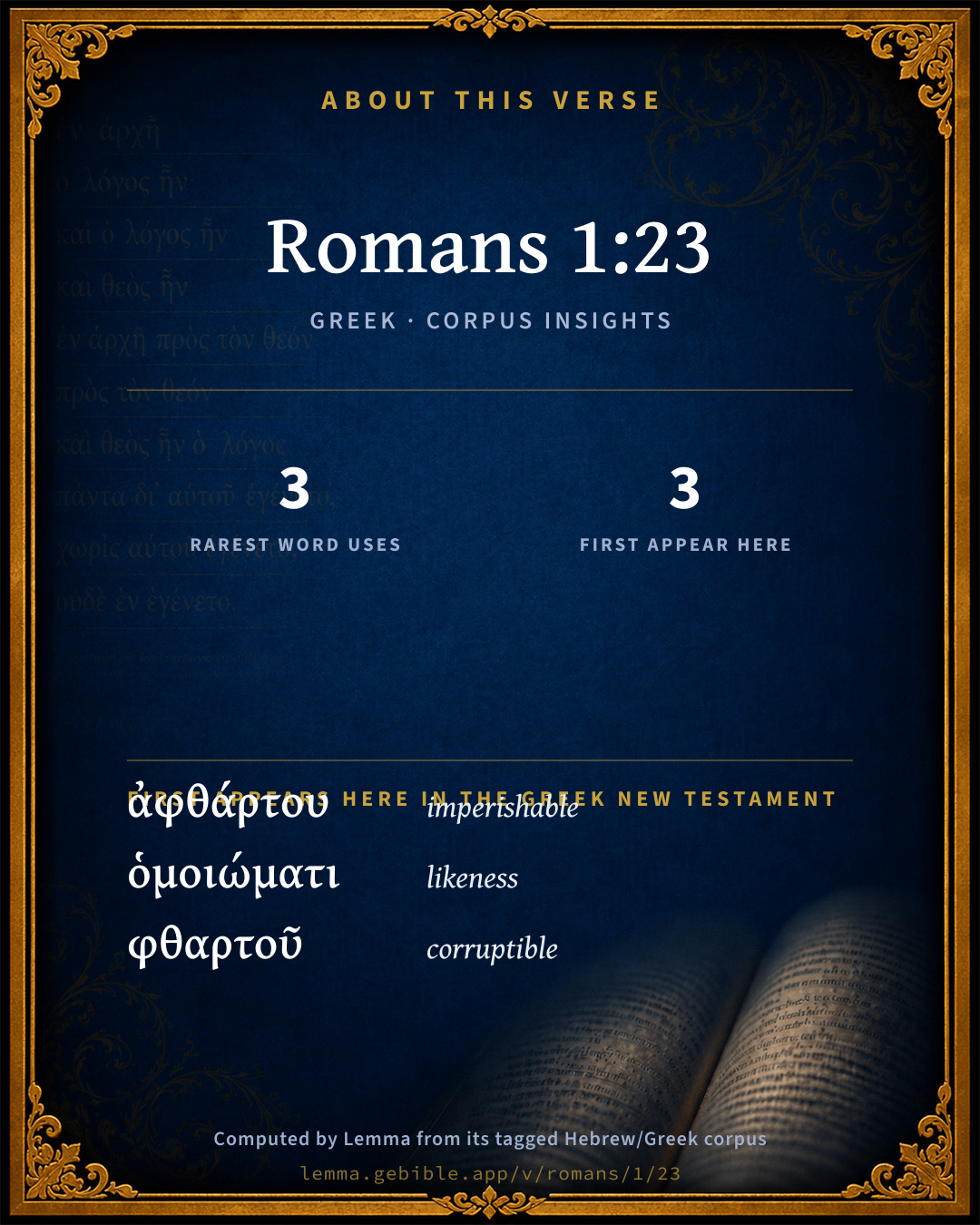
  • 3 first appearances in the Greek New Testament
Full analysis ↓
Download a study sheet

One document with this verse’s original text, its word-by-word gloss line, the meaning frame, cross-references with their text, attributed commentary, and full source and license credits — printable, and it pastes into notes with its structure intact.

This verse Autodidact and up

Study sheet (.html) Plain text (.txt)

A passage Seminary Student

Up to 50 verses in one chapter. A passage sheet keeps up to 6 commentary sources and 12 cross-references per verse, in the order this page ranks them, and says so on the sheet whenever that leaves anything out. Ask for a single verse and you get the Autodidact verse sheet above.

Everything on this page stays free to read, with no account — the sheet is a download of what is already on screen, not access to it.

Want to remove ads? Support Godless Engineer
Compare translations 3

The same verse in 3 English versions, stacked beneath the original-language interlinear above. Click any original word for its lexicon entry.

Each is an independent rendering of the whole verse — the interlinear is not word-aligned to these translations.

Highlighted words mark where these versions differ — a whole-verse word diff, not a word-by-word alignment.

  • World English Bible Public Domain
    and traded the glory of the incorruptible God for the likeness of an image of corruptible man, and of birds, and four-footed animals, and creeping things.
  • King James Version Public Domain
    And changed the glory of the uncorruptible God into an image made like to corruptible man, and to birds, and fourfooted beasts, and creeping things.
  • unfoldingWord Literal Text CC BY-SA 4.0
    and exchanged the glory of the imperishable God for a likeness of an image of perishable man, and of birds, and of four-footed beasts, and of creeping things.

unfoldingWord Literal Text — © unfoldingWord, licensed CC BY-SA 4.0. Word-aligned USFM3 via Door43 (git.door43.org/unfoldingWord/en_ult).

Versions to compare (up to 4)

3 of 4 selected

Show all 19 translations

Every available English version of this verse, each an independent rendering of the whole verse.

  • World English Bible Public Domain
    and traded the glory of the incorruptible God for the likeness of an image of corruptible man, and of birds, and four-footed animals, and creeping things.
  • Berean Standard Bible Public Domain
    and exchanged the glory of the immortal God for images of mortal man and birds and animals and reptiles.
  • Majority Standard Bible Public Domain
    and exchanged the glory of the immortal God for images of mortal man and birds and animals and reptiles.
  • King James Version Public Domain
    And changed the glory of the uncorruptible God into an image made like to corruptible man, and to birds, and fourfooted beasts, and creeping things.
  • American Standard Version (1901) Public Domain
    and changed the glory of the incorruptible God for the likeness of an image of corruptible man, and of birds, and four-footed beasts, and creeping things.
  • Revised Version (1885) Public Domain
    and changed the glory of the incorruptible God for the likeness of an image of corruptible man, and of birds, and four-footed beasts, and creeping things.
  • Geneva Bible (1599) Public Domain
    For they turned the glorie of the incorruptible God to the similitude of the image of a corruptible man, and of birdes, and foure footed beastes, and of creeping things.
  • Douay-Rheims (1899) Public Domain
    And they changed the glory of the incorruptible God into the likeness of the image of a corruptible man, and of birds, and of fourfooted beasts, and of creeping things.
  • Young's Literal Translation Public Domain
    and changed the glory of the incorruptible God into the likeness of an image of corruptible man, and of fowls, and of quadrupeds, and of reptiles.
  • Literal Standard Version CC BY-SA 4.0
    and changed the glory of the incorruptible God into the likeness of an image of corruptible man, and of birds, and of quadrupeds, and of reptiles.
  • Unlocked Literal Bible CC BY-SA 4.0
    They exchanged the glory of the imperishable God for the likenesses of an image of perishable man, of birds, of four-footed beasts, and of creeping things.
  • unfoldingWord Literal Text CC BY-SA 4.0
    and exchanged the glory of the imperishable God for a likeness of an image of perishable man, and of birds, and of four-footed beasts, and of creeping things.
  • Darby Bible Public Domain
    and changed the glory of the incorruptible God into [the] likeness of an image of corruptible man and of birds and quadrupeds and reptiles.
  • World Messianic Bible Public Domain
    and traded the glory of the incorruptible God for the likeness of an image of corruptible man, and of birds, four-footed animals, and creeping things.
  • Webster's Bible Public Domain
    And changed the glory of the incorruptible God into an image made like to corruptible man, and to birds, and four-footed beasts, and creeping animals.
  • Free Bible Version CC BY-SA 4.0
    They exchanged the glory of the immortal God for idols, images of mortal human beings, birds, animals, and reptiles.
  • Bible in Basic English Public Domain
    And by them the glory of the eternal God was changed and made into the image of man who is not eternal, and of birds and beasts and things which go on the earth.
  • Text-Critical English NT CC BY 4.0
    and exchanged the glory of the immortal God for images resembling mortal man, birds, four-footed animals, and reptiles.
  • Tyndale New Testament (1534) Public Domain
    and turned the glory of the immortall god vnto the similitude of the ymage of mortall man and of byrdes and foure foted beastes and of serpentes.

Literal Standard Version (2020), Covenant Press — licensed CC BY-SA 4.0. Text via the HelloAO Bible API (eBible.org). Unlocked Literal Bible (unfoldingWord) — licensed CC BY-SA 4.0. Text via the HelloAO Bible API (eBible.org). unfoldingWord Literal Text — © unfoldingWord, licensed CC BY-SA 4.0. Word-aligned USFM3 via Door43 (git.door43.org/unfoldingWord/en_ult). Free Bible Version, Dr. Jonathan Gallagher — licensed CC BY-SA 4.0. Text via the HelloAO Bible API (eBible.org).

Word by word

More ways to search: Search by grammar → Find every occurrence → Compare this word →

Practice this passage: Drill this verse → Learn its vocabulary →

τετραπόδων
tetrápous
G5074
“four-footed animal”
Adjective, Genitive, Plural, Neuter
Part of Speech
Adjective
Case
Genitive
Number
Plural
Gender
Neuter
Full Thayer's Definition

Origin: from G5064 and G4228

TDNT: None

1. a fourfooted animal
  1. καὶ kaí G2532 “and” Conjunction
  2. ἤλλαξαν allássō G236 “to change” Verb, Aorist, Active, Indicative, 3rd person, Plural
  3. τὴν ho G3588 “the” Article, Accusative, Singular, Feminine
  4. δόξαν dóxa G1391 “glory” Noun, Accusative, Singular, Feminine
  5. τοῦ ho G3588 “the” Article, Genitive, Singular, Masculine
  6. ἀφθάρτου áphthartos G862 “imperishable” Adjective, Genitive, Singular, Masculine
  7. θεοῦ theós G2316 “God” Noun, Genitive, Singular, Masculine
  8. ἐν en G1722 “in” Preposition
  9. ὁμοιώματι homoíōma G3667 “likeness” Noun, Dative, Singular, Neuter
  10. εἰκόνος eikṓn G1504 “image” Noun, Genitive, Singular, Feminine
  11. φθαρτοῦ phthartós G5349 “corruptible” Adjective, Genitive, Singular, Masculine
  12. ἀνθρώπου ánthrōpos G444 “human being” Noun, Genitive, Singular, Masculine
  13. καὶ kaí G2532 “and” Conjunction
  14. πετεινῶν peteinón G4071 “winged” Noun, Genitive, Plural, Neuter
  15. καὶ kaí G2532 “and” Conjunction
  16. καὶ kaí G2532 “and” Conjunction
  17. ἑρπετῶν herpetón G2062 “creeping animal” Noun, Genitive, Plural, Neuter

About this verse

These counts appear in no published source. They are computed here, from the morphology-tagged text and Lemma’s own curated glosses. What Lemma adds →

18
words
14
distinct lemmas
Pauline Epistles
section

Notable vocabulary

The rarest word here is τετραπόδων four-footed animal G5074 — appearing just 3 times in the whole Greek New Testament.

First appearance in Scripture

These words make their first canonical appearance in the Greek New Testament here:

  • ἀφθάρτου imperishable G862
  • ὁμοιώματι likeness G3667
  • φθαρτοῦ corruptible G5349

Shared distinctive vocabulary

τετραπόδων four-footed animal G5074 occurs in 3 verses of the Greek New Testament. Also found in:
Repetition

Words recur within this verse:

Cross-references

15

Topical passages linked to Romans 1:23 in the Treasury of Scripture Knowledge — connected by theme and wording, ordered by reader-vote popularity; previews shown in the World English Bible.

  • Psalms 106:20 Thus they exchanged their glory For an image of a bull that eats grass.
  • Jeremiah 2:11 Has a nation changed [its] gods, which yet are no gods? but my people have changed their glory for that which does not profit.
  • Acts 17:29 Being then the offspring of God, we ought not to think that the Divine Nature is like gold, or silver, or stone, engraved by art and design of man.
  • 1 Peter 4:3 For we have spent enough of our past time doing the desire of the Gentiles, and having walked in lewdness, lusts, drunken binges, orgies, carousings, and abominable idolatries.
  • Psalms 115:5–8 They have mouths, but they don't speak; They have eyes, but they don't see;
  • Romans 1:25 who exchanged the truth of God for a lie, and worshiped and served the creature rather than the Creator, who is blessed forever. Amen.
  • Deuteronomy 5:8 "You shall not make an engraved image for yourself, [nor] any likeness [of anything] that is in heaven above, or that is in the earth beneath, or that is in the water under the earth:
  • Psalms 135:15–18 The idols of the nations are silver and gold, The work of men's hands.
  • Ezekiel 8:10 So I went in and saw; and see, every form of creeping things, and abominable animals, and all the idols of the house of Israel, portrayed on the wall round about.
  • Deuteronomy 4:15–18 Take therefore good heed to yourselves; for you saw no manner of form on the day that Yahweh spoke to you in Horeb out of the midst of the fire.
  • Isaiah 40:18 To whom then will you liken God? or what likeness will you compare to him?
  • Isaiah 44:13 The carpenter stretches out a line; he marks it out with a pencil; he shapes it with planes, and he marks it out with the compasses, and shapes it after the figure of a man, according to the beauty of a man, to dwell in a house.
  • Isaiah 40:26 Lift up your eyes on high, and see who has created these, who brings out their host by number; he calls them all by name; by the greatness of his might, and because he is strong in power, not one is lacking.
  • 1 Corinthians 12:2 You know that when you were heathen, you were led away to those mute idols, however you might be led.
  • Revelation 9:20 The rest of mankind, who were not killed with these plagues, didn't repent of the works of their hands, that they wouldn't worship demons, and the idols of gold, and of silver, and of brass, and of stone, and of wood; which can neither see, nor hear, nor walk.

Cross-references courtesy of OpenBible.info (CC BY 4.0).

Commentary

Notes on Romans 1:23 from classic Christian and Jewish commentators (each source and its license shown beneath its notes). The classic Christian expositions comment on the surrounding passage and are grouped to its opening verse, so a note may address several verses; the Jewish commentaries on the Tanakh (Rashi and others) are per-verse, so they appear only where the commentator wrote on this verse.

Lemma curates 59 commentaries, every one of them public domain or Creative Commons licensed, each selected and text-cleaned for this edition rather than reprinted as found. About our sources →

The Biblical Illustrator

Joseph S. Exell

Rom_1:23

Who changed the truth of God into a lie.

The truth of God exchanged into a lie

ἐν, signifies the workshop, or matrix, where the exchange took place. Everything, of course, effected in and coming out of the workshop or matrix of falsehood is falsehood itself. How ridiculous would it be for us to exchange the present knowledge of science for the crude notions and false theories of savages or of the ancients! How absurd for us to strip the walls of our national galleries of the masterpieces of such artists as Raphael and Titian and the like, and to put up in their places paintings without true perspective, worthy conception, or correct execution! Or, again, what an act of madness would it be to abandon springs of clear and crystal waters for impure and poisonous ponds! (Isa_44:20.) But such instances of folly and madness in exchanging the true for the false, the good for the evil, were nothing in comparison to the exchanging the positive and precious knowledge of God in the workshop of falsehood, and, as a matter of course, into falsehood itself, such as idols, the tales of mythology, and heathen systems of philosophy and religion. (C. Neil, M. A.)

Idolatry a lie against Gods truth

The number of the gods of the heathen is a lie against the Divine unity; their corporeal nature a lie against His pure invisible spirituality; their confined and local residence a lie against His omnipresence and immensity; their limited and subdivided departments of operation a lie against His universal proprietorship and dominion; their follies and weaknesses a lie against His infinite wisdom; their defects and vices and crimes a lie against His unsullied purity and perfection. The entire system, in all its diversity of modes, is a sacrilegious robbery of Heaven, a universal slander on the character of the Most High. Every framer and every worshipper of idols, or of real or imaginary beings represented by idols, has changed the truth of God into a lie. (R. Wardlaw, D. D.)

A lie

I. An idol is a lie.

1. As professing to be what it is not.

2. As deceiving him who trusts in it.

II. Everything opposed to God is a lie.

III. Everything is a lie which--

1. Disappoints mans hopes.

2. Fails to satisfy the cravings of his immortal soul.

IV. That life is a lie which is not--

1. According to Gods will.

2. Directed to His glory.

3. The realisation of His enjoyment. (T. Robinson, D. D.)

And worshipped and served the creature more than the Creator.

Nature worship

1. There is no fact in the history of the Jews more certain or familiar than their propensity to lapse into idolatry, yet after the return from Babylon they have never been reproached with any tendency to idol worship. While a large part of the Christian world has resumed the form, if not the substance of idolatry, the Jews have borne witness against their defection.

2. This extraordinary contrast prompts the question, How and why is it so? What has become of the idolatrous propensity which once appeared inseparable from the corruptions of the human heart? There might be less cause to propound this question if a corresponding change had taken place among the heathen. But the heathen world is as idolatrous as ever. Is it because we are too civilised? If by this we mean intellectual refinement and cultivation of the taste, we have only to remember Greece. Or if a civil and political wisdom, military force, and practical sagacity, then look at Rome!

3. Since none of these solutions explain why idolatry is now so rare among ourselves, it may not be without its use to inquire whether, after all, we are so free from idolatry as supposed. Let us then inquire what is idolatry. We must reject the etymological definition which would restrict it to the worship of images. Then they who adored the host of heaven, who invoked the winds, bowed down at the fountains, whispered their devotions to the air, and called upon the mountains, are excluded from the catalogue. On the other hand, idolatry is not to be resolved into a purely spiritual act, the preference of some other supreme object of affection to our Maker. This, though the soul of all idolatry, is not the whole of it, and exists now just as much as in ancient times. Covetousness is idolatry, but idolatry is not covetousness. What imparted to the ancient Paganism its distinctive character, and gave unity to it, was the worship of nature. However they might differ in their symbols, rites, theology, or ethics, they are all reducible to this.

4. This view does not exclude a vast variety of forms and of gradations. The lowest stage, above that of mere stupid fetishism, may be described as the religious worship of particular natural objects or their artificial representatives, rising from the shapeless stone to plants, to trees, from the meanest brutes to the most noble, from the clod to the mountain, from the spring to the ocean, from earth to heaven. A still more intellectual variety would be that which, instead of individual sensible objects, paid its adorations to the elements or mysterious powers of nature. By a still higher act of philosophical abstraction some worshipped Nature itself, including all the objects which have been already mentioned.

5. These views as to the essential character of ancient heathenism derive at least some countenance from the solution which they seem to afford of the disappearance of idolatry. On this hypothesis, if on no other, it may certainly be said that there is still a strong taint of idolatry perceptible.

I. In our language; for to what strange accident can it be owing that in common parlance and in current literature there should be so constant, so instinctive an aversion to the name of God as a personal distinctive appellation. Can it be reverence? Alas! this explanation is precluded by the levity with which the same men often make that venerable name the theme of jests and the burden of imprecation. No; the name seems to be shunned because it means too much. Not only is the grand and simple name of God exchanged for a descriptive title, such as Supreme Being--or an abstract term, the Deity--but still more readily and frequently is God supplanted by a goddess, and her name is Nature. It is Nature that endows men with her gifts and graces, that regulates the seasons and controls the elements. Whatever explanation may be given of this, it is still an odd coincidence that this darling figure of speech or philosophical formula should so exactly tally with the spirit and language of idolatry considered as the worship of nature.

II. But this coincidence may, in some, be the effect of classical studies, and need excite no serious alarm if confined to the fanciful creations of romance or poetry. But we find these analogies also in real life and its least imaginative walks. The compulsory dependence upon seasons and weather often takes the form of an extreme anxiety, a breathless watching of the elements, a superstitious faith in something quite distinct from God, and a constant disposition to invest this something with an individual existence and with personal attributes; although it may prove nothing with respect to any formal belief, it certainly presents another strange approximation to the spirit and the practice of the old idolaters. The fisherman who feels himself to be the slave of the winds and tides, without a thought of God as his Creator, is not so very far removed from the old Greek or Phoenician, who sacrificed to Ocean ere he launched his bark. The mariner who spends whole nights in whistling for the wind, may do it from habit or in jest; but he may also do it with a secret faith, by no means wholly different in kind from the emotions of the ancient pagan, as he poured out his libations to Eolus, or his prayers to the particular wind of which he stood in need. The social and domestic superstitions which have lingered in all Christian countries, as to signs of good and evil luck, and the methods of procuring or averting it, are the relics of a heathenism which we sometimes look upon as finally exploded.

III. But objection may be made to sweeping influences from the errors of the vulgar. Well, admitting that the uninstructed multitude must always embrace errors, some of which may accidentally resemble those of heathenism, let us ascend again into the region of intellectual cultivation in reference to scientific observation. The philosophical explorer often looks upon Gods place as empty, or as filled by another--yet the same--viz., Nature. No one supposes that astronomers ever formally adore the stars, or geologists earth, or chemists the elements, or botanists trees and flowers. But let the evidence that some of all these classes recognise a Nature, quite distinct from God, by whose mysterious virtues these effects are all produced, and whose authoritative laws are independent of His will, be gathered from the language, actions, and feelings of these votaries of science, and then it will appear whether the prophets and the high priests of material wisdom are or are not in heart and practice worshipped of nature.

IV. Another class adore nature as the source of sensible and imaginative pleasure. These are the worshippers of beauty. The voice that whispers in the trees or roars in the tornado may, to some ears, be the voice of God; but they may also utter other inspirations, and bring responses from another oracle. Instead of calling us to God, they may but call us to themselves, or to the place where nature sits enthroned as God. This form of idolatry has all the aid that art can yield to nature. The idolater of nature cannot but be an idolater of art. The high art of the ancients was a part of their religion. It was nature that they represented, beautified and worshipped. The gradual return in modern times to this view of the arts, and the impassioned zeal with which it is pursued, is one of the most startling analogies to heathenism that can be produced, and threatens, more than any other, to result in an exterior resemblance corresponding to the essential one described already. It may no doubt be said that this apotheosis, both of art and nature, has resulted by reaction from the barbarous and unscriptural contempt, especially of Gods material works. This is in some sense true. But the idolatry itself springs from a deeper and remoter source. As long as man retains the sensibilities which God has given him, and yet remains unwilling to retain God in his thoughts, the voice of nature will be louder than the voice of God.

V. From the agreements which have now been traced, it may reasonably be expected that the principle of this idolatry will also avow itself in doctrine. It has done so already in the pantheistical philosophy of Germany. Conclusion: From all this it becomes us to take warning, that whatever we do we do with our eyes open, to see to it that we incur not the reproach, Ye know not what ye worship, and to see to it that we are not led into idolatry by any specious figments or delusions, lest we be constrained to take up the lament of those confessors in the times of heathen persecution, who, though proof against all menace and persuasion, were at last miserably cheated into sets of worship at the altar of an idol, when they thought themselves kneeling at the altar of their God. (J. A. Alexander, D. D.)

Scepticism and superstition

There is a very close connection, as all history proves, between theoretical disbelief in a future life and spiritual existence, and superstition. So strong is the bond that unites men with the unseen world that if they do not link themselves with that world in the legitimate and true fashion, it is almost certain to avenge itself upon them by leading them to all manner of low and abject superstitions. (A. Maclaren, D. D.)

Heart idolatry

Worship is the attribution of supreme excellence to, and the entire dependence of the heart upon, a certain person. And the people or the things to which a man attributes excellence, and on which he hangs his happiness and his well-being, these be his gods, no matter what his outward profession is. You can find out what these are for yourself, if you will honestly ask yourself one or two questions. What is it that I want most? What is it which makes my ideal of happiness? What is it which I feel that I should be desperate without? What do I think about most naturally and spontaneously, when the spring is taken off, and my thoughts are allowed to go as they will? And if the answer to none of these questions is God! then I do not know why you should call yourself a worshipper of Gods. It does not matter, though we pray in the temple, if we have the dark subterranean pit, where our true adoration is rendered. Oh! I am afraid there are a great many of us nominal Christians, connected with Christian churches, posing before men as orthodox religionists, who keep this private chapel where we do our devotions to an idol and not to God. If our real gods could be made visible, what a pantheon they would make! All the foul forms painted on that underground cell would be paralleled in the creeping things--which crawl along the low earth, and never soar nor even stand erect, and in the vile bestial forms of passion to which some of us really bow down. Honour, wealth, literary or other distinction, the sweet sanctities of human love dishonoured and profaned by being exalted to the place which Divine love should hold, ease, family, animal appetites, lust, drink--these are the gods of some of us. (A. Maclaren, D. D.)

Who is blessed forever.--

The blessedness of God

I. The blessedness of God. To bless is to make happy, and to be blessed is to be happy. God is necessarily happy--

1. In His benevolent feelings. God is love. Benevolence always gives pleasure to the mind. There is a selfish benevolence, which is a happy feeling so long as it continues. There is also a pure, disinterested, and universal benevolence, which yields a purer, higher, and more lasting satisfaction to the mind. And such is the benevolence of the Deity. His benevolent feelings, therefore, must be a source of pure and permanent felicity.

2. In expressing His benevolent feelings. There are emotions which are not productive of any external act. Good men have a thousand affections which they never could express by any external actions, but God is both able and disposed to express His benevolence. He diffuses as much happiness among His creatures as His mighty power, guided by His unsearchable wisdom, can produce. And all these expressions of His goodness are extremely gratifying to His benevolent heart. He makes Himself happy by making His creatures happy. Do parents feel peculiar satisfaction in expressing their love to their children? So does the kind parent of the universe.

3. In beholding the effects of His benevolence. As He loves to promote the happiness of His creatures, so He loves to see the happiness which He bestows and they enjoy.

II. God is perfectly and forever blessed. This blessedness is--

1. Without the least alloy, or mixture. It is as pure as His perfect benevolence, from which it flows. God is love, and in Him is no malevolence at all. Though the benevolence of saints in this life affords them some real happiness, yet it is mixed with many painful feelings, which arise from the mixture of their selfish with their benevolent affections. But all the affections of Gods heart are uniform and harmonious.

2. Uninterrupted. There are many things which serve to interrupt the happiness of saints in this imperfect state. But there is nothing to interrupt the pure and unmixed felicity of the Divine Being. He never finds any difficulty in the way of extending His benevolent regards to any of His creatures, who are always in His sight and His reach. He never sees a good to be done which is out of His power to do. He never sees an evil to be removed which it is out of His power to remove.

3. Unlimited. The happiness of created beings never can be unlimited. Their finite natures will forever set bounds to their enjoyments. But the blessedness of the Deity can admit of no limitation. This is evident from the great scheme which God formed from eternity. Among all possible modes of operation which stood present to His omniscient eye, His infinite wisdom chose the best, to give the most free, full, extensive expressions of His perfectly benevolent feelings. Among all possible things to be done, He determined to do all those which would diffuse the greatest sum of happiness through the universe. And by forming this scheme which would give the most unlimited indulgence to His benevolent feelings, He laid a foundation for His own unlimited felicity and self-enjoyment.

4. Everlasting. He is blessed forever. He can never see any reason to alter His designs, and therefore it is certain that He never will alter them. He can never meet with any insurmountable difficulties in carrying His designs into effect, and therefore He will infallibly accomplish them. And if He does eventually accomplish all His purposes, His joy will be full. He was blessed in forming His benevolent designs; He has been blessed in carrying them on; He will be blessed in bringing them to a close; and He will be blessed in contemplating them, through interminable ages.

III. Improvement:

1. If the blessedness of God essentially consists in the benevolence of His heart, then we may clearly understand what is meant by His acting for His own glory. His creating the universe for His glory, means His creating it for His own most benevolent and perfect blessedness.

2. If Gods blessedness, which consists in the gratification of His benevolence, be His glory, which He seeks in all His works, then His glory and the good of the universe cannot be separated. His acting for His glory is acting to express His pure benevolence to His creatures, in promoting their highest happiness. It is impossible that God should promote His own glory to the highest degree, without promoting the highest good of the universe.

3. If God means to gratify His own benevolence in all His conduct, then we may be assured that He never has suffered, and never will suffer anything to take place but what will promote the greatest good of the whole system of moral beings. Since He has caused both natural and moral evils to exist, we may be sure that no more shall exist than He sees necessary to promote His benevolent purposes. As He designs that the wrath of man shall praise Him, so the remainder of wrath He will restrain, or not cause to exist.

4. If it be Gods supreme design to make Himself and His creatures as happy as possible, then we have reason to rejoice that He is absolutely sovereign. If any of His selfish creatures could guide or stay His hand, they would not suffer Him to seek His own happiness, nor the greatest happiness of the universe, but constrain Him to promote their own private, personal, selfish happiness.

5. Since God places His highest happiness in promoting the highest happiness of His creatures, we have solid ground to believe that He will fulfil all His great and precious promises to believers. He has inseparably connected their happiness with His own.

6. We learn from what has been said that none can be miserable, in time or eternity, but those who are unwilling that God should promote the highest good of the universe. (N. Emmons, D. D.)

The Divine blessedness

I. Let us approach this subject from the easiest standpoint, that of the future. We project our vision through dim ages yet to come. The curse has gone from the universe. Terrible whilst it lasted, Gods tenderness has at last abolished it from the hearts and lives of men. Gods innate blessedness has been transfused into numbers no arithmetic can compute, and they are eager to copy the beneficence that has won their supreme adoration. If there were fresh worlds to be redeemed, not one would decline the task, for the Son who gave Himself a ransom for many is in them. In spirits many as the sands of the sea, He has implanted the foundation motives of His own saving love, and has drawn them into the same circle of sacred joy with Himself. When we look at God from this standpoint, it is not difficult to conceive of Him as infinitely and endlessly blessed. But the subject is not without its difficulties.

1. On the far-off confines of all this blessedness, is there not the smoke of a torment that ascendeth up forever and ever? Whilst there is one world of guilt and pain, can Gods great pitying heart be quite at rest? Well, do not suppose that the ratio between good and evil will always be what it was when Christ spoke of the few that were saved, or even what it is now. Evil will shrink to ever-diminishing proportions in the uncounted centuries yet to be. In the quiet night the heavens breathe their wealth of dew upon the fields and moors and forests, but you can scarcely find the dewdrop that has distilled itself into the cup of the nightshade. For many a hundred miles the trellised vines spread their proud clusters before the sun, You may travel for days before you find the one vine that has been smitten with mildew. Uncounted suns glitter through the Milky Way. The astronomer may search for months before he can find the sun whose light has been quenched. And so evil will be lost in the prevalence of good, and Gods blessing prove itself measureless.

2. But does not this view run counter to that of the Good Shepherd who left the ninety and nine to seek that which was lost? Yes, if the lost one could still be brought back. But I know of no law of beneficence that compels the Shepherd to tarry in the wilderness when the wanderer fights the hand that seeks to guide it back, or rushes into thickets where it is impossible to follow it. I know of no law of beneficence which compels the Shepherd to sit down by the carcase of His lost sheep, like Rizpah by the bones of her son, and rend the air with incessant lamentation. God would be untrue to the claims of the saved if He were so full of regrets for the lost few, that He could not rejoice with infinite gladness over the saved multitudes.

3. But was not God the Father of these lost ones, and can a father be perfectly blessed whilst a single child remains in uncancelled sin and abiding torment? But what is it that haunts the mind of the parent? The sense of possible failure in himself. If I had guided more wisely, spoken more softly, prayed more faithfully, sympathised more ungrudgingly, possibly the issue might have been otherwise. But no thought akin to that can be awakened in the Divine mind. Whatever suffering convulses the world of impenitence, He has not contributed to it. In respect of the damned He has the blessedness of knowing that He has done for them all that infinite love and patience and resource could.

4. But He might have withheld the freedom through the misuse of which these men have damned themselves. Yes, but that would have been to create a vast negative hell of privation and frustrated gladness, in place of a limited positive hell of incurable perversity and woe. If God does all that His great heart can devise, and all that His mighty hand can achieve, and if what He has done issues in the sanctity and blessedness of a vast preponderating majority, God is without qualification infinitely blessed.

II. Contemplate Gods blessedness from the standpoint of the present. That is much more difficult. How are we to reconcile Gods blessedness with suffering and sin? If a mother lay in a trance, conscious of all that was going on around, but unable to move, and heard the cry of pain from her little one, could she be blessed? And God seems to be blessed? And God seems to be present in every scene of human woe. The human parent is spared the pain of looking upon the actual circumstances of the childs profligacy. But God is looking with unveiled eye upon every offence. One hot summer morning, long before daybreak, I wandered through the streets of a Japanese city. The houses are built of thin board, and the rooms separated by paper partitions only. I cannot describe the strange sensations that took possession of my mind. I could hear the tick of every clock, the very breath and movements of the sleepers. And I thought, Is it not thus with God as He walks through this world of ours? How can He be perfectly blessed? The least sensitive man in our midst could not bear it for an hour. Is not Gods present relation to pain a qualification of His blessedness?

1. No; for He is ever exercising a ministry of pity and healing. A nervous woman in the presence of disaster is brought by the excess of grief to the verge of madness; but commit to her some trifling ministry of help, and she becomes calm as an angel. The people whose lives are employed in mitigating pain are always the happiest. And so the blessedness God realises through His secret ministry to sorrow, protects Him against the shadow that the spectacle of widespread suffering might otherwise cast upon His gladness.

2. Gods blessedness can suffer no eclipse from contact with pain, because it is His will to make it the vehicle for the manifestation of conspicuous tenderness. How many cynical people have only felt the sympathy and affection of their kind in the hour of affliction? Although the human heart in its perversity may make of suffering a curse, it is Gods will to make it a point in our wilderness lives at which sweet, secret springs of Divine and human sympathy shall arise and blend with each other, and create magic balm and beauty and freshness. When Gods purpose is accomplished, He makes His servants glory in their tribulations; and when men glory in their tribulations God glories with them, and in that case His blessedness is not impaired.

3. Gods blessedness is not overshadowed by human pain, because by it He is teaching us sympathy with each other, and conformity to His own pattern of beneficence. God very often does not help and heal because He wants us to do it. God is blessed in the very pains of His creatures, when they teach His people to be full of kindness.

4. God looks upon pain from the standpoint of that wider epoch when sorrow and sighing shall have fled away,

(1) Pain so viewed cannot darken His gladness. What a little thing the pain and sickness of your childhood is, when you look at it through the vista of years! Pain is nothing when passed, and, regarded from the standpoint of the Eternal, it is as though it were passed already.

(2) So with death--so sad, solemn, unknown to us, it is a very different thing as God sees it. Some time ago a young lady was operated upon who had been blind from her childhood. The operations themselves were not painful, but the terror created by the returning power of sight was excruciating. She wished to remain in blindness. She felt as though she were always standing upon the brink of a precipice. But the doctor felt no remorse. He knew that his patient would by and by rejoice in the faculty of sight. So when death takes the scales from our sight, the revelation is full of terror. But the beneficent issue of the process is more than a counterpoise to its pain. The work of death does not embitter the blessedness of God. By and by death, like pain, will be no more.

(3) And so with sin, which would otherwise be a qualification of the Divine blessedness. It is in the hearts of parents that the sweetest joys as well as sharpest sorrows are to be found. The father, by his relation and process of loving his children, has given to those children a strange power of wounding him through their disobedience. But the very same love attunes his nature to gratifications that may reach him through the conduct of dutiful and loving children. God looks upon the race in Jesus Christ, and in regard to their future. He may see the prodigal in his unholy riot. That is the fleeting image of the moment. He sees the restored prodigal welcomed back within the household. That is the reality that abides. He may hear the music to whose seductive strains the prodigal is listening in the haunts of harlotry, and that is the murmur in the sea shell. He hears also the music and gladness in the homes whose vacant places have just been filled again, and that is the pealing anthem of an everlasting ocean. In that anthem the faint murmurs in the shells that strew the shore are swallowed up and forgotten. There are terrible contingencies connected with the gift of free will. But we must never forget the profound theology in the simple parable of the marriage feast. God will find countless recipients for the bounty His great love has made ready; if not amongst Pharisees, then amongst publicans; if not amongst Jews, then amongst Gentiles; if not in the men of this generation, then in uncounted generations yet to come.

III. Realise Gods blessedness in relation to the past. We go back to the epochs when the worlds had not issued upon their courses. How can we reconcile the Divine blessedness with solitude? There can be no blessedness without beneficence, and no beneficence without a relation.

1. Well, the beneficence of character that was the spring of all after triumph and achievement was there. The righteousness and purity and love that were exercised in the relations to be afterwards constituted, were already living and conscious forces. And God could not be morally perfect without being infinitely blessed in Himself.

2. More still: the Son, who was to be the instrument for the accomplishment of all the Fathers vast and holy and loving purposes, was already a willing instrument in the Fathers bosom. And in the life of that Son every soul was reflected that was to be afterwards united by faith to Him as its Saviour and Head. Literary artists sometimes identify themselves with the creatures of their imagination. They have shed tears over their pains and reverses, and been in ecstasies over the good fortune to which they thought fit to bring them at the breaking of the clouds. And the mind of God has been peopled from the beginning with the forms of those who were afterwards to be, not the figures of a romance only, but profound realities upon the platform of human life and action. And towards all these, the Divine love has been pouring itself out from everlasting. Conclusion: But it may be asked: Does not this view of the eternal blessedness of God preclude the possibility of sympathy? How can the eternal God enter into the fleeting sorrows of time? Can He grieve for us in our grief and shame? Does not the vast perspective in His vision seem to exclude every trace of affinity and sensitive relation with our mortal life? Just as the human eye has different focal lengths, and can adjust itself to the different degrees in which light may be diffused, so the Divine mind can mysteriously combine into one the view of life opening itself at the standpoint of time, and that other view opening itself at the standpoint of eternity. Indeed, in the Person of Jesus He has given us proof of the fact that He can bring Himself under the conditions of time, looking at sorrow and sin from our own levels, and transcending all human brotherhood and friendship in the perfectness of His sympathy. (T. G. Selby.)

The Biblical Illustrator, edited by Joseph S. Exell (c. 1880s–1900s) — public domain. Text from a community e-Sword module.

Bengel's Gnomon

Johann Albrecht Bengel

Rom 1:23. Ἤλλαξαν, they changed), with the utmost folly, Psa 106:20; Jer 2:11. The impiety being one and the same, and the punishment one and the same, have three successive stages. In the first, these words are the emphatic ones, viz., καρδία, in Rom 1:21; καρδιῶν, in Rom 1:24; ἐδόξασαν, and δόξαν, and ἀτιμάζεσθαι τὰ σώματα, in Rom 1:21; Rom 1:23-24. In the second stage, μετήλλαξαν is emphatic, and the repetition of this verb, not, however, without a difference between the simple and compound forms [ἤλλαξαν τ. δοξαν, Rom 1:23; μετήλλαξαν τ. φυσικὴν χρῆσιν, Rom 1:26, the corresponding sin and punishment], gives the meaning of like for like [talionis, their punishment being like their sin], Rom 1:25-26; as παρὰ changes its meaning, when repeated in the same place [παρὰ τ. κτίσαντα, Rom 1:25; παρὰ φύσιν, Rom 1:26]. In the third, οὐκ ἐδοκίμασαν, and ἀδόκιμον, Rom 1:28, are emphatic. In the several cases, the word παρέδωκε expresses the punishment. If a man worships not God as God, he is so far left to himself, that he casts away his manhood, and departs as far as possible from God, after whose image he was made.—τὴν δόξαν το͂υ ἀφθὰρτου, the glory of the incorruptible) The perfections of God are expressed either in positive or negative terms. The Hebrew language abounds in positive terms, and generally renders negatives by a periphrasis.—ἐν), Hebrew á, [So, after the verb to change with, or for] the Latin pro, cum; so, ἐν, Rom 1:25 [changed the truth of God into a lie].—ἀνθρώπου—ἑρπετῶν, like to man—to creeping things) A descending climax; corruptible is to be construed also with birds, etc. They often mixed together the form of man, bird, quadruped, and serpent.—ὁμοιώματι εἰκόνος, in the likeness of an image) Image is the concrete; likeness the abstract, opposed to δόξῃ, the glory; the greater the resemblance of the image to the creature, the more manifest is the aberration from the truth.

Bengel's Gnomon of the New Testament — English translation (T&T Clark, Edinburgh, 1860) — public domain. Text from a community e-Sword module.

Hodge's Commentary on Romans, Ephesians & First Corinthians

Charles Hodge

Rom_1:23

They became fools and exchanged the glory of the incorruptible God for the likeness of the image of corruptible man. Herein consisted their amazing folly, that they, as rational beings, should worship the creature in preference to the Creator. The common construction of the verb ἀλλάσσειν in Greek when it means to exchange, is either τί τινος, or τὶ ἀντί τινος; but the apostle imitates the Hebrew construction, הֵימִיר בְּ, which by the lxx, is rendered ἀλλάσσειν ἐν, as in Psa_106:20. The sense is not that they change one thing into another, but that they exchanged one thing for another. The glory, a collective term for all the divine perfections. They exchanged the substance for the image, the substantial or real divine glories for the likeness of an image of corruptible man, i.e., an image like to corruptible man. The contrast is not merely between God and man, or between the incorruptible, imperishable, eternal God, and frail man, but between this incorruptible God and the image of a man. It was not, however, in the worship of the images of men only that the degradation of the heathen was manifested, for they paid religious homage to birds, beasts, and reptiles. In such idolatry the idol or animal was, with regard to the majority, the ultimate object of worship. Some professed to regard the visible image as a mere symbol of the real object of their adoration; while others believed that the gods in some way filled these idols, and operated through them; and others again, that the universal principle of being was reverenced under these manifestations. The Scriptures take no account of these destinations. All who bowed down to stocks and stones are denounced as worshipping gods which their own hands had made; and idolatry is made to include not merely the worship of false gods, but the worship of the true God by images. The universal prevalence of idolatry among the heathens, notwithstanding the revelation which God had made of himself in his works, is the evidence which Paul adduces to prove that they are ungodly, and consequently exposed to that wrath which is revealed against all ungodliness. In the following, verses, to the end of the chapter, he shows that they are unrighteous; that as the consequence of their departure from God, they sank into the grossest vices.

Charles Hodge — Commentary on Romans (1835), First Corinthians (1857), and Ephesians (1856) — public domain. Text from a community e-Sword module.

Geneva Bible (1599)

Geneva Bible translators

For the true God they took another.

Geneva Bible (1599) marginal notes — public domain. Text via Bolls.life.

Jamieson, Fausset & Brown

Robert Jamieson, A. R. Fausset & David Brown

And changed--or "exchanged."

the glory of the uncorruptible God into--or "for"

an image . . . like to corruptible man--The allusion here is doubtless to the Greek worship, and the apostle may have had in his mind those exquisite chisellings of the human form which lay so profusely beneath and around him as he stood on Mars' Hill; and "beheld their devotions." (See on Act 17:29). But as if that had not been a deep enough degradation of the living God, there was found "a lower deep" still.

and to birds, and four-footed beasts, and to creeping things--referring now to the Egyptian and Oriental worship. In the face of these plain declarations of the descent of man's religious belief from loftier to ever lower and more debasing conceptions of the Supreme Being, there are expositors of this very Epistle (as REICHE and JOWETT), who, believing neither in any fall from primeval innocence, nor in the noble traces of that innocence which lingered even after the fall and were only by degrees obliterated by wilful violence to the dictates of conscience, maintain that man's religious history has been all along a struggle to rise, from the lowest forms of nature worship, suited to the childhood of our race, into that which is more rational and spiritual.

Jamieson, Fausset & Brown — Commentary Critical and Explanatory on the Whole Bible (1871) — public domain (CC PDM 1.0). Text via the HelloAO Bible API.

Adam Clarke's Commentary

Verse 23. They changed the glory, c.] The finest representation of their deities was in the human figure and on such representative figures the sculptors spent all their skill; hence the HERCULES of Farnese, the VENUS of Medicis, and the APOLLO of Belvidere. And when they had formed their gods according to the human shape, they endowed them with human passions; and as they clothed them with attributes of extraordinary strength, beauty, wisdom, c., not having the true principles of morality, they represented them as slaves to the most disorderly and disgraceful passions excelling in irregularities the most profligate of men, as possessing unlimited powers of sensual gratification.

And to birds] As the eagle of Jupiter among the Romans, and the ibis and hawk among the Egyptians; which were all sacred animals.

Four-footed beasts] As the apis or white ox among the Egyptians; from which the idolatrous Israelites took their golden calf. The goat, the monkey, and the dog, were also sacred animals among the same people.

Creeping things.] Such as the crocodile and scarabeus, or beetle, among the Egyptians.

Adam Clarke's Commentary on the Bible (1810–1826) — public domain. Text from a community e-Sword/MySword module.

John Calvin's Commentaries

23. And changed, etc. Having feigned such a God as they could comprehend according to their carnal reason, they were very far from acknowledging the true God: but devised a fictitious and a new god, or rather a phantom. And what he says is, that they changed the glory of God; for as though one substituted a strange child, so they departed from the true God. Nor are they to be excused for this pretense, that they believe that God dwells in heaven, and that they count not the wood to be God, but his image; for it is a high indignity to God, to form so gross an idea of his majesty as to dare to make an image of him. But from the wickedness of such a presumption none were exempt, neither priests, nor statesmen, nor philosophers, of whom the most sound-minded, even Plato himself, sought to find out some likeness of God.

The madness then here noticed, is, that all attempted to make for themselves an image of God; which was a certain proof that their notions of God were gross and absurd. And, first, they befouled the majesty of God by forming him in the likeness of a corruptible man: for I prefer this rendering to that of mortal man, which is adopted by Erasmus; for Paul sets not the immortality of God in opposition to the mortality of man, but that glory, which is subject to no defects, to the most wretched condition of man. And then, being not satisfied with so great a crime, they descended even to beasts and to those of the most filthy kind; by which their stupidity appeared still more evident. You may see an account of these abominations in Lactantius, in Eusebius, and in Augustine in his book on the city of God.

John Calvin's Commentaries (1540-1563) — public domain. Text from the Calvin Translation Society English edition (1840s-50s) via the Christian Classics Ethereal Library (ccel.org). Calvin's coverage is partial (roughly two-thirds of the Bible); uncommented books and verses are honest gaps, never fabricated. The 19th-century editor's footnotes and remarks are omitted so the notes are faithfully Calvin's own voice.

Ellicott's Commentary for English Readers

(23) Into an image made like to.—For the likeness of the image of mortal man. This anthropomorphism applies more especially to the religions of Greece and Rome. Representations of the Deity under the form of beasts were most common in Egypt. “Worship was universally paid to cattle, lions, cats, dogs, weasels, and otters; among the birds, to the sparrow-hawk, the hoopoe, the stork, and the sheldrake; and among fish, to the eel and lepidotus. Besides these, other creatures received local worship. The sheep was worshipped in Sais and the Thebais, but sacrificed and eaten in Lycopolis. The hippopotamus in the district of Papremis, and the crocodile in the greater part of the land, were considered specially sacred; but the latter was chased and eaten in Tentyra and Apollinopolis. The sacred serpent Thermapis which served as head-gear for Isis had holes in all the temples, where it was fed with veal fat.” “Among the sacred beasts,” says Döllinger, “the first place was given to the divine bulls, of which the Egyptians worshipped four.” No doubt the images in Greece and the beasts in Egypt were by some of the people regarded only as symbols of the Deity, but it was in all probability only a small minority who were capable of drawing this distinction.

A Bible Commentary for English Readers, edited by Charles John Ellicott (1878–1897) — public domain. Text from a community e-Sword module.

The Cambridge Bible for Schools and Colleges

gen. ed. J. J. S. Perowne

23. into an image made like to] Lit. in the resemblance of the likeness of; i.e. “so as to appear in a form like man, bird, beast, snake, and insect.” Deity, and its prerogatives, were so degraded as to be (in the idolater’s act) transferred to idols. The illustrations of the Apostle’s words from ancient and modern heathenism are too abundant to need special mention.

The Cambridge Bible for Schools and Colleges (gen. ed. J. J. S. Perowne; Cambridge University Press, 1878–1918) — public domain. Text from a community e-Sword module.

John Gill's Exposition

And changed the glory of the incorruptible God,.... God is incorruptible and immortal in his nature, and so is opposed to all corruptible creatures and things: he has a glory which is essential to him, and a manifestative one in the creatures, and which is relative, and of right belongs to him: his absolute essential glory cannot be changed, cannot be taken away from him, nor given to another; but his relative glory may be said to be changed, when another is worshipped in his stead, and called by his name. So Philo the Jew (g) speaks of

"some, who, leaving the true God, make to themselves false ones, and impose the name of the eternal and incorruptible upon created and corruptible beings.''

Into an image made like to corruptible man; which was worshipped in different forms by the several nations of the world:

and to birds; as the dove by the Samaritans, the hawk, the ibis, and others by the Egyptians:

and fourfooted beasts; as the ox, and other creatures:

and creeping things; such as beetles, serpents, and others, by the same.

(g) De Vita Mosis, l. 3. p. 678, 679.

John Gill's Exposition of the Whole Bible (1746–1763) — public domain (CC PDM 1.0). Text via the HelloAO Bible API.

Trapp's Complete Commentary

John Trapp

23 And changed the glory of the uncorruptible God into an image made like to corruptible man, and to birds, and fourfooted beasts, and creeping things.

Ver. 23. Made like to corruptible man] God made man in his own image; and man (to be even with him, as it were) will needs make God after his image.

And four-footed beasts] God therefore justly gave them up to sodomy, which did abase them below the beasts; that there might be an analogy between the sin and the punishment. This is called a "meet recompence," Rom 1:27. They dishonoured God, they dishonoured therefore themselves. They would not know nor honour him, they shall not therefore know nor spare one another, &c.; so severely will God punish the contempt of and rebellion against the light.

And creeping things] In Lapland the people worship that all day for a god, whatsoever they see first in the morning, be it a bird or worm.

John Trapp, A Commentary or Exposition upon All the Books of the Old and New Testament (1647–1656) — public domain. Text from a community e-Sword module.

Albert Barnes' Notes on the Bible

And changed - This does not mean that they literally “transmuted” God himself; but that in their views they exchanged him; or they changed him “as an object of worship” for idols. They produced, of course, no real change in the glory of the infinite God, but the change was in themselves. They forsook him of whom they had knowledge Rom 1:21, and offered the homage which was due to him, to idols.

The glory - The majesty, the honor, etc. This word stands opposed here to the “degrading” nature of their worship. Instead of adoring a Being clothed with majesty and honor, they bowed down to reptiles, etc. They exchanged a glorious object of worship for what was degrading and humiliating. The glory of God, in such places as this, means his essential honor, his majesty, the concentration and expression of his perfections, as the glory of the sun, 1Co 15:41 means his shining, or his splendor; compare Jer 2:11; Psa 106:20.

The uncorruptible God - The word “uncorruptible” is here applied to God in opposition to “man.” God is unchanging, indestructible, immortal. The word conveys also the idea that God is eternal. As he is incorruptible, he is the proper object of worship. In all the changes of life, man may come to him, assured that he is the same. When man decays by age or infirmities, he may come to God, assured that he undergoes no such change, but is the same yesterday, today, and forever; compare 1Ti 1:17.

Into an image - An image is a representation or likeness of anything, whether made by painting, or from wood, stone, etc. Thus, the word is applied to “idols,” as being “images” or “representations” of heavenly objects; 2Ch 33:7; Dan 3:1; Rev 11:4, etc. See instances of this among the Jews described in Isa 40:18-26, and Eze 8:10.

To corruptible man - This stands opposed to the “incorruptible” God. Many of the images or idols of the ancients were in the forms of men and women. Many of their gods were heroes and benefactors, who were deified, and to whom temples, altars, and statues were erected. Such were Jupiter, and Hercules, and Romulus, etc. The worship of these heroes thus constituted no small part of their idolatry, and their images would be of course representations of them in human form. It was proof of great degradation, that they thus adored human beings with like passions as themselves; and attempted to displace the true God from the throne, and to substitute in his place an idol in the likeness of men.

And to birds - The “ibis” was adored with special reverence among the Egyptians, on account of the great benefits resulting from its destroying the serpents which, but for this, would have overrun the country. The hawk was also adored in Egypt, and the eagle at Rome. As one great principle of pagan idolatry was to adore all objects from which important benefits were derived, it is probable that all birds would come in for a share of pagan worship, that rendered service in the destruction of noxious animals.

And fourfooted beasts - Thus, the ox, under the name “apis,” was adored in Egypt; and even the dog and the monkey. In imitation of the Egyptian ox, the children of Israel made their golden calf, Exo 22:4. At this day, two of the most sacred objects of worship in Hindostan are the cow and the “monkey.”

And creeping things - Reptiles. “Animals that have no feet, or such short ones that they seem to creep or crawl on the ground.” “(Calmet.)” Lizards, serpents, etc. come under this description. The “crocodile” in Egypt was an object of adoration, and even the serpent so late as the second century of the Christian era, there was a sect in Egypt, called “Ophites” from their worshipping a serpent, and who ever claimed to be Christians, (Murdock’s Mosheim, vol. i. p. 180, 181). There was scarcely an object, animal or vegetable, which the Egyptians did not adore. Thus, the leek, the onion, etc. were objects of worship, and people bowed down and paid adoration to the sun and moon, to animals, to vegetables, and to reptiles. Egypt was the source of the views of religion that pervaded other nations, and hence, their worship partook of the same wretched and degrading character. (See “Leland’s” “Advantage and Necessity of Revelation.”)

Albert Barnes' Notes on the Bible (1834–1885) — public domain. Text from a community e-Sword/MySword module.

Matthew Poole's English Annotations

Changed the glory of the uncorruptible God; you have the same phrase, Psa 106:20; Jer 2:11; and from thence it is borrowed.

Into an image made like to corruptible man, &c.: the apostle proeeedeth from the more worthy to the less worthy creatures, that the grossness of their idolatry might the better appear; and these four are put for all other kinds. This gross idolatry of the heathen in worshipping such images as are here spoken of, was practised by the Israelites; see Eze 8:10,11; and so it is by the Romanists to this day; nor doth it avail them to say, they do not worship images, but the true God in or before those images; for the same plea was made by the idolaters of old. Symmachus, in a learned oration, wherein he craved of the emperors Valentinian and Theodosius the restitution of the Roman gods, affirms, that they had respect only to one God; but they had divers ways to bring them to that God: they did not hold such things as they worshipped to be God, but in them they said they worshipped the true God. That worship which is intended to God by an image, is not the worship of God, but of the image. Compare Psa 106:19,20, with Exo 32:4,5.

Matthew Poole's English Annotations on the Holy Bible (1683–1685) — public domain. Text from a community e-Sword/MySword module.

Whedon's Commentary on the Bible

Daniel D. Whedon

23. Changed—What unspeakable fools these self-conceited wise ones were is here unfolded. The glory of the incorruptible God they transformed into the basest shapes of man, birds, quadrupeds, and reptiles.

Man—In Athens the most exquisite art was applied in shaping statues of human form into representatives of gods.

Birds—In Egypt the ibis.

Four-footed beasts—Dogs, cats, wolves, oxen, and crocodiles.

Creeping things—The serpent worship is one of the most marvellous and most widely diffused of idolatries. Wherever these apostates from God discerned or imagined the nature-power manifesting itself peculiarly, as in some animals, there they bestowed their strange and degrading worship. At first it was perhaps the nature power conceived to inhere in the animal which they worshipped, but, sooner or later, not only the animal, but even the lifeless image, was worshipped as the very god.

Daniel D. Whedon (gen. ed.), Commentary on the Old and New Testaments (1874–1909) — public domain. Text from a community e-Sword module.

John Wesley's Explanatory Notes

And changed - With the utmost folly. Here are three degrees of ungodliness and of punishment: the first is described, ver. 21- 24; the second, ver. 25-27; the third, in ver. 28, and following verses. The punishment in each case is expressed by God gave them up. If a man will not worship God as God, he is so left to himself that he throws away his very manhood. Reptiles - Or creeping things; as beetles, and various kinds of serpents.

John Wesley, Explanatory Notes Upon the Whole Bible (1754–1765) — public domain. Text via the GEBible commentary corpus.

McGarvey & Pendleton's Commentaries

J. W. McGarvey

and changed the glory of the incorruptible God for the likeness of an image of corruptible man, and of birds, and four-footed beasts, and creeping things . [Vaunting their wisdom, these wicked ones made fools of themselves, so that they exchanged the glory of the immortal God for the likeness of an image of mortal man, or even images of baser things, as birds, beasts and reptiles. The audacity of the attempt to reason God out of existence has invariably turned the brain of man ( Psa_53:1 ), and the excess of self-conceit and vanity developed by such an undertaking has uniformly resulted in pitiable folly. In the case of the ancients it led to idolatry. Reiche contended that idolatry preceded monotheism, and that the better was developed out of the worse; but history sustains Paul in presenting idolatry as a decline from a purer form of worship "For," says Meyer, "heathenism is not the primeval religion from which man might gradually have risen to the true knowledge of the wisdom of God, but is, on the contrary, the result of a falling away from the known original revelation of the true God in his works." Paul does not say that they exchanged the "form" of God for that of an idol, for God is sensuously perceived as glory, or shekinah, rather than as form. Hence, Moses asked to see, not the form, but the glory of God ( Exo_33:18-22 ). The Greeks and Romans preferred the human form as the model for their idols, but the Egyptians chose the baser, doubtless because, having been longer engaged in the practice of idolatry, their system was more fully developed in degradation. The ibis, the bull, the serpent and the crocodile of the Egyptians give us the complements of Paul's catalogue. Schaff sees in the phrase "likeness of an image" a double meaning, and interprets it thus: "The expression refers both to the grosser and the more refined forms of idolatry; common people saw in the idols the gods themselves; the cultivated heathen regarded them as symbolical representations."]

J. W. McGarvey (with Philip Y. Pendleton), Commentaries on the New Testament (The Fourfold Gospel, 1914; Acts; and the epistles) — public domain. Text from a community e-Sword/MySword module.

The People's New Testament

B. W. Johnson

23. Changed the glory of the uncorruptible God. Turning from the glorious revelation of God in nature, they showed that they were fools by making an image, like man, or lower animals, and calling it a god. Man. The Greeks made their gods like men. Many statues still exist that were taken from old Greek or Roman temples. Birds. The Egyptians worshiped birds, quadrupeds, and reptiles.

B. W. Johnson's The People's New Testament with Notes (1889–1891) — public domain. Electronic text from the Christian Classics Ethereal Library (CCEL) ThML edition.

Cambridge Greek Testament for Schools and Colleges

23. ἤλλαξαν. Cf. Psalms 106 (105) 20; cf. infra 25. The consequence of their false conception is a false religion, substituting inferior objects of worship for the one true object. The construction is a survival of poetic usage. Cf. Soph. Antigone 495 (Lietzmann).

τὴν δόξαν. Here apparently = the manifestation of GOD as an object of worship; cf. Rom 1:21. |[76] τὸ γνωστὸν τ. θ. the manifestation of GOD as an object of knowledge.

[76] | parallel to

Cambridge Greek Testament for Schools and Colleges (Cambridge University Press, 1896; 21 vols, various authors incl. Carr, Maclear, Plummer, Farrar, Lumby, Moule, M. R. James, Simcox) — public domain. Text from a community e-Sword module.

Alford’s Greek Testament

Henry Alford

23. ἤλλαξαν κ.τ.λ.] quoted from ref. Ps., only τὴν δόξαν αὐτῶν, ‘their glory,’ of the Psalm, is changed to ‘God’s glory,’—viz. His Power and Majesty visible in the Creation. ἐν represents the conditional element in which the change subsisted.

ἀφθάρτου and φθαρτοῦ shew by contrast the folly of such a substitution: He who made and upholds all things must be incorruptible, and no corruptible thing can express His likeness.

ὁμοιώματι εἰκόνος] the similitude of the form—εἰκόνος generalizes it to mean the human form, it not being any one particular man, but the form of man (examples being abundant) to which they degraded God,—and so of the other creatures. Deities of the human form prevailed in Greece—those of the bestial in Egypt. Both methods of worship were practised in Rome.

Henry Alford, The Greek Testament (1849–1861) — public domain. Text from a community e-Sword module.

International Critical Commentary

23. ἤλλαξαν ἐν: an imitation of a Heb. construction: cf. Psa 106(105):20; also for the expression Jer 2:2 (Del. ad loc.) &c.

δόξαν = ‘manifested perfection.’ See on 3:23.

Comp. with this verse Philo, Vit. Mos. iii. 20 (Mang. ii. 161) οἳ τον ἀληθῆ θεὸν καταλιπόντες τοὺς ψευδωνύμους ἐδημιούργησαν, φθαρταῖς καὶ γενηταῖς οὐσίαις τὴν τοῦ ἀγενήτου καὶ ἀφθάρτου πρόσρησιν ἐπιφημίσαντες: also De Ebriet. 28 (Mang. i. 374) παρʼ ὃ καὶ θεοπλαστεῖν ἀρξάμενος ἀγαλμάτων καὶ ξοάνων καὶ ἄλλων μυρίων ἀφιδρυμάτων ὑλαῖς διαφόροις τετεχνιτευμένων κατέπλησε τὴν οἰκουμένην … κατειργάσατο τὸ ἐναντίον οὗ προσεδόκησεν, ἀντὶ ὁσιότητος ἀσέβειαν—τὸ γὰρ πολύθεον ἐν ταῖς τῶν ἀφρόνων ψυχαῖς ἀθεότης, καὶ θεοῦ τιμῆς ἀλογοῦσιν οἱ τὰ θνητὰ θειώσαντες—οἷς οὐκ ἐξήρκεσεν ἡλίου καὶ σελήνης … εἰκόνας διαπλάσασθαι, ἀλλʼ ἤδη καὶ ἀλόγοις ζώοις καὶ φυτοῖς τῆς τῶν ἀφθάρτων τιμῆς μετέδοσαν.

23. καὶ ἤλλαξαν τὴν δόξαν τοῦ ἀφθάρτου Θεοῦ ἐν ὁμοιώματι εἰκόνος φθαρτοῦ ἀνθρώπου καὶ πετεινῶν καὶ τετραπόδων καὶ ἑρπετῶν. 12:1. τὸ ἄφθαρτόν σου πνεῦμα.

14:8. τὸ δὲ φθαρτὸν Θεὸς ὠνομάσθη.

13:10. ταλαίπωροι δὲ καὶ ἐν νεκροῖς αἱ ἐλπίδες αὐτῶν, οἵτινες ἐκαλεσαν θεοὺς ἔργα χειρῶν ἀνθρώπων.

International Critical Commentary — older volumes (1896–1929), various authors — public domain. Text from a community e-Sword module.

Lesson kit

Teaching starters — assembled from the data on this page, not authored interpretation. Every prompt links to the verse data it draws on. Edit before teaching.

Romans, in the Pauline Epistles, opens this verse with 18 words (14 distinct Greek lemmas). Its most distinctive word is tetrápous (“four-footed animal”). A historical commentator’s framing appears above. Read the whole chapter for the surrounding context.

Discussion questions

  1. What does “four-footed animal” (tetrápous) contribute to the verse as a whole?
  2. 3 words here appear for the first time in Scripture. What is being introduced at this debut?
  3. Acts 10:12 shares the word «four-footed animal» with this verse. How do the two illuminate each other?
  4. “and” occurs 4× in this one verse. What is the effect of the repetition?
  5. These translations render this verse differently. What is at stake in choosing one wording over another?
  6. Reading how The Biblical Illustrator and Bengel's Gnomon read this verse, where do the two commentators agree and where do they part?

Things to notice

  • 3 words make their first canonical appearance in Scripture here.
  • These translations choose different wording for 16 words in this verse.
  • “and” occurs 4× in this single verse.
  • 14 distinct Greek lemmas span 18 words in this verse.

Reading settings

Reading text

Shown beneath each verse's original-language words.

Old Testament
Old Testament edition

Read the OT as the Masoretic Hebrew (MT) or the Greek Septuagint (LXX).

English shown for the Greek Septuagint (in the Hebrew ↔ Greek comparison).

Comparing translations? Open the Compare panel on any verse page to stack up to four side by side.