Galatians 3:21

Greek (Tischendorf 8th ed.) Galatians 3:21 appears in the Greek New Testament. The text above is from the Tischendorf 8th edition. Each word links to its Strong’s number and a concise gloss. Click any word for its full Thayer’s Greek Lexicon entry.
Download image
Cite this verse

Galatians 3:21 (World English Bible). Public Domain. Lemma interlinear Bible study tool, https://lemma.gebible.app/v/galatians/3/21.

Show BibTeX & RIS
BibTeX
RIS
English Translation
Is the law then against the promises of God? Certainly not! For if there had been a law given which could make alive, most assuredly righteousness would have been of the law.
World English Bible · Public Domain
Download a study sheet

One document with this verse’s original text, its word-by-word gloss line, the meaning frame, cross-references with their text, attributed commentary, and full source and license credits — printable, and it pastes into notes with its structure intact.

This verse Autodidact and up

Study sheet (.html) Plain text (.txt)

A passage Seminary Student

Up to 50 verses in one chapter. A passage sheet keeps up to 6 commentary sources and 12 cross-references per verse, in the order this page ranks them, and says so on the sheet whenever that leaves anything out. Ask for a single verse and you get the Autodidact verse sheet above.

Everything on this page stays free to read, with no account — the sheet is a download of what is already on screen, not access to it.

Want to remove ads? Support Godless Engineer
Compare translations 3

The same verse in 3 English versions, stacked beneath the original-language interlinear above. Click any original word for its lexicon entry.

Each is an independent rendering of the whole verse — the interlinear is not word-aligned to these translations.

Highlighted words mark where these versions differ — a whole-verse word diff, not a word-by-word alignment.

  • World English Bible Public Domain
    Is the law then against the promises of God? Certainly not! For if there had been a law given which could make alive, most assuredly righteousness would have been of the law.
  • King James Version Public Domain
    Is the law then against the promises of God? God forbid: for if there had been a law given which could have given life, verily righteousness should have been by the law.
  • unfoldingWord Literal Text CC BY-SA 4.0
    Therefore the law against the promises? May it never be! For if a law was given being able to make alive, truly righteousness would have come by the law.

unfoldingWord Literal Text — © unfoldingWord, licensed CC BY-SA 4.0. Word-aligned USFM3 via Door43 (git.door43.org/unfoldingWord/en_ult).

Versions to compare (up to 4)

3 of 4 selected

Show all 19 translations

Every available English version of this verse, each an independent rendering of the whole verse.

  • World English Bible Public Domain
    Is the law then against the promises of God? Certainly not! For if there had been a law given which could make alive, most assuredly righteousness would have been of the law.
  • Berean Standard Bible Public Domain
    Is the law, then, opposed to the promises of God? Certainly not! For if a law had been given that could impart life, then righteousness would certainly have come from the law.
  • Majority Standard Bible Public Domain
    Is the law, then, opposed to the promises of God? Certainly not! For if a law had been given that could impart life, then righteousness would certainly have come from the law.
  • King James Version Public Domain
    Is the law then against the promises of God? God forbid: for if there had been a law given which could have given life, verily righteousness should have been by the law.
  • American Standard Version (1901) Public Domain
    Is the law then against the promises of God? God forbid: for if there had been a law given which could make alive, verily righteousness would have been of the law.
  • Revised Version (1885) Public Domain
    Is the law then against the promises of God? God forbid: for if there had been a law given which could make alive, verily righteousness would have been of the law.
  • Geneva Bible (1599) Public Domain
    Is the Lawe then against the promises of God? God forbid: For if there had bene a Lawe giuen which coulde haue giuen life, surely righteousnes should haue bene by the Lawe.
  • Douay-Rheims (1899) Public Domain
    Was the law then against the promises of God? God forbid. For if there had been a law given which could give life, verily justice should have been by the law.
  • Young's Literal Translation Public Domain
    the law, then, `is' against the promises of God? -- let it not be! for if a law was given that was able to make alive, truly by law there would have been the righteousness,
  • Literal Standard Version CC BY-SA 4.0
    [Is] the Law, then, against the promises of God? Let it not be! For if a law was given that was able to make alive, truly there would have been righteousness by law,
  • Unlocked Literal Bible CC BY-SA 4.0
    So is the law against the promises of God? Absolutely not! For if a law had been given that could give life, then righteousness would certainly have come by the law.
  • unfoldingWord Literal Text CC BY-SA 4.0
    Therefore the law against the promises? May it never be! For if a law was given being able to make alive, truly righteousness would have come by the law.
  • Darby Bible Public Domain
    [Is] then the law against the promises of God? Far be the thought. For if a law had been given able to quicken, then indeed righteousness were on the principle of law;
  • World Messianic Bible Public Domain
    Is the law then against the promises of God? Certainly not! For if there had been a law given which could make alive, most certainly righteousness would have been of the law.
  • Webster's Bible Public Domain
    Is the law then against the promises of God? By no means: for if there had been a law given which could give life, verily righteousness would have been by the law.
  • Free Bible Version CC BY-SA 4.0
    So does the law work against God's promises? Of course not! For if there was a law that could give life, then we could be made right by keeping it.
  • Bible in Basic English Public Domain
    Is the law then against the words of God? in no way; because if there had been a law which was able to give life, truly righteousness would have been by the law.
  • Text-Critical English NT CC BY 4.0
    Is the law then opposed to the promises of God? Certainly not! For if a law had been given that was able to give life, truly righteousness would have come through the law.
  • Tyndale New Testament (1534) Public Domain
    Ys the lawe then agaynst the promes of God? God forbid. How be it yf ther had bene a lawe geve which coulde have geven lyfe: then no doute rightewesnes shuld have come by the lawe.

Literal Standard Version (2020), Covenant Press — licensed CC BY-SA 4.0. Text via the HelloAO Bible API (eBible.org). Unlocked Literal Bible (unfoldingWord) — licensed CC BY-SA 4.0. Text via the HelloAO Bible API (eBible.org). unfoldingWord Literal Text — © unfoldingWord, licensed CC BY-SA 4.0. Word-aligned USFM3 via Door43 (git.door43.org/unfoldingWord/en_ult). Free Bible Version, Dr. Jonathan Gallagher — licensed CC BY-SA 4.0. Text via the HelloAO Bible API (eBible.org).

Word by word

More ways to search: Search by grammar → Find every occurrence → Compare this word →

Practice this passage: Drill this verse → Learn its vocabulary →

ὄντως
óntōs
G3689
“truly”
Adverb
Part of Speech
Adverb
Full Thayer's Definition

Origin: from the oblique cases of G5607

TDNT: None

1. truly, in reality, in point of fact, as opp. to what is pretended, fictitious, false, conjectural 2. that which is truly etc., that which is indeed
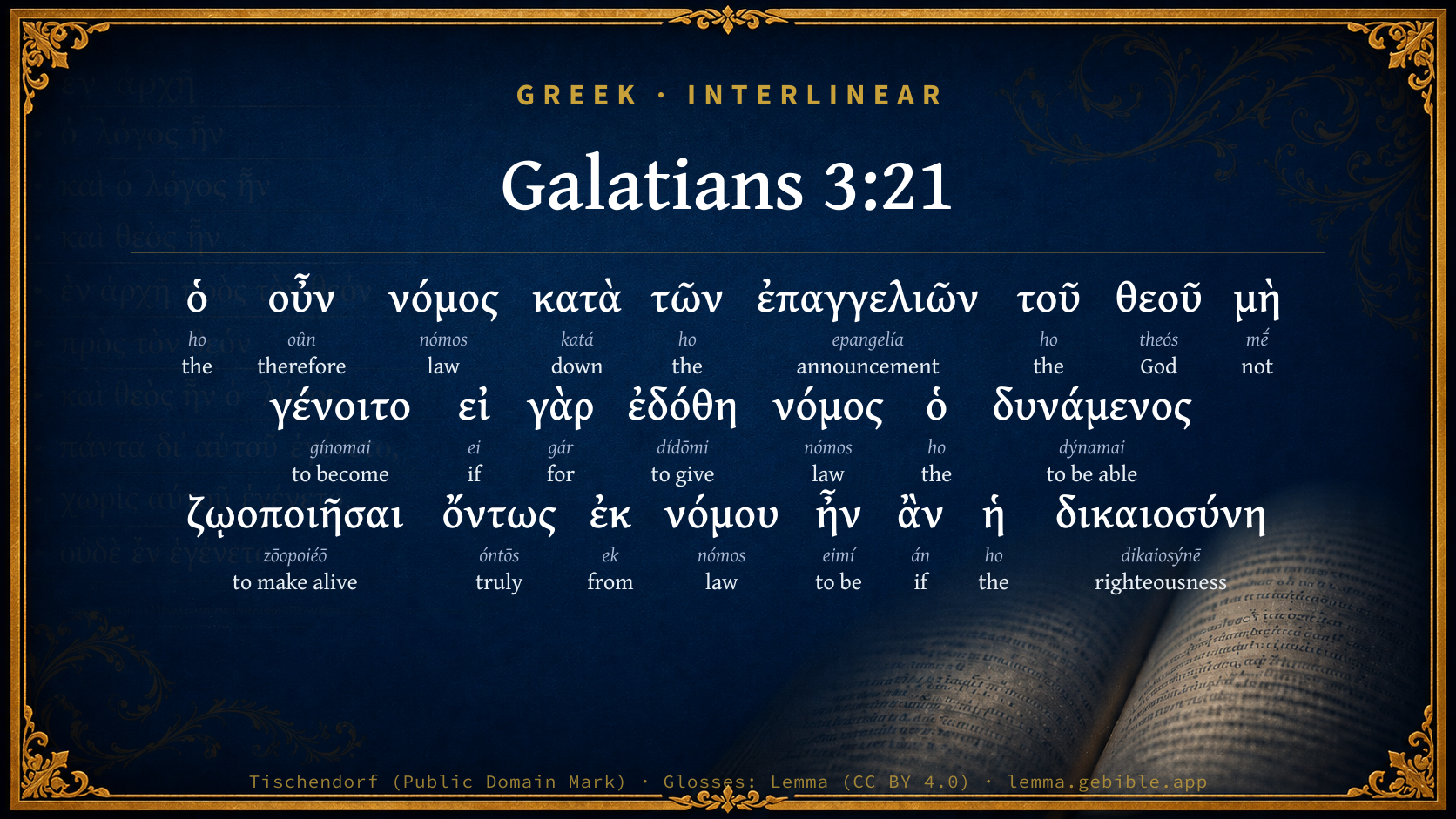
  1. ὁ ho G3588 “the” Article, Nominative, Singular, Masculine
  2. οὖν oûn G3767 “therefore” Conjunction
  3. νόμος nómos G3551 “law” Noun, Nominative, Singular, Masculine
  4. κατὰ katá G2596 “down” Preposition
  5. τῶν ho G3588 “the” Article, Genitive, Plural, Feminine
  6. ἐπαγγελιῶν epangelía G1860 “announcement” Noun, Genitive, Plural, Feminine
  7. τοῦ ho G3588 “the” Article, Genitive, Singular, Masculine
  8. θεοῦ theós G2316 “God” Noun, Genitive, Singular, Masculine
  9. μὴ mḗ G3361 “not” Particle, Negative
  10. γένοιτο gínomai G1096 “to become” Verb, Aorist, Middle deponent, Optative, 3rd person, Singular
  11. εἰ ei G1487 “if” Conditional
  12. γὰρ gár G1063 “for” Conjunction
  13. ἐδόθη dídōmi G1325 “to give” Verb, Aorist, Passive, Indicative, 3rd person, Singular
  14. νόμος nómos G3551 “law” Noun, Nominative, Singular, Masculine
  15. ὁ ho G3588 “the” Article, Nominative, Singular, Masculine
  16. δυνάμενος dýnamai G1410 “to be able” Verb, Present, Middle or Passive deponent, Participle, Nominative, Singular, Masculine
  17. ζῳοποιῆσαι zōopoiéō G2227 “to make alive” Verb, Aorist, Active, Infinitive
  18. ἐκ ek G1537 “from” Preposition
  19. νόμου nómos G3551 “law” Noun, Genitive, Singular, Masculine
  20. ἦν eimí G1510 “to be” Verb, Imperfect, Active, Indicative, 3rd person, Singular
  21. ἂν án G302 “if” Particle
  22. ἡ ho G3588 “the” Article, Nominative, Singular, Feminine
  23. δικαιοσύνη dikaiosýnē G1343 “righteousness” Noun, Nominative, Singular, Feminine

About this verse

These counts appear in no published source. They are computed here, from the morphology-tagged text and Lemma’s own curated glosses. What Lemma adds →

24
words
18
distinct lemmas
Pauline Epistles
section

Notable vocabulary

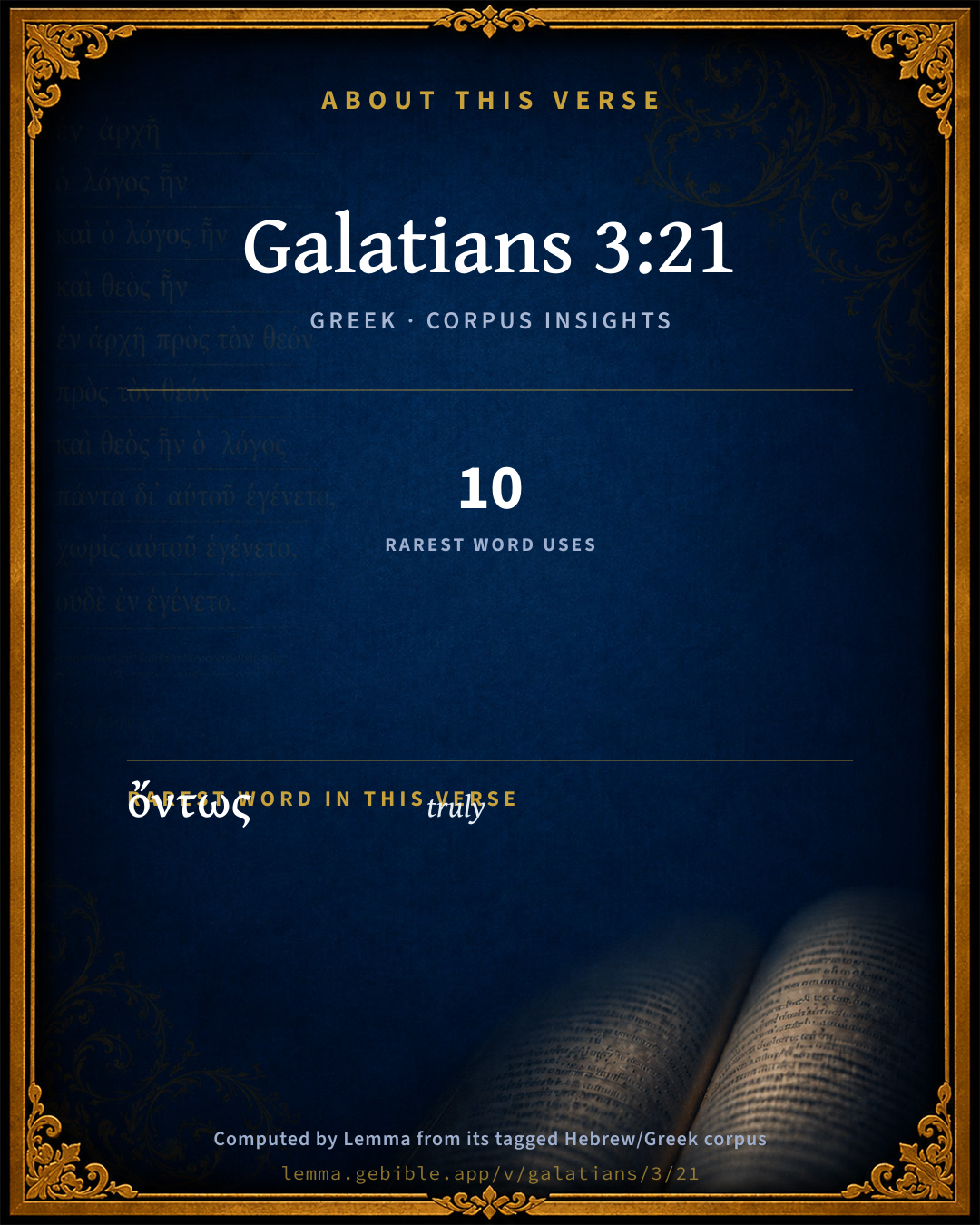
The rarest word here is ὄντως truly G3689 — appearing just 10 times in the whole Greek New Testament.

Shared distinctive vocabulary

ὄντως truly G3689 occurs in 10 verses of the Greek New Testament. Also found in:

Repetition

Words recur within this verse:

Cross-references

13

Topical passages linked to Galatians 3:21 in the Treasury of Scripture Knowledge — connected by theme and wording, ordered by reader-vote popularity; previews shown in the World English Bible.

  • Galatians 2:21 I don't make void the grace of God. For if righteousness is through the law, then Christ died for nothing!"
  • Romans 9:31 but Israel, following after a law of righteousness, didn't arrive at the law of righteousness.
  • Romans 3:20–22 Because by the works of the law, no flesh will be justified in his sight. For through the law comes the knowledge of sin.
  • Galatians 2:19 For I, through the law, died to the law, that I might live to God.
  • Romans 10:3–6 For being ignorant of God's righteousness, and seeking to establish their own righteousness, they didn't subject themselves to the righteousness of God.
  • Romans 3:31 Do we then nullify the law through faith? May it never be! No, we establish the law.
  • Romans 7:7–13 What shall we say then? Is the law sin? May it never be! However, I wouldn't have known sin, except through the law. For I wouldn't have known coveting, unless the law had said, "You shall not covet."
  • Galatians 2:17 But if, while we sought to be justified in Christ, we ourselves also were found sinners, is Christ a servant of sin? Certainly not!
  • Matthew 5:17–20 "Don't think that I came to destroy the law or the prophets. I didn't come to destroy, but to fulfill.
  • Romans 3:4 May it never be! Yes, let God be found true, but every man a liar. As it is written, "That you might be justified in your words, And might prevail when you come into judgment."
  • Romans 3:6 May it never be! For then how will God judge the world?
  • Philippians 3:6–9 concerning zeal, persecuting the assembly; concerning the righteousness which is in the law, found blameless.
  • Hebrews 11:7 By faith, Noah, being warned about things not yet seen, moved with godly fear, prepared an ark for the saving of his house, through which he condemned the world, and became heir of the righteousness which is according to faith.

Cross-references courtesy of OpenBible.info (CC BY 4.0).

Commentary

Notes on Galatians 3:21 from classic Christian and Jewish commentators (each source and its license shown beneath its notes). The classic Christian expositions comment on the surrounding passage and are grouped to its opening verse, so a note may address several verses; the Jewish commentaries on the Tanakh (Rashi and others) are per-verse, so they appear only where the commentator wrote on this verse.

Lemma curates 59 commentaries, every one of them public domain or Creative Commons licensed, each selected and text-cleaned for this edition rather than reprinted as found. About our sources →

The Biblical Illustrator

Joseph S. Exell

Gal_3:21

Is the law, then, against the promises of God?

The harmony between the law and the gospel

I. The gospel gift of righteousness is not made of none effect by the law. Abraham was justified by faith.

1. Which is Gods old covenant.

2. Resting on Gods own promises.

3. And still endures.

II. The law is not made of none effect by the gospel gift of righteousness. The law is--

1. For conviction.

2. Discovers need for righteousness.

3. Leads to righteousness by leading to Christ. (Canon Vernon Hutton.)

If the law had been for the same end as the gospel, for man ruined and sinful to obtain life and salvation by it as well as the gospel, then they might have been supposed to contradict one another; but since they are given for different purposes, they are but different revelations of God which are happily subordinate one to another, and their different ends and designs are both obtained. (I. Watts, D. D.)

The harmony of revelation

There is a mighty growth in the discovery of Gods nature and will, but never a point at which we are brought to a pause by a manifest contradiction of one part with another. In reading the Bible we always look on the same landscape, the only difference being that as we take in more of its statements, more and more of the mist is rolled away from the horizon, so that the eye can behold a wider sweep of its beauty. There is a vast difference between the New Testament and the Old, but it is the difference between two parts of one whole. It is no new landscape which opens on our gaze, as the town and the forest come out from the shadow, and fill up the blanks in the glorious panorama; it is no new planet which comes travelling in its majesty, as the crescent deepens into the circle, and the line of faint light gives place to the rich globe of silver; and it is no fresh religion which is made known as the brief notices given to patriarchs expand into the institutions of the law, under the teachings of prophecy, till at length in the days of Christ and His apostles they burst into magnificence, and fill a world with redemption. It is throughout the same system, and revelation has been only the gradual development of this system--the drawing up of another fold of the veil from the landscape, the adding of another stripe of light to the crescent; so that the fathers of our race, and ourselves, look on the same arrangements for human deliverance, though to them there was nothing but cloudy expanse, with here and there a prominent landmark, whilst to us, though the horizon loses itself in the far-off eternity, every object of personal interest is exhibited in beauty and distinctness. (H. Melvill, B. D.)

The importance of the law

Law, as law, can do nothing but enjoin the right, and then, justify on perfect obedience, or condemn on proved violation. A sinful man, hearing the law and nothing else, or hearing it more distinctly, and with more corroborating consciousness, than the provision for relief is perceived in its intention or experienced in fact, can only despair and die. Strength withers with the extinction of hope; effort is vain when performance is impossible (see Rom_8:3-4). The law was weak because corruption was strong; and corruption strong because the sense of guilt could not be removed. In proportion, in fact, to its anxiety to realize the ideal of virtue, and its spiritual insight into the inefficacy of ritual observances, humanity, while under the law, was disheartened and bewildered, and was thus made to long for deliverance and life. Sometimes it felt goaded and exasperated, and became desperate and reckless from the feeling of its helplessness (Rom_7:5). The gospel brings hope to the despairing and life to the dead, by its ample arrangements for both pardon and strength; by its atoning sacrifice and sanctifying spirit. Obedience becomes possible because it may be of another sort, and is to be presented for a different object. It is acceptable to God as the result of what He has done, not as a ground of what He is to do. The impulses and instincts of the Divine nature of which the saved are partakers, make duty a necessity, labour a delight, obedience a spontaneous service, conformity to the law a privilege and a joy. (T. Blarney, D. D.)

The law useful

No doubt the Jaw restrains us; but all chains are not fetters, nor are all walls the gloomy precincts of a gaol. It is a blessed chain by which the ship, now buried in the trough, and now rising on the top of the sea, rides at anchor, and outlives the storm. The condemned would give worlds to break his chain, but the sailor trembles lest his should snap; and when the grey morning breaks on the wild lee shore, all strewn with wrecks and corpses, he blesses God for the good iron that stood the strain. The pale captive eyes his high prison wall, to curse the man who built it, and envies the little bird that, perched upon its summit, sings merrily, and flies away on wings of freedom; but were you travelling some Alpine pass, where the narrow road, cut out of the face of the rock, hung over a frightful gorge, it is with other eyes you would look on the wall that restrains your restive steed from backing into the gulf below. Such are the restraints Gods law imposes--no other. It is a fence from evil--nothing else. I challenge the world to put its finger on any one of these Ten Commandments which is not meant and calculated to keep us from harming ourselves or hurting others. (Dr. Guthrie.)

Contrasts

Up to this point the apostle has contrasted the promise made to Abraham, the fulfilment of which was in the gospel, with the law of Moses in these particulars:--

1. The promise was made first four hundred and thirty years before the giving of the law on Sinai, and that which is given afterwards cannot weaken the older covenant.

2. The covenant of promise was one of blessing to mankind, the law regarded transgressions.

3. The promise is absolute and without limitation of time; the blessing will be for ever, the law is given until the coming of the Messiah.

4. The promise was made by God Himself, without the intervention of others. The law was ordained by the ministry of angels.

5. The promise was made without any mediator, the law was given to the people by the hands of Moses. The law here spoken of by the apostle is the ceremonial law; not that of the Decalogue; not the moral law, which was reimposed, but not for the first time given at Sinai. (W. Denton, M. A.)

The Biblical Illustrator, edited by Joseph S. Exell (c. 1880s–1900s) — public domain. Text from a community e-Sword module.

Joseph Benson's Commentary

Gal 3:21-22. Is the law then — Which requires perfect obedience, and subjects all that in any respect violate it, to the curse, against, or contrary to, the promises of God — Wherein he declares that he will justify men by faith? God forbid — That we should intimate any thing of that kind! On the contrary, it was intended to be subservient to the promise, by leading those who were under it to a higher and better dispensation, by subjecting them to the curse, without giving them the least hope of mercy, to oblige them to flee to the promises for justification. For if there had been a law given which could have given life — Either spiritual or eternal; if any law, considered in itself alone, could have been a sufficient mean of justification and eternal happiness, then verily righteousness — Justification, and the blessings consequent thereon; would have been by the Mosaic law — Which is so holy, just, and good in all its moral precepts. By this the apostle shows that the law of Moses was utterly incapable of giving the Jews life and salvation; because, considered in itself, independent of the covenant of grace, it neither promised them the pardon of sin on their repentance, nor the influences of the divine Spirit to enable them to overcome and mortify the corruption of their nature; and of consequence, neither gave them a title to, nor a meetness for, eternal life. Justification, therefore, was not to be obtained by that law. On the contrary, the Scripture — Wherein that law is written; hath concluded all under sin — Hath shut them up together, (so the word συνεκλεισεν properly signifies,) as in a prison, under sentence of death; that is, hath declared them all to be so shut up; that the promise — That is, the blessing of life and salvation, promised through faith in Jesus Christ, might be freely given to them that truly believe in him, and in the truths and promises of his gospel.

Joseph Benson's Commentary on the Old and New Testaments (1811–1818) — public domain. Text from a community e-Sword module.

The Preacher's Complete Homiletical Commentary

Joseph S. Exell (gen. ed.)

CRITICAL AND EXPLANATORY NOTES

Gal_3:22. The Scripture hath concluded all under sin.—The written letter was needed so as permanently to convict man of disobedience to God’s command. He is shut up under condemnation as in a prison.

Gal_3:24. The law was our schoolmaster to bring us unto Christ.—As a tutor, checking our sinful propensities, making the consciousness of the sinful principle more vivid, and showing the need of forgiveness and freedom from the bondage of sin.

MAIN HOMILETICS OF THE PARAGRAPH.—Gal_3:21-25

The True Use of the Law—

I. Was not intended to bestow spiritual life.—“If there had been a law given which could have given life, verily righteousness should have been by the law” (Gal_3:21). The law was not against the promises. It was a divine method in dealing with man, and one divine method never conflicts with another. It was intended to mediate between the promise and its fulfilment. It is not the enemy but the minister of grace. It did not profess to bestow spiritual life; but in its sacrifices and oblations pointed to the coming Christ who is “the end of the law for righteousness to every one that believeth” (Rom_10:4).

II. Was to reveal the universal domination of sin.—“The Scripture hath concluded all under sin” (Gal_3:22). The Bible from the beginning and throughout its course, in its unvarying teaching, makes the world one vast prison-house, with the law for gaoler, and mankind held fast in chains of sin, condemned, and waiting for the punishment of death. Its perpetual refrain is, “All have sinned and come short of the glory of God.” Its impeachment covers the whole realm of human life, thought, and desire. “Every human life,” says Martensen, “that has not yet become a partaker of redemption is a life under the law, in opposition to the life under grace. The law hovers over his life as an unfulfilled requirement; and, in the depth of his own being, remains as an indismissible but unsatisfied and unexpiated claim on him, which characterises such a human existence as sinful and guilt-laden.”

III. Was to teach the absolute necessity of faith in order to escape its condemnation.—“But before faith came, we were kept under the law, shut up unto the faith which should afterwards be revealed” (Gal_3:23). The law was all the while standing guard over its subjects, watching and checking every attempt to escape, but intending to hand them over in due time to the charge of faith. The law posts its ordinances, like so many sentinels, round the prisoner’s cell. The cordon is complete. He tries again and again to break out; the iron circle will not yield. But deliverance will yet be his. The day of faith approaches. It dawned long ago in Abraham’s promise. Even now its light shines into his dungeon, and he hears the word of Jesus, “Thy sins are forgiven thee; go in peace.” Law, the stern gaoler, has after all been a good friend if it has reserved him for this. It prevents the sinner escaping to a futile and illusive freedom (Findlay).

IV. Was to act as a moral tutor to train us to the maturity and higher freedom of a personal faith in Christ.—“Wherefore the law was our schoolmaster to bring us unto Christ,” etc. (Gal_3:24-25). The schoolmaster, or pedagogue, among the Greeks meant a faithful servant entrusted with the care of the boy from childhood, to keep him from evil, physical and moral, and accompany him to his amusements and studies. “If then the law is a pedagogue,” says Chrysostom, “it is not hostile to grace, but its fellow-worker; but should it continue to hold us fast when grace has come, then it would be hostile.” Judaism was an education for Christianity. It trained the childhood of the race. It humbled and distressed the soul with the consciousness of sin. It revealed the utter inadequacy of all its provisions to justify. It brought the despairing soul to Christ, and showed that the true way to righteousness was by personal faith in Him.

Lessons.—

1. Law is the revealer of sin.

2. Law demands universal righteousness.

3. Law is a training for faith.

GERM NOTES ON THE VERSES

Gal_3:21-22. The Law not contrary to the Divine Promise.—

1. It is the way of some to make one Scripture contradict another, yet their bold allegations will be found always false, and truth to be ever most consonant and never contrary to itself.

2. So exact and full is the righteousness required in order to life, and so far short do all mankind come of it, that no works of our own, done in obedience to the law, can amount to that righteousness.

3. Though all men by nature be under sin, it is a matter of no small difficulty to convince any man of it. The work of the law, accusing, convincing, or condemning the sinner, is compared to the work of a judge detaining a malefactor in prison which is not effectuated but with force and violence.

4. The law by its threatenings prepares and necessitates the soul to embrace salvation by faith in the Christ revealed in the promise.—Fergusson.

Gal_3:22. The Great Prison; or, All concluded under Sin.—

1. Satan does indeed draw and drive men into sin—this is the accursed work of his restless, sabbathless life; and when he has got them there he binds them fast, and will not let them flee from his toils. He builds a high wall of sin all round them so that they shall not look over it into the goodly land beyond, and here he shuts them up together, sinner with sinner, a never-ending ghastly multitude, that they may encourage and pamper each other in wickedness, and that no example, no voice of holiness, may ever reach and startle them. But God never drove, never drew, any man into sin. He is calling us to come out from the deadly land, from the loathsome, plague-breathing dungeon. So when the Scripture concludes, or shuts all men up together under sin, it is not by driving them into sin, but for the sake of calling them out of it.

2. With all the light of the Scriptures shining around us, with the law of God ever sounding in our ears, and the life of Christ set continually before us, how prone are we to forget our sinfulness, to turn away from the thought of it, to fancy we are as good as we need be, and that, though we might certainly be better, yet it does not matter much! How apt are we still to forget that we are concluded under sin, to forget that we are shut up in a prison! Although the souls of so many millions are lying around us, bloated with the poison of sin, how tardily do we acknowledge that the poison by which they perished must also be deadly to us!

3. Suppose you were to be carried before an earthly court of justice, and that one sweeping accusation were to be brought against you; suppose you were found guilty, and the excuse you set up were the complete proof of your guilt,—what would follow? The judge would straightway pass sentence upon you, and you would be condemned to suffer punishment according to the measure of your offence. And must we not expect that the course of things should be the very same when you are carried before a heavenly court of justice?

4. When a man’s eyes are opened to see the prison in which he is shut up, to see and feel the chains that are fast bound round his soul and have eaten into it; when he has learnt to see and know that the pleasures, whatever they may be, of sin are only, like the flesh-pots of Egypt, intoxicating drugs, given to him to deprive him of all sense of his captivity,—then will he long for a deliverer, rejoice on hearing of his approach, hail him when he comes in view, and follow him whithersoever he may lead. As unbelief is the one great universal sin, in which all mankind are concluded, as it is only from having let slip our faith in God that we have yielded our hearts to the temptations of the world and given ourselves up to its idolatries, so it is only through faith that we can be brought back to God—that we can receive the promise given to those who believe.—J. C. Hare.

Gal_3:23. “Shut up unto the faith.” The Reasonableness of Faith.—The mode of conception is military. The law is made to act the part of a sentry, guarding every avenue but one, and that one leads those, who are compelled to take it, to the faith of the gospel. Out of the leading varieties of taste and sentiment which obtain in the present age we may collect something which may be turned into an instrument of conviction for reclaiming men from their delusions and shutting them up to the faith.

I. There is the school of natural religion.—It is founded on the competency of the human mind to know God by the exercise of its own faculties, to clothe Him in the attributes of its own demonstration, to serve Him by a worship and a law of its own discovery, and to assign to Him a mode of procedure in the administration of this vast universe upon the strength and plausibility of its own theories. They recognise the judicial government of God over moral and accountable creatures. They hold there is a law. One step more, and they are fairly shut up to the faith. That law has been violated.

II. There is the school of classical morality.—It differs from the former school in one leading particular. It does not carry in its speculations so distinct and positive a reference to the Supreme Being. Our duties to God are viewed as a species of moral accomplishment, the effect of which is to exalt and embellish the individual. We ask them to look at man as he is, and compare him with man as they would have him to be. If they find that he falls miserably short of their ideal standard of excellence, what is this but making a principle of their own the instrument of shutting them up unto the faith of the gospel, or at least shutting them up unto one of the most peculiar of its doctrines, the depravity of our nature, or the dismal ravage which the power of sin has made upon the moral constitution of the species? This depravity the gospel proposes to do away.

III. There is the school of fine feeling and poetical sentiment.—It differs from the school of morality in this—the one makes virtue its idol because of its rectitude, the other makes virtue its idol because of its beauty, and the process of reasoning by which they are shut up unto the faith is the same in both. However much we may love perfection and aspire after it, yet there is some want, some disease, in the constitution of man which prevents his attainment of it, that there is a feebleness of principle about him, that the energy of his practice does not correspond to the fair promises of his fancy, and however much he may delight in an ideal scene of virtue and moral excellence, there is some lurking malignity in his constitution which, without the operation of that mighty power revealed to us in the gospel, makes it vain to wish and hopeless to aspire after it.—Dr. Thomas Chalmers.

Gal_3:24-25. The Law our Schoolmaster.—There was a time when God put His world under a schoolmaster; then it would have been preposterous to apply faith. There is a time when a larger spirit has come, and then it would be going back to use law.

I. The uses of restraint in the heart’s education.—

1. The first use of law is to restrain from open violence. It is necessary for those who feel the inclination to evil, and so long as the inclination remains so far must a man be under law. Imagine a governor amidst a population of convicts trusting to high principle. Imagine a parent having no fixed hours, no law in his household, no punishment for evil. There is a morbid feeling against punishment; but it is God’s method.

2. The second use of restraint is to show the inward force of evil.—A steam-engine at work in a manufactory is so quiet and gentle that a child might put it back. But interpose a bar of iron many inches thick, and it cuts through as if it were so much leather. Introduce a human limb—it whirls round, and the form of man is in one moment a bleeding, mangled, shapeless mass. It is restraint that manifests this unsuspected power. In the same way law discovers the strength of evil in our hearts.

3. The third use is to form habits of obedience.—In that profession which is Specially one of obedience—the military profession—you cannot mistake the imparted type of character. Immediate, prompt obedience, no questioning “why?” Hence comes their decision of character. Hence, too, their happiness. Would you have your child happy, decided, manly? Teach him to obey. It is an error to teach a child to act on reason, or to expect reasons why a command is given. Better it is that he should obey a mistaken order than be taught to see that it is mistaken. A parent must be master in his own house.

4. The fourth use is to form habits of faith.—As Judaism was a system calculated to nurture habits of obedience, so was it one which nourished the temper of faith. All education begins with faith. The child does not know the use of the alphabet, but he trusts. The boy beginning mathematics takes on trust what he sees no use in. The child has to take parental wisdom for granted. Happy the child that goes on believing that nothing is wiser, better, greater, than his father! Blessed spirit of confiding trust which is to be transferred to God.

II. The time when restraint may be laid aside.—

1. When self-command is obtained. Some of us surely there are who have got beyond childish meanness: we could not be mean; restraint is no longer needed; we are beyond the schoolmaster. Some of us there are who have no inclination to intemperance; childish excess in eating and drinking exists no longer. Some of us there are who no longer love indolence. We have advanced beyond it. The law may be taken away, for we are free from law. True Christian liberty is this—self-command, to have been brought to Christ, to do right and love right, without a law of compulsion to school into doing it.

2. When the state of justification by faith has been attained.—There are two states of justification—by the law and by faith. Justification by the law implies a scrupulous and accurate performance of minute acts of obedience in every particular; justification by faith is acceptance with God, not because a man is perfect, but because he does all in a trusting, large, generous spirit, actuated by a desire to please God. In Christianity there are few or no definite laws—all men are left to themselves.

3. Restraint must be laid aside when the time of faith has come, whether faith itself have come or not.—It is so in academical education. We may have attained the full intellectual comprehension of the gospel, but religious goodness has not kept pace with it, and the man wakes to conviction that the gospel is a name and the powers of the world to come are not in him. You cannot put him to school again. Fear will not produce goodness. Forms will not give reverence. System will not confer freedom. Therefore the work of childhood and youth must be done while we are young, when the education is not too late.—F. W. Robertson.

Gal_3:24. The Law preparing for Christ.

I. The law led men to Christ by foreshadowing Him.—This was true of the ceremonial part of it. The ceremonies meant more than the general duty of offering to God praise and sacrifice, since this might have been secured by much simpler rites. What was the meaning of the solemn and touching observance of the Jewish day of atonement? We know that what passed in that old earthly sanctuary was from first to last a shadow of the majestic self-oblation of the true High Priest of Christendom, Jesus Christ our Lord and Saviour. Each ceremony was felt to have some meaning beyond the time then present, and so it fostered an expectant habit of mind; and as the ages passed these expectations thus created converged more and more towards a coming Messiah, and in a subordinate but real way the ceremonial law did its part in leading the nation to the school of Christ.

II. By creating in man’s conscience a sense of want which Christ alone could relieve.—This was the work of the moral law, of every moral precept in the books of Moses, but especially of those most sacred and authoritative precepts which we know as the ten commandments. So far from furnishing man with a real righteousness, so far from making him such as he should be, correspondent to the true ideal of his nature, the law only inflicted on every conscience that was not fatally benumbed a depressing and overwhelming conviction that righteousness, at least in the way of legal obedience, was a thing impossible. And this conviction of itself prepared men for a righteousness which should be not the product of human efforts, but a gift from heaven—a righteousness to be attained by the adhesion of faith to the perfect moral Being, Jesus Christ, so that the believer’s life becomes incorporate with His.

III. By putting men under a discipline which trained them for Christ.—What is the divine plan for training, whether men or nations? Is it not this—to begin with rule and to end with principle, to begin with law and to end with faith, to begin with Moses and to end with Christ? God began with rule. He gave the Mosaic law, and the moral parts of that law being also laws of God’s own essential nature could not possibly be abrogated; but as rules of life the ten commandments were only a preparation for something beyond them. In the Christian revelation God says, “Believe on the Lord Jesus Christ.” When you have done this, and He on His part has by His Spirit infused into you His divine life so that you are one with Him, you will not depend any longer mainly upon rules of conduct. Justification by faith is so far from being moral anarchy that it is the absorption of rule into the higher life of principle. In the experience of the soul faith corresponds to the empire of principle in the growth of individual character and in the development of national life, while the law answers to that elementary stage in which outward rules are not yet absorbed into principle.—H. P. Liddon.

The Law a Schoolmaster.

I. The Jewish religion brought men to Christ by the light, the constraining force, of prophecy.—First a human deliverance of some kind, then a personal Saviour, is announced. He was exactly what prophecy had foretold. He Himself appealed to prophecy as warranting His claims.

II. By that ceremonial law which formed so important a part of it.—The Jewish ceremonial pointed to Christ and His redemptive work from first to last. The epistle to the Hebrews was written to show this—that the ceremonial law was far from being a final and complete rule of life and worship, did but prefigure blessings that were to follow it, that it was a tutor to lead men to the school of Christ.

III. By creating a sense of moral need that Christ alone could satisfy.—The moral law—God’s essential, indestructible moral nature in its relation to human life, thrown for practical purposes into the form of commandments—is essentially, necessarily beyond criticism; but when given to sinful man it does, but without grace, discover a want which it cannot satisfy. It enhanced the acting sense of unpardoned sin before a holy God. It convinced man of his moral weakness, as well as of his guilt, of his inability without the strengthening grace of Christ ever to obey it.

Lessons.—

1. We see a test of all religious privileges or gifts: Do they or do they not lead souls to Christ?

2. Observe the religious use of all law—to teach man to know his weakness and to throw himself on a higher power for pardon and strength.

3. We see the exceeding preciousness of Christ’s gospel—the matchless value of that faith which lives in the heart of the Church of God.—H. P. Liddon.

The Progress of Revelation.

I. The law was our schoolmaster as giving precepts in which principles were involved but not expressly taught.

II. As teaching inadequate and not perfect duties—a part instead of the whole, which was to develop into the whole. Examples—the institution of the Temple worship; the observance of the Sabbath; the third commandment.

Lessons.—

1. Revelation is education.

2. Revelation is progressive.

3. The training of the character in God’s revelation has always preceded the illumination of the intellect.—F. W. Robertson.

The Preacher's Complete Homiletical Commentary (gen. ed. Joseph S. Exell; Funk & Wagnalls, c. 1892) — public domain (pre-1929). A full-Bible homiletical/sermon-outline anthology covering 65 of 66 books (2 John is absent from the source module). Text from a community e-Sword module.

Tyndale Open Study Notes

Tyndale Open Resources

3:21-25 See Rom 7:7-13.

3:21 No conflict of purpose exists between law and promise, or between law and faith. Law partners with the promise in bringing people to faith in Christ. Law has its proper roles of declaring people prisoners of sin (3:19, 22) and of restraining sin (3:23-25). In Galatia, the Judaizers tried to convince Gentile Christians that the law could do something it was never intended to do—give . . . new life and make people right with God. God does these things on the basis of faith in his promise, which was fulfilled in Jesus Christ (see 3:22).

Tyndale Open Study Notes — © Tyndale Open Resources, licensed CC BY-SA 4.0. Text via the HelloAO Bible API.

Bengel's Gnomon

Johann Albrecht Bengel

Gal 3:21. Οὖν, then) This objection may be taken from the circumstance, that the law is said to have been given because of transgressions. The answer is, that the law is not against the promises, and in regard to the answer two considerations are presented: The one is, the law in itself, though it were willing, cannot give the life that has been promised, Gal 3:21; the other is, nevertheless, as a schoolmaster, it assisted the promise of life; Gal 3:22 to Gal 4:7. The first consideration is proved by this Enthymeme[29] (of the same sort as at Gal 3:18): If the law could give you life, righteousness would be by the law; but righteousness is not by the law; supply [the conclusion], therefore the law cannot give life. The major proposition is evident, for only the just shall live, Gal 3:11. The minor proposition, and at the same time the second consideration itself, is proved by Gal 3:22: and that too by Epanodus;[30] for of these four terms, to give life, righteousness, sin, promise, the first and fourth, the second and third, have respect to each other.—νόμος, the law) It is called the law, not the law of God: but we say, the promises of God, not, the promises absolutely.—εἰ γὰρ, for if) The conditional force does not fall upon was given, for the law was certainly given, but upon was able (could have).—ὁ δυνάμενος, that was able) The article shows that the emphasis is on δύναμαι. The law would wish [to give life], Gal 3:12, for it says, he shall live, but it is not able.—ζωοποιῆσαι, to give life) In this expression death is taken for granted as threatened [by the law] against the sinner, and therefore the language becomes very distinct. The law offers life conditionally, Gal 3:12; but does not confer it, because it cannot, being deprived of all power to do so by sin.—ὄντως, verily) not merely in the opinion of those maintaining justification by works. The matter in hand [justification] is a serious one [the question at issue is a serious reality], although it be now beyond the power of the law.—ἡ δικαιοσύνη, righteousness) For righteousness is the foundation of life. The antithesis is sin, Gal 3:22.

[29] See Append. A covert syllogism, where one or other premiss is understood. Here it is the oratorical Enthymeme, where an argument is confirmed from its contrary: If the law could, etc., which it could not, etc.—ED.

[30] See App. It is the repetition of the same words, either as to sound or sense, in an inverted order.

Bengel's Gnomon of the New Testament — English translation (T&T Clark, Edinburgh, 1860) — public domain. Text from a community e-Sword module.

Meyer's Critical & Exegetical Commentary

Heinrich August Wilhelm Meyer

Gal_3:21. ὁ οὖν νόμος κατὰ τῶν ἐπαγγελιῶν;] οὖν, the reference of which is differently explained according to the different interpretations of Gal_3:20, draws an inference, not from the definition of the object of the law in Gal_3:19 (Castalio, Luther, Gomarus, Pareus, Estius, Bengel, and others, including Lücke, Olshausen, de Wette, Wieseler, Hofmann, Stölting), but from Gal_3:20, which is not arbitrarily to be set aside, or to be treated merely as an appendage of Gal_3:19.[163] The law, namely, which was given through a mediator, and therefore essentially otherwise than the promise, might thereby appear to introduce on the part of God another way of granting the Messianic salvation than the promises, and consequently to be opposed to the latter. See the fuller statement at Gal_3:20.

κατὰ τῶν ἐπαγγελιῶν] See Gal_3:8; Gal_3:16. The ΚΑΤΆ is the usual contra, in opposition, to. Matthias incorrectly explains it: Is it included under the idea of the promises? Since the simple ἐστίand not, possibly, ΤΆΣΣΕΤΑΙ (see Lobeck, Phryn. p. 272)is to be supplied, the expression would be wholly without the sanction of usage. Moreover, looking to the specific difference in the ideas of the two things, Paul could not have asked such a question at all.

εἰ γὰρ ἐδόθη νόμος κ.τ.λ.] ground assigned for the ΜῊ ΓΈΝΟΙΤΟ, and therefore proof that it would be incorrect to conclude from Gal_3:20 that the law was opposed to the promises. For if it had been opposed to the promises, the law must have been in a position to procure life;[164] and if this were so, then would righteousness actually be from the law,[165] which, according to the Scriptures, cannot be the case (Gal_3:22).

νόμος] just as in the whole context: the Mosaic law, although without the article, as in ii. 21, iii. 11, 18; Winer, p. 117 [E. T. 152].

ὁ δυνάμ. ζωοπ.] The article marks off the definite quality which, in the words εἰ γὰρ ἐδόθη νόμος, is conceived by the lawgiver as belonging to the law (Winer, p. 127 [E. T. 167]; Kühner, ad Xen. Mem. ii. 7, 13): as that which is able to give life; and this is the point of this conditional sentence.

ζωοποιῆσαι] Hoc verbo praesupponitur mors peccatori intentata, Bengel. The ζωή, however, which the law is not able to furnish, is not the being alive morally (Winer, Rückert, Matthies, Olshausen, Ewald, Wieseler, Hauck, Hofmann, Buhl, and others, following older expositors), but, in harmony with the context, the everlasting Messianic life (see Käuffer, de bibl. ζωῆς αἰωνίου notione, p. 75), as is evident from Gal_3:18 (εἰ γὰρ ἐκ νόμου ἡ κληρονομία) and from Gal_3:22. Comp. also 2Co_3:6. The moral quickening is presupposed in this ζωοποιῆσαι. The law, in itself good and holy, could not subdue the dominion of the principle of sin in man (Rom_8:3), but rather necessarily served to promote this dominion (see on Gal_3:19), and was therefore unable to bring about the eternal life which was dependent on obedience to the law (Gal_3:12): given unto life, it was found unto death, Rom_7:10. Paul never uses ζωοποιεῖν of the moral quickening, nor συζωοποιεῖν either (Eph_2:5; Col_2:13). The ζεή is the eternal life which is manifested at the Parousia (Col_3:3 f.), and therefore in reality the κληρονομία (Gal_3:18; Gal_3:29). Comp. ζήσεται, Gal_3:12, to which our ζωοπ. glances back.

ὄντως ἐκ νόμου ἂν ἦν ἡ δικαιοσύνη] then in reality (not merely in Jewish imagination) the law would be that, from which the existence of righteousness would proceed, namely, by its enabling men to offer complete obedience. The argument proceeds ab effectu (ζωοποιῆσαι) ad causam (ἡ δικαιοσύνη), for, without being righteous before God, man cannot attain eternal life: not as Rückert, Wieseler, Hofmann, and others, in accordance with their view of ζωοπ., are compelled to assume, a causa (the new moral life whereby the law is fulfilled) ad effectum (the δικαιοσύνη which would be acquired by the fulfilment of the law). The relation between ζωοποιῆσαι and ἡ δικαιοσύνη is aptly indicated by Oecumenius: οὐκ ἔσωσεν οὐδὲ ἐδικαίωσεν, and by Bengel: Justitia est vitae fundamentum.

[163] Also in 1Co_6:15, οὖν (in opposition to Stöltings appeal to the passage) introduces a possible (mischievous) inference from what immediately precedes, to be at once repelled with horror by μὴ γένοιτο.

[164] This consequence depends upon the dilemma: Life may be procured either through the promises or through the law. If, therefore, the law stands in opposition to the promises, so that the latter shall no longer be valid, the law must be able to procure life. This dilemma is correct, because no third possibility is given in the divine plan of salvation.

[165] Even if ἄν be not genuine, this interpretation is not altered (Buttmann, neut. Gr. p. 194, 6); and we cannot explain (with Hofmann): If there was given, etc., then was, etc. This imperfect (erat) would be illogical; Paul would have written ἐστίν or γέγονεν.

Meyer — Critical and Exegetical Commentary on the New Testament — English translation by Peter Christie, edited by Frederick Crombie (T&T Clark, 1880) — public domain. Text from a community e-Sword module.

Expositor's Greek Testament

ed. W. Robertson Nicoll

Gal 3:21 . In view of the continuity of divine providence the suggestion that the Law contravened or nullified the previous covenant of God with Abraham and the patriarchs is dismissed as monstrous. It was incompatible with the faithfulness of God to His pledged word, and is therefore repudiated with the customary formula μὴ γένοιτο . The apparent sanction given by the Law to a new method of justification ( viz. , by works) could lead to no actual result, unless it had at the same time possessed the power which it lacked of quickening spiritual life. τοῦ Θεοῦ . These words are omitted in some MSS., but the preponderance of authority is in favour of their retention. The sense is the same whether they be expressed or understood. The addition may perhaps be due to a marginal comment which found its way into the text.

The Expositor's Greek Testament, edited by W. Robertson Nicoll (1897–1910) — public domain. Text from a community e-Sword module.

Geneva Bible (1599)

Geneva Bible translators

The conclusion uttered by a manner of asking a question, and it is the same that was uttered before, verse 17, but proceeding of another rule: so that the argument is new, and is this: God is always like unto himself: Therefore the Law was not given to abolish the promises. But it should abolish them if it gave life, for by that means it should justify, and therefore it should abolish that justification which was promised to Abraham and to his seed by faith. Nay it was rather given to bring to light the guiltiness of all men, to the end that all believers fleeing to Christ promised, might be freely justified in him.

Geneva Bible (1599) marginal notes — public domain. Text via Bolls.life.

Jamieson, Fausset & Brown

Robert Jamieson, A. R. Fausset & David Brown

"Is the law (which involves a mediator) against the promises of God (which are without a mediator, and rest on God alone and immediately)? God forbid."

life--The law, as an externally prescribed rule, can never internally impart spiritual life to men naturally dead in sin, and change the disposition. If the law had been a law capable of giving life, "verily (in very reality, and not in the mere fancy of legalists) righteousness would have been by the law (for where life is, there righteousness, its condition, must also be)." But the law does not pretend to give life, and therefore not righteousness; so there is no opposition between the law and the promise. Righteousness can only come through the promise to Abraham, and through its fulfilment in the Gospel of grace.

Jamieson, Fausset & Brown — Commentary Critical and Explanatory on the Whole Bible (1871) — public domain (CC PDM 1.0). Text via the HelloAO Bible API.

Adam Clarke's Commentary

Verse 21. Is the law then against the promises of God?] Is it possible that the intervention of the law, in reference to one part of the Abrahamic seed, should annul the promise made to the other? It is impossible.

For if there had been a law, &c.] If any law or rule of life could have been found out that would have given life-saved sinners from death, and made them truly happy, then righteousness- justification, should have been by that law.

Adam Clarke's Commentary on the Bible (1810–1826) — public domain. Text from a community e-Sword/MySword module.

John Calvin's Commentaries

21. Is the law then against the promises of God? The certainty and steadiness of the divine purpose being admitted, we are bound equally to conclude that its results are not contrary to each other. Still there was a difficulty to be resolved, arising from the apparent contradiction between the Law and the covenant of grace. This is, perhaps, an exclamation. Dreading no farther contradiction, now that the point is settled, Paul concludes, that the former arguments have placed it beyond a doubt, and exclaims: “Who will now dare to imagine a disagreement between the law and the promises?” And yet this does not prevent Paul from proceeding to remove the difficulties that might still arise.

Before answering the question, he expresses, in his usual manner, a high disdain of such folly; thus intimating the strong abhorrence with which pious men must regard whatever brings reproach on the Divine character. But another instance of high address, which claims our notice, is found in this turn of expression. He charges his adversaries with the offense of making God contradict himself. For from him the Law and the promises have evidently proceeded: whoever then alleges any contradiction between them blasphemes against God: but they do contradict each other, if the Law justifies. Thus does Paul most dexterously retort upon his adversaries the charge which they falsely and calumniously brought against him.

For if there had been a law given. The reply is (what is called) indirect, and does not plainly assert an agreement between the law and the promises, but contains all that is necessary to remove the contradiction. At first sight, you would say that this sentence departs from the context, and has nothing to do with the solution of the question; but this is not the case. The law would be opposed to the promises, if it had the power of justifying; for there would be two opposite methods of justifying a man, two separate roads towards the attainment of righteousness. But Paul refuses to the law such a power; so that the contradiction is removed. I would admit, says he, that righteousness is obtained by the law, if salvation were found in it. But what?

John Calvin's Commentaries (1540-1563) — public domain. Text from the Calvin Translation Society English edition (1840s-50s) via the Christian Classics Ethereal Library (ccel.org). Calvin's coverage is partial (roughly two-thirds of the Bible); uncommented books and verses are honest gaps, never fabricated. The 19th-century editor's footnotes and remarks are omitted so the notes are faithfully Calvin's own voice.

Ellicott's Commentary for English Readers

(21) The promises.—Here, as in Gal_3:16, the plural, because the promise to Abraham was several times repeated, and afterwards ratified to his descendants.

For if . . .—The argument which follows begins with a concession. Though the Law was no substitute for the promise, it yet directly led up to it.

Given life.—This is practically equivalent to “justified,” or “made righteous.” He who is justified has life—both true spiritual life in the present and eternal life in the future. That the Law could not justify had been shown in Gal_3:11 and in Rom_3:20.

(21-24) If the Law was thus inferior to the promise, does it therefore follow that it is contrary to it? By no means. The Law could not indeed give life; it could not justify, or place in a state of righteousness. Its real result was rather to place all men in a state of sin. But by so doing it prepared the way for the fulfilment of the promise in all who put faith in Christ. The Law was a close and strict, yet salutary, discipline to make us fit for faith in Christ.

A Bible Commentary for English Readers, edited by Charles John Ellicott (1878–1897) — public domain. Text from a community e-Sword module.

The Cambridge Bible for Schools and Colleges

gen. ed. J. J. S. Perowne

21. Having thus sharply contrasted the two covenants, the Apostle anticipates an objection—‘You say that God is One. He is the Author both of the law and of the promises. How then can there be the opposition between them which your argument would imply?’ To this the answer is decisive. The difference is such as to display a marked contrast, not such as to involve antagonism. Otherwise God might seem in giving the law to have retracted the promises. Away with such a supposition.

for if there had been a law given … by the law] Life had been forfeited by sin; life must be recovered by righteousness. The promise assured life to the believer through righteousness imputed; the law offered life as the reward of a perfect obedience. Had the conditions of the law been less strict, or had man been able to fulfil them, then righteousness (and life) had come to men from the law. Hence there is no antagonism between the two covenants. ‘To give life’ was the end of both. The law failed to do this; the promise succeeded. Man could not obey perfectly: he could believe, and so obtain life.

The Cambridge Bible for Schools and Colleges (gen. ed. J. J. S. Perowne; Cambridge University Press, 1878–1918) — public domain. Text from a community e-Sword module.

John Gill's Exposition

Is the law then against the promises of God?.... If the law was added because of transgressions, and curses for them, and if the inheritance is not of it, but by promise, were it, it would not be by promise, then, says an objector, it is against the promises: these are contrary to one another, and God, in giving the one and the other, must contradict himself: to which it is replied,

God forbid; a way of speaking the apostle uses, when he would express his abhorrence and detestation of anything, as here; for though the law and promises are distinct things, and have their separate uses, yet they are not contradictory to each other; the law has its use, and so have the promises; the promises do not set aside the law as useless on all accounts, nor does the law disannul the promises, but is subservient to them:

for if there had been a law which could have given life, verily righteousness should have been by the law; but the law cannot give life, spiritual life to a dead sinner; God only can do this, Father, Son, and Spirit; so far is the law from giving it efficiently, that it is not so much as the means of it; it is not made use of this way; God makes use of the law to kill, but not to make alive; he makes use of the law to strike dead all a man's hopes of happiness, by the deeds of it; but it is the Gospel he uses to quicken and comfort; that is the Spirit that giveth life. The law requires as much of a dead sinner, as it did of Adam in innocence, but gives him no life, activity, and strength to perform; could it quicken him, and enable him to do all its demands perfectly, then there would be righteousness, and so justification by it, as by the promise; whence it appears that there is no contrariety in the law to the promises: the reason why there is no righteousness is, because it cannot give life, spiritual life and strength; and if so, then not eternal life; which is the free gift of God, and not the merit of men's works: this is directly contrary to a notion of the Jews, who cry up the law as a life giving law; say they (n),

"great is the law, , "for it giveth life to them that do it", in this world, and in the world to come:''

and elsewhere (o),

"the law is a tree of life to all that study in it,

, "to give unto them life" in this world, and "to give unto them life" in the world to come.''

(n) Pirke Abot, c. 6. sect. 6. (o) Zohar in Gen. fol. 70. 3. & in Num. fol. 62. 1.

John Gill's Exposition of the Whole Bible (1746–1763) — public domain (CC PDM 1.0). Text via the HelloAO Bible API.

Trapp's Complete Commentary

John Trapp

21 Is the law then against the promises of God? God forbid: for if there had been a law given which could have given life, verily righteousness should have been by the law.

Ver. 21. Have given life] That is, have justified a sinner. But herein lay the law’s weakness through the flesh, Rom 8:3.

John Trapp, A Commentary or Exposition upon All the Books of the Old and New Testament (1647–1656) — public domain. Text from a community e-Sword module.

Albert Barnes' Notes on the Bible

Is the law then against the promises of God? - Is the Law of Moses to be regarded as opposed to the promises made to Abraham? Does this follow from any view which can be taken of the subject? The object of the apostle in asking this question is, evidently, to take an opportunity to deny in the most positive manner that there can be any such clashing or contradiction. He shows, therefore, what was the design of the Law, and declares that the object was to further the plan contemplated in the promise made to Abraham. It was an auxiliary to that. It was as good as a law could be; and it was designed to prepare the way for the fulfillment of the promise made to Abraham.

God forbid - It cannot be. It is impossible. I do not hold such an opinion. Such a sentiment by no means follows from what has been advanced; compare the note at Rom 3:4.

For if there had been a law given which could have given life - The Law of Moses is as good as a law can be. It is pure, and truly, and good. It is not the design to insinuate anything against the Law in itself, or to say that as a law it is defective. But law could not give life. It is not its nature; and man cannot be justified by obedience to it. No man has ever yielded perfect compliance with it and no man, therefore, can be justified by it, compare the notes at Gal 2:16; Gal 3:10, note.

Verily righteousness should have been by the law - Or justification would have been secured by the Law. The Law of Moses was as well adapted to this as a law could be. No better law could have been originated for this purpose, and if people were to attempt to justify themselves before God by their own works, the Law of Moses would be as favorable for such an undertaking as any law which could be revealed. It is as reasonable, and equal, and pure. Its demands are as just, and its terms as favorable as could be any of the terms of mere law. And such a law has been given in part in order to show that justification by the Law is out of the question. If people could not be justified by a law so pure, and equal, and just; so reasonable in all its requirements and so perfect, how could they expect to be justified by conformity to any inferior or less perfect rule of life? The fact, therefore, that no one can be justified by the pure law revealed on Mount Sinai, forever settles the question about the possibility of being justified by law.

Albert Barnes' Notes on the Bible (1834–1885) — public domain. Text from a community e-Sword/MySword module.

Matthew Poole's English Annotations

Is the law then against the promises of God? God forbid: though it be thus, yet there is no such opposition between the law and the promises, as that either of them make the other useless. Far be it from me (saith the apostle) to assert any such thing! They are not contrary to one another but subservient to one another.

For if there had been a law given which could have given life; for if there had been a law which could, by our perfect performance of it, have given us a righteousness, wherein we might have stood righteous before God, then righteousness should have been by the law; then men might have hoped to have been justified and accepted of God by me for such obedience; then indeed the law had been against the promises, they holding forth another righteousness, viz. the righteousness of God from faith to faith.

Matthew Poole's English Annotations on the Holy Bible (1683–1685) — public domain. Text from a community e-Sword/MySword module.

Whedon's Commentary on the Bible

Daniel D. Whedon

21. Law… against the promises—They are very diverse; but do they oppose each other as foes, to collide with and destroy each other?

God forbid—By no means. They both aim at the same results—holiness and life. And if men would accord with law, they would by law attain to holiness and life. But though the law is all right, the men are not; and the blessed result is to be attained by Christ, grace, and promise. The latter is substitute to gain the same end that the former attempts, but fails to gain.

Given life—Eternal, blessed life, by perfect law-keeping, such as angels possess.

Daniel D. Whedon (gen. ed.), Commentary on the Old and New Testaments (1874–1909) — public domain. Text from a community e-Sword module.

The Pulpit Commentary

Is the Law then against the promises of God? (oJ oun nomov kata twn ejpaggeliwn tou Qeou). "Against" (kata), as Gal_5:23; Rom_8:31; Mat_12:30. Since the apostle has already (vers. 15-18) disposed of the notion that the Law may have superseded or essentially qualified the promise, this word "against" can hardly intend adverse action of that kind, but rather imports simply contrariety of spirit or purpose. This objection the apostle meets by stating that the spirit and purpose of the Law were not contrary to the promises, inasmuch as the Law did not offer to interfere with the work which the promises were to do, but was designed, to be auxiliary to their function by preparing the way for its discharge. God forbid (mhnoito). The tone of abhorrence with which the apostle negatives the inference (see note on Gal_2:17) is due, not so much to its mere unreasonableness, as to the almost blasphemous character which he feels to attach to the notion. To think that one unquestionable revelation of the faithful, unchangeable God can be contrary in spirit or purpose to another equally unquestionable revelation of his! For if there had been a Law given which could have given life (eij gaqh nomov oJ dunamenov zwopoihsai); for if a Law had been given such as could make alive. The construction of the article in the phrase, nomov oJ dunamenov, is similar to that in eqnh ta mh econta; (Rom_2:14) martusi toiv prokeceirotonhmenoiv (Act_10:41) The noun is first put undetermined, a narrowing determination with the article being then added: "If in the Law of Moses had been given a Law such as," etc. By fastening attention upon the Law as unable "to make alive," the apostle marks its character as contrasted with the new covenant, the characteristic function of which is that of imparting a life-giving Spirit. The Law made men feel their sin, their spiritual incapacitation, "the body of death" which enthralled them; (Ro 7) but the grace which should instil into their souls the life of love which they lacked, it had not to bestow. So far only reaches the unfavourable estimate of the Law"s function given here: it was not "able to make alive." Verily righteousness should have been by the Law (ontwv a ejk nomou hn hJ dikaiosunh); in very deed then from the Law would have accrued righteousness. "In very deed then." But as the case now stands, it is a delusion to think it can, as the unbelieving Jews do, and as some of you seem minded to do. Ontwv, as Luk_23:47; 1Co_14:25. If the Law could have quickened men with spiritual life it wouldhave brought them justification. This is what the apostle here affirms. But why so? That in the economy of grace there is no justification without spiritual quickening, nor spiritual life without justification, we are clearly apprised by many passages of St. Paul"s own writings, notably by Rom_8:1-10. The explanation, however, is probably this: in the apostle"s view, the gift of the indwelling Spirit, to sanctify us and enable us for living a spiritual life, is conditioned by a state of acceptableness with God; until we have been brought into a state of grace, we are not qualified to receive this the supreme proof of Divine love. It is "because we are sons that God sends the Spirit of his Son into our hearts, crying, Abba, Father". (Gal_4:6) If, then, the Law can be supposed capable of imparting the Spirit of life, it must be supposed capable of antecedently imparting righteousness. The "inheritance" of Abraham"s seed includes both, both accruing to them from faith. So far was the Law from having these gifts to bestrew, that on the one hand, Moses" ministering of the Law to the people was a ministration of condemnation, (2Co_3:6-9) and on the other, it brought quickening, indeed, but not to the sinner"s spirit, but to his sin. (Rom_7:9) intensifying its malignity and working death (ibid., vers. 10-13). These views, so explicitly expressed by the apostle in the two nearly contemporaneous Epistles just cited, reveal to us what was in his mind when writing, the words before us, and may be properly adduced to explain them.

Vers. 21-25.

The Law designed to be subservient to the promise.

Though the Law is inferior to the promise in the four points already suggested, it is not antagonistic to it.

I THE LAW IS NOT ANTAGONISTIC TO THE PROMISE. "Is the Law against the promises of God? God forbid.

1. The Law and the promise are equally of Divine origin two distinct parts of the Divine plan, each part with its own distinct purpose to be carried out inside the Divine plan. The distinction between them is not that the one is good and the other evil; for" the Law is good if a man use it lawfully," while the promise is self-evidently and essentially so.

2. There would be antagonism if life came by the Law. "For if there had been a Law given that could have given life, verily righteousness should have been by the Law." In that case, the Law and the promise would have come into competition as two diverse methods of salvation. In the one case, salvation would have come "of debt;" in the other case, it actually comes "of grace." If life came by the Law, there would, in fact, be no room for free gift at all.

3. The Law was absolutely incapable of giving life. If it could have done so, it would have been chosen as the method or" salvation, because, in that case, man had only to use his faculties to accomplish it, and the agony of the cross would never have been necessary. But the thing was impossible; salvation is a Divine work, and, if it comes at all, it must come from the quickening power of the Spirit.

4. If life could have come by the Law, its result, which is righteousness, would have come in the same way. But the apostle has closed up the way of righteousness through the Law by many strong texts.

II THE TRUE EFFECT AND DESIGN OF THE LAW. "But the Scripture shut up all under sin, that the promise by faith in Christ might be given to them that believe.

1. The Law shuts up men under sin. The Scripture, rather than the Law, is here represented as doing it. It pronounces all to be guilty before God, but solely in virtue of the condemnation pronounced by the Law. The phrase here employed is very expressive. Men are, as it were, closed in, or shut up, on every side, with only one way of escape with no way left open but that of faith.

2. There is a gracious purpose in this legal incarceration. "That the promise by faith in Christ might be given to them that believe.

(1) The blessing the promise," with all it involves.

(2) The channel of blessing" faith." That is a precious conduit-pipe between the soul and the Saviour.

(3) The source of blessing Christ.

(4) The recipients them that believe." How evidently all blessing reaches us, not by the Law, but by grace!

III THE JEWS IN WARD UNDER THE OLD DISPENSATION. "But before faith came, we were kept under the Law, shut up unto the faith which should afterwards be revealed.

1. The old dispensation described as the age before the faith.

(1) This does not mean that there was no faith in a Redeemer in pre-Christian ages. To say otherwise is to say that there was no salvation in those ages. The apostle shows elsewhere that Abraham was saved as Christians are now saved. (Ro 4)

(2) Pious Israelites lived "before the faith came," because "the faith in him as really existent, or as Jesus, came with himself into the world.

1. The wardship of the Law in the old dispensation. The apostle identifies himself with the whole body of believers under the old economy, and represents them as under the strict surveillance of a rigorous janitor, who held them firmly under the discipline of the Law, with the design, however, that the very severity of their bondage might lead them to look believingly for escape to the Lord Jesus Christ.

2. The design of this wardship. "Shut up under the Law unto the faith which should afterwards be revealed." There was thus a gracious purpose in the very Law which was thus seen not to be "against the promises of God." The Law still brings conviction of sin and shuts men up to the faith of Christ. It is not to be supposed "that the faith had not been revealed" from the earliest ages of the world for Christ was the promised Seed to Adam but there was a veil upon men"s minds till it was rent in the death of Christ. The faith revealed in due time was the faith of Christ incarnate.

IV THE LAW OUR SCHOOLMASTER FOR CHRIST. "Wherefore the Law has become our tutor for Christ, that we might be justified by faith." Thus we see how "Christ becomes the end of the Law for righteousness.

1. The symbolic ritual of the Law pointed expressly to Christ. "Christ our Passover is sacrificed for us." The sacrifices had no meaning apart from their typical relationship to Christ. The Epistle to the Hebrews is the best commentary on the Book of Leviticus. The Law with its sacrifices was always leading the Israelites to the" Lamb slain from the foundation of the world.

2. The moral Law was always leading to Christ; for it revealed sin, which deserved God"s mighty condemnation.

3. The spiritual insufficiency of the Law was its constant preparation of the soul for the faith of Christ.

The Pulpit Commentary (1880–1919), ed. H.D.M. Spence-Jones & Joseph S. Exell — public domain. Text from a community e-Sword module.

John Wesley's Explanatory Notes

Will it follow from hence that the law is against, opposite to, the promises of God? By no means. They are well consistent. But yet the law cannot give life, as the promise doth. If there had been a law which could have given life - Which could have entitled a sinner to life, God would have spared his own Son, and righteousness, or justification. with all the blessings consequent upon it, would have been by that law.

John Wesley, Explanatory Notes Upon the Whole Bible (1754–1765) — public domain. Text via the GEBible commentary corpus.

Luther on Galatians

Martin Luther

VERSE 21. Is the law then against the promises of God?

Before he digressed Paul stated that the Law does not justify. Shall we then discard the Law? No, no. It supplies a certain need. It supplies men with a needed realization of their sinfulness. Now arises another question: If the Law does no more than to reveal sin, does it not oppose the promises of God? The Jews believed that by the restraint and discipline of the Law the promises of God would be hastened, in fact earned by them.

Paul answers: "Not so. On the contrary, if we pay too much attention to the Law the promises of God will be slowed up. How can God fulfill His promises to a people that hates the Law?"

VERSE 21. God forbid.

God never said to Abraham: "In thee shall all the nations of the earth be blessed because thou hast kept the Law." When Abraham was still uncircumcised and without the Law or any law, indeed, when he was still an idol worshiper, God said to him: "Get thee out of thy country, etc.; I am thy shield, etc.; In thy seed shall all the nations of the earth be blessed." These are unconditional promises which God freely made to Abraham without respect to works.

This is aimed especially at the Jews who think that the promises of God are impeded by their sins. Paul says: "The Lord is not slack concerning His promises because of our sins, or hastens His promises because of any merit on our part." God’s promises are not influenced by our attitudes. They rest in His goodness and mercy.

Just because the Law increases sin, it does not therefore obstruct the promises of God. The Law confirms the promises, in that it prepares a person to look for the fulfillment of the promises of God in Christ.

The proverb has it that Hunger is the best cook. The Law makes afflicted consciences hungry for Christ. Christ tastes good to them. Hungry hearts appreciate Christ. Thirsty souls are what Christ wants. He invites them: "Come unto me, all ye that labour and are heavy laden, and I will give you rest." Christ’s benefits are so precious that He will dispense them only to those who need them and really desire them.

VERSE 21. For if there had been a law given which could have given life, verily righteousness should have been by the law.

The Law cannot give life. It kills. The Law does not justify a person before God; it increases sin. The Law does not secure righteousness; it hinders righteousness. The Apostle declares emphatically that the Law of itself cannot save.

Despite the intelligibility of Paul’s statement, our enemies fail to grasp it. Otherwise they would not emphasize free will, natural strength, the works of supererogation, etc. To escape the charge of forgery they always have their convenient annotation handy, that Paul is referring only to the ceremonial and not to the moral law. But Paul includes all laws. He expressly says: "If there had been a law given."

There is no law by which righteousness may be obtained, not a single one. Why not?

Martin Luther — Commentary on the Epistle to the Galatians (1535), English translation by Theodore Graebner (Zondervan, 1939) — public domain (U.S. copyright not renewed). Text from a community e-Sword module.

Scofield Reference Notes

C. I. Scofield

righteousness

(See Scofield "Rom 10:10").

The Scofield Reference Bible (1917 edition), notes by C. I. Scofield — public domain. Text from a community e-Sword module.

Burkitt's Expository Notes on the New Testament

William Burkitt

Another objection is here made by the apostle: The Jews might possibly say, "That the law given by Moses was against the promise of God made to Abraham." The apostle answers, No; that the law is not contrary, but subservient to the promise: For the law was not given on Mount Sinai, to afford life and justification by obedience to it (seeing it could not by a fallen creature be ever perfectly kept) but to convince of sin, and to condemn for sin; and that men, despairing of salvation in and of themselves, might speedily betake themselves to Christ for it: for God in the scripture, hath concluded, that is, declared all men to be under sin, and under the curse due to sin; that renouncing all confidence in themselves, they should, by faith, have recourse to the only Mediator for righteousness and life, for justification and salvation.

Learn hence, that God in the publication of the law by Moses, on Mount Sinai, had none but merciful and evangelical intentions.

2. That the publication of the law by Moses, was not against the promise of God made to Abraham, but they had both the same merciful design and gracious intention. To explain the matter by a similitude or illustration, thus: "Suppose a prince should proclaim a pardon to all traitors, if they would come in and plead it, and after this should send forth an officer to attack and arraign them, to threaten and condemn them: Is the prince contrary to himself? Hath he repented of his mercy?

No, sure! but he is unwilling to lose the glory of his mercy, and most desirous to have the honour of it acknowledged; and therefore he bringeth these criminals into extremities, that when their guilt is made evident, they may acknowledge the justice of the law that would condemn them, and the great mercy of the prince in offering a pardon to them." The case is alike between God and us; first to Abraham, and in him to us: God made a promise of mercy and blessedness, even to all that would plead an interest in it, for remission of sins, and acceptance with God: But the world grew secure; and though sin was in them, and death reigned over them, they regarded not their miserable condition; being without a law to evidence sin and death unto their consciences, they saw no necessity of pleading the promise of pardon.

Hereupon God publishes by Moses, a severe and terrible law, a law which filled the air with thunder, and the mount with fire, insomuch, that Moses, the Mediator, did exceedingly fear and quake; yet in all this, God did but pursue his first purpose of mercy, and take a course to make his gospel accounted worthy of all acceptation, that men being by this law roused from their security, and made sensible of the course and malediction they lie under, might run from Sinai unto Sion, from Moses to Christ, and by faith plead that pardon and remission which in Christ was promised, when God told Abraham, that in his seed should all the families of the earth be blessed.

William Burkitt's Expository Notes on the New Testament (1700–1703) — public domain. Text from a community e-Sword module.

McGarvey & Pendleton's Commentaries

J. W. McGarvey

Is the law then against the promises of God? God forbid: for if there had been a law given which could make alive, verily righteousness would have been of the law.

J. W. McGarvey (with Philip Y. Pendleton), Commentaries on the New Testament (The Fourfold Gospel, 1914; Acts; and the epistles) — public domain. Text from a community e-Sword/MySword module.

The People's New Testament

B. W. Johnson

21. Is the law then against the promises? No. The law does not give life at all. If it did, and could impart righteousness, then it might be said to be opposed to the promises of righteousness by faith.

B. W. Johnson's The People's New Testament with Notes (1889–1891) — public domain. Electronic text from the Christian Classics Ethereal Library (CCEL) ThML edition.

unfoldingWord translationNotes

Door43 World Missions Community

General Information:

The word "us" in this section refers to all Christians. (See: Inclusive "We")

against the promises

"opposed to the promises" or "in conflict with the promises"

if a law had been given that could give life

This can be stated in active form, and the abstract noun "life" can be translated with the verb "live." AT: "if God had given a law that enabled those who kept it to live" (See: Active or Passive and Abstract Nouns)

righteousness would certainly have come by the law

"we could have become righteous by obeying that law"

scripture imprisoned everything under sin. God did this so that the promise to save us by faith in Jesus Christ might be given to those who believe

Other possible meanings are 1) "because we all sin, God put all things under the control of the law, like putting them in prison, so that what he has promised to those who have faith in Christ Jesus he might give to those who believe" or 2) "because we sin, God put all things under the control of the law, like putting them in prison. He did this because what he has promised to those who have faith in Christ Jesus he wants to give to those who believe."

scripture

Paul is treating scripture as though it were a person and is speaking of God, who wrote scripture. AT: "God" (See: Personification)

translationWords

law

promise

God

life

righteous

word of God

sin

save

faith

Jesus

believe

unfoldingWord translationNotes — © Distant Shores Media and the Door43 World Missions Community, licensed CC BY-SA 4.0. Source: git.door43.org/Door43/en_tn.

Cambridge Greek Testament for Schools and Colleges

21. [τοῦ θεοῦ] omitted by B.

ἐν νόμῳ B Cyrador 54. ἐκ νόμου (W. H. margin) appears to be read by all other authorities. If ἐκ νόμου be genuine ἐν νόμῳ may be due to the similar passage in Gal 3:11; if ἐν νόμῳ then ἐκ νόμου may be due to the nearer phrase in Gal 3:18. The position of ἂν varies so much that its authenticity is very doubtful.

21. ὁ οὖν νόμος. Seeing therefore that the Law is inferior to the Promise (Gal 3:19-20) are we to conclude that there is opposition between these two expressions of God’s mind? Is, that is to say, the Law by its very nature contradictory to the Promises?

κατὰ τῶν ἐπαγγελιῶν (Gal 3:16) [τοῦ θεοῦ]. See notes on Textual Criticism.

μὴ γένοιτο. St Paul is so horrified because it would imply a contradiction in the mind and character of God.

εἰ γὰρ κ.τ.λ. No, for the Law as far as it goes is good.

ἐδόθη νόμος, “if a law had ever been given.”

ὁ δυνάμενος ζωοποιῆσαι. For the article cf. Rom 1:18; Act 10:41.

ὄντως, “in reality,” as opposed to mere pretence. Found only here, 1Co 14:25; 1Ti 5:3; 1Ti 5:5; 1Ti 5:16; 1Ti 6:19, in St Paul’s writings.

ἐν νόμῳ. See notes on Textual Criticism. Almost certainly (a) “in the Law” (Gal 2:16 note on ἔργων νόμου). The Mosaic Law would have brought righteousness. But possibly (b) “in law” as such. The Mosaic Law was a failure because righteousness is not to be found in law at all, but in faith. The marginal ἐκ νόμου is in favour of (b). There does not seem to be sufficient reason for taking ἐν as instrumental.

ἂ ἦν ἡ δικαιοσύνη. The article is difficult. Either it means the righteousness required, and even revealed, in the Law but not obtained in it, or, and more probably, it consciously takes up the thought of the righteousness suggested in Gal 3:11. In either case it is the necessary condition of the life implied in ζωοποιῆσαι.

Cambridge Greek Testament for Schools and Colleges (Cambridge University Press, 1896; 21 vols, various authors incl. Carr, Maclear, Plummer, Farrar, Lumby, Moule, M. R. James, Simcox) — public domain. Text from a community e-Sword module.

Alford’s Greek Testament

Henry Alford

21.] The Law being thus set over against the promises,—being given through a mediator between two,—the promises by the one God,—it might seem as if there were an inconsistency between them. The nature of the contrariety must not (as De W.) be deduced from the following disproof of it: this disproof proceeds on τῶν παραβάσεων χάριν προσετέθη, which is not the ground of the apparent contrariety, but its explanation. The appearance of inconsistency lay in the whole paragraph preceding—the οὐκ ἀκυροῖ of ver. 17, the εἰ ἐκ νόμου, οὐκέτι ἐξ ἐπαγγελίας of ver. 18,—and the contrast between the giving of the two in ver. 20. “τοῦ θεοῦ is not without emphasis: the promises which rest immediately on God, and were attested (? sic still in Exo_2) by no mediator.” Ellic. εἰ γάρ] Notwithstanding all the above features of contrast between the Law and the promises, it is not against them, for it does not pretend to perform the same office; if it did, then there would be this rivalry, which now does not exist.

νόμος ὁ δυν. is best expressed in English, as in E. V., a law which could … for the article circumscribes the νόμος to some particular quality indicated in the defining participle which follows: see reff. Peile’s rendering, “if that which (ὁ δυνάμενος!) should have power to give life had been given in the form of law,” is in the highest degree ungrammatical.

ζωοποιῆσαι takes for granted that we by nature are dead in trespasses and sins.

ὄντως has the emphasis: in very truth, and not only in the fancy of some, by the law (as its ground) would have been righteousness (which is the condition of life eternal,—ὁ δίκαιος … ζήσεται.

If life, the result, had been given by the law, then righteousness, the condition of life, must have been by it also: reasoning from the whole to its part).

Henry Alford, The Greek Testament (1849–1861) — public domain. Text from a community e-Sword module.

International Critical Commentary

21. ὁ οὖν νόμος κατὰ τῶν ἐπαγγελιῶν τοῦ θεοῦ; μη γένοιτο. “Is the law, then, contrary to the promises of God? By no means.” The question is suggested by the whole argument from v. 10, esp. v. 15 on, which obviously suggests an affirmative answer. That Paul returns a negative answer signifies, however, not that he has forgotten and is now denying what he has up to this time affirmed, nor probably that he is using the word “law” in a different sense. It would, indeed, resolve the seeming contradiction and take the words in a sense not improbable in itself to suppose that he here means the law simply as a historical fact. But it is more likely that as he means here by the promises those of the covenant (vv. 16, 17, 18), so he uses law in the same sense as throughout the

passage, and that he affirms that they are not in conflict (on κατά, cf. chap. 5:16, 17, 2Co 13:8, Rom 8:31), because they have distinct functions. Notice that it is this of which the next clause speaks. Paul admits, even affirms, that the law judges a man on a basis of works of law, and the promises on a basis of faith—in this they are different the one from the other, but he contends, as against his opponents who hold that men are actually justified by law, that the law, whose sentence is always one of condemnation, was not intended to express God’s attitude towards men, is not the basis of God’s actual judgment of men, but is a revelation of a man’s legal standing only. He will presently add that it is thus a means of bringing us to Christ (v. 24). At present he is content to affirm that they are not in conflict, because they operate in different spheres. Thus one may rightly say that the courts are not in conflict with the pardoning power; for though one sentences and the other releases, each is operative in its own sphere, the one saying whether the accused is guilty, the other whether he shall be punished; or that a father who first ascertains by careful inquiry whether his child has disobeyed his commands, and pronounces him guilty, and then using this very sentence of guilty to bring him to repentance, and discovering that he is repentant assures him of forgiveness and fellowship, is in no conflict with himself.

Τοῦ θεοῦ is omitted by B d e Victorin. Ephrem. (?) Ambrst. only. Despite the intrinsic improbability of the reading τοῦ θεοῦ (the sentence is equally clear, more terse, and more in Paul’s usual style without the words), the evidence for the insertion of the words and the possibility that the omission by the few witnesses on this side is an accidental coincidence, is too strong to permit rejection of the words.

εἰ γὰρ ἐδόθη νόμος ὁ δυνάμενος ζωοποιῆσαι, ὄντως ἐκ νόμου ἂν ἦν ἡ δικαιοσύνη. “For if there had been given a law that could give life, righteousness would indeed be by law.” νόμος, without the article, is a law, and undoubtedly, as the context shows, a divine law, which the participial phrase ὁ δυνάμενος ζωοποιῆσαι further describes as “a law that could give life.” The form of the sentence marks it as a supposition contrary to fact (BMT 248). Such a sentence is often used to prove the falsity of the hypothesis from the unreality of the apodosis. Cf. chap. 1:10, 1Co 2:8, 1Jn 2:19. In this case the unreality of the apodosis, righteousness by law, is for the present assumed, to be proved later, in v. 22. The fact thus established, that no law had been given that could give life, hence that this was not the purpose of the law of Moses, is adduced as proof (γάρ is argumentative) that μὴ γένοιτο is the right answer to the question just asked, i. e., that the law is not against the promises. The validity of this proof for its purpose lies in the implication, not that the two are in agreement, being of the same intent and significance, but that they are in separate realms, established for different purposes, hence not conflicting.

Ἐκ νόμου is attested by all authorities except B and Cyr., who read ἐν νόμῳ; ἧν is attested by all authorities except FG 429, 206; ἄν is read by ABC Cyr. before ἧν; by א33, 218, 1912, 436, 462 after ἧν; by 429, 206 without ἧν; by Db et c KLP al. pler. Chr. Thdrt. before ἐκ νόμου; it is omitted by D* 88, 442, 1952 al. Dam. and, together with ἧν, by FG. Alike external evidence and intrinsic and transcriptional probability point to ἐκ νόμου ἂν ἧν as the original reading. While 4:15 shows that Paul might omit ἄν, yet he more commonly inserts it, and when inserting it, places it before the verb; cf. chap. 1:10, 1Co 2:8, 1Co 11:31. Out of this reading arise in transcription that of א, etc., and that of the Syrian authorities KLP, etc., by transposition of ἄν; that of the Western authorities D*, etc., by the omission of ἄν (cf. the evidence on 4:15); that of B Cyr. by the substitution for ἐκ νόμου of the equally familiar ἐν νόμῳ; and that of FG 429, 206 by the accidental omission of ἧν, the two former from the Western reading, the two latter from the original reading. It will be observed that the insertion of ἄν in some position is attested by all non-Western authorities, and ἐκ νόμου by all authorities except B Cyr. The assumption of ἐν νόμῳ as original (WH.), necessitating the derivation of the reading of AC from this original and then the derivation of all other variants from this secondary form, involves a genealogical relationship distinctly more difficult than that above proposed, as well as the adoption of a sub-singular reading of B against all other pre-Syrian authorities.

On an attributive with the article after an indefinite substantive, see W. XX 4 (WM p. 174); Rad. p. 93; Gild.Syn. p. 283; Rob. p. 777; BMT 424. Cf. chap. 1:7, 2:20, Act 4:12, etc.

Ζωοποιέω occurs in the Lxx in the sense, “to cause to live,” “to give life”: Neh 9:6: σὺ (θεός) ζωοποιεῖς τὰ πάντα. 2Ki 5:7; “to save alive”: Jdg 21:14, Psa 71:20. In N. T. it means “to cause to live,” “to germinate” (of a seed): 1Co 15:36; “to bring to life” (the dead); Rom 8:11, 1Co 15:22; “to give spiritual life”: Joh 6:63, 2Co 3:6. In the last passage it stands in antithesis to the death sentence of the law, and thus acquires a certain forensic sense. It is probable that this is the prominent clement in the thought of the word here; that it is, in fact, the causative of ζάω as used in v. 12 (see note on ζήσεται there) and in effect means “to justify.” That there is an associated idea of the ethical life which is imparted by the Spirit of God, as in 2:20, 5:25 (cf. 5:16, 18) and Rom 8:2-9, or of the eternal life after death, as in Rom 8:10, Rom 8:11 (note esp. 11), is not improbable. Ell. and Sief. make the reference exclusively to the latter, and interpret the argument as one from effect to cause: If there were a law that could give eternal life, then justification, which is the condition precedent of such life, would be in law. This, also, is possible, but less probable than a more direct reference to justification in ζωοποιῆσαι. ἐκ νόμου (cf. textual note above), here as in v. 18 (q. v.), expresses source—righteousness would have proceeded from law, had its origin in law. It is a qualitative phrase, but that which is referred to is the Mosaic law as a legalistic system. The emphasis of ἡ δικαιοσύνη is doubtless upon the forensic element in the meaning of the word (see detached note on Δικαιοσύνη VI B 2, and cf. esp. 2:21). The article reflects the thought that there is but one way of acceptance with God, the sentence meaning not, “there would be a way of acceptance with God on a basis of legalism” (cf. 2:21), but “the way of acceptance would be,” etc.

International Critical Commentary — older volumes (1896–1929), various authors — public domain. Text from a community e-Sword module.

Vincent's Word Studies in the New Testament

Marvin R. Vincent

Against the promises [κατα των επαγγελιων] . Does it follow from the difference between the law and the promises that they are in antagonism? Paul supposes this objection on the part of a Jewish Christian.

God forbid [μη γενοιτο] . See on Rom 3:4. This could only be true in case the law gave life, for life must come either through the promises or through the law. If the law is against the promises, and makes them invalid, it follows that life must come through the law, and therefore righteousness, without which there is no life, would verily [οντως] , just as the Judaisers claim, be through the law.

By the law. Tisch., Rev. T., Weiss, retain ejk nomou from, resulting from the law. WH. read ejn nomw in the law. The meaning is substantially the same with either reading : in the one case proceeding from, in the other residing in the law.

Marvin R. Vincent, Word Studies in the New Testament (1887–1900) — public domain. Text from a community e-Sword/MySword module.

Lesson kit

Teaching starters — assembled from the data on this page, not authored interpretation. Every prompt links to the verse data it draws on. Edit before teaching.

Galatians, in the Pauline Epistles, opens this verse with 24 words (18 distinct Greek lemmas). Its most distinctive word is óntōs (“truly”). A historical commentator’s framing appears above. Read the whole chapter for the surrounding context.

Discussion questions

  1. How does “truly” (óntōs) shape what this verse is saying?
  2. Mark 11:32 shares the word «truly» with this verse. How do the two illuminate each other?
  3. “law” occurs 3× in this one verse. What is the effect of the repetition?
  4. These translations render this verse differently. What is at stake in choosing one wording over another?
  5. Reading how The Biblical Illustrator and Joseph Benson's Commentary read this verse, where do the two commentators agree and where do they part?

Things to notice

Reading settings

Reading text

Shown beneath each verse's original-language words.

Old Testament
Old Testament edition

Read the OT as the Masoretic Hebrew (MT) or the Greek Septuagint (LXX).

English shown for the Greek Septuagint (in the Hebrew ↔ Greek comparison).

Comparing translations? Open the Compare panel on any verse page to stack up to four side by side.