
Romans 16:26

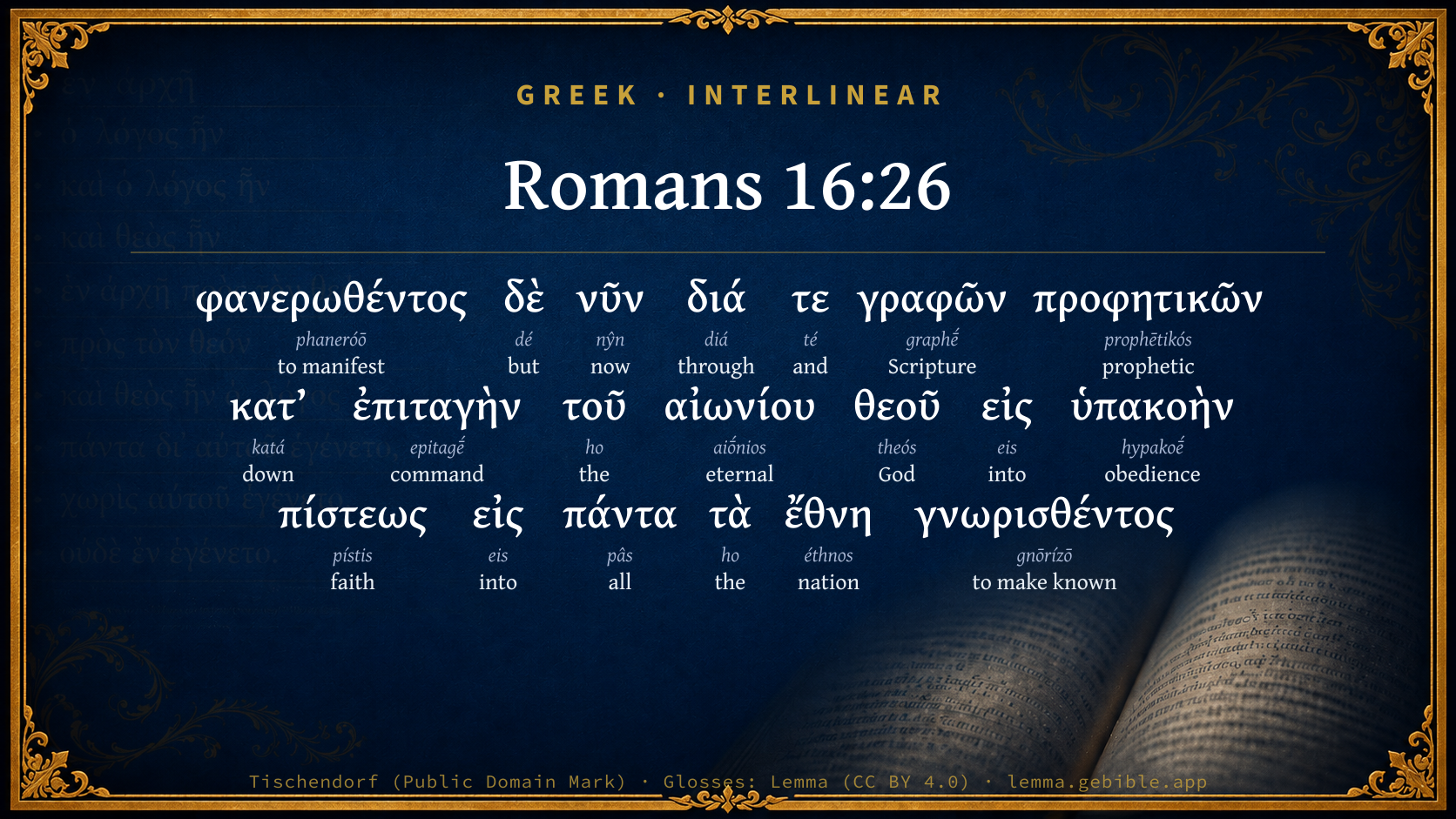
Greek (Tischendorf 8th ed.) Romans 16:26 appears in the Greek New Testament. The text above is from the Tischendorf 8th edition. Each word links to its Strong’s number and a concise gloss. Click any word for its full Thayer’s Greek Lexicon entry.
Download image
Cite this verse

Romans 16:26. Public Domain. Lemma interlinear Bible study tool, https://lemma.gebible.app/v/romans/16/26.

Show BibTeX & RIS
BibTeX
RIS
Highlights
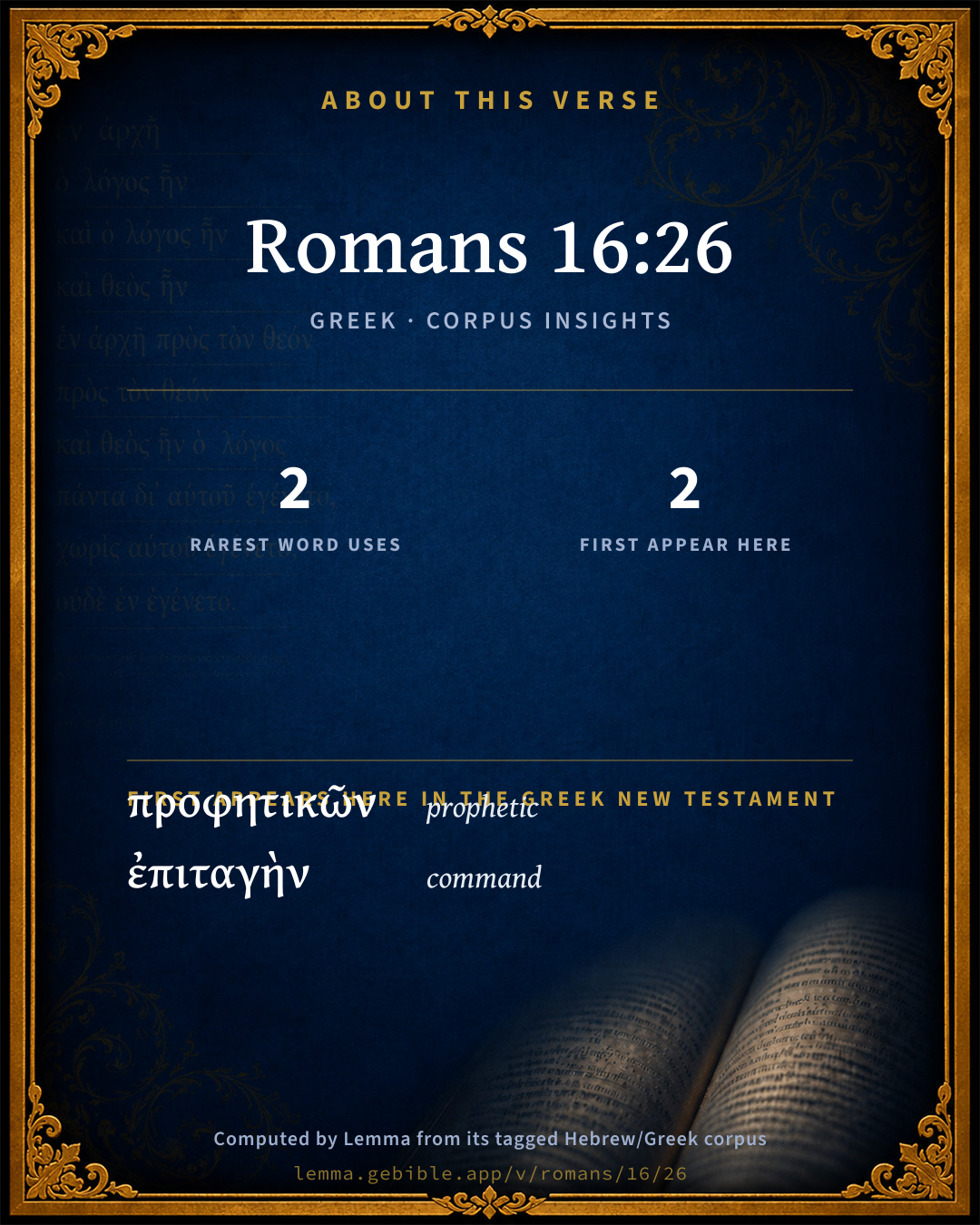
  • 2 first appearances in the Greek New Testament
Full analysis ↓
Download a study sheet

One document with this verse’s original text, its word-by-word gloss line, the meaning frame, cross-references with their text, attributed commentary, and full source and license credits — printable, and it pastes into notes with its structure intact.

This verse Autodidact and up

Study sheet (.html) Plain text (.txt)

A passage Seminary Student

Up to 50 verses in one chapter. A passage sheet keeps up to 6 commentary sources and 12 cross-references per verse, in the order this page ranks them, and says so on the sheet whenever that leaves anything out. Ask for a single verse and you get the Autodidact verse sheet above.

Everything on this page stays free to read, with no account — the sheet is a download of what is already on screen, not access to it.

Want to remove ads? Support Godless Engineer
Compare translations 3

The same verse in 3 English versions, stacked beneath the original-language interlinear above. Click any original word for its lexicon entry.

Each is an independent rendering of the whole verse — the interlinear is not word-aligned to these translations.

Highlighted words mark where these versions differ — a whole-verse word diff, not a word-by-word alignment.

  • World English Bible Public Domain

    (No text available for this verse in this version)

  • King James Version Public Domain
    But now is made manifest, and by the scriptures of the prophets, according to the commandment of the everlasting God, made known to all nations for the obedience of faith:
  • unfoldingWord Literal Text CC BY-SA 4.0
    but now having been revealed, and through the prophetic writings, according to the command of the eternal God, to the obedience of faith, to all the nations, having been made known,

unfoldingWord Literal Text — © unfoldingWord, licensed CC BY-SA 4.0. Word-aligned USFM3 via Door43 (git.door43.org/unfoldingWord/en_ult).

Versions to compare (up to 4)

3 of 4 selected

Show all 16 translations

Every available English version of this verse, each an independent rendering of the whole verse.

  • Berean Standard Bible Public Domain
    but now revealed and made known through the writings of the prophets by the command of the eternal God, in order to lead all nations to the obedience that comes from faith—
  • Majority Standard Bible Public Domain
    but now revealed and made known through the writings of the prophets by the command of the eternal God, in order to lead all nations to the obedience that comes from faith—
  • King James Version Public Domain
    But now is made manifest, and by the scriptures of the prophets, according to the commandment of the everlasting God, made known to all nations for the obedience of faith:
  • American Standard Version (1901) Public Domain
    but now is manifested, and by the scriptures of the prophets, according to the commandment of the eternal God, is made known unto all the nations unto obedience of faith:
  • Revised Version (1885) Public Domain
    but now is manifested, and by the scriptures of the prophets, according to the commandment of the eternal God, is made known unto all the nations unto obedience of faith;
  • Geneva Bible (1599) Public Domain
    (But nowe is opened, and published among all nations by the Scriptures of the Prophetes, at the commandement of the euerlasting God for the obedience of faith)
  • Douay-Rheims (1899) Public Domain
    (Which now is made manifest by the scriptures of the prophets, according to the precept of the eternal God, for the obedience of faith,) known among all nations;
  • Young's Literal Translation Public Domain
    and now having been made manifest, also, through prophetic writings, according to a command of the age-during God, having been made known to all the nations for obedience of faith --
  • Literal Standard Version CC BY-SA 4.0
    and now having been revealed, also, through prophetic writings, according to a command of the perpetual God, having been made known to all the nations for obedience of faith—
  • Unlocked Literal Bible CC BY-SA 4.0
    but now has been revealed and made known through the prophetic writings to all nations, by the command of the eternal God, to bring about the obedience of faith.
  • unfoldingWord Literal Text CC BY-SA 4.0
    but now having been revealed, and through the prophetic writings, according to the command of the eternal God, to the obedience of faith, to all the nations, having been made known,
  • Darby Bible Public Domain
    but [which] has now been made manifest, and by prophetic scriptures, according to commandment of the eternal God, made known for obedience of faith to all the nations --
  • Webster's Bible Public Domain
    But now is made manifest, and by the scriptures of the prophets, according to the commandment of the everlasting God, made known to all nations for the obedience of faith:
  • Free Bible Version CC BY-SA 4.0
    now made visible; Through the prophets' writings, and Following the command of the eternal God, The mystery of truth is made known to everyone everywhere so they can trust and obey him;
  • Bible in Basic English Public Domain
    But is now made clear; and by the writings of the prophets, by the order of the eternal God, the knowledge of it has been given to all the nations, so that they may come under the rule of the faith;
  • Tyndale New Testament (1534) Public Domain
    but now is opened by the scriptures of prophesie at the commaundement of the everlastinge god to stere vp obedience to the faith publisshed amonge all nacions:

Literal Standard Version (2020), Covenant Press — licensed CC BY-SA 4.0. Text via the HelloAO Bible API (eBible.org). Unlocked Literal Bible (unfoldingWord) — licensed CC BY-SA 4.0. Text via the HelloAO Bible API (eBible.org). unfoldingWord Literal Text — © unfoldingWord, licensed CC BY-SA 4.0. Word-aligned USFM3 via Door43 (git.door43.org/unfoldingWord/en_ult). Free Bible Version, Dr. Jonathan Gallagher — licensed CC BY-SA 4.0. Text via the HelloAO Bible API (eBible.org).

Word by word

More ways to search: Search by grammar → Find every occurrence → Compare this word →

Practice this passage: Drill this verse → Learn its vocabulary →

προφητικῶν
prophētikós
G4397
“prophetic”
Adjective, Genitive, Plural, Feminine
Part of Speech
Adjective
Case
Genitive
Number
Plural
Gender
Feminine
Full Thayer's Definition

Origin: from G4396

TDNT: 19:02,0

1. proceeding from a prophet 2. prophetic
  1. φανερωθέντος phaneróō G5319 “to manifest” Verb, Aorist, Passive, Participle, Genitive, Singular, Masculine
  2. δὲ dé G1161 “but” Conjunction
  3. νῦν nŷn G3568 “now” Adverb
  4. διά diá G1223 “through” Preposition
  5. τε té G5037 “and” Particle
  6. γραφῶν graphḗ G1124 “Scripture” Noun, Genitive, Plural, Feminine
  7. κατ’ katá G2596 “down” Preposition
  8. ἐπιταγὴν epitagḗ G2003 “command” Noun, Accusative, Singular, Feminine
  9. τοῦ ho G3588 “the” Article, Genitive, Singular, Masculine
  10. αἰωνίου aiṓnios G166 “eternal” Adjective, Genitive, Singular, Masculine
  11. θεοῦ theós G2316 “God” Noun, Genitive, Singular, Masculine
  12. εἰς eis G1519 “into” Preposition
  13. ὑπακοὴν hypakoḗ G5218 “obedience” Noun, Accusative, Singular, Feminine
  14. πίστεως pístis G4102 “faith” Noun, Genitive, Singular, Feminine
  15. εἰς eis G1519 “into” Preposition
  16. πάντα pâs G3956 “all” Adjective, Accusative, Plural, Neuter
  17. τὰ ho G3588 “the” Article, Accusative, Plural, Neuter
  18. ἔθνη éthnos G1484 “nation” Noun, Accusative, Plural, Neuter
  19. γνωρισθέντος gnōrízō G1107 “to make known” Verb, Aorist, Passive, Participle, Genitive, Singular, Neuter

About this verse

These counts appear in no published source. They are computed here, from the morphology-tagged text and Lemma’s own curated glosses. What Lemma adds →

20
words
18
distinct lemmas
Pauline Epistles
section

Notable vocabulary

The rarest word here is προφητικῶν prophetic G4397 — appearing just 2 times in the whole Greek New Testament.

First appearance in Scripture

These words make their first canonical appearance in the Greek New Testament here:

  • προφητικῶν prophetic G4397
  • ἐπιταγὴν command G2003

Shared distinctive vocabulary

προφητικῶν prophetic G4397 occurs in 2 verses of the Greek New Testament. Also found in:
Repetition

Words recur within this verse:

Cross-references

33

Topical passages linked to Romans 16:26 in the Treasury of Scripture Knowledge — connected by theme and wording, ordered by reader-vote popularity; previews shown in the World English Bible.

  • Romans 1:5 through whom we received grace and apostleship, for obedience of faith among all the nations, for his name's sake;
  • Romans 15:18 For I will not dare to speak of any things except those which Christ worked through me, for the obedience of the Gentiles, by word and deed,
  • Galatians 3:8 The Scripture, foreseeing that God would justify the Gentiles by faith, preached the Gospel beforehand to Abraham, saying, "In you all the nations will be blessed."
  • Isaiah 40:28 Have you not known? have you not heard? The everlasting God, Yahweh, the Creator of the ends of the earth, doesn't faint, neither is weary; there is no searching of his understanding.
  • 1 Timothy 1:17 Now to the King eternal, immortal, invisible, to God who alone is wise, be honor and glory forever and ever. Amen.
  • Genesis 21:33 Abraham planted a tamarisk tree in Beersheba, and called there on the name of Yahweh, the Everlasting God.
  • Acts 13:46–47 Paul and Barnabas spoke out boldly, and said, "It was necessary that God's word should be spoken to you first. Since indeed you thrust it from you, and judge yourselves unworthy of eternal life, behold, we turn to the Gentiles.
  • Romans 1:2 which he promised before through his prophets in the holy Scriptures,
  • Romans 15:4 For whatever things were written before were written for our learning, that through patience and through encouragement of the Scriptures we might have hope.
  • Ephesians 1:9 making known to us the mystery of his will, according to his good pleasure which he purposed in him
  • Colossians 1:26 the mystery which has been hidden for ages and generations. But now it has been revealed to his saints,
  • 2 Timothy 1:10 but has now been revealed by the appearing of our Savior, Christ Jesus, who abolished death, and brought life and immortality to light through the Gospel.
  • Titus 1:2–3 in hope of eternal life, which God, who can't lie, promised before eternal times;
  • Micah 5:2 But you, Bethlehem Ephrathah, Being small among the clans of Judah, Out of you one will come forth to me that is to be ruler in Israel; Whose goings forth are from of old, from everlasting.
  • Matthew 28:19–20 Therefore go, and make disciples of all nations, baptizing them in the name of the Father and of the Son and of the Holy Spirit,
  • Mark 16:15 He said to them, "Go into all the world, and preach the Gospel to the whole creation.
  • Luke 24:44–47 He said to them, "This is what I told you, while I was still with you, that all things which are written in the law of Moses, the prophets, and the psalms, concerning me must be fulfilled."
  • Acts 26:17–18 delivering you from the people, and from the Gentiles, to whom I send you,
  • Acts 26:22–23 Having therefore obtained the help that is from God, I stand to this day testifying both to small and great, saying nothing but what the prophets and Moses said would happen,
  • Ephesians 2:20 being built on the foundation of the apostles and prophets, Christ Jesus himself being the chief cornerstone;
  • 1 John 5:20 We know that the Son of God has come, and has given us an understanding, that we know him who is true, and we are in him who is true, in his Son Jesus Christ. This is the true God, and eternal life.
  • Deuteronomy 33:27 The eternal God is [your] dwelling-place, Underneath are the everlasting arms. He thrust out the enemy from before you, Said, Destroy.
  • Isaiah 9:6 For to us a child is born, to us a son is given; and the government shall be on his shoulder: and his name shall be called Wonderful, Counselor, Mighty God, Everlasting Father, Prince of Peace.
  • Acts 6:7 The word of God increased and the number of the disciples multiplied in Jerusalem exceedingly. A great company of the priests were obedient to the faith.
  • Acts 8:32–35 Now the passage of the Scripture which he was reading was this, "He was led as a sheep to the slaughter. As a lamb before his shearer is silent, So he doesn't open his mouth.
  • Acts 10:43 All the prophets testify about him, that through his name everyone who believes in him will receive remission of sins."
  • Romans 1:20 For the invisible things of him since the creation of the world are clearly seen, being perceived through the things that are made, even his everlasting power and divinity; that they may be without excuse.
  • Romans 3:21 But now apart from the law, a righteousness of God has been revealed, being testified by the law and the prophets;
  • Hebrews 9:14 how much more will the blood of Christ, who through the eternal Spirit offered himself without blemish to God, cleanse your conscience from dead works to serve the living God?
  • Revelation 1:8–11 "I am the Alpha and the Omega," says the Lord God, "who is and who was and who is to come, the Almighty."
  • Hebrews 13:8 Jesus Christ is the same yesterday, today, and forever.
  • Revelation 1:17 When I saw him, I fell at his feet like a dead man. He laid his right hand on me, saying, "Don't be afraid. I am the first and the last,
  • Revelation 19:10 I fell down before his feet to worship him. He said to me, "Look! Don't do it! I am a fellow bondservant with you and with your brothers who hold the testimony of Jesus. Worship God, for the testimony of Jesus is the Spirit of Prophecy."

Cross-references courtesy of OpenBible.info (CC BY 4.0).

Commentary

Notes on Romans 16:26 from classic Christian and Jewish commentators (each source and its license shown beneath its notes). The classic Christian expositions comment on the surrounding passage and are grouped to its opening verse, so a note may address several verses; the Jewish commentaries on the Tanakh (Rashi and others) are per-verse, so they appear only where the commentator wrote on this verse.

Lemma curates 59 commentaries, every one of them public domain or Creative Commons licensed, each selected and text-cleaned for this edition rather than reprinted as found. About our sources →

Tyndale Open Study Notes

Tyndale Open Resources

16:26 so that they too might believe and obey him: Paul uses the same language about the mission to the Gentiles that he used in 1:5, creating a beautiful frame around the letter as a whole.

Tyndale Open Study Notes — © Tyndale Open Resources, licensed CC BY-SA 4.0. Text via the HelloAO Bible API.

Bengel's Gnomon

Johann Albrecht Bengel

Rom 16:26. Φανερωθέντος, made manifest) Col 1:26; 2Ti 1:10; Tit 1:3.—ἐπιταγὴν, commandment) The foundation of his apostleship, 1Ti 1:1; Tit 1:3.—τοῦ αἰωνίου Θεοῦ, of the eternal God) a very proper epithet, comp. the preceding verse, during the eternal ages, so Tit 1:2. The silence on the part of God presupposes eternal knowledge, Act 15:18. The new Economy implies no change in God Himself; His own work is well known to Him from eternity. Comp. presently after, to Him who is the only wise.—ἔθνη, nations) not merely that they may know, but also that they may enjoy [the blessing so known].

Bengel's Gnomon of the New Testament — English translation (T&T Clark, Edinburgh, 1860) — public domain. Text from a community e-Sword module.

Meyer's Critical & Exegetical Commentary

Heinrich August Wilhelm Meyer

Rom_16:26. Contrast of χρόνοις αἰων. σεσιγ.

But which has been made manifest in the present time, and by means of prophetic writings, according to the commandment of the eternal God, in order to produce obedience of faith, has been made known among all nations. In this happy relation of the present time, with regard to that which the χρόνοι αἰώνιοι lacked, how powerful a motive to the praise of God!

φανερωθέντος δὲ νῦν] Comp. Col_1:26, νυνὶ δὲ ἐφανερώθη, in the same contrast; but here the stress lies, in contradistinction to the immediately preceding σεσιγημ., on φανερωθ. Reiches observation, that the φανέρωσις is never attributed to the prophets, is not at all applicable; for it is not in fact ascribed to the prophets here, and φανερωθ. is not even connected with διὰ γραφ. προφ., which τε[54] undoubtedly assigns to the following participle γνωρισθ.[55] The mystery has, namely, in the Christian present been clearly placed in the light, has been made an object of knowledge (comp. on Rom_1:19), a result obviously accomplished through the gospel (comp. Col_1:26; Tit_1:3); and with this φανέρωσις, in and by itself, there was connected in further concrete development the general publication of the secret, as it is more precisely designated by διά τε γραφῶν … γνωρισθ. This general publication was, namely, one which took place (1) by means of prophetic writings (comp. Rom_1:2), inasmuch as, after the precedent of Jesus Himself (Joh_5:39; Mat_5:17; Luk_24:27; Luk_24:44), it was brought into connection with the prophecies of the O. T. testifying beforehand (1Pe_1:11), the fulfilment of the same was exhibited, and they were employed as a proof and confirmation of the evangelical preaching (comp. also Act_17:11), and generally as a medium enabling the latter to produce knowledge and faith. (2) It took place at the command of God (Rom_10:17; Tit_1:3), whose servants (Rom_1:9) and stewards of His mysteries (1Co_4:1) the apostles are, conscious of His command (Gal_1:1; Gal_1:15). (3) It was made in order to produce obedience towards the faith (comp. on Rom_1:5), and that (4) among all nations.

τοῦ αἰωνίου Θεοῦ] αἰων. is not a faint allusion to ΧΡΌΝΟΙς ΑἸΩΝΊΟΙς (Reiche); but stands in a very natural and apt relation of meaning thereto, since it is only as eternal (Bar_4:8; Bar_4:22; Hist. Susann. 42) that God could dispose of the eternal times and of the present, so that what was kept silent in the former should be made known in the latter.

εἰς π. τ. ἔθνη] Consequently the publication was not confined to the Jews, but was accomplished among all Gentile peoples; comp. Rom_1:5. As to εἰς of the direction, comp. Joh_8:26, and see on Mar_1:39; Mar_14:9.

[54] Τέ is wanting indeed in D E 34, 87, Syr. Erp. Copt. Aeth. Arm. Slav. Vulg. Clar. Germ. Chrys. and some Latin Fathers; but this is to be regarded as a hasty deletion, occasioned by the fact that, without precise consideration of the sense and of the following connection, διὰ γραφ. προφ. was mechanically attached to φανερωθ. as nearest in position, and the necessity in point of construction for its belonging to γνωρισθ., widely separated by the intervening notices, was not perceived. In order thereupon to supply the want of connection between the two participles, which arose through the omission of the τέ, an et was inserted before κατʼ in versions (Syr. Erp. Aeth.).

[55] This, too, against Hofmann, who makes διὰ γραφ. προφ. be added to νῦν by means of τέ, in the sense of just as also. But the τέ must have added to the νῦν something homogeneous, supplementing (Baeumlein, Partik. p. 211; Kühner, II. 2, p. 787), not a notion dissimilar to it. Generally, it would not be easy to see why Paul should not have placed his τέ only after κατʼ ἐπιταγήν, and thereby have given to the second participial sentencewhich, according to Hofmanns explanation, follows without connecting particlea connecting link in conformity with the sense.

Meyer — Critical and Exegetical Commentary on the New Testament — English translation by Peter Christie, edited by Frederick Crombie (T&T Clark, 1880) — public domain. Text from a community e-Sword module.

Hodge's Commentary on Romans, Ephesians & First Corinthians

Charles Hodge

Rom_16:26

But is now made manifest, and by the Scriptures of the prophets; that is, this gospel or mystery, hidden from eternity, is now revealed; not now for the first time indeed, since there are so many intimations of it in the prophecies of the Old Testament. It is evident that the apostle adds the words and by the Scriptures of the prophets, to avoid having it supposed that he overlooked the fact that the plan of redemption was taught in the Old Testament; compare Rom_1:2; Rom_3:21. According to the command of the everlasting God, that is, this gospel is now made manifest by command of God. Paul probably uses the expression, everlasting (αἰωνίου) God, because he had just before said that the gospel was hid from eternity. It is now revealed by that eternal Being in whose mind the wonderful plan was formed, and by whom alone it could be revealed. Made known to on nations for the obedience of the faith. Made known among (εἰς, see Mar_13:10; Luk_24:47,) all nations. For the obedience of faith, i.e. that they should become obedient to the faith; see Rom_1:5. This gospel so long concealed, or but partially revealed in the ancient prophets, is now, by the command of God, to be made known among all nations.

Charles Hodge — Commentary on Romans (1835), First Corinthians (1857), and Ephesians (1856) — public domain. Text from a community e-Sword module.

Geneva Bible (1599)

Geneva Bible translators

Offered and exhibited to all nations to be known.

Geneva Bible (1599) marginal notes — public domain. Text via Bolls.life.

Jamieson, Fausset & Brown

Robert Jamieson, A. R. Fausset & David Brown

But is now made manifest--The reference here is to that peculiar feature of the Gospel economy which Paul himself was specially employed to carry into practical effect and to unfold by his teaching--the introduction of the Gentile believers to an equality with their Jewish brethren, and the new, and, to the Jews, quite unexpected form which this gave to the whole Kingdom of God (compare Eph 3:1-10, &c.). This the apostle calls here a mystery hitherto undisclosed, in what sense Rom 16:27 will show, but now fully unfolded; and his prayer for the Roman Christians, in the form of a doxology to Him who was able to do what he asked, is that they might be established in the truth of the Gospel, not only in its essential character, but specially in that feature of it which gave themselves, as Gentile believers, their whole standing among the people of God.

and by the scriptures of the prophets, according to the commandment of the everlasting God, made known to all nations for--in order to

the obedience of faith--Lest they should think, from what he had just said, that God had brought in upon his people so vast a change on their condition without giving them any previous notice, the apostle here adds that, on the contrary, "the Scriptures of the prophets" contain all that he and other preachers of the Gospel had to declare on these topics, and indeed that the same "everlasting God," who "from eternal ages" had kept these things hid, had given "commandment" that they should now, according to the tenor of those prophetic Scriptures, be imparted to every nation for their believing acceptance.

Jamieson, Fausset & Brown — Commentary Critical and Explanatory on the Whole Bible (1871) — public domain (CC PDM 1.0). Text via the HelloAO Bible API.

Adam Clarke's Commentary

Verse 26. But now is made manifest] Now, under the New Testament dispensation, and by my preaching.

By the scriptures of the prophets] Hints relative to this important work being scattered up and down through all their works, but no clear revelation that the Gentiles, who should be admitted into the Church, should be admitted without passing under the yoke of the Mosaic law. This was the point which was kept secret: as to the calling of the Gentiles, this was declared in general terms by the prophets, and the apostle quotes and makes a most important use of their predictions; but the other was a point on which the prophets gave no information, and it seems to have been peculiarly revealed to St. Paul, who received the commandment of the everlasting God to make it known εις παντα τα εθνη, to all the Gentiles-all the people of the earth that were not of Jewish extraction. And it was to be made known for the obedience of faith, that they might believe its doctrines and obey its precepts; its universal voice requiring repentance towards God, faith in our Lord Jesus Christ, and circumcision of the heart, in the place of all Jewish rites and ceremonies.

Adam Clarke's Commentary on the Bible (1810–1826) — public domain. Text from a community e-Sword/MySword module.

Ellicott's Commentary for English Readers

(26) But now is made manifest.—The first clause of this verse goes with the last clause of the preceding “mystery,” which before was kept secret, but now has been “made manifest.” The rest of the verse all hangs together: “this mystery, through the help of the corroboration which it derives from the prophets of the Old Testament, has, by God’s command to us, the Apostles, been made known.”

By the scriptures of the prophets.—Through the help of that appeal to prophecy which we are enabled to make.

According to the commandment.—That which had taken place according to the command of God was the making known of the gospel to the Gentiles, as, e.g., when Paul and Barnabas were specially “separated” for the work by the Holy Ghost.

Made known to all nations.—The word “to” has a little more stress laid upon it than would appear from the English, “made known so as to reach all nations.”

For the obedience of faith.—An exact repetition of the phrase in Rom_1:5, “to win over the Gentiles unto the allegiance demanded of them by faith in Christ.”

A Bible Commentary for English Readers, edited by Charles John Ellicott (1878–1897) — public domain. Text from a community e-Sword module.

The Cambridge Bible for Schools and Colleges

gen. ed. J. J. S. Perowne

26. now] In the days of Messiah, and in Him as the Propitiation. Cp. Col_1:26.

by the scriptures, &c.] Lit. by means of (the) prophetic scriptures. This Epistle, and e.g. Acts 13, are the best commentary on these words. The O. T., as the great prediction of Messiah and preparation for Him, was the text and the warrant of His Apostles wherever they went, and that for Gentiles as much as for Jews. When the Gentiles previously knew nothing of the O. T. the preaching would, of course, not take the O. T. as its starting-point; (see St Paul’s discourse at Athens;) but even in such cases it would bring forward the Prophecies as soon as possible, both as its credentials and its text.—We have heard this verse unintentionally illustrated by a distinguished Hindoo convert, of great intellectual power; who attributed his ultimate escape from the maze of Brahminic pantheism to the attentive study of the Messianic prophecies side by side with the Gospel history.

the everlasting God] The Gr. word (aionios) rendered everlasting perhaps refers back to the “æons” or “ages” of Rom_16:25. Q. d., “The Gospel is now revealed and proclaimed according to the will of Him who appoints and adjusts all the developements of His providence, alike past, present and to come.” He who rules all duration knows when to keep silence and when to break it.—This adjective is nowhere else in the N. T. attached to the word God.—On the adjective, see further on Rom_2:7.

to all nations] Lit. to (or perhaps better, for) all the nations. The special reference is, of course, to the Gentiles.

for the obedience of faith] i.e. to invite that obedience which, in fact, faith implies; that trustful acceptance of the terms of Salvation which may be described, in one aspect, as “submission to the righteousness of God.” (See note on Rom_10:3.) The thought is not so much of the course of moral obedience to which faith leads, as of the element of submission in the act of faith.

In this brief phrase the great Theme of the Epistle is heard for the last time.

The Cambridge Bible for Schools and Colleges (gen. ed. J. J. S. Perowne; Cambridge University Press, 1878–1918) — public domain. Text from a community e-Sword module.

Trapp's Complete Commentary

John Trapp

26 But now is made manifest, and by the scriptures of the prophets, according to the commandment of the everlasting God, made known to all nations for the obedience of faith:

Ver. 26. According to the commandment] The writings of the prophets concerning the mystery of Christ were not made known to the world by haphazard, but by a special command of God.

For the obedience of faith] Though God purposed good to his people before all worlds, yet that is concealed till such time as they yield this obedience of faith like as water that runs underground, is hidden a long time till it break out suddenly, and then we discover that there was a stream ran underground; as Arethusa and other rivers do.

John Trapp, A Commentary or Exposition upon All the Books of the Old and New Testament (1647–1656) — public domain. Text from a community e-Sword module.

Albert Barnes' Notes on the Bible

But now is made manifest - Is revealed, or made known; that which was so long concealed is now divulged, that is, God’s plan of saving people is now made known to all nations.

And by the Scriptures ... - By the “writings” of the prophets. The prophetic writings contained the doctrines, obscurely indeed, but so as to be an important means of disseminating and confirming the truth that the Gentiles should be made acquainted with the gospel. To those writings the apostle had repeatedly appealed in his defense of the proposition that the gospel was to be preached to the Gentile word; Rom. 10; 11; 15. The prophetic writings; moreover, were extensively scattered among the Gentile nations, and thus were readily appealed to in defense of this position. Their writings being thus translated, and read, were an important means of propagating the truths of the Christian religion.

According to the commandment ... - By his command through Jesus Christ; made known in the gospel of his Son.

The everlasting God - God who is eternal, and therefore unchanged. He who has indeed concealed this truth, but who has always intended that it should be revealed.

To all nations - Mat 28:19; compare Col 1:23.

For the obedience of faith - To produce obedience to the requirements of the gospel; see the note at Rom 1:5.

Albert Barnes' Notes on the Bible (1834–1885) — public domain. Text from a community e-Sword/MySword module.

Matthew Poole's English Annotations

Concerning the revelation of this mystery, four things are further recorded:

1. The means whereby it was made known; viz.

the Scriptures of the prophets; see Act 10:43; 16:32; 28:23.

2. The authority by which it was made known;

the commandment of the everlasting God.

3. The persons to whom it was made known; the Gentiles, or the inhabitants of

all nations.

4. The end for which it was made known; viz.

for the obedience of faith; i.e. that it may be believed and obeyed: see Rom 1:5; 15:18.

Matthew Poole's English Annotations on the Holy Bible (1683–1685) — public domain. Text from a community e-Sword/MySword module.

Whedon's Commentary on the Bible

Daniel D. Whedon

26. Now… manifest—First by Christ, next by his apostles, and now by Paul in this epistle.

Scriptures of the prophets—A needlessly awkward rendering of γραφων προφητικων, prophetic Scriptures. Through the Scriptures as instrument of revelation and proof.

Made known—Referring to mystery. The eternal mystery is now disclosed by God’s command, namely, that all can be saved by faith in Christ.

Daniel D. Whedon (gen. ed.), Commentary on the Old and New Testaments (1874–1909) — public domain. Text from a community e-Sword module.

John Wesley's Explanatory Notes

According to the commandment - The foundation of the apostolical office. Of the eternal God - A more proper epithet could not be. A new dispensation infers no change in God. Known unto him are all his works, and every variation of them, from eternity. Made known to all nations - Not barely that they might know, but enjoy it also, through obeying the faith.

John Wesley, Explanatory Notes Upon the Whole Bible (1754–1765) — public domain. Text via the GEBible commentary corpus.

Scofield Reference Notes

C. I. Scofield

obedience

See margin ref., (See Scofield "Rom 1:5"). Faith as a system, in contrast with law as a system.

The Scofield Reference Bible (1917 edition), notes by C. I. Scofield — public domain. Text from a community e-Sword module.

Godbey's Commentary on the New Testament

William B. Godbey

26. “But having now been made manifest through the prophetical Scriptures, according to the promise of eternal God unto the obedience of faith having been made known unto all the Gentiles,

William B. Godbey, Commentary on the New Testament (1896–1900) — public domain. Text from a community e-Sword module.

McGarvey & Pendleton's Commentaries

J. W. McGarvey

but now is manifested, and by the scriptures of the prophets, according to the commandment of the eternal God, is made known unto all the nations unto obedience of faith [Comp. Col_1:26 ; Col_4:4 ; Gal_1:12 ; Gal_1:16 ; 1Co_2:10 . "Manifested. . . made known." These two words express the two phases of revelation. Christ himself was the manifestation ( Luk_2:30-32 ; Joh_1:14-18 ; Joh_2:11 ; Heb_1:3 ), the Light of the world ( Joh_1:4-9 ; Joh_8:12 ); but this manifestation is introduced, interpreted, explained, "made known" by the Scriptures of the Old and New Testament writers or prophets, the former with their types, shadows and forecasts ( Luk_24:25-27 ; Gal_4:21-31 ; Col_2:16-17 ; Heb_8:5 ; Heb_9:9 ; Heb_10:1-9 ), the latter with their gospel sermons and doctrinal epistles ( 1Co_15:1 ; Gal_1:11 ; 1Jo_1:1-3 ). And these Scriptures were written for that purpose, not at the motion, option or choice of the writers, but by order and command of God himself ( Deu_5:22 ; Jer_36:27-28 ; 2Pe_1:20-21 ; 1Co_2:13 ; 2Ti_3:16 ), that men might know, and, knowing, might believe and obey, the gospel in its conditions and be saved thereby. Thus the apostle assures us that the Father, who gave us the Christ, gave us also correct biographies as to his incarnation, miracles, life, death, resurrection and coronation; that the God who gave us a gospel also insured to us the preservation of it in an efficient and effective form in the record which he commanded; that the Lord who gave us a church has also provided for the perpetual safeguarding of its plans, specifications and model as designed in his holy mountain ( Heb_8:5 ), preserving them forever in those Chronicles of his kingdom which we call the Bible. Common sense should tell us this, even if Paul had kept silence. How could we attribute infinite wisdom to a God who sacrificed his Son to make a gospel and then neglected to preserve that gospel that it might be used for the purposes for which it was prepared at so much cost? Moreover, this passage shows that God himself, back of the human penman, wrote the Bible; for he, and not they--no, not even the angels ( 1Pe_1:10 ; 1Pe_10:12 )--knew the secret which these Scriptures were revealing. Yea, he wrote it for the universal instruction of the unborn church in matters which no human wisdom could discover for itself. Therefore, whoso strikes at the Old Testament would destroy the foundation of the New, would annul what God has commanded, obliterate what God has revealed, and rob the dying world of the gospel, the salvation and the Christ which God has given. The one who attempts to do this thing (God be praised, he can not succeed save for a brief season-- Rev_11:3-12 ) would destroy God's means of life, and would leave the world, "all nations," with their teeming but helpless millions to perish without hope, setting his wisdom against that of "the only Wise." Such an one rivals the devil, both in unfeeling heartlessness and in supreme presumption]:

J. W. McGarvey (with Philip Y. Pendleton), Commentaries on the New Testament (The Fourfold Gospel, 1914; Acts; and the epistles) — public domain. Text from a community e-Sword/MySword module.

The People's New Testament

B. W. Johnson

26. This mystery now is made manifest. The apostles were engaged in declaring this mystery to the world.

B. W. Johnson's The People's New Testament with Notes (1889–1891) — public domain. Electronic text from the Christian Classics Ethereal Library (CCEL) ThML edition.

Cambridge Greek Testament for Schools and Colleges

26. φανερωθέντος. Cf. Rom 3:21 where exactly the same relation between the manifestation and the witness of prophets is expressed. The secret was manifested in the Person and history of Christ; He is the secret of GOD; cf. 1Co 1:24.

νῦν = ‘in our day’ as contrasted with the χρ. αἰ.; cf. 1Pe 1:12 (Hort, p. 59), supra Rom 5:11, Rom 11:30-31.

διά τε κ.τ.λ. The τε connects γνωρ. closely with φαν., both in contrast with σεσιγ. ‘But has in our day been manifested (in Christ) and made known.’ The aorists should be translated by perfects. Then this clause tersely describes the apostolic preaching (1) in its support in the prophets, (2) in its commission from GOD, (3) in its direct aim, (4) in its range in the world.

διὰ γραφῶν προφ. For διὰ cf. 2Ti 2:2 = on the authority of; cf. Rom 12:1; Rom 12:3 n., an extension of the use of διὰ for the means or instrument: cf. a slight further extension = under the guidance of 1Th 4:14; Heb 3:16.

γρ. προφ. Cf. Rom 1:2, Rom 3:21. The fact is seen throughout the Epp. and Acts; e.g. cc. 9–11, Rom 15:4; Rom 15:9 ff.; cf. 1Pe 1:12; 2Co 1:20; Luk 1:70. The particular phrase is unique, and includes all the O.T. as all in its degree prophetic, cf. 2Pe 1:20. The absence of the article emphasises the character of all, rather than any specific writing.

κατ’ ἐπιταγὴν τ. αἰ. θ. corresponds to κλητὸς ἀποστ. ἀφωρισμένος (Rom 1:1) and δι’ οὗ ἐλάβομεν χάριν καὶ ἀποστολήν (Rom 1:5) but describes the authority of all apostolic work = διὰ ἀποστόλων; cf. 1Ti 1:1; Tit 1:3.

τοῦ αἰ. θεοῦ. Only here in N.T. In LXX[339] Gen 21:33; Isa 26:4; Isa 40:28; 2Ma 1:25; 3Ma 6:12; 3Ma 7:16; for the idea cf. Rom 11:33-36; 1Co 2:7; 1Co 10:11; and Eph 3:9; Eph 3:11; Col 1:26; 1Ti 1:17; 2Ti 1:9; Tit 1:2.

[339] LXX. the Septuagint Version of the Old Testament

εἰς ὑπακοὴν πίστεως = Rom 1:5 only; cf. Rom 15:18, Rom 16:19, 1Pe 1:2; = to secure an obedience rendered by faith; ὑπ. in this sense only in the earlier epistles Rom 6:17, Rom 10:16; 2Th 1:8; 2Co 7:15.

εἰς πάντα τὰ ἔθνη. Cf. Rom 1:5, Rom 15:11, Rom 16:4; Gal 3:8; 2Ti 4:17 and Rev. (saepe) for the whole phrase; cf. παντὶ τῷ πιστ. Ἰ. καὶ Ἕ. Rom 1:16.

γνωρισθέντος. Cf. Rom 9:22-23; 1Co 15:1; Eph 6:19.

Cambridge Greek Testament for Schools and Colleges (Cambridge University Press, 1896; 21 vols, various authors incl. Carr, Maclear, Plummer, Farrar, Lumby, Moule, M. R. James, Simcox) — public domain. Text from a community e-Sword module.

Alford’s Greek Testament

Henry Alford

26.] See ch. 1:2. The prophetic writings were the storehouse out of which the preachers of the gospel took their demonstrations that Jesus was the Christ: see Act 18:28;—more especially, it is true, to the Jews, who however are here included among πάντα τὰ ἔθνη.

κατʼ ἐπιταγ. may refer either to the prophetic writings being drawn up by the command of God,—or to the manifestation of the mystery by the preachers of the gospel thus taking place. The latter seems best to suit the sense. αἰωνίου refers back to χρ. αἰωνίοις [the word should have been kept scrupulously the same in English, not as here and in Mat 22:46 rendered by two different English terms].

The first εἰς indicates the aim—in order to their becoming obedient to the faith:—the second, the local extent of the manifestation.

Henry Alford, The Greek Testament (1849–1861) — public domain. Text from a community e-Sword module.

International Critical Commentary

26. In this verse we should certainly read διά τε γραφῶν προφητικῶν. The only Greek MSS. that omit τε are DE, and the authority of versions can hardly be quoted against it. Moreover, the sentence is much simpler if it be inserted. It couples together φανερωθέντος and γνωρισθέντος, and all the words from διά τε γραφῶν to the latter word should be taken together. εἰς πάντα τὰ ἔθνη probably goes with εἰς ὑπακοὴν πίστεως and not with γνωρισθέντος.

διά τε γραφῶν προφητικῶν … γνωρισθέντος. All the ideas in this sentence are exactly in accordance with the thoughts which run through this Epistle. The unity of the Old and New Testaments, the fact that Christ had come in accordance with the Scriptures (Rom 1:1, Rom 1:2), that the new method of salvation although apart from law, was witnessed to by the Law and the Prophets (μαρτυρουμένη ὑπὸ τοῦ νόμου καὶ τῶν προφητῶν Rom 3:21), the constant allusion esp. in chaps. ix-xi to the Old Testament Scriptures; all these are summed up in the phrase διὰ γραφῶν προφητικῶν.

The same is true of the idea expressed by κατʼ ἐπιταγὴν τοῦ αἰωνίου Θεοῦ. The mission given to the preachers of the Gospel is brought out generally in Rom 10:15 ff., the special command to the Apostle is dwelt on in the opening vv. 1-5, and the sense of commission is a constant thought of this period. With regard to the words, αἰωνίου is of course suggested by χρόνοις αἰωνίοις: cp. Baruch 4:8, Susanna (Theod.) 42 (LXX) 35. The formula κατʼ ἐπιταγήν occurs 1Co 7:6; 2Co 8:8, but with quite a different meaning; in the sense of this passage it comes again in 1Ti 1:1; Tit 1:3.

We find the phrase εἰς ὑπακοὴν πίστεως in Rom 1:5. As Hort points out, the enlarged sense of ὑπακοή and ὑπακούω is confined to the earlier Epistles.

The last phrase εἰς πάντα τὰ ἔθνη γνωρισθέντος hardly requires illustrating; it is a commonplace of the Epistle. In this passage still carrying on the explanation of κήρυγμα, four main ideas of the Apostolic preaching are touched upon—the continuity of the Gospel, the Apostolic commission, salvation through faith, the preaching to the Gentiles.

μόνῳ σοφῷ Θεῷ: a somewhat similar expression may be found in 1Ti 1:17, which at a later date was assimilated to this, σοφῷ being inserted. But the idea again sums up another line of thought in the Epistle—God is one, therefore He is God of both Jews and Greeks; the Gospel is one (3:29, 30). God is infinitely wise (ὦ βάθος πλούτου καὶ σοφίας καὶ γνώσεως Θεοῦ 11:33); even when we cannot follow His tracks, He is leading and guiding us, and the end will prove the depths of His wisdom.

International Critical Commentary — older volumes (1896–1929), various authors — public domain. Text from a community e-Sword module.

Godet's Commentaries

Frédéric Louis Godet

Vv. 26. With these times of silence there is contrasted that of divine speaking. The word νῦν, now, strongly expresses this contrast. The participle φανερωθέντος, manifested, refers to the inward revelation of the divine mystery by the Holy Spirit, which the apostles have received; comp. the perfectly similar expressions, Eph 3:5.

This act of revelation must necessarily be completed by another, as is indicated by the following participle: γνωρισθέντος, published, divulged. What the apostles received by revelation, they are not to keep to themselves; they are called to proclaim it throughout the whole world. These two participles are joined by the particle τέ, and. This mode of connection applies in Greek only to things of a homogeneous nature, and the one of which serves to complete the other. This peculiarity of the τέ suffices to set aside Hofmann’s explanation, who translates: “manifested now and by the prophetical writings.” For the two notions of the time and mode of revelation are too heterogeneous to be thus connected. And, moreover, it would follow from this explanation that the second participle (γνωρισθέντος, published) would be unconnected with the first by any conjunction, which is impossible. The Greco-Lats. and some versions omit the particle τέ. But it is a copyist’s error well explained by Meyer. The words: by prophetical writings, were connected with the preceding participle (φανερωθέντος, manifested), as nearer than the following one, and from this false connection arose the suppression of the τέ.

The second participle, γνωρισθέντος, made known, is defined by four clauses. The first refers to the cause: the divine command; the second to the means: the prophetical writings; the third to the end: the obedience of the faith; the fourth to the object: all the Gentiles.

The command of God sounded forth by the mouth of Jesus when He said: “Go ye and teach all nations.” This command was not the expression of a transient or secondary thought; it was the immutable and eternal thought, to which all the rest were subordinated, even the decree of creation. This is what the epithet eternal, given to God, is intended to remind us of. He remains exalted above all the phases through which the execution of His designs passes.

By the prophetical Scriptures, which are the means of the making known, all critics understand the prophetical books of the O. T. But how could Paul say: The gospel is proclaimed by these books? He has just declared, on the contrary, that they mystery had been kept secret up to the present time. It is answered, that the apostle is alluding to the use made of the writings of the prophets in apostolic preaching. But though these writings were a means of demonstration, they were not a means of making known; and yet this is what is expressed by the participle λνωρισθέντος. And, besides, why in this case reject the article which was necessary to designate these prophetical books as well-known writings; why say: “by writings”...and not: “by the writings of the prophets?” It might be answered, that Paul expresses himself in the same way in the passage Rom 1:2; but there, the term prophets which precedes, and the epithet holy which accompanies, the word Scriptures, sufficiently determine the idea. It is not so here, where these writings are represented as the means of propagating a new revelation, and should consequently designate new prophetical writings. I think that the only explanation of this term in harmony with the apostle’s thought is got from the passage which we have already quoted, Eph 3:3-6 : “For God by revelation made known unto me the mystery, as I wrote afore in few words, whereby when ye read ye may understand my knowledge in the mystery of Christ, which in other ages was not made known unto the sons of men, as it is now revealed unto His holy apostles and prophets by the Spirit, that the Gentiles are fellow-heirs, and of the same body, and partakers of His promise in Christ by the gospel.” The apostles are here called prophets, inasmuch as they are bearers of a new revelation. What then are their writings, if not prophetical writings? Paul himself feels that the letter which he has just written has this character, and that it ranks among the means which God is using to carry out the publication of the new revelation. It is therefore of this very letter, as well as of the other letters which had proceeded from his pen, or from that of his colleagues, that he is speaking in our passage. And from this point of view the absence of the article is easily explained. Paul really means: “by prophetical writings.” It is as it were a new series of inspired writings coming to complete the collection of the ancient and well-known books, even as the new revelation is the completion of the old.

The end is denoted by the words: for the obedience of faith; an expression which reproduces that of Rom 1:5, and the meaning of which is, as we have proved there, the obedience to God which consists of faith itself.

Finally, the object of the publication: to all the Gentiles (nations); an expression similar to that of Rom 1:5 : among all the Gentiles. Paul thus ends where he had begun: with his apostleship to the Gentiles, which follows from the appearance of a new and final revelation, and of the full realization of God’s eternal plan. The return to the ideas of Rom 1:1-5 is evident.

Frédéric Louis Godet — Commentaries on Luke, John, Romans, and 1 Corinthians — English translation (T&T Clark, Edinburgh, 1870s–1890s) — public domain. Text from a community e-Sword module.

Lesson kit

Teaching starters — assembled from the data on this page, not authored interpretation. Every prompt links to the verse data it draws on. Edit before teaching.

Romans, in the Pauline Epistles, opens this verse with 20 words (18 distinct Greek lemmas). Its most distinctive word is prophētikós (“prophetic”). A historical commentator’s framing appears above. Read the whole chapter for the surrounding context.

Discussion questions

  1. How does “prophetic” (prophētikós) shape what this verse is saying?
  2. 2 words make their first appearance in Scripture here. What does this debut establish?
  3. How does 2 Peter 1:19, which shares the word «prophetic», read alongside this verse?
  4. What does the repetition of “into” (2× in this one verse) do in this verse?
  5. The translations on this page render this verse differently — a whole-verse word diff, not a word-by-word alignment. What might account for the different wordings?
  6. Compare how Tyndale Open Study Notes and Bengel's Gnomon read this verse. Where do they agree or differ?

Things to notice

  • 2 words make their first canonical appearance in Scripture here.
  • These translations choose different wording for 13 words in this verse.
  • “into” occurs 2× in this single verse.
  • 18 distinct Greek lemmas span 20 words in this verse.

Reading settings

Reading text

Shown beneath each verse's original-language words.

Old Testament
Old Testament edition

Read the OT as the Masoretic Hebrew (MT) or the Greek Septuagint (LXX).

English shown for the Greek Septuagint (in the Hebrew ↔ Greek comparison).

Comparing translations? Open the Compare panel on any verse page to stack up to four side by side.