

1 Corinthians 6:10
Greek (Tischendorf 8th ed.) 1 Corinthians 6:10 appears in the Greek New Testament. The text above is from the Tischendorf 8th edition. Each word links to its Strong’s number and a concise gloss. Click any word for its full Thayer’s Greek Lexicon entry.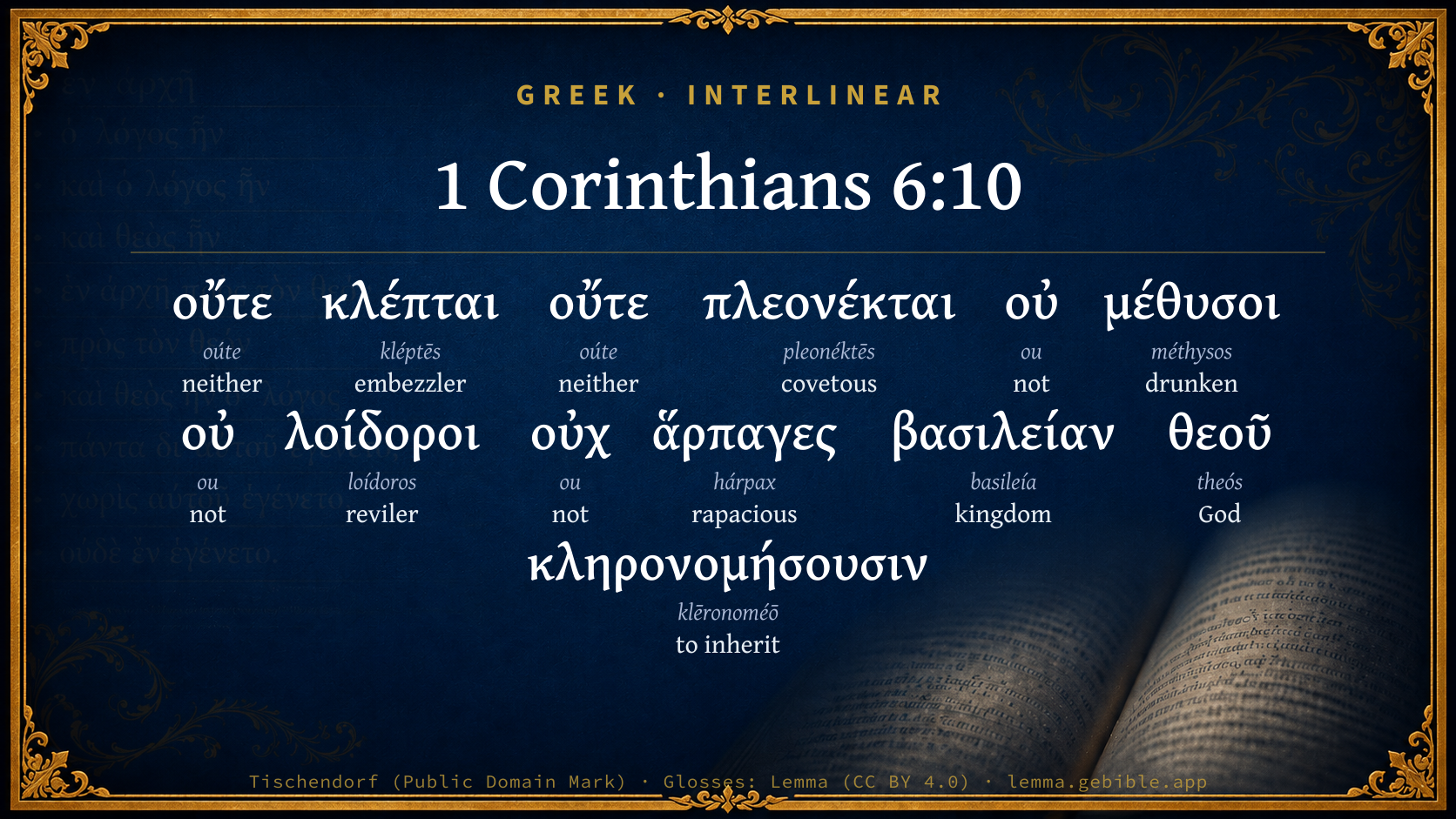
nor thieves, nor covetous, nor drunkards, nor slanderers, nor extortioners, will inherit the Kingdom of God.
Download a study sheet
One document with this verse’s original text, its word-by-word gloss line, the meaning frame, cross-references with their text, attributed commentary, and full source and license credits — printable, and it pastes into notes with its structure intact.
This verse Autodidact and up
A passage Seminary Student
Up to 50 verses in one chapter. A passage sheet keeps up to 6 commentary sources and 12 cross-references per verse, in the order this page ranks them, and says so on the sheet whenever that leaves anything out. Ask for a single verse and you get the Autodidact verse sheet above.
Everything on this page stays free to read, with no account — the sheet is a download of what is already on screen, not access to it.
Compare translations 3
The same verse in 3 English versions, stacked beneath the original-language interlinear above. Click any original word for its lexicon entry.
Each is an independent rendering of the whole verse — the interlinear is not word-aligned to these translations.
Highlighted words mark where these versions differ — a whole-verse word diff, not a word-by-word alignment.
-
World English Bible Public Domain
nor thieves, nor covetous, nor drunkards, nor slanderers, nor extortioners, will inherit the Kingdom of God.
-
King James Version Public Domain
Nor thieves, nor covetous, nor drunkards, nor revilers, nor extortioners, shall inherit the kingdom of God.
-
unfoldingWord Literal Text CC BY-SA 4.0
nor thieves nor the greedy nor drunkards nor slanderers nor swindlers will inherit the kingdom of God.
unfoldingWord Literal Text — © unfoldingWord, licensed CC BY-SA 4.0. Word-aligned USFM3 via Door43 (git.door43.org/unfoldingWord/en_ult).
Show all 19 translations
Every available English version of this verse, each an independent rendering of the whole verse.
-
World English Bible Public Domain
nor thieves, nor covetous, nor drunkards, nor slanderers, nor extortioners, will inherit the Kingdom of God.
-
Berean Standard Bible Public Domain
nor thieves, nor the greedy, nor drunkards, nor verbal abusers, nor swindlers, will inherit the kingdom of God.
-
Majority Standard Bible Public Domain
nor the covetous, nor thieves, nor drunkards, nor verbal abusers, nor swindlers, will inherit the kingdom of God.
-
King James Version Public Domain
Nor thieves, nor covetous, nor drunkards, nor revilers, nor extortioners, shall inherit the kingdom of God.
-
American Standard Version (1901) Public Domain
nor thieves, nor covetous, nor drunkards, nor revilers, nor extortioners, shall inherit the kingdom of God.
-
Revised Version (1885) Public Domain
nor thieves, nor covetous, nor drunkards, nor revilers, nor extortioners, shall inherit the kingdom of God.
-
Geneva Bible (1599) Public Domain
Nor theeues, nor couetous, nor drunkards, nor railers, nor extortioners shall inherite the kingdome of God.
-
Douay-Rheims (1899) Public Domain
Nor the effeminate, nor liers with mankind, nor thieves, nor covetous, nor drunkards, nor railers, nor extortioners, shall possess the kingdom of God.
-
Young's Literal Translation Public Domain
nor thieves, nor covetous, nor drunkards, nor revilers, nor extortioners, the reign of God shall inherit.
-
Literal Standard Version CC BY-SA 4.0
nor thieves, nor covetous, nor drunkards, nor revilers, nor extortioners, will inherit the Kingdom of God.
-
Unlocked Literal Bible CC BY-SA 4.0
thieves, the greedy, drunkards, slanderers, and swindlers—none of them will inherit the kingdom of God.
-
unfoldingWord Literal Text CC BY-SA 4.0
nor thieves nor the greedy nor drunkards nor slanderers nor swindlers will inherit the kingdom of God.
-
Darby Bible Public Domain
nor thieves, nor covetous, nor drunkards, nor abusive persons, nor [the] rapacious, shall inherit [the] kingdom of God.
-
World Messianic Bible Public Domain
nor thieves, nor covetous, nor drunkards, nor slanderers, nor extortionists, will inherit God’s Kingdom.
-
Webster's Bible Public Domain
Nor thieves, nor covetous, nor drunkards, nor revilers, nor extortioners, shall inherit the kingdom of God.
-
Free Bible Version CC BY-SA 4.0
thieves, greedy, drunkards, abusers, or cheats, will not inherit the kingdom of God.
-
Bible in Basic English Public Domain
Or is a thief, or the worse for drink, or makes use of strong language, or takes by force what is not his, will have any part in the kingdom of God.
-
Text-Critical English NT CC BY 4.0
nor the greedy, nor thieves, nor drunkards, nor revilers, nor swindlers will inherit the kingdom of God.
-
Tyndale New Testament (1534) Public Domain
nether theves nether the coveteous nether dronkardes nether cursed speakers nether pillers shall inheret the kyngdome of God.
Literal Standard Version (2020), Covenant Press — licensed CC BY-SA 4.0. Text via the HelloAO Bible API (eBible.org). Unlocked Literal Bible (unfoldingWord) — licensed CC BY-SA 4.0. Text via the HelloAO Bible API (eBible.org). unfoldingWord Literal Text — © unfoldingWord, licensed CC BY-SA 4.0. Word-aligned USFM3 via Door43 (git.door43.org/unfoldingWord/en_ult). Free Bible Version, Dr. Jonathan Gallagher — licensed CC BY-SA 4.0. Text via the HelloAO Bible API (eBible.org).
Word by word
More ways to search: Search by grammar → Find every occurrence → Compare this word →
Practice this passage: Drill this verse → Learn its vocabulary →
- Appears 2× in the Greek New Testament
- First appears at 1 Corinthians 5:11
- Part of Speech
- Noun
- Case
- Nominative
- Number
- Plural
- Gender
- Masculine
Full Thayer's Definition
- οὔτε oúte G3777 “neither” Conjunction, Negative
- κλέπται kléptēs G2812 “embezzler” Noun, Nominative, Plural, Masculine
- οὔτε oúte G3777 “neither” Conjunction, Negative
- πλεονέκται pleonéktēs G4123 “covetous” Noun, Nominative, Plural, Masculine
- οὐ ou G3756 “not” Particle, Negative
- μέθυσοι méthysos G3183 “drunken” Noun, Nominative, Plural, Masculine
- οὐ ou G3756 “not” Particle, Negative
- λοίδοροι loídoros G3060 “reviler” Adjective, Nominative, Plural, Masculine
- οὐχ ou G3756 “not” Particle, Negative
- ἅρπαγες hárpax G727 “rapacious” Adjective, Nominative, Plural, Masculine
- βασιλείαν basileía G932 “kingdom” Noun, Accusative, Singular, Feminine
- θεοῦ theós G2316 “God” Noun, Genitive, Singular, Masculine
- κληρονομήσουσιν klēronoméō G2816 “to inherit” Verb, Future, Active, Indicative, 3rd person, Plural
About this verse
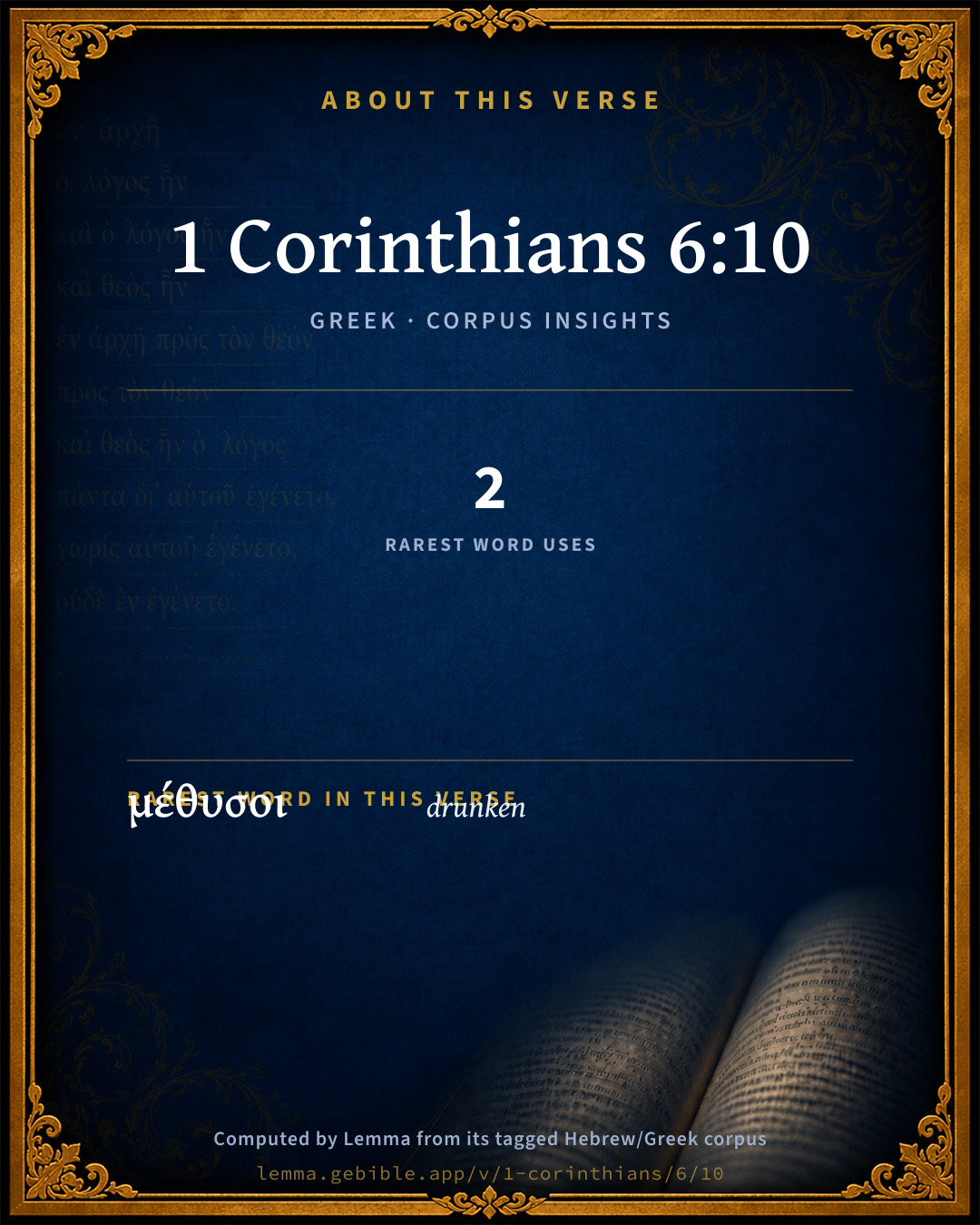
These counts appear in no published source. They are computed here, from the morphology-tagged text and Lemma’s own curated glosses. What Lemma adds →
- 13
- words
- 10
- distinct lemmas
- Pauline Epistles
- section
Cross-references
15Topical passages linked to 1 Corinthians 6:10 in the Treasury of Scripture Knowledge — connected by theme and wording, ordered by reader-vote popularity; previews shown in the World English Bible.
- 1 Corinthians 5:11 But as it is, I wrote to you not to associate with anyone who is called a brother who is a sexual sinner, or covetous, or an idolater, or a slanderer, or a drunkard, or an extortioner. Don't even eat with such a person.
- Galatians 5:21 envyings, murders, drunkenness, orgies, and things like these; of which I forewarn you, even as I also forewarned you, that those who practice such things will not inherit the Kingdom of God.
- Ezekiel 22:29 The people of the land have used oppression, and exercised robbery; yes, they have vexed the poor and needy, and have oppressed the foreigner wrongfully.
- Ephesians 4:28 Let him who stole steal no more; but rather let him labor, working with his hands the thing that is good, that he may have something to give to him who has need.
- Ezekiel 22:27 Her princes in the midst of it are like wolves ravening the prey, to shed blood, [and] to destroy souls, that they may get dishonest gain.
- 1 Peter 4:15 For let none of you suffer as a murderer, or a thief, or an evil doer, or as a meddler in other men's matters.
- Matthew 23:33 You serpents, you offspring of vipers, how will you escape the judgment of Gehenna?
- Ezekiel 22:13 Behold, therefore, I have struck my hand at your dishonest gain which you have made, and at your blood which has been in the midst of you.
- John 12:6 Now he said this, not because he cared for the poor, but because he was a thief, and having the money box, used to steal what was put into it.
- 1 Thessalonians 4:6 that no one should take advantage of and wrong a brother or sister in this matter; because the Lord is an avenger in all these things, as also we forewarned you and testified.
- Psalms 50:17–18 Seeing you hate instruction, And throw my words behind you?
- Isaiah 1:23 Your princes are rebellious, and companions of thieves. Everyone loves bribes, and follows after rewards. They don't judge the fatherless, Neither does the cause of the widow come to them.
- Matthew 21:19 Seeing a fig tree by the road, he came to it, and found nothing on it but leaves. He said to it, "Let there be no fruit from you forever!" Immediately the fig tree withered away.
- Matthew 23:13 "Woe to you, scribes and Pharisees, hypocrites! For you devour widows' houses, and as a pretense you make long prayers. Therefore you will receive greater condemnation.
- Jeremiah 7:11 Is this house, which is called by my name, become a den of robbers in your eyes? Behold, I, even I, have seen it, says Yahweh.
Cross-references courtesy of OpenBible.info (CC BY 4.0).
Lesson kit
Teaching starters — assembled from the data on this page, not authored interpretation. Every prompt links to the verse data it draws on. Edit before teaching.
1 Corinthians, in the Pauline Epistles, opens this verse with 13 words (10 distinct Greek lemmas). Its most distinctive word is méthysos (“drunken”). A historical commentator’s framing appears above. Read the whole chapter for the surrounding context.
Discussion questions
- What does “drunken” (méthysos) contribute to the verse as a whole?
- 1 Corinthians 5:11 shares the word «drunken» with this verse. How do the two illuminate each other?
- “neither” occurs 2× in this one verse. What is the effect of the repetition?
- These translations render this verse differently; the difference is in the English rendering, not the original. What questions does that raise?
- Reading how Tyndale Open Study Notes and Hodge's Commentary on Romans, Ephesians & First Corinthians read this verse, where do the two commentators agree and where do they part?
Things to notice
- These translations choose different wording for 8 words in this verse.
- “neither” occurs 2× in this single verse.
- 10 distinct Greek lemmas span 13 words in this verse.
Commentary
Notes on 1 Corinthians 6:10 from classic Christian and Jewish commentators (each source and its license shown beneath its notes). The classic Christian expositions comment on the surrounding passage and are grouped to its opening verse, so a note may address several verses; the Jewish commentaries on the Tanakh (Rashi and others) are per-verse, so they appear only where the commentator wrote on this verse.
Lemma curates 59 commentaries, every one of them public domain or Creative Commons licensed, each selected and text-cleaned for this edition rather than reprinted as found. About our sources →
Tyndale Open Study Notes
Tyndale Open Resources
Tyndale Open Study Notes — © Tyndale Open Resources, licensed CC BY-SA 4.0. Text via the HelloAO Bible API.
Hodge's Commentary on Romans, Ephesians & First Corinthians
Charles Hodge
Charles Hodge — Commentary on Romans (1835), First Corinthians (1857), and Ephesians (1856) — public domain. Text from a community e-Sword module.
The Cambridge Bible for Schools and Colleges
gen. ed. J. J. S. Perowne
The Cambridge Bible for Schools and Colleges (gen. ed. J. J. S. Perowne; Cambridge University Press, 1878–1918) — public domain. Text from a community e-Sword module.
John Gill's Exposition
John Gill's Exposition of the Whole Bible (1746–1763) — public domain (CC PDM 1.0). Text via the HelloAO Bible API.
Trapp's Complete Commentary
John Trapp
John Trapp, A Commentary or Exposition upon All the Books of the Old and New Testament (1647–1656) — public domain. Text from a community e-Sword module.
Albert Barnes' Notes on the Bible
Albert Barnes' Notes on the Bible (1834–1885) — public domain. Text from a community e-Sword/MySword module.
Matthew Poole's English Annotations
Matthew Poole's English Annotations on the Holy Bible (1683–1685) — public domain. Text from a community e-Sword/MySword module.
The Pulpit Commentary
The Pulpit Commentary (1880–1919), ed. H.D.M. Spence-Jones & Joseph S. Exell — public domain. Text from a community e-Sword module.
Godbey's Commentary on the New Testament
William B. Godbey
William B. Godbey, Commentary on the New Testament (1896–1900) — public domain. Text from a community e-Sword module.
McGarvey & Pendleton's Commentaries
J. W. McGarvey
J. W. McGarvey (with Philip Y. Pendleton), Commentaries on the New Testament (The Fourfold Gospel, 1914; Acts; and the epistles) — public domain. Text from a community e-Sword/MySword module.
Cambridge Greek Testament for Schools and Colleges
Cambridge Greek Testament for Schools and Colleges (Cambridge University Press, 1896; 21 vols, various authors incl. Carr, Maclear, Plummer, Farrar, Lumby, Moule, M. R. James, Simcox) — public domain. Text from a community e-Sword module.