

2 Corinthians 10:5
Greek (Tischendorf 8th ed.) 2 Corinthians 10:5 appears in the Greek New Testament. The text above is from the Tischendorf 8th edition. Each word links to its Strong’s number and a concise gloss. Click any word for its full Thayer’s Greek Lexicon entry.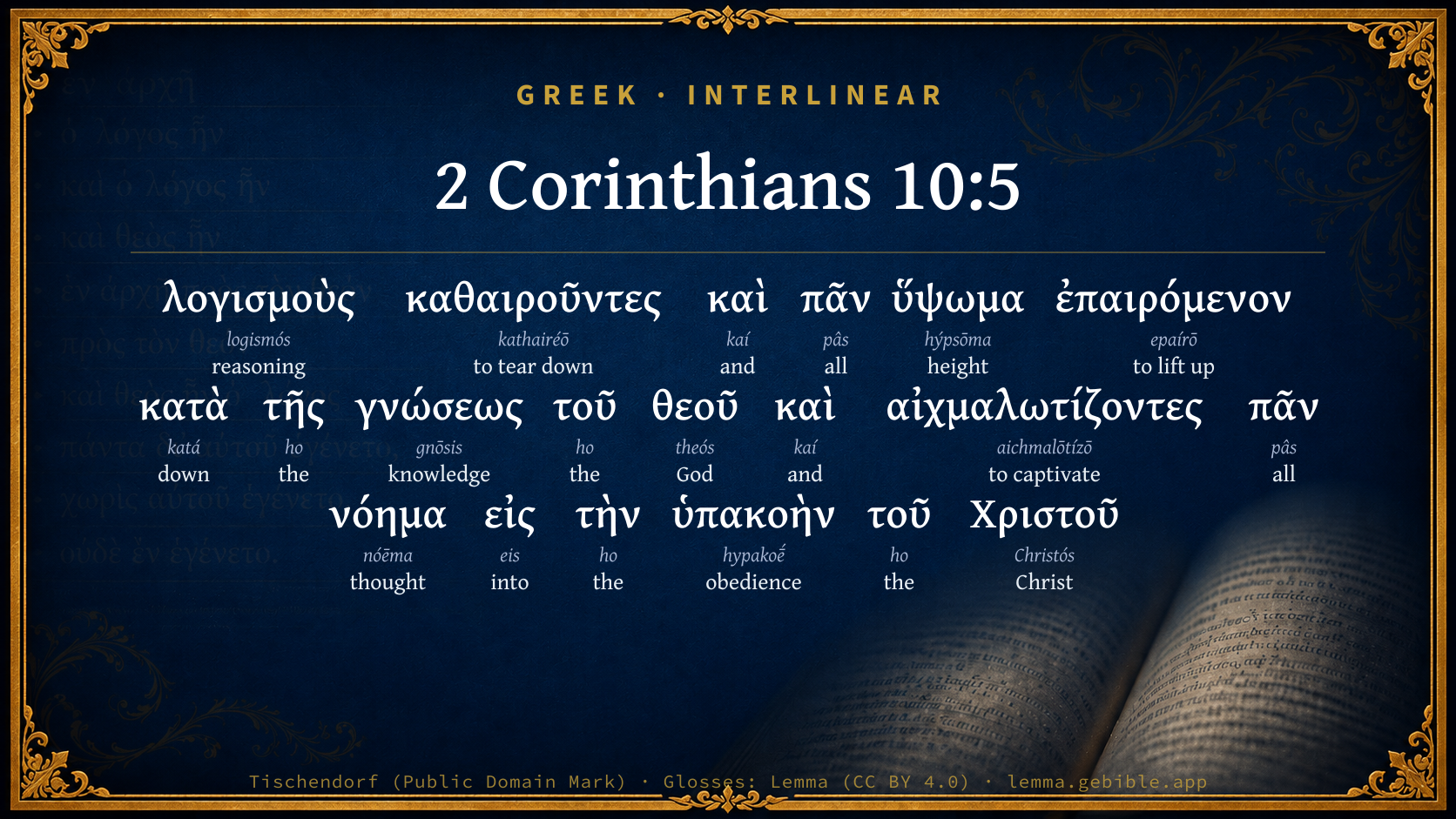
throwing down imaginations and every high thing that is exalted against the knowledge of God, and bringing every thought into captivity to the obedience of Christ;
Download a study sheet
One document with this verse’s original text, its word-by-word gloss line, the meaning frame, cross-references with their text, attributed commentary, and full source and license credits — printable, and it pastes into notes with its structure intact.
This verse Autodidact and up
A passage Seminary Student
Up to 50 verses in one chapter. A passage sheet keeps up to 6 commentary sources and 12 cross-references per verse, in the order this page ranks them, and says so on the sheet whenever that leaves anything out. Ask for a single verse and you get the Autodidact verse sheet above.
Everything on this page stays free to read, with no account — the sheet is a download of what is already on screen, not access to it.
Compare translations 3
The same verse in 3 English versions, stacked beneath the original-language interlinear above. Click any original word for its lexicon entry.
Each is an independent rendering of the whole verse — the interlinear is not word-aligned to these translations.
Highlighted words mark where these versions differ — a whole-verse word diff, not a word-by-word alignment.
-
World English Bible Public Domain
throwing down imaginations and every high thing that is exalted against the knowledge of God, and bringing every thought into captivity to the obedience of Christ;
-
King James Version Public Domain
Casting down imaginations, and every high thing that exalteth itself against the knowledge of God, and bringing into captivity every thought to the obedience of Christ;
-
unfoldingWord Literal Text CC BY-SA 4.0
and every high thing raising itself up against the knowledge of God, and we take every thought captive into the obedience of Christ;
unfoldingWord Literal Text — © unfoldingWord, licensed CC BY-SA 4.0. Word-aligned USFM3 via Door43 (git.door43.org/unfoldingWord/en_ult).
Show all 19 translations
Every available English version of this verse, each an independent rendering of the whole verse.
-
World English Bible Public Domain
throwing down imaginations and every high thing that is exalted against the knowledge of God, and bringing every thought into captivity to the obedience of Christ;
-
Berean Standard Bible Public Domain
We tear down arguments and every presumption set up against the knowledge of God; and we take captive every thought to make it obedient to Christ.
-
Majority Standard Bible Public Domain
We demolish arguments and every presumption set up against the knowledge of God; and we take captive every thought to make it obedient to Christ.
-
King James Version Public Domain
Casting down imaginations, and every high thing that exalteth itself against the knowledge of God, and bringing into captivity every thought to the obedience of Christ;
-
American Standard Version (1901) Public Domain
casting down imaginations, and every high thing that is exalted against the knowledge of God, and bringing every thought into captivity to the obedience of Christ;
-
Revised Version (1885) Public Domain
casting down imaginations, and every high thing that is exalted against the knowledge of God, and bringing every thought into captivity to the obedience of Christ;
-
Geneva Bible (1599) Public Domain
Casting downe the imaginations, and euery high thing that is exalted against the knowledge of God, and bringing into captiuitie euery thought to the obedience of Christ,
-
Douay-Rheims (1899) Public Domain
And every height that exhalteth itself against the knowledge of God, and bringing into captivity every understanding unto the obedience of Christ;
-
Young's Literal Translation Public Domain
reasonings bringing down, and every high thing lifted up against the knowledge of God, and bringing into captivity every thought to the obedience of the Christ,
-
Literal Standard Version CC BY-SA 4.0
bringing down reasonings, and every high thing lifted up against the knowledge of God, and bringing into captivity every thought to the obedience of the Christ,
-
Unlocked Literal Bible CC BY-SA 4.0
We also destroy every high thing that rises up against the knowledge of God. We take every thought captive into obedience to Christ.
-
unfoldingWord Literal Text CC BY-SA 4.0
and every high thing raising itself up against the knowledge of God, and we take every thought captive into the obedience of Christ;
-
Darby Bible Public Domain
overthrowing reasonings and every high thing that lifts itself up against the knowledge of God, and leading captive every thought into the obedience of the Christ;
-
World Messianic Bible Public Domain
throwing down imaginations and every high thing that is exalted against the knowledge of God and bringing every thought into captivity to the obedience of Messiah,
-
Webster's Bible Public Domain
Casting down imaginations, and every high thing that exalteth itself against the knowledge of God, and bringing into captivity every thought to the obedience of Christ;
-
Free Bible Version CC BY-SA 4.0
Every high wall that stands tall and proud against the knowledge of God is knocked down. Every rebel idea is captured and brought into obedient agreement with Christ.
-
Bible in Basic English Public Domain
Putting an end to reasonings, and every high thing which is lifted up against the knowledge of God, and causing every thought to come under the authority of Christ;
-
Text-Critical English NT CC BY 4.0
We tear down arguments and every high thing that exalts itself against the knowledge of God, and we take every thought captive to the obedience of Christ.
-
Tyndale New Testament (1534) Public Domain
wherwith we overthrowe ymaginacyons and every hye thynge that exalteh it silfe agaynst the knowledge of god and brynge into captivite all vnderstondynge to the obedience of Christ
Literal Standard Version (2020), Covenant Press — licensed CC BY-SA 4.0. Text via the HelloAO Bible API (eBible.org). Unlocked Literal Bible (unfoldingWord) — licensed CC BY-SA 4.0. Text via the HelloAO Bible API (eBible.org). unfoldingWord Literal Text — © unfoldingWord, licensed CC BY-SA 4.0. Word-aligned USFM3 via Door43 (git.door43.org/unfoldingWord/en_ult). Free Bible Version, Dr. Jonathan Gallagher — licensed CC BY-SA 4.0. Text via the HelloAO Bible API (eBible.org).
Word by word
More ways to search: Search by grammar → Find every occurrence → Compare this word →
Practice this passage: Drill this verse → Learn its vocabulary →
- Appears 2× in the Greek New Testament
- First appears at Romans 2:15
- Part of Speech
- Noun
- Case
- Accusative
- Number
- Plural
- Gender
- Masculine
Full Thayer's Definition
- λογισμοὺς logismós G3053 “reasoning” Noun, Accusative, Plural, Masculine
- καθαιροῦντες kathairéō G2507 “to tear down” Verb, Present, Active, Participle, Nominative, Plural, Masculine
- καὶ kaí G2532 “and” Conjunction
- πᾶν pâs G3956 “all” Adjective, Accusative, Singular, Neuter
- ὕψωμα hýpsōma G5313 “height” Noun, Accusative, Singular, Neuter
- ἐπαιρόμενον epaírō G1869 “to lift up” Verb, Present, Middle, Participle, Accusative, Singular, Neuter
- κατὰ katá G2596 “down” Preposition
- τῆς ho G3588 “the” Article, Genitive, Singular, Feminine
- γνώσεως gnōsis G1108 “knowledge” Noun, Genitive, Singular, Feminine
- τοῦ ho G3588 “the” Article, Genitive, Singular, Masculine
- θεοῦ theós G2316 “God” Noun, Genitive, Singular, Masculine
- καὶ kaí G2532 “and” Conjunction
- αἰχμαλωτίζοντες aichmalōtízō G163 “to captivate” Verb, Present, Active, Participle, Nominative, Plural, Masculine
- πᾶν pâs G3956 “all” Adjective, Accusative, Singular, Neuter
- νόημα nóēma G3540 “thought” Noun, Accusative, Singular, Neuter
- εἰς eis G1519 “into” Preposition
- τὴν ho G3588 “the” Article, Accusative, Singular, Feminine
- ὑπακοὴν hypakoḗ G5218 “obedience” Noun, Accusative, Singular, Feminine
- τοῦ ho G3588 “the” Article, Genitive, Singular, Masculine
- Χριστοῦ Christós G5547 “Christ” Noun, Genitive, Singular, Masculine
About this verse
These counts appear in no published source. They are computed here, from the morphology-tagged text and Lemma’s own curated glosses. What Lemma adds →
- 20
- words
- 15
- distinct lemmas
- Pauline Epistles
- section
Cross-references
45Topical passages linked to 2 Corinthians 10:5 in the Treasury of Scripture Knowledge — connected by theme and wording, ordered by reader-vote popularity; previews shown in the World English Bible.
- Hebrews 4:12 For the word of God is living, and active, and sharper than any two-edged sword, and piercing even to the dividing of soul and spirit, of both joints and marrow, and is able to discern the thoughts and intentions of the heart.
- Isaiah 55:7 let the wicked forsake his way, and the unrighteous man his thoughts; and let him return to Yahweh, and he will have mercy on him; and to our God, for he will abundantly pardon.
- 1 Peter 1:14–15 as children of obedience, not conforming yourselves according to your former lusts as in your ignorance,
- Romans 7:23 but I see a different law in my members, warring against the law of my mind, and bringing me into captivity under the law of sin which is in my members.
- Matthew 15:19 For out of the heart come forth evil thoughts, murders, adulteries, sexual sins, thefts, false testimony, and blasphemies.
- Romans 1:21 Because, knowing God, they didn't glorify him as God, neither gave thanks, but became vain in their reasoning, and their senseless heart was darkened.
- Jeremiah 4:14 Jerusalem, wash your heart from wickedness, that you may be saved. How long shall your evil thoughts lodge within you?
- 1 Corinthians 3:19 For the wisdom of this world is foolishness with God. For it is written, "He has taken the wise in their craftiness."
- Isaiah 2:11–12 The lofty looks of man will be brought low, The haughtiness of men will be bowed down, And Yahweh alone will be exalted in that day.
- Psalms 139:2 You know my sitting down and my rising up. You perceive my thoughts from afar.
- 1 Corinthians 1:19 For it is written, "I will destroy the wisdom of the wise, I will bring the discernment of the discerning to nothing."
- Proverbs 15:26 Yahweh detests the thoughts of the wicked, But the thoughts of the pure are pleasing.
- Matthew 11:29–30 Take my yoke upon you, and learn from me, for I am gentle and lowly in heart; and you will find rest for your souls.
- Psalms 10:4 The wicked, in the pride of his face, Has no room in his thoughts for God.
- Hebrews 5:9 Having been made perfect, he became to all of those who obey him the author of eternal salvation,
- 1 Peter 1:22 Seeing you have purified your souls in your obedience to the truth through the Spirit in sincere brotherly affection, love one another from the heart fervently:
- 1 Corinthians 1:27–29 but God chose the foolish things of the world that he might put to shame those who are wise. God chose the weak things of the world, that he might put to shame the things that are strong;
- Ezekiel 17:24 All the trees of the field shall know that I, Yahweh, have brought down the high tree, have exalted the low tree, have dried up the green tree, and have made the dry tree to flourish; I, Yahweh, have spoken and have done it.
- Proverbs 24:9 The schemes of folly are sin. The mocker is detested by men.
- Philippians 3:4–9 though I myself might have confidence even in the flesh. If any other man thinks that he has confidence in the flesh, I yet more:
- 2 Thessalonians 2:8 Then the lawless one will be revealed, whom the Lord will kill with the breath of his mouth, and bring to nothing by the brightness of his coming;
- Deuteronomy 15:9 Beware that there not be a base thought in your heart, saying, The seventh year, the year of release, is at hand; and your eye be evil against your poor brother, and you give him nothing; and he cry to Yahweh against you, and it be sin to you.
- Isaiah 2:17 The loftiness of man shall be bowed down, And the haughtiness of men shall be brought low; And Yahweh alone shall be exalted in that day.
- Isaiah 59:7 Their feet run to evil, and they make haste to shed innocent blood: their thoughts are thoughts of iniquity; desolation and destruction are in their paths.
- Luke 1:51 He has shown strength with his arm. He has scattered the proud in the imagination of their heart.
- Daniel 4:37 Now I, Nebuchadnezzar, praise and extol and honor the King of heaven; for all his works are truth, and his ways justice; and those who walk in pride he is able to abase.
- Romans 16:26
- 2 Corinthians 9:13 seeing that through the proof given by this service, they glorify God for the obedience of your confession to the Gospel of Christ, and for the liberality of your contribution to them and to all;
- 2 Thessalonians 2:4 he who opposes and exalts himself against all that is called God or that is worshiped; so that he sits as God in the temple of God, setting himself up as God.
- 2 Kings 19:22 Whom have you defied and blasphemed? and against whom have you exalted your voice and lifted up your eyes on high? [even] against the Holy One of Israel.
- 2 Kings 19:28 Because of your raging against me, and because your arrogance is come up into my ears, therefore will I put my hook in your nose, and my bridle in your lips, and I will turn you back by the way by which you came.
- Isaiah 60:14 The sons of those who afflicted you shall come bending to you; and all those who despised you shall bow themselves down at the soles of your feet; and they shall call you The city of Yahweh, The Zion of the Holy One of Israel.
- Romans 1:5 through whom we received grace and apostleship, for obedience of faith among all the nations, for his name's sake;
- Acts 4:25–26 who by the mouth of your servant, David, said, 'Why do the nations rage, And the peoples plot a vain thing?
- 1 Peter 1:2 according to the foreknowledge of God the Father, in sanctification of the Spirit, that you may obey Jesus Christ and be sprinkled in his blood: Grace to you and peace be multiplied.
- Exodus 9:16–17 but indeed for this cause I have made you stand: to show you my power, and that my name may be declared throughout all the earth;
- Daniel 5:23–30 but have lifted up yourself against the Lord of heaven; and they have brought the vessels of his house before you, and you and your lords, your wives and your concubines, have drunk wine from them; and you have praised the gods of silver and gold, of brass, iron, wood, and stone, which don't see, nor hear, nor know; and the God in whose hand your breath is, and whose are all your ways, you have not glorified.
- Job 40:11–12 Pour forth the fury of your anger. Look on everyone who is proud, and bring him low.
- Psalms 18:27 For you will save the afflicted people, But the haughty eyes you will bring down.
- Acts 9:4–6 He fell on the earth, and heard a voice saying to him, "Saul, Saul, why do you persecute me?"
- Job 42:6 Therefore I abhor myself, And repent in dust and ashes."
- Exodus 5:2 Pharaoh said, "Who is Yahweh, that I should listen to his voice to let Israel go? I don't know Yahweh, and moreover I will not let Israel go."
- Psalms 18:44 As soon as they hear of me they shall obey me. The foreigners shall submit themselves to me.
- Psalms 110:2–3 Yahweh will send forth the rod of your strength out of Zion. Rule in the midst of your enemies.
- Genesis 8:21 Yahweh smelled the sweet savor. Yahweh said in his heart, "I will not again curse the ground any more for man's sake, because the imagination of man's heart is evil from his youth; neither will I ever again strike everything living, as I have done.
Cross-references courtesy of OpenBible.info (CC BY 4.0).
Lesson kit
Teaching starters — assembled from the data on this page, not authored interpretation. Every prompt links to the verse data it draws on. Edit before teaching.
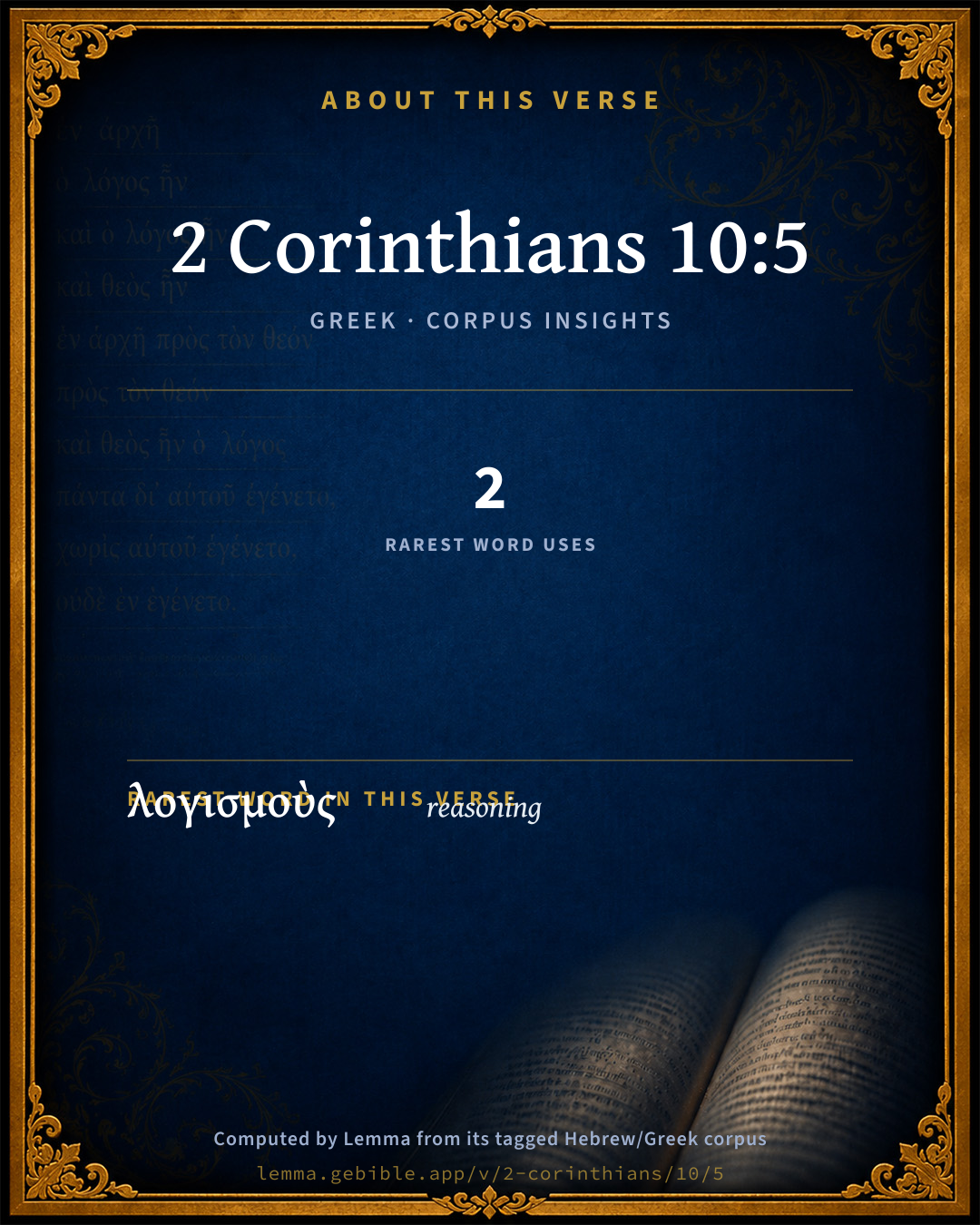
2 Corinthians, in the Pauline Epistles, opens this verse with 20 words (15 distinct Greek lemmas). Its most distinctive word is logismós (“reasoning”). A historical commentator’s framing appears above. Read the whole chapter for the surrounding context.
Discussion questions
- How does “reasoning” (logismós) shape what this verse is saying?
- Romans 2:15 shares the word «reasoning» with this verse. How do the two illuminate each other?
- “all” occurs 2× in this one verse. What is the effect of the repetition?
- These translations render this verse differently; the difference is in the English rendering, not the original. What questions does that raise?
- Reading how The Biblical Illustrator and Joseph Benson's Commentary read this verse, where do the two commentators agree and where do they part?
Things to notice
- These translations choose different wording for 14 words in this verse.
- “all” occurs 2× in this single verse.
- 15 distinct Greek lemmas span 20 words in this verse.
Commentary
Notes on 2 Corinthians 10:5 from classic Christian and Jewish commentators (each source and its license shown beneath its notes). The classic Christian expositions comment on the surrounding passage and are grouped to its opening verse, so a note may address several verses; the Jewish commentaries on the Tanakh (Rashi and others) are per-verse, so they appear only where the commentator wrote on this verse.
Lemma curates 59 commentaries, every one of them public domain or Creative Commons licensed, each selected and text-cleaned for this edition rather than reprinted as found. About our sources →
The Biblical Illustrator
Joseph S. Exell
The Biblical Illustrator, edited by Joseph S. Exell (c. 1880s–1900s) — public domain. Text from a community e-Sword module.
Joseph Benson's Commentary
Joseph Benson's Commentary on the Old and New Testaments (1811–1818) — public domain. Text from a community e-Sword module.
Whedon's Commentary on the Bible
Daniel D. Whedon
Daniel D. Whedon (gen. ed.), Commentary on the Old and New Testaments (1874–1909) — public domain. Text from a community e-Sword module.
The Pulpit Commentary
The Pulpit Commentary (1880–1919), ed. H.D.M. Spence-Jones & Joseph S. Exell — public domain. Text from a community e-Sword module.
MacLaren's Expositions of Holy Scripture
Alexander MacLaren
Alexander MacLaren, Expositions of Holy Scripture (1904–1910) — public domain. Text from a community e-Sword module.
Bengel's Gnomon
Johann Albrecht Bengel
Bengel's Gnomon of the New Testament — English translation (T&T Clark, Edinburgh, 1860) — public domain. Text from a community e-Sword module.
Meyer's Critical & Exegetical Commentary
Heinrich August Wilhelm Meyer
Meyer — Critical and Exegetical Commentary on the New Testament — English translation by Peter Christie, edited by Frederick Crombie (T&T Clark, 1880) — public domain. Text from a community e-Sword module.
Expositor's Greek Testament
ed. W. Robertson Nicoll
The Expositor's Greek Testament, edited by W. Robertson Nicoll (1897–1910) — public domain. Text from a community e-Sword module.
Geneva Bible (1599)
Geneva Bible translators
Geneva Bible (1599) marginal notes — public domain. Text via Bolls.life.
Jamieson, Fausset & Brown
Robert Jamieson, A. R. Fausset & David Brown
Jamieson, Fausset & Brown — Commentary Critical and Explanatory on the Whole Bible (1871) — public domain (CC PDM 1.0). Text via the HelloAO Bible API.
Adam Clarke's Commentary
Adam Clarke's Commentary on the Bible (1810–1826) — public domain. Text from a community e-Sword/MySword module.
John Calvin's Commentaries
John Calvin's Commentaries (1540-1563) — public domain. Text from the Calvin Translation Society English edition (1840s-50s) via the Christian Classics Ethereal Library (ccel.org). Calvin's coverage is partial (roughly two-thirds of the Bible); uncommented books and verses are honest gaps, never fabricated. The 19th-century editor's footnotes and remarks are omitted so the notes are faithfully Calvin's own voice.
Ellicott's Commentary for English Readers
A Bible Commentary for English Readers, edited by Charles John Ellicott (1878–1897) — public domain. Text from a community e-Sword module.
The Cambridge Bible for Schools and Colleges
gen. ed. J. J. S. Perowne
The Cambridge Bible for Schools and Colleges (gen. ed. J. J. S. Perowne; Cambridge University Press, 1878–1918) — public domain. Text from a community e-Sword module.
John Gill's Exposition
John Gill's Exposition of the Whole Bible (1746–1763) — public domain (CC PDM 1.0). Text via the HelloAO Bible API.
Trapp's Complete Commentary
John Trapp
John Trapp, A Commentary or Exposition upon All the Books of the Old and New Testament (1647–1656) — public domain. Text from a community e-Sword module.
Albert Barnes' Notes on the Bible
Albert Barnes' Notes on the Bible (1834–1885) — public domain. Text from a community e-Sword/MySword module.
Matthew Poole's English Annotations
Matthew Poole's English Annotations on the Holy Bible (1683–1685) — public domain. Text from a community e-Sword/MySword module.
John Wesley's Explanatory Notes
John Wesley, Explanatory Notes Upon the Whole Bible (1754–1765) — public domain. Text via the GEBible commentary corpus.
McGarvey & Pendleton's Commentaries
J. W. McGarvey
J. W. McGarvey (with Philip Y. Pendleton), Commentaries on the New Testament (The Fourfold Gospel, 1914; Acts; and the epistles) — public domain. Text from a community e-Sword/MySword module.
The People's New Testament
B. W. Johnson
B. W. Johnson's The People's New Testament with Notes (1889–1891) — public domain. Electronic text from the Christian Classics Ethereal Library (CCEL) ThML edition.
unfoldingWord translationNotes
Door43 World Missions Community
unfoldingWord translationNotes — © Distant Shores Media and the Door43 World Missions Community, licensed CC BY-SA 4.0. Source: git.door43.org/Door43/en_tn.
Cambridge Greek Testament for Schools and Colleges
Cambridge Greek Testament for Schools and Colleges (Cambridge University Press, 1896; 21 vols, various authors incl. Carr, Maclear, Plummer, Farrar, Lumby, Moule, M. R. James, Simcox) — public domain. Text from a community e-Sword module.
Alford’s Greek Testament
Henry Alford
Henry Alford, The Greek Testament (1849–1861) — public domain. Text from a community e-Sword module.
International Critical Commentary
International Critical Commentary — older volumes (1896–1929), various authors — public domain. Text from a community e-Sword module.
Vincent's Word Studies in the New Testament
Marvin R. Vincent
Marvin R. Vincent, Word Studies in the New Testament (1887–1900) — public domain. Text from a community e-Sword/MySword module.