Romans 14:22

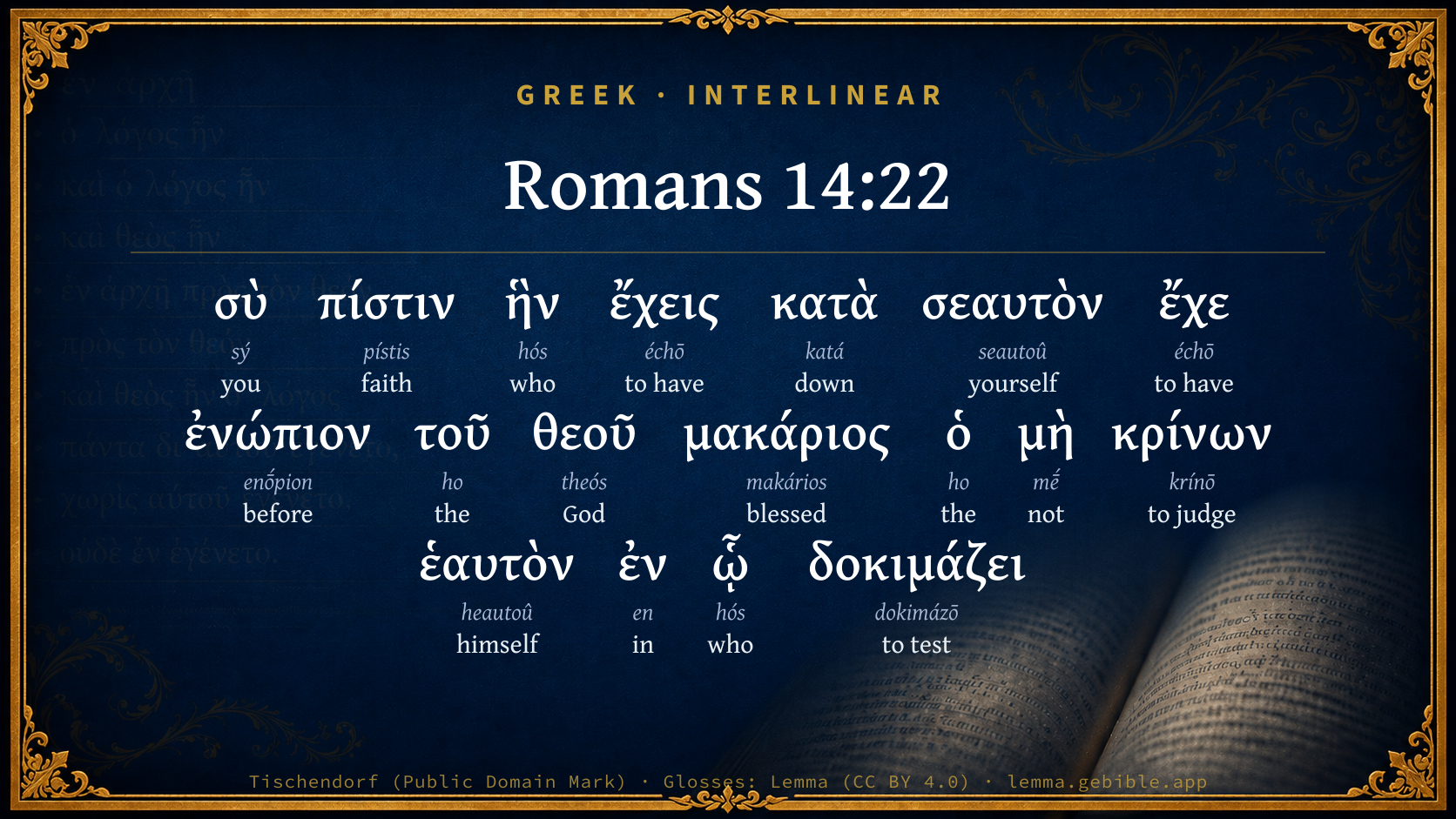
Greek (Tischendorf 8th ed.) Romans 14:22 appears in the Greek New Testament. The text above is from the Tischendorf 8th edition. Each word links to its Strong’s number and a concise gloss. Click any word for its full Thayer’s Greek Lexicon entry.
Download image
Cite this verse

Romans 14:22 (World English Bible). Public Domain. Lemma interlinear Bible study tool, https://lemma.gebible.app/v/romans/14/22.

Show BibTeX & RIS
BibTeX
RIS
English Translation
Do you have faith? Have it to yourself before God. Happy is he who doesn't judge himself in that which he approves.
World English Bible · Public Domain
Download a study sheet

One document with this verse’s original text, its word-by-word gloss line, the meaning frame, cross-references with their text, attributed commentary, and full source and license credits — printable, and it pastes into notes with its structure intact.

This verse Autodidact and up

Study sheet (.html) Plain text (.txt)

A passage Seminary Student

Up to 50 verses in one chapter. A passage sheet keeps up to 6 commentary sources and 12 cross-references per verse, in the order this page ranks them, and says so on the sheet whenever that leaves anything out. Ask for a single verse and you get the Autodidact verse sheet above.

Everything on this page stays free to read, with no account — the sheet is a download of what is already on screen, not access to it.

Want to remove ads? Support Godless Engineer
Compare translations 3

The same verse in 3 English versions, stacked beneath the original-language interlinear above. Click any original word for its lexicon entry.

Each is an independent rendering of the whole verse — the interlinear is not word-aligned to these translations.

Highlighted words mark where these versions differ — a whole-verse word diff, not a word-by-word alignment.

  • World English Bible Public Domain
    Do you have faith? Have it to yourself before God. Happy is he who doesn't judge himself in that which he approves.
  • King James Version Public Domain
    Hast thou faith? have it to thyself before God. Happy is he that condemneth not himself in that thing which he alloweth.
  • unfoldingWord Literal Text CC BY-SA 4.0
    The faith that you yourself have, keep according to yourself before God. Blessed the one not judging himself in what he approves.

unfoldingWord Literal Text — © unfoldingWord, licensed CC BY-SA 4.0. Word-aligned USFM3 via Door43 (git.door43.org/unfoldingWord/en_ult).

Versions to compare (up to 4)

3 of 4 selected

Show all 19 translations

Every available English version of this verse, each an independent rendering of the whole verse.

  • World English Bible Public Domain
    Do you have faith? Have it to yourself before God. Happy is he who doesn't judge himself in that which he approves.
  • Berean Standard Bible Public Domain
    Keep your belief about such matters between yourself and God. Blessed is the one who does not condemn himself by what he approves.
  • Majority Standard Bible Public Domain
    Keep your belief about such matters between yourself and God. Blessed is the one who does not condemn himself by what he approves.
  • King James Version Public Domain
    Hast thou faith? have it to thyself before God. Happy is he that condemneth not himself in that thing which he alloweth.
  • American Standard Version (1901) Public Domain
    The faith which thou hast, have thou to thyself before God. Happy is he that judgeth not himself in that which he approveth.
  • Revised Version (1885) Public Domain
    The faith which thou hast, have thou to thyself before God. Happy is he that judgeth not himself in that which he approveth.
  • Geneva Bible (1599) Public Domain
    Hast thou faith? haue it with thy selfe before God: blessed is hee that condemneth not himselfe in that thing which he aloweth.
  • Douay-Rheims (1899) Public Domain
    Hast thou faith? Have it to thyself before God. Blessed is he that condemneth not himself in that which he alloweth.
  • Young's Literal Translation Public Domain
    Thou hast faith! to thyself have `it' before God; happy is he who is not judging himself in what he doth approve,
  • Literal Standard Version CC BY-SA 4.0
    You have faith! Have [it] to yourself before God; blessed is he who is not judging himself in what he approves,
  • Unlocked Literal Bible CC BY-SA 4.0
    The faith you have, keep between yourself and God. Blessed is the one who does not condemn himself by what he approves.
  • unfoldingWord Literal Text CC BY-SA 4.0
    The faith that you yourself have, keep according to yourself before God. Blessed the one not judging himself in what he approves.
  • Darby Bible Public Domain
    Hast *thou* faith? have [it] to thyself before God. Blessed [is] he who does not judge himself in what he allows.
  • World Messianic Bible Public Domain
    Do you have faith? Have it to yourself before God. Happy is he who doesn’t judge himself in that which he approves.
  • Webster's Bible Public Domain
    Hast thou faith? have it to thyself before God. Happy is he that condemneth not himself in that thing which he alloweth.
  • Free Bible Version CC BY-SA 4.0
    What you personally believe is between you and God. Happy are those who don't condemn themselves for doing what they think is right!
  • Bible in Basic English Public Domain
    The faith which you have, have it to yourself before God. Happy is the man who is not judged by that to which he gives approval.
  • Text-Critical English NT CC BY 4.0
    Do yoʋ have a firm belief about these things? Have it privately before God. Blessed is he who does not condemn himself by what he approves.
  • Tyndale New Testament (1534) Public Domain
    Hast thou fayth? have it with thy selfe before god. Happy is he that condempneth not him selfe in that thinge which he aloweth.

Literal Standard Version (2020), Covenant Press — licensed CC BY-SA 4.0. Text via the HelloAO Bible API (eBible.org). Unlocked Literal Bible (unfoldingWord) — licensed CC BY-SA 4.0. Text via the HelloAO Bible API (eBible.org). unfoldingWord Literal Text — © unfoldingWord, licensed CC BY-SA 4.0. Word-aligned USFM3 via Door43 (git.door43.org/unfoldingWord/en_ult). Free Bible Version, Dr. Jonathan Gallagher — licensed CC BY-SA 4.0. Text via the HelloAO Bible API (eBible.org).

Word by word

More ways to search: Search by grammar → Find every occurrence → Compare this word →

Practice this passage: Drill this verse → Learn its vocabulary →

δοκιμάζει
dokimázō
G1381
“to test”
Verb, Present, Active, Indicative, 3rd person, Singular
Part of Speech
Verb
Tense
Present
Voice
Active
Mood
Indicative
Person
3rd person
Number
Singular
Full Thayer's Definition

Origin: from G1384

TDNT: 06:15,2

1. to test, examine, prove, scrutinise (to see whether a thing is genuine or not), as metals 2. to recognise as genuine after examination, to approve, deem worthy
  1. σὺ sý G4771 “you” Personal pronoun, 2nd person, Nominative, Singular
  2. πίστιν pístis G4102 “faith” Noun, Accusative, Singular, Feminine
  3. ἣν hós G3739 “who” Relative pronoun, Accusative, Singular, Feminine
  4. ἔχεις échō G2192 “to have” Verb, Present, Active, Indicative, 2nd person, Singular
  5. κατὰ katá G2596 “down” Preposition
  6. σεαυτὸν seautoû G4572 “yourself” Reflexive pronoun, 2nd person, Accusative, Singular, Masculine
  7. ἔχε échō G2192 “to have” Verb, Present, Active, Imperative, 2nd person, Singular
  8. ἐνώπιον enṓpion G1799 “before” Adverb
  9. τοῦ ho G3588 “the” Article, Genitive, Singular, Masculine
  10. θεοῦ theós G2316 “God” Noun, Genitive, Singular, Masculine
  11. μακάριος makários G3107 “blessed” Adjective, Nominative, Singular, Masculine
  12. ὁ ho G3588 “the” Article, Nominative, Singular, Masculine
  13. μὴ mḗ G3361 “not” Particle, Negative
  14. κρίνων krínō G2919 “to judge” Verb, Present, Active, Participle, Nominative, Singular, Masculine
  15. ἑαυτὸν heautoû G1438 “himself” Reflexive pronoun, 3rd person, Accusative, Singular, Masculine
  16. ἐν en G1722 “in” Preposition
  17. ᾧ hós G3739 “who” Relative pronoun, Dative, Singular, Neuter

About this verse

These counts appear in no published source. They are computed here, from the morphology-tagged text and Lemma’s own curated glosses. What Lemma adds →

18
words
15
distinct lemmas
Pauline Epistles
section

Notable vocabulary

The rarest word here is δοκιμάζει to test G1381 — appearing just 22 times in the whole Greek New Testament.

Shared distinctive vocabulary

δοκιμάζει to test G1381 occurs in 20 verses of the Greek New Testament. Also found in:

Repetition

Words recur within this verse:

Cross-references

11

Topical passages linked to Romans 14:22 in the Treasury of Scripture Knowledge — connected by theme and wording, ordered by reader-vote popularity; previews shown in the World English Bible.

  • 1 John 3:21 Beloved, if our hearts don't condemn us, we have boldness toward God;
  • Romans 14:5 One man esteems one day as more important. Another esteems every day alike. Let each man be fully assured in his own mind.
  • James 3:13 Who is wise and understanding among you? Let him show by his good conduct that his deeds are done in gentleness of wisdom.
  • Galatians 6:1 Brothers, even if a man is caught in some fault, you who are spiritual must restore such a one in a spirit of gentleness; looking to yourself so that you also aren't tempted.
  • Romans 14:23 But he who doubts is condemned if he eats, because it isn't of faith; and whatever is not of faith is sin. (14:24) Now to him who is able to establish you according to my Gospel and the preaching of Jesus Christ, according to the revelation of the mystery which has been kept secret through long ages, (14:25) but now is revealed, and by the Scriptures of the prophets, according to the commandment of the eternal God, is made known for obedience of faith to all the nations; (14:26) to the only wise God, through Jesus Christ, to whom be the glory forever! Amen.
  • Romans 14:2 One man has faith to eat all things, but he who is weak eats only vegetables.
  • Romans 14:14 I know, and am persuaded in the Lord Jesus, that nothing is unclean of itself; except that to him who considers anything to be unclean, to him it is unclean.
  • Acts 24:16 Herein I also practice always having a conscience void of offense toward God and men.
  • 2 Corinthians 1:12 For our boasting is this: the testimony of our conscience, that in holiness and sincerity of God, not in fleshly wisdom but in the grace of God we behaved ourselves in the world, and more abundantly toward you.
  • Romans 7:15 For I don't know what I am doing. For I don't practice what I desire to do; but what I hate, that I do.
  • Romans 7:24 What a wretched man I am! Who will deliver me out of the body of this death?

Cross-references courtesy of OpenBible.info (CC BY 4.0).

Commentary

Notes on Romans 14:22 from classic Christian and Jewish commentators (each source and its license shown beneath its notes). The classic Christian expositions comment on the surrounding passage and are grouped to its opening verse, so a note may address several verses; the Jewish commentaries on the Tanakh (Rashi and others) are per-verse, so they appear only where the commentator wrote on this verse.

Lemma curates 59 commentaries, every one of them public domain or Creative Commons licensed, each selected and text-cleaned for this edition rather than reprinted as found. About our sources →

The Biblical Illustrator

Joseph S. Exell

Rom_14:22-23

Hast thou faith?

Have it to thyself before God.

Duties in regard to things indifferent

Some things are unlawful in their own nature, and can never be right. Others are wrong because forbidden, and only as long as the prohibition continues, and only to the parties concerned. Others are wrong on the ground of expediency, and therefore are sometimes wrong and sometimes right. It is not always easy to discriminate these classes.

I. There are, however, certain criteria by which we can distinguish the naturally wrong from the naturally indifferent.

1. One of these is to be found in our moral constitution. We can see intuitively that malice, envy, pride, etc., are in their nature wrong. They are evil, not because they are forbidden, nor because of their injurious tendency, but they are essentially evil.

2. The Scriptures condemn such things as are in their nature evil, not for one people, nor for a limited period, but for all men always.

II. For things indifferent in their nature the scriptures lay down the following rules.

1. If prohibited for any special reason, they are unlawful while that prohibition lasts.

2. When the prohibition is removed, they are right or wrong according to circumstances.

(1) They are wrong when their use or enjoyment would do harm to others.

(2) They are right when no such evil is to be apprehended.

(3) That principle is never to be sacrificed to expediency, i.e., when doing or not doing anything would imply the denial of an important truth. All these principles are illustrated by the apostles conduct and teaching. These were circumcision, observance of Jewish holy days, and eating meats prohibited by the Mosaic law, or which had been offered to idols. Paul taught--

(a) That there was no harm in doing or neglecting them. If a man chose to circumcise his son, or to keep a holy day, or to abstain from certain meats, he was free to do so.

(b) That he must not make his judgment a rule of duty to others. He must not condemn those who thought or acted differently (Rom_14:4).

(c) But if any of these things became a source of evil, caused the weak to offend, then the law of love forbids our indulging in them, or availing ourselves of our Christian liberty,

(d) But if any of these things were urged as a matter of duty, or a condition of salvation, then it became a sin to make them necessary. Paul, therefore, although he circumcised Timothy, refused to allow Titus to be circumcised. It is difficult to determine whether compliance with the prejudices of others is right or wrong. Our Lord disregarded Jewish prejudices in regard to the Sabbath. In other cases He complied in order to avoid giving offence.

III. There are certain principles important to have fixed as guides of conduct.

1. Nothing is right or wrong which is not commanded or forbidden in Scripture.

2. We must stand fast in the liberty wherewith Christ has made us free, and not allow any rule of duty to be imposed on us.

3. In the use of this liberty, and while asserting and maintaining it, we should not so use it as to do harm to our neighbours.

4. Nothing indifferent can be a proper ground of Church discipline or a condition of Church fellowship. These principles are often violated, as in the course pursued by many on slavery, temperance, tobacco, dress, Church ceremonies, etc. (C. Hodge, D.D.)

Happy is he that condemneth not himself in that thing which he alloweth.

The management and offices of conscience

There is a great difference of opinion among good men respecting many things in religion. They are not altogether agreed respecting moral duties. There is one point, however, in which we are all agreed--which is, the necessity of every mans following the dictates of his own conscience. The man that violates his own conscience stands condemned in his own mind; whilst He is happy that condemneth not himself in that thing which he alloweth.

I. The offices of conscience. It is given us as--

1. A secret monitor. The spirit of man is the candle of the Lord. It testifies beforehand respecting the quality of the act proposed, and operates as a stimulus if the act be good, and as a check if the act be evil.

2. An authoritative judge. It is Gods vicegerent in the soul. Sometimes conscience exercises this authority immediately, as in the cases of Adam and David. At other times it delays its verdict until some occasion give reason for speaking plainly the truth, as in the case of Josephs brethren. Sometimes it delivers judgment, and so produces humiliation, as in the case of Peter; at other times it will drive a man to despondency, as in the ease of Judas.

II. Our duty to our consciences. We ought--

1. To get our consciences well informed. Conscience prescribes no rules, but gives testimony to a rule before existing. Nor does any man ever commit sin by following its dictates. St. Paul sinned, of course; but not because he followed the dictates of his conscience, but on account of his not having his conscience well informed. He did it ignorantly, through unbelief. We must always look to God to guide us by His Word and Spirit. Nor should we hastily imagine that our views are correct; we must be jealous of ourselves lest Satan deceive us; Take care that the light that is in you be not darkness, etc.

2. To consult it on all occasions. To act first, and afterwards to make inquiries, is a certain way to involve ourselves in guilt. To do anything without a careful inquiry into the quality of the action, is presumptuous. Nor is the testimony of conscience always easily obtained; sometimes, indeed, it speaks instantaneously; but generally it requires time to make a fair estimate of the circumstances; and then, if they have respect to God only, we should consider the example of Christ; or if it be in respect to man, we should change places with the person concerned. If we doubt concerning the lawfulness of anything, we are self-condemned if we perform it, for whatsoever is not of faith is sin. We should pause, in such a case, and deliberate, until we see our way clearly--and determine not to proceed in anything until we are fully persuaded in our own minds.

3. To keep it upright and tender. Conscience may easily be warped, and silenced too, so that it will give no testimony until awakened by some flagrant enormity.

III. The happiness of conformity to conscience.

1. Peace.

2. Confidence.

3. The favour of God. (C. Simeon, M.A.)

The danger of contracting unallowable habits

I. The foundation on which the caution in the text is built.

1. There are some things which are in themselves indifferent, but are sinful by accident.

(1) When they are indulged to excess; when we spend too much time about them; or indulge them to a degree that is injurious to the health of body or peace of mind.

(2) Indifferent things may become unlawful by being unseasonable. Not only the beauty and success, but the very lawfulness of an action often depends upon opportunity.

(3) Another way whereby an indifferent action may become sinful is its giving offence to others,

2. There are other kinds of actions which some men inadvertently carry into common practice that are not only circumstantially but essentially evil in themselves. And the great danger of contracting any habits of this kind lies here, that they wear off a sense of the evil of them.

II. In what manner this happiness is to be attained.

1. Let us see in what manner bad habits are originally contracted.

(1) Sometimes by implicitly following the examples of others; especially their superiors; especially if these have been distinguished for their wisdom and piety.

(2) Another thing that often draws men unawares into a sinful course of actions is precipitancy or inattention to the nature and consequences of them. Before we indulge in any kind of temper or conduct that is like to become a habit, we should ask ourselves three questions.

(a) What is it? is it in its own nature good, bad, or indifferent?

(b) Whither does it tend? what influence will it have on the temper of my mind or the health of my body?

(c) Where will it end? how will it appear in the review? and what will be the certain consequence if it settle into a habit?

(3) Men are often betrayed into an unlawful conduct by venturing boldly on the very verge of vice or going to the utmost bounds of what is lawful. The precise limits of virtue and vice are indiscernible; or, rather, the passage from the one to the other is through so easy and gradual a shade that men oftentimes insensibly slide out of the former into the latter, and are got far into the regions of vice before they are aware. And the danger of this appears still greater when we consider the nearer approach we make to a sinful object, the stronger is its attraction.

(4) Another common source of wrong conduct, and what frequently betrays men into bad habits, is the undue influence of the appetites and passions, in opposition to the dictates of conscience and reason.

(5) Another thing that deceives some unwary minds into a wrong course of conduct is the false names that are given to sinful actions, whereby the evil of them is concealed and their deformity disguised.

(6) The most common reason that men so generally condemn themselves in the things which they allow, is because they forget to form their judgment by the principles and their lives by the rules of Christianity.

2. How they are to be conquered.

(1) The difficulty of the attempt. The reason that men so seldom succeed in their attempt to break off a bad habit is because they do not set about it in good earnest or in a right way.

(2) If we would succeed in it we must often renew and reinforce our resolutions to persevere.

(a) As all bad habits are contracted by frequent repetition of bad actions, so they are conquered by a frequent repetition of the opposite good ones.

(b) Temptations are more weakened by declining than opposing them.

(c) To suppress the first motions and avoid the remote occasions of sin is the easiest way to conquer it.

(d) Let us especially beware of indolence, self-confidence, in a time of prosperity. For when we are least apprehensive of danger it is then oftentimes the nearest.

III. Illustrate the truth of the proposition contained in the text, and show wherein the happiness here mentioned doth consist. This happiness may refer both to the present and future world.

1. With regard to the present world the man who condemns not himself in the thing which he alloweth is happy in two respects especially.

(1) This gives him the best evidence he can have of his security. One who takes so much care to please God must have the fear of Him before his eyes and the love of Him in his heart.

(2) This constant care to keep our heart and conduct conformable to the Word of God will inspire us with great freedom and comfort of mind when we have access to Him in prayer. And what more comprehensive happiness can we conceive than this?

2. This happiness reaches beyond the bounds of time, and will attend us in the world of spirits, where we shall be happy beyond all that words can paint or thought conceive. Conclusion:

1. How well is Christianity adapted to promote the happiness of civil society! If it does not permit us, even in matters of indifference, to do anything that would unnecessarily offend our neighbour, this implies our duty to cultivate the greatest tenderness and good-will towards him.

2. We see that, considering the condition of our natures as frail beings and our connection with creatures as imperfect as ourselves, we are under an indispensable necessity of exercising continual circumspection and frequent self-denial and patience in order to keep our conscience clear.

3. Let us take care, then, what habits we contract, and diligently examine those we have already contracted. (J. Mason, M.A.)

Better be sure than sorry

Better be sure than sorry! said a garden-worker, when his employer expressed a doubt whether it was necessary to cover a certain vegetation to protect it from frost. Better be sure than sorry!A man who is not sure is very likely to be sorry. He who takes things on trust will be quite likely to be cheated and disappointed at last. The business man who treads in uncertain paths, who is not sure of his course, is very likely to be sorry he has taken it. Keep on the safe side. Do not give yourself the benefit of every doubt. Be lenient to others faults, but strict regarding your own. If there be an act which in your own mind is doubtful or questionable in its character, take the course of wisdom and prudence. It would be a terrible thing to be mistaken in the final day; it is better to be sure here than to be sorry at the judgment-seat of Christ. (Christian Journal.)

And he that doubteth is damned if he eat, because he eateth not of faith.--

Doubtful actions

1. Doubt of its rectitude makes the action doubtful.

2. Doubtful actions bring condemnation.

3. Condemnation implies sin.

4. The sin lies in the want of faith.

5. Therefore all doubtful actions should be avoided. (J. Lyth, D.D.)

Doubtful things

Resolved, that I will never do anything about the lawfulness of which I am doubtful, unless I am equally doubtful whether it be lawful to omit the doing of it. (Jon. Edwards.)

For whatsoever is not of faith is sin.--

I. How this is often misapplied.

1. When all the virtues of the heathen--

2. The morality of the unconverted--

3. The proprieties of civilised life--are denounced as polished vice.

II. How it ought to be applied.

1. To Christian believers.

2. As a rule for the regulation of all doubtful actions. (J. Lyth, D.D.)

Whatsoever is not of faith is sin

I. In order for works to be acceptable to god they must--

1. Be done by His grace.

2. Spring from a principle of faith.

II. The spirit which leads a man to rely on his unassisted efforts as rendering him meet to receive grace is sin, because it involves a denial of--

1. Christs atonement.

2. Human infirmity.

3. The need of the Holy Spirits help.

Lessons:

1. For reproof.

2. Correction.

3. Instruction in righteousness. (W. Webster, M.A.)

Whatsoever is not of faith is sin

I. Explain the proposition. Some actions are doubtful; in this case compliance is sinful, because it discovers--

1. A contempt of Gods authority and favour.

2. Light views of the evil of sin.

3. A great want of self-denial and resolution.

4. Some prevailing bad principle or motive of action.

5. And leads to greater irregularities.

II. Some practical reflections.

1. How aggravated the guilt of presumptuous sin.

2. We should show a tender regard for others that we do not lead them into sin.

3. In all doubtful cases it is best to keep on the safe side. (J. Lyth, D.D.)

.

The Biblical Illustrator, edited by Joseph S. Exell (c. 1880s–1900s) — public domain. Text from a community e-Sword module.

Joseph Benson's Commentary

Rom 14:22-23. Hast thou faith — That these things are lawful? Have it to thyself, before God — In circumstances like these keep it to thyself, and do not offend others by it. Happy is he that condemneth not himself — For using his liberty in an undue manner, respecting those things which he practises, or judges lawful in themselves. Or, as others understand the apostle, that condemneth not himself by an improper use of even innocent things. And happy is he who is free from a doubting conscience, which he that hath may allow the action which he does, and yet condemn himself for it, and thereby make himself miserable. And he that doubteth — Namely, whether it be lawful for him to eat, (or do any other thing,) or not, is damned — Or condemned, contracts guilt and wounds his conscience; if he eat — That which he doubts of, or does that the lawfulness of which he questions; because he eateth not of faith — With a persuasion of its lawfulness. For whatsoever is not of faith is sin — Whatever a man does without a full persuasion that it is lawful, it is sin to him. The reader will observe that here, as in Rom 14:22, faith does not signify the believing in Christ, and in the truths and promises of his gospel, but a persuasion that what one doth is lawful. And thus understood, the apostle’s declaration is perfectly just in every case; because if a man acts without that persuasion, he acts without any principle of virtue, being guided merely by his own inclinations. And therefore, although what he doth may, in some instances, be materially right, it is sin in the sight of God, as being done without a sense of duty. From this it follows, that if a person acts contrary to his conscience in anything, he is exceedingly blameable.

Joseph Benson's Commentary on the Old and New Testaments (1811–1818) — public domain. Text from a community e-Sword module.

Tyndale Open Study Notes

Tyndale Open Resources

14:22 keep it between yourself and God: Paul did not contest the freedom of the strong believers, but he instructed them to limit the expression of their freedom out of love for fellow believers so that the whole Christian community could be built up. • Blessed are those who don’t feel guilty: Guilt could come from harming the faith of the weak believers. Christian freedom is only worthwhile when it can be lived out without bringing such guilt.

Tyndale Open Study Notes — © Tyndale Open Resources, licensed CC BY-SA 4.0. Text via the HelloAO Bible API.

Bengel's Gnomon

Johann Albrecht Bengel

Rom 14:22. Πίστιν, faith) concerning the cleanness of meat [all meats alike].—σεαυτὸν,—Θεοῦ, thyself—of God) a double antithesis, in relation to our neighbour; as in ch. Rom 15:3.—ἔχε, have) The foundation of real prudence and judicious concealment [of our views on non-essentials, for the sake of our neighbour].—μακάριος, happy) These words down to the end of the chapter, contain the antithesis to ch. Rom 15:1, but.—κρίνων, judging [condemning]) [Condemning] judging and approving are the words in antithesis: by combining the two, the doubting conscience is exquisitely described, when a man approves a thing, and yet [condemns] judges his own action.

Bengel's Gnomon of the New Testament — English translation (T&T Clark, Edinburgh, 1860) — public domain. Text from a community e-Sword module.

Meyer's Critical & Exegetical Commentary

Heinrich August Wilhelm Meyer

Rom_14:22-23. Σὺ πίστιν ἔχεις] may be viewed either concessively (Luther, Beza, and many others, including Scholz, Tischendorf, Fritzsche, Tholuck, Hofmann) or interrogatively (Calvin, Grotius, Calovius, and most moderns). Comp. on Rom_13:3. The latter (already in Oecumenius, and probably also Chrysostom) corresponds better to the increasing animation of the discourse. Paul hears, as it were, how the strong in faith opposes him with an ἐγὼ πίστιν ἔχω, and he replies thereto: Thou hast faith? Thou partakest of the confidence of faith grounded on Christ, respecting the allowableness of the eating and drinking (Rom_14:2; Rom_14:21), which is here in question?

Have it for thyself (ἀρκείτω σου τὸ συνειδός, Chrysostom) before God, so that God is the witness of thy faith, and thou dost not make a parade of it before men to the offence of the weak. Fundamentum verae prudentiae et dissimulationis, Bengel.

ἔχε] not: thou mayest have it (Reiche), which deprives the imperative expression of its force.

κατὰ σεαυτόν] for thyself alone; see Kühner, II. 1, p. 414. Comp. Heliodorus, vii. 16 : κατὰ σαυτὸν ἔχε καὶ μηδενὶ φράζε, also the classical αὐτὸς ἔχε, keep it for thyself.

μακάριος … κατακέκριται forms a twofold consideration, which must influence the strong one not to abuse his strong faith to the prejudice of the weaker; namely, (1) he has in truth on his side the high advantage, which is expressed by μακάριος … δοκιμάζει; on the other hand, (2) the danger is great for the weak one, if he through the example of the strong one is tempted to a partaking contrary to his conscience (ὁ δὲ διακρινόμενος κ.τ.λ.). How shouldest thou not content thyself with that privilege, and spare this peril to the weak! On the formal mutual relation of κρίν., διακρίν., and κατακρίν., comp. 1Co_11:31-32, where, however, the definition of the sense is not as here.

μακάριος] for the Messianic blessedness, which has been acquired for him through Christ, does not become lost to him through conscientious doubts in the determining of his action.

κρίνων] not equivalent to κατακρίνων, as, since Chrysostom, most interpreters think; against which the climax κρίνων, διακρινόμενος, κατακέκριται is decisive. It means: he who does not hold judgment upon himself, i.e. he who is so certain of his conviction, that his decision for this or that course is liable to no self-judgment; he does not institute any such judgment, as the anxious and uncertain one does.

ἐν ᾧ δοκιμάζει] in that which he approves, i.e. agendum eligit (Estius). Luther aptly renders: in that which he accepts. Comp. 2Ma_4:3; Dem. 1381. 6; Plato, Legg. p. 579 C; Diod. Sic. iv. 7.

Rom_14:23 : But he who wavers (διακρίν., qui dubius haeret., see on Rom_4:20), as to whether, namely, the eating is really allowed or not, is, if he shall have eaten, condemned, eo ipso (comp. on Rom_13:8; Joh_3:18) liable to the divine penal judgment, the opposite of μακάριος; comp. ἀπόλλυε, Rom_14:15. The matter is apprehended from the point of view of morally ideal strictness. Actual self-condemnation (Chrysostom, Theodoret, Grotius, and others, including Hofmann) would have required a more precise designation.

ὅτι οὐκ ἐκ πίστεως] sc. ἔφαγε.

πᾶν δὲ κ.τ.λ.] may be still connected with ὅτι: because he ate not from faith, but all, that comes not from faith, is sin. If it is taken independently, however, the sense is more emphatic. In the conclusion, which proves the κατακέκριται, πᾶν δὲ … ἁμαρτ. ἐστίν is the major, and οὐκ ἐκ πίστεως sc. ἔφαγε the minor premiss.

πίστις is here also none other than faith according to its moral quality (conscientiam informans et confirmans, Bengel), i.e. faith in Christ, so far as it brings with it the moral confidence as to what in general, and under given circumstances, is the right Christian mode of action. Respecting the conduct of the Christian, Paul lays down the axiom which regulates it generally, and more especially in adiaphora, that all which does not proceed from that confidence of faith as the moral spring of action is sin; to express a moral fundamental law beyond the Christian sphere of life, is foreign to his intention. Hence it was an alien proceeding to draw from the present expression, indirectly or directly,in disregard of the natural law of conscience (Rom_2:14-15),the inference that the works and even the virtues of unbelievers were all of them sins (Augustine, c. Julian. iv. 3, et al.; Luther; Form. Conc. p. 700; Calovius, and others). Very correctly Chrysostom: ταῦτα δὲ πάντα περὶ τῆς προκειμένης ὑποθέσεως εἴρηται τῷ Παύλῳ, οὐ περὶ πάντων. But against the abuse of this passage, as though it made all accountability dependent only on subjective moral conviction, see Jul. Müller, von d. Sünde, I. p. 285, ed. 5; comp. also Delitzsch, Psychol. I. p. 139.

Meyer — Critical and Exegetical Commentary on the New Testament — English translation by Peter Christie, edited by Frederick Crombie (T&T Clark, 1880) — public domain. Text from a community e-Sword module.

Expositor's Greek Testament

ed. W. Robertson Nicoll

Rom 14:22 . The true text is σὺ πίστιν ἣν ἔχεις : “the faith that thou hast, have thou to thyself in the sight of God”. The verse is still addressed to the strong. The faith he has is the enlightened faith which enables him to see that all things are clean; such faith does not lose its value though it is not flaunted in reckless action. On κατὰ σεαυτὸν Wetstein quotes Heliod. Rom 7:16 : κατὰ σεαυτὸν ἔχε καὶ μηδενὶ φράζε . Cf. 1Co 14:28 ( ἑαυτῷ δὲ λαλείτω καὶ τῷ θεῷ ). ἐνώπιον τοῦ θεοῦ reminds the strong once more (Rom 14:10 ) that the fullest freedom must be balanced by the fullest sense of responsibility to God. In another sense than that of 1Co 9:21 the Christian made free by faith must feel himself ( μὴ ἄνομος θεοῦ ἀλλʼ ἔννομος Χριστοῦ . μακάριος ὁ μὴ κρίνων ἑαυτὸν ἐν ᾧ δοκιμάζει : “a motive to charitable self-restraint addressed to the strong in faith” (Gifford). It is a rare felicity (this is always what μακάριος denotes) to have a conscience untroubled by scruples in Paul’s words, not to judge oneself in the matter which one approves ( sc. , by his own practice); and he who has this felicity should ask no more. In particular, he should not run the risk of injuring a brother’s conscience, merely for the sake of exercising in a special way the spiritual freedom which he has the happiness to possess whether he exercises it in that way or not.

The Expositor's Greek Testament, edited by W. Robertson Nicoll (1897–1910) — public domain. Text from a community e-Sword module.

Hodge's Commentary on Romans, Ephesians & First Corinthians

Charles Hodge

Rom_14:22

Hast thou faith? have it to thyself before God. Happy is he that condemneth not himself in that which he alloweth. Paul presents in this verse, more distinctly than he had before done, the idea that he required no concession of principle or renunciation of truth. He did not wish them to believe a thing to be sinful which was not sinful, or to trammel their own consciences with the scruples of their weaker brethren. He simply required them to use their liberty in a considerate and charitable manner. He, therefore, here says, Hast thou faith? (i.e., a firm persuasion, e.g., of the lawfulness of all kinds of meat) it is well, do not renounce it, but retain it and use it piously, as in the sight of God. Instead of reading the first clause interrogatively, Hast thou faith? it may be read, Thou hast faith. It is then presented in the form of an objection, which a Gentile convert might be disposed to make to the direction of the apostle to accommodate his conduct to the scruples of others. Thou hast faith, thou mayest say; well, have it, I do not call upon thee to renounce it. By faith here seems clearly to be understood the faith of which Paul had been speaking in the context; a faith which some Christians had, and others had not, viz., a firm belief that there is nothing (no meat) unclean of itself. Have it to thyself, (κατὰ σεαυτὸν ἔχε,) keep it to yourself. There are two ideas included in this phrase. The first is, keep it privately, i.e. do not parade it, or make it a point to show that you are above the weak scruples of your brethren; and the second is, that this faith or firm conviction is not to be renounced, but retained, for it is founded on the truth. Before God, i.e. in the sight of God. As God sees and recognizes it, it need not be exhibited before men. It is to be cherished in our hearts, and used in a manner acceptable to God. Being right in itself, it is to be piously, and not ostentatiously or injuriously paraded and employed.

Blessed is he that condemneth not himself in that which he alloweth. That is, blessed is the man that has a good conscience; who does not allow himself to do what he secretly condemns. The faith, therefore, of which the apostle had spoken, is a great blessing. It is a source of great happiness to be sure that what we do is right, and, therefore, the firm conviction to which some Christians had attained, was not to be undervalued or renounced. Compare Rom_1:28; 1Co_16:3, for a similar use of the word (δοκιμάζω) here employed. This interpretation seems better suited to the context, and to the force of the words, than another which is also frequently given, Blessed is the man who does not condemn himself, i.e. give occasion to others to censure him for the use which he makes of his liberty. This gives indeed a good sense, but it does not adhere so closely to the meaning of the text, nor does it so well agree with what follows.

Charles Hodge — Commentary on Romans (1835), First Corinthians (1857), and Ephesians (1856) — public domain. Text from a community e-Sword module.

Geneva Bible (1599)

Geneva Bible translators

Embraceth.

He showed before verse 14 what he meaneth by faith, to wit, for a man to be certain and out of doubt in matters and things indifferent.

He giveth a double warning in these matters, one, which pertaineth to the strong, that he which hath obtained a sure knowledge of this liberty, keep that treasure to the end he may use it wisely and profitably as hath been said: the other which respecteth the weak, that they do nothing rashly by other men’s example with a wavering conscience, for that cannot be done without sin, whereof we are not persuaded by the word of God, that he liketh, and approveth it.

Geneva Bible (1599) marginal notes — public domain. Text via Bolls.life.

Jamieson, Fausset & Brown

Robert Jamieson, A. R. Fausset & David Brown

Hast thou faith--on such matters?

have it to thyself--within thine own breast

before God--a most important clause. It is not mere sincerity, or a private opinion, of which the apostle speaks; it is conviction as to what is the truth and will of God. If thou hast formed this conviction in the sight of God, keep thyself in this frame before Him. Of course, this is not to be over-pressed, as if it were wrong to discuss such points at all with our weaker brethren. All that is here condemned is such a zeal for small points as endangers Christian love.

Happy is he that condemneth not himself in that which he alloweth--allows himself to do nothing, about the lawfulness of which he has scruples; does only what he neither knows nor fears to be sinful.

Jamieson, Fausset & Brown — Commentary Critical and Explanatory on the Whole Bible (1871) — public domain (CC PDM 1.0). Text via the HelloAO Bible API.

Adam Clarke's Commentary

Verse 22. Hast thou faith?] The term faith seems to signify in this place a full persuasion in a man's mind that he is right, that what he does is lawful, and has the approbation of God and his conscience. Dr. Taylor has a judicious note on this passage. "There is no necessity," says he, " for reading the first clause interrogatively; and it seems to be more agreeable to the structure of the Greek to render it, Thou hast faith; as if he had said: 'I own thou hast a right persuasion.' Farther, there is an anadiplosis in εχεις, and εχε the first simply signifies thou hast, the latter, hold fast. Thou hast a right persuasion concerning thy Christian liberty; and I advise thee to hold that persuasion steadfastly, with respect to thyself in the sight of God. εχω have, has frequently this emphatical signification. See Mt 25:29, c."

Happy is he that condemneth not, &c.] That man only can enjoy peace of conscience who acts according to the full persuasion which God has given him of the lawfulness of his conduct: whereas he must be miserable who allows himself in the practice of any thing for which his conscience upbraids and accuses him. This is a most excellent maxim, and every genuine Christian should be careful to try every part of his conduct by it. If a man have not peace in his own bosom, he cannot be happy and no man can have peace who sins against his conscience. If a man's passions or appetite allow or instigate him to a particular thing, let him take good heed that his conscience approve what his passions allow, and that he live not the subject of continual self-condemnation and reproach. Even the man who has the too scrupulous conscience had better, in such matters as are in question, obey its erroneous dictates than violate this moral feeling, and live only to condemn the actions he is constantly performing.

Adam Clarke's Commentary on the Bible (1810–1826) — public domain. Text from a community e-Sword/MySword module.

John Calvin's Commentaries

22. Hast thou faith? In order to conclude, he shows in what consists the advantage of Christian liberty: it hence appears, that they boast falsely of liberty who know not how to make a right use of it. He then says, that liberty really understood, as it is that of faith, has properly a regard to God; so that he who is endued with a conviction of this kind, ought to be satisfied with peace of conscience before God; nor is it needful for him to show before men that he possesses it. It hence follows, that if we offend our weak brethren by eating meats, it is through a perverse opinion; for there is no necessity to constrain us.

It is also plainly evident how strangely perverted is this passage by some, who hence conclude, that it is not material how devoted any one may be to the observance of foolish and superstitious ceremonies, provided the conscience remains pure before God. Paul indeed intended nothing less, as the context clearly shows; for ceremonies are appointed for the worship of God, and they are also a part of our confession: they then who tear off faith from confession, take away from the sun its own heat. But Paul handles nothing of this kind in this place, but only speaks of our liberty in the use of meat and drink.

Happy is he who condemns not himself, etc. Here he means to teach us, first, how we may lawfully use the gifts of God; and, secondly, how great an impediment ignorance is; and he thus teaches us, lest we should urge the uninstructed beyond the limits of their infirmity. But he lays down a general truth, which extends to all actions, — “Happy,” he says, “is he who is not conscious of doing wrong, when he rightly examines his own deeds.” For it happens, that many commit the worst of crimes without any scruple of conscience; but this happens, because they rashly abandon themselves, with closed eyes, to any course to which the blind and violent intemperance of the flesh may lead them; for there is much difference between insensibility and a right judgment. He then who examines things is happy, provided he is not bitten by an accusing conscience, after having honestly considered and weighed matters; for this assurance alone can render our works pleasing to God. Thus is removed that vain excuse which many allege on the ground of ignorance; inasmuch as their error is connected with insensibility and sloth: for if what they call good intention is sufficient, their examination, according to which the Spirit of God estimates the deeds of men, is superfluous.

John Calvin's Commentaries (1540-1563) — public domain. Text from the Calvin Translation Society English edition (1840s-50s) via the Christian Classics Ethereal Library (ccel.org). Calvin's coverage is partial (roughly two-thirds of the Bible); uncommented books and verses are honest gaps, never fabricated. The 19th-century editor's footnotes and remarks are omitted so the notes are faithfully Calvin's own voice.

Ellicott's Commentary for English Readers

(22) Hast thou faith?—It is with some reluctance that in deference to the union of the four best MSS. we give up the Received text here, and substitute (by the insertion of the relative) “The faith which thou hast, have to thyself before God,” i.e., reserve the exhibition of it to the privacy of your own direct communion with God, and do not display it ostentatiously in public where it may do harm. “It is indeed”—the Apostle continues—“a happy thing to have no self-condemnatory scruples of conscience, but, on the other hand, it is fatal to have scruples and to disregard them.”

In that thing which he alloweth.—In the acts which he permits himself. He is a happy man who can eat what he pleases, and drink what he pleases, without any qualms of conscience to condemn him while he does so.

A Bible Commentary for English Readers, edited by Charles John Ellicott (1878–1897) — public domain. Text from a community e-Sword module.

The Cambridge Bible for Schools and Colleges

gen. ed. J. J. S. Perowne

22. Hast thou faith?] “Thou” is emphatic, and marks the contrast of the persons—the “strong” and the “weak.”—“Faith” here, as throughout the Epistle, is (in its radical idea) justifying faith; trustful acceptance of the Propitiation. But it has here a special reference to the results of that faith in regard of ceremonial restrictions—the “strong” Christian’s decided view that he is wholly above such restrictions, because “justified by faith.”

have it to thyself] i.e. keep it to thyself. The Gr. verb in this phrase can be rendered either “have” or “keep”; and thus affords a slight “play” on the same word (“Hast thou faith?”) just before.—St Paul’s meaning is that faith, with its results, is not a matter for personal display—the use to which many Christians were tempted to put it.—Admirable is this plain warning in the very Epistle in which the preciousness and power of justifying faith have been the primary topic.

before God] In the calm, and heartsearching, secrecy of the soul’s intercourse with Him.

Happy is he, &c.] In this clause, and the next verse, we have a double warning; (1) of the “strong” Christian’s risk in the eager assertion of his liberty; (2) of the “weak” Christian’s sin, should he violate his conscience—the thought of which must check the conduct of the “strong” in dealing with him.—The present clause may be paraphrased, “Happy is the man who so understands his liberty as never to misapply it to sinful indulgence! For the risk is great; self-assertion may easily take the place of the assertion of free grace; and so you may persuade yourself to accept as an act of true freedom what is really a moral wrong, and thus bring yourself into judgment.”

condemneth] Lit. judgeth; but the connexion implies the guilt of the party on trial, and thus E. V. is practically right.

The Cambridge Bible for Schools and Colleges (gen. ed. J. J. S. Perowne; Cambridge University Press, 1878–1918) — public domain. Text from a community e-Sword module.

John Gill's Exposition

And he that doubteth,.... Or makes a difference between meats and meats, or is in suspense whether any difference should be observed or not,

is damned; not with everlasting damnation, which is not the consequent of, nor connected with such an action, as eating of a thing indifferent, with a scrupulous conscience; but such an one is condemned in his own conscience; he is self-condemned, his conscience condemns him for what he himself does; and he is self-condemned in judging and censuring others, for the same things: so the Syriac renders it, , "he becomes guilty", or he contracts guilt to himself, or is self-condemned; and so the Arabic, "he is already condemned",

because he eateth not of faith: or of a full persuasion in his own mind that he is right in eating; he halts between two opinions, and is doubtful in his own mind what is best to do, and therefore, whilst this is his case, he ought to refrain:

for whatsoever is not of faith is sin. This is a general rule, or axiom, which is not only applicable to the present case, but to any other, whether of a natural, civil, moral, or evangelic kind: "whatsoever does not spring from faith", as the Arabic version renders it, cannot be excused of sin; whatever is not agreeable to the word and doctrine of faith, ought not to be done; whatever is done without faith, or not in the exercise of it, is culpable, for without faith nothing can be pleasing to God; and whatever is contrary to the persuasion of a man's own mind, is so far criminal, as it is a violation of his conscience; whatever men do, especially in a religious way, they ought to make faith of it, or to be fully persuaded of it in their own minds, or they act amiss: in the Arabic version, the Complutensian edition, the Alexandrian copy, and some others, Rom 16:25, "now to him that is of power", &c. are here added; which have induced some to think, that the apostle intended to have finished his epistle here; but having more time, and other things occurred to write of, he proceeded.

Next: Romans Chapter 15

John Gill's Exposition of the Whole Bible (1746–1763) — public domain (CC PDM 1.0). Text via the HelloAO Bible API.

Trapp's Complete Commentary

John Trapp

22 Hast thou faith? have it to thyself before God. Happy is he that condemneth not himself in that thing which he alloweth.

Ver. 22. Hast thou faith] Posse, et nolle, nobile est. To be able, and unwilling, is noble. Forbear for fear of offence, unless it be in point of necessary duty: for then we may not do evil that good may come, Rom 3:8.

John Trapp, A Commentary or Exposition upon All the Books of the Old and New Testament (1647–1656) — public domain. Text from a community e-Sword module.

Albert Barnes' Notes on the Bible

Hast thou faith? - The word “faith” here refers only to the subject under discussion - to the subject of meats, drinks, etc. Do you believe that it is right to eat all kinds of food, etc. The apostle had admitted that this was the true doctrine; but he maintains that it should be so held as not to give offence.

Have it to thyself - Do not obtrude your faith or opinion on others. Be satisfied with cherishing the opinion, and acting on it in private, without bringing it forward to produce disturbance in the church.

Before God - Where God only is the witness. God sees your sincerity, and will approve your opinion. That opinion cherish and act on, yet so as not to give offence, and to produce disturbance in the church. God sees your sincerity; he sees that you are right; and you will not offend him. Your brethren do “not” see that you are right, and they will be offended.

Happy is he ... - This state of mind, the apostle says, is one that is attended with peace and happiness; and this is a “further” reason why they should indulge their opinion in private, without obtruding it on others. They were conscious of doing right, and that consciousness was attended with peace. This fact he states in the form of a universal proposition, as applicable not only to “this” case, but to “all” cases; compare 1Jo 3:21.

Condemneth not himself - Whose conscience does not reprove him.

In that which he alloweth - Which he “approves,” or which he “does.” Who has a clear conscience in his opinions and conduct. Many people indulge in practices which their consciences condemn, many in practices of which they are in doubt. But the way to be happy is to have a “clear conscience” in what we do; or in other words, if we have “doubts” about a course of conduct, it is not safe to indulge in that course, but it should be at once abandoned. Many people are engaged in “business” about which they have many doubts; many Christians are in doubt about certain courses of life. But they can have “no doubt” about the propriety of abstaining from them. They who are engaged in the slave-trade; or they who are engaged in the manufacture or sale of ardent spirits; or they who frequent the theater or the ball-room, or who run the round of fashionable amusements, if professing Christians, must often be troubled with “many” doubts about the propriety of their manner of life. But they can have no doubt about the propriety of an “opposite” course. Perhaps a single inquiry would settle all debate in regard to these things: “Did anyone ever become a slave-dealer, or a dealer in ardent spirits, or go to the theater, for engage in scenes of splendid amusements, with any belief that he was imitating the Lord Jesus Christ, or with any desire to honor him or his religion?” But one answer would be given to this question; and in view of it, how striking is the remark of Paul, “Happy is he that condemneth not himself in what he alloweth.”

Albert Barnes' Notes on the Bible (1834–1885) — public domain. Text from a community e-Sword/MySword module.

Haydock's Catholic Bible Commentary

Hast thou faith? [2] He doth not here mean, saith St. John Chrysostom, a faith to believe divine truths. But art thou by faith persuaded in mind and conscience, that to eat meats formerly forbidden, in now lawful, have it within thyself, remain in this faith and conscience, but make it not appear, when it is prejudicial to thy weak brother. --- Happy is he that condemneth not himself, that maketh not himself liable to condemnation, by giving scandal, by using that liberty, which he is convinced is allowed. Or happy is he that acteth not against his conscience, by doing what he sees is allowed of by others, but which his conscience tells him he ought not to do. (Witham)

===============================

[BIBLIOGRAPHY]

Tu fidem habes? upon which St. John Chrysostom, Greek: om ks. p. 209. Greek: ou ten peri dogmaton (pistin) alla ten peri tes prokeimenes upotheseos.

====================

George Leo Haydock (1774–1849), Haydock's Catholic Family Bible and Commentary, 1859 edition — public domain. Excludes Psalms (Douay-Rheims chapter numbering differs from Protestant) and Deuterocanonical books (Catholic canon only).

Matthew Poole's English Annotations

Hast thou faith? have it to thyself before God: some read the first clause without an interrogation, thou hast faith; either way the sense is the same. The apostle here anticipates an objection. The stronger Christian might be ready to say, as it is in Rom 14:14;

I know and am persuaded by the Lord Jesus, that nothing is unclean of itself; I firmly believe, that now, under the gospel, all meats are lawful, and that I have liberty to use or eat what I please; and is it not fit that my practice should be agreeable to my belief, that I should act according to my judgment? To this he answereth, that if a man hath such a faith or persuasion, he should not unseasonably discover it to the offence of his brother, but rather conceal it. He doth not speak of faith in the fundamentals of religion, this must be professed and acknowledged, let who will be offended; but of faith in indifferent things (which are the subject matter he is treating of): our belief or persuasion therein is not to be unseasonably uttered or declared, so as to occasion scandal or contention.

Happy is he that condemneth not himself in that thing which he alloweth; an excellent aphorism respecting all, especially the stronger and more knowing Christian: the sense is: He is a happy man, that, when he knoweth a thing to be lawful, he doth so manage the practice of it, that he hath therein no reason to accuse or condemn himself: or else, that doth not inwardly condemn himself, for doing that against his conscience. which he openly alloweth or practiseth: such a one is happy in this respect, because he is free from those terrors that torment those who act against their consciences.

Matthew Poole's English Annotations on the Holy Bible (1683–1685) — public domain. Text from a community e-Sword/MySword module.

Whedon's Commentary on the Bible

Daniel D. Whedon

22. Hast thou faith?—We prefer the different reading which admits the following rendering: What faith thou hast, have to thyself before God. Do not protrude it out upon thy brother to his damage. By faith we here by no means understand, with Dr. Hodge, “a firm persuasion of the lawfulness of all kinds of meat.” Such a variance in interpreting this most important word from its uniform meaning throughout this epistle is arbitrary and dangerous. We strictly understand it to be justifying faith in Christ; that faith which the weakling had, but in which he was obscure. Now what stronger, clearer faith thou hast in Christ alone, by which thou seest that these scruples are no proper part of Christianity, so have it to thyself and God as to hurt nobody else.

Condemneth… alloweth—You in your clear faith in Christ can eat meats. Happy is your case; you are not self-condemned in your liberal allowance. There is a harmony between your faith, your conscience, and your conduct. Not so your weak brother, as the next verse shows.

Daniel D. Whedon (gen. ed.), Commentary on the Old and New Testaments (1874–1909) — public domain. Text from a community e-Sword module.

The Pulpit Commentary

Hast thou faith? have it to thyself before God. Hast thou an enlightened faith, showing thee the unimportance of these observances? Do not parade it needlessly before men. Yeleiv mai deixai oti teleiov ei kai aphrtismenov mh emoi deiknoe all arkeitw to suneidov (Chrysostom). Happy is he that judgeth not himself in that thing which he alloweth. Thy weak brother, if he abstains conscientiously, is thus happy; take care that thou art equally so in the exercise of thy freedom; for he that alloweth himself in anything that he is not fully convinced is lawful passes, ipso facto, judgment on himself.

The Pulpit Commentary (1880–1919), ed. H.D.M. Spence-Jones & Joseph S. Exell — public domain. Text from a community e-Sword module.

John Wesley's Explanatory Notes

Hast thou faith - That all things are pure? Have it to thyself before God - In circumstances like these, keep it to thyself, and do not offend others by it. Happy is he that condemneth not himself - By an improper use of even innocent things! and happy he who is free from a doubting conscience! He that has this may allow the thing, yet condemn himself for it.

John Wesley, Explanatory Notes Upon the Whole Bible (1754–1765) — public domain. Text via the GEBible commentary corpus.

Burkitt's Expository Notes on the New Testament

William Burkitt

Here the apostle answers an objection: "Some might be ready to say, that they had faith, that is, a firm and full persuasion that it is lawful for them to eat those meats, which others judged to be sinful; and therefore it is necessary that they profess it, and own it, and assert their liberty."

The apostle answers, "Hast thou more knowledge than he, to believe those things to be lawful, which he apprehends to be sinful? Keep thy knowledge and belief to thyself, to justify thy actions before God, but use it not to the hurt and prejudice of others; for he is a happy man, that when he knows a thing to be lawful, doth so use his liberty about it as not to offend others, or condemn himself; for that is a sad kind of knowledge which is used to destroy others, and condemn ourselves.

Such Christians as have different sentiments from their brethren, as to the matters of indifferent things especially, ought to keep their judgment and opinion to themselves, and not to hazard the peace of the church by an imprudent publication: Hast thou faith? have it to thyself.

William Burkitt's Expository Notes on the New Testament (1700–1703) — public domain. Text from a community e-Sword module.

Godbey's Commentary on the New Testament

William B. Godbey

22. “The faith which you have, have it with yourself before God. Happy is he who condemneth not himself in that which he alloweth.” We must keep a conscience void of offense before God and man in all things if we keep justified.

William B. Godbey, Commentary on the New Testament (1896–1900) — public domain. Text from a community e-Sword module.

McGarvey & Pendleton's Commentaries

J. W. McGarvey

The faith which thou hast, have thou to thyself before God . [The faith or conviction of liberty which thou hast need not be abandoned; but it should be held or preserved in the heart before God, and should not be hauntingly paraded in the sight of the weak.] Happy is he that judgeth not himself in that which he approveth .

J. W. McGarvey (with Philip Y. Pendleton), Commentaries on the New Testament (The Fourfold Gospel, 1914; Acts; and the epistles) — public domain. Text from a community e-Sword/MySword module.

The People's New Testament

B. W. Johnson

22. Hast thou faith? Art thou strong in the faith, and possessed of knowledge that the weaker brethren have not? Let God take not of it, but do not parade it before the weak. Happy is he that condemneth not himself, etc. If one “allowed” that he had the right to eat all kinds of meats, etc., and did it to the injury of his brother, he would condemn himself, because he trampled on the law of love.

B. W. Johnson's The People's New Testament with Notes (1889–1891) — public domain. Electronic text from the Christian Classics Ethereal Library (CCEL) ThML edition.

unfoldingWord translationNotes

Door43 World Missions Community

The faith you have

This refers back to the beliefs about food and drink.

you ... yourself

singular. Because Paul is addressing the believers, you may have to translate this using plural. (See: Forms of You)

Blessed is the one who does not condemn himself by what he approves

"Blessed are those who do not feel guilty for what they decide to do"

He who doubts is condemned if he eats

You can translate this in an active form. AT: "God will say that the person does wrong if he is not sure if it is right to eat a certain food, but he eats it anyway" or "The person who is not sure if it is right to eat a certain food, but then eats it anyway will have a troubled conscience" (See: Active or Passive)

because it is not from faith

Anything that is "not from faith" is something that God does not want you to do. You can make explicit the full meaning here. AT: "God will say that he is wrong because he is eating something he believes God does not want him to eat" (See: Assumed Knowledge and Implicit Information)

whatever is not from faith is sin

Anything that is "not from faith" is something that God does not want you to do. You can make explicit the full meaning here. AT: "you are sinning if you do something that you do not believe God wants you to do" (See: Assumed Knowledge and Implicit Information)

translationWords

God

bless

condemn

sin

unfoldingWord translationNotes — © Distant Shores Media and the Door43 World Missions Community, licensed CC BY-SA 4.0. Source: git.door43.org/Door43/en_tn.

Cambridge Greek Testament for Schools and Colleges

22. σὺπ. κ.τ.λ. π. ἔχεις = πιστεύει Rom 14:2. It is not necessary to exhibit your faith in this matter to men: to be taken with the preceding.

μακάριος κ.τ.λ. gives the final contrast between the really strong and the weak: the one with a clear conscience is to be envied (cf. Jas 1:25): the doubter must not claim the freedom he does not feel.

ἐν ᾧ δοκιμάζει. ἐν ἐκείνῳ ὃ δοκ. in the matter which he passes as right and sound; cf. 1Co 16:3; 2Co 8:22; 1Th 2:4 (pass.).

Cambridge Greek Testament for Schools and Colleges (Cambridge University Press, 1896; 21 vols, various authors incl. Carr, Maclear, Plummer, Farrar, Lumby, Moule, M. R. James, Simcox) — public domain. Text from a community e-Sword module.

Alford’s Greek Testament

Henry Alford

22.] The faith which thou hast (this reading, which is the more probable on critical grounds, was perhaps changed into the σὺ πίστιν ἔχεις of the rec. on account of the position of the σύ. But this is quite in St. Paul’s manner: cf. ver. 4; 1Co 15:36; 2Co 2:10. However, the other reading is very ancient, and it is impossible to decide positively between them. If it is taken, the interrogative rendering, “Hast thou faith?” better suits the lively character of the address than the affirmative, “Thou hast faith”) have (it) to thyself (reff.) before God. Chrys., who does not read the last words (ἐν. τ. θ.), says, πίστιν ἐνταῦθα οὐ τὴν περὶ δογμάτων, ἀλλὰ τὴν περὶ τῆς προκειμένης ὑποθέσεως λέγει …, ἐκείνη μὲν γὰρ μὴ ὁμολογουμένη καταστρέφει, αὕτη δὲ ὁμολογουμένη ἀκαίρως. Hom. xxvi. p. 714. ‘Before God,’—because He is the object of faith: hardly, as Erasm., “comprimens inanem gloriam quæ solet esse comes scientiæ,”—for there is no trace of a depreciation of the strong in faith in the chapter,—only a caution as to their conduct in regard of their weaker brethren.

With μακάριος begins the closing and general sentence of the Apostle with regard to both: it is a blessed thing to have no scruples (the strong in faith is in a situation to be envied) about things in which we allow ourselves (Olsh. refers to the addition in the Codex Bezæ at Luk 6:4,—where our Lord is related to have seen a man tilling his land on the Sabbath, and to have said to him, εἰ μὲν οἶδας τί ποιεῖς, μακάριος εἶ, εἰ δὲ μὴ οἶδας, ἐπικατάρατος, καὶ παραβάτης εἶ τοῦ νόμου):

Henry Alford, The Greek Testament (1849–1861) — public domain. Text from a community e-Sword module.

International Critical Commentary

22. σὺ πίστιν ἣν ἔχεις. Your faith is sufficient to see that all these things are a matter of indifference. Be content with that knowledge, it is a matter for your own conscience and God. Do not boast of it, or wound those not so strong as yourself.

The preponderance of authorities (א A B C, Vulg. codd. Boh., Orig.-lat.) compels us to read ἣν ἔχεις. The omission of ἥν (D E F G L P ב, Vulg. codd. Syrr. Boh., Chrys. &c.) is a Western correction and an improvement.

μακάριος κ.τ.λ. Blessed (see on 4:6, 7) because of his strong faith is the man who can courageously do what his reason tells him that he may do without any doubt or misgiving κρίνων, to ‘judge censoriously so as to condemn,’ cf. 2:1, 3, 27. δοκιμάζει (1:28, 2:18) to ‘approve of after testing and examining.’

International Critical Commentary — older volumes (1896–1929), various authors — public domain. Text from a community e-Sword module.

Vincent's Word Studies in the New Testament

Marvin R. Vincent

Hast thou faith [συ πιστιν εχεις] . The best texts insert hn which. "The faith which thou hast have thou to thyself," etc. So Rev.

Condemneth not himself [κρινων] . Rev., better, judgeth. Who, in settled conviction of the rightness of his action, subjects himself to no self - judgment after it.

Alloweth [δοκιμαζει] . Rev., approveth. See on 1Pe 1:7. "Christian practice ought to be out of the sphere of morbid introspection."

Marvin R. Vincent, Word Studies in the New Testament (1887–1900) — public domain. Text from a community e-Sword/MySword module.

Godet's Commentaries

Frédéric Louis Godet

Vv. 22, 23. “As to thee, thou hast faith;have it to thyself before God. Happy is he that judgeth not himself in that thing which he approveth! But he that doubteth is condemned if he eat, because he eateth not of faith. Whatsoever is not done by faith is sin.”

The proposition: thou hast faith, might be taken in the interrogative sense; but there is more force in the simple affirmation. The Alexs. read ἥν, which, after πίστιν, faith. The meaning in that case is: “The faith which thou hast, keep.” The ancient versions do not favor this reading, and neither is it in keeping with the context, which requires that the two cases treated should be put expressly face to face with one another, with a view to the definite counsel to be stated for each. The words keep, etc. allude to the sacrifice which Paul had asked the strong to make in his external conduct. Paul reminds him that he does not in the least ask the abandonment of his internal conviction, and invites him to preserve it intact in his heart under the eye of God.

By the last words: Happy..., he gives him to understand that it is a feeling of gratitude and not of pride, with which he ought to be inspired by the degree of faith, and of liberty in faith, to which he has attained. Here, as elsewhere, the word κρίνειν must be translated by judge, and not by condemn. “To condemn oneself in what he adopts as good,” would be a contradictory idea. The subject in question is a simple inquiry as to the course which has been adopted once for all. Happy the man who no longer feels any scruple, nor puts any question of conscience to himself regarding the resolution he has taken. Δοκιμάζειν, to find good after examination.

Vv. 23 applies to the opposite case: that of doubt in regard to the line to be followed. Conscience has not reached oneness with itself; hence the term διακρίνεσθαι, to be divided into two men, the one of whom says yes, the other no.

Many give to the word πίστις, faith, the abstract sense of conviction.But there is nothing to authorize us to take from the word so common in Paul its religious signification. It refers, as always, to the acceptance of the salvation won by Christ. What a man cannot do as His redeemed one and in the joy of His salvation, must not be done at all. Otherwise this act, of which faith is not the soul, becomes sin, and may lead to the result indicated Rom 14:20: the total destruction of God’s work in us.

Of the position of the doxology, Rom 16:25-27, at the end of chap. xiv.

A considerable number of documents place here, after Rom 14:23, the three doxological verses which, in the generally Received text, close the Epistle (Rom 16:25-27). These are the Mj. L, nearly 220 Mnn., the Lectionaria, the Philoxenian Syriac version, some ancient MSS. mentioned by Origen, finally, the Fathers of the Greek Church (Chrysostom, Cyril, Theodoret, etc. There may be added the MS. G and the Latin translation which accompanies it (g), which leave a blank here, as well as the Mjj. A and P and three Mnn., which read these three verses in both places. We shall complete these indications when we come to Rom 16:25. Should it be held that these verses have their original place here, and were afterward transposed from it to the end of the Epistle? Or did they, on the contrary, form originally the conclusion of the letter, and have certain copyists transferred them to this place for some reason or other? Or, finally, should we regard this passage as a later interpolation, which was placed sometimes at the end of chap. 14, sometimes at the end of chap. 16? There might be a fourth supposition, viz., that the apostle himself repeated at the end of his letter this passage, placed originally at the end of our chapter. But such a repetition would be without example or object. As to the apostolic origin of the passage, we shall examine it at Rom 16:27.

The question has more importance than appears at the first glance; for it has a somewhat close connection with that of the authenticity of chaps. 15, 16. If the apostle closed chap. 14 with this formula of adoration, it is probable that he meant thereby to terminate his Epistle; consequently all that follows would be open to the suspicion of being unauthentic. True, Reuss says, that even though the last three verses were placed at the end of chap xiv., “there would arise therefrom no prejudice unfavorable to the authenticity of chap. 15;” the apostle might have intended “to lay down the pen and close his discourse with a short prayer; then he bethought himself to add a few pages.” We doubt, however, whether a real example of such procedure can be quoted, and we think that if the true position of these three verses was indeed at the end of chap. 14, the fact would prove indirectly either that chaps. 15 and 16 are the work of an interpolator, or that, if they proceeded from the apostle’s pen, they belonged originally to some other writing, whence they were transferred to this.

Let us examine the different hypotheses made on this subject:

1st. Hofmann has attempted to bring these three verses into the apostolic text by making them the transition from chap. 14 to chap. 15. According to him, the expression: “To Him that is of power to stablish you” (Rom 16:25), is in close connection with the discussion of chap. 14 relative to the strong and the weak; and the dative τῷ δυναμένῳ, to Him that is of power...is dependent on the verb ὀφείλομεν, we owe (Rom 15:1): “We owe to Him that is of power to stablish us to concur in His work by bearing the burdens of the weak.” The relation is ingeniously discovered; but this explanation is nevertheless inadmissible. Not only would this dative: to Him that is of power, be separated from the verb on which it depends by a doxological amplification out of all proportion, but especially the δέ, now then, which accompanies the verb we owe, indicates clearly the beginning of a new sentence.

2d. Baur, Volkmar, Lucht, place the doxology here, but as a later interpolation, and infer from this fact the total or almost total unauthenticity of chaps. 15 and 16. According to Lucht, the true conclusion of the Epistle, which immediately followed Rom 14:23, was suppressed by the elders of the church of Rome as too severe for the weak of chap. 14. But it was discovered again afterward in the archives of this church, and amplified in two different ways, in the form of the doxology Rom 16:25-27, and in the more extended form of the passage Rom 15:1 to Rom 16:24; these two conclusions, at first distinct, were afterward fused into one, which produced the now generally received form. Volkmar enters still more into detail. The true apostolic conclusion may, according to him, be found with certainty and in a complete form in chaps. 15 and 16. It consists of the two passages Rom 15:33 to Rom 16:2, and Rom 16:21-24. The rest of these two chapters embraces additions intended to co-operate in the pacification of the church. They proceed principally from two authors, the one in the east, who added the doxology about 145; the other in the west, who composed nearly all the rest about 120.

We are struck at once with the arbitrariness there is in the hypothesis of Lucht. What! elders take the liberty of suppressing the end of the apostolic writing! Then they preserve it in the archives of the church, and it becomes in the hands of some writer or other, along with some fragments of an Epistle to the Ephesians, the theme of our last two chapters! This is a romance which in any case could only gain some historical probability if we were to discover in chaps. 15 and 16 very positive proofs of their unauthenticity. Volkmar holds that the authentic conclusion has been wholly preserved, though mixed with a conglomerate of diverse interpolations. But would this close be sufficient? The apostle had introduced his didactic treatise with a long preamble in the letter form (Rom 1:1-15). Was it possible that in closing the writing he should not return, at least for a few moments, to the epistolary form with which he had begun? Now it is evident that the few words which Volkmar preserves as authentic by no means correspond to a preamble at once so grave and affectionate as the beginning of the Epistle. And it is impossible to understand how Paul could pass suddenly from the end of the practical treatise: “Whatsoever is not of faith is sin” (Rom 14:23), to the words which, according to Volkmar, immediately followed: “The God of peace be with you all! Amen. I commend unto you Phoebe”...No, it was not thus the apostle composed.

3d. Since, then, it is impossible to find a place for this doxology in the didactic tissue of chaps. 14 and 15; and since, on the other hand, it cannot be held that it indicates the conclusion of the Epistle (at the end of chap. 14)—it only remains to have recourse to a third solution. The weight of critical authorities makes the balance incline in favor of the position of these three verses at the end of chap. 16. What circumstance could have led to their migration, in a certain number of documents, to the end of chap. 14? If we keep account of the fact demonstrated by the study of the text of the whole N. T., that most of the errors of the Byz. documents arise from the tendency to adapt the text to the necessities of public reading, we shall be led to the supposition that in very ancient times the reading of our Epistle in the assemblies of the church stopped at the end of chap. 14, because from that point the didactic part, properly so called, terminated. But the reading could not end so abruptly. There was written therefore on the margin, for the use of the reader, the doxology which closed the entire Epistle; and, as has so often happened, it passed from the margin into the text at this place. So it has come about that it is found here in the documents of Byz. origin, and particularly in the Lectionaria, or collections of passages intended for public reading. It is objected, no doubt, that chaps. 15 and 16 appear in all our ancient lectionaries. But the period at which the omission of these two chapters would have taken place is long anterior to the date of the collections of pericopes which have been preserved to us. This way of explaining the transposition of the doxology seems to us preferable to the reasons stated by Meyer. If it is so, we understand how this doxology is found in both places at once in some documents, and how it is wholly wanting in some others. Certain copyists, doubtful about the position to be given to it, put it in both places; certain others, made suspicious by this double position, rejected it altogether. It is singular, we acknowledge, that it was not rather placed after Rom 14:13 of chap. 15, so as to embrace also in the public reading the passage we are now going to study (Rom 15:1-13). It is impossible at this date to discover the circumstance which has led to the choice rather of the end of chap. 14

Frédéric Louis Godet — Commentaries on Luke, John, Romans, and 1 Corinthians — English translation (T&T Clark, Edinburgh, 1870s–1890s) — public domain. Text from a community e-Sword module.

Lesson kit

Teaching starters — assembled from the data on this page, not authored interpretation. Every prompt links to the verse data it draws on. Edit before teaching.

Romans, in the Pauline Epistles, opens this verse with 18 words (15 distinct Greek lemmas). Its most distinctive word is dokimázō (“to test”). A historical commentator’s framing appears above. Read the whole chapter for the surrounding context.

Discussion questions

  1. The word dokimázō carries the sense “to test.” How does it shape the verse?
  2. How does Luke 12:56, which shares the word «to test», read alongside this verse?
  3. What does the repetition of “to have” (2× in this one verse) do in this verse?
  4. The translations on this page render this verse differently — a whole-verse word diff, not a word-by-word alignment. What might account for the different wordings?
  5. Compare how The Biblical Illustrator and Joseph Benson's Commentary read this verse. Where do they agree or differ?

Things to notice

Reading settings

Reading text

Shown beneath each verse's original-language words.

Old Testament
Old Testament edition

Read the OT as the Masoretic Hebrew (MT) or the Greek Septuagint (LXX).

English shown for the Greek Septuagint (in the Hebrew ↔ Greek comparison).

Comparing translations? Open the Compare panel on any verse page to stack up to four side by side.