1 Corinthians 1:3

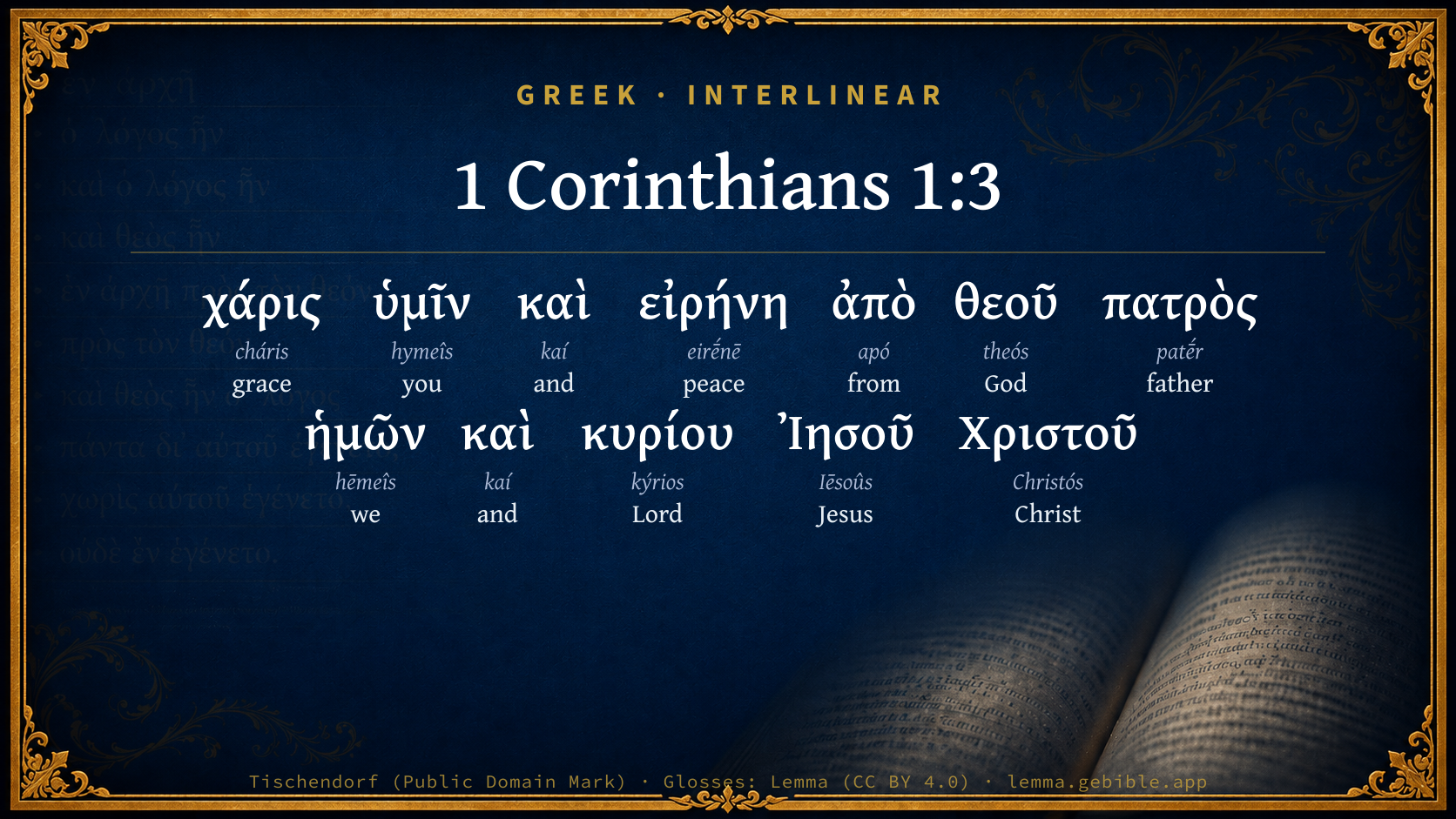
Greek (Tischendorf 8th ed.) 1 Corinthians 1:3 appears in the Greek New Testament. The text above is from the Tischendorf 8th edition. Each word links to its Strong’s number and a concise gloss. Click any word for its full Thayer’s Greek Lexicon entry.
Download image
Cite this verse

1 Corinthians 1:3 (World English Bible). Public Domain. Lemma interlinear Bible study tool, https://lemma.gebible.app/v/1-corinthians/1/3.

Show BibTeX & RIS
BibTeX
RIS
English Translation
Grace to you and peace from God our Father and the Lord Jesus Christ.
World English Bible · Public Domain
Download a study sheet

One document with this verse’s original text, its word-by-word gloss line, the meaning frame, cross-references with their text, attributed commentary, and full source and license credits — printable, and it pastes into notes with its structure intact.

This verse Autodidact and up

Study sheet (.html) Plain text (.txt)

A passage Seminary Student

Up to 50 verses in one chapter. A passage sheet keeps up to 6 commentary sources and 12 cross-references per verse, in the order this page ranks them, and says so on the sheet whenever that leaves anything out. Ask for a single verse and you get the Autodidact verse sheet above.

Everything on this page stays free to read, with no account — the sheet is a download of what is already on screen, not access to it.

Want to remove ads? Support Godless Engineer
Compare translations 3

The same verse in 3 English versions, stacked beneath the original-language interlinear above. Click any original word for its lexicon entry.

Each is an independent rendering of the whole verse — the interlinear is not word-aligned to these translations.

Highlighted words mark where these versions differ — a whole-verse word diff, not a word-by-word alignment.

  • World English Bible Public Domain
    Grace to you and peace from God our Father and the Lord Jesus Christ.
  • King James Version Public Domain
    Grace be unto you, and peace, from God our Father, and from the Lord Jesus Christ.
  • unfoldingWord Literal Text CC BY-SA 4.0
    Grace and peace to you from God our Father and the Lord Jesus Christ.

unfoldingWord Literal Text — © unfoldingWord, licensed CC BY-SA 4.0. Word-aligned USFM3 via Door43 (git.door43.org/unfoldingWord/en_ult).

Versions to compare (up to 4)

3 of 4 selected

Show all 19 translations

Every available English version of this verse, each an independent rendering of the whole verse.

  • World English Bible Public Domain
    Grace to you and peace from God our Father and the Lord Jesus Christ.
  • Berean Standard Bible Public Domain
    Grace and peace to you from God our Father and the Lord Jesus Christ.
  • Majority Standard Bible Public Domain
    Grace and peace to you from God our Father and the Lord Jesus Christ.
  • King James Version Public Domain
    Grace be unto you, and peace, from God our Father, and from the Lord Jesus Christ.
  • American Standard Version (1901) Public Domain
    Grace to you and peace from God our Father and the Lord Jesus Christ.
  • Revised Version (1885) Public Domain
    Grace to you and peace from God our Father and the Lord Jesus Christ.
  • Geneva Bible (1599) Public Domain
    Grace be with you, and peace from God our Father, and from the Lord Iesus Christ.
  • Douay-Rheims (1899) Public Domain
    Grace to you, and peace from God our Father, and from the Lord Jesus Christ.
  • Young's Literal Translation Public Domain
    Grace to you and peace from God our Father and the Lord Jesus Christ!
  • Literal Standard Version CC BY-SA 4.0
    Grace to you and peace from God our Father and the Lord Jesus Christ!
  • Unlocked Literal Bible CC BY-SA 4.0
    May grace and peace be to you from God our Father and the Lord Jesus Christ.
  • unfoldingWord Literal Text CC BY-SA 4.0
    Grace and peace to you from God our Father and the Lord Jesus Christ.
  • Darby Bible Public Domain
    Grace to you and peace from God our Father, and [the] Lord Jesus Christ.
  • World Messianic Bible Public Domain
    Grace to you and peace from God our Father and the Lord Yeshua the Messiah.
  • Webster's Bible Public Domain
    Grace be to you, and peace from God our Father, and from the Lord Jesus Christ.
  • Free Bible Version CC BY-SA 4.0
    May you have grace and peace from God our Father and the Lord Jesus Christ.
  • Bible in Basic English Public Domain
    Grace to you and peace from God our Father and the Lord Jesus Christ.
  • Text-Critical English NT CC BY 4.0
    Grace to you and peace from God our Father and the Lord Jesus Christ.
  • Tyndale New Testament (1534) Public Domain
    Grace be with you and peace from God oure father and from the lorde Iesus Christ.

Literal Standard Version (2020), Covenant Press — licensed CC BY-SA 4.0. Text via the HelloAO Bible API (eBible.org). Unlocked Literal Bible (unfoldingWord) — licensed CC BY-SA 4.0. Text via the HelloAO Bible API (eBible.org). unfoldingWord Literal Text — © unfoldingWord, licensed CC BY-SA 4.0. Word-aligned USFM3 via Door43 (git.door43.org/unfoldingWord/en_ult). Free Bible Version, Dr. Jonathan Gallagher — licensed CC BY-SA 4.0. Text via the HelloAO Bible API (eBible.org).

Word by word

More ways to search: Search by grammar → Find every occurrence → Compare this word →

Practice this passage: Drill this verse → Learn its vocabulary →

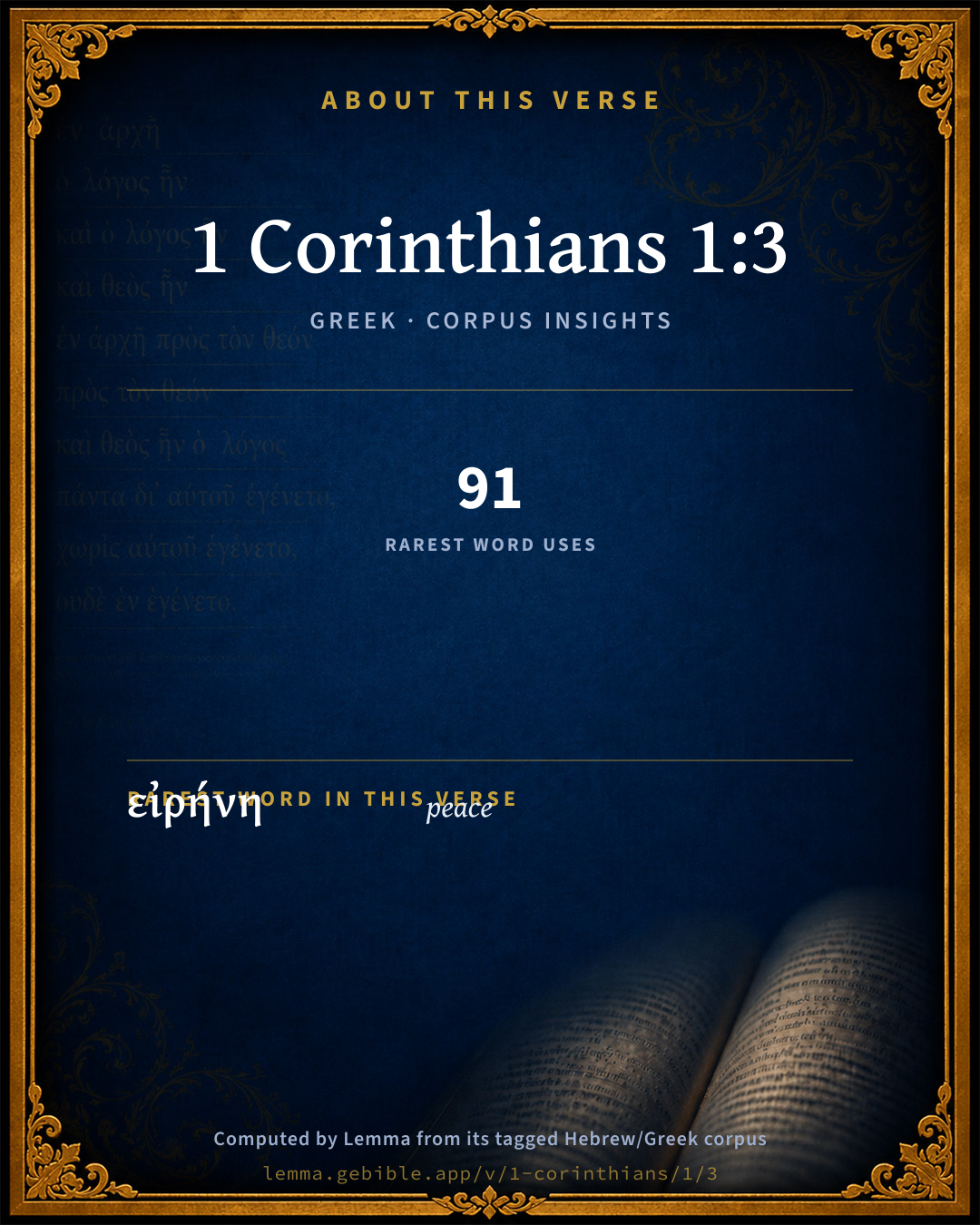
εἰρήνη
eirḗnē
G1515
“peace”
Noun, Nominative, Singular, Feminine
Part of Speech
Noun
Case
Nominative
Number
Singular
Gender
Feminine
Full Thayer's Definition

Origin: probably from a primary verb eiro (to join)

TDNT: 08:40,2

1. a state of national tranquillity a. exemption from the rage and havoc of war 2. peace between individuals, i.e. harmony, concord 3. security, safety, prosperity, felicity, (because peace and harmony make and keep things safe and prosperous) 4. of the Messiah's peace a. the way that leads to peace (salvation) 5. of Christianity, the tranquil state of a soul assured of its salvation through Christ, and so fearing nothing from God and content with its earthly lot, of whatsoever sort that is 6. the blessed state of devout and upright men after death
  1. χάρις cháris G5485 “grace” Noun, Nominative, Singular, Feminine
  2. ὑμῖν hymeîs G5210 “you” Personal pronoun, 2nd person, Dative, Plural
  3. καὶ kaí G2532 “and” Conjunction
  4. ἀπὸ apó G575 “from” Preposition
  5. θεοῦ theós G2316 “God” Noun, Genitive, Singular, Masculine
  6. πατρὸς patḗr G3962 “father” Noun, Genitive, Singular, Masculine
  7. ἡμῶν hēmeîs G2249 “we” Personal pronoun, 1st person, Genitive, Plural
  8. καὶ kaí G2532 “and” Conjunction
  9. κυρίου kýrios G2962 “Lord” Noun, Genitive, Singular, Masculine
  10. Ἰησοῦ Iēsoûs G2424 “Jesus” Noun, Genitive, Singular, Masculine
  11. Χριστοῦ Christós G5547 “Christ” Noun, Genitive, Singular, Masculine

About this verse

These counts appear in no published source. They are computed here, from the morphology-tagged text and Lemma’s own curated glosses. What Lemma adds →

12
words
11
distinct lemmas
Pauline Epistles
section

Repetition

A word recurs within this verse:

Cross-references

4

Topical passages linked to 1 Corinthians 1:3 in the Treasury of Scripture Knowledge — connected by theme and wording, ordered by reader-vote popularity; previews shown in the World English Bible.

  • Romans 1:7 to all who are in Rome, beloved of God, called to be saints: Grace to you and peace from God our Father and the Lord Jesus Christ.
  • 2 Corinthians 1:2 Grace to you and peace from God our Father and the Lord Jesus Christ.
  • 1 Peter 1:2 according to the foreknowledge of God the Father, in sanctification of the Spirit, that you may obey Jesus Christ and be sprinkled in his blood: Grace to you and peace be multiplied.
  • Ephesians 1:2 Grace to you and peace from God our Father and the Lord Jesus Christ.

Cross-references courtesy of OpenBible.info (CC BY 4.0).

Commentary

Notes on 1 Corinthians 1:3 from classic Christian and Jewish commentators (each source and its license shown beneath its notes). The classic Christian expositions comment on the surrounding passage and are grouped to its opening verse, so a note may address several verses; the Jewish commentaries on the Tanakh (Rashi and others) are per-verse, so they appear only where the commentator wrote on this verse.

Lemma curates 59 commentaries, every one of them public domain or Creative Commons licensed, each selected and text-cleaned for this edition rather than reprinted as found. About our sources →

Ellicott's Commentary for English Readers

(3) Grace be unto you, and peace.—This is the usual style of apostolic greeting (Gal_1:3; Eph_1:2), and with these words the address and greeting which open the Epistle conclude.

A Bible Commentary for English Readers, edited by Charles John Ellicott (1878–1897) — public domain. Text from a community e-Sword module.

Joseph Benson's Commentary

1Co 1:3-9. Grace be unto you, &c. — See on Rom 1:7. I thank my God always — Whenever I mention you to God in prayer, or on every occasion; on your behalf — On your account; for the grace of God which is given you, &c. — For all those spiritual blessings which are freely conferred upon you by God, for Christ’s sake. That in every thing — With all kinds of spiritual gifts, pertaining to the knowledge and preaching of the gospel; ye are enriched by him — That is, many among you are; in all utterance — With great freedom of speech; and in all knowledge — Namely, of the mystery of the gospel. These gifts the Corinthians particularly admired. Therefore this congratulation naturally tended to soften their spirits, and make way for the reproofs which follow. Even as the testimony of Christ — The gospel, which testifies of Christ, and declares the will of God concerning the way of saving sinners, Mat 24:14; was confirmed in — Or among, you — That is, was plainly proved to be from God, Rev 19:10, by these gifts bestowed upon you. They knew they had received these gifts by the hand of Paul, and that long before the false teachers came among them, and that they had received none from them. And this consideration was highly proper to revive in them their former reverence and affection for their spiritual father, and to show them how much they were to blame for attaching themselves to teachers who had given them no proof at all either of their divine mission or of the truth of their doctrine. So that ye come behind — Other churches, and are defective in no gift — Namely, tending to edification and confirmation in the faith and hope of the gospel; waiting for the coming — Την αποκαλυψιν, the revelation of our Lord Jesus Christ — A sure mark of a true or false Christian, to long for, or dread, the second glorious revelation of the Lord Jesus. The apostle speaks here, not of all individual believers at Corinth, but of the church there in general; as having in it many spiritual persons, who possessed all the different spiritual gifts which common believers could enjoy. Accordingly he asked them, 2Co 12:13, What is it wherein ye were inferior to other churches? Who shall also — If you faithfully apply to him; confirm you — In these gifts and graces; unto the end — Of your lives, and of the time of your trial; that ye may be blameless — Clear from the guilt of any known sin; in the day of our Lord Jesus Christ — The time of his coming to judgment. Now it is our day, wherein we are to work out our salvation: then it will be eminently the day of Christ, and of his glory in the saints. God is faithful to all his promises, and therefore to him that hath shall be given: by whom ye were called — By his word and Spirit; unto the fellowship of his Son —

To partake, through him, of all the blessings of the gospel. And this calling, as if he had said, you should consider as a pledge of his willingness to save you unto the uttermost.

Joseph Benson's Commentary on the Old and New Testaments (1811–1818) — public domain. Text from a community e-Sword module.

Tyndale Open Study Notes

Tyndale Open Resources

1:3 Grace and peace represent traditional Greek and Hebrew greetings. Grace is undeserved blessing that comes from the kindness of God. Peace is a sense of well-being and contentedness, rooted in the Good News and brought about by the Holy Spirit (see Gal 5:22). Together, the phrase conveys things understood as gifts from God (see Rom 5:1-2).

Tyndale Open Study Notes — © Tyndale Open Resources, licensed CC BY-SA 4.0. Text via the HelloAO Bible API.

Meyer's Critical & Exegetical Commentary

Heinrich August Wilhelm Meyer

1Co_1:3. See on Rom_1:7.[106]

[106] See also the elaborate dissertation on the apost. benedictory greeting by Otto in the Jahrb. für D. Theol. 1867, p. 678 ff. The origin of that greeting, however, is hardly to be traced back, as the author holds, to the Aaronic blessing, Num_6:25 f. Otherwise it would always be tripartite, and, in particular, would not omit the characteristic ἔλεος. Now, the only Epistles in which it certainly occurs as tripartite, and with ἔλεος, are the (post-Pauline) ones, 1 and 2 Tim. and 2Jn_1:3; also Jud_1:2 (but with a peculiar variation). It was only at a later date that the Aaronic blessing passed over into Christian liturgic use (Constitt. ap. ii. 57. 13); but a free reminiscence of that blessing may already be contained in the greetings of those late Epistles.

Meyer — Critical and Exegetical Commentary on the New Testament — English translation by Peter Christie, edited by Frederick Crombie (T&T Clark, 1880) — public domain. Text from a community e-Sword module.

Expositor's Greek Testament

ed. W. Robertson Nicoll

1Co 1:3 . χάρις ὑμῖν καὶ εἰρήνη ἀπὸ Θεοῦ κ . τ . λ .: Paul’s customary greeting; see note on Rom 1:7 . “The occurrence of the peculiar phrase ‘grace and peace’ in Paul, John, and Peter intimates that we have here the earliest Christian password or symbolum ” (Ed [63] ). κυρίου might grammatically be parl [64] to ἡμῶν , both depending upon πατρός , as in 2Co 1:3 , etc.; but 1 and 2Th 1:1 ( Θεῷ πατρὶ κ . Κυρίῳ Ἰ . Χ .) prove Father and Lord in this formula to be parl [65] : cf. 1Co 8:6 , 2Co 13:13 ; nowhere does P. speak (as in Joh 20:17 ) of God as Father of Christ and of men co-ordinately, and for ἡμῶν to come first in such connexion would be incongruous. “The union of” Θεοῦ and Κυρίου “under the vinculum of a common prp [66] is one of the numberless hints scattered through St. Paul’s epp. of the consciously felt and recognised co-ordination” of the Father and Christ (El [67] ).

[63] T. C. Edwards’ Commentary on the First Ep. to the Corinthians . 2

[64] parallel.

[65] parallel.

[66] preposition.

[67] C. J. Ellicott’s St. Paul’s First Epistle to the Corinthians .

The Expositor's Greek Testament, edited by W. Robertson Nicoll (1897–1910) — public domain. Text from a community e-Sword module.

International Critical Commentary

3. χάρις ὑμῖν καὶ εἰρήνη. This is St Paul’s usual greeting, the Greek χαίρειν combined with the Hebrew Shalom, and both with a deepened meaning. In 1 and 2 Tim., and in 2Jn 1:3, ἔλεος is added after χάρις. St James has the laconic and secular χαίρειν (cf. Act 15:23). St Jude has ἔλεος ὑμν καὶ εἰρήνη καὶ ἀγάπη. In 1 and 2 Pet. we have χάρις ὑμῖν καὶ εἰρήνη, as here. The fact that ‘grace and peace’ or ‘grace, mercy, and peace’ is found in St Paul, St Peter, and St John, is some evidence “that we have here the earliest Christian password or symbolum. Grace is the source, peace the consummation” (Edwards). The favour of God leads naturally to peace of mind. Enmity to God has ceased, and reconciliation has followed. Quae gratia a non ofenso? Quae pax a non rebellato? asks Tertullian (Adv. Marc. 5:5). See on Rom 1:5 and 7. In Dan. 3:31 [98] we have as a salutation, εἰρήνη ὑμῖν πληθυνθείη. See J. A. Robinson, Ephesians, pp. 221-226. In 2 Macc. 1:1 we have χαίρειν … είρήνην ἀγαθήν, and in the Apoc. of Baruch 78:2, “mercy and peace.” Such greetings are not primarily christian.

1:4-9. PREAMBLE OF THANKSGIVING AND HOPE

I thank God continually for your present spiritual condition. Christ will strengthen you to the end according to Divine assurance.

4 I never cease thanking God, because of the favours which He bestowed upon you through your union with Christ Jesus, 5 whereby as immanent in Him ye received riches of every kind, in every form of inspired utterance and every form of spiritual illumination, for the giving and receiving of instruction. 6 These gifts ye received in exact proportion to the completeness with which our testimony to the Messiah was brought home to your hearts and firmly established there; 7 so that (as we may hope from this guarantee) there is not a single gift of grace in which you find yourselves to be behind other Churches, while you are loyally and patiently waiting for the hour when our Lord Jesus Christ shall be revealed. 8 And this hour you need not dread, for our Lord Himself, who has done so much for you hitherto, will also unto the very end keep you secure against such accusations as would be fatal in the Day of our Lord Jesus Christ. 9 This is a sure and certain hope: for it was God, who cannot prove false, who Himself called you into fellowship with His Son and in His Son, Jesus Christ our Lord; and God will assuredly do His part to make this calling effective.

This Thanksgiving is a conciliatory prelude to the whole Epistle, not directed to a section only (v. 12), nor ironical (1), nor studiously indefinite (Hofm.), but a measured and earnest encomium of their general state of grace (Act 18:10), with special stress on their intellectual gifts, and preparing the way for candid dealing with their inconsistencies.

International Critical Commentary — older volumes (1896–1929), various authors — public domain. Text from a community e-Sword module.

Hodge's Commentary on Romans, Ephesians & First Corinthians

Charles Hodge

1Co_1:3

Grace (be) unto you, and peace from God our Father, and (from) the Lord Jesus Christ.

Grace is favor, and peace its fruits. The former includes all that is comprehended in the love of God as exercised towards sinners; and the latter all the benefits which flow from that love. All good, therefore, whether providential or spiritual, whether temporal or eternal, is comprehended in these terms: justification, adoption and sanctification with all the benefits which either accompany or flow from them. These infinite blessings suppose an infinite source; and as they are sought no less from Christ than from God the Father, Christ must be a divine person. It is to be remarked that God is called our Father, and Christ our Lord. God as God has not only created us, but renewed and adopted us. God in Christ has redeemed us. He is our owner and sovereign, to whom our allegiance is immediately due; who reigns in and rules over us, defending us from all his and our enemies. This is the peculiar form which piety assumes under the gospel. All Christians regard God as their Father and Christ as their Lord. His person they love, his voice they obey, and in his protection they trust.

Charles Hodge — Commentary on Romans (1835), First Corinthians (1857), and Ephesians (1856) — public domain. Text from a community e-Sword module.

Geneva Bible (1599)

Geneva Bible translators

The foundation and the life of the Church, is Christ Jesus given of the Father.

Geneva Bible (1599) marginal notes — public domain. Text via Bolls.life.

Jamieson, Fausset & Brown

Robert Jamieson, A. R. Fausset & David Brown

peace--peculiarly needed in the Corinthian church, on account of its dissensions. On this verse see on Rom 1:7.

Jamieson, Fausset & Brown — Commentary Critical and Explanatory on the Whole Bible (1871) — public domain (CC PDM 1.0). Text via the HelloAO Bible API.

Adam Clarke's Commentary

Verse 3. Grace be unto you] For a full explanation of all these terms, See Clarke on Ro 1:7.

Adam Clarke's Commentary on the Bible (1810–1826) — public domain. Text from a community e-Sword/MySword module.

John Calvin's Commentaries

3. Grace be to you and peace For an exposition of this prayer, let my readers consult the beginning of my Commentary on the Epistle to the Romans (Romans 1:7;) for I do not willingly burden my readers with repetitions.

John Calvin's Commentaries (1540-1563) — public domain. Text from the Calvin Translation Society English edition (1840s-50s) via the Christian Classics Ethereal Library (ccel.org). Calvin's coverage is partial (roughly two-thirds of the Bible); uncommented books and verses are honest gaps, never fabricated. The 19th-century editor's footnotes and remarks are omitted so the notes are faithfully Calvin's own voice.

The Cambridge Bible for Schools and Colleges

gen. ed. J. J. S. Perowne

3. grace be unto you, and peace, from God our Father, and from the Lord Jesus Christ] The close association of these words—for the preposition is not repeated twice—has been held to imply the oneness of substance of the Father and the Son. It is also to be noted that the grace and peace are said to come from our Lord Jesus Christ equally with the Father. The same formula is to be found in the greeting of every epistle. But the most remarkable instance of this form of speech is certainly that in 1Th_3:11 and 2Th_2:16-17, where the Father and the Son stand together as nominatives to a verb in the singular. Grace is here used in the signification of favour, kindness, rather than in the usual theological signification of Divine assistance. The Apostle is speaking of that Divine favour in the sunshine of which the believer is privileged to dwell, and which produces peace of mind as its natural effect. For it is a cardinal point of his teaching that ‘there is henceforth no condemnation to them that are in Christ Jesus, who walk not after the flesh, but after the Spirit’ It is to be remembered that our word grace is derived from the Latin gratia, the original signification of which is favour, kindness.

The Cambridge Bible for Schools and Colleges (gen. ed. J. J. S. Perowne; Cambridge University Press, 1878–1918) — public domain. Text from a community e-Sword module.

John Gill's Exposition

Grace be unto you, and peace from God,.... This is an usual salutation in all Paul's epistles; See Gill on Rom 1:7.

.

1 Corinthians 1:4

co1 1:4

co1 1:4

co1 1:4I thank my God always on your behalf,.... Now follows a thanksgiving for various blessings bestowed upon this church, which is a proof of the apostle's great affection for it, and how much its welfare lay at his heart. The object of thanksgiving is God, for as he is the author of all mercies, the glory and praise of them ought to be given to him. The apostle styles him "my God", to distinguish him from others; and to express his faith of interest in him; and to observe to this church, that all the good things they enjoyed came from him, who was his God and their God, his Father and their Father; and for which reason he returned thanks to him for them, and by so doing set them an example: the persons on whose behalf he gave thanks were not at this time himself and Sosthenes, but the members of the church at Corinth; and the continuance of his thankfulness for them, is "always", as often as he went to the throne of grace, or at any other time thought of them: what he particularly gives thanks to God for in this verse is,

for the grace which is given you by Jesus Christ: and includes all sorts of grace, adopting, justifying, pardoning, regenerating, and sanctifying grace; every particular grace of the Spirit, as faith, repentance, hope, love, fear, humility, self-denial, &c. all are gifts of God, and entirely owing to his free grace, and not to man's free will and power, or to any merits of his; and all come through the hands of Christ, and are given forth by him, as the Mediator of the covenant, and in consequence of his blood, righteousness, sacrifice, and merit.

John Gill's Exposition of the Whole Bible (1746–1763) — public domain (CC PDM 1.0). Text via the HelloAO Bible API.

Trapp's Complete Commentary

John Trapp

3 Grace be unto you, and peace, from God our Father, and from the Lord Jesus Christ.

Ver. 3. Grace be to you and peace] All peace that flows not from the sense of God’s love and favour, is as that of the Romans with the Samnites, unsound and uncertain. Pax infida, pax incerta. Peace with the treacherous is a dubious peace. (Livius.) {See Trapp on "Rom 1:7"}

John Trapp, A Commentary or Exposition upon All the Books of the Old and New Testament (1647–1656) — public domain. Text from a community e-Sword module.

Albert Barnes' Notes on the Bible

Grace be unto you ... - See the note at Rom 1:7.

Albert Barnes' Notes on the Bible (1834–1885) — public domain. Text from a community e-Sword/MySword module.

Matthew Poole's English Annotations

This is the common salutation in all Paul’s Epistles, only in one or two mercy is also added.

Grace signifies free love.

Peace signifies either a reconciliation with God, or brotherly love and unity each with other: See Poole on "Rom 1:7". The apostle wisheth them spiritual blessings, and the greatest spiritual blessings, grace and peace, and that not from and with men, but from God our Father, and the Lord Jesus Christ.

Matthew Poole's English Annotations on the Holy Bible (1683–1685) — public domain. Text from a community e-Sword/MySword module.

Whedon's Commentary on the Bible

Daniel D. Whedon

3. Grace—Note on Rom_1:7. In both passages both God and Christ are made sources of peace and grace.

Daniel D. Whedon (gen. ed.), Commentary on the Old and New Testaments (1874–1909) — public domain. Text from a community e-Sword module.

The Pulpit Commentary

Grace to you and peace. This is St. Paul"s greeting in all the Epistles except the pastoral Epistles, in which he beautifully adds the word "mercy." It is a remarkable blending of the Greek and Jewish salutations. The Greeks said Cairein, and to them the word "grace" involved the notions of joy and brightness and prosperity. The calmer and more solemn greeting of the East was, "Peace be to thee." The Church unites both forms of greeting the beginning of every blessing; "peace," the end of all blessings; and into both she infuses a deeper meaning, that of a "joy" which defied all tribulations, and a" peace which passeth all understanding." From God our Father and the Lord Jesus Christ. God is the Source of "every good gift and every perfect gift." God is our Father as our Creator, and as the Father of our Lord Jesus Christ, in whom we become, in a higher sense, his children. Christ, in his mediatorial kingdom, is specially and immediately "our Lord," though that phrase, now so universal, only occurs (in its isolated form) in Heb_7:14. Jesus Christ. One of St. Paul"s peculiarities of style is the constant reiteration of one dominant word. In the first nine verses of this Epistle, the Name "Jesus Christ" is repeated no less than nine times. "Observe," says St. Chrysostom, "how he nails them down to the Name of Christ, not mentioning any man, either apostle or teacher, but continually mentioning him for whom they yearn, as men preparing to awaken those who are drowsy after a debauch. For nowhere in any other Epistle is the Name of Christ so continually introduced By means of it he weaves together almost his whole exordium.

The Hebraic and the Christian salutations.

The formalities of politeness have deep meanings, and bear important relations to the social and moral life of cities and nations. The heathen benediction was Salve, or "Health to you." The modern salutation, "Good morning," or "Good day," is a brief assertion of national and individual faith in the one God; for it really means "God bless you today," and so is a perpetual witness against infidelity. The salutation in the text is a blending together of the characteristic points of the Hebrew and the Christian good wishes.

I FROM THE HEBREW POINT OF VIEW, WHAT WAS INVOLVED IN WISHING "PEACE ONTO YOU"? "Peace" to the Hebrew was the word gathering up the blessings of the keeping of the Jehovah covenant. If faithful to the claims of that covenant and to the spirit of that covenant, they would realize peace in the heart, in the home, and in the state. And to an industrial and agricultural people, "peace" would appear the most desirable of all earthly blessings, and the condition of enjoying all others. It may be noticed how the unsettled years of later Jewish history intensified the common desire and prayer for "peace." As the prosperity of the whole land was bound up in the faithfulness of each member, it was befitting that each should wish for the other that "peace" which can alone attend on righteousness. So the formality of the salutation covered a real anxiety for brotherly faithfulness to Jehovah.

II FROM THE CHRISTIAN POINT OF VIEW, WHAT WAS INVOLVED IN WISHING "GRACE AND PEACE UNTO YOU"? The addition is most characteristic, seeing that Christianity declares the grace of God that bringeth salvation." Man discovers that the adequate keeping of covenant, and so securing "peace," is not within his own power. It is this discovery that prepares him to welcome the revelation of grace for his need. With the grace he can attain the righteousness which ensures the peace, and so he recognizes that both the grace and the peace come from God. Then the wish of the early Christian is that a special manifestation of Divine grace may be made to the individual. The salutation, in effect, is this: May you enter fully into the blessings of the gospel, into the grace brought unto men in Jesus Christ; and so may you know the gospel peace, which you will find a hallowing influence resting on all your life! How may we put into modern Christian language the Pauline benediction? And how should we so watch over even the formalities of every day speech that our common good wishes should be filled with rich and fervent Christian meanings? R.T.

The Father and the Lord.

From the Gospels it may be efficiently set forth and illustrated that the Father name for God was a most marked feature in our Lord"s life and teachings. He seldom or ever used any other name; and a candid reader cannot fail to realize that in this "Father name" must lie much of the secret of his mission. It may be further shown from the Epistles that his disciples caught his purpose; and, with great frequency, they use the names Father for God, and its correlate, Son, for the Lord Jesus. This appears in the text, but connected with a different name for the Lord Christ.

PAUL"S PREVAILING THOUGHT FOR GOD. The Father; our Father; the Church"s Father. Towards realizing the aspects of the Divine Being that are gathered under this name, we gain help by considering the natural associations and duties of paternity; the idea of the tribal patriarch as found in the early ages; and the prophetic qualifications of the sterner and governmental conceptions of God which are found in the Mosaic system.

If the Father name for God be an essential, and a foundation of Christianity, as set forth by the Apostle Paul, then we must expect to find the entire Christian revelation toned and conditioned by this primary conception of the Divine Being and relations. This may be worked out and illustrated in connection with either of the primary Christian truths. And it may be pointed out that the term "Father" is properly inclusive of all holy demands, all governmental authorities, all reverential relations; but it is new and infinitely precious to the race, because it brings home the possibility of God"s individual and personal love to each member of it. In that lies a great part of the attractive and persuasive power of Christianity. R.T.

The Pulpit Commentary (1880–1919), ed. H.D.M. Spence-Jones & Joseph S. Exell — public domain. Text from a community e-Sword module.

Godbey's Commentary on the New Testament

William B. Godbey

3. This is a very common salutatory benediction peculiar to the Pauline Epistles.

William B. Godbey, Commentary on the New Testament (1896–1900) — public domain. Text from a community e-Sword module.

McGarvey & Pendleton's Commentaries

J. W. McGarvey

Grace to you and peace from God our Father and the Lord Jesus Christ . [See note at 1Th_1:1 ]

J. W. McGarvey (with Philip Y. Pendleton), Commentaries on the New Testament (The Fourfold Gospel, 1914; Acts; and the epistles) — public domain. Text from a community e-Sword/MySword module.

The People's New Testament

B. W. Johnson

3. Grace be unto you. The favor of God; the divine blessing. This is the apostolical benediction. Peace. This is always an appropriate benediction, since peace is one of the greatest blessings, but was especially appropriate to a church which was torn by dissensions.

B. W. Johnson's The People's New Testament with Notes (1889–1891) — public domain. Electronic text from the Christian Classics Ethereal Library (CCEL) ThML edition.

Cambridge Greek Testament for Schools and Colleges

3. ἀπὸ θεοῦ πατρὸς ἡμῶν καὶ κυρίου Ἰησοῦ Χριστοῦ. The close association of these words—for the preposition is not repeated twice—has been held to imply the oneness of substance of the Father and the Son. See Winer Gr. Gram. § 50, 7. It is also worthy of remark that the grace and peace are said to come from our Lord Jesus Christ equally with the Father, The same formula is to be found in the greeting of every Epistle. But the most remarkable instance of this form of speech is certainly that in 1Th 3:11 and 2Th 2:16-17, where the Father and the Son stand together as nominatives to a verb in the singular.

Cambridge Greek Testament for Schools and Colleges (Cambridge University Press, 1896; 21 vols, various authors incl. Carr, Maclear, Plummer, Farrar, Lumby, Moule, M. R. James, Simcox) — public domain. Text from a community e-Sword module.

Alford’s Greek Testament

Henry Alford

3.] See introductory note to the Epistle to the Romans. Olsh. remarks, that εἰρήνη has peculiar weight here on account of the dissensions in the Corinthian Church.

Henry Alford, The Greek Testament (1849–1861) — public domain. Text from a community e-Sword module.

Vincent's Word Studies in the New Testament

Marvin R. Vincent

Grace - peace. Grace is the Greek salutation, peace the Jewish. Both in the spiritual sense. Compare Num 6:25, 26. This form of salutation is common to all Paul 's epistles to the churches. In Timothy and Titus, mercy is added. James alone has the ordinary conventional salutation, cairein rejoice, hail, greeting.

Marvin R. Vincent, Word Studies in the New Testament (1887–1900) — public domain. Text from a community e-Sword/MySword module.

Godet's Commentaries

Frédéric Louis Godet

Vv. 3. “Grace and peace be unto you, from God our Father, and from the Lord Jesus Christ!”

This prayer is the Christian paraphrase of two salutations, the Greek (χαίρειν, Act 23:26) and the Hebrew (“Peace be to thee”).

Grace is the Divine good will, bending compassionately toward the sinner to pardon him; toward the reconciled child, to bless him. Peace is the profound tranquillity with which faith in this Divine love fills the believer’s heart.

Paul does not say: “be to you from God by Jesus Christ,” but “from God and from Jesus Christ,” for Jesus is not in his eyes the impersonal channel of the Divine love; He loves with His own peculiar love as brother, as God loves with His love as Father.

By this prayer, the apostle invites the Corinthians to take their place ever anew under the influence of this double source of salvation, the love of the Father and the love of the Son.

We have said that in the address of Paul’s letters there are already betrayed the concerns with which his mind is preoccupied at the time of writing; this is easy to establish in the Epistles to the Romans and to the Galatians, and we have seen the proof of it also in the address we have just studied. Holiness is the characteristic of the members of the Church; the relation of a common life between the particular Church and the Church universal; the dignity of Lord, as competent to Jesus only: such are the traits which distinguish this address from every other; and is it not manifest that they are dictated to the apostle by the particular circumstances of the Church of Corinth, at the time when he wrote?

Frédéric Louis Godet — Commentaries on Luke, John, Romans, and 1 Corinthians — English translation (T&T Clark, Edinburgh, 1870s–1890s) — public domain. Text from a community e-Sword module.

Lesson kit

Teaching starters — assembled from the data on this page, not authored interpretation. Every prompt links to the verse data it draws on. Edit before teaching.

1 Corinthians, in the Pauline Epistles, opens this verse with 12 words (11 distinct Greek lemmas). Its most distinctive word is eirḗnē (“peace”). A historical commentator’s framing appears above. Read the whole chapter for the surrounding context.

Discussion questions

  1. What does “peace” (eirḗnē) contribute to the verse as a whole?
  2. How does Romans 1:7, which shares this passage’s theme, read alongside this verse?
  3. What does the repetition of “and” (2× in this one verse) do in this verse?
  4. Compare how Ellicott's Commentary for English Readers and Joseph Benson's Commentary read this verse. Where do they agree or differ?

Things to notice

Reading settings

Reading text

Shown beneath each verse's original-language words.

Old Testament
Old Testament edition

Read the OT as the Masoretic Hebrew (MT) or the Greek Septuagint (LXX).

English shown for the Greek Septuagint (in the Hebrew ↔ Greek comparison).

Comparing translations? Open the Compare panel on any verse page to stack up to four side by side.