1 Corinthians 3:23

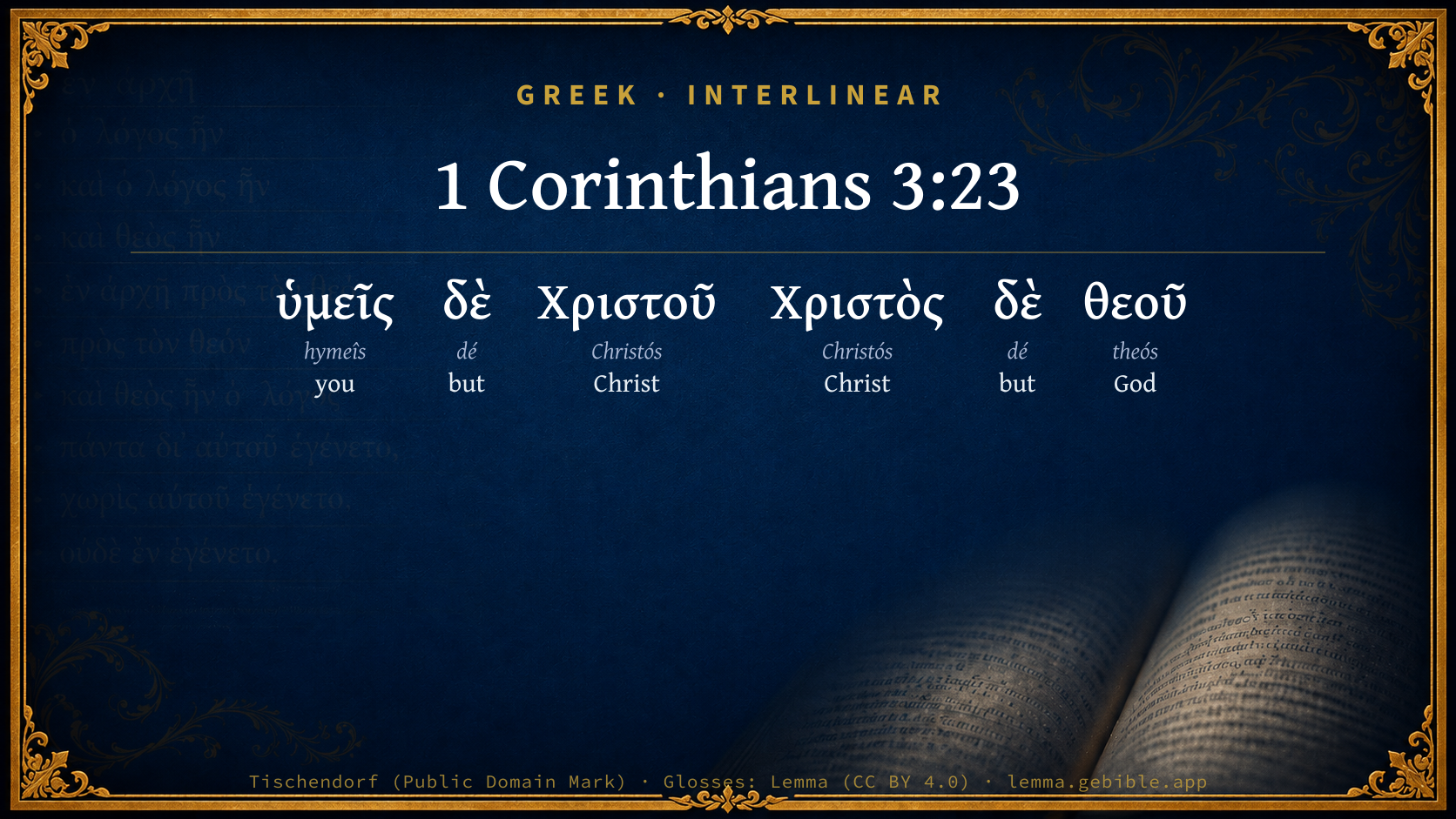
Greek (Tischendorf 8th ed.) 1 Corinthians 3:23 appears in the Greek New Testament. The text above is from the Tischendorf 8th edition. Each word links to its Strong’s number and a concise gloss. Click any word for its full Thayer’s Greek Lexicon entry.
Download image
Cite this verse

1 Corinthians 3:23 (World English Bible). Public Domain. Lemma interlinear Bible study tool, https://lemma.gebible.app/v/1-corinthians/3/23.

Show BibTeX & RIS
BibTeX
RIS
English Translation
and you are Christ's, and Christ is God's.
World English Bible · Public Domain
Download a study sheet

One document with this verse’s original text, its word-by-word gloss line, the meaning frame, cross-references with their text, attributed commentary, and full source and license credits — printable, and it pastes into notes with its structure intact.

This verse Autodidact and up

Study sheet (.html) Plain text (.txt)

A passage Seminary Student

Up to 50 verses in one chapter. A passage sheet keeps up to 6 commentary sources and 12 cross-references per verse, in the order this page ranks them, and says so on the sheet whenever that leaves anything out. Ask for a single verse and you get the Autodidact verse sheet above.

Everything on this page stays free to read, with no account — the sheet is a download of what is already on screen, not access to it.

Want to remove ads? Support Godless Engineer
Compare translations 3

The same verse in 3 English versions, stacked beneath the original-language interlinear above. Click any original word for its lexicon entry.

Each is an independent rendering of the whole verse — the interlinear is not word-aligned to these translations.

Highlighted words mark where these versions differ — a whole-verse word diff, not a word-by-word alignment.

  • World English Bible Public Domain
    and you are Christ's, and Christ is God's.
  • King James Version Public Domain
    And ye are Christ's; and Christ is God's.
  • unfoldingWord Literal Text CC BY-SA 4.0
    and you Christ’s, and Christ God’s.

unfoldingWord Literal Text — © unfoldingWord, licensed CC BY-SA 4.0. Word-aligned USFM3 via Door43 (git.door43.org/unfoldingWord/en_ult).

Versions to compare (up to 4)

3 of 4 selected

Show all 19 translations

Every available English version of this verse, each an independent rendering of the whole verse.

  • World English Bible Public Domain
    and you are Christ's, and Christ is God's.
  • Berean Standard Bible Public Domain
    and you belong to Christ, and Christ belongs to God.
  • Majority Standard Bible Public Domain
    and you belong to Christ, and Christ belongs to God.
  • King James Version Public Domain
    And ye are Christ's; and Christ is God's.
  • American Standard Version (1901) Public Domain
    and ye are Christ's; and Christ is God's.
  • Revised Version (1885) Public Domain
    and ye are Christ’s; and Christ is God’s.
  • Geneva Bible (1599) Public Domain
    And ye Christes, and Christ Gods.
  • Douay-Rheims (1899) Public Domain
    And you are Christ's; and Christ is God's.
  • Young's Literal Translation Public Domain
    and ye `are' Christ's, and Christ `is' God's.
  • Literal Standard Version CC BY-SA 4.0
    and you [are] Christ’s, and Christ [is] God’s.
  • Unlocked Literal Bible CC BY-SA 4.0
    and you are Christ's, and Christ is God's.
  • unfoldingWord Literal Text CC BY-SA 4.0
    and you Christ’s, and Christ God’s.
  • Darby Bible Public Domain
    and *ye* [are] Christ's, and Christ [is] God's.
  • World Messianic Bible Public Domain
    and you are Messiah’s, and Messiah is God’s.
  • Webster's Bible Public Domain
    And ye are Christ's; and Christ is God's.
  • Free Bible Version CC BY-SA 4.0
    and you are Christ's, and Christ is God's.
  • Bible in Basic English Public Domain
    And you are Christ's; and Christ is God's.
  • Text-Critical English NT CC BY 4.0
    and you belong to Christ, and Christ belongs to God.
  • Tyndale New Testament (1534) Public Domain
    and ye are Christes and Christ is goddis.

Literal Standard Version (2020), Covenant Press — licensed CC BY-SA 4.0. Text via the HelloAO Bible API (eBible.org). Unlocked Literal Bible (unfoldingWord) — licensed CC BY-SA 4.0. Text via the HelloAO Bible API (eBible.org). unfoldingWord Literal Text — © unfoldingWord, licensed CC BY-SA 4.0. Word-aligned USFM3 via Door43 (git.door43.org/unfoldingWord/en_ult). Free Bible Version, Dr. Jonathan Gallagher — licensed CC BY-SA 4.0. Text via the HelloAO Bible API (eBible.org).

Word by word

More ways to search: Search by grammar → Find every occurrence → Compare this word →

Practice this passage: Drill this verse → Learn its vocabulary →

About this verse

These counts appear in no published source. They are computed here, from the morphology-tagged text and Lemma’s own curated glosses. What Lemma adds →

6
words
4
distinct lemmas
Pauline Epistles
section

Repetition

Words recur within this verse:

  • Χριστοῦ Christ G5547 ×2
  • δὲ but G1161 ×2

Cross-references

15

Topical passages linked to 1 Corinthians 3:23 in the Treasury of Scripture Knowledge — connected by theme and wording, ordered by reader-vote popularity; previews shown in the World English Bible.

  • Galatians 3:29 If you are Christ's, then you are Abraham's seed and heirs according to promise.
  • John 17:9–10 I pray for them. I don't pray for the world, but for those whom you have given me, for they are yours.
  • John 17:18 As you sent me into the world, even so I have sent them into the world.
  • 1 Corinthians 11:3 But I would have you know that the head of every man is Christ, and the head of the woman is the man, and the head of Christ is God.
  • 1 Corinthians 15:23 But each in his own order: Christ the first fruits, then those who are Christ's, at his coming.
  • 2 Corinthians 10:7 Do you look at things only as they appear in front of your face? If anyone trusts in himself that he is Christ's, let him consider this again with himself, that, even as he is Christ's, so also we are Christ's.
  • John 17:21 that they may all be one; even as you, Father, are in me, and I in you, that they also may be one in us; that the world may believe that you sent me.
  • Romans 14:8 For if we live, we live to the Lord. Or if we die, we die to the Lord. If therefore we live or die, we are the Lord's.
  • 1 Corinthians 6:19–20 Or don't you know that your body is a temple of the Holy Spirit which is in you, which you have from God? You are not your own,
  • 1 Corinthians 7:22 For he who was called in the Lord being a bondservant is the Lord's free man. Likewise he who was called being free is Christ's bondservant.
  • 1 Corinthians 8:6 yet to us there is one God, the Father, of whom are all things, and we for him; and one Lord, Jesus Christ, through whom are all things, and we live through him.
  • Galatians 5:24 Those who belong to Christ have crucified the flesh with its passions and lusts.
  • Philippians 2:8–11 And being found in human form, he humbled himself, becoming obedient to death, yes, the death of the cross.
  • Matthew 17:5 While he was still speaking, behold, a bright cloud overshadowed them. Behold, a voice came out of the cloud, saying, "This is my beloved Son, in whom I am well pleased. Listen to him."
  • Ephesians 1:10 to an administration of the fullness of the times, to sum up all things in Christ, the things in the heavens, and the things on the earth, in him;

Cross-references courtesy of OpenBible.info (CC BY 4.0).

Commentary

Notes on 1 Corinthians 3:23 from classic Christian and Jewish commentators (each source and its license shown beneath its notes). The classic Christian expositions comment on the surrounding passage and are grouped to its opening verse, so a note may address several verses; the Jewish commentaries on the Tanakh (Rashi and others) are per-verse, so they appear only where the commentator wrote on this verse.

Lemma curates 59 commentaries, every one of them public domain or Creative Commons licensed, each selected and text-cleaned for this edition rather than reprinted as found. About our sources →

The Biblical Illustrator

Joseph S. Exell

1Co_3:23

And ye are Christs, and Christ is Gods.

Ye are Christs, and Christ is Gods

I. Christ is Gods. To understand this high saying we must remember that Christ is God. But Christ is man also. As Man, Christ is Gods great Agent for man in every respect.

1. He is Gods Messenger, Gods Witness, to reveal the mind and heart of God towards fallen men. His whole life is an index by which you may read the secret spring of love divine; in Him God is love.

2. He is Gods Servant--obedient in life, obedient unto death.

3. He is Gods Priest--the One only Mediator between God and men, who ever liveth to make intercession for them.

4. He is Gods King, reigning now invisibly in truth, and to reign in due time visibly in righteousness over the whole earth.

II. ye are christs.

1. By creation, in common with all things. All things were made by Him, &c.

2. By purchase, in common with all mankind. He tasted death for every man.

3. By ordinance, in common with all Christendom.

4. By gift from God the Father.

5. By the secret power of the eternal Spirit working in due season, according to the purpose and plan of God.

6. In the enjoyment of a friendship and fellowship such as no other friendship can equal. (H. McNeile, D. D.)

That a godly man in all that he is, or can do, is wholly Christs

Where we may observe the apostle in a climax rising higher, All things are yours, you are Christs, and Christ is Gods. So that the highest round in this ladder teacheth to heaven as Jacobs did, and the lowest one is in the earth. All things are yours, there is your privilege; but you are Christs, there is your duty; even to see that whatever you are, or can do, it be in reverence to Him. So all things are for the godly, and the godly is for Christ.

I. Let us consider in what respects the godly man is Christs.

1. He is bought and purchased by His blood, so that he oweth all his being, comforts, and privileges to Christ (1Co_6:19-20). So then, well may the godly man be said to be Christs, for he cometh to be His at a dear rate. Never did king get subject, or master a servant, at so dear a price as Christ obtained thee.

2. The godly they are Christs because by His Spirit they are made new creatures. They have a new being. For it cannot be theft any should be Christs who live in the flesh and are carnally minded.

3. They are Christs because He is the Alpha and Omega, the first and the last, the beginning and the end. He is the Alpha; He is the Author and Fountain of all the spiritual good we have; and the apostle calls Him the Author and Finisher of our faith (Heb_12:2). It is He that giveth life and motion and all spiritual strength to us. Now every effect is more the causes than it is its own. Seeing, therefore, thou hast no good but what thou hast received from Christ, thou art wholly to depend on Him, as the stream is on the fountain, as the light is on the sun--for take them away and these immediately perish. We are not to live to ourselves, but to Him (Gal_3:20). All our graces are to carry us out of ourselves to Christ, our faith in Christ, our love and affections to be pitched on Christ.

4. We are Christs in that all our Christian completeness is in Him (Col_1:19). It pleased the Father that in Him should all fulness dwell. The privileges of justification, and adoption, and sanctification, that we have by Him, are to be more than meat or drink unto us.

5. We are Christs because we are wholly to be disposed by Him in all conditions, in all exercises and temptations. For Christ being made a Lord and King over us, He orders us in all things.

II. Now in the next place let us consider some characters or properties of such as are Christs.

1. They desire more knowledge of Him, more acquaintance with Him; they prize Him above all worldly things (Php_3:8).

2. Those that are Christs abhor and have no communion with any sin or wickedness, because that only Christ hateth.

3. Those that are Christs, they live not to themselves but to Him. They please not themselves or others in a sinful way. Exhortation to those who are Christs to be self-denying, to take up Christs cross, to love Him more than all they have; for Christ is not for thee, but thou for Christ. (A. Burgess.)

Christ is Gods

Now the doctrine speaks of Christ both in respect of His human nature, and as He is a Mediator--not as God. Let us see, then, how Christ as a man and as a Mediator is Gods.

1. His incarnation and coming into the world, it was not for Himself but for God.

2. That Christ is Gods appeareth, in that He acknowledgeth His doctrine and truth not to be His, but His Fathers, taking all off from Himself, and making Himself only a minister or ambassador in His Fathers Name, and revealing His will (Joh_8:26; Joh_8:28; Joh_7:16).

3. That Christ is wholly Gods appeareth in that as the doctrine He preached was the Fathers, so He sought not His own glory, did not exalt Himself but the Father (Joh_8:29; Joh_17:4).

4. That Christ is wholly Gods appeareth in that obediential resignation of Himself to do Gods will (Joh_17:4). (A. Burgess.)

Ye are Christs

means that we are dependent on Him and belong to Him. Note--

I. Christs proprietorship.

1. In this is involved the denial--

(1) That we are our own. We do not belong to ourselves in the sense that our own advantage can be the legitimate end of our pursuit, or that our will can be the legitimate rule of our conduct.

(2) That we belong to the world, parents, friends, country, mankind in either of the above senses; that their good or their will can be the legitimate end or rule.

(3) That we belong to the Church. It is a fatal error to live for and be governed by the Church, and know no higher end or rule or duty.

2. Positively the declaration includes that we are Christs in such a sense that His glory is the end and His will the rule of our life. He, and He alone, has the right to us. To Him, and to Him alone, is devotion and submission due.

II. Its basis.

1. Not specially creation, for as creatures we belong to the Triune God.

2. But--

(1) Gift. From countless orders of creatures the people of Christ were given Him, in the counsels of eternity, as a peculium, a speciality, in which He was to have exclusive right. God as Sovereign of the universe can give what He pleases, and His will is the only real and stable ground of property or possession.

(2) Purchase.

(a) This gives the right of property as founded on justice.

(b) The purchase involving redemption from infinite evil gives the higher and tenderer obligation of gratitude.

(c) The price paid being His own precious blood it gives the highest of all obligations, that of love.

(3) Conquest. We were the captives of Satan. Christ has destroyed his power and delivered us who were led captive at his will.

III. Its various forms. We are--

1. The servants of Christ, which expresses the relation as founded in justice. We are bound as His δούλοι to live for Him and obey Him.

2. His bride. This includes the ideas of--

(1) Exclusive possession.

(2) Preference and peculiar love.

(3) Perfect community of interest.

3. His friends, bound to Him by mutual love and confidence.

4. His body. Nothing is so intimately a mans own as his body. It has a common life and consciousness with him. The pains and pleasures of the body are our own pains and pleasures. It has a common interest and destiny with us. So are we bound to Christ in all these ways. This is the nearest relationship of all.

IV. The blessedness resulting from it.

1. Security. If we belong to Christ as His servants, &c., we are secure for time and eternity.

2. Participation in Christs excellence, both as to soul and body--in His happiness, glory, and dominion.

V. Duties.

1. That we should act worthy of this relation. Remember that we belong neither to ourselves nor the world, but only to Christ.

2. Contentment. We may well be satisfied if we are Christs, for all things are ours.

3. Joyful anticipation of Christs coming. (C. Hodge, D. D.)

Ye are Christs

You are His--

I. By donation; for the Father gave you to the Son.

II. By purchase; for He counted down the price for your redemption.

III. By dedication; for you have consecrated yourself to Him.

IV. By relation; for you are named by His name, and made one of His brethren and joint heirs. Application--Labour practically to show the world that you are--

(1) The servant.

(2) The friend.

(3) The bride of Jesus. (C. H. Spurgeon.)

The possession

A gentleman one day took an acquaintance to the top of his house to show him the extent of his possessions. Waving his hand about, There, said he, that is my estate. Then pointing to a great distance on one side, Do you see that farm? Yes. Well, that is mine. Pointing again to the other side, Do you see that house? Yes. That also belongs to me. Then, said his friend, do you see that little village out yonder? Yes. Well, there lives a poor woman in that village who can say more than all this. Ay! what can she say? Why, she can say, Christ is mine. He looked confounded, and said no more.

The Biblical Illustrator, edited by Joseph S. Exell (c. 1880s–1900s) — public domain. Text from a community e-Sword module.

MacLaren's Expositions of Holy Scripture

Alexander MacLaren

1 Corinthians

SERVANTS AND LORDS

1Co 3:21 - 1Co 3:23.

The Corinthian Christians seem to have carried into the Church some of the worst vices of Greek-and English-political life. They were split up into wrangling factions, each swearing by the name of some person. Paul was the battle-cry of one set; Apollos of another. Paul and Apollos were very good friends, their admirers bitter foes-according to a very common experience. The springs lie close together up in the hills, the rivers may be parted by half a continent.

These feuds were all the more detestable to the Apostle because his name was dragged into them; and so he sets himself, in the first part of this letter, with all his might, to shame and to argue the Corinthian Christians out of their wrangling. This great text is one of the considerations which he adduces with that purpose. In effect he says, ‘To pin your faith to any one teacher is a wilful narrowing of the sources of your blessing and your wisdom. You say you are Paul’s men. Has Apollos got nothing that he could teach you? and may you not get any good out of brave brother Cephas? Take them all; they were all meant for your good. Let no man glory in individuals.’

That is all that his argument required him to say. But in his impetuous way he goes on into regions far beyond. His thought, like some swiftly revolving wheel, catches fire of its own rapid motion; and he blazes up into this triumphant enumeration of all the things that serve the soul which serves Jesus Christ. ‘You are lords of men, of the world of time, of death, of eternity; but you are not lords of yourselves. You belong to Jesus, and in the measure in which you belong to Him do all things belong to you.’

I. I think, then, that I shall best bring out the fulness of these words by simply following them as they lie before us, and asking you to consider, first, how Christ’s servants are men’s lords.

‘All things are yours, Paul, Apollos, Cephas.’ These three teachers were all lights kindled at the central Light, and therefore shining. They were fragments of His wisdom, of Him that spoke; varying, but yet harmonious, and mutually complementary aspects of the one infinite Truth had been committed to them. Each was but a part of the mighty whole, a little segment of the circle

‘They are but broken lights of Thee,

And Thou, O Lord! art more than they.’

And in the measure, therefore, in which men adhere to Christ, and have taken Him for theirs; in that measure are they delivered from all undue dependence on, still more from all slavish submission to, any single individual teacher or aspect of truth. To have Christ for ours, and to be His, which are only the opposite sides of the same thing, mean, in brief, to take Jesus Christ for the source of all knowledge of moral and religious truth. His Word is the Christian’s creed, His Person and the truths that lie in Him, are the fountains of all our knowledge of God and man. To be Christ’s is to take Him as the master who has absolute authority over conduct and practice. His commandment is the Christian’s duty; His pattern the Christian’s all-sufficient example; His smile the Christian’s reward. To be Christ’s is to take Him for the home of our hearts, in whose gracious and sweet love we find all sufficiency and a rest for our seeking affections. And so, if ye are His, Paul, Apollos, Cephas, all men are yours; in the sense that you are delivered from all undue dependence upon them; and in the sense that they subserve your highest good.

So the true democracy of Christianity, which abjures swearing by the words of any teacher, is simply the result of loyal adherence to the teaching of Jesus Christ. And that proud independence which some of you seek to cultivate, and on the strength of which you declare that no man is your master upon earth, is an unwholesome and dangerous independence, unless it be conjoined with the bowing down of the whole nature, in loyal submission, to the absolute authority of the only lips that ever spoke truth, truth only, and truth always. If Christ be our Master, if we take our creed from Him, if we accept His words and His revelation of the Father as our faith and our objective religion, then all the slavery to favourite names, all the taking of truth second-hand from the lips that we honour, all the partisanship for one against another which has been the shame and the ruin of the Christian Church, and is working untold mischiefs in it to-day, are ended at once. ‘One is your Master, even Christ.’ ‘Call no man Rabbi! upon earth; but bow before Him, the Incarnate and the Personal Truth.’

And in like manner they who are Christ’s are delivered from all temptations to make men’s maxims and practices and approbation the law of their conduct. Society presses upon each of us; what we call public opinion, which is generally the clatter of the half-dozen people that happen to stand nearest us, rules us; and it needs to be said very emphatically to all Christian men and women-Take your law of conduct from His lips, and from nobody else’s.

‘They say. What say they? Let them say.’ If we take Christ’s commandment for our absolute law, and Christ’s approbation for our highest aim and all-sufficient reward, we shall then be able to brush aside other maxims and other people’s opinions of us, safely and humbly, and to say, ‘With me it is a very small matter to be judged of you, or of man’s judgment. He that judgeth me is the Lord.’

The envoy of some foreign power cares very little what the inhabitants of the land to which he is ambassador may think of him and his doings; it is his sovereign’s good opinion that he seeks to secure. The soldier’s reward is his commander’s praise, the slave’s joy is the master’s smile, and for us it ought to be the law of our lives, and in the measure in which we really belong to Christ it will be the law of our lives, that ‘we labour that, whether present or absent, we may be pleasing to Him.’

So, brethren, as teachers, as patterns, as objects of love which is only too apt to be exclusive and to master us, we can only take one another in subordination to our supreme submission to Christ, and if we are His, our duty, as our joy, is to count no man necessary to our wellbeing, but to hang only on the one Man, whom it is safe and blessed to believe utterly, to obey abjectly, and to love with all our strength, because He is more than man, even God manifest in the flesh.

II. And now let us pass to the next idea here, secondly, Christ’s servants are the lords of ‘the world.’

That phrase is used here, no doubt, as meaning the external material universe. These creatures around us, they belong to us, if we belong to Jesus Christ. That man owns the world who despises it. There are plenty of rich men in Manchester who say they possess so many thousand pounds. Turn the sentence about and it would be a great deal truer-the thousands of pounds possess them. They are the slaves of their own possessions, and every man who counts any material thing as indispensable to his wellbeing, and regards it as the chiefest good, is the slave-servant of that thing. He owns the world who turns it to the highest use of growing his soul by it. All material things are given, and, I was going to say, were created, for the growth of men, or at all events their highest purpose is that men should, by them, grow. And therefore, as the scaffolding is swept away when the building is finished, so God will sweep away this material universe with all its wonders of beauty and of contrivance, when men have been grown by means of it. The material is less than the soul, and he is master of the world, and owns it, who has got thoughts out of it, truth out of it, impulses out of it, visions of God out of it, who has by it been led nearer to his divine Master. If I look out upon a fair landscape, and the man who draws the rents of it is standing by my side, and I suck more sweetness, and deeper impulses, and larger and loftier thoughts out of it than he does, it belongs to me far more than it does to him. The world is his who from it has learned to despise it, to know himself and to know God. He owns the world who uses it as the arena, or wrestling ground, on which, by labour, he may gain strength, and in which he may do service. Antagonism helps to develop muscle, and the best use of the outward frame of things is that we shall take it as the field upon which we can serve God.

And now all these three things-the contempt of earth, the use of earth for growing souls, and the use of earth as the field of service-all these things belong most truly to the man who belongs to Christ. The world is His, and if we live near Him and cultivate fellowship with Him, and see His face gleaming through all the Material, and are led up nearer to Him by everything around us, then we own the world and wring the sweetness to the last drop out of it, though we may have but little of that outward relation to its goods which short-sighted men call possessing them. We may solve the paradox of those who, ‘having nothing, yet have all,’ if we belong to Christ the Lord of all things, and so have co-possession with Him of all His riches.

III. Further, my text tells us, in the third place, that Christian men, who belong to Jesus Christ, are the lords and masters of ‘life and death.’

Both of these words are here used, as it seems to me, in their simple, physical sense, natural life and natural death. You may say, ‘Well, everybody is lord of life in that sense.’ Yes, of course, in a fashion we all possess it, seeing that we are all alive. But that mysterious gift of personality, that awful gift of conscious existence, only belongs, in the deepest sense, to the men who belong to Jesus Christ. I do not call that man the owner of his own life who is not the lord of his own spirit. I do not see in what, except in the mere animal sense in which a fly, or a spider, or a toad may be called the master of its life, that man owns himself who has not given up himself to Jesus Christ. The only way to get a real hold of yourselves is to yield yourselves to Him who gives you back Himself, and yourself along with Him. The true ownership of life depends upon self-control, and self-control depends upon letting Jesus Christ govern us wholly. So the measure in which it is true of me that ‘I live; yet not I, but Christ liveth in me,’ is the measure in which the lower life of sense really belongs to us, and ministers to our highest good.

And then turn to the other member of this wonderful antithesis, ‘whether life or death.’ Surely if there is anything over which no man can become lord, except by sinfully taking his fate into his own hands, it is death. And yet even death, in which we seem to be abjectly passive, and by which so many of us are dragged away reluctantly from everything that we care to possess, may become a matter of consent and therefore a moral act. Animals expire; a Christian man may yield his soul to his Saviour, who is the Lord both of the dead and of the living. If thus we feel our dependence upon Him, and yield up our lives to Him, and can say, ‘Living or dying we are the Lord’s,’ then we may be quite sure that death, too, will be our servant, and that our wills will be concerned even in passing out of life.

Still more, if you and I, dear brethren, belong to Jesus Christ, then death is our fellow-servant who comes to call us out of this ill-lighted workshop into the presence of the King. And at His magic cold touch, cares and toils and sorrows are stiffened into silence, like noisy streams bound in white frost; and we are lifted clean up out of all the hubbub and the toil into eternal calm. Death is ours because it fulfils our deepest desires, and comes as a messenger to paupers to tell them they have a great estate. Death is ours if we be Christ’s.

IV. And lastly, Christ’s servants are the lords of time and eternity, ‘things present or things to come.’

Our Apostle’s division, in this catalogue of his, is rhetorical rather than logical; and we need not seek to separate the first of this final pair from others which we have already encountered in our study of the words, but still we may draw a distinction. The whole mass of ‘things present,’ including not only that material universe which we call the world, but all the events and circumstances of our lives, over these we may exercise supreme control. If we are bowing in humble submission to Jesus Christ, they will all subserve our highest good. Every weather will be right; night and day equally desirable; the darkness will be good for eyes that have been tired of brightness and that need repose, the light will be good. The howling tempests of winter and its white snows, the sharp winds of spring and its bursting sunshine; the calm steady heat of June and the mellowing days of August, all serve to ripen the grain. And so all ‘things present,’ the light and the dark, the hopes fulfilled and the hopes disappointed, the gains and the losses, the prayers answered and the prayers unanswered, they will all be recognised, if we have the wisdom that comes from submission to Jesus Christ’s will, as being ours and ministering to our highest blessing.

We shall be their lords too inasmuch as we shall be able to control them. We need not be ‘anvils but hammers.’ We need not let outward circumstances dominate and tyrannise over us. We need not be like the mosses in the stream, that lie whichever way the current sets, nor like some poor little sailing boat that is at the mercy of the winds and the waves, but may carry an inward impulse like some great ocean-going steamer, the throb of whose power shall drive us straight forward on our course, whatever beats against us. That we may have this inward power and mastery over things present, and not be shaped and moulded and made by them, let us yield ourselves to Christ, and He will help us to rule them.

And then, all ‘things to come,’ the dim, vague future, shall be for each of us like some sunlit ocean stretching shoreless to the horizon; every little ripple flashing with its own bright sunshine, and all bearing us onwards to the great Throne that stands on the sea of glass mingled with fire.

Then, my brother, ask yourselves what your future is if you have not Christ for your Friend.

‘I backward cast mine eye

On prospects drear;

And forward though I cannot see,

I guess and fear.’

So I beseech you, yield yourselves to Jesus Christ, He died to win us. He bears our sins that they may be all forgiven. If we give ourselves to Him who has given Himself to us, then we shall be lords of men, of the world, of life and death, of time and eternity.

In the old days conquerors used to bestow upon their followers lands and broad dominions on condition of their doing suit and service, and bringing homage to them. Christ, the King of the universe, makes His subjects kings, and will give us to share in His dominion, so that to each of us may be fulfilled that boundless and almost unbelievable promise: ‘He that overcometh shall inherit all things.’ ‘All are yours if ye are Christ’s.’

Alexander MacLaren, Expositions of Holy Scripture (1904–1910) — public domain. Text from a community e-Sword module.

Tyndale Open Study Notes

Tyndale Open Resources

3:23 Just as they may now claim everything as their own, so Christ has claimed them for himself (see Rom 14:7-9), and in Christ they are ultimately claimed by God (see 1 Cor 6:19-20; 7:23).

Tyndale Open Study Notes — © Tyndale Open Resources, licensed CC BY-SA 4.0. Text via the HelloAO Bible API.

Bengel's Gnomon

Johann Albrecht Bengel

1Co 3:23. Ὑμεῖς δὲ Χριστοῦ, and ye are Christ’s) Immediately; not by the intervention of Peter.—Χριστοῦ—Θεοῦ, of Christ—of God) To this 1Co 4:1 has respect.—Χριστὸς δὲ, Θεοῦ, and Christ is God’s) 1Co 15:28; Luk 9:20.

Bengel's Gnomon of the New Testament — English translation (T&T Clark, Edinburgh, 1860) — public domain. Text from a community e-Sword module.

Meyer's Critical & Exegetical Commentary

Heinrich August Wilhelm Meyer

1Co_3:23. In 1Co_3:22 Paul had stated the active relation of the Christians as regards ownership, all being made to serve thema relation which, by its universality, must preclude all boasting of human authorities. He now adds to this their passive relation as regards ownership also, which is equally adverse to the same hurtful tendency, namely: but ye belong to Christ,so that in this respect, too, the καυχᾶσθαι ἐν ἀνθρώποις of 1Co_3:21 cannot but be unseemly. Rückert would make πάντα γὰρ ὑμῶν ἐστι κ.τ.λ[580] in 1Co_3:22 the protasis and said by way of concession, so that the leading thought would lie in 1Co_3:23 : All indeed is yours; but ye belong to Christ. We are, he holds, to supply μέν after πάντα. But, even apart from this erroneous addition, there may be urged against his view, partly the fact that an independent emphasis is laid upon the thought πάντα ὑμῶν, as is clear at a glance both from its explication in detail and from the repetition of the phrase; and partly the internal state of the case, that what Rückert takes as a concession really contains a very pertinent and solid argument against the καυχ. ἐν ἀνθρώποις.

Χριστὸς δὲ Θεοῦ] and Christ, again, belongs to God, is subordinated to God, stands in His service. For κεφαλὴ Χριστοῦ ὁ Θεός, 1Co_11:3. Comp Luk_9:20. The strict monotheism of the N. T. (see on Rom_9:5), and the relation of Christ as the Son to the Father, necessarily give the idea of the subordination of Christ under God.[582] As His equality with God and His divine glory before the incarnation (Php_2:6), although essential, were still derived (εἰκὼν τ. Θεοῦ, πρωτότοκος πάσης κτίσεως, Col_1:15), so also the divine glory, which He has obtained by His exaltation after His obedience rendered to God even unto the death of the cross, is again a glory bestowed upon Him (Php_2:9), and His dominion is destined to be given back to God (1Co_15:28). Since, however, this relation of dependence, affirmed by Χριστὸς δὲ Θεοῦ (comp on Eph_1:17), by no means expresses the conception of Arianism, but leaves untouched the essential equality of Christ with God (Theodoret aptly remarks: Χριστὸς γὰρ Θεοῦ οὐχ ὡς κτίσμα Θεοῦ, ἀλλʼ ὡς υἱὸς τοῦ Θεοῦ), it was all the more a mistake to assume (so Calvin, Estius, Calovius, and many others, including Flatt and Olshausen) that the statement here refers only to the human nature. It is precisely on the divine side of His being that Christ is, according to Paul (Rom_1:4), the Son of God, and therefore as γέννημα γνήσιον … ὡς αὐτὸν αἴτιον ἔχων κατὰ τὸ πατέρα εἶναι (Chrysostom), not subordinate to Him simply in respect of His manhood. But for what reason does Paul add here at all this Χριστὸς δὲ Θεοῦ, seeing it was not needed for the establishment of the prohibition of the καυχᾶσθαι ἐν ἀνθρώποις? We answer: Had he ended with ὑμεῖς δὲ Χριστοῦ, he would then, in appearance, have conceded the claim of the Christ-party, who did not boast themselves ἐν ἀνθρώποις (and hence were not touched by 1Co_3:22), but held to Christ; and this, in point of fact, is what Pott and Schott make out that the apostle here does. But this was not his intention; for the confession of the Christ-party was not, indeed, Ebionitic,as if the Χ. δὲ Θεοῦ were aimed against this (Osiander),but, although right enough in idea, yet practically objectionable on the ground of the schismatic misuse made of it. He rises, therefore, to the highest absolute jurisdiction, that to which even Christ is subject, in order in this passage, where he rejects the three parties who supported themselves on human authorities, to make the Christ-party, too, feel their error: Christ, again, isnot the head of a party, as many among you would make Him, butbelonging to God, and consequently exalted in the highest possible degree above all drawing in of His name into party-contentions. In this way, with no little delicacy, Paul sets the relation of the fourth Corinthian party alsoof which 1Co_3:22 did not allow the mentionin the light of the true Christian perspective; to do which by no means lay too far from the path of his exhortation (Hofmann), but was very naturally suggested by the concrete circumstances which he could not but have in his eye.

[580] .τ.λ. καὶ τὰ λοιπά.

[582] See also Hahn, Theol. d. N. T. I. p. 120 ff. Gess, v. d. Person Chr. p. 157 ff. Ernesti, Ursprung der Sünde, I. p. 194 ff. Weiss, bibl. Theol. p. 306.

REMARK.

The reference in 1Co_3:22 f. to the party of Peter and on Christ is to be regarded as simply by the way. The whole section from 1Co_1:13 to 1Co_4:21 is directed against the antagonism between the Pauline and the Apollonian parties (comp on 1Co_3:4); but the idea πάντα ὑμῶν ἐστιν, which Paul holds up to these two, very naturally leads him to make all the parties sensible of their fault as well, although to enter further upon the Petrine and the Christ-party did not lie in the line of his purpose. The theory, so much in favour of late, which refers the polemic, beginning with 1Co_1:17, to the Christ-party (Jaeger, Schenkel, Goldhorn, Kniewel, etc.), has led to acts of great arbitrariness, as is most conspicuous in the case of Kniewel, who divides chap. 3 among all the four parties, giving 1Co_3:3-10 to that of Paul and that of Apollos, 1Co_3:12-17 to that of Peter, and 1Co_3:18 f. to that of Christ; while in the contrasts of 1Co_3:22 (εἴτε κόσμος … μέλλοντα) he finds the Christ-partys doctrine of the harmony of all contrasts accomplished in Christ as the world-soul.

Meyer — Critical and Exegetical Commentary on the New Testament — English translation by Peter Christie, edited by Frederick Crombie (T&T Clark, 1880) — public domain. Text from a community e-Sword module.

Hodge's Commentary on Romans, Ephesians & First Corinthians

Charles Hodge

1Co_3:23

And ye are Christs: and Christ (is) Gods.

As all things are subject to the church and belong to it, the church itself can be subject and belong to none but Christ. In him, therefore, only can it glory.

Christ is Gods. As the church is subject only to Christ, so Christ is subject only to God. The Scriptures speak of a threefold subordination of Christ.

1. A subordination as to the mode of subsistence and operation, of the second, to the first person in the Trinity; which is perfectly consistent with their identity of substance, and equality in power and glory.

2. The voluntary subordination of the Son in his humbling himself to be found in fashion as a man, and becoming obedient unto death, and therefore subject to the limitations and infirmities of our nature.

3. The economical or official subjection of the theanthropos. That is, the subordination of the incarnate Son of God, in the work of redemption and as the head of the church. He that is by nature equal with God becomes, as it were, officially subject to him. The passages the most directly parallel with the one before us are 1Co_11:3, and 1Co_15:28, but in Phi_2:6-11; Heb_1:3, and in many other passages, the same truth is taught.

Charles Hodge — Commentary on Romans (1835), First Corinthians (1857), and Ephesians (1856) — public domain. Text from a community e-Sword module.

Jamieson, Fausset & Brown

Robert Jamieson, A. R. Fausset & David Brown

ye are Christ's--not Paul's, or Apollos,' or Cephas' (Co1 11:3; Mat 23:8-10). "Neither be ye called masters; for one is your Master, even Christ" (Rom 14:8). Not merely a particular section of you, but ye all are Christ's (Co1 1:12).

Christ is God's-- (Co1 11:3). God is the ultimate end of all, even of Christ, His co-equal Son (Co1 15:28; Phi 2:6-11).

Next: 1 Corinthians Chapter 4

Jamieson, Fausset & Brown — Commentary Critical and Explanatory on the Whole Bible (1871) — public domain (CC PDM 1.0). Text via the HelloAO Bible API.

Adam Clarke's Commentary

Verse 23. And ye are Christ's] You are called by his name; you have embraced his doctrine; you depend on him for your salvation; he is your foundation stone; he has gathered you out of the world, and acknowledges you as his people and followers. υμειςδεχριστου, ye are of Christ; all the light and life which ye enjoy ye have received through and from him, and he has bought you with his blood.

And Christ is God's.] χριστος δε θεου, And Christ is of God. Christ, the Messiah, is the gift of God's eternal love and mercy to mankind; for God so loved the world that he gave his only begotten Son, that they who believe in him should not perish, but have everlasting life. Christ in his human nature is as much the property of God as any other human being. And as mediator between God and man, he must be considered, in a certain way, inferior to God, but in his own essential, eternal nature, there is no inequality-he is God over all. Ye, therefore, do not belong to men. Why then take Paul, Apollos, Kephas, or any other man for your head? All these are your servants; ye are not their property, ye are Christ's property: and as he has taken the human nature into heaven, so will he take yours; because he that sanctifieth, and they that are sanctified are all of one: ye are his brethren; and as his human nature is eternally safe at the throne of God, so shall your bodies and souls be, if ye cleave to him and be faithful unto death.

1. A FINER and more conclusive argument, to correct what was wrong among this people, could not have been used than that with which the apostle closes this chapter. It appears to stand thus: "If you continue in these divisions, and arrange yourselves under different teachers, you will meet with nothing but disappointment, and lose much good. If ye will have Paul, Apollos, c., on your present plan, you will have them and nothing else nor can they do you any good, for they are only instruments in God's hand, at best, to communicate good, and he will not use them to help you while you act in this unchristian way. On the contrary, if you take GOD as your portion, you shall get these and every good besides. Act as you now do, and you get nothing and lose all! Act as I advise you to do, and you shall not only lose nothing of the good which you now possess, but shall have every possible advantage: the men whom you now wish to make your heads, and who, in that capacity, cannot profit you, shall become God's instruments of doing you endless good. Leave your dissensions, by which you offend God, and grieve his Christ; and then God, and Christ, and all will be yours." How agitated, convinced, and humbled must they have been when they read the masterly conclusion of this chapter!

2. A want of spirituality seems to have been the grand fault of the Corinthians. They regarded outward things chiefly, and were carried away with sound and show. They lost the treasure while they eagerly held fast the earthen vessel that contained it. It is a true saying, that he who lends only the ear of his body to the word of God, will follow that man most who pleases the ear; and these are the persons who generally profit the soul least.

3. All the ministers of God should consider themselves as jointly employed by Christ for the salvation of mankind. It is their interest to serve God and be faithful to his calling; but shall they dare to make his Church their interest. This is generally the origin of religious disputes and schisms. Men will have the Church of Christ for their own property, and Jesus Christ will not trust it with any man.

4. Every man employed in the work of God should take that part only upon himself that God has assigned him. The Church and the soul, says pious Quesnel, are a building, of which GOD is the master and chief architect; JESUS CHRIST the main foundation; the APOSTLES the subordinate architects; the BISHOPS the workmen; the PRIESTS their helpers; GOOD WORKS the main body of the building; FAITH a sort of second foundation; and CHARITY the top and perfection. Happy is that man who is a living stone in this building.

5. He who expects any good out of God is confounded and disappointed in all things. God alone can content, as he alone can satisfy the soul. All our restlessness and uneasiness are only proofs that we are endeavouring to live without God in the world. A contented mind is a continual feast; but none can have such a mind who has not taken God for his portion. How is it that Christians are continually forgetting this most plain and obvious truth, and yet wonder how it is that they cannot attain true peace of mind?

Adam Clarke's Commentary on the Bible (1810–1826) — public domain. Text from a community e-Sword/MySword module.

John Calvin's Commentaries

23. Christ is God’s This subjection relates to Christ’s humanity, for by taking upon him our flesh, he assumed “the form” and condition “of a servant,” that he might make himself obedient to his Father in all things. (Philippians 2:7, 8.) And assuredly, that we may cleave to God through him, it is necessary that he have God as his head (1 Corinthians 11:3.) We must observe, however, with what intention Paul has added this. For he admonishes us, that the sum of our felicity consists in this, that we are united to God who is the chief good, and this is accomplished when we are gathered together under the head that our heavenly Father has set over us. In the same sense Christ said to his disciples,

“Ye ought to rejoice, because I go to the Father, for the Father is greater than I,” (John 14:28,)

for there he set himself forth as the medium, through which believers come to the original source of every blessing. It is certain, that those are left destitute of that signal blessing, who depart from the unity of the Head. Hence this order of things suits the connection of the passage — that those subject themselves to Christ alone, who desire to remain under God’s jurisdiction.

John Calvin's Commentaries (1540-1563) — public domain. Text from the Calvin Translation Society English edition (1840s-50s) via the Christian Classics Ethereal Library (ccel.org). Calvin's coverage is partial (roughly two-thirds of the Bible); uncommented books and verses are honest gaps, never fabricated. The 19th-century editor's footnotes and remarks are omitted so the notes are faithfully Calvin's own voice.

Ellicott's Commentary for English Readers

(23) And Christ is God’s.—Probably these words were added, not only as being the great climax of the gradual ascent up which the Apostle’s thoughts and language have gone in the whole passage, but as avoiding any danger of the party who called themselves by the name of Christ, arrogating anything to themselves from the previous words, “Ye are Christ’s,” if the passage had concluded with them. Christ is God’s as being Mediator (as Joh_14:28; Joh_17:3.) There was no danger, in that early age of the Church, of these words being misunderstood (as some have endeavoured to misunderstand them since) as in the least implying a want of absolute identity between the Son, in regard of His Divine Nature, and the Father.

A Bible Commentary for English Readers, edited by Charles John Ellicott (1878–1897) — public domain. Text from a community e-Sword module.

The Cambridge Bible for Schools and Colleges

gen. ed. J. J. S. Perowne

23. Christ is God’s] Even He is not existing apart and for Himself (cf. St Joh_5:19-30), but is for ever united and conjoined with His faithful ones in the God and Father of all. ‘I in them and Thou in Me, that they may be made perfect in one.’ St Joh_17:23.

The Cambridge Bible for Schools and Colleges (gen. ed. J. J. S. Perowne; Cambridge University Press, 1878–1918) — public domain. Text from a community e-Sword module.

John Gill's Exposition

And ye are Christ's,.... This is the ground and foundation of all things being theirs, and shows in what way they come by them, and what gives them their claim and property: they are Christ's, he has an interest in them, and they in him; they are his, not only by creation, as all men are, but by the Father's special gift of them to him, as his spouse and bride, his children, his sheep, his portion, and his jewels; they are his through the purchase of his own blood, and by a voluntary surrender of themselves unto him, under the influence of his Spirit and grace; they are his by their profession of him; they avouch themselves to be the Lord's and call themselves by his name; and they are his by his possession of them, and dwelling in their hearts by faith; and all they have are his. Their worst things are his; their sins are accounted to him, and laid on him by imputation, and have been bore and done away by him: their griefs and sorrows are his, their reproaches his, and their afflictions and sufferings his. Their best things are his; their temporal mercies come from him, and through him; and all their spiritual blessings, they are blessed with in him; and all the good things done by them are done in his strength, by the assistance of his Spirit, and in virtue of his grace.

And Christ is God's; he is his Son, his own, his only begotten and well beloved Son, as he is a divine person; and as man he is his creature, made by him, and inferior to him; he is the head of him, as the man is of the woman; and as Mediator, he is his righteous servant, whom he has chosen, called, brought forth, upheld, and in whom he is glorified: so that, upon the whole, the saints should not glory in men, though ever so great and good, but in God, and in Christ, as of God, made unto them wisdom, righteousness, sanctification, and redemption.

Next: 1 Corinthians Chapter 4

John Gill's Exposition of the Whole Bible (1746–1763) — public domain (CC PDM 1.0). Text via the HelloAO Bible API.

Trapp's Complete Commentary

John Trapp

23 And ye are Christ’s; and Christ is God’s.

Ver. 23. And ye are Christ’s] We hold all we have in capite tenure in Christ. From Christ therefore let us take our denomination. The name of Jesuits savoureth of blasphemous arrogance.

John Trapp, A Commentary or Exposition upon All the Books of the Old and New Testament (1647–1656) — public domain. Text from a community e-Sword module.

Albert Barnes' Notes on the Bible

And ye are Christ’s - You belong to him; and should not, therefore, feel that you are devoted to any earthly leader, whether Paul, Apollos, or Peter. As you belong to Christ by redemption, and by solemn dedication to his service, so you should feel that you are his alone. You are his property - his people - his friends. You should regard yourselves as such, and feel that you all belong to the same family, and should not, therefore, be split up into contending factions and parties.

Christ is God’s - Christ is the Mediator between God and man. He came to do the will of God. He was and is still devoted to the service of his Father. God has a proprietorship in all that he does, since Christ lived, and acted, and reigns to promote the glory of his Father. The argument here seems to be this, “You belong to Christ; and he to God. You are bound therefore, not to devote yourselves to a man, whoever he may be, but to Christ, and to the service of that one true God, in whose service even Christ was employed. And as Christ sought to promote the glory of his Father, so should you in all things.” This implies no inferiority of nature of Christ to God. It means only that he was employed in the service of his Father, and sought his glory - a doctrine everywhere taught in the New Testament. But this does not imply that he was inferior in his nature. A son may be employed in the service of his father, and may seek to advance his father’s interests. But this does not prove that the son is inferior in nature to his father. It proves only that he is inferior in some respects - in office. So the Son of God consented to take an inferior office or rank; to become a mediator, to assume the form of a servant, and to be a man of sorrows; but this proves nothing in regard to his original rank or dignity. That is to be learned from the numerous passages which affirm that in nature he was equal with God. See the note at Joh 1:1.

Remarks On 1 Corinthians 3

1. Christians when first converted may be well compared to infants, 1Co 3:1. They are in a new world. They just open their eyes on truth. They see new objects; and have new objects of attachment. They are feeble, weak, helpless. And though they often have high joy, and even great self-confidence, yet they are in themselves ignorant and weak, and in need of constant teaching. Christians should not only possess the spirit, but they should feel that they are like children. They are like them not only in their temper, but in their ignorance, and weakness, and helplessness.

2. The instructions which are imparted to Christians should be adapted to their capacity, 1Co 3:2. Skill and care should be exercised to adapt that instruction to the needs of tender consciences, and to those who are feeble in the faith. It would be no more absurd to furnish strong food to the new born babe than it is to present some of the higher doctrines of religion to the tender minds of converts. The elements of knowledge must be first learned; the tenderest and most delicate food must first nourish the body - And perhaps in nothing is there more frequent error than in presenting the higher, and more difficult doctrines of Christianity to young converts, and because they have a difficulty in regard to them, or because they even reject them, pronouncing them destitute of piety. Is the infant destitute of life because it cannot digest the solid food which nourishes the man of fifty years? Paul adapted his instructions to the delicacy and feebleness of infant piety; and those who are like Paul will feed with great care the lambs of the flock. All young converts should be placed under a course of instruction adapted to their condition, and should secure the careful attention of the ministers of the churches.

3. Strife and contention in the church is proof that people are under the influence of carnal feelings. No matter what is the cause of the contention, the very fact of the existence of such strife is a proof of the existence of such feelings somewhere, 1Co 3:3-4. On what side soever the original fault of the contention may be, yet its existence in the church is always proof that some - if not all - of those who are engaged in it are under the influence of carnal feelings. Christ’s kingdom is designed to be a kingdom of peace and love; and divisions and contentions are always attended with evils, and with injury to the spirit of true religion.

4. We have here a rebuke to that spirit which has produced the existence of sects and parties, 1Co 3:4. The practice of naming sects after certain people, we see, began early, and was as early rebuked by apostolic authority. Would not the same apostolic authority rebuke the spirit which now calls one division of the church after the name of Calvin, another after the name of Luther, another after the name of Arminius! Should not, and will not all these divisions yet be merged in the high and holy name of Christian? Our Saviour evidently supposed it possible that his church should be one Joh 17:21-23; and Paul certainly supposed that the church at Corinth might be so united. So the early churches were; and is it too much to hope that some way may yet be discovered which shall break down the divisions into sects, and unite Christians both in feeling and in name in spreading the gospel of the Redeemer everywhere? Does not every Christian sincerely desire it? And may there not yet await the church such a union as shall concentrate all its energies in saving the world? How much effort, how much talent, how much wealth and learning are now wasted in contending with other denominations of the great Christian family! How much would this wasted - and worse than wasted wealth, and learning, and talent, and zeal do in diffusing the gospel around the world! Whose heart is not sickened at these contentions and strifes; and whose soul will not breathe forth a pure desire to Heaven that the time may soon come when all these contentions shall die away, and when the voice of strife shall be hushed; and when the united host of God’s elect shall go forth to subdue the world to the gospel of the Saviour?

5. The proper honor should be paid to the ministers of the gospel 1Co 3:5-7. They should not be put in the place of God; nor should their services, however important, prevent the supreme recognition of God in the conversion of souls. God is to be all and in all - It is proper that the ministers of religion should be treated with respect 1Th 5:12-13; and ministers have a right to expect and to desire the affectionate regards of those who are blessed by their instrumentality. But Paul - eminent and successful as he was - would do nothing that would diminish or obscure the singleness of view with which the agency of God should be regarded in the work of salvation. He regarded himself as nothing compared with God; and his highest desire was that God in all things might be honored.

6. God is the source of all good influence, and of all that is holy in the church. Its only gives the increase. Whatever of humility, faith, love, joy, peace, or purity we may have, is all to be traced to him. No matter who plants, or who waters, God gives life to the seed; God rears the stalk; God expands the leaf; God opens the flower and gives it its fragrance; and God forms, preserves, and ripens the fruit. So in religion. No matter who the minister may be; no matter how faithful, learned, pious, or devoted, yet if any success attends his labors, it is all to be traced to God. This truth is never to be forgotten; nor should any talents, or zeal, however great, ever be allowed to dim or obscure its lustre in the minds of those who are converted.

7. Ministers are on a level, 1Co 3:8-9. Whatever may be their qualifications or their success, yet they can claim no pre-eminence over one another. They are fellow laborers - engaged in one work, accomplishing the same object, though they may be in different parts of the same field. The man who plants is as necessary as he that waters; and both are inferior to God, and neither could do anything without him.

8. Christians should regard themselves as a holy people, 1Co 3:9. They are the cultivation of God. All that they have is from him. His own agency has been employed in their conversion; his own Spirit operates to sanctify and save them. Whatever they have is to be traced to God; and they should remember that they are, therefore, consecrated to him.

9. No other foundation can be laid in the church except that of Christ, 1Co 3:10-11. Unless a church is founded on the true doctrine respecting the Messiah, it is a false church, and should not be recognized as belonging to him. There can be no other foundation, either for an individual sinner, or for a church. How important then to inquire whether we are building our hopes for eternity on this tried foundation! How faithfully should we examine this subject lest our hopes should all be swept away in the storms of divine wrath! Mat 7:27-28. How deep and awful will be the disappointment of those who suppose they have been building on the true foundation, and who find in the great Day of Judgment that all has been delusion!

10. We are to be tried at the Day of Judgment, 1Co 3:13-14. All are to be arraigned, not only in regard to the foundation of our hopes for eternal life, but in regard to the superstructure, the nature of our opinions and practices in religion. Everything shall come into judgment.

11. The trial will be such as to test our character. All the trials through which we are to pass are designed to do this. Affliction, temptation, sickness, death, are all intended to produce this result, and all have a tendency to this end. But, pre-eminently is this the case with regard to the trial at the great Day of Judgment. Amidst the light of the burning world, and the terrors of the Judgment; under the blazing throne, and the eye of God, every man’s character shall be seen, and a just judgment shall be pronounced.

12. The trial shall remove all that is impure in Christians, 1Co 3:14. They shall then see the truth; and in that world of truth, all that was erroneous in their opinions shall be corrected. They shall be in a world where fanaticism cannot be mistaken for the love of truth, and where enthusiasm cannot be substituted for zeal. All true and real piety shall there abide; all which is false and erroneous shall be removed.

13. What a change will then take place in regard to Christians. all probably cherish some opinions which are unsound; all indulge in some things now supposed to be piety, which will not then bear the test. The great change will then take place from impurity to purity; from imperfection to perfection. The very passage from this world to heaven will secure this change; and what a vast revolution will it be thus to be ushered into a world where all shall be pure in sentiment; all perfect in love.

14. Many Christians may be much disappointed in that Day. Many who are now zealous for doctrines, and who pursue with vindictive spirit others who differ from them, shall then “suffer loss,” and find that the persecuted had more real love of truth than the persecutor. Many who are now filled with zeal, and who denounce the comparatively leaden and tardy pace of others; many whose bosoms glow with rapturous feeling, and burn, as they suppose, with a seraph’s love, shall find that all this was not piety - that animal feeling was mistaken for the love of God; and that a zeal for sect, or for the triumph of a party, was mistaken for love to the Saviour; and that the kindlings of an ardent imagination had been often substituted for the elevated emotions of pure and disinterested love.

15. Christians, teachers, and people should examine themselves, and see what is the building which they are rearing on the true foundation. Even where the foundation of a building is laid broad and deep, it is of much importance whether a stately and magnificent palace shall he reared on it, suited to the nature of the foundation, or whether a mud-walled and a thatched cottage shall be all. Between the foundation and the edifice in the one case there is the beauty of proportion and fitness; in the other there is incongruity and unfitness. Who would lay such a deep and broad foundation as the basis upon which to raise the hut of the savage or the mud cottage of the Hindu? So in religion. The foundation to all who truly believe in the Lord Jesus is broad, deep, firm, magnificent. But the superstructure - the piety, the advancement in knowledge, the life, is often like the cottage that is reared on the firm basis - that every wind shakes, and that the fire would soon consume. As the basis of the Christian hope is firm, so should the superstructure be large, magnificent, and grand,

16. Christians are to regard themselves as holy and pure, 1Co 3:16-17. They are the temple of the Lord - the dwelling place of the Spirit. A temple is sacred and inviolable. So should Christians regard themselves. They are dedicated to God. He dwells among them. And they should deem themselves holy and pure; and should preserve their minds from impure thoughts, from unholy purposes, from selfish and sensual desires. They should be in all respects such as will be the fit abode for the Holy Spirit of God. How pure should people be in whom the Holy Spirit dwells! How single should be their aims! How constant their self-denials! How single their desire to devote all to his service, and to live always to his glory! How heavenly should they be in their feelings; and how should pride, sensuality:. vanity, ambition, covetousness, and the love of gaiety, be banished from their bosoms! Assuredly in God’s world there should be one place where he will delight to dwell - one place that shall remind of heaven, and that place should be the church which has been purchased with the purest blood of the universe.

17. We see what is necessary if a man would become a Christian, 1Co 3:18. He must be willing to be esteemed a feel; to be despised; to have his name cast out as evil; and to be regarded as even under delusion and deception. Whatever may be his rank, or his reputation for wisdom, and talent, and learning, he must be willing to be regarded as a fool by his former associates and companions; to cast off all reliance on his own wisdom; and to be associated with the poor, the persecuted, and the despised followers of Jesus. Christianity knows no distinctions of wealth, talent, learning. It points out no royal road to heaven. It describes but one way; and whatever contempt an effort to be saved may involve us in, it requires us to submit to that, and even to rejoice that our names are cast out as evil.

18. This is a point on which people should be especially careful that they are not deceived, 1Co 3:18. There is nothing on which they are more likely to be than this. It is not an easy thing for a proud man to humble himself; it is not easy for people who boast of their wisdom to be willing that their names should be cast out as evil. And there is great danger of a man’s flattering himself that he is willing to be a Christian, who would not be willing to be esteemed a fool by the great and the frivilous people of this world. He still intends to be a Christian and be saved; and yet to keep up his reputation for wisdom and prudence. Hence, everything in religion which is not consistent with such a reputation for prudence and wisdom he rejects. Hence, he takes sides with the world. As far as the world will admit that a man ought to attend to religion he will go. Where the world would pronounce anything to be foolish, fanatical, or enthusiastic, he pauses. And his religion is not shaped by the New Testament, but by the opinions of the world - Such a man should be cautious that he is not deceived. All his hopes of heaven are probably built on the sand,

19. We should not overvalue the wisdom of this world, 1Co 3:18-19. It is folly in the sight of God. And we, therefore, should not over-estimate it, or desire it, or be influenced by it. True wisdom on any subject we should not despise; but we should especially value that which is connected with salvation.

20. This admonition is of special applicability to ministers of the gospel. They are in special danger on the subject; and it has been by their yielding themselves so much to the power of speculative philosophy, that parties have been formed in the church, and that the gospel has been so much corrupted.

21. These considerations should lead us to live above contention, and the fondness of party. Sect and party in the church are not formed by the love of the pure and simple gospel, but by the love of some philosophical opinion, or by an admiration of the wisdom, talents, learning, eloquence, or success of some Christian teacher. Against this the apostle would guard us; and the considerations presented in this chapter should elevate us above all the causes of contention and the love of sect, and teach us to love as brothers all who love our Lord Jesus Christ.

22. Christians have an interest in all things that can go to promote their happiness. Life and death, things present and things to come - all shall tend to advance their happiness, and promote their salvation; 1Co 3:21-23.

23. Christians have nothing to fear in death. Death is theirs, and shall be a blessing to them. Its sting is taken away; and it shall introduce them to heaven. What have they to fear? Why should they be alarmed? Why afraid to die? Why unwilling to depart and to be with Christ?

24. Christians should regard themselves as devoted to the Saviour. They are his, and he has the highest conceivable claim on their time, their talents, their influence, and their wealth. To him, therefore, let us be devoted, and to him let us consecrate all that we have.

Albert Barnes' Notes on the Bible (1834–1885) — public domain. Text from a community e-Sword/MySword module.

The Pulpit Commentary

And ye are Christ"s (see 1Co_6:19 1Co_15:23; Rom_14:8; Gal_3:29) Christians possess because they are possessed by Christ (Meyer). Christ is our Master, and God our Father. (Mat_23:10) And Christ is God"s; because "Christ is equal to the Father as touching his Godhead, but inferior to the Father as touching his manhood." Hence in 1Co_11:3 he says, "The head of Christ is God;" and in 1Co_15:28, we read of Christ resigning his mediatorial kingdom, that God may be all in all. Perhaps St. Paul implies the thought that Christ belongs, not to a party, but to God, the Father of us all. But the ultimate climax from Christ to God is found also in 1Co_4:1: Rom_15:5, etc.

The Pulpit Commentary (1880–1919), ed. H.D.M. Spence-Jones & Joseph S. Exell — public domain. Text from a community e-Sword module.

John Wesley's Explanatory Notes

And ye are Christ's - His property, his subjects. his members. And Christ is God's - As Mediator, he refers all his services to his Father's glory.

John Wesley, Explanatory Notes Upon the Whole Bible (1754–1765) — public domain. Text via the GEBible commentary corpus.

Godbey's Commentary on the New Testament

William B. Godbey

23. “Ye are Christ’s and Christ is God’s.” Everything in the universe is a golden chain binding us to Christ, if duly appreciated and utilized; while Christ is our only way to God, leading suffering humanity back to the loving Heavenly Father they lost in the Fall. Christ has thrown His omnipotent arms around the world, utilizing and sanctifying everything in all the earth to those who will be true to Him. Like all the roads in England leading to London, everything in all the world, viewed in the light of God’s Word, Providence and grace, points to Christ, and He brings all back to the God they lost in the Fall.

William B. Godbey, Commentary on the New Testament (1896–1900) — public domain. Text from a community e-Sword module.

McGarvey & Pendleton's Commentaries

J. W. McGarvey

and ye are Christ's [and hence not the property of his servants]; and Christ is God's . [These words are an echo of the prayer of the Master at Joh_17:21-23 . The church must have perfect unity in Christ that Christ may maintain his unity with God. Christ must of necessity quiet all contention between the members of his body ( 1Co_12:12 ); for if he is at variance with himself, how can he have unity with the Father? Variance is an infallible proof of imperfection, and imperfection can not have unity with God, who is perfection-- Mat_5:48 ]

J. W. McGarvey (with Philip Y. Pendleton), Commentaries on the New Testament (The Fourfold Gospel, 1914; Acts; and the epistles) — public domain. Text from a community e-Sword/MySword module.

The People's New Testament

B. W. Johnson

23. And ye are Christ's. He had procured for us all things, but has bought us with a price. Christ is God's. God's Son, and belonging to the Father. All things are ours, but we are not our own! We own all else, but we do not own ourselves! Hence our duty to be consecrated to the service of Christ.

B. W. Johnson's The People's New Testament with Notes (1889–1891) — public domain. Electronic text from the Christian Classics Ethereal Library (CCEL) ThML edition.

Cambridge Greek Testament for Schools and Colleges

23. Χριστὸς δὲ θεοῦ. Even Christ is not existing apart and for Himself (cf. Joh 5:19-30), but is for ever united and conjoined with His faithful ones in the God and Father of all. ‘I in them and Thou in Me, that they may be made perfect in one.’ Joh 17:23. Cf. also ch. 1Co 15:28.

Cambridge Greek Testament for Schools and Colleges (Cambridge University Press, 1896; 21 vols, various authors incl. Carr, Maclear, Plummer, Farrar, Lumby, Moule, M. R. James, Simcox) — public domain. Text from a community e-Sword module.

Alford’s Greek Testament

Henry Alford

23.] Specification of some of the things included under πάντα: and first of those teachers in whom they were disposed to boast,—in direct reference to ch. 1:12. But having enumerated Paul, Apollos, Cephas, he does not say εἴτε χριστός, but adding the world itself and its events and circumstances, he reiterates the πάντα ὑμῶν as if to mark the termination of this category, and changing the form, concludes with ὑμεῖς δὲ (not only one part of you) χριστοῦ· χριστὸς δὲ θεοῦ (see below). The expressions ζωή, θάνατος, ἐνεστῶτα, μέλλοντα, have nothing to do with the teachers, as Chrys., Theophyl., Grot.,—ἡ ζωή, φησι, τῶν διδασκάλων διʼ ὑμᾶς ἔστιν ἵνα ὠφελῆσθε διδασκόμενοι· κ. ὁ θάνατος αὐτῶν διʼ ὑμᾶς· ὑπὲρ ὑμῶν γὰρ κινδυνεύουσι καὶ τῆς ὑμετέρας σωτηρίας, Theophyl.,—and “præsentia, … linguarum et sanationum dona … futura, … rerum futurarum revelationes,” Grot.,—but are perfectly general.

ἐνεστῶτα is things actually present,—see note on 2Th 2:2.

23.] On the change of the possessives, see above:—Christ is not yours, in the sense in which πάντα are,—not made for and subserving you—but (δέ) you are His,—and even that does not reach the Highest possession: He possesses not you for Himself; but (δέ again) κεφαλὴ χριστοῦ ὁ θεός, ch. 11:3.

Christ Himself, the Incarnate God the Mediator, belongs to God, is subordinate to the Father, see Joh 14:28; and 17 passim. But this mediatorial subordination is in no way inconsistent with His eternal and co-equal Godhead: see notes on Php 2:6-9; and on ch. 15:28, where the subjection of all things to Christ, and His subjection to the Father, are similarly set forth.

There is a striking similarity in the argument in this last verse to that in our Lord’s prohibition, Mat 23:8-10.

See Stanley’s beautiful note.

Henry Alford, The Greek Testament (1849–1861) — public domain. Text from a community e-Sword module.

International Critical Commentary

23. ὑμεῖς δὲ Χριστοῦ. These words complete the rebuke of those who said that they belonged to Paul, etc. They belonged to no one but Christ, and they all alike belonged to Him. While all things were theirs, they were not their own (6:20, 7:23), and none of them had any greater share in Christ than the rest (1:13). Christians, with all their immense privileges, are not the ultimate owners of anything. There is only one real Owner, God. On the analogy between Χριστοῦ here and Καίσαρος = “belonging to the Emperor” in papyri see Deissmann, Light from the Anc. East, p. 382. Cf. 15:23; Gal 3:29, Gal 5:24.

Χριστὸς δὲ Θεοῦ. Not quite the same in meaning as Luk 9:20, Luk 9:23:35; Act 3:18; Rev 12:10. In all those passages we have ὁ Χριστὸς τοῦ Θεοῦ or αὐτοῦ. Here Χριστός is more of a proper name. The thought of the Christian’s lordship over the world has all its meaning in that of his being a son of God through Christ (Rom 8:16, Rom 8:17). This passage is one of the few in which St Paul expresses his conception of the relation of Christ to God (see on 2:16). Christ, although ἐν μορθῇ Θεοῦ ὑπάρχων (Php 2:6, where see Lightfoot and Vincent), is so derivatively (Col 1:15, where see Lightfoot and Abbott): His glory in His risen and exalted state is given by God (Php 2:9; cf. Rom 6:10), and in the end is to be merged in God (see on 15:28). Theodoret says here, οὐχ ὡς κτίσμα Θεοῦ, ἀλλʼ ὡς υἱὸς τοῦ Θεοῦς. There is no need to suppose, with some of the Fathers and later writers, that St Paul is here speaking of our Lord’s human nature exclusively; there is no thought of separating the two natures; he is speaking of ‘Christ,’ the Divine Mediator in His relation to His Father and to His ‘many brethren.’ See many admirable remarks in Sanday, Ancient and Modern Christologies, on the doctrine of Two Natures in Christ, pp. 37, 50, 52, 90, 165, and especially p. 173; see also Edwards’ and Stanley’s notes ad loc.

* Cf. γενώμεθα πνευματικοί, γενώμεθα ναὸς τέλειος τῷ φεῷ (Ep. of Barn. iv. 11), a possible reminiscence of this and v. 16.

אԠא (Fourth century.) The Sinaitic MS., now at St Petersburg, the only MS. containing the whole N.T.

A A (Fifth century.) The Codex Alexandrinus; now at the British Museum.

B B (Fourth century.) The Vatican MS.

C C (Fifth century). The Codex Ephraem, a Palimpsest; now at Paris. Lacks 7:18 ἐν ἀκροβυστίᾳ-9:6 τοῦ μὴ ἐργάζεσθαι: 13:8 παύσονται-14:40 ἀλλὰ ἕτερα.

D D (Sixth century.) Codex Clarmontanus; now at Paris. A Graeco-Latin MS. 14:13 διο͂ ὁ λαλῶν-22 σημεῖον ἐστίν is supplied by a later but ancient hand. Many subsequent hands (sixth to ninth centuries) have corrected the MS. (See Gregory, Prolegomena , pp. 418-422).

E E (Ninth century). At Petrograd. A copy of D, and unimportant

F F (Late ninth century). Codex Augiensis (from Reichenau); now at Trin. Coll. Cambr. Probably a copy of G in any case, secondary to G, from which it very rarely varies (see Gregory, p. 429).

G G (Late ninth century). Codex Boernerianus; at Dresden. Interlined with the Latin (in minluscules). Lacks 1Co 3:8-16, 1Co 6:7-14 (F).

L L (Ninth century). Codex Angelicus; At Rome.

P P (Ninth century). Porfirianus Chiovensis. A palimpsest acquired in the East by Porphyrius Bishop of Kiew. Lacks 7:15 ὑμᾶς ὁ θεός-17 περιπάτει: 12:23 τοῦ σώματος-13:5 οὐ λογί-: 14:23 τὸ λαλεῖν μή. A good type of text in St Paul’s Epistles.

* Irenaeus (IV. xxxviii. 2) has οὐδὲ γὰρ ἠδύνασθε βαστάζειν(from Joh 16:12), and his translator has nondum enim poteratis escam percipere.

* He contrasts it with envy, which is always bad and springs from a mean character; whereas the man who is moved by emulation is conscious of being capable of higher things. Wetstein distinguishes thus; ζῆλος cogitatione, ἕρις uerbis, διχοστασίας opere.

† Abbott renders, ‘In the very moment of saying’; by uttering a partycry he stamps himself as carnal; so also in 14:26 (Johan. Gr. 2534). There is here nothing inconsistent with 1:5-7. There he thanks God for the gifts with which He had enriched the Corinthians. Here he blames them for the poor results.

17 17. (Ev. 33, Act_13. Ninth century.) At Paris (Nat. Gr. 14). See Westcott and Hort., Introd. §§ 211, 212.

* ‘There is no evidence that at this time διακονία or διακονεῖν had an exclusively official sense” (Westcott on Eph 4:12); cf. Heb 6:10.

d d The Latin text of D

e e The Latin text of E

f f The Latin text of F

g g The Latin text of G

† Latin and English Versions ignore the change of tense; and the difference between human activities, which come and go, and divine action, which goes on for ever, is lost.

* In LXX συνεργός is very rare; 2 Mac. 8:7, 14:5, of favourable opportunities.

† Dei enim sumus adjutores (Vulg.); Etenim Dei sumus administri (Beza); Denn wir sind Gottes Mitarbeiter (Luth.). In such constructions, συναιχμάλωτός μου, σύνδουλοι αὐτοῦ, συνέκδημος ἡμῶν, the συν-commonly refers to the person in the genitive : but see 9:23

* Augustine (De cat. rud. 21) rightly omits the first estis.

* This use of σοφός is more common in poets than in prose writers. When σοφός became usual of philosophical wisdom, δεινός took its place in the sense of skilful. Herodotus (v. xxiii. 3) uses both words of the clever and shrewd Histiaeus. Plato (Politicus 259) defines the ἀρχιτέκτων, as distinct from an έργαστικός, as one who contributes knowledge, but out manual labour. Tertullian (Adv. Marc. v. 6) interprets it here as depalator disciplinae divinae, one who stakes out the boundaries.

* See Lock, St Paul, the Master-Builder, pp. 69 f.

* It is perhaps worse than frigid. Obviously, it would be unskilful to use both sets of material in the same building; Origen regards ξύλα as worse than χόρτος, and χόρτος than καλάμη, which can hardly be right. See Chase, Chrysostom, pp. 186, 187.

K K (Ninth century). Codex S. Synod. xcviii. Lacks 1:1-6:13 ταύτην καί: 8:7 τινὲς δὲ—8:11 ἀπέθανεν.

*

On the very insufficient ground that Kephas is not mentioned in vv. 5 and 6, but is mentioned in v. 22, Zahn regards vv. 16-20 as directed against the Kephas party. He says that St Paul knows more than he writes about this faction, and fears more than he knows Introd. to N.T. i. pp. 288 f.).

See on v. 1 for the resemblance to Ep. of Barn. iv. 11. Ignatius (Eph. 15) has πάντα οὖν ποιῶμεν, ὡς αὐτοῦ ἐν ἡμῖν κατοικοῦντος, ἵνα ὧμεν αὐτοῦ ναοὶ καὶ αὐτὸς ἐν ἡμῖν Θεός.

* This is a third case, quite different from the two cases in vv. 14, 15. A good superstructure wins a reward for the builder. A bad superstrueture perishes but the builder is rescued. But he who, instead of adding to the edifice, ruins what has been built, will himself meet with ruin.

* We find the same thought, on a lower level, even in such a writer as Ovid (Epp. ex Ponto, 11. i. 34); quae templum pectore semper habet.

* Cf. Οὐαὶ οἱ συνετοὶ ἑαυτοῖς καὶ ἐνώπιον ἑαυτῶν ἐπιστήμονες: Barnabas 4:11 quotes these words as γραφἡ.

International Critical Commentary — older volumes (1896–1929), various authors — public domain. Text from a community e-Sword module.

Vincent's Word Studies in the New Testament

Marvin R. Vincent

Ye are Christ 's. A summary of the title following the inventory. Compare Rom 8:17.

Marvin R. Vincent, Word Studies in the New Testament (1887–1900) — public domain. Text from a community e-Sword/MySword module.

Godet's Commentaries

Frédéric Louis Godet

Vv. 23. We might be tempted to give the words, and ye are Christ’s, a restrictive meaning: “Ye are His alone, not your teachers’.” But in the two analogous propositions, that which precedes and that which follows, Paul certainly does not mean: “All things are only yours,” and “Christ is only God’s.” It is not restrictions we have here, but strong affirmations; the thought is not limited, it rises. “All things are the Church’s, because it belongs itself to Christ, and depends on Him.” It is in this saying, and ye are Christ’s, that allusion is found to the fourth party. It is not merely a few presumptuous people, puffed up with conceit of their own wisdom, who can say: And as for me, I am Christ’s; this is the privilege of the whole Church.

And, as if to put the last stroke to the annihilation of all human glory, Paul denies it even in the person of that Lord in whom all mankind might legitimately glory: and Christ is God’s. As the Church possesses all things because it depends on Christ, Christ possesses all things because He depends on God; comp. 1Co 11:3. God in Christ, such then for man is the one subject of glorying (1Co 1:31). It has been asked, from the first ages of the Church, whether these words referred to Christ as man, or as a Divine Being. The old commentators and several of the Fathers, even Athanasius (see Edwards), applied them to the eternal relation between the Son and the Father. This is done also by Meyer, Kling, etc. Hence would follow the subordination of the Son to the Father, even within the Trinity. Others, Augustine, Calvin, Olshausen, de Wette, Edwards, apply them to Christ only in His humanity, in order to maintain the essential equality of the Father and the Son. It must be remembered, above all, that they refer to the Lord in His present state of glory, for it is as glorified that He is the Head of the Church. But this itself proves that the first explanation is not less true than the second; they are as inseparable from one another as the two states, the human and Divine, in the person of the exalted Christ. That is to say, we apply the notion of dependence contained in Paul’s expression, not only to the Lord’s humanity, but also to His Divinity. Is not this implied besides in the names of Son and Word used to denote His Divine being? And is not Beet right in affirming that only this notion of the essential subordination of the Son to the Father enables us to conceive the unity in the Divine Trinity? The meaning therefore is, that as to His one and indivisible person as Son of God and Son of man, Jesus receives all from the Father, and consequently belongs to Him wholly. It is on this absolute dependence that His universal sovereignty rests.

As soon as the Church of Corinth rises to the view of these relations, what will become of the miserable desire among its members to magnify themselves and to turn what may be wanting to others into a ground of self-satisfaction? How will it be possible for one, when he contemplates the absolute dependence in which the Son abides relatively to the Father, still to glory in himself or in another? Each believer will possess everything, even the eminent teachers who enable him to make progress, as gifts from His hand.

After thus making the Corinthians ashamed of their guilty infatuations, it only remains to the apostle to check the rash judgments in which some indulge respecting him: this is what he does in the following passage, which closes this section.

Frédéric Louis Godet — Commentaries on Luke, John, Romans, and 1 Corinthians — English translation (T&T Clark, Edinburgh, 1870s–1890s) — public domain. Text from a community e-Sword module.

Lesson kit

Teaching starters — assembled from the data on this page, not authored interpretation. Every prompt links to the verse data it draws on. Edit before teaching.

1 Corinthians, in the Pauline Epistles, opens this verse with 6 words (4 distinct Greek lemmas). Its most distinctive word is Christós (“Christ”). A historical commentator’s framing appears above. Read the whole chapter for the surrounding context.

Discussion questions

  1. How does “Christ” (Christós) shape what this verse is saying?
  2. How does Galatians 3:29, which shares this passage’s theme, read alongside this verse?
  3. What does the repetition of “Christ” (2× in this one verse) do in this verse?
  4. These translations render this verse differently; the difference is in the English rendering, not the original. What questions does that raise?
  5. Compare how The Biblical Illustrator and MacLaren's Expositions of Holy Scripture read this verse. Where do they agree or differ?

Things to notice

  • These translations choose different wording for 5 words in this verse.
  • “Christ” occurs 2× in this single verse.
  • 4 distinct Greek lemmas span 6 words in this verse.

Reading settings

Reading text

Shown beneath each verse's original-language words.

Old Testament
Old Testament edition

Read the OT as the Masoretic Hebrew (MT) or the Greek Septuagint (LXX).

English shown for the Greek Septuagint (in the Hebrew ↔ Greek comparison).

Comparing translations? Open the Compare panel on any verse page to stack up to four side by side.