Galatians 6:16

Greek (Tischendorf 8th ed.) Galatians 6:16 appears in the Greek New Testament. The text above is from the Tischendorf 8th edition. Each word links to its Strong’s number and a concise gloss. Click any word for its full Thayer’s Greek Lexicon entry.
Download image
Cite this verse

Galatians 6:16 (World English Bible). Public Domain. Lemma interlinear Bible study tool, https://lemma.gebible.app/v/galatians/6/16.

Show BibTeX & RIS
BibTeX
RIS
English Translation
As many as walk by this rule, peace and mercy be on them, and on God's Israel.
World English Bible · Public Domain
Download a study sheet

One document with this verse’s original text, its word-by-word gloss line, the meaning frame, cross-references with their text, attributed commentary, and full source and license credits — printable, and it pastes into notes with its structure intact.

This verse Autodidact and up

Study sheet (.html) Plain text (.txt)

A passage Seminary Student

Up to 50 verses in one chapter. A passage sheet keeps up to 6 commentary sources and 12 cross-references per verse, in the order this page ranks them, and says so on the sheet whenever that leaves anything out. Ask for a single verse and you get the Autodidact verse sheet above.

Everything on this page stays free to read, with no account — the sheet is a download of what is already on screen, not access to it.

Want to remove ads? Support Godless Engineer
Compare translations 3

The same verse in 3 English versions, stacked beneath the original-language interlinear above. Click any original word for its lexicon entry.

Each is an independent rendering of the whole verse — the interlinear is not word-aligned to these translations.

Highlighted words mark where these versions differ — a whole-verse word diff, not a word-by-word alignment.

  • World English Bible Public Domain
    As many as walk by this rule, peace and mercy be on them, and on God's Israel.
  • King James Version Public Domain
    And as many as walk according to this rule, peace be on them, and mercy, and upon the Israel of God.
  • unfoldingWord Literal Text CC BY-SA 4.0
    And as many as will walk in this standard, peace and mercy upon them and upon the Israel of God.

unfoldingWord Literal Text — © unfoldingWord, licensed CC BY-SA 4.0. Word-aligned USFM3 via Door43 (git.door43.org/unfoldingWord/en_ult).

Versions to compare (up to 4)

3 of 4 selected

Show all 19 translations

Every available English version of this verse, each an independent rendering of the whole verse.

  • World English Bible Public Domain
    As many as walk by this rule, peace and mercy be on them, and on God's Israel.
  • Berean Standard Bible Public Domain
    Peace and mercy to all who walk by this rule, even to the Israel of God.
  • Majority Standard Bible Public Domain
    Peace and mercy to all who walk by this rule, even to the Israel of God.
  • King James Version Public Domain
    And as many as walk according to this rule, peace be on them, and mercy, and upon the Israel of God.
  • American Standard Version (1901) Public Domain
    And as many as shall walk by this rule, peace `be' upon them, and mercy, and upon the Israel of God.
  • Revised Version (1885) Public Domain
    And as many as shall walk by this rule, peace be upon them, and mercy, and upon the Israel of God.
  • Geneva Bible (1599) Public Domain
    And as many as walke according to this rule, peace shalbe vpon them, and mercie, and vpon the Israel of God.
  • Douay-Rheims (1899) Public Domain
    And whosoever shall follow this rule, peace on them, and mercy, and upon the Israel of God.
  • Young's Literal Translation Public Domain
    and as many as by this rule do walk -- peace upon them, and kindness, and on the Israel of God!
  • Literal Standard Version CC BY-SA 4.0
    and as many as walk by this rule—peace on them, and kindness, and on the Israel of God!
  • Unlocked Literal Bible CC BY-SA 4.0
    To all who live according to this standard, peace and mercy be upon them, even upon the Israel of God.
  • unfoldingWord Literal Text CC BY-SA 4.0
    And as many as will walk in this standard, peace and mercy upon them and upon the Israel of God.
  • Darby Bible Public Domain
    And as many as shall walk by this rule, peace upon them and mercy, and upon the Israel of God.
  • World Messianic Bible Public Domain
    As many as walk by this rule, peace and mercy be on them, and on God’s Israel.
  • Webster's Bible Public Domain
    And as many as walk according to this rule, peace be on them, and mercy, and upon the Israel of God.
  • Free Bible Version CC BY-SA 4.0
    Peace and mercy to all who follow this principle, and to the Israel of God!
  • Bible in Basic English Public Domain
    And on all who are guided by this rule be peace and mercy, and on the Israel of God.
  • Text-Critical English NT CC BY 4.0
    As for all who follow this standard, peace and mercy be upon them and upon the Israel of God.
  • Tyndale New Testament (1534) Public Domain
    And as many as walke accordinge to this rule peace be on them and mercy and vpon Israel that pertayneth to God.

Literal Standard Version (2020), Covenant Press — licensed CC BY-SA 4.0. Text via the HelloAO Bible API (eBible.org). Unlocked Literal Bible (unfoldingWord) — licensed CC BY-SA 4.0. Text via the HelloAO Bible API (eBible.org). unfoldingWord Literal Text — © unfoldingWord, licensed CC BY-SA 4.0. Word-aligned USFM3 via Door43 (git.door43.org/unfoldingWord/en_ult). Free Bible Version, Dr. Jonathan Gallagher — licensed CC BY-SA 4.0. Text via the HelloAO Bible API (eBible.org).

Word by word

More ways to search: Search by grammar → Find every occurrence → Compare this word →

Practice this passage: Drill this verse → Learn its vocabulary →

κανόνι
kanṓn
G2583
“measuring rod”
Noun, Dative, Singular, Masculine
Part of Speech
Noun
Case
Dative
Number
Singular
Gender
Masculine
Full Thayer's Definition

Origin: from kane (a straight reed, i.e. rod)

TDNT: 12:56,4

1. a rod or straight piece of rounded wood to which any thing is fastened to keep it straight a. used for various purposes 1. a measuring rod, rule 2. a carpenter's line or measuring tape 3. the measure of a leap, as in the Olympic games 2. a definitely bounded or fixed space within the limits of which one's power of influence is confined a. the province assigned one b. one's sphere of activity 3. metaph. any rule or standard, a principle or law of investigating, judging, living, acting
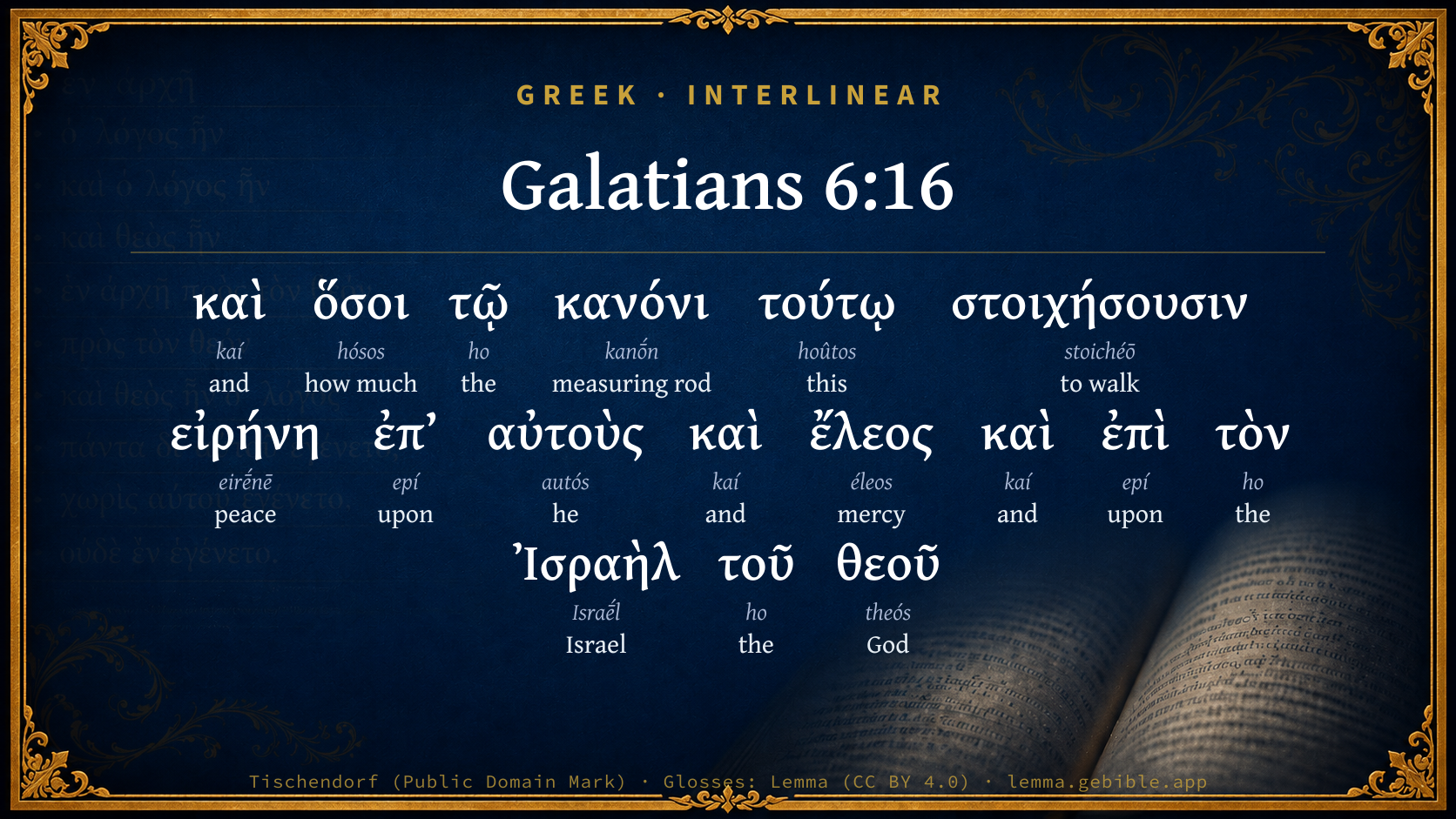
  1. καὶ kaí G2532 “and” Conjunction
  2. ὅσοι hósos G3745 “how much” Correlative pronoun, Nominative, Plural, Masculine
  3. τῷ ho G3588 “the” Article, Dative, Singular, Masculine
  4. τούτῳ hoûtos G3778 “this” Demonstrative pronoun, Dative, Singular, Masculine
  5. στοιχήσουσιν stoichéō G4748 “to walk” Verb, Future, Active, Indicative, 3rd person, Plural
  6. εἰρήνη eirḗnē G1515 “peace” Noun, Nominative, Singular, Feminine
  7. ἐπ’ epí G1909 “upon” Preposition
  8. αὐτοὺς autós G846 “he” Personal pronoun, Accusative, Plural, Masculine
  9. καὶ kaí G2532 “and” Conjunction
  10. ἔλεος éleos G1656 “mercy” Noun, Nominative, Singular, Neuter
  11. καὶ kaí G2532 “and” Conjunction
  12. ἐπὶ epí G1909 “upon” Preposition
  13. τὸν ho G3588 “the” Article, Accusative, Singular, Masculine
  14. Ἰσραὴλ Israḗl G2474 “Israel” Noun, Proper, indeclinable
  15. τοῦ ho G3588 “the” Article, Genitive, Singular, Masculine
  16. θεοῦ theós G2316 “God” Noun, Genitive, Singular, Masculine

About this verse

These counts appear in no published source. They are computed here, from the morphology-tagged text and Lemma’s own curated glosses. What Lemma adds →

17
words
12
distinct lemmas
Pauline Epistles
section

Notable vocabulary

The rarest word here is κανόνι measuring rod G2583 — appearing just 4 times in the whole Greek New Testament.

Shared distinctive vocabulary

κανόνι measuring rod G2583 occurs in 4 verses of the Greek New Testament. Also found in:

Repetition

Words recur within this verse:

Cross-references

22

Topical passages linked to Galatians 6:16 in the Treasury of Scripture Knowledge — connected by theme and wording, ordered by reader-vote popularity; previews shown in the World English Bible.

  • Galatians 3:29 If you are Christ's, then you are Abraham's seed and heirs according to promise.
  • Romans 9:6–8 But it is not as though the word of God has come to nothing. For they are not all Israel, that are of Israel.
  • Philippians 3:3 For we are the circumcision, who worship God in the Spirit, and rejoice in Christ Jesus, and have no confidence in the flesh;
  • Galatians 3:7–9 Know therefore that those who are of faith, the same are children of Abraham.
  • 1 Peter 2:5–9 You also, as living stones, are built up as a spiritual house, to be a holy priesthood, to offer up spiritual sacrifices, acceptable to God through Jesus Christ.
  • Romans 4:12 The father of circumcision to those who not only are of the circumcision, but who also walk in the steps of that faith of our father Abraham, which he had in uncircumcision.
  • Hosea 1:10 Yet the number of the children of Israel will be as the sand of the sea, which can't be measured nor numbered; and it will come to pass that, in the place where it was said to them, 'You are not my people,' they will be called 'sons of the living God.'
  • Romans 2:28–29 For he is not a Jew who is one outwardly, neither is that circumcision which is outward in the flesh;
  • Numbers 6:23–27 "Speak to Aaron and to his sons, saying, 'This is how you shall bless the children of Israel.' You shall tell them,
  • Psalms 73:1 Surely God is good to Israel, To those who are pure in heart.
  • Isaiah 45:25 In Yahweh shall all the seed of Israel be justified, and shall glory.
  • John 1:47 Jesus saw Nathanael coming to him, and said about him, "Behold, an Israelite indeed, in whom is no deceit!"
  • 1 Chronicles 12:18 Then the Spirit came on Amasai, who was chief of the thirty, [and he said], "We are yours, David, and on your side, you son of Jesse: peace, peace be to you, and peace be to your helpers; for your God helps you." Then David received them, and made them captains of the band.
  • Psalms 125:4–5 Do good, Yahweh, to those who are good, To those who are upright in their hearts.
  • John 14:27 Peace I leave with you. My peace I give to you; not as the world gives, give I to you. Don't let your heart be troubled, neither let it be fearful.
  • John 16:33 I have told you these things, that in me you may have peace. In the world you have oppression; but cheer up! I have overcome the world."
  • Galatians 5:16 But I say, walk by the Spirit, and you won't fulfill the lust of the flesh.
  • Galatians 5:25 If we live by the Spirit, let's also walk by the Spirit.
  • Philippians 3:16 Nevertheless, to the extent that we have already attained, let us walk by the same rule. Let us be of the same mind.
  • Romans 1:7 to all who are in Rome, beloved of God, called to be saints: Grace to you and peace from God our Father and the Lord Jesus Christ.
  • Galatians 1:3 Grace to you and peace from God the Father, and our Lord Jesus Christ,
  • Philippians 4:7 And the peace of God, which surpasses all understanding, will guard your hearts and your thoughts in Christ Jesus.

Cross-references courtesy of OpenBible.info (CC BY 4.0).

Commentary

Notes on Galatians 6:16 from classic Christian and Jewish commentators (each source and its license shown beneath its notes). The classic Christian expositions comment on the surrounding passage and are grouped to its opening verse, so a note may address several verses; the Jewish commentaries on the Tanakh (Rashi and others) are per-verse, so they appear only where the commentator wrote on this verse.

Lemma curates 59 commentaries, every one of them public domain or Creative Commons licensed, each selected and text-cleaned for this edition rather than reprinted as found. About our sources →

The Biblical Illustrator

Joseph S. Exell

Gal_6:16

And as many as walk according to this rule, peace be on them, and mercy, and upon the Israel of God.

The Christians walk and rule

1. Christianity is a walk; a free and voluntary motion, an uniform and even motion, a progressive motion, a constant motion.

2. This walk is a walk by rule. A Christian is not a lawless person to range up and down as fancy leads him.

3. The rule is the law of the new creature. The new creature, in the principles and workings of it, is made the ground, the pattern and direction of our obedience, and we frame and square all the actions of our lives according thereunto.

4. The blessed privileges belonging to those who thus walk--peace and mercy.

5. Such are the true Israel: a thousand times greater privilege than to be the children of Abrahams flesh. (W. Burkitt.)

The true canon of Christianity

This rule--

I. Does not consist in party watchwords.

II. Does consist in a spiritual change of the inner man (2Co_5:17).

III. Practically followed brings blessing. Peace and mercy. (Canon Vernon Hutton.)

Canonical obedience

I. The rule.

1. Glorying in the Cross.

2. The new life.

3. Called a rule of faith and practice because by it all doctrines and acts are to be examined.

4. We are to walk by it warily, circumspectly, in order and measure, without swerving, but making straight steps to our feet.

II. The blessedness of walking by this rule.

1. Peace.

(1) With God (Rom_5:1).

(2) With ourselves.

(3) With the world.

2. Mercy--all spiritual blessings flowing from the love and favour of God in Christ. (R. Cudworth.)

Peace and righteousness

Peace may be sought two ways. One way is as Gideon sought it when he built his altar in Ophrah, naming it God send peace, yet sought this peace that he loved as he was ordered to seek it, and the peace was sent, in Gods way: The country was in quietness forty years in the days of Gideon. And the other way of seeking peace is as Menahem sought it when he gave the king of Assyria a thousand talents of silver, that his hand might be with him. That is, you may either win your peace or buy it--win it by resistance to evil; buy it by compromise with evil. You may buy your peace with silenced consciences; you may buy it with broken vows; buy it with lying words; buy it with base connivances; buy it with the blood of the slain, and the cry of the captive, and the silence of lost souls. (Ruskin.)

Christianity a rule of life

I. That Christianity is a rule of life. And as many as walk according to this rule.

1. Christianity is a Divine rule. Christianity is of God.

2. Christianity is a perfect rule. The law of the Lord is perfect.

3. Christianity is an unchangeable rule. The word of the Lord standeth for ever.

4. Christianity is a precious rule. The law of Thy mouth is better unto me than thousands of gold and silver.

5. Christianity is an influential rule. Converting the soul.

II. That conformity to Christianity as a rule of life imparts great blessings.

1. Harmony of soul. Peace be on them.

2. The favour of God. And mercy

3. Relation to the children of God. And upon the Israel of God. (J. O. Griffiths.)

The Biblical Illustrator, edited by Joseph S. Exell (c. 1880s–1900s) — public domain. Text from a community e-Sword module.

The Preacher's Complete Homiletical Commentary

Joseph S. Exell (gen. ed.)

CRITICAL AND EXPLANATORY NOTES

Gal_6:16. As many as walk according to this rule.—Of life: a straight rule to detect crookedness. Upon the Israel of God.—Not the Israel after the flesh, but the spiritual seed of Israel by faith.

Gal_6:17. I bear in my body the marks of the Lord Jesus.—The Judaising teachers gloried in the circumcision marks in the flesh of their followers; St. Paul in the scars or brands of suffering for Christ in his own body—the badge of an honourable servitude.

Gal_6:18. Brethren.—After much rebuke and monition, he bids them farewell with the loving expression of brotherhood as his last parting word, as if Greatheart had meant to say, “After all, my last word is, I love you, I love you.”

MAIN HOMILETICS OF THE PARAGRAPH.—Gal_6:16-18

A Dignified and Touching Farewell—

I. Supplicates the best blessings on the truly righteous.—“As many as walk according to this rule, peace be on them, and mercy, and upon the Israel of God” (Gal_6:16). Jewish discipline and pagan culture are for ever discredited by the new creation of moral virtue. The rule of the renewed inward life supersedes the works of the condemned flesh. On all who seek to regulate their lives according to this rule the apostle invokes the peace and mercy of God. “Peace is followed by the mercy which guards and restores it. Mercy heals backslidings and multiplies pardons. She loves to bind up a broken heart or a rent and distracted Church. For the betrayers of the cross he has stern indignation and alarms of judgment. Towards his children in the faith nothing but peace and mercy remains in his heart. As an evening calm shuts in a tempestuous day, so this blessing concludes the epistle so full of strife and agitation. We catch in it once more the chime of the old benediction, which through all storm and peril ever rings in ears attuned to its note: “Peace shall be upon Israel” (Psa_125:5).

II. Pleads the brand of suffering for loyalty to Christ as conclusive proof of authority.—“From henceforth let no man trouble me: for I bear in my body the marks of the Lord Jesus” (Gal_6:17). The apostle has sufficiently vindicated his authority by facts and arguments, and he would effectually silence all quibbles on this subject by triumphantly pointing to the marks of suffering on his own body received in his Master’s service. These marks he carried wherever he went, like the standard-bearer of an army who proudly wears his scars. No man would have suffered as Paul did unless he was convinced of the importance of the truth he had received and of his supernatural call to declare the same. Suffering is the test of devotion and fidelity. For a picture of the harassed, battered, famished sufferer in the cause of Christ and His gospel read 2Co_4:8-10; 2Co_11:23-28. Marks of suffering are more eloquent than words. The highest eminence of moral perfection and influence cannot be reached without much suffering. It is a callous nature indeed that is not touched with the sight of suffering heroically endured. The calm bravery of the early Christians under the most fiendish persecution won many a convert to the truth.

III. Concludes with an affectionate benediction.—“Brethren, the grace of our Lord Jesus Christ be with your spirit. Amen” (Gal_6:18). Placing the word “brethren” at the end of the sentence, as in the Greek, suggests that, after much rebuke and admonition, the apostle bids his readers farewell with the warm-hearted expression of brotherhood. Notwithstanding fickleness on their part, his love towards them remains unchanged. He prays that the grace of Christ, the distinctive and comprehensive blessing of the new covenant, may continue to rest upon them and work its renewing and sanctifying power upon their spirit, the place where alone it can accomplish its most signal triumphs. Forgiveness for their defection and confidence in their restoration to the highest Christian privileges and enjoyment, are the last thoughts of the anxious apostle. Between them and moral bankruptcy is the prayerful solicitude of a good man.

Lessons.—

1. When argument is exhausted prayer is the last resource.

2. Prayer links divine blessing with human entreaty.

3. Last words have about them a solemn and affecting efficacy.

GERM NOTES ON THE VERSES

Gal_6:16. The True Israel of God—

I. Are those who personally enjoy the inward righteousness that comes through faith.

II. Who live consistently with their spiritual profession and the truth they have embraced.

III. Enjoy the divine benedictions of mercy and peace.

Gal_6:17. Marks of the Lord Jesus.

I. The word-picture here presented.—

1. The figure—slave-brands, στίγματα.

2. The facts—Paul’s historic experiences (1Co_4:9-15; 2Co_11:23-30).

3. The challenge—“Let no man trouble me.”

II. The suggestion the picture makes.—

1. He who follows the Lord Jesus must expect some will try to trouble him.

2. He whose marks are most conspicuous will be troubled the least.

3. He who has marks may take comfort in knowing how much his Master paid for him.

4. He who is owned may remember that his Master owns and recognises the marks also.

5. He that has no marks is either a better or a poorer Christian than the apostle Paul.

6. Satan outwits himself when he gives a believer more marks.

7. A sure day is coming when the marks will be honourable, for the body of humiliation will be like the glorious body of Christ.—Homiletic Monthly.

Marked Men.

I. Ill-marked men.—Think of the marks left on men by sickness, intemperance, impurity, crime, sin of any kind. Evil will always leave its mark.

II. Well-marked men.—

1. Christian marks—the marks of Christ. Paul was the slave of Christ. Some of his marks for Christ were literal, as the weals caused by the rods of the Roman Cæsars, the red lines caused by scourging in Jewish synagogues, the scars caused by repeated stonings. The marks of the Christian are mainly spiritual—marked by trustfulness, gentleness, purity, unselfishness.

2. Distinct marks.—Marked that he may be recognised. If you have the marks of Jesus, confess and obey Him.

3. Deep marks.—Branded on the body, not lines that can easily be removed, but going down to the flesh. Our Christian life is often feeble because it is not deep.

4. Personal marks.—The marks of Jesus of no avail unless you possess them. No man can really trouble you if you bear branded on your body the marks of Jesus.—Local Preacher’s Treasury.

Suffering for Jesus.

I. The scars of the saints for the maintenance of the truth are the sufferings, wounds, and marks of Christ Himself, seeing they are the wounds of the members of that body whereof He is the Head.

II. They convince the persecutors that they are the servants of Christ who suffer thus for righteousness’ sake.

III. If men be constant in their profession—in faith and obedience—the marks of their suffering are banners of victory.—No man ought to be ashamed of them, no more than soldiers of their wounds and scars, but rather in a holy manner to glory of them. Constantine the Great kissed the holes of the eyes of certain bishops who had them put out for their constant profession of the faith of Christ, reverencing the virtue of the Holy Ghost which shined in them.

1. By suffering bodily afflictions we are made conformable to Christ.

2. They teach us to have sympathy with the miseries of our brethren.

3. Our patient enduring of affliction is an example to others and a means of confirming them in the truth.

4. They serve to scour us from the rust of sin.—Perkins.

Gal_6:18. Concluding Benediction.

I. The apostle invokes the grace of our Lord Jesus Christ—

1. Because He is the fountain of it.

2. Because He is the conduit or pipe by which it is conveyed to us.

II. Christ is called our Lord—

1. By right of creation.

2. Of inheritance.

3. Of redemption.

4. Of conquest.

5. Of contract and marriage.

III. Observe the emphasis with which the apostle concludes the epistle.—

1. Opposing Christ, the Lord of the house, to Moses, who was but a servant.

2. The grace of Christ to inherent justice and merit of works.

3. The spirit in which he would have grace to be seated, to the flesh in which the false teachers gloried so much. 4. Brotherly unity one with another—implied in the word “brethren”—to the proud and lordly carriage of the false teachers.—Ibid.

The Preacher's Complete Homiletical Commentary (gen. ed. Joseph S. Exell; Funk & Wagnalls, c. 1892) — public domain (pre-1929). A full-Bible homiletical/sermon-outline anthology covering 65 of 66 books (2 John is absent from the source module). Text from a community e-Sword module.

MacLaren's Expositions of Holy Scripture

Alexander MacLaren

1 Corinthians

FORMS VERSUS CHARACTER

1Co 7:19. - Gal 5:6. - Gal 6:16.

The great controversy which embittered so much of Paul’s life, and marred so much of his activity, turned upon the question whether a heathen man could come into the Church simply by the door of faith, or whether he must also go through the gate of circumcision. We all know how Paul answered the question. Time, which settles all controversies, has settled that one so thoroughly that it is impossible to revive any kind of interest in it; and it may seem to be a pure waste of time to talk about it. But the principles that fought then are eternal, though the forms in which they manifest themselves vary with every varying age.

The Ritualist-using that word in its broadest sense-on the one hand, and the Puritan on the other, represent permanent tendencies of human nature; and we find to-day the old foes with new faces. These three passages, which I have read, are Paul’s deliverance on the question of the comparative value of external rites and spiritual character. They are remarkable both for the identity in the former part of each and for the variety in the latter. In all the three cases he affirms, almost in the same language, that ‘circumcision is nothing, and uncircumcision is nothing,’ that the Ritualist’s rite and the Puritan’s protest are equally insignificant in comparison with higher things. And then he varies the statement of what the higher things are, in a very remarkable and instructive fashion. The ‘keeping of the commandments of God,’ says one of the texts, is the all-important matter. Then, as it were, he pierces deeper, and in another of the texts {I take the liberty of varying their order} pronounces that ‘a new creature’ is the all-important thing. And then he pierces still deeper to the bottom of all, in the third text, and says the all-important thing is ‘faith which worketh by love.’

I think I shall best bring out the force of these words by dealing first with that emphatic threefold proclamation of the nullity of all externalism; and then with the singular variations in the triple statement of what is essential, viz. spiritual conduct and character.

I. First, the emphatic proclamation of the nullity of outward rites.

‘Circumcision is nothing, and uncircumcision is nothing,’ say two texts. ‘Circumcision availeth nothing, and uncircumcision availeth nothing,’ says the other. It neither is anything nor does anything. Did Paul say that because circumcision was a Jewish rite? No. As I believe, he said it because it was a rite; and because he had learned that the one thing needful was spiritual character, and that no external ceremonial of any sort could produce that. I think we are perfectly warranted in taking this principle of my text, and in extending it beyond the limits of the Jewish rite about which Paul was speaking. For if you remember, he speaks about baptism, in the first chapter of the First Epistle to the Corinthians, in a precisely similar tone and for precisely the same reason, when he says, in effect, ‘I baptized Crispus and Gaius and the household of Stephanas, and I think these are all. I am not quite sure. I do not keep any kind of record of such things; God did not send me to baptize, He sent me to preach the Gospel.’

The thing that produced the spiritual result was not the rite, but the truth, and therefore he felt that his function was to preach the truth and leave the rite to be administered by others. Therefore we can extend the principle here to all externalisms of worship, in all forms, in all churches, and say that in comparison with the essentials of an inward Christianity they are nothing and they do nothing.

They have their value. As long as we are here on earth, living in the flesh, we must have outward forms and symbolical rites. It is in Heaven that the seer ‘saw no temple.’ Our sense-bound nature requires, and thankfully avails itself of, the help of external rites and ceremonials to lift us up towards the Object of our devotion. A man prays all the better if he bow his head, shut his eyes, and bend his knees. Forms do help us to the realisation of the realities, and the truths which they express and embody. Music may waft our souls to the heavens, and pictures may stir deep thoughts. That is the simple principle on which the value of all external aids to devotion depends. They may be helps towards the appreciation of divine truth, and to the suffusing of the heart with devout emotions which may lead to building up a holy character.

There is a worth, therefore-an auxiliary and subordinate worth-in these things, and in that respect they are not nothing, nor do they ‘avail nothing.’ But then all external rites tend to usurp more than belongs to them, and in our weakness we are apt to cleave to them, and instead of using them as means to lift us higher, to stay in them, and as a great many of us do, to mistake the mere gratification of taste and the excitement of the sensibilities for worship. A bit of stained glass may be glowing with angel-forms and pictured saints, but it always keeps some of the light out, and it always hinders us from seeing through it. And all external worship and form have so strong a tendency to usurp more than belongs to them, and to drag us down to their own level, even whilst we think that we are praying, that I believe the wisest man will try to pare down the externals of his worship to the lowest possible point. If there be as much body as will keep a soul in, as much form as will embody the spirit, that is all that we want. What is more is dangerous.

All form in worship is like fire, it is a good servant but it is a bad master, and it needs to be kept very rigidly in subordination, or else the spirituality of Christian worship vanishes before men know; and they are left with their dead forms which are only evils-crutches that make people limp by the very act of using them.

Now, my dear friends, when that has happened, when men begin to say, as the people in Paul’s time were saying about circumcision, and as people are saying in this day about Christian rites, that they are necessary, then it is needful to take up Paul’s ground and to say, ‘No! they are nothing!’ They are useful in a certain place, but if you make them obligatory, if you make them essential, if you say that grace is miraculously conveyed through them, then it is needful that we should raise a strong note of protestation, and declare their absolute nullity for the highest purpose, that of making that spiritual character which alone is essential.

And I believe that this strange recrudescence-to use a modern word-of ceremonialism and aesthetic worship which we see all round about us, not only in the ranks of the Episcopal Church, but amongst Nonconformists, who are sighing for a less bare service, and here and there are turning their chapels into concert-rooms, and instead of preaching the Gospel are having ‘Services of Song’ and the like-that all this makes it as needful to-day as ever it was to say to men: ‘Forms are not worship. Rites may crush the spirit. Men may yield to the sensuous impressions which they produce, and be lapped in an atmosphere of aesthetic emotion, without any real devotion.’

Such externals are only worth anything if they make us grasp more firmly with our understandings and feel more profoundly with our hearts, the great truths of the Gospel. If they do that, they help; if they are not doing that, they hinder, and are to be fought against. And so we have again to proclaim to-day, as Paul did, ‘Circumcision is nothing,’ ‘but the keeping of the commandments of God.’

Then notice with what remarkable fairness and boldness and breadth the Apostle here adds that other clause: ‘and uncircumcision is nothing.’ It is a very hard thing for a man whose life has been spent in fighting against an error, not to exaggerate the value of his protest. It is a very hard thing for a man who has been delivered from the dependence upon forms, not to fancy that his formlessness is what the other people think that their forms are. The Puritan who does not believe that a man can be a good man because he is a Ritualist or a Roman Catholic, is committing the very same error as the Ritualist or the Roman Catholic who does not believe that the Puritan can be a Christian unless he has been ‘christened.’ The two people are exactly the same, only the one has hold of the stick at one end, and the other at the other. There may be as much idolatry in superstitious reliance upon the bare worship as in the advocacy of the ornate; and many a Nonconformist who fancies that he has ‘never bowed the knee to Baal’ is as true an idol-worshipper in his superstitious abhorrence of the ritualism that he sees in other communities, as are the men who trust in it the most.

It is a large attainment in Christian character to be able to say with Paul, ‘Circumcision is nothing, and my own favourite point of uncircumcision is nothing either. Neither the one side nor the other touches the essentials.’

II. Now let us look at the threefold variety of the designation of these essentials here.

In our first text from the Epistle to the Corinthians we read, ‘Circumcision is nothing, and uncircumcision is nothing, but the keeping of the commandments of God.’ If we finished the sentence it would be, ‘but the keeping of the commandments of God is everything.’

And by that ‘keeping the commandments,’ of course, the Apostle does not mean merely external obedience. He means something far deeper than that, which I put into this plain word, that the one essential of a Christian life is the conformity of the will with God’s-not the external obedience merely, but the entire surrender and the submission of my will to the will of my Father in Heaven. That is the all-important thing; that is what God wants; that is the end of all rites and ceremonies; that is the end of all revelation and of all utterances of the divine heart. The Bible, Christ’s mission, His passion and death, the gift of His Divine Spirit, and every part of the divine dealings in providence, all converge upon this one aim and goal. For this purpose the Father worketh hitherto, and Christ works, that man’s will may yield and bow itself wholly and happily and lovingly to the great infinite will of the Father in heaven.

Brethren! that is the perfection of a man’s nature, when his will fits on to God’s like one of Euclid’s triangles superimposed upon another, and line for line coincides. When his will allows a free passage to the will of God, without resistance or deflection, as light travels through transparent glass; when his will responds to the touch of God’s finger upon the keys, like the telegraphic needle to the operator’s hand, then man has attained all that God and religion can do for him, all that his nature is capable of; and far beneath his feet may be the ladders of ceremonies and forms and outward acts, by which he climbed to that serene and blessed height, ‘Circumcision is nothing, and uncircumcision is nothing, but the keeping of God’s commandments is everything.’

That submission of will is the sum and the test of your Christianity. Your Christianity does not consist only in a mere something which you call faith in Jesus Christ. It does not consist in emotions, however deep and blessed and genuine they may be. It does not consist in the acceptance of a creed. All these are means to an end. They are meant to drive the wheel of life, to build up character, to make your deepest wish to be, ‘Father! not my will, but Thine, be done.’ In the measure in which that is your heart’s desire, and not one hair’s-breadth further, have you a right to call yourself a Christian.

But, then, I can fancy a man saying: ‘It is all very well to talk about bowing the will in this fashion; how can I do that?’ Well, let us take our second text-the third in the order of their occurrence-’For neither circumcision is anything, nor uncircumcision, but a new creature.’ That is to say, if we are ever to keep the will of God we must be made over again. Ay! we must! Our own consciences tell us that; the history of all the efforts that ever we have made-and I suppose all of us have made some now and then, more or less earnest and more or less persistent-tells us that there needs to be a stronger hand than ours to come into the fight if it is ever to be won by us. There is nothing more heartless and more impotent than to preach, ‘Bow your wills to God, and then you will be happy; bow your wills to God, and then you will be good.’ If that is all the preacher has to say, his powerless words will but provoke the answer, ‘We cannot. Tell the leopard to change his spots, or the Ethiopian his skin, as soon as tell a man to reduce this revolted kingdom within him to obedience, and to bow his will to the will of God. We cannot do it.’ But, brethren, in that word, ‘a new creature,’ lies a promise from God; for a creature implies a creator. ‘It is He that hath made us, and not we ourselves.’ The very heart of what Christ has to offer us is the gift of His own life to dwell in our hearts, and by its mighty energy to make us free from the law of sin and death which binds our wills. We may have our spirits moulded into His likeness, and new tastes, and new desires, and new capacities infused into us, so as that we shall not be left with our own poor powers to try and force ourselves into obedience to God’s will, but that submission and holiness and love that keeps the commandments of God, will spring up in our renewed spirits as their natural product and growth. Oh! you men and women who have been honestly trying, half your lifetime, to make yourselves what you know God wants you to be, and who are obliged to confess that you have failed, hearken to the message: ‘If any man be in Christ, he is a new creature, old things are passed away.’ The one thing needful is keeping the commandments of God, and the only way by which we can keep the commandments of God is that we should be formed again into the likeness of Him of whom alone it is true that ‘He did always the things that pleased’ God.

And so we come to the last of these great texts: ‘In Christ Jesus, neither circumcision availeth anything, nor uncircumcision, but faith which worketh by love.’ That is to say, if we are to be made over again, we must have faith in Christ Jesus. We have got to the root now, so far as we are concerned. We must keep the commandments of God; if we are to keep the commandments we must be made over again, and if our hearts ask how can we receive that new creating power into our lives, the answer is, by ‘faith which worketh by love.’

Paul did not believe that external rites could make men partakers of a new nature, but he believed that if a man would trust in Jesus Christ, the life of that Christ would flow into his opened heart, and a new spirit and nature would be born in him. And, therefore, his triple requirements come all down to this one, so far as we are concerned, as the beginning and the condition of the other two. ‘Neither circumcision does anything, nor uncircumcision, but faith which worketh by love,’ does everything. He that trusts Christ opens his heart to Christ, who comes with His new-creating Spirit, and makes us willing in the day of His power to keep His commandments.

But faith leads us to obedience in yet another fashion, than this opening of the door of the heart for the entrance of the new-creating Spirit. It leads to it in the manner which is expressed by the words of our text, ‘worketh by love.’ Faith shows itself living, because it leads us to love, and through love it produces its effects upon conduct.

Two things are implied in this designation of faith. If you trust Christ you will love Him. That is plain enough. And you will not love Him unless you trust Him. Though it lies wide of my present purpose, let us take this lesson in passing. You cannot work yourself up into a spasm or paroxysm of religious emotion and love by resolution or by effort. All that you can do is to go and look at the Master and get near Him, and that will warm you up. You can love if you trust. Your trust will make you love; unless you trust you will never love Him.

The second thing implied is, that if you love you will obey. That is plain enough. The keeping of the commandments will be easy where there is love in the heart. The will will bow where there is love in the heart. Love is the only fire that is hot enough to melt the iron obstinacy of a creature’s will. The will cannot be driven. Strike it with violence and it stiffens; touch it gently and it yields. If you try to put an iron collar upon the will, like the demoniac in the Gospels, the touch of the apparent restraint drives it into fury, and it breaks the bands asunder. Fasten it with the silken leash of love, and a ‘little child’ can lead it. So faith works by love, because whom we trust we shall love, and whom we love we shall obey.

Therefore we have got to the root now, and nothing is needful but an operative faith, out of which will come all the blessed possession of a transforming Spirit, and all sublimities and noblenesses of an obedient and submissive will.

My brother! Paul and James shake hands here. There is a ‘faith’ so called, which does not work. It is dead! Let me beseech you, none of you to rely upon what you choose to call your faith in Jesus Christ, but examine it. Does it do anything? Does it help you to be like Him? Does it open your hearts for His Spirit to come in? Does it fill them with love to that Master, a love which proves itself by obedience? Plain questions, questions that any man can answer; questions that go to the root of the whole matter. If your faith does that, it is genuine; if it does not, it is not.

And do not trust either to forms, or to your freedom from forms. They will not save your souls, they will not make you more Christ-like. They will not help you to pardon, purity, holiness, blessedness. In these respects neither if we have them are we the better, nor if we have them not are we the worse. If you are trusting to Christ, and by that faith are having your hearts moulded and made over again into all holy obedience, then you have all that you need. Unless you have, though you partook of all Christian rites, though you believed all Christian truth, though you fought against superstitious reliance on forms, you have not the one thing needful, for ‘in Christ Jesus neither circumcision availeth anything, nor uncircumcision, but faith which worketh by love.’

Alexander MacLaren, Expositions of Holy Scripture (1904–1910) — public domain. Text from a community e-Sword module.

Tyndale Open Study Notes

Tyndale Open Resources

6:16 This principle is putting trust in Christ for salvation (6:14-15) • they are the new people of God (literally and [or even] upon the Israel of God): The Greek conjunction kai, usually translated “and,” often means “even.” If it means and, then the Israel of God is a separate group from all who live by this principle; if it means even, then they are the same group. The Jewish people still have an identity before God (Rom 9:1-5; 10:1-4; 11:1-32). Gentiles who believe have been grafted in, and Jews who disbelieve have been pruned out of the spiritual Israel (Rom 11:17-24; cp. Phil 3:2-3; Col 2:11-12). Paul thus considers all Christians to be the true Israel (see Rom 2:28-29; 9:6-8; cp. Gal 4:21-31). The phrase the Israel of God does not appear elsewhere in the New Testament or in other literature; perhaps the false teachers promised this identification to Gentiles who would accept circumcision. If so, then Paul turned their argument on its head: The believing Gentiles in Galatia didn’t need circumcision, for they were already God’s Israel—his true people—through faith in Christ.

Tyndale Open Study Notes — © Tyndale Open Resources, licensed CC BY-SA 4.0. Text via the HelloAO Bible API.

Bengel's Gnomon

Johann Albrecht Bengel

Gal 6:16. Κανόνι, rule) This refers chiefly to teachers.—εἰρήνη, peace) May it be, and it shall be. On peace, comp. Eph 2:14-17.—ἐπʼ αὐτοὺς, on them) In antithesis to the uncircumcision [those uncircumcised, viz. the unbelieving Gentiles].—καὶ ἔλεος, and mercy) Rom 15:9.—καὶ ἐπὶ τὸν Ἰσραὴλ τοῦ Θεοῦ, and on the Israel of God) In antithesis to the circumcision [the Jews]. The Israel of God are believers of the circumcision, or Jewish nation [Php 3:3]. The meaning of the apostle, which is by no means Jewish, has beautifully seized on an expression inconsistent with the idiom of the people; for the Hebrews do not say, Israel of God; nor do they even use the proper name in the construct state.[67]

[67] i.e. They do not put two proper names together in such a construction as “the Israel of God.”—ED.

Bengel's Gnomon of the New Testament — English translation (T&T Clark, Edinburgh, 1860) — public domain. Text from a community e-Sword module.

Meyer's Critical & Exegetical Commentary

Heinrich August Wilhelm Meyer

Gal_6:16. The heart, full of the great truth in Gal_6:15, has now a wish of blessing for all who follow it in their conduct. The simple and, carrying on the train of thought and linking it with Gal_6:15, serves to express this wish. A reference to Gal_6:14, so as to connect our verse with the wish therein contained (Hofmann), is not required by καί, and is forbidden by the importance of Gal_6:15, which would in that case have to be reduced to a mere parenthetical insertion.

The emphasis lies not on τούτῳ, but on τῷ κανόνι (comp. on 1Co_15:19); for it is the very canonical character of the saying in Gal_6:15 which has to be brought out: who shall walk according to the guiding line, which is herein given. We are prohibited from assigning to κανών the non-literal meaning rule, maxim (as is usually done; see Schott in loc.), by the figurative στοιχήσουσιν, which requires the literal meaning guiding line (2Co_10:13 ff.), that is, in this passage, a line defining the direction of the way; as such, the maxim expressed in Gal_6:15 is placed before them. As to στοιχεῖν, comp. on Gal_5:25. The anacoluthic nominative ὅσοι κ.τ.λ. has rhetorical emphasis, directing the whole attention of the readers first to the subject in itself which is under discussion. Comp. on Mat_7:24; Mat_10:14; Joh_1:12; Act_7:40. The future στοιχήσ. (comp. Gal_5:10) applies to the time of receiving the letter (comp. τοῦ λοιποῦ, Gal_6:17). Paul hopes that the letter will have a converting and strengthening effect upon many readers, but makes the question, who should be warranted in applying to himself the concluding blessing, depend on the result.

εἰρήνη ἐπʼ αὐτοὺς καὶ ἔλεος] sc. εἴη,[270] welfare (שלום; see on Eph_6:23; Joh_14:27) on them, and mercy (Tittm. Synon. p. 69 f). Comp. 1Ti_1:2; 2Ti_1:2; Jud_1:2; 2Jn_1:3, in which passages ἜΛΕΟς stands first. Here it follows after, not because Paul intended at first to write ΕἸΡΉΝΗ only (so, arbitrarily, Olshausen), nor because in ἜΛΕΟς he had specially in view the day of judgment (Hofmann), which indeed is expressly added in 2Ti_1:18, but because he has thought of the effect produced before the producing cause. What welfare it is that Paul wishesnamely, all Messianic welfareis obvious of itself. The peace of reconciliation forms a part of it. ἜΛΕΟς is, moreover, to be considered as neuter, because Paul throughout so uses it (even in Tit_3:5 it is neuter, according to decisive testimony); although the neuter form, which very often occurs in the LXX., is but very rarely found in classical authors. See Dindorf, ad Diod. iii. 18; Kühner, I. p. 396, c. ed. 2.

In ἐπʼ αὐτούς is implied the idea that welfare and mercy come down upon them from heaven. Comp. Luk_2:25; Luk_2:40; Luk_4:18; 2Co_12:9; Mar_1:10; Act_19:6, et al.

καὶ ἐπὶ τὸν Ἰσραὴλ τοῦ Θεοῦ] That this is a reminiscence of Psa_125:5; Psa_128:6 (Theophylact, Erasmus, and others; also Rückert, Schott, de Wette, Reiche), could only be assumed without dealing arbitrarily, if, instead of καὶ ἐπὶ τὸν Ἰσρ. τοῦ Θεοῦ, Paul had written: εἰρήνη ἑπὶ τὸν Ἰσραήλ! which, after the instruction given by him in Gal_4:21 ff., he might have written without any danger of misunderstanding. Still less can the expression be referred to Psa_73:1; for which purpose Hofmann employs an impossible interpretation of the Hebrew text of the passage. The Israel of God, that is, as contrasted with Jacobs bodily descendants as such (comp. Rom_9:6; 1Co_10:18; Php_3:3), the Israelites who belong to God as His own, and therefore form the real people of God ideally viewed (comp. also Joh_1:48), are at any rate the true Christians.[271] But according as καί is taken either as explanatory or as conjunctive, we may understand either the true Christians in general, Jewish and Gentile Christians (Chrysostom, Theodoret, Luther, Calvin, Pareus, Cornelius a Lapide, Calovius, Baumgarten, Koppe, Rosenmüller, Borger, Winer, Paulus, Olshausen, Baumgarten-Crusius, Wieseler, and others), or the truly converted Jews (Ambrosiaster, Beza, Grotius, Estius, Schoettgen, Bengel, Rückert, Matthies, Schott, de Wette, Ewald, Reithmayr, and others; Usteri does not decide). If we adopt the latter interpretation, we must either (with Grotius, Schott, Bengel, Ewald) refer the foregoing ὅσοι and ΑὐΤΟΎς to the Gentile Christians,a view which is, however, decisively at variance with the universal ὍΣΟΙ, and with the description excluding any national reference, Τῷ ΚΑΝΌΝΙ ΤΟΎΤῼ ΣΤΟΙΧ.or (with Rückert, Matthies, de Wette, Reithmayr, and others) we must explain the train of thought as follows: Salvation be upon all true Christians, and more especially (to mention these in particular; see on Mar_1:5; Mar_16:7) on all true Jewish Christians! But however near Pauls fellow-countrymen were to his heart (Rom_9:1), he not only had no ground in the context for bringing them forward here so specially; but any such distinction would even be quite improperly introducedespecially in the deeply-impassioned close of the letterin presence of churches which consisted principally of Gentile Christians and had been involved by Jewish interference in violent controversies. And even apart from this, no reader to whom the teaching of the apostle as to the true Israelites was familiar (and see Gal_3:7, Gal_4:21 ff.) could think that τὸν Ἰσρ. τοῦ Θεοῦ referred to Jewish Christians only; this would be opposed to the specific conception of Paul on this point. We must adhere, therefore, to the explicative view of καί as the correct one (1Co_3:5; 1Co_8:12; 1Co_15:38; Joh_1:16), and indeed, namely, so that it introduces an appropriate, more precise description (Hartung, Partikell. I. p. 145 f.; Winer, p. 407 [E. T. 545 f.]) of the subjects previously characterized. Hofmann is wrong in objecting that the epexegetical καί is always climactic; see Hermann ad Viger. p. 838. Moreover, the designation of all those, who shall walk according to that entirely anti-Jewish rule of conduct, as the Israelites of God, forms as it were the final triumph of the whole epistle over the Judaistic practices, the very aim of which was to assert the title of the Ἰσραὴλ κατὰ αάρκα to the heritage of salvation. Hofmann is entirely mistaken in his view that ΚΑΊ is even, and that the Israel of God are the Jew-Christians, so that Paul expresses the idea that he desired to include even these in his wish. It was, indeed, obvious that in ἐπʼ αὐτούς they could not be, and were not intended to be, excluded; but Paul was neither so unwise nor so devoid of tact as expressly to state that self-evident point, as if there could possibly be any doubt about it. By adding this last word, he would only have offended the theocratical point of honour (Rom_1:16). Lastly, Matthias also is wrong in supposing that καὶ ἐπὶ τὸν Ἰσρ. τοῦ Θεοῦ begins the new sentence (Gal_6:17): And concerning the Israel of God henceforth let no man, etc. This interpretation ought to have been prevented by the solemn repetition of the preposition, which indeed on the second occasion would acquire quite a different sense (concerning).

[270] Taken as a wish of blessing, the thought harmonizes more naturally with the conclusion of the epistle, than if it is taken as an affirmation (de Wette, ἔσται or ἐστίν). Chrysostom and Theophylact appear to have supplied ἔσται; but Theodoret takes it as wish: ἐπηύξατο τὸν ἔλεον κ. τὴν εἰρήνην.

[271] Not the Jews (Morus), nor even the pious Jews,those, namely, who have not rejected the gospel out of stubbornness, and permit the hope of their coming to recognise the rule expressed in ver. 15 (Reiche, p. 97 f.). The apostle, according to his whole system, could not understand under the ideal Israel of God any others than believers (Gal_3:7; Gal_3:29, Gal_4:26; Rom_9:6-8). To him the καινὴ κτίσις in ver. 15 was not conceivable otherwise than as necessarily conditioned by faith (Gal_3:28; Eph_2:10); hence he could not expect of any Jew not yet converted, however pious he might be as an observer of the law, that he would walk according to the canon of ver. 15.

Meyer — Critical and Exegetical Commentary on the New Testament — English translation by Peter Christie, edited by Frederick Crombie (T&T Clark, 1880) — public domain. Text from a community e-Sword module.

Expositor's Greek Testament

ed. W. Robertson Nicoll

Gal 6:16 . κανόνι . Men need a rule to guide their lives as the surveyor or the carpenter for the right adjustment of his work. This rule was supplied to the Jew by the Law in a code of morals, but the Spirit quickens in Christians a new life whereby the conscience is enlightened to discern good and evil for the regulation of their lives. καὶ ἐπὶ τὸν Ἰσραὴλ : yea upon the Israel of God . καί is not properly copulative here, but intensive. Those who walk by the rule of the Spirit are declared to be indeed the true Israel of God, not the Jews who have the name of Israel, but are really only children of Abraham after the flesh.

The Expositor's Greek Testament, edited by W. Robertson Nicoll (1897–1910) — public domain. Text from a community e-Sword module.

Geneva Bible (1599)

Geneva Bible translators

Upon the true Israel, whose praise is of God and not of men, Rom. 2:19.

Geneva Bible (1599) marginal notes — public domain. Text via Bolls.life.

Jamieson, Fausset & Brown

Robert Jamieson, A. R. Fausset & David Brown

as many--contrasting with the "as many," Gal 6:12.

rule--literally, a straight rule, to detect crookedness; so a rule of life.

peace--from God (Eph 2:14-17; Eph 6:23).

mercy-- (Rom 15:9).

Israel of God--not the Israel after the flesh, among whom those teachers wish to enrol you; but the spiritual seed of Abraham by faith (Gal 3:9, Gal 3:29; Rom 2:28-29; Phi 3:3).

Jamieson, Fausset & Brown — Commentary Critical and Explanatory on the Whole Bible (1871) — public domain (CC PDM 1.0). Text via the HelloAO Bible API.

Adam Clarke's Commentary

Verse 16. As many as walk according to this rule] Τῳ κανονι τουτῳ· This canon; viz. what is laid down in the preceding verses, that redemption is through the sacrifice of Christ; that circumcision and uncircumcision are equally unavailable; and that none can be saved without being created anew. This is the grand canon or rule in Christianity.

Peace be on them] Those who act from this conviction will have the peace and mercy of God; for it is in this way that mercy is communicated and peace obtained.

The Israel of God.] The true Christians, called here the Israel of God, to distinguish them from Israel according to the flesh. See Clarke on Ro 2:29; "Ro 4:12".

Adam Clarke's Commentary on the Bible (1810–1826) — public domain. Text from a community e-Sword/MySword module.

John Calvin's Commentaries

16. And as many as walk according to this rule. “May they enjoy all prosperity and happiness!” This is not merely a prayer in their behalf, but a token of approbation. His meaning therefore is, that those who teach this doctrine are worthy of all esteem and regard, and those who reject it do not deserve to be heard. The word rule denotes the regular and habitual course which all godly ministers of the gospel ought to pursue. Architects employ a model in the erection of buildings, to assist them in preserving the proper form and just proportions. Such a model (κανόνα) does the apostle prescribe to the ministers of the word, who are to build the church “according to the pattern shewn to them.” (Hebrews 8:5.)

Faithful and upright teachers, and all who allow themselves to conform to this rule, must derive singular encouragement from this passage, in which God, by the mouth of Paul, pronounces on them a blessing. We have no cause to dread the thunders of the Pope, if God promises to us from heaven peace and mercy. The word walk may apply both to a minister and to his people, though it refers chiefly to ministers. The future tense of the verb, (ὅσοι στοιχήσουσιν,) as many as shall walk, is intended to express perseverance.

And upon the Israel of God This is an indirect ridicule of the vain boasting of the false apostles, who vaunted of being the descendants of Abraham according to the flesh. There are two classes who bear this name, a pretended Israel, which appears to be so in the sight of men, — and the Israel of God. Circumcision was a disguise before men, but regeneration is a truth before God. In a word, he gives the appellation of the Israel of God to those whom he formerly denominated the children of Abraham by faith, (Galatians 3:29,) and thus includes all believers, whether Jews or Gentiles, who were united into one church. On the contrary, the name and lineage are the sole boast of Israel according to the flesh; and this led the apostle to argue in the Epistle to the Romans, that “they are not all Israel which are of Israel, neither because they are the seed of Abraham, are they all children.” (Romans 9:6, 7.)

John Calvin's Commentaries (1540-1563) — public domain. Text from the Calvin Translation Society English edition (1840s-50s) via the Christian Classics Ethereal Library (ccel.org). Calvin's coverage is partial (roughly two-thirds of the Bible); uncommented books and verses are honest gaps, never fabricated. The 19th-century editor's footnotes and remarks are omitted so the notes are faithfully Calvin's own voice.

Ellicott's Commentary for English Readers

(16) According to this rule.—The word for “rule” is the same that afterwards received a special application in the phrase, “Canon of Scripture.” It meant originally a carpenter’s rule, or the line that a carpenter works by—hence, a rule or standard; and, from that, the list of books coming up to a certain standard—not (as might be thought) which themselves supplied a standard.

The Apostle confines his benediction to those who hold the fundamental truths of Christianity—i.e., here more especially, the doctrine of justification by faith and the spiritual view of Christianity connected with it, as opposed to the merely external and mechanical system of the Judaisers.

And upon the Israel of God.—The benediction is addressed, not to two distinct sets of persons (“those who walk by this rule” and “the Israel of God”), but to the same set of persons described in different ways. “And” is therefore equivalent to “namely:” Yea, upon the Israel of God. By the “Israel of God” is here meant the “spiritual Israel;” not converts from Judaism alone, but all who prove their real affinity to Abraham by a faith like Abraham’s. (Comp. Gal_3:7-9; Gal_3:14; Gal_3:29; Rom_4:11-12; Rom_9:6-8.)

A Bible Commentary for English Readers, edited by Charles John Ellicott (1878–1897) — public domain. Text from a community e-Sword module.

The Cambridge Bible for Schools and Colleges

gen. ed. J. J. S. Perowne

16. as many as walk] See note on ch. Gal_5:25. Some commentators attach to this verb a different sense, ‘as many as conform to this rule’. But the A.V. gives what is probably a correct rendering. The reading ‘shall walk’, adopted by R.V. is on the whole preferable on MSS. authority. At the time when the Epistle was written believers were comparatively few in number, but the blessing was a prophecy extending to all who in the long series of centuries, even to the end of the dispensation, should walk, that is, live by the same rule.

this rule] This word originally meant a carpenter’s rod or rule for guiding and testing his work, or the tongue of a balance. Then, any standard by which to regulate procedure or conduct. The transition to the sense of a model or pattern was not difficult. It is of frequent occurrence in different applications in ecclesiastical literature. See Article ‘Canon’ in Dict. of Christian Antiquities, and Westcott On the Canon, App. A.

Here ‘this rule’ is the principle of justification through faith in the Atoning Blood, and the renewal of man’s nature by the Holy Ghost. ‘As many as walk by it’—whether circumcised or not—in every age, in every clime—male or female—slave or free, without distinction of visible Church or sect. Surely this must be that ‘great multitude which no man can number’, of whom it is written ‘they washed their robes and made them white in the blood of the Lamb’, Rev_7:13.

peace be on them, and mercy] This is probably a prayer, ‘May peace be on them’; though the original allows us to render, ‘Peace rests on them’. Peace in the soul, because of reconciliation with God. Peace with man through Him Who is ‘our peace’. But mercy also, as needed by sinners.

and upon the Israel of God] Are ‘the Israel of God’ distinct from those who walk according to the Apostle’s rule, or are we to regard the particle ‘and’ as epexegetical, and equivalent to ‘yea, upon &c.’? The answer will depend on the exact meaning which is attached to the expression, ‘the Israel of God’. If it means those ‘who are not of the circumcision only, but who walk in the steps’ of Abraham’s faith, i.e. Jews who have been really converted to Christianity, we must suppose St Paul to have had Gentile converted in his mind in the preceding verses. It seems better, however, to regard the expression as intended to sum up the ‘as many as’ in a phrase which is closely identified with the whole argument of the Epistle, ‘If ye be Christ’s, then are ye Abraham’s seed and heirs according to the promise’. These are ‘the Israel of God’, whether Jews or Gentiles, for ‘the Jew is he who is one inwardly in the spirit, not in the letter’. Rom_2:29. So that the blessing is invoked on all who walk according to the rule enunciated, and so in fact on the true Israel, not Israel after the flesh, but the Israel of the promise and of God.

The Cambridge Bible for Schools and Colleges (gen. ed. J. J. S. Perowne; Cambridge University Press, 1878–1918) — public domain. Text from a community e-Sword module.

John Gill's Exposition

From henceforth let no man trouble me,.... Having so clearly stated and explained the doctrine of justification, and so largely proved that it is not by works, but by faith, and that circumcision and other rituals of the ceremonial law were not necessary to it, he desires, nay, in an authoritative way he requires, that they give him no further trouble on that head; signifying, that he expected they would be satisfied with what he had wrote, and abide by the truth and obey it, as they had formerly done; that he should hear no more objections from them, or complaints of them: nor need they further inquire his sense of these things; by this they would fully know his faith and practice; as indeed they might also by his suffering persecutions on the account of his faith, and his preaching the Gospel of Christ, and particularly this part of it:

for I bear in my body the marks of the Lord Jesus; by which he means, not the marks in Christ's hands, feet, and side; but the reproachful characters the apostle was stigmatized with; or the real scars in his body, made by beating, scourging, and stoning of him; or his sufferings and persecutions in general, which he endured for the sake of Christ and his Gospel; see Co2 11:23. The allusion is either to servants and soldiers, who, when taken into service, used to have some particular mark put upon them, that they might be known to be such an one's servant, or soldier (c); as the Hebrew servant, who was willing to serve his master, had his ear bored through with an awl, Exo 21:6 so the apostle was known to be a firm and faithful servant, and a good soldier of Christ, by the reproaches and afflictions which he underwent for his sake; or else to those marks which, by way of reproach and punishment, were made upon fugitive servants, or soldiers, that deserted; as the sufferings of the apostle were designed as reproaches to him, and punishments of him, for preaching the Gospel of Christ; but these he gloried in, and bore and carried as trophies and marks of honour. Just as veteran soldiers show the scars and wounds they have received in battle, as tokens of their valour and courage, in facing and fighting the enemy in greatest danger: these he is said to bear "in his body"; not in the bodies of others, he gloried not in their flesh, as the false apostles did; nor in the circumcision of his own flesh, the scar that left there the mark of Moses and of a Jew; but in those things which were marks of his being a disciple of Christ, and not of Moses, and which he bore for his sake; and since therefore it was so easy to discern on which side of the question he was, from his suffering persecution for the cross of Christ; and since he had so many and such great trials and exercises, he, with apostolical gravity and authority, commands them to give him no more trouble, from the time of their reception of the epistle, henceforward.

(c) Vid. Lydium de re militare, l. 1. c. 6.

John Gill's Exposition of the Whole Bible (1746–1763) — public domain (CC PDM 1.0). Text via the HelloAO Bible API.

Trapp's Complete Commentary

John Trapp

16 And as many as walk according to this rule, peace be on them, and mercy, and upon the Israel of God.

Ver. 16. According to this rule] viz. Of the new creature. Or the doctrine of this Epistle.

Peace be on them] Not only in them, or with them, but "on them," maugre the malice of earth and hell.

John Trapp, A Commentary or Exposition upon All the Books of the Old and New Testament (1647–1656) — public domain. Text from a community e-Sword module.

Albert Barnes' Notes on the Bible

And as many as walk - As many as live, for so the word walk is used in the Scriptures. According to this rule. Greek: “This canon”; see the word explained in the notes at 2Co 10:13.

Peace be on them - See the note at Rom 15:33.

And upon the Israel of God - The true church of God; all who are his true worshippers; see the note at Rom 2:28-29; Rom 9:6, note.

Albert Barnes' Notes on the Bible (1834–1885) — public domain. Text from a community e-Sword/MySword module.

Matthew Poole's English Annotations

And as many as walk according to this rule; he either meaneth the rule of Scripture, the whole word of God; or the doctrine which he had taught them throughout this Epistle, or what he had said in the words immediately going before, where the apostle had given them this rule, not to regard either circumcision or uncircumcision, or any thing in the flesh, but only the change of their hearts. To these he either prophesieth

peace and mercy, or he prayeth peace and mercy for them; under which large terms he comprehendeth all good things, whether internal or external.

Upon the Israel of God; upon the true Israelites, whom he calleth the Israel of God; hereby intimating and confirming the truth of what he had said, Rom 2:28,29, and what our Saviour had said of Nathanael, Joh 1:47, calling him an Israelite indeed, because in him was no guile; and establishing a distinction between such as were so really, and those who were only Israelites in name, because descended from Jacob, to whom God gave the name of Israel. Hereby also checking the vanity of the Jews, who gloried in the name of Israelites, and thought there could no water come out of the fountains of Israel which God would cast away. The apostle doth not promise, or prophesy, mercy and peace to all Israelites, but only to the Israel of God; that is, to believers, that received and embraced Jesus Christ offered in the gospel.

Matthew Poole's English Annotations on the Holy Bible (1683–1685) — public domain. Text from a community e-Sword/MySword module.

Whedon's Commentary on the Bible

Daniel D. Whedon

16. Rule—Κανων, that is, canon. Dr. Westcott, in his work on the Canon, says, “The original meaning of Κανον (connected with קנת, κανη, καννα, canno, [canalis, channel,] cane, canon) is a straight rule; as a ruler, or, rarely, the beam of a balance; and this with the secondary notion, either (1) of keeping any thing straight, or (2) testing straightness, as a carpenter’s rule, and even, improperly, a plumb-line.” From this the acknowledged books of the Bible are called the canon, and canonical. St. Paul lays down the principle of the last verse, and pronounces a benediction on all who walk (or, a better reading, shall walk) according to this canon.

Israel of God—In distinction from the Israel of the flesh. In this terse phrase Paul triumphantly embodies his great doctrine that the theocracy has left the old ritual and gone with the new Church of the Spirit.

Daniel D. Whedon (gen. ed.), Commentary on the Old and New Testaments (1874–1909) — public domain. Text from a community e-Sword module.

The Pulpit Commentary

And as many as walk according to this rule (kaini toutw stoichsousin); and as many as shall be walking by this rule. The word kanwn, properly a workman"s rule, according to Liddell and Scott, but according to Bishop Lightfoot, who, refers to Dr. Westcott, "On the Canon," App. A, the carpenter"s or surveyor"s line by which a direction is taken, is used in 2Co_10:13, 2Co_10:15, 16 of the measurements and delimitation of districts; here, with reference apparently to a surveyor"s measuring-line, as marking out a path or road. So that tw kano toutw stoicein means "walking on orderly" (see note on stoice in Gal_5:25) in the line marked out by what has now been said. The future tense appears to point forward to what should be the case among the Galatians when the letter now going to them should have had time to do its work. But what in the preceding context does the apostle refer to as supplying "this rule"? Many think that he points to the aphorism in ver. 15, affirming the utter indifferency of circumcision or uncircumcision, and the all-importance of a "new creature;" in which case the stress would lie mainly upon the latter point, the "new all-importance of a creature," which was of perpetual interest, rather than on the indifferency of circumcision which in itself was a matter of but passing concern. It may be fairly questioned, however, whether the apostle does not rather point to the description which in ver. 14 he has given of the manner in which he himself regarded the cross of Christ, as a pattern to the Galatian Churchmen of the manner in which they also should be affected by it. It was customary with the apostle to present himself to his converts as the model to which they should conform themselves. Thus he commends the Thessalonians for that on their conversion they proved themselves imitators of him. (1Th_1:6) When discoursing to the Corinthians of his manifold afflictions and of his self-humbling, men-loving demeanour under them all, he besought them to be imitators of him, (1Co_4:9-16) which entreaty he renews with a similar reference in 9:1. So he exhorts the Philippians to unite with one another in imitating him, and to fix their regards upon such as walked as they had him and those with him for a pattern, (Php_3:17) and again repeats to them (4:9), "Those things which ye, moreover, learned, and received, and heard, and saw in me, do, all which clauses refer to his own character and doings as seen by themselves or as reported to them by others (see Alford, in loc.). This purpose, of propounding his sentiments and course of action as a model for the guidance of his converts, no doubt underlies very many of those passages in which he so frankly and (we might but for this be tempted to think) so self approvingly dilates upon them. In those days we must remember there was no "Canon "of New Testament Scripture which might serve for the guidance of the newly gained converts from heathenism; for practical guidance in the Christian life, besides the Old Testament Scriptures, (2Ti_3:15-17) they had, perforce, to be referred partly to their own moral sense, partly to the inward teachings of the Holy Spirit, and partly, and this to a very important extent, to the living examples of eminently Spirit-taught men. This purpose, of propounding himself as an example, evidently underlay the writing of ver. 14; and it is the consciousness that it was so that now leads him to use the phrase, "by this rule," in reference, as seems most probable, to that very description of his own life. It is noticeable that, after having exhorted the Philippians to do all the things which they had seen and known him to do, he adds. (Php_4:9) "And the God of peace shall be with you;" just as he here says, "As many as shall be walking orderly by this rule, peace upon them, and mercy!" We are now brought into a position to see clearly the force of the conjunction "and," with which he introduces this verse. It connects it closely with ver. 14. "I myself glory in the cross of Christ, and to that cross have sacrificed all I held dear; and for all that shall be found walking in that same path upon them shall rest my hearty sympathy and my pastoral benediction." It is further deserving of notice that in Philippians 3., when presenting himself to the Philippians as their examplar, the apostle speaks of "many no doubt with inclusive reference to those Judaizing advocates of circumcision whose circumcision he scornfully styles a concision as being "the enemies of the cross of Christ." This was written some years after the Epistle to the Galatians; but it shows that it was a common experience with the apostle to find among the Gentile Churches two classes in particular of Christians: one, consisting of his own adherents and followers in the spirit and life of the gospel; another, of those who (either because as born Jews or Gentile Judaizers, they eschewed the pollution of the cross and its aspect towards the ceremonial Law, or because they were Gentiles, ashamed before their countrymen of trusting in a Jew who had been crucified), were fain to the utmost of their power to thrust the crucifixion of Christ out of sight enemies of the cross of Christ?" Peace be on them, and mercy, and upon the Israel of God (eijrhnh ejp aujtouv kai eleov kai ejpi ton jIsrahl tou Qeou). The suppletion of "be" in the Authorized Version, in preference to "shall be" or "is," is borne out by the fact that the language of benediction, both in the greeting at the beginning of the Epistles and in their close, ordinarily omits the copula verb, which in such cases must be what is here supplied. We may compare in particular Eph_6:24, "Grace be with all them that love our Lord Jesus Christ in uncorruptness," not only as similar in construction, requiring the like suppletion of "be," but also as another instance in which the apostle pronounces his pastoral benediction with a certain limitation, specifying those only who sincerely love Jesus Christ. The limitation in these two cases only implied is in 1Co_16:22 converted into a distinctly expressed anathema upon those who do not love Christ. The present passage makes the implied limitation without even that measure of stern precision which would have been marked by his writing ejpitouv ("upon these") instead of ejp aujtouv ("upon them"). It seems as if he would fain allure back to the gospel blessing those of his readers who might feel themselves as not now coming within its range. Perhaps in the addition of the words, "and mercy," we may detect a sympathizing sense in the mind of the apostle of the mental suffering, which those in Galatia sincerely devoted to the crucified Christ had and would still have to encounter, in contending for the truth of the gospel against fellow Churchmen of their own. They would probably be no mere hard-minded controversialists, but humble, loving believers, to whom the mercy of God would be very dear. The apostle adds it to his greeting only in writing to Timothy (1Ti_1:2; 2Ti_1:2) distinguished apparently for the affectionateness and feminine-heartedness of his character. In Tit_1:4 the addition is not genuine. The words, "and upon the Israel of God," seem to be an echo of the "peace upon Israel (eijrh ejpi tol)," which, in the Septuagint, closes the hundred and twenty-fifth and hundred and twenty-eighth psalms. The addition of the words, "of God," seems intended pointedly to distinguish the "Israel" which the apostle has m view from that which boasted itself as being Israel while it was not, and also from the false brethren (yeudadelfoi, (Gal_2:4) in the Christian Church, who were for linking themselves with the false Israel. The addition is not merely honorific, as in the expression, "the Church of God" (1Co_1:2; 2Co_1:1 2Co 10:32 2Co_11:22 2Co 15:9) but distinctive as well that which alone God views and loves as "Israel to wit, the entire body of real believers in Christ, who, as portrayed in this Epistle, are "children of promise after the fashion of Isaac", (Gal_4:28) Abraham"s seed and heirs of the promise", (Gal_3:29) and the children of "the upper Jerusalem, which is our mother". (Gal_4:26) Of that portion of the true Israel which dwelt in Galatia, (see 1Pe_1:1 1Pe_2:10) those who, like the apostle, consecrated themselves to Christ as crucified, were the guiding and characterizing element; and therefore his blessing shed upon these spreads itself also upon those connected with them. That the apostle is even here still regardful of others among the Galatians, who were themselves" shifting away from the gospel" and were drawing others away, (Gal_1:6, Gal_1:7) is shown by the next verse.

The apostolic blessing.

This takes its colour from the tenor of the Epistle. Consider

I THE AUTHORITATIVE RULE FOR CHRISTIAN GUIDANCE. "As many as walk according to this rule.

1. Christians are not lawless in their obedience. They walk according to rule, and are never so free as within the limits of rule.

2. The rule is evidently that expressed in the previous verse that what is outward in religion is nothing, and what is inward is everything; that the new creation is the whole of religion. If this position were rightly recognized, to be a Jew would be no privilege, to be a Gentile would be no barrier.

II THE BENEDICTION. "Peace be on them, and mercy." The two greatest blessings of the covenant. Peace is the distinctive theocratic gift Peace shall be upon Israel"; (Psa_125:5) mercy is the blessing in which peace finds at once its origin and support.

III THE OBJECTS OF THE BLESSING. Those "who walk according to this rule" and "the Israel of God." The first class was not Gentile believers as such, and the second Jewish believers as such. The blessing is for the entire number who walk according to this rule, but the apostle finds among them a class whom he describes with a tender and suggestive fitness as "the Israel of God." He had been all along proving that the true Israel was "of faith," but he evidently thinks of his countrymen as standing apart from their Judaistic perverters in the glorious eminence of "the Israel of God." It is a peculiar expression, still more distinctive even than "Israel after the Spirit," and emphasizes the Divine ownership in those who are "the circumcision, who worship God in the Spirit, who rejoice in Christ Jesus, and have no confidence in the flesh". (Php_3:3)

The Israel of God.

To one who enters into the ideas taught by St. Paul, the anxiety of some persons in the present day to discover that the English are descended from the lost ten tribes of Israel is altogether mistaken. Even if they could prove their very improbable theory, it would have nothing but an ethnological, or at best a sentimental, interest. Religiously it is not of the slightest importance. All Christians, whatever their birth and descent, are the true Israel of God. Look at some of the marks of Israel upon the Christian.

I ABRAHAM"S SEED. The Jew traced his pedigree back to Abraham. He was Abraham"s seed. Therefore he accounted himself the heir of the promises made to Abraham. The Christian possesses Abraham"s faith. By means of this he becomes Abraham"s seed, (Gal_3:29) while the Jew who lacks faith is disowned.

II POSSESSING THE ORACLES OF GOD. St. Paul reckons as the first advantage of the Jews "that they were entrusted with the oracles of God". (Rom_3:2) The Hebrew race had the unspeakable privilege of receiving through their inspired teachers the highest revelation of God vouchsafed to the world for many ages. But there came a later revelation outshining this old revelation in clearness and glory. The Jew rejected this. The Christian accepted it. The Christian holds the New Testament, and he has Christ, God"s brightest manifestation of himself. Thus he steps into the position held by ancient Israel.

III SEPARATION FROM THE WORLD. The Jew was called out from the world to live apart as a lonely race with a peculiar destiny of its own. Christians are thus called out of life into the world. They are made to live as pilgrims and strangers, as sojourners with God.

IV A MISSION TO THE WOULD. Israel did not always understand her mission, and often grossly neglected it in proud exclusiveness. Yet many of the prophets saw clearly that the chosen people were called from among the nations that they might be trained to give to the world the highest blessings. They did this, but only through giving it Christianity. Now, Christians are an elect people elect to be missionaries and apostles to the people that sit in darkness.

V A SUTURE HERITAGE. The Hebrew in the wilderness looked for a promised had. Abraham and the patriarchs had hoped for "a city which hath foundations, whose Builder and Maker is God." The perfect fulfilment of these hopes was not given to the Jew on earth. It is for the Christian hereafter; for "there remaineth therefore a sabbath rest for the people of. W.F.A. (Heb_4:9)

The Pulpit Commentary (1880–1919), ed. H.D.M. Spence-Jones & Joseph S. Exell — public domain. Text from a community e-Sword module.

John Wesley's Explanatory Notes

And as many as walk according to this rule -

1. Glorying only in the cross of Christ.

2. Being crucified to the world. And,

3. Created anew. Peace and mercy be upon them, and upon the Israel, that is, the Church, of God - Which consists of all those, and those only, of every nation and kindred, who walk by this rule.

John Wesley, Explanatory Notes Upon the Whole Bible (1754–1765) — public domain. Text via the GEBible commentary corpus.

Luther on Galatians

Martin Luther

VERSE 16. And as many as walk according to this rule, peace be on them, and mercy.

This is the rule by which we ought to live, "that ye put on the new man, which after God is created in righteousness and true holiness." (Eph 4:24.) Those who walk after this rule enjoy the favor of God, the forgiveness of their sins, and peace of conscience. Should they ever be overtaken by any sin, the mercy of God supports them.

Martin Luther — Commentary on the Epistle to the Galatians (1535), English translation by Theodore Graebner (Zondervan, 1939) — public domain (U.S. copyright not renewed). Text from a community e-Sword module.

Kretzmann's Popular Commentary

Paul E. Kretzmann

Conclusion:

v. 16. And as many as walk according to this rule, peace be on them and mercy, and upon the Israel of God.

v. 17. From henceforth let no man trouble me; for I bear in my body the marks of the Lord Jesus.

v. 18. Brethren, the grace of our Lord Jesus Christ be with your spirit. Amen.

Crucified to the world, but alive to Christ and in Christ, that is the condition of the believers that have become new creatures by the regenerative power of the Holy Spirit. And therefore Paul, in a calm, but triumphant statement, calls out: And as many as shall walk according to this rule: peace upon them and mercy, yea, upon the Israel of God. All believers accept the principle formulated by Paul in

v. 15. it is the standard according to which they regulate their lives. And upon all such, as upon the true Israel of God, the apostle invokes peace and mercy. The peace of God, which passes all understanding, which assures them of the right relation to God, Php 4:7, the peace with God through our Lord Jesus Christ, Rom 5:1, is the blessing which follows belief in the Gospel. For it has been made possible by the mercy of God, shown to us poor sinners for the sake of His Son, by which He forgives us all our sins and accepts us as His dear children.

Having thus finished his exposition of the truth, Paul has only one wish: Henceforth let no one cause me distresses, wearisome annoyances. He expects it of the Galatians, and feels sure that they will heed his appeal, that they will pay no more attention to the Judaizing teachers. For as for him, he was hearing the marks, or stigmata, of the Lord Jesus in his body. Such marks were branded upon the body for various reasons, the reference here probably being to the brand of freedom placed upon the slave when he was sold to the temple and thus liberated from his master. Paul bore such marks on his body, all the traces, scars, wounds, and welts of the various persecutions which he had been obliged to endure in his apostolic calling. Also herein he had become like his great Master.

And so he concludes: The grace of our Lord Jesus Christ be with your spirit, brethren. The grace which was merited by the atoning work of Christ is the highest gift which God can bestow, and it is Paul’s prayer that it may fill their spirit, their mind, with the calm certainty of salvation, a certainty which neither false teachers nor all the forces of the world could take from them. The very last word of the epistle proper is the kind and appealing address "brethren. " The severity of the entire letter is mitigated by this one word, in which unaltered brotherly love is expressed.

Summary

The apostle warns against self-exaltation and every show of selfishness, pictures his love in contrast to the hypocrisy of the false teachers, and begs the Galatians to return to the proper spirit of peace in order that they may enjoy the mercy of the Lord.

Paul E. Kretzmann, Popular Commentary of the Bible (1921–1924) — public domain. Text from a community e-Sword module.

Burkitt's Expository Notes on the New Testament

William Burkitt

Observe here, 1. The nature of Christianity described: it is a walk. Now a walk is a motion, a free and voluntary motion, an uniform and even motion: it is a progressive motion, and a constant motion.

Observe, 2. The condition of this walk, and that is regularity: it is a walk by rule; a Christian is not a lawless person, to range and ramble, and run up and down, as fancy leads him: but he walks by rule, by the rule of scripture, by the rule of charity.

Observe, 3. The determination of that rule which a Christian is to walk by: it must be according to this rule. What rule? The foregoing verse declares it is regeneration, and the law of the new creature. As many as walk according to that rule; when the new creature in the principles and workings of it is made the ground, the pattern, and direction, of our obedience, and we frame and square all the actions of our lives according thereunto.

Observe, 4. The blessed privileges belonging to them that thus walk: Peace be into them, and mercy: that is, there shall be peace and mercy to them; these shall be their portion; nay, they shall be upon them; that is, in a large and plentiful manner vouchsafed to them.

Observe lastly, The honourable mention which the apostle makes of them that thus walk by scripture rule, according to the law of the new creature, written in the heart: he calls them the true Israel of God, the spiritual seed of Abraham, the children of his faith; which was a thousand times greater privilege than to be the children of his flesh: these are the persons interested in his blessings.

Learn hence, That true and inward peace, great and lasting peace, peace with God, and peace with conscience, is the assured portion, and shall be the possession, of all and only those who walk according to the law of God, the rule of the creature. As many as walk according to this rule.

William Burkitt's Expository Notes on the New Testament (1700–1703) — public domain. Text from a community e-Sword module.

McGarvey & Pendleton's Commentaries

J. W. McGarvey

And as many as shall walk by this rule, peace be upon them, and mercy, and upon the Israel of God. [Upon all who walk by the rule which I have just stated--the rule which rejects carnal ordinances, and accepts a regenerated life--upon them, even upon the Israel of God, be peace and mercy. The word translated "and" often means "even," and it has that force here, for it was Paul's constant contention that Christians were the true Israel of God, the bona-fide sons of Abraham.]

J. W. McGarvey (with Philip Y. Pendleton), Commentaries on the New Testament (The Fourfold Gospel, 1914; Acts; and the epistles) — public domain. Text from a community e-Sword/MySword module.

The People's New Testament

B. W. Johnson

16. This rule. The one just named in verse 15. A benediction is pronounced upon all such. And upon the Israel of God. Rather, Even upon, etc. The Greek word often means even, and does here, as the Israel of God does not differ from those who follow “this rule.”

B. W. Johnson's The People's New Testament with Notes (1889–1891) — public domain. Electronic text from the Christian Classics Ethereal Library (CCEL) ThML edition.

Cambridge Greek Testament for Schools and Colleges

16. καὶ ὅσοι. Without restriction; whatever their nationality or past or even present behaviour. The καί makes an apodosis in thought though not in form; if a new creation then peace and mercy.

τῷ κανόνι τούτῳ, “by this rule,” i.e. the maxim of Gal 6:14-15 culminating in the principle that a καινὴ κτίσις is of all importance. For κανών see 2Co 10:13; 2Co 10:15-16; Jdt 13:6 (8); Mic 7:4 and especially 4Ma 7:21[171] πρὸς ὅλον τὸν τῆς φιλοσοφίας κανόνα εὐσεβῶς φιλοσοφῶν.

[171] Is affixed it means that all the passages are mentioned where the word occurs in the Greek Bible.

στοιχήσουσιν. Gal 5:25 note. In the future tense lies an invitation. For its construction with a dative see Rom 4:12. Observe here the insistence on a holy life; yet “Deed” as determined by “Creed “of mind and heart.

εἰρήνη ἐπʼ αὐτοὺς κ.τ.λ. An adaptation of Psalms 125 (124):5, 128 (127):6. Compare the Palestinian recension of the last prayer of the Eighteen Benedictions (Shemone ‘esre), “Set Thy peace upon Israel Thy people, and on Thy city and on Thine inheritance, and bless us, yea all of us as one man. Blessed be Thou, O LORD, who makest peace” (see Dalman, Words of Jesus, German edition, p. 301).

καὶ ἔλεος. This precise combination and order are unique. Contrast 1Ti 1:2; 2Ti 1:2; 2Jn 1:3 and even Jud 1:2. The usual order is ἔλ. κ. εἰρ., i.e. God’s mercy as the ground of peace. Here apparently εἰρ., refers to the immediate and ἔλ. the final blessing; cf. 2Ti 1:18.

καὶ ἐπὶ τὸν Ἰσραηλ τοῦ θεοῦ. The phrase is unique. The addition of τοῦ θεοῦ to the old form excludes those who are of Israel and yet are not Israel (Rom 9:6); cf. Rev 2:9. The sentence forms a suitable close to an epistle which has endeavoured to distinguish clearly those who are and those who are not the true seed of Abraham (e.g. Gal 3:7; Gal 3:29, Gal 4:21 sqq.). Apparently καὶ is epexegetic of ὄσοι … στοιχήσουσιν, and ὁ Ἰσρ. τ. θ. includes all true believers whatever their origin; and so, probably, ἡ περιτομή in Php 3:3.

Cambridge Greek Testament for Schools and Colleges (Cambridge University Press, 1896; 21 vols, various authors incl. Carr, Maclear, Plummer, Farrar, Lumby, Moule, M. R. James, Simcox) — public domain. Text from a community e-Sword module.

Alford’s Greek Testament

Henry Alford

16.] And as many (reference to the ὅσοι of ver. 12; and in κανόνι to the εὐπροσωπ. and πηλίκοις γράμμ.? see above) as shall walk by this rule (of ver. 15. κανών is a ‘straight rule,’ to detect crookedness: hence a norma vivendi. The dative is normal), peace be (not ‘is:’ it is the apostolic blessing, so common in the beginnings of his Epistles: see also Eph 6:23) upon them (come on them from God; reff., and Luk 2:25, Luk 2:40 al. freq.) and (and indeed, ‘und zwar:’ the καὶ explicative, as it is called: see reff.) upon the Israel of God (the subject of the whole Epistle seems to have given rise to this expression. Not the Israel after the flesh, among whom these teachers wish to enrol you, are blessed: but the Israel of God, described ch. 3. ult., εἰ δὲ ὑμεῖς χριστοῦ, ἄρα τοῦ Ἀβραὰμ σπέρμα ἐστέ. Jowett compares, though not exactly parallel, yet for a similar apparent though not actual distinction, 1Co 10:32).

Henry Alford, The Greek Testament (1849–1861) — public domain. Text from a community e-Sword module.

International Critical Commentary

16. καὶ ὅσοι τῷ κανόνι τούτῳ στοιχήσουσιν, εἰρήνη ἐπʼ αύτούς, καὶ ἔλεος καὶ ἐπι τὸν Ἰσραὴλ τοῦ θεοῦ. “And as many as shall walk by this rule, peace be upon them, and mercy upon the Israel of God.” The apostle concludes this paragraph of brief reiterations of the chief ideas of the letter (cf. on v. 11) with a benediction upon all whose life is conformed to the great principle for which he has been contending, viz., the essentially spiritual character of religion as against the ascription of fundamental religious value to any physical or material condition, however sanctioned. κανών, occurring in N. T. here and 2Co 10:13-16 only, meaning properly “measuring rod” or “straight edge,” is clearly shown by τούτῳ (referring to v. 15) to have here its metaphorical sense of “principle.” στοιχέω doubtless has here the same meaning as in 5:25 (q. v.), viz., “to walk, to conduct oneself.” While v. 15, to which τῷ κανόνι τούτῳ refers, is affirmative rather than imperative, yet the proposition which it affirms is of fundamental importance for the determination of conduct. He who recognises the valuelessness of such externals as circumcision and uncircumcision and the necessity of the new spiritual life will, on the one hand, be unmoved by the appeal of the judaisers to receive circumcision, and on the other seek, rather, to be led by, and to live by, the Spirit.

Καὶ ἔλεος is usually joined with εἰρήνη, as with it limiting ἐπʼ αὐτούς, the comma being placed after ἔλεος (so Tdf. WH. Ell. Ltft. Alf. Wies. Sief. Zahn). Against this interpretation, however, it is to be said: (a) The order εἰρήνη καὶ ἔλεος, if both words have reference to one class of persons, is illogical, placing effect first and cause afterwards. ἔλεος is joined with εἰρήνη elsewhere in benedictions in N. T. in 1Ti 1:2, 2Ti 1:2, 2Jn 1:3, Jud 1:2, always preceding εἰρήνη. Note, also, the often-repeated benediction, χάρις and εἰρήνη, in which χάρις, closely corresponding to ἔλεος in meaning, always precedes εἰρήνη. καὶ ἔλεος becomes, then, an afterthought, to which καὶ ἐπὶ τὸν Ἰσραὴλ τοῦ θεοῦ appends a second afterthought. (b) Though Rom 9:6, 1Co 10:18 show that Paul distinguished between Israel according to the flesh and the Israel according to election or promise, and Rom 2:29, Php 3:3 suggest that he might use τὸν Ἰσραὴλ τοῦ θεοῦ of all believers in Christ, regardless of nationality, there is, in fact, no instance of his using Ἰσραήλ except of the Jewish nation or a part thereof. These facts favour the interpretation of the expression as applying not to the Christian community, but to Jews; yet, in view of τοῦ θεοῦ, not to the whole Jewish nation, but to the pious Israel, the remnant according to the election of grace (Rom 11:5), including even those who had not seen the truth as Paul saw it, and so could not be included in ὅσοι … στοιχ. In this case the benediction falls into two distinct parts. In the first the apostle invokes peace upon those who recognise and act in accordance with the principle of v. 15, and, in distinction from them, the mercy of God through which they may obtain enlightenment and enter into peace, upon those within Israel who even though as yet unenlightened are the true Israel of God. Against the combined force of these two reasons the presence of καί after ἔλεος is of little weight. It is quite explicable as slightly ascensive. In view of the apostle’s previous strong anti-judaistic expressions, he feels impelled, by the insertion of καί, to emphasise this expression of his true attitude towards his people. It can scarcely be translated into English without overtranslating.

Κανών is believed to be ultimately of Semitic origin. Cf. Gregory, Canon and Text, p. 15. It is found, however, in Greek from Homer down in a great variety of usages at a greater or less remove from the probable ground-meaning, “a tool or utensil made of reed or cane.” (1) Literally, of a large number of implements, most of which were probably originally made of cane, the name being retained though other material was later used in their construction: e. g., the rods across the hollow of the shield, through which the arm was passed: Il. VIII 193; XIII 407; the shuttle or quill, by which the threads of the woof were passed between those of the warp, Il. XXIII 761; in classical times most frequently of the rule or straight edge used by masons and carpenters: Soph. Frag. 421; Eur. Troiad. 6; Aristoph. Av. 999, 1002; Plato, Phil. 56B; Æschin. 3:200, etc. (in the same meaning, but metaphorically used: Aristoph. Ran. 799: Eur. Supp. 650); later of the scribe’s rule, Anth. Pal. 6:63; a curtain rod, Chares ap. Ath. 538D; the keys or stops of a flute, Anth. Pal. 9. 365; the beam or tongue of a balance, Anth. Pal. 11. 334. (2) Metaphorically. It is probably upon the basis of the meaning most frequently found in classical times, “a ruler or straight edge,” that the word came to be used in a metaphorical sense, of anything regulative, determinative, a rule or standard. Cf. the similar transfer of meaning in our English word “rule.” It is so used of the written law conceived of as a whole, or a section of it, Lycurg. 149. 4: of the good man, Arist. Eth. N. 3. 6 (1113 a33); of the Δορυφόρος of Polycleitus and the book explaining it: Pliny, H. N. 34. 55; Galen, Hippocr. et Plat. V 3; of a general rule or principle: Anecdota Grœca (Bekker), 1180; Epict. Diss. I 28:28; Luc. Halieus, 30; of a list of the chief epochs or eras, which served to determine intermediate dates, Plut. Sol. 27:1; and for other things of the same general character.

In the Lxx the word is found but once, in the difficult passage, Mic 7:4, where the translator either read a text differing from the Massorah, or misunderstood the Hebrew. The meaning is probably “measuring rod” or “line.” In the Apocr. it occurs only once, Jdth. 13:6 (8), for a rod used in the construction of a bed; in 4 Mac. 7:21 it means “rule” or “standard.”

In N. T., only Paul uses the word and that in but two passages: 2Co 10:13, 2Co 10:16, where the meaning probably is “measure” (others prefer the meaning, “limit, boundary-line”), and in the present passage, where it evidently refers to the preceding sentence, which it describes, as a general rule or principle, serving as a standard. The use of κανών to designate ecclesiastical statutes and ordinances, a fixed body of Christian doctrines serving as a standard of correct teaching (sometimes conceived of as summed up in the pithy sentences of the Apostle’s Creed), the clergy, the catalogue of martyrs or saints, or the collection of books accepted as authoritative for Christian doctrine and practice, does not occur until later and belongs properly under a treatment of the ecclesiastical development of the word. In the last-mentioned use it is (according to Zahn) not found until the middle of the fourth century A. D., in Athanasius, Decr. Syn. Nic.; cf. also Canon 59 of the Synod at Laodicea (Mansi II 574); Athanasius, Festal Letter 39. For a fuller treatment of the word, see Zahn, Grundriss der Gesch. des ntl. Kanons, 2 pp. 1 ff.; cf. also Westcott, The Canon of the N. T.5, App. A, pp. 504 ff.; Gregory, Canon and Text, pp. 15 ff.

Like πνεύματι in 5:25, τῷ κανόνι is a dative of means. On the use of the future (στοιχήσουσιν) in a hypothetical clause see BMT 308. Cf. Luk 17:31. On εἰρήνη, cf. on 1:3. The verb to be supplied is an optative as in 1:3, 6:18, and frequently in similar connections.

International Critical Commentary — older volumes (1896–1929), various authors — public domain. Text from a community e-Sword module.

Vincent's Word Studies in the New Testament

Marvin R. Vincent

Rule [κανονι] . P o. See on 2Co 10:13, 16. 9 1 Emphasis on rule not this.

Peace be on them [ειρηνη επ αυτους] . The only instance of this formula in N. T. Commonly eijrhnh with the simple dative, peace unto you, as Joh 20:19, 21; Rom 1:7; 1Co 1:3; Gal 1:3, etc. In the Catholic Epistles, with plhqunqeih be multiplied. See 1Pe 1:2; 2Pe 1:2; Jude 1:2.

Mercy [ελεος] . In the opening salutations of the Pastoral Epistles with grace and peace; also in 2 John 3. In Jude 1:2 with peace and love. And upon the Israel of God. The kai and may be simply collective, in which case the Israel of God may be different from as many as walk, etc., and may mean truly converted Jews. Or the kai may be explicative, in which case the Israel of God will define and emphasize as many as, etc., and will mean the whole body of Christians, Jewish and Gentile. In other words, they who walk according to this rule form the true Israel of God. The explicative kai is at best doubtful here, and is rather forced, although clear instances of it may be found in 1Co 3:5; 1Co 14:38. It seems better to regard it as simply connective. Then osoi will refer to the individual Christians, Jewish and Gentile, and Israel of God to the same Christians, regarded collectively, and forming the true messianic community.

Marvin R. Vincent, Word Studies in the New Testament (1887–1900) — public domain. Text from a community e-Sword/MySword module.

Lesson kit

Teaching starters — assembled from the data on this page, not authored interpretation. Every prompt links to the verse data it draws on. Edit before teaching.

Galatians, in the Pauline Epistles, opens this verse with 17 words (12 distinct Greek lemmas). Its most distinctive word is kanṓn (“measuring rod”). A historical commentator’s framing appears above. Read the whole chapter for the surrounding context.

Discussion questions

  1. The word kanṓn carries the sense “measuring rod.” How does it shape the verse?
  2. How does 2 Corinthians 10:13, which shares the word «measuring rod», read alongside this verse?
  3. What does the repetition of “upon” (2× in this one verse) do in this verse?
  4. These translations render this verse differently. What is at stake in choosing one wording over another?
  5. Compare how The Biblical Illustrator and The Preacher's Complete Homiletical Commentary read this verse. Where do they agree or differ?

Things to notice

  • These translations choose different wording for 7 words in this verse.
  • “upon” occurs 2× in this single verse.
  • 12 distinct Greek lemmas span 17 words in this verse.

Reading settings

Reading text

Shown beneath each verse's original-language words.

Old Testament
Old Testament edition

Read the OT as the Masoretic Hebrew (MT) or the Greek Septuagint (LXX).

English shown for the Greek Septuagint (in the Hebrew ↔ Greek comparison).

Comparing translations? Open the Compare panel on any verse page to stack up to four side by side.