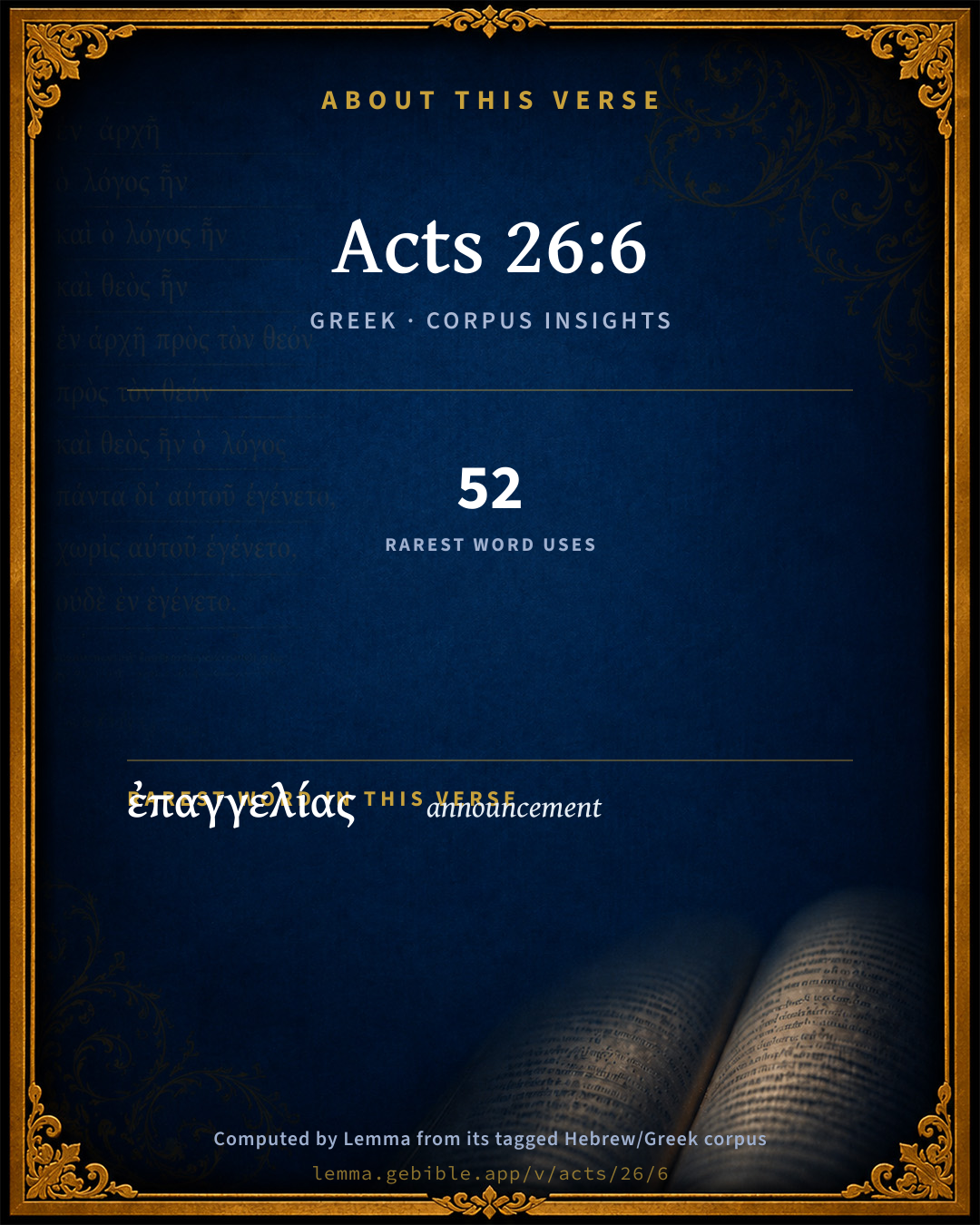
Acts 26:6

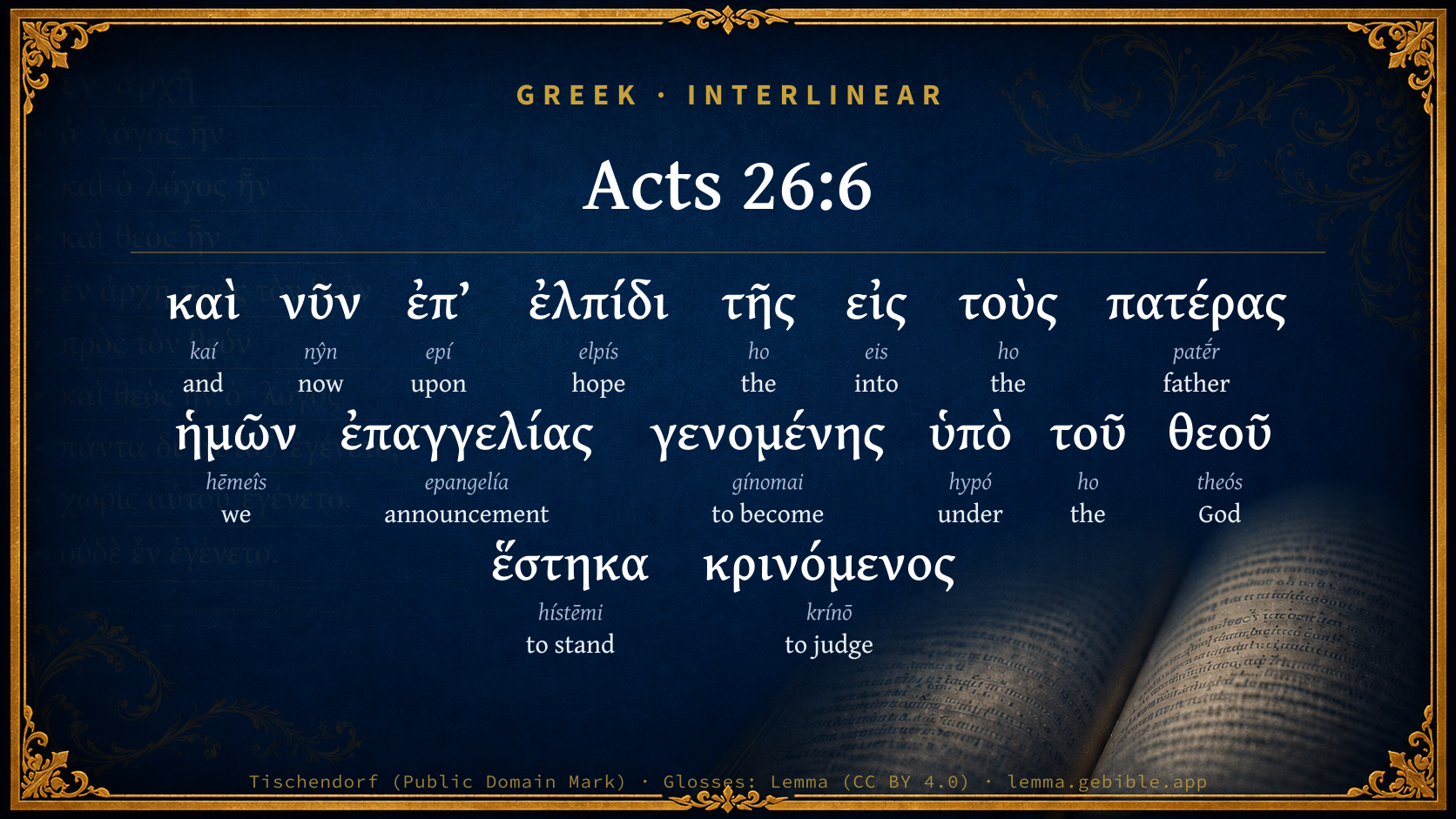
Greek (Tischendorf 8th ed.) Acts 26:6 appears in the Greek New Testament. The text above is from the Tischendorf 8th edition. Each word links to its Strong’s number and a concise gloss. Click any word for its full Thayer’s Greek Lexicon entry.
Download image
Cite this verse

Acts 26:6 (World English Bible). Public Domain. Lemma interlinear Bible study tool, https://lemma.gebible.app/v/acts/26/6.

Show BibTeX & RIS
BibTeX
RIS
English Translation
Now I stand here to be judged for the hope of the promise made by God to our fathers,
World English Bible · Public Domain
Download a study sheet

One document with this verse’s original text, its word-by-word gloss line, the meaning frame, cross-references with their text, attributed commentary, and full source and license credits — printable, and it pastes into notes with its structure intact.

This verse Autodidact and up

Study sheet (.html) Plain text (.txt)

A passage Seminary Student

Up to 50 verses in one chapter. A passage sheet keeps up to 6 commentary sources and 12 cross-references per verse, in the order this page ranks them, and says so on the sheet whenever that leaves anything out. Ask for a single verse and you get the Autodidact verse sheet above.

Everything on this page stays free to read, with no account — the sheet is a download of what is already on screen, not access to it.

Want to remove ads? Support Godless Engineer
Compare translations 3

The same verse in 3 English versions, stacked beneath the original-language interlinear above. Click any original word for its lexicon entry.

Each is an independent rendering of the whole verse — the interlinear is not word-aligned to these translations.

Highlighted words mark where these versions differ — a whole-verse word diff, not a word-by-word alignment.

  • World English Bible Public Domain
    Now I stand here to be judged for the hope of the promise made by God to our fathers,
  • King James Version Public Domain
    And now I stand and am judged for the hope of the promise made of God, unto our fathers:
  • unfoldingWord Literal Text CC BY-SA 4.0
    And now I stand here being judged because of hope of the promise made to our fathers by God,

unfoldingWord Literal Text — © unfoldingWord, licensed CC BY-SA 4.0. Word-aligned USFM3 via Door43 (git.door43.org/unfoldingWord/en_ult).

Versions to compare (up to 4)

3 of 4 selected

Show all 19 translations

Every available English version of this verse, each an independent rendering of the whole verse.

  • World English Bible Public Domain
    Now I stand here to be judged for the hope of the promise made by God to our fathers,
  • Berean Standard Bible Public Domain
    And now I stand on trial because of my hope in the promise that God made to our fathers,
  • Majority Standard Bible Public Domain
    And now I stand on trial because of my hope in the promise that God made to our fathers,
  • King James Version Public Domain
    And now I stand and am judged for the hope of the promise made of God, unto our fathers:
  • American Standard Version (1901) Public Domain
    And now I stand `here' to be judged for the hope of the promise made of God unto our fathers;
  • Revised Version (1885) Public Domain
    And now I stand here to be judged for the hope of the promise made of God unto our fathers;
  • Geneva Bible (1599) Public Domain
    And now I stand and am accused for the hope of the promise made of God vnto our fathers.
  • Douay-Rheims (1899) Public Domain
    And now for the hope of the promise that was made by God to the fathers, do I stand subject to judgment:
  • Young's Literal Translation Public Domain
    and now for the hope of the promise made to the fathers by God, I have stood judged,
  • Literal Standard Version CC BY-SA 4.0
    and now for the hope of the promise made to the fathers by God, I have stood judged,
  • Unlocked Literal Bible CC BY-SA 4.0
    Now I stand here to be judged because of my certain hope in the promise made by God to our fathers.
  • unfoldingWord Literal Text CC BY-SA 4.0
    And now I stand here being judged because of hope of the promise made to our fathers by God,
  • Darby Bible Public Domain
    And now I stand to be judged because of the hope of the promise made by God to our fathers,
  • World Messianic Bible Public Domain
    Now I stand here to be judged for the hope of the promise made by God to our fathers,
  • Webster's Bible Public Domain
    And now I stand, and am judged for the hope of the promise made by God to our fathers:
  • Free Bible Version CC BY-SA 4.0
    Now I am standing here to be judged regarding the promised hope God gave to our fathers
  • Bible in Basic English Public Domain
    And now I am here to be judged because of the hope given by God's word to our fathers;
  • Text-Critical English NT CC BY 4.0
    And now I am standing trial because of my hope in the promise God made to our fathers,
  • Tyndale New Testament (1534) Public Domain
    And now I stond and am iudged for the hope of the promes made of God vnto oure fathers:

Literal Standard Version (2020), Covenant Press — licensed CC BY-SA 4.0. Text via the HelloAO Bible API (eBible.org). Unlocked Literal Bible (unfoldingWord) — licensed CC BY-SA 4.0. Text via the HelloAO Bible API (eBible.org). unfoldingWord Literal Text — © unfoldingWord, licensed CC BY-SA 4.0. Word-aligned USFM3 via Door43 (git.door43.org/unfoldingWord/en_ult). Free Bible Version, Dr. Jonathan Gallagher — licensed CC BY-SA 4.0. Text via the HelloAO Bible API (eBible.org).

Word by word

More ways to search: Search by grammar → Find every occurrence → Compare this word →

Practice this passage: Drill this verse → Learn its vocabulary →

ἐπαγγελίας
epangelía
G1860
“announcement”
Noun, Genitive, Singular, Feminine
Part of Speech
Noun
Case
Genitive
Number
Singular
Gender
Feminine
Full Thayer's Definition

Origin: from G1861

TDNT: 11:36,2

1. announcement 2. promise a. the act of promising, a promise given or to be given b. a promised good or blessing
  1. καὶ kaí G2532 “and” Conjunction
  2. νῦν nŷn G3568 “now” Adverb
  3. ἐπ’ epí G1909 “upon” Preposition
  4. ἐλπίδι elpís G1680 “hope” Noun, Dative, Singular, Feminine
  5. τῆς ho G3588 “the” Article, Genitive, Singular, Feminine
  6. εἰς eis G1519 “into” Preposition
  7. τοὺς ho G3588 “the” Article, Accusative, Plural, Masculine
  8. πατέρας patḗr G3962 “father” Noun, Accusative, Plural, Masculine
  9. ἡμῶν hēmeîs G2249 “we” Personal pronoun, 1st person, Genitive, Plural
  10. γενομένης gínomai G1096 “to become” Verb, Aorist, Middle deponent, Participle, Genitive, Singular, Feminine
  11. ὑπὸ hypó G5259 “under” Preposition
  12. τοῦ ho G3588 “the” Article, Genitive, Singular, Masculine
  13. θεοῦ theós G2316 “God” Noun, Genitive, Singular, Masculine
  14. ἕστηκα hístēmi G2476 “to stand” Verb, Perfect, Active, Indicative, 1st person, Singular
  15. κρινόμενος krínō G2919 “to judge” Verb, Present, Passive, Participle, Nominative, Singular, Masculine

About this verse

These counts appear in no published source. They are computed here, from the morphology-tagged text and Lemma’s own curated glosses. What Lemma adds →

16
words
14
distinct lemmas
Acts
section

Shared distinctive vocabulary

ἐπαγγελίας announcement G1860 occurs in 50 verses of the Greek New Testament. Also found in:

Repetition

A word recurs within this verse:

Cross-references

59

Topical passages linked to Acts 26:6 in the Treasury of Scripture Knowledge — connected by theme and wording, ordered by reader-vote popularity; previews shown in the World English Bible.

  • Titus 2:13 looking for the blessed hope and appearing of the glory of our great God and Savior, Jesus Christ;
  • Daniel 7:13–14 I saw in the night-visions, and, behold, there came with the clouds of the sky one like a son of man, and he came even to the ancient of days, and they brought him near before him.
  • Acts 24:15 having hope toward God, which these also themselves look for, that there will be a resurrection of the dead, both of the just and unjust.
  • Acts 28:20 For this cause therefore I asked to see you and to speak with you. For because of the hope of Israel I am bound with this chain."
  • Romans 15:8 Now I say that Christ has been made a minister of the circumcision for the truth of God, that he might confirm the promises given to the fathers,
  • Genesis 12:3 I will bless those who bless you, and I will curse him who curses you. In you will all of the families of the earth be blessed."
  • Genesis 22:18 In your seed will all the nations of the earth be blessed, because you have obeyed my voice."
  • Genesis 26:4 I will multiply your seed as the stars of the sky, and will give to your seed all these lands. In your seed will all the nations of the earth be blessed,
  • Deuteronomy 18:15 Yahweh your God will raise up to you a prophet from the midst of you, of your brothers, like me; to him you shall listen;
  • Job 19:25–27 But as for me, I know that my Redeemer lives. In the end, he will stand upon the earth.
  • Isaiah 9:6–7 For to us a child is born, to us a son is given; and the government shall be on his shoulder: and his name shall be called Wonderful, Counselor, Mighty God, Everlasting Father, Prince of Peace.
  • Micah 5:2 But you, Bethlehem Ephrathah, Being small among the clans of Judah, Out of you one will come forth to me that is to be ruler in Israel; Whose goings forth are from of old, from everlasting.
  • Zechariah 13:7 "Awake, sword, against my shepherd, And against the man who is close to me," says Yahweh of Hosts. Strike the shepherd, and the sheep will be scattered; And I will turn my hand against the little ones.
  • Acts 13:32–33 We bring you good news of the promise made to the fathers,
  • Acts 23:6 But when Paul perceived that the one part were Sadducees and the other Pharisees, he cried out in the council, "Men and brothers, I am a Pharisee, a son of Pharisees. Concerning the hope and resurrection of the dead I am being judged!"
  • Genesis 3:15 I will put enmity between you and the woman, and between your offspring and her offspring. He will bruise your head, and you will bruise his heel."
  • Genesis 49:10 The scepter will not depart from Judah, Nor the ruler's staff from between his feet, Until he comes to whom it belongs. To him will the obedience of the peoples be.
  • 2 Samuel 7:12–13 When your days are fulfilled, and you shall sleep with your fathers, I will set up your seed after you, who shall proceed out of your bowels, and I will establish his kingdom.
  • Psalms 2:6–12 "Yet I have set my king on my holy hill of Zion."
  • Psalms 40:6–8 Sacrifice and offering you didn't desire. You have opened my ears: Burnt offering and sin offering you have not required.
  • Psalms 98:2 Yahweh has made known his salvation. He has openly shown his righteousness in the sight of the nations.
  • Psalms 110:1–4 Yahweh says to my Lord, "Sit at my right hand, Until I make your enemies your footstool for your feet."
  • Psalms 132:11 Yahweh has sworn to David in truth. He will not turn from it: "I will set the fruit of your body on your throne.
  • Psalms 132:17 There I will make the horn of David to bud. I have ordained a lamp for my anointed.
  • Isaiah 4:2 In that day, Yahweh's branch will be beautiful and glorious, and the fruit of the land will be the beauty and glory of the survivors of Israel.
  • Isaiah 7:14 Therefore the Lord himself will give you a sign. Behold, the virgin will conceive, and bear a son, and shall call his name Immanuel.
  • Isaiah 11:1–5 There shall come forth a shoot out of the stock of Jesse, and a branch out of his roots shall bear fruit.
  • Isaiah 40:9–11 You who tell good news to Zion, go up on a high mountain; you who tell good news to Jerusalem, lift up your voice with strength; lift it up, don't be afraid; say to the cities of Judah, Behold, your God!
  • Isaiah 42:1–4 Behold, my servant, whom I uphold; my chosen, in whom my soul delights: I have put my Spirit on him; he will bring forth justice to the Gentiles.
  • Isaiah 53:10–12 Yet it pleased Yahweh to bruise him; he has put him to grief: when you shall make his soul an offering for sin, he shall see [his] seed, he shall prolong his days, and the pleasure of Yahweh shall prosper in his hand.
  • Isaiah 61:1–3 The Spirit of the Lord Yahweh is on me; because Yahweh has anointed me to preach good news to the humble; he has sent me to bind up the broken-hearted, to proclaim liberty to the captives, and the opening [of the prison] to those who are bound;
  • Jeremiah 23:5–6 Behold, the days come, says Yahweh, that I will raise to David a righteous Branch, and he shall reign as king and deal wisely, and shall execute justice and righteousness in the land.
  • Jeremiah 33:14–17 Behold, the days come, says Yahweh, that I will perform that good word which I have spoken concerning the house of Israel and concerning the house of Judah.
  • Ezekiel 17:22–24 Thus says the Lord Yahweh: I will also take of the lofty top of the cedar, and will set it; I will crop off from the topmost of its young twigs a tender one, and I will plant it on a high and lofty mountain:
  • Ezekiel 21:27 I will overturn, overturn, overturn it: this also shall be no more, until he come whose right it is; and I will give it [him].
  • Ezekiel 34:23–25 I will set up one shepherd over them, and he shall feed them, even my servant David; he shall feed them, and he shall be their shepherd.
  • Ezekiel 37:24 My servant David shall be king over them; and they all shall have one shepherd: they shall also walk in my ordinances, and observe my statutes, and do them.
  • Daniel 2:34–35 You saw until a stone was cut out without hands, which struck the image on its feet that were of iron and clay, and broke them in pieces.
  • Daniel 2:44–45 In the days of those kings shall the God of heaven set up a kingdom which shall never be destroyed, nor shall the sovereignty of it be left to another people; but it shall break in pieces and consume all these kingdoms, and it shall stand forever.
  • Daniel 9:24–26 Seventy weeks are decreed on your people and on your holy city, to finish disobedience, and to make an end of sins, and to make reconciliation for iniquity, and to bring in everlasting righteousness, and to seal up vision and prophecy, and to anoint the most holy.
  • Hosea 3:5 Afterward the children of Israel shall return, and seek Yahweh their God, and David their king, and shall come with trembling to Yahweh and to his blessings in the last days.
  • Joel 2:32 It will happen that whoever will call on the name of Yahweh shall be saved; For in Mount Zion and in Jerusalem there will be those who escape, As Yahweh has said, And among the remnant, those whom Yahweh calls.
  • Amos 9:11–12 In that day I will raise up the tent of David who is fallen, and close up its breaches, and I will raise up its ruins, and I will build it as in the days of old;
  • Obadiah 1:21 Saviors will go up on Mount Zion to judge the mountains of Esau, and the kingdom will be Yahweh's.
  • Micah 7:20 You will give truth to Jacob, and mercy to Abraham, As you have sworn to our fathers from the days of old.
  • Zephaniah 3:14–17 Sing, daughter of Zion! Shout, Israel! Be glad and rejoice with all your heart, daughter of Jerusalem.
  • Zechariah 2:10–11 Sing and rejoice, daughter of Zion; for, behold, I come, and I will dwell in the midst of you,' says Yahweh.
  • Zechariah 6:12 and speak to him, saying, 'Thus says Yahweh of Hosts, "Behold, the man whose name is the Branch: and he shall grow up out of his place; and he shall build the temple of Yahweh;
  • Zechariah 9:9 Rejoice greatly, daughter of Zion! Shout, daughter of Jerusalem! Behold, your king comes to you! He is righteous, and having salvation; Lowly, and riding on a donkey, Even on a colt, the foal of a donkey.
  • Zechariah 13:1 "In that day there will be a spring opened to the house of David and to the inhabitants of Jerusalem, for sin and for uncleanness.
  • Malachi 3:1 "Behold, I send my messenger, and he will prepare the way before me; and the Lord, whom you seek, will suddenly come to his temple; and the messenger of the covenant, whom you desire, behold, he comes!" says Yahweh of hosts.
  • Malachi 4:2 But to you who fear my name shall the sun of righteousness arise with healing in its wings. You will go out, and leap like calves of the stall.
  • Luke 1:69–70 And has raised up a horn of salvation for us in the house of his servant David
  • Acts 3:24 Yes, and all the prophets from Samuel and those who followed after, as many as have spoken, they also told of these days.
  • Acts 24:21 unless it is for this one thing that I cried standing among them, 'Concerning the resurrection of the dead I am being judged before you today!'"
  • Acts 26:8 Why is it judged incredible with you, if God does raise the dead?
  • Galatians 3:17–18 Now I say this. A covenant confirmed beforehand by God in Christ, the law, which came four hundred thirty years after, does not annul, so as to make the promise of no effect.
  • Galatians 4:4 But when the fullness of the time came, God sent out his Son, born to a woman, born under the law,
  • 1 Peter 1:11–12 searching for who or what kind of time the Spirit of Christ, which was in them, pointed to, when he predicted the sufferings of Christ, and the glories that would follow them.

Cross-references courtesy of OpenBible.info (CC BY 4.0).

Commentary

Notes on Acts 26:6 from classic Christian and Jewish commentators (each source and its license shown beneath its notes). The classic Christian expositions comment on the surrounding passage and are grouped to its opening verse, so a note may address several verses; the Jewish commentaries on the Tanakh (Rashi and others) are per-verse, so they appear only where the commentator wrote on this verse.

Lemma curates 59 commentaries, every one of them public domain or Creative Commons licensed, each selected and text-cleaned for this edition rather than reprinted as found. About our sources →

Bengel's Gnomon

Johann Albrecht Bengel

Act 26:6. Καὶ, and) These things which are contained in Act 26:6-8, are spoken as it were in a parenthesis: that Paul may show that he has not thrown aside that very tenet, which the Pharisees rightly maintain, viz. concerning the resurrection of the dead, but that he really asserts and vindicates it. As to the connection of Act 26:5; Act 26:9, to which the words μὲν οὖν are subservient, comp. ch. Act 22:3-4, “Zealous toward God, as ye all are this day: And I persecuted this way unto the death.” In fact it was Pharisaism that had prompted Paul to persecution.—νῦν) even still [though no longer a Pharisee in other respects].—ἐλπίδι, for the hope) There is force contained in the repetition: hope (ἐλοίζει); for which hope’s sake (περὶ ἧς ἐλπίδος), Act 26:7.—ἐπαγγελίας, of the promise) The hope therefore is firmly established.—ἔστηκα, I stand) on this day.—κρινόμενος, being put on my trial) at this time.

Bengel's Gnomon of the New Testament — English translation (T&T Clark, Edinburgh, 1860) — public domain. Text from a community e-Sword module.

Meyer's Critical & Exegetical Commentary

Heinrich August Wilhelm Meyer

Act_26:6-7. As I was known from of old by every one as a disciple of the strictest orthodoxy, so it is also now far from being anything heterodox, on account of which I stand accused (ἕστηκα κρινόμενος),it is the universal, ardently-cherished, national hope, directed to the promise issued by God to our fathers.

ἐπʼ ἐλπίδι] on account of hope toward the promise, etc. That Paul means the hope of the Messianic kingdom to be erected, the hope of the whole eternal κληρονομία (Heb_9:15), not merely the special hope of the resurrection of the dead (Grotius), the following more precise description proves, in which the universal and unanimous solicitude of the nation is depicted. He had preached of this hope, that the risen Jesus would realize it (comp. Act_13:32 f.), and this was the reason of his persecution. See also Act_28:20.

εἰς τοὺς κατέρας ἡμῶν] issued to our fathers. On the order of the words, the participle after the substantive, see Kühner, ad Xen. Anab. v. 3. 4.

εἰς ἥν refers to the ἐπαγγελία.

τὸ δωδεκάφυλον ἡμῶν] our twelve-tribe-stock (a theocratically honourable designation of the nation as a whole, comp. Jam_1:1). The word is also found in the Protevang. Jacobi, 1 (see Thilo in loc., p. 166 f.); Clem. 1 Cor. 55, comp. chap. 31, p. 76: τὸ δωδεκάσκηπτρον τοῦ Ἰσραήλ. Quite analogous is δεκάφυλος, Herod. v. 66 (comp. τετράφυλος in the same place). To understand the expression historically, it need only be remarked, that even after the exile the collective body of the people actually consisted of the twelve tribes; in which view the circumstance, that ten tribes did not return from the exile, did not alter anything in the objective relation, and could not destroy the consciousness, deeply interwoven and vividly bound up by history and prophecy with the whole national character, that every Jew (wherever he was) belonged to the great unity of the δωδεκάφυλον,to say nothing of the fact that all the members of the ten tribes did not go into exile, and of the exiled all did not jointly and severally remain in exile. The question, therefore, as to the later fate of the ten tribes (see especially, Baumgarten) does not belong to this place.

ἐν ἐκτενείᾳ κ.τ.λ.] with constancy attending to the worship of God, as well by the תָּמִיד (sacrificium juge; see Ewald, Alterth. p. 171) as by prayer and every kind of adoration. Comp. on Luk_2:37, where also, in order at once to give prominence to the earnestness of the constant worship, νύκτα precedes.ͅκαταντῆσαι] to arrive, as if at a goal, which is the contents of the promise. Comp. on Php_3:7. The conception λαμβάνειν τὴν ἐπαγγελ., Act_2:23, Gal_3:14, Heb_9:15; Heb_11:13, is analogous. The realization of the Messianic promise is also here represented as attaching itself to the pious preparation of the nation. Comp. Act_3:20 f.

ὑπὸ Ἰουδαίων] by Jews! placed at the end, brings into emphatic prominence the contrast. The absurdity and wickedness of being impeached by Jews concerning the hope of the Messianic kingdom were to be made thoroughly palpable.

Meyer — Critical and Exegetical Commentary on the New Testament — English translation by Peter Christie, edited by Frederick Crombie (T&T Clark, 1880) — public domain. Text from a community e-Sword module.

Expositor's Greek Testament

ed. W. Robertson Nicoll

Act 26:6 . καὶ νῦν : the expression does not indicate any contrast with Act 26:4 : this hope for which he stands to be judged is in full accord with his whole past life. ἐπʼ ἐλπίδι : phrase only found elsewhere in St. Paul’s Epistles, where it is frequent; Rom 8:20 , 1Co 9:10 , Tit 1:2 . A hope not merely of the resurrection of the dead, but of the Messiah’s kingdom with which the resurrection was connected, as the context points to the national hope of Israel; cf. Schürer, Jewish People , div. ii., vol. ii., p. 175, E.T., see also pp. 137, 148, 149, and Edersheim, Jesus the Messiah , i., pp. 75, 79, on the strong bond of the common hope of Israel. πρὸς τοὺς πατέρας , see critical note. With either preposition we have a Pauline expression; on the force of εἰς see Alford and Weiss, in loco . If we read ἡμῶν after πατ . perhaps including Agrippa with himself as a Jew.

The Expositor's Greek Testament, edited by W. Robertson Nicoll (1897–1910) — public domain. Text from a community e-Sword module.

Geneva Bible (1599)

Geneva Bible translators

There are three chief and principal witnesses of true doctrine, God, the true Fathers, and the consent of the Church.

Geneva Bible (1599) marginal notes — public domain. Text via Bolls.life.

Jamieson, Fausset & Brown

Robert Jamieson, A. R. Fausset & David Brown

I . . . am judged for the hope of the promise made . . . to our fathers--"for believing that the promise of Messiah, the Hope of the Church (Act 13:32; Act 28:20) has been fulfilled in Jesus of Nazareth risen from the dead."

Jamieson, Fausset & Brown — Commentary Critical and Explanatory on the Whole Bible (1871) — public domain (CC PDM 1.0). Text via the HelloAO Bible API.

Adam Clarke's Commentary

Verse 6. For the hope of the promise] This does not appear to mean, the hope of the Messiah, as some have imagined, but the hope of the resurrection of the dead, to which the apostle referred in Ac 23:6, where he says to the Jewish council, (from which the Roman governor took him,) of the hope and resurrection of the dead I am called in question: see the notes there. And here he says, I stand and am judged for the hope of the promise, c., and to which, he says, Ac 26:7, the twelve tribes hope to come. The Messiah had come, and was gone again, as Paul well knew and what is here meant is something which the Jews hoped to come to, or attain; not what was to come to them; and this singular observation excludes the Messiah from being meant. It was the resurrection of all men from the dead which Paul's words signified; and this the Jews had been taught to hope for, by many passages in the Old Testament. I shall only add, that when, in the next verse, this hope of the promise is mentioned as what the Jews did then hope, καταντηοαι, to come to, it is the very same word which Paul, in Php 3:11, uses to express the same thing: If by any means, (says he) καταντησω, I might attain to, the resurrection of the dead. Bp. Pearce.

Adam Clarke's Commentary on the Bible (1810–1826) — public domain. Text from a community e-Sword/MySword module.

John Calvin's Commentaries

6. For the hope of the promise. He doth now descend into the cause, to wit, that he laboreth for the principal point of faith. And though he seem to have spoken generally of the resurrection, yet we may gather out of the text, that he beginneth with a farther point, and that he did comprehend those circumstances which did properly appertain unto the faith of the gospel. He complaineth that the Jews did accuse him, because he maintained the hope of the promise made to the fathers. Therefore, this was the beginning and also the issue of the matter, that the covenant which God had made with the fathers is referred unto eternal salvation. Wherefore this was the sum of the disputation, that the Jewish religion was nothing worth unless they took heed to the heavens, and did also lift up their eyes unto Christ, the author of the new life. They did boast that they were chosen from among all people of the word. But their adoption did profit them nothing, unless they did trust to the promised Mediator, and look unto the inheritance of the kingdom of God. Therefore, we must conceive much more than Luke doth plainly express. And surely his narration tendeth to no other end, save only that we may know of what things Paul intreated. But what this was, and in what words he uttered it, we cannot tell. Nevertheless, it behoveth us to gather out of a brief sum those things which appertain unto this disputation, which was freely handled before Agrippa, when Paul had free liberty granted to him to plead his own cause.

John Calvin's Commentaries (1540-1563) — public domain. Text from the Calvin Translation Society English edition (1840s-50s) via the Christian Classics Ethereal Library (ccel.org). Calvin's coverage is partial (roughly two-thirds of the Bible); uncommented books and verses are honest gaps, never fabricated. The 19th-century editor's footnotes and remarks are omitted so the notes are faithfully Calvin's own voice.

Ellicott's Commentary for English Readers

(6) For the hope of the promise made of God. The words include the whole expectation of a divine kingdom of which the Christ was to be the head, as well as the specific belief in a resurrection of the dead.

Unto our fathers.—Some of the better MSS. have simply, “to the fathers.” The Received text is, perhaps, more in harmony with St. Paul’s usual manner of identifying himself with those to whom he speaks. He will claim even Agrippa as of the stock of Abraham. (Comp. in this connection the anecdote as to Agrippa I. given in Note on Act_12:21.)

A Bible Commentary for English Readers, edited by Charles John Ellicott (1878–1897) — public domain. Text from a community e-Sword module.

The Cambridge Bible for Schools and Colleges

gen. ed. J. J. S. Perowne

6. And now I stand and am judged] Rev. Ver. “And now I stand here to be judged.” The idea is “I am on my trial.”

for the hope of the promise made of God unto our fathers] i.e. because I entertain the hope that the promise which God made to the patriarchs and to David shall be fulfilled to us. The “promise” must be of the Messiah and of His coming into the world as King. For this is what the ten tribes were looking for. But this in St Paul’s view embraced the doctrine of the resurrection, because that was God’s assurance to the world (Act_17:31) that He who was so raised up was to be the judge of quick and dead.

The Cambridge Bible for Schools and Colleges (gen. ed. J. J. S. Perowne; Cambridge University Press, 1878–1918) — public domain. Text from a community e-Sword module.

John Gill's Exposition

And now I stand, and am judged,.... Before the Roman governor, and in the presence of Agrippa:

for the hope of the promise made of God unto our fathers; either for the hope of righteousness, life, and salvation, by the Messiah; who was promised to the Jewish fathers, Abraham, Isaac, and Jacob, and others; see Gen 22:18 or for the hope of the resurrection of the dead, and eternal life; of which there are various testimonies in the writings of the Old Testament, committed to the people of the Jews. Job 19:26 and others; and both these senses may be very well joined together, for it was for asserting that the promised Messiah was come, and that Jesus of Nazareth was he; that he was risen from the dead, and that all the dead will be raised by him; and that life and righteousness, salvation, and everlasting glory and happiness, are only by him; for asserting these things, I say, the apostle was now a prisoner, and stood at the bar of a Roman judge, being accused by the Jews.

John Gill's Exposition of the Whole Bible (1746–1763) — public domain (CC PDM 1.0). Text via the HelloAO Bible API.

Trapp's Complete Commentary

John Trapp

6 And now I stand and am judged for the hope of the promise made of God unto our fathers:

Ver. 6. For the hope of the promise] The goodness of his cause made much for his comfort. It is one thing to suffer as a martyr, and another thing to suffer as a malefactor. Ibi erat Christus, ubi latrones: similis poena, dissimilis causa. Christ and the thieves were in the like condemnation, but their cause was not alike. (Angustin.) Samson died with the Philistines by the fail of the same house; simili quidem poena, sed dissimili culpa, et diverso fine ac fato, but for another end, and by a different destiny. (Bucholcer.) Together with the Lord Cromwell was beheaded the Lord Hungerford; neither so Christianly suffering, nor so courageously dying for his offence committed against nature. (Speed.) Blessed are they that suffer "for righteousness’ sake," Mat 5:10; and, "for thy sake are we slain all the day long," Psa 44:22. And, O beata Apocalypsis, quam bene mecum, agitur qui comburar tecum? said a certain martyr when he saw the Revelation cast into the fire with him. (Fox.) So might St Paul say by that hope of the promise made of God unto the fathers, for the which he now stood and was judged.

John Trapp, A Commentary or Exposition upon All the Books of the Old and New Testament (1647–1656) — public domain. Text from a community e-Sword module.

Albert Barnes' Notes on the Bible

And now I stand - I stand before the tribunal. I am arraigned.

And am judged - Am tried with reference to being judged. I am undergoing a trial on the point in which all my nation are agreed.

For the hope - On account of the hope; or because, in common with my countrymen, I had entertained this hope, and now believe in its fulfillment.

Of the promise ... - See the references in the margin. It is not quite certain whether Paul refers here to the promise of the Messiah or to the hope of the resurrection of the dead. When he stood before the Jewish Sanhedrin Act 23:6, he said that he was called in question on account of holding the doctrine of the resurrection of the dead. But it may be observed that in his view the two things were closely united. He hoped that the Messiah would come, and he hoped therefore for the resurrection of the dead. He believed that he had come, and had risen, and therefore he believed that the dead would rise. He argued the one from the other. And as he believed that Jesus was the Messiah, and that he had risen from the dead, and that he had thus furnished a demonstration that the dead would rise, it was evident that the subject of controversy between him and the Jews involved everything that was vital to their opinions and their hopes. See Act 26:8.

Made of God - Made by God. See the marginal references. The promises had been made to the fathers of a Messiah to come, and that embraced the promise of a future state, or of the resurrection of the dead. It will help us to understand the stress which Paul and the other apostles laid on the doctrine of the resurrection of the dead to remember that it involved the whole doctrine of the separate existence of the soul and of a future state. The Sadducees denied all this; and when the Pharisees, the Saviour, and the apostles opposed them, they did it by showing that there would be a future state of rewards and punishments. See the argument of the Saviour with the Sadducees explained in the notes on Mat 22:23-32.

Unto our fathers - Our ancestors, the patriarchs, etc.

Albert Barnes' Notes on the Bible (1834–1885) — public domain. Text from a community e-Sword/MySword module.

Haydock's Catholic Bible Commentary

For the hope of the promise. That is, of the promised Messias, and of salvation by him. (Witham)

George Leo Haydock (1774–1849), Haydock's Catholic Family Bible and Commentary, 1859 edition — public domain. Excludes Psalms (Douay-Rheims chapter numbering differs from Protestant) and Deuterocanonical books (Catholic canon only).

Matthew Poole's English Annotations

I stand; the posture of such as are held for guilty.

The hope of the promise; St. Paul brings in the discourse of the resurrection, which, as hath been observed, is the foundation of all religion, 1Co 15:14; Act 23:6; 24:15; and now it is called

the hope of the promise, because God’s promise did raise them up to this hope: for God having promised to be the God of Abraham, Isaac, and Jacob, gave them rather less than others in this world; neither had they any propriety in all the Promised Land, but only to a burying place; whence they might certainly infer, that there was another life to be expected, in which God would make this his word good. Paul was also

judged for the hope of the promise, taking this hope for the salvation which Christ did purchase, and Paul preach, which was also promised unto the fathers, though mostly under types and obscure representations. The sum is, Paul was judged for one of those two articles of our faith, viz. the resurrection of the body, or a life everlasting.

Matthew Poole's English Annotations on the Holy Bible (1683–1685) — public domain. Text from a community e-Sword/MySword module.

Whedon's Commentary on the Bible

Daniel D. Whedon

6. And now—In accordance with and springing from this deep Judaism.

I stand—A phrase of manly firmness.

Promise—Namely, of the Messiah.

Daniel D. Whedon (gen. ed.), Commentary on the Old and New Testaments (1874–1909) — public domain. Text from a community e-Sword module.

The Pulpit Commentary

Here to be judged for and am judged, A.V.. To be judged (esthka krinomenov); rather, I stand on my trial. The A.V. seems to give the sense well. The hope of the promise. The hope of the kingdom of Christ, which necessarily implies the resurrection of the dead. This hope, which rested upon God"s promise to the fathers, Paul clung to; this hope his Sadducean persecutors denied. He, then, was the true Jew; he was faithful to Moses and the prophets; he claimed the sympathy and support of all true Israelites, and specially of King Agrippa.

Vers. 6-8. The hope of the promise.

It is a thing of deepest interest and significance that we can note so clearly, so repeatedly, what it was ever lay so close to the heart that craved the better, that was not dead, that reached towards light. It was ever that one transporting hope that grows out of the death and resurrection of Jesus, the hope of future and eternal life, the vista of an abiding city, a heavenly Canaan, and for their behoove "a house not made with hands," We learn here that, under whatever various aspects and with whatever needful accompaniments

I THE OLD ORIGINAL REVELATION WAS A REVELATION OF WHAT SHOULD BE THE CONTRADICTION OF SIN"S PRONOUNCED WORK, DEATH. The hope of the promise was the hope of eternal life and of heaven.

II THAT THIS FIRST REAL REVELATION SHAPED ITSELF IN THE FORM OF A "PROMISE," "MADE OF GOD," TO A CERTAIN FEW, WHO WOULD HALLOW IT ABOVE ALL ELSE THEY HAD.

III THAT IT WAS ONE LONG REMEMBERED, CLUNG TO TENACIOUSLY, AND IN THESE RESPECTS WELL JUSTIFYING ITS DIVINE ADAPTATION.

IV THAT, MISUNDERSTOOD THOUGH IT MIGHT BE, IT TURNED ON THE RESURRECTION OF THE DEAD, IN ONE TREMENDOUS INSTANCE OF IT, NAMELY, THE RESURRECTION OF JESUS.

V THAT, THE FATAL WEAKNESS AND SIN OF THOSE TO WHOM THIS PROMISE, AN HEIRLOOM SO PRECIOUS, WAS GIVEN, REVEALED THEMSELVES, WHEN THE VERY HOUR OF UNSPEAKABLE GLORY CAME, AND WITH IT THE TEST CAME, AND NATURE REGARDED REVELATION AS INCREDIBLE, AND THE EYES OF NATURE DISCREDITED THEIR OWN TESTIMONY, THOUGH THE DIVINE FACT WAS THERE, THE RESURRECTION OF JESUS. One of the correctest commentaries on the letter and the spirit of this striking and beautiful passage and the similar parallel passages, is found in the exquisite little poem of J. H. Newman, entitled "Moses seeing the Land.

My father"s hope! my childhood"s dream! The promise from on high! Long waited for I its glories beam Now when my death is nigh.

My death is come, but not decay; Nor eye nor mind is dim; The keenness of youth"s vigorous day Thrills in each nerve and limb.

Blest scene! thrice welcome after toil If no deceit I view; Oh, might my lips but press the soil, And prove the vision true!

Its glorious heights, its wealthy plains, Its many-tinted groves, They call! But he my steps restrains Who chastens whom he loves.

Ah! now they melt... they are but shades... I die! yet is no rest, O Lord! in store, since Canaan fades But seen, and not possest? B.

The Messianic promise.

words of this verse include the whole expectation of a Divine kingdom, of which the Christ was to be the Head, as well as the specific belief in a resurrection of the dead." It is said of the early revelations of God, by the writer of the Epistle to the Hebrews, "God, having of old time spoken unto the fathers in the prophets by divers portions and in divers manners" (Revised Version). And the presentation of Messiah in the Old Testament Scriptures has been likened to the painting of a great picture, on which, during the many ages, many hands have worked. At first we have but the barest outline figure, drawn by God himself in the promise to our first parents. Then patriarch, lawgiver, judge, king, poet, and prophet in their turn become artist-painters, and help to fill in the wondrous outline, until in the later days of Isaiah the Messiah stands forth full and clear before us, the suffering, conquering King. Dealing with the scriptural promise of Messiah, the Prince and Savior, we note

I THAT IT WAS EARLY GIVES. In the world"s very morning. In the first hem"s of the world"s sin and woe. Almost before the shadow of man"s sin could fall upon his life, God sent forth this great ray of hope.

II THAT IT WAS OFTEN RENEWED. For every generation; for every new set of circumstances. In ever-varied forms. With a gracious advancing clearness and fullness. The actual instances provide the illustrations. For lists of them, see appendices to modern Bibles.

III THAT IT WAS STRANGELY MISCONCEIVED. Because men would not take the Messianic figure as a whole, but chose the parts of it which they preferred. And because men did not take the revelation in its simplicity, but read it in the light of their circumstances, and especially of their temporal necessities. So a nation whose liberty had been taken from them only saw in Messianic promise a liberator, a Judas Maccabeus, a triumphing prince, after the pattern indicated by Daniel. Messiah is for men, not for Jews only, for sinners, and not for an enslaved nation only. R.T.

The Pulpit Commentary (1880–1919), ed. H.D.M. Spence-Jones & Joseph S. Exell — public domain. Text from a community e-Sword module.

John Wesley's Explanatory Notes

And now - This and the two following verses are in a kind of ver. 6, 7, 8 parenthesis, and show that what the Pharisees rightly taught concerning the resurrection, Paul likewise asserted at this day. The ninth verse is connected with the fifth. For Pharisaism ver. 9, 5 impelled him to persecute. I stand in judgment for the hope of the promise - Of the resurrection. So it was in effect. For unless Christ had risen, there could have been no resurrection of the dead. And it was chiefly for testifying the resurrection of Christ, that the Jews still persecuted him.

John Wesley, Explanatory Notes Upon the Whole Bible (1754–1765) — public domain. Text via the GEBible commentary corpus.

Burkitt's Expository Notes on the New Testament

William Burkitt

Our apostle had vindicated his life before, his doctrine now: he tells Agrippa, That for believing, expecting, and preaching the doctrine of the resurrection, he was questioned of the Jews; this he calls the hope of the promise made by God unto the fathers.

Others understand it of the promise of the Messias, which was made unto the fathers and was generally depended upon by the most pious among the twelve tribes scattered abroad upon the face of the whole earth; and in the faith and expection whereof they fervently served God night and day.

Learn thence, 1. That the pious and godly among the Jews lived in hopes of the Messias’ appearing, of a glorious resurrection by him, and of an eternal life and salvation with him.

2. That their hope of this promised mercy did cause them to serve God instantly day and night. Hope is the great exciter of industry and endeavour, expectation puts it upon action; hope of obtaining is the motive to every undertaking: the Christian’s hope, or thing hoped for, is great and excellent in the esteem is high, the endeavour will be strong.

The Christian, who has a well-grounded belief and hope of a life to come, will serve God with an unwearied diligence and industry; if by any means he may attain the fruition and enjoyment of it: Unto which promise our twelve tribes, instantly serving God day and night, hope to come.

William Burkitt's Expository Notes on the New Testament (1700–1703) — public domain. Text from a community e-Sword module.

McGarvey & Pendleton's Commentaries

J. W. McGarvey

See notes on verse 4

J. W. McGarvey (with Philip Y. Pendleton), Commentaries on the New Testament (The Fourfold Gospel, 1914; Acts; and the epistles) — public domain. Text from a community e-Sword/MySword module.

unfoldingWord translationNotes

Door43 World Missions Community

General Information:

Here "you" is plural and refers to the people who were listening to Paul. (See: Forms of You)

Now

This word marks a shift from Paul discussing his past to talking about himself in the present.

I stand here to be judged

This can be stated in active form. AT: "I am here, where they are putting me on trial" (See: Active or Passive)

of my certain hope in the promise made by God to our fathers

This speaks about a promise as if it were something a person could look for and see. AT: "I am waiting expectantly for God to do what he promised our forefathers he would do" (See: Metaphor)

For this is the promise that our twelve tribes sought to receive

The phrase "our twelve tribes" stands for the people in those tribes. AT: "This is also what our fellow Jews in the twelve tribes were waiting for" (See: Metonymy)

the promise ... sought to receive

This speaks about a promise as if it were an object that can be received. (See: Metaphor)

worshiped God night and day

The extremes "night" and "day" mean they "worshiped God continually." (See: Merism)

that the Jews

This does not mean all the Jews. AT: "that the leaders of the Jews" (See: Synecdoche)

Why should any of you think it is unbelievable that God raises the dead?

Paul uses a question to challenge the Jews present. They believe God can raise the dead but do not think God brought Jesus back to life. This can be expressed as a statement. AT: "None of you think it is unbelievable that God raises the dead." (See: Rhetorical Question)

raises the dead

Here to raise up is an idiom for causing someone who has died to become alive again. AT: "makes dead people come alive again"

translationWords

judge

promise

God

ancestor

twelve tribes of Israel

hope

worship

king

Jew

accuse

raise

die

unfoldingWord translationNotes — © Distant Shores Media and the Door43 World Missions Community, licensed CC BY-SA 4.0. Source: git.door43.org/Door43/en_tn.

Cambridge Greek Testament for Schools and Colleges

6. εἰς τοὺς πατέρας ἡμῶν with אABCE. Vulg. ‘ad patres nostros.’

6. καὶ νῦν … ἕστηκα κρινόηενος, and now I stand here to be judged, i.e. I am on my trial.

ἐπ’ ἐλπίδι τῆς εἰς τοὺς πατέρας ἡμῶν ἐπαγγελίας κ.τ.λ., for the hope of the promise made by God unto our fathers, i.e. because I entertain the hope that the promise which God made to the patriarchs and to David shall be fulfilled to us. The ‘promise’ must be of the Messiah, and of His coming into the world as King. For this is what the ten tribes were looking for. But this in St Paul’s view embraced the doctrine of the Resurrection, because that was God’s assurance to the world (Act 17:31) that He who was so raised up was to be the judge of quick and dead.

Cambridge Greek Testament for Schools and Colleges (Cambridge University Press, 1896; 21 vols, various authors incl. Carr, Maclear, Plummer, Farrar, Lumby, Moule, M. R. James, Simcox) — public domain. Text from a community e-Sword module.

Alford’s Greek Testament

Henry Alford

6.] The rec. text has apparently been corrected after ch. 13:32; for there we have πρός, and no ἡμῶν. The εἰς has its propriety here, combining the ideas of address towards, and of ethical relation to, its object: so ἐς δʼ ὑμᾶς ἐρῶ μῦθον, Æsch. Pers. 159: ψόγος ἐς Ἕλληνας μέγας, Eur. Bacch. 778 (735): δημοκρατίας κατίστα εἰς τὰς πόλιας, Herod. vi. 43. See Bernhardy, Syntax, p. 217, where many more examples are given.

The promise spoken of is not that of the resurrection merely, but that of a Messiah and His kingdom, involving (ver. 8) the resurrection. This is evident from the way in which he brings in the mention of Jesus of Nazareth, and connects His exaltation (ver. 18) with the universal preaching of repentance and remission of sins. But he hints merely at this hope, and does not explain it fully; for Agrippa knew well what was intended, and the mention of any king but Cæsar would have misled and prejudiced the Roman procurator. There is great skill in binding on his former Pharisaic life of orthodoxy (in externals), to his now real and living defence of the hope of Israel. But though he thus far identifies them, he makes no concealment of the difference between them, ver. 9 ff.

Henry Alford, The Greek Testament (1849–1861) — public domain. Text from a community e-Sword module.

Vincent's Word Studies in the New Testament

Marvin R. Vincent

For the hope [επ ελπιδι] . Lit., "on the ground of the hope."

Made of God. The article clearly defines what promise, "the one, namely, made of God."

Marvin R. Vincent, Word Studies in the New Testament (1887–1900) — public domain. Text from a community e-Sword/MySword module.

Lesson kit

Teaching starters — assembled from the data on this page, not authored interpretation. Every prompt links to the verse data it draws on. Edit before teaching.

Acts, in the Acts, opens this verse with 16 words (14 distinct Greek lemmas). Its most distinctive word is epangelía (“announcement”). A historical commentator’s framing appears above. Read the whole chapter for the surrounding context.

Discussion questions

  1. What does “announcement” (epangelía) contribute to the verse as a whole?
  2. How does Luke 24:49, which shares the word «announcement», read alongside this verse?
  3. What does the repetition of “the” (3× in this one verse) do in this verse?
  4. These translations render this verse differently. What is at stake in choosing one wording over another?
  5. Compare how Bengel's Gnomon and Meyer's Critical & Exegetical Commentary read this verse. Where do they agree or differ?

Things to notice

Reading settings

Reading text

Shown beneath each verse's original-language words.

Old Testament
Old Testament edition

Read the OT as the Masoretic Hebrew (MT) or the Greek Septuagint (LXX).

English shown for the Greek Septuagint (in the Hebrew ↔ Greek comparison).

Comparing translations? Open the Compare panel on any verse page to stack up to four side by side.