2 Corinthians 7:12

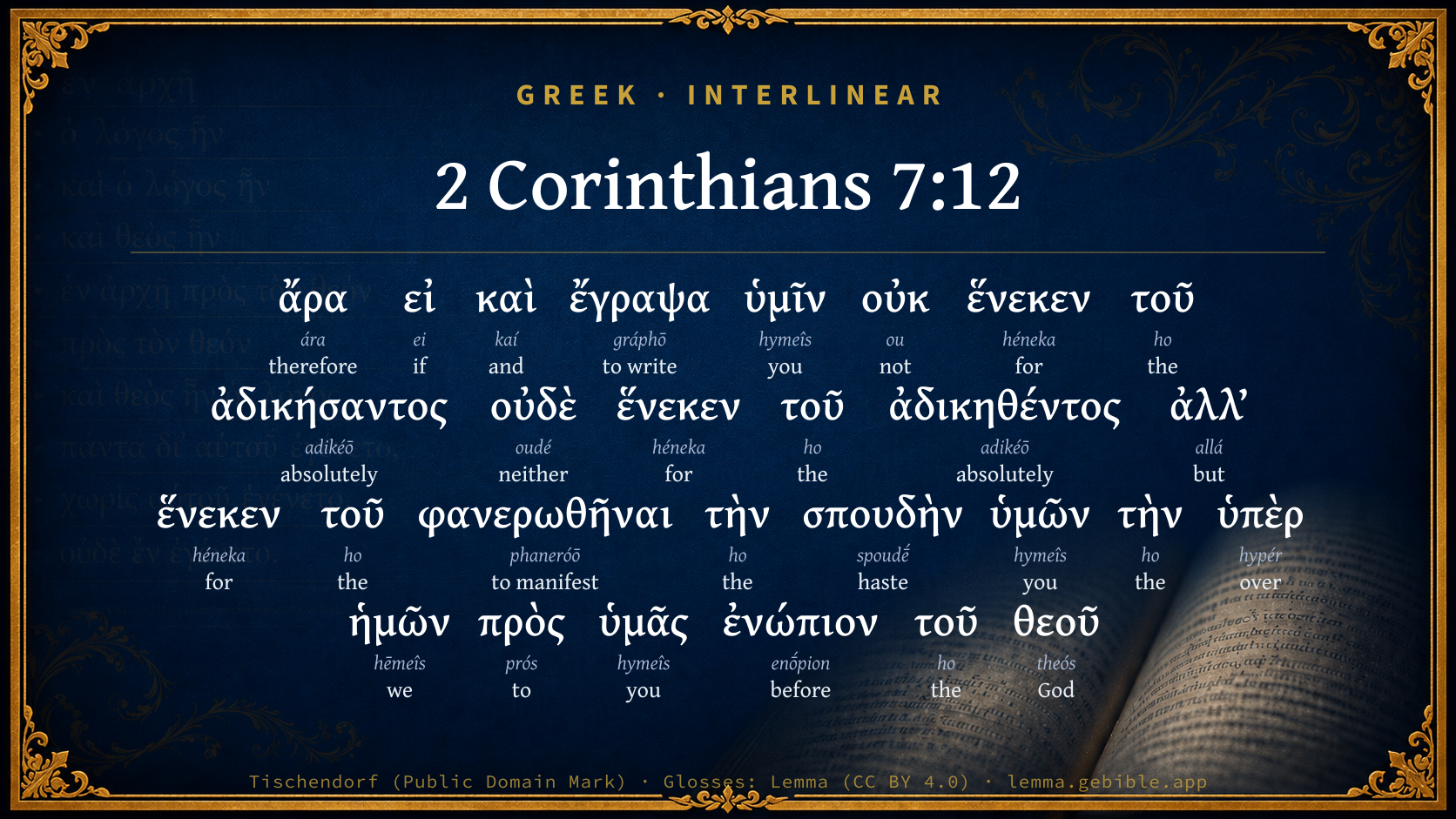
Greek (Tischendorf 8th ed.) 2 Corinthians 7:12 appears in the Greek New Testament. The text above is from the Tischendorf 8th edition. Each word links to its Strong’s number and a concise gloss. Click any word for its full Thayer’s Greek Lexicon entry.
Download image
Cite this verse

2 Corinthians 7:12 (World English Bible). Public Domain. Lemma interlinear Bible study tool, https://lemma.gebible.app/v/2-corinthians/7/12.

Show BibTeX & RIS
BibTeX
RIS
English Translation
So although I wrote to you, I wrote not for his cause that did the wrong, nor for his cause that suffered the wrong, but that your earnest care for us might be revealed in you in the sight of God.
World English Bible · Public Domain
Download a study sheet

One document with this verse’s original text, its word-by-word gloss line, the meaning frame, cross-references with their text, attributed commentary, and full source and license credits — printable, and it pastes into notes with its structure intact.

This verse Autodidact and up

Study sheet (.html) Plain text (.txt)

A passage Seminary Student

Up to 50 verses in one chapter. A passage sheet keeps up to 6 commentary sources and 12 cross-references per verse, in the order this page ranks them, and says so on the sheet whenever that leaves anything out. Ask for a single verse and you get the Autodidact verse sheet above.

Everything on this page stays free to read, with no account — the sheet is a download of what is already on screen, not access to it.

Want to remove ads? Support Godless Engineer
Compare translations 3

The same verse in 3 English versions, stacked beneath the original-language interlinear above. Click any original word for its lexicon entry.

Each is an independent rendering of the whole verse — the interlinear is not word-aligned to these translations.

Highlighted words mark where these versions differ — a whole-verse word diff, not a word-by-word alignment.

  • World English Bible Public Domain
    So although I wrote to you, I wrote not for his cause that did the wrong, nor for his cause that suffered the wrong, but that your earnest care for us might be revealed in you in the sight of God.
  • King James Version Public Domain
    Wherefore, though I wrote unto you, I did it not for his cause that had done the wrong, nor for his cause that suffered wrong, but that our care for you in the sight of God might appear unto you.
  • unfoldingWord Literal Text CC BY-SA 4.0
    So even though I wrote to you, not for the sake of the one having done wrong, nor for the sake of the one having suffered wrong, but so that your earnestness which on our behalf might be revealed to you before God.

unfoldingWord Literal Text — © unfoldingWord, licensed CC BY-SA 4.0. Word-aligned USFM3 via Door43 (git.door43.org/unfoldingWord/en_ult).

Versions to compare (up to 4)

3 of 4 selected

Show all 19 translations

Every available English version of this verse, each an independent rendering of the whole verse.

  • World English Bible Public Domain
    So although I wrote to you, I wrote not for his cause that did the wrong, nor for his cause that suffered the wrong, but that your earnest care for us might be revealed in you in the sight of God.
  • Berean Standard Bible Public Domain
    So even though I wrote to you, it was not on account of the one who did wrong or the one who was harmed, but rather that your earnestness on our behalf would be made clear to you in the sight of God.
  • Majority Standard Bible Public Domain
    So even though I wrote to you, it was not on account of the one who did wrong or the one who was harmed, but rather that your earnestness on our behalf would be made clear to you in the sight of God.
  • King James Version Public Domain
    Wherefore, though I wrote unto you, I did it not for his cause that had done the wrong, nor for his cause that suffered wrong, but that our care for you in the sight of God might appear unto you.
  • American Standard Version (1901) Public Domain
    So although I wrote unto you, I `wrote' not for his cause that did the wrong, nor for his cause that suffered the wrong, but that your earnest care for us might be made manifest unto you in the sight of God.
  • Revised Version (1885) Public Domain
    So although I wrote unto you, I wrote not for his cause that did the wrong, nor for his cause that suffered the wrong, but that your earnest care for us might be made manifest unto you in the sight of God.
  • Geneva Bible (1599) Public Domain
    Wherefore, though I wrote vnto you, I did not it for his cause that had done the wrong, neither for his cause that had the iniurie, but that our care toward you in the sight of God might appeare vnto you.
  • Douay-Rheims (1899) Public Domain
    Wherefore although I wrote to you, it was not for his sake that I did the wrong, nor for him that suffered it; but to manifest our carefulness that we have for you
  • Young's Literal Translation Public Domain
    If, then, I also wrote to you -- not for his cause who did wrong, nor for his cause who did suffer wrong, but for our diligence in your behalf being manifested unto you before God --
  • Literal Standard Version CC BY-SA 4.0
    If, then, I also wrote to you—not for his cause who did wrong, nor for his cause who suffered wrong, but for our diligence in your behalf being revealed to you before God—
  • Unlocked Literal Bible CC BY-SA 4.0
    Although I wrote to you, I did not write for the sake of the wrongdoer, nor for the one who suffered the wrong, but so that your good will toward us should be made known to you in the sight of God.
  • unfoldingWord Literal Text CC BY-SA 4.0
    So even though I wrote to you, not for the sake of the one having done wrong, nor for the sake of the one having suffered wrong, but so that your earnestness which on our behalf might be revealed to you before God.
  • Darby Bible Public Domain
    So then, if also I wrote to you, [it was] not for the sake of him that injured, nor for the sake of him that was injured, but for the sake of our diligent zeal for you being manifested to you before God.
  • World Messianic Bible Public Domain
    So although I wrote to you, I wrote not for his cause that did the wrong, nor for his cause that suffered the wrong, but that your earnest care for us might be revealed in you in the sight of God.
  • Webster's Bible Public Domain
    Wherefore, though I wrote to you, I did it not for his cause that had done the wrong, nor for his cause that suffered wrong, but that our care for you in the sight of God might appear to you.
  • Free Bible Version CC BY-SA 4.0
    So when I wrote to you, I wasn't writing about who did the wrong or who was wronged, but to show you how devoted you are to us in God's sight.
  • Bible in Basic English Public Domain
    So though I sent you a letter, it was not only because of the man who did the wrong, or because of him to whom the wrong was done, but so that your true care for us might be made clear in the eyes of God.
  • Text-Critical English NT CC BY 4.0
    So although I wrote to you, it was not on account of the one who did the wrong, nor on account of the one who was wronged, but so that your earnestness for us might be revealed to you in the sight of God.
  • Tyndale New Testament (1534) Public Domain
    Wherfore though I wrote vnto you I did it not for his cause that did hurte nether for his cause that was hurte: but that oure good mynde whych we have towarde you in the sight of god myght appere vnto you.

Literal Standard Version (2020), Covenant Press — licensed CC BY-SA 4.0. Text via the HelloAO Bible API (eBible.org). Unlocked Literal Bible (unfoldingWord) — licensed CC BY-SA 4.0. Text via the HelloAO Bible API (eBible.org). unfoldingWord Literal Text — © unfoldingWord, licensed CC BY-SA 4.0. Word-aligned USFM3 via Door43 (git.door43.org/unfoldingWord/en_ult). Free Bible Version, Dr. Jonathan Gallagher — licensed CC BY-SA 4.0. Text via the HelloAO Bible API (eBible.org).

Word by word

More ways to search: Search by grammar → Find every occurrence → Compare this word →

Practice this passage: Drill this verse → Learn its vocabulary →

σπουδὴν
spoudḗ
G4710
“haste”
Noun, Accusative, Singular, Feminine
Part of Speech
Noun
Case
Accusative
Number
Singular
Gender
Feminine
Full Thayer's Definition

Origin: from G4692

TDNT: 16:19,1

1. haste, with haste 2. earnestness, diligence a. earnestness in accomplishing, promoting, or striving after anything b. to give all diligence, interest one's self most earnestly
  1. ἄρα ára G686 “therefore” Particle
  2. εἰ ei G1487 “if” Conditional
  3. καὶ kaí G2532 “and” Conjunction
  4. ἔγραψα gráphō G1125 “to write” Verb, Aorist, Active, Indicative, 1st person, Singular
  5. ὑμῖν hymeîs G5210 “you” Personal pronoun, 2nd person, Dative, Plural
  6. οὐκ ou G3756 “not” Particle, Negative
  7. ἕνεκεν héneka G1752 “for” Preposition
  8. τοῦ ho G3588 “the” Article, Genitive, Singular, Masculine
  9. ἀδικήσαντος adikéō G91 “absolutely” Verb, Aorist, Active, Participle, Genitive, Singular, Masculine
  10. οὐδὲ oudé G3761 “neither” Conjunction, Negative
  11. ἕνεκεν héneka G1752 “for” Preposition
  12. τοῦ ho G3588 “the” Article, Genitive, Singular, Masculine
  13. ἀδικηθέντος adikéō G91 “absolutely” Verb, Aorist, Passive, Participle, Genitive, Singular, Masculine
  14. ἀλλ’ allá G235 “but” Conjunction
  15. ἕνεκεν héneka G1752 “for” Preposition
  16. τοῦ ho G3588 “the” Article, Genitive, Singular, Neuter
  17. φανερωθῆναι phaneróō G5319 “to manifest” Verb, Aorist, Passive, Infinitive
  18. τὴν ho G3588 “the” Article, Accusative, Singular, Feminine
  19. ὑμῶν hymeîs G5210 “you” Personal pronoun, 2nd person, Genitive, Plural
  20. τὴν ho G3588 “the” Article, Accusative, Singular, Feminine
  21. ὑπὲρ hypér G5228 “over” Preposition
  22. ἡμῶν hēmeîs G2249 “we” Personal pronoun, 1st person, Genitive, Plural
  23. πρὸς prós G4314 “to” Preposition
  24. ὑμᾶς hymeîs G5210 “you” Personal pronoun, 2nd person, Accusative, Plural
  25. ἐνώπιον enṓpion G1799 “before” Adverb
  26. τοῦ ho G3588 “the” Article, Genitive, Singular, Masculine
  27. θεοῦ theós G2316 “God” Noun, Genitive, Singular, Masculine

About this verse

These counts appear in no published source. They are computed here, from the morphology-tagged text and Lemma’s own curated glosses. What Lemma adds →

28
words
18
distinct lemmas
Pauline Epistles
section

Notable vocabulary

The rarest word here is σπουδὴν haste G4710 — appearing just 12 times in the whole Greek New Testament.

Shared distinctive vocabulary

σπουδὴν haste G4710 occurs in 12 verses of the Greek New Testament. Also found in:

Repetition

Words recur within this verse:

  • ἀδικήσαντος absolutely G91 ×2
  • τοῦ the G3588 ×6
  • ὑμῖν you G5210 ×3
  • ἕνεκεν for G1752 ×3

Cross-references

8

Topical passages linked to 2 Corinthians 7:12 in the Treasury of Scripture Knowledge — connected by theme and wording, ordered by reader-vote popularity; previews shown in the World English Bible.

  • 2 Corinthians 2:9 For to this end I also wrote, that I might know the proof of you, whether you are obedient in all things.
  • 1 Timothy 3:5 (but if a man doesn't know how to rule his own house, how will he take care of the assembly of God?)
  • 2 Corinthians 2:3–4 And I wrote this very thing to you, so that, when I came, I wouldn't have sorrow from them of whom I ought to rejoice; having confidence in you all, that my joy would be shared by all of you.
  • 2 Corinthians 2:17 For we are not as so many, peddling the word of God. But as of sincerity, but as of God, in the sight of God, we speak in Christ.
  • 2 Corinthians 7:8 For though I made you sorry with my letter, I do not regret it, though I did regret it. For I see that my letter made you sorry, though just for a while.
  • 2 Corinthians 11:11 Why? Because I don't love you? God knows.
  • 2 Corinthians 11:28 Besides those things that are outside, there is that which presses on me daily, anxiety for all the assemblies.
  • 1 Corinthians 5:1–2 It is actually reported that there is sexual immorality among you, and such sexual immorality as is not even named among the Gentiles, that one has his father's wife.

Cross-references courtesy of OpenBible.info (CC BY 4.0).

Where the printed editions differ

1 variant

Places in this verse where the major printed Greek editions disagree on the wording in a way that affects the translation — a comparison of editions, not a manuscript-by-manuscript collation. The editions are the modern critical texts (Nestlé-Aland 28/27, SBL, Westcott-Hort, Tregelles, Tyndale House) and the traditional texts behind the KJV (the Textus Receptus and the Byzantine/Majority text). It is not a claim about which reading is original.

  1. Extra text
    ἀλλ᾽

    “but”

    In WH Not in NA28NA27TynSBLTregTRByz

    ἀλλ᾽ (all᾽) 'but' is only in a few manuscripts (WH)

Textual data: Translators Amalgamated Greek New Testament (STEPBible TAGNT) · CC BY 4.0.

Commentary

Notes on 2 Corinthians 7:12 from classic Christian and Jewish commentators (each source and its license shown beneath its notes). The classic Christian expositions comment on the surrounding passage and are grouped to its opening verse, so a note may address several verses; the Jewish commentaries on the Tanakh (Rashi and others) are per-verse, so they appear only where the commentator wrote on this verse.

Lemma curates 59 commentaries, every one of them public domain or Creative Commons licensed, each selected and text-cleaned for this edition rather than reprinted as found. About our sources →

Matthew Henry's Commentary

In these verses the apostle endeavours to comfort the Corinthians, upon whom his admonitions had had such good effect. And in order thereto, 1. He tells them he had a good design in his former epistle, which might be thought severe, Co2 7:12. It was not chiefly for his cause that did the wrong, not only for his benefit, much less merely that he should be punished; nor was it merely for his cause that suffered wrong, namely, the injured father, and that he might have what satisfaction could be given him; but it was also to manifest his great and sincere concern and care for them, for the whole church, lest that should suffer by letting such a crime, and the scandal thereof, remain among them without due remark and resentment. 2. He acquaints them with the joy of Titus as well as of himself upon the account of their repentance and good behaviour. Titus was rejoiced, and his spirit refreshed, with their comfort, and this comforted and rejoiced the apostle also (Co2 7:13); and, as Titus was comforted while he was with them, so when he remembered his reception among them, expressing their obedience to the apostolical directions, and their fear and trembling at the reproofs that were given them, the thoughts of these things inflamed and increased his affections to them, Co2 7:15. Note, Great comfort and joy follow upon godly sorrow. As sin occasions general grief, so repentance and reformation occasion general joy. Paul was glad, and Titus was glad, and the Corinthians were comforted, and the penitent ought to be comforted; and well may all this joy be on earth, when there is joy in heaven over one sinner that repenteth. 3. He concludes this whole matter with expressing the entire confidence he had in them: He was not ashamed of his boasting concerning them to Titus (Co2 7:14); for he was not disappointed in his expectation concerning them, which he signified to Titus, and he could now with great joy declare what confidence he still had in them as to all things, that he did not doubt of their good behaviour for the time to come. Note, It is a great comfort and joy to a faithful minister to have to do with a people whom he can confide in, and who he has reason to hope will comply with every thing he proposes to them that is for the glory of God, the credit of the gospel, and their advantage.

Matthew Henry's Commentary on the Whole Bible (1708–1710) — public domain (CC PDM 1.0). Text via the HelloAO Bible API.

The Biblical Illustrator

Joseph S. Exell

2Co_7:12-16

Wherefore, though I wrote unto you, I did it not for his cause that had done the wrong.

Church discipline

I. Church discipline should be exercised for the good of the whole Church (2Co_7:12). The particular individual referred to here was the incestuous person (1Co_5:1). The apostle here states that this discipline was not merely for the offenders sake, nor indeed for the sake of the offended. His object in writing was not merely to chastise the one, and to obtain justice for the other. He had a larger aim; it was to prove to them how much he cared for their spiritual purity and reputation. Punishment should not only be for the reformation of the wrongdoer, but as an example to others. The unhealthy branch should be cut off for the sake of the trees health and growth. All true chastisement for wrong aims not only at the good of the offender, but at the good of the community at large.

II. When the good of the Church is manifested it is a just matter for rejoicing (2Co_7:13). The Church was improved by Pauls disciplinary letter. Of this Titus had assured him, for they had refreshed his spirit during his visit among them. Their improvement, too, justified the high testimony which he had given Titus concerning them (verse 14). The love of Titus for them was increased by the discovery of it (verse 15). Thus the godly sorrow which they manifested on account of that which was wrong amongst them was in every way satisfactory to him; it gave him comfort, it greatly refreshed the spirit of Titus, increased his affection for them, and inspired the apostle himself with confidence and with joy. (D. Thomas D. D.)

.

The Biblical Illustrator, edited by Joseph S. Exell (c. 1880s–1900s) — public domain. Text from a community e-Sword module.

Joseph Benson's Commentary

2Co 7:12-16. Wherefore, though I wrote so severely to you — It was not only or chiefly for the sake of the incestuous person, or his father; but to show my care over you; in the sight of God — Who hath committed you to me to be instructed and directed. Therefore we were comforted in your comfort — In hearing you were made happy by my care of you; and exceedingly the more for the joy ye gave to Titus, because his spirit was refreshed — When ye received him with affection, and read my letter with due submission. If I have boasted any thing — Concerning you; to him — That I was confident the converts at Corinth would approve themselves worthy of the esteem in which I held them; I am not ashamed — Of that boasting; but as we spake all things to you in truth — When addressing ourselves to you; so our boasting — Of you to Titus, concerning your good disposition and proper behaviour, has been verified to our great satisfaction. And — Or so that; his inward affection — Greek, τα σπλαγχνα αυτου, his bowels, or tender affection; is more abundant toward you — Than it had been before; while he remembers the obedience — Of the generality of you to those apostolical injunctions which I sent you by him; how ye received him — As my messenger; with fear and trembling — With great solicitude, that there might be nothing in or among you which it might grieve him to observe, or me to hear reported. I rejoice therefore that your behaviour has been such as to give me reason to rely on your ready obedience in all things. Œcumenius has observed, that the apostle, in this part of his epistle, expressed his good opinion of the Corinthians, and mentioned his having praised them to Titus, to prepare them for his exhortations in the two following chapters concerning the collection for the saints in Judea. His address, therefore, in this part of his letter is admirable, especially as, in commending the Corinthians, he expressed himself quite agreeably to the good opinion which he now entertained of them.

Joseph Benson's Commentary on the Old and New Testaments (1811–1818) — public domain. Text from a community e-Sword module.

Bengel's Gnomon

Johann Albrecht Bengel

2Co 7:12. Οὐχ ἓνεκεν τοῦ ἀδικήσαντος) Whatever I have written, I have written it, not for the sake of him, who did the wrong. He calls him τὸν ἀδικήσαντα, whom he calls, ch. 2Co 2:5, τὸν λελυπηκότα. He now varies the term because the expression, to make sorry, he said concerning himself, 2Co 7:8-9; and he now dismisses this very sorrow. Inasmuch as you Corinthians have done what was just respecting him, who had committed the sin, by your zeal and revenge, I acquiesce.—οὐδὲ ἕνεκεν τοῦ ἀδικηθέντος, nor for the sake of him, who suffered wrong) The singular for the plural by euphemism. The Corinthians had suffered wrong, ch. 2Co 2:5; and their clearing of themselves, and indignation put it now in Paul’s power to acquiesce also on their account. Others explain it as referring to the offended parent, 1Co 5:1.—τὴν σπουδὴν ἡμῶν, our care) Comp. 2Co 2:4.—ἐνώπιον, in the sight of) Construed with φανερωθῆναι, that it might be manifested.

Bengel's Gnomon of the New Testament — English translation (T&T Clark, Edinburgh, 1860) — public domain. Text from a community e-Sword module.

Meyer's Critical & Exegetical Commentary

Heinrich August Wilhelm Meyer

2Co_7:12. Ἄρα] therefore, for how natural was it for the readers to think that Paul had written on account of the ἀδικήσαντος and on account of the ἀδικηθέντος! And yet the effect which that part of the Epistle had produced on themselves had showed them by experience that the apostles true purpose was quite different. So at least Paul represents the matter in a delicate and conciliatory wa.

εἰ καὶ ἔγραψα ὑμῖν] if I have also written to you, i.e. have not kept silence, but have expressed myself by letter regarding the affair in question. Commonly a so, so sternly, or the like, is imported quite arbitrarily. Grotius indicates the right meaning: si quid scripsi, nempe ea de re. Comp. Osiander. Those who assume an Epistle now lost between our first and second (Bleek, Neander, Ewald, Beyschlag, Hilgenfeld) find it here alluded to. Comp. 2Co_2:3; 2Co_2:9. The apodosis already begins at οὐχ εἵνεκεν κ.τ.λ., and does not follow only at διὰ τοῦτο (as Hofmann complicates it, without sufficient ground), the more especially as in this construction, according to Hofmann, διὰ τοῦτο does not apply to 2Co_7:12to which it must apply (comp. 1Th_3:7)but to 2Co_7:11.

οὐχ … ἀλλʼ] is not non tam … quam (Erasmus, Estius, Flatt, and many others), but non … sed. Paul denies absolutely that he has written that part of the Epistle on account of the two persons mentioned. In the nature of the case, no doubt, he had to write against the ἀδικήσας, and so indirectly in favour of the ἀδικηθείς; but the destined purpose of this letter, as Paul from the true light of his apostolic standpoint is aware, lay not in this aim affecting the two persons primarily concerned, but in its higher significance as bearing on the churchs relation to the apostle: ἀλλʼ εἵνεκεν τοῦ φανερωθῆναι κ.τ.λ.

Regarding the form εἵνεκεν, see on Luk_4:18, and Kühner, I. p. 229, ed. 2. The ἀδικήσας is the incestuous person, and the ἀδικηθείς his father, as the party grievously injured by the sons incestuous marriage with the step-mother. Theodoret, however, is quite arbitrary in supposing from this that he was already dead (καὶ τεθνεὼς γὰρ ἠδίκητο, τῆς εὐνῆς ὑβρισθείσης). See on 1Co_5:1. This explanation of the ἀδικηθείς seems from the relation of the two participles active and passive to be the only natural, and, in fact, necessary one. It is no objection that, in the first Epistle, nothing was said at length regarding the father and the wrong done to him (see only 2Co_5:1), since the censure and ordaining of chastisement to the transgressor of themselves practically contained the satisfaction to the injured father. Comp. on the passive ἀδικ. in the sense of infringing marriage-rights, Plut. Anton. 9; Eurip. Med. 267, 314; and see in general on ἀδικεῖν in reference to adultery, Dorvill. ad Charit. p. 468; Abresch, ad Xen. Eph., ed. Locella, p. 222. Others (Wolf, Storr, Emmerling, Osiander, Neander, Maier) think that Paul means himself, in so far as he had been deeply injured in his office by that transgression. But this mode of designating himself, set down thus without any more precise indication, would be strangely enigmatical, as well as marked by want of delicate tact (as if the readers were not ἀδικηθέντες, like Paul!), and no longer suiting what was already said in 2Co_2:5. The reference of τοῦ ἀδικηθέντος to the apostle himself would only be right on the assumption that allusion is here made to the state of things discussed by Paul in an intermediate letter now lost.[263] Others (Bengel, comp. Wolf also) think that the Corinthians are meant, but the singular is decisive against this view, even apart from the unsuitable meaning. Others have even referred τοῦ ἀδικησ. and ΤΟῦ ἈΔΙΚΗΘ. to the adulterer and the adulteress (Theophylact: ἀμφότεροι γὰρ ἀλλήλους ἠδίκησαν); others, again, have taken ΤΟῦ ἈΔΙΚΗΘ. as neuter (Heinsius, Billroth), equivalent to τοῦ ἀδικήματος. The last is at variance with linguistic usage; and what sort of delicate apostolic tact would it have been, to say that he had not written on account of the deed!

ἀλλʼ εἵνεκεν κ.τ.λ.] According to Lachmanns correct reading, as translated also by Luther (see the critical remarks): but because your zeal for us was to become manifest among you before God, i.e. but because I unshed to bring it about that the zealous interest which you cherish for us should be brought to light among you before God (a religious expression of uprightness and sincerity, 2Co_4:2). Comp. on the thought, 2Co_2:9; πρὸς ὑμᾶς is the simple with you, among you, in the midst of you, in your church-life, not exactly in public meeting of the church (Ewald), which would have been indicated more precisely. Comp. 1Co_16:7. Rückert, without due ground, finds the meaning of πρὸς ὑμᾶς so ambiguous that he prefers the Recepta, according to which the meaning is: because our zealous interest for you was to become manifest upon you before God. Comp. 2Co_2:4. Hofmann, who rejects both the Recepta and the reading of Lachmann, and prefers that of א: Τ. ΣΠΟΥΔῊΝ ὙΜῶΝ ΤῊΝ ὙΠῈΡ ὙΜῶΝ ΠΡῸς ὙΜᾶς, takes this ΠΡῸς ὙΜᾶς even in a hostile sense: You are to show yourselves diligent for yourselves and against yourselves; the strict procedure of the church against its adherents is on the one hand an acting for themselves (ὙΠῈΡ ὙΜῶΝ), and on the other hand an acting against themselves (πρὸς ὑμᾶς). This artificial interpretation is wrong, because, if πρὸς could mean contra here, Paul must have written at least ΤῊΝ ὙΠῈΡ ὙΜῶΝ ΤΕ ΚΑῚ ΠΡῸς ὙΜᾶς, and because ΠΡΌς with ΣΠΟΥΔΉ (Heb_6:11; Herod. iv. 11. 1; Diod. xvii. 114) and with ΣΠΟΥΔΆΖΕΙΝ (Dem. 515. 23, 617. 10) has not that arbitrarily assumed sense, but the sense of an interest for some one, though this is more commonly expressed by περί. If the reading of א were right, it would have to be explained simply: in order that your zeal, in which you aim at your own good, should become manifest among you before God. Had Paul wished to express the singular meaning which Hofmann imports, he would have known how to write: ΤῊΝ ΣΠΟΥΔῊΝ ὙΜῶΝ ΤῊΝ ὙΠῈΡ ὙΜῶΝ ΤΕ ΚΑῚ ΚΑΘʼ ὙΜῶΝ.

[263] On this assumption Bleek is of opinion that Paul, in that lost Epistle, had rebuked the wanton defiance of the incestuous person towards him (comp. also Neander). According to Ewald, Paul is the ἀδικηθείς over against the man of reputation in the church, who had been endeavouring to deprive him of his repute in it by public accusations. Comp. Hilgenfeld in his Zeitschr. 1864, p. 169, 1865, p. 252, according to whom Paul is the ἀδικηθείς, because things had in the meanwhile come to a pronounced rejection of his apostolic repute. According to Beyschlag in the Stud. u. Krit. 1865, p. 254, Timothy is meant, who was personally insulted by a spokesman in the ranks of the opponents.

Meyer — Critical and Exegetical Commentary on the New Testament — English translation by Peter Christie, edited by Frederick Crombie (T&T Clark, 1880) — public domain. Text from a community e-Sword module.

Expositor's Greek Testament

ed. W. Robertson Nicoll

2Co 7:12 . ἄρα εἰ καὶ ἔγραψα κ . τ . λ .: consequently, although I wrote to you, i.e. , wrote a severe letter, it was not for his cause that did the wrong, sc. , the incestuous son of 1Co 5:1 , nor for his cause that suffered the wrong, sc. , his father, but that your diligence on our behalf might be made manifest to yourselves (“chez vous,” so πρὸς ὑμᾶς , 1Th 3:4 ) in the sight of God . He does not mean that this was the only reason for writing ( cf. 2Co 2:9 ), and that the more obvious reason was not in his mind; but he states strongly (expressing himself by an idiom common in the O.T., e.g. , Jer 7:22 ) a principal cause of his writing, viz. , that the Corinthian Church might be recalled to a true sense of what was due to its founder, as if it were the only cause. See on 2Co 2:9 , and, for a discussion of the whole question, see Introd. , p. 10 ff.

The Expositor's Greek Testament, edited by W. Robertson Nicoll (1897–1910) — public domain. Text from a community e-Sword module.

Geneva Bible (1599)

Geneva Bible translators

It was not colored nor counterfeit, but such as I dare stand to before God.

Geneva Bible (1599) marginal notes — public domain. Text via Bolls.life.

Jamieson, Fausset & Brown

Robert Jamieson, A. R. Fausset & David Brown

though I wrote unto you--"making you sorry with my letter" (Co2 7:8).

his cause that suffered wrong--the father of the incestuous person who had his father's wife (Co1 5:1). The father, thus it seems, was alive.

that our care for you, &c.--Some of the oldest manuscripts read thus, "That YOUR care for us might be made manifest unto you," &c. But the words, "unto you," thus, would be rather obscure; still the obscurity of the genuine reading may have been the very reason for the change being made by correctors into the reading of English Version. ALFORD explains the reading: "He wrote in order to bring out their zeal on his behalf (that is, to obey his command), and make it manifest to themselves in God's sight, that is, to bring out among them their zeal to regard and obey him." But some of the oldest manuscripts and versions (including the Vulgate and old Italian) support English Version. And the words, "to you," suit it better than the other reading. Co2 2:4, "I wrote . . . that ye might know the love which I have more abundantly unto you," plainly accords with it, and disproves ALFORD'S assertion that English Version is inconsistent with the fact as to the purpose of his letter. His writing, he says, was not so much for the sake of the individual offender, or the individual offended, but from his "earnest care" or concern for the welfare of the Church.

Jamieson, Fausset & Brown — Commentary Critical and Explanatory on the Whole Bible (1871) — public domain (CC PDM 1.0). Text via the HelloAO Bible API.

Adam Clarke's Commentary

Verse 12. Not for his cause that had done the wrong] viz. the incestuous person.

Nor for his cause that suffered wrong] Some think the apostle means himself; others, that he means the Church at Corinth, the singular being put for the plural; others, the family of the incestuous person; and others, the father of the incestuous person. If this latter opinion be adopted, it would seem to intimate that the father of this person was yet alive, which would make the transgression more flagrant; but these words might be spoken in reference to the father, if dead, whose cause should be vindicated; as his injured honour might be considered, like Abel's blood, to be crying from the earth.

But that our care for you-might appear] It was not to get the delinquent punished, nor merely to do justice to those who had suffered in this business, that the apostle wrote his epistle to them, but that they might have the fullest proof of his fatherly affection for them, and his concern for the honour of God; and that they might thereby see how unnatural their opposition to him was, and what cause they had to prefer him, who was ready to give up his life in their service, to that false apostle or teacher who was corrupting their minds, leading them from the simplicity of the truth, and making a gain of them.

Adam Clarke's Commentary on the Bible (1810–1826) — public domain. Text from a community e-Sword/MySword module.

John Calvin's Commentaries

11. Ye have approved yourselves to be clear. The Old Interpreter reads, “Ye have shown yourselves.” Erasmus renders it, “Ye have commended yourselves.” I have preferred a third rendering, which appeared to me to suit better — that the Corinthians showed by clear evidences, that they were in no degree participants in the crime, with which they had appeared, from their connivance, to have had some connection. What those evidences were, we have already seen. At the same time, Paul does not altogether clear them, but palliates their offense. For the undue forbearance, which they had exercised, was not altogether free from blame. He acquits them, however, from the charge of concurrence. We must farther observe, that he does not acquit all of them without exception, but merely the body of the Church. For it may readily be believed, that some were concerned in it, and countenanced it; but, while all of them together were involved in disgrace, it afterwards appeared that only a few were in fault.

12. Wherefore if I wrote. He acts as persons are wont to do, that are desirous of a reconciliation. He wishes all past things to be buried, he does not any more reproach them, he does not reprove them for any thing, he does not expostulate as to any thing; in fine, he forgets every thing, inasmuch as he was satisfied with their simply repenting. And, certainly, this is the right way — not to press offenders farther, when they have been brought to repentance. For if we still

call their sins to remembrance, (1 Kings 17:18,)

it is certain that we are actuated by malevolence, rather than by pious affection, or a desire for their welfare. These things, however, are said by Paul by way of concession, for, unquestionably, he had followed up the offense that he had taken, and had felt desirous that the author of this offense should be chastised, but now he puts his foot upon what had been in some degree offensive. “I am now desirous, that whatever I have written may be looked upon as having been written with no other view, than that you might perceive your affection towards me. As to all other things, let us now leave them as they are.” Others explain it in this way, — that he had not regard to one individual in particular, but consulted the common advantage of all. The former interpretation, however, is the more natural one.

Your concern for us. As this reading occurs very generally in the Greek versions, I have not ventured to go so far as to erase it, though at the same time in one ancient manuscript the reading is ἡμων, (of us,) and it appears from Chrysostom s Commentaries, that the Latin rendering was more commonly received in his times even among the Greeks — that our concern for you might become manifest to you, that is, that it might be manifest to the Corinthians, how much concerned Paul was in regard to them. The other rendering, however, in which the greater part of the Greek manuscripts concur, is, notwithstanding, a probable one. For Paul congratulates the Corinthians on their having learned at length, through means of this test, how they stood affected towards him. “You were not yourselves aware of the attachment that you felt towards me, until you had trial of it in this matter.” Others explain it as referring to the particular disposition of an individual, in this way: “That it might be manifest among you, how much respect each of you entertained for me, and that, through the occurrence of this opportunity, each of you might discover what had previously been concealed in his heart.” As this is not of great moment, my readers are at liberty, so far as I am concerned, to make choice of either; but, as he adds at the same time, in the sight of God, I rather think that he meant this — that each of them, having made a thorough search, as if he had come into the presence of God, had come to know himself better than before.

John Calvin's Commentaries (1540-1563) — public domain. Text from the Calvin Translation Society English edition (1840s-50s) via the Christian Classics Ethereal Library (ccel.org). Calvin's coverage is partial (roughly two-thirds of the Bible); uncommented books and verses are honest gaps, never fabricated. The 19th-century editor's footnotes and remarks are omitted so the notes are faithfully Calvin's own voice.

Ellicott's Commentary for English Readers

(12) Wherefore, though I wrote unto you.—The reference to the man that had suffered wrong implies that the offender in 1Co_5:1 had married his step-mother during his father’s life. All other inter pretations—such as those which make St. Paul or the community the injured party—are fantastic. But in what sense was the father injured? The union was a marriage, not a mere concubinage or adultery (see Note on 1Co_5:1), and it could not have been so unless the first marriage had been dissolved by a divorce. But if the husband had divorced the wife, then, though the son’s marriage may have shocked men as immoral, the father could hardly be said to have suffered a wrong to which he had exposed himself by his own act. The probable explanation is found in supposing that the wife, seduced by her step-son or seducing him, had divorced herself. Wives had this power under Roman law; and it was used with such license under the Empire, that Juvenal speaks of one woman of rank who had—

“Eight husbands in five autumns. Do you laugh?

The thing reads well upon an epitaph.”—Sat. vi. 230.

On this assumption the father had, of course, sustained a very grievous wrong. There is an obvious tone of impatience, almost of annoyance, in the way in which St. Paul speaks of the whole business. It was one of those scandals in which, though it had been necessary to assert the law of purity and enforce the discipline of the Church, he could not bring himself at the time to feel any special interest in either of the parties. Afterwards, when the sinner was repentant, there came, it is true, a new feeling of pity for him, as in 2Co_2:6-8. But when he wrote, it was with a larger aim, to show them how much he cared for his disciples at Corinth, how jealous he was to clear away any stains that affected their reputation as a Church. It is noticeable that no mention is made of the woman’s repentance, nor, indeed, of her coming, in any way, under the discipline of the Church. The facts of the case suggest the conclusion that both husband and wife were heathens, and that the son was the only convert of the family. In this case we may fairly assume that she had played the part of temptress, and that his conscience, though weak, had been the more sensitive of the two. On this view the exhortations against being “unequally yoked together” with unbelievers gains a fresh significance. Possibly some idolatrous festival had furnished the first opportunity of sin, and so the fact gave special protest against any attempt to combine the worship of Christ with that of Belial.

A Bible Commentary for English Readers, edited by Charles John Ellicott (1878–1897) — public domain. Text from a community e-Sword module.

The Cambridge Bible for Schools and Colleges

gen. ed. J. J. S. Perowne

12. for his cause that had done the wrong] See 1Co_5:1.

nor for his cause that suffered wrong] From this it has been inferred that the father of the offender was still alive.

but that our care for you in the sight of God might appear unto you] Many MSS., versions, and editors read that your care for us might appear to you. Whichever be the true reading, the alteration has either sprung from a desire to alter the passage into conformity with the supposed meaning of the Apostle, or from similarity of sound, in the case of a copyist writing from oral dictation. Either reading would make good sense, but that in the text is more probable for two reasons: (1) the Apostle has been all along insisting on the purity of his motives and on his unfeigned affection for his Corinthian converts (ch. 2Co_2:17, 2Co_4:2); and (2) it seems rather unlikely that he should have wished the Corinthians to manifest their earnestness in his behalf unto themselves. See, however, on the other hand, ch. 2Co_2:9, and cf. Calvin, who says “St Paul congratulates the Corinthians on having learned at length by this test, how they were disposed towards him.” The word here translated care is the same as that rendered carefulness in the last verse.

The Cambridge Bible for Schools and Colleges (gen. ed. J. J. S. Perowne; Cambridge University Press, 1878–1918) — public domain. Text from a community e-Sword module.

John Gill's Exposition

Wherefore, though l wrote unto you,.... Meaning in his former epistle, with so much sharpness and severity, and as may have been thought too much:

I did it not for his cause that had done the wrong; not for the sake of the incestuous person only and chiefly, not merely for his correction and restoration; though these things were intended, and earnestly desired by the apostle:

nor for his cause that suffered wrong: that is, the father of the incestuous person, who had been injured by this wicked action; it was not only or merely out of favour and respect to him, and that some compensation should be made to him in a church way, by detesting the crime, casting out the offender, and declaring themselves on the side of the injured person, and against him that had done the injury:

but that our care for you, in the sight of God, might appear unto you: some copies, and the Complutensian edition, and the Syriac, Arabic, and Ethiopic versions, read, "that your care for us", &c. and then the sense is, that you might have an opportunity of showing your affection for us, your regard to us, how readily you obey us in all things; but the other reading is to be preferred, the meaning of which is, that the apostle in writing did not so much consult and regard the private good of any particular person, either the injurer or the injured, though these were not out of his view; but he wrote in the manner he did, chiefly that it might be manifest what a concern he had for the good and welfare of the whole church; lest that should be corrupted, and receive any damage from such a notorious delinquent being tolerated or connived at among them; and that it was such a care and concern as was real, hearty, and sincere, was well known to God, and for the truth of which he could appeal to him.

John Gill's Exposition of the Whole Bible (1746–1763) — public domain (CC PDM 1.0). Text via the HelloAO Bible API.

Trapp's Complete Commentary

John Trapp

12 Wherefore, though I wrote unto you, I did it not for his cause that had done the wrong, nor for his cause that suffered wrong, but that our care for you in the sight of God might appear unto you.

Ver. 12. Not for his cause] That is, not so much for his cause.

That suffered the wrong] viz. The father of the incestuous person. Compare Gen 49:4.

But that our care for you] That the Church might not suffer, as allowing such foul facts. How the primitive Christians were slandered by the heathens in this kind, who knows not? Cenalis, bishop of Auranches, wrote against the Church at Paris, defending impudently that their assemblies were to maintain whoredom. Such reports also they cast abroad a little before the massacre. They tell the people in Italy that Geneva is a professed sanctuary of all roguery, that in England the people are grown barbarous, and eat young children, &c.

John Trapp, A Commentary or Exposition upon All the Books of the Old and New Testament (1647–1656) — public domain. Text from a community e-Sword module.

Albert Barnes' Notes on the Bible

Wherefore, though I wrote unto you ... - In this verse Paul states the main reason why he had written to them on the subject. It was not principally on account of the man who had done the wrong, or of him who had been injured; but it was from tender anxiety for the whole church, and in order to show the deep interest which he had in their welfare.

Not for his cause that had done the wrong - Not mainly, or principally on account of the incestuous person; 1Co 5:1. It was not primarily with reference to him as an individual that I wrote, but from a regard to the whole church.

Nor for his cause that suffered wrong - Not merely that the wrong which he had suffered might be rectified, and that his rights might be restored, valuable and desirable as was that object. The offence was that a man had taken his father’s wife as his own 1Co 5:1, and the person injured, therefore, was his father. It is evident from this passage, I think, that the father was living at the time when Paul wrote this Epistle.

But that our care ... - I wrote mainly that I might show the deep interest which I had in the church at large, and my anxiety that it might not suffer by the misconduct of any of its members. It is from a regard to the welfare of the whole earth that discipline should be administered, and not simply with reference to an individual who has done wrong, or an individual who is injured. In church discipline such private interests are absorbed in the general interest of the church at large.

Albert Barnes' Notes on the Bible (1834–1885) — public domain. Text from a community e-Sword/MySword module.

Haydock's Catholic Bible Commentary

I wrote to you not on the account, &c. That is, not only on his account, or the account of his father, who suffered the injury, (by which his father seems to have been then alive) but also to demonstrate the care and solicitude I have for you. I was also overjoyed to find that Titus was so well received by you, with fear and trembling, that is, with so great respect, and submission to him. (Witham)

George Leo Haydock (1774–1849), Haydock's Catholic Family Bible and Commentary, 1859 edition — public domain. Excludes Psalms (Douay-Rheims chapter numbering differs from Protestant) and Deuterocanonical books (Catholic canon only).

Matthew Poole's English Annotations

I did it not for his cause that had done the wrong; for the cause of him that had abused his father’s wife, not out of any particular hatred or ill-will I had to him;

nor for his cause that suffered wrong; nor for the sake of him whose wife was so abused; nor for my own sake, who had been so abused, and suffered wrong by you.

But that our care for you in the sight of God might appear to you; but only out of a love to your souls, and a care I had for you, that in all things you might approve yourselves unto God. Or possibly this text is more generally be interpreted, without respect either to the incestuous person in particular, or to his father; and the sense of the verse no more than this: Though in my former Epistle I wrote something sharply to you, yet I did it not in any passion, nor was I drawn aside by any prejudice or hatred of any person, nor out of any partial affection to any, as to any thing for which I blamed you; but out of that general love and affection which I have to you all, which produceth in me a care of and a solicitude for you, that you might do no evil; which care I was willing should appear to you.

Matthew Poole's English Annotations on the Holy Bible (1683–1685) — public domain. Text from a community e-Sword/MySword module.

Whedon's Commentary on the Bible

Daniel D. Whedon

12. His cause that had done the wrong—The incestuous transgressor.

That suffered—The father. Here St. Paul assures them that it was not to right the parties that he wrote, but to right the Church. There were countless adulterers in Corinth, but Paul did not interfere with them, as they belonged not to the Church, and so did not corrupt it.

Our care— Literally, that your zeal for us might be manifested among you before God. His object was to inspire among them a genuine Pauline zeal before God.

Daniel D. Whedon (gen. ed.), Commentary on the Old and New Testaments (1874–1909) — public domain. Text from a community e-Sword module.

The Pulpit Commentary

Wherefore, though I wrote unto you. "So then, even if I did write you," namely, about that matter. For his cause that had done the wrong, etc. My object in writing was not to mix myself up with the personal quarrel. I had in view neither the wronger nor the wronged, directly and primarily, but wrote for the sake of the whole Church. (1Co_5:1, 2 6:7) Nor for his cause that suffered wrong. Apparently the father of the offender. (1Co_5:1) Our care for you, etc. Among the diversity of readings in this clause, which seem to be still further confused by mere mistakes of copyists, the best supported reading is "your care for us" (B, C, E, K, L, and various versions, etc.). The Sinaitic manuscript has "your care for yourselves." The variations have partly risen from the apparent strangeness of the remark that his letter had been written in order that their care for him might be manifested to themselves; in other words, that they might learn from their own conduct the reality of their earnest feelings for him. He has already spoken of this "earnest care" of theirs (ver. 11), but not in quite the same sense. Certainly, however, the reading followed by our Authorized Version, even if it be a correction, furnishes a more natural meaning, (comp. 2Co_2:4) and the other may have arisen from a clerical error.

Vers. 12-16.

Church discipline.

though I wrote unto you," etc. The subject of these words may be regarded as that of Church discipline, and two general remarks are suggested.

I CHURCH DISCIPLINE SHOULD BE EXERCISED FOR THE GOOD OF THE WHOLE CHURCH. "Wherefore, though I wrote unto you, I did it not for his cause that had done the wrong, nor for his cause that suffered wrong, but that our care for you in the sight of God might appear unto you." The particular individual referred to here, on whom Paul calls discipline to be exercised, was the incestuous person. (1Co_5:1) The apostle here states that this was done, not merely for the offender"s sake, nor indeed for the sake of the person whom the offender had injured (viz. his father, whose wife he had taken as his own). His object in writing was, not merely to chastise the one and to obtain justice and redress for the other, but that "our care for you in the sight of God might appear unto you," He had a larger aim; it was to prove to them how much he cared for their spiritual purity and reputation. Punishment should not only be for the reformation of the wrong doer, but as an example to others. The unhealthy branch should be cut off for the sake of the tree"s health and growth. All true chastisement for wrong aims, not only at the good of the offender, but at the good of the community at large.

II WHEN THE GOOD OF THE CHURCH IS MANIFESTED THEREBY IT IS A JUST MATTER FOR REJOICING. "Therefore we were comforted in your comfort: yea, and exceedingly the more joyed we for the joy of Titus, because his spirit was refreshed by you all." The Church was improved by Paul"s disciplinary letter. Of this Titus had assured him, for they had "refreshed" his "spirit" during his visit among them. Their improvement, too, justified the high testimony which he had given Titus concerning them. "For if I have boasted anything to him of you, I am not ashamed," etc. The love of Titus for them was increased by the discovery of it. "His inward affection is more abundant toward you." Thus the godly sorrow which they manifested on account of that which was wrong amongst them, was in every way satisfactory to him; it gave him comfort, it greatly refreshed the spirit of Titus, increased his affection for them, and inspired the apostle himself with confidence and with joy.

Apostolic cares.

care of you in the sight of God might appear unto you." The apostle always used the persuasion of his affection, whenever it was possible, rather than the force of his apostolic authority. Elsewhere he pleads thus: "Not that we have dominion over your faith, but are helpers of your joy." And he speaks of "that which cometh upon me daily, the care of all the Churches." We may compare the care of a wise and faithful mother for the well being of her children, and the burden of thought and interest which they are to her every day. The apostle"s care concerned three things.

I PURITY. Of this he was supremely zealous. Christians must be seen to differ essentially from pagan idolaters. Immorality and uncleanness were directly associated with heathenism, and were even consecrated by idolatrous religions; but there must be no possibility of questioning that the Christian Church was "called unto holiness." "Every member must know how to possess his vessel in sanctification and honor." There must be no "touching of the unclean thing.

II EDIFICATION. Security for the Christian lies in continuous growth. This, indeed, is the law of all life. When a thing ceases to grow it begins to die. The growth or upbuilding of the plant is St. Paul"s supreme anxiety; and he evidently feared that the Corinthians must have been neglecting their spiritual culture, seeing they could suffer such evils to come in amongst them. Fungus growths only attack trees in which the vitality is lowered.

III WITNESS. St. Paul expects the Churches to make positive and active testimony to all around them. That witness can only be a fitting one and a powerful one as the Church is kept pure. So St. Paul is moved with so much anxiety for the clearing of the Corinthians. He wants the light that shines from them on all the heathen world around to be a pure light, clear, white, in no way dimmed, and therefore he can rejoice that they have so fully responded to his supreme care on their behalf. R.T.

The Pulpit Commentary (1880–1919), ed. H.D.M. Spence-Jones & Joseph S. Exell — public domain. Text from a community e-Sword module.

John Wesley's Explanatory Notes

It was not only, or chiefly, for the sake of the incestuous person, or of his father; but to show my care over you.

John Wesley, Explanatory Notes Upon the Whole Bible (1754–1765) — public domain. Text via the GEBible commentary corpus.

Burkitt's Expository Notes on the New Testament

William Burkitt

Here our apostle tells them, that he did not write so passionately and severely to them, only or chiefly for the incestuous person’s sake, who had done the wrong, that he might be punished, not for his sake that had suffered the wrong, namely, the injured father, out of a particular kindness to have him righted; but that his general care, solicitude, and concern for them, the whole church of Corinth, to remove sin and scandal from them, might appear unto them.

William Burkitt's Expository Notes on the New Testament (1700–1703) — public domain. Text from a community e-Sword module.

McGarvey & Pendleton's Commentaries

J. W. McGarvey

So although I wrote unto you [for what he had written, see 1Co_5:1-5 ], I wrote not for his cause that did the wrong [i. e., the incestuous son], nor for his cause that suffered the wrong [i. e., the injured father], but that your earnest core for us might be made manifest unto you in the sight of God . [In writing to you to discipline the incestuous man, I was not moved by the small motive of setting to rights a difficulty between two parties, though one of them was clearly a wrongdoer, and the other obviously a sufferer by reason of his wrong-doing. My motive was much larger. I wished you to see that despite all the accusations brought against me to which you gave ear, you still show, by your own conduct, as you view it in the sight of God, that you know better than to disobey me.]

J. W. McGarvey (with Philip Y. Pendleton), Commentaries on the New Testament (The Fourfold Gospel, 1914; Acts; and the epistles) — public domain. Text from a community e-Sword/MySword module.

The People's New Testament

B. W. Johnson

12–16. Though I wrote unto you, etc. The language that follows in this verse has caused some confusion. Paul evidently means to say that he did not write his stern charge, in 1 Corinthians, chapter 5, so much on account of the wrong doer, the incestuous person, nor on account of the person he had injured (his father), as to manifest his earnest care for the welfare of the church.

B. W. Johnson's The People's New Testament with Notes (1889–1891) — public domain. Electronic text from the Christian Classics Ethereal Library (CCEL) ThML edition.

Cambridge Greek Testament for Schools and Colleges

12. The ἀλλʼ before οὐδέ (Bא3) is doubtful. ὑμῶν τὴν ὑπὲρ ἡμῶν (BCD2KLP, d Syrr. Copt. Aeth.) rather than ὑμῶν τ. ὑπ. ὑμῶν (אDF) or ἡμῶν τ. ὑπ. ὑμῶν (some cursives, f Vulg. Goth.). Comp. 2Co 6:16, 2Co 8:8; 2Co 8:19 for similar confusion between ἡμεῖς and ὑμεῖς.

12. ἄρα εἰ καὶ ἔγραψα ὑμῖν. So then, although I did write to you, and did not let ‘the matter’ pass without notice. This is again a reference to the painful letter between our 1 and 2 Corinthians: see on 2Co 1:17 and 2Co 2:3.

τοῦ ἀδικήσαντος. Not the incestuous person of 1Co 5:1; for in that case ὁ ἀδικηθείς would be the man’s father, and would have been alive when the son contracted the incestuous union. Theodoret tries to evade this difficulty by suggesting καὶ τεθνεὼς γὰρ ἠδίκητο, τῆς εὐνῆς ὑβρισθείσης. But the Apostle would not have written thus of a dead person. It is hardly credible that a member of the Corinthian Church had had his father’s wife while his father was still alive, and that the Corinthian Christians, so far from being distressed and feeling humiliated, were πεφυσιωμένοι (1Co 5:2), i.e. retained their usual self-complacency and spiritual pride. Moreover, the Apostle would hardly treat such a sin as being an injury inflicted on an individual. It was a scandal to the whole Church. Perhaps ὁ ἀδικηθείς is Timothy, who may have been grossly insulted by a leader of rebellion against S. Paul; or (more probably) it may be the Apostle himself. Then the meaning would be, ‘Still less (οὐδέ) was my letter prompted by personal resentment’; nor yet for his sake that suffered the wrong. If the ἀλλʼ before οὐδέ is genuine, this makes the second alternative still more improbable when compared with the first: ‘not on account of the injurer, but (I need hardly say) still less on account of the injured.’ See p. 44; also Findlay on ‘Paul the Apostle,’ and Lock on ‘Timothy,’ in Hastings’ DB. iii. p. 711, iv. p. 768.

ἀλλʼ ἕνεκεν τοῦ φανερωθῆναι τὴν σπουδὴν ὑμῶν τὴν ὑπὲρ ἡμῶν πρὸς ὑμᾶς. See critical note. But for the sake of your earnestness on our behalf being made manifest (2Co 3:3, 2Co 4:10-11, 2Co 5:10-11) unto you. The repetition of ἕνεκεν is worth preserving in translation, and ‘for the sake of’ suits all three clauses. The apparent difficulty of the Apostle’s wishing the Corinthians’ zeal for him to be made manifest to themselves probably caused the change of reading. But Calvin gives the right sense; vos ipsi nondum intelligebatis, quo essetis in me studio, donec in hac causa experti estis. This crisis revealed to themselves their own fundamental loyalty to him. Moreover, πρὸς ὑμᾶς might mean ‘among you’ or ‘with you’ (1Th 3:4).

ἐνώπιον τοῦ θεοῦ. The letter was written, not only with a high aim, but with a ‘full sense of responsibility. The R.V. rightly keeps the clause at the end of the sentence, when it comes with solemn emphasis, as in 2Co 4:2 and Rom 14:22. The clause must be taken with ἔγραψα, not with φανερωθῆναι.

Cambridge Greek Testament for Schools and Colleges (Cambridge University Press, 1896; 21 vols, various authors incl. Carr, Maclear, Plummer, Farrar, Lumby, Moule, M. R. James, Simcox) — public domain. Text from a community e-Sword module.

Alford’s Greek Testament

Henry Alford

12.] He shews them that to bring out this zeal in them was the real motive of his writing to them, and no private considerations.

ἄρα, accordingly,—‘in accordance with the result just mentioned.’

εἰ καὶ ἔγραψα ὑμ. is parallel with εἰ καὶ ἐλύπησα ὑμᾶς, ver. 8,—though (i.e. assumed that) I wrote (severely) to you.

The ἀδικηθείς would be the father of the incestuous person, who γυναῖκα τοῦ πατρὸς εἶχεν, 1Co 5:1.

Theodoret imagines it to mean the stepmother, who was the adulteress; and thinks that the father was dead. But there is no ground for this in 1Co_5, and the masculine participle, though not decisive against it, is at least more naturally explained on the other view. Others (as Wolf, Bleek, al.) suppose Paul himself to be meant, which however would be in direct contradiction to ch. 2:5: Bengel, al., the Corinthians, ‘singularis pro plurali, per euphemiam,’ which is forced: Theophyl., al., both the persons concerned (—ἀμφότεροι γὰρ ἀλλήλους ἠδίκησαν):—and Neander, al., take τοῦ ἀδικηθέντος as = τοῦ ἀδικήματος, ‘the fault committed:’—which however would not be true, for the Apostle certainly did write on account of the committal of the fault.

It would be easy for any of the Apostle’s adversaries to maintain that the reproof had been administered from private and interested motives.

ἀλλʼ ἕνεκεν …] But he wrote, in order to bring out their zeal on his behalf (i.e. to obey his command), and make it manifest to themselves in God’s sight. The other reading, ἡμῶν τὴν ὑπὲρ ὑμῶν, has been an alteration owing to not understanding τ. σπουδ. ὑμ. τ. ὑπ. ἡμ., and is inconsistent with the fact: it was not to exhibit to them his zeal for them that he wrote, but to make manifest to (πρός ‘among,’ ‘chez’ them, to bring out among them, their zeal to regard and obey him.

Henry Alford, The Greek Testament (1849–1861) — public domain. Text from a community e-Sword module.

International Critical Commentary

12. ἄρα εἰ καὶ ἔγραψα ὑμῖν. ‘So then, although I did write to you.’ The subject seems to be closed, and yet the Apostle does not end here. The excellent results of the mission of Titus and St Paul’s intense joy have been fully described, but something more is added as a sort of explanatory appendix. He goes on to explain why he wrote the letter which has borne such good fruit. There was one point in which it had partially failed, for the Corinthians had not treated the offender in the way in which he had expected; they had been more lenient than he had perhaps suggested. But he has assured them that he is content with what was done and does not desire anything further (2:5 f.); and he now tells them that his main object in writing was not to get the offender punished, or the person who was offended righted, but to give them an opportunity of showing how loyal they really were to himself. We may regard it as almost certain that the person offended was himself. His whole treatment of τὸ πρᾶγμα is in harmony with this view. This is another allusion to the severe letter.

The ἄρα here is equivalent to ὤστε with a finite verb; ‘so then,’ ‘accordingly,’ ‘consequently.’ In class. Grk. it is almost invariably sub joined to another word, as in 1Co 7:14; Rom 7:21; Gal 3:7; etc., and is hardly ever placed first, as here; 1Co 15:18; Rom 10:17; Gal 5:11.

οὐχ ἕνεκεν τοῦ ἀδικήσαντος. St Paul is always exhibiting Hebrew modes of thought and language. In Jewish literature we often have two alternatives, one of which is negatived, without meaning that it is negatived absolutely, but only in comparison with the other alternative, which is much more important. ‘I will have mercy, and not sacrifice’ (Hos 6:6) does not prohibit sacrifice; it affirms that mercy is much the better of the two. Cf. Mar 9:37; Luk 10:20, Luk 14:12, Luk 23:28. Here St Paul does not mean that he had no thought of the offender or the offended person in writing; he means that they were not the main cause of his doing so. His object was to get the Corinthian Church out of the false position in which it was in reference to himself. That was the thing for which he chiefly cared, and in comparision with that all other ends were as nothing. Cf. 1Co 1:17. Is it possible to believe that the letter to which allusion is here made Isa_1 Corinthians?

It is still less possible to believe that τοῦ ἀδικήσαντος is the incestuous person of 1Co 5:1. St Paul would hardly have regarded such a sin as a personal injury to an individual; it was a monstrous injury to the whole of the Corinthian Church. But there is a stronger reason than this. If ὁ ἀδικήσας is the man who had his father’s wife, then ὁ ἀδικήθείς must be the man’s father, who was alive when the son committed incest with his father’s wife. Disorderly as the Corinthian Church was, it is difficult to believe that one of its members would be guilty of taking his father’s wife while his father was living, and that the rest of the Church, so far from being scandalized, were as much puffed up with self-complacency as usual (see on 1Co 5:2). What is said about forgiving the offender (4:5 f.) is strangely worded, if he was an offender of such heinousness.

It is possible that ὁ ἀδικηθείς was Timothy (Hastings, D B. iv. p. 768), but almost certainly it was St Paul himself (D B. iii. p. 711).* That hypothesis satisfies all requirements, especially with regard to the reserve with which he speaks of the matter. The Corinthians would understand. Who ὁ ἀδικήσας was was known to them, but is unknown to us. He was probably a turbulent Corinthian who in some outrageous and public manner had defied the Apostle’s authority. Now that the Corinthians had withdrawn all sympathy from him and had submissively sought reconciliation with St Paul, it did not matter whether the punishment inflicted by the congregation had been adequate or not.

ἀλλʼ ἕνεκεν τοῦ φανερωθῆναι τὴν σπουδὴν ὑμῶν τὴν ὑπὲρ ἡμῶν πρὸς ὑμᾶς. Not for either of these ends, ‘but in order that your earnestness on our behalf might be made manifest unto you.’ If the same translation is to be given to ἕνεκεν in all three places, we may say, ‘not in order to punish the wrong-doer, not yet in order to avenge the wronged, but in order, etc.’ The main object was to get the Corinthians to realize their true state of mind respecting the Apostle. In the friction and excitement of the recent crisis they had fancied that they could part from him with a light heart; but his letter showed them what casting him off would mean, and they found that the ties which bound them to him could not be so easily broken. They cared for him too much for that. ‘Unto you’ is simpler and more telling than ‘among you’ or ‘with you’ (1Th 3:4) for πρὸς ὑμᾶς. It was unto themselves that this revelation had to be made; they did not know the state of their own hearts till the shock of the letter came. With ὑμῶν … πρὸς ὑμᾶς comp. 1:11.

ἐνώπιον τοῦ θεοῦ. Placed last with emphatic solemnity, as in 4:2 (see the last note there). The words are to be taken with ἔγραψα: he wrote with a deep sense of responsibility. God would judge of his reason for writing and of the words which he said.

In this verse we twice have in MSS. the common confusion between ἡμεῖς and ὑμεῖς. The reading of Vulg., sollicitudinem nostram, quam pro vobis habemus, and of T.R., τ. σπουδὴν ἡμῶν τ. ὑπὲρ ὑμῶν is inconsistent with the context. He did not write to manifest his zeal for them, but to bring out their zeal for him. The σπουδή in this verse is the same as in v. 10. B C D2 E K L P, e Syrr. Copt. have τ. σπ. ὑμῶν τ. ὑπὲρ ημῶν.

International Critical Commentary — older volumes (1896–1929), various authors — public domain. Text from a community e-Sword module.

Vincent's Word Studies in the New Testament

Marvin R. Vincent

Our care for you [την σπουδην ημων την υπερ υμων] . The correct text reverses the pronouns and reads your care for us. This difficult passage means that while Paul did desire the punishment and reformation of the offender, and the vindication of the wronged party, his main object was that the fidelity and zeal of the Church toward God should be manifested, as it was (ver. 11). This would appear in the manifestation of their zealous interest for him as God 's minister. He states this as if it were his only object. Manifest unto you is rather among you [προς] , as in ch. 1 12; 1Co 16:7.

Marvin R. Vincent, Word Studies in the New Testament (1887–1900) — public domain. Text from a community e-Sword/MySword module.

Lesson kit

Teaching starters — assembled from the data on this page, not authored interpretation. Every prompt links to the verse data it draws on. Edit before teaching.

2 Corinthians, in the Pauline Epistles, opens this verse with 28 words (18 distinct Greek lemmas). Its most distinctive word is spoudḗ (“haste”). A historical commentator’s framing appears above. Read the whole chapter for the surrounding context.

Discussion questions

  1. What does “haste” (spoudḗ) contribute to the verse as a whole?
  2. Mark 6:25 shares the word «haste» with this verse. How do the two illuminate each other?
  3. “absolutely” occurs 2× in this one verse. What is the effect of the repetition?
  4. The translations on this page render this verse differently — a whole-verse word diff, not a word-by-word alignment. What might account for the different wordings?
  5. Reading how Matthew Henry's Commentary and The Biblical Illustrator read this verse, where do the two commentators agree and where do they part?

Things to notice

  • These translations choose different wording for 21 words in this verse.
  • “absolutely” occurs 2× in this single verse.
  • 18 distinct Greek lemmas span 28 words in this verse.

Reading settings

Reading text

Shown beneath each verse's original-language words.

Old Testament
Old Testament edition

Read the OT as the Masoretic Hebrew (MT) or the Greek Septuagint (LXX).

English shown for the Greek Septuagint (in the Hebrew ↔ Greek comparison).

Comparing translations? Open the Compare panel on any verse page to stack up to four side by side.