Galatians 3:26

Greek (Tischendorf 8th ed.) Galatians 3:26 appears in the Greek New Testament. The text above is from the Tischendorf 8th edition. Each word links to its Strong’s number and a concise gloss. Click any word for its full Thayer’s Greek Lexicon entry.
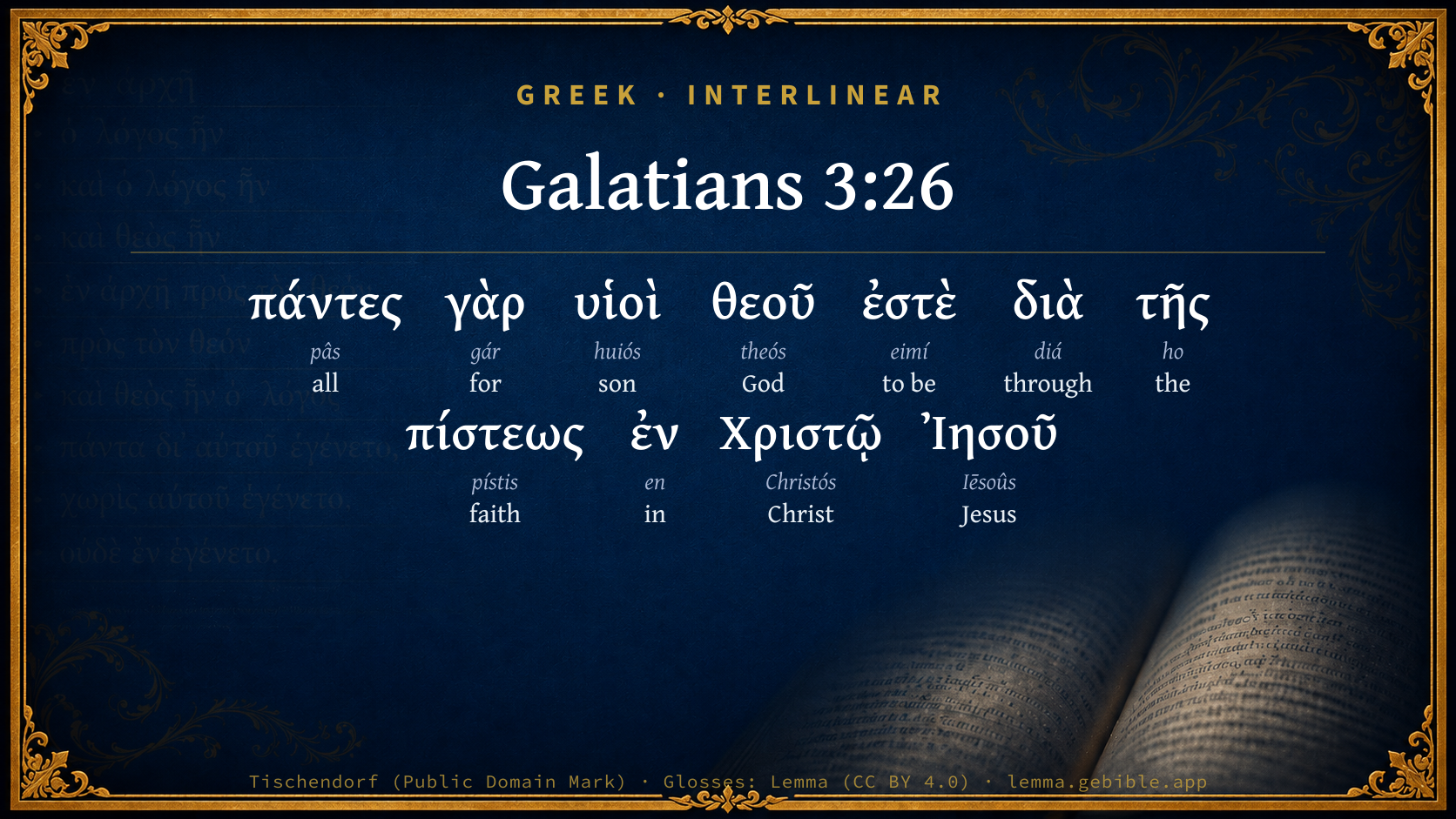
Download image
Cite this verse

Galatians 3:26 (World English Bible). Public Domain. Lemma interlinear Bible study tool, https://lemma.gebible.app/v/galatians/3/26.

Show BibTeX & RIS
BibTeX
RIS
English Translation
For you are all children of God, through faith in Christ Jesus.
World English Bible · Public Domain
Download a study sheet

One document with this verse’s original text, its word-by-word gloss line, the meaning frame, cross-references with their text, attributed commentary, and full source and license credits — printable, and it pastes into notes with its structure intact.

This verse Autodidact and up

Study sheet (.html) Plain text (.txt)

A passage Seminary Student

Up to 50 verses in one chapter. A passage sheet keeps up to 6 commentary sources and 12 cross-references per verse, in the order this page ranks them, and says so on the sheet whenever that leaves anything out. Ask for a single verse and you get the Autodidact verse sheet above.

Everything on this page stays free to read, with no account — the sheet is a download of what is already on screen, not access to it.

Want to remove ads? Support Godless Engineer
Compare translations 3

The same verse in 3 English versions, stacked beneath the original-language interlinear above. Click any original word for its lexicon entry.

Each is an independent rendering of the whole verse — the interlinear is not word-aligned to these translations.

Highlighted words mark where these versions differ — a whole-verse word diff, not a word-by-word alignment.

  • World English Bible Public Domain
    For you are all children of God, through faith in Christ Jesus.
  • King James Version Public Domain
    For ye are all the children of God by faith in Christ Jesus.
  • unfoldingWord Literal Text CC BY-SA 4.0
    For you are all sons of God through faith in Christ Jesus.

unfoldingWord Literal Text — © unfoldingWord, licensed CC BY-SA 4.0. Word-aligned USFM3 via Door43 (git.door43.org/unfoldingWord/en_ult).

Versions to compare (up to 4)

3 of 4 selected

Show all 19 translations

Every available English version of this verse, each an independent rendering of the whole verse.

  • World English Bible Public Domain
    For you are all children of God, through faith in Christ Jesus.
  • Berean Standard Bible Public Domain
    You are all sons of God through faith in Christ Jesus.
  • Majority Standard Bible Public Domain
    You are all sons of God through faith in Christ Jesus.
  • King James Version Public Domain
    For ye are all the children of God by faith in Christ Jesus.
  • American Standard Version (1901) Public Domain
    For ye are all sons of God, through faith, in Christ Jesus.
  • Revised Version (1885) Public Domain
    For ye are all sons of God, through faith, in Christ Jesus.
  • Geneva Bible (1599) Public Domain
    For ye are al the sonnes of God by faith, in Christ Iesus.
  • Douay-Rheims (1899) Public Domain
    For you are all the children of God by faith, in Christ Jesus.
  • Young's Literal Translation Public Domain
    for ye are all sons of God through the faith in Christ Jesus,
  • Literal Standard Version CC BY-SA 4.0
    for you are all sons of God through faith in Christ Jesus,
  • Unlocked Literal Bible CC BY-SA 4.0
    For you are all sons of God through faith in Christ Jesus.
  • unfoldingWord Literal Text CC BY-SA 4.0
    For you are all sons of God through faith in Christ Jesus.
  • Darby Bible Public Domain
    for ye are all God's sons by faith in Christ Jesus.
  • World Messianic Bible Public Domain
    For you are all children of God, through faith in Messiah Yeshua.
  • Webster's Bible Public Domain
    For ye are all children of God by faith in Christ Jesus.
  • Free Bible Version CC BY-SA 4.0
    For you are all God's children through your trust in Christ Jesus.
  • Bible in Basic English Public Domain
    Because you are all sons of God through faith in Christ Jesus.
  • Text-Critical English NT CC BY 4.0
    for you are all sons of God through faith in Christ Jesus.
  • Tyndale New Testament (1534) Public Domain
    For ye are all the sonnes of God by the fayth which is in Christ Iesus.

Literal Standard Version (2020), Covenant Press — licensed CC BY-SA 4.0. Text via the HelloAO Bible API (eBible.org). Unlocked Literal Bible (unfoldingWord) — licensed CC BY-SA 4.0. Text via the HelloAO Bible API (eBible.org). unfoldingWord Literal Text — © unfoldingWord, licensed CC BY-SA 4.0. Word-aligned USFM3 via Door43 (git.door43.org/unfoldingWord/en_ult). Free Bible Version, Dr. Jonathan Gallagher — licensed CC BY-SA 4.0. Text via the HelloAO Bible API (eBible.org).

Word by word

More ways to search: Search by grammar → Find every occurrence → Compare this word →

Practice this passage: Drill this verse → Learn its vocabulary →

πίστεως
pístis
G4102
“faith”
Noun, Genitive, Singular, Feminine
Part of Speech
Noun
Case
Genitive
Number
Singular
Gender
Feminine
Full Thayer's Definition

Origin: from G3982

TDNT: 08:54,8

1. conviction of the truth of anything, belief; in the NT of a conviction or belief respecting man's relationship to God and divine things, generally with the included idea of trust and holy fervour born of faith and joined with it a. relating to God 1. the conviction that God exists and is the creator and ruler of all things, the provider and bestower of eternal salvation through Christ b. relating to Christ 1. a strong and welcome conviction or belief that Jesus is the Messiah, through whom we obtain eternal salvation in the kingdom of God c. the religious beliefs of Christians d. belief with the predominate idea of trust (or confidence) whether in God or in Christ, springing from faith in the same 2. fidelity, faithfulness a. the character of one who can be relied on
  1. πάντες pâs G3956 “all” Adjective, Nominative, Plural, Masculine
  2. γὰρ gár G1063 “for” Conjunction
  3. υἱοὶ huiós G5207 “son” Noun, Nominative, Plural, Masculine
  4. θεοῦ theós G2316 “God” Noun, Genitive, Singular, Masculine
  5. ἐστὲ eimí G1510 “to be” Verb, Present, Active, Indicative, 2nd person, Plural
  6. διὰ diá G1223 “through” Preposition
  7. τῆς ho G3588 “the” Article, Genitive, Singular, Feminine
  8. ἐν en G1722 “in” Preposition
  9. Χριστῷ Christós G5547 “Christ” Noun, Dative, Singular, Masculine
  10. Ἰησοῦ Iēsoûs G2424 “Jesus” Noun, Dative, Singular, Masculine

About this verse

These counts appear in no published source. They are computed here, from the morphology-tagged text and Lemma’s own curated glosses. What Lemma adds →

11
words
11
distinct lemmas
Pauline Epistles
section

Cross-references

11

Topical passages linked to Galatians 3:26 in the Treasury of Scripture Knowledge — connected by theme and wording, ordered by reader-vote popularity; previews shown in the World English Bible.

  • Ephesians 1:5 having predestined us for adoption as children through Jesus Christ to himself, according to the good pleasure of his desire,
  • 2 Corinthians 6:18 I will be to you a Father. You will be to me sons and daughters,' says the Lord Almighty."
  • John 1:12–13 But as many as received him, to them he gave the right to become God's children, to those who believe in his name:
  • Galatians 4:5–6 that he might redeem those who were under the law, that we might receive the adoption of children.
  • 1 John 3:1–2 Behold, how great a love the Father has bestowed on us, that we should be called children of God! For this cause the world doesn't know us, because it didn't know him.
  • Romans 8:14–17 For as many as are led by the Spirit of God, these are children of God.
  • Philippians 2:15 that you may become blameless and harmless, children of God without blemish in the midst of a crooked and perverse generation, among whom you are seen as lights in the world,
  • Revelation 21:7 He who overcomes, I will give him these things. I will be his God, and he will be my son.
  • Ephesians 5:1 Be therefore imitators of God, as beloved children.
  • John 20:17 Jesus said to her, "Don't touch me, for I haven't yet ascended to my Father; but go to my brothers, and tell them, 'I am ascending to my Father and your Father, to my God and your God.'"
  • Hebrews 2:10–15 For it became him, for whom are all things, and through whom are all things, in bringing many children to glory, to make the author of their salvation perfect through sufferings.

Cross-references courtesy of OpenBible.info (CC BY 4.0).

Commentary

Notes on Galatians 3:26 from classic Christian and Jewish commentators (each source and its license shown beneath its notes). The classic Christian expositions comment on the surrounding passage and are grouped to its opening verse, so a note may address several verses; the Jewish commentaries on the Tanakh (Rashi and others) are per-verse, so they appear only where the commentator wrote on this verse.

Lemma curates 59 commentaries, every one of them public domain or Creative Commons licensed, each selected and text-cleaned for this edition rather than reprinted as found. About our sources →

The Preacher's Complete Homiletical Commentary

Joseph S. Exell (gen. ed.)

CRITICAL AND EXPLANATORY NOTES

Gal_3:26. Ye are all the children of God.—No longer children requiring a tutor, but sons emancipated and walking at liberty.

Gal_3:28. Ye are all one in Christ Jesus.—No class privileged above another, as the Jews under the law had been above the Gentiles. Difference of sex makes no difference in Christian privileges. But under the law the male sex had great privileges.

Gal_3:29. If ye be Christ’s, then are ye Abraham’s seed and heirs.—Christ is Abraham’s seed, and all who are baptised into Christ, put on Christ (Gal_3:27), and are one in Christ (Gal_3:28), are children entitled to the inheritance of promise.

MAIN HOMILETICS OF THE PARAGRAPH.—Gal_3:26-29

The Dignity of Sonship with God—

I. Enjoyed by all who believe in Christ.—“For ye are all the children of God by faith in Christ Jesus” (Gal_3:26). Faith in Christ emancipates the soul from the trammels and inferior status of the tutorial training, and lifts it to the higher and more perfect relationship of a free son of God. The believer is no longer a pupil, subject to the surveillance and restrictions of the pedagogue; but a son, enjoying immediate and constant intercourse with the Father and all the privileges and dignities of a wider freedom. The higher relation excludes the lower; an advance has been made that leaves the old life for ever behind. The life now entered upon is a life of faith, which is a superior and totally different order of things from the suppressive domination of the law.

II. Is to be invested with the character of Christ.—“For as many as have been baptised into Christ have put on Christ” (Gal_3:27). For if Christ is Son of God, and thou hast put on Him, having the Son in thyself and being made like to Him, thou wast brought into one kindred and one form of being with Him (Chrysostom). To be baptised into Christ is not the mere mechanical observance of the rite of baptism; the rite is the recognition and public avowal of the exercise of faith in Christ. In the Pauline vocabulary baptised is synonymous with believing. Faith invests the soul with Christ, and joyfully appropriates the estate and endowments of the filial relationship. Baptism by its very form—the normal and most expressive form of primitive baptism, the descent into and rising from the symbolic waters—pictured the soul’s death with Christ, its burial and its resurrection in Him, its separation from the life of sin, and entrance upon the new career of a regenerated child of God (Rom_6:3-14).

III. Implies such a complete union with Christ as to abolish all secondary distinctions.—“For there is neither Jew nor Greek, bond nor free, male nor female; for ye are all one in Christ Jesus” (Gal_3:28). All distinctions of nationality, social status, and sex—necessary as they may be in the worldly life—disappear in the blending of human souls in the loftier relationship of sons of God. The gospel is universal in its range and provisions, and raises all who believe in Christ to a higher level than man could ever reach under the Mosaic regimen. To add circumcision to faith would be not to rise but to sink from the state of sons to that of serfs. Christ is the central bond of unity to the whole human race; faith in Him is the realisation by the individual of the honours and raptures of that unity.

IV. Is to be entitled to the inheritance of joint heirship with Christ.—“If ye be Christ’s, then are ye … heirs according to the promise” (Gal_3:29). In Christ the lineal descent from David becomes extinct. He died without posterity. But He lives and reigns over a vaster territory than David ever knew; and all who are of His spiritual seed, Jew or Gentile, share with Him the splendours of the inheritance provided by the Father. Here the soul reaches its supreme glory and joy. In Worcester Cathedral there is a slab with just one doleful word on it as a record of the dead buried beneath. That word is Miserrimus. No name, no date; nothing more of the dead than just this one word to say he who lay there was or is most miserable. Surely he had missed the way home to the Father’s house and the Father’s love, else why this sad record? But in the Catacombs at Rome there is one stone recently found inscribed with the single word Felicissima. No name, no date again, but a word to express that the dead Christian sister was most happy. Most happy; why? Because she had found the Father’s house and love, and that peace which the storms of life, the persecutions of a hostile world, and the light afflictions of time could neither give nor take away.

Lessons.—

1. Faith confers higher privileges than the law.

2. Faith in Christ admits the soul into sonship with God.

3. The sons of God share in the fulness of the Christly inheritance.

GERM NOTES ON THE VERSES

Gal_3:26-29. Baptism.

I. The doctrine of Rome.—Christ’s merits are instrumentally applied by baptism; original sin is removed by a change of nature; a new character is imparted to the soul; a germinal principle or seed of life is miraculously given; and all this in virtue, not of any condition in the recipient, nor of any condition except that of the due performance of the rite. The objections to this doctrine are:

1. It assures baptism to be not the testimony to a fact, but the fact itself. Baptism proclaims the child of God; the Romanist says it creates him.

2. It is materialism of the grossest kind.

3. It makes Christian life a struggle for something that is lost, instead of a progress to something that lies before.

II. The doctrine of modern Calvinism.—Baptism admits all into the visible Church, but into the invisible Church only a special few. The real benefit of baptism only belongs to the elect. With respect to others, to predicate of them regeneration in the highest sense is at best an ecclesiastical fiction, said in the judgment of charity. You are not God’s child until you become such consciously. On this we remark:

1. This judgment of charity ends at the baptismal font.

2. This view is identical with the Roman one in this respect—that it creates the fact instead of testifying to it.

3. Is pernicious in its results in the matter of education.

III. The doctrine of the Bible.—Man is God’s child, and the sin of the man consists in perpetually living as if it were false. To be a son of God is one thing; to know that you are and call Him Father is another. Baptism authoritatively reveals and pledges to the individual that which is true of the race.

1. This view prevents exclusiveness and spiritual pride.

2. Protests against the notion of our being separate units in the divine life.

3. Sanctifies materialism.—F. W. Robertson.

Gal_3:26. The Children of God.

I. We are all children.

II. We are all children of God.

III. We are all children of God through faith.

IV. We are all children of God in Christ Jesus.—Dr. Beet.

God’s Children.

I. If thou be God’s child, surely He will provide all things necessary for soul and body.—Our care must be to do the duty that belongs to us; when this is done our care is ended. They who drown themselves in worldly cares live like fatherless children.

II. In that we are children we have liberty to come into the presence of God.

III. Nothing shall hurt those who are the children of God.

IV. Walk worthy of your profession and calling.—Be not vassals of sin and Satan; carry yourselves as King’s sons.

V. Our care must be to resemble Christ.

VI. We must have a desire and love to the word of God that we may grow by it.

VII. We must have afflictions, if we be God’s children, for He corrects all His children.—Perkins.

Gal_3:27-28. The Christly Character—

I. Acquired by a spiritual union with Christ.—“Baptised into Christ.”

II. Is a complete investiture with Christ.—“Have put on Christ.”

III. Is a union with Christ that absorbs all conventional distinctions (Gal_3:28).

Gal_3:27. Profession without Hypocrisy.—Hypocrisy is professing without practising. Men profess without feeling and doing, or are hypocrites in nothing so much as in their prayers. Let a man set his heart upon learning to pray and strive to learn, and no failures he may continue to make in his manner of praying are sufficient to cast him from God’s favour. Let him but be in earnest, striving to master his thoughts and to be serious, and all the guilt of his incidental failings will be washed away in his Lord’s blood. We profess to be saints, to be guided by the highest principles, and to be ruled by the Spirit of God. We have long ago promised to believe and obey. It is true we cannot do these things aright—nay, even with God’s help we fall short of duty. Nevertheless we must not cease to profess. There is nothing so distressing to a true Christian as to have to prove himself such to others, both as being conscious of his own numberless failings and from his dislike of display. Christ has anticipated the difficulties of his modesty. He does not allow such a one to speak for himself; He speaks for him. Let us endeavour to enter more and more fully into the meaning of our own prayers and professions; let us humble ourselves for the very little we do and the poor advance we make; let us avoid unnecessary display of religion. Thus we shall, through God’s grace, form within us the glorious mind of Christ.—Newman.

Teachings of Baptism.

I. Our baptism must put us in mind that we are admitted and received into the family of God.

II. Our baptism in the name of the Trinity must teach us to know and acknowledge God aright.

III. Our baptism must be unto us a storehouse of comfort in time of need.

IV. Baptism is a putting on of Christ.—Alluding to the custom of those who were baptised in the apostle’s days putting off their garments when they were baptised, and putting on new garments after baptism.

1. In that we are to put on Christ we are reminded of our moral nakedness.

2. To have a special care of the trimming and garnishing of our souls.

3. Though we be clothed with Christ in baptism, we must further desire to be clothed upon—clad with immortality.—Perkins.

Gal_3:28. All are One in Christ.

I. People of all nations, all conditions, and all sexes.

II. They who are of great birth and high condition must be put in mind not to be high-minded, nor despise them of low degree, for all are one in Christ.

III. All believers must be of one heart and mind.

IV. We learn not to hate any man, but do good to all.—Men turn their swords and spears into mattocks and scythes, because they are one with Christ by the bond of one Spirit.—Perkins.

Gal_3:29. The Promise of Grace.—The specific form of the whole gospel is promise, which God gives in the word and causes to be preached. The last period of the world is the reign of grace. Grace reigns in the world only as promise. Grace has nothing to do with law and requisition of law; therefore the word of that grace can be no other than a word of promise. The promise of life in Christ Jesus is the word of the new covenant. The difference between the gospel of the old covenant and that of the new rests alone on the transcendently greater glory of its promise.—Harless.

Heirs according to the Promise.

I. The basest person, if he believes in Christ, is in the place of Abraham, and succeeds him in the inheritance of the kingdom of heaven.

II. Believers must be content in this world with any estate God may lay upon them, for they are heirs with Abraham of heaven and earth.

III. They that believe in Christ must moderate their worldly cares and not live as drudges of the world, for they are heirs of God, and are entitled to all good things promised in the covenant.

IV. Our special care must be for heaven.—The city of God is thy portion, or child’s part.—Perkins.

The Preacher's Complete Homiletical Commentary (gen. ed. Joseph S. Exell; Funk & Wagnalls, c. 1892) — public domain (pre-1929). A full-Bible homiletical/sermon-outline anthology covering 65 of 66 books (2 John is absent from the source module). Text from a community e-Sword module.

McGarvey & Pendleton's Commentaries

J. W. McGarvey

For ye are all sons of God, through faith, in Christ Jesus. [Faith, announcing justification from sin, is like a messenger of the father's announcing maturity and liberty to the son so long under the care of a tutor. From the time of this announcement the son ceases to be a minor, shut off from the father, and becomes the companion of the father. Paul plainly declares the literal meaning of his figurative language in Gal_3:26 . Fausset draws attention to the analogy between the illustration here and that formed by the history of Moses and Joshua. Moses, as a representative of the law, brought the people to the border of the land of liberty; but it was the privilege of Joshua, as a type of faith, to lead the people into the full enjoyment of that liberty.]

J. W. McGarvey (with Philip Y. Pendleton), Commentaries on the New Testament (The Fourfold Gospel, 1914; Acts; and the epistles) — public domain. Text from a community e-Sword/MySword module.

Tyndale Open Study Notes

Tyndale Open Resources

3:26-29 Because of Christ, our condition under faith contrasts with our condition under the law (3:23-24).

3:26 Those who are children of God through faith in Christ Jesus (see also 4:4-7; John 1:12; Rom 9:8) have come of age as heirs of his promises (see Gal 3:24-25, 29) and have received the down payment of that inheritance (3:14; Eph 1:14). The Galatians were foolish (Gal 3:1) in trying to gain access to God through circumcision. As God’s children by faith, they already had the best possible access to God.

Tyndale Open Study Notes — © Tyndale Open Resources, licensed CC BY-SA 4.0. Text via the HelloAO Bible API.

Bengel's Gnomon

Johann Albrecht Bengel

Gal 3:26. Υἱοὶ) Sons, emancipated, the keeper being removed.

Bengel's Gnomon of the New Testament — English translation (T&T Clark, Edinburgh, 1860) — public domain. Text from a community e-Sword module.

Meyer's Critical & Exegetical Commentary

Heinrich August Wilhelm Meyer

Gal_3:26. The argumentative emphasis is laid first on πάντες, and then, not on υἱοί,which expositors have been wont to understand in the pregnant sense: sons of full age, free, in contrast to the παισί implied in παιδαγωγός (see, against this view, Wieseler and Matthias),but on υἱοὶ Θεοῦ, because in this Θεοῦ the υἱοί actually has its express and full definition, and therefore to supply the defining idea is quite unwarrantable. All of you are sons of God by means of faith;[169] but where all without exception and without distinction are sons of God, and are so through faith, none can be, like Israel before the appearance of faith, under the dominion of the law, because the new state of life, that of faith, is something altogether different,namely, fellowship with the υἱότης of Christ (Gal_3:27). To be a son of God through faith, and to be under the old tutorial training, are contradictory relations, one of which excludes the other. The higher, and in fact perfect relation,[170] excludes the lower.

ΠΆΝΤΕς] Paul now speaks in the second person, because what is said in Gal_3:26 f. held good, not of the Jewish Christians alone (of whom he previously spoke in the first person), but of all Christians in general as such, consequently of all his readers whom he now singles out for address; whether they may have previously been Jews or Gentiles, now they are sons of God. Hofmann supposes that Paul meant by the second person his Gentile-Christian readers, and wished to employ what he says of them in proof of his assertion respecting those who had been previously subject to the law. In this case he must, in order to be intelligible, have used some such words as καὶ γὰρ ὑμεῖς ἔθνη πάντες κ.τ.λ. According to the expression in the second person used without any limitation, the Galatian Christians must have considered themselves addressed as a whole without distinction,a view clearly confirmed to them by the ὅσοι (Gal_3:27), and the ἸΟΥΔΑῖΟς ΟὐΔῈ ἝΛΛΗΝ comp. with ΠΆΝΤΕς ὙΜΕῖς (Gal_3:28). Where, on the other hand, Paul is thinking of the Galatians as Gentile Christians (so far as the majority of them actually were so), this may be simply gathered from the context (Gal_4:8).

ἐν Χριστῷ Ἰησοῦ] belongs to ΠΊΣΤΕΩς. According to the construction ΠΙΣΤΕΎΕΙΝ ἜΝ ΤΙΝΙ (see Mar_1:15; Eph_1:13; LXX. Ps. 77:22, Jer_12:6; Clem. 1 Cor. 22: Ἡ ἘΝ ΧΡΙΣΤῷ ΠΊΣΤΙς, Ignat. ad Philad. 8: ἐν τῷ εὐαγγελίῳ οὐ πιστεύω), Ἡ ΠΊΣΤΙς ἘΝ ΧΡΙΣΤῷ is fides in Christo reposita, the faith resting in Christ; the words being correctly, in point of grammar, combined so as to form one idea. See Winer, p. 128 [E. T. 169]; Fritzsche, ad Marc. p. 63, ad Rom. I. p. 195 f. Comp. Eph_1:1; Eph_1:15; Col_1:4; 1Ti_3:13. But Usteri, Schott, Hofmann, Wieseler, Ewald, Matthias, Reithmayr (Estius also pronouncing it allowable), join ἐν Χρ. Ἰ. with ΥἹΟῚ ΘΕΟῦ ἘΣΤΕ, of which it is alleged to be the modal definition; specially explaining the sense, either as utpote Christo prorsus addicti (Schott), or of the inclusion in Christ (Hofmann), or as assigning the objective ground of the sonship, which has its subjective ground in διὰ τ. πίστ. (Wieseler; comp. Hofmann and Buhl). But all these elements are already obviously involved in ΔΙᾺ Τ. ΠΊΣΤ. itself, so that ἘΝ Χ. Ἰ., as parallel to ΔΙᾺ Τ. Π., would be simply superfluous and awkward; whereas, connected with ΔΙᾺ Τ. Π., it expresses the emphatic and indeed solemn completeness of this idea (comp. Gal_3:22), in accordance with the great thought of the sentence, coming in all the more forcibly at the end, as previously in the case of ἐλθεῖν (Gal_3:23) and ἘΛΘΟΎΣΗς (Gal_3:25) the ΠΊΣΤΙς was mentioned without its object, and the latter was left to be understood as a matter of course.

[169] διὰ τ. πίστ. stands third in the order of emphasis, but has not the main stress laid upon it in contradistinction to the πάντες (Hofmann), as if it stood immediately after πάντες γάρ.

[170] Theodoret aptly remarks: ἔδειξε τῶν πεπιστευκότων τὸ τέλειον· τί γὰρ τελειότερον τῶν υἱῶν χρηματιζόντων Θεοῦ;

Meyer — Critical and Exegetical Commentary on the New Testament — English translation by Peter Christie, edited by Frederick Crombie (T&T Clark, 1880) — public domain. Text from a community e-Sword module.

Cambridge Greek Testament for Schools and Colleges

26. πάντες γὰρ κ.τ.λ. It has been thought that Gal 3:26-29 are an appeal to the experience of the Galatians; having, as they have found, all these privileges, they surely cannot be any more under the Law. But it is questionable whether this does not assume too much experimental religion on the part of the Galatians, and also there is no appeal (as in Gal 3:2; Gal 3:5) to their reception of the Spirit or the existence of miraculous or other gifts. It is better therefore to understand the verses as laying down principles. You are no longer under a paedagogue, for, as I must remind you, you are already sons of God in Christ, yes, all are received in Him, and if you are in Him then you are Abraham’s seed, heirs according to promise.

πάντες. Primarily whether Jews or Gentiles, but it serves as an occasion for mentioning various conditions of life in Gal 3:28.

γὰρ. Not merely giving he reason for saying πάντες (“why he ranks Galatians and Jews together”), but for speaking of their freedom in Gal 3:25.

νἱοὶ. More than τέκνα (Gal 3:7 note), and even παῖδες (a word not employed by St Paul but suggested by the previous παιδαγωγός), which in the present context would be almost equivalent to νήπιοι (Gal 4:1).

θεοῦ. Here added not in contrast to Abraham (Gal 3:7) as being greater, but rather as being the fundamental privilege of believers, which proves itself eventually to carry with it the further privilege (which has been so much under discussion) of being sons of Abraham (Gal 3:29). But in itself it does not bear the emphasis of the sentence. That is chiefly on νἱοί (in contrast to those under a paedagogus), though formally on πάντες.

διὰ τῆς πίστεως. Here probably “your faith.”

ἐν Χριστῷ Ἰησοῦ: faith centred on Christ and resting in Him, Col 1:4; Eph 1:15. These parallels make it improbable that ἐν Χρ. Ἰης. are to be taken with νἱοὶ θεοῦ ἐστε as R.V.; cf. also Gal 3:22. The names are in this order (contrast Gal 3:22) because Χρ. takes up Gal 3:24, and Ἰης. is an addition expressly identifying Messiah with Jesus.

Cambridge Greek Testament for Schools and Colleges (Cambridge University Press, 1896; 21 vols, various authors incl. Carr, Maclear, Plummer, Farrar, Lumby, Moule, M. R. James, Simcox) — public domain. Text from a community e-Sword module.

Geneva Bible (1599)

Geneva Bible translators

Because age changeth not the condition of servants, he addeth that we are free by condition, and therefore, seeing we are out of our childhood, we have no more need of a keeper and Schoolmaster.

Geneva Bible (1599) marginal notes — public domain. Text via Bolls.life.

Jamieson, Fausset & Brown

Robert Jamieson, A. R. Fausset & David Brown

children--Greek, "sons."

by--Greek, "through faith." "Ye all" (Jews and Gentiles alike) are no longer "children" requiring a tutor, but SONS emancipated and walking at liberty.

Jamieson, Fausset & Brown — Commentary Critical and Explanatory on the Whole Bible (1871) — public domain (CC PDM 1.0). Text via the HelloAO Bible API.

Adam Clarke's Commentary

Verse 26. For ye, who have believed the Gospel, are all the children of God by faith in Christ Jesus.] But no man is a child of God by circumcision, nor by any observance of the Mosaic law.

Adam Clarke's Commentary on the Bible (1810–1826) — public domain. Text from a community e-Sword/MySword module.

John Calvin's Commentaries

26. For ye are all the children of God. It would be unjust, and in the highest degree unreasonable, that the law should hold believers in perpetual slavery. This is proved by the additional argument, that they are the children of God. It would not be enough to say that we are no longer children, unless it were added that we are freemen; for in slaves age makes no alteration. The fact of their being the children of God proves their freedom. How? By faith in Christ Jesus; for

“as many as received him, to them gave he power to become the sons of God, even to them that believe on his name.” (John 1:12.)

Since, then, by faith we have obtained adoption, by faith likewise we have obtained our freedom.

John Calvin's Commentaries (1540-1563) — public domain. Text from the Calvin Translation Society English edition (1840s-50s) via the Christian Classics Ethereal Library (ccel.org). Calvin's coverage is partial (roughly two-thirds of the Bible); uncommented books and verses are honest gaps, never fabricated. The 19th-century editor's footnotes and remarks are omitted so the notes are faithfully Calvin's own voice.

Ellicott's Commentary for English Readers

(26) Children of God.—The translation “children” here is unfortunate, as the point to be brought out is that the Christian is no longer in the condition of “children,” but in that of grown-up “sons.” The pre-Messianic period bears to the Messianic period the same relation that a childhood or minority bears to full age. The Christian, as such, has the privileges of an adult son in his Father’s house. He is released from pupilage, and has received his freedom.

A Bible Commentary for English Readers, edited by Charles John Ellicott (1878–1897) — public domain. Text from a community e-Sword module.

The Cambridge Bible for Schools and Colleges

gen. ed. J. J. S. Perowne

26. Ye are] The change from the first person ‘we are’ Gal_3:25 to the second ‘ye are’ marks a transition from an argument to an appeal. The converse is found 2Co_6:14; 2Co_6:16; 2Co_7:1; 1Th_5:6.

all] Both Jews and Gentiles—an indirect confirmation of the statement that the law is not against the promises of God.

the children] Better, sons. Comp. Joh_1:12 ‘As many as received Him, to them gave He power to become the sons of God, even to them which believe on His name.’

26–29. The selection of the metaphor of Gal_3:24-25 is by no means accidental. It suggests and leads up to the grand revelation of Gospel blessedness contained in the peroration to this chapter. The very fact that we were under tutelage proves that our true relation to God is that of sons, a relationship into which we all, both Jews and Gentiles, entered by believing in Jesus Christ. Of this relationship our Baptism was the sign and pledge and instrument. We therein became clothed with Christ. Our nakedness was covered with the robe of His perfect righteousness. He became the circumambient, enveloping element in which our new life is lived and sustained. And here the external distinctions, of Jew and Gentile, bond and free, nay, even that which has so long separated the sexes, disappears. In Christ all are united who by faith are united to Him. And if we belong to Christ, if we are part of Him, who is the promised Seed, then we are the seed of Abraham, we are heirs according to the promise.

The Cambridge Bible for Schools and Colleges (gen. ed. J. J. S. Perowne; Cambridge University Press, 1878–1918) — public domain. Text from a community e-Sword module.

John Gill's Exposition

For ye are all the children of God,.... Not by nature, as Christ is the Son of God, for he is the only begotten of the Father, and in such sense as neither angels nor men are the sons of God; nor by creation, as Adam and all mankind, and the angels are; but by divine adoption by an act of God's rich and sovereign grace, putting them among the children in saying this the apostle directs himself to the Gentiles for their comfort, and says this of them all in a judgment of charity, they being under a profession of faith; lest they should think, because they were not Abraham's seed according to the flesh, nor were ever trained up under the law as a schoolmaster, that they were not the children of God: whereas they were such not by the law, as none indeed are,

but by faith in Christ Jesus; not that faith makes any the children of God, or puts them into such a relation; no, that is God's own act and deed; of his free rich grace and goodness, God the Father has predestinated his chosen ones to the adoption of children, and has secured and laid up this blessing for them in the covenant of grace; Christ by redemption has made way for their reception and enjoyment of it; the Spirit of God, in consequence of their sonship, as a spirit of adoption bears strong reason and argument, proving that they are not under the law as a schoolmaster, in which light it is here set by the apostle; since they are sons and not servants, and so free from the bondage of the law; they are sons grown up into the faith of Christ, and are led and taught by the Spirit of God, as they are that are the children of God by faith; and as is promised to the saints under the Gospel, that they shall be "all taught of God"; and therefore stood in no need of the law as a schoolmaster, which only was concerned with the Jews, whilst they were children under age; and has nothing to do with such, whether Jews or Gentiles, who believe in Christ, and are growing up into him their head, till they come to the measure of the stature of the fulness of him.

John Gill's Exposition of the Whole Bible (1746–1763) — public domain (CC PDM 1.0). Text via the HelloAO Bible API.

Trapp's Complete Commentary

John Trapp

26 For ye are all the children of God by faith in Christ Jesus.

Ver. 26. The children of God] Gr. The sons of God, grown up at man’s estate; Qui magnum ferulae subduximus, who are no longer under a schoolmaster. How we are the children of God by faith. {See Trapp on "Joh 1:12"}

John Trapp, A Commentary or Exposition upon All the Books of the Old and New Testament (1647–1656) — public domain. Text from a community e-Sword module.

Albert Barnes' Notes on the Bible

For ye are all the children of God ... - All who bear the Christian name - the converts from among the Jews and Gentiles alike; see the note at Joh 1:12. The idea here is, that they are no longer under tutors and governors; they are no longer subject to the direction and will of the “paedagogus”; they are arrived at age, and are admitted to the privileges of sons; see the note at Gal 4:1. The language here is derived from the fact, that until the son arrived at age, he was in many respects not different from a servant. He was under laws and restraints; and subject to the will of another. When of age, he entered on the privileges of heirship, and was free to act for himself. Thus, under the Law, people were under restraints, and subject to heavy exactions. Under the gospel, they are free, and admitted to the privileges of the sons of God.

Albert Barnes' Notes on the Bible (1834–1885) — public domain. Text from a community e-Sword/MySword module.

Matthew Poole's English Annotations

All you that believe, whether native Jews or Gentiles, are the children of God by adoption, through faith in Jesus Christ, Joh 1:12; so that you need not run back to the law to look for help and salvation from that; but only look unto Christ, to whom the law was but a schoolmaster to lead you; who being fully and clearly revealed, you may have immediate recourse to, by faith; and need not to make use of the Jewish schoolmaster, as hoping for justification from the observances of the law.

Matthew Poole's English Annotations on the Holy Bible (1683–1685) — public domain. Text from a community e-Sword/MySword module.

Whedon's Commentary on the Bible

Daniel D. Whedon

26. Children—Rather, full grown sons. Ye—Ye Galatians, so far forth as ye maintain your emancipation from law by faith in Christ Jesus.

Daniel D. Whedon (gen. ed.), Commentary on the Old and New Testaments (1874–1909) — public domain. Text from a community e-Sword module.

The Pulpit Commentary

For ye are all the children of God by faith in Christ Jesus (pantev gar uiJoi Qeou ejste diastewv ejn Cristw jIhsou) for sons of God are ye all through faith in Christ Jesus. "For;" that is, what is just affirmed (ver. 25) is true, because ye are "sons" and no longer "children." "Ye are;" in ver. 25 it is "we are." The whole course of the argument, however, shows that the persons recited by each of the personal pronouns are in effect the same, namely, the people of God; otherwise this verse would not furnish proof, as by the "for" it professes to do, of the statement of ver. 25. The change from "we" to "ye" has by some been explained as due to the writer"s wish to preclude the supposition that the "we" in ver. 25 applied to Jewish believers only. A more satisfactory explanation is that he wishes to give the statement in vers. 22-25, which is general, a more trenchant force as applying to those whose spiritual difficulties he is now dealing with. in 1Th_5:5, "Ye are all sons of light, and sons of the day: we are not of the night, nor of darkness," we have the converse transition. There likewise the persons recited are in effect the same; and the change of person in the pronoun, making the discourse, from exhortation addressed to others, pass into a form of cohortation applying to all Christians alike, including the writer himself, is dictated by the apostle"s sympathetic kindness for especially his Thessalonian converts. "Ye are." The fact that faith is the sole and sufficient ground of qualification eliminates all those distinctions by which the Law has heretofore fenced off Gentiles, pronouncing them "separated as aliens," "strangers to the covenants," and "without God" (cf. Eph_2:12) In the sequel (ver. 28) the apostle passes on from the thought of this particular outward distinction of Jew and Gentile to the thought of all other purely external distinctions. "In Christ Jesus." It is debated whether this clause should be connected with "faith," as if it were pistewv thv ejn Cristw jIhsou, the article being omitted, as in Col_1:4; Eph_1:15, and often; or with the words, "ye are sons of God," with a comma following the word "faith." Both modes of construing find in the sentence at last the same contents of thought; for each of the two propositions thus severally formed contains by implication the other. It probably suits the connection best to take the apostle as at once affirming that it is in Christ Jesus that we are God"s sons through faith, rather than as leaving this to be inferred from the fact of our being sons through faith in Christ. "In Christ" is, with St. Paul, a very favourite form of indicating the channel through which the great blessings of the gospel are realized (cf. Eph_1:3, Eph_1:6, Eph_1:7, 11 2:6, 7, 10, 13, 21, 22 3:12, etc.) "Sons of God." It is quite clear that the term "sons" (uiJoi) denotes those who have come into the full enjoyment, so far as the present life is concerned, of the position Which their birth had entitled them to; and that it stands in contrast with their earlier position when children in years under a paedagogus. The noun uiJov, son, itself, however, while it is never used as synonymous with nhpiov to describe one as a child in years, yet, like teknon, child, does not ordinarily betoken more than simple relationship as the correlative with "father;" for which reason uiJov (as well as teknon) is used in such phrases as "children of disobedience," "of Israel," of light," "of the day," "of the devil," "of perdition." In Heb_12:6-8 uiJov is applied in the case of one who is as yet under the discipline of the rod; but even there uiJov of itself immediately designates his filial relation only. St. Paul never uses the word paiv at all, though he has paidi in piov 1Co_14:20 for children in years, in place of the word nh) which he ordinarily employs (Rom_2:20; 1Co_3:1 1Co_13:11; Eph_4:14; Heb_5:13) and which we find presently after in vers. I and 3 of the next chapter. The particular modification of meaning in which the apostle here uses the term is justified by the consideration which he presently puts forward, that a son of even an opulent or high-born parent, while a mere child, possesses no more freedom than if he were the child of any other person; his heirship or distinction of birth is for so long more or less veiled; it is not until he passes out of his nonage that he appears in his proper character.

The blessing of adoption.

The apostle has already traced justification to faith, the inheritance to faith, life to faith; now he traces adoption to faith. Believers are not children of Abraham merely, but sons of God. It is clear, then, that they are no longer children "in need of a schoolmaster." "For ye are all both Jews and Gentiles of God by faith in Christ Jesus.

I THE FOUNDATION OF SONSHIP.

1. It originates in the distinguishing grace of God. We "are predestinated to the adoption of children". (Eph_1:4-6)

2. It is based on the incarnation of the eternal Son, who became the Son of man that his people might become the sons of God. The Father loves them in his Son, and looks upon them with the complacency with which he regards his Son.

3. It is based on the mediatorial work of Christ; for, as it is in Christ "we have redemption through his blood," so in him we:have obtained the inheritance." Besides, God has sent forth his Son "to redeem them that were under the Law, that we might receive the adoption of sons". (Gal_4:4, Gal_4:5)

II THE INSTRUMENT OF ADOPTION FAITH. We become "sons of God by faith in Christ Jesus". (Joh_1:12) It is clear, then, that we donot become sons of God by nature.

1. We are "by nature children of wrath.

2. We only become sons on believing.

III THE ADOPTION IS COMMON TO ALL BELIEVERS, WHETHER JEW OR GENTILE. It is not enjoyed in a varying degree by believers, as some seem to think, as if God regarded them with varying degrees of affection. "Beloved, now are we the sons of God." The adoption carries with it Divine favour, discipline, training, tenderness, conformity to the image of God"s Son.

IV IT IS A PRIVILEGE CONCERNING WHICH BELIEVERS ARE NOT LEFT IN DOUBT; for we receive the witness of the Spirit that we are children of God. (Rom_8:16)

Vers. 26-29.

Sonship.

Liberated from the tutelage of Law through faith and on account of his union with Christ, the Christian is exalted into the condition of a free son of God and enjoys the large privileges of sonship.

I THE CONDITION OF SONSHIP. God is the Father of all mankind, and all human creatures, even the most ignorant, the most degraded, and the most vicious are naturally God"s children. The prodigal son is still a son and can think of "my father." Nevertheless, it is clear that St. Paul often speaks of a sonship that does not belong to all men a sonship which is the Christian"s peculiar condition and is not even shared. by the Jew, a sonship which is not enjoyed by natural birth, but must be received by adoption, i.e. by a special act of Divine grace. What does this mean?

1. Near relationship with God. The son is most closely related to his father. But the disobedient child who forsakes his home is practically dead, for him practically the old relation is severed. It needs to be restored if he is to enjoy it again. The son, too, with St. Paul is not the young child in the nursery, but the older child admitted into the society of his father. The Jew was kept in the nursery separated from God by a "mediator" (ver. 19) and a "tutor" (ver. 24). The Christian is admitted into close fellowship with God.

2. Liberty. This is an idea always associated with St. Paul"s description of sonship. The son is no longer the child "under guardians and stewards," who "differeth nothing from a bond-servant." He is a free man enjoying the confidence of his father. Such are Christians; to them the mind and will of God are revealed; they are free from restraints of formal Law; they are put in positions of trust.

II THE ORIGIN OF SONSHIP.

1. Through rattle. This is an important point in the apostle"s argument. So long as we have not faith we remain in tutelage and at a distance from God. Faith breaks the yoke and brings us into the presence of God. Faith teaches us to realize that God is our Father and to trust him fearlessly, and so to take the position of sons.

2. By union with Christ. Christ is the Son of God. Yet he is not desirous of keeping his privileges to himself. On the contrary, he laboured and suffered that his people might share them. The baptized, that is to say, all of the Galatian people who accepted Christianity as a religion, had happily gone further and really entered into the spirit of it. They had since backslidden, but they were no hypocrites. Living Christianity is "putting on Christ," being clothed with the spirit of Christ. They who do this through faith in Christ become one with him, and, as his brethren, become sons of his Father.

III THE CONSEQUENCES OF SONSHIP.

1. Universal brotherhood. We are all one "in Christ Jesus." Here is the secret. The fraternity that sprang from the mere enthusiasm of philosophic philanthropy led to the guillotine. It is only union in Christ that secures true lasting union among men. As all colours melt into one common brilliancy under the rays of a very strong light, all distinctions vanish when Christ"s presence is deeply felt.

(1) National distinctions vanish. The old antagonism of Jew and Gentile disappears. Christianity now tends to blend nations.

(2) Social distinctions vanish. Slaves are free in Christ. Free men are servants to Christ. The gospel is the enemy of all caste-feeling.

(3) Even distinctions of sex count for nothing. This meant much in ancient times, when cruel injustice was done to women. Women are under eternal obligations to the gospel, which has freed them from an unworthy bondage and given them their true place in the world.

2. The inheritance of ancient promises. The son of a king is an heir. What shall be the inheritance of a Son of God? To him it is said, "All things are yours." The Jew cherished the promises as a hope. The Christian enjoys the fulfilment of the promises. As yet the fulfilment is but partial, though enough to be an earnest of better things to come for those sons of God who are being made "meet for the inheritance of the saints in light. W.F.A.

The Pulpit Commentary (1880–1919), ed. H.D.M. Spence-Jones & Joseph S. Exell — public domain. Text from a community e-Sword module.

John Wesley's Explanatory Notes

For ye - Christians. Are all adult sons of God - And so need a schoolmaster no longer.

John Wesley, Explanatory Notes Upon the Whole Bible (1754–1765) — public domain. Text via the GEBible commentary corpus.

Luther on Galatians

Martin Luther

VERSE 26. For we are all the children of God by faith in Christ Jesus.

Paul as a true apostle of faith always has the word "faith" on the tip of his tongue. By faith, says he, we are the children of God. The Law cannot beget children of God. It cannot regenerate us. It can only remind us of the old birth by which we were born into the kingdom of the devil. The best the Law can do for us is to prepare us for a new birth through faith in Christ Jesus. Faith in Christ regenerates us into the children of God. St. John bears witness to this in his Gospel: "As many as received him, to them gave he power to become the sons of God, even to them that believe on his name." (Joh 1:12.) What tongue of man or angel can adequately extol the mercy of God toward us miserable sinners in that He adopted us for His own children and fellow-heirs with His Son by the simple means of faith in Christ Jesus!

Martin Luther — Commentary on the Epistle to the Galatians (1535), English translation by Theodore Graebner (Zondervan, 1939) — public domain (U.S. copyright not renewed). Text from a community e-Sword module.

Scofield Reference Notes

C. I. Scofield

the children

(Greek - παιδαγωγός = sons). (See Scofield "Eph 1:5").

The Scofield Reference Bible (1917 edition), notes by C. I. Scofield — public domain. Text from a community e-Sword module.

Burkitt's Expository Notes on the New Testament

William Burkitt

Observe here, 1. A glorious gospel privilege discovered, namely, adoption; Ye are the children of God. The church of God, under the New Testament, is in a special state of sonship and adoption, to whom the privileges and immunities of sons and heirs grown up to maturity do belong.

Observe, 2. The universality of this privilege, Ye are all children of God; that is, all, both Jews and Gentiles, all, both weak and strong, believers; substantial relations do not recipere majus et minus; he that is a father in reality, cannot be more a father to one child than to another: the young one in the cradle may call the parent father, as well as he that is grown to man’s estate; Ye are all the children of God.

Observe, 3. The instrumental cause of this blessed privilege, Faith in Christ Jesus; Christ invests every believer, weak as well as strong, in this glorious privilege of adoption; faith in Christ to come, did entitle believers under the Old Testament, to the dignity of sons and daughters; and faith in Christ now already come, doth add some peculiar dignity of sonship to believers under the New Testament: They with us, and we with them, are all the children of God, through faith in Christ Jesus; Christ of a Son became a servant, that we of slaves might become sons.

William Burkitt's Expository Notes on the New Testament (1700–1703) — public domain. Text from a community e-Sword module.

The People's New Testament

B. W. Johnson

26. For ye are all the children of God. Faith has come to all of you. You are all God's children by faith in Christ. Hence you are under the schoolmaster no longer.

B. W. Johnson's The People's New Testament with Notes (1889–1891) — public domain. Electronic text from the Christian Classics Ethereal Library (CCEL) ThML edition.

Alford’s Greek Testament

Henry Alford

26.] Reason of the negation in last verse. For ye all (Jews and Gentiles alike) are sons (no longer παῖδες, requiring a παιδαγωγός) of God by means of the (or, but not so well, your) faith in Christ Jesus (some (Usteri, Windisch., al.) would join ἐν χρ. Ἰησ. with υἱοὶ θεοῦ ἐστε, but most unnaturally,—and unmeaningly, for the idea of ἐν χρ. Ἰησ. in that case has been already given by διὰ τῆς πίστεως. The omission of τῆς before ἐν will stagger no one: see Col 1:4, where the same expression occurs).

Henry Alford, The Greek Testament (1849–1861) — public domain. Text from a community e-Sword module.

International Critical Commentary

26. Πάντες γὰρ υἱοὶ θεοῦ ἐστὲ διὰ τῆς πίστεως ἐν Χριστῷ Ἰησοῦ. “For ye are all sons of God, through your faith, in Christ Jesus.” By the change from the first person of v. 25, with its reference to the Jewish Christians, to the second person in this v. the apostle applies the thought of that v. directly to his readers. One must supply as the connecting thought to which γάρ is, as often, directly related, some such phrase as, “And this applies to all of you.” That πάντες is emphatic is indicated by its position, but esp. by the continuation of the thought of universality in v. 28. It may then mean “all you Gentiles,” so including the Galatians; or if, as is possible, there were some Jews in the Galatian churches, it may mean “all you Galatians,” emphasising the fact that the statements of v. 25 apply to all the Christians of Galatia, Gentiles as well as Jews. In either case υἱοὶ θεοῦ, a qualitative expression without the article, repeats and explicates the idea of οὐκέτι ὑπὸ παιδαγωγόν (cf. the use of various phrases for the related idea “sons of Abraham” in vv. 7, 9, 29). The emphasis of the expression is, therefore, upon “sons of God” as objects of God’s favour, men in filial favour with God. See detached note on Titles and Predicates of Jesus, V, p. 404. Cf. 4:4, 5 for the expression of the thought that subjection to law and sonship to God are mutually exclusive. That ἐν Χριστῷ Ἰησοῦ does not limit πίστεως is evident because Paul rarely employs ἐν after πίστις (see, however, Col 1:4, Eph 1:15), and in this letter always uses the genitive (2:16, 20, 3:22), but especially because vv. 27, 28 take up and dwell upon the fact that the Galatians are in Christ Jesus. And this fact in turn shows that, unless Paul shifts his thought of the meaning of ἐν after he has used it before Χριστῷ Ἰησοῦ, it has here its metaphorical spatial sense, marking Christ as one in whom the believers live, with whom they are in fellowship. This does not of necessity exclude the thought that Christ is the basis of their sonship to God, but makes this a secondary and suggested thought. For a similar instance of a phrase introduced by ἐν standing after πίστις but limiting an earlier element of the sentence, see ἐν … αἳματι Rom 3:25. τῆς πίστεως, standing then without limitation, the article may refer specifically to the Christian type of faith, as in vv. 23, 25, or to the faith of the Galatians, meaning “your faith”; cf. 2Co 1:24. The latter is more probable because of the personal character of the statement as against the impersonal, historical, character of vv. 23, 25.

On θεός without the article in υἱοὶ θεοῦ, see on chap. 4:8.

International Critical Commentary — older volumes (1896–1929), various authors — public domain. Text from a community e-Sword module.

Lesson kit

Teaching starters — assembled from the data on this page, not authored interpretation. Every prompt links to the verse data it draws on. Edit before teaching.

Galatians, in the Pauline Epistles, opens this verse with 11 words (11 distinct Greek lemmas). Its most distinctive word is pístis (“faith”). A historical commentator’s framing appears above. Read the whole chapter for the surrounding context.

Discussion questions

  1. The word pístis carries the sense “faith.” How does it shape the verse?
  2. How does Ephesians 1:5, which shares this passage’s theme, read alongside this verse?
  3. These translations render this verse differently; the difference is in the English rendering, not the original. What questions does that raise?
  4. Compare how The Preacher's Complete Homiletical Commentary and McGarvey & Pendleton's Commentaries read this verse. Where do they agree or differ?

Things to notice

Reading settings

Reading text

Shown beneath each verse's original-language words.

Old Testament
Old Testament edition

Read the OT as the Masoretic Hebrew (MT) or the Greek Septuagint (LXX).

English shown for the Greek Septuagint (in the Hebrew ↔ Greek comparison).

Comparing translations? Open the Compare panel on any verse page to stack up to four side by side.