1 Corinthians 9:21

Greek (Tischendorf 8th ed.) 1 Corinthians 9:21 appears in the Greek New Testament. The text above is from the Tischendorf 8th edition. Each word links to its Strong’s number and a concise gloss. Click any word for its full Thayer’s Greek Lexicon entry.
Download image
Cite this verse

1 Corinthians 9:21 (World English Bible). Public Domain. Lemma interlinear Bible study tool, https://lemma.gebible.app/v/1-corinthians/9/21.

Show BibTeX & RIS
BibTeX
RIS
English Translation
to those who are without law, as without law (not being without law toward God, but under law toward Christ), that I might win those who are without law.
World English Bible · Public Domain
Download a study sheet

One document with this verse’s original text, its word-by-word gloss line, the meaning frame, cross-references with their text, attributed commentary, and full source and license credits — printable, and it pastes into notes with its structure intact.

This verse Autodidact and up

Study sheet (.html) Plain text (.txt)

A passage Seminary Student

Up to 50 verses in one chapter. A passage sheet keeps up to 6 commentary sources and 12 cross-references per verse, in the order this page ranks them, and says so on the sheet whenever that leaves anything out. Ask for a single verse and you get the Autodidact verse sheet above.

Everything on this page stays free to read, with no account — the sheet is a download of what is already on screen, not access to it.

Want to remove ads? Support Godless Engineer
Compare translations 3

The same verse in 3 English versions, stacked beneath the original-language interlinear above. Click any original word for its lexicon entry.

Each is an independent rendering of the whole verse — the interlinear is not word-aligned to these translations.

Highlighted words mark where these versions differ — a whole-verse word diff, not a word-by-word alignment.

  • World English Bible Public Domain
    to those who are without law, as without law (not being without law toward God, but under law toward Christ), that I might win those who are without law.
  • King James Version Public Domain
    To them that are without law, as without law, (being not without law to God, but under the law to Christ,) that I might gain them that are without law.
  • unfoldingWord Literal Text CC BY-SA 4.0
    To the ones without law, as without law (not being without the law of God, but under the law of Christ) so that I might gain the ones without law.

unfoldingWord Literal Text — © unfoldingWord, licensed CC BY-SA 4.0. Word-aligned USFM3 via Door43 (git.door43.org/unfoldingWord/en_ult).

Versions to compare (up to 4)

3 of 4 selected

Show all 19 translations

Every available English version of this verse, each an independent rendering of the whole verse.

  • World English Bible Public Domain
    to those who are without law, as without law (not being without law toward God, but under law toward Christ), that I might win those who are without law.
  • Berean Standard Bible Public Domain
    To those without the law I became like one without the law (though I am not outside the law of God but am under the law of Christ), to win those without the law.
  • Majority Standard Bible Public Domain
    To those without the law I became like one without the law (though I am not outside the law of God but am under the law of Christ), to win those without the law.
  • King James Version Public Domain
    To them that are without law, as without law, (being not without law to God, but under the law to Christ,) that I might gain them that are without law.
  • American Standard Version (1901) Public Domain
    to them that are without law, as without law, not being without law to God, but under law to Christ, that I might gain them that are without law.
  • Revised Version (1885) Public Domain
    to them that are without law, as without law, not being without law to God, but under law to Christ, that I might gain them that are without law.
  • Geneva Bible (1599) Public Domain
    To them that are without Lawe, as though I were without Lawe, (when I am not without Lawe as pertaining to God, but am in the Lawe through Christ) that I may winne them that are without Lawe:
  • Douay-Rheims (1899) Public Domain
    To them that are under the law, as if I were under the law, (whereas myself was not under the law,) that I might gain them that were under the law. To them that were without the law, as if I were without the law, (whereas I was not without the law of God, but was in the law of Christ,) that I might gain them that were without the law.
  • Young's Literal Translation Public Domain
    to those without law, as without law -- (not being without law to God, but within law to Christ) -- that I might gain those without law;
  • Literal Standard Version CC BY-SA 4.0
    to those without law, as without law—(not being without law to God, but within law to Christ)—that I might gain those without law;
  • Unlocked Literal Bible CC BY-SA 4.0
    To those outside the law, I became like one outside the law, although I was not outside the law of God myself, but under the law of Christ. I did this so that I may win those outside the law.
  • unfoldingWord Literal Text CC BY-SA 4.0
    To the ones without law, as without law (not being without the law of God, but under the law of Christ) so that I might gain the ones without law.
  • Darby Bible Public Domain
    to those without law, as without law, (not as without law to God, but as legitimately subject to Christ,) in order that I might gain [those] without law.
  • World Messianic Bible Public Domain
    to those who are without law, as without law (not being without law toward God, but under law toward Messiah), that I might win those who are without law.
  • Webster's Bible Public Domain
    To them that are without law, as without law, (being not without law to God, but under the law to Christ,) that I might gain them that are without law.
  • Free Bible Version CC BY-SA 4.0
    To those who don't operate according to the law, I behave like them (though not disregarding God's law, but operating under the law of Christ), so that I might gain those who don't observe the law.
  • Bible in Basic English Public Domain
    To those without the law I was as one without the law, not as being without law to God, but as under law to Christ, so that I might give the good news to those without the law.
  • Text-Critical English NT CC BY 4.0
    To those outside the law I became like one outside the law (though I am not outside the law of God but under the law of Christ), so that I might win those outside the law.
  • Tyndale New Testament (1534) Public Domain
    To them that were without lawe became I as though I had bene without lawe (when I was not without lawe as perteyninge to god but vnder a lawe as concerninge Christ) to wynne the that were without lawe.

Literal Standard Version (2020), Covenant Press — licensed CC BY-SA 4.0. Text via the HelloAO Bible API (eBible.org). Unlocked Literal Bible (unfoldingWord) — licensed CC BY-SA 4.0. Text via the HelloAO Bible API (eBible.org). unfoldingWord Literal Text — © unfoldingWord, licensed CC BY-SA 4.0. Word-aligned USFM3 via Door43 (git.door43.org/unfoldingWord/en_ult). Free Bible Version, Dr. Jonathan Gallagher — licensed CC BY-SA 4.0. Text via the HelloAO Bible API (eBible.org).

Word by word

More ways to search: Search by grammar → Find every occurrence → Compare this word →

Practice this passage: Drill this verse → Learn its vocabulary →

ἔννομος
énnomos
G1772
“lawful”
Adjective, Nominative, Singular, Masculine
Part of Speech
Adjective
Case
Nominative
Number
Singular
Gender
Masculine
Full Thayer's Definition

Origin: from G1722 and G3551

TDNT: 22:07,6

1. bound to the law 2. bound by the law, lawful 3. lawful, regular
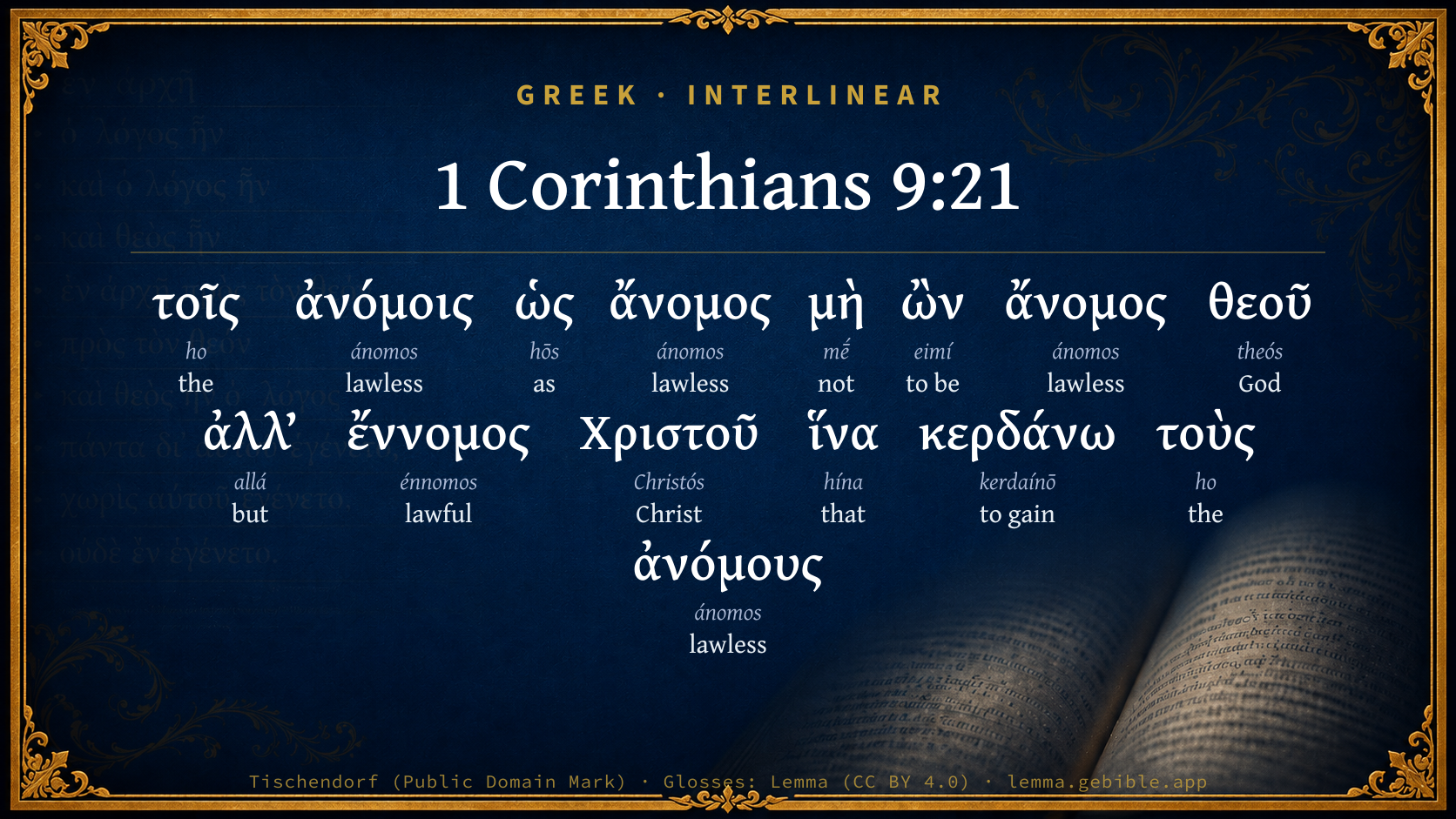
  1. τοῖς ho G3588 “the” Article, Dative, Plural, Masculine
  2. ἀνόμοις ánomos G459 “lawless” Adjective, Dative, Plural, Masculine
  3. ὡς hōs G5613 “as” Adverb
  4. ἄνομος ánomos G459 “lawless” Adjective, Nominative, Singular, Masculine
  5. μὴ mḗ G3361 “not” Particle, Negative
  6. ὢν eimí G1510 “to be” Verb, Present, Active, Participle, Nominative, Singular, Masculine
  7. ἄνομος ánomos G459 “lawless” Adjective, Nominative, Singular, Masculine
  8. θεοῦ theós G2316 “God” Noun, Genitive, Singular, Masculine
  9. ἀλλ’ allá G235 “but” Conjunction
  10. Χριστοῦ Christós G5547 “Christ” Noun, Genitive, Singular, Masculine
  11. ἵνα hína G2443 “that” Conjunction
  12. κερδάνω kerdaínō G2770 “to gain” Verb, Aorist, Active, Subjunctive, 1st person, Singular
  13. τοὺς ho G3588 “the” Article, Accusative, Plural, Masculine
  14. ἀνόμους ánomos G459 “lawless” Adjective, Accusative, Plural, Masculine

About this verse

These counts appear in no published source. They are computed here, from the morphology-tagged text and Lemma’s own curated glosses. What Lemma adds →

15
words
11
distinct lemmas
Pauline Epistles
section

Notable vocabulary

The rarest word here is ἔννομος lawful G1772 — appearing just 2 times in the whole Greek New Testament.

Shared distinctive vocabulary

ἔννομος lawful G1772 occurs in 2 verses of the Greek New Testament. Also found in:

Repetition

Words recur within this verse:

  • ἀνόμοις lawless G459 ×4
  • τοῖς the G3588 ×2

Cross-references

21

Topical passages linked to 1 Corinthians 9:21 in the Treasury of Scripture Knowledge — connected by theme and wording, ordered by reader-vote popularity; previews shown in the World English Bible.

  • Romans 2:12 For as many as have sinned without law will also perish without the law. As many as have sinned under the law will be judged by the law.
  • Romans 2:14 (for when Gentiles who don't have the law do by nature the things of the law, these, not having the law, are a law to themselves,
  • Galatians 3:2 I just want to learn this from you. Did you receive the Spirit by the works of the law, or by hearing of faith?
  • Matthew 5:17–20 "Don't think that I came to destroy the law or the prophets. I didn't come to destroy, but to fulfill.
  • 1 Corinthians 7:19–22 Circumcision is nothing, and uncircumcision is nothing, but the keeping of the commandments of God.
  • Titus 2:2–12 that older men should be temperate, sensible, sober-minded, sound in faith, in love, and in patience:
  • Psalms 119:32 I run in the path of your commandments, For you have set my heart free.
  • Acts 16:4 As they went on their way through the cities, they delivered the decrees to them to keep which had been ordained by the apostles and elders who were at Jerusalem.
  • Romans 7:22 For I delight in God's law after the inward man,
  • Romans 7:25 I thank God through Jesus Christ, our Lord! So then with the mind, I myself serve God's law, but with the flesh, the sin's law.
  • Romans 8:4 that the ordinance of the law might be fulfilled in us, who walk not after the flesh, but after the Spirit.
  • Romans 13:8–10 Owe no one anything, except to love one another; for he who loves his neighbor has fulfilled the law.
  • Galatians 2:3–4 But not even Titus, who was with me, being a Greek, was compelled to be circumcised.
  • Galatians 2:12–14 For before some people came from James, he ate with the Gentiles. But when they came, he drew back and separated himself, fearing those who were of the circumcision.
  • Galatians 5:13–14 For you, brothers, were called for freedom. Only don't use your freedom for gain to the flesh, but through love be servants to one another.
  • Galatians 5:22–23 But the fruit of the Spirit is love, joy, peace, patience, kindness, goodness, faithfulness,
  • Ephesians 6:1–3 Children, obey your parents in the Lord, for this is right.
  • 1 Thessalonians 4:1–2 Finally then, brothers, we beg and exhort you in the Lord Jesus, that as you received from us how you ought to walk and to please God, that you abound more and more.
  • Acts 15:28 For it seemed good to the Holy Spirit, and to us, to lay no greater burden on you than these necessary things:
  • Acts 21:25 But concerning the Gentiles who believe, we have written our decision that they should observe no such thing, except that they should keep themselves from food offered to idols, from blood, from strangled things, and from sexual immorality."
  • Hebrews 8:10 "For this is the covenant that I will make with the house of Israel. After those days," says the Lord; "I will put my laws into their mind, I will also write them on their heart. I will be to them a God, And they will be to me a people.

Cross-references courtesy of OpenBible.info (CC BY 4.0).

Commentary

Notes on 1 Corinthians 9:21 from classic Christian and Jewish commentators (each source and its license shown beneath its notes). The classic Christian expositions comment on the surrounding passage and are grouped to its opening verse, so a note may address several verses; the Jewish commentaries on the Tanakh (Rashi and others) are per-verse, so they appear only where the commentator wrote on this verse.

Lemma curates 59 commentaries, every one of them public domain or Creative Commons licensed, each selected and text-cleaned for this edition rather than reprinted as found. About our sources →

Bengel's Gnomon

Johann Albrecht Bengel

1Co 9:21. Ἀνόμους) This is here used in that sense, which the meaning of the primitive word precisely produces, as ἀνυπότακτον, Heb 2:8.—ὡς ἀνόμος, as without law), by omitting things that may be omitted in regard to things ceremonial.—μὴ ὤν ἄνομος, who am not without the law) Paul was not (anomus) without the law, much less was he (antinomus) opposed to the law.—μὴ ἄνομος, Θεῷ, ἀλλʼ ἔννομος Χριστῷ) Χριστὸς, Θεοῦ ἐστι, 1Co 3:23: whence, he who is without the law to God, ἄνομος Θεῷ, is also without the law to Christ, ἄνομος Χριστῷ: he who is under the law to Christ, ἔννομος Χριστῶ, is under the law to God, ἔννομος Θεῷ. Concerning the law of Christ, comp. Gal 6:2, note. Ἔννομος has a milder meaning than ὑπὸ νόμον.

Bengel's Gnomon of the New Testament — English translation (T&T Clark, Edinburgh, 1860) — public domain. Text from a community e-Sword module.

Meyer's Critical & Exegetical Commentary

Heinrich August Wilhelm Meyer

1Co_9:21. Τοῖς ἀνόμοις] i.e. to the heathen, Rom_2:12. Comp Suicer, Thes. I. p. 366.

ὡς ἄνομος] by holding intercourse with them, giving up Jewish observances, teaching in Hellenic form (as at Athens, Acts 17). Comp Isidor. Pelus, ed. Paris. 1638, p. 186.

ΜῊ ὪΝ Κ. Τ. Λ[1509]] must similarly be regarded not exactly as a defence of himself (Grotius, Rückert), but as arising very naturally from the pious feeling of the apostle, who, with all the consciousness of his freedom of position towards the Mosaic law, which allowed him to be τοῖς ἀνόμοις ὡς ἄνομος, always recognised his subjection to the divine νόμος revealed in Christ. In spite, therefore, of his thus condescending to the ἀνόμοις, he was by no means one without legal obligation to God (no ἄνομος Θεοῦ[1510]), but oneand this is precisely what brings out the absolute character of the oppositewho stood within the sphere of legal obligation to Christ. And Paul was conscious that he stood thus in virtue of his faith in Christ, who lived in him (Gal_2:20), and in conformity with the gospel, which ruled him as the νόμος τοῦ πνεύματος καὶ τῆς χάριτος (Chrysostom), and was to him accordingly the higher analogue of the venerated ΝΌΜΟς (Rom_3:27), which has its fulfilment in love (Rom_13:10); comp Gal_6:2. The two genitives ΘΕΟῦ and ΧΡΙΣΤΟῦ denote simply in relation to, in my position towards; they thus give to the two notions ἄνομος and ἜΝΝΟΜΟς their definite reference.

[1509] . τ. λ. καὶ τὰ λοιπά.

[1510] Hofmanns conjecture, that Paul wrote Θεῷ (following it, however, with Χριστοῦ), has virtually no critical foundation, and is wholly devoid of exegetical basis. Hofmann explains the passage as if he read ἔννομος Χριστοῦ οὐκ ὢν ἄνομος Θεῷ, making Paul say of his being shut up in the law of Christ, that it made him one who was not without law in his relation to God.

Meyer — Critical and Exegetical Commentary on the New Testament — English translation by Peter Christie, edited by Frederick Crombie (T&T Clark, 1880) — public domain. Text from a community e-Sword module.

Hodge's Commentary on Romans, Ephesians & First Corinthians

Charles Hodge

1Co_9:21

To them that are without law, as without law, (being not without law to God, but under the law to Christ,) that I might gain them that are without law.

Those without law were the heathen, who had no written revelation as the rule of their conduct; comp. Rom_2:12. As, however, the word (ἄνομος), without law, means also reckless, regardless of moral restraint, Paul is careful to explain in what sense he acted as without law. When among the Gentiles he did not conform to the Jewish law; in that sense, he was without law; but he did not act as without law to God, i.e. without regard to the obligation of the moral law; but as under law to Christ, i.e. as recognizing his obligation to obey Christ, whose will is the highest rule of duty. In other words, he was not under the Jewish law; but he was under the moral law. He disregarded the Jewish law that he might gain those without law, i.e. the Gentiles. When in Jerusalem, he conformed to the Jewish law; when in Antioch he refused to do so, and rebuked Peter for acting as a Jew among the Gentiles, Gal_2:11-21. It would have greatly impeded, if not entirely prevented, the progress of the gospel among the heathen, had it been burdened with the whole weight of the Jewish ceremonies and restrictions. Peter himself had told even the Jews that the Mosaic law was a yoke which neither they nor their fathers had been able to bear, Act_15:10. And Paul said to the Galatians, that he had resisted the Judaizers, in order that the truth of the gospel might remain with them, Gal_2:5.

Charles Hodge — Commentary on Romans (1835), First Corinthians (1857), and Ephesians (1856) — public domain. Text from a community e-Sword module.

Jamieson, Fausset & Brown

Robert Jamieson, A. R. Fausset & David Brown

To them . . . without law--that is, without revealed law: the heathen (compare Rom 2:12 with Co1 9:15).

as without law--not urging on them the ceremonies and "works of the law," but "the hearing of faith" (Gal 3:2). Also discoursing in their own manner, as at Athens, with arguments from their own poets (Act 17:28).

being not without law to God--"While thus conforming to others in matters indifferent, taking care not to be without law in relation to God, but responsible to law (literally, "IN LAW") in relation to Christ." This is the Christian's true position in relation to the world, to himself, and to God. Everything develops itself according to its proper law. So the Christian, though no longer subject to the literal law as constraining him from without, is subject to an inward principle or law, the spirit of faith in Christ acting from within as the germ of a new life. He does not in the Greek (as in English Version) say "under the law (as he does in Co1 9:20) to Christ"; but uses the milder term, "in . . . law," responsible to law. Christ was responsible to the law for us, so that we are no longer responsible to it (Gal 3:13, Gal 3:24), but to Him, as the members to the Head (Co1 7:22; Rom 8:1-4; Pe1 2:16). Christians serve Christ in newness of spirit, no longer in oldness of the letter (that is, the old external law as such), Rom 7:4-6. To Christ, as man's Head, the Father has properly delegated His authority (Joh 5:22, Joh 5:27); whence here he substitutes "Christ" for "God" in the second clause, "not without law to God, but under the law to Christ." The law of Christ is the law of love (Gal 6:2; compare Gal 5:13).

Jamieson, Fausset & Brown — Commentary Critical and Explanatory on the Whole Bible (1871) — public domain (CC PDM 1.0). Text via the HelloAO Bible API.

Adam Clarke's Commentary

Verse 21. To them that are without law] The Gentiles, who had no written law, though they had the law written in their hearts; See Clarke on Ro 2:15.

Being not without law to God] Instead of θεω, TO God, and χριστω, TO Christ, the most important MSS. and versions have θεου, OF God, and χριστου, OF Christ; being not without the law of God, but under the law of Christ.

Them that are without law.] Dr. Lightfoot thinks the Sadducees may be meant, and that in certain cases, as far as the rites and ceremonies of the Jewish religion were concerned, he might conform himself to them, not observing such rites and ceremonies, as it is well known that they disregarded them; for the doctor cannot see how the apostle could conform himself in any thing to them that were without law, i.e. the heathen. But, 1. It is not likely that the apostle could conform himself to the Sadducees; for what success could he expect among a people who denied the resurrection, and consequently a future world, a day of judgment, and all rewards and punishments? 2. He might among the heathen appear as if he were not a Jew, and discourse with them on the great principles of that eternal law, the outlines of which had been written in their hearts, in order to show them the necessity of embracing that Gospel which was the power of God unto salvation to every one that believed.

Adam Clarke's Commentary on the Bible (1810–1826) — public domain. Text from a community e-Sword/MySword module.

John Calvin's Commentaries

21. Though not without law to God. He wished by this parenthesis to soften the harshness of the expression, for it might. have seemed harsh at first view to have it said, that he had come to be without law. Hence in order that this might not be taken in a wrong sense, he had added, by way of correction, that he had always kept in view one law — that of subjection to Christ. By this too he hints that odium was excited against him groundlessly and unreasonably, as if he called men to an unbridled licentiousness, while he taught exemption from the bondage of the Mosaic law. Now he calls it expressly the law of Christ, in order to wipe away the groundless reproach, with which the false apostles branded the gospel, for he means, that in the doctrine of Christ nothing is omitted, that might serve to give us a perfect rule of upright. living.

John Calvin's Commentaries (1540-1563) — public domain. Text from the Calvin Translation Society English edition (1840s-50s) via the Christian Classics Ethereal Library (ccel.org). Calvin's coverage is partial (roughly two-thirds of the Bible); uncommented books and verses are honest gaps, never fabricated. The 19th-century editor's footnotes and remarks are omitted so the notes are faithfully Calvin's own voice.

Ellicott's Commentary for English Readers

(21) To them that are without law—i.e., the heathen. St. Paul adapted himself to their habits and mode of thought when necessary. He quoted from their literature (Act_17:28); he based an argument on the inscriptions on their altars (Act_17:23); and he did not require them to adopt Jewish ceremonies (Gal_2:9; Gal_2:11). The parenthesis explains in what sense only St. Paul was “without” the Law, so as to prevent the possibility of this statement being used as a justification of lawlessness. As being one with Christ, he was indeed under the law of God as revealed in the person, work, and teaching of the Lord. (See Gal_6:2.)

A Bible Commentary for English Readers, edited by Charles John Ellicott (1878–1897) — public domain. Text from a community e-Sword module.

The Cambridge Bible for Schools and Colleges

gen. ed. J. J. S. Perowne

21. to them that are without law, as without law] Literally, to the lawless, as a lawless man, i.e. to those who had received no external laws or statutes from God. St Paul’s accommodation to the prejudices of Gentiles may be seen in Gal_2:3; Gal_2:12; Gal_2:14.

being not without law to God, but under the law to Christ] Cf. Gal_6:2 A kind of apology is here made for the use of the term lawless. It was only intended in the sense just explained. Even a Gentile was under some kind of law (Rom_2:14-15), and no Christian could rightly be called lawless, for he was subject to that inward law written in the heart, of which Jeremiah had prophesied (Jer_31:33), even the law of the Spirit of life (Rom_8:2), which, though it had set him free from a slavish bondage to ordinances (Col_2:20), had not set him free from the obligation to holiness, justice, and truth which is involved in the very idea of faith in Jesus Christ.

The Cambridge Bible for Schools and Colleges (gen. ed. J. J. S. Perowne; Cambridge University Press, 1878–1918) — public domain. Text from a community e-Sword module.

John Gill's Exposition

To the weak became I as weak,.... That is, to weak Christians, who were weak in faith, and had not such clear knowledge of Gospel liberty, and therefore scrupled the eating of some sorts of meat, and particularly meats offered to idols; and the apostle so far consulted the peace and edification of these weak brethren, and so far complied with them, and became as one of them, that, rather than offend them, he determined to eat no meat while the world stood:

that I might gain the weak; promote their edification and welfare, who otherwise might be stumbled, be in danger of falling from, and laid under a temptation to desert the faith of the Gospel:

I am made all things to all men; which is to be understood, as in all the other instances of his being so, not in cases and things criminal and sinful, contrary to the moral law, and the dictates of his own conscience, subversive of the Gospel of Christ, and of the order and discipline of it, but in cases and things of an indifferent nature:

that I might by all means save some; that is, that he might be the means of saving some of Jews and Gentiles, and of all sorts of men; by preaching the Gospel of salvation to them, and by directing them to Christ, the only Saviour of lost sinners; thus he explains what he means by so often saying that he might gain them.

John Gill's Exposition of the Whole Bible (1746–1763) — public domain (CC PDM 1.0). Text via the HelloAO Bible API.

Trapp's Complete Commentary

John Trapp

21 To them that are without law, as without law, (being not without law to God, but under the law to Christ,) that I might gain them that are without law.

Ver. 21. That I might gain them] A metaphor from merchants, Qui κερδαινοντες ου κοπιωσι, who are never weary of taking money. (Naz.) St Paul harps much upon this string, out of a strong desire of winning souls to God. Ministers must turn themselves into all shapes and fashions both of spirit and speech to gain souls to God. Christ useth every engine of wisdom (παση σοφιας μηχανη, saith Clemens Alexand.) that he may convert some. Ministers should labour to be masters of their people’s affections, δημαγωγοι, as the Athenian orators were called, i.e. people leaders.

John Trapp, A Commentary or Exposition upon All the Books of the Old and New Testament (1647–1656) — public domain. Text from a community e-Sword module.

Albert Barnes' Notes on the Bible

To them that are without law - To the Gentiles, who have not the law of Moses; see the note at Rom 2:12, note at Rom 2:14.

As without law - Not practicing the special rites and ceremonies enjoined in the law of Moses. Not insisting on them, or urging them, but showing that the obligation to those rites had been done away; and that they were not binding, though when among the Jews I might still continue to observe them; see the notes at Acts 15; and the argument of Paul in Gal 2:11-18. I neglected the ceremonial precepts of the Mosaic law, when I was with those who had not heard of the law of Moses, or those who did not observe them, because I knew that the binding obligation of these ceremonial precepts had ceased. I did not, therefore, press them upon the Gentiles, nor did I superstitiously and publicly practice them. In all this, Paul has reference only to those things which he regarded as in themselves indifferent, and not a matter of conscience; and his purpose was not; needlessly to excite the prejudice or the opposition of the world. Nothing is ever gained by provoking opposition for the mere sake of opposition. Nothing tends more to hinder the gospel than that. In all things of conscience and truth a man should be firm, and should lose his life rather than abandon either; in all things of indifference, of mere custom, of prejudice, he should yield, and accomodate himself to the modes of thinking among people, and adapt himself to their views, feelings, and habits of life, that he may win them to Christ.

Being not without law to God - Not regarding myself as being “absolutely” without law, or as being freed from obligation to obey God. Even in all this, I endeavored so to live as that it might be seen that I felt myself bound by law to God. I was not a despiser, and contemner, and neglector of “law as such,” but only regarded myself as not bound by the special ceremonial law of Moses. This is an instance of Paul’s conscientiousness. He would not leave room to have it supposed for a moment that he disregarded all law. He was bound to God by law; and in the conduct to which he was referring he felt that he was obeying him. He was bound by higher law than those ceremonial observances which were now to be done away. This passage would destroy all the refuges of the Antinomians. Whatever privileges the gospel has introduced, it has not set us free from the restraints and obligations of law. That is binding still; and no man is at liberty to disregard the moral law of God. Christ came to magnify, strengthen, and to honor the law, not to destroy it.

But under the law to Christ - Bound by the law enjoined by Christ; under the law of affectionate gratitude and duty to him. I obeyed his commands; followed his instructions; sought his honor; yielded to his will. In this he would violate none of the rules of the moral law. And he here intimates, that his grand object was to yield obedience to the law of the Saviour, and that this was the governing purpose of his life. And this would guide a man right. In doing this, he would never violate any of the precepts of the moral law, for Christ obeyed them, and enjoined their observance. He would never feel that he was without law to God, for Christ obeyed God, and enjoined it on all. He would never feel that religion came to set him free from law, or to authorize licentiousness; for its grand purpose and aim is to make people holy, and to bind them everywhere to the observance of the pure law of the Redeemer.

Albert Barnes' Notes on the Bible (1834–1885) — public domain. Text from a community e-Sword/MySword module.

Haydock's Catholic Bible Commentary

To them that were without the law. That is, to the Gentiles, who never were under the law of Moses. (Witham)

George Leo Haydock (1774–1849), Haydock's Catholic Family Bible and Commentary, 1859 edition — public domain. Excludes Psalms (Douay-Rheims chapter numbering differs from Protestant) and Deuterocanonical books (Catholic canon only).

Matthew Poole's English Annotations

It is manifest by the opposition of them that are without law, mentioned in this verse, to them under the law, mentioned in the former verse, that as by the latter the Jews are understood, so by the former the Gentiles are to be understood, who were under no obligation to the observance either of the ceremonial law or judicial law, given to the Jews; the one to guide that nation in the matters of worship till Christ should come; the other to guide them in matters of civil justice, as well as criminal causes, as matters of plea and trespass: so that the term ανομοις here signifieth differently from what it signifieth in many other scriptures; where it signifieth men that live as they list, without any regard to any laws of God or men, as Mar 15:28; Luk 22:37; Act 2:23; 2Th 2:8; 1Ti 1:9, &c. This the apostle makes appear by the next words, where he tells us, he was

not without law to God, but under the law to Christ: though to the Gentiles he behaved himself as if he himself had been a Gentile, that is, forbearing the observances of the Levitical law, to which the Gentiles had never any obligation at all, yet he did not behave himself as one that had no regard to the law of God, that was yet in force and obligatory, but acknowledged himself to be under that, though a servant of Christ’s; so that he abated nothing of his necessary duty, only denied himself in some things as to which the law of God had left him a liberty, both to the Jews and Gentiles, propounding to himself the same end as to both, that is, the gaining of their souls to Christ.

Matthew Poole's English Annotations on the Holy Bible (1683–1685) — public domain. Text from a community e-Sword/MySword module.

Whedon's Commentary on the Bible

Daniel D. Whedon

21. Them… without law—Gentiles. Note on Rom_2:14.

Not without law—For the being as a thing is not being the thing itself. Paul defines his position as showing that the gospel emancipation from law is still submission to the law of Christ. Paul, as Bengel says, is neither lawless nor anti-law.

Daniel D. Whedon (gen. ed.), Commentary on the Old and New Testaments (1874–1909) — public domain. Text from a community e-Sword module.

The Pulpit Commentary

To them that are without law, as without law. In other words, I so far became to the heathen as a heathen, (Rom_2:12) that I never wilfully insulted their beliefs (Act_19:7) nor shocked their prejudices, but on the contrary, judged them with perfect forbearance (Act_17:30) and treated them with invariable courtesy. St, Paul tried to look at every subject, so far as he could do so innocently, from "their point of view. (Ac 17) He defended their gospel liberty, and had intercourse with Gentile converts on terms of perfect equality. (Gal_2:12) Not without law to God. Not even "without law" (anomos) Much less "opposed to law" (antiheroes), though free from it as a bondage. (Gal_2:19) The need for this qualification is shown by the fact that in the Clementine writings, in the spurious letter of Peter to James, St. Paul is surreptitiously calumniated as "the lawless one." Even the Gentiles were "not without law to God". (Rom_2:14, Rom_2:15) So that St. Paul is here using language which base opponents might distort, but which the common sense of honest readers would prevent them from misinterpreting.

The Pulpit Commentary (1880–1919), ed. H.D.M. Spence-Jones & Joseph S. Exell — public domain. Text from a community e-Sword module.

John Wesley's Explanatory Notes

To them that are without the law - The heathens. As without the law - Neglecting its ceremonies. Being not without the law to God - But as much as ever under its moral precepts. Under the law to Christ - And in this sense all Christians will be under the law for ever.

John Wesley, Explanatory Notes Upon the Whole Bible (1754–1765) — public domain. Text via the GEBible commentary corpus.

Scofield Reference Notes

C. I. Scofield

without

The expression is peculiar and might be literally rendered, " not lawless toward God, but inlawed to Christ." See "Law (of Christ)," Gal 6:2; 2Jn 1:5. It is another way of saying, "not under the law, but under the rule of grace." Rom 6:14.

The Scofield Reference Bible (1917 edition), notes by C. I. Scofield — public domain. Text from a community e-Sword module.

Godbey's Commentary on the New Testament

William B. Godbey

21. “To those who were without law as without law, not being without the law of God, but with the law of Christ, that I might gain those without the law.” The Gentiles knew nothing about the law of Moses, cared nothing about it, and looked upon the Jewish rites and ceremonies as silly superstition. If Paul as a Jew had undertaken to prevail on the Gentiles to Judaize, he would simply have assumed the attitude of a mere Jewish proselyter, thus eclipsing the glory of Christ in what the Gentiles regarded as Jewish superstition. Now what a contrast. With the Jews he is a ritualized disciple of Moses, meek and lowly at the feet of the patriarchs and prophets, that he may win them to Christ. With the Gentiles he says not a word about all the vast routine of Jewish rites and ceremonies, but simply preaches Christ like a messenger from Heaven.

William B. Godbey, Commentary on the New Testament (1896–1900) — public domain. Text from a community e-Sword module.

McGarvey & Pendleton's Commentaries

J. W. McGarvey

to them that are without law [pagans and Gentiles-- Rom_2:12 ], as without law [ Rom_6:14 . He did not seek to enforce the laws of Moses among the Gentiles, as did the Jews, and he refrained from insulting heathens in their beliefs ( Act_19:37 ), and dealt gently with their prejudices-- Act_17:30 ], not being without law to God [for the Gentiles themselves were not wholly without such law-- Rom_2:14-15 ], but under law to Christ [Paul did not forget his obligations to the moral law, nor his duty to the will of Christ. Though behaving himself as a Jew in Jerusalem in things indifferent, he rebuked Peter openly for playing the Jew in Antioch in matters of principle ( Gal_2:11-21 ). Peter knew better-- Act_15:10 ], that I might gain them that are without law .

J. W. McGarvey (with Philip Y. Pendleton), Commentaries on the New Testament (The Fourfold Gospel, 1914; Acts; and the epistles) — public domain. Text from a community e-Sword/MySword module.

The People's New Testament

B. W. Johnson

21. To them without law. To such, though in the sight of God keeping His law, he came not as an enforcer of the law of Moses. He spoke to Gentiles from a Gentile standpoint, as at Athens. (Acts 17.)

B. W. Johnson's The People's New Testament with Notes (1889–1891) — public domain. Electronic text from the Christian Classics Ethereal Library (CCEL) ThML edition.

unfoldingWord translationNotes

Door43 World Missions Community

outside the law

"who do not obey the laws of Moses"

translationWords

law

save

good news

bless

unfoldingWord translationNotes — © Distant Shores Media and the Door43 World Missions Community, licensed CC BY-SA 4.0. Source: git.door43.org/Door43/en_tn.

Cambridge Greek Testament for Schools and Colleges

21. ἄνομος θεοῦ … ἔννομος Χριστοῦ אABCDFG. Rec. θεῷ and χριστῷ.

κερδάνω here אABCFG. κερδήσω (as in 1Co 9:20) rec. with DE. The latter is clearly an alteration to agree with 1Co 9:20. Both forms of the future are in use.

21. τοῖς ἀνόμοις ὡς ἄνομος. Literally, to the lawless, as a lawless man, i.e. to those who had received no external laws or statutes from God. St Paul’s accommodation to the prejudices of Gentiles may be seen in Gal 2:3; Gal 2:12; Gal 2:14.

μὴ ὢν ἄνομος θεοῦ. The gen. of relation. A kind of apology is here made for the use of the term lawless. It was only intended in the sense just explained. Even a Gentile was under some kind of law (Rom 2:14-15), and no Christian could rightly be called lawless, for he was subject to that inward law written in the heart, of which Jeremiah had prophesied (Jer 31:33), even the law of the Spirit of life (Rom 8:2), which, though it had set him free from a slavish bondage to ordinances (Col 2:20), had not set him free from the obligation to holiness, justice, and truth which is involved in the very idea of faith in Jesus Christ. Cf. Gal 6:2. The μὴ indicates what the Apostle was in his own mind, ‘not considering myself as without law in relation to God.’

Cambridge Greek Testament for Schools and Colleges (Cambridge University Press, 1896; 21 vols, various authors incl. Carr, Maclear, Plummer, Farrar, Lumby, Moule, M. R. James, Simcox) — public domain. Text from a community e-Sword module.

Alford’s Greek Testament

Henry Alford

21. τοῖς ἀνόμοις ὡς ἄν.] The ἄνομοι are the Heathen; hardly, with Chrys., such as Cornelius, fearing God but not under the law. Paul became as a Heathen to the Heathen, e.g., when he discoursed at Athens (Act_17) in their own manner, and with arguments drawn from their own poets.

μὴ ὢν κ.τ.λ.] not being (being conscious of not being, remembering well in the midst of my ἀνομία that I was not. This is implied by μή, which is subjective, giving the conviction of the subject, not merely the objective fact, as οὐκ ὤν would do) an outlaw from God (θεοῦ and χριστοῦ are genitives of dependence, as after κατήκοος, ἔνοχος, &c.) but a subject-of-the-law of Christ (the words seem inserted rather to put before the reader the true position of a Christian with regard to God’s law revealed by Christ, than merely with an apologetic view to keep his own character from suffering by the imputation of ἀνομία) that I might gain those who had no law. κερδανῶ (here only in N. T.) and κερδήσω are both found in the classics; see Matthiæ, § 239, and Lobeck on Phrynichus, p. 740.

Henry Alford, The Greek Testament (1849–1861) — public domain. Text from a community e-Sword module.

International Critical Commentary

21. τοῖς ἀνόμοις. He goes a good deal further, and says that he was willing to behave as a heathen to heathen (cf. Gal 2:19). He did this, as Origen remarks, when he quoted heathen poets, and took as a text the inscription on a heathen altar, ἀνγώστῳ Θεῶ. See also Act 14:15, Act 24:25, where his arguments are such as a heathen would appreciate. Here ἄνομος does not mean ‘lawless’ in the sense of disregarding and transgressing law (Luk 22:37; Act 2:23; 1Ti 1:9), but = οἱ μὴ ὑπὸ νόμον, ‘those who were outside Law’; Rom 2:14. Evans (following Estius, exlex, inlex) translates, ‘To God’s outlaws I behaved as an outlaw, not being (as I well knew) an outlaw of God, but an inlaw of Christ’; and Origen explains the latter as meaning τηρῶν τὴν πολιτείαν τὴν κατὰ τὸ εὐαγγέλιον. But even ‘outlaw’ has too much of the idea of lawlessness to be quite satisfactory. The genitives, Θεοῦ and Χριστοῦ mean ‘in relation to.’ Qui est ἄνομος Θεῷ est etiam ἄνομος Χριστῷ: qui est ἔννομος Χριστῷ est ἔννομος Θεῷ: and (on Gal 6:2) lex Christi, lex amoris (Beng.). It was the lex amoris, as followed by himself, that the Apostle would enforce on the Corinthians with regard to eating idol-meats; and this thought brings him to the last illustration of his forbearing conformity, τοῖς ἀσθενέσιν ἀσθενής. The Law of Christ, while freeing him from the Law of Moses, did not leave him free to do as he pleased: it restrained him, and kept him from wandering to other objects than the service of God and man (2Co 5:14).

θεοῦ and Χριστοῦ (א A B C D* F G P, Latt. Copt., Orig. Chrys.) rather than θεῷ and Χρισῷ (D3 K L, Arm. Thdrt.): see Blass, § 36. II. κερδάνω or κερδανῶ (א* A B C F G P 17) rather than κερδήσω (א* D E K L Orig. Chrys. Thdrt.), which is from vv. 19, 20. τοὺς άνόμους (א A B C D E P 17, Orig.) rather than ἀνόμους(א3 F G K L, Chrys. Thdrt.), perhaps to conform with Ἰουδαίους,

International Critical Commentary — older volumes (1896–1929), various authors — public domain. Text from a community e-Sword module.

Vincent's Word Studies in the New Testament

Marvin R. Vincent

Without law [ανομος] . As one of the Gentiles. By intercourse with them, relinquishment of Jewish observances, and adapting his teaching to their modes of thought. See Acts 17.

Under law [εννομος] . The expression differs from that in ver. 20, uJpo nomon under law, though with only a shade of difference in meaning. Ennomov means subject to the law, but in the sense of keeping within [εν] the law.

Marvin R. Vincent, Word Studies in the New Testament (1887–1900) — public domain. Text from a community e-Sword/MySword module.

Lesson kit

Teaching starters — assembled from the data on this page, not authored interpretation. Every prompt links to the verse data it draws on. Edit before teaching.

1 Corinthians, in the Pauline Epistles, opens this verse with 15 words (11 distinct Greek lemmas). Its most distinctive word is énnomos (“lawful”). A historical commentator’s framing appears above. Read the whole chapter for the surrounding context.

Discussion questions

  1. The word énnomos carries the sense “lawful.” How does it shape the verse?
  2. How does Acts 19:39, which shares the word «lawful», read alongside this verse?
  3. What does the repetition of “lawless” (4× in this one verse) do in this verse?
  4. The translations on this page render this verse differently — a whole-verse word diff, not a word-by-word alignment. What might account for the different wordings?
  5. Compare how Bengel's Gnomon and Meyer's Critical & Exegetical Commentary read this verse. Where do they agree or differ?

Things to notice

  • These translations choose different wording for 5 words in this verse.
  • “lawless” occurs 4× in this single verse.
  • 11 distinct Greek lemmas span 15 words in this verse.

Reading settings

Reading text

Shown beneath each verse's original-language words.

Old Testament
Old Testament edition

Read the OT as the Masoretic Hebrew (MT) or the Greek Septuagint (LXX).

English shown for the Greek Septuagint (in the Hebrew ↔ Greek comparison).

Comparing translations? Open the Compare panel on any verse page to stack up to four side by side.