
1 Corinthians 1:4

Greek (Tischendorf 8th ed.) 1 Corinthians 1:4 appears in the Greek New Testament. The text above is from the Tischendorf 8th edition. Each word links to its Strong’s number and a concise gloss. Click any word for its full Thayer’s Greek Lexicon entry.
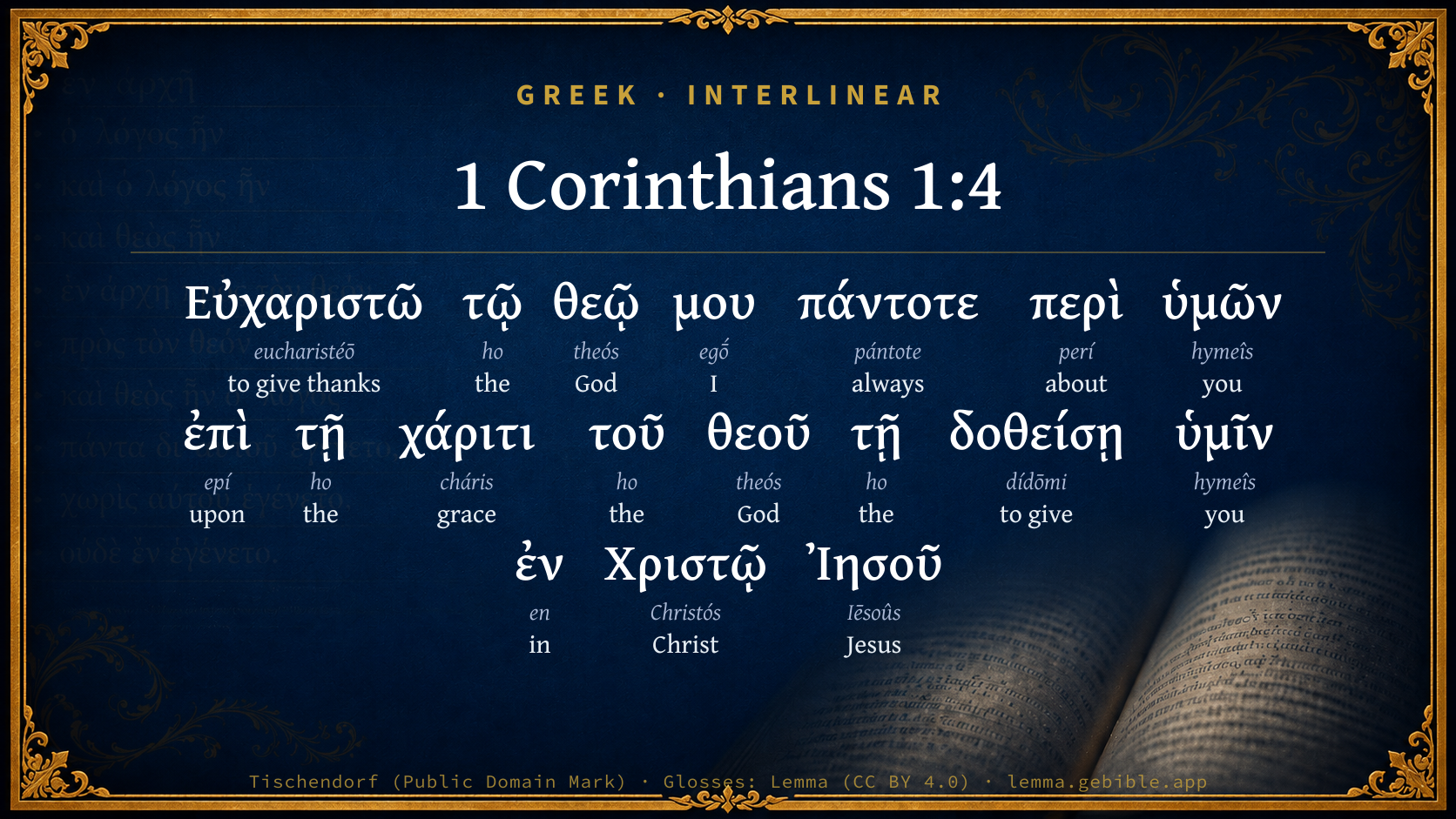
Download image
Cite this verse

1 Corinthians 1:4 (World English Bible). Public Domain. Lemma interlinear Bible study tool, https://lemma.gebible.app/v/1-corinthians/1/4.

Show BibTeX & RIS
BibTeX
RIS
English Translation
I always thank my God concerning you, for the grace of God which was given you in Christ Jesus;
World English Bible · Public Domain
Download a study sheet

One document with this verse’s original text, its word-by-word gloss line, the meaning frame, cross-references with their text, attributed commentary, and full source and license credits — printable, and it pastes into notes with its structure intact.

This verse Autodidact and up

Study sheet (.html) Plain text (.txt)

A passage Seminary Student

Up to 50 verses in one chapter. A passage sheet keeps up to 6 commentary sources and 12 cross-references per verse, in the order this page ranks them, and says so on the sheet whenever that leaves anything out. Ask for a single verse and you get the Autodidact verse sheet above.

Everything on this page stays free to read, with no account — the sheet is a download of what is already on screen, not access to it.

Want to remove ads? Support Godless Engineer
Compare translations 3

The same verse in 3 English versions, stacked beneath the original-language interlinear above. Click any original word for its lexicon entry.

Each is an independent rendering of the whole verse — the interlinear is not word-aligned to these translations.

Highlighted words mark where these versions differ — a whole-verse word diff, not a word-by-word alignment.

  • World English Bible Public Domain
    I always thank my God concerning you, for the grace of God which was given you in Christ Jesus;
  • King James Version Public Domain
    I thank my God always on your behalf, for the grace of God which is given you by Jesus Christ;
  • unfoldingWord Literal Text CC BY-SA 4.0
    I always give thanks to my God for you because of the grace of God, the one having been given to you in Christ Jesus.

unfoldingWord Literal Text — © unfoldingWord, licensed CC BY-SA 4.0. Word-aligned USFM3 via Door43 (git.door43.org/unfoldingWord/en_ult).

Versions to compare (up to 4)

3 of 4 selected

Show all 19 translations

Every available English version of this verse, each an independent rendering of the whole verse.

  • World English Bible Public Domain
    I always thank my God concerning you, for the grace of God which was given you in Christ Jesus;
  • Berean Standard Bible Public Domain
    I always thank my God for you because of the grace He has given you in Christ Jesus.
  • Majority Standard Bible Public Domain
    I always thank my God for you because of the grace He has given you in Christ Jesus.
  • King James Version Public Domain
    I thank my God always on your behalf, for the grace of God which is given you by Jesus Christ;
  • American Standard Version (1901) Public Domain
    I thank my God always concerning you, for the grace of God which was given you in Christ Jesus;
  • Revised Version (1885) Public Domain
    I thank my God always concerning you, for the grace of God which was given you in Christ Jesus;
  • Geneva Bible (1599) Public Domain
    I thanke my God alwayes on your behalfe for the grace of God, which is giuen you in Iesus Christ,
  • Douay-Rheims (1899) Public Domain
    I give thanks to my God always for you, for the grace of God that is given you in Christ Jesus,
  • Young's Literal Translation Public Domain
    I give thanks to my God always concerning you for the grace of God that was given to you in Christ Jesus,
  • Literal Standard Version CC BY-SA 4.0
    I give thanks to my God always concerning you for the grace of God that was given to you in Christ Jesus,
  • Unlocked Literal Bible CC BY-SA 4.0
    I always give thanks to my God for you because of the grace of God that Christ Jesus gave to you.
  • unfoldingWord Literal Text CC BY-SA 4.0
    I always give thanks to my God for you because of the grace of God, the one having been given to you in Christ Jesus.
  • Darby Bible Public Domain
    I thank my God always about you, in respect of the grace of God given to you in Christ Jesus;
  • World Messianic Bible Public Domain
    I always thank my God concerning you for the grace of God which was given you in Messiah Yeshua,
  • Webster's Bible Public Domain
    I thank my God always on your behalf, for the grace of God which is given you by Jesus Christ;
  • Free Bible Version CC BY-SA 4.0
    I'm always thanking God for you because of the grace of God given to you in Christ Jesus.
  • Bible in Basic English Public Domain
    I give praise to my God for you at all times, because of the grace of God which has been given to you in Christ Jesus;
  • Text-Critical English NT CC BY 4.0
    I always give thanks to my God for you because of the grace of God that has been given to you in Christ Jesus.
  • Tyndale New Testament (1534) Public Domain
    I thanke my God all wayes on youre behalfe for the grace of God which is geuen you by Iesus Christ

Literal Standard Version (2020), Covenant Press — licensed CC BY-SA 4.0. Text via the HelloAO Bible API (eBible.org). Unlocked Literal Bible (unfoldingWord) — licensed CC BY-SA 4.0. Text via the HelloAO Bible API (eBible.org). unfoldingWord Literal Text — © unfoldingWord, licensed CC BY-SA 4.0. Word-aligned USFM3 via Door43 (git.door43.org/unfoldingWord/en_ult). Free Bible Version, Dr. Jonathan Gallagher — licensed CC BY-SA 4.0. Text via the HelloAO Bible API (eBible.org).

Word by word

More ways to search: Search by grammar → Find every occurrence → Compare this word →

Practice this passage: Drill this verse → Learn its vocabulary →

Εὐχαριστῶ
eucharistéō
G2168
“to give thanks”
Verb, Present, Active, Indicative, 1st person, Singular
Part of Speech
Verb
Tense
Present
Voice
Active
Mood
Indicative
Person
1st person
Number
Singular
Full Thayer's Definition

Origin: from G2170

TDNT: 15:47,1

1. to be grateful, feel thankful 2. give thanks
  1. τῷ ho G3588 “the” Article, Dative, Singular, Masculine
  2. θεῷ theós G2316 “God” Noun, Dative, Singular, Masculine
  3. μου egṓ G1473 “I” Personal pronoun, 1st person, Genitive, Singular
  4. πάντοτε pántote G3842 “always” Adverb
  5. περὶ perí G4012 “about” Preposition
  6. ὑμῶν hymeîs G5210 “you” Personal pronoun, 2nd person, Genitive, Plural
  7. ἐπὶ epí G1909 “upon” Preposition
  8. τῇ ho G3588 “the” Article, Dative, Singular, Feminine
  9. χάριτι cháris G5485 “grace” Noun, Dative, Singular, Feminine
  10. τοῦ ho G3588 “the” Article, Genitive, Singular, Masculine
  11. θεοῦ theós G2316 “God” Noun, Genitive, Singular, Masculine
  12. τῇ ho G3588 “the” Article, Dative, Singular, Feminine
  13. δοθείσῃ dídōmi G1325 “to give” Verb, Aorist, Passive, Participle, Dative, Singular, Feminine
  14. ὑμῖν hymeîs G5210 “you” Personal pronoun, 2nd person, Dative, Plural
  15. ἐν en G1722 “in” Preposition
  16. Χριστῷ Christós G5547 “Christ” Noun, Dative, Singular, Masculine
  17. Ἰησοῦ Iēsoûs G2424 “Jesus” Noun, Dative, Singular, Masculine

About this verse

These counts appear in no published source. They are computed here, from the morphology-tagged text and Lemma’s own curated glosses. What Lemma adds →

18
words
13
distinct lemmas
Pauline Epistles
section

Shared distinctive vocabulary

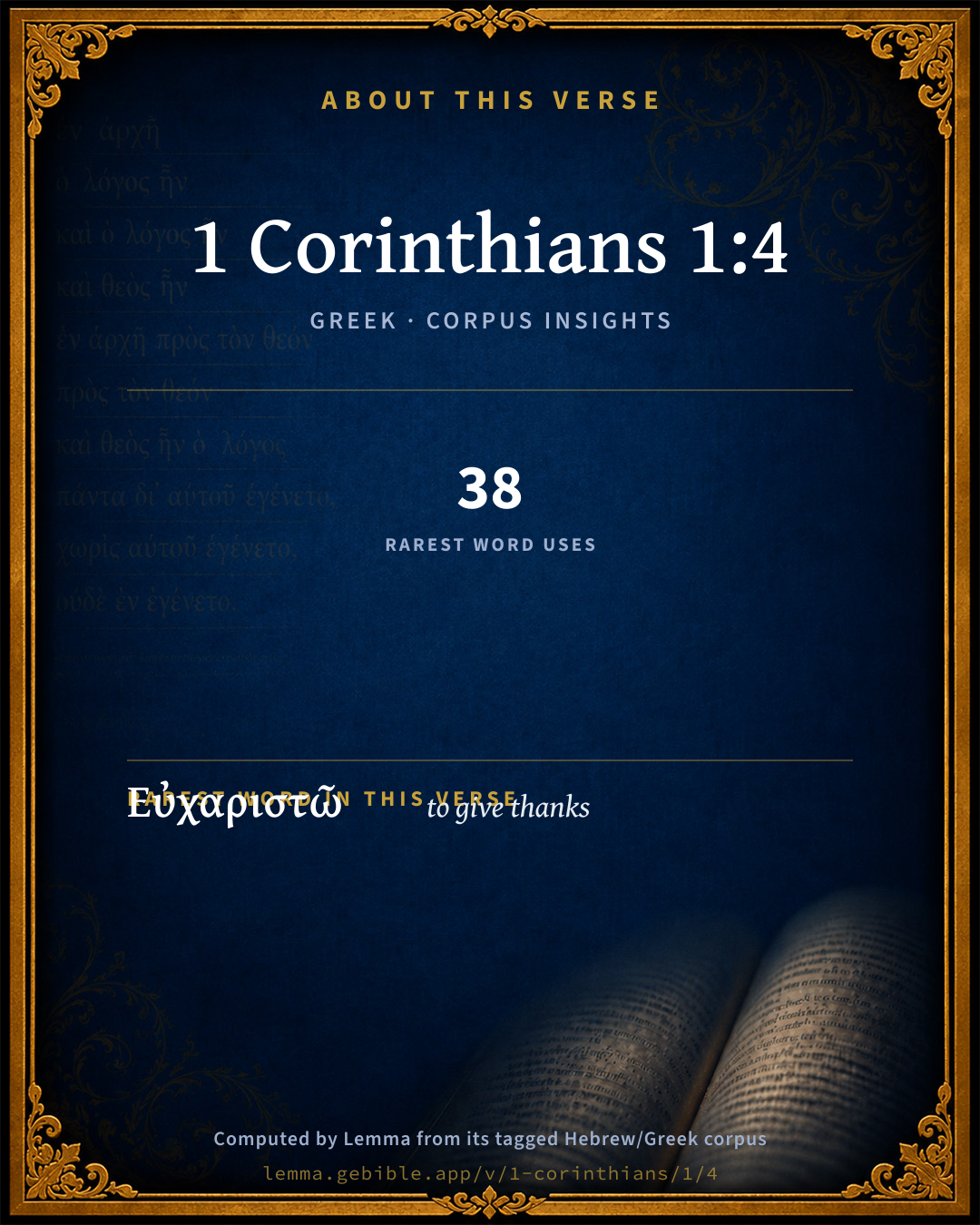
Εὐχαριστῶ to give thanks G2168 occurs in 37 verses of the Greek New Testament. Also found in:
Repetition

Words recur within this verse:

Cross-references

11

Topical passages linked to 1 Corinthians 1:4 in the Treasury of Scripture Knowledge — connected by theme and wording, ordered by reader-vote popularity; previews shown in the World English Bible.

  • Romans 1:8 First, I thank my God through Jesus Christ for all of you, that your faith is proclaimed throughout the whole world.
  • John 14:26 But the Counselor, the Holy Spirit, whom the Father will send in my name, he will teach you all things, and will remind you of all that I said to you.
  • John 14:14 If you will ask anything in my name, I will do it.
  • John 14:16 I will pray to the Father, and he will give you another Counselor, that he may be with you forever,--
  • John 15:26 "When the Counselor has come, whom I will send to you from the Father, the Spirit of truth, who proceeds from the Father, he will testify about me.
  • Romans 6:17 But thanks be to God, that, whereas you were bondservants of sin, you became obedient from the heart to that form of teaching whereunto you were delivered.
  • 1 Timothy 1:14 The grace of our Lord abounded exceedingly with faith and love which is in Christ Jesus.
  • John 10:30 I and the Father are one."
  • Acts 11:23 who, when he had come, and had seen the grace of God, was glad. He exhorted them all, that with purpose of heart they should remain near to the Lord.
  • 1 Corinthians 1:3 Grace to you and peace from God our Father and the Lord Jesus Christ.
  • Acts 21:20 They, when they heard it, glorified God. They said to him, "You see, brother, how many thousands there are among the Jews of those who have believed, and they are all zealous for the law.

Cross-references courtesy of OpenBible.info (CC BY 4.0).

Commentary

Notes on 1 Corinthians 1:4 from classic Christian and Jewish commentators (each source and its license shown beneath its notes). The classic Christian expositions comment on the surrounding passage and are grouped to its opening verse, so a note may address several verses; the Jewish commentaries on the Tanakh (Rashi and others) are per-verse, so they appear only where the commentator wrote on this verse.

Lemma curates 59 commentaries, every one of them public domain or Creative Commons licensed, each selected and text-cleaned for this edition rather than reprinted as found. About our sources →

Jamieson, Fausset & Brown

Robert Jamieson, A. R. Fausset & David Brown

He puts the causes for praise and hope among them in the foreground, not to discourage them by the succeeding reproof, and in order to appeal to their better selves.

my God-- (Rom 1:8; Phi 1:3).

always--(Compare Phi 1:4).

the grace . . . given you--(Compare Co1 1:7).

by . . . Christ--literally, "IN Jesus Christ" given you as members in Christ.

Jamieson, Fausset & Brown — Commentary Critical and Explanatory on the Whole Bible (1871) — public domain (CC PDM 1.0). Text via the HelloAO Bible API.

Ellicott's Commentary for English Readers

(4) I thank my God.—Expressions of thankfulness (1Co_1:4-9), serving also to secure at the very outset the attention of those to whom the Apostle is writing. He thus shows that he is not blind to, or forgetful of, their good qualities, although this Epistle is specially written to rebuke their present sins; and also that he is not about to utter words of hopeless condemnation, but of wholesome warning. The emphatic use of the singular, I thank my God, in contrast to the plural in the previous verses, indicates that St. Paul does not join Sosthenes with him as author of the Epistle, but that it is written in his name alone and with his sole authority.

The grace of God which is given you by Jesus Christ.—Better, the grace of God given you in Christ Jesus—i.e., given to you as being in Christ.

A Bible Commentary for English Readers, edited by Charles John Ellicott (1878–1897) — public domain. Text from a community e-Sword module.

The Biblical Illustrator

Joseph S. Exell

1Co_1:4-13

I thank my God … for the grace of God which is given you by Jesus Christ.

Apostolic thanksgiving for

I. The grace they had received.

1. Freely given.

2. Richly supplied.

3. Amply confirmed.

II. The hope they anticipated. They waited confidently for--

1. The coming of Christ.

2. Their final justification.

3. Everlasting fellowship with Him. (J. Lyth, D. D.)

Apostolic congratulation and warning

I. The apostolic congratulation. I thank my God, &c.

1. In the heart of St. Paul, the unselfishness of Christianity had turned this world into a perpetual feast. If we want to know what his life was, turn to 2Co_11:1-33.; yet it was filled with the blessedness which arises from the abilities to enjoy the blessings of others as though they were our own. Personally we get very little in this world; and if we are to mourn that we never had a whole kid to ourselves to make merry with, life will become desolate indeed. Only by saying, It is meet we should rejoice and be glad with our brethren, can life be a blessing. Thus the apostle, in all his weariness and persecutions, was nevertheless always rejoicing with his Churches.

2. Here he rejoices over three gifts to the Corinthians--

(1) That of utterance. To Paul a blessing was nothing unless it could be imparted to others. Knowing a truth is one thing, being able to express it is another, and to dare to express it another. Utterance implies both power and courage. A truth hidden is unproductive. And therefore the power of utterance becomes, by the grace of God, a faculty divine.

(2) But there may be utterance without knowledge. St. Paul desired utterance in order to speak out something in him. With many persons utterance is only verbiage. Let us seek, not merely to have utterance, but to have something worthy of uttering. Be sure you speak that you do know, and nothing else.

(3) The attitude of expectation (verse 7), as though that were the best gift of all.

(a) We are to look for a Church of the future--not of the past, nor of the present. The coming of Christ includes the perfect state of human society, and here--Christ coming to us, not our going to Him. And we are to be looking forward to this; not busying ourselves in dreams about, and mournings after, the past, nor complacently praising the present, but thankful to God for what we have, feeling that the past was necessary, and, still dissatisfied with ourselves, hoping something better yet, both for Gods Church and world.

(b) It, implies a humble expecting state; not dogmatising, not dreading, but simply waiting. The kingdom of God is within us; but the kingdom of God developed will be as the lightning, sudden and universal.

3. Note the ground of hope for the continuance and successful issue of those blessings. Not on any stability of human goodness, but the character of God (verse 9). Had not Saul once had the Spirit? Had not Judas once had gifts? Who, then, could say that the Corinthians might not make shipwreck of their faith? The apostle answers this, not by counting on their faithfulness to God, but on Gods faithfulness to them. Of course, this doctrine may be misused. We may rest upon it too much, and so become unwatchful and supine; but, nevertheless, it is a most precious truth, and without it I cannot understand how any man dares go forth to his work in the morning, or at evening lay his head on his pillow to sleep.

II. The apostles warning and reproof.

1. Parties had arisen in Corinth.

(1) That which called itself by the name of Paul. Now the teaching of this apostle differed from that of the others in the prominence which it gave to certain truths--justification by faith, the salvability of the Gentiles, and Christian liberty. Some of the Corinthians exaggerated all this, and said, This is the truth and nothing else: accordingly they made the doctrine of justification by faith an excuse for licentiousness, and the doctrine of Christian liberty a cloak of maliciousness.

(2) That which named itself after Apollos, the difference between whom and Paul seems to be not so much a difference of views as in the mode of stating those views; the eloquence of St. Paul was rough and burning, that of Apollos was more refined and polished.

(3) That called by the name of Cephas, between whom and Paul there was this difference--that whereas the Spirit of God had detached Paul from Judaism by a sudden shock, in the heart of Peter Christianity had been slowly developed; he had known Jesus first as the Son of Man, and afterwards as the Son of God. It was long before he realised Gods purpose of love to the Gentiles. Therefore all the Jewish converts preferred to follow him.

(4) That calling itself by the name of Christ, who doubtless prided themselves on their spirituality and inward light, and looked down with contempt on those who professed to follow the opinion of any human teacher. Perhaps they ignored apostolic teaching altogether, and proclaimed the doctrine of direct communion with God without the aid of ministry or ordinances.

2. The guilt of these partisans did not lie in holding views differing from each other; the guilt of schism is when each party, instead of expressing fully its own truth, denies that others are in the truth at all. Nothing eats out the heart and life of religion more than party spirit. Christianity is love; party spirit is the death of love. Christianity is union amidst variety of views; party spirit is disunion. In these days of party spirit, be it urged solemnly on our hearts that we love one another. Accuracy of view is worth little in comparison with warmth of heart. It is easy to love such as agree with us. Let us learn to love those who differ from us. (F. W. Robertson, M. A.)

Exemplary gratitude and precious confidence

Two blessed states of mind:--

I. Exemplary gratitude. I thank my God always on your behalf. The gratitude here was--

1. Unselfish. On your behalf. It is right and well to praise God for what He has done for us, but it is a nobler thing to praise Him for what He has done for others. No man rightly appreciates a blessing who does not desire others to participate in it. The sublimity of a landscape is more than doubly enjoyed when one or more stand by your side to share your admiration.

2. For spiritual good. For the grace of God.

(1) That grace which enriched in all utterance and in all knowledge--two splendid gifts where they are inspired by the grace of God and properly related. Utterance apart from knowledge is worthless and pernicious, volubilities of vice, garrulousness of social evils. Knowledge is of no value to others, unless it has effective utterance. Knowledge with a powerful oratory will move the world; it has shivered dynasties, converted millions, and created churches.

(2) That grace which confirmed in their experience the testimony of Christ. What higher gift than this--a personal realisation of Christianity?

(3) That grace which inspired them with a practical hope of the appearance of Christ.

3. An habitual state of mind. I thank God always. It was not an occasional sentiment. It was a settled attitude of heart.

II. Precious confidence.

1. In Christ perfecting character. Who shall also confirm you unto the end. So perfecting it that it shall be blameless. All moral imperfections removed.

2. In His appearing again. The day when He will appear is the day of days for humanity.

3. In His granting them companionship. Unto the fellowship of His Son Jesus Christ the Lord. Where I am there ye shall be also. (D. Thomas D. D.)

The grace and gifts of God

Paul uses here two expressions, elsewhere placed in the same close connection (see Rom_12:6; 1Pe_4:10), grace (χάρις) and gift--not δῶρον or its cognate words (which might include every natural blessing common to heathen and Christian), but χάρισμα, the spiritual blessing connected with and flowing from Gods grace. Note that--

I. Both are characteristic of the gospel dispensation.

1. True, grace is mentioned in the Old Testament, and God is proclaimed to be gracious, but this rarely. It is in the New Testament that we have complete revelation of this, and first have the frequent phrase the grace of God.

2. And this because grace … came by Jesus Christ (Joh_1:17; Tit_2:11). So in the text. Gods fullest, freest favour to a sinful world, made possible by the sacrifice of Christ, made manifest by His life and ministry, and made over to His disciples as an abiding possession in the outpouring of the Spirit.

3. The gifts of God are thus--

(1) The heritage of the Christian Church, which is the special sphere of the Holy Spirits operations (2Co_6:16; Eph_2:22).

(2) Distributed to believers by Him as being God (chap. 12:4, 11).

(3) The outcome of the Divine grace of our Christian calling (Rom_12:6), and argue the possession of that grace (1Pe_4:10).

II. Both are to be used by us.

1. Grace looks chiefly to the side of personal sanctification. St. Paul beseeches his converts not to receive the grace of God in vain (2Co_6:1), shows how he himself had been changed from a chief of sinners by the grace of God (1Co_15:10), and thanks God that they had been partakers of the same blessing (text and 1Co_6:11).

2. Gifts look chiefly to the side of Church edification. They are to be used for others (1Pe_4:10). Some have more, and some less; some have one, and some others. In our text St. Paul mentions two, utterance (or perhaps the expounding of doctrine--λόγος) and knowledge of spiritual things. In chap. 12. he shows how this Church was enriched by an abundance (see verses 8-10, 28).

3. As every truehearted Christian has received both grace and some spiritual gift or gifts, we should be careful to use both aright.

(1) To profit by all means of grace.

(2) To essay some work in the Church.

4. The grace and gifts of God may be neglected or misused. Illustrate by the parable of the ten pounds for grace, and of the ten talents for gifts.

III. Both point forward to the end set before us.

1. Sanctification is in order to that holiness without which no m an shall see the Lord (Heb_12:14); to that being like Him, that we may see Him as He is (1Jn_3:2).

2. Christian work is not an end, but the means to an end, even preparedness for the second coming of Christ.

3. This second advent--and not death--is the one great end set forth in the New Testament as the goal of the Christians hopes and efforts. So our text.

Conclusion: Let this subject lead to--

1. Thankfulness for the grace of God manifest in the progress of His work amongst us.

2. Humility in the recognition of our spiritual gifts as of His grace alone.

3. Earnestness in the fulfilling our obligation of ministering the same one to another.

4. Singleness of purpose in looking towards the end of Gods work in us and by us--the coming of our Lord Jesus Christ. (T. H. Barnett.)

The blessings which the gospel

I. Implants--

1. An enlightened mind.

2. A waiting spirit.

II. Secures--

1. The continued preservation of believers.

2. Their ultimate acceptance.

Application:

1. Be thankful if you are partakers of this grace.

2. Be careful to walk worthy of it.

3. Remember in whom is all your strength. (C. Simeon, M. A.)

Christian excellence

Paul here brings this before us as--

I. A fact of human experience.

II. A product of Divine influence.

III. A subject of thankfulness to God. (J. Willcox.)

Our Lord Jesus Christ is

I. The channel of Divine grace. If we are called to be saints, partakers of the heavenly calling, it is all in and through the grace given by Jesus Christ (verse 4).

II. The source of all spiritual gifts. Enriched by Him in all utterance and in all knowledge (verse 5); So that ye come behind in no gift (verse 7); Who shall also confirm you unto the end (verse 8); That ye be unreprovable (R. V.).

Thus: Gifts of--

1. Preaching.

2. Hearing.

3. Miracles (1Co_12:4).

4. Perseverance.

5. Holiness--Are all traced to Him as the Author.

III. The subject of apostolic preaching. The testimony of Christ means the witness given concerning Christ. Christ is the Alpha and Omega of all true preaching. Christ in all His work and offices, especially Christ as crucified.

IV. The object of Christian expectation (verses 7, 8). We look for Him in faith, and hope, and love. His coming will be a revealing of His glory, and of our judgment. May we be unreprovable in His sight. (Clerical World.)

That in everything ye are enriched by Him--

Spiritual riches by Christ

I. Man poor by nature (Rev_3:17). Lost his birthright--his inheritance.

1. Poor in time. If not enriched, poor in eternity.

2. Poor in utterance, because poor in knowledge. His language impious, foolish, idle, &c.

3. Poor, though possessing earthly wealth. Carry nothing out.

4. Poor, because without Him, without whom nothing is strong.

II. Man enriched by grace (Rev_3:18). Birthright restored. Inheritance secured. If children, then heirs.

1. Rich in utterance--all utterance--because rich in all knowledge. Holy, loving, grateful words. Prayer and praise.

2. Rich, though possessing little of this worlds wealth. Having nothing, yet, &c.

3. Rich, because in Christ, in whom dwelleth all the fulness of the Godhead bodily. Unsearchable riches. Enriched by Him. All of Christ, who for our sakes became poor that we … might be made rich. (J. Cornford.)

The enriching power of God

In everything--in your

(1) physical,

(2) intellectual,

(3) emotional,

(4) spiritual natures.

All nature shows this affluence of God. We are enriched in all our relations--at home, in society, &c. In Him. This can be said of no one else than God. Presidents and kings may help us to justice. Millionaires, railroad magnates, and bankers have the power to enrich us temporally. Only of God can it be said that in everything ye are enriched by Him. In what ways are we enriched?

1. The best way to secure true honours is to make our lives conform to Christian principles.

2. The ideas of inspiration will more largely and more permanently enrich the intellect than draughts drawn from other reservoirs of wisdom. All others are receiving reservoirs: the Bible is a fountain source.

3. The man whose business is conducted on a Christian basis will most certainly be rich in the best sense of the word. No one is rich who is not rich in contentment and in good works.

4. We are enabled in God to believe in and assert our immortality.

5. In Him we have a wealth of spirituality which is ever-increasing. It is unaffected by the grave. Lack we any good thing, we ask and receive. All things are ours. If such to us is the enriching power of God on earth, how much more enriching will that power be in the world to come! (N. Schenk, D. D.)

Enriched by Christ

1. Christ has enriched the worlds intellectual life. Range of human thought immense, but finite. Grandeur of worlds art and literature evidences the high, capacious powers of man. Christ has touched and refined the worlds art and literature. Ancient literature, except Jewish sacred writings, Pagan, a mass of mingled glory and shame. Christs purifying influence. To-day the worlds art and literature are Christian.

2. Christ has enriched the worlds moral life. Fatal weakness of human moralists. Lacked authority. Christ spake with authority. His teachings not opinions, but living rule of life and conduct. Christs teachings have changed the worlds moral life. Most important.

(1) The Fatherhood of God. New meaning given to Old Testament simile, Like as a father, &c.

(2) The brotherhood of man. Strong and wise to help the weak and ignorant. Bear one anothers burdens, and so fulfil the law of Christ.

(3) Necessity of moral change to fit men for the kingdom of heaven.

(4) Life and immortality brought to light. Christ alone speaks here with authority. In My Fathers house are many mansions.

3. Christ has enriched the worlds social life. Truths which enrich the worlds thought and moral life bound to tell upon its social life. Living power in true and noble thoughts to leaven character. Truth subjective in its influence upon the mind; objective in character and influence upon others. Christian thought can mould a nations life.

(1) Human life made sacred.

(2) By the elevation of woman. (Methodist Times.)

Life enriched through Christ

If you will to be His disciple, He will enrich your life, He will purge it of its pollution, He will conquer your lusts, He will enlighten your mind, He will deepen in you all that is generous and rich and brotherly and true and just. He will make your life worth having--yea, increasingly worth having--as you gain in experience of His power and His love, even to the end. He will touch your sufferings and your labours with the glory of His sympathy; He will deepen your hopes for yourselves and others with the security of an eternal prospect. At the last He will purify and perfect and welcome you. Only do not make the fatal mistake of imagining that your life is Christian anyhow, or that it can be Christian by any other process than by your deliberate and courageous acceptance of the law of Christ, because you desire to be His disciple. (Chas. Gore, M. A.)

The power of utterance

There is another power which each man should cultivate according to his ability, but which is very much neglected in the mass of the people, and that is the power of utterance. A man was not made to shut up his mind in itself, but to give it voice and to exchange it for other minds. Speech is one of our grand distinctions from the brute. Our power over others lies not so much in the amount of thought within us as in the power of bringing it out. A man of more than ordinary intellectual vigour may, for want of expression, be a cipher, without significance, in society; and not only does a man influence others, but he greatly aids his own intellect by giving distinct and forcible utterance to his thoughts. We understand ourselves better, our conceptions grow clearer, by the very effort to make them clear to another. Our social rank, too, depends a good deal on our power of utterance. To have intercourse with respectable people we must speak their language. (H. E. Channing, D. D.)

Utterance and knowledge

The two special gifts of the Corinthians consisted partly in the elevation and consecration of their national characteristics. Speech occupies no less prominent a place in the New Testament than it did among the Greeks. It has for its object to bear witness for Christ, and is a gift of God for which the apostle gives thanks. Christianity broke on the world as a new revelation, which, by being told and echoed on all sides, is powerful to regenerate men. This is the origin and life of preaching; for, as Pascal says, The saints have never been silent. (Principal Edwards.)

Even as the testimony of Christ was confirmed in you.--

Bearing witness to the truth

Note--

I. The testimony of Jesus. When He was brought before Pilate the interrogatory was, What was His mission? The response was that He had a kingdom, not of this world, and consequently He must be a King. His was the kingdom of truth; and the weapons of His warfare were not carnal, but spiritual. He came into the world that He might bear witness to the truth. The Pharisees charged Him with witnessing for Himself. The response was not a denial of the facts, but a reaffirmation that He should be the light of the world and bear witness to the truth. When John, in his exile, began to see the revelations of God, he declared that Jesus was the faithful Witness: that He was the Prince of the kings of the earth. Whether, therefore, we view Him in prophecy or in history, or in the revelation which He made of Himself to His servants, we see that His mission was to be that of Witness.

II. Jesus having given His evidence for truth, it now remains for every reliever to confirm that witness to the world in his life by words and deeds. The world does not believe in the Son of God. The Pharisees told Him that His witness was not true. He, on the other hand, when He had laid claim to being the witness for the truth, speaking as never man spake, working with the mighty power of God, turns round upon His followers, and says unto them, Ye shall be My witnesses. The idea here evidently is that Jesus, having once deposed, they must stand forth to confirm Him before the world. He is, so to speak, the main witness in court. The effort is to break Him down when He claims to be the King of the truth. His word has been spoken, and now His people are rendering their evidence; it is passing silently to the jury, and the verdict is rapidly being made up, either for or against the Son of God. Men must receive Him. This they will do when they see His disciples corroborating in their lives the witness He made for the truth. This corroborating witness of the Church is borne in these ways: we do for God, or we bear for Him, or we suffer for Him. The world pays a special tribute to Christian ethics when it says, Your creed is a good one, but your life is not up to it. We may print religious literature and scatter it over the land, but the world will not read books--it is too busy, too restless, too eager; but it will read you, and it will receive or reject the claims of the religion of Christ in proportion as it finds in everyday life the record which believers are there making, the witness they are giving. (R. K. Smoot, D. D.)

The Biblical Illustrator, edited by Joseph S. Exell (c. 1880s–1900s) — public domain. Text from a community e-Sword module.

Whedon's Commentary on the Bible

Daniel D. Whedon

Gratulatory Exordium, 1Co_1:4-9.

Before unfolding to the Corinthians their errors of practice and doctrine, Paul, in the exordium, touches briefly upon their brighter points. And this favourable description must not be viewed as a flattery, or an unreality, or a contradiction to the reproofs that follow, but a truthful view which the apostle rejoiced to give. They were, in spite of defects, a true Christian, apostolic Church. The apostle’s commendations, however, are merely general, allowing ample exceptions; and he dwells more fully on their charismatic endowments, and less on their sanctified graces, than in some other of his epistles.

4. My God—The possessive my is intensive, expressive of the earnest faith of the apostle that God was truly his, and of the intimate approach to God which he made in his thanksgiving for his Corinthians.

By Christ—Rather, in Christ. That is, the grace which, treasured in Christ, is thence imparted to you. This grace in Christ is the basis and substance of the charisms which he next specifies.

Daniel D. Whedon (gen. ed.), Commentary on the Old and New Testaments (1874–1909) — public domain. Text from a community e-Sword module.

Lange's Commentary on the Holy Scriptures

II. Gratitude and hope in respect to their Christian state in general

1Co_1:4-9

4I thank my God always on your behalf, for the grace of God which is [was5] given you by [in: ἐν] Jesus Christ; 5That in everything ye are [were] enriched by [in] him, in all utterance, and in all knowledge; 6Even as the testimony of Christ was confirmed in you: 7So that ye come behind in no gift; waiting for the coming of our Lord Jesus Christ: 8Who shall also confirm you unto the end, that ye may be blameless in the day 9of our Lord Jesus Christ. God is faithful, by [through] whom ye were called unto the fellowship of his Son Jesus Christ our Lord.

EXEGETICAL AND CRITICAL

This opening, in which the Apostle expresses his thanks to God for the abundance of spiritual gifts possessed by the Corinthian Church, and his hope in their steadfastness and further prosperity in all good, should by no means be regarded as a simple rhetorical captatio benevolentiæ, as a mere bit of flattery designed to win his readers, so that they might the better accept his subsequent exhortations and rebukes, and keep themselves well disposed in spite of the unpleasant things he had to say, and submit to be the more readily guided to the ends he had in view. What Paul here says is preëminently the truth. It comes from his heart. He does feel a sincere joy that so much good exists in the church and that it affords such ground of hope for the future. It is a conviction which proceeds from his fatherly disposition (comp. 1Co_4:15). Nor are we to regard it as any self-deception or fond fancy of his. For however great may have been the faults of individuals, the work of Divine grace had nevertheless been begun in all the plenitude of spiritual gifts, and his confidence in the continued operation of the Lord confirming their hearts, and in the faithfulness of God towards them, was verily well grounded. Both these things are presupposed in his exhortation and rebuke. First, objectively: in so far as the expectation of any good results from his efforts rested only upon the existence of some good already in the church and upon God’s faithfulness and coöperation. Again, subjectively: in so far as the acknowledgment of previous successes and the hope of yet greater ones, generally inspire confidence and render persons favorably disposed to receive exhortation and rebuke as given kindly and intelligently, and infuse into them courage to undertake the work of reform; and this courage is of the right kind since it refers all good back to God as the source. And in this style of address there is something more than cool human calculation. It is acting in perfect conformity with the true laws of the mind, and above all with the law of that love “which believeth all things and hopeth all things,” but which nevertheless secures the same results that worldly prudence is wont to calculate for in a selfish way. “The Corinthian Church was well trained and instructed and established in the faith; but it was not yet entirely simple-minded and pure in heart; there was much worldly vanity and party spirit still among them. So in every church there is to be found a mixture of what is praiseworthy and blameworthy. The praise of the better class piques even the worse, and is a means of inciting them to merit that praise, too. And the reproof of the bad ought to affect the better class likewise, awakening in them regrets that there are such persons by their side and in their communion as deserve reproof, and it should prompt them to remove the evil. Every church is one organic whole, by reason of which the several members exert an influence upon each other and share in that which others have and are.” Heubner, p. 213. “This introduction, breathing blessing and praise, gratitude and confidence, exhibits the spiritual shepherd in apostolic simplicity and truth. All goodness in the church he denominates a work of grace, and he sets in prospect the consummation of the salvation begun as only grace likewise, and he does it in a manner at once humbling and animating. He looks at the church in its germ, in the strength of its better elements which may be rendered a source of blessing to others, and so, wisely preparing the way, he passes over from the bright to the darker side.” Osiander.

1Co_1:4. I thank.—An expression of acknowledgment and joy towards God as the Author of all good.—My God.—As in Rom_1:8 and elsewhere,—of course not in an exclusive sense, but as an avowal of his own personal communion with God and direct interest in Him; a personal attestation of his religious position, without any sinister design, but yet in a manner calculated to elicit respect and confidence in what he is about to say.—Always.—This cannot mean that he was always engaged in audible thanksgiving, or that this feeling of gratitude was also definitely present in his consciousness; but only that he bore this church perpetually upon his heart with grateful emotions to God—a meaning which the word in the Greek also carries.—On your behalf for the grace of God.—The personal object for whom and the reason on account of which the thanks were given. [χάρις: grace, the disposition in God, for χαρίσματα: the blessings flowing from it—“a metonymy which has passed so completely into our common parlance, as to be almost lost sight of as such.”—Alf. Wordsworth, however, distinguishes here, χάρισμα is a special gift to be used for general edification. χάρις is grace generally for personal sanctification. Tongues, miracles, healing are χαρίσματα. χάρις is given in order that χαρίσματα may be rightly used.”].—Which was given you in Jesus Christ.—Comp. also 1Co_1:2.—Christ is here regarded, in a sort, as the place, where the grace of God is manifested (comp. 2Co_5:19) so that he who enters there becomes partaker of it. But this entrance is faith, by which the believer is in Christ and comes into vital communion with Him.

1Co_1:5. Extends the thought and shows wherein the manifested grace consists.—That ye were enriched in him—i. e., as being in Christ and having constant communion with Him; and this enriching is the work of God’s grace.—In every thing.—A general statement, which is at once more particularly defined and limited.—In all doctrine.—Thus ought λόγος to be translated with Luther [in which Calvin, Alf., de Wette, Billroth, Meyer concur, understanding by it: doctrine preached to the Corinthians], and not: “utterance,” as though the reference were to powers of eloquence or the gift of tongues [so Bengel, Stanley and Wordsworth; “and which interpretation,” Hodge says, “gives good sense and is the one generally adopted.” Meyer: “All manner of external endowments for speaking;” excluding however any allusion to gift of tongues, as inconsistent with the subordinate value attached to this in chap. 14. This view is sustained by 1Co_12:8; 2Co_8:7; 2Co_11:6, In this case γνώσις; knowledge, would denote the inward endowment. The order of the words appears to support Kling’s view. “Truth preached, (i.e.) ‘doctrine,’ must precede ‘truth apprehended,’ i. e. ‘knowledge.’ ” But the analogous passages in the two Epistles go to prove Meyer’s view and the correctness of the English version also].—In all knowledge.—By this he means: the general acceptance of the doctrines that had been communicated to them on every side, and a comprehensive insight into their truth. This statement does not conflict with the fact of peculiar defects in individuals.

1Co_1:6. Further confirms and illustrates the foregoing. Inasmuch as—καθώς: [not correlation: “according as,” but as in appended clauses denoting explanation, quoniam, si quidem, since. Winer’s Gr. LIII. 8].—The testimony of Christ.—Christ may here be taken either as the subject, the one testifying, or as the object, the one testified of. The one does not exclude the other. In the former case the phrase would mean, the proclamation of the Divine plan of salvation in all its parts (its grounds, aims and relations; its beginning, mediation, execution and consummation), obtained by a direct insight into the heart of God, into His inmost thought and purpose (comp. Joh_1:18; Joh_6:46). But in this testimony of Christ, which sounded forth from the Apostles also, and so included their preaching, there is involved also the other idea, Christ’s own personal testimony, and the testimony of His Apostles likewise, to His divine Sonship and His mediatoral office. It makes little difference whether we construe it in the one way or the other. [“The former is the higher and therefore the better sense. It is good to contemplate the Gospel as that system of truth which the Eternal Logos or Revealer has made known.” Hodge. Yet, it must be said, usage favors the latter acceptation. “The testimony of Christ” is the witness borne concerning Christ by His Apostles of which the New Testament is the record, and in this instance by Paul. So Calv., Alf., Stan., Meyer]. “That the word μαρτύριον, testimony, and not διδασκαλία, instruction, is here chosen, does not rest upon a simple Hebraism, but is well explained on the ground that the gospel has not to do first and primarily with a system of ideas, but with an announcement of facts, the power of which a person must experience in himself.” Neander. The same expression occurs in 2Ti_1:18.—was confirmed in you.—Others render: ‘was established among you’ (Mar_16:20; Rom_15:8; Heb_2:4), whether it be by signs and miracles or by extraordinary operations of the Gospel.—Rückert: ‘by its effects on you.’ But this neither suits the connection with what precedes, nor what is afterwards (1Co_1:7) mentioned as the result of it. The former indicates that the testimony of Christ was confirmed in their hearts, inwardly rooted there. And this happens partly through a comprehensive knowledge, so that thus the words “in all knowledge” would be further illustrated, and partly as its presupposed condition, inasmuch as it is effected by faith, which is the root of all knowledge, and is to be regarded as a becoming fixed and remaining steadfast in the truth. Respecting their steadfastness in this respect see 1Co_16:1; 2Co_1:24.

1Co_1:7. The consequence.—So that ye come behind in no gift.—The deep and fixed rooting of the gospel in the soul results in a rich unfolding of spiritual life, of which he now proceeds to speak. By “gift” we are to understand a result of the operation of divine grace. Rom_5:16 expresses by it the work of grace as a whole. Here we are to understand it of the particular operations by which the members of the Church were variously qualified to labor for the edification of the body of Christ, either by instruction, or exhortation, or rule, or service, inasmuch as the native talents of individuals requisite for such labors are awakened and sanctified by divine grace (comp. 12). When such talents fall within the sphere of moral effort, and are exercised in furthering the welfare of the Church and in glorifying God, they acquire an ethical character, and the gifts appear as Christian virtues. That such were the gifts alluded to seems to be intimated in what follows—Waiting for the revelation of our Lord Jesus Christ.—This constant expectation of our Lord’s second coming (Rom_8:19 etc.), when He shall be revealed in his glory unto all (Col_3:4), is one of the characteristic features of primitive Christianity (comp. Php_3:20; 1Th_1:10 : Tit_2:13; 2Ti_4:8). Hence the clause has been taken as a simple paraphrase of the word: Christians. But this is by no means allowable here.—The connection of this participial clause with the preceding one has been variously interpreted. Luther somewhat loosely: “And are waiting,” “only waiting” in the sense, that they were all ready; in which sense we might translate it: “And can wait” or: “can comfortably wait;” But this would conflict with the entire contents of the Epistle. To take it as ironical, (Mosheim) in the way of a slant at their self-sufficiency, would be inconsistent with the friendly winning style of the introduction. And no less so, to suppose that he intended to alarm, by the suggestion of a coming judgment (Chrysostom), or to rebuke the sceptics of whom mention is made in chap. 15. More correct it would be, undoubtedly, to adopt the closer connection and translate: “while ye are waiting,” or, “ye who are expecting,” etc. The train of thought is this, that they, in this state of waiting, did not cease to make advances in every Christian qualification. So considered, the fact of “not coming behind” obtains the sense of: not falling short from any lack of earnest moral endeavor. There was a self-cultivation on the part of the spiritually quickened in consequence of their establishment in the faith (1Co_1:6). [But it must be added also that in the very mention of their waiting attitude, a commendation is intended. For this very “waiting,” as Alford well says, was “the greatest proof of maturity and richness of the spiritual life; implying the coëxistence and coöperation of faith, whereby they believed the promise of Christ—hope, whereby they looked on to its fulfilment, and love, whereby that anticipation was lit up with earnest desire.” But it may be asked, Were the Corinthians looking for Christ’s second advent as an event likely to occur in their day, and which some of them might expect to witness? This question must be answered in the affirmative. As Trench has well remarked, “It is a necessary element of the doctrine concerning the second coming of Christ, that it should be possible at any time.” And all the hints given us throughout the Epistles (comp. 1Th_4:13 to 1Th_5:10; Php_3:20; Tit_2:13; 2Ti_4:8) show that the hope of seeing Christ appear, while yet in the flesh, was an influential and inspiring sentiment, pervading the whole early Church. It was a powerful motive to watchfulness and patient endurance. And that it should so operate was one design of the secrecy which veiled it. “Latet ultimus dies, ut observetur omnes dies” (Aug.). That such was the case with the Corinthians seems to be intimated in the use of the word expressive of their mental attitude, ἀπεκδεχο μένους: waiting it out, as persons expecting to see what they are waiting for].6

The earnest endeavor of the Church (or at least its better portion, its kernel) just recognized, leads the Apostle, in spite of all existing defects in individuals, to cherish the hope which he expresses in.

1Co_1:8. Who shall also confirm you.—To whom does the relative “who” refer? Most naturally to Christ, mentioned just before in 1Co_1:7. But in this case it is remarkable that in the next clause instead of saying “in His day,” he uses again the whole name and title of Christ. Hence the “who” might be referred back to “God” (1Co_1:9), whose gracious doings are spoken of in 1Co_1:5-6, and to whom the confirmation in the faith is ascribed (2Co_1:21; Rom_16:25). The effect then of the Divine confirmation of the testimony of Christ in them would be regarded as awakening the hope also that God would establish them still further.7 The reference however to Christ must still be maintained. The use of the full phrase “in the day of our Lord Jesus Christ,” must be regarded only as the adoption of a solemn formula, elsewhere also employed, to designate the time of the second advent (comp. 2Ti_1:8). In 2Th_3:3 we have likewise the work of confirming believers ascribed to Christ. And this is mentioned here in correspondence with what is said of their not coming behind in any gift and of their patient waiting. It involves also what follows.—Unto the end.—i. e., as the connection requires, not the end of the present life of individuals, but the end of the present dispensation, which terminates at the second advent, when the new era (αἰὼυ μέλλων) will come in.—“Blameless.”—A short constructio prægnans—εἰς τὸ εἶναι ὑμᾶς: that ye may be, [which is supplied in the E. V. “Compare the expressions διδάσκειν σοφὸν, αὐξάνειν μέγαν, to teach a man so as to become wise, to increase him so as to be great; Kühner, § 417, 3. This is called by grammarians a proleptic use of the adjective.” Words. See Winer, Gram. Part iii. § lxvi. 3. g.]. By the term ‘blameless’ we understand such as are liable to no accusation; and this not simply putatively, but, since he is speaking of their condition at the appearing of Christ, in the sense of an actual or perfected holiness, so that the All-seeing Judge Himself will have nothing to lay to their charge (comp. Eph_5:27). Meyer. “This blamelessness is conditioned upon perseverance in the faith by which our justification is appropriated, and therefore is imputed; nevertheless by virtue of the moral nature and power of faith, as well as by virtue of the sanctification through the Holy Ghost, it is entirely of a moral nature (Rom_6:1 ff; Rom_8:1 ff.). Hence the person who is ἀνέγκλητος: blameless, appears at the revelation of Christ not indeed as ἀναμάρτητος: sinless, but as a “new creature in Christ” (2Co_5:17) who having been Divinely restored (Eph_2:10) and progressively sanctified (1Th_5:23) has worked out his own salvation in the moral power of a new life (Php_2:12). [But here a question arises. Is this promise absolute or conditional? Conybeare and Howson add the gloss, “He will do His part to confirm you.” Hammond puts in the qualification, “God will make good His promise if you do not fail yourselves.” A. Clark inquires “But can it be said that God will keep what is either not intrusted to Him? or, after being intrusted, is taken away?” But such limitations seem to take from the promise its blessedness and comfort, for if this promise be of any value, it is the fact that it furnishes a guarantee against that greatest of dangers, the fickleness of the human will. It is in view of this danger, so manifest in the Corinthians, that Paul expresses his assurance of their steadfastness as grounded in the confirming grace of God. It were better therefore to take the promise absolutely. “Those to whom God gives the renewing influence of the Spirit, He thereby pledges himself to save; for the ‘first fruits of the spirit’ are of the nature of a pledge.” Hodge.]

1Co_1:9. Refers the hope expressed in 1Co_1:8 to its deepest ground.—God is faithful.—He will not drop the work He has begun after the fashion of weak inconstant men; but persevering in love He will carry out that which was commenced in love, even unto its goal. (Comp. Php_1:6; 1Th_5:24; 2Th_3:3; Rom_11:29)—[“Here, on this fidelity of God, and not on the strength of the believers’ purpose to persevere, nor on any assumption that the principle of religion in their hearts was indestructible, was the confidence of the Apostle in their steadfastness grounded.” Hodge. This faithfulness of God is pledged in three directions: 1. to Himself in the purpose formed; 2. to Christ in the covenant made with Him, Isaiah 53; Isaiah , 3. to believers].—Through whom.—δἰ οὗ: a popular expression. We can speak of God as a mediating as well as a principal cause. (Rom_11:36). His Providence it is that through a great variety of arrangements and coöperating circumstances mediates the call, viz., the presentation of the Gospel to them, and also its effect in their hearts.—Ye were called unto the fellowship of His Son, &c.—This calling of God is the commencement of His work. Its goal is a participation as a son in the glory of his Lord (Comp. Rom_8:21; Rom_8:23; 2Th_2:14). The fellowship with Jesus Christ embraces our entire condition, into which we are transferred through the power of the word when heard and received, and through the sacraments, extending from childhood on until we come into the inheritance of the glory which is to be revealed in Him and in us also.” Burger.

But does not 1Co_1:9 compel us to take God as the subject in 1Co_1:8? [Certainly; one would suppose so]. By no means [!]. The truth of God is a pledge that Christ will confirm us. For it is precisely because we have been called through the unchangeable loving will of the Father to have part in Him, the glorified Son of God, and therefore to be made conformable unto Him that He whose will is ever one with the Father can do no other than confirm us. [Rather far fetched].

DOCTRINAL AND ETHICAL

1. That Jesus Christ is the living sanctuary, whence all the manifestations of Divine grace are made, and all gifts are imparted, rests upon the character of His person. In Him it pleased God that all fulness should dwell—yea, that the fulness of the Godhead should dwell in Him bodily (Col_1:19; Col_2:9). From this it follows that believers are complete in Him. (Col_2:10).

2. The actual participation in this fulness is conditioned on the confirmation of this “testimony of Christ” in the heart through a lively faith, which involves a union with Christ and results in energetic endeavors, awakened in prospect of Christ’s glorious advent, to be behind in no gift, in order that the Church of Christ may become a well-equipped organic whole, and so ripen on to perfection.

3. To this actual confirmation of the truth in the heart there corresponds the work of Christ, resting upon the faithfulness of God who has called us unto the fellowship of His Son, for the confirmation of His own unto the end that they may be found blameless at His appearing, and prepared to participate in His glory as a bride adorned for the bridegroom (Rev_21:2; Rev_21:9; comp. 2Co_11:2; Col_1:12).

[4. The nature of the believers’ calling: 1. As to its condition. It is a fellowship with Christ through faith in character, in sufferings, and in glory. 2. As to its permanence, endurance unto the end; kept by the power of a faithful God. 3. As to its activity, a cultivation of Divine gifts in the service of Christ.]

[5. The second advent of Christ is possible for any generation, and ought constantly to be looked for, desired and prayed for.]

HOMILETICAL AND PRACTICAL

1. A proper joy at the prosperity of a church: a. expresses itself in thanks to God, (1Co_1:4); b. is occasioned by the grace of God manifested to it in Jesus Christ; [c. and should fill every minister’s heart even as it did Paul’s, compensating him for all the toil and suffering of his ministry].

2. The wealth of a church in doctrine, [or utterance] and knowledge, a. has its ground in Christ, (1Co_1:5); b. is obtained through the confirmation of his testimony in it.

3. The right waiting for the coming of Christ allows us to remain neither idle nor unfruitful, but inspires us with an earnest zeal constantly to appropriate and improve every spiritual gift.

4. Our hope for the perfection of Christians is our confidence in Christ [or God], who will confirm them blameless unto the end, and it is founded upon the faithfulness of God who has called us to the fellowship of His Son. (1Co_1:9.)

[5. The test of a true or false Christian is his waiting for or dreading the revelation of Christ. Bengel].

Heubner: 1Co_1:4 : 1. Gratitude is something more than prayer. He who does nothing but always pray, is and appears ever unsatisfied. 2. God must become our God, i. e., we should not only acknowledge Him as God in general, but we should also recognize Him as our own God from all the experiences of life. This is true egotism. 3. A teacher has no blessing except what comes from God. 1Co_1:5 : 1. Wealth in that which is needful for salvation is true permanent wealth. 2. The amount the Apostles accomplished in their churches ought to shame us. They were obliged to quarry their churches out of the rough rock. We find Christians ready made to our hand, yet how little we achieve. 1Co_1:7 : Christian life in a church is to be known by the awakening of all good Christian energies. Every one should be ready to serve the holy cause of Christ with his gift. 1Co_1:8 : Unblamableness at Christ’s judgment should be the goal of a Christian.

[1Co_1:4. There is a bright side even to the most disheartening circumstances of the church. It is our duty to consider these first and take courage].

[1Co_1:4-9. The rebukes of a minister, when steeped in love and prefaced by commendation descend like an excellent oil that doth not break the head].

Footnotes:

[5][1Co_1:4. δοθείσῃ: was given, viz., at the time of conversion].

[6][Neander believed that in the minds of the Apostles, especially in Paul, a progressive development in Eschatology took place. The second advent at first seemed close at hand and possible in their day, but as they became more enlightened as to the future by the illuminations of the Spirit, it stood at a farther remove. Neander “Plant and Train, of the Christian Church,” p. 484.]

[7][The reasons for referring “Who” to God, 1Co_1:4, are well given by Stanley “1. καὶ βεβαιώσει: also confirm, evidently refers back to ἐβεβαιώθη: was confirmed, in ver.6.” 2. “In the day of the Lord Jesus Christ,” would else be: “in His day.” 3. ὁ θεός; God is the general subject of the whole sentence, and therefore repeated in 1Co_1:9. “God is faithful. For the sense comp. Php_1:6.” To these may be added a 4. from Hodge: “vocation and perseverance are in the work of redemption specially referred to the Father.” The same position is taken by Calvin, Alford, Billroth, Olshausen, de Wette, Osiander and others.]

Lange's Commentary on the Holy Scriptures (Critical, Doctrinal, and Homiletical), ed. John Peter Lange, English translation edited by Philip Schaff (1864–1880) — public domain. Text from a community e-Sword module.

Tyndale Open Study Notes

Tyndale Open Resources

1:4-9 Paul thanks God for the spiritual gifts he sees in the lives of the Corinthian Christians and expresses his confidence that God will keep them safe to the end.

1:4 now that you belong to Christ Jesus (literally in Christ Jesus): Paul frequently uses the phrase in Christ Jesus to refer to the saving relationship believers have with Christ (e.g., Rom 3:24; Gal 2:4; Eph 3:6).

Tyndale Open Study Notes — © Tyndale Open Resources, licensed CC BY-SA 4.0. Text via the HelloAO Bible API.

Meyer's Critical & Exegetical Commentary

Heinrich August Wilhelm Meyer

1Co_1:4-5. Μου] as in Rom_1:8.

πάντοτε] always, to be measured not strictly by the literal import of the word, but by the fervour of his constant love. Comp 1Th_1:2 f.; 2Th_1:3.

ἘΠΊ] ground of the thanks, Php_1:5; Polyb. xviii. 26. 4; Valck. in loc[109] The grace of God, which had been bestowed on them, is described more precisely in 1Co_1:5 according to its effects.

ἐν Χ. Ἰ.] i.e. in your fellowship with Christ. By this is denoted the specifically Christian nature of the gift, in so far, namely, as it is not attained apart from Christ, butotherwise it were a worldly gifthas in Christ, as the life-element of those who are its subjects, the distinctive sphere of its manifestation. Just in the same way 1Co_1:5.

ὅτι] that you, namely, etc., epexegesis of ἐπὶ τῇ χάρ. Κ.Τ.Λ[110]

ἐν παντί] without limitation: in all, in every point; comp 2Co_9:11; 1Ti_6:18; Eph_2:4; Jam_2:5. To this Paul forthwith, and again with ἐν (comp 2Co_6:4), adds the more precise definition chosen in reference to the state of things at Corinth: ἐν παντὶ λόγῳ κ. πάσῃ γνώσει: in all discourse and all knowledgethat is to say, so that no kind of Christian aptitude of speech, or of Christian intelligence, is wanting among you, but boththe former outwardly communicative aptitude, in virtue of which a man is δυνατὸς γνῶσιν ἐξειπεῖν (Clem. Cor. I. 48); and the latter, the inward endowmentare to be found with you richly in every form. This view, according to which λόγος is sermo, occurs in substance in the Greek commentators, in Calovius, Rückert, Neander, Hofmann, and many others, and is confirmed beyond a doubt by 2Co_8:7; 2Co_11:6. As to the different kinds of Christian utterance, comp 1Co_12:8. Λόγος is not therefore to be understood, with Billroth, de Wette, and Maier, of the doctrine preached to the Corinthians. Beza, Grotius, and others take λόγος to be specially the donum linguarum, and γνῶσις the donum prophetiae, which, however, is not conveyed either in the words themselves or in the connection, and is, moreover, at variance with the subordinate importance attached to the γλώσσαις λαλεῖν (chap. 14). Lastly, as to the running together of the two: ἐν πάσῃ γνώσει τοῦ λόγου (Schulz, Morus, Rosenmüller), the very repetition of the πάσῃ, and the difference in point of idea between the two words, should have dissuaded its supporters from such a view; for λόγ. and γνώσ. can as little be synonyms (Clericus, Pott) as דבר and דעת. Clement also, 1, praises the former condition of the church with respect to ΤῊΝ ΤΕΛΕΊΑΝ ΚΑῚ ἈΣΦΑΛῆ ΓΝῶΣΙΝ.

[109] n loc. refers to the note of the commentator or editor named on the particular passage.

[110] .τ.λ. καὶ τὰ λοιπά.

1Co_1:4-9. Conciliatory preamble, by no means without real praise (Hofmann), assuredly not ironical (Semler, comp Mosheim), which would be unwise and wrong; and not addressed merely to the party of Paul and that of Apollos (Flatt), which is at variance with 1Co_1:2; but, as is alone in accordance with the character of Paul and with the words themselves, directed to the church as a whole under a persuasion of the truth of its contents,bringing forward first of all with true affection what was laudable, so far as it existed, and lovingly leaving out of view for a time what was blameworthy, but withal soberly keeping within the bounds of truth and tracing all up to God.

Meyer — Critical and Exegetical Commentary on the New Testament — English translation by Peter Christie, edited by Frederick Crombie (T&T Clark, 1880) — public domain. Text from a community e-Sword module.

Expositor's Greek Testament

ed. W. Robertson Nicoll

1Co 1:4-9 . § 2. THE THANKSGIVING. The Pauline thanksgiving holds the place of the captatio benevolentiœ in ancient speeches, with the diff [68] that it is in solemn sincerity addressed to God . The Ap. thanks God (1) for the past grace given the Cor [69] in Christ, 1Co 1:4 ; (2) for the rich intellectual development of that grace , according with the sure evidence upon which they had received the Gospel, and attended by an eager anticipation of Christ’s advent, 1Co 1:5-7 ; (3) for the certainty that they will be perfected in grace and found unimpeached at Christ’s return a hope founded on God’s fidelity to His own signal call, 1Co 1:8 f. Paul reflects gratefully on the past, hopefully on the future of this Church; he is significantly silent respecting its present condition: contrast with this the Thess. and Phil. Thanksgivings. He extracts from a disquieting situation all the comfort possible.

[68] difference, different, differently.

[69] Corinth, Corinthian or Corinthians.

1Co 1:4 . On εὐχαριστῶ κ . τ . λ ., and the form of Paul’s introductory thanksgivings, see Rom 1:8 . ἐπὶ τῇ χάριτι κ . τ . λ . ἐπί (at), of the occasioning cause; cf. 1Co 13:6 , 1Co 14:16 , etc. τ . δοθείσῃ ὑμῖν (aor [70] ptp [71] ) “the grace that was given you,” sc. at conversion (see 1Co 1:6 ); contrast the pr [72] ptp [73] of continuous bestowment in 1Co 15:57 , and the pf. of abiding result in 2Co 8:1 . For ἐν Χριστῷ Ἰησοῦ , see note on 1Co 1:2 . P. refers not to the general objective gift of grace in Christ (as in Rom 8:32 ), nor to its eternal bestowment in the thought of God (as in 2Ti 1:9 ), but to its actual conferment at the time when the Cor [74] became God’s κλητοὶ ἅγιοι (1Co 1:2 ).

[70] aorist tense.

[71] participle

[72] present tense.

[73] participle

[74] Corinth, Corinthian or Corinthians.

The Expositor's Greek Testament, edited by W. Robertson Nicoll (1897–1910) — public domain. Text from a community e-Sword module.

Alford’s Greek Testament

Henry Alford

4-9.] Thanksgiving, and expression of hope, on account of the spiritual state of the Corinthian church. There was much in the Corinthian believers for which to be thankful, and on account of which to hope. These things he puts in the foreground, not only to encourage them, but (as Olsh.) to appeal to their better selves, and to bring out the following contrast more plainly.

4. τ. θεῷ μου] so in reff. Rom. Phil.

πάντοτε] expanded in Php 1:4 into πάντοτε ἐν πάσῃ δεήσει μου.

The ἡ χάρις ἡ δοθεῖσα = τὰ χαρίσματα τὰ δοθέντα (see below on ver. 7)—a metonymy which has passed so completely into our common parlance, as to be almost lost sight of as such. ‘Grace’ is properly in God: the gifts of grace in us, given by that grace.

ἐν] not, as Chrys., Theophyl., Œcum., for διὰ, [nor = by as E. V.,] but as usually in this connexion, in Christ,—i.e. to you as members of Christ. So also below.

Henry Alford, The Greek Testament (1849–1861) — public domain. Text from a community e-Sword module.

Godet's Commentaries

Frédéric Louis Godet

The Thanksgiving. 1:4-9.

The Epistle to the Galatians is the only one in which the apostle passes directly from the address to the handling of his subject, without interposing a thanksgiving. This is due to the tone of abrupt and severe rebuke which characterizes the beginning of the letter. In his other Epistles, before speaking to the Church of what it lacks, of what he would teach or correct in it, the apostle begins by expressing his gratitude for the work already accomplished, and the desires he cherishes for fresh progress to be made. This is what he does here in 1Co 1:4-9. But, as in the addresses, there is in these thanksgivings a great variety, according to the state of each Church. If we compare that which follows with those of the two Epistles to the Thessalonians, the wide difference will be immediately perceived: there, he congratulates the Thessalonians on the work of their faith, the labour of their love, the patience of their hope (1Th 1:3; 2Th 1:3 seq.). Here, there is nothing of the kind: the apostle blesses God for the spiritual gifts, both of knowledge and of speech, which He bestows abundantly at Corinth. We shall have no difficulty in understanding the reason of this difference.

Vers. 4-6. “I thank my God always on your behalf, for the grace of God which is given you in Jesus Christ; 5. That in everything ye were enriched in Him, in every kind of utterance, and in every kind of knowledge; 6. Even as the testimony of Christ was confirmed in you.”

On account of the severity of the rebukes to be found in this letter, some commentators have detected in this thanksgiving a touch of flattery or even of irony. But the whole Epistle shows that the apostle is no flatterer, and irony is excluded by the expression, “I thank my God.” Though many things were wanting in the Church of Corinth, the gratitude which the apostle expresses to his God for what He has done in its behalf is nevertheless sincere and earnest; as appears besides from the very measuredness of his commendations shown in the terms he uses.

He addresses his thanks to his God: thereby he describes God as the Being in close communion with whom he lives and labours; who, in particular, stood by him in his work at Corinth, and there gave him the most personal proofs of His help and love (Act 18:9-10); if he uses the word my instead of our (Sosthenes and I), it is because the matter involves his personal relation to God, in which he can associate none of those who labour with him. It is undoubtedly by mistake that the Sinaït. and the Vatic. have omitted this pronoun μου. The first corrector of the Sinaït., who is almost contemporary with the copyist, has supplied it (Edwards).

The word always might seem exaggerated; but the apostle’s constant concern was the Church in general, and that of Corinth was one of its most important members.

The general term: on your behalf, is defined by the more precise phrase, for the grace of God which..., intended to express the more special subject of the thanksgiving. This grace comprehends the whole state of salvation, with the new life which has been displayed in the Church. It is a mistake, as it seems to me, in many interpreters to limit the application of the word grace to the spiritual gifts about to be spoken of: the term is more general.

Frédéric Louis Godet — Commentaries on Luke, John, Romans, and 1 Corinthians — English translation (T&T Clark, Edinburgh, 1870s–1890s) — public domain. Text from a community e-Sword module.

Hodge's Commentary on Romans, Ephesians & First Corinthians

Charles Hodge

1Co_1:4

I thank my God always on your behalf, for the grace of God which is given you by Jesus Christ.

Paul expresses his gratitude for the grace of God given to the Corinthians. The word grace, as just remarked, means favor, and then the blessings of which that favor is the source; just as we use the word favor sometimes for a disposition of the mind, and sometimes for gifts; as when we speak of receiving favors. The latter is the sense of the word in this place.

By Christ Jesus, or rather, in Christ Jesus. This limits and explains the kind of favors to which the apostle refers. He renders thanks for those gifts which God had bestowed upon them in virtue of their union with Christ. The fruits of the Spirit are the blessings referred to. These inward spiritual benefits are as much gifts as health or prosperity, and are, therefore, as properly the grounds of gratitude. All virtues are graces, gifts of the grace of God.

Charles Hodge — Commentary on Romans (1835), First Corinthians (1857), and Ephesians (1856) — public domain. Text from a community e-Sword module.

Geneva Bible (1599)

Geneva Bible translators

Going about to condemn many vices, he beginneth with a true commendation of their virtues, lest he might seem after to descend to chiding being moved with malice or envy: yet so, that he referreth all to God as the author of them, and that in Christ. That the Corinthians might be more ashamed to profane and abuse the holy gifts of God.

Geneva Bible (1599) marginal notes — public domain. Text via Bolls.life.

Adam Clarke's Commentary

Verse 4. For the grace - which is given you] Not only their calling to be saints, and to be sanctified in Christ Jesus; but for the various spiritual gifts which they had received, as specified in the succeeding verses.

Adam Clarke's Commentary on the Bible (1810–1826) — public domain. Text from a community e-Sword/MySword module.

John Calvin's Commentaries

4. I give thanks to my God. Having in the salutation secured for himself authority from the station assigned him, he now endeavors to procure favor for his doctrine, by expressing his affection for them. In this way he soothes their minds beforehand, that they may listen patiently to his reproofs. He persuades them of his affection for them by the following tokens — his discovering as much joy in the benefits bestowed upon them, as if they had been conferred upon himself; and his declaring that he entertains a favorable opinion of them, and has good hopes of them as to the future. Farther, he qualifies his congratulations in such a way as to give them no occasion to be puffed up, as he traces up to God all the benefits that they possessed, that the entire praise may redound to him, inasmuch as they are the fruits of his grace. It is as though he had said — “I congratulate you indeed, but it is in such a way as to ascribe the praise to God.” His meaning, when he calls God his God, I have explained in my Commentary upon the Epistle to the Romans (Romans 1:8.) As Paul was not prepared to flatter the Corinthians, so neither has he commended them on false grounds. For although all were not worthy of such commendations, and though they corrupted many excellent gifts of God by ambition, yet the gifts themselves it became him not to despise, because they were, in themselves, deserving of commendation. Farther, as the gifts of the Spirit are conferred for the edification of all, it is with good reason that he enumerates them as gifts common to the whole Church. But let us see what he commends in them.

For the grace, etc. This is a general term, for it comprehends blessings of every kind that they had obtained through means of the gospel. For the term grace denotes here not the favor of God, but by metonymy (μετωνυμικῶς), the gifts that he bestows upon men gratuitously. He immediately proceeds to specify particular instances, when he says that they are enriched in all things, and specifies what those all things are — the doctrine and word of God. For in these riches it becomes Christians to abound; and they ought also to be esteemed by us the more, and regarded by us as so much the more valuable, in proportion as they are ordinarily slighted. The phrase in ipso (in him) I have preferred to retain, rather than render it per ipsum (by him,) because it has in my opinion more expressiveness and force. For we are enriched in Christ, inasmuch as we are members of his body, and are engrafted into him: nay more, being made one with him, he makes us share with him in everything that he has received from the Father.

John Calvin's Commentaries (1540-1563) — public domain. Text from the Calvin Translation Society English edition (1840s-50s) via the Christian Classics Ethereal Library (ccel.org). Calvin's coverage is partial (roughly two-thirds of the Bible); uncommented books and verses are honest gaps, never fabricated. The 19th-century editor's footnotes and remarks are omitted so the notes are faithfully Calvin's own voice.

The Cambridge Bible for Schools and Colleges

gen. ed. J. J. S. Perowne

4. the grace of God which is given you by Jesus Christ] Rather, perhaps, the favour of God which is given you in Jesus Christ. “We are to conceive of Jesus Christ as filled with grace and as pouring it out upon the human race” (Olshausen). Or rather perhaps, All gifts are the result not of our merit, but God’s good-will, and are not only given to us by Jesus Christ, but are results of His indwelling in the soul.

The Cambridge Bible for Schools and Colleges (gen. ed. J. J. S. Perowne; Cambridge University Press, 1878–1918) — public domain. Text from a community e-Sword module.

Trapp's Complete Commentary

John Trapp

4 I thank my God always on your behalf, for the grace of God which is given you by Jesus Christ;

Ver. 4. I thank my God] Thus he begins most of his Epistles. Deo gratias was ever in Austin’s mouth, who had Paul’s spirit. Every gracious man is a grateful man. The same Greek word (χαρις) signifieth grace and thanks. Only that part of Abraham’s seed that is as the stars of heaven, can in their courses sing a song of praise to God. True it is, that "all his works praise him;" that is, they give matter and occasion so to do; but his saints only bless him, in manner as Paul here doth, Psa 145:10, and bring actual glory to him, Eph 1:11-12. Wicked men cannot say, I thank my God, for they have no true notion of God, but as of an enemy; and therefore all their verbal thanks are but as music at funerals, or as the trumpet before a judge, no comfort to the mourning wife or guilty prisoner.

For the grace of God] Intending to chide them, he first commends them, that he may preserve in their hearts an opinion of his love, while he rebuked them sharply, that they might be sound in the faith.

John Trapp, A Commentary or Exposition upon All the Books of the Old and New Testament (1647–1656) — public domain. Text from a community e-Sword module.

Albert Barnes' Notes on the Bible

I thank my God ... - No small part of this Epistle is occupied with reproofs for the disorders which had arisen in the church at Corinth. Before proceeding, however, to the specific statement of those disorders (1Co 1:10 ff), the apostle commends them for the attainments which they had really made in divine knowledge, and thus shows that he was disposed to concede to them all that he could. It was no part of the disposition of Paul to withhold commendation where it was due. On the contrary, as he was disposed to be faithful in reproving the errors of Christians, he was no less disposed to commend them when it could be done; compare the note at Rom 1:8. A willingness to commend those who do well is as much in accordance with the gospel, as a disposition to reprove where it is deserved; and a minister, or a parent, may frequently do as decided good by judicious commendation as by reproof, and much more than by fault-finding and harsh crimination.

On your behalf - In respect to you; that God has conferred these favors on you.

For the grace of God - On account of the favors which God has bestowed on you through the Lord Jesus. Those favors are specified in the following verses. For the meaning of the word “grace,” see the note at Rom 1:7.

Albert Barnes' Notes on the Bible (1834–1885) — public domain. Text from a community e-Sword/MySword module.

Haydock's Catholic Bible Commentary

That is given you in, or by Christ Jesus.[1] Where we may take notice with St. John Chrysostom for the understanding of other places, that in, is many times put for by or through.

===============================

[BIBLIOGRAPHY]

In Christo Jesu, Greek: en christo Iesou. St. John Chrysostom, Greek: om. b., ora pos pollakou to en, anti tou di ou, estin.

====================

George Leo Haydock (1774–1849), Haydock's Catholic Family Bible and Commentary, 1859 edition — public domain. Excludes Psalms (Douay-Rheims chapter numbering differs from Protestant) and Deuterocanonical books (Catholic canon only).

Matthew Poole's English Annotations

Lest his former salutation should be misapprehended by them, as signifying that he thought they were without grace, he here cleareth his meaning by blessing God for that grace which they had received: but no man hath so much grace, but he is still capable of more, and stands in need of further influences; therefore, as he here blesseth God for the grace of God, which they by Jesus Christ received; so he before prayed for grace and peace for them, from God our Father, and from the Lord Jesus Christ. Christ is both the Author and Finisher of our faith, he giveth both to will and to do. The beginnings, increases, and finishings of grace are all from him. Grace is indeed from God the Father, but by Jesus Christ; it floweth from him who is Love, but it is through his Well-beloved. No man hath the love of God, but by and through Jesus Christ.

Matthew Poole's English Annotations on the Holy Bible (1683–1685) — public domain. Text from a community e-Sword/MySword module.

The Pulpit Commentary

Vers. 4-9. The thanksgiving. The thanksgiving is a feature in almost every Epistle of St. Paul, except the Epistle to the Galatians, in which he plunges at once into severe reprobation.

I thank my God. It is probable, from papyrus rolls in the British Museum, that the general form and outline of letters was more or less conventional. In St. Paul, however, this thanksgiving is the natural overflow of a full heart. It was no mere compliment or rhetorical artifice like the captatio benevolentiae, or endeavouring to win the hearers by flattery, which we find in most ancient speeches. My God. (Rom_1:8) Always; that is, constantly; on all occasions of special prayer. He could still thank God for them, though his letter was written "with many tears". (2Co_2:4) For the grace of God. The grace (cariv) of spiritual life showing itself in many special spiritual gifts (carismata), such as "the gift of tongues." Which was given you. This is one of St. Paul"s "baptismal aorists." He always regards and speaks of the life of the soul as summed up potentially in one supreme moment and crisis namely, the moment of conversion and baptism. The grace given once was given for ever, and was continually manifested. In Christ Jesus. St. Paul regarded the life of the Christian as "hid with Christ in God," and of Christ as being the Christian"s life. (see Rom_6:23; 2Co_4:10, Col_3:3, Col_3:4; 2Ti_1:1; 1Jn_5:11, etc.)

Vers. 4-9.

Exemplary gratitude and precious confidence.

thank my God always on your behalf," etc. Here we have two blessed states of mind

(1) exemplary gratitude, and

(2) precious confidence.

I EXEMPLARY GRATITUDE. "I thank my God always on your behalf." The gratitude here was:

1. Unselfish. "On your behalf." It is right and well to praise God for what he has done for us, but it is a higher and nobler thing to praise him for what he has done for others. No man rightly appreciates a blessing who does not desire others to participate in it. The sublimity of a landscape is more than doubly enjoyed when one or more stand by your side to share your admiration.

2. For spiritual good. "For the grace of God.

(1) That grace which "enriched in all utterance and in all knowledge." Two splendid gifts these, where they are inspired by the "grace of God," and properly related. "Utterance," apart from "knowledge," is worthless and pernicious. Volubilities and garrulousness are social evils. "Knowledge" is of no value to others, unless it has effective "utterance." Knowledge, with a powerful natural oratory, will move the world; it has shivered dynasties, converted millions, and created Churches.

(2) That grace which confirmed in their experience the testimony of Christ. Their spiritual experience confirmed the testimony. What higher gift than this a personal realization of Christianity?

(3) That grace which inspired them with a practical hope of the appearance of Christ. "Waiting for the coming of our Lord.

3. A habitual state of mind. "I thank my God always." It was not an occasional sentiment; it was a settled attitude of heart.

II PRECIOUS CONFIDENCE. The apostle seems to have had confidence in three things in relation to Christ.

1. In his perfecting character. "Who shall also confirm you unto the end." So perfecting it that it shall be "blameless." All moral imperfections removed.

2. In his appearing again. "In the day of our Lord Jesus Christ." The day when he will appear. This day is the day of days for humanity.

3. In his granting them companionship. "Unto the fellowship of his Son Jesus Christ our Lord." "Where I am there ye shall be also." Unshaken confidence in these things, how precious!

Vers. 4-9.

Thanksgiving on account of their gifts.

Paul, as is his wont, begins by congratulating the Corinthian Church on all that is good and praiseworthy in their character, and by expressing a confident hope for the future. This is just in itself, tell a man his good points as well as his bad; and it is wise, for thus the good among them will be encouraged, and the evil will be the more disposed to listen to rebuke. Consider

I THEIR GIFTS (carismata).

1. They had the gift of all utterance, as appeared in their highly gifted teachers and preachers; and they had "all knowledge," i.e. an intelligent apprehension of the truth. These two gifts are closely connected. There may be knowledge without utterance, in which case it is of profit only to the individual; and there is too often utterance without knowledge, to the hurt of speaker and hearer. This last is the plague of our time. Whoso feeds on empty words becomes lean. But how blessed is the union of thought and speech! Happy the Church that possesses spiritual insight into the mind of God, and the power of communicating this to the edification of others!

2. The other gift is that of "waiting for the revelation of our Lord Jesus Christ. Faith rests on the first advent; hope looks onward to the second. The time of that great apocalypse has been left indefinite, even the Son being ignorant of it. (Mat_24:36) Sometimes it is represented as very near ("at hand," Jam_5:8; 1Pe_4:7) while hints are dropped that this nearness is not to be taken according to our time measurement. (2Pe_3:8) The purpose of this uncertainty is that we may watch and wait, look for and earnestly desire the day of the Lord. (2Pe_3:12) The apostles maintained this attitude of expectancy, and exhorted others to maintain it. It is noted here as a mark of true spirituality, and elsewhere the crown of righteousness is promised to all them that "love his appearing". (2Ti_4:8) Apart from all points of dispute, the coming of the Lord a second time should exercise a powerful influence on the Christian"s life. What a motive to holiness, a stimulus to work, a strength to endure affliction, is the thought, "The Lord is at hand"! "Amen: come, Lord Jesus". (Rev_22:20) These gifts are:

(1) Of grace. They are not natural endowments. They are given by the free, good pleasure of God.

(2) Given in Christ Jesus. All fulness dwells in him, the fulness of the Godhead. (Col_2:9) The gifts of grace come to us only through him. (comp 1Co_5:3) To him, therefore, let us repair, that we may receive of his fulness. In him we are truly enriched ("made full,". Col_2:10)

(3) A confirmation of the gospel. The gospel is a testimony concerning Christ, not a system of doctrines. This was specially true of apostolic preaching: "That which we have seen and heard declare we unto you"; (1Jn_1:1-3) and it is true of all right preaching. There is a personal testimony to Christ and the power of his gospel unto salvation. This testimony is confirmed when it is believed and acted on. Faith and its fruits are the best evidences of Christianity. "He that hath received his witness hath set his seal to this, that God is true". (Joh_3:33)

II ASSURANCE OF HOPE. These gifts of grace are pledges of future blessings.

1. Confirmation unto the end. (Ver. 8.) He who begins the good work in us will perfect it until the day of Jesus Christ. (Php_1:6) God does nothing by halves. He not only brings up the sinner out of the horrible pit and sets his feet upon a rock, but he also establishes his goings. (Psa_40:2) The Holy Spirit is the "earnest of our inheritance", (Eph_1:14) the first instalment of the full heritage. "The God of all grace, who called you unto his eternal glory in Christ,... shall himself perfect, stablish, strengthen you". (1Pe_5:10) Observe the links of the chain in Rom_8:29, Rom_8:30. All through life, onwards to the end of the world, will God deliver our feet from falling. (Psa_56:13) "The righteous also shall hold on his way, and he that hath clean hands shall be stronger and stronger". (Job_17:9) This confirmation is effected by the continued impartation of his grace to the believer.

1. The object in view ye be unreprovable in the day of our Lord Jesus Christ. (Comp. Col_1:22; 1Th_5:23) God will not stop short in his work of grace till it be fully completed. Meanwhile believers are unreprovable in Christ; no charge can be brought against them

2. which he does not meet. Who shall impeach the perfection of his work for us? But we are not morally blameless in ourselves. Personal holiness is far from being perfect. In the day of Christ, however, this work shall be complete. The challenge, "Who shall lay anything to the charge of God"s elect?", (Rom_8:33) will then apply to character as well as standing. God"s ideal will be realized in us when we are holy as he is holy. What a comfort, amid conscious imperfection and sinfulness, to know that we shall one day be "set before the presence of his glory without blemish in exceeding joy! (Jud_1:24)

3. The security for this. "God is faithful. Not our faithfulness to him, but his faithfulness to us, is the ground of our assurance. Having called us into the fellowship of his Son, all else will follow. (Rom_8:30) (See next homily.)

Learn the duty of giving thanks for the blessing bestowed upon others. Our own joy shall thus be multiplied. B.

Vers. 4-7.

Gifts are signs of grace.

The introduction will naturally deal with the fact, universally recognized, that talents and genius and particular endowments come from God. This was early declared in the call of Bezaleel and Aholiab, and was a familiar idea even to the heathen nations. It is one that needs fresh and frequent statement in our day. In the early Church there were both ordinary and special gifts, but the manifest Divine origin of the more special ones was designed to convince of the Divine source of all gifts, great and small.

I THE GIFTS SPECIALLY ENTRUSTED TO THE CORINTHIAN CHURCH. They included everything that could be regarded as necessary to their maintenance and work as a Church. But only two things are mentioned here:

1. Utterance.

2. Knowledge.

Both these were highly valued at Corinth, rhetoric and wisdom being eagerly pursued. Consequently, as the desire for these found expression and sphere within the Christian community, Paul properly leads them to recognize fully the source of such endowments. And to know the source is to recognize the responsibility of using the gifts only in the Divine spheres and in accordance with the Divine will. This may be pointedly applied to all the modern gifts and talents in Christ"s Church; all are from God, all are for God"s use, and all are to be used on God"s conditions.

II THE GRACE SEEN IN THE BESTOWMENT OF THE GIFTS. This may be recognized in the honour of receiving such trusts, and in the adaptation of the gifts to the various needs of the Church.

III THE AGENT THROUGH WHOM THE GIFTS ARE BESTOWED. The living Lord Jesus Christ Christ Jesus conceived as present with and presiding over the Church; dispensing to every man severally as he wills, for the general edification.

Apply by showing the importance of gifts in every age, the proper modesty of those who have the trust of gifts, and the thankfulness and hope we should cherish concerning those among us who are divinely endowed. R.T.

The Pulpit Commentary (1880–1919), ed. H.D.M. Spence-Jones & Joseph S. Exell — public domain. Text from a community e-Sword module.

John Wesley's Explanatory Notes

Always - Whenever I mention you to God in prayer.

John Wesley, Explanatory Notes Upon the Whole Bible (1754–1765) — public domain. Text via the GEBible commentary corpus.

Scofield Reference Notes

C. I. Scofield

for the grace

Grace (imparted). 1Co 3:10; Rom 6:1; 2Pe 3:18.

The Scofield Reference Bible (1917 edition), notes by C. I. Scofield — public domain. Text from a community e-Sword module.

Kretzmann's Popular Commentary

Paul E. Kretzmann

The thanksgiving of the apostle:

v. 4. I thank my God always on your behalf for the grace of God which is given you by Jesus Christ,

v. 5. that in everything ye are enriched by Him, in all utterance and in all knowledge,

v. 6. even as the testimony of Christ was confirmed in you,

v. 7. so that ye come behind in no gift, waiting for the coming of our Lord Jesus Christ;

v. 8. who shall also confirm you unto the end that ye may be blameless in the day of our Lord Jesus Christ.

v. 9. God is faithful, by whom ye were called unto the fellowship of His Son, Jesus Christ, our Lord.

In spite of the conditions which Paul knew to be existing in Corinth, he must break forth in a hymn of thankfulness. "The injury of the ungrateful Corinthians was great, but their ingratitude did not consume Paul’s gratitude. " Paul’s manner of dealing in this instance is, incidentally, a fine example of love’s believing all things; for he was sure that the abuses that were found in the Corinthian congregation did not represent their real spiritual selves, and that his admonition would readily be heeded. And therefore he was engaged in thanking God always, in blessing and praising His mercy, concerning the Corinthian Christians, for the grace of God which was given them in Christ Jesus. That was the reason for his continual thanksgiving. In spite of their many weaknesses they were yet believers; they had received from God, and were in possession of, His grace, as a free gift in Christ Jesus, a gift made possible through the merits of Christ in His vicarious office. "That is also an unspeakable treasure of a Christian that he has of a certainty first of all the Word of God, which is the Word of eternal grace and comfort, Baptism, the Sacrament, the understanding of the Ten Commandments and of faith, and, in addition, also the certain refuge and assurance that He will hear us in trouble, if we will call upon Him."

The apostle now shows in what way the grace of God has given practical evidence of its living power in the hearts of the Corinthian Christians: That in every point you have been enriched, abundantly blessed, in Him, namely, in every word and in every knowledge, in all doctrine and in all understanding. "That is what St. Paul calls ’being rich,’ first ’in all doctrine or wisdom,’ which is the high spiritual understanding of the word which concerns eternal life, that is, the comfort of faith in Christ; also of calling upon Him and praying. And ’in all understanding,’ that is, correct knowledge and distinction of the entire external physical life and being on earth. " They had learned to know the way to eternal life, they were filled with the riches of the certainty of the grace of God, and they were rich in all understanding, they had an insight into the truth of the doctrine of God in its application to every-day life, to their needs in every condition of life. And the abundance of this knowledge and understanding in them was in proportion to their acceptance of the Gospel-truth: Even as, or, inasmuch as, the witness of Christ was confirmed in you. The witness to Christ, the good news of God about His Son, "the well-established truth of the message" of salvation, had been made sure in them; they had become fixed, they had remained steadfast in the truth, their hearts were established, Heb 13:9, they were certain of its reality. As then, so today this establishment in the witness to Christ is a matter of His grace, an object of prayer, and a cause for thankfulness.

A further result of this gift of grace and of the firm establishment of the Gospel: So that you are not deficient in any gift. The Christians of Corinth did not lack, did not fall behind in, any gift of grace which was needed for edification, by which they were qualified to labor for the Lord by instruction, by exhortation, by rule, by service. No congregation of the early days exceeded that of Corinth in the variety of its endowments and the satisfaction felt in them, chap. 12:7-11. The believers in that heathen city were in possession of such rich endowments while they eagerly awaited the coming, the final revelation, of the Lord Jesus Christ. They received the rich endowment of the gifts of grace and used them for the benefit of the work for Christ, but at the same time their hearts were turned in eager anticipation to their final redemption, Php 3:20; Tit 2:13; 2Pe 3:12. Thus the heart of every believer is filled with homesickness for the mansions above; but that very fact causes him to work in the interest of the Master while it is day, to use all his gifts and abilities in the interest of his Lord. In the meantime he knows that Christ the Lord will confirm, establish, us unto the end, to the end of the world, if that is thus near, or to the end of our life, if the Lord calls us home before His last great day. But no matter when the day may come, He will establish us to be blameless, that we shall no longer be guilty and under the condemnation, Rom 8:33-34. This blamelessness of the Christians does not consist in any merits on their part, but in the fact that the righteousness of Christ is imputed to them by faith, Php 3:9. The reason for every believer’s acceptance by God is thus placed on the side of God and Christ alone, and the promise is made with such reassuring certainty that it should be the basis of a joyful hope, Joh 10:27-28.

The final, the deepest ground of Paul’s hope for the salvation of the Corinthian Christians is the fidelity of God: Faithful is God, through whom you are chosen to the fellowship of His Son, Jesus Christ, our Lord. Our hope of eternal life is based upon the promise of God, who cannot lie, Tit 1:2. Our election to the fellowship of His Son, Jesus Christ, the fact that we have been brought to faith by Him and have thus been united with Him in that wonderful spiritual union of members in His body, is His earnest-money to us that our salvation is secure in His hands. Christ is but the Firstborn among many brethren, and we are joint-heirs with Him of the blessings of eternal life. Since He, however, is also our exalted Lord, our communion with Him invests us with His present grandeur and certifies the manifestation of His glory upon us. So the Christian’s faith is not a vague and uncertain hope, but is based upon the fact that he has received a guarantee of the final consummation of his hopes. "What Christ has begun in you, and what He has already given you, in that He will surely keep you to the end and into eternity, if only you do not willfully fall from it and cast it from you; for His Word and promise, given you, and His work, which He performs in you, is not changeable like men’s word and work, but sure, certain, and divinely immovable truth. Since, then, you have such a divine call, take comfort in it and rely upon it firmly. " "Thus, also, Holy Scripture testifies that God, who has called us, is so faithful that, when He has begun the good work in us, He also will preserve it to the end and perfect it, if we ourselves do not turn from Him, but firmly retain to the end the work begun, for which He has promised His grace."

Paul E. Kretzmann, Popular Commentary of the Bible (1921–1924) — public domain. Text from a community e-Sword module.

Burkitt's Expository Notes on the New Testament

William Burkitt

As if the apostle had said, "I am very thankful to God for his grace and favour bestowed upon you through Jesus Christ, in and by the preaching of the gospel, and particularly for the gift of tongues, and other miraculous gifts of the Holy Spirit vouchsafed to you, whereby the divinity of the gospel (called here the testimony of Christ, because it testifies of Christ) was attested and confirmed.

He farther tells them, he was firmly persuaded that God would confirm them unto the end, causing them to persevere unblameable in holiness, till the coming of Christ to deliver his faithful servants, and remarkably to destroy his crucifiers; because of the faithfulness of God, who having called them to the fellowship of his Son, and to partake of his invaluable benefits, will never leave them, but accomplish the whole pleasure of his will in them."

Observe here, 1. That the apostle in the third verse prayed affectionately for the grace of God to be bestowed upon the Corinthians; in his fourth verse he thanks God abundantly for the grace they had already received: and no man has such supplies of grace, but he stands in need of farther influences; and there is no such way to attain more grace, as to be thankful for what we have already received.

Observe, 2. To whom the apostle returns his thanks for all that grace the Corinthians had received; even to the God of all grace: I thank my God for the grace which is given you. All grace depends upon God, as to its being and production, as to its exercise and operation, as to its growth and augmentation, as to its evidence and manifestation, as to its perseverance and preservation; he is both the author and finisher of our faith. Both seed, increment, and perfection, the beginnings, increasings, and finishings of grace, are all from God the Father, but by and through our Lord Jesus Christ, who by his blood purchased grace for us, and by his spirit produceth it in us.

Observe, 3. That believers, in the first ages of the Christian church, received not only sanctifying graces, but the miraculous gifts of the Holy Spirit, particularly the gift of tongues and miracles.

Observe, 4. That they obtained these gifts by Jesus Christ, and through faith in him.

Observe 5. That by these gifts the testimony of Christ was confirmed, that is, the doctrine of the gospel, testifying that Jesus was the true Messias, by his being raised from the dead.

Observe, 6. That by these gifts, and by this earnest of the Spirit, they had encouragement to expect and wait for the approach and coming of our Lord Jesus Christ, ver. 7. Ye come behind in no gift, waiting for the coming of our Lord Jesus Christ.

William Burkitt's Expository Notes on the New Testament (1700–1703) — public domain. Text from a community e-Sword module.

Godbey's Commentary on the New Testament

William B. Godbey

4. Here he gives thanks to God in their behalf in view of His grace conferred on the Corinthian saints.

William B. Godbey, Commentary on the New Testament (1896–1900) — public domain. Text from a community e-Sword module.

McGarvey & Pendleton's Commentaries

J. W. McGarvey

I thank my God always concerning you, for the grace of God which was given you in Christ Jesus ;

J. W. McGarvey (with Philip Y. Pendleton), Commentaries on the New Testament (The Fourfold Gospel, 1914; Acts; and the epistles) — public domain. Text from a community e-Sword/MySword module.

The People's New Testament

B. W. Johnson

4–9. I thank my God always on your behalf. Before speaking of the faults which he must rebuke, he speaks of the grounds for praise and hope. He did not forget these, because there was much that he could not praise. He could see their improvement on their former condition, as well as their present faults. A good example for all critics.

B. W. Johnson's The People's New Testament with Notes (1889–1891) — public domain. Electronic text from the Christian Classics Ethereal Library (CCEL) ThML edition.

unfoldingWord translationNotes

Door43 World Missions Community

Connecting Statement:

Paul describes the believer's position and fellowship in Christ as they wait for his coming.

because of the grace of God that Christ Jesus gave to you

Paul speaks of grace as though it were a physical object that Jesus gives Christians as a gift. AT: "because Christ Jesus has made it possible for God to be kind to you" (See: Metaphor)

He has made you rich

Possible meanings are 1) "Christ has made you rich" or 2) "God has made you rich."

made you rich in every way

Paul is speaking in general terms. AT: "made you rich with all kinds of spiritual blessings" (See: Hyperbole and Generalization)

in all speech

God has enabled you to tell others about God's message in many ways.

all knowledge

God has enabled you to understand God's message in many ways.

the testimony about Christ has been confirmed as true among you

Possible meanings are 1) "you saw for yourselves that what we had said about Christ was true" or 2) "other people learned from seeing how you now live that what we and you say about Christ is true."

translationWords

grace

know

testimony

true

unfoldingWord translationNotes — © Distant Shores Media and the Door43 World Missions Community, licensed CC BY-SA 4.0. Source: git.door43.org/Door43/en_tn.

Cambridge Greek Testament for Schools and Colleges

4. τῇ χάριτι τοῦ θεοῦ τῇ δοθείσῃ ὑμῖν ἐν Χριστῷ Ἰησοῦ. Literally, the favour of God which was given you in Christ Jesus. χάρις is here used in the signification of favour, kindness, rather than in the usual theological signification of Divine assistance. The Apostle is speaking of that Divine favour in the sunshine of which the believer is privileged to dwell, and which produces peace of mind as its natural effect. For it is a cardinal point of his teaching that ‘there is henceforth no condemnation to them that are in Christ Jesus, who walk not after the flesh, but after the Spirit.’ It is to be remembered that our word grace is derived from the Latin gratia, the original signification of which is favour, kindness. ‘We are to conceive of Jesus Christ as filled with grace and as pouring it out upon the human race’ (Olshausen). Or rather perhaps, All gilts are the result not of our merit, but of God’s good-will, and are not only given to us by Jesus Christ, but are results of His indwelling in the soul. See next note but one. The aorist probably refers to baptism.

Cambridge Greek Testament for Schools and Colleges (Cambridge University Press, 1896; 21 vols, various authors incl. Carr, Maclear, Plummer, Farrar, Lumby, Moule, M. R. James, Simcox) — public domain. Text from a community e-Sword module.

International Critical Commentary

4. εὐχαριστῶ. Sosthenes seems to be at once forgotten; this important letter is the Apostle’s own, and his alone: contrast εὐχαριστοῦμεν, 1Th 1:2; ὥσπερ οὖν πατὴρ ἐπὶ υἱοῖς εὐχαριστεῖ ὅτʼ ἂν ὑγιαίνωσιν τὸν αὐτὸν τρόπον ὅτʼ ἂν βλέπῃ διδάσκαλος τοὺς ἀκροατὰς πλουτοῦντας λόγῳ σοφίας, εὐχαριστεῖ πάντοτε περὶ αὐτῶν (Orig.). With this Thanksgiving compare that in 2 Macc. 9:20 (AV.). See also Deissmann, Light from the Anc. East, p. 168. St Paul’s εὐχαριστῶ is uttered in full earnest: there is no irony, as some think. In the sense of thanksgiving, the verb belongs to Hellenistic rather than to class. Grk. (Lightfoot on 1Th 1:2): πάντοτε as in 1Th 1:2; 2Th 1:3.

τῇ χάριτι τ. Θ. τ. δοθείσῃ. Special gifts of grace are viewed as incidental to, or presupposing, a state of grace, i.e., the state of one living under the influence of, and governed by, the redemption and reconciliation of man effected by Jesus Christ; more briefly, ‘the grace of our Lord Jesus Christ’ (2Co 8:9; cf. ὑπὸ χάριν, Rom 6:14). The aorists (δοθείσῃ… ἐπλουτίσθητε … ἐβεβαιώθη) sum up their history as a Christian community from their baptism to the time of his writing.

τῷ Θεῷ μου (א1 A C D E F G L P, Latt. Syr. Copt. Arm.); א* B. Aeth. omit μου. A* and some other authorities omit τοῦ Θεοῦ after χάριτι.

International Critical Commentary — older volumes (1896–1929), various authors — public domain. Text from a community e-Sword module.

Vincent's Word Studies in the New Testament

Marvin R. Vincent

I thank [ευχαριστω] . Found in the Gospels, Acts, and Revelation, but most frequently in Paul.

My God. Some very high authorities omit. The pronoun implies close personal relationship. Compare Act 27:23; Phi 1:3; Phi 3:8. By Christ Jesus [εν] . Better, as Rev., in; in fellowship with. The element or sphere in which the grace is manifested.

Marvin R. Vincent, Word Studies in the New Testament (1887–1900) — public domain. Text from a community e-Sword/MySword module.

Lesson kit

Teaching starters — assembled from the data on this page, not authored interpretation. Every prompt links to the verse data it draws on. Edit before teaching.

1 Corinthians, in the Pauline Epistles, opens this verse with 18 words (13 distinct Greek lemmas). Its most distinctive word is eucharistéō (“to give thanks”). A historical commentator’s framing appears above. Read the whole chapter for the surrounding context.

Discussion questions

  1. What does “to give thanks” (eucharistéō) contribute to the verse as a whole?
  2. Matthew 15:36 shares the word «to give thanks» with this verse. How do the two illuminate each other?
  3. “God” occurs 2× in this one verse. What is the effect of the repetition?
  4. These translations render this verse differently; the difference is in the English rendering, not the original. What questions does that raise?
  5. Reading how Jamieson, Fausset & Brown and Ellicott's Commentary for English Readers read this verse, where do the two commentators agree and where do they part?

Things to notice

Reading settings

Reading text

Shown beneath each verse's original-language words.

Old Testament
Old Testament edition

Read the OT as the Masoretic Hebrew (MT) or the Greek Septuagint (LXX).

English shown for the Greek Septuagint (in the Hebrew ↔ Greek comparison).

Comparing translations? Open the Compare panel on any verse page to stack up to four side by side.