Romans 10:2

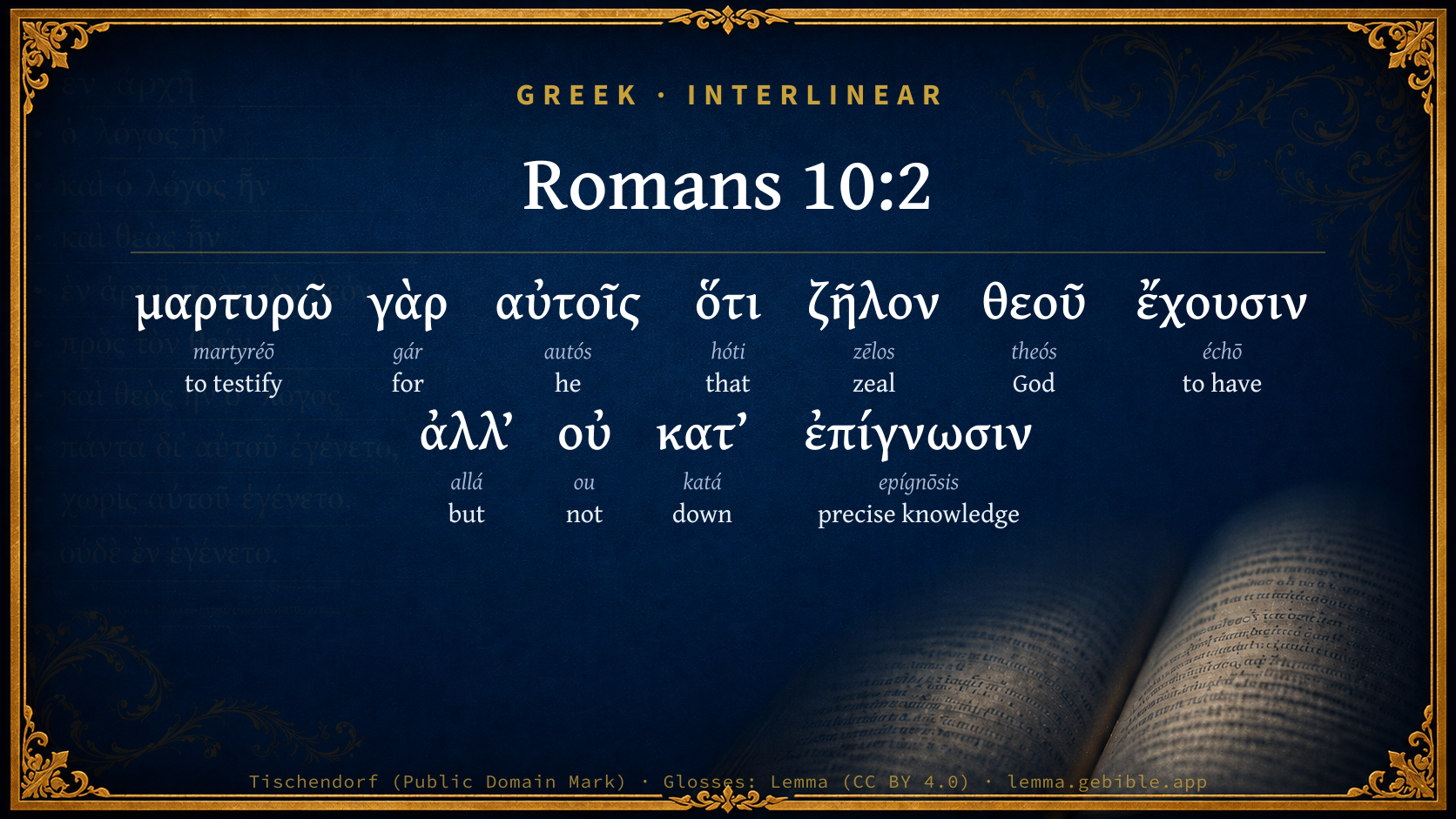
Greek (Tischendorf 8th ed.) Romans 10:2 appears in the Greek New Testament. The text above is from the Tischendorf 8th edition. Each word links to its Strong’s number and a concise gloss. Click any word for its full Thayer’s Greek Lexicon entry.
Download image
Cite this verse

Romans 10:2 (World English Bible). Public Domain. Lemma interlinear Bible study tool, https://lemma.gebible.app/v/romans/10/2.

Show BibTeX & RIS
BibTeX
RIS
English Translation
For I testify about them that they have a zeal for God, but not according to knowledge.
World English Bible · Public Domain
Download a study sheet

One document with this verse’s original text, its word-by-word gloss line, the meaning frame, cross-references with their text, attributed commentary, and full source and license credits — printable, and it pastes into notes with its structure intact.

This verse Autodidact and up

Study sheet (.html) Plain text (.txt)

A passage Seminary Student

Up to 50 verses in one chapter. A passage sheet keeps up to 6 commentary sources and 12 cross-references per verse, in the order this page ranks them, and says so on the sheet whenever that leaves anything out. Ask for a single verse and you get the Autodidact verse sheet above.

Everything on this page stays free to read, with no account — the sheet is a download of what is already on screen, not access to it.

Want to remove ads? Support Godless Engineer
Compare translations 3

The same verse in 3 English versions, stacked beneath the original-language interlinear above. Click any original word for its lexicon entry.

Each is an independent rendering of the whole verse — the interlinear is not word-aligned to these translations.

Highlighted words mark where these versions differ — a whole-verse word diff, not a word-by-word alignment.

  • World English Bible Public Domain
    For I testify about them that they have a zeal for God, but not according to knowledge.
  • King James Version Public Domain
    For I bear them record that they have a zeal of God, but not according to knowledge.
  • unfoldingWord Literal Text CC BY-SA 4.0
    For I testify about them that they have a zeal of God, but not according to full knowledge.

unfoldingWord Literal Text — © unfoldingWord, licensed CC BY-SA 4.0. Word-aligned USFM3 via Door43 (git.door43.org/unfoldingWord/en_ult).

Versions to compare (up to 4)

3 of 4 selected

Show all 19 translations

Every available English version of this verse, each an independent rendering of the whole verse.

  • World English Bible Public Domain
    For I testify about them that they have a zeal for God, but not according to knowledge.
  • Berean Standard Bible Public Domain
    For I testify about them that they are zealous for God, but not on the basis of knowledge.
  • Majority Standard Bible Public Domain
    For I testify about them that they are zealous for God, but not on the basis of knowledge.
  • King James Version Public Domain
    For I bear them record that they have a zeal of God, but not according to knowledge.
  • American Standard Version (1901) Public Domain
    For I bear them witness that they have a zeal for God, but not according to knowledge.
  • Revised Version (1885) Public Domain
    For I bear them witness that they have a zeal for God, but not according to knowledge.
  • Geneva Bible (1599) Public Domain
    For I beare them record, that they haue the zeale of God, but not according to knowledge.
  • Douay-Rheims (1899) Public Domain
    For I bear them witness, that they have a zeal of God, but not according to knowledge.
  • Young's Literal Translation Public Domain
    for I bear them testimony that they have a zeal of God, but not according to knowledge,
  • Literal Standard Version CC BY-SA 4.0
    for I bear them testimony that they have a zeal of God, but not according to knowledge,
  • Unlocked Literal Bible CC BY-SA 4.0
    For I testify about them that they have a zeal for God, but not according to knowledge.
  • unfoldingWord Literal Text CC BY-SA 4.0
    For I testify about them that they have a zeal of God, but not according to full knowledge.
  • Darby Bible Public Domain
    For I bear them witness that they have zeal for God, but not according to knowledge.
  • World Messianic Bible Public Domain
    For I testify about them that they have a zeal for God, but not according to knowledge.
  • Webster's Bible Public Domain
    For I bear them testimony that they have a zeal of God, but not according to knowledge.
  • Free Bible Version CC BY-SA 4.0
    I can testify to their passionate dedication to God, but it's not based on knowing him as he truly is.
  • Bible in Basic English Public Domain
    For I give witness of them that they have a strong desire for God, but not with knowledge.
  • Text-Critical English NT CC BY 4.0
    I can testify that they have a zeal for God, but not according to knowledge.
  • Tyndale New Testament (1534) Public Domain
    For I beare them recorde that they have a fervet mynde to God warde but not accordinge to knowledge.

Literal Standard Version (2020), Covenant Press — licensed CC BY-SA 4.0. Text via the HelloAO Bible API (eBible.org). Unlocked Literal Bible (unfoldingWord) — licensed CC BY-SA 4.0. Text via the HelloAO Bible API (eBible.org). unfoldingWord Literal Text — © unfoldingWord, licensed CC BY-SA 4.0. Word-aligned USFM3 via Door43 (git.door43.org/unfoldingWord/en_ult). Free Bible Version, Dr. Jonathan Gallagher — licensed CC BY-SA 4.0. Text via the HelloAO Bible API (eBible.org).

Word by word

More ways to search: Search by grammar → Find every occurrence → Compare this word →

Practice this passage: Drill this verse → Learn its vocabulary →

About this verse

These counts appear in no published source. They are computed here, from the morphology-tagged text and Lemma’s own curated glosses. What Lemma adds →

11
words
11
distinct lemmas
Pauline Epistles
section

Notable vocabulary

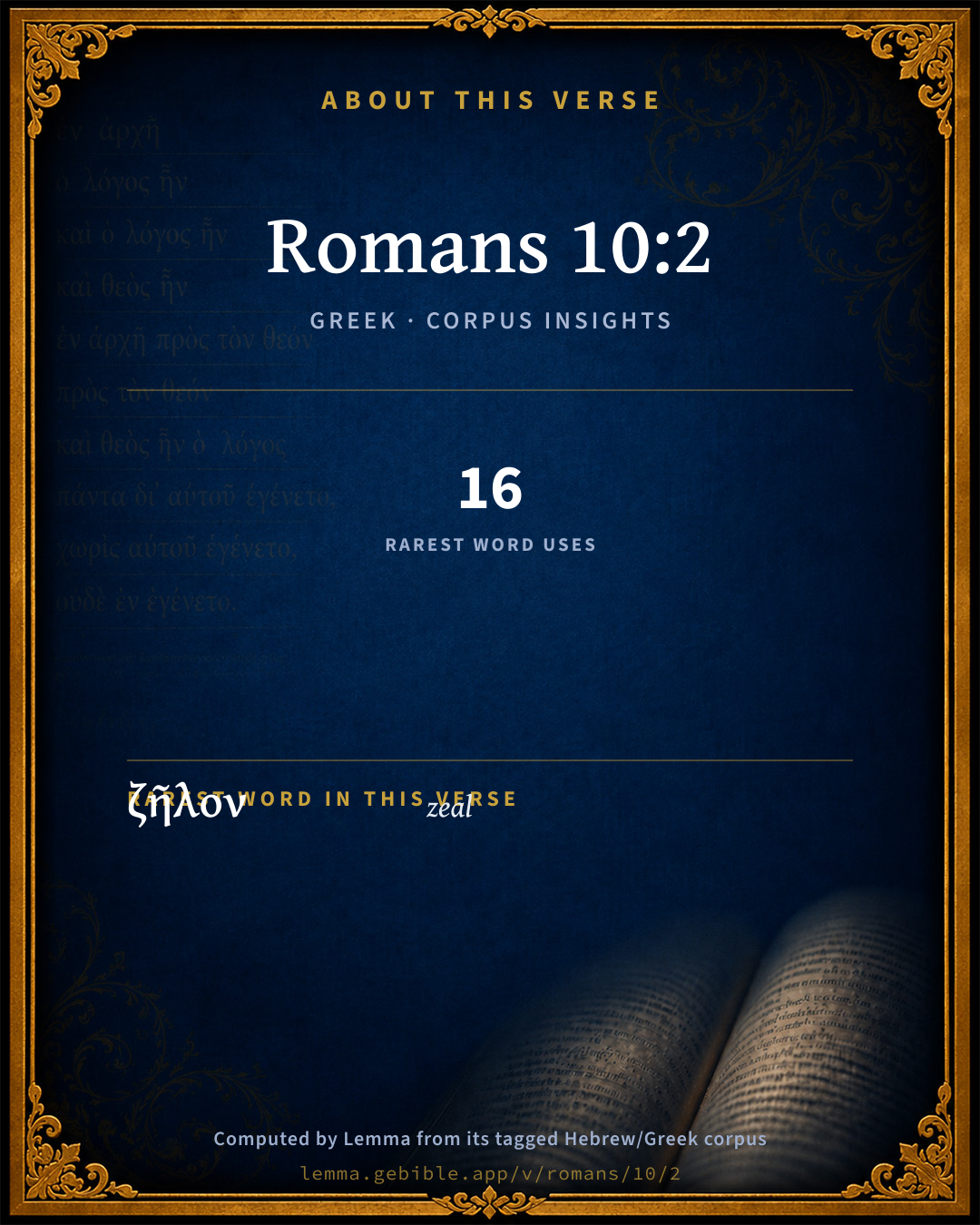
The rarest word here is ζῆλον zeal G2205 — appearing just 16 times in the whole Greek New Testament.

Shared distinctive vocabulary

ζῆλον zeal G2205 occurs in 16 verses of the Greek New Testament. Also found in:

Cross-references

21

Topical passages linked to Romans 10:2 in the Treasury of Scripture Knowledge — connected by theme and wording, ordered by reader-vote popularity; previews shown in the World English Bible.

  • Acts 21:20 They, when they heard it, glorified God. They said to him, "You see, brother, how many thousands there are among the Jews of those who have believed, and they are all zealous for the law.
  • Romans 9:31–32 but Israel, following after a law of righteousness, didn't arrive at the law of righteousness.
  • Proverbs 19:2 It isn't good to have zeal without knowledge; Nor being hasty with one's feet and missing the way.
  • Romans 10:3 For being ignorant of God's righteousness, and seeking to establish their own righteousness, they didn't subject themselves to the righteousness of God.
  • Philippians 1:9 This I pray, that your love may abound yet more and more in knowledge and all discernment;
  • Philippians 3:6 concerning zeal, persecuting the assembly; concerning the righteousness which is in the law, found blameless.
  • 2 Corinthians 4:4 in whom the god of this world has blinded the minds of the unbelieving, that the light of the Gospel of the glory of Christ, who is the image of God, should not dawn on them.
  • Galatians 1:14 I advanced in the Jews' religion beyond many of my own age among my countrymen, being more exceedingly zealous for the traditions of my fathers.
  • 2 Kings 10:16 He said, Come with me, and see my zeal for Yahweh. So they made him ride in his chariot.
  • Psalms 14:4 Have all the workers of iniquity no knowledge, Who eat up my people as they eat bread, And don't call on Yahweh?
  • Acts 22:3 "I am indeed a Jew, born in Tarsus of Cilicia, but brought up in this city at the feet of Gamaliel, instructed according to the strict manner of the law of our fathers, being zealous for God, even as you all are this day.
  • Acts 26:9–10 "I myself most assuredly thought that I ought to do many things contrary to the name of Jesus of Nazareth.
  • 2 Corinthians 4:6 seeing it is God who said, "Light will shine out of darkness," who has shone in our hearts, to give the light of the knowledge of the glory of God in the face of Jesus Christ.
  • Acts 21:28 crying out, "Men of Israel, help! This is the man who teaches all men everywhere against the people, and the law, and this place. Moreover, he also brought Greeks into the temple, and has defiled this holy place!"
  • 2 Corinthians 8:3 For according to their power, I testify, yes and beyond their power, they gave of their own accord,
  • Galatians 4:15 What was the blessing you enjoyed? For I testify to you that, if possible, you would have plucked out your eyes and given them to me.
  • Isaiah 27:1 In that day Yahweh with his hard and great and strong sword will punish leviathan the swift serpent, and leviathan the crooked serpent; and he will kill the monster that is in the sea.
  • Acts 22:22 They listened to him until he said that; then they lifted up their voice, and said, "Rid the earth of this fellow, for he isn't fit to live!"
  • Galatians 4:17–18 They zealously seek you in no good way. No, they desire to alienate you, that you may seek them.
  • Colossians 4:13 For I testify about him, that he has great zeal for you, and for those in Laodicea, and for those in Hierapolis.
  • John 16:2 They will put you out of the synagogues. Yes, the time comes that whoever kills you will think that he offers service to God.

Cross-references courtesy of OpenBible.info (CC BY 4.0).

Commentary

Notes on Romans 10:2 from classic Christian and Jewish commentators (each source and its license shown beneath its notes). The classic Christian expositions comment on the surrounding passage and are grouped to its opening verse, so a note may address several verses; the Jewish commentaries on the Tanakh (Rashi and others) are per-verse, so they appear only where the commentator wrote on this verse.

Lemma curates 59 commentaries, every one of them public domain or Creative Commons licensed, each selected and text-cleaned for this edition rather than reprinted as found. About our sources →

Tyndale Open Study Notes

Tyndale Open Resources

10:2 Zeal denotes a passionate and commendable commitment to God and his purposes (see Num 25:6-13). But in Paul’s day Jewish zeal was misdirected because it failed to understand that Jesus Christ is the pinnacle of God’s plan. (For Paul’s own misdirected zeal before his conversion to Christ, see Acts 9:1-2; Gal 1:13-14.)

Tyndale Open Study Notes — © Tyndale Open Resources, licensed CC BY-SA 4.0. Text via the HelloAO Bible API.

Bengel's Gnomon

Johann Albrecht Bengel

Rom 10:2. [115]Ζῆλου Θεοῦ, a zeal of God) Act 22:3, note. Zeal of God, if it is not against Christ, is good.—οὐ κατʼ ἐπίγνωσιν, not according to knowledge) An example of Litotes [expressing in less strong terms a strong truth] i.e. with great blindness; it agrees with the word, ignorant, in the next verse. Flacius says: The Jews had and now have a zeal without knowledge; we on the contrary, alas! to our shame, have knowledge without zeal. Zeal and ignorance are referred to at Rom 10:19.

[115] Γὰρ, for.) Therefore even in those, who are not in a state of grace, something at least may be found which may induce those, who rejoice in the Divine favour, to intercede for them.—V. g.

Bengel's Gnomon of the New Testament — English translation (T&T Clark, Edinburgh, 1860) — public domain. Text from a community e-Sword module.

Meyer's Critical & Exegetical Commentary

Heinrich August Wilhelm Meyer

Rom_10:2. Reason assigned why ἡ εὐδοκία … εἰς σωτηρίαν.

ζῆλον Θεοῦ] zeal for God. Comp. Act_21:20; Act_22:3; Gal_1:14; Joh_2:17; 1Ma_2:58. This their zeal makes them worth that interest of my heart.

οὐ κατʼ ἐπίγνωσιν] knowledge is not that, according to the measure of which they are zealous for God. We must here again (comp. on Rom_1:28) note the composite expression; for the Jews were not wanting in γνῶσις generally, but just in the very point, on which it depended whether their γνῶσις was the right and practically vital ἐπίγνωσις.

Meyer — Critical and Exegetical Commentary on the New Testament — English translation by Peter Christie, edited by Frederick Crombie (T&T Clark, 1880) — public domain. Text from a community e-Sword module.

Expositor's Greek Testament

ed. W. Robertson Nicoll

Rom 10:2 . Their good qualities compel his affection. ζῆλον θεοῦ ἔχουσιν : they have a zeal for God, are intensely (though mistakenly) religious. Cf. Gal 1:14 . An unbelieving Jew could interpret his opposition to the lawless gospel of Paul as zeal for the divinely-given rule of life, and his opposition to the crucified Messiah as zeal for the divinely-given promises. It was God’s honour for which he stood in refusing the Gospel. ἀλλʼ οὐ κατʼ ἐπίγνωσιν : this religious earnestness is not regulated by adequate knowledge. For ἐπίγνωσις see Eph 4:13 , Phi 1:9 , Col 1:9-10 ; Col 2:2 , 1Ti 2:4 , 2Ti 2:25 ; it is especially used of religious knowledge, and suggests attainment in it ( ἄρτι γινώσκω ἐκ μέρους , τότε δὲ ἐπιγνώσομαι , 1Co 13:12 ).

The Expositor's Greek Testament, edited by W. Robertson Nicoll (1897–1910) — public domain. Text from a community e-Sword module.

Hodge's Commentary on Romans, Ephesians & First Corinthians

Charles Hodge

Rom_10:2

For I bear them record that they have a zeal of God. So far from desiring to exaggerate the evil of their conduct, the apostle, as was his uniform manner, endeavored to bring every thing commendable and exculpatory fully into view. The word for, has here its appropriate force, as it introduces the ground or reason of the preceding declaration. I desire their salvation, for they themselves are far from being unconcerned as to divine things. Zeal of God may mean very great zeal, as cedars of God mean great cedars, according to a common Hebrew idiom; or zeal of which God is the object; the latter explanation is to be preferred. Joh_2:17, The zeal of thy house hath eaten me up. Act_21:20, Zealous of the law. Act_22:3, Zealous of God. Gal_1:14, etc., etc. The Jews had great zeal about God, but it was wrong as to its object, and of consequence wrong in its moral qualities. Zeal, when rightly directed, however ardent, is humble and amiable. When its object is evil, it is proud, censorious, and cruel. Hence, the importance of its being properly guided, not merely to prevent the waste of feeling and effort, but principally to prevent its evil effects on ourselves and others. But not according to knowledge. Commentators notice that Paul uses the word ἐπίγνωσις. The Jews had γνῶσις (knowledge), what they lacked was ἐπίγνωσις, correct knowledge and appreciation. Their knowledge was neither enlightened nor wise; neither right as to its objects, nor correct in its character. The former idea is here principally intended. The Jews were zealous about their law, the traditions of their fathers, and the establishment of their own merit. How naturally would a zeal for such objects make men place religion in the observance of external rites; and be connected with pride, censoriousness, and a persecuting spirit. In so far, however, as this zeal was a zeal about God, it was preferable to indifference, and is, therefore, mentioned by the apostle with qualified commendation.

Charles Hodge — Commentary on Romans (1835), First Corinthians (1857), and Ephesians (1856) — public domain. Text from a community e-Sword module.

Jamieson, Fausset & Brown

Robert Jamieson, A. R. Fausset & David Brown

For I bear them record--or, "witness," as he well could from his own sad experience.

that they have a zeal of--"for"

God, but not according to knowledge--(Compare Act 22:3; Act 26:9-11; Gal 1:13-14). He alludes to this well-meaning of his people, notwithstanding their spiritual blindness, not certainly to excuse their rejection of Christ and rage against His saints, but as some ground of hope regarding them. (See Ti1 1:13).

Jamieson, Fausset & Brown — Commentary Critical and Explanatory on the Whole Bible (1871) — public domain (CC PDM 1.0). Text via the HelloAO Bible API.

Adam Clarke's Commentary

Verse 2. They have a zeal of God] They believe their law to have come immediately from God himself, and are jealous of its glory and excellence; they conscientiously observe its rites and ceremonies, but they do not consider the object and end of those rites; they sin more through ignorance than malice; and this pleads in their excuse. By this fine apology for them, the apostle prepares them for the harsher truths which he was about to deliver.

Adam Clarke's Commentary on the Bible (1810–1826) — public domain. Text from a community e-Sword/MySword module.

John Calvin's Commentaries

2. For I bear to them a testimony, etc. This was intended to secure credit to his love. There was indeed a just cause why he should regard them with compassion rather than hatred, since he perceived that they had fallen only through ignorance, and not through malignancy of mind, and especially as he saw that they were not led except by some regard for God to persecute the kingdom of Christ. Let us hence learn where our good intentions may guide us, if we yield to them. It is commonly thought a good and a very fit excuse, when he who is reproved pretends that he meant no harm. And this pretext is held good by many at this day, so that they apply not their minds to find out the truth of God, because they think that whatever they do amiss through ignorance, without any designed maliciousness, but with good intention, is excusable. But no one of us would excuse the Jews for having crucified Christ, for having cruelly raged against the Apostles, and for having attempted to destroy and extinguish the gospel; and yet they had the same defense as that in which we confidently glory. Away then with these vain evasions as to good intention; if we seek God sincerely, let us follow the way by which alone we can come to him. For it is better, as Augustine says, even to go limping in the right way than to run with all our might out of the way. If we would be really religious, let us remember that what Lactantius teaches is true, that true religion is alone that which is connected with the word of God.

And further, since we see that they perish, who with good intention wander in darkness, let us bear in mind, that we are worthy of thousand deaths, if after having been illuminated by God, we wander knowingly and willfully from the right way.

John Calvin's Commentaries (1540-1563) — public domain. Text from the Calvin Translation Society English edition (1840s-50s) via the Christian Classics Ethereal Library (ccel.org). Calvin's coverage is partial (roughly two-thirds of the Bible); uncommented books and verses are honest gaps, never fabricated. The 19th-century editor's footnotes and remarks are omitted so the notes are faithfully Calvin's own voice.

Ellicott's Commentary for English Readers

(2) A zeal of God, but not according to knowledge.—It would be difficult to find a more happy description of the state of the Jews at this period. They had “a zeal for God.” “The Jew,” said Josephus, “knows the Law better than his own name . . . The sacred rules were punctually observed . . . The great feasts were frequented by countless thousands . . . Over and above the requirements of the Law, ascetic religious exercises advocated by the teachers of the Law came into vogue. . . . Even the Hellenised and Alexandrian Jews under Caligula died on the cross and by fire, and the Palestinian prisoners in the last war died by the claws of African lions in the amphitheatre, rather than sin against the Law. What Greek,” exclaims Josephus, “would do the like? . . . The Jews also exhibited an ardent zeal for the conversion of the Gentiles to the Law of Moses. The proselytes filled Asia Minor and Syria, and—to the indignation of Tacitus—Italy and Rome.” The tenacity of the Jews, and their uncompromising monotheism, were seen in some conspicuous examples. In the early part of his procuratorship, Pilate, seeking to break through their known repugnance to everything that savoured of image-worship, had introduced into Jerusalem ensigns surmounted with silver busts of the emperor. Upon this the people went down in a body to Cæsarea, waited for five days and nights in the market-place, bared their necks to the soldiers that Pilate sent in among them, and did not desist until the order for the removal of the ensigns had been given. Later he caused to be hung up in the palace at Jerusalem certain gilded shields bearing a dedicatory inscription to Tiberius. Then, again, the Jews did not rest until, by their complaints addressed directly to the emperor, they had succeeded in getting them taken down. The consternation that was caused by Caligula’s order for the erection of his own statue in the Temple is well known. None of the Roman governors dared to carry it into execution; and Caligula himself was slain before it could be accomplished.

Justice must be done to the heroic spirit of the Jews. But it was zeal directed into the most mistaken channels. Their religion was legal and formal to the last degree. Under an outward show of punctilious obedience, it concealed all the inward corruption described by the Apostle in Rom_2:17-29, the full extent of which was seen in the horrors of the great insurrection and the siege of Jerusalem.

A Bible Commentary for English Readers, edited by Charles John Ellicott (1878–1897) — public domain. Text from a community e-Sword module.

The Cambridge Bible for Schools and Colleges

gen. ed. J. J. S. Perowne

2. For] The connexion is, that they seem to be, but are not, in the way to salvation; and that this stirs up his affectionate and anxious longing that they may find it.

record] witness; as one who so intimately knows them and their state of conscience and will.

zeal of God] So lit. The genitive implies that the zeal is in close connexion with, and directed towards, Him. So “faith of God” (Gr. of Mar_11:22). Jewish jealousy for the Law, Temple, Scriptures, &c.—eagerness to proselytize—hatred of Christian renegades—is all implied here; all being connected, rightly or mistakenly, with the true God, and intended, more or less, to “do Him service.”—Observe that St Paul gives them full credit for sincerity, and yet does not look on their sincerity as a ground of safety. His true generosity had in it no false “liberalism.” The Jews (like himself of old, 1Ti_1:13,) acted “ignorantly in unbelief;” but their “ignorance,” in face of offered knowledge, was their crime; and so their misguided zeal was indirectly sinful.

knowledge] Lit. full knowledge. (German, Erkenntniss.) Same word as Rom_1:28, Rom_3:20. The word is appropriate, for it was just the full knowledge of the true God as God in Christ which they lacked. Their knowledge of God impelled them to persecuting zeal exactly because it was not full knowledge. (See Act_13:27.) So it is with all persecution in the name of the true God.

The Cambridge Bible for Schools and Colleges (gen. ed. J. J. S. Perowne; Cambridge University Press, 1878–1918) — public domain. Text from a community e-Sword module.

John Gill's Exposition

For I bear them record, that they have a zeal of God,.... A zeal for God; for the being and unity of God, against the polytheism and idolatry of the Gentiles; for the word of God, the writings of the Old Testament, of which they were zealous defenders and preservers, and which they diligently read and heard explained, and whereby they thought to obtain eternal life; for the law of God, moral and ceremonial, especially for the rituals of the Mosaic economy; for the service and worship of God, they spared no pains, but compassed sea and land to bring in proselytes to their religion; all which the apostle could testify from his own knowledge, and by his own experience, who had been as great a zealot as any of them all. But now whilst the apostle is expressing his strong affection for this people, he is careful to act the faithful part to them, and points out their mistakes, and shows them their faults; which he does in this and the following verse, by observing, that they had a zeal of God indeed,

but not according to knowledge: it was not well regulated, it proceeded on mistaken principles, and moved in a wrong way, in persecuting the church of God, in doing things contrary to the name of Christ, in putting to death his ministers and members, thinking that hereby they did God good service; which arose from their ignorance of their Father, and of the Son: though they had a zeal of God, they knew neither God nor Christ aright; they did not know God in Christ, nor Jesus to be the true Messiah; they understood neither law nor Gospel truly, and fancied the Gospel was contrary to the law, and an enemy to it; and therefore in their great zeal opposed it, and the professors of it; they were zealous of the law, and of doing the commands of it, but knew not the true nature, use, and end of the law; as appears by what follows.

John Gill's Exposition of the Whole Bible (1746–1763) — public domain (CC PDM 1.0). Text via the HelloAO Bible API.

Trapp's Complete Commentary

John Trapp

2 For I bear them record that they have a zeal of God, but not according to knowledge.

Ver. 2. They have a zeal of God] So had those two Rabbis, David Rubenita and Shelomoh Molchu, that set upon the Emperor Charles v. to persuade him to Judaism, and were therefore put to a cruel death, A. D. 1530. (Alsted. Chron.) So had Latimer before his conversion: I was as obstinate a Papist, saith he, as any was in England: insomuch that when I should be made Bachelor in Divinity, my whole oration went against Philip Melancthon and his opinions, &c. Being a priest, and using to say mass, he thought he had never sufficiently mingled his massing wine with water: and moreover that he should never be dammed, if he were once a professed friar; with various such superstitious fantasies. (Acts and Mon.) Zeal without knowledge is as wild fire in a fool’s hand; it is like the devil in the demoniac, that casts him sometimes into the fire and sometimes into the water.

John Trapp, A Commentary or Exposition upon All the Books of the Old and New Testament (1647–1656) — public domain. Text from a community e-Sword module.

Albert Barnes' Notes on the Bible

For I bear them record - To bear record means to be a witness; to give evidence. This, Paul was well qualified to do. He had been a Jew of the strictest order Act 26:5; Phi 3:5, and he well knew the extraordinary exertions which they put forth to obey the commands of the Law.

A zeal of God - A zeal for God. Thus, Joh 2:17,” The zeal of thine house hath eaten me up;” an earnest desire for the honor of the sanctuary has wholly absorbed my attention; compare Psa 69:9; Act 21:20, “Thou seest, brother, how many thousands of Jews there are which believe, and they are all zealous of the law;” Act 22:3, “And was zealous toward God as ye all are this day.” Zeal for God here means passionate ardor in the things pertaining to God, or in the things of religion. In this they were, doubtless, many of them sincere; but sincerity does not of itself constitute true piety; Joh 16:2, “The time cometh that whosoever killeth you will think that he doeth God service.” This would be an instance of extraordinary zeal, and in this they would be sincere; but persecution to death of apostles cannot be true religion; see also Mat 23:15; Act 26:9, “I thought that I ought to do,” etc. So many persons suppose that, provided they are sincere and zealous, they must of course be accepted of God. But the zeal which is acceptable is what aims at the glory of God, and which is founded on true benevolence to the universe; and which does not aim primarily to establish a system of self-righteousness, as did the Jew, or to build up our own sect, as many others do. We may remark here, that Paul was not insensible to what the Jews did, and was not unwilling to give them credit for it. A minister of the gospel should not be blind to the amiable qualities of people or to their zeal; and should be willing to speak of it tenderly, even when he is proclaiming the doctrine of depravity, or denouncing the just judgments of God.

Not according to knowledge - Not an enlightened, discerning, and intelligent zeal. Not what was founded on correct views of God and of religious truth. Such zeal is enthusiasm, and often becomes persecuting. Knowledge without zeal becomes cold, abstract, calculating, formal; and may be possessed by devils as well as human beings. It is the union of the two - the action of the man called forth to intense effort by just views of truth and by right feeling - that constitutes true religion. This was the zeal of the Saviour and of the apostles.

Albert Barnes' Notes on the Bible (1834–1885) — public domain. Text from a community e-Sword/MySword module.

Haydock's Catholic Bible Commentary

According to knowledge, &c. The Jews ran with ardour in the paths of the law, but saw not whither they were going; they followed the law, but did not know whither it conducted them. (Calmet)

George Leo Haydock (1774–1849), Haydock's Catholic Family Bible and Commentary, 1859 edition — public domain. Excludes Psalms (Douay-Rheims chapter numbering differs from Protestant) and Deuterocanonical books (Catholic canon only).

Matthew Poole's English Annotations

For I bear them record, i.e. I must testify this of them, or of many of them,

that they have a zeal of God; that they have a fervent desire to maintain the law of God, with all the Mosaical rites and ceremonies, as thinking thereby to promote the glory of God.

But not according to knowledge; i.e. true and right knowledge. Though it be a warm, yet it is a blind zeal. They know not the will of God, or what that righteousness is which he will accept. They know not for what end the law and worship of God, under the Old Testament, was instituted. They knew not that Christ, in, and by whom, that law is fulfilled.

Matthew Poole's English Annotations on the Holy Bible (1683–1685) — public domain. Text from a community e-Sword/MySword module.

Whedon's Commentary on the Bible

Daniel D. Whedon

2. Zeal of God—Monotheism, the maintenance of the doctrine of one God, as opposed to polytheism and idolatry, was the great mission bestowed on Israel in the Old Testament. Before the captivity the people were prone to idolatry. The remnant who returned were the earnest few, who never again relapsed. But their very monotheism grew fierce and malignant.

Not… knowledge—The fiercer the zeal, even for truth, when not regulated by the real principles of truth, the worse its excesses. The very element of truth renders the mind self-conceited and unsparing, and the corrective and restraining part of the truth is over-ridden and disregarded. Monotheism by its very conscious truth took firm hold of the Jew’s conscience; and then, strangely for that truth, as Paul knew by experience, he could be a knave, a persecutor, and a bloody brigand.

Daniel D. Whedon (gen. ed.), Commentary on the Old and New Testaments (1874–1909) — public domain. Text from a community e-Sword module.

The Pulpit Commentary

Vers. 2, 3. For I bear them record that they have a zeal of God. For zhlon Yeou , meaning zeal for God, cf. Joh_2:17 Act_22:3 Gal_1:14. The word zhlov was commonly used for the religious ardour of the Jews at that time, (cf. Act_21:20, Pantev zhlwtai tou nomou uparcousi) and there was a faction among them called distinctively Zhlwtai , to which Simon Zelotes (Luk_6:15 Act_1:13) is supposed to have belonged originally. St. Paul"s mention of the religious zeal of the Jews of his day is apposite in this place. In Rom_9:1-5, where he was about to speak of their rejection from the inheritance of the promises, he appropriately dwelt on their ancient privileges; here, where he has in view their own failure to respond to God"s purpose for them, he as appropriately refers to their undoubted zeal, which he regrets should be misdirected. But not according to knowledge. For being ignorant of (agnoountev , in explanation of ou kat epignwsin preceding) God"s righteousness, and seeking to establish their own (righteousness, repeated here, is ill supported), they have not submitted themselves to the righteousness of God. For the meaning of God"s righteousness, opposed to man"s own righteousness, see on Rom_3:19, Rom_3:20; also on Rom_1:17, and Introduction.

Vers. 2-4. False righteousness and true.

Paul"s desire for the salvation of his countrymen and kinsmen arose from his clear perception of their spiritual destitution and need. They might hide their condition from themselves, but it was clear enough to him. The measure of true light which they enjoyed made it the sadder that many of them refused to accept and to walk in the full light of the Sun of Righteousness. And the apostle"s sympathy was excited on their behalf all the more because he understood their case so well.

I ZEALOUS RELIGIOUSNESS MAY BE MISDIRECTED BY IGNORANCE. The apostle does not charge the Jews with neglecting, far less with despising, religion. In their own way they were very religious, and many of them were found willing to put forth great efforts and endure many sacrifices for their religion. They had "a zeal for God." They hated idolatry; they revered their Scriptures, their temple, their priesthood, their sacrifices and festivals; they prided themselves upon their ceremonial purity and their scrupulous observances. Yet, with all this, they were not commended by the apostle. Their zeal was without knowledge. We meet with similar characters in our own time. Some persons consider that if there is religiousness with sincerity, that is sufficient. It is a great mistake. We need light as well as warmth, knowledge as well as zeal. If truth has been revealed, our first duty is to learn and receive it.

II THERE IS A FALSE AND UNCHRISTIAN CONCEPTION OF RIGHTEOUSNESS. The Jews are censured for seeking to establish "their own righteousness." The Law, indeed, was good in itself. For those who perfectly obeyed it, it was a means of salvation. But the Law is Condemnation to those who trust in it and yet do not conform to it. And, as a matter of fact, the Law was "weak through the flesh," was insufficient for the salvation of sinful men. It is no foundation for a sinner"s hopes. Further, the Hebrews were too much accustomed to regard their religious acts as services rendered, for which Divine recompense and payment are due. This is a notion still prevalent, but it is radically unscriptural and unreasonable. We cannot be justified by the works of the Law, and we can earn nothing as a right from God.

III THE TRUE RIGHTEOUSNESS IS THAT WHICH IS THROUGH CHRIST JESUS. Observe:

1. The relation between Christ and the Law. The word "end" may be taken literally. The Law, as a dispensation, came to an end when Christ appeared. The Law was to the Israelites a Conductor to lead them to Jesus. But the word "end" may mean more than this; it may mean the purpose and design of the Law. The Law was given in order to reveal both the righteousness of God and the sinfulness of man. It thus prepared the way for the coming of him whose obedience fulfilled the Law, and whoso redemption secured pardon and liberty for those whom the Law was powerless to save.

2. Observe the way in which the higher righteousness is secured through Christ. This is described by three several expressions in this passage knowledge, subjection, belief. The ignorant are without the means of obtaining justification; the unsubmissive rebel against the means; the unbelieving reject the means. It is the will of God that faith should be accounted for righteousness. This is a principle as old as Abraham; yet its most mighty working is apparent in the case of those who believe in Jesus. The doctrine of justification by faith is here plainly revealed, and its superiority to all rival doctrines plainly exhibited.

The Pulpit Commentary (1880–1919), ed. H.D.M. Spence-Jones & Joseph S. Exell — public domain. Text from a community e-Sword module.

John Wesley's Explanatory Notes

They have a zeal, but not according to knowledge - They had zeal without knowledge; we have knowledge without zeal.

John Wesley, Explanatory Notes Upon the Whole Bible (1754–1765) — public domain. Text via the GEBible commentary corpus.

Burkitt's Expository Notes on the New Testament

William Burkitt

As if the apostle had said, "I can bear them witness that many, very many, of the Jews, have a zealous desire in their way to please God, and do what is acceptable in his sight; but though it be a warm, it is but a blind zeal, and not according to right knowledge."

Here observe, 1. The apostle is desirous to say the best he could of his countrymen the Jews; he commends the good meaning of their zeal, but blames the ill conduct of it. It was a misguided and mistaken zeal, and not directed as it ought. Zeal is either one of the best or worst of things in the world. It is a good thing when it is right in its object, right in the measure and degree, and pursued by right means. As to the object of our zeal, it must be that which is certainly and considerably good: certainly good, or else we are zealous for we know not what; and considerably good, or else it doth not deserve our zeal. To be zealous, and that beyond all due measure, for the observation so a ceremony or custom, as some in the Christian church were of old about the observation of Easter, is certainly a zeal not according to knowledge.

Again, zeal must be prosecuted by lawful and warrantable means; we must not from a principle of zeal do any evil, that good may come. But there is a zeal amongst the church of Rome, which I am sure cannot be according to knowledge, and that is a zeal for ignorance. This is a zeal peculiar to themselves; they will not allow the people to understand what they do in the service of God; they require them to pray, but will not let them know what they pray for; and all this under a pretence that ignorance, which makes a man a block, is the mother of devotion. As if the less men understand the service of God, the better he was pleased with it, and the more they were edified by it.

William Burkitt's Expository Notes on the New Testament (1700–1703) — public domain. Text from a community e-Sword module.

Godbey's Commentary on the New Testament

William B. Godbey

2. “For I testify to them that they have a zeal of God, but not according to perfect knowledge.” The Jews in Paul’s day, like the fallen churches in all ages, had some knowledge of God, but it was not the experimental sort, such as enables us to know Him personally in practical and real salvation.

William B. Godbey, Commentary on the New Testament (1896–1900) — public domain. Text from a community e-Sword module.

McGarvey & Pendleton's Commentaries

J. W. McGarvey

For I bear them witness that they have a zeal for God, but not according to knowledge . ["For" introduces Paul's reason for having hope in his prayer. Had Israel been sodden in sin, or stupefied in indifference, he would have had less heart to pray. But they were ardently religious, though ignorantly so, for, had they possessed a true knowledge of their law, it would have led them to Christ, and had they understood their prophets, they would have recognized that Jesus was the Christ ( Gal_3:24 ; Luk_24:25-27 ; Rev_19:10 ). But the chief ignorance of which Paul complained was their failure to see that there is no other way to justification and salvation save by faith in Christ Jesus. As to their zeal, which in the centuries wore out the vital energy of the Greek, and amazed the stolidity of the Roman, till in the siege of Jerusalem it dashed itself to atoms against the impregnable iron of the legionaries, no tongue nor pen can describe it. Of this zeal, Paul was a fitting witness, for before conversion he shared it as a persecutor, and after conversion he endured it as a martyr ( Phi_3:6 ; 2Co_11:24 ; Act_21:20-31 ; Act_22:4 ). But misguided zeal miscarries like a misdirected letter, and the value of the contents does not mend the address. "It is better," says Augustine, "to go limping in the right way, than to run with all our might out of the way." Their lack of knowledge, being due to their own stubborn refusal to either hear or see, was inexcusable.]

J. W. McGarvey (with Philip Y. Pendleton), Commentaries on the New Testament (The Fourfold Gospel, 1914; Acts; and the epistles) — public domain. Text from a community e-Sword/MySword module.

The People's New Testament

B. W. Johnson

2. They have a zeal of God. They were religious, conscientious, zealous, but mistaken and fanatical. For examples of their mistaken zeal, see Acts 21:27–31; also 22:3. Even mistaken zeal is better than indifference.

B. W. Johnson's The People's New Testament with Notes (1889–1891) — public domain. Electronic text from the Christian Classics Ethereal Library (CCEL) ThML edition.

Cambridge Greek Testament for Schools and Colleges

2. ζῆλον. In a good sense; cf. Joh 2:17; 2Co 7:7; 2Co 7:11; 2Co 9:2; 2Co 11:2 only.

οὐ κατ’ ἐπίγνωσιν = without clear or true discernment of the will or character of GOD. “γνῶσις is the wider word and expresses knowledge in the fullest sense: ἐπίγνωσις is knowledge directed towards a particular object, perceiving, discerning, recognising; but it is not knowledge in the abstract; that is γνῶσις,” Robinson, Eph. p. 254 (see the whole discussion).

Cambridge Greek Testament for Schools and Colleges (Cambridge University Press, 1896; 21 vols, various authors incl. Carr, Maclear, Plummer, Farrar, Lumby, Moule, M. R. James, Simcox) — public domain. Text from a community e-Sword module.

Alford’s Greek Testament

Henry Alford

2.] For (reason why I thus sympathize with their efforts, though misdirected) I bear witness to them that they have a zeal for God (for this meaning of the gen. see reff., especially 2Co 11:2, and note there), but not according to (in accordance with, founded upon, and carried on with) knowledge (accurate apprehension of the way of righteousness as revealed to them).

Henry Alford, The Greek Testament (1849–1861) — public domain. Text from a community e-Sword module.

International Critical Commentary

2. μαρτυρῶ γάρ. This gives the reason for St. Paul’s grief. He had been a Jew περισσοτέρως ζηλωτὴς ὑπάρχων (Gal 1:14; cf. Act 22:3) and hence he knew only too well the extent both of their zeal and of their ignorance.

ζῆλον Θεοῦ. Obj. genitive: ‘zeal for God’ (not as in 2Co 11:2). An O. T. expression: Judith. 9:4 ἐζήλωσαν τὸν ζῆλόν σου: Psa_68 [69]; 118[119]:139 ὁ ζῆλος τοῦ οἴκου σου: 1 Macc. 2:58 ζῆλος νόμου. Jowett quotes Philo, Leg. ad Caium, § 16 (Mang. ii. 562) ‘Ready to endure death like immortality rather than suffer the neglect of the least of their national customs.’ St. Paul selects the very word which the Jew himself would have chosen to express just that zeal on which more than anything else he would have prided himself.

κατʼ ἐπίγνωσιν. The Jews were destitute, not of γνῶσις, but of the higher disciplined knowledge, of the true moral discernment by which they might learn the right way. ἐπίγνωσις (see Lft. on Col 1:9, to whose note there is nothing to add) means a higher and more perfect knowledge, and hence it is used especially and almost technically for knowledge of God, as being the highest and most perfect form: see on 1:28 and cf. 3:20.

2. Roman Catholic commentators, followed by Liddon and Gore, consider that the words are introduced in order to justify an apostolic or authorized ministry. But this is to introduce into the passage an idea which is quite alien to it, and which is unnecessary for the argument.

2. But the language of Scripture is not used without a point. In the original Psalm these words describe how universally the works of nature glorify God. By using them St. Paul ‘compares the universality of the preaching of the Gospel with the universality with which the works of nature proclaim God.’ Gif.

A second difficulty is raised by older commentators. As a matter of fact the Gospel had not been preached everywhere; and some writers have inverted this argument, and used this text as a proof that even as early as this Christianity had been universally preached. But all that St. Paul means to imply is that it is universal in its character. Some there were who might not have heard it; some Jews even might be among them. He is not dealing with individuals. The fact remained true that, owing to the universal character of its preaching, those whose rejection of it he is considering had at any rate as a body had the opportunities of hearing of it.

International Critical Commentary — older volumes (1896–1929), various authors — public domain. Text from a community e-Sword module.

Vincent's Word Studies in the New Testament

Marvin R. Vincent

I bear them record [μαρτυρω] . Rev. witness. "He seems to be alluding to his conduct of former days, and to say, 'I know something of it, of that zeal '" (Godet).

Zeal of God [ζηλον θεου] . Rev., zeal for God. Like the phrase "faith of Christ" for "faith in Christ" (Phi 3:9); compare Col 2:12; Eph 3:12; Joh 2:17, "the zeal of thine house," i e., "for thy house." Knowledge [επιγνωσιν] . Full or correct and vital knowledge. See on ch. Rom 1:28; Rom 3:20.

Marvin R. Vincent, Word Studies in the New Testament (1887–1900) — public domain. Text from a community e-Sword/MySword module.

Godet's Commentaries

Frédéric Louis Godet

Vv. 2. In this verse Paul justifies his so lively interest in the lot of the Jews, expressed in Rom 10:1. What has not been done, what has not been suffered, by those Jews devoted to the cause of God, under successive Gentile powers? Notwithstanding the most frightful persecutions, have they not succeeded in maintaining their monotheistic worship for ages in all its purity? And at that very time what an admirable attachment did they show to the ceremonies of their worship and the adoration of Jehovah! When Paul says μαρτυρῶ, I bear them witness, he seems to be alluding to his conduct of other days, and to say: I know something of it, of that zeal!

Unhappily this impulse is not guided according to the standard (κατά) of a just knowledge, of a real discernment of things. And it is this want of understanding which has spoiled the effects of this admirable zeal. He does not use the word γνῶσις, knowledge (in the ordinary sense of the word), for the Jews certainly do not lack religious knowledge. The compound term ἐπίγνωσις, which he employs here, rather signifies discernment, that understanding which puts its finger on the true nature of the thing. They have failed to discern the true meaning and the true scope of the legal dispensation; they are ardently attached to all its particular rites, but they have not grasped their moral end.

Frédéric Louis Godet — Commentaries on Luke, John, Romans, and 1 Corinthians — English translation (T&T Clark, Edinburgh, 1870s–1890s) — public domain. Text from a community e-Sword module.

Lesson kit

Teaching starters — assembled from the data on this page, not authored interpretation. Every prompt links to the verse data it draws on. Edit before teaching.

Romans, in the Pauline Epistles, opens this verse with 11 words (11 distinct Greek lemmas). Its most distinctive word is zēlos (“zeal”). A historical commentator’s framing appears above. Read the whole chapter for the surrounding context.

Discussion questions

  1. What does “zeal” (zēlos) contribute to the verse as a whole?
  2. How does John 2:17, which shares the word «zeal», read alongside this verse?
  3. These translations render this verse differently. What is at stake in choosing one wording over another?
  4. Compare how Tyndale Open Study Notes and Bengel's Gnomon read this verse. Where do they agree or differ?

Things to notice

Reading settings

Reading text

Shown beneath each verse's original-language words.

Old Testament
Old Testament edition

Read the OT as the Masoretic Hebrew (MT) or the Greek Septuagint (LXX).

English shown for the Greek Septuagint (in the Hebrew ↔ Greek comparison).

Comparing translations? Open the Compare panel on any verse page to stack up to four side by side.