

2 Corinthians 1:12
Greek (Tischendorf 8th ed.) 2 Corinthians 1:12 appears in the Greek New Testament. The text above is from the Tischendorf 8th edition. Each word links to its Strong’s number and a concise gloss. Click any word for its full Thayer’s Greek Lexicon entry.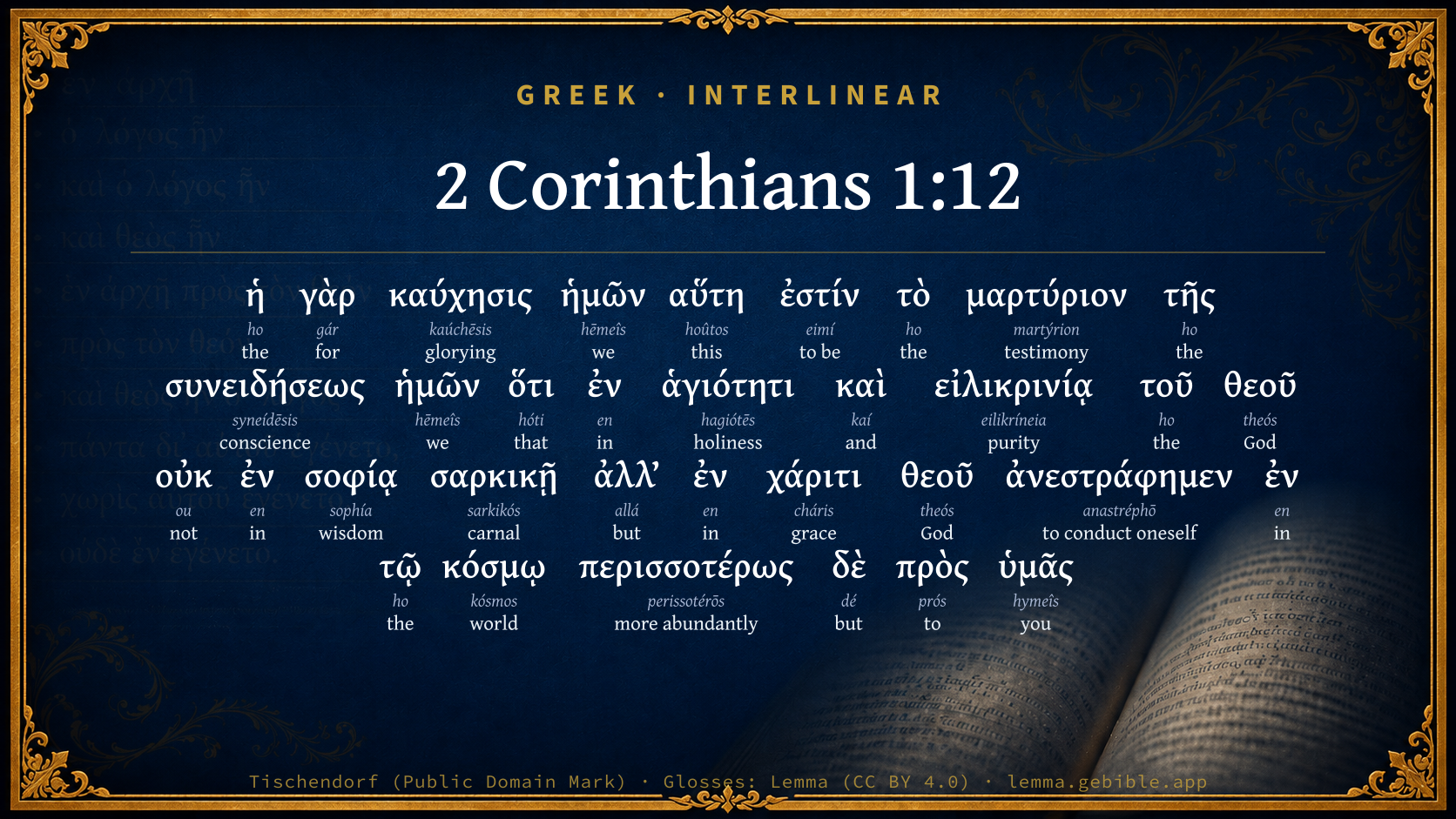
For our boasting is this: the testimony of our conscience, that in holiness and sincerity of God, not in fleshly wisdom but in the grace of God we behaved ourselves in the world, and more abundantly toward you.
Download a study sheet
One document with this verse’s original text, its word-by-word gloss line, the meaning frame, cross-references with their text, attributed commentary, and full source and license credits — printable, and it pastes into notes with its structure intact.
This verse Autodidact and up
A passage Seminary Student
Up to 50 verses in one chapter. A passage sheet keeps up to 6 commentary sources and 12 cross-references per verse, in the order this page ranks them, and says so on the sheet whenever that leaves anything out. Ask for a single verse and you get the Autodidact verse sheet above.
Everything on this page stays free to read, with no account — the sheet is a download of what is already on screen, not access to it.
Compare translations 3
The same verse in 3 English versions, stacked beneath the original-language interlinear above. Click any original word for its lexicon entry.
Each is an independent rendering of the whole verse — the interlinear is not word-aligned to these translations.
Highlighted words mark where these versions differ — a whole-verse word diff, not a word-by-word alignment.
-
World English Bible Public Domain
For our boasting is this: the testimony of our conscience, that in holiness and sincerity of God, not in fleshly wisdom but in the grace of God we behaved ourselves in the world, and more abundantly toward you.
-
King James Version Public Domain
For our rejoicing is this, the testimony of our conscience, that in simplicity and godly sincerity, not with fleshly wisdom, but by the grace of God, we have had our conversation in the world, and more abundantly to you-ward.
-
unfoldingWord Literal Text CC BY-SA 4.0
For our boasting is this: the testimony of our conscience, that we conducted ourselves in the world in holiness and sincerity of God, and not in fleshly wisdom, but in the grace of God, and more abundantly toward you.
unfoldingWord Literal Text — © unfoldingWord, licensed CC BY-SA 4.0. Word-aligned USFM3 via Door43 (git.door43.org/unfoldingWord/en_ult).
Show all 19 translations
Every available English version of this verse, each an independent rendering of the whole verse.
-
World English Bible Public Domain
For our boasting is this: the testimony of our conscience, that in holiness and sincerity of God, not in fleshly wisdom but in the grace of God we behaved ourselves in the world, and more abundantly toward you.
-
Berean Standard Bible Public Domain
And this is our boast: Our conscience testifies that we have conducted ourselves in the world, and especially in relation to you, in the holiness and sincerity that are from God—not in worldly wisdom, but in the grace of God.
-
Majority Standard Bible Public Domain
For this is our boast: Our conscience testifies that we have conducted ourselves in the world, and especially in relation to you, in the integrity and sincerity that are from God—not in worldly wisdom, but in the grace of God.
-
King James Version Public Domain
For our rejoicing is this, the testimony of our conscience, that in simplicity and godly sincerity, not with fleshly wisdom, but by the grace of God, we have had our conversation in the world, and more abundantly to you-ward.
-
American Standard Version (1901) Public Domain
For our glorifying is this, the testimony of our conscience, that in holiness and sincerity of God, not in fleshly wisdom but in the grace of God, we behaved ourselves in the world, and more abundantly to you-ward.
-
Revised Version (1885) Public Domain
For our glorying is this, the testimony of our conscience, that in holiness and sincerity of God, not in fleshly wisdom but in the grace of God, we behaved ourselves in the world, and more abundantly to you-ward.
-
Geneva Bible (1599) Public Domain
For our reioycing is this, the testimonie of our conscience, that in simplicitie and godly purenesse, and not in fleshly wisedome, but by the grace of God wee haue had our conuersation in the worlde, and most of all to you wardes.
-
Douay-Rheims (1899) Public Domain
For our glory is this, the testimony of our conscience, that in simplicity of heart and sincerity of God, and not in carnal wisdom, but in the grace of God, we have conversed in this world: and more abundantly towards you.
-
Young's Literal Translation Public Domain
For our glorying is this: the testimony of our conscience, that in simplicity and sincerity of God, not in fleshly wisdom, but in the grace of God, we did conduct ourselves in the world, and more abundantly toward you;
-
Literal Standard Version CC BY-SA 4.0
For our glorying is this: the testimony of our conscience, that in simplicity and sincerity of God, not in fleshly wisdom, but in the grace of God, we conducted ourselves in the world, and more abundantly toward you;
-
Unlocked Literal Bible CC BY-SA 4.0
We are proud of this: Our conscience testifies that we have conducted ourselves in the world with holiness and godly sincerity, not relying on fleshly wisdom but on the grace of God.
-
unfoldingWord Literal Text CC BY-SA 4.0
For our boasting is this: the testimony of our conscience, that we conducted ourselves in the world in holiness and sincerity of God, and not in fleshly wisdom, but in the grace of God, and more abundantly toward you.
-
Darby Bible Public Domain
For our boasting is this, the testimony of our conscience, that in simplicity and sincerity before God, (not in fleshly wisdom but in God's grace,) we have had our conversation in the world, and more abundantly towards you.
-
World Messianic Bible Public Domain
For our boasting is this: the testimony of our conscience that in holiness and sincerity of God, not in fleshly wisdom but in the grace of God, we behaved ourselves in the world, and more abundantly toward you.
-
Webster's Bible Public Domain
For our rejoicing is this, the testimony of our conscience, that in simplicity and godly sincerity, not with fleshly wisdom, but by the grace of God, we have had our manner of life in the world, and more abundantly toward you.
-
Free Bible Version CC BY-SA 4.0
We take pride in the fact—and our conscience confirms it—that we have acted properly towards people, and especially to you. We have followed God's principles of holiness and sincerity, not according to worldly wisdom but through the grace of God.
-
Bible in Basic English Public Domain
For our glory is in this, in the knowledge which we have that our way of life in the world, and most of all in relation to you, has been holy and true in the eyes of God; not in the wisdom of the flesh, but in the grace of God.
-
Text-Critical English NT CC BY 4.0
Now this is the reason for our confidence: Our conscience testifies that we have conducted ourselves in the world, and especially toward you, with integrity and godly sincerity, not by worldly wisdom, but by the grace of God.
-
Tyndale New Testament (1534) Public Domain
Oure reioysynge is this the testimony of oure conscience that in synglenes and godly purenes and not in flesshly wysdome but by the grace of God we have had oure conuersacion in the worlde and most of all to you wardes.
Literal Standard Version (2020), Covenant Press — licensed CC BY-SA 4.0. Text via the HelloAO Bible API (eBible.org). Unlocked Literal Bible (unfoldingWord) — licensed CC BY-SA 4.0. Text via the HelloAO Bible API (eBible.org). unfoldingWord Literal Text — © unfoldingWord, licensed CC BY-SA 4.0. Word-aligned USFM3 via Door43 (git.door43.org/unfoldingWord/en_ult). Free Bible Version, Dr. Jonathan Gallagher — licensed CC BY-SA 4.0. Text via the HelloAO Bible API (eBible.org).
Word by word
More ways to search: Search by grammar → Find every occurrence → Compare this word →
Practice this passage: Drill this verse → Learn its vocabulary →
- Appears 2× in the Greek New Testament
- First appears here
- Part of Speech
- Noun
- Case
- Dative
- Number
- Singular
- Gender
- Feminine
Full Thayer's Definition
- ἡ ho G3588 “the” Article, Nominative, Singular, Feminine
- γὰρ gár G1063 “for” Conjunction
- καύχησις kaúchēsis G2746 “glorying” Noun, Nominative, Singular, Feminine
- ἡμῶν hēmeîs G2249 “we” Personal pronoun, 1st person, Genitive, Plural
- αὕτη hoûtos G3778 “this” Demonstrative pronoun, Nominative, Singular, Feminine
- ἐστίν eimí G1510 “to be” Verb, Present, Active, Indicative, 3rd person, Singular
- τὸ ho G3588 “the” Article, Nominative, Singular, Neuter
- μαρτύριον martýrion G3142 “testimony” Noun, Nominative, Singular, Neuter
- τῆς ho G3588 “the” Article, Genitive, Singular, Feminine
- συνειδήσεως syneídēsis G4893 “conscience” Noun, Genitive, Singular, Feminine
- ἡμῶν hēmeîs G2249 “we” Personal pronoun, 1st person, Genitive, Plural
- ὅτι hóti G3754 “that” Conjunction
- ἐν en G1722 “in” Preposition
- ἁγιότητι hagiótēs G41 “holiness” Noun, Dative, Singular, Feminine
- καὶ kaí G2532 “and” Conjunction
- εἰλικρινίᾳ eilikríneia G1505 “purity” Noun, Dative, Singular, Feminine
- τοῦ ho G3588 “the” Article, Genitive, Singular, Masculine
- θεοῦ theós G2316 “God” Noun, Genitive, Singular, Masculine
- οὐκ ou G3756 “not” Particle, Negative
- ἐν en G1722 “in” Preposition
- σοφίᾳ sophía G4678 “wisdom” Noun, Dative, Singular, Feminine
- σαρκικῇ sarkikós G4559 “carnal” Adjective, Dative, Singular, Feminine
- ἀλλ’ allá G235 “but” Conjunction
- ἐν en G1722 “in” Preposition
- χάριτι cháris G5485 “grace” Noun, Dative, Singular, Feminine
- θεοῦ theós G2316 “God” Noun, Genitive, Singular, Masculine
- ἀνεστράφημεν anastréphō G390 “to conduct oneself” Verb, Aorist, Passive, Indicative, 1st person, Plural
- ἐν en G1722 “in” Preposition
- τῷ ho G3588 “the” Article, Dative, Singular, Masculine
- κόσμῳ kósmos G2889 “world” Noun, Dative, Singular, Masculine
- περισσοτέρως perissotérōs G4056 “more abundantly” Adverb, Comparative
- δὲ dé G1161 “but” Conjunction
- πρὸς prós G4314 “to” Preposition
- ὑμᾶς hymeîs G5210 “you” Personal pronoun, 2nd person, Accusative, Plural
About this verse
These counts appear in no published source. They are computed here, from the morphology-tagged text and Lemma’s own curated glosses. What Lemma adds →
- 34
- words
- 25
- distinct lemmas
- Pauline Epistles
- section
Notable vocabulary
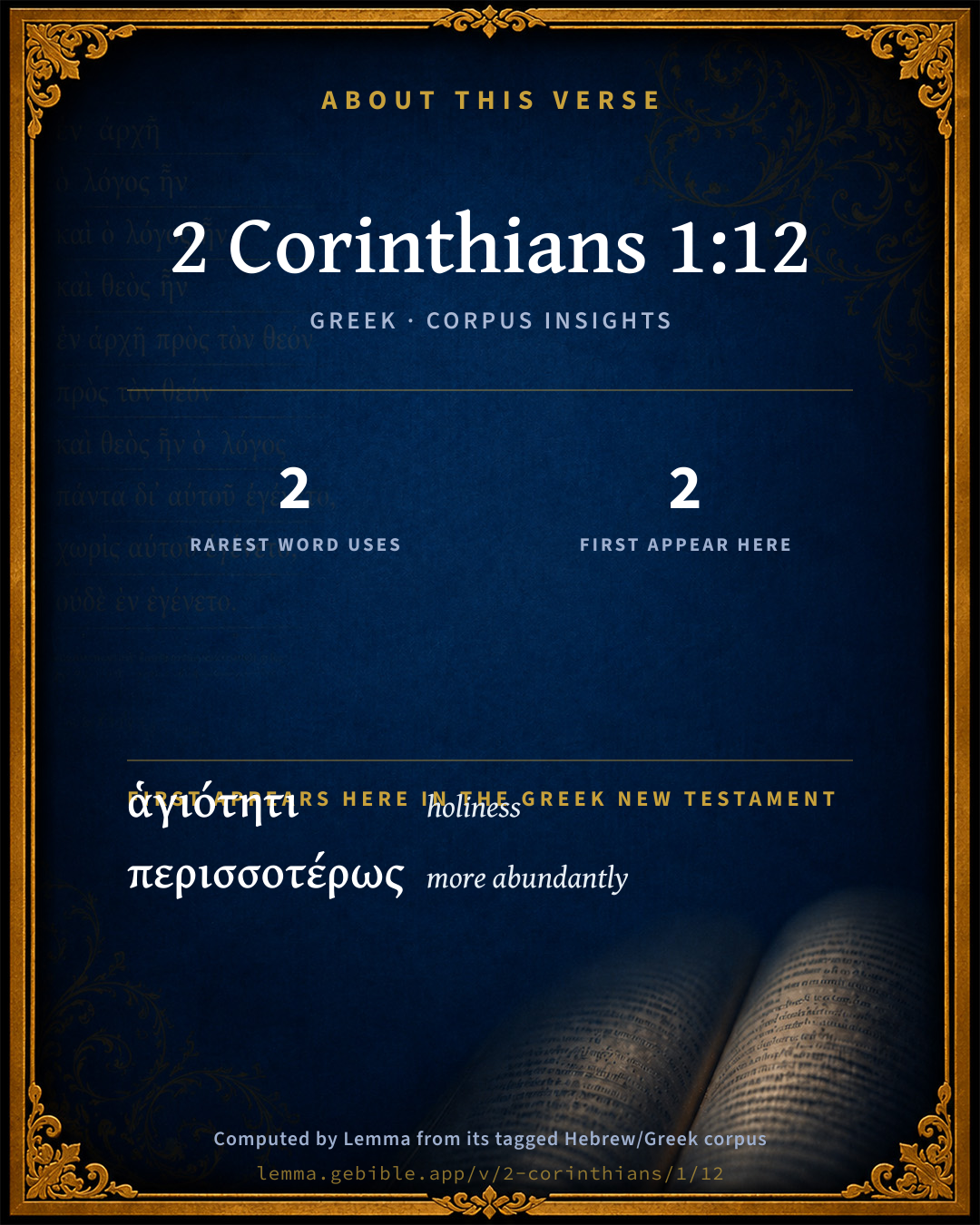
The rarest word here is ἁγιότητι holiness G41 — appearing just 2 times in the whole Greek New Testament.
First appearance in Scripture
These words make their first canonical appearance in the Greek New Testament here:
Shared distinctive vocabulary
ἁγιότητι holiness G41 occurs in 2 verses of the Greek New Testament. Also found in:
Cross-references
37Topical passages linked to 2 Corinthians 1:12 in the Treasury of Scripture Knowledge — connected by theme and wording, ordered by reader-vote popularity; previews shown in the World English Bible.
- 1 Corinthians 2:13 Which things also we speak, not in words which man's wisdom teaches, but which the Holy Spirit teaches, comparing spiritual things with spiritual things.
- 2 Corinthians 2:17 For we are not as so many, peddling the word of God. But as of sincerity, but as of God, in the sight of God, we speak in Christ.
- James 3:13–18 Who is wise and understanding among you? Let him show by his good conduct that his deeds are done in gentleness of wisdom.
- 1 Thessalonians 2:10 You are witnesses with God, how holy, righteously, and blamelessly we behaved ourselves toward you who believe.
- Job 13:15 Behold, he will kill me; I have no hope. Nevertheless, I will maintain my ways before him.
- Job 23:10–12 But he knows the way that I take. When he has tried me, I shall come forth like gold.
- Acts 23:1 Paul, looking steadfastly at the council, said, "Brothers, I have lived before God in all good conscience until this day."
- Acts 24:16 Herein I also practice always having a conscience void of offense toward God and men.
- 1 Corinthians 15:10 But by the grace of God I am what I am. His grace which was bestowed on me was not futile, but I worked more than all of them; yet not I, but the grace of God which was with me.
- 2 Corinthians 4:2 But we have renounced the hidden things of shame, not walking in craftiness, nor handling the word of God deceitfully; but by the manifestation of the truth commending ourselves to every man's conscience in the sight of God.
- 2 Corinthians 8:8 I speak not by way of commandment, but as proving through the earnestness of others the sincerity also of your love.
- 2 Corinthians 12:15–19 I will most gladly spend and be spent for your souls. If I love you more abundantly, am I loved the less?
- Hebrews 13:18 Pray for us, for we are persuaded that we have a good conscience, desiring to live honorably in all things.
- 1 Peter 3:21 This is a symbol of baptism, which now saves you-- not the putting away of the filth of the flesh, but the answer of a good conscience toward God, through the resurrection of Jesus Christ,
- Job 27:5–6 Far be it from me that I should justify you. Until I die I will not put away my integrity from me.
- Job 31:1–40 "I made a covenant with my eyes, How then should I look lustfully at a young woman?
- Psalms 7:3–5 Yahweh, my God, if I have done this, If there is iniquity in my hands,
- Psalms 44:17–21 All this has come on us, Yet have we not forgotten you, Neither have we been false to your covenant.
- Isaiah 38:3 and said, Remember now, Yahweh, I beg you, how I have walked before you in truth and with a perfect heart, and have done that which is good in your sight. Hezekiah wept sore.
- Romans 9:1 I tell the truth in Christ. I am not lying, my conscience testifying with me in the Holy Spirit,
- Romans 16:18–19 For those who are such don't serve our Lord, Jesus Christ, but their own belly; and by their smooth and flattering speech, they deceive the hearts of the innocent.
- 1 Corinthians 2:4–5 My speech and my preaching were not in persuasive words of human wisdom, but in demonstration of the Spirit and of power,
- 1 Corinthians 4:4 For I know nothing against myself. Yet I am not justified by this, but he who judges me is the Lord.
- 1 Corinthians 5:8 Therefore let us keep the feast, not with old yeast, neither with the yeast of malice and wickedness, but with the unleavened bread of sincerity and truth.
- 2 Corinthians 1:17 When I therefore was thus determined, did I show fickleness? Or the things that I purpose, do I purpose according to the flesh, that with me there should be the "Yes, yes" and the "No, no?"
- 2 Corinthians 11:3 But I am afraid that somehow, as the serpent deceived Eve in his craftiness, so your minds might be corrupted from the simplicity that is in Christ.
- Galatians 6:4 But let each man test his own work, and then he will take pride in himself and not in his neighbor.
- Ephesians 6:14 Stand therefore, having the utility belt of truth buckled around your waist, and having put on the breastplate of righteousness,
- Philippians 1:10 so that you may approve the things that are excellent; that you may be sincere and without offense to the day of Christ;
- 1 Timothy 1:5 but the end of the charge is love, out of a pure heart and a good conscience and unfeigned faith;
- 1 Timothy 1:19–20 holding faith and a good conscience; which some having thrust away made a shipwreck concerning the faith;
- 1 Peter 3:16 having a good conscience; that, while you are spoken against as evildoers, they may be disappointed who curse your good manner of life in Christ.
- 1 John 3:19–22 And by this we know that we are of the truth, and persuade our hearts before him,
- Joshua 24:14 Now therefore fear Yahweh, and serve him in sincerity and in truth; and put away the gods which your fathers served beyond the River, and in Egypt; and serve you Yahweh.
- 2 Corinthians 10:2–4 Yes, I beg you that I may not, when present, show courage with the confidence with which I intend to be bold against some, who consider us to be walking according to the flesh.
- Titus 2:7 in all things showing yourself an example of good works; in your teaching showing integrity, seriousness, incorruptibility,
- James 4:6 But he gives more grace. Therefore it says, "God resists the proud, but gives grace to the humble."
Cross-references courtesy of OpenBible.info (CC BY 4.0).
Where the printed editions differ
1 variantPlaces in this verse where the major printed Greek editions disagree on the wording in a way that affects the translation — a comparison of editions, not a manuscript-by-manuscript collation. The editions are the modern critical texts (Nestlé-Aland 28/27, SBL, Westcott-Hort, Tregelles, Tyndale House) and the traditional texts behind the KJV (the Textus Receptus and the Byzantine/Majority text). It is not a claim about which reading is original.
-
Different wording
ἁπλότητι
“openness”
In NA28NA27TRByz Not in TynSBLWHTregἁγιότητι (hagiotēti) '[the] holiness' occurs in a few manuscripts (Tyn+SBL+WH+Treg) instead of ἁπλότητι (haplotēti) 'openness' in older manuscripts (NA28+NA27+TR+Byz)
Textual data: Translators Amalgamated Greek New Testament (STEPBible TAGNT) · CC BY 4.0.
Lesson kit
Teaching starters — assembled from the data on this page, not authored interpretation. Every prompt links to the verse data it draws on. Edit before teaching.
2 Corinthians, in the Pauline Epistles, opens this verse with 34 words (25 distinct Greek lemmas). Its most distinctive word is hagiótēs (“holiness”). A historical commentator’s framing appears above. Read the whole chapter for the surrounding context.
Discussion questions
- The word hagiótēs carries the sense “holiness.” How does it shape the verse?
- 2 words here appear for the first time in Scripture. What is being introduced at this debut?
- Hebrews 12:10 shares the word «holiness» with this verse. How do the two illuminate each other?
- “God” occurs 2× in this one verse. What is the effect of the repetition?
- The translations on this page render this verse differently — a whole-verse word diff, not a word-by-word alignment. What might account for the different wordings?
- Reading how Matthew Henry's Commentary and The Biblical Illustrator read this verse, where do the two commentators agree and where do they part?
Things to notice
- 2 words make their first canonical appearance in Scripture here.
- These translations choose different wording for 14 words in this verse.
- “God” occurs 2× in this single verse.
- 25 distinct Greek lemmas span 34 words in this verse.
Commentary
Notes on 2 Corinthians 1:12 from classic Christian and Jewish commentators (each source and its license shown beneath its notes). The classic Christian expositions comment on the surrounding passage and are grouped to its opening verse, so a note may address several verses; the Jewish commentaries on the Tanakh (Rashi and others) are per-verse, so they appear only where the commentator wrote on this verse.
Lemma curates 59 commentaries, every one of them public domain or Creative Commons licensed, each selected and text-cleaned for this edition rather than reprinted as found. About our sources →
Matthew Henry's Commentary
Matthew Henry's Commentary on the Whole Bible (1708–1710) — public domain (CC PDM 1.0). Text via the HelloAO Bible API.
The Biblical Illustrator
Joseph S. Exell
The Biblical Illustrator, edited by Joseph S. Exell (c. 1880s–1900s) — public domain. Text from a community e-Sword module.
Joseph Benson's Commentary
Joseph Benson's Commentary on the Old and New Testaments (1811–1818) — public domain. Text from a community e-Sword module.
The Preacher's Complete Homiletical Commentary
Joseph S. Exell (gen. ed.)
The Preacher's Complete Homiletical Commentary (gen. ed. Joseph S. Exell; Funk & Wagnalls, c. 1892) — public domain (pre-1929). A full-Bible homiletical/sermon-outline anthology covering 65 of 66 books (2 John is absent from the source module). Text from a community e-Sword module.
Lange's Commentary on the Holy Scriptures
Lange's Commentary on the Holy Scriptures (Critical, Doctrinal, and Homiletical), ed. John Peter Lange, English translation edited by Philip Schaff (1864–1880) — public domain. Text from a community e-Sword module.
Godbey's Commentary on the New Testament
William B. Godbey
William B. Godbey, Commentary on the New Testament (1896–1900) — public domain. Text from a community e-Sword module.
Tyndale Open Study Notes
Tyndale Open Resources
Tyndale Open Study Notes — © Tyndale Open Resources, licensed CC BY-SA 4.0. Text via the HelloAO Bible API.
Bengel's Gnomon
Johann Albrecht Bengel
Bengel's Gnomon of the New Testament — English translation (T&T Clark, Edinburgh, 1860) — public domain. Text from a community e-Sword module.
Meyer's Critical & Exegetical Commentary
Heinrich August Wilhelm Meyer
Meyer — Critical and Exegetical Commentary on the New Testament — English translation by Peter Christie, edited by Frederick Crombie (T&T Clark, 1880) — public domain. Text from a community e-Sword module.
Expositor's Greek Testament
ed. W. Robertson Nicoll
The Expositor's Greek Testament, edited by W. Robertson Nicoll (1897–1910) — public domain. Text from a community e-Sword module.
Geneva Bible (1599)
Geneva Bible translators
Geneva Bible (1599) marginal notes — public domain. Text via Bolls.life.
Jamieson, Fausset & Brown
Robert Jamieson, A. R. Fausset & David Brown
Jamieson, Fausset & Brown — Commentary Critical and Explanatory on the Whole Bible (1871) — public domain (CC PDM 1.0). Text via the HelloAO Bible API.
Adam Clarke's Commentary
Adam Clarke's Commentary on the Bible (1810–1826) — public domain. Text from a community e-Sword/MySword module.
John Calvin's Commentaries
John Calvin's Commentaries (1540-1563) — public domain. Text from the Calvin Translation Society English edition (1840s-50s) via the Christian Classics Ethereal Library (ccel.org). Calvin's coverage is partial (roughly two-thirds of the Bible); uncommented books and verses are honest gaps, never fabricated. The 19th-century editor's footnotes and remarks are omitted so the notes are faithfully Calvin's own voice.
Ellicott's Commentary for English Readers
A Bible Commentary for English Readers, edited by Charles John Ellicott (1878–1897) — public domain. Text from a community e-Sword module.
The Cambridge Bible for Schools and Colleges
gen. ed. J. J. S. Perowne
The Cambridge Bible for Schools and Colleges (gen. ed. J. J. S. Perowne; Cambridge University Press, 1878–1918) — public domain. Text from a community e-Sword module.
John Gill's Exposition
John Gill's Exposition of the Whole Bible (1746–1763) — public domain (CC PDM 1.0). Text via the HelloAO Bible API.
Trapp's Complete Commentary
John Trapp
John Trapp, A Commentary or Exposition upon All the Books of the Old and New Testament (1647–1656) — public domain. Text from a community e-Sword module.
Albert Barnes' Notes on the Bible
Albert Barnes' Notes on the Bible (1834–1885) — public domain. Text from a community e-Sword/MySword module.
Haydock's Catholic Bible Commentary
George Leo Haydock (1774–1849), Haydock's Catholic Family Bible and Commentary, 1859 edition — public domain. Excludes Psalms (Douay-Rheims chapter numbering differs from Protestant) and Deuterocanonical books (Catholic canon only).
Matthew Poole's English Annotations
Matthew Poole's English Annotations on the Holy Bible (1683–1685) — public domain. Text from a community e-Sword/MySword module.
Whedon's Commentary on the Bible
Daniel D. Whedon
Daniel D. Whedon (gen. ed.), Commentary on the Old and New Testaments (1874–1909) — public domain. Text from a community e-Sword module.
The Pulpit Commentary
The Pulpit Commentary (1880–1919), ed. H.D.M. Spence-Jones & Joseph S. Exell — public domain. Text from a community e-Sword module.
John Wesley's Explanatory Notes
John Wesley, Explanatory Notes Upon the Whole Bible (1754–1765) — public domain. Text via the GEBible commentary corpus.
Scofield Reference Notes
C. I. Scofield
The Scofield Reference Bible (1917 edition), notes by C. I. Scofield — public domain. Text from a community e-Sword module.
Kretzmann's Popular Commentary
Paul E. Kretzmann
Paul E. Kretzmann, Popular Commentary of the Bible (1921–1924) — public domain. Text from a community e-Sword module.
Burkitt's Expository Notes on the New Testament
William Burkitt
William Burkitt's Expository Notes on the New Testament (1700–1703) — public domain. Text from a community e-Sword module.
McGarvey & Pendleton's Commentaries
J. W. McGarvey
J. W. McGarvey (with Philip Y. Pendleton), Commentaries on the New Testament (The Fourfold Gospel, 1914; Acts; and the epistles) — public domain. Text from a community e-Sword/MySword module.
The People's New Testament
B. W. Johnson
B. W. Johnson's The People's New Testament with Notes (1889–1891) — public domain. Electronic text from the Christian Classics Ethereal Library (CCEL) ThML edition.
unfoldingWord translationNotes
Door43 World Missions Community
unfoldingWord translationNotes — © Distant Shores Media and the Door43 World Missions Community, licensed CC BY-SA 4.0. Source: git.door43.org/Door43/en_tn.
Cambridge Greek Testament for Schools and Colleges
Cambridge Greek Testament for Schools and Colleges (Cambridge University Press, 1896; 21 vols, various authors incl. Carr, Maclear, Plummer, Farrar, Lumby, Moule, M. R. James, Simcox) — public domain. Text from a community e-Sword module.
Alford’s Greek Testament
Henry Alford
Henry Alford, The Greek Testament (1849–1861) — public domain. Text from a community e-Sword module.
International Critical Commentary
International Critical Commentary — older volumes (1896–1929), various authors — public domain. Text from a community e-Sword module.
Vincent's Word Studies in the New Testament
Marvin R. Vincent
Marvin R. Vincent, Word Studies in the New Testament (1887–1900) — public domain. Text from a community e-Sword/MySword module.