
1 Corinthians 15:34

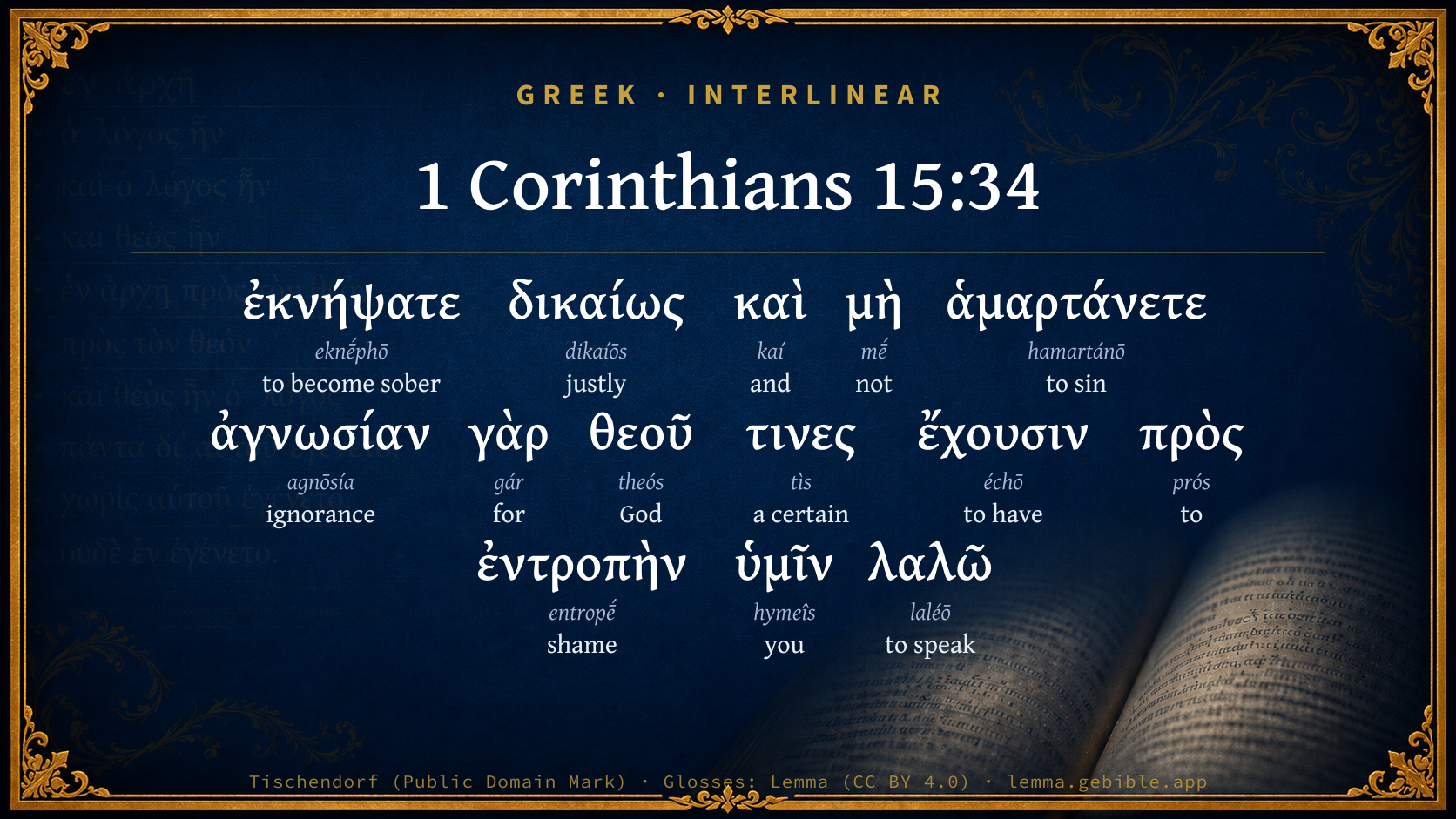
Greek (Tischendorf 8th ed.) 1 Corinthians 15:34 appears in the Greek New Testament. The text above is from the Tischendorf 8th edition. Each word links to its Strong’s number and a concise gloss. Click any word for its full Thayer’s Greek Lexicon entry.
Download image
Cite this verse

1 Corinthians 15:34 (World English Bible). Public Domain. Lemma interlinear Bible study tool, https://lemma.gebible.app/v/1-corinthians/15/34.

Show BibTeX & RIS
BibTeX
RIS
English Translation
Wake up righteously, and don't sin, for some have no knowledge of God. I say this to your shame.
World English Bible · Public Domain
Highlights
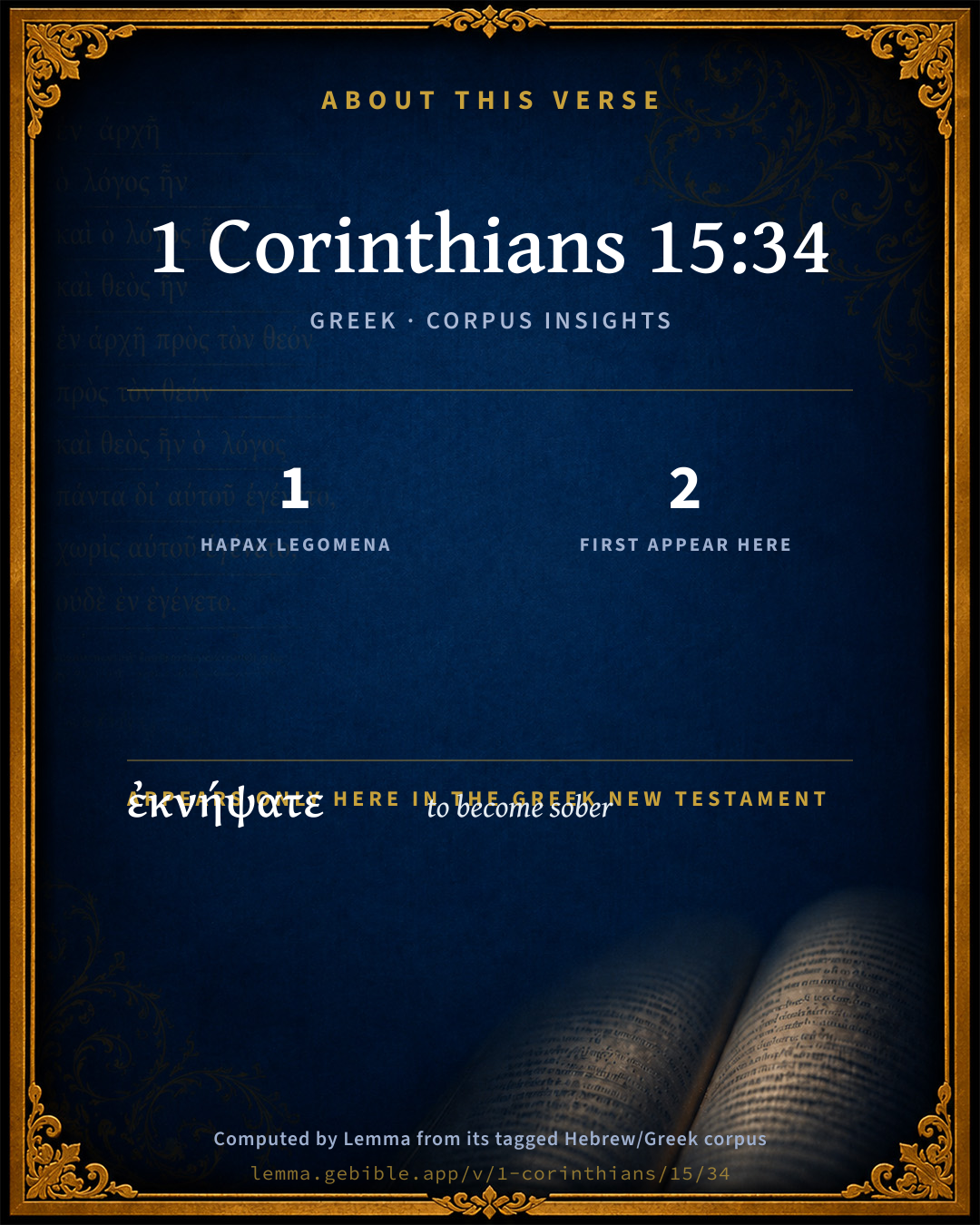
  • 1 hapax legomenon — only here in the Greek New Testament
  • 2 first appearances in the Greek New Testament
Full analysis ↓
Download a study sheet

One document with this verse’s original text, its word-by-word gloss line, the meaning frame, cross-references with their text, attributed commentary, and full source and license credits — printable, and it pastes into notes with its structure intact.

This verse Autodidact and up

Study sheet (.html) Plain text (.txt)

A passage Seminary Student

Up to 50 verses in one chapter. A passage sheet keeps up to 6 commentary sources and 12 cross-references per verse, in the order this page ranks them, and says so on the sheet whenever that leaves anything out. Ask for a single verse and you get the Autodidact verse sheet above.

Everything on this page stays free to read, with no account — the sheet is a download of what is already on screen, not access to it.

Want to remove ads? Support Godless Engineer
Compare translations 3

The same verse in 3 English versions, stacked beneath the original-language interlinear above. Click any original word for its lexicon entry.

Each is an independent rendering of the whole verse — the interlinear is not word-aligned to these translations.

Highlighted words mark where these versions differ — a whole-verse word diff, not a word-by-word alignment.

  • World English Bible Public Domain
    Wake up righteously, and don't sin, for some have no knowledge of God. I say this to your shame.
  • King James Version Public Domain
    Awake to righteousness, and sin not; for some have not the knowledge of God: I speak this to your shame.
  • unfoldingWord Literal Text CC BY-SA 4.0
    Be sober, as is right! And do not keep sinning. For some have no knowledge of God—I say this to your shame.

unfoldingWord Literal Text — © unfoldingWord, licensed CC BY-SA 4.0. Word-aligned USFM3 via Door43 (git.door43.org/unfoldingWord/en_ult).

Versions to compare (up to 4)

3 of 4 selected

Show all 19 translations

Every available English version of this verse, each an independent rendering of the whole verse.

  • World English Bible Public Domain
    Wake up righteously, and don't sin, for some have no knowledge of God. I say this to your shame.
  • Berean Standard Bible Public Domain
    Sober up as you ought, and stop sinning; for some of you are ignorant of God. I say this to your shame.
  • Majority Standard Bible Public Domain
    Sober up as you ought, and stop sinning; for some of you are ignorant of God. I say this to your shame.
  • King James Version Public Domain
    Awake to righteousness, and sin not; for some have not the knowledge of God: I speak this to your shame.
  • American Standard Version (1901) Public Domain
    Awake to soberness righteously, and sin not; for some have no knowledge of God: I speak `this' to move you to shame.
  • Revised Version (1885) Public Domain
    Awake up righteously, and sin not; for some have no knowledge of God: I speak this to move you to shame.
  • Geneva Bible (1599) Public Domain
    Awake to liue righteously, and sinne not: for some haue not ye knowledge of God, I speake this to your shame.
  • Douay-Rheims (1899) Public Domain
    Awake, ye just, and sin not. For some have not the knowledge of God, I speak it to your shame.
  • Young's Literal Translation Public Domain
    awake up, as is right, and sin not; for certain have an ignorance of God; for shame to you I say `it'.
  • Literal Standard Version CC BY-SA 4.0
    wake up, as is right, and do not sin; for some have an ignorance of God; I say [it] to you for shame.
  • Unlocked Literal Bible CC BY-SA 4.0
    Sober up! Live righteously! Do not keep sinning. For some of you have no knowledge of God. I say this to your shame.
  • unfoldingWord Literal Text CC BY-SA 4.0
    Be sober, as is right! And do not keep sinning. For some have no knowledge of God—I say this to your shame.
  • Darby Bible Public Domain
    Awake up righteously, and sin not; for some are ignorant of God: I speak to you as a matter of shame.
  • World Messianic Bible Public Domain
    Wake up righteously and don’t sin, for some have no knowledge of God. I say this to your shame.
  • Webster's Bible Public Domain
    Awake to righteousness, and sin not; for some have not the knowledge of God. I speak this to your shame.
  • Free Bible Version CC BY-SA 4.0
    Come to your senses as you should, and stop sinning! Some of you don't know God. I tell you this to shame you.
  • Bible in Basic English Public Domain
    Be awake to righteousness and keep yourselves from sin; for some have no knowledge of God: I say this to put you to shame.
  • Text-Critical English NT CC BY 4.0
    Come to your senses, as is right, and stop sinning. For there are some who are ignorant of God. I say this to your shame.
  • Tyndale New Testament (1534) Public Domain
    Awake truely out of slepe and synne not. For some have not the knowlege of God. I speake this vnto youre rebuke.

Literal Standard Version (2020), Covenant Press — licensed CC BY-SA 4.0. Text via the HelloAO Bible API (eBible.org). Unlocked Literal Bible (unfoldingWord) — licensed CC BY-SA 4.0. Text via the HelloAO Bible API (eBible.org). unfoldingWord Literal Text — © unfoldingWord, licensed CC BY-SA 4.0. Word-aligned USFM3 via Door43 (git.door43.org/unfoldingWord/en_ult). Free Bible Version, Dr. Jonathan Gallagher — licensed CC BY-SA 4.0. Text via the HelloAO Bible API (eBible.org).

Word by word

More ways to search: Search by grammar → Find every occurrence → Compare this word →

Practice this passage: Drill this verse → Learn its vocabulary →

ἐκνήψατε
eknḗphō
G1594
“to become sober”
Verb, Aorist, Active, Imperative, 2nd person, Plural
Part of Speech
Verb
Tense
Aorist
Voice
Active
Mood
Imperative
Person
2nd person
Number
Plural
Full Thayer's Definition

Origin: from G1537 and G3525

TDNT: 19:41,6

1. to return to one's self from drunkenness, become sober 2. metaph. to return to soberness of mind
  1. δικαίως dikaíōs G1346 “justly” Adverb
  2. καὶ kaí G2532 “and” Conjunction
  3. μὴ mḗ G3361 “not” Particle, Negative
  4. ἁμαρτάνετε hamartánō G264 “to sin” Verb, Present, Active, Imperative, 2nd person, Plural
  5. ἀγνωσίαν agnōsía G56 “ignorance” Noun, Accusative, Singular, Feminine
  6. γὰρ gár G1063 “for” Conjunction
  7. θεοῦ theós G2316 “God” Noun, Genitive, Singular, Masculine
  8. τινες tìs G5100 “a certain” Indefinite pronoun, Nominative, Plural, Masculine
  9. ἔχουσιν échō G2192 “to have” Verb, Present, Active, Indicative, 3rd person, Plural
  10. πρὸς prós G4314 “to” Preposition
  11. ἐντροπὴν entropḗ G1791 “shame” Noun, Accusative, Singular, Feminine
  12. ὑμῖν hymeîs G5210 “you” Personal pronoun, 2nd person, Dative, Plural
  13. λαλῶ laléō G2980 “to speak” Verb, Present, Active, Indicative, 1st person, Singular

About this verse

These counts appear in no published source. They are computed here, from the morphology-tagged text and Lemma’s own curated glosses. What Lemma adds →

14
words
14
distinct lemmas
Pauline Epistles
section

Notable vocabulary

1 hapax legomenon — a word that appears only here in the entire Greek New Testament:

  • ἐκνήψατε to become sober G1594

First appearance in Scripture

These words make their first canonical appearance in the Greek New Testament here:

  • ἐκνήψατε to become sober G1594
  • ἀγνωσίαν ignorance G56

Shared distinctive vocabulary

ἀγνωσίαν ignorance G56 occurs in 2 verses of the Greek New Testament. Also found in:
Cross-references

13

Topical passages linked to 1 Corinthians 15:34 in the Treasury of Scripture Knowledge — connected by theme and wording, ordered by reader-vote popularity; previews shown in the World English Bible.

  • 1 Corinthians 6:5 I say this to move you to shame. Isn't there even one wise man among you who would be able to decide between his brothers?
  • Romans 13:11 Do this, knowing the time, that it is already time for you to awaken out of sleep, for salvation is now nearer to us than when we first believed.
  • Hebrews 5:11–12 About him we have many words to say, and hard to interpret, seeing you have become dull of hearing.
  • Joel 1:5 Wake up, you drunkards, and weep! Wail, all you drinkers of wine, because of the sweet wine; For it is cut off from your mouth.
  • Ephesians 5:14 Therefore he says, "Awake, you who sleep, and arise from the dead, and Christ will shine on you."
  • 1 Corinthians 8:7 However, that knowledge isn't in all men. But some, with consciousness of the idol until now, eat as of a thing sacrificed to an idol, and their conscience, being weak, is defiled.
  • Jonah 1:6 So the shipmaster came to him, and said to him, "What do you mean, sleeper? Arise, call on your gods! Maybe the gods will notice us, so that we won't perish."
  • John 5:14 Afterward Jesus found him in the temple, and said to him, "Behold, you are made well. Sin no more, so that nothing worse happens to you."
  • John 8:11 She said, "No one, Lord." Jesus said, "Neither do I condemn you. Go your way. From now on, sin no more."
  • Romans 1:28 Even as they refused to have God in their knowledge, God gave them up to a reprobate mind, to do those things which are not fitting;
  • Psalms 119:11 I have hidden your word in my heart, That I might not sin against you.
  • 1 Thessalonians 4:5 not in the passion of lust, even as the Gentiles who don't know God;
  • Psalms 4:4 Stand in awe, and don't sin. Search your own heart on your bed, and be still. Selah.

Cross-references courtesy of OpenBible.info (CC BY 4.0).

Commentary

Notes on 1 Corinthians 15:34 from classic Christian and Jewish commentators (each source and its license shown beneath its notes). The classic Christian expositions comment on the surrounding passage and are grouped to its opening verse, so a note may address several verses; the Jewish commentaries on the Tanakh (Rashi and others) are per-verse, so they appear only where the commentator wrote on this verse.

Lemma curates 59 commentaries, every one of them public domain or Creative Commons licensed, each selected and text-cleaned for this edition rather than reprinted as found. About our sources →

The Biblical Illustrator

Joseph S. Exell

1Co_15:34

Awake to righteousness.

Moral resurrection

This chapter generally deals with the resurrection of the body; but the text refers to the resurrection of the soul. And this is a greater and more glorious work than the other, because--

I. The soul is greater than the body. What is the casket to the jewel, the house to the tenant, the barque to the crew? Heap worlds on worlds; one soul outweighs them all.

2. It can only be accomplished with the full concurrence of the man. In the material resurrection the man has no choice, but the soul will not rise without its own consent.

3. It requires a higher agency. Mere volition and force will effect the material resurrection. Christ had only to say to Lazarus, Come forth; but thousands of souls dead in sin He appealed to, yet but few came out of their spiritual graves. Mere volition will not do it; it requires argument, suasion, love, example.

4. It is an invaluable blessing in itself. The material resurrection will be an intolerable curse to the wicked; but the resurrection of the soul is evermore a blessing.

5. It is necessary to qualify us to understand the resurrection of the body. This is suggested by the text when viewed in connection with the apostles object. Rectitude of soul is a better interpreter than any hermeneutic skill. Note--

I. The condition from which man is summoned. What is moral sleep?

1. It is not the sleep of--

(1) The animal faculties; they are often more active in consequence of the sleep of the soul.

(2) The intellectual powers; the imagination may be as active as Byrons, the reason as Voltaires, and yet the soul may be asleep.

(3) The social sympathies; they are active when the soul is asleep.

2. When is the soul asleep? When it is not inspired in all its powers by supreme love to God. This is not like sleep--

(1) In being the ordination of God, as is natural sleep; it is contrary to His desire and command.

(2) In being the means of refreshment. Moral sleep is a corroding and an exhausting state.

3. There are certain points of resemblance which warrant the figure.

(1) Insensibility. There is a world of grand and solemn realities around the sinner; voices deep and loud speak to him; and visions of awful majesty pass before him. Yet he is dead to all. He is dead to himself and to God.

(2) Fictitiousness. Objects flit before the natural sleeper that have no real existence; to the moral sleeper, heaven, hell, God, eternity, are but as dreams. Sometimes they may startle the man, but like the dream, the impression soon departs. The life of a sinner is fiction--a great lie.

(3) Transitoriness. Sleep is not a permanent state. They that sleep, sleep in the night. There is a dark spiritual night brooding over the moral sleeper, and one of two very different mornings must break the slumbers of all.

(a) There is the morning of spiritual reformation--the morning when God commands the light, etc. Then the soul awakes, and finds itself in a new world--a world full of God, and exclaims, Surely God is in this place, etc.

(b) The other morning is the morning of retribution. The awful manifestations of that morning will startle the most sleepy into active consciousness.

II. The state into which we are summoned. Men are not required to awake to business, pleasure, or fashion; they are all alive in relation to these things. But concerning righteousness they are asleep.

1. The state of righteousness includes--

(1)Living righteously towards God and His universe.

(a) Be just to yourself; that is virtue.

(b) Be just to others; that is morality.

(c) Be just to God; this is piety.

(2) Being treated as righteous.

2. The getting of man into this righteous state is ascribed to Christ. He furbishes--

(1) The moral force by which it is done.

(2) The moral reasons by which the past wrongs may be overlooked. He is made unto us, etc.

3. This righteous state includes--

(1) Harmonious action.

(2) Social usefulness.

(3) Spiritual progress.

(4) Heavenly fellowships.

III. The voice by which we are summoned. Awake. Paul is but the organ of the Divine voice. This Divine voice sounds through--

1. All history. Turn over the sin-stained annals of the world, and you will find every chapter pealing with the word, Awake. All the miseries of the awful past sprang from the want of righteousness.

2. The moral constitution of our nature. Conscience, with more or less emphasis, calls upon every man to awake.

3. The memories of sainted friends.

4. The whole Bible of God. (D. Thomas, D.D.)

A call to the unconverted

I. A lamentable condition. Some have not the knowledge of God.

II. A merited reproof. This is shameful with all the means of enlightenment around you, and implies the love of darkness.

III. An earnest call to a better life.

1. Awake. Seek forgiveness.

2. Put away sin and follow after holiness. (J. Lyth, D.D.)

I. Observe that a state of sin is here represented by sleep.

1. Unconcerned.

2. Unapprehensive of danger.

II. Observe that man, being careless and secure in the midst of the greatest dangers, he is called upon to awake. This is an instance of the care and compassion of God. He calls us by His providences, His Holy Spirit, His Word, His ministers, etc.

III. Observe that we are called to awake to righteousness, and to renounce sin.

1. Awake to righteousness.

(1) To a sense of the necessity of righteousness.

(2) To the practice and pursuit of righteousness.

2. And sin not.

(1) Sin not, in hope that there is no resurrection.

(2) Sin not, in hope that there is no judgment.

(3) Sin not, in hope that there is no state of future punishment.

(4) Sin not, in hope of future repentance.

(5) Sin no more. Why shouldst thou destroy thyself, and stand in jeopardy every hour? The soul that sinneth shall die. The wages of sin is death.

IV. Observe the charge alleged against some of the Corinthians. Some have not the knowledge of God. May not the same thing be charged upon some of us? Do we know God, so as to fear Him, so as to be reconciled unto Him by Christ, so as to love Him, so as to serve Him with a perfect heart and willing mind? If not, then in the apostles sense we do not know Him. I speak this to your shame. It is our shame. Because we have so many means of knowing Him, so many reasons to know Him drawn from our wants, etc. (J. Walker, D.D.)

Sin not.--

Sin not

I. The condition implied.

1. Ignorance.

2. Insensibility.

3. Peril.

II. The earnest call.

1. To serious reflection.

2. To righteousness, both the knowledge and practise of it.

3. To vigilance. (J. Walker, D.D.)

The sins Easter Day condemns

This warning, in the midst of an elaborate argument about the resurrection, reminds us that Christianity is intended to be a regulative rather than a speculative system, that it is a law for our life, not merely a theme for our thought. Paul brings to bear the resurrection as an argument against sinning. It is an argument against--

I. Degrading the body. It is the body that is to rise as well as the spirit. Avoid, then, both the extreme of pampering it in animalism, and of despising it in asceticism.

II. Absorption in this world. Beyond the time-world there is another; beneath the sense-world there is another. Live for the unseen and the eternal.

III. Wronging Christ, For us He was the Conqueror, which implies that for us He went through the battle. The resurrection is--

1. The seal of His Divinity. Shall we slight His Divinity?

2. The sign of His power. Shall we defy His power?

3. The token of His love. Shall we neglect His love? (U. R. Thomas.)

For some have not the knowledge of God: I speak this to your shame.--

The knowledge of God

1. Knowledge lies at the foundation of religion; for, if we are to serve and worship God we ought to know who and why we are to worship; and it is this which renders religion a reasonable service.

2. Ignorance is the fruitful source of wickedness. The heathen were devoted to the grossest abominations--because they did not like to retain God in their knowledge, the Corinthians were erroneous in doctrine and licentious in practice, because they had not the knowledge of God.

I. What is this knowledge? It cannot be a knowledge of the Divine essence; for of the essence of anything we know just nothing at all. Canst thou, by searching, find out God? etc. This knowledge must be considered as--

1. Theoretical to begin with. From the visible things of creation may be clearly inferred the existence and perfections of a great First Cause; but we can learn nothing of His justice or His mercy, or of the method of reconciliation with Him through Christ from nature. The Bible is the only book whence we can acquire a satisfactory knowledge of God; because there God has been pleased to give a revelation of Himself. Here He is seen as the just God and the compassionate Saviour, giving His Son to death that He may make the sinner alive.

2. Experimental. A person may study navigation at school and acquire a theoretical knowledge of it, but he must reduce that knowledge to practice, then, becoming a skilful pilot, his knowledge is experimental. We may study medicine by books, or at a university; but until we walk the hospitals our knowledge is not experimental. Now, we may believe that God knows all things, and our belief may be merely theory; but when He has removed the veil from our understandings, and shown us all that is in our hearts, then we have experience of the infinite knowledge of God. We may believe that God is pure, and this may be all theory; but when we have been given to see sin as exceeding sinful, Then we have an experience of the purity of God. We believe that God is almighty--but that, too, may be all theory. When, however, He has effected a change in our moral nature, which is nothing less than a new creation, then have we experimental proof of the power of God. We may believe that Christ is a Saviour; but this may be nothing more than a mere general apprehension; but when we have seen ourselves guilty and undone, and when He has said, Thy sins be forgiven thee, we experimentally know the power of the grace of the Lord Jesus.

3. Practical. There is no perfection of God but which, if experimentally known, will have a practical influence upon us. If we know His greatness and codescension, this will humble us; if we know His holiness, we shall abhor whatever is offensive to His purity; if we know His justice, we shall tremble at His power and be driven for a refuge to the great atonement; ii we know the whole Divine character, we shall love Him with all our heart, and serve Him with all our powers. That knowledge which does not improve the life is very little worth. Hence the character of a wicked man is included in this, that he knows the God.

II. Some have not this knowledge.

1. They do not admit the truth of God.

2. They do not fear Him. They who know God, know that He is awful in power, glorious in holiness, and that it is a fearful thing to fall into His hands. As such, they fear to offend Him, and reverence His law.

3. They do not trust in Him. Every instance of doubt or of unbelief are just a total or partial ignorance of the Divine character; for They that know Thy Name will put their trust in Thee.

4. They do not love Him.

III. The want of the knowledge of God is a great shame.

1. Nothing can be more important than that ignorant creatures should know their safety; that weak and perishing creatures should know where their strength lies; that the miserable should know where happiness is to be found; and that an immortal spirit should know its portion.

2. This knowledge will have considerable influence upon our duties. We are called to serve God, and we cannot, serve an unknown God.

3. We have adequate means put into our hands to acquire this knowledge, if we have inclination to avail ourselves of them in nature, the Scriptures, through the Holy Spirit, etc.

4. For this knowledge, too, we have also adequate faculties. Can it be said that our faculties are adequate to the attainment of every other kind of knowledge but that which most concerns us to be acquainted with?

5. We have the most important and positive motives to urge us on to secure this knowledge. Godliness is profitable unto all things, etc. In this knowledge standeth our eternal life.

Conclusion: This is interesting to us all; and every man ought to inquire of his own conscience, Do I know God?

1. Alas! of some it may be said--by your fruits your ignorance of God is too clearly manifested.

2. There are some who profess to know God--but is that knowledge real? is it experimental? (W. Atherton.)

The shame of living without the knowledge of God

I. The knowledge of God.

1. There is a knowledge of God obtained by reflecting on His works.

2. There is a knowledge of God obtained by perusing His Word.

3. There is a knowledge of God by a revelation of Himself to the mind. This knowledge has been usually termed experimental.

II. Some have not this knowledge.

1. Avowed infidels have not the knowledge of God.

2. Profligate sinners have not the knowledge of God.

3. Nominal Christians have not the knowledge of God.

III. This was spoken to their shame.

1. Consider the object of this knowledge. A Being who unites in Himself all possible perfections. How disgraceful to live in ignorance of God!

2. Consider the congeniality of this knowledge with the nature of man. Our first parents were invested with a large share of it; and the human soul was formed for its possession.

3. Consider the means afforded us for obtaining this knowledge.

4. Consider the ease with which this knowledge may be secured. Human knowledge is often obtained with difficulty.

5. Consider the happiness which you will forego, and the misery you will share, by living without this knowledge.

We conclude by observing--

1. How important is the knowledge of God! How insignificant is human science when put into competition with this!

2. How solicitous should we be to ascertain whether we are in the possession of this knowledge.

3. How shameful to live without the knowledge of God! (Sketches of Sermons.)

The immediate knowledge of God

Who, then, are these Corinthian disciples, that they have not so much as the knowledge of God? Plainly enough our apostle is not charging them here with ignorance, but with some lack of the Divine illumination which ought, if they are true disciples, to be in them. They certainly know God in the traditional and merely cognitive way. Indeed, the apostle is discoursing to them here of the resurrection of the dead, which is itself a matter based in Christian ideas. We shall best understand the point assumed in this impeachment, I think, if we raise the distinction between knowing God, and knowing about God. Doubtless it is much to know about God, about His operations, His works, His plans, His laws, His truth, His perfect attributes, His saving mercies. But true faith itself discovers another and more absolute kind of knowledge, a knowledge of God Himself; immediate, personal knowledge, coming out of no report, or statement, or anything called truth, as being taught in language. It is knowing God within, even as we know ourselves. The other is only a knowing about God, as from a distance. It may be well to say that we have two denials set against this doctrine. One is the denial of the philosophers outside of Christianity, speculating there about the cognitive functions, and making what they conceive to be their specially profound discovery, that knowledges are possible only of things relative. Therefore, God being infinite, cannot be known--God is unknowable. They say nothing of faith, they have no conception of any such super-eminent, almost Divine talent in our humanity. Could they simply trust themselves over to God, to live by His tender guidance and true inward revelation, they would never again call Him the Unknowable. The other and second form of denial as regards the immediate knowledge of God, sets up its flag inside of the Christian Church and among the muniments of doctrine. Here the possibility of faith is admitted, and the necessity of it abundantly magnified. But the faith power is used up, it is conceived, on propositions; that is propositions which affirm something about God. It does not go through, and over, and beyond, such propositions, to meet the inward revelation or discovery of God Himself. They do not even conceive it as a possibility, that we should know God Himself as a presence operative in us; even as we know the summer heat by its pervasive action in our bodies. We do not know the heat by report, or debate, or inference, or scientific truth interpreting medially between us and it; we do not see it, or hear it, or handle it, and yet we have it and know that we have, by the inward sense it creates. What then is the truth of this matter? Why it is that human souls or minds are just as truly made to be filled with Gods internal actuating presence, as human bodies are to be tempered internally by heat, or as matter is made to be swayed by gravity, or the sky-space to be irradiated by the day. God is to them heat, gravity, day, immediately felt as such, and known by the self-revelation of His person. So at least it was originally to be, and so it would be now, had not this presence of God internally and personally to souls, this quickening, life-giving God-sense, been shut off by sin. Is it, then, to be said or imagined that, in the new birth, or new-begun life of faith, the subject really knows God by an immediate knowledge? He may not so conceive it, I answer, but it is none the less true. He will speak, it may be, only of his peace, but it will seem to him to be a kind of Divine peace. Thus you have every one two kinds of knowledge relating to yourself. One is what you know mediately about yourself, through language, and one that which you have immediately as being conscious of yourself. Under the first you learn who your parents were, what others think of you, what effects the world has on you, what power you have over it, and what is thought to be the science, it may be, of your nature, as an intelligent being. Under the second you have a knowledge of yourself so immediate, that there is no language in it, no thought, no act of judgment or opinion, you simply have a self-feeling that is intuitive and direct. Now you were made to have just such an immediate knowledge of God as of yourself; to be conscious of God; only this consciousness of God has been closed up by your sin and is now set open by your faith; and this exactly is what distinguishes every soul enlightened by the Spirit, and born of God. Observe now in what manner the Scriptures speak on this subject. And the time would fail me to merely recount the ways in which it is given as the distinction of faith or holy experience, that it carries, in some way, the knowledge of God, and differs the subject in that manner from all that are under the blindness of mere nature. The Holy Spirit, in like manner, is spoken of in a great many ways, as the intercoursing life and immediate inward manifestation of God. But there is an objection to this mode of conceiving holy experience, as implying an immediate discovery of God, which I am properly required to notice. What is the use, in this view, some will ask, of a Bible, or external revelation? what use of the incarnation itself? Does it follow that because we have an immediate knowledge of heat we have therefore no use at all for the scientific doctrine of heat, or the laws by which it is expounded? There is also another objection to be noticed here, which moves in the exactly opposite direction, where those who know not God complain that revelation, as they look upon it, does not reveal Him, and that God is dark to them still, as they could not expect Him to be. If there be a God, they ask, why does He not stand forth and be known as a Father to His children? Why allow us to grope and stumble after Him, or finally miss Him altogether? They are not satisfied with the Bible, and if we call it a revelation of God, they do not see it. We must not make Him responsible for the blear and self-blinding of our sin. And if it were not for this I think we should all see Him plainly enough, and always, and everywhere. For it is the whole endeavour of His management to be known. Now this exposition of Gods truth converges practically, as I conceive, on a single point of broadest consequence; correcting a mistake almost universally prevalent in some greater or less degree; the mistake I mean of being overmuch occupied in religion with matters of the head. The true evidence of discipleship is knowing God. Other men know something about Him. The Christian knows Him, has Him as a friend. And there is no substitute for this. Observances, beliefs, opinions, self-testing severities--all these are idle and prove nothing. If a man knows God, it is a fact so grand, so full of meaning, that he wants no evidence beside. Now as these keep off the light of their day by the ever-busy meddling of their understanding, there is another class who have never found the day by reason of their over-busy, over-curious endeavours to make ready for it. They are waiting, and reading, and reasoning, as they think, to get light for conversion. They are going to be converted rationally, nursing all the while a subtle pride of this, which only makes them darker and puts them farther off. After all you have reasoned, faith is still to come. The roads of the natural understanding are in a lower plane, you must rise, you must go up into trust and know God--God Himself--by the inward discovery of His infinite spirit and person. What is wanted, therefore, for us all, is summed up in this Christian word faith--faith in Christ, or faith in God; for it makes no difference. Thinking and questioning stir the mind about God, faith discerns Him, and by it, as the souls open window, he enters to be discerned. Would that all of you could know how much this means. (H. B Bushnell, D.D.)

On the knowledge of God

How deplorable would be our condition if universal knowledge were necessary in order to our happiness! For, alas! how very little do the wisest know! There is, however, a certain kind of knowledge essentially necessary to our happiness, viz., the knowledge of God. If we would enjoy peace, and secure future good, we must be acquainted with Him (Job_22:21). This knowledge infallibly leads to eternal life, and is, in fact, an anticipation of it (Joh_17:3), whereas they who are destitute of it remain in spiritual death (2Th_1:7-8). And quite agreeable to Scripture is the testimony of reason. As creatures who are dependent continually upon God for all we have or hope for, we owe to Him our worship and service. But to worship and serve Him in an acceptable manner is impossible if we do not know Him. Consider--

I. The nature and origin of the knowledge of God. He is infinite and incomprehensible to our limited faculties. He is a Spirit, and invisible to our bodily eyes. If therefore He do not reveal Himself to us, we can never know Him. But He does reveal Himself in the works of creation and providence, in the Bible, in His Son, and by the illumination of His Spirit.

II. The fruits of this knowledge.

1. Humility.

2. Confidence attended with inward peace (Psa_9:10; Isa_26:3).

3. Love (1Jn_4:8). (J. Benson.)

The Biblical Illustrator, edited by Joseph S. Exell (c. 1880s–1900s) — public domain. Text from a community e-Sword module.

Tyndale Open Study Notes

Tyndale Open Resources

15:34 some of you don’t know God at all: Paul sharply rebukes those who prided themselves on their knowledge but remained skeptical of resurrection.

Tyndale Open Study Notes — © Tyndale Open Resources, licensed CC BY-SA 4.0. Text via the HelloAO Bible API.

Bengel's Gnomon

Johann Albrecht Bengel

1Co 15:34. Ἐκνήψατε) An exclamation full of apostolic majesty: shake off lethargy or surfeiting, 1Co 15:32, so the LXX., ἐκνήψατε οἱ μεθύοντες, Awake, ye drunkards, Joe 1:5. He uses milder language, watch ye, in the conclusion, 1Co 16:13.—δικάιως, to righteousness) that righteousness, which is derived from the true knowledge of God. The antithesis is, sinning in this ver., and corrupt manners, 1Co 15:33.—καὶ μὴ ἁμαρτάνετε) The Imperative after an imperative has the force of a future (Joh 7:37, note) and ye shall not sin, either by an error of the understanding, or by evil communications [conversation] or by corrupt manners. Those, who place sin in the will alone, and not in the understanding, are in error, and therefore commit sin. Arguments calculated to rouse are added to those used as proofs, as Gal 4:12, note: for Scripture instructs the whole man.—ἀγνωσίαν, ignorance) ἀγνωσία is both ignorance, 1Pe 2:15, and forgetfulness, 3Ma 5:24: κατὰ πᾶν ἀγνωσίᾳ κεκρατημένος. To have ignorance, [To labour under ignorance] is a more significant phrase than to be ignorant,[142] and includes in it the antithesis to knowledge, which in other respects was so agreeable to the Corinthians.—Θεοῦ, of God) and therefore also of the power and works of God, Mat 22:29.—τινὲς, some) This word softens the reproof.—ἐντροπὴν, shame) The Corinthians claimed for themselves great knowledge. Ignorance and drowsiness are a disgrace, and from these they must awake.—ὑμῖν, to you) who are either ignorant, or have among you those that are ignorant. It is however at the same time the dative of advantage.—λέγω, I speak) boldly. He speaks more severely than at the beginning, when treating of another subject, 1Co 4:14.

[142] The former implies an habitual state of ignorance under which they labour. To be ignorant, may be but temporary, and restricted to one point.—ED.

Bengel's Gnomon of the New Testament — English translation (T&T Clark, Edinburgh, 1860) — public domain. Text from a community e-Sword module.

Hodge's Commentary on Romans, Ephesians & First Corinthians

Charles Hodge

1Co_15:34

Awake to righteousness, and sin not; for some have not the knowledge of God: I speak (this) to your shame.

Surrounded by evil teachers, the Corinthians had need not only of being on their guard against deception, but also of vigilance. Awake. The word properly means, to become sober, to arouse from a state of drunkenness or torpor. The call is to prompt exertion to shake off the delusion under which they were lying as to their security. To righteousness, literally, righteously, i.e. in a proper manner. Awake rightly, or, as Luther renders it, Wake right up. And sin not, i.e. do not allow yourselves to be carried away into sin. This was the end to be answered by their vigilance. There was need of this exhortation, for some have not the knowledge of God; literally, have ignorance of God. They are ignorant of God; and therefore they deny the resurrection. Comp. Mat_22:29, where our Lord says to the Sadducees who denied the resurrection, Ye do err, not knowing the Scriptures, nor the power of God. I speak this to your shame. It should make you ashamed that there are men among you capable of calling in question one of the great essential facts of the gospel the resurrection of the dead.

Charles Hodge — Commentary on Romans (1835), First Corinthians (1857), and Ephesians (1856) — public domain. Text from a community e-Sword module.

Jamieson, Fausset & Brown

Robert Jamieson, A. R. Fausset & David Brown

Awake--literally, "out of the sleep" of carnal intoxication into which ye are thrown by the influence of these skeptics (Co1 15:32; Joe 1:5).

to righteousness--in contrast with "sin" in this verse, and corrupt manners (Co1 15:33).

sin not--Do not give yourselves up to sinful pleasures. The Greek expresses a continued state of abstinence from sin. Thus, Paul implies that they who live in sinful pleasures readily persuade themselves of what they wish, namely, that there is to be no resurrection.

some--the same as in Co1 15:12.

have not the knowledge of God--and so know not His power in the resurrection (Mat 22:29). Stronger than "are ignorant of God." An habitual ignorance: wilful, in that they prefer to keep their sins, rather than part with them, in order to know God (compare Joh 7:17; Pe1 2:15).

to your shame--that you Corinthian Christians, who boast of your knowledge, should have among you, and maintain intercourse with, those so practically ignorant of God, as to deny the resurrection.

Jamieson, Fausset & Brown — Commentary Critical and Explanatory on the Whole Bible (1871) — public domain (CC PDM 1.0). Text via the HelloAO Bible API.

Adam Clarke's Commentary

Verse 34. Awake to righteousness] Shake off your slumber; awake fully, thoroughly, δικαιως, as ye ought to do: so the word should be rendered; not awake to righteousness. Be in earnest; do not trifle with God, your souls, and eternity.

Sin not] For this will lead to the destruction both of body and soul. Life is but a moment; improve it. Heaven has blessings without end.

Some have not the knowledge of God] The original is very emphatic: αγνωσιανγαρθεουτινεςεχουσι, some have an ignorance of God; they do not acknowledge God. They have what is their bane; and they have not what would be their happiness and glory. To have an ignorance of God-a sort of substantial darkness, that prevents the light of God from penetrating the soul, is a worse state than to be simply in the dark, or without the Divine knowledge. The apostle probably speaks of those who were once enlightened, had once good morals, but were corrupted by bad company. It was to their shame or reproach that they had left the good way, and were now posting down to the chambers of death.

Adam Clarke's Commentary on the Bible (1810–1826) — public domain. Text from a community e-Sword/MySword module.

Ellicott's Commentary for English Readers

(34) Awake to righteousness, and sin not.—Literally, Awake to soberness in a righteous manner, With this earnest call to arouse from the sleep of indulgence and of death, the Apostle completes this section of the chapter, and the direct proofs of the doctrine of the resurrection. The exhortation is needed, for there are some who call themselves Christians and still have “an ignorance” regarding God. “To their shame” the Apostles speaks this, not only the last words, but the whole preceding argument. It was a shame that to Christians the Apostle should have to vindicate the very fundamental truth of the Faith.

A Bible Commentary for English Readers, edited by Charles John Ellicott (1878–1897) — public domain. Text from a community e-Sword module.

The Cambridge Bible for Schools and Colleges

gen. ed. J. J. S. Perowne

34. Awake to righteousness] The word here translated ‘Awake’ signifies to arise from the stupefaction of a slumber produced by overindulgence (cf. ch. 1Co_6:11, 1Co_12:2). The word translated ‘to righteousness,’ literally righteously, may either mean (1) as is just and proper, or (2) to what is just and proper, or (3) as in our version, so as to become righteous. The Vulgate renders by justi, Wiclif by juste men. Tyndale truely, Luther recht (i.e. rightly, properly), Calvin juste. Diodati has giustamente. De Sacy follows the Vulgate.

for some have not the knowledge of God] The original is remarkable; some have ignorance of God. So Wiclif. Cf. ch. 1Co_14:38. As there were some among them who denied the resurrection, so there were some who were ready to pervert such denial to every form of fleshly indulgence. See Php_3:18-19; 2Pe_2:10; 2Pe_2:18-22; Judges 4, 7, 8, 10.

I speak this to your shame] The original is even stronger, to shame you. To reuerence, Wiclif, following the Vulgate. To youre rebuke, Tyndale. Ad pudorem incutiendum, Calvin. St Paul was usually very anxious to spare the feelings of his converts (2Co_1:23; 2Co_2:3). But when the question was of making shipwreck of Christian purity, he had no such scruples. See 2Co_7:9; 2Co_12:20; 2Co_13:2; 2Co_13:10.

The Cambridge Bible for Schools and Colleges (gen. ed. J. J. S. Perowne; Cambridge University Press, 1878–1918) — public domain. Text from a community e-Sword module.

John Gill's Exposition

And that which thou sowest, thou sowest not that body that shall be,.... The sower, for instance, does not take a stalk of wheat in its blade, and ear, and full corn in the ear, encompassed with the husk, and sow it in the earth, which is the body or form in which it appears when it rises up again, and is come to its full growth:

but bare grain (or naked grain) it may chance of wheat, or some other grain; wheat, or any other grain, is cast into the earth naked, beat out of the husk; and that selfsame grain rises up again, clothed with additional verdure, beauty, and fruitfulness; and so the body which comes out of its mother's womb naked, and returns naked again, Job 1:21 to which the apostle seems to allude, will rise again the same body, though with additional glories and excellencies; so that if it should be asked, how is it possible that a dead body can be raised up again? the possibility of it may be seen, in the quickening and raising up of a grain of wheat, that first rots and dies; and if it be inquired with what body the dead will be raised, it may in some measure be observed in this instance, that though it will be the same body, yet with different and excelling qualities: this simile seems to have been much in use among the Jews, to illustrate this doctrine, and we have some traces of it still in their writings (o):

"Cleopatra the queen asked R. Meir, saying, I know that the dead shall live, for it is written, "they of the city shall flourish like grass of the earth", Psa 72:16 but when they rise, shall they rise naked, or shall they rise in their clothes? to which he replied, much more than wheat: for as wheat is buried, "naked", it comes forth, (or springs up,) with many clothings; and how much more the righteous, who are buried in their clothes?''

and again (p),

"says R. Eliezer, all the dead shall stand in the resurrection of the dead, and shall rise with their garments on; from whence do you learn this? from the seed of the earth, especially from wheat; for as wheat is buried "naked", and comes forth with many clothings, much more the righteous, who are buried in their clothes.''

(o) T. Bab. Sanhedrin, fol, 90. 2. (p) Pirke Eliezer, c. 33.

John Gill's Exposition of the Whole Bible (1746–1763) — public domain (CC PDM 1.0). Text via the HelloAO Bible API.

Trapp's Complete Commentary

John Trapp

34 Awake to righteousness, and sin not; for some have not the knowledge of God: I speak this to your shame.

Ver. 34. Awake to righteousness] Go forth and shake yourselves (as Samson did) out of that dead lethargy whereinto sin hath cast you; your enemies are upon you, and you fast asleep the while.

I speak this to your shame] Ignorance is a blushful sin. Are ye also ignorant? said Christ to his apostles; q.d. that is an arrant shame, indeed. The Scripture sets such below the ox and the ass.

John Trapp, A Commentary or Exposition upon All the Books of the Old and New Testament (1647–1656) — public domain. Text from a community e-Sword module.

Albert Barnes' Notes on the Bible

Awake to righteousness - See the note on Rom 13:11. The word here translated “awake” denotes, properly, to awake up from a deep sleep or torpor; and is usually applied to those who awake, or become sober after drunkenness. The phrase “to righteousness” (δικαίως dikaiōs) may mean either “rouse to the ways of righteousness; to a holy life; to sound doctrine,” etc.; or it may mean “as it is right and just that you should do.” Probably the latter is the correct idea, and then the sense will be, “Arouse from stupidity on this subject; awake from your conscious security; be alarmed, as it is right and proper that you should do, for you are surrounded by dangers, and by those who would lead you into error and vice; rouse from such wild and delusive opinions as these persons have, and exercise a constant vigilance as becomes those who are the friends of God and the expectants of a blessed resurrection.”

And sin not - Do not err; do not depart from the truth and from holiness; do not embrace a doctrine which is not only erroneous, but the tendency of which is to lead into sin. It is implied here, that if they suffered themselves to embrace a doctrine which was a denial of the resurrection, the effect would be that they would fall into sin or that a denial of that doctrine led to a life of self-indulgence and transgression. This truth is everywhere seen and against this effect Paul sought to, guard them. He did not regard the denial of the doctrine of the resurrection as a harmless speculation, but as leading to most dangerous consequences in regard to their manner of life or their conduct.

For some have not - Some among you. You are surrounded by strangers to God; you have those among you who would lead you into error and sin.

I speak this to your shame - To your shame as a church; because you have had abundant opportunities to know the truth, and because it is a subject of deep disgrace that there are any in your bosom who deny the doctrine of the resurrection of the dead, and who are strangers to the grace of God.

Albert Barnes' Notes on the Bible (1834–1885) — public domain. Text from a community e-Sword/MySword module.

Matthew Poole's English Annotations

Awake to righteousness, and sin not: sin is in Scripture compared to sleep, Rev 13:11; Eph 5:14, and that very properly; for as the natural senses are bound up in natural sleep, so the sinner’s spiritual senses are locked up, so that he doth not exercise them to discern between good and evil; and as he that is asleep is void of all care and fear, is secure, so the sinner is secure and void of fear. And repentance is set out under the notion of awaking; we are not only concerned to eschew evil, but to do good; not only to awake from sin, but to righteousness, that is, to a holy life and conversation, that is it which is here called righteousness, all spiritual rectitude being to be judged from the soul’s conformity to the Divine rule; hence sin is called a crooked way, because it will not agree with the rule of God’s word.

For some have not the knowledge of God; for some amongst you have not a due and saving knowledge of God, or a right apprehension of the things of God;

I speak this to your shame; though it be a shame for them that have it not, considering the light and means of knowledge which you have had by my ministry, and the ministry of others who have been amongst you.

Matthew Poole's English Annotations on the Holy Bible (1683–1685) — public domain. Text from a community e-Sword/MySword module.

Whedon's Commentary on the Bible

Daniel D. Whedon

34. Awake, from the influence of these seductions to living righteously, and sin not; for some, whose doctrines I have indicated, though their names I will not utter, have not the knowledge of God; literally, have an ignorance of God. They are really holding fast a part of their old paganism—the evil of matter and the impossibility of a renovation of man’s body. They “err, not knowing the Scriptures, nor the power of God” touching the resurrection. Mat_22:29-30.

Your shame—That these semi-pagan errorists, denying the power of God for a resurrection, and demoralizing the Church, should be still influential among them.

Daniel D. Whedon (gen. ed.), Commentary on the Old and New Testaments (1874–1909) — public domain. Text from a community e-Sword module.

The Pulpit Commentary

Awake to righteousness. The word rendered "awake" means "awake at once from a drunken sleep." This verb does not occur elsewhere in the New Testament. The word rendered "awake" in Eph_5:14 Rom_13:11 is a different one. The metaphor, however, occurs in the simple verb in 1Th_5:6, 1Th_5:8; 2Ti_4:5; 1Pe_5:8, etc. The word rendered "to righteousness" is literally an adverb, righteously. It may mean "as is fit." And sin not. Here the present tense, "be not sinning," is contrasted with the instantaneous aorist, "awake." Have not the knowledge. The original is stronger, "have an ignorance." They have not a vacuum of nescience, but a plenuum of ignorance. I speak this to your shame; rather, I am speaking to shame you. The object of all I am saying is to excite your shame not, as in some previous instances, "to spare you.

Moral resurrection.

"Awake to righteousness, etc. Observe

I THE CONDITION FROM WHICH MAN IS SUMMONED. It is represented by a "sleep." What is this moral sleep? There are three points of resemblance in this condition that warrant the figure.

1. Insensibility. How insensible is man in sleep! He has lost all consciousness. The great world of life is shut out from him. So it is with the moral sleeper. There is a world of realities round the sinner, of the most grand and solemn description. Yet he is dead to all. He is not conscious of his spiritual being. He does not feel that he has a soul.

2. Fictitiousness. If the mind of the natural sleeper act, it is in a world of pictures. Objects flit before it that have no real existence. The life of the moral sleeper is highly fictitious; it is a life of dreams; it is a great lie.

3. Transitoriness. Sleep is not a permanent state. It has its seasons. And so it is in relation to the soul. There is a dark spiritual night brooding over the moral sleeper, but there is a spiritual morning forevery moral sleeper to awake in.

II THE STATE INTO WHICH WE ARE SUMMONED. "Awake to righteousness," or "wake up righteously.

III THE VOICE BY WHICH WE ARE SUMMONED. This may be regarded as God"s voice to man in all times and in all lands. Wake up to the right. To the right in politics, commerce, religion, and in all departments of life. Realize the right, embody the right. The crime and curse of humanity is that it is gone from the right.

The Pulpit Commentary (1880–1919), ed. H.D.M. Spence-Jones & Joseph S. Exell — public domain. Text from a community e-Sword module.

John Wesley's Explanatory Notes

Awake - An exclamation full of apostolical majesty. Shake off your lethargy! To righteousness - Which flows from the true knowledge of God, and implies that your whole soul be broad awake. And sin not - That is, and ye will not sin. Sin supposes drowsiness of soul. There is need to press this. For some among you have not the knowledge of God - With all their boasted knowledge, they are totally ignorant of what it most concerns them to know. I speak this to your shame - For nothing is more shameful, than sleepy ignorance of God, and of the word and works of God; in these especially, considering the advantages they had enjoyed.

John Wesley, Explanatory Notes Upon the Whole Bible (1754–1765) — public domain. Text via the GEBible commentary corpus.

Scofield Reference Notes

C. I. Scofield

sin

Sin. (See Scofield "Rom 3:23").

The Scofield Reference Bible (1917 edition), notes by C. I. Scofield — public domain. Text from a community e-Sword module.

Godbey's Commentary on the New Testament

William B. Godbey

34. “Awake to righteousness and sin not, for some have not the knowledge of God: I speak this to your shame.” Faith is the foundation of the gracious economy. While all real salvation is received by spiritual faith (Rom 10:10), yet the intellectual is the necessary antecedent of the spiritual. When the intellect does not apprehend and receive the great truth of the Bible, the spiritual superstructure is without foundation. “He that believeth not shall be damned” has a very extensive application. Here Paul certainly does recognize belief in the doctrine of corporeal resurrection. When we reject any cardinal truth revealed in the Bible we so grieve the Holy Spirit as to put ourselves beyond the pale of hope.

William B. Godbey, Commentary on the New Testament (1896–1900) — public domain. Text from a community e-Sword module.

McGarvey & Pendleton's Commentaries

J. W. McGarvey

Awake to soberness righteously, and sin not; for some have no knowledge of God: I speak this to move you to shame . [Do not be deceived by freethinkers and shun those who would corrupt the truth, for right doctrine and right practice stand or fall together. Shake off, therefore, this drunken fit, and keep from those sins in which it has tempted you to indulge. The sentence "Evil," etc., is a quotation taken from the Greek poet Menander. To show the full enormity of the teaching of the rationalists, Paul declares that it is a shame to the Corinthians to have such Christless Christians in the church--men who have so little knowledge of even the power of God as to deny his ability to bring to pass so simple a matter as the resurrection. That God gives life is daily apparent; and to give it is infinitely more wonderful than to restore it.]

J. W. McGarvey (with Philip Y. Pendleton), Commentaries on the New Testament (The Fourfold Gospel, 1914; Acts; and the epistles) — public domain. Text from a community e-Sword/MySword module.

The People's New Testament

B. W. Johnson

34. Awake to righteousness. Such an error leads to Epicurean sensuality. Shake it off, that you sin not. Some have no knowledge of God. Such errors can only spring from ignorance of God and his power to raise men.

B. W. Johnson's The People's New Testament with Notes (1889–1891) — public domain. Electronic text from the Christian Classics Ethereal Library (CCEL) ThML edition.

Cambridge Greek Testament for Schools and Colleges

34. λαλῶ אBDE Vulg. λέγω AFG Peshito.

34. ἐκνήψατε δικαίως. ‘The aor. marks the sudden momentary occurrence of the awakening.’ Meyer. ἐκνήφειν signifies to arise from the stupefaction of a slumber produced by over-indulgence. Cf. ch. 1Co 6:11, 1Co 12:2. δικαίως, literally righteously, may either mean (1) as is just and proper, or (2) to what is just and proper, or (3) as in our version, so as to become righteous. The Vulgate renders by justi, Wiclif by juste men. Tyndale truely, Luther recht (i.e. rightly, properly), Calvin juste. Diodati has giustamente. De Sacy follows the Vulgate.

καὶ μὴ ἁμαρτάνετε. The change of tense marks the transition from the sudden act to the continuous state. The present here (see also 1Co 15:32; 1Co 15:35) is used of habitual condition.

ἀγνωσίαν γὰρ θεοῦ τινὲς ἔχονσιν. The expression is remarkable; some have ignorance of God. So Wiclif. Cf. ch. 1Co 14:38. As there were some among them who denied the resurrection, so there were some who were ready to pervert such denial to every form of fleshly indulgence. See Php 3:18-19; 2Pe 2:10; 2Pe 2:18-22; Jud 1:4; Jud 1:7-8; Jud 1:10.

πρὸς ἐντροπὴν ὑμῖν. To shame you. To reuerence, Wiclif, following the Vulgate. To youre rebuke, Tyndale. Ad pudorem incutiendum, Calvin. St Paul was usually very anxious to spare the feelings of his converts (2Co 1:23; 2Co 2:3). But when the question was of making shipwreck of Christian purity, he had no such scruples. See 2Co 7:9; 2Co 12:20; 2Co 13:2; 2Co 13:10.

Cambridge Greek Testament for Schools and Colleges (Cambridge University Press, 1896; 21 vols, various authors incl. Carr, Maclear, Plummer, Farrar, Lumby, Moule, M. R. James, Simcox) — public domain. Text from a community e-Sword module.

Alford’s Greek Testament

Henry Alford

34. ἐκνήψ.] Awake out of (your moral) intoxication, already possessing you by the influence of these men.

δικαίως] either, as is just,—as you ought (Wahl, al.),—or, in a proper manner (Olsh., al.),—or, ἐπὶ συμωέροντι καὶ χρησίμῳ (Chrys. p. 382, al.), or so as to be δίκαιοι [i.e. so as to recover your righteousness, which you are in danger of losing], as E. V., Awake to righteousness. The last meaning is well defended by Dr. Peile from Thuc. i. 21: ἀπίστως ἐπὶ τὸ μυθῶδες ἐκνενικηκότα,—‘so as to become incredible;’—and seems to be the best. The aor. imper. ἐκνήψατε marks the quick momentary awaking; the pres. imper. μὴ ἁμαρτάνετε, on the other hand, the enduring practice of abstinence from sin (Meyer). But that this must not always be rigidly pressed, see Kühner, § 445. 2. Anm. 1.

ἀγνωσίαν] The stress is on this word: for some (the τινές of ver. 12, most probably, are hinted at, and the source of their error pointed out) have (are affected with) ignorance (an absence of all true knowledge) of God. See ref. to Wisd.

πρὸς ἐντ. ὑμ. λ. shews that these τινές were ἐν ὑμῖν,—not the heathen without:—the existence of such in the Corinthian church was a disgrace to the whole.

λαλᾶ] I am speaking; not merely I say this; it refers to the spirit of the whole passage.

Henry Alford, The Greek Testament (1849–1861) — public domain. Text from a community e-Sword module.

International Critical Commentary

34. ἐκνήψατε δικαίως καὶ μὴ ἁμαρτάνετε. Aor. imperat., between two presents with the negative: μὴ πλανᾶσθε … ἐκνήψατε … μὴ ἁμαρτάνετε. ‘Once for all shake off your drowsiness in a right spirit, and do not begin to sin,’ i.e. do not let yourselves drift into evil courses by dallying with false opinions; or, ‘Get rid of your stupor with a righteous resolve, and cease to go wrong’ in bad company. The strong metaphor, ἐκνήψατε, implies that they were already in a grievous case. He addresses them, says Chrysostom, as if they were drunk or mad. Hence, evigilate (Vulg.) is hardly strong enough. The verb is used in a literal sense Gen 9:24; 1Sa 25:37; Joe 1:5 cf. ἀνανήψωσιν ἐκ τῆς διαβόλου παγίδος (2Ti 2:26). Of its use here Beng. says; exclamatio plena majestatis apostolicae: nowhere else in N.T.

It is possible that these sceptics claimed to be sober thinkers, and condemned the belief in a resurrection as a wild enthusiasm. If so, we have an explanation of the rather strange combination of δικαίως with ἐκνήψατε.

ἀγνωσίαν γὰρ Θεοῦ τινες ἔχουσιν. ‘For utter ignorance of God is what some (v. 12) have got.’ This is their disease, and they must get rid of it: for ἔχειν in this sense see Mar 3:10, Mar 9:17, Act 28:9. He says ἀγνωσίαν ἔχειν rather than ἀγνοεῖν or οὐκ εἰδέναι or οὐ γινώσκειν (1:21) as being much stronger; and rather than γνῶσιν οὐκ ἔχειν as intimating that they not merely fail to possess what is good and necessary, but possess what is evil. Agnosticism is not so much privation and poverty, as positive peril. Is St Paul thinking of Wisd. 13:1? Μάταιοι μὲν γὰρ πάντες ἄνθρωποι φύσει, οἷς παρῆν Θεοῦ ἀγνωσία. On “the unquestionable acquaintance of St. Paul with Book” of Wisdom see Hastings, DB. iv. pp. 930f. Ἀγνωσία is not ἄγνοια, ignorantia, the absence of knowledge, but ignoratio, the failure or inability to take knowledge. These Corinthians had no power of appreciating God’s existence or presence, His nature or will. See Hort on 1Pe 2:15; also on Jas 2:18.

πρὸς ἐντοροπὴν ὑμῖν λαλῶ. ‘It is to move you to shame (6:5; Ps. 34:26) that I am speaking to you in this manner.’ It was indeed a bitter thing for Corinthians, who prided themselves on their intelligence, to be told that as regards the knowledge of God they were more purblind than the heathen. Paulus ignorantiam Dei illis exprobans, omni prorsus honore eos spoliat (Calv.). Their inability to recognize the power and goodness of God was shown in their dogmatic assertion that He does not raise the dead. See on 4:14 and 6:5; also Milligan, Greek Papyri, p. 22.

λαλῶ (א B D E P 17) is certainly to be preferred to λέγω (A F G K L); loquor (Vulg.) dico (f g).

15:35-58. ANSWERS TO OBJECTIONS; THE NATURE OF THE BODY OF THE RISEN

Again we have three subdivisions; (a) The Answers of Nature and of Scripture, 35-49; (b) Victory over Death, 50-57; (c) Practical Result, 58.

Plato in the Phaedo, and Cicero in the Tusculan Disputations, argue for a future life; but resurrection is beyond their view. Does St Paul confuse the resurrection of the body with the immortality of the soul? Only so far as those with whom he is arguing confused the two. According to current ideas, to deny the possibility of resurrection was coming very near to denying any real life beyond the grave. The body was commonly regarded as the security for the preservation of personality. If the body was never to be preserved, the survival of the soul would be precarious or worthless. Either the finite spirit would be absorbed in the Infinite Spirit, or its separate existence would be shadowy, insipid, and joyless. St Paul shapes his argument to meet both classes,—those who denied the resurrection of the body, but allowed the survival of the soul, and those who denied both. Christ, in refuting the Sadducees, treated the two doctrines as so closely connected that to admit immortality and deny resurrection was illogical.* Christ argues from the Living God, as St Paul from the Risen Christ. The continued relation of the Living God to each one of the patriarchs implied the permanence of their personal life. The continued relation of believers to the Christ who has been raised in the body implies the permanence of their bodily life. See Swete, The Ascended Christ, p. 138.

In working onwards to the triumphant conclusion, St Paul frequently falls into the rhythmical parallelism which distinguishes Hebrew poetry: see especially vv. 42 f. and 51 f.

People ask how the body that dies and the body that is raised can be the same. Nature itself shows that there is no necessity for their being the same. The seed and the plant that rises from it are so far from being the same, that the one must die in order that the other may live. Even between bodies that are material there are endless possibilities of difference; and not all bodies are material. There may be immense differences, yet real relationship, between the body that dies and the body that is raised. Scripture confirms this.

The transformation of the material body that dies into a glorified body that will not die is not only possible, but necessary and certain; and hence the completeness of the victory over Death.

With this certainty before you, be steadfast, working in sure hope of eternal life.

35 But some one is sure to object, Is it possible for the dead to be raised? Why, with what kind of a body will they come back? 36 The question may seem to be clever, but it is really very foolish, and daily experience answers it. The seed which you yourself sow can have no new life given to it, unless it dies: 37 and what you sow is not the body that is to be, but just a leafless grain; say a grain of wheat, or of any other plant. 38 But it is God who gives it a body just as He ordained it from the first, and to every one of the seeds the kind of body that is appropriate to it. 39 Even now, without taking account of resurrection, flesh is not all of it the same in kind: there is flesh of men, and of beasts, and of birds, and of fishes,—all different. 40 Moreover, there are bodies fitted for existence in heaven, and bodies fitted for existence on earth; but the beauty of the heavenly bodies is quite different from the beauty of the earthly. 41 The sun has a splendour of its own; so has the moon; and so have all the stars, for no two stars are the same in splendour. 42 These differences are very great, yet we think them natural. There is just as much difference between the body that dies and the body that is raised, and the change need not seem incredible. Think of the body as a seed committed to the ground.

It is sown a thing perishable, it is raised imperishable.

43 It is sown in disability, it is raised in full glory.

It is sown in powerlessness, it is raised in full vigour.

44 It is sown an animal body, it is raised a spiritual body.

As surely as there exists an animal body,

So surely there exists a spiritual one.

45 Yes, this is the meaning of that which stands written,

The first man Adam became a life-having soul;

The last Adam became a life-giving spirit.

46 Yet not first in time is the life-giving spirit;

But the animate comes first, and then the spiritual.

47 The first man is from the dust of the earth;

The Second Man is from heaven.

48 And each gives his nature to those of his race.

As the earthy one is, such also are those who are earthy,

And as the Heavenly One is, such also are those who are heavenly.

49 So, just as we have borne the likeness of the earthy, We shall also bear the likeness of the Heavenly.

50 Now this I assure you, Brothers, that flesh and blood can have no share in the Kingdom of God, nor yet what is perishable in what is not perishable. 51 And here I reveal to you a truth that has hitherto been kept secret respecting our future estate.

We shall all of us—not sleep in death,

52 But we shall all be transformed;

In a moment, in the twinkling of an eye,

At the last trumpet-call.

For the trumpet will sound,

And the dead will be raised, never again to perish,

And we who are then alive shall be transformed.

53 For this perishable nature of ours

must put on what is imperishable;

And this mortal nature of ours

must put on what is immortal.

54 Now when this perishable nature

shall have put on imperishability,

And this mortal nature

shall have put on immortality,

Then indeed shall come true the word that has been written,

Death hath been swallowed up into victory.

55 Where, O death, is thy victory?

Where, O death, is thy sting?

56 Its sting is given to death by sin;

Its power is given to sin by the Law.

57 But thanks be to God who is giving us the victory

Through our Lord Jesus Christ.

58 So then, my dear Brothers, prove yourselves firm and unmoveable, abounding unceasingly in the work which the Lord appoints for you, for you know that your toil cannot be in vain, with the Lord as your security for a blessed immortality.

International Critical Commentary — older volumes (1896–1929), various authors — public domain. Text from a community e-Sword module.

Vincent's Word Studies in the New Testament

Marvin R. Vincent

Awake [εκνηψατε] . Only here in the New Testament. It means to awake from a drunken stupor. Compare Joe 1:5, Sept. The kindred verb ajnanhfw return to soberness (A. V. and Rev., recover), occurs at 2Ti 2:26.

Have not the knowledge (ajgnwsian ecousin). Lit., have an ignorance. Stronger than ajgnoein to be ignorant. They have and hold it. For the form of expression, see on have sorrow, Joh 16:29. The word for ignorance is found only here and 1Pe 2:15 (see note).

Marvin R. Vincent, Word Studies in the New Testament (1887–1900) — public domain. Text from a community e-Sword/MySword module.

Lesson kit

Teaching starters — assembled from the data on this page, not authored interpretation. Every prompt links to the verse data it draws on. Edit before teaching.

1 Corinthians, in the Pauline Epistles, opens this verse with 14 words (14 distinct Greek lemmas). Its most distinctive word is eknḗphō (“to become sober”). A historical commentator’s framing appears above. Read the whole chapter for the surrounding context.

Discussion questions

  1. The word eknḗphō carries the sense “to become sober.” How does it shape the verse?
  2. This verse holds 1 word here found nowhere else in the Greek New Testament. What might the rare word draw attention to?
  3. 2 words here appear for the first time in Scripture. What is being introduced at this debut?
  4. 1 Peter 2:15 shares the word «ignorance» with this verse. How do the two illuminate each other?
  5. The translations on this page render this verse differently — a whole-verse word diff, not a word-by-word alignment. What might account for the different wordings?
  6. Reading how The Biblical Illustrator and Tyndale Open Study Notes read this verse, where do the two commentators agree and where do they part?

Things to notice

  • 1 word in this verse appears nowhere else in the Greek New Testament.
  • 2 words make their first canonical appearance in Scripture here.
  • These translations choose different wording for 17 words in this verse.
  • 14 distinct Greek lemmas span 14 words in this verse.

Reading settings

Reading text

Shown beneath each verse's original-language words.

Old Testament
Old Testament edition

Read the OT as the Masoretic Hebrew (MT) or the Greek Septuagint (LXX).

English shown for the Greek Septuagint (in the Hebrew ↔ Greek comparison).

Comparing translations? Open the Compare panel on any verse page to stack up to four side by side.