1 Corinthians 2:7

Greek (Tischendorf 8th ed.) 1 Corinthians 2:7 appears in the Greek New Testament. The text above is from the Tischendorf 8th edition. Each word links to its Strong’s number and a concise gloss. Click any word for its full Thayer’s Greek Lexicon entry.
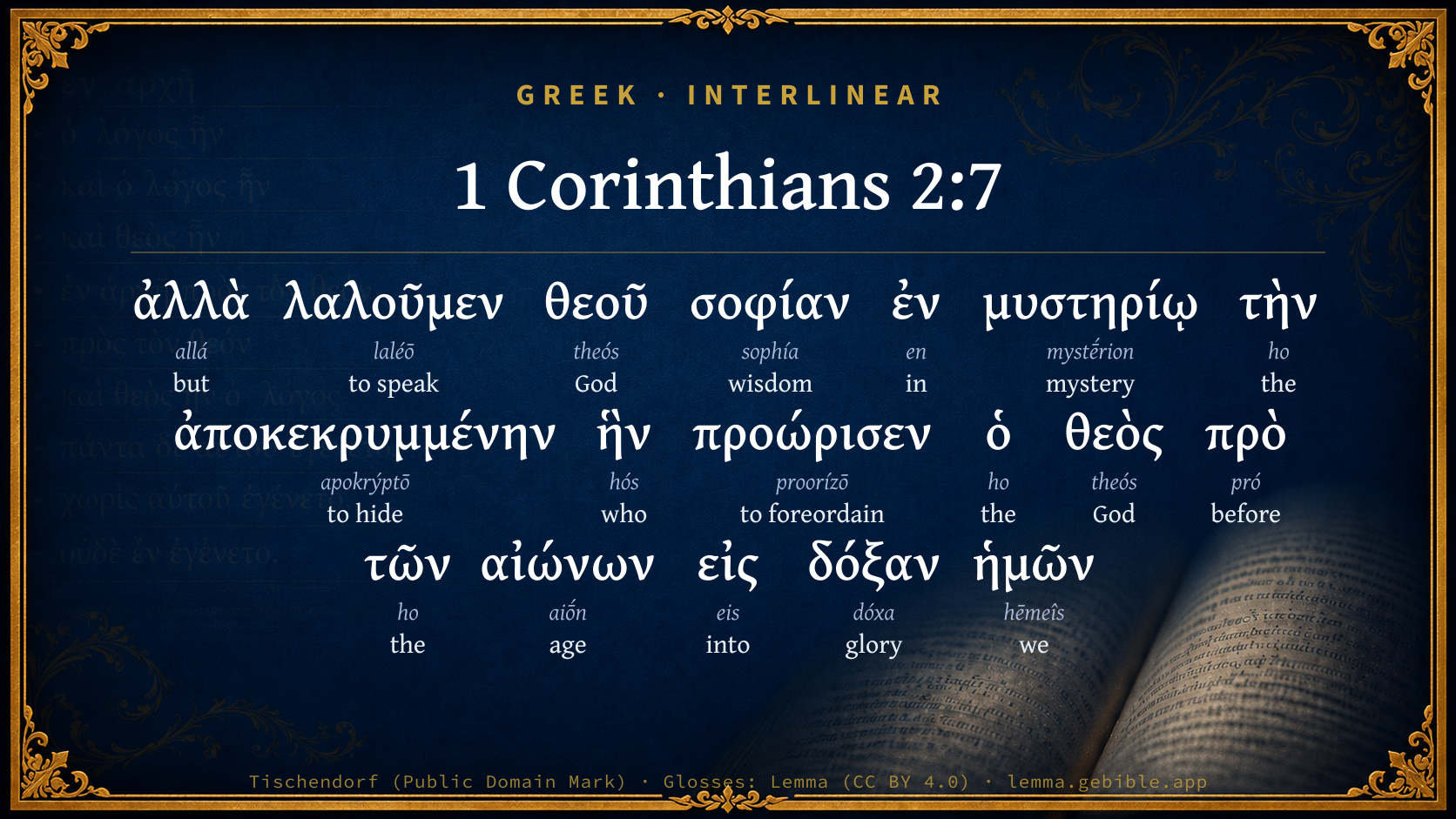
Download image
Cite this verse

1 Corinthians 2:7 (World English Bible). Public Domain. Lemma interlinear Bible study tool, https://lemma.gebible.app/v/1-corinthians/2/7.

Show BibTeX & RIS
BibTeX
RIS
English Translation
But we speak God's wisdom in a mystery, the wisdom that has been hidden, which God foreordained before the worlds for our glory,
World English Bible · Public Domain
Download a study sheet

One document with this verse’s original text, its word-by-word gloss line, the meaning frame, cross-references with their text, attributed commentary, and full source and license credits — printable, and it pastes into notes with its structure intact.

This verse Autodidact and up

Study sheet (.html) Plain text (.txt)

A passage Seminary Student

Up to 50 verses in one chapter. A passage sheet keeps up to 6 commentary sources and 12 cross-references per verse, in the order this page ranks them, and says so on the sheet whenever that leaves anything out. Ask for a single verse and you get the Autodidact verse sheet above.

Everything on this page stays free to read, with no account — the sheet is a download of what is already on screen, not access to it.

Want to remove ads? Support Godless Engineer
Compare translations 3

The same verse in 3 English versions, stacked beneath the original-language interlinear above. Click any original word for its lexicon entry.

Each is an independent rendering of the whole verse — the interlinear is not word-aligned to these translations.

Highlighted words mark where these versions differ — a whole-verse word diff, not a word-by-word alignment.

  • World English Bible Public Domain
    But we speak God's wisdom in a mystery, the wisdom that has been hidden, which God foreordained before the worlds for our glory,
  • King James Version Public Domain
    But we speak the wisdom of God in a mystery, even the hidden wisdom, which God ordained before the world unto our glory:
  • unfoldingWord Literal Text CC BY-SA 4.0
    Instead, we speak the wisdom of God that has been hidden in a mystery that God predestined before the ages for our glory,

unfoldingWord Literal Text — © unfoldingWord, licensed CC BY-SA 4.0. Word-aligned USFM3 via Door43 (git.door43.org/unfoldingWord/en_ult).

Versions to compare (up to 4)

3 of 4 selected

Show all 19 translations

Every available English version of this verse, each an independent rendering of the whole verse.

  • World English Bible Public Domain
    But we speak God's wisdom in a mystery, the wisdom that has been hidden, which God foreordained before the worlds for our glory,
  • Berean Standard Bible Public Domain
    No, we speak of the mysterious and hidden wisdom of God, which He destined for our glory before time began.
  • Majority Standard Bible Public Domain
    No, we speak of the mysterious and hidden wisdom of God, which He destined for our glory before time began.
  • King James Version Public Domain
    But we speak the wisdom of God in a mystery, even the hidden wisdom, which God ordained before the world unto our glory:
  • American Standard Version (1901) Public Domain
    but we speak God's wisdom in a mystery, `even' the `wisdom' that hath been hidden, which God foreordained before the worlds unto our glory:
  • Revised Version (1885) Public Domain
    but we speak God’s wisdom in a mystery, even the wisdom that hath been hidden, which God foreordained before the worlds unto our glory:
  • Geneva Bible (1599) Public Domain
    But we speake the wisedome of God in a mysterie, euen the hid wisedom, which God had determined before the world, vnto our glory.
  • Douay-Rheims (1899) Public Domain
    But we speak the wisdom of God in a mystery, a wisdom which is hidden, which God ordained before the world, unto our glory:
  • Young's Literal Translation Public Domain
    but we speak the hidden wisdom of God in a secret, that God foreordained before the ages to our glory,
  • Literal Standard Version CC BY-SA 4.0
    but we speak the hidden wisdom of God in a secret, that God foreordained before the ages to our glory,
  • Unlocked Literal Bible CC BY-SA 4.0
    Instead, we speak God's wisdom in hidden truth, the hidden wisdom that God predestined before the ages for our glory.
  • unfoldingWord Literal Text CC BY-SA 4.0
    Instead, we speak the wisdom of God that has been hidden in a mystery that God predestined before the ages for our glory,
  • Darby Bible Public Domain
    But we speak God's wisdom in [a] mystery, that hidden [wisdom] which God had predetermined before the ages for our glory:
  • World Messianic Bible Public Domain
    But we speak God’s wisdom in a mystery, the wisdom that has been hidden, which God foreordained before the worlds for our glory,
  • Webster's Bible Public Domain
    But we speak the wisdom of God in a mystery, even the hidden wisdom which God ordained before the world to our glory:
  • Free Bible Version CC BY-SA 4.0
    On the contrary we explain God's wisdom in terms of a revealed mystery that was previously hidden which God planned for our glory before the creation of the worlds.
  • Bible in Basic English Public Domain
    But we give the news of the secret wisdom of God, which he had kept in store before the world came into existence, for our glory;
  • Text-Critical English NT CC BY 4.0
    On the contrary, we speak the hidden wisdom of God in a mystery, which God foreordained for our glory before time began.
  • Tyndale New Testament (1534) Public Domain
    but we speake the wysdome of God which is in secrete and lieth hyd which God ordeyned before the worlde vnto oure glory:

Literal Standard Version (2020), Covenant Press — licensed CC BY-SA 4.0. Text via the HelloAO Bible API (eBible.org). Unlocked Literal Bible (unfoldingWord) — licensed CC BY-SA 4.0. Text via the HelloAO Bible API (eBible.org). unfoldingWord Literal Text — © unfoldingWord, licensed CC BY-SA 4.0. Word-aligned USFM3 via Door43 (git.door43.org/unfoldingWord/en_ult). Free Bible Version, Dr. Jonathan Gallagher — licensed CC BY-SA 4.0. Text via the HelloAO Bible API (eBible.org).

Word by word

More ways to search: Search by grammar → Find every occurrence → Compare this word →

Practice this passage: Drill this verse → Learn its vocabulary →

ἀποκεκρυμμένην
apokrýptō
G613
“to hide”
Verb, Perfect, Passive, Participle, Accusative, Singular, Feminine
Part of Speech
Verb
Tense
Perfect
Voice
Passive
Mood
Participle
Case
Accusative
Number
Singular
Gender
Feminine
Full Thayer's Definition

Origin: from G575 and G2928

TDNT: 18:57,5

1. to hide 2. concealing, keeping secret
  1. ἀλλὰ allá G235 “but” Conjunction
  2. λαλοῦμεν laléō G2980 “to speak” Verb, Present, Active, Indicative, 1st person, Plural
  3. θεοῦ theós G2316 “God” Noun, Genitive, Singular, Masculine
  4. σοφίαν sophía G4678 “wisdom” Noun, Accusative, Singular, Feminine
  5. ἐν en G1722 “in” Preposition
  6. μυστηρίῳ mystḗrion G3466 “mystery” Noun, Dative, Singular, Neuter
  7. τὴν ho G3588 “the” Article, Accusative, Singular, Feminine
  8. ἣν hós G3739 “who” Relative pronoun, Accusative, Singular, Feminine
  9. προώρισεν proorízō G4309 “to foreordain” Verb, Aorist, Active, Indicative, 3rd person, Singular
  10. ὁ ho G3588 “the” Article, Nominative, Singular, Masculine
  11. θεὸς theós G2316 “God” Noun, Nominative, Singular, Masculine
  12. πρὸ pró G4253 “before” Preposition
  13. τῶν ho G3588 “the” Article, Genitive, Plural, Masculine
  14. αἰώνων aiṓn G165 “age” Noun, Genitive, Plural, Masculine
  15. εἰς eis G1519 “into” Preposition
  16. δόξαν dóxa G1391 “glory” Noun, Accusative, Singular, Feminine
  17. ἡμῶν hēmeîs G2249 “we” Personal pronoun, 1st person, Genitive, Plural

About this verse

These counts appear in no published source. They are computed here, from the morphology-tagged text and Lemma’s own curated glosses. What Lemma adds →

18
words
15
distinct lemmas
Pauline Epistles
section

Notable vocabulary

The rarest word here is ἀποκεκρυμμένην to hide G613 — appearing just 4 times in the whole Greek New Testament.

Shared distinctive vocabulary

ἀποκεκρυμμένην to hide G613 occurs in 4 verses of the Greek New Testament. Also found in:

Repetition

Words recur within this verse:

Cross-references

14

Topical passages linked to 1 Corinthians 2:7 in the Treasury of Scripture Knowledge — connected by theme and wording, ordered by reader-vote popularity; previews shown in the World English Bible.

  • Colossians 1:26–27 the mystery which has been hidden for ages and generations. But now it has been revealed to his saints,
  • 2 Peter 1:3 seeing that his divine power has granted to us all things that pertain to life and godliness, through the knowledge of him who called us by his own glory and virtue;
  • Romans 16:25–26
  • Psalms 78:2 I will open my mouth in a parable. I will utter dark sayings of old,
  • Matthew 11:25 At that time, Jesus answered, "I thank you, Father, Lord of heaven and earth, that you hid these things from the wise and understanding, and revealed them to infants.
  • Matthew 13:35 that it might be fulfilled which was spoken through the prophet, saying, "I will open my mouth in parables; I will utter things hidden from the foundation of the world."
  • 1 Peter 5:10 But may the God of all grace, who called you to his eternal glory by Christ Jesus, after you have suffered a little while, perfect, establish, strengthen, and settle you.
  • Ephesians 3:4–9 by which, when you read, you can perceive my understanding in the mystery of Christ;
  • Ephesians 1:4 even as he chose us in him before the foundation of the world, that we would be holy and without blemish before him in love;
  • Isaiah 48:6–7 You have heard it; see all this; and you, will you not declare it? I have shown you new things from this time, even hidden things, which you have not known.
  • 2 Timothy 1:9 who saved us and called us with a holy calling, not according to our works, but according to his own purpose and grace, which was given to us in Christ Jesus before times eternal,
  • Revelation 13:8 All who dwell on the earth will worship him, everyone whose name has not been written from the foundation of the world in the book of life of the Lamb who has been killed.
  • 1 Peter 1:11 searching for who or what kind of time the Spirit of Christ, which was in them, pointed to, when he predicted the sufferings of Christ, and the glories that would follow them.
  • 1 Peter 5:1 I exhort the elders among you, as a fellow elder, and a witness of the sufferings of Christ, and who will also share in the glory that will be revealed.

Cross-references courtesy of OpenBible.info (CC BY 4.0).

Commentary

Notes on 1 Corinthians 2:7 from classic Christian and Jewish commentators (each source and its license shown beneath its notes). The classic Christian expositions comment on the surrounding passage and are grouped to its opening verse, so a note may address several verses; the Jewish commentaries on the Tanakh (Rashi and others) are per-verse, so they appear only where the commentator wrote on this verse.

Lemma curates 59 commentaries, every one of them public domain or Creative Commons licensed, each selected and text-cleaned for this edition rather than reprinted as found. About our sources →

The Biblical Illustrator

Joseph S. Exell

1Co_2:7

But we speak the wisdom of God in a mystery.

The wisdom of God in the gospel appears

I. In its origin--the Divine purpose.

II. In the form of its revelation--mystery.

III. In the mode of its communication--by man.

IV. In its ultimate design--to our glory. (J. Lyth, D. D.)

The gospel-wisdom

I. It is Gods wisdom (1Co_2:6-9).

II. It is revealed inwardly by the Spirit (1Co_2:10-13).

III. It is understood only by the spiritual man (verse 2:14-3:4). (Principal Edwards.)

Gods wisdom in a mystery

Christianity is--

I. The wisdom of God. Wisdom is knowledge directed to practical ends through the most effectual means. The moral systems of Greece ill deserved that appellation. They were imaginative; they fed the appetite for speculation, but fell with no power upon conscience or conduct. But in the gospel the wisdom of Godis displayed in efficient and wondrous arrangements to enlighten and save a fallen world.

1. It affords infallible instruction in all necessary truth. All true knowledge properly comes from God. Even art and science were probably first suggested to the mind by God, but secretly and without any mark of distinction. It is conceivable that much of Bible truth might have been thus secretly suggested, and have been published only as the results of the human investigation. Beyond their own rational evidence none of these truths, however, would have had, in this case, a greater than human authority. They would have been but matters of opinion still. The disadvantage of the most enlightened paganism was, that what of the wisdom of God was in it was not known to be from God. When they met with truth they met also with error; and both appeared to rest upon equal authority, and each was held with equal unsteadfastness and doubt. What was wanting was truth in a revealed form. The wisdom of God has supplied that desideratum. Whilst human teachers remained in the human court darkly investigating what might be hidden within that veil, the Teacher sent from God rent that veil, and He who dwelt between the cherubim shone forth. Whilst they were gazing upon every dark form of error which flitted before them like the clouds of night, He came forth, and cried, I am the light of the world; he that followeth Me, &c.; and the credentials He bore were equal to this high declaration.

2. It is a Divine contrivance to administer pardon to the guilty. This is peculiar to the gospel. The question, What must I do to be saved? has been sighed from many a breast, but has obtained no answer except from Christianity.

3. It is an efficient scheme for promoting personal and universal happiness. Man is miserable, and cannot be otherwise. Between sin and misery there is a necessary connection. Many experiments have been tried to build up happy and peaceful societies, but all have failed. Christianity would not have been wisdom had it not provided for mans happiness; and it could only provide for it by effecting his regeneration. When this takes place the heart is at rest; the fruits of the Spirit spring forth from the renewed soil; then man lives to help and bless his fellows.

II. The wisdom of God in a mystery. The apostle here probably alludes to the mysteries of Paganism. The priesthood in many places pretended to be in possession of a higher and purer doctrine which they kept from the vulgar, under the plea that they were too base and impure to be entrusted with it. It was, therefore, hidden wisdom. But it was occasionally communicated to distinguished persons. The initiated had, however, to undergo severe penances; scenic symbolic representations in caverns, and in the night, were the means adopted for unfolding the secret; and these, and other ceremonies, were employed to inspire greater awe and to enforce secrecy. Probably this secret doctrine contained some of the ancient and purer theology, but mingled with fables. The apostle supposes--

1. Points of resemblance; but even the resemblances are implied contrasts such as exist between the sun and a fire, which at once calls our thoughts from what is common to both, to the contrast exhibited between a darkened blaze and an unsullied light.

(1) Christianity was connected with symbolic representations running through the previous ages, of which it was at once the accomplishment and the exposition; and it retained some figurative rites of its own--e.g., Baptism, the Eucharist, and the Sabbath.

(2) It, too, is hidden from the profane, and those who receive it must be prepared by a previous discipline. But its discipline is not some foolish bodily austerity or onerous ceremonies, it is the discipline of humility and prayer. For the secret of the Lord is with them that fear Him, and to them He shows His covenant.

(3) It also produces deep impressions of awe and reverence upon those who are admitted, to it. Religion has an awful grandeur, but nowhere is it displayed so impressively as in the gospel.

2. Points of direct contrast.

(1) The mysteries of Paganism were, for the most part, by artifice; those of Christianity by nature and necessity. The bottom of this ocean is not discovered, not because the waters are muddy, but because they are deep.

(2) In the Pagan mysteries plain truths were often hidden in doubtful enigmas; in Christianity nothing is mysterious but what is so by the appointment of Him who hides that from us which is unfit for us to know, or from the necessary magnitude of the objects.

(3) The impression produced upon the initiated was the result greatly of trick, and brought the spirit of man into bondage and disquieting superstition. But the mysteries of godliness at once humble and exalt; and whilst they inspire fear, elevate, strengthen, and sanctify.

(4) In the mysteries of Paganism, whatever wisdom was hidden was for the few; that of Christianity, for all. From the former the poor were systematically excluded. The poor find mercy in the gospel, but nowhere else.

III. This Wisdom of God In a mystery was Ordained before the world to glory.

1. Christianity was ordained before the world. We hear sometimes of its invention by man. We acknowledge that things invented have been added by human authority. But these are no parts of the system itself; and we may ask, When was that invented? And what human mind first devised its leading fundamental principles?--that man is a fallen being who can be saved only through the merits of a Divine sacrifice.

2. It was ordained as a perfect and efficient plan for human recovery. (R. Watson.)

The great theme of gospel preaching

I. The wisdom referred to in the text. It is called the wisdom of God; by which we are to understand, not that attribute of Gods nature, but that attribute in its display. The wisdom of God has been denominated manifold--manifold, not simply because the things in which it is displayed are many, but because, as displayed in each of those things, it is in itself manifold; in other words, ample, full in its display. And of what does he thus speak? It is of Gods wisdom as displayed in the economy of human salvation. What is wisdom? What but that which, having an object in view, chooses a plan, and employs means for the attainment of its object--not indeed any plan, but that which is indisputably the best--nor any means, but those which are indisputably the most suitable; and by its choice of the one and its employment of the other, both seeks the attainment of its object, and makes provision for the removal out of the way of what would otherwise operate to make its attainment impossible. If this be what wisdom is, does it not furnish an explanation of what the wisdom of God is, as displayed in the economy of human salvation? He had an object in view. That object was twofold--His own glory and mans salvation. Had sinful man been left to perish, without any regard to the wish of mercy, the holiness, and the faithfulness, and the justice of God would doubtless have been seen in mans perdition. Or had sinful man been rescued from destruction, without any regard to the demand of holiness, and faithfulness, and justice, the mercy of God would doubtless have been seen in mans preservation from ruin. But where--in either the one or the other of those supposed cases--where would have been Gods glory? For His glory is not His mercy, or His justice, or His faithfulness, or His holiness, in their separate form, but all these perfections in combination. And is not this the appearance which these perfections of God present to view in His mode of saving man?

II. The peculiar description which the apostle in the text further gives of it.

1. The wisdom of God in a mystery. By this, questionless, the apostle primarily intended to intimate that in speaking, or in ministerially publishing the wisdom of God, or the plan of human salvation in the mode of its accomplishment, in which the wisdom of God has its highest illustration, he proclaimed that which, in itself, is mysterious or incomprehensible. And is it not so? But though there is here that which is mysterious, that which is incomprehensible, there is nothing that is incredible. To refuse the plan of human salvation a place in our creed, because the mode of its accomplishment transcends our comprehension, we must, in order to be consistent, disbelieve whatever we cannot fully understand or explain. And in what tremendous and hopeless scepticism would this involve us! For what is there that is not to us replete with mystery?

2. But though the apostle may have referred to what is strictly mysterious in the plan of human salvation when he said, We speak the wisdom of God in a mystery, yet, from what immediately follows, it would appear that he meant to be understood as referring, not so much to the essential incomprehensibility of that plan, as to its previous secrecy. The plan of human salvation was before a mystery, a secret; but in consequence of the commencement of the Christian era, it is now made known: hence, We speak--I and my fellow-apostles speak--publish, proclaim, the once hidden wisdom. His meaning is, that, compared with the revelation of it now made, all former revelations of it were imperfect. Though adapted to be spiritually and morally useful, yet every former revelation was not only partial, but oftentimes obscure. In this latter revelation, however, there was no darkness; it was clear, intelligible, satisfactory. But the apostle refers, not merely to the complete discovery now made of the plan of human salvation compared with the former partial and defective revelations of it, but also to its benevolent, its philanthropic character, when he says, We speak the wisdom of God in a mystery, even the hidden wisdom. The plan of human salvation was primarily revealed to the progenitor of the human race as their representative; but subsequently this revelation was made only to a portion of his descendants. The rest of mankind needed it, as well as these favoured ones; but from all without the pale of their privileged community it was withheld, and long withheld--so long, that to this latter class it seemed its revelation was never to be made. Until the commencement of this era the calling of the Gentiles to be partakers with the Jews of the blessings of salvation was a mystery, a secret; but no sooner did this era commence than the original benevolent and philanthropic character of the plan of human salvation was made manifest. Widely was the revelation of this plan spread during the apostolic age; widely has it been spread since; but still it is far, very far from being universally spread.

III. The source whence it originated, the antiquity of its device, and the grandeur of the object of its revelation.

1. Its source was God. We speak the wisdom of God; that in which the wisdom of God was illustriously displayed we publish--even the plan of human salvation which God ordained; that is, which God decreed, and having decreed, revealed as His own contrivance. And is not this what the plan of human salvation is? Could it have any other origin than that to which it is here traced? Does not that about it which exceeds all description and transcends all conception prove that its contrivance not only was, but must have been Divine?

2. The antiquity of its device. We speak the wisdom of God the plan of human salvation which God ordained before the world, that is, before the creation of the world; and if before the creation of the world, before the beginning of time; and if before the beginning of time, from eternity. And is not the plan of human salvation thus ancient? Known unto God, it is said, are all His works from the beginning f the world; language which, whilst it undeniably imports antecedent arrangement, as undeniably implies that that arrangement was, on the part of God, eternal. And if, in reference to all His other works, the date of Gods plans must be fixed in eternity, what other date can be reasonably assigned to His plan of human salvation? What admiration, what gratitude, what confidence is this fitted to excite in our breast!

3. The grandeur of the object of its revelation. We speak the wisdom of God, which God ordained before the world, unto our glory. In devising the plan of human salvation, God sought His own glory; and in the accomplishment of that plan His glory has been secured. But though in devising that plan God chiefly sought His own glory, yet He sought ours also; even our spiritual, moral, and eternal benefit, which constitutes our glory. Indeed, the device of that plan would have failed in its object had not its accomplishment combined, in this sense, our glory with the glory of God. And have we not every reason to be assured, from it adaption to our ease, of its fitness to promote our glory, by promoting our spiritual, moral, and eternal benefit? (A. Jack, D. D.)

The wisdom of God in mystery

Light and darkness are here mingled together. It is wisdom, but wisdom in a mystery. We may know from it enough to make us wise unto salvation, but the gospel never proposes to give answers to the catechism of curiosity. Consider--

I. The mystery which lies in the crucifixion of Christ. It is entirely a mystery to us--

1. How it could comport with the justice of God to lay the punishment of our sins on the head of an innocent Being. He has done it. There is no mystery about that. But we know no more.

2. How justice could be satisfied through such an infliction. We cannot tell. All we know is that Divine justice positively did receive there the very last item of her demands.

3. How Christ could render satisfaction to Divine justice, while, at the same time, He was the Being to whom satisfaction was rendered, and the very Being who rendered it.

4. How it came to pass that, while the Divine nature is utterly unsusceptible of pain and death, nevertheless the sufferings and death of Jesus Christ have all their value and efficacy from the Divine nature of the Victim. We know it is so, but we know nothing further.

5. How there could be, in the one person of Christ upon the Cross, such a wonderful union of grandeur and humiliation--of complaining and omnipotence--of immortal Deity and expiring humanity! They are truths, but they are mysteries--Divine mysteries of Divine truth.

6. How that Son on the Cross, in whom the Father was well pleased, could have been abandoned at such a moment, and left to wail, My God, My God, why hast Thou forsaken Me?. How the love of God should ever have brought Jesus Christ to the Cross.

II. The demonstration that all this mysteriousness is no greater than we ought to expect on the subject-matter before us. It perfectly accords with all the facts and all the other arrangements of the plan of redemption. In this accordance beams out the wisdom of God.

1. Sin was the great evil which brought our Saviour into the world and took Him to the Cross. And the existence of sin is just as mysterious a matter to us as its expiation. If sin is a mystery, the expiation of it ought to be a mystery also. And so it is. Great is the mystery of godliness, &c.

2. Why did the Son of God select this world as the theatre of His redeeming wonders? Spirits as precious as ours had fallen. Why did God pass angels by when He rescued us? No answer comes, except, Even so, Father, for so it seemed good in Thy sight. There we must leave it. And if it be a mystery how God came to select this apostate world, it accords with God that that work itself should be a mystery also.

3. There is an entire correspondence between the doctrines of Christs expiation of sin and satisfaction of justice, and all the other information we have about the Saviour Himself. The incarnation of Jesus ,Christ is just as mysterious to us as His atonement. That Jesus Christ should be able to give strength to the poor cripples bones, and yet be Himself weary and wayworn--that He should feed thousands of men, and yet be a man of hunger--that He should please the Father, and yet the Father be pleased to bruise Rim, these are things before which faith and love may wonder and adore, but which reason can never explain!

4. There is something truly amazing in the mode of the redemption of sinners. If it were so, that Jesus Christ were coming into this world to ransom sinners, we should naturally have expected that He would come in the chariots of His omnipotence! But He was a poor man, and at the end of His work, instead of receiving any signals of triumph, He was mocked as an impostor and crucified as a malefactor. This is the mode in which God treated His Son! It corresponds with the mysteries of its design.

5. Through this Christ some sinners are brought into favour with God. They are believers. They are adopted into Gods family, and He loves them with an unequalled tenderness and strength. But how does He treat them? The very pathway by which they travel to heaven corresponds in wonders with all the rest of their redemption! (L S. Spencer, D. D.)

Christianity the wisdom of God in a mystery

I. Mystery primarily signifies a secret, and Christianity is the wisdom of God in a mystery, because of its having been long a secret. It was ordained before the foundation of the world it was a Divine plan formed in the mind of God, but, from eternity to the point of time when it was needed, it remained a secret there. But at the moment of mans fall then came the wisdom of God out of this long mystery. And whilst justice shut the gates of paradise, mercy opened the new and living way to reconciliation and friendship with God. But the apostle speaks of Gods purpose to call the Gentiles as a mystery. The wisdom of God had retired behind the impenetrable cloud for ages till our Saviour gave the charter of salvation to all nations--Go ye into all the world, &c.

II. A mystery is an emblem, and Christianity is the wisdom of God in a mystery, because it has delighted in all ages to array itself in emblem. The parables of our Lord were called mysteries for this reason, and the golden candlesticks and the stars in the Book of the Revelation. But the object of a mystery, in this respect, is not so much concealment as to test whether men love the truth sufficiently to investigate the figures under which it is presented. The wisdom of God chose the ancient types for the manifestation of itself. All nature is made use of in this respect. The sun is the established emblem of Christ, the light of the world. In the shadows of evening the voice of heavenly wisdom admonishes us that the night cometh in which no man can work. Dews and rains remind us of the great promise of the fertilising and life-giving Spirit. It was for this very reason that the sacraments were anciently called mysteries. Baptism teaches us the washing away of sin, and the Lords Supper that we live by His death.

III. A mystery is a deep and dark enigma, and Christianity is the wisdom of God in a mystery, because it is by the most perplexing circumstances that it has often accomplished its designs. Take--

1. The humiliation of our Lord. The great pretensions of all the prophets were that He was to save and redeem and reign. Well, this Saviour is seen in the form of an infant--is placed in entire obscurity for thirty years. He was despised and rejected by the people at large, and His character and designs often perplexed His immediate followers. By and by we see this universal sovereign and Saviour expiring on a Cross, and provoking the taunt, He saved others, but Himself He cannot save. Yet, however deep that mystery, there was wisdom behind it, and on the morning of the resurrection the wisdom of God came forth from the mystery. There seems to be an allusion to this in the words of St. Paul: Great, says he, is the mystery of godliness, &c.

2. The history of the Church. There have been so many manifestations of the wisdom of God in the mystery that certainly there is something for faith to rest upon with respect to the grand result as to the Church; and yet how deep and portentous are the clouds which arise before the mind of him who contemplates the apostasies of the Church, &c.

IV. A mystery is a proceeding which contradicts the notions which men ordinarily form of fitness; and Christianity is the wisdom of God in a mystery, because it employs, for the accomplishment of its proposes, means which contradict all the notions of men.

1. There was nothing agreeable to human wisdom in the agents appointed for the conversion of the world; but Paul tells us that the wisdom of God had proved stronger than the wisdom of men, and that God had chosen the weak things to confound the mighty, &c. The mystery was to the men of the world; the wisdom in the mystery was manifested in the end.

2. There is the soul of a man immersed in worldliness and sin to be made sensible of its sin and danger--to have produced within it a new train of emotions which shall lead to God. What is the instrumentality which the wisdom of God employs in producing this effect? Is it the work of an angel? Verily it were worthy of such an agency. But now the wisdom of God veils itself in mystery, and makes use of a fellow-man, and by the secret influence which God gives, the work is done.

3. A soul reconciled to God is to be matured in grace and to be qualified for glory. How often does the wisdom of God, in accomplishing this great end, wrap itself in mystery! One object is to cure the spirit of worldly care, and a load of additional care is laid upon it. Another object is to teach reflectiveness of spirit, and the subject is plunged in most perplexing circumstances. Another object is to increase the peace of the soul; and yet the soul is placed in the midst of the turbulent storm. Another object is to excite a higher love, and yet the heavier stroke of the Lord is laid upon him. Here is the mystery; but we know the wisdom notwithstanding this, for tribulation worketh patience, &c.

4. A nation sunk in ignorance and immorality is to be raised into a better state. How is it done? Never by means which are at all taken into the calculation of statesmen. God raises up His own instruments--they may be few in number--from the lower class of society, and the work goes on, principles are secretly spreading, and the scene changes. It is amusing to read the theories of the worldly wise on these changes, whereas the whole proves that the wisdom of God has been proceeding in a mystery to them.

5. And so it is with respect to foreign missions.

V. A mystery is as unfathomable subject, and Christianity is the wisdom of God in a mystery, because the subjects with which it is conversant are of this kind. There are many persons who object to our religion because of its mysteriousness. But what would a religion be that had no mysteries? What view could you have of God if you could comprehend Him? God is eternal--can the creature of a day take in the idea of eternal duration? Gods plans must be like Himself; must they, then, not be incomprehensible by the necessity of nature to creatures like ourselves? The subject is clear, but our minds are clouded by reason of darkness, We cannot perceive the beauty and the proportions of an extended landscape, not because the objects in themselves are indistinct, but because they are distant.

VI. Christianity is a mystery of love. Great has been the manifestation of the goodness of God to His people. Christ has come--the Holy Spirit has been poured out--the ordinances of Christianity instituted; but there is a period coming of still greater glory for the Church. They whom Christ has redeemed are to be with Him for ever and see His glory. (R. Watson.)

The mystery of the gospel

I. In its principles. It reveals reconciliation with God,

1. By sacrifice.

2. By the sacrifice of His own dear Son.

II. In its spirituality.

1. It is revealed by the Spirit of God.

2. To the spirit of man.

3. By faith.

III. In its design.

1. To manifest the glory of God.

2. Secure the glorification of man. (J. Lyth, D. D.)

The mystery of the gospel

The gospel--

I. May well be mysterious--for it is the wisdom of God.

II. Must be acknowledged to be mysterious. For its doctrines--

1. Transcend human thought.

2. Are spiritual in their nature.

3. Are in opposition to our common modes of thinking,

III. Is wisely mysterious.

1. To command our reverence.

2. Humble our pride.

3. Provoke our inquiry.

4. Awaken anticipation of a brighter revelation in another life. (J. Lyth, D. D.)

Mystery

The word has four meanings which may be arranged almost in chronological order.

I. That which it is forbidden to divulge except to the initiated. Such were the secrets of the political and religious festivals held in most cities of Greece. We have a trace of this meaning in Mat_13:2. In 2Pe_1:16 it is said that the apostles did not follow the false track of rationalised myths, but were eye-witnesses by initiation of Christs majesty (Col_2:3).

II. That which cannot be known except by revelation (cf. Rom_16:25; Eph_3:3-4; Col_1:26)

.

III. Sacred ceremonies that have a symbolical or spiritual significance; sometimes restricted to denote the Eucharist. After the time of Tertullian this is its prevailing signification, and its Latin equivalent is sacramentum.

IV. A truth that transcends the human intellect to comprehend, and this may be absolute impossibility or impossible till the Spirit of God gives an inward revelation. In the present passage the word includes somewhat of all these meanings except the third. The word perfect, while it signifies full-grown, contains an allusion to initiation into mysteries. (Principal Edwards.)

Mystery no obstacle to faith

Each human being at his birth has everything to learn. The child is apt to imagine that those who are older than himself, and whom he has found able to answer his first inquiries, know almost everything, and he is surprised and disappointed when he finds, in many instances, that no sufficient explanation of his difficulties can be given, and he is inclined to disbelieve whatever offers itself as a mystery to his mind. In this vulnerable point, scepticism in reference to subjects of a religious nature is wont to assail the mind. It would have it believed that mystery is something peculiar to religion, and then insists that what is so incomprehensible cannot rationally be believed. But neither is true. We purpose to show the contrary.

I. There is mystery in everything.

1. Of nothing can we feel a greater certainty than of our own being and personal identity. But what am I? I can no more understand the essence of my conscious self, than I can that of God the Infinite Spirit. The philosopher here is no wiser than the child.

2. Turn to nature in any of her various departments. Look, e.g., at--

(1) The facts presented in the animal kingdom. Explain the nature of instinct. Observe that spider, which has spread her gossamer across your window. How did she learn to construct that octagon as perfect as if drawn by the nicest geometrician? Or watch the robin; that nest is the first she ever built: yet see how perfect--the most practised of her kind has never formed a better. Where did she gain her skill in architecture?

(2) Animal life and the functions of the vital economy. What is it that prevents the decomposition of the flesh of animals so long as the vital principle is there, while decay commences the moment it is gone? Tell us how it is that the gross substances taken in the form of food are converted into the beautiful carnation of the human cheek, and the gorgeous and variegated dyes of birds and insects. Show what it is that keeps the heart for ever throbbing, and the lungs perpetually heaving, without any effort of the will.

(3) The vegetable world. There is the rose blushing crimson by your window. What elements have been concerned in its production? Light, heat, moisture, and the common earth. But by what means have the petal, the odour, and the hues been elaborated from such materials? How has the same sap been made to produce the hard stalk, the sharp thorn, the green leaf, and the admirable flower? There, too, is the lily by its side. It springs from the same soil, is warmed by the same sun, watered by the same showers, yet instead of having the same colour it is white as the virgin snow. Again, there is the grass and the violet that both spring from one common mould, and yet, one is a soft and lively green, and the other an imperial purple.

(4) Inorganic matter. You have here the laws of chemical affinity and repulsion. You find that certain substances when reduced to a fluid state and then placed in given conditions, return to solids by the process of crystallisation; and that in doing this one always takes the cubic form, another always that of an octahedron, another always that of a parallelopiped, and so on. But of these, and a multitude of other plain and unquestionable facts, you cannot by the nicest observation detect the cause, or the mode of its operation. Nature veils it in deep mystery.

(5) Those subtle yet efficient agents that produce the more general and grand phenomena of nature. Put an end to the conjectures of mankind, by telling us what light, and heat, and electricity, and magnetism are. That mighty universal force, to which, by way of concealing our ignorance, we give the name of gravity, which brings the pebble to the earth, and chains revolving worlds about their centres; search out the secret and instruct us in relation to its nature. You cannot answer our inquiries. You see, then, that mystery is written all over the universe of God.

II. That the truths of revealed religion are confessedly mysterious, is a confirmation of its Divinity.

1. A system of religion which professed to be from God, and yet claimed to have no mysteries, would prove it to be false. For such a system would be anomalous, and we should justly reason that if earthly things are found to be beyond our comprehension, much more ought heavenly things to be expected to be so. To the Omniscient only are there no dark and hidden things.

2. There may be many other reasons besides that of our want of capacity to comprehend Him, to render it fit that God should withhold from us many kinds and degrees of knowledge which might without difficulty be imparted. It might, for example, only perplex us to have our minds excited to yet higher inquiry by further disclosures as to things that have no immediate relation to our duty or our happiness for the present. Life is so short, so full of engrossing occupation, that very little time is allowed us for merely speculative thought. Then, further, it is no less obvious that this living in the midst of mysteries may prove a most salutary moral discipline. By contact with the as yet unopened secrets of the universe our pride receives a salutary check. Both as regards the ends of practical life and the development in our souls of sentiments of humility, of veneration, and of worship, there are great advantages to be derived from the present withholding of many parts of Divine knowledge which might possibly be revealed.

3. Instead, then, of suffering ourselves to be perplexed because we encounter mysteries in the Christian revelation, it is much wiser, as well as more becoming, that we cultivate a humble, docile spirit. How exceedingly limited, at best, is our horizon! What an infant, in a sober view, does the wisest man on earth appear on the scale of universal being!

4. We ought likewise to consider, for the enkindling of a heartfelt gratitude, that the mysteries of our being had been far deeper and darker than they are, but for the partial light which God has afforded in His Word. By the help of this, where the wisest heathen, in all ages, have groped their way, we are able to see distinctly; and though we are able to know so little comparatively, yet let us devotedly praise God that He has enabled us to know enough to enable us to discern and keep the path of duty and of life.

5. For the rest it may content us that we can confidently anticipate the future increase of our knowledge. (Ray Palmer, D. D.)

Christianity mysterious, and the wisdom of God in making it so

The reasons of this may be stated upon these two grounds.

I. The nature and quality of the things treated of.

1. Their surpassing greatness to the mind of man. God is an infinite being, a world in Himself, too high for our speculations and too great for our descriptions. Heaven enters into us, as we must into it, by a very narrow passage. But how shall the King of glory, whom the heavens themselves cannot contain, enter in by these doors? How shall these short faculties measure the lengths of His eternity, the breadths of His immensity, the heights of His prescience, and the depths of His decrees? and those mysteries of two natures united into one person and of one nature diffused into a triple personality?

2. Their spirituality. When we read that God is a Spirit, and that angels and the souls of men are spirits, we cannot frame any notion or resemblance of them. We can fetch in no information from our senses. Imagine a man born blind, able upon hearsay to conceive all the varieties of colour, to draw a map of France, &c. But as it would be extremely irrational for a blind man to deny that there are such things as colours, &c., because he cannot form any mental perception of them, so would it be superlatively more unreasonable for us to deny on the same grounds the great articles of our Christianity.

3. Their strangeness and unreducibleness to the common methods and observations of nature. Take, e.g.--

(1) Christs satisfaction for sin. That He who was the offended person should provide a satisfaction and concern Himself to solicit a needless reconciliation, that a Father should deliver up an innocent and infinitely beloved Son for the redemption of His enemies, are transactions such as we can find nothing analogous to in all the dealings of men.

(2) Regeneration, concerning which men wonder by what strange power it should come to pass that any one should be brought to conquer inveterate appetites and desires, and to have new ones absolutely contrary planted in their room. So that when our Saviour discoursed of these things to Nicodemus, he asked, How can these things be?

(3) The resurrection.

II. Some of its principal ends and designs. But may it not be objected that the grand design of religion is to engage men in the practice of its commands, and that the way to obey a law is to know it, and the way to know it is to have it plainly propounded? To this I answer, first, that it is as much the design of religion to oblige men to believe the credenda as to practise the agenda of it: and secondly, that there is as clear a reason for the belief of the one as for the practice of the other. They exceed indeed the human reason to comprehend them scientifically, and are therefore proposed, not to our knowledge, but to our belief; but since God has revealed them we may with the highest reason, upon His bare word, believe them. But then, as for those things that concern our practice, they indeed are of that clearness that being once proposed to us, need not our study, but only our acceptance. In sum, the articles of our faith are those depths in which the elephant may swim, and the rules of our practice those shallows in which the lamb may wade. But as both light and darkness make but one natural day, so both the clearness of the agenda and the mystery of the credenda of the gospel constitute but one entire religion. I come now to show that the mysteriousness of the credenda, or matters of our faith, is most subservient to the great ends of religion.

1. Because religion in its prime institution was designed to make impressions of awe and reverential fear upon mens minds. God, who designed man to a supernatural end, thought fit also to engage him to a way of living above the bare course of nature, and for that purpose to oblige him to a control of his mere natural desires. And this can never be done but by imprinting such apprehensions of dread as may stave off appetite from its desired satisfactions, which the infinite wisdom of God has thought fit to do, by nonplussing the world with certain new and unaccountable revelations. To protect which from the encroachments of bold minds, He has hedged it in with a sacred obscurity in some of the principal parts of it, inasmuch as familiarity breeds contempt.

2. Because religion is delivered by God to humble the pride of mans reason. Man fell by pride, founded upon an irregular desire of knowledge, and therefore Divine wisdom contrived mans recovery by such a method as should abase him in that very perfection, whereof the ambitious improvement first cast him down from that glorious condition.

3. Because He would engage us in a more diligent search into the articles of religion. No man studies things plain and evident. We are commanded by Christ to search the Scriptures, and whosoever shall apply himself to a thorough performance of this high command, shall find difficulty enough in the things searched into to perpetuate his search. For they are a rich mine which the greatest wit and diligence may dig in for ever and still find new matter to entertain the busiest contemplation with, even to the utmost period of the most extended life. Truth, we are told, dwells low, and in a bottom; and the most valued things of the creation are hidden from the common view, so that violence must be done to nature, before she will produce and bring them forth.

4. Because the full know]edge of it may be one principal part of our blessedness hereafter. All those heights and depths which confound the subtlest apprehension shall then be made clear to us. (R. South, D. D.)

The Biblical Illustrator, edited by Joseph S. Exell (c. 1880s–1900s) — public domain. Text from a community e-Sword module.

Tyndale Open Study Notes

Tyndale Open Resources

2:7 In Paul’s writings, mystery often refers to a truth previously hidden but now revealed in the Good News of Christ and his saving work (see Rom 11:25-27; 1 Tim 3:9, 16). • before the world began: From the very beginning, it has been God’s desire to save his chosen people through Christ (see Rom 16:25-26; Eph 1:9-12; 3:3-12; Col 1:25-27) and to bring them to ultimate glory in the coming age (see Rom 5:2; 8:18-21, 29-30; 1 Thes 2:12).

Tyndale Open Study Notes — © Tyndale Open Resources, licensed CC BY-SA 4.0. Text via the HelloAO Bible API.

Bengel's Gnomon

Johann Albrecht Bengel

1Co 2:7. Ἐν μυστηρίῳ, τὴν ἀποκεκρυμμένην, in a mystery, [even] the hidden [wisdom]) It is concealed before it is brought forward, and when it is brought forward, it still remains hidden to many, namely to those that are imperfect.—προώρισεν, ordained before) The allusion is to hath prepared, 1Co 2:9.—πρὸ, before) therefore it does not come to nought, 1Co 2:6. This wisdom very far surpasses worldly wisdom in antiquity.—αἰώνων, the ages [of the world]) in the plural. The antithesis to it is, of this world, 1Co 2:6.—εἰς, unto) that it may be our glory; comp. the following verse, and glorying, 1Co 1:31.—δόξαν) glory, from the Lord of glory; 1Co 2:8, afterwards to be revealed, at the time when the princes of the world shall come to nought. It is an antithesis to, mystery.

Bengel's Gnomon of the New Testament — English translation (T&T Clark, Edinburgh, 1860) — public domain. Text from a community e-Sword module.

Meyer's Critical & Exegetical Commentary

Heinrich August Wilhelm Meyer

1Co_2:7. Θεοῦ σοφίαν] Gods philosophy, of which God is the possessor, who has made it known to those who proclaim it, 1Co_2:10. This Θεοῦ is with great emphasis prefixed; the repetition of λαλοῦμεν, too, carries with it a certain solemnity, comp Rom_8:15; Php_4:17.

ἘΝ ΜΥΣΤΗΡΊῼ] does not belong to ΤῊΝ ἈΠΟΚΕΚΡ. (with which it was connected expressly as early as Theodoret; comp Grotius: quae diu in arcano recondita fuit), but to ΛΑΛΟῦΜΕΝ (Erasmus, Estius, Rückert, Schrader, de Wette, Osiander, Hofmann), not, however, in the sense: secreto et apud pauciores (Estius, Cornelius a Lapide), since there is no mention of a disciplina arcani (see on 1Co_2:6), but rather: by means of a secret, i.e. by our delivering what has been secret (a doctrine hidden from the human understanding, and revealed to us by God, see on Rom_11:25). To this is to be referred also the rendering of Rückert and Neander: as a mystery. Most interpreters, however, join ἐν μυστηρίῳ with ΣΟΦΊΑΝ, sc[362] οὖσαν: Gods secret wisdom (unknown but for revelation). So also Pott, Heydenreich, Billroth, Tittmann, Usteri, Ewald. But the article, although after the anarthrous σοφίαν not in itself absolutely necessary, would be omitted here at the expense of clearness. Paul would have expressed himself with ambiguity, while he might easily have avoided it by ΤῊΝ ἘΝ ΜΥΣΤΗΡΊῼ. On the other hand, if he joined ἘΝ ΜΥΣΤ. to ΛΑΛΟῦΜΕΝ, he could not, seeing that he wished to prefix λαλ. for the sake of emphasis, write otherwise.

ΤῊΝ ἈΠΟΚΕΚΡ.] as respects its nature, by virtue of which it not only had been hidden from all preceding generations, but remained unknown apart from divine revelation. Comp 1Co_2:9-10; Rom_16:25. The word, which in itself might be dispensed with, is added in order to introduce the following statement with completeness and solemnity.

ἫΝ ΠΡΟΏΡ. Ὁ ΘΕῸς Κ.Τ.Λ[364]] There is no ground here for supplying (with the majority of expositors, including Pott and Heydenreich) ἀποκαλύπτειν, γνωρίσαι, or the like, or (with Olshausen) a dative of the person; or yet for assuming, as do Billroth and Rückert, that Paul meant by ἥν the object of the wisdom, the salvation obtained through Christ. For προώρ. has its complete and logically correct reference in εἰς δόξαν ἡμ. (comp Eph_1:5), so that the thought is: to which wisdom God has, before the beginning of the ages of this world (in eternity), given the predestination that by it we should attain to glory. This εἰς δόξ. ἡμ. corresponds significantly to the τῶν καταργ. of 1Co_2:6, and denotes the Messianic glory of the Christians which is to begin with the Parousia (Rom_8:17; Rom_8:29 f.; 1Th_2:12). That wisdom of God is destined in the eternal divine plan of salvation not to become (Hofmann) this glory, but to establish and to realize it. This destination it attains in virtue of the faith of the subjects (1Co_1:21); but the reference to the spiritual glorification on earth is not even to be assumed as included with the other (in opposition to de Wette, Osiander, Neander, and many older expositors), as also the correlative τῆς δόξης in 1Co_2:8 applies purely to the heavenly glory. Bengel says well: olim revelandam, tum cum principes mundi destruentur. It reveals itself then as the wisdom that makes blessed, having attained in the δόξα of believers the end designed for it by God before the beginning of the world.

[362] c. scilicet.

[364] .τ.λ. καὶ τὰ λοιπά.

Meyer — Critical and Exegetical Commentary on the New Testament — English translation by Peter Christie, edited by Frederick Crombie (T&T Clark, 1880) — public domain. Text from a community e-Sword module.

Expositor's Greek Testament

ed. W. Robertson Nicoll

1Co 2:7 . “(We speak … a wisdom not of this world …) but ( ἀλλά , of diametrical opposition) a wisdom of God, in (shape of) a mystery.” ἐν μυστηρίῳ qualifies λαλοῦμεν , rather than σοφίαν (as Hn [340] , Ev [341] , Lt [342] read it “couched in mystery”), indicating how it is that the App. do not speak in terms of worldly wisdom, and express themselves fully to the τέλειοι alone: their message is a Divine secret, that the Spirit of God reveals (1Co 2:10 f.), while “the age” possesses only “the spirit of the world” (1Co 2:12 ). Hence to the age God’s wisdom is uttered “in a mystery” and remains “the hidden (wisdom)”; cf. 2Co 4:4 ; also Mat 13:13 ff. ( ἐν παραβολαῖς … λαλῶ ), Luk 10:21 f.: λαλῶ ἐν μυστηρίῳ = ἀποκρύπτω . μυστήριον ( cf. 1Co 15:51 ) has “its usual meaning in St. Paul’s Epp., something not comprehensible by unassisted human reason” (El [343] ; for a full account see Ed [344] , or Bt [345] , on the term). The Hellenic “mysteries,” which flourished at this time, were practised at night in an imposing dramatic form; and peculiar doctrines were taught in them, which the initiated were sworn to keep secret. This popular notion of “mystery,” as a sacred knowledge disclosed to fit persons, on their subjecting themselves to prescribed conditions, is appropriated and adapted in Bibl. Gr [346] to Divine revelation. The world at large does not perceive God’s wisdom in the cross, being wholly disqualified; the Cor [347] believers apprehend it but partially, since they have imperfectly received the revealing Spirit and are “babes in Christ” (1Co 3:1 ff.); to the App., and those like them (1Co 2:10 ff.), a full disclosure is made. When he “speaks wisdom among the ripe,” P. is not setting forth esoteric doctrines diff [348] from those preached to beginners, but the same “word of the cross” for he knows nothing greater or higher (Gal 6:14 ) in its recondite meaning and larger implications, as, e.g. , in 1Co 15:20-27 of this Ep. (where he relents from the implied threat of 1Co 3:1 ff.), in Rom 5:12-21 ; Rom 11:25 ff., or Col 1:15 ff., Eph 5:22-32 . τὴν ἀποκεκρυμμένην expands the idea of ἐν μυστηρίῳ (see parls.): P. utters, beneath his plain Gospel tale, the deepest truths “in a guise of mystery” “that (wisdom) hidden away ( ἀπὸ τ . αἰώνων , Col 1:26 ), which God predetermined before the ages unto ( εἰς , aiming at ) our glory”. That the Gospel is a veiled mystery to many accords with past history and with God’s established purpose respecting it; “est occulta ante-quam expromitur: et quum expromitur, tamen occulta manet multis, imperfectis” (Bg [349] ). The “wisdom of God” now revealed, was destined eternally “for us” “the believers” (1Co 1:21 ), “the called” (1Co 1:24 ), “the elect” (1Co 1:27 ff.), “those that received the Spirit of God” (1Co 2:10 ff.), as men who fulfil the ethical conditions of the case and whom “it has been God’s good pleasure to save” (1Co 1:21 ); see the same thought in Eph 1:4 ff. This δόξα is not the heavenly glory of the saints; the entire “ministry of the Spirit” is ἐν δόξῃ and carries its subjects on ἀπὸ δόξης εἰς δόξαν (2Co 3:8-18 ); His ἀπαρχὴ effects a glorious transformation, by which the base things of the world put to shame its mighty (1Co 1:27 ff.), and “our glory” overthrows “the rulers of this world” (1Co 2:6 ), “increasing as theirs wanes” (Lt [350] ), cf. Rom 8:30 . This present (moral) glory is an “earnest” of “that which shall be revealed” (Rom 8:18 f.). For προώρισεν , marked out beforehand , see parls., and notes to Rom 8:29 f.

[340] C. F. G. Heinrici’s Erklärung der Korintherbriefe (1880), or 1 Korinther in Meyer’s krit.-exegetisches Kommentar (1896).

[341] T. S. Evans in Speaker’s Commentary .

[342] J. B. Lightfoot’s (posthumous) Notes on Epp. of St. Paul (1895).

[343] C. J. Ellicott’s St. Paul’s First Epistle to the Corinthians .

[344] T. C. Edwards’ Commentary on the First Ep. to the Corinthians .

[345] J. A. Beet’s St. Paul’s Epp. to the Corinthians (1882).

[346] Greek, or Grotius’ Annotationes in N.T.

[347] Corinth, Corinthian or Corinthians.

[348] difference, different, differently.

[349] Bengel’s Gnomon Novi Testamenti.

[350] J. B. Lightfoot’s (posthumous) Notes on Epp. of St. Paul (1895).

The Expositor's Greek Testament, edited by W. Robertson Nicoll (1897–1910) — public domain. Text from a community e-Sword module.

International Critical Commentary

7. ἀλλὰ λαλοῦμεν. The verb is repeated for emphasis with the fully adversative ἀλλά (Rom 8:15; Php 4:17); ‘But what we do utter is,’ etc.

θεοῦ σοφίαν. The Θεοῦ is very emphatic, as the context demands, and nearly every uncial has the words in this order. To read σοφίαν Θεοῦ (L) mars the sense.

ἐν μυστηριῳ. We may connect this with λαλοῦμεν, to characterize the manner of communication, as we say, ‘to speak in a whisper,’ or to characterize its effect—‘while declaring a mystery.’ Or we may connect with σοφίαν: and this is better, in spite of the absence of τήν before ἐν μυστηρίῳ (see Lightfoot on 1Th 1:1). The ‘wisdom’ is ἐν μυστηρίῳ, because it has been for so long a secret, although now made known to all who can receive it, the ἅγιοι (Col 1:26) and κλητοί.

Assuming that μαρτύριον is the right reading in v. 1, we have here almost the earliest use of μυστήριον in N.T. (2Th 2:7 is the earliest). See J.A. Robinson, Ephesians, pp. 234-240, for a full discussion of the use of the word in N.T., also Westcott, Ephesians, pp. 180-182.

τὴν ἀποκεκρυμμένην. For the sense see Eph 3:5; Col 1:26; Rom 16:25. The words are explanatory of ἐν μυστηρίῳ. The wisdom of God had been hidden even from prophets and saints (Luk 10:24), until the fulness of time: now it is made manifest. But it remains hidden from those who are not prepared to receive it; e.g. from Jews (2Co 3:14) and the ἀπολλύμενοι generally (2Co 4:3-6). This contrast is followed up in vv. 8-16.

ἣν προώρισεν ὁ Θεός. To be taken directly with the words that follow, without supplying ἀποκαλύψαι or any similar link. The ‘wisdom’ is ‘Christ crucified’ (1:18-24), fore-ordained by God (Act 4:28; Eph 3:11) for the salvation of men. It was no afterthought or change of plan, as Theodoret remarks, but was fore-ordained ἄνωθεν καὶ ἐξ ἀρχῆς.

εἰς δόξαν ἡμῶν. Our eternal glory, or complete salvation (2Co 4:17; Rom 8:18, Rom 8:21, etc.). From meaning ‘opinion,’ and hence ‘public repute,’ ‘praise,’ or ‘honour,’ δόξα acquires in many passages the peculiarly Biblical sense of ‘splendour,’ ‘brightness,’ ‘glory.’ This ‘glory’ is used sometimes of physical splendour, sometimes of special ‘excellence’ and ‘pre-eminency’; or again of ‘majesty,’ denoting the unique glory of God, the sum-total either of His incommunicable attributes, or of those which belong to Christ. In reference to Christ, the glory may be either that of His pre-incarnate existence in the Godhead, or of His exaltation through Death and Resurrection, at God’s right hand.

It is on this sense of the word that is based its eschatological sense, denoting the final state of the redeemed. Excepting Heb 2:10 and 1Pe 5:1, this eschatological sense is almost peculiar to St Paul and is characteristic of him (15:43; 1Th 2:12; 2Th 2:14; Rom 5:2; Php 3:21, etc.). This state of the redeemed, closely corresponding to ‘the Kingdom of God,’ is called ‘the glory of God,’ because as God’s adopted sons they share in the glory of the exalted Christ, which consists in fellowship with God. This ‘glory’ maybe said to be enjoyed in this life in so far as we are partakers of the Spirit who is the ‘earnest’ (ἀρραβών) of our full inheritance (2Co 1:22, 2Co 1:5:5; Eph 1:14; cf. Rom 8:23). But the eschatological sense is primary and determinant in the class of passages to which the present text belongs, and this fact is of importance.

What is the wisdom of which the Apostle is speaking? Does he mean a special and esoteric doctrine reserved for a select body of the initiated (τέλειοι)? Or does he mean the Gospel, ‘the word of the Cross,’ as it is apprehended, not by babes in Christ, but by Christians of full growth? Some weighty considerations suggest the former view, which is adopted by Clement, Origen, Meyer, and others; especially the clear distinction made in 3:1, 2 between the γάλα and the βρῶμα, coupled with the right meaning of ἐν in v. 6. On the other hand, the frequent assertions (1:18, 24, 30) that Christ crucified is the Power and Wisdom of God, coupled with the fact that this Wisdom was ‘fore-ordained for our salvation’ (see also σῶσαι in 1:21), seem to demand the equation of the wisdom uttered by the Apostle with the μωρία τοῦ κηρύματος, and the equation of Θεοῦ σοφίαν in 2:7 with Θεοῦ σοφίαν in 1:24 (cf. 1:30). These considerations seem to be decisive. With Heinrici, Edwards, and others, we conclude that St Paul’s ‘wisdom’ is the Gospel, simply. With this Chrysostom agrees; σοφίαν λέγει τὸ κήρυγμα καὶ τὸν τρόπον τῆς σωτηρίας, τὸ διὰ τοῦ σταυροῦ σωθῆναι· τελείοῦς δὲ τοῦς πεπιστευκότος.

But the γάλα and the βρῶμα of 3:2, and the distinction between τέλειοι and νήπιοι ἐν Χριστῷ, must be satisfied. The τέλειοι are able to follow the ‘unsearchable riches of Christ’ and ‘manifold wisdom of God’ (Eph 3:8, Eph 3:10) into regions of spiritual insight, and into questions of practical import, to which νήπιοι cannot at present rise. But they may rise, and with proper nurture and experience will rise. There is no bar to their progress.

The ‘wisdom of God,’ therefore, comprises primarily Christ and Him crucified; the preparation for Christ as regards Jew and Gentile; the great mystery of the call of the Gentiles and the apparent rejection of the Jews; the justification of man and the principles of the Christian life; and (the thought dominant in the immediate context) the consummation of Christ’s work in the δόξαἡμῶν. The Epistle to the Romans, which is an unfolding of the thought of 1Co 1:24-31, is St Paul’s completest utterance of this wisdom. It is βρῶμα, while our Epistle is occupied with things answering to γάλα, although we see how the latter naturally leads on into the range of deeper problems (13., 15). But there is no thought here, or in Romans, or anywhere in St Paul’s writings, of a disciplina arcani or body of esoteric doctrine. The βρῶμα is meant for all, and all are expected to grow into fitness for it (see Lightfoot on Col 1:26 f.); and the form of the Gospel (2:2) contains the whole of it in germ.

International Critical Commentary — older volumes (1896–1929), various authors — public domain. Text from a community e-Sword module.

Hodge's Commentary on Romans, Ephesians & First Corinthians

Charles Hodge

1Co_2:7

But we speak the wisdom of God in a mystery, (even) the hidden (wisdom), which God ordained before the world unto our glory.

Having in 1Co_2:6 stated what this wisdom is not, he here states what it is. It is, first, the wisdom of God; secondly, it is mysterious, or hidden; thirdly, it is a system of truth which God from eternity had determined to reveal for the salvation of his people. In other words, it is the revelation of the counsels of eternity in reference to the redemption of man.

The wisdom of God, i.e. the wisdom derived from God; which he has revealed, as distinguished from any form of knowledge of human origin. In a mystery. The word mystery always means something into which men must be initiated; something undiscoverable by human reason. Whether its being undiscoverable arises from its lying in the future, or because hid in the unrevealed purposes of God, or from its own nature as beyond our comprehension, is not determined by the signification of the word, but is to be learned from the context. The most natural connection of the words here is with what precedes, wisdom in a mystery, for mysterious, or hidden wisdom, as is immediately explained by what follows. As there is no connecting article (between σοφίαν and μυστηρίῳ) in the original, some prefer connecting this clause with the verb. We speak in a mystery, i.e. as declaring a mystery or matter of revelation.

Which God before the world (πρὸ τῶν αἰώνων), before the ages, i.e. before time, or from eternity, preordained to our glory predetermined in reference to our glory. The word glory is often used from all the benefits of salvation. It includes all the excellence and blessedness which Christ has secured for his people, Rom_5:2. The idea that the scheme of redemption, which the apostle here calls the wisdom of God, was from eternity formed in the divine mind, far out of the reach of human penetration, and has under the gospel been made known for the salvation of men, is one often presented by the apostle, Rom_16:25, Rom_16:26. Eph_3:9.

Charles Hodge — Commentary on Romans (1835), First Corinthians (1857), and Ephesians (1856) — public domain. Text from a community e-Sword module.

Geneva Bible (1599)

Geneva Bible translators

Which men could not so much as dream of.

He taketh away an objection: if it be so hard, when and how is it known? God, saith he, determined with himself from the beginning, that which his purpose was to bring forth at this time out of his secrets for the salvation of men.

He showeth the cause why this wisdom cannot be perceived of those excellent worldly writes: to wit, because indeed it is so deep that they cannot attain unto it.

Geneva Bible (1599) marginal notes — public domain. Text via Bolls.life.

Jamieson, Fausset & Brown

Robert Jamieson, A. R. Fausset & David Brown

wisdom of God--emphatically contrasted with the wisdom of men and of this world (Co1 2:5-6).

in a mystery--connected in construction with "we speak": We speak as dealing with a mystery; that is not something to be kept hidden, but what heretofore was so, but is now revealed. Whereas the pagan mysteries were revealed only to a chosen few, the Gospel mysteries were made known to all who would obey the truth. "If our Gospel be hid, it is hid to them that are lost" (Co2 4:3), "whom the God of this world hath blinded." Ordinarily we use "mystery" in reference to those from whom the knowledge is withheld; the apostles, in reference to those to whom it is revealed [WHATELY]. It is hidden before it is brought forward, and when it is brought forward it still remains hidden to those that are imperfect [BENGEL].

ordained--literally, "foreordained" (compare Co1 2:9), "prepared for them that love Him."

before the world--rather, "before the ages" (of time), that is, from eternity. This infinitely antedates worldly wisdom in antiquity. It was before not only the wisdom of the world, but eternally before the world itself and its ages.

to our glory--ours both now and hereafter, from "the Lord of glory" (Co1 2:8), who brings to naught "the princes of this world."

Jamieson, Fausset & Brown — Commentary Critical and Explanatory on the Whole Bible (1871) — public domain (CC PDM 1.0). Text via the HelloAO Bible API.

Adam Clarke's Commentary

Verse 7. The wisdom of God in a mystery] The GOSPEL of Jesus Christ, which had been comparatively hidden from the foundation of the world, (the settling of the Jewish economy, as this phrase often means,) though appointed from the beginning to be revealed in the fulness of time. For, though this Gospel was, in a certain sense, announced by the prophets, and prefigured by the law, yet it is certain that even the most intelligent of the Jewish rulers, their doctors, scribes, and Pharisees, had no adequate knowledge of it; therefore it was still a mystery to them and others, till it was so gloriously revealed by the preaching of the apostles.

Adam Clarke's Commentary on the Bible (1810–1826) — public domain. Text from a community e-Sword/MySword module.

John Calvin's Commentaries

7. The wisdom of God in a mystery He assigns the reason why the doctrine of the gospel is not held in high esteem by the princes of this world — because it is involved in mysteries, and is consequently hidden For the gospel so far transcends the perspicacity of human intellect, that to whatever height those who are accounted men of superior intellect may raise their view, they never can reach its elevated height, while in the meantime they despise its meanness, as if it were prostrate at their feet. The consequence is, that the more proudly they contemn it, they are the farther from acquaintance with it — nay more, they are removed to so great a distance as to be prevented from even seeing it.

Which God hath ordained. Paul having said that the gospel was a hidden thing, there was a danger lest believers should, on hearing this, be appalled by the difficulty, and retire in despair. Accordingly he meets this danger, and declares that it had notwithstanding been appointed to us, that we might enjoy it. Lest any one, I say, should reckon that he has nothing to do with the hidden wisdom, or should imagine it to be unlawful to direct his eyes towards it, as not being within the reach of human capacity, he teaches that it has been communicated to us in accordance with the eternal counsel of God. At the same time he has something still farther in view, for by an implied comparison he extols that grace which has been opened up by Christ’s advent, and distinguishes us above our fathers, who lived under the law. On this point I have spoken more at large in the end of the last chapter of the Romans. First of all then he argues from what God had ordained, for if God has appointed nothing in vain, it follows, that we will be no losers by listening to the gospel which he has appointed for us, for he accommodates himself to our capacity in addressing us. In accordance with this Isaiah (Isaiah 45:19) says —

“I have not spoken in a lurking place, or in a dark corner. I have not in vain said to the seed of Jacob, Seek ye me.”

Secondly, with the view of rendering the gospel attractive, and alluring us to a desire of acquaintance with it, he draws an argument still farther from the design that God had in view in giving it to us — “for our glory.” In this expression, too, he seems to draw a comparison between us and the fathers, our heavenly Father not having vouchsafed to them that honor which he reserved for the advent of his Son.

John Calvin's Commentaries (1540-1563) — public domain. Text from the Calvin Translation Society English edition (1840s-50s) via the Christian Classics Ethereal Library (ccel.org). Calvin's coverage is partial (roughly two-thirds of the Bible); uncommented books and verses are honest gaps, never fabricated. The 19th-century editor's footnotes and remarks are omitted so the notes are faithfully Calvin's own voice.

Ellicott's Commentary for English Readers

(7) In a mystery.—The writer explains in these words the plan on which his speaking of God’s wisdom proceeded, that he dealt with it as the ancient mysteries were dealt with, explaining certain truths only to the initiated, and not to all (1Co_4:1; Col_1:26).

Hidden.—Heretofore unrevealed, but now made manifest in Christ and by His teachers (Rom_16:25; Eph_3:10). And this has been in accordance with what God ordained “before the beginning of time,” to our glory, as distinct from the humiliation of the world’s teaching, which is coming to nought.

A Bible Commentary for English Readers, edited by Charles John Ellicott (1878–1897) — public domain. Text from a community e-Sword module.

The Cambridge Bible for Schools and Colleges

gen. ed. J. J. S. Perowne

7. the wisdom of God in a mystery] The distinction between faith wisdom and knowledge in St Paul’s writings would appear to be this. Faith is the fundamental principle of Christianity, whereby the life of God in Christ is received into the heart; wisdom is the power of insight into things Divine revealed to faith; knowledge the effect of Christian experience and study upon him who possesses the life of faith. For mystery see ch. 1Co_4:1.

hidden] Not only from men but also from angels and heavenly powers. See Rom_16:25; Eph_3:10; 1Pe_1:12.

which God ordained before the world] Literally, before the ages. Cf. Act_2:23; Act_4:28; Eph_3:9; Col_1:26; Rev_13:8. The whole scheme of man’s redemption was in the mind of God from all eternity. The fall of man and his restoration, the wondrous fact of salvation through Christ, were decreed in the counsels of the Most High before the world was.

The Cambridge Bible for Schools and Colleges (gen. ed. J. J. S. Perowne; Cambridge University Press, 1878–1918) — public domain. Text from a community e-Sword module.

John Gill's Exposition

Which none of the princes of this world knew,.... Meaning not the devils, as some have thought, who had they known what God designed to do by the death of Christ, would never have been concerned in bringing it about; nor so much the political governors of the Roman empire, particularly in Judea, as Herod and Pontius Pilate, who also were entirely ignorant of it; but rather the ecclesiastical rulers of the Jewish church state, called , "this world", in distinction from , "the world to come", or times of the Messiah; see Heb 2:5 such as the priests, Scribes, and Pharisees, the Rabbins and learned doctors. These knew nothing of the wisdom of the Gospel, or the wise counsels of God concerning salvation by Christ; they knew not the Messiah when he came, nor the prophecies concerning him; the Jews and their rulers did what they did through ignorance, and fulfilled those things they knew nothing of; see Act 3:17.

for had they known it, they would not have crucified the Lord of glory. They would have received him, believed in him, and not put him to death: a very great character is here given of Christ, "the Lord of glory", or the glorious Jehovah; reference seems to be had to Psa 24:7 where he is called, "the King of glory", and is an argument of his true and proper deity: he is so called because possessed of all glorious perfections, and is the brightness of his Father's glory; the same honour and glory are due to him as to the Father; and the same ascriptions of glory are made to him by angels and men. This is an instance of what the ancients call a communication of idioms or properties, whereby that which belongs to one nature in Christ, is predicated of his person, as denominated from the other: thus here the crucifixion of him, which properly belongs to his human nature, and that to his body only, is spoken of his person, and that as denominated from his divine nature, "the Lord of glory"; and he being so, this rendered his crucifixion, sufferings, and death, in human nature, efficacious to answer all the purposes for which they were endured.

John Gill's Exposition of the Whole Bible (1746–1763) — public domain (CC PDM 1.0). Text via the HelloAO Bible API.

Trapp's Complete Commentary

John Trapp

7 But we speak the wisdom of God in a mystery, even the hidden wisdom, which God ordained before the world unto our glory:

Ver. 7. Wisdom of God in a mystery] While God did not divide himself into a merciful Father and a just Judge (as Valerius speaketh of Zaleucus), but declared himself to be both a perfectly merciful Father, and withal a perfectly just Judge; which was such an act of wisdom as the world never heard of. This is that great mystery of godliness, 1Ti 3:16.

John Trapp, A Commentary or Exposition upon All the Books of the Old and New Testament (1647–1656) — public domain. Text from a community e-Sword module.

Albert Barnes' Notes on the Bible

But we speak - We who have preached the gospel.

The wisdom of God - We teach or proclaim the wise plan of God for the salvation of people; we make known the divine wisdom in regard to the scheme of human redemption. This plan was of God, in opposition to other plans which were of human beings.

In a mystery, even the hidden wisdom - ἐν μυστηρίῳ τὴν ἀποκεκρυμμένην en mustēriō tēn apokekrummenēn. The words “even” and “wisdom” in this translation have been supplied by our translators; and the sense would be more perspicuous if they were omitted, and the translation should be literally made, “We proclaim the divine wisdom hidden in a mystery.” The apostle does not say that their preaching was mysterious, nor that their doctrine was unintelligible, but he refers to the fact that this wisdom had been “hidden in a mystery” from people until that time, but was then revealed by the gospel. In other words, he does not say that what they then declared was hidden in a mystery, but that they made known the divine wisdom which had been concealed from the minds of people. The word “mystery” with us is commonly used in the sense of that which is beyond comprehension; and it is often applied to such doctrines as exhibit difficulties which we are not able to explain.

But this is not the sense in which it is commonly used in the Scriptures; see the note at Mat 13:11; compare Campbell on the Gospels, Dissertation 9; part 1. The word properly denotes that which is “concealed” or “hidden;” that which has not yet been made known; and is applied to those truths which until the revelation of Jesus Christ were concealed from people, which were either hidden under obscure types and shadows or prophecies, or which had been altogether unrevealed, and unknown to the world. The word stands opposed to that which is revealed, not to that which is in itself plain. The doctrines to which the word relates may be in themselves clear and simple, but they are hidden in mystery until they are revealed. From this radical idea in the word “mystery,” however, it came also to be applied not only to those doctrines which had not been made known, but to those also which were in themselves deep and difficult to that which is enigmatical and obscure; 1Co 14:2; 1Ti 3:16.

It is applied also to the secret designs and purposes of God; Rev 10:7. The word is most commonly applied by Paul to the secret and long concealed design of God to make known his gospel to the Gentiles; to break down the wall between them and the Jews; and to spread the blessings of the true religion everywhere; Rom 11:25; Rom 16:25; Eph 1:9; Eph 3:9; Eph 6:19. Here, it evidently means the beauty and excellency of the person and plans of Jesus Christ, but which were in fact unknown to the princes of this world. It does not imply, of necessity, that they could not have understood them, nor that they were unintelligible, but that, in fact, whatever was the cause, they were concealed from them. Paul says 1Co 2:8, that had they known his wisdom, they would not have crucified him - which implies at least that it was not in itself unintelligible; and he further says, that this mystery had been revealed to Christians by the Spirit of God, which proves that he does not here refer to that which is in itself unintelligible; 1Co 2:10. “The apostle has here especially in view the all-wise counsel of God for the salvation of people by Jesus Christ, in the writings of the Old Testament only obscurely signified, and to the generality of people utterly unknown” - Bloomfield.

Which God ordained - Which plan, so full of wisdom, God appointed in his own purpose before the foundation of the world; that is, it was a plan which from eternity he determined to execute. It was not a new device; it had not been got up to serve an occasion; but it was a plan laid deep in the eternal counsel of God, and on which he had his eye forever fixed. This passage proves, that God had a plan, and that this plan was eternal. This is all that is involved in the doctrine of eternal decrees or purposes. And if God had a plan about this, there is the same reason to think that he had a plan in regard to all things.

Unto our glory - In order that we might be honored or glorified. This may refer either to the honor which was put upon Christians in this life, in being admitted to the privileges of the sons of God; or more probably to that “eternal weight of glory” which remains for them in heaven; 2Co 4:17. One design of that plan was to raise the redeemed to “glory, and honor, and immortality.” It should greatly increase our gratitude to God, that it was a subject of eternal design; that he always has cherished this purpose; and that he has loved us with such love, and sought our happiness and salvation with such intensity, that in order to accomplish it, he was willing to give his own Son to die on a cross.

Albert Barnes' Notes on the Bible (1834–1885) — public domain. Text from a community e-Sword/MySword module.

Matthew Poole's English Annotations

But we speak the wisdom of God in a mystery; we preach the gospel, where the righteousness in which alone men can another day appear, and be accepted before God, is revealed from faith to faith. It is indeed a sacred secret, a mystery to many men, but it is the wisdom of God, a doctrine directing the best means to the best end of man.

Even the hidden wisdom, which God ordained before the world unto our glory: it is hidden wisdom: it was ordained of God before the world unto our glory, the way of salvation for man, which he had from all eternity ordained and decreed; but it lay hidden in the secret counsels of God till the latter ages of the world, when it pleased God to send forth his Son into the world to publish it, and after him to appoint us to be the preachers and publishers of it.

Matthew Poole's English Annotations on the Holy Bible (1683–1685) — public domain. Text from a community e-Sword/MySword module.

Whedon's Commentary on the Bible

Daniel D. Whedon

7. Wisdom of God—Note on 1Co_1:17.

Daniel D. Whedon (gen. ed.), Commentary on the Old and New Testaments (1874–1909) — public domain. Text from a community e-Sword module.

The Pulpit Commentary

In a mystery; that is, "in a truth, once hidden, now revealed." The word is now used for what is dark and incomprehensible, but it has no such meaning in the New Testament, where it means "what was once secret, but has now been made manifest" (Rom_16:25; Eph_3:4, Eph_3:9; Col_1:26; 1Ti_3:16) It implies the very reverse of any esoteric teaching. Hidden. It was "hidden from the wise and prudent, but revealed to babes". (Mat_11:25) Before the worlds; literally, before the ages; before time began. Unto our glory. The author of the Epistle to the Hebrews clearly states that "the future age" is in God"s counsels subjected, not to the angels, but to man. But "our glory" is that we are "called to his eternal glory by Christ Jesus". (1Pe_5:10)

The Divine mystery.

The Apostle Paul was accustomed to press into his service, as a Christian teacher, all the institutions and usages of the societies with which he was in any way and at any time associated. Thus in this passage he makes use of the Eleusinian mysteries, with which his readers were doubtless familiar, to set forth the profundity of the Divine wisdom, and the distinction and happiness of those who were initiated into the glorious secrets of Christianity. "We speak God"s wisdom in a mystery.

I THE SUBSTANCE OF THE MYSTERY. There is little reason to believe that the ancient Grecian mysteries had any substantial and valuable truth to conserve and communicate. Observe the contrast: the New Testament tells us of the purpose of God to save mankind; not Jews only, but Gentiles also, in the exercise of his wisdom and compassion.

II THE HIDING OF THE MYSTERY. It is not for us to explain why a purpose so gracious should have been so long concealed. So it was. And for generations and ages the human race was unacquainted with the purpose which the Supreme had conceived in the counsels of eternity. We can see that the Law had been a "pedagogue" to bring the Jews, and philosophy to bring the Gentiles, to Christ. But the fulness of the time was known only to God.

III THE REVELATION OF THE MYSTERY. This took place when Christ came and, in his ministry and sacrifice, made known the gracious designs of the Father, that all men should be drawn unto himself, and that the world might not be condemned but saved with an everlasting salvation.

IV THE COMMUNICATION OF THE MYSTERY. This took place in the gospel. The fervour which Paul and his fellow labourers displayed in the preaching of the glad tidings shows how deeply those tidings had sunk into their nature, and how precious the reception of them appeared to their enlightened minds. They unfolded what had been wrapped up; they brought to light what had been buried beneath the soil, even "the hid treasure;" they brought out from the deep sea that "pearl of great price" which is for the enrichment of every possessor and for the delight of every beholder. T.

HOMILIES BY J. WAITE Ver. 7.

The wisdom of God in a mystery.

The word "mystery" has a twofold meaning as used by the apostle. It means that which is concealed from men until the due time for its disclosure has come; and it also means that which in itself, by reason of its own inherent greatness, surpasses human comprehension. Both meanings are involved here. God"s wisdom in the gospel, though foreordained before the worlds, had been "hidden" from the ages and generations of the past. As it would seem to be with many of the secrets of nature, there was the proper, the "appointed" time for it to be brought to light. The men of the earlier ages were as ignorant of it as our fathers even of the last generation were of many of the marvellous things that are now among the familiar facts of our social life, or as we are of what the triumphs of scientific discovery a hundred years hence shall be. Not that the discovery of this Divine wisdom is like a mere step in scientific development. It is a supernatural revelation. And now that it has been revealed, it is still a "mystery," too profound for any power of man to fathom. The apostle "speaks" it, handles it, deals with it, as a mystery a mystery which even he himself cannot penetrate and solve. (see also Rom_16:25, Rom_16:26; Eph_3:5; Col_1:26) Having special regard now to this inherent characteristic of the gospel, note

I WHEREIN THIS ELEMENT OF MYSTERY CHIEFLY LIES. It lies in matters such as these.

1. The person of Christ. (1Ti_3:16)

2. The efficacy of his atoning sacrifice (Eph_3:9, Eph_3:10; 1Pe_1:12)

3. The operation of his Spirit on the souls of men. (Joh_3:8)

4. The nature of the union between himself and his people (Joh_6:53; Eph_5:32)

5. The ultimate issues of his redemption (1Co_15:51; 1Jn_3:2; Act_3:21)

II CERTAIN CONSIDERATIONS THAT VINDICATE AND EXPLAIN IT.

1. That which is Divine must needs transcend the limits of human intelligence.

2. It shows Christianity to be in harmony with every other form of Divine revelation.

3. It accords with the progressive character of our present state of existence.

4. It serves to develop in us some of the noblest moral qualities.

5. It heightens our impression of the simplicity of those truths which are vital to our salvation.

6. It stimulates our longing for the brighter and better future. W. (1Co_13:9, 1Co_13:12)

The Pulpit Commentary (1880–1919), ed. H.D.M. Spence-Jones & Joseph S. Exell — public domain. Text from a community e-Sword module.

John Wesley's Explanatory Notes

But we speak the mysterious wisdom of God, which was hidden for many ages from all the world, and is still hidden even from "babes in Christ;" much more from all unbelievers. Which God ordained before the world - So far is this from coming to nought, like worldly wisdom. For our glory - Arising from the glory of our Lord, and then to be revealed when all worldly glory vanishes.

John Wesley, Explanatory Notes Upon the Whole Bible (1754–1765) — public domain. Text via the GEBible commentary corpus.

Scofield Reference Notes

C. I. Scofield

mystery (See Scofield "Mat 13:11").

ordained Predestination, trans. predestinated, Rom 8:29; Rom 8:30; Eph 1:5; Eph 1:11; Act 4:28.

world foreordained before the ages. Cf. See margin ref., Rom 16:25, (See Scofield "Rom 16:25").

The Scofield Reference Bible (1917 edition), notes by C. I. Scofield — public domain. Text from a community e-Sword module.

Godbey's Commentary on the New Testament

William B. Godbey

7. “But we speak the wisdom of God which has been hidden in a mystery, which God before the ages predestined unto our glory.” Of course the knowledge of God is absolutely illimitable.

“Whom he did foreknow he did also predestinate” (Rom 9:28).

Hence we see the predestination is a corollary of the foreknowledge. Our choice is perfectly free and untrammeled. Yet God foreknows our decision, and appoints our destiny accordingly. It is our prerogative to receive the Bible as it is, and our glorious privilege to believe it all, whether we can satisfactorily comprehend the deep things of God or not. It is the very climax of rationalistic infidelity for us to reject the plain revelation of God simply because our poor little gourd-heads can not comprehend it. Let us remember when we pass beyond the veil we will learn more in a week than we have ever known in all this probationary life. It is very beautiful and inspiring to contemplate and recognize the fact that God, before the ages began their flight, saw me, commended my choice of the good way, and predestinated unto me the glory of this wonderful salvation which has been the delight of my heart for forty-nine years, and is daily accumulating new brilliancy along my shortening journey to the probationary goal.

William B. Godbey, Commentary on the New Testament (1896–1900) — public domain. Text from a community e-Sword module.

McGarvey & Pendleton's Commentaries

J. W. McGarvey

but we speak God's wisdom in a mystery, even the wisdom that hath been hidden, which God foreordained before the worlds unto our glory [Paul often speaks of Christ and his gospel as a mystery ( Rom_16:25 ; Eph_3:4-9 ; Col_1:26 ; 1Ti_3:6 ; 1Ti_3:17 ). God's purpose to give his Son for the salvation of the world was a mystery long hidden, but now revealed, but still hidden from those who wickedly refused to receive it ( Mat_11:25 ; Mat_13:10-13 ), to which class Paul proceeds to relegate the world-rulers]:

J. W. McGarvey (with Philip Y. Pendleton), Commentaries on the New Testament (The Fourfold Gospel, 1914; Acts; and the epistles) — public domain. Text from a community e-Sword/MySword module.

The People's New Testament

B. W. Johnson

7. We speak the wisdom of God in a mystery. The Greeks had their mysteries, like the Eleusinian, in which secrets were imparted to the initiated. A mystery is a secret as yet not made known. The wisdom of God in the gospel was a mystery hidden until Christ came, and since then fully comprehended only by “the initiated,” the full-grown Christians. The apostolic sense of “mystery” is that which was hidden, but is now disclosed to those who accept the gospel. Those who will not receive the gospel cannot comprehend this wisdom. See Rom. 16:25, 26; Eph. 3:6; 1 Tim. 3:16. Even the hidden wisdom. Long hidden, though existing in God's plans made before the “age” (see margin of Revision). The Jewish age or dispensation may be meant, or it may mean the ages of man's existence. The Greek word is “ages.” This hidden wisdom proposed all through the dispensations the glory of God's chosen ones.

B. W. Johnson's The People's New Testament with Notes (1889–1891) — public domain. Electronic text from the Christian Classics Ethereal Library (CCEL) ThML edition.

Cambridge Greek Testament for Schools and Colleges

7. ἐν μυστηρίῳ. See ch. 1Co 4:1.

τὴν ἀποκεκρυμμένην. Not only from men but also from angels and heavenly powers. See Rom 16:25; Eph 3:5; Eph 3:9-10; 1Pe 1:12.

πρὸ τῶν αἰώνων. Literally, before the ages. Cf. Act 2:23; Act 4:28; Eph 3:9; Col 1:26; Rev 13:8. The whole scheme of man’s redemption was in the mind of God from all eternity. The fall of man and his restoration, the wondrous fact of salvation through Christ, were decreed in the counsels of the Most High before the world was. The ‘wisdom’ of which St Paul speaks is that which treats of these high and mysterious truths of revelation.

Cambridge Greek Testament for Schools and Colleges (Cambridge University Press, 1896; 21 vols, various authors incl. Carr, Maclear, Plummer, Farrar, Lumby, Moule, M. R. James, Simcox) — public domain. Text from a community e-Sword module.

Alford’s Greek Testament

Henry Alford

7.] But we speak God’s wisdom (emphasis on θεοῦ:—the wisdom which God possesses and has revealed) in a mystery (ἐν μυστ. does not belong to τὴν ἀποκεκ., as Theodoret and Grot., which must be τὴν ἐν μυστ. ἀποκ.,—nor to σοφίαν, as Beza, Bengel, which though not absolutely, yet certainly here, seeing τὴν ἀποκεκρ. immediately follows, would require the art., τὴν ἐν μυστ.,—but to λαλοῦμεν,—‘we speak God’s wisdom in a mystery,’ i.e. as handling a mystery, dealing with a mystery. So τὴν σύνεσίν μου ἐν τῷ μυστ. τ. χριστοῦ, Eph 3:4.

Estius and the Romanists, taking the connexion rightly, have wrested the meaning to support the disciplina arcani which they imagine to be here hinted at, explaining ἐν μυστ., “non propalam et passim apud omnes, quia non omnes ea capiunt, sed … secreto et apud pauciores, scilicet eos qui spirituales et perfecti sunt,” Est.), which has been (hitherto) hidden (see Rom 16:25; ref. Col.):—which God foreordained (nothing need be supplied, as ἀποκαλύπτειν, or the like, after προώρισεν) before the ages (of time) to (in order to, the purpose of this preordination) our glory (our participation in the things which He has prepared for them that love Him, ver. 9: δόξα, as contrasted with the bringing to nought of the ἄρχοντες).

Henry Alford, The Greek Testament (1849–1861) — public domain. Text from a community e-Sword module.

Vincent's Word Studies in the New Testament

Marvin R. Vincent

In a mystery. Connect with we speak. See on Mt 13:11; Rom 11:25. 80 The in [εν] has a kind of instrumental force : by means of a mystery; i e., by delivering a doctrine hidden from the human understanding and revealed to us by God.

Marvin R. Vincent, Word Studies in the New Testament (1887–1900) — public domain. Text from a community e-Sword/MySword module.

Godet's Commentaries

Frédéric Louis Godet

Vv. 7. “But we speak the wisdom of God, which is a mystery, the hidden wisdom, which God preordained before the ages, unto our glory;”

This verse is the antithesis of the foregoing one (ἀλλά, but). The term λαλοῦμεν, we speak, is repeated because of the remoteness of this verb in 1Co 2:6.

The gen. θεοῦ, of God, is that of origin and possession. The workshop whence this plan has proceeded, where it remains shut up till its revelation, is the mind of God Himself. The ἐν μυστηρίῳ, in mystery, or in the form of mystery, is naturally joined with the principal term σοφία, wisdom, which the apostle aims to distinguish positively, in opposition to the negative definitions of the former verse. The word mystery has taken in theological language a meaning which it has not in the New Testament, to wit, a truth which human reason cannot fathom. In Paul’s writings it simply signifies a truth or a fact which the human understanding cannot of itself discover, but which it apprehends as soon as God gives the revelation of it. Thus Jesus says, Luk 8:10: “It is given to you to know the mysteries of the kingdom,” and Paul applies the word mystery to things which we perfectly comprehend; for example, Rom 16:25, to the general plan of salvation; Eph 3:4, to the calling of the Gentiles; Rom 11:25, to the restoration of the Jews; in our Epistle, 1Co 15:51, to the transformation of the faithful at the moment of the Parousia. The term is here contrasted with a system having the spirit of man for its author (1Co 2:6), and which consequently does not need to be revealed. Many commentators, Erasmus, Rückert, de Wette, Osiander, Meyer, Hofmann, Edwards, Beet, make the adjunct ἐν μυστηρίῳ depend on the verb λαλοῦμεν: “We speak of this wisdom in the form of a mystery;” or, as Beet says, “in words containing a secret of infinite value, and which only they understand to whom God reveals it, the τέλειοι.” But this idea of a speaking on the part of the apostle taking place mysteriously, and, as it were, in secret, is foreign to all we know of his procedure. The sense equally contradicts the use of the term μυστήριον by Paul; for the word refers, not to the relation of one man to another, but to that of God to man. Meyer attempts to meet this last objection; he translates: “We speak this wisdom as being a Divine mystery;” but the phrase λαλεῖν ἐν cannot have this meaning. Other commentators, such as Theodoret and Thomas Aquinas, connect ἐν μυστηρίῳ with τὴν ἀποκεκρυμμένην: “the wisdom hidden in the form of a mystery.” But what would this adjunct add to the idea of the participle? And besides, the article τήν would have its natural place before the adjunct. The simplest connection is that which we have followed in beginning; it is that which the position of the words itself indicates. The absence of the article τήν before ἐν μυστηρίῳ has been objected; but when the adjunct is closely united in one and the same idea with the substantive on which it depends, the omission of the article is legitimate; comp. the phrase ἡ δωρεὰ ἐν χάριτι (Rom 5:15).

The epithet τὴν ἀποκεκρυμμένην, the hidden, that is to say, which has remained hidden (perfect participle), is not a repetition. It adds to the idea of the mode, contained in ἐν μυστηρίῳ, the notion of time. This plan, while a secret conceived by God and known to Him alone, might have been revealed much earlier, from the beginning of the existence of humanity; but it pleased Him to keep silence about it for long ages (μυστηρίου χρόνοις αἰωνίοις σεσιγημένου, Rom 16:25; “which was not revealed to other generations as it is now,” Eph 3:5). It might even be thought that by the article τήν, the, this long-concealed wisdom is contrasted with another which God had unveiled long before, that of which Paul has spoken, 1Co 1:21, which was displayed from the creation of the world in the works of nature (Rom 1:20).

To these two features which distinguish the wisdom revealed in the gospel from all the products of the human understanding, its higher origin and its non-revelation up to that hour, the apostle adds a third: its saving end in behalf of man, the eternal object of Divine concern.

Some have thought that the term ὁρίζειν, to mark out by limit, to decree, did not suit the idea of wisdom, and have thought we should understand an infinitive like γνωρίζειν, to make known: “which God had determined...to make known.” If this wisdom were only a system or a theory, the verb ὁρίζειν might really be applied to it without difficulty. But it should be remembered that the subject in question is a plan to be realized in history, and to which consequently the term decree is perfectly suitable. The preposition πρό, added to the verb, is afterwards developed in the words, before the ages. It is therefore an eternal decree. No doubt eternity is not a prius in relation to time; to hold this would be to bring it into time. The πρό, before, therefore expresses in the inadequate form of temporal priority a superiority of dignity, in relation to the decree of creation. The universe exists with a view to man, and man exists with a view to glory. This object, δόξα, was the logical prius of all that is, of the existence of man himself. These words, for our glory, find their explanation in other sayings of the apostle, particularly Rom 8:29: “He hath predestinated us to be conformed to the image of His Son, that He might be the firstborn among many brethren;” Rom 8:17 : “Heirs of God and joint-heirs with Christ;” 1Co 15:28 : “That God may be all in all.” A society of intelligent and free beings, of men perfectly holy, made capable of reflecting God’s glory, and of serving as instruments for His holy action, in filial communion with the Father and in fraternal union with the Son: such was the end which God set before Him in creating the human race. All His particular plans are subordinate to this end. To understand all things from this viewpoint, is the wisdom of which Paul speaks; it is this Divine wisdom which, long kept hidden, is at length unveiled to mankind by the gospel of the cross.

In the two following verses St. Paul demonstrates the superhuman and consequently mysterious nature of this wisdom, such as he has just described it negatively and positively in 1Co 2:6-7. He gives two proofs of it: first, a known fact, 1Co 2:8; next, a prophetic saying, 1Co 2:9.

Frédéric Louis Godet — Commentaries on Luke, John, Romans, and 1 Corinthians — English translation (T&T Clark, Edinburgh, 1870s–1890s) — public domain. Text from a community e-Sword module.

Lesson kit

Teaching starters — assembled from the data on this page, not authored interpretation. Every prompt links to the verse data it draws on. Edit before teaching.

1 Corinthians, in the Pauline Epistles, opens this verse with 18 words (15 distinct Greek lemmas). Its most distinctive word is apokrýptō (“to hide”). A historical commentator’s framing appears above. Read the whole chapter for the surrounding context.

Discussion questions

  1. How does “to hide” (apokrýptō) shape what this verse is saying?
  2. Luke 10:21 shares the word «to hide» with this verse. How do the two illuminate each other?
  3. “God” occurs 2× in this one verse. What is the effect of the repetition?
  4. These translations render this verse differently. What is at stake in choosing one wording over another?
  5. Reading how The Biblical Illustrator and Tyndale Open Study Notes read this verse, where do the two commentators agree and where do they part?

Things to notice

Reading settings

Reading text

Shown beneath each verse's original-language words.

Old Testament
Old Testament edition

Read the OT as the Masoretic Hebrew (MT) or the Greek Septuagint (LXX).

English shown for the Greek Septuagint (in the Hebrew ↔ Greek comparison).

Comparing translations? Open the Compare panel on any verse page to stack up to four side by side.