2 Corinthians 6:7

Greek (Tischendorf 8th ed.) 2 Corinthians 6:7 appears in the Greek New Testament. The text above is from the Tischendorf 8th edition. Each word links to its Strong’s number and a concise gloss. Click any word for its full Thayer’s Greek Lexicon entry.
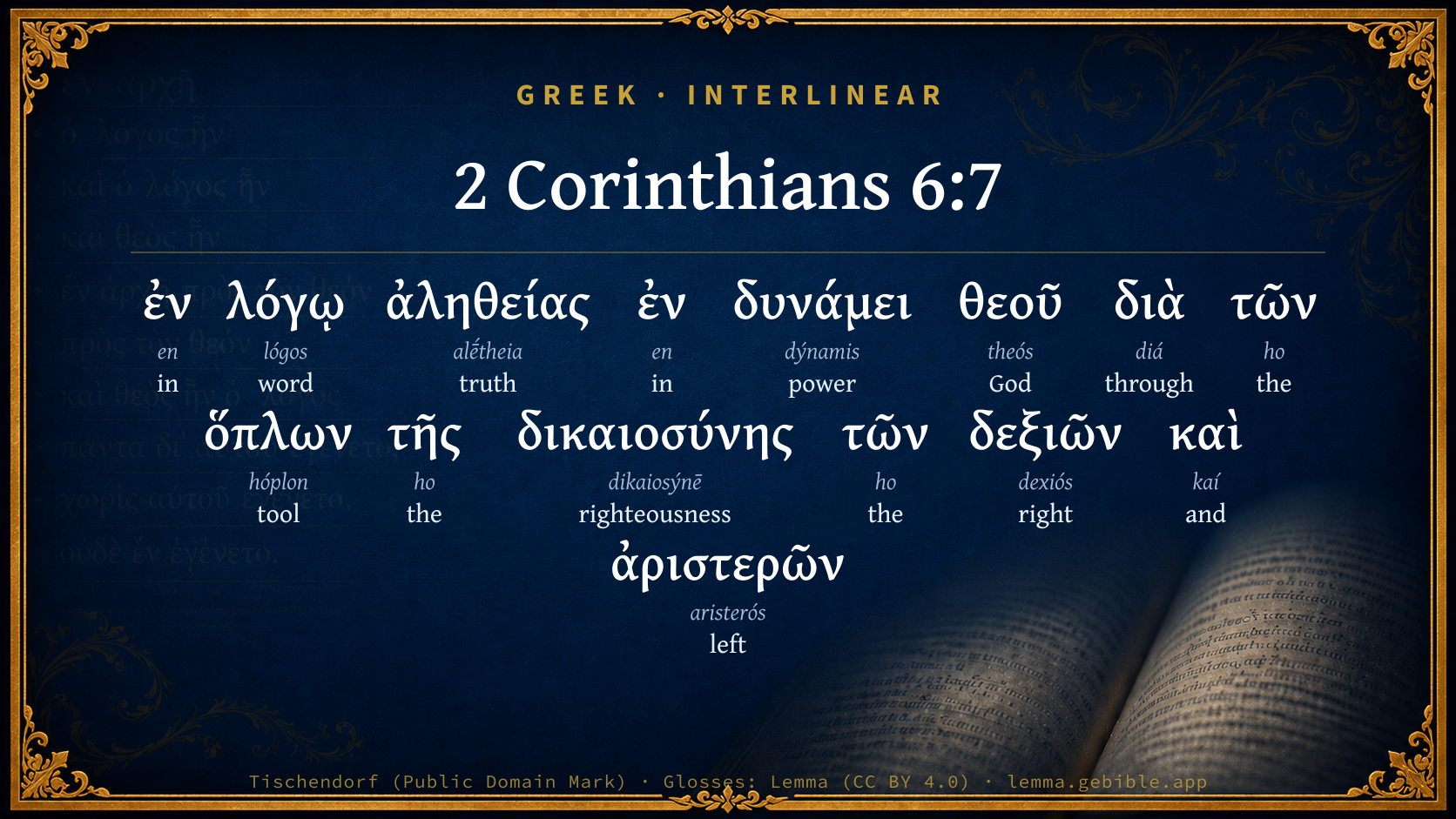
Download image
Cite this verse

2 Corinthians 6:7 (World English Bible). Public Domain. Lemma interlinear Bible study tool, https://lemma.gebible.app/v/2-corinthians/6/7.

Show BibTeX & RIS
BibTeX
RIS
English Translation
in the word of truth, in the power of God; by the armor of righteousness on the right hand and on the left,
World English Bible · Public Domain
Download a study sheet

One document with this verse’s original text, its word-by-word gloss line, the meaning frame, cross-references with their text, attributed commentary, and full source and license credits — printable, and it pastes into notes with its structure intact.

This verse Autodidact and up

Study sheet (.html) Plain text (.txt)

A passage Seminary Student

Up to 50 verses in one chapter. A passage sheet keeps up to 6 commentary sources and 12 cross-references per verse, in the order this page ranks them, and says so on the sheet whenever that leaves anything out. Ask for a single verse and you get the Autodidact verse sheet above.

Everything on this page stays free to read, with no account — the sheet is a download of what is already on screen, not access to it.

Want to remove ads? Support Godless Engineer
Compare translations 3

The same verse in 3 English versions, stacked beneath the original-language interlinear above. Click any original word for its lexicon entry.

Each is an independent rendering of the whole verse — the interlinear is not word-aligned to these translations.

Highlighted words mark where these versions differ — a whole-verse word diff, not a word-by-word alignment.

  • World English Bible Public Domain
    in the word of truth, in the power of God; by the armor of righteousness on the right hand and on the left,
  • King James Version Public Domain
    By the word of truth, by the power of God, by the armour of righteousness on the right hand and on the left,
  • unfoldingWord Literal Text CC BY-SA 4.0
    in the word of truth, in the power of God; through the weapons of righteousness the right hand and the left,

unfoldingWord Literal Text — © unfoldingWord, licensed CC BY-SA 4.0. Word-aligned USFM3 via Door43 (git.door43.org/unfoldingWord/en_ult).

Versions to compare (up to 4)

3 of 4 selected

Show all 19 translations

Every available English version of this verse, each an independent rendering of the whole verse.

  • World English Bible Public Domain
    in the word of truth, in the power of God; by the armor of righteousness on the right hand and on the left,
  • Berean Standard Bible Public Domain
    in truthful speech and in the power of God; with the weapons of righteousness in the right hand and in the left;
  • Majority Standard Bible Public Domain
    in truthful speech and in the power of God; with the weapons of righteousness in the right hand and in the left;
  • King James Version Public Domain
    By the word of truth, by the power of God, by the armour of righteousness on the right hand and on the left,
  • American Standard Version (1901) Public Domain
    in the word of truth, in the power of God; by the armor of righteousness on the right hand and on the left,
  • Revised Version (1885) Public Domain
    in the word of truth, in the power of God; by the armour of righteousness on the right hand and on the left,
  • Geneva Bible (1599) Public Domain
    By the worde of trueth, by the power of God, by the armour of righteousnesse on the right hand, and on the left,
  • Douay-Rheims (1899) Public Domain
    In the word of truth, in the power of God; by the armour of justice on the right hand and on the left;
  • Young's Literal Translation Public Domain
    in the word of truth, in the power of God, through the armour of the righteousness, on the right and on the left,
  • Literal Standard Version CC BY-SA 4.0
    in the word of truth, in the power of God, through the armor of righteousness, on the right and on the left,
  • Unlocked Literal Bible CC BY-SA 4.0
    We are his servants in the word of truth, in the power of God. We have the armor of righteousness for the right hand and for the left.
  • unfoldingWord Literal Text CC BY-SA 4.0
    in the word of truth, in the power of God; through the weapons of righteousness the right hand and the left,
  • Darby Bible Public Domain
    in [the] word of truth, in [the] power of God; through the arms of righteousness on the right hand and left,
  • World Messianic Bible Public Domain
    in the word of truth, in the power of God, by the armor of righteousness on the right hand and on the left,
  • Webster's Bible Public Domain
    By the word of truth, by the power of God, by the armor of righteousness on the right hand and on the left,
  • Free Bible Version CC BY-SA 4.0
    We speak truthfully, living in the power of God. Our weapons consist of what is true and right; we attack with our right hand and we defend with our left.
  • Bible in Basic English Public Domain
    In the true word, in the power of God; with the arms of righteousness on the right hand and on the left,
  • Text-Critical English NT CC BY 4.0
    in the word of truth, in the power of God; with weapons of righteousness for the right hand and the left,
  • Tyndale New Testament (1534) Public Domain
    in the wordes of trueth in the power of God by the armoure of rightewesnes on the right honde and on the lyfte

Literal Standard Version (2020), Covenant Press — licensed CC BY-SA 4.0. Text via the HelloAO Bible API (eBible.org). Unlocked Literal Bible (unfoldingWord) — licensed CC BY-SA 4.0. Text via the HelloAO Bible API (eBible.org). unfoldingWord Literal Text — © unfoldingWord, licensed CC BY-SA 4.0. Word-aligned USFM3 via Door43 (git.door43.org/unfoldingWord/en_ult). Free Bible Version, Dr. Jonathan Gallagher — licensed CC BY-SA 4.0. Text via the HelloAO Bible API (eBible.org).

Word by word

More ways to search: Search by grammar → Find every occurrence → Compare this word →

Practice this passage: Drill this verse → Learn its vocabulary →

About this verse

These counts appear in no published source. They are computed here, from the morphology-tagged text and Lemma’s own curated glosses. What Lemma adds →

15
words
12
distinct lemmas
Pauline Epistles
section

Notable vocabulary

The rarest word here is ἀριστερῶν left G710 — appearing just 4 times in the whole Greek New Testament.

Shared distinctive vocabulary

ἀριστερῶν left G710 occurs in 4 verses of the Greek New Testament. Also found in:

Repetition

Words recur within this verse:

Cross-references

26

Topical passages linked to 2 Corinthians 6:7 in the Treasury of Scripture Knowledge — connected by theme and wording, ordered by reader-vote popularity; previews shown in the World English Bible.

  • 2 Corinthians 4:2 But we have renounced the hidden things of shame, not walking in craftiness, nor handling the word of God deceitfully; but by the manifestation of the truth commending ourselves to every man's conscience in the sight of God.
  • 2 Corinthians 10:4–5 for the weapons of our warfare are not of the flesh, but mighty before God to the throwing down of strongholds,
  • Ephesians 6:11–20 Put on the whole armor of God, that you may be able to stand against the wiles of the devil.
  • 2 Timothy 2:15 Give diligence to present yourself approved by God, a workman who doesn't need to be ashamed, properly handling the Word of Truth.
  • 2 Corinthians 13:4 For he was crucified through weakness, yet he lives through the power of God. For we also are weak in him, but we will live with him through the power of God toward you.
  • Ephesians 3:20 Now to him who is able to do exceedingly abundantly above all that we ask or think, according to the power that works in us,
  • 1 Thessalonians 5:8 But let us, since we belong to the day, be sober, putting on the breastplate of faith and love, and, for a helmet, the hope of salvation.
  • 2 Timothy 4:7 I have fought the good fight. I have finished the course. I have kept the faith.
  • James 1:18 Of his own will he brought us forth by the word of truth, that we should be a kind of first fruits of his creatures.
  • Psalms 119:43 Don't snatch the word of truth out of my mouth, For I put my hope in your ordinances.
  • 1 Corinthians 2:4–5 My speech and my preaching were not in persuasive words of human wisdom, but in demonstration of the Spirit and of power,
  • 2 Corinthians 7:14 For if in anything I have boasted to him on your behalf, I was not disappointed. But as we spoke all things to you in truth, so our glorying also which I made before Titus was found to be truth.
  • Ephesians 1:13 in whom you also, having heard the word of the truth, the Gospel of your salvation,--in whom, having also believed, you were sealed with the Holy Spirit of promise,
  • Proverbs 3:16 Length of days is in her right hand. In her left hand are riches and honor.
  • Isaiah 59:17 He put on righteousness as a breastplate, and a helmet of salvation on his head; and he put on garments of vengeance for clothing, and was clad with zeal as a mantle.
  • Mark 16:20 They went out, and preached everywhere, the Lord working with them, and confirming the word by the signs that followed. Amen.
  • Acts 11:21 The hand of the Lord was with them, and a great number believed and turned to the Lord.
  • Romans 13:12–13 The night is far gone, and the day is near. Let's therefore throw off the works of darkness, and let's put on the armor of light.
  • 1 Corinthians 1:24 but to those who are called, both Jews and Greeks, Christ is the power of God and the wisdom of God.
  • Ephesians 1:19–20 and what is the exceeding greatness of his power toward us who believe, according to that working of the strength of his might
  • Ephesians 4:21 if indeed you heard him, and were taught in him, even as truth is in Jesus:
  • Colossians 1:5 because of the hope which is laid up for you in the heavens, of which you heard before in the word of the truth of the Gospel,
  • Hebrews 2:4 God also bearing witness with them, both by signs and wonders, and by various works of power, and by gifts of the Holy Spirit, according to his own will?
  • Exodus 14:22 The children of Israel went into the midst of the sea on the dry ground, and the waters were a wall to them on their right hand, and on their left.
  • Isaiah 11:5 Righteousness shall be the belt of his waist, and faithfulness the belt of his loins.
  • 2 Corinthians 1:18–20 But as God is faithful, our word toward you was not "Yes and no."

Cross-references courtesy of OpenBible.info (CC BY 4.0).

Commentary

Notes on 2 Corinthians 6:7 from classic Christian and Jewish commentators (each source and its license shown beneath its notes). The classic Christian expositions comment on the surrounding passage and are grouped to its opening verse, so a note may address several verses; the Jewish commentaries on the Tanakh (Rashi and others) are per-verse, so they appear only where the commentator wrote on this verse.

Lemma curates 59 commentaries, every one of them public domain or Creative Commons licensed, each selected and text-cleaned for this edition rather than reprinted as found. About our sources →

Bengel's Gnomon

Johann Albrecht Bengel

2Co 6:7. Δεξιῶν καὶ ἀριστερῶν) by offensive armour, when we are prospering; and defensive, when we are in difficulties. In the case of soldiers, κλίνειν, ἄγειν, ἐπιστρέφειν ἐπὶ δόρυ or ἐπὶ ξῖφος signifies towards the right hand; the ἐπὶ ἀσπίδα, ἐφʼ ἡνίαν or χαλινὸν, signifies, towards the left hand, just as the left hand is called by the French, the bridle hand (main de la bride), and the right hand is called the lance hand (main de la lance). Add the note to Chrysost. de Sacerd., p. 464. Paul has so placed these words, that they might at the same time form a transition; for he just now treated of the armour for the right hand, and he is forthwith about to treat of that for the left.

Bengel's Gnomon of the New Testament — English translation (T&T Clark, Edinburgh, 1860) — public domain. Text from a community e-Sword module.

Meyer's Critical & Exegetical Commentary

Heinrich August Wilhelm Meyer

2Co_6:7. The enumerations hitherto made related generally to the conduct and character of Gods servants; now the stream, swelling ever more boldly, passes over to the province of the teachers work, and pours itself forth from 2Co_6:8 in a succession of contrasts between seeming and being, which are so many triumphs of the apostles clear self-assuranc.

ἐν λόγῳ ἀληθ.] through discourse of truth, i.e. through doctrine, the character of which is truth. Comp. 2Co_2:17, 2Co_4:2. It will not do to take, with Rückert, λόγ. ἀληθ. objectively, as equivalent to εὐαγγέλιον, because, as at Eph_1:13, Col_1:5, the article could not have been omitte.

ἐν δυνάμει θεοῦ] through power of God, which shows itself efficacious in our work of teaching, 2Co_4:7. Comp. 1Co_2:4; 1Co_4:20. The limitation to the miracles is arbitrary (Theophylact, comp. Emmerling and Flatt).

διὰ τῶν ὁπλῶν τῆς δικαιοσ. κ.τ.λ.] is by Grotius connected with what precedes (Dei virtute nobis arma subministrante, etc.); but seeing that other independent points are afterwards introduced by διά, we must suppose that Paul, who elsewhere without any special purpose varies in his use of equivalent prepositions, passes from the instrumental ἐν to the instrumental διά, so that we have here also a special point: through the weapons, which righteousness furnishes. The δικαιοσύνη is to be taken in the usual dogmatic sense. Comp. τὴν θώρακα τῆς δικαιοσ., Eph_6:15. It is the righteousness of faith which makes us strong and victorious in the way of assault or defence against all opposing powers. See the noble commentary of the apostle himself in Rom_8:31-39. It has been explained of moral integrity (comp. Rom_6:13; Rom_6:19; Eph_5:9; Eph_6:14), the genitive being taken either as ad justitiam implendam (Grotius), or as weapons, which the consciousness of integrity gives (Erasmus, Beza, Calvin, Billroth), or which are allowed to a moral man and are at his command (Rückert), or which minister to that which is of right (Hofmann), and the like; but the explanation has this against it, that the context contains absolutely nothing which leads us away from the habitual Pauline conception of δικαιοσύνη, as it was most definitely expressed even at 2Co_5:21, whereas the idea of δύναμις θεοῦ stands in quite a Pauline connection with that of δικαιοσύνη θεοῦ. See Rom_1:16-17. Hence there is no ground for uniting the two conceptions of δικαιοσύνη (Osiander), or for explaining it of righteousness as a quality of God which works through Paul (Kling). The explanation: arma justa, legitimate weapons (Flatt, following Heumann and Morus), is out of the questio.

τῶν δεξιῶν καὶ ἀριστ.] right-hand and left-hand arms, an apportioning specification of the whole armament. The former are the weapons of attack wielded with the right hand, the latter are the weapons of defence (shield); the warrior needs both together. Hence it was unsuitable to refer the former specially to res prosperas, the latter to res adversas (Erasmus, Estius, Grotius, Bengel, and others, following the Fathers): ne prosperis elevemur, nec frangamur adversis, Pelagius. Comp. rather, on the subject-matter, 2Co_10:4 f.

Meyer — Critical and Exegetical Commentary on the New Testament — English translation by Peter Christie, edited by Frederick Crombie (T&T Clark, 1880) — public domain. Text from a community e-Sword module.

Geneva Bible (1599)

Geneva Bible translators

Preaching of the Gospel.

Power to work miracles, and to bring under the wicked.

Uprightness.

Geneva Bible (1599) marginal notes — public domain. Text via Bolls.life.

Jamieson, Fausset & Brown

Robert Jamieson, A. R. Fausset & David Brown

By the word of truth, by the power of God--rather, "IN . . . in," &c. As to "the word of truth" (compare Co2 4:2; Col 1:5), and "the (miraculous) power of God" (Co2 4:7); Co1 2:4, "in demonstration of the Spirit and of power."

by the armour--Greek, "through" or "by means of the armor." "Righteousness," which is the breastplate alone in Eph 6:13-17, here is made the whole Christian panoply (compare Co2 10:4).

on . . . right . . . and . . . left--that is, guarding on every side.

Jamieson, Fausset & Brown — Commentary Critical and Explanatory on the Whole Bible (1871) — public domain (CC PDM 1.0). Text via the HelloAO Bible API.

Adam Clarke's Commentary

Verse 7. By the word of truth] The doctrine of truth received immediately from God, and faithfully and affectionately preached to men.

By the power of God] Confirming this doctrine, not only by the miracles which we were enabled to work, but also by the application of that truth to the souls of the people by the energy of God.

By the armour of righteousness] Such as that described by the apostle, Eph 6:13-17, which he calls there the whole armour of God, consisting of the following pieces: the girdle of truth, the breastplate of righteousness, the shoes of the Gospel of peace, the shield of faith, the helmet of salvation, and the sword of the Spirit.

On the right hand and on the left] Particularly, the shield and the sword; the former on the left arm, the latter in the right hand. We have the doctrine of truth, and the power of God, as an armour to protect us on all sides, every where, and on all occasions.

It seems far-fetched to understand the right hand as signifying prosperity, and the left as signifying adversity; as if the apostle had said: We have this armour to defend us both in prosperity and adversity. By the doctrine of the Gospel, and by the power of God, the apostles were furnished with offensive and defensive weapons; they could ever defend themselves, and discomfit their foes.

Adam Clarke's Commentary on the Bible (1810–1826) — public domain. Text from a community e-Sword/MySword module.

John Calvin's Commentaries

7. By the armor of righteousness By righteousness you must understand — rectitude of conscience, and holiness of life. He employs the metaphor of armor, because all that serve God require to fight, inasmuch as the devil is always on the alert, to molest them. Now they must be completely armed, because, if he does not succeed in one onset, he thereupon makes a new attempt, and attacks them at one time from before, at another from behind — now on this side, and then on that.

John Calvin's Commentaries (1540-1563) — public domain. Text from the Calvin Translation Society English edition (1840s-50s) via the Christian Classics Ethereal Library (ccel.org). Calvin's coverage is partial (roughly two-thirds of the Bible); uncommented books and verses are honest gaps, never fabricated. The 19th-century editor's footnotes and remarks are omitted so the notes are faithfully Calvin's own voice.

Ellicott's Commentary for English Readers

(7) By the word of truth.—Both words are, in the Greek, without the article, and this throws a slight shade of doubt upon their meaning. With the article, the same combination occurs in Eph_1:13; 2Ti_2:15; and there can be no doubt that there the sense is objective—“the word which conveys the truth of God to men.” Here a subjective meaning, “a word of truthfulness,” or “truthful word,” as distinct from insincerity of speech, is grammatically possible; but in Jas_1:18, where precisely the same combination occurs, we have ample warrant for retaining the objective meaning even here.

By the power of God.—Here, again, the words hover between a general and a specific sense. As distinguished from the “Holy Ghost” in 2Co_6:6, and looking to the general use of the Greek word for “power,” it seems natural to refer the word here chiefly, though, perhaps, not exclusively, to the supernatural power given by God for working miracles. (Comp. especially 2Co_12:12; 1Co_2:5; 1Co_12:10; 1Co_12:28-29.)

By the armour of righteousness on the right hand and on the left.—The thought is found in a more expanded form in Eph_6:11-17; 1Th_5:8. Its recurrence in 2Co_10:4 shows how familiar it was to St. Paul’s mind. Here it is presented in a more condensed form, but its meaning is sufficiently obvious. The weapon of the right hand is “the sword of the Spirit,” aggressive in the conflict with evil (Eph_6:17). The armour for the left hand is defensive, the “shield of faith,” which is our defence against the fiery darts of the wicked (Eph_6:16). This gives, it is believed, a better meaning than the interpretation which translates the Greek word by “instruments,” as in Rom_6:13, and taking these as meaning opportunities for action, sees in the two adjectives the meaning which sometimes attaches to them in Greek authors, and was derived from the usages of Greek divination, as “favourable” and “unfavourable.” It has been urged that the absence of the Greek article before “weapons on the left” is against the distinction which has been drawn above, and therefore that the words refer to the breast-plate which encompasses both sides of the body; but this, though a tenable view grammatically, is somewhat over-subtle. A man dictating a letter under the influence of strong emotion is not always mindful of minute grammatical distinctions, such as that on which this last interpretation rests.

A Bible Commentary for English Readers, edited by Charles John Ellicott (1878–1897) — public domain. Text from a community e-Sword module.

The Cambridge Bible for Schools and Colleges

gen. ed. J. J. S. Perowne

7. by the word of truth] i.e. the Gospel of reconciliation, with which he was entrusted. Cf. Gal_2:5; Eph_1:13; Eph_4:21; Col_1:5; 2Ti_2:15; Jas_1:18.

by the power of God] This is an expression very common in the N.T.; and, as Act_8:10 shews, was not confined to the Christian Church. See Mat_22:29; Luk_9:43; Rom_1:16; 1Co_1:18; 1Co_1:24, &c. Also 1Co_4:19-20; 1Co_5:4, and ch. 2Co_13:10.

by the armour of righteousness] Rather weapons (arma, Vulgate). The translation in the text—which we owe to Tyndale—is possibly suggested by passages such as Eph_6:11; Eph_6:13; 1Th_5:8. Cf. ch. 2Co_10:4.

on the right hand and on the left] i.e. offensive and defensive, shield as well as spear.

The Cambridge Bible for Schools and Colleges (gen. ed. J. J. S. Perowne; Cambridge University Press, 1878–1918) — public domain. Text from a community e-Sword module.

John Gill's Exposition

By honour and dishonour,.... Some persons think and speak honourably of us, and behave in a reverent manner towards us; they wish us well, bid us God speed, receive us into their houses, and treat us with respect: others think meanly of us, speak of us with the utmost contempt, and use us as if we were the filth of the world, and the offscouring of all things; so we pass through the world; this is the treatment we meet with on the right hand and on the left; nor are we much affected with it:

by evil report and good report; as it fares with our persons, so with our doctrine: some speak well of it, receive and embrace it; others blaspheme it, and have it in the utmost abhorrence; we are charged with the vilest of crimes, and our doctrines loaded with the most absurd and wicked consequences, and both branded in the most infamous manner by one set of men; and by others both our persons and principles are cleared and vindicated from all such aspersions, and are highly commended and applauded.

As deceivers; for so they were accounted, as Christ was before them, by the unbelieving Jews, and by the false apostles, as if they were the authors, or abettors, and spreaders of errors, and the instruments of leading people aside.

And yet true; true and faithful ministers of the word; true to their Lord and master; true to the trust committed to them; true to the Gospel of Christ, and to the souls of men.

John Gill's Exposition of the Whole Bible (1746–1763) — public domain (CC PDM 1.0). Text via the HelloAO Bible API.

Trapp's Complete Commentary

John Trapp

7 By the word of truth, by the power of God, by the armour of righteousness on the right hand and on the left,

Ver. 7. On the right hand, &c.] Against the world’s both irritamenta and terriculamenta, both allurements and affrightments. Contemptus est a me Romanus et favor et furor, The Roman is despised by me both in gooodwil and anger, saith Luther, when the pope one while enticed him and another while threatened him. When he was offered to be cardinal if he would be quiet, he replied, No, not if I might be pope. When he was told that he should find no favour; Quid vero facere poterunt? (said he) occident? Nunquid resuscitabunt, ut iterum occidant? What will they do? will they kill me? But can they raise me to life again that they may kill me again? Can they kill me the second time? (Epist. ad Spal.)

John Trapp, A Commentary or Exposition upon All the Books of the Old and New Testament (1647–1656) — public domain. Text from a community e-Sword module.

Albert Barnes' Notes on the Bible

By the word of truth - That is, by making known the truths of the gospel. It was his object to make known the simple truth. He did not corrupt it by false mixtures of philosophy and human wisdom, but communicated it as it had been revealed to him. The object of the appointment of the Christian ministry is to make known the truth, and when that is done it cannot but be that they will commend their office and work to the favorable regards of people.

By the power of God - By the divine power which attended the preaching of the gospel. Most of the ancient commentators explain this of the power of working miracles - Bloomfield. But it probably includes all the displays of divine power which attended the propagation of the gospel, whether in the working of miracles, or in the conversion of people. If it be asked how Paul used this power so as to give no offence in the work of the ministry, it may be replied, that the miraculous endowments bestowed upon the apostles, the power of speaking foreign languages, etc., seem to have been bestowed upon them to be employed in the same way as were their natural faculties; see the notes on 1Co 14:32. The idea here is, that they used the great powers entrusted to them by God, not as impostors would have done, for the purposes of gain and ambition, or for vain display, but solely for the furtherance of the true religion, and the salvation of people. They thus showed that they were sent from God, as well by the nature of the powers with which they were entrusted, as by the manner in which they used them.

By the armor of righteousness on the right hand and on the left - Interpreters bare varied much in the exposition of this passage; and many have run into utter wildness. Grotius says, that it refers to the manner in which the ancient soldiers were armed. They bore a spear in their right hand, and a shield in the left. With the former they attacked their foes, with the later they made defense. Some have supposed that it refers to the fact that they were taught to use the sword with the left hand as well as with the right. The simple idea is, that they were completely armed. To be armed on the right hand and on the left is to be well armed, or entirely equipped. They went forth to conflict. They met persecution, opposition, and slander. As the soldier went well armed to battle, so did they. But the armor with which they met their foes, and which constituted their entire panoply, was a holy life. With that they met all the assaults of their enemies; with that all slander and persecution. That was their defense, and by that they hoped and expected to achieve their conquests. They had no swords, and spears, and helmets, and shields; no carnal weapons of offence and defense; but they expected to meet all their assaults, and to gain all their victories, by an upright and holy life.

Albert Barnes' Notes on the Bible (1834–1885) — public domain. Text from a community e-Sword/MySword module.

Matthew Poole's English Annotations

By the word of truth; living up to and keeping our eye upon the word of God, which is the word of truth: this seems to be the sense, rather than speaking truth to every one, as some have thought.

By the power of God; by the efficacious working of the Spirit of God upon our hearts, enabling us to live up to the doctrine we preach. Some understand here, by the power of God, that extraordinary power of working miracles, which God gave the apostles; others, the gospel, which the apostle calls the power of God unto salvation, Rom 1:16. It may be understood of the first and the last joined together; for the gospel is no otherwise the power of God to salvation, than as it is attended to the souls of those to whom it is so made powerful, with the inward, powerful, efficacious working of the Holy Spirit.

By the armour of righteousness; he means a good conscience, (which cannot be without a universal rectitude, or uprightness of life), which is a defence against all temptations, either from prosperity or from adversity. In which sense that of Solomon is true: He that walketh uprightly, walketh surely, Pro 10:9; and David prayeth, Psa 25:21; Let integrity and uprightness preserve me.

Matthew Poole's English Annotations on the Holy Bible (1683–1685) — public domain. Text from a community e-Sword/MySword module.

Whedon's Commentary on the Bible

Daniel D. Whedon

7. Word preached, of gospel truth.

Power of God—Supernatural efficiency both in word and deed; prophecy and miracle.

In the two following verses (8, 9) we have the contradictions, meeting in the persons of the apostles, between the views taken by their enemies and the views taken by their own self-knowledge. In 2Co_6:10 we have the opposite sides as truly seen by themselves.

Daniel D. Whedon (gen. ed.), Commentary on the Old and New Testaments (1874–1909) — public domain. Text from a community e-Sword module.

The Pulpit Commentary

By the word of truth. St. Paul now passes to the more specific endowments of the true teacher. (comp. 2Co_2:17 2Co_4:2; 1Co_2:4; Gal_2:5) By the power of God; literally, in power of God (2Co_4:7; 1Co_2:4 1Co_4:20) "For the kingdom of God is not only in word, but in power." By the armour of righteousness. Here first the preposition "in" (ejn) is changed for "through," "by means of" (dia). Armour; rather, arms. On the right hand and on the left. That is, both by offensive weapons and a defensive panoply (2Co_10:4; Eph_6:11-17; 1Th_5:8)

The armour of righteousness.

There was something soldierly both in the nature and in the life course of the Apostle Paul. His resolution, courage, fortitude, capacity for endurance, fidelity to his spiritual Commander, were all high military qualities. We do not wonder that he made in his writings use so frequent and so effective of the warrior"s life. The Christian"s career, and much more emphatically the apostolic career, appeared to him one large campaign. Hence his reliance upon "the armour of righteousness on the right hand and on the left.

I THE CHRISTIAN"S NEED OF SPIRITUAL ARMOUR.

1. His foes are many, active, vigilant, formidable, untiring.

2. The warfare to which he is called is accordingly perilous and serious.

3. His own natural resources are utterly inadequate for his defence.

II THE NATURE OF THE CHRISTIAN"S SPIRITUAL ARMOUR.

1. It is not physical, or carnal, but moral.

2. It is described in one word as "the armour of righteousness," as opposedto fraud and cunning and iniquity of every kind.

3. It is adapted to the several necessities of the welfare. Vide Ephesians 6., where the several weapons are enumerated and described.

III THE PURPOSES WHICH THE CHRISTIAN"S ARMOUR EFFECTS.

1. The right hand of the warrior wields the sword; and this is the emblemof the weapon of attack which the Christian grasps even "the sword of the Spirit," which is the Word of God.

2. The left hand of the warrior holds the shield, which is the symbol of thatmighty principle of faith, which is the defensive weapon used by every soldier in the spiritual warfare, with which he quenches the fiery darts of the evil one.

IV THE RESULTS OF THE WARFARE WAGED BY THE CHRISTIAN THROUGH THE USE OF HIS SPIRITUAL ARMOUR.

1. To himself, security and honour. He is delivered from his foes, and hefights the good fight of faith.

2. To his cause, victory. Righteousness is destined to conquer; there is nouncertainty as to the issues of the holy war.

3. To his Commander, great and growing renown, as his foes arevanquished and his kingdom is consolidated and extended. T.

The Pulpit Commentary (1880–1919), ed. H.D.M. Spence-Jones & Joseph S. Exell — public domain. Text from a community e-Sword module.

John Wesley's Explanatory Notes

By the convincing and converting power of God - Accompanying his word; and also attesting it by divers miracles. By the armour of righteousness on the right hand and the left - That is, on all sides; the panoply or whole armour of God.

John Wesley, Explanatory Notes Upon the Whole Bible (1754–1765) — public domain. Text via the GEBible commentary corpus.

Scofield Reference Notes

C. I. Scofield

righteousness

(See Scofield "1Jn 3:7").

The Scofield Reference Bible (1917 edition), notes by C. I. Scofield — public domain. Text from a community e-Sword module.

McGarvey & Pendleton's Commentaries

J. W. McGarvey

in the word of truth, in the power of God [If Paul had kept his private life in fit condition for the ministry, he had likewise demeaned himself publicly as a true apostle. If he had kept his heart loyal to the truth, he had likewise kept his tongue faithful to the proclamation of it. In exercising discipline he had manifested the fullness of the power of God which was in him-- 2Co_4:7 ; 1Co_2:4-5 ; 1Co_4:19-21 ; Act_13:9-12 ]; by the armor of righteousness on the right hand and on the left [The armor of the right hand was offensive, and that of the left was defensive. As a true minister of Christ engaged in the Christian warfare, Paul knew how to strike so as to discipline all real offenders, and he also was well able to defend himself against the attacks of unchristian Jews, etc., and false brethren, who assailed his character as they had here at Corinth],

J. W. McGarvey (with Philip Y. Pendleton), Commentaries on the New Testament (The Fourfold Gospel, 1914; Acts; and the epistles) — public domain. Text from a community e-Sword/MySword module.

The People's New Testament

B. W. Johnson

7. By the word of truth. By preaching the gospel with power. By the power of God. Shown in his great activity and unparalleled success (4:7). By the armor of righteousness on the right hand and on the left. See Eph. 6:11. On the left hand was the shield; in the right, the sword. Protected by the shield of faith, Paul used the sword of the Spirit.

B. W. Johnson's The People's New Testament with Notes (1889–1891) — public domain. Electronic text from the Christian Classics Ethereal Library (CCEL) ThML edition.

Cambridge Greek Testament for Schools and Colleges

7. ἐν λόγῳ ἀληθείας. In Eph 1:13; Col 1:5; 2Ti 2:15 the Gospel is called ὁ λόγος τῆς ἀληθείας. The omission of the article here does not prove that the Gospel is not meant, as λόγῳ ἀληθείας (Jas 1:18), ποιηταὶ λόγου (Jas 4:11), λόγος ζωῆς (Php 2:16) show. But perhaps the sincerity of his utterances is all that is intended here. Through the influence of the Spirit neither his affection nor his speech was hypocritical. His enemies said that both were.

ἐν δυνάμει θεοῦ. Not to be confined to either his preaching or his miracles (2Co 12:12): it covers the whole of his ministerial work, the success of which was not his but God’s; ἐν ἀποδείξει πνεύματος καὶ δυνάμεως (1Co 2:4). For δύναμις θεοῦ comp. 2Co 13:4; 1Co 1:18; 1Co 2:5; Rom 1:16; &c.

διὰ τῶν ὅπλων τῆς δικαιοσύνης. By weapons of righteousness, i.e. which righteousness supplies. Neither ‘weapons,’ nor ‘armour’ is satisfactory, the one meaning almost exclusively offensive, and the other quite exclusively defensive arms; whereas ὅπλα includes both. ‘Arms’ might be understood as brachia rather than arma. Comp. Eph 6:13-17. See Chase, Chrysostom, p. 183.

τῶν δεξιῶν καὶ ἀριστερῶν. For the right hand and the left. This does not mean for prosperity and adversity, but for completeness. The arms form a panoply; neither side is unarmed or unprotected.

Cambridge Greek Testament for Schools and Colleges (Cambridge University Press, 1896; 21 vols, various authors incl. Carr, Maclear, Plummer, Farrar, Lumby, Moule, M. R. James, Simcox) — public domain. Text from a community e-Sword module.

Alford’s Greek Testament

Henry Alford

7. ἐν λόγ. ἀληθ.] is taken by De W., Meyer, al., as subjective,—‘in speaking, or teaching truth’—‘in discourse, the contents whereof were truth:’ but their objection against the sense in the word of truth, = ἐν τῷ λόγῳ τῆς ἀληθείας, as it is expressed Col 1:5, is not valid, on account (1) of the government by a preposition, which would make the insertion of the article optional,—(2) of the whole catalogue being anarthrous, which would cause the article to be omitted for uniformity’s sake.

ἐν δυν. θεοῦ] viz. the Power spoken of ch. 4:7,—the power manifested in every part of our apostolic working,—not merely in miracles.

διὰ τ. ὅπλ. τ. δικ.] By means of (ἐν is changed for διὰ, first apparently on account of τὰ ὅπλα, marking them more distinctly as instruments,—and then continued) the weapons of righteousness (belonging to,—or as Meyer, furnished by, the righteousness which is of faith. That panoply, part of which only in the more particular specification of Eph 6:13-17, viz. the θῶραξ, is allotted to δικαιοσύνη,—is here all assigned to it.

Some of the ancient Commentators,—Chrys., Œcum., al., and Grot., Estius, al., understand by ὅπλα, ‘instruments,’ as in Rom 6:13, and interpret these instruments to be, situations and opportunities of life, whether prosperous, δεξιά, or adverse, ἀριστερά: but the other interpretation is in better accordance with the Apostle’s habit of comparison,—see ch. 10:4; Eph 6:13 ff.; 1Th 5:8).

τῶν δεξ. κ. ἀριστ.] which are on the right and left: i.e. encompassing and guarding the whole person. Grot., Bengel, and most recent Commentators, even De W. and Meyer, explain it, both righthanded,—i.e. of attack, the sword and spear,—and left-handed,—i.e. of defence, the shield: but it seems to me that this would require: τῶν δεξιῶν καὶ τῶν ἀριστερῶν: whereas now, no article being inserted before ἀριστ., it is implied that the panoply (τὰ ὅπλα) is on both sides (δεξιὰ κ. ἀριστερά) of the person. On the interpretation prosperity and adversity, see above.

Henry Alford, The Greek Testament (1849–1861) — public domain. Text from a community e-Sword module.

International Critical Commentary

7. ἐν λόγῳ ἀληθείας. We have the article omitted in Jas 1:18, as here; so also in διὰ λόγου ζῶντος Θεοῦ (1Pe 1:23), a passage which perhaps was suggested by Jas 1:18. In Eph 1:13; Col 1:5; 2Ti 2:15, we have the full expression, ὁ λόγος τῆς ἀληθείας. The genitive may be of apposition, ‘the word which is the truth’; or possessive, ‘the word which belongs to the truth’; or objective, ‘the declaration of the truth.’ The last is best,—the teaching which told the truth of the good tidings, the preaching of the Gospel. Some think that general truthfulness is the meaning here; and this fits on well to ‘love unfeigned.’ There was no insincerity either in the affection which he manifested or in the statements which he uttered (2:17, 4:2).

ἐν δυνάμει Θεοῦ. This Divine power was all the more conspicuous because of his personal weakness (4:7, 12:9). See on 1Co 2:4: neither there nor here is the chief reference, if there be any at all, to the miracles wrought by St Paul. In 12:12, where he does mention them, ἐν πάσῃ ὑπομονῇ is placed first among τὰ σημεῖα τοῦ ἀποστόλου, and the miracles are secondary. Here he is referring to his missionary career in general, the results of which showed that he must be working in the power of God. If there is allusion to one feature in the career more than to another, it is probably to the exercise of the Apostolic authority in enforcing Christian discipline.

The expression δύναμις Θεοῦ is chiefly Pauline in N.T. (13:4; 1Co 1:18, 1Co 1:2:5; Rom 1:16; 2Ti 1:8; cf. 2Th 1:11). On ἐν δυνάμει Θεοῦ (1Pe 1:5) Hort remarks; “What is dwelt on is not so much that the power of God is exerted on behalf of men, as that men are uplifted and inspired by power, or by a power, proceeding from God. Ἐν is not here instrumental, but is used with its strict meaning. In one sense the power is in men; but in another and yet truer sense men are in the power, they yield to it as something greater and more comprehensive than themselves, in which their separateness is lost.”

διὰ τῶν ὅπλων τῆς δικαιοσύνης. ‘Through ( = by) weapons of righteousness.’ Here again the Book of Wisdom (5:17-20) may have suggested the expression used: cf.1Th 5:8; Eph 6:13-17; and see on Rom 13:12.Isa 59:17 is another possible source. The change from ἐν to διά is made partly because the frequent repetition of ἐν has become intolerable; but the change may point to the difference between the δύναμις Θεοῦ and the ὅπλα used by the διάκονοι Θεοῦ. ‘Weapons of righteousness’ are those which righteousness supplies and which support the cause of righteousness (Rom 6:13). Whether he assailed others or defended himself, it was always with legitimate weapons and in a legitimate cause. He adds τῶν δεξιῶν καὶ ἀριστερῶν to intimate that he is thoroughly equipped; his panoply is complete. On the right hand, etc. (AV, RV), is ambiguous; ‘ for the right hand,’ is better, i.e. ‘right-hand and left-hand weapons,’ offensive and defensive armour, the shield being carried on the left arm. Chrys. interprets ἀριστερά as afflictions, which not only do not cast down but fortify. So also Thdrt.; δεξιὰ δὲ καλεῖ τὰ δοκοῦντα θυμήρη, ἀριστερὰ δὲ τὰ ἐναντία. But the meaning of success and failure— ne prosperis elevemur, nec frangamur adversis—is alien to the passage and to N.T. usage.

International Critical Commentary — older volumes (1896–1929), various authors — public domain. Text from a community e-Sword module.

Vincent's Word Studies in the New Testament

Marvin R. Vincent

Right - left. Right - hand and left - hand weapons. Offensive, as the sword, in the right hand, defensive, as the shield, in the left.

Marvin R. Vincent, Word Studies in the New Testament (1887–1900) — public domain. Text from a community e-Sword/MySword module.

Lesson kit

Teaching starters — assembled from the data on this page, not authored interpretation. Every prompt links to the verse data it draws on. Edit before teaching.

2 Corinthians, in the Pauline Epistles, opens this verse with 15 words (12 distinct Greek lemmas). Its most distinctive word is aristerós (“left”). A historical commentator’s framing appears above. Read the whole chapter for the surrounding context.

Discussion questions

  1. How does “left” (aristerós) shape what this verse is saying?
  2. How does Matthew 6:3, which shares the word «left», read alongside this verse?
  3. What does the repetition of “the” (3× in this one verse) do in this verse?
  4. These translations render this verse differently; the difference is in the English rendering, not the original. What questions does that raise?
  5. Compare how Bengel's Gnomon and Meyer's Critical & Exegetical Commentary read this verse. Where do they agree or differ?

Things to notice

Reading settings

Reading text

Shown beneath each verse's original-language words.

Old Testament
Old Testament edition

Read the OT as the Masoretic Hebrew (MT) or the Greek Septuagint (LXX).

English shown for the Greek Septuagint (in the Hebrew ↔ Greek comparison).

Comparing translations? Open the Compare panel on any verse page to stack up to four side by side.