
Romans 8:39

Greek (Tischendorf 8th ed.) Romans 8:39 appears in the Greek New Testament. The text above is from the Tischendorf 8th edition. Each word links to its Strong’s number and a concise gloss. Click any word for its full Thayer’s Greek Lexicon entry.
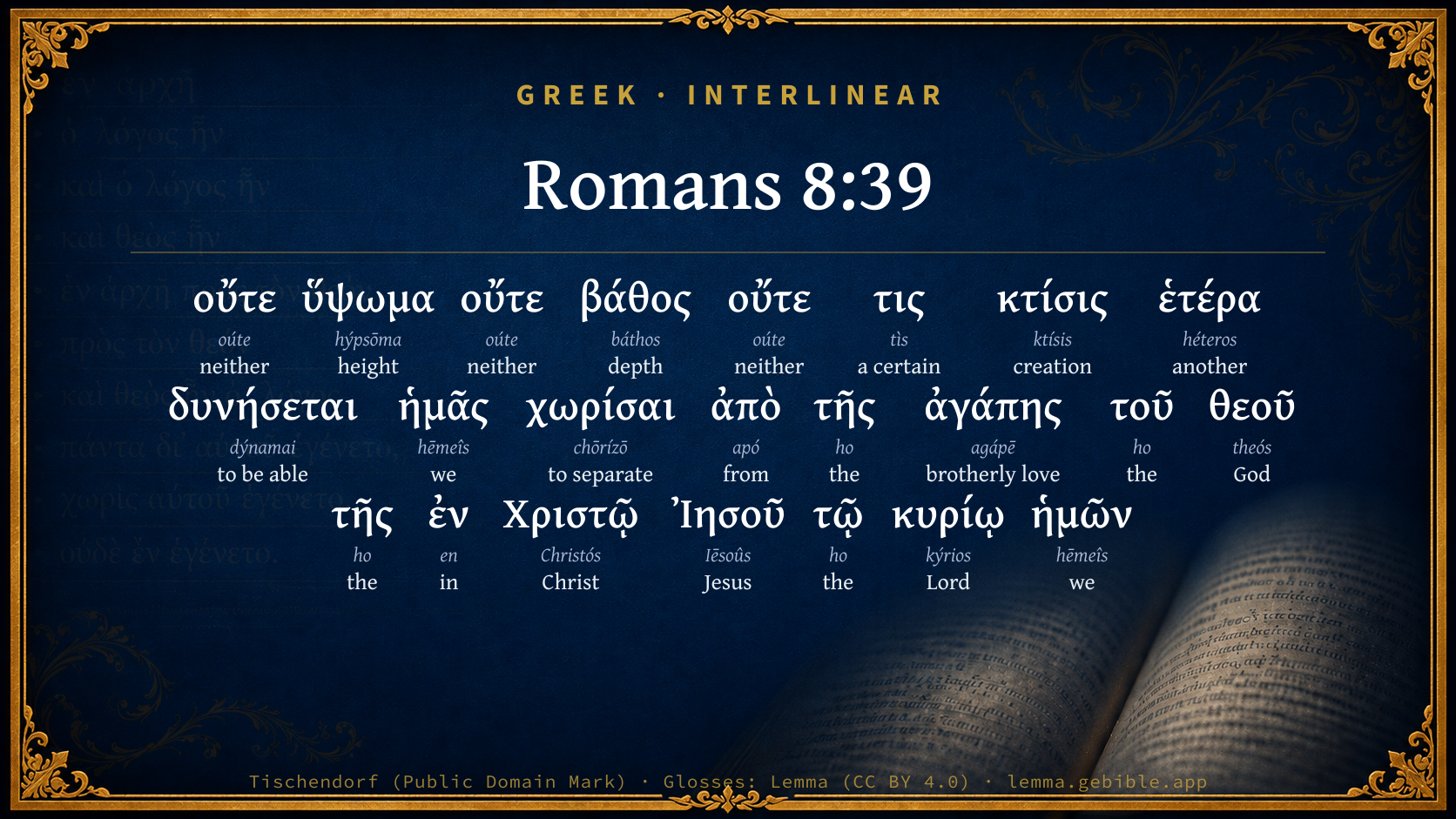
Download image
Cite this verse

Romans 8:39 (World English Bible). Public Domain. Lemma interlinear Bible study tool, https://lemma.gebible.app/v/romans/8/39.

Show BibTeX & RIS
BibTeX
RIS
English Translation
nor height, nor depth, nor any other created thing, will be able to separate us from the love of God, which is in Christ Jesus our Lord.
World English Bible · Public Domain
Highlights
  • 1 first appearance in the Greek New Testament
Full analysis ↓
Download a study sheet

One document with this verse’s original text, its word-by-word gloss line, the meaning frame, cross-references with their text, attributed commentary, and full source and license credits — printable, and it pastes into notes with its structure intact.

This verse Autodidact and up

Study sheet (.html) Plain text (.txt)

A passage Seminary Student

Up to 50 verses in one chapter. A passage sheet keeps up to 6 commentary sources and 12 cross-references per verse, in the order this page ranks them, and says so on the sheet whenever that leaves anything out. Ask for a single verse and you get the Autodidact verse sheet above.

Everything on this page stays free to read, with no account — the sheet is a download of what is already on screen, not access to it.

Want to remove ads? Support Godless Engineer
Compare translations 3

The same verse in 3 English versions, stacked beneath the original-language interlinear above. Click any original word for its lexicon entry.

Each is an independent rendering of the whole verse — the interlinear is not word-aligned to these translations.

Highlighted words mark where these versions differ — a whole-verse word diff, not a word-by-word alignment.

  • World English Bible Public Domain
    nor height, nor depth, nor any other created thing, will be able to separate us from the love of God, which is in Christ Jesus our Lord.
  • King James Version Public Domain
    Nor height, nor depth, nor any other creature, shall be able to separate us from the love of God, which is in Christ Jesus our Lord.
  • unfoldingWord Literal Text CC BY-SA 4.0
    nor height, nor depth, nor any other created thing, will be able to separate us from the love of God, which in Christ Jesus our Lord.

unfoldingWord Literal Text — © unfoldingWord, licensed CC BY-SA 4.0. Word-aligned USFM3 via Door43 (git.door43.org/unfoldingWord/en_ult).

Versions to compare (up to 4)

3 of 4 selected

Show all 19 translations

Every available English version of this verse, each an independent rendering of the whole verse.

  • World English Bible Public Domain
    nor height, nor depth, nor any other created thing, will be able to separate us from the love of God, which is in Christ Jesus our Lord.
  • Berean Standard Bible Public Domain
    neither height nor depth, nor anything else in all creation, will be able to separate us from the love of God that is in Christ Jesus our Lord.
  • Majority Standard Bible Public Domain
    neither height nor depth, nor anything else in all creation, will be able to separate us from the love of God that is in Christ Jesus our Lord.
  • King James Version Public Domain
    Nor height, nor depth, nor any other creature, shall be able to separate us from the love of God, which is in Christ Jesus our Lord.
  • American Standard Version (1901) Public Domain
    nor height, nor depth, nor any other creature, shall be able to separate us from the love of God, which is in Christ Jesus our Lord.
  • Revised Version (1885) Public Domain
    nor height, nor depth, nor any other creature, shall be able to separate us from the love of God, which is in Christ Jesus our Lord.
  • Geneva Bible (1599) Public Domain
    Nor height, nor depth, nor any other creature shalbe able to separate vs from the loue of God, which is in Christ Iesus our Lord.
  • Douay-Rheims (1899) Public Domain
    Nor height, nor depth, nor any other creature, shall be able to separate us from the love of God, which is in Christ Jesus our Lord.
  • Young's Literal Translation Public Domain
    nor things about to be, nor height, nor depth, nor any other created thing, shall be able to separate us from the love of god, that `is' in Christ Jesus our Lord.
  • Literal Standard Version CC BY-SA 4.0
    nor things about to be, nor height, nor depth, nor any other created thing, will be able to separate us from the love of God that [is] in Christ Jesus our Lord.
  • Unlocked Literal Bible CC BY-SA 4.0
    nor height, nor depth, nor any other created thing, will be able to separate us from the love of God, which is in Christ Jesus our Lord.
  • unfoldingWord Literal Text CC BY-SA 4.0
    nor height, nor depth, nor any other created thing, will be able to separate us from the love of God, which in Christ Jesus our Lord.
  • Darby Bible Public Domain
    nor height, nor depth, nor any other creature, shall be able to separate us from the love of God, which [is] in Christ Jesus our Lord.
  • World Messianic Bible Public Domain
    nor height, nor depth, nor any other created thing will be able to separate us from God’s love which is in Messiah Yeshua our Lord.
  • Webster's Bible Public Domain
    Nor hight, nor depth, nor any other creature, will be able to separate us from the love of God which is in Christ Jesus our Lord.
  • Free Bible Version CC BY-SA 4.0
    neither height nor depth, in fact nothing in all creation can separate us from the love of God in Christ Jesus our Lord.
  • Bible in Basic English Public Domain
    Or things on high, or things under the earth, or anything which is made, will be able to come between us and the love of God which is in Christ Jesus our Lord.
  • Text-Critical English NT CC BY 4.0
    nor height, nor depth, nor any other created thing, will be able to separate us from the love of God that is in Christ Jesus our Lord.
  • Tyndale New Testament (1534) Public Domain
    nether heyth nether loweth nether eny other creature shalbe able to departe vs from the love of God shewed in Christ Iesu oure lorde.

Literal Standard Version (2020), Covenant Press — licensed CC BY-SA 4.0. Text via the HelloAO Bible API (eBible.org). Unlocked Literal Bible (unfoldingWord) — licensed CC BY-SA 4.0. Text via the HelloAO Bible API (eBible.org). unfoldingWord Literal Text — © unfoldingWord, licensed CC BY-SA 4.0. Word-aligned USFM3 via Door43 (git.door43.org/unfoldingWord/en_ult). Free Bible Version, Dr. Jonathan Gallagher — licensed CC BY-SA 4.0. Text via the HelloAO Bible API (eBible.org).

Word by word

More ways to search: Search by grammar → Find every occurrence → Compare this word →

Practice this passage: Drill this verse → Learn its vocabulary →

ὕψωμα
hýpsōma
G5313
“height”
Noun, Nominative, Singular, Neuter
Part of Speech
Noun
Case
Nominative
Number
Singular
Gender
Neuter
Full Thayer's Definition

Origin: from G5312

TDNT: 18:13,1

1. thing elevated, height a. of space b. elevated structure i.e. barrier, rampart, bulwark
  1. οὔτε oúte G3777 “neither” Conjunction, Negative
  2. οὔτε oúte G3777 “neither” Conjunction, Negative
  3. βάθος báthos G899 “depth” Noun, Nominative, Singular, Neuter
  4. οὔτε oúte G3777 “neither” Conjunction, Negative
  5. τις tìs G5100 “a certain” Indefinite pronoun, Nominative, Singular, Feminine
  6. κτίσις ktísis G2937 “creation” Noun, Nominative, Singular, Feminine
  7. ἑτέρα héteros G2087 “another” Adjective, Nominative, Singular, Feminine
  8. δυνήσεται dýnamai G1410 “to be able” Verb, Future, Middle deponent, Indicative, 3rd person, Singular
  9. ἡμᾶς hēmeîs G2249 “we” Personal pronoun, 1st person, Accusative, Plural
  10. χωρίσαι chōrízō G5563 “to separate” Verb, Aorist, Active, Infinitive
  11. ἀπὸ apó G575 “from” Preposition
  12. τῆς ho G3588 “the” Article, Genitive, Singular, Feminine
  13. ἀγάπης agápē G26 “brotherly love” Noun, Genitive, Singular, Feminine
  14. τοῦ ho G3588 “the” Article, Genitive, Singular, Masculine
  15. θεοῦ theós G2316 “God” Noun, Genitive, Singular, Masculine
  16. τῆς ho G3588 “the” Article, Genitive, Singular, Feminine
  17. ἐν en G1722 “in” Preposition
  18. Χριστῷ Christós G5547 “Christ” Noun, Dative, Singular, Masculine
  19. Ἰησοῦ Iēsoûs G2424 “Jesus” Noun, Dative, Singular, Masculine
  20. τῷ ho G3588 “the” Article, Dative, Singular, Masculine
  21. κυρίῳ kýrios G2962 “Lord” Noun, Dative, Singular, Masculine
  22. ἡμῶν hēmeîs G2249 “we” Personal pronoun, 1st person, Genitive, Plural

About this verse

These counts appear in no published source. They are computed here, from the morphology-tagged text and Lemma’s own curated glosses. What Lemma adds →

23
words
17
distinct lemmas
Pauline Epistles
section

Notable vocabulary

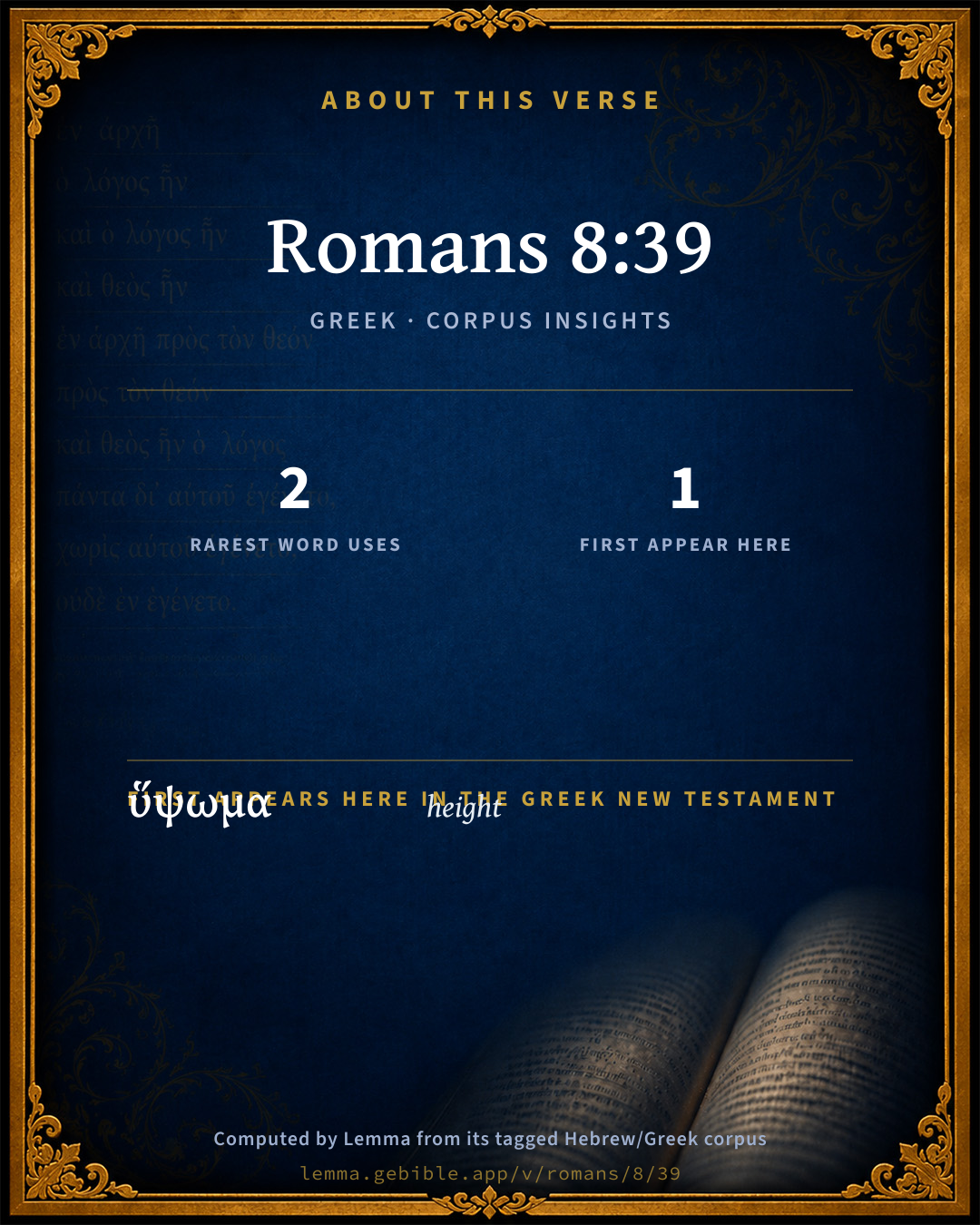
The rarest word here is ὕψωμα height G5313 — appearing just 2 times in the whole Greek New Testament.

First appearance in Scripture

This word makes its first canonical appearance in the Greek New Testament here:

  • ὕψωμα height G5313

Shared distinctive vocabulary

ὕψωμα height G5313 occurs in 2 verses of the Greek New Testament. Also found in:
Repetition

Words recur within this verse:

  • οὔτε neither G3777 ×3
  • τῆς the G3588 ×4
  • ἡμᾶς we G2249 ×2

Cross-references

36

Topical passages linked to Romans 8:39 in the Treasury of Scripture Knowledge — connected by theme and wording, ordered by reader-vote popularity; previews shown in the World English Bible.

  • John 10:28–30 I give eternal life to them. They will never perish, and no one will snatch them out of my hand.
  • Romans 8:35 Who shall separate us from the love of Christ? Could oppression, or anguish, or persecution, or famine, or nakedness, or peril, or sword?
  • Romans 5:8 But God commends his own love toward us, in that while we were yet sinners, Christ died for us.
  • Ephesians 3:18–19 may be strengthened to comprehend with all the saints what is the breadth and length and height and depth,
  • 1 John 4:19 We love Him, because he first loved us.
  • John 3:16 For God so loved the world, that he gave his one and only Son, that whoever believes in him should not perish, but have eternal life.
  • 1 John 4:9–10 By this was God's love revealed in us, that God has sent his one and only Son into the world that we might live through him.
  • Ephesians 1:4 even as he chose us in him before the foundation of the world, that we would be holy and without blemish before him in love;
  • John 16:27 for the Father himself loves you, because you have loved me, and have believed that I came forth from God.
  • John 17:26 I made known to them your name, and will make it known; that the love with which you loved me may be in them, and I in them."
  • Colossians 3:3–4 For you died, and your life is hidden with Christ in God.
  • 1 John 4:16 We know and have believed the love which God has for us. God is love, and he who remains in love remains in God, and God remains in him.
  • Titus 3:4–7 But when the kindness of God our Savior and his love toward mankind appeared,
  • Ephesians 2:4–7 But God, being rich in mercy, for his great love with which he loved us,
  • Exodus 9:16–17 but indeed for this cause I have made you stand: to show you my power, and that my name may be declared throughout all the earth;
  • Isaiah 24:21 It shall happen in that day, that Yahweh will punish the host of the high ones on high, and the kings of the earth on the earth.
  • Romans 11:33 Oh the depth of the riches both of the wisdom and the knowledge of God! How unsearchable are his judgments, and his ways past tracing out!
  • Psalms 64:6 They plot injustice, saying, "We have made a perfect plan!" Surely man's mind and heart are cunning.
  • Proverbs 20:5 Counsel in the heart of man is like deep water; But a man of understanding will draw it out.
  • 2 Thessalonians 2:9–12 even he whose coming is according to the working of Satan with all power and signs and lying wonders,
  • Isaiah 10:10–14 As my hand has found the kingdoms of the idols, whose engraved images did excel them of Jerusalem and of Samaria;
  • Isaiah 10:33 Behold, the Lord, Yahweh of Hosts, will lop the boughs with terror: and the high of stature shall be hewn down, and the lofty shall be brought low.
  • Daniel 4:11 The tree grew, and was strong, and the height of it reached to the sky, and the sight of it to the end of all the earth.
  • Daniel 5:18–23 You king, the Most High God gave Nebuchadnezzar your father the kingdom, and greatness, and glory, and majesty:
  • Matthew 24:24 For there will arise false christs, and false prophets, and they will show great signs and wonders, so as to lead astray, if possible, even the chosen ones.
  • 2 Corinthians 2:11 that no advantage may be gained over us by Satan; for we are not ignorant of his schemes.
  • 2 Corinthians 11:3 But I am afraid that somehow, as the serpent deceived Eve in his craftiness, so your minds might be corrupted from the simplicity that is in Christ.
  • Psalms 93:3–4 The floods have lifted up, Yahweh, The floods have lifted up their voice. The floods lift up their waves.
  • 2 Thessalonians 2:4 he who opposes and exalts himself against all that is called God or that is worshiped; so that he sits as God in the temple of God, setting himself up as God.
  • Revelation 2:24 But to you I say, to the rest who are in Thyatira, as many as don't have this teaching, who don't know what some call 'the deep things of Satan,' to you I say, I am not putting any other burden on you.
  • Revelation 12:9 The great dragon was thrown down, the old serpent, he who is called the devil and Satan, the deceiver of the whole world. He was thrown down to the earth, and his angels were thrown down with him.
  • Revelation 13:1–8 Then I stood on the sand of the sea. I saw a beast coming up out of the sea, having ten horns and seven heads. On his horns were ten crowns, and on his heads, blasphemous names.
  • Revelation 13:14 He deceives my own people who dwell on the earth because of the signs he was granted to do in front of the beast; saying to those who dwell on the earth, that they should make an image to the beast who had the sword wound and lived.
  • Revelation 19:20 The beast was taken, and with him the false prophet who worked the signs in his sight, with which he deceived those who had received the mark of the beast and those who worshiped his image. These two were thrown alive into the lake of fire that burns with sulfur.
  • Revelation 20:3 and cast him into the abyss, and shut it, and sealed it over him, that he should deceive the nations no more, until the thousand years were finished. After this, he must be freed for a short time.
  • Revelation 20:7 And after the thousand years, Satan will be released from his prison,

Cross-references courtesy of OpenBible.info (CC BY 4.0).

Commentary

Notes on Romans 8:39 from classic Christian and Jewish commentators (each source and its license shown beneath its notes). The classic Christian expositions comment on the surrounding passage and are grouped to its opening verse, so a note may address several verses; the Jewish commentaries on the Tanakh (Rashi and others) are per-verse, so they appear only where the commentator wrote on this verse.

Lemma curates 59 commentaries, every one of them public domain or Creative Commons licensed, each selected and text-cleaned for this edition rather than reprinted as found. About our sources →

McGarvey & Pendleton's Commentaries

J. W. McGarvey

nor height, nor depth, nor any other creature, shall be able to separate us from the love of God, which is in Christ Jesus our Lord . [From the various grounds of assurance which he has enumerated in this chapter, Paul gives it as his own personal, final conviction that (apart from the disciple's own will) nothing can separate him from God's love as displayed in the gift of Christ to die for man's redemption, and to reign for man's glorification. To illustrate the wide range of possible antagonism which may arise to oppose man's glorification, he submits a wonderful list of things having such inherent vastness and grandeur that they can not be defined without diminution and loss. If we should attempt to explain him, we would say that neither terrestrial existence, with its phases of life and death; nor celestial existence, reaching from angels to unknown altitudes of rulership; nor time, present or future; nor any other imaginable power; nor space, heavenward or hellward; nor any other form of creation, visible or invisible, known or unknown, can effect a separation between God and those objects of his love whom he has redeemed in Christ. As to the whole passage, the words of Erasmus are a characteristic comment. "Cicero," says he, "never said anything more eloquent." It is far more easy for us all to grasp the rhetorical and superficial beauty of this marvelous passage, which soars to the extreme altitude of divine inspiration, than to appreciate, even in the slightest or most remote degree, the excellencies of the sublime and eternal verities which it seeks to bring home to our consciences. The love of God is so little comprehended by our sinful and finite natures, that expositions of it are to us as descriptions of color are to the blind, or as explanations of melody and harmony are to the deaf. We, as they, admire the verbiage and the skill of him who has dazed our understanding, and are hardly conscious how far we fall short of truly following the conceptions which the writer sought to convey to our spirits.]

NOTE.--At this point Rom_8:39 the work on Romans was discontinued on the 16th of July, 1908. Since then (in October, 1911) Bro. McGarvey went to his rest and reward. Now, June 15, 1914, I resume work alone, and shall miss him. He was to me a considerate editor, a genial companion, a most thoughtful and faithful friend. Soon after the work was discontinued I received from him a much-prized letter, containing these words. "You have written a commentary which will compare favorably with any."

Encouraged in part by so frank a commendation from so competent an authority, I did not destroy my analysis of the Book of Romans; but (though it is very similar to that found in the Introduction) I filed it away, believing that if his judgment were correct, the merits of the work would some day call for its completion. Now, after five years and eleven months, the analysis comes forth from its dusty pigeon-hole and the work is resumed; but he is not here to rejoice with me. How inspiring the thought that he is where the pleasures unknown abound, and where such joy as I would share with him are as dust and weightless motes upon the balances! CINCINNATI, O., June 15, 1914. PHILIP Y. PENDLETON

J. W. McGarvey (with Philip Y. Pendleton), Commentaries on the New Testament (The Fourfold Gospel, 1914; Acts; and the epistles) — public domain. Text from a community e-Sword/MySword module.

Bengel's Gnomon

Johann Albrecht Bengel

Rom 8:39. Οὔτε ὕψωμα, οὔτε βάθος, nor height nor depth) Things past and future point to differences of times, height and depth to differences of places. We do not know, the number, magnitude, and variety of things, comprehended in these words, and yet we do not fear them. Height here, in sublime style, is used for heaven; depth for the abyss; with which comp. ch. Rom 5:6-7; Eph 4:8-10, that is, neither the arduous and high ascents, nor the precipitous and deep descents, I shall not say, of the feelings, of the affections, of fame, and of pecuniary resources, Php 4:12, nor shall I say [the arduous ascents, etc.], of walls, of mountains, and of waters, but even of heaven and of the abyss itself, of which even a careless consideration has power sufficient to make the human mind beside itself [to fill it with strange awe], produce in us no terror. Furthermore, Paul does not say in Greek, ὕψος, βάθος, as he does elsewhere in another sense; nor ὕψωμα, βάθυσμα (as Plutarch says, ὑψώματα τῶι ἀστέρων, the heights of the stars, and Theophrastus, βαθύσματα τῆς λίμνης, the depths of the lake) but ὕψωμα, βάθος; using purposely, as it were, the derivative and primitive, which strike the ear with variety in sound. Ὕψος, the primitive noun, signifies height absolutely; ὑψωμα, a sort of verbal noun, is not so much height, as something that has been elevated, or made high; ὕψος belongs to God, and the third heaven, from whence we receive nothing hurtful; ὕψωμα has perhaps some likeness in sound [resemblance by alliteration] to the word στερέωμα, firmament, which is frequently used by the LXX. interpreters; and in this passage certainly points to those regions, to which it is difficult to ascend, and where the powers of darkness range, exalting themselves awfully against us [2Th 2:4, exalteth himself, Ephes. Rom 2:2, Rom 6:12]: βάθος, how far soever it descends, does no injury to us.—κτίσις, creature) whatever things exist outside of God, and of what kind soever they are. He does not so much as condescend to mention visible enemies.—δυνήσεται, shall be able) although they should make many attempts.—χωρίσαι, to separate) neither by violence, Rom 8:35, nor in the way of law [just right], Rom 8:33-34.

Bengel's Gnomon of the New Testament — English translation (T&T Clark, Edinburgh, 1860) — public domain. Text from a community e-Sword module.

Hodge's Commentary on Romans, Ephesians & First Corinthians

Charles Hodge

Rom_8:38, Rom_8:39

In these verses the confidence of the apostle is expressed in the strongest language. He heaps words together in the effort to set forth fully the absolute inability of all created things, separately or united, to frustrate the purpose of God, or to turn away his love from those whom he has determined to save.

For I am persuaded, that neither death, nor life, etc. It is somewhat doubtful how far the apostle intended to express distinct ideas by the several words here used. The enumeration is by some considered as expressing the general idea that nothing in the universe can injure believers, the detail being designed merely as amplification. This, however, is not very probable. The former view is to be preferred. Neither death. That is, though cut off in this world, their connection with Christ is not thereby destroyed. They shall never perish, neither shall any pluck them out of my hand, Joh_10:28. Nor life, neither its blandishments nor its trials. Whether we live, we live unto the Lord, or whether we die, we die unto the Lord. So that living or dying we are the Lords. Rom_14:8.

Nor angels, nor principalities, nor powers. Principalities and powers are by many understood here to refer to the authorities of this world as distinguished from angels. But to this it may be objected, that Paul frequently uses these terms in connection to designate the different orders of spiritual beings, Eph_1:21; Col_1:16; and secondly, that corresponding terms were in common use among the Jews in this sense. It is probable, from the nature of the passage, that this clause is to be taken generally, without any specific reference to either good or bad angels as such. No superhuman power, no angel, however mighty, shall ever be able to separate us from the love of God. Neither things present, nor things to come. Nothing in this life, nor in the future; no present or future event, etc.

Rom_8:39

Nor height, nor depth. These words have been very variously explained. That interpretation which seems, on the whole, most consistent with scriptural usage and the context, is that which makes the terms equivalent to heaven and earth. Nothing in heaven or earth; see Eph_4:8; Isa_7:11, Ask it either in the depth or the height above, etc., etc. Nor any other creature. Although the preceding enumeration had been so minute, the apostle, as if to prevent despondency having the possibility of a foothold, adds this all-comprehending specification, no created thing shall be able to separate us from the love of God. This love of God, which is declared to be thus unchangeable, is extended towards us only on account of our connection with Christ, and therefore the apostle adds, which is in Christ Jesus our Lord; see Eph_1:6; 2Ti_1:9.

Charles Hodge — Commentary on Romans (1835), First Corinthians (1857), and Ephesians (1856) — public domain. Text from a community e-Sword module.

Jamieson, Fausset & Brown

Robert Jamieson, A. R. Fausset & David Brown

nor any other creature--rather, "created thing"--any other thing in the whole created universe of God

shall be able to separate us, &c.--"All the terms here are to be taken in their most general sense, and need no closer definition. The indefinite expressions are meant to denote all that can be thought of, and are only a rhetorical paraphrase of the conception of allness" [OLSHAUSEN].

from the love of God, which is in Christ Jesus our Lord--Thus does this wonderful chapter, with which the argument of the Epistle properly closes, leave us who are "justified by faith" in the arms of everlasting Love, whence no hostile power or conceivable event can ever tear us. "Behold what manner of love is this?" And "what manner of persons ought we to be," who are thus "blessed with all spiritual blessings in Christ?"

Note, (1) There is a glorious consistency between the eternal purposes of God and the free agency of men, though the link of connection is beyond human, perhaps created, apprehension (Rom 8:28). (2) How ennobling is the thought that the complicated movements of the divine government of the world are all arranged in expressed furtherance of the "good" of God's chosen (Rom 8:28)! (3) To whatever conformity to the Son of God in dignity and glory, believers are or shall hereafter be raised, it will be the joy of everyone of them, as it is most fitting, "that in all things He should have the pre-eminence" (Col 1:18), (Rom 8:29). (4) "As there is a beautiful harmony and necessary connection between the several doctrines of grace, so must there be a like harmony in the character of the Christian. He cannot experience the joy and confidence flowing from his election without the humility which" the consideration of its being gratuitous must produce; nor can he have the peace of one who is justified without the holiness of one who is saved" (Rom 8:29-30) [HODGE]. (5) However difficult it may be for finite minds to comprehend the emotions of the Divine Mind, let us never for a moment doubt that in "not sparing His own Son, but delivering Him up for us all," God made a real sacrifice of all that was dearest to His heart, and that in so doing He meant for ever to assure His people that all other things which they need--inasmuch as they are nothing to this stupendous gift, and indeed but the necessary sequel of it--will in due time be forthcoming (Rom 8:32). (6) In return for such a sacrifice on God's part, what can be considered too great on ours? (7) If there could be any doubt as to the meaning of the all-important word "JUSTIFICATION" in this Epistle--whether, as the Church of Rome teaches, and many others affirm, it means "infusing righteousness into the unholy, so as to make them righteous," or, according to Protestant teaching, "absolving, acquitting, or pronouncing righteous the guilty" Rom 8:33 ought to set such doubt entirely at rest. For the apostle's question in this verse is, "Who shall bring a charge against God's elect?" In other words, "Who shall pronounce" or "hold them guilty?" seeing that "God justifies" them: showing beyond all doubt, that to "justify" was intended to express precisely the opposite of "holding guilty"; and consequently (as CALVIN triumphantly argues) that it means "to absolve from the charge of guilt." (8) If there could be any reasonable doubt in what light the death of Christ is to be regarded in this Epistle, Rom 8:34 ought to set that doubt entirely at rest. For there the apostle's question is, Who shall "condemn" God's elect, since "Christ died" for them; showing beyond all doubt (as PHILIPPI justly argues) that it was the expiatory (character of that death which the apostle had in view). (9) What an affecting view of the love of Christ does it give us to learn that His greatest nearness to God and most powerful interest with Him--as "seated on His right hand"--is employed in behalf of His people here below (Rom 8:34)! (10) "The whole universe, with all that it contains, so far as it is good, is the friend and ally of the Christian; and, so far as it is evil, is more than a conquered foe" (Rom 8:35-39) [HODGE]. (11) Are we who "have tasted that the Lord is gracious," both "kept by the power of God through faith unto salvation" (Pe1 1:5), and embraced in the arms of Invincible Love? Then surely, while "building ourselves up on our most holy faith," and "praying in the Holy Ghost," only the more should we feel constrained to "keep ourselves in the love of God, looking for the mercy of our Lord Jesus Christ unto eternal life" (Jde 1:20-21).

Next: Romans Chapter 9

Jamieson, Fausset & Brown — Commentary Critical and Explanatory on the Whole Bible (1871) — public domain (CC PDM 1.0). Text via the HelloAO Bible API.

Adam Clarke's Commentary

Verse 39. Nor height - of honour, nor depth - of ignominy, nor any other creature, ουτε τις κτισις ετερα, (nor any other thing whatever,) shall be able to separate us, who love God, from the love of God, which he has vouchsafed to us in Christ Jesus. See Whitby. And for farther observations on the subject of the 29th and 30th verses, see at the end of the chapter.

1. THE confidence expressed by the apostle at the end of this chapter, is as rational as it is bold. On the premises laid down by him, in reference to which he has most logically conducted his whole argument, the conclusion to which he arrives is as natural and forcible as it is legitimate. The permanency of the Christian Church, in all the tribulations it has endured from pagans and papists, is a full proof of the correctness of the apostle's reasoning. The true followers of Christ can never be forsaken by him. And his Church, which is founded on the rock, can never be shaken down by the tempests of persecution. And what God does for his Church in general, (the collective body of those who believe in the Lord Jesus, love, and obey him,) he does for every individual in that body: no man that trusts in him can be confounded. While the love of God is in his heart, and the work of God in his hand, he may be as fully persuaded as he is of his own being, that neither death, nor life, nor angels, nor principalities, nor powers, nor things present, nor things to come, nor height, nor depth, nor any other thing whatsoever, shall be able to separate him from the love of God which is in Christ Jesus. The reader who has any knowledge of what is great, commanding, and sublime in composition, will not hesitate to add here, with Dr. Taylor: "The conclusion of this chapter is the most elegant and sublime piece of writing I remember ever to have read. It is founded on the grand and solid principles of the Gospel; it breathes the true spirit of Christian magnanimity; raises our minds far above all things created; and shows, in a bright and heavenly view, the greatness of soul and the strong consolation which the Gospel inspires. God grant that it may stand clear before our understandings, and be transcribed into all our hearts! They who despise the Gospel despise all that is great, and happy, and glorious!"

2. The doctrine of the necessity of personal holiness, so clearly and strongly laid down in the former part of this chapter, should be deeply considered by every person professing godliness; and while from the seventh chapter they learn that they have an infected and morally diseased nature, they should learn from the eighth that to destroy the work of the devil was Jesus Christ manifested; and that no soul can be said to be saved by Jesus Christ who is not saved from its sins. What a full proof is it of the fallen state of man, that there should be found persons professing Christianity more fervent in their pleadings for the necessary continuance of indwelling sin, than they are for the mind that was in Christ. The seventh chapter, because there are some expressions which, being misunderstood, seem to favour this doctrine, is read and incessantly quoted: the eighth chapter, though given by the same inspiration, yet because it so strongly shows the necessity of being saved from all sin, is seldom read and scarcely ever quoted!

3. The restoration of the brute creation to a state of happiness has been thought by several to be the doctrine of Ro 8:19-25. In the notes on those verses I have given reasons against this opinion, and have proved that the Gentiles, and not the irrational part of the creation, are the persons of whom the apostle speaks; nor can any consistent interpretation be given of the place, if it be applied to the brute creation. But, although this doctrine is not contained in the above verses, it does not follow that the doctrine itself is not true. Indeed, there are several reasons which render the supposition very probable.

(1) The brute creation never sinned against God, nor are they capable of it, and consequently cannot be justly liable to punishment.

(2) But the whole brute creation is in a state of suffering, and partake of the common infirmities and privations of life, as well as mankind: they suffer, but who can say that they suffer justly?

(3) As they appear to be necessarily involved in the sufferings of sinful man, and yet neither through their fault nor their folly, it is natural to suppose that the Judge of all the earth, who ever does right, will find some means by which these innocent creatures shall be compensated for their sufferings.

(4) That they have no compensation here, their afflictions, labours, and death prove; and if they are to have any compensation, they must have it in another state.

(5) God, the fountain of all goodness, must have originally designed them for that measure of happiness which is suited to the powers with which he had endowed them; but, since the fall of man, they never had that happiness; and, in their present circumstances, never can.

(6) In reference to intelligent beings, God has formed his purposes in reference to their happiness on the ground of their rational natures. He has decreed that they shall be happy if they will, all the means of it being placed within their power; and, if they be ultimately miserable, it is the effect of their own unconstrained choice. Therefore his purpose is fulfilled, either in their happiness or misery; because he has purposed that they shall be happy if they please, and that misery shall be the result of their refusal.

(7) But it does not appear that the brute creation are capable of this choice; and it is evident that they are not placed in their present misery through either their choice or their sin; and if no purpose of God can be ultimately frustrated, these creatures must be restored to that state of happiness for which they have been made, and of which they have been deprived through the transgression of man.

(8) To say that the enjoyments which they have in this life are a sufficient compensation, is most evidently false; for, had not sin entered into the world, they would have had much greater enjoyments, without pain, excessive labour and toil, and without death, and all those sufferings which arise from its predisposing causes. Nor does it appear that they have much happiness from eating, drinking, and rest, as they have these only in the proportion in which they are necessary to their existence as the slaves of men. Therefore, allowing that they have even gratification and enjoyment in life, they have much less than they would have had had not sin entered into the world; and consequently they have been deprived of the greater portion of the happiness designed for them by their bountiful Creator.

(9) It is therefore obvious that the gracious purpose of God has not been fulfilled in them; and that, as they have not lost their happiness through their own fault, both the beneficence and justice of God are bound to make them a reparation.

(10) Hence it is reasonable to conclude that, as from the present constitution of things they cannot have the happiness designed for them in this state, they must have it in another.

4. On the subject of the foreknowledge of God, some observations have been made at the conclusion of the notes on the second chapter of Acts. On the subject of the prescience and predestination mentioned here, Ro 8:29; Ro 8:30, vast volumes have been written, and the Christian world greatly agitated and perplexed. These doctrines of men have very little place in the texts in question. After a long and serious investigation of this business, I am led to conclude that, whether the doctrine of the decrees be true or false, it does not exist in these verses.

No portion of the word of God has been more unhappily misunderstood than several parts of the Epistle to the Romans; because men have applied to individuals what belongs to nations; and referred to eternity transactions which have taken place in time.

We have already seen that one grand aim of the apostle in writing this epistle was:

(1) To prove, to both Jews and Gentiles, that they were all under sin, and that neither of them had any claim either on the justice or beneficence of God; yet he, of his own free mercy, had revealed himself to the Jews, and crowned them with innumerable privileges; and,

(2) That, as he was no respecter of persons, his mercy was as free to the Gentiles as to them, being equally their God as he was the God of the Jews, and therefore had, by the Gospel, called them to a state of salvation; and to this display of his mercy the two verses in question seem particularly to refer, and show us not what God will do for some selected individuals, but what he has already done for nations.

After having shown that the whole Gentile world was groaning and travailing in pain together, waiting for the manifestation of the sons of God, he shows that it was, according to the affectionate purpose, προθεσιν, of God, that the Gentiles should be also called into the glorious liberty of the sons of God - into equal privileges with the Jews. He therefore represents them as objects of God's gracious foreknowledge. That the word προγινωσκω, which literally signifies to know, or discern beforehand, and to know so as to determine, signifies also to approve, or love before, to be well affected to, is not only evident from yada in Hebrew, but also from the simple verb γινωσκω, in Greek, by which it is translated, and to which the compound verb repeatedly answers, without any extension of meaning by means of the preposition, as its use among the best Greek writers proves: and it is evident that the apostle uses the word in the sense of loving, being graciously affected to, Ro 11:1; Ro 11:2. I say then, hath God cast away his people, which he FOREKNEW, ον προεγνω; to whom he has been so long graciously affected? By no means. As, therefore, he had been so long graciously affected towards the Jews, so has he towards the Gentiles. His call of Abraham, and the promises made to him, are the proof of it. The Jews, thus foreknown, were called into a glorious state of salvation, and endowed with privileges the most extraordinary ever bestowed on any people; as their whole history testifies. But is God the God of the Jews only? Is he not also the God of the Gentiles? Yes, of the Gentiles also, Ro 3:29; and to prove this is the main subject of the ninth chapter. Now, as he is the God of the Gentiles, he foreknew, had from the beginning a gracious purpose to them as well as to the Jews; and, being thus graciously disposed towards them, he determined προωρισε, from προ, before, and οριζω, to bound, define, c., he defined, circumscribed, and determined the boundaries of this important business from the beginning, that they also should be taken into his Church, and conformed to the image of his Son and, as Jesus Christ was to be their pattern, it must be by his Gospel that they should be brought into the Church; and consequently, that bringing in could not take place before the revelation of Christ. Having therefore thus foreknown and thus predestinated them ALSO, he called them ALSO by the Gospel; he justified them ALSO on their believing; and he glorified them ALSO, dignified them also with the same privileges, blessings, honours, and Divine gifts: so that they were now what the Jews had been before, the peculiar people of God. The apostle, therefore, speaks here not of what they should be, or of what they might be, but of what they then were - the called, the justified, the highly honoured of God. See Clarke on Ro 8:30.

It is strange that so obvious a meaning of the passage should not have been noticed; but the word δοξαζω, which we render to glorify, and by which we understand eternal beatification, which it is very seldom used to express, being taken in this sense in the passage in question, fixed the meaning of the preceding terms; and thus the whole passage was applied to things eternal, which had reference only to things in time. This seems to me to be the true key of the passage, and the whole scope of the epistle, and especially of the context, which shows that this is the sense in which it should be understood. The passages understood in this way illustrate the infinite mercy and wisdom of God; they show that whatever appearances his providential dealings may assume of partiality towards any particular people, yet he is equally the Father of the spirits of all flesh; hateth nothing that he hath made; is loving to all; that his tender mercies are over all his works; and that he is not willing that any should perish, but that all should come unto the knowledge of the truth and be saved. Hence, whatever he did for the Jews he purposed to do for the Gentiles: if he foreknew, predestinated, called, justified, and glorified the former; he ALSO foreknew, predestinated, called, justified, and glorified the latter; having brought them into the same state of salvation, with a vast extension of blessings and higher degrees of honour. As the Jews forfeited their privileges, and now, instead of being glorified, instead of being highly honoured, and rendered illustrious, they are degraded, brought down, and rendered contemptible; because they have not made a proper use of their election, they are now reprobated; so a similar reverse awaits the Gentiles if they sin after the similitude of their transgression; and it is against this that the apostle so solemnly warns them, Ro 11:20-22: Because of unbelief they (the Jews) were broken off - thou (the Gentiles) standest by faith. If God spared not the NATURAL BRANCHES, take heed lest he also spare not THEE. Behold the goodness and severity of God! on them which FELL severity; but toward THEE goodness, IF THOU CONTINUE in his goodness; otherwise THOU ALSO shalt be CUT OFF.

5. This is also a lesson of solemn instruction to Christians in general: God has called them into a glorious state of salvation, and has furnished them with every requisite help to enable them to work out that salvation with fear and trembling. As it is an awful thing to receive the grace of God in vain, (whether that grace imply the common benefits of the Gospel, or those especial blessings received by believing souls,) so every person professing godliness should be jealous over himself lest he should trifle with matters of eternal moment; for, should he even neglect so great a salvation, his escape would be impossible. Heb 2:3; and if so, to what severe punishment must they be exposed who despise and reject it?

Adam Clarke's Commentary on the Bible (1810–1826) — public domain. Text from a community e-Sword/MySword module.

John Calvin's Commentaries

39. Which is in Christ, etc. That is, of which Christ is the bond; for he is the beloved Son, in whom the Father is well pleased. If, then, we are through him united to God, we may be assured of the immutable and unfailing kindness of God towards us. He now speaks here more distinctly than before, as he declares that the fountain of love is in the Father, and affirms that it flows to us from Christ.

John Calvin's Commentaries (1540-1563) — public domain. Text from the Calvin Translation Society English edition (1840s-50s) via the Christian Classics Ethereal Library (ccel.org). Calvin's coverage is partial (roughly two-thirds of the Bible); uncommented books and verses are honest gaps, never fabricated. The 19th-century editor's footnotes and remarks are omitted so the notes are faithfully Calvin's own voice.

Ellicott's Commentary for English Readers

(39) Nor height, nor depth.—No remoteness in space. (Comp. Psa_139:8 et seq. “If I ascend up into heaven,” &c.)

Any other creature.—Any other created thing.

The love of God.—It is to be observed that for the shorter phrase, “the love of Christ,” the Apostle now substitutes the fuller but, as it would seem, equivalent phrase, “the love of God in Christ.”

A Bible Commentary for English Readers, edited by Charles John Ellicott (1878–1897) — public domain. Text from a community e-Sword module.

The Cambridge Bible for Schools and Colleges

gen. ed. J. J. S. Perowne

39. height—depth] Vastness of intervening space. The Lord who loved us is “above all Heavens” as to His bodily presence: but His love reaches thence to our “depth” below, and holds us fast.

any other creature] A phrase meant to be absolutely inclusive—of everything except the Uncreated One. And it is the Uncreated who loved us!—The previous phrases had logically included “all creatures;” but St Paul would fain preclude even the least definable causes of apprehension.

shall be able] At any possible future time.

the love of God, which is in, &c.] A deeply instructive equivalent for “the love of Christ,” Rom_8:35. The “love of Christ” is the Divine Love felt for us by the Eternal Son. And this, because He is the Eternal Son, is also the Divine expression of the love felt for us by the Eternal Father, who “sent His Son to be the Propitiation for our sins,” and, in giving His Son, gave His Son’s love to be our bliss and light.

This closing passage of ch. 8, taken as the climax of the whole previous part of the Epistle, is a remarkable illustration of the vital connexion between revealed Truth and sacred Love. It is out of the dogmatic statements and discussions of the previous passages that this utterance of adoring love and confidence comes forth.

Here closes the more strictly dogmatic part of the Epistle. But the next three chapters, though less purely dogmatic, are, incidentally, full of definitions of truth. Not till ch. 12 comes in the “practical” part of the Epistle, in the ordinary sense of that word.

The Cambridge Bible for Schools and Colleges (gen. ed. J. J. S. Perowne; Cambridge University Press, 1878–1918) — public domain. Text from a community e-Sword module.

John Gill's Exposition

Nor height, nor depth,.... Neither heaven, earth, nor hell, nor any of the inhabitants of either, or anything in either; no high or low place, to be cast down from the one, or into the other; nor the height of honour and prosperity, or the depth of meanness and adversity; nor the height of power, or depth of policy in men or devils;

nor any other creature. This takes in the whole compass of created beings in heaven, earth, and sea; and most strongly expresses the inseparableness of the saints from the love of God, by anything or creature whatever; nothing in the whole universe

shall be able to separate us the love of God, which is in Christ Jesus our Lord: by "the love of God", is not meant the saints' love to God; for though this is sometimes called the love of God, it is from him, as the author of it, and to him, as the object of it, and may be said to be in Christ, or by him, and can never be lost; yet the apostle would not have expressed such a strong confidence and full persuasion about this, and would rather have said, had this been his meaning, that nothing shall be able to separate our love from God, or God from our love, and not us from the love of God; besides, he is speaking of that love by which we are more than conquerors, and manifestly intends the love with which God loves his people, particularly the love of God the Father: and this is "in Christ Jesus our Lord"; he has expressed it in and through Christ, in choosing and blessing them in him, and in sending him to die for them; and it still continues in him, and is in him as their Lord, head, husband, and Redeemer; and is a reason why nothing can separate them from it: which is to be understood, not of the effects of love, and the application of it, which may be suspended for a time; nor of the manifestation and sense of it, which believers may be without for a while; nor of any sort of separation from God, for saints themselves may be separated from him, with respect to intimate sensible communion and fellowship; but the sense of this passage is, that they can never be separated from the love of God, so as that that union which is made by it between God and them can ever be dissolved, or they cease to have any share or interest in his love. This the apostle was persuaded could never be.

Next: Romans Chapter 9

John Gill's Exposition of the Whole Bible (1746–1763) — public domain (CC PDM 1.0). Text via the HelloAO Bible API.

Trapp's Complete Commentary

John Trapp

39 Nor height, nor depth, nor any other creature, shall be able to separate us from the love of God, which is in Christ Jesus our Lord.

Ver. 39. For the love of God] viz. Wherewith he loved us. For he loveth his own to the end, and in the end, Joh 13:1. See the note there. The wife of Camerarius heard Sarcerius interpreting this text and Rom 8:35; thus, and was much comforted after a sore conflict. (Joh. Manlii, loc. com.)

John Trapp, A Commentary or Exposition upon All the Books of the Old and New Testament (1647–1656) — public domain. Text from a community e-Sword module.

Albert Barnes' Notes on the Bible

Nor height - This has been variously understood. Some have regarded it as referring to evil spirits in the air; others, to high and lofty speculation in doctrine; others, to heaven - to all that is in heaven. I regard it here as a synonymous with prosperity, honor, elevation in this life. The meaning is, that “no possible circumstances” in which Christians could be placed, though surrounded with wealth, honor, splendor, and though elevated to rank and function, could alienate them from the love of Christ. The tendency of these things to alienate the mind, to engross the affections, and to occupy the time, all know; but the apostle says that even these would not be sufficient to withdraw their strong love from the Lord Jesus Christ.

Nor depth - Nor the lowest circumstances of depression, poverty, contempt, and want; the very lowest rank of life.

Nor any other creature - Nor any other created thing; any other thing in the universe; anything that can occur. This expresses the most unwavering confidence that all who were Christians would certainly continue to love the Lord Jesus, and be saved.

Shall be able - Shall have power to do it. The love to Christ is stronger than any influence which they can exert on the mind.

The love of God - The love which we have to God.

Which is in Christ Jesus - Which is produced and secured by his work. Of which he is the bond, the connecting link. It was caused by his mediation; it is secured by his influence; it is in and through him, and him alone, that people love God. There is no true love of God which is not produced by the work of Christ. There is no man who truly loves the Father, who does not do it in, and by the Son.

Perhaps there is no chapter in the Bible on the whole so interesting and consoling to the Christian as this; and there certainly is not to be found any where a specimen of more elevated, animated, and lofty eloquence and argumentation. We may remark in view of it,

That it is the highest honor that can be conferred on mortal man to be a Christian.

(2)Our trials in this life are scarcely worth regarding in comparison with our future glory.

(3)Calamities should be borne without a complaint; nay, without a sigh.

(4)The Christian has every possible security for his safety. The purposes of God, the work of Christ, the aid of the Holy Spirit, and the tendency of all events under the direction of his Father and Friend, conspire to secure his welfare and salvation.

(5)With what thankfulness, then, should we approach the God of mercy.

In the gospel, we have a blessed and cheering hope which nothing else can produce, and which nothing can destroy. Safe in the hands of God our Redeemer, we may commit our way to him, whether it lead through persecutions, or trials, or sickness, or a martyr’s grave: and triumphantly we may wait until the day of our complete adoption, the entire redemption of soul and body, shall fully come.

Albert Barnes' Notes on the Bible (1834–1885) — public domain. Text from a community e-Sword/MySword module.

Haydock's Catholic Bible Commentary

So powerful and efficacious, so certain and unchangeable is the love of God, which conducts us to the kingdom of bliss, that no creature can separate us from it, either by making us cease to love him, or by frustrating our love of its effect, viz. life everlasting. (Estius)

George Leo Haydock (1774–1849), Haydock's Catholic Family Bible and Commentary, 1859 edition — public domain. Excludes Psalms (Douay-Rheims chapter numbering differs from Protestant) and Deuterocanonical books (Catholic canon only).

Matthew Poole's English Annotations

Nor height, nor depth; i.e. neither the height of honour and worldly advancement, nor the depth of disgrace and worldly abasement. Some take height and depth for a comprehensive expression, which the Scripture uses, when he takes in all, and leaves nothing out.

Nor any other creature; this is added to the rest, as an &c. at the end of a sentence; and to supply whatever our fancies might in this case, frame to themselves. Or the apostle here makes an end of his induction; and because it had been endless to reckon up all the creatures, he closeth in this manner: If there be any other creature.

Shall be able to separate us from the love of God, which is in Christ Jesus our Lord; which he bears to us, as members of Christ, and by faith united to him: see Rom 8:35, and the notes there.

Matthew Poole's English Annotations on the Holy Bible (1683–1685) — public domain. Text from a community e-Sword/MySword module.

Whedon's Commentary on the Bible

Daniel D. Whedon

39. Nor height, nor depth—Two antithetic potencies of space. The interpretation of heights and depths as equivalent to heaven and hell is scarce commensurate with the apostle’s conception. He designates the opposite extremes of immensity. Height indicates the sublimity of loftiness or grandeur; depth the sublimity of darkness, obscurity, and terror. Both personified suggest limitless power for unknown destruction.

Any other creature—Any other nature or being, save God and the man himself. Only these two (neither of whom are named in the list) can work the terrible separation. The former never will; the dread alternative rests solely in the power of the latter. (See notes on John 17:27, 28.)

So closes the Argument of the apostle, (to be supplemented by the Defence,) winding off and up into a final Anthem. And so we may say that the entire book, as an Argument, is a book of grand climaxes. Over and over again it begins in gloom, struggles through trials, and ends in triumph. Its topic is human ruin and renovation, beginning with the awful first three chapters, and closing with this grand eighth. Then, Abraham begins in Gentilism, and ends in justification. The antithesis of Adam and Christ finishes with abounding grace and eternal life. The struggling convictof chapter seventh finishes in emancipation and glory; and even the coming Defence, starting with the downfall of Israel, ends with a cheering hope of his restoration. (Note on Rom_14:23.)

Daniel D. Whedon (gen. ed.), Commentary on the Old and New Testaments (1874–1909) — public domain. Text from a community e-Sword module.

Scofield Reference Notes

C. I. Scofield

creature Or, created thing.

The Scofield Reference Bible (1917 edition), notes by C. I. Scofield — public domain. Text from a community e-Sword module.

The People's New Testament

B. W. Johnson

39. Nor height, nor depth. Perhaps, the things which exalt us and the things which cast us down. Things high and things low. Nor any other creature. Any other created thing. Shall be able. None of these, “I am persuaded,” shall have power enough to tear us away from Christ, by causing us to apostatize. The love of God, which is in Christ. God's great love for us is all shown through Christ. Nowhere has Paul shown more exultation, more overflowing emotion, than in this close of a profound argument, which shows the complete and full salvation of those who believe upon Christ and are found in him.

B. W. Johnson's The People's New Testament with Notes (1889–1891) — public domain. Electronic text from the Christian Classics Ethereal Library (CCEL) ThML edition.

Cambridge Greek Testament for Schools and Colleges

39. τῆς ἀγάπης τ. θ. τ. ἐ. Χρ. Ἰ. τ. κ. ἡ. The full phrase sums up the whole argument from Rom 1:16.

Cambridge Greek Testament for Schools and Colleges (Cambridge University Press, 1896; 21 vols, various authors incl. Carr, Maclear, Plummer, Farrar, Lumby, Moule, M. R. James, Simcox) — public domain. Text from a community e-Sword module.

International Critical Commentary

39. οὔτε ὕψωμα οὔτε βάθος. Lips. would give to the whole context a somewhat more limited application than is usually assigned to it. He makes οὔτε ἐνεστ … βάθος all refer to angelic powers: ‘neither now nor at the end of life (when such spirits were thought to be most active) shall the spirits either of the height or from the depth bar our entrance into the next world, where the love of Christ will be still nearer to us.’ This is also the view of Origen (see below). But it is quite in the manner of St. Paul to personify abstractions, and the sense attached to them cannot well be too large: cf. esp. Eph 3:18 τί τὸ πλάτος καὶ μῆκος καὶ ὕψος καὶ βάθος, and 2Co 10:5 πᾶν ὕψωμα ἐπαιρόμενον κατὰ τῆς γνώσεως τοῦ Θεοῦ.

The common patristic explanation of ὕψωμα is ‘things above the heavens,’ and of βάθος, ‘things beneath the earth.’ Theod. Monach. ὕψωμα μὲν τὰ ἄγαν ἐπίδοξα, βάθος δὲ τὰ ἄγαν ἄδοξα. Theodoret βάθος δὲ τὴν γέενναν, ὕψωμα τὴν βασιλείαν. Origen (in Cramer’s Catena) explains ὕψωμα of the ‘spiritual hosts of wickedness in the heavenly places’ (Eph 6:12), and βάθος of τὰ καταχθόνια. The expanded version of Rufinus approaches still more nearly to the theory of Lipsius: Similiter et altitudo et profundum impugnant nos, sicut et David dicit multi qui debellant me de alto: sine dubio cum a spiritibus nequitiae de caelestibus urgeretur: et sicut iterum dicit: de profundis clamavi ad te, Domine: cum ab his qui in inferno deputati sunt et gehennae spiritibus impugnaretur.

οὔτε τις κτίσις ἑτέρα. The use of ἑτέρα and not ἄλλη seems to favour the view that this means not exactly ‘any other created thing’ but ‘any other kind of creation,’ ‘any other mode of being,’ besides those just enumerated and differing from the familiar world as we see it.

Origen (in Cramer) would like to take the passage in this way. He asks if there may not be another creation besides this visible one, ‘in its nature visible though not as yet seen’—a description which might seem to anticipate the discoveries of the microscope and telescope. Comp. Balfour, Foundations of Belief, p. 71 f. ‘It is impossible therefore to resist the conviction that there must be an indefinite number of aspects of Nature respecting which science never can give us any information, even in our dreams. We must conceive ourselves as feeling our way about this dim corner of the illimitable world, like children in a darkened room, encompassed by we know not what; a little better endowed with the machinery of sensation than the protozoon, yet poorly provided indeed as compared with a being, if such a one could be conceived, whose senses were adequate to the infinite variety of material Nature.’

ἀπὸ τῆς ἀγάπης τοῦ Θεοῦ τῆς ἐν Χριστῷ Ἰησοῦ. This is the full Christian idea. The love of Christ is no doubt capable of being isolated and described separately (2Co 5:14; Eph 3:19), but the love of Christ is really a manifestation of the love of God. A striking instance of the way in which the whole Godhead co-operates in this manifestation is ch. 5:5-8: the love of God is poured out in our hearts through the Holy Spirit, because Christ died for us; and God commends His love because Christ died. The same essential significance runs through this section (note esp. vv. 31-35, 39).

A Cod. Alexandrinus

D Cod. Claromontanus

f Latin version of F

Vulg. Vulgate.

Pesh. Peshitto.

Goth. Gothic.

Arm. Armenian.

Bas. Basil.

Chrys. Chrysostom.

אԠCod. Sinaiticus, corrector c

E Cod. Sangermanensis

K Cod. Mosquensis

L Cod. Angelicus

P Cod. Porphyrianus

&c. always qualify the word which precedes, not that which follows:

Gif. Gifford.

אԠCod. Sinaiticus

B Cod. Vaticanus

F Cod. Augiensis

G Cod. Boernerianus

Tert. Tertullian.

codd. codices.

C Cod. Ephraemi Rescriptus

Va. Vaughan.

Mey. Meyer.

Lips. Lipsius.

Fri. Fritzsche (C. F. A.).

* The text is not free from suspicion.

Cyr.-Alex. Cyril of Alexandria.

Alf. Alford.

Orig.-lat. Latin Version of Origen

Euthym.-Zig. Euthymius Zigabenus.

Wic. Wiclif.

Rhem. Rheims (or Douay).

Tyn. Tyndale.

AV. Authorized Version.

Oltr. Oltramare.

Aug. Augustine.

Go. Godet.

Clem.-Alex. Clement of Alexandria.

Orig. Origen.

al. alii, alibi.

Ath. Athanasius.

Boh. Bohairic.

Sah. Sahidic.

Harcl. Harclean.

Aeth. Ethiopic.

Method. Methodius.

plur. plures.

Hippol. Hippolytus.

Grm.-Thay. Grimm-Thayer’s Lexicon.

Ell. Ellicott.

Lft. Lightfoot.

Theod.-Mops. Theodore of Mopsuessia.

Tisch. Tischendorf.

RV. Revised Version.

WH. Westcott and Hort.

Beng. Bengel.

Lid. Liddon.

Mey.-W. Meyer-Weisa.

Theoph. Theophylact.

Oecum. Oecumenius.

Pelag. Pelagius.

Theodrt. Theodoret.

De W. De Wette.

Syrr. Syriac.

Cyr.-Jerus. Cyril of Jerusalem.

om. omittit, omittunt, &c.

Eus. Eusebius.

Genev. Geneva.

Ambrstr. Ambrosiaster.

International Critical Commentary — older volumes (1896–1929), various authors — public domain. Text from a community e-Sword module.

Lesson kit

Teaching starters — assembled from the data on this page, not authored interpretation. Every prompt links to the verse data it draws on. Edit before teaching.

Romans, in the Pauline Epistles, opens this verse with 23 words (17 distinct Greek lemmas). Its most distinctive word is hýpsōma (“height”). A historical commentator’s framing appears above. Read the whole chapter for the surrounding context.

Discussion questions

  1. The word hýpsōma carries the sense “height.” How does it shape the verse?
  2. The word “height” first appears here in Scripture. What is being introduced at this debut?
  3. 2 Corinthians 10:5 shares the word «height» with this verse. How do the two illuminate each other?
  4. “neither” occurs 3× in this one verse. What is the effect of the repetition?
  5. The translations on this page render this verse differently — a whole-verse word diff, not a word-by-word alignment. What might account for the different wordings?
  6. Reading how McGarvey & Pendleton's Commentaries and Bengel's Gnomon read this verse, where do the two commentators agree and where do they part?

Things to notice

  • 1 word makes its first canonical appearance in Scripture here.
  • These translations choose different wording for 5 words in this verse.
  • “neither” occurs 3× in this single verse.
  • 17 distinct Greek lemmas span 23 words in this verse.

Reading settings

Reading text

Shown beneath each verse's original-language words.

Old Testament
Old Testament edition

Read the OT as the Masoretic Hebrew (MT) or the Greek Septuagint (LXX).

English shown for the Greek Septuagint (in the Hebrew ↔ Greek comparison).

Comparing translations? Open the Compare panel on any verse page to stack up to four side by side.