Romans 3:18

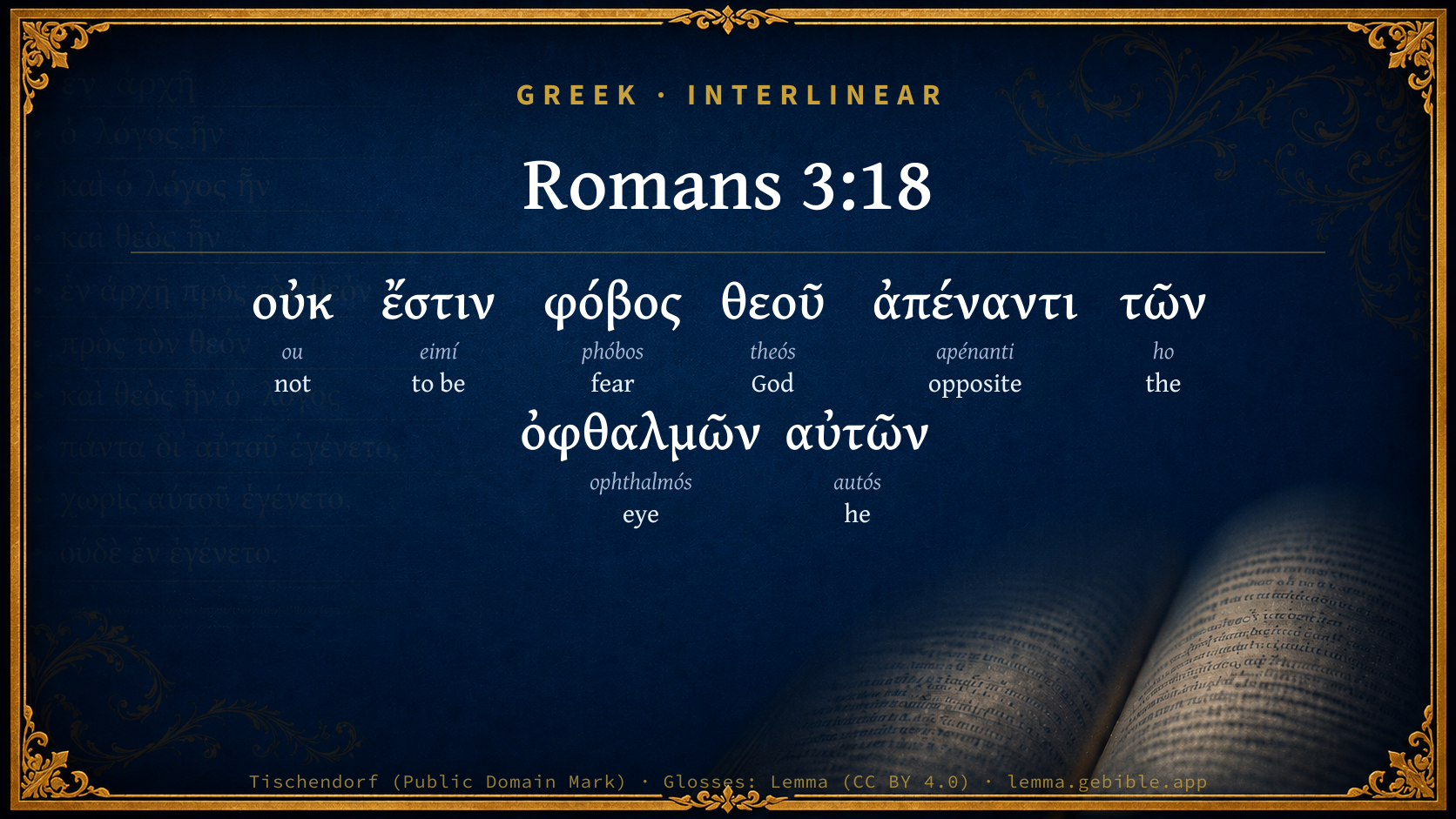
Greek (Tischendorf 8th ed.) Romans 3:18 appears in the Greek New Testament. The text above is from the Tischendorf 8th edition. Each word links to its Strong’s number and a concise gloss. Click any word for its full Thayer’s Greek Lexicon entry.
Download image
Cite this verse

Romans 3:18 (World English Bible). Public Domain. Lemma interlinear Bible study tool, https://lemma.gebible.app/v/romans/3/18.

Show BibTeX & RIS
BibTeX
RIS
English Translation
"There is no fear of God before their eyes."
World English Bible · Public Domain
Download a study sheet

One document with this verse’s original text, its word-by-word gloss line, the meaning frame, cross-references with their text, attributed commentary, and full source and license credits — printable, and it pastes into notes with its structure intact.

This verse Autodidact and up

Study sheet (.html) Plain text (.txt)

A passage Seminary Student

Up to 50 verses in one chapter. A passage sheet keeps up to 6 commentary sources and 12 cross-references per verse, in the order this page ranks them, and says so on the sheet whenever that leaves anything out. Ask for a single verse and you get the Autodidact verse sheet above.

Everything on this page stays free to read, with no account — the sheet is a download of what is already on screen, not access to it.

Want to remove ads? Support Godless Engineer
Compare translations 3

The same verse in 3 English versions, stacked beneath the original-language interlinear above. Click any original word for its lexicon entry.

Each is an independent rendering of the whole verse — the interlinear is not word-aligned to these translations.

Highlighted words mark where these versions differ — a whole-verse word diff, not a word-by-word alignment.

  • World English Bible Public Domain
    "There is no fear of God before their eyes."
  • King James Version Public Domain
    There is no fear of God before their eyes.
  • unfoldingWord Literal Text CC BY-SA 4.0
    “There is no fear of God before their eyes.”

unfoldingWord Literal Text — © unfoldingWord, licensed CC BY-SA 4.0. Word-aligned USFM3 via Door43 (git.door43.org/unfoldingWord/en_ult).

Versions to compare (up to 4)

3 of 4 selected

Show all 19 translations

Every available English version of this verse, each an independent rendering of the whole verse.

  • World English Bible Public Domain
    "There is no fear of God before their eyes."
  • Berean Standard Bible Public Domain
    “There is no fear of God before their eyes.”
  • Majority Standard Bible Public Domain
    “There is no fear of God before their eyes.”
  • King James Version Public Domain
    There is no fear of God before their eyes.
  • American Standard Version (1901) Public Domain
    There is no fear of God before their eyes.
  • Revised Version (1885) Public Domain
    There is no fear of God before their eyes.
  • Geneva Bible (1599) Public Domain
    The feare of God is not before their eies.
  • Douay-Rheims (1899) Public Domain
    There is no fear of God before their eyes.
  • Young's Literal Translation Public Domain
    There is no fear of God before their eyes.'
  • Literal Standard Version CC BY-SA 4.0
    There is no fear of God before their eyes.”
  • Unlocked Literal Bible CC BY-SA 4.0
    “There is no fear of God before their eyes.”
  • unfoldingWord Literal Text CC BY-SA 4.0
    “There is no fear of God before their eyes.”
  • Darby Bible Public Domain
    there is no fear of God before their eyes.
  • World Messianic Bible Public Domain
    “There is no fear of God before their eyes.”
  • Webster's Bible Public Domain
    There is no fear of God before their eyes.
  • Free Bible Version CC BY-SA 4.0
    They don't care about respecting God at all.”
  • Bible in Basic English Public Domain
    There is no fear of God before their eyes.
  • Text-Critical English NT CC BY 4.0
    “There is no fear of God before their eyes.”
  • Tyndale New Testament (1534) Public Domain
    There is no feare of God before their eyes.

Literal Standard Version (2020), Covenant Press — licensed CC BY-SA 4.0. Text via the HelloAO Bible API (eBible.org). Unlocked Literal Bible (unfoldingWord) — licensed CC BY-SA 4.0. Text via the HelloAO Bible API (eBible.org). unfoldingWord Literal Text — © unfoldingWord, licensed CC BY-SA 4.0. Word-aligned USFM3 via Door43 (git.door43.org/unfoldingWord/en_ult). Free Bible Version, Dr. Jonathan Gallagher — licensed CC BY-SA 4.0. Text via the HelloAO Bible API (eBible.org).

Word by word

More ways to search: Search by grammar → Find every occurrence → Compare this word →

Practice this passage: Drill this verse → Learn its vocabulary →

About this verse

These counts appear in no published source. They are computed here, from the morphology-tagged text and Lemma’s own curated glosses. What Lemma adds →

8
words
8
distinct lemmas
Pauline Epistles
section

Notable vocabulary

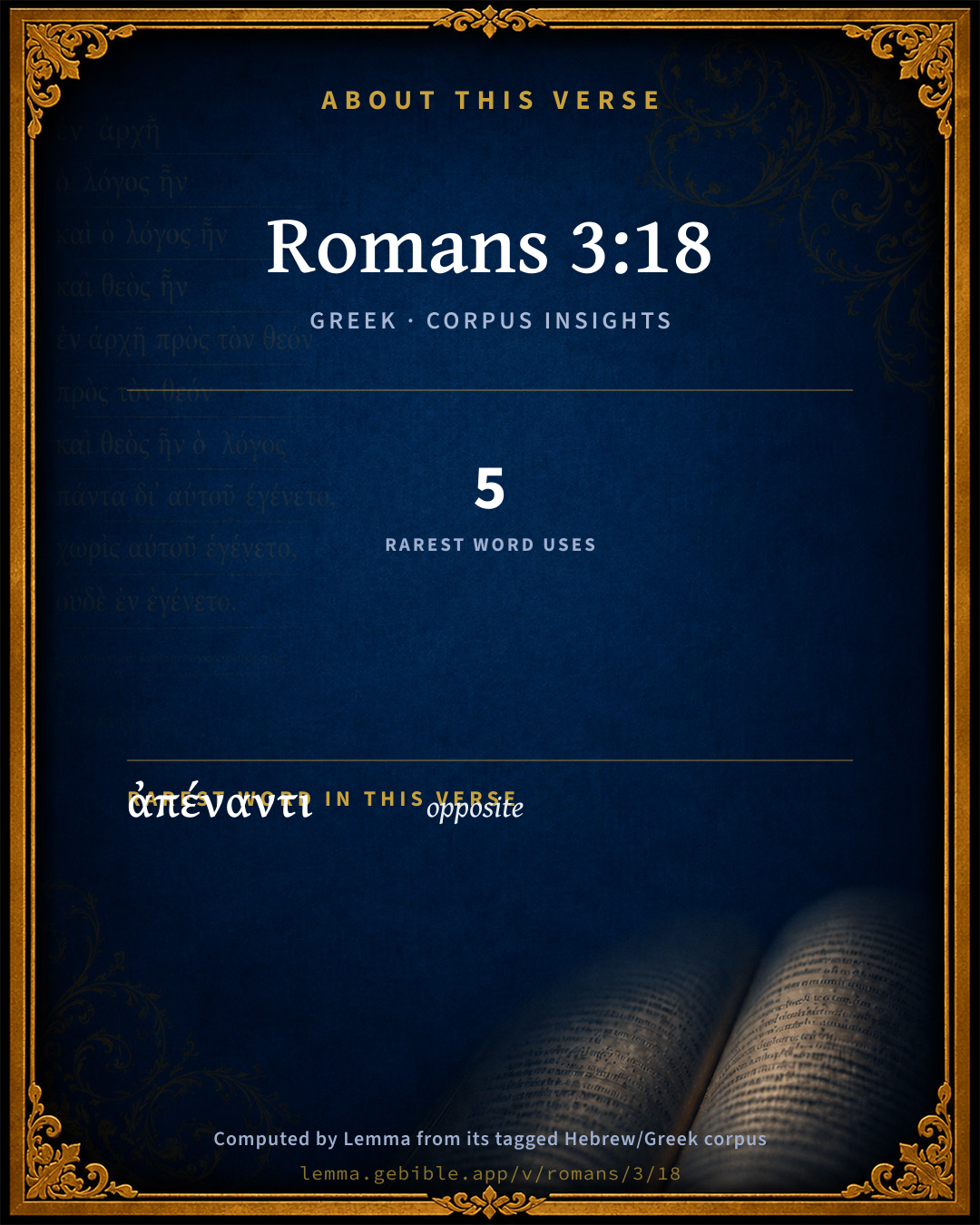
The rarest word here is ἀπέναντι opposite G561 — appearing just 5 times in the whole Greek New Testament.

Shared distinctive vocabulary

ἀπέναντι opposite G561 occurs in 5 verses of the Greek New Testament. Also found in:

Cross-references

7

Topical passages linked to Romans 3:18 in the Treasury of Scripture Knowledge — connected by theme and wording, ordered by reader-vote popularity; previews shown in the World English Bible.

  • Psalms 36:1 An oracle is within my heart about the disobedience of the wicked: "There is no fear of God before his eyes."
  • Proverbs 23:17 Don't let your heart envy sinners; But rather fear Yahweh all the day long.
  • Proverbs 16:6 By mercy and truth iniquity is atoned for. By the fear of Yahweh men depart from evil.
  • Proverbs 8:13 The fear of Yahweh is to hate evil. I hate pride, arrogance, the evil way, and the perverse mouth.
  • Genesis 20:11 Abraham said, "Because I thought, 'Surely the fear of God is not in this place. They will kill me for my wife's sake.'
  • Luke 23:40 But the other answered, and rebuking him said, "Don't you even fear God, seeing you are under the same condemnation?
  • Revelation 19:5 A voice came forth from the throne, saying, "Give praise to our God, all you his servants, you who fear him, the small and the great!"

Cross-references courtesy of OpenBible.info (CC BY 4.0).

Commentary

Notes on Romans 3:18 from classic Christian and Jewish commentators (each source and its license shown beneath its notes). The classic Christian expositions comment on the surrounding passage and are grouped to its opening verse, so a note may address several verses; the Jewish commentaries on the Tanakh (Rashi and others) are per-verse, so they appear only where the commentator wrote on this verse.

Lemma curates 59 commentaries, every one of them public domain or Creative Commons licensed, each selected and text-cleaned for this edition rather than reprinted as found. About our sources →

McGarvey & Pendleton's Commentaries

J. W. McGarvey

There is no fear of God before their eyes . [ Psa_36:1 . The above quotations are placed in logical order. "The arrangement is such," says Meyer, "that testimony is adduced: first, for the state of sin generally ( Rom_3:10-12 ); second, the practice of sin in word ( Rom_3:13-14 ) and deed ( Rom_3:13-17 ); and third, the sinful source of the whole-- Rom_3:18 "]

J. W. McGarvey (with Philip Y. Pendleton), Commentaries on the New Testament (The Fourfold Gospel, 1914; Acts; and the epistles) — public domain. Text from a community e-Sword/MySword module.

Tyndale Open Study Notes

Tyndale Open Resources

3:18 They have no . . . : This concluding quotation from Ps 36:1 neatly ties up the whole series (Rom 3:10-18) by referring to the same Greek words that introduced the first quotation (ouk estin, translated in 3:10, “No one is”).

Tyndale Open Study Notes — © Tyndale Open Resources, licensed CC BY-SA 4.0. Text via the HelloAO Bible API.

Bengel's Gnomon

Johann Albrecht Bengel

Rom 3:18. Οὐκ αὐτῶν) so the LXX., Psa 36:2, οὐκ—ἀυτοῦς—φόβος, fear), not to say love, of which man in his natural state knows much less. Of several passages, in which human depravity is expressed, either in the complaint of God and of the saints, or else in the confessions of the penitent, Paul has written out a part of the words, and intimates that all the rest are to be sought for out of the same places.—ὀφθαλμῶν, their eyes) The seat of reverential awe is in the eyes.

Bengel's Gnomon of the New Testament — English translation (T&T Clark, Edinburgh, 1860) — public domain. Text from a community e-Sword module.

Expositor's Greek Testament

ed. W. Robertson Nicoll

Rom 3:18 . Psa 35:2 , LXX, with αὐτῶν for αὐτοῦ . This verse at once sums up and explains the universal corruption of mankind.

The Expositor's Greek Testament, edited by W. Robertson Nicoll (1897–1910) — public domain. Text from a community e-Sword module.

Hodge's Commentary on Romans, Ephesians & First Corinthians

Charles Hodge

Rom_3:18

There is no fear of God before their eyes. This is taken from Psa_36:1 : The dictum of depravity concerning the wicked man in my heart is, There is no fear of God before his eyes. That is, his depravity proves or reveals to me that he does not fear God. See Alexander on the Psalms, who proposes this with other versions of the passage. However the previous part of the verse may be understood, the clause quoted by the apostle is plain. The course of wicked men, as previously described, is proof that they are destitute of the fear of God. And by the fear of God we may understand, according to Scripture usage, reverence for God, piety towards him; or fear, in the more restricted sense, dread of his wrath. In either way, the reckless wickedness of men proves that they are destitute of all proper regard of God. They act as if there were no God, no Being to whom they are responsible for their conduct, and who has the purpose and power to punish them for their iniquity.

Charles Hodge — Commentary on Romans (1835), First Corinthians (1857), and Ephesians (1856) — public domain. Text from a community e-Sword module.

Jamieson, Fausset & Brown

Robert Jamieson, A. R. Fausset & David Brown

There is no fear of God before their eyes-- (Psa 36:1): that is, "Did the eyes but 'see Him who is invisible' (Heb 11:27), a reverential awe of Him with whom we have to do would chasten every joy and lift the soul out of its deepest depressions; but to all this the natural man is a stranger." How graphic is this picture of human depravity, finding its way through each several organ of the body into the life (Rom 3:13-17): but how small a part of the "desperate wickedness" that is within (Jer 17:9) "proceedeth out of the heart of man!" (Mar 7:21-23; Psa 19:12).

Jamieson, Fausset & Brown — Commentary Critical and Explanatory on the Whole Bible (1871) — public domain (CC PDM 1.0). Text via the HelloAO Bible API.

Adam Clarke's Commentary

Verse 18. There is no fear of God before their eyes.] This completes their bad character; they are downright atheists, at least practically such. They fear not God's judgments, although his eye is upon them in their evil ways. There is not one article of what is charged against the Jews and Gentiles here that may not be found justified by the histories of both, in the most ample manner. And what was true of them in those primitive times is true of them still. With very little variation, these are the evils in which the vast mass of mankind delight and live. Look especially at men in a state of warfare; look at the nations of Europe, who enjoy most of the light of God; see what has taken place among them from 1792 to 1814; see what destruction of millions, and what misery of hundreds of millions, have been the consequence of Satanic excitement in fallen, ferocious passions! O SIN, what hast thou done! How many myriads of souls hast thou hurried, unprepared, into the eternal world! Who, among men or angels, can estimate the greatness of this calamity! this butchery of souls! What widows, what orphans, are left to deplore their sacrificed husbands and parents, and their own consequent wretchedness! And whence sprang all this? From that, whence come all wars and fightings; the evil desires of men; the lust of dominion; the insatiable thirst for money; and the desire to be sole and independent. This is the sin that ruined our first parents, expelled them from paradise, and which has descended to all their posterity; and proves fully, incontestably proves, that we are their legitimate offspring; the fallen progeny of fallen parents; children in whose ways are destruction and misery; in whose heart there is no faith; and before whose eyes there is nothing of the fear of God.

Adam Clarke's Commentary on the Bible (1810–1826) — public domain. Text from a community e-Sword/MySword module.

John Calvin's Commentaries

18. In the last clause he repeats again, in other words, what we have noticed at the beginning — that every wickedness flows from a disregard of God: for as the principal part of wisdom is the fear of God, when we depart from that, there remains in us nothing right or pure. In short, as it is a bridle to restrain our wickedness, so when it is wanting, we feel at liberty to indulge every kind of licentiousness.

And that these testimonies may not seem to any one to have been unfitly produced, let us consider each of them in connection with the passages from which they have been taken. David says in Psalm 14:1, that there was such perverseness in men, that God, when looking on them all in their different conditions, could not find a righteous man, no, not one. It then follows, that this evil pervaded mankind universally; for nothing is hid from the sight of God. He speaks indeed at the end of the Psalm of the redemption of Israel: but we shall presently show how men become holy, and how far they are exempt from this condition. In the other Psalms he speaks of the treachery of his enemies, while he was exhibiting in himself and in his descendants a type of the kingdom of Christ: hence we have in his adversaries the representatives of all those, who being alienated from Christ, are not led by his Spirit. Isaiah expressly mentions Israel; and therefore his charge applies with still greater force against the Gentiles. What, then? There is no doubt but that the character of men is described in those words, in order that we may see what man is when left to himself; for Scripture testifies that all men are in this state, who are not regenerated by the grace of God. The condition of the saints would be nothing better, were not this depravity corrected in them: and that they may still remember that they differ nothing from others by nature, they do find in the relics of their flesh (by which they are always encompassed) the seeds of those evils, which would constantly produce fruits, were they not prevented by being mortified; and for this mortification they are indebted to God’s mercy and not to their own nature. We may add, that though all the vices here enumerated are not found conspicuously in every individual, yet they may be justly and truly ascribed to human nature, as we have already observed on Romans 1:26.

John Calvin's Commentaries (1540-1563) — public domain. Text from the Calvin Translation Society English edition (1840s-50s) via the Christian Classics Ethereal Library (ccel.org). Calvin's coverage is partial (roughly two-thirds of the Bible); uncommented books and verses are honest gaps, never fabricated. The 19th-century editor's footnotes and remarks are omitted so the notes are faithfully Calvin's own voice.

Ellicott's Commentary for English Readers

(18) The fear of God, which is properly a subjective feeling, is here projected, as it were, and regarded as an external rule of life.

A Bible Commentary for English Readers, edited by Charles John Ellicott (1878–1897) — public domain. Text from a community e-Sword module.

John Gill's Exposition

Even the righteousness of God, which is by faith of Jesus Christ,.... A further account is given of this righteousness: why it is called "the righteousness of God", and in what sense revealed and manifested; see Gill on Rom 1:17; Here it is said to be "by faith of Jesus Christ"; not by that faith which Christ himself had as man, but by that faith, of which he the author and object: the Alexandrian copy reads, "by faith in Jesus Christ"; and not by that as the cause of justification; for faith is neither the efficient, nor the moving, nor meritorious cause of it; no, nor the instrumental cause of it on the part of God or Christ: nor is faith the matter of a justifying righteousness; for faith is a part of sanctification, is itself imperfect, is a man's own, as it is implanted in him, and exercised by him; is here and elsewhere distinguished from righteousness; something else, and not that, as the obedience and blood of Christ, are said to be what men are made righteous and justified by: but faith is a means of apprehending and receiving righteousness; it views the excellency of Christ's righteousness; it owns the sufficiency of it; the soul by it renounces its own righteousness, submits to Christ's, rejoices in it, and gives him the glory of it: now this is by, or through faith,

unto all, and upon all: not all men, for all have not faith, nor are all justified and saved: but

all that believe; which must be understood, not of believing any thing, nor of any sort of believing; but of such, who truly and with the heart believe in Christ for salvation; and who are here opposed to the wise philosophers among the Gentiles, had to all self-righteous persons among the Jews. Though this character does not design any cause or condition of justification, but is only descriptive of the persons, who are declaratively interested in a justifying righteousness, which is said to be "unto", and "upon them"; that is, it is appointed, provided, and wrought out for them, and directed and applied unto them, and put upon them as a garment, and that upon all of them:

for there is no difference; of nation, age, or sex, or of state and condition; no respect is had to persons or works; nor is there any difference with respect to weak or strong believers; the righteousness is equally applied to one as to another, and one is as much justified by it in the sight of God as another.

John Gill's Exposition of the Whole Bible (1746–1763) — public domain (CC PDM 1.0). Text via the HelloAO Bible API.

Trapp's Complete Commentary

John Trapp

18 There is no fear of God before their eyes.

Ver. 18. There is no fear of God] This is set last, as the source of all the former evils.

John Trapp, A Commentary or Exposition upon All the Books of the Old and New Testament (1647–1656) — public domain. Text from a community e-Sword module.

Albert Barnes' Notes on the Bible

There is no fear of God - Psa 36:1. The word “fear” here denotes “reverence, awe, veneration.” There is no such regard or reverence for the character, authority, and honor of God as to restrain them from crime. Their conduct shows that they are not withheld from the commission of iniquity by any regard to the fear or favor of God. The only thing that will be effectual in restraining people from sin, will be a regard to the honor and Law of God.

In regard to these quotations from the Old Testament, we may make the following remarks.

(1) They fully establish the position of the apostle, that the nation, as such, was far from being righteous, or that they could be justified by their own works. By quotations from no less than six distinct places in their own writings, referring to different periods of their history, he shows what the character of the nation was. And as this was the characteristic of those times. it followed that a Jew could not hope to be saved simply because he was a Jew. He needed, as much as the Gentile, the benefit of some other plan of salvation.

(2) These passages show us how to use the Old Testament, and the facts of ancient history. They are to be adduced not as showing directly what the character of man is, now, but to show what human nature is. They demonstrate what man is when under the most favorable circumstances; in different situations; and at different periods of the world. The concurrence of past facts shows what the race is. And as past facts are uniform; as man thus far, in the most favorable circumstances, has been sinful; it follows that this is the characteristic of man everywhere. It is settled by the facts of the world, just as any other characteristic of man is settled by the uniform occurrence of facts in all circumstances and times. Ancient facts, and quotations of Scripture, therefore, are to be adduced as proofs of the tendency of human nature. So Paul used them, and so it is lawful for us to use them.

(3) It may be observed further, that the apostle has given a view of human depravity which is very striking. He does not confine it to one faculty of the mind, or to one set of actions; he specifies each member and each faculty as being perverse, and inclined to evil. The depravity extends to all the departments of action. The tongue, the mouth, the feet, the “lips,” are all involved in it; all are perverted, and all become the occasion of the commission of sin. The entire man is corrupt; and the painful description extends to every department of action.

(4) If such was the character of the Jewish nation under all its advantages, what must have been the character of the pagan? We are prepared thus to credit all that is said in Rom. i., and elsewhere, of the sad state of the pagan world.

(5) What a melancholy view we have thus of human nature. From whatever quarter we contemplate it, we come to the same conclusion. Whatever record we examine; whatever history we read; whatever time or period we contemplate; we find the same facts, and are forced to the same conclusion. All are involved in sin, and are polluted, and ruined, and helpless. Over these ruins we should sit down and weep, and lift our eyes with gratitude to the God of mercy, that he has pitied us in our low estate, and has devised a plan by which “these ruins may be built again,” and lost, fallen man be raised up to forfeited “glory, honor, and immortality.”

Albert Barnes' Notes on the Bible (1834–1885) — public domain. Text from a community e-Sword/MySword module.

Matthew Poole's English Annotations

This last assertion gives us one true cause of all the aforesaid evils, taken out of Psa 36:1; See Poole on "Psa 36:1".

Matthew Poole's English Annotations on the Holy Bible (1683–1685) — public domain. Text from a community e-Sword/MySword module.

John Wesley's Explanatory Notes

The fear of God is not before their eyes - Much less is the love of God in their heart. Psalm xxxvi, 1.

John Wesley, Explanatory Notes Upon the Whole Bible (1754–1765) — public domain. Text via the GEBible commentary corpus.

Godbey's Commentary on the New Testament

William B. Godbey

18. “The fear of God is not before their eyes.” Wickedness, like righteousness, is progressive. Here we reach the climax. They have passed the dead-line and the Spirit of conviction has been grieved away. So they are doomed. Without the fear of God there is no more hope for a sinner than a devil. “The fear of the Lord is the beginning of wisdom.” When there is no fear there is no place to begin. The Holy Spirit abides in every land, convicting every soul, till He is grieved away. Conviction fills the soul with fear, yet there is no salvation without love, i. e., the divine love poured out in the heart by the Holy Ghost (Ch. 5:5) in regeneration. Then love and fear consist till sanctification gives perfect love, which casts out fear (1Jn 4:18). The unconvicted sinner has neither fear nor love. He is like a demon. The convicted sinner has fear and no love. The converted man has love, but is not free from fear, while the sanctified has perfect love and no fear.

William B. Godbey, Commentary on the New Testament (1896–1900) — public domain. Text from a community e-Sword module.

The People's New Testament

B. W. Johnson

18. There is no fear of God, etc. David, in the psalms quoted, has affirmed in the strongest possible language, the universal sinfulness. The Jews accepted David's words as inspired. These words included Jews as well as Gentiles; hence all are included under sin.

B. W. Johnson's The People's New Testament with Notes (1889–1891) — public domain. Electronic text from the Christian Classics Ethereal Library (CCEL) ThML edition.

Lesson kit

Teaching starters — assembled from the data on this page, not authored interpretation. Every prompt links to the verse data it draws on. Edit before teaching.

Romans, in the Pauline Epistles, opens this verse with 8 words (8 distinct Greek lemmas). Its most distinctive word is apénanti (“opposite”). A historical commentator’s framing appears above. Read the whole chapter for the surrounding context.

Discussion questions

  1. How does “opposite” (apénanti) shape what this verse is saying?
  2. Matthew 27:24 shares the word «opposite» with this verse. How do the two illuminate each other?
  3. Reading how McGarvey & Pendleton's Commentaries and Tyndale Open Study Notes read this verse, where do the two commentators agree and where do they part?

Reading settings

Reading text

Shown beneath each verse's original-language words.

Old Testament
Old Testament edition

Read the OT as the Masoretic Hebrew (MT) or the Greek Septuagint (LXX).

English shown for the Greek Septuagint (in the Hebrew ↔ Greek comparison).

Comparing translations? Open the Compare panel on any verse page to stack up to four side by side.