Galatians 4:7

Greek (Tischendorf 8th ed.) Galatians 4:7 appears in the Greek New Testament. The text above is from the Tischendorf 8th edition. Each word links to its Strong’s number and a concise gloss. Click any word for its full Thayer’s Greek Lexicon entry.
Download image
Cite this verse

Galatians 4:7 (World English Bible). Public Domain. Lemma interlinear Bible study tool, https://lemma.gebible.app/v/galatians/4/7.

Show BibTeX & RIS
BibTeX
RIS
English Translation
So you are no longer a bondservant, but a son; and if a son, then an heir of God through Christ.
World English Bible · Public Domain
Download a study sheet

One document with this verse’s original text, its word-by-word gloss line, the meaning frame, cross-references with their text, attributed commentary, and full source and license credits — printable, and it pastes into notes with its structure intact.

This verse Autodidact and up

Study sheet (.html) Plain text (.txt)

A passage Seminary Student

Up to 50 verses in one chapter. A passage sheet keeps up to 6 commentary sources and 12 cross-references per verse, in the order this page ranks them, and says so on the sheet whenever that leaves anything out. Ask for a single verse and you get the Autodidact verse sheet above.

Everything on this page stays free to read, with no account — the sheet is a download of what is already on screen, not access to it.

Want to remove ads? Support Godless Engineer
Compare translations 3

The same verse in 3 English versions, stacked beneath the original-language interlinear above. Click any original word for its lexicon entry.

Each is an independent rendering of the whole verse — the interlinear is not word-aligned to these translations.

Highlighted words mark where these versions differ — a whole-verse word diff, not a word-by-word alignment.

  • World English Bible Public Domain
    So you are no longer a bondservant, but a son; and if a son, then an heir of God through Christ.
  • King James Version Public Domain
    Wherefore thou art no more a servant, but a son; and if a son, then an heir of God through Christ.
  • unfoldingWord Literal Text CC BY-SA 4.0
    So then, you are no longer a slave, but a son, and if a son, also an heir through God.

unfoldingWord Literal Text — © unfoldingWord, licensed CC BY-SA 4.0. Word-aligned USFM3 via Door43 (git.door43.org/unfoldingWord/en_ult).

Versions to compare (up to 4)

3 of 4 selected

Show all 19 translations

Every available English version of this verse, each an independent rendering of the whole verse.

  • World English Bible Public Domain
    So you are no longer a bondservant, but a son; and if a son, then an heir of God through Christ.
  • Berean Standard Bible Public Domain
    So you are no longer a slave, but a son; and since you are a son, you are also an heir through God.
  • Majority Standard Bible Public Domain
    So you are no longer a slave, but a son; and since you are a son, you are also an heir of God through Christ.
  • King James Version Public Domain
    Wherefore thou art no more a servant, but a son; and if a son, then an heir of God through Christ.
  • American Standard Version (1901) Public Domain
    So that thou art no longer a bondservant, but a son; and if a son, then an heir through God.
  • Revised Version (1885) Public Domain
    So that thou art no longer a bondservant, but a son; and if a son, then an heir through God.
  • Geneva Bible (1599) Public Domain
    Wherefore, thou art no more a seruant, but a sonne: now if thou be a sone, thou art also the heire of God through Christ.
  • Douay-Rheims (1899) Public Domain
    Therefore now he is not a servant, but a son. And if a son, an heir also through God.
  • Young's Literal Translation Public Domain
    so that thou art no more a servant, but a son, and if a son, also an heir of God through Christ.
  • Literal Standard Version CC BY-SA 4.0
    So that you are no longer a servant, but a son, and if a son, also an heir of God through Christ.
  • Unlocked Literal Bible CC BY-SA 4.0
    So you are no longer a slave, but a son, and if a son, then you are also an heir through God.
  • unfoldingWord Literal Text CC BY-SA 4.0
    So then, you are no longer a slave, but a son, and if a son, also an heir through God.
  • Darby Bible Public Domain
    So thou art no longer bondman, but son; but if son, heir also through God.
  • World Messianic Bible Public Domain
    So you are no longer a bondservant, but a son; and if a son, then an heir of God through Messiah.
  • Webster's Bible Public Domain
    Wherefore thou art no more a servant, but a son; and if a son, then an heir of God through Christ.
  • Free Bible Version CC BY-SA 4.0
    Since you are now no longer a slave, but a child, and if you are his child, then God has made you his heir.
  • Bible in Basic English Public Domain
    So that you are no longer a servant, but a son; and if a son, then the heritage of God is yours.
  • Text-Critical English NT CC BY 4.0
    So yoʋ are no longer a slave, but a son. And if yoʋ are a son, yoʋ are also an heir of God through Christ.
  • Tyndale New Testament (1534) Public Domain
    Wherfore now thou art not a servaunt but a sonne. Yf thou be the sonne thou arte also the heyre of God thorow Christ.

Literal Standard Version (2020), Covenant Press — licensed CC BY-SA 4.0. Text via the HelloAO Bible API (eBible.org). Unlocked Literal Bible (unfoldingWord) — licensed CC BY-SA 4.0. Text via the HelloAO Bible API (eBible.org). unfoldingWord Literal Text — © unfoldingWord, licensed CC BY-SA 4.0. Word-aligned USFM3 via Door43 (git.door43.org/unfoldingWord/en_ult). Free Bible Version, Dr. Jonathan Gallagher — licensed CC BY-SA 4.0. Text via the HelloAO Bible API (eBible.org).

Word by word

More ways to search: Search by grammar → Find every occurrence → Compare this word →

Practice this passage: Drill this verse → Learn its vocabulary →

κληρονόμος
klēronómos
G2818
“heir”
Noun, Nominative, Singular, Masculine
Part of Speech
Noun
Case
Nominative
Number
Singular
Gender
Masculine
Full Thayer's Definition

Origin: from G2819 and the base of G3551 (in its original sense of partitioning, i.e. [reflexively] getting by apportionment)

TDNT: 15:47,4

1. one who receives by lot, an heir a. an heir b. in Messianic usage, one who receives his allotted possession by right of sonship 2. one who has acquired or obtained the portion allotted to him
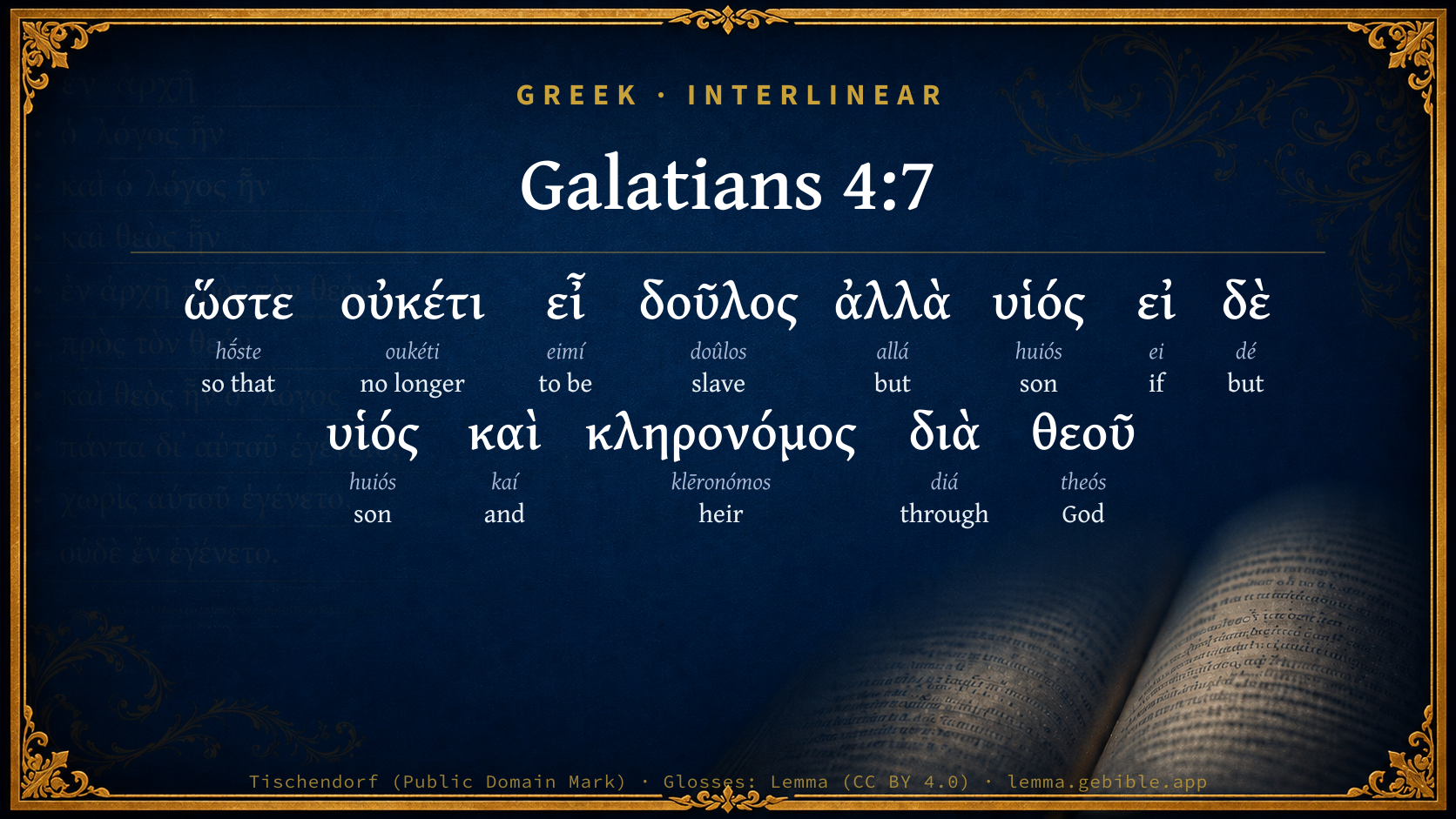
  1. ὥστε hṓste G5620 “so that” Conjunction
  2. οὐκέτι oukéti G3765 “no longer” Adverb, Negative
  3. εἶ eimí G1510 “to be” Verb, Present, Active, Indicative, 2nd person, Singular
  4. δοῦλος doûlos G1401 “slave” Noun, Nominative, Singular, Masculine
  5. ἀλλὰ allá G235 “but” Conjunction
  6. υἱός huiós G5207 “son” Noun, Nominative, Singular, Masculine
  7. εἰ ei G1487 “if” Conditional
  8. δὲ dé G1161 “but” Conjunction
  9. υἱός huiós G5207 “son” Noun, Nominative, Singular, Masculine
  10. καὶ kaí G2532 “and” Conjunction
  11. διὰ diá G1223 “through” Preposition
  12. θεοῦ theós G2316 “God” Noun, Genitive, Singular, Masculine

About this verse

These counts appear in no published source. They are computed here, from the morphology-tagged text and Lemma’s own curated glosses. What Lemma adds →

13
words
12
distinct lemmas
Pauline Epistles
section

Notable vocabulary

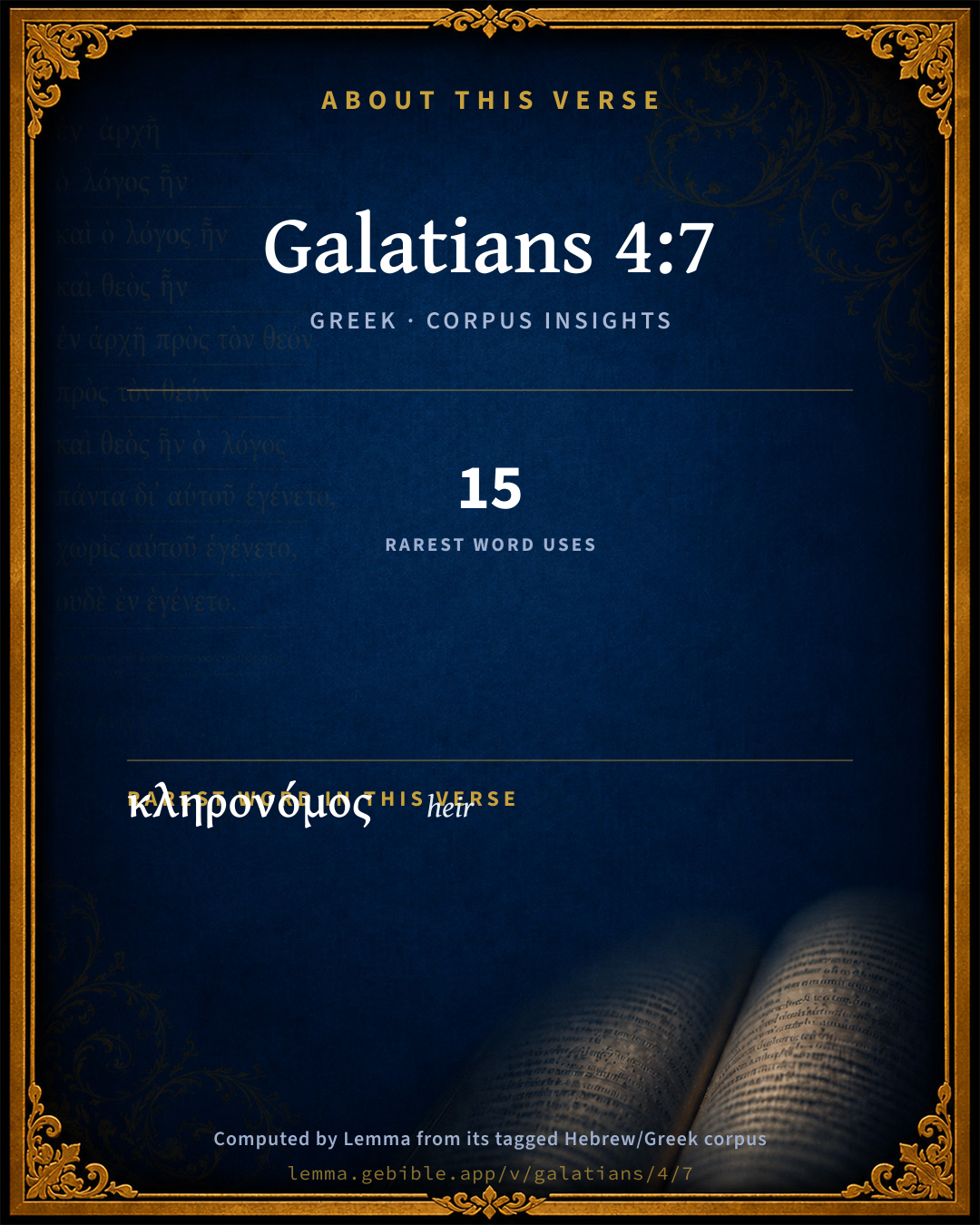
The rarest word here is κληρονόμος heir G2818 — appearing just 15 times in the whole Greek New Testament.

Shared distinctive vocabulary

κληρονόμος heir G2818 occurs in 14 verses of the Greek New Testament. Also found in:

Repetition

A word recurs within this verse:

  • υἱός son G5207 ×2

Cross-references

16

Topical passages linked to Galatians 4:7 in the Treasury of Scripture Knowledge — connected by theme and wording, ordered by reader-vote popularity; previews shown in the World English Bible.

  • Romans 8:16–17 The Spirit himself testifies with our spirit that we are children of God;
  • Galatians 3:29–4:2 If you are Christ's, then you are Abraham's seed and heirs according to promise.
  • Galatians 3:26 For you are all children of God, through faith in Christ Jesus.
  • 1 Corinthians 3:21–23 Therefore let no one boast in men. For all things are yours,
  • Galatians 4:5–6 that he might redeem those who were under the law, that we might receive the adoption of children.
  • Galatians 4:31–5:1 So then, brothers, we are not children of a handmaid, but of the free woman.
  • Psalms 73:26 My flesh and my heart fails, But God is the strength of my heart and my portion forever.
  • 2 Corinthians 6:16–18 What agreement has a temple of God with idols? For you are a temple of the living God. Even as God said, "I will dwell in them, and walk in them; and I will be their God, and they will be my people."
  • Lamentations 3:24 Yahweh is my portion, says my soul; therefore will I hope in him.
  • Genesis 15:1 After these things the word of Yahweh came to Abram in a vision, saying, "Don't be afraid, Abram. I am your shield, your exceedingly great reward."
  • Genesis 17:7–8 I will establish my covenant between me and you and your seed after you throughout their generations for an everlasting covenant, to be a God to you and to your seed after you.
  • Jeremiah 10:16 The portion of Jacob is not like these; for he is the former of all things; and Israel is the tribe of his inheritance: Yahweh of Hosts is his name.
  • Revelation 21:7 He who overcomes, I will give him these things. I will be his God, and he will be my son.
  • Psalms 16:5 Yahweh assigned my portion and my cup. You made my lot secure.
  • Jeremiah 31:33 But this is the covenant that I will make with the house of Israel after those days, says Yahweh: I will put my law in their inward parts, and in their heart will I write it; and I will be their God, and they shall be my people:
  • Jeremiah 32:38–41 and they shall be my people, and I will be their God:

Cross-references courtesy of OpenBible.info (CC BY 4.0).

Where the printed editions differ

1 variant

Places in this verse where the major printed Greek editions disagree on the wording in a way that affects the translation — a comparison of editions, not a manuscript-by-manuscript collation. The editions are the modern critical texts (Nestlé-Aland 28/27, SBL, Westcott-Hort, Tregelles, Tyndale House) and the traditional texts behind the KJV (the Textus Receptus and the Byzantine/Majority text). It is not a claim about which reading is original.

  1. Extra text
    Χριστοῦ.¶

    “Christ.”

    In TRByz Not in NA28NA27TynSBLWHTreg

    Χριστοῦ.¶ (Christou) 'Christ.' is only in traditional manuscripts (TR+Byz)

Textual data: Translators Amalgamated Greek New Testament (STEPBible TAGNT) · CC BY 4.0.

Commentary

Notes on Galatians 4:7 from classic Christian and Jewish commentators (each source and its license shown beneath its notes). The classic Christian expositions comment on the surrounding passage and are grouped to its opening verse, so a note may address several verses; the Jewish commentaries on the Tanakh (Rashi and others) are per-verse, so they appear only where the commentator wrote on this verse.

Lemma curates 59 commentaries, every one of them public domain or Creative Commons licensed, each selected and text-cleaned for this edition rather than reprinted as found. About our sources →

The Biblical Illustrator

Joseph S. Exell

Gal_4:7

Wherefore thou art no more a servant, but a son.

Servitude and sonship

I. Sonship is here contrasted with servitude.

1. It is a change from ignorance to knowledge.

2. A change from bondage to self-control.

3. A change from a temporal relationship to an eternal one.

II. This sonship is the gift of God.

1. God intervenes with the offer of sonship at the fitting time.

2. God sends the only Being who can win us to sonship.

3. God accompanies the gift of sonship with the only infallible witness--the indwelling of the Holy Spirit.

III. This gift of sonship makes us heirs of God. (S. Pearson, M. A.)

The Christians inheritance

For what purpose did God make the worlds? Not that He might in solitary joy behold their glittering brightness; but that they might minister to our sense of beauty, and cast lights on our devious way. If we truly understood our relation to the world in which we live, and indeed to the universe of which we form a part, we should see that the material has been made for the sake of the moral, that all things have been put under our feet because we are sons of God Who has more right to the worlds riches and wealth than a child of Him to whom the world belongs? Let him erect his machinery, carry on his transactions, dive into the mine, cross the ocean, span yawning gulfs, and pierce hard rocks, assured that He is doing his Fathers will in thus obtaining and using his leathers wealth All things are yours--things present and things to come. Blessed are the meek, for they shall inherit the earth. But higher things are ours if we are children of God. We become partakers of the Divine nature. That nature is spirit, and our spirits overcome and subjugate the grosset part of our being. That nature is righteous, and we become pure in heart, single in purpose, simple in behaviour, lust toward all men. That nature is mercy, and we, having ourselves obtained the blessings of Divine pity, look with compassion on the fallen, and long to win them to the home from which they have been so long exiles. That nature is changeless power, and our weakness becomes strength, and an inward energy is granted enabling us to triumph over time, the world, and self. That nature is infinite wisdom, and by dwelling ever in the presence of God we see the worlds troubles and our own in the light of higher purposes, and when we cannot understand we learn in quiet repose to trust in Him who doeth all things well. That nature is world-embracing and unquenchable love; He takes away the patriarchs when their weary pilgrimage is finished, that He may give them perfect rest. He makes us ask, The fathers, where are they? because He wants them home with Him; and soon the doors of His presence-chamber will open for us, new visions of bliss and joy will open upon us, and we shall see God as He is, and be like Him. In the meanwhile our rejoicing is, that now are we the sons of God. (S. Pearson, M. A.)

The Christians scorn of the world

Whoever could believe without any doubt that it were true, and certainly comprehend how immeasurably great a thing it is, that one should be Gods child and heir, such an one would without doubt take little account of the world, with all that therein is esteemed precious and honourable, such as human righteousness, wisdom, dominion, power, money, possessions, honour, pleasure, and the like; yea, all that in the world is honourable and glorious, would be to him loathsome and an abomination. (Luther.)

Sons and heirs

I. No inheritance without sonship. Spiritual blessings are only for those who are in a spiritual condition.

1. The lower orders of creatures are shut out from gifts which belong to the higher forms of life because they are so organized that these cannot enter into their nature.

2. So the soul must be adapted to the enjoyment of spiritual salvation.

3. The final inheritance depends on character. To possess God for ever we must love Him for ever.

II. No Sonship Without A Spiritual Birth.

1. We are sons in some sense by nature.

2. But we become spiritual sons by grace.

III. No spiritual birth without Christ.

1. The very figure shows us that the process of becoming sons does not; lie within our own power.

2. Christ has come to give the spirit of adoption and regeneration.

IV. No Christ without faith.

1. Ceremonies are nothing.

2. Trust in Christ is everything. (A. Maclaren, D. D.)

Sonship through Christ

Christ has effected an actual change in the possible aspect of the Divine justice and government to us; and He has carried in the golden urn of His humanity a new spirit and a new life which He has set down in the midst of the race; and the urn was broken on the Cross of Calvary, and the water flowed out, and whithersoever that water comes there is life, and whithersoever it comes not there is death. (A. Maclaren, D. D.)

Adoption and confidence

A train dashed into a tunnel with a warning whistle. The whistle and darkness startled a child in his mothers arms, and caused him to scream with fear; but directly the mothers voice was heard, and he felt the soothing hand upon his face, all fear vanished. Yet the child knew not why the train went through the darkness, but immediately the parents voice reached him, he trusted. When we go through any dark or laborious way, let us also trust our Father in heaven, and nothing will harm us. The darkness and the light, O Lord, are both alike to Thee.

Privileges of adoption

By it God the Father is made our Father. The incarnate God-man is made our Elder Brother, and we are made--

1. Like Him.

2. Intimately associated with Him in community of life, standing, relations, and privileges.

3. Joint-heirs with Him of His glory. The Holy Ghost is our Indweller, Guide, Advocate, Comforter, and Sanctifier. All believers being subjects of the same adoption are brethren. (A. A. Hodge.)

The Christian a Son of God

I. Then we are to notice the gracious relation in which good men stand to God. They are not servants, but sons. As I have before intimated, this privilege belongs to believers alone; they only can properly be called the sons of God.

1. That true believers are the sons of God by a new creation. By nature they are the children of wrath even as others. They are the offspring of degenerate, fallen man, the posterity of Adam, the sinful representative of mankind. The temper of the mind is renewed, and the outward conduct is reformed. A spiritual and vital influence is felt, and a spiritual and vital principle is imparted.

2. Believers are the sons of God, by their union with Christ. Wherefore, my brethren, says the apostle to the Romans, ye are also become dead to the law by the body of Christ; that ye should be married to another, even to Him that is raised from the dead, that ye should bring forth fruit unto God.

3. Believers are the sons of God by adoption. Adoption was an act frequent among the ancient Hebrews, Greeks, and Romans.

II. The happy consequence which results from the privilege of our being the sons of God. If a son, then an heir of God, through Christ. They are heirs of all that God possesses. The treasures to which they are entitled are vast and immeasurable. Believers, too, are heirs of all that God has promised. Christians are said to be heirs of the promise. If they have but little in possession, they have much in prospect; if not rich in enjoyment, they are rich in faith and hope. Believers, too, are heirs of the righteousness of Christ. Believers, too, are heirs of salvation, and angels are their ministering spirits. Those happy beings have charge over the people of God, and minister to them in their path to glory. They are called, too, heirs of the grace of life. Salvation is all of grace. Believers, too, are heirs of the kingdom. God has provided a kingdom for them that love Him, and of this kingdom they are heirs. They are also heirs of the world. This promise primarily refers to the land of Canaan, which Abraham and his seed were to possess; but here heaven is typically promised and represented.

III. Notice the means by which this privilege is obtained. If a son, then an heir of God, through Christ. Now we are heirs of God through Christ, because he has purchased this privilege for us. Christ, too, can only give this glorious privilege. He is the Head and Representative of His Church. Believers are the members of His body, and receive their spiritual nourishment from Him. It is through Christ we obtain this privilege as joint-heirs with Him. To Him the birthright blessing properly belongs. The Father loved the Son, and hath given all things into His hands. In conclusion, let me inquire--If not heirs of God, what are we? We are heirs of Satan--that prince of darkness, who now employs us in the drudgery of sin in order that he may reward us with the damnation of hell. (Isaac Clarkson.)

A servant or a son

The apostle had laid down some broad, simple rules of the gospel (verses 4, 5).

Here he points out

I. The believers change: he was a servant; he is a son.

1. A servant to sin (Rom_6:16). Unconverted mans virtues are splendid sins. Servants in a large house have different work, but if well done, master is satisfied.

2. Slave to the world--its fashions, opinions, pleasures.

3. In bondage to the law. He cannot see the freeness of the gospel (Rom_3:28; Rom_5:1). But there is a change (verse 6; Rom_8:15). There is now an interest in God; filial affection to Him; freedom of access (Eph_2:18; Pro_15:8); an abode in the Fathers house (Joh_8:34-35; Eph_2:19-22).

II. The believers hope. An inheritance is not purchased by ourselves--it descends. It implies--

1. Full forgiveness. One unpardoned sin is certain hell (Eze_18:4; 1Jn_1:7).

2. Inward righteousness--imperfect, but improving (Luk_23:41; Heb_12:14).

3. That God Himself will be the portion of His believing people (1Co_3:21-23). Whatever Christ has, we have.

In conclusion--

1. Is it not a wonder that privileges such as these should be so much overlooked, undervalued? Can every one here say; I was a servant of sin, but I am now a son of God? (Rom_10:10).

2. If not a son of God, what is the alternative? (Gal_6:7-8). An heir of the one or of the other is every one present at this moment. We must expect opposition, but we are well led, supported (2Co_12:9; Rev_21:7). (H. M. Villiers.)

No more a servant, but a son:

He simply reminds those Christians of their early state, and calls them to consider their present condition. Once they were servants, now they are sons; once in bondage, now free.

I. Every believer will find it to his advantage occasionally to recall his former condition under the Divine law, previous to the glad day in which grace came to him with full redemption. They say it is the custom in the city of Munich to arrest every mendicant child that is caught begging in the street, and put him immediately at school under some proper supervision until he is able to obtain a moderate support. As he enters the institution, his portrait is taken by an artist precisely as he appears in his uncleanliness and rags. This picture is always carefully preserved, so that when he is educated and matured enough to appreciate his position it may be shown to him. Then he will know how much has been done for his good, even while he was thinking unkindly of the restraint he resisted. Furthermore: he is made then to promise that he will keep She likeness ever afterwards, in order not only that it may remind him of his abject career as a beggar, and so keep him humble, but also make him think of others as companions in misfortune, and so render him charitable to the poor. And it is said in the reports that some of these castaways thus saved to usefulness, make the strongest and the most hopeful friends for the recovery and rescue of any young lad, however unpromising he may at first sight appear, a mere waif and wanderer in the world. Here in our lesson the apostle seems to have a very similar purpose in mind. For he begins with the description of men in a state of nature (verses 1-3), and having shown how deeply in bondage they are, he proceeds to set forth the glorious interposition of grace in the gospel (verses 4-6), by which they might receive the adoption of sons. It is as if we all looked steadily back for a moment to see what we were once, and in the height of our gratitude looked around to see what we now have become, and to inquire how best we could glorify our Saviour.

II. In the next place, the apostle dwells upon the lofty position of those who are the children of God. They are not any more bound by the drudgeries of service; they are not under tutors and governors any longer; they are sons. It remains for us only to understand what adoption implies, and then this liberty will be defined, and this relationship established.

1. A son by adoption takes the name of his new father for all the future. No matter how honourable that may be; no matter how clear the aristocratic blood may have run in the ancestral veins; no matter what the worlds heraldry has to say of ancient prowess or feudal right; any one who is legally adopted bears the same proud designation. Although the forefathers never knew him, the Children of this generation must hereafter call him a brother, the mother must consider him the same as her son. The analogy holds perfectly here. To be sons of God means to bear His name. Christians are called such after Christ; it is said that the Germans often call a true believer a Christ.

2. An adopted child receives the care of his father. The privileges bestowed upon the other children are exactly the privileges bestowed upon him. Indeed, a son by adoption is often more likely to want peculiar help, simply because on entering an entirely fresh line of relations and duties he has everything to learn and much to unlearn. He hardly knows the first rules of the house, and he does not at all understand the dispositions of those within the family circle. He cannot be expected to arrive at once, as if by a flash of intuition, at a full apprehension of even his fathers will; he will need time to be instructed in the delicate solicitudes of watchful obedience. Hence, he must have more forbearance, more patient instruction, more provident guardianship, perhaps than all the rest together. To be the adopted sons of God means just in this way to share His peculiar parental care. Jesus our Lord left on record an engagement of it for His brethren (Joh_16:27). Even the Father Himself has made a covenant promise for help (2Co_6:17-18).

3. An adopted child takes the honours of his father. The child goes away from the old condition wholly into the new. A prince might bring a peasants son into a royal household; then he will be a peasant-boy no longer; he is a kings son. That sets him on a level with the nobles of the realm; for he takes the condition of his parent as if he had been born under the same roof.

4. A child by adoption receives an appropriate share in the wealth of his father. Numbered in the household, bearing the common name, he can also draw on the joint resources. Former poverty is forgotten. Avenues of influence are suddenly thrown open to him.

5. An adopted child receives at last the inheritance of his father. What God has laid out for His people is much, what He has laid up for them is more. The Saints Inventory contains a list of spiritual possessions, most rare and valuable (1Co_3:21-23).

III. It would seem now as if there could be no need for the apostle to press his closing consideration. How could any one wish to go back into service after he had experienced these advantages of sonship? How could he desire again to be in bondage? We are told that the Israelites, even when they had manna, wished for onions and leeks of Egypt; and, even when God was feeding them, sighed for garlic. But what is this beside the folly of those who accept times and seasons in the place of the blessedness of a sonship of God with Christ! (C. S. Robinson, D. D.)

Son and heir

I. What we were--servants. The idea of bondage is implied, and refers to the twofold influence of sin.

1. Its entire sway over ourselves. The language of Scripture is decisive on this matter. Sin has not only affected a part of human nature, but the whole.

2. Its power to exclude every good influence. The slave has no intercourse with the outside world. Others must not speak to him, or offer him any counsel. His master will not allow any foreign influence. Sin keeps out the light; the sinner does neither see himself nor his surroundings.

II. What we are--sons, Adoption is the term used by the apostle to designate the change. No comparison, however, will exactly represent the altered state.

1. As sons we are partakers of the Divine nature. The Spirit of God has imparted a heavenly disposition to our hearts.

2. As sons we are partakers of Gods care and government. Correction is a necessary part of the relationship.

III. What we shall be--heirs. There is a present right, but minority excludes full possession for want of fitness.

1. Maturity There is a stage in our experience when restrictions and limitations will be removed. We now only know in part.

2. Indebtedness--through Christ. He is the!ink between us and the inheritance. (The Weekly Pulpit.)

The Biblical Illustrator, edited by Joseph S. Exell (c. 1880s–1900s) — public domain. Text from a community e-Sword module.

The Pulpit Commentary

Wherefore thou art no more a servant, but a son (wste oujk eti ei doulov ajll uiJov); so then, no longer art thou a bondservant, but a son. "Wste, properly "so that," is frequently used by St. Paul for" so then" or "wherefore," to state a final conclusion. (cf. ver. 16, below; Gal_3:24; Rom_7:4, etc.) It here marks the conclusion resulting from the statements of the preceding six verses, viz. of God having sent forth his Son to do away with the Law, subjection to which had marked the nonage of his people, and to raise them to their complete filial position, and of his then sending forth his Spirit into their hearts loudly protesting their sonship. "No longer art thou;" by this individualizing address the apostle strives to awaken each individual believer to the consciousness of the filial position belonging to him in particular. Believe it: in Christ Jesus, thou, thine own very self, art a son! The phrase, "no longer," marks the position of God"s servant new, as compared with what it would have been before Christ had wrought his emancipating work and the Holy Spirit had been sent forth as the Spirit of adoption; then he would have still been a bond-servant; he is not that now. This abrupt singling out one individual as a sample of all the members of a class is an instance of the deinothv of St. Paul"s style. (comp. Rom_11:17 Rom_12:20 Rom_13:4 Rom_14:4; 1Co_4:7) The individual cited by the "thou" is neither a Gentile convert only nor a Jewish believer only; it is any member of God"s kingdom. "A son," a member of God"s family, an oijkeiov tou Qeou, (Eph_2:19) one free of all law of bondage and in full possession of a son"s privileges; no sinner, now, under his Father"s frown; but accepted, beloved, cherished, honoured with his Father"s confidence. And if a son, then an heir of God through Christ (eij dev kaimov dia Qeou Receptus, klhronomov Qeou dia Cristou D; and if a son, an heir also through God. Sokna), Rom_8:17, "And if children (te) heirs also; heirs of God, joint-heirs with Christ." The inheritance here meant is the possession of every blessing which the theocratic kingdom entitles its members to look forward to. And the point of this added clause is that no further qualification is needed for our having a vested right in that inheritance, than that which is supplied by faith in Christ, uniting us to him and making us sharers with him; no such qualification, for example, as the Mosaizing reactionaries insisted upon; (see Act_15:1) no observance of ceremonial rites, whether of the Law or of such freaks of heretical" will-worship" as are referred to in Col_2:23. Thy faith in Christ (says in effect the apostle) gives thee now for good and all an assured place in whatever inheritance God designs to give his people. The manuscripts "rod other authorities for the text present considerable variety in the reading of the last words of this clause. The reading adopted by L. T. Tr., Meyer, Alford, Lightfoot, and Hort and Westcott, namely, klhronomov dia Qeou, is that found in the three oldest uncials, and presents a form of expression which was likely so greatly to surprise the copyist as to set him naturally upon the work of revision; whereas that of the Received Text, klhronomov Qeou dia Cristou, would have seemed to him so perfectly natural and easy that he would never have thought of altering it. The words, heir through God," taken in connection with the foregoing context, insist upon the especial appointment of the supreme God himself; his intervention displayed in the most conspicuous manner conceivable, through the incarnated Son and the sent-forth Spirit. The believer is here said to be a son and an heir "through God," in the same sense as St. Paul affirms himself to be an apostle "through Jesus Christ and God the Father," and "through the will of God" (Gal_1:1; 1Co_1:1) for "of him and through him and unto him are all things," and most manifestedly so, the things composing the economy of grace which the gospel announces. (Rom_11:36) The apostle has thus brought back his discourse to the same point which it had reached before in Gal_3:29. The reader will do well to carefully compare this section of the Epistle (vers. 3-7) with Rom_7:25; Rom_8:1-4 and Rom_8:14-17. With great similarity in the forms of expression, the difference of the apostle"s object in the two Epistles is clearly discerned. There he is discoursing the more prominently of the believer"s emancipation from the controlling power of a sinful nature, which, under the Law, viewed under its moral aspect rather than its ceremonial, was rather fretted into yet more aggravated disobedience than quelled or overpowered. Here his subject is more prominently the believer"s emancipation from the thraldom of the Law"s cere-monialism, which in the present Epistle, relative to the troubles in the Galatian Churches, he has more occasion to deal with. Both the one deliverance, however, and the other was necessary for the believer"s full consciousness of adoptive sonship; and each was, in fact, involved in the other.

The son and the slave.

The Christian is compared to the son, the Jew to the slave. The gospel brings sonship, Law inflicts bondage. The sonship of the new order involves liberty and heirship. Consider some of the privileges herein implied.

I INTELLIGENT PRINCIPLES SUBSTITUTED FOR SPECIFIC COMMANDMENTS, The slave is ordered to do this or that without his master condescending to tell him the reason for his mandates. He is bound to a blind, implicit obedience. Nothing is done to develop his understanding and to help him to choose and decide on his own judgment. But the son is admitted to his father"s counsels, and educated so as to reason for himself and to act on the dictates of his own conscience. The Law keeps men as slaves. It commands, it does not explain. Christianity

(1) enlightens so that we see the principles of righteousness, understand their inherent rightness and discern their applicability to specific cases;

(2) liberates by allowing us freedom to apply these principles according to our own conscientious convictions, instead of forcing upon us a rigid course of conduct.

II LOVE AS A MOTIVE INSTEAD OF COMPULSION. The slave may hate his master and only obey in fear of the lash. The true son is above this abject, servile obedience. He has learnt to love his father, and from love to seek to anticipate his father"s wishes and willingly to endeavour to please him. The Law commands, threatens, drives, compels. The gospel persuades and attracts. The Christian obeys God because he first loves God. The secret is that Law cannot change our hearts, while the gospel does "create a new heart within" us, so that we no longer need the restraints of Law, but earnestly desire to please God.

III FAMILY FELLOWSHIP IN PLACE OF SERVILE INFERIORITY. The slave is kept at a distance from his master, holds an inferior position, and is excluded from familiar intercourse. The son lives at home in the presence of his father and enjoys close companionship with him. Law keeps us at a distance from God. Jews were made to feel a sense of separation caused by their Levitical system. Christians are brought near through Christ and belong to the family of God.

IV A RICH INHERITANCE IN EXCHANGE FOR HELPLESS POVERTY, The slave can own nothing. All he earns and his very person are the property of his master. Sons are heirs. Law allows us to gain nothing it is a hard master; but the gospel offers the richest gifts. Christians, being God"s sons, become fellow-heirs with Christ. W.F.A.

The Pulpit Commentary (1880–1919), ed. H.D.M. Spence-Jones & Joseph S. Exell — public domain. Text from a community e-Sword module.

Bengel's Gnomon

Johann Albrecht Bengel

Gal 4:7. Εἶ—υἱὸς, thou art—a son) Paul passes with a sweet effect from the plural to the singular, as in ch. Gal 6:1; and there is at the same time expressed in this passage the fatherly answer of God towards [in relation to] individuals who cry out, Abba, Father, in the spirit.—δοῦλος, a servant) in the manner of inferiors.—κληρονόμος) an heir in reality.[36]

[36] Θεοῦ, of God) See App., p. 11, on this passage, where the great variety renders it probable that Θεοῦ was inserted from Rom 8:17.—Not. Crit. Yet the margin of the 2d Ed. gives less countenance to the omission, and the Germ. Vers. expresses the words of God, as if they were not doubtful.—E. B.

ABC corrected later, g Vulg. Memph., read διὰ Θεοῦ. G reads διὰ Θεόν. Rec. Text reads Θεοῦ, διὰ Χριστοῦ, with D(Δ)f.

Bengel's Gnomon of the New Testament — English translation (T&T Clark, Edinburgh, 1860) — public domain. Text from a community e-Sword module.

Meyer's Critical & Exegetical Commentary

Heinrich August Wilhelm Meyer

Gal_4:7. Ὥστε] Inference from Gal_4:5-6.

οὐκέτι] no longer as in the pre-Christian condition, when thou wast in bondage to the στοιχεῖα τοῦ κόσμου.

εἶ] The language, addressing every reader, not merely the Gentile readers (Hofmann), advances in its individualizing application: Gal_4:5, ἀπολάβωμεν; Gal_4:6, ἔστε; Gal_4:7, εἶ. Comp. Gal_5:26, Gal_5:1.

εἰ δὲ υἱὸς, καὶ κληρονόμος] But if thou art a son (and not a slave, who does not inherit from his master), thou art also an heir, as future possessor of the Messianic salvation, and art so (not in any way through the law, but) through God (διὰ Θεοῦ; see the critical notes), who, as a consequence of His adoption of thee as a son, has made thee also His heir. To Him thou art indebted for this ultimate blessing, to be attained by means of sonship. This διὰ Θεοῦ cannot also apply to υἱός (Hofmann), so that ἀλλʼ should include all the rest of the verse in one sentence. With εἰ δέ a new sentence begins. Otherwise Paul must have written: ἀλλʼ υἱὸς, υἱὸς δὲ ὢν καὶ κληρονόμος. Rückert unjustly blames the apostle for having, in εἰ δὲ υἱὸς, καὶ κληρ., departed from the right track of his thoughts, because in Gal_4:1 he had started at once from the idea of κληρονόμος. But in Gal_4:1 the apostle, in fact, has not started from the Messianic idea of κληρονόμος, but from its lower analogue in civil life. With respect to the legal aspect of the conclusion itself, εἰ δὲ υἱὸς, καὶ κληρ. (comp. Rom_8:17),in which, by the way, the father is conceived as dividing the inheritance during his lifetime,the idea is not based on the Jewish law of inheritance,[184] according to which the (legitimately born) sons alone,[185] if there were such,the first-born among these taking, according to Deu_21:17, a double portion,were, as a rule, intestate heirs (see Keil, Archäol. II. § 142; Ewald, Alterth. p. 238 f.; Saalschütz, M. R. p. 820 f.). The apostles idea is founded on the intestate succession of the Roman law, with which Paul as a Roman citizen was acquainted, as in fact it was well known in the provinces and applied there as regarded Roman citizens. Comp. also Fritzsche, Tholuck, and van Hengel, on Rom_8:17. According to the Roman law sons and daughters, whether born in marriage or adopted children (and Paul conceives Christians as belonging to the latter class), were intestate heirs. It is evident in itself, and from Gal_3:28, that υἱός, which Paul used here on account of its correlation with δοῦλος, does not, in the popular mode of expression, exclude the female sex. On the whole of this subject, see C. F. A. Fritzsche, utrum Pauli argumentatio Rom_8:17 et Gal_4:7, Hebraeo an Romano jure aestimanda sit, in Fritzschior. Opusc. p. 143 ff. To assume a mere allusion to general human laws of succession (Wieseler) is not sufficient; for Paul has very distinctly and clearly conceived and designated the υἱότης of the Christian as a relation of adoption, which presupposes for his conclusion as to the heirship a special legal reference, and not merely the general and vague correlation of the ideas of childship and heirship. The clear precision of his thought vouches for this, and it ought not to be evaded by declaring such a legal question even foolish (Hofmann),a dogmatical judgment which is all the more precipitate, as the specific Johannean idea of the divine begetting of the children of God (comp. Weiss, bibl. Theol. p. 717 ff.) can by no means be found in the Pauline πνεῦμα υἱοθεσίας[186] (see on Rom_8:15). Besides, ΥἹΟΘΕΣΊΑ is, and after all remains, nothing else than the quite definite legal idea of adoption, which separates the υἱοί εἰσποιητοί or ΘΕΤΟΊ (Pollux, iii. 21) from those begotten or ΓΝΗΣΙΟΊ.

[184] So Grotius, who says: Jure Hebr. filii tantum haeredes, sed sub illo nomine indicantur omnes fideles cujusque sint sexus. The fact that Christians are the adopted children of God, is decidedly opposed to this.

[185] In Pro_17:2 nothing is said of adoption.

[186] The adoption into the state of children takes place on Gods part along with justification, and is on mans part certain to the believing self-consciousness, to which the πνεῦμα υἱοθεσίας also attests it. Beyschlag (Christol. p. 222) wrongly holds that the communication of the Spirit is itself the υἱοθεσία. No, those who receive the Spirit are already believing, justified, and thereby υἱόθετοι, and obtain through the Spirit the testimony that they are υἱοί,a testimony which agrees with that of their own consciousness, συμμαρτυρεῖ, Rom_8:16.

Meyer — Critical and Exegetical Commentary on the New Testament — English translation by Peter Christie, edited by Frederick Crombie (T&T Clark, 1880) — public domain. Text from a community e-Sword module.

Expositor's Greek Testament

ed. W. Robertson Nicoll

Gal 4:7 . διὰ Θεοῦ . This language is unusual, and many variations are found in MSS. and versions, amidst them the Received Text Θεοῦ διὰ Χριστοῦ , but there can be little question on MS. evidence that the above is the genuine text. As for the true force of the words, the Epistle has now traced the scheme of redemption and design of bestowing a heavenly inheritance in Christ as far back as the patriarchs, and has shown that from the time of Abraham downwards God was disciplining Israel with a view to their becoming sons of God, and again that He was really ordering the lives of Gentiles likewise, though they knew Him not, with the same intent. With good reason therefore it is here said “through God through His original design and providential care thou hast now become son and heir”.

The Expositor's Greek Testament, edited by W. Robertson Nicoll (1897–1910) — public domain. Text from a community e-Sword module.

Cambridge Greek Testament for Schools and Colleges

7. διὰ θεοῦ א*ABC* vulg. διὰ θεόν Ggr. θεοῦ armen. aeth. θεοῦ διὰ χριστοῦ Text. Rec. with אcC3D etc. θεοῦ διὰ Ἰησοῦ Χριστοῦ 39. syrr. διὰ χριστοῦ Jerome.

7. ὥστε. “So that,” after God’s work in sending His Son for you and His Spirit within you, with the effect of the latter on your very language.

οὐκέτι. Though once, yet no longer. How then can you think of going back?

εἶ. For a similar personal appeal to the individual see Gal 6:1; Rom 12:20-21; 1Co 4:7.

δοῦλος (Gal 4:3).

κληρονόμος (Gal 3:29).

διὰ θεοῦ. See notes on Textual Criticism. The short and solemn ending attributes the means all to God, not to themselves, and reminds them alike of His past training under the Law and of His recent work for them. It refers not only to κληρονόμος but also to the sonship of which St Paul has been speaking; hardly however to the word υἱός as such.

Cambridge Greek Testament for Schools and Colleges (Cambridge University Press, 1896; 21 vols, various authors incl. Carr, Maclear, Plummer, Farrar, Lumby, Moule, M. R. James, Simcox) — public domain. Text from a community e-Sword module.

Geneva Bible (1599)

Geneva Bible translators

Partaker of this blessing.

The word, servant, is not taken here for one that liveth in sin, which is proper to the infidels, but for one that is yet under the ceremonies of the Law, which is proper to the Jews.

Geneva Bible (1599) marginal notes — public domain. Text via Bolls.life.

Jamieson, Fausset & Brown

Robert Jamieson, A. R. Fausset & David Brown

Wherefore--Conclusion inferred from Gal 4:4-6.

thou--individualizing and applying the truth to each. Such an individual appropriation of this comforting truth God grants in answer to them who cry, "Abba, Father."

heir of God through Christ--The oldest manuscripts read, "an heir through God." This combines on behalf of man, the whole before-mentioned agency, of THE TRINITY: the Father sent His Son and the Spirit; the Son has freed us from the law; the Spirit has completed our sonship. Thus the redeemed are heirs THROUGH the Triune GOD, not through the law, nor through fleshly descent [WINDISCHMANN in ALFORD]; (Gal 3:18 confirms this).

heir--confirming Gal 3:29; compare Rom 8:17.

Jamieson, Fausset & Brown — Commentary Critical and Explanatory on the Whole Bible (1871) — public domain (CC PDM 1.0). Text via the HelloAO Bible API.

Adam Clarke's Commentary

Verse 7. Thou art no more a servant] Thou who hast believed in Christ art no longer a slave, either under the dominion of sin or under obligation to the Mosaic ritual; but a son of God, adopted into the heavenly family.

And if a son, then an heir] Having a right to the inheritance, because one of the family, for none can inherit but the children; but this heirship is the most extraordinary of all: it is not an heirship of any tangible possession, either in heaven or earth; it is not to possess a part or even the whole of either, it is to possess Him who made all things; not God's works, but God himself: heirs of GOD through Christ.

Adam Clarke's Commentary on the Bible (1810–1826) — public domain. Text from a community e-Sword/MySword module.

John Calvin's Commentaries

7. Wherefore thou art no more a servant. In the Christian Church slavery no longer exists, but the condition of the children is free. In what respect the fathers under the law were slaves, we have already inquired; for their freedom was not yet revealed, but was hidden under the coverings and yoke of the law. Our attention is again directed to the distinction between the Old and New Testaments. The ancients were also sons of God, and heirs through Christ, but we hold the same character in a different manner; for we have Christ present with us, and in that manner enjoy his blessings.

John Calvin's Commentaries (1540-1563) — public domain. Text from the Calvin Translation Society English edition (1840s-50s) via the Christian Classics Ethereal Library (ccel.org). Calvin's coverage is partial (roughly two-thirds of the Bible); uncommented books and verses are honest gaps, never fabricated. The 19th-century editor's footnotes and remarks are omitted so the notes are faithfully Calvin's own voice.

Ellicott's Commentary for English Readers

(7) Thus, by your redemption, adoption, and the gift of the Spirit, it is distinctly proved that the old state of servitude and minority is past. You have entered upon the full privileges of the adult son. And the son is also called to the Messianic inheritance.

Thou.—The singular is used in order to individualise the expression and bring it home pointedly to each of the readers.

No more.—Since the coming of Christ, and your own acceptance of Christianity.

If a son, then an heir . . .—The Roman law (which the Apostle seems to be following) treated all the sons as heirs, and provided for an equal division of the property between them.

Of God through Christ.—The true reading here appears to be, through God—a somewhat unusual expression. The Christian is admitted as an heir, not through any merits of his own, but through the process of redemption and adoption wrought for him by God.

A Bible Commentary for English Readers, edited by Charles John Ellicott (1878–1897) — public domain. Text from a community e-Sword module.

The Cambridge Bible for Schools and Colleges

gen. ed. J. J. S. Perowne

7. The conclusion of the argument is not stated didactically, but made emphatic by its personal form, passing from ‘we’ to ‘ye’, from ‘ye’ to ‘thou’.

no more a servant] rather no longer in bondage (Gal_4:4).

then an heir] By the Roman law all the children whether sons or daughters inherited equally, whereas by the Jewish law females succeeded only in default of heirs male. Comp. Rom_8:17.

of God through Christ] The reading which has most authority is ‘through God’. It is unlikely that any transcriber would have adopted this reading, which is less usual, if he had had the received text before him. The expression ‘through God’ has the same sense as in ch. Gal_1:1. It stands in antithesis to all human effort or merit, by the appointment and grace of God.

The Cambridge Bible for Schools and Colleges (gen. ed. J. J. S. Perowne; Cambridge University Press, 1878–1918) — public domain. Text from a community e-Sword module.

John Gill's Exposition

Wherefore thou art no more a servant,.... This is a benefit resulting from adoption, and the manifestation of it to the children of God, and supposes them to have been formerly servants; as whilst in a natural state they were the servants of sin, the vassals of Satan, slaves to the world, and the lusts of it, and in bondage to the law; but now being declared to be the sons of God under the witnessings of the Spirit, they are freed from the servitude of sin, from the captivity of Satan, from the slavery of the world, and particularly from the law, and that spirit of bondage which it brought upon them, which is chiefly designed; and from which they are delivered by the spirit of adoption, enabling and encouraging them to cry "Abba", Father; so that they are now no more under the former servile spirit, the spirit of a servant,

but a son; whose spirit, state, and case, are vastly different from those of a servant: the servant has not that interest in his master's affections as the son has; nor that liberty of access to him; nor is he fed and clothed as he is, or shares in the same privileges he does; nor is his obedience performed in the same free generous manner, from a principle of love and gratitude, but in a servile and mercenary way; and though he may expect his wages, he cannot hope for the inheritance; nor does he always abide in the house as the son does. He that is once a son, is always so, and no more a servant: predestination to sonship is immutable; it is God's act to put any among the children, and none can put them out; the covenant of grace, in which this blessing is secured, is unalterable; union with Christ, the Son of God, on which it is founded, is indissoluble; the spirit of adoption, wherever he witnesses, abides as such. They that are the sons of God may be corrected and chastised, as they often are, in a fatherly way; but these corrections are proofs for, and not against their sonship; they may indeed judge themselves unworthy to be called the sons of God, and may be in such frames of soul as to conclude, at least fear, they are not; but still the relation abides, and ever will. They will never more be servants, but always sons. The very learned Mr. Selden (i) thinks the apostle alludes to a custom among the Jews, who allowed only freemen, and not servants and handmaids, to call any Abba, Father such an one, or "Imma", Mother such an one: but this seems to proceed upon a mistaken sense, and rendering of a passage in the Talmud (k), which is as follows, ; which he thus renders, "neither servants nor handmaids use this kind of appellation, Abba", or "Father such an one", and "Imma", or "Mother such an one"; whereas it should be rendered, "servants and handmaids, they do not call them Abba, Father such an one", and "Imma, Mother such an one"; this is clear from what follows. "The Family of "R. Gamaliel" used to call them Father such an one, and Mother such an one"; which in the other Talmud (l) is, "the family of" R. Gamaliel "used to call their servants and their handmaids Father Tabi, and Mother Tabitha"; which were the names of the servant and handmaid of Gamaliel. Rather therefore reference is had to a tradition (m) of theirs, that

"a servant, who is carried captive, when others redeemed him, if under the notion of a servant, or in order to be one, he becomes a servant; but if under the notion of a freeman, , "he is no more a servant".''

Or to the general expectation of that people, that when they are redeemed by the Messiah, they shall be servants no more; for so they say (n),

"your fathers, though they were redeemed, became servants again, but you, when ye are redeemed, , "shall be no more servants";''

which in a spiritual sense is true of all that are redeemed by Christ, and through that redemption receive the adoption of children, and is what the apostle here means.

And if a son, then an heir of God through Christ; which is another benefit arising from adoption. Such as are the children of God, they are heirs of God himself; he is their portion and exceeding great reward; his perfections are on their side, and engaged for their good; all his purposes run the same way, and all his promises belong to them; they are heirs of all the blessings of grace and glory, of righteousness, of life, of salvation, and a kingdom and glory; and shall inherit all things, and all "through Christ": he is the grand heir of all things; they are joint heirs with him; their sonship is through him, and so is their heirship and inheritance; their inheritance is in his possession, it is reserved safe in him; and by him, and with him they shall enjoy it. The Alexandrian copy, and some others, only read, "an heir through God", and so the Vulgate Latin version; and the Ethiopic version only, "an heir of God".

(i) De Successionibus ad Leg. Ebr. c. 4. p. 33. (k) T. Bab. Beracot, fol. 16. 2. Vid. Maimon. Hilch. Nechalot, c. 4. sect. 5. (l) T. Hieros. Niddah, fol. 49. 2. Vid. Massech. Semachet, c. 1. sect. 13. (m) Misn. Gittin, c. 4. sect. 4. (n) T. Hieros. Sheviith, fol. 37. 2.

John Gill's Exposition of the Whole Bible (1746–1763) — public domain (CC PDM 1.0). Text via the HelloAO Bible API.

Trapp's Complete Commentary

John Trapp

7 Wherefore thou art no more a servant, but a son; and if a son, then an heir of God through Christ.

Ver. 7. And if a son, &c.] {See Trapp on "Rom 8:17"}

John Trapp, A Commentary or Exposition upon All the Books of the Old and New Testament (1647–1656) — public domain. Text from a community e-Sword module.

Albert Barnes' Notes on the Bible

Wherefore - In consequence of this privilege of addressing God as your Father.

Thou art no more - You who are Christians.

A servant - In the servitude of sin; or treated as a servant by being bound under the oppressive rites and ceremonies of the Law; compare the note at Gal 4:3

But a son - A child of God, adopted into his family, and to be treated as a son.

And if a son ... - Entitled to all the privileges of a son, and of course to be regarded as an heir through the Redeemer, and with him. See the sentiment here expressed explained in the the note at Rom 8:17.

Albert Barnes' Notes on the Bible (1834–1885) — public domain. Text from a community e-Sword/MySword module.

Matthew Poole's English Annotations

Thou that art a believing Gentile, as well as the believing Israelites,

art no more a servant, not in that state of servile subjection to the law;

but a son; but in a more excellent state of liberty, like unto that of sons that have attained to a full and ripe age. Christ told his disciples, Joh 15:15, that he did not call them servants, for servants knew not what their lord did; but he had freely communicated to them what he had received from the Father. The apostle here saith, they were sons, sons by adoption; which is the highest notion of freedom and liberty. And this entitled them to an inheritance:

if a son, then an heir of God through Christ: which agreeth with Rom 8:17. And as it is with sons and heirs, though the inheritance cometh not fully to them till the death of the parent, yet while they live they are in a far better condition than servants; so the believing Gentiles, being made sons and heirs of God through Christ, though they were to stay a while for the inheritance reserved for the sons of God in the heavens, yet their state was much better than that of servants; for though they were obliged to serve the Lord, yet they served him without servile fear, and were no otherwise servants than sons are also servants to their father.

Matthew Poole's English Annotations on the Holy Bible (1683–1685) — public domain. Text from a community e-Sword/MySword module.

Whedon's Commentary on the Bible

Daniel D. Whedon

7. No more a servant—Even in form and law like the minor child in Gal_4:1.

A son—In the full privileges of thy majority, and the full abundance of thy inheritance.

Daniel D. Whedon (gen. ed.), Commentary on the Old and New Testaments (1874–1909) — public domain. Text from a community e-Sword module.

John Wesley's Explanatory Notes

Wherefore thou - Who believest in Christ. Art no more a servant - Like those who are under the law. But a son - Of mature age. And if a son, then an heir of all the promises, and of the all- sufficient God himself.

John Wesley, Explanatory Notes Upon the Whole Bible (1754–1765) — public domain. Text via the GEBible commentary corpus.

Luther on Galatians

Martin Luther

VERSE 7. Wherefore thou art no more a servant, but a son.

This sentence clinches Paul’s argument. He says: "With the Holy Spirit in our hearts crying, ’Abba, Father,’ there can be no doubt that God has adopted us for His children and that our subjection to the Law has come to an end." We are now the free children of God. We may now say to the Law: "Mister Law, you have lost your throne to Christ. I am free now and a son of God. You cannot curse me any more." Do not permit the Law to lie in your conscience. Your conscience belongs to Christ. Let Christ be in it and not the Law.

As the children of God we are the heirs of His eternal heaven. What a wonderful gift heaven is, man’s heart cannot conceive, much less describe. Until we enter upon our heavenly inheritance we are only to have our little faith to go by. To man’s reason our faith looks rather forlorn. But because our faith rests on the promises of the infinite God, His promises are also infinite, so much so that nothing can accuse or condemn us.

VERSE 7. And if a son, then an heir of God through Christ.

A son is an heir, not by virtue of high accomplishments, but by virtue of his birth. He is a mere recipient. His birth makes him an heir, not his labors. In exactly the same way we obtain the eternal gifts of righteousness, resurrection, and everlasting life. We obtain them not as agents, but as beneficiaries. We are the children and heirs of God through faith in Christ. We have Christ to thank for everything.

We are not the heirs of some rich and mighty man, but heirs of God, the almighty Creator of all things. If a person could fully appreciate what it means to be a son and heir of God, he would rate the might and wealth of nations small change in comparison with his heavenly inheritance. What is the world to him who has heaven? No wonder Paul greatly desired to depart and to be with Christ. Nothing would be more welcome to us than early death, knowing that it would spell the end of all our miseries and the beginning of all our happiness. Yes, if a person could perfectly believe this he would not long remain alive. The anticipation of his joy would kill him.

But the law of the members strives against the law of the mind, and makes perfect joy and faith impossible. We need the continued help and comfort of the Holy Spirit. We need His prayers. Paul himself cried out: "O wretched man that I am! Who shall deliver me from the body of this death?" The body of this death spoiled the joy of his spirit. He did not always entertain the sweet and glad expectation of his heavenly inheritance. He often felt miserable.

This goes to show how hard it is to believe. Faith is feeble, because the flesh wars against the spirit. If we could have perfect faith, our loathing for this life in the world would be complete. We would not be so careful about this life. We would not be so attached to the world and the things of the world. We would not feel so good when we have them; we would not feel so bad when we lose them. We would be far more humble and patient and kind. But our faith is weak, because our spirit is weak. In this life we can have only the first- fruits of the Spirit, as Paul says.

VERSE 7. Through Christ.

The Apostle always has Christ on the tip of his tongue. He foresaw that nothing would be less known in the world some day than the Gospel of Christ. Therefore he talks of Christ continually. As often as he speaks of righteousness, grace, the promise, the adoption, and the inheritance of heaven, he adds the words, "In Christ," or "Through Christ," to show that these blessings are not to be had by the Law, or the deeds of the Law, much less by our own exertions, or by the observance of human traditions, but only by and through and in Christ.

Martin Luther — Commentary on the Epistle to the Galatians (1535), English translation by Theodore Graebner (Zondervan, 1939) — public domain (U.S. copyright not renewed). Text from a community e-Sword module.

Burkitt's Expository Notes on the New Testament

William Burkitt

Note here, 1. That the spirit of the first covenant was a servile spirit, a spirit of fear and bondage, and they that were under that covenant, were rather servants than sons; not but that true believers, in and under the Old Testament, were the sons and daughters of the Most High God, and we find them challenging their privilege, Isa 63:16. Doubtless thou art our Father: But yet it was in so defective a degree, that they seemed more like to servants than to sons, and were trained up under suitable discipline: Hence, says the apostle here, thou art now no more a servant; implying, they were once so.

Note, 2. That the Spirit of the new covenant is a free and ingenuous Spirit, and the gospel state a more filial state than the legal state was: Thou art now no more a servant, but a son; and if sons, then are you heirs of God, and have a right to the inheritance of heaven when you die, and to the blessed privileges, and royal immunities contained in that great charter, the covenant of grace, whilst you live: If a son, then an heir of God, through Christ.

William Burkitt's Expository Notes on the New Testament (1700–1703) — public domain. Text from a community e-Sword module.

McGarvey & Pendleton's Commentaries

J. W. McGarvey

So that thou art no longer a bondservant, but a son; and if a son, then an heir through God . [And being made sons by the Son through the operation of faith ( Joh_1:12 ), the Spirit of Christ is bestowed upon us to bring us to blissful realization of our sonship, so that we may speak to God, calling him Abba, Father. Abba is the Syriac for father. The Syriac and Greek names are both used by Paul, probably that all the tender associations which, to either Jews or Greeks, clustered around the paternal name, might be, at the sound of the sacred word, transferred to God. Thus, by the blessed ministration of Christ, all who believed on him in Galatia passed from servitude and wardship to the estate of sons and heirs-- Rom_8:17 ]

J. W. McGarvey (with Philip Y. Pendleton), Commentaries on the New Testament (The Fourfold Gospel, 1914; Acts; and the epistles) — public domain. Text from a community e-Sword/MySword module.

The People's New Testament

B. W. Johnson

7–9. Wherefore, thou art no more a servant. Because redeemed, adopted as a son, having received the spirit of adoption. If a son, then an heir. Compare Rom. 8:17. Heirs of a heavenly inheritance.

B. W. Johnson's The People's New Testament with Notes (1889–1891) — public domain. Electronic text from the Christian Classics Ethereal Library (CCEL) ThML edition.

Alford’s Greek Testament

Henry Alford

7.] Statement of the conclusion from the foregoing, and corroboration, from it, of ch. 3:29. The second person singular individualizes and points home the inference. Meyer remarks that this individualization has been gradually proceeding from ver. 5—ἀπολάβωμεν,—ἔστε,—εἶ.

διὰ θεοῦ] The rec. θεοῦ διὰ χριστοῦ seems to have been an adaptation to the similar passage, Rom 8:17.

On the text, Windischmann remarks, “διὰ θεοῦ combines, on behalf of our race, the whole before-mentioned agency of the Blessed Trinity: the Father has sent the Son and the Spirit, the Son has freed us from the law, the Spirit has completed our sonship; and thus the redeemed are heirs through the tri-une God Himself, not through the law, nor through fleshly descent.”

Henry Alford, The Greek Testament (1849–1861) — public domain. Text from a community e-Sword module.

International Critical Commentary

7. Continuation of the argument for the inferiority of the condition under law, with the use of the illustration of guardianship (4:1-7)

Still pursuing his purpose of persuading the Galatians that they would lose, not gain, by putting themselves under the law, Paul compares the condition under law to that of an heir who is placed under a guardian for a period fixed by the father and in that time has no freedom of action, and describes it as a bondage under the elements of the world. Over against this he sets forth the condition into which they are brought by Christ as that of sons of God, living in filial and joyous fellowship with God.

1Now I say, so long as the heir is a child, he differs in no way from a slave, though he is lord of all, 2but is under guardians and stewards until the time set by the father. 3So also we, when we were children, were enslaved under the elements of the world. 4But when the fulness of the time came, God sent forth his Son, born of woman, made subject to law, 5that he might deliver those that were under law, that we might receive the adoption. 6And because ye are sons, God sent forth the Spirit of his Son into your hearts, crying, Abba, Father. 7So that thou art no longer a slave but a son, and if son, then heir through God.

7. ὥστε οὐκέτι εἶ δοῦλος ἀλλὰ υἱός· “So that thou art no longer a slave, but a son.” In the possession of the Spirit of God’s Son, assumed to be known as a fact of the experience of the readers (cf. 3:2), the apostle finds confirmation of the ἐστὲ υἱοί of v. 6, as there the sonship is said to be the ground for the bestowal of the Spirit. That the emphasis of sonship is still upon the fact of freedom from bondage to law is shown in the insertion of the negative οὐκέτι δοῦλος, and that those addressed were formerly in this bondage is implied in οὐκέτι. The change from plural to singular has the effect of bringing the matter home to each individual reader; the persons designated remaining, of course, unchanged. Cf. 6:1, and for classical examples, see Kühner-Gerth, 371.5, b.

εἰ δὲ υἱός, καὶ κληρονόμος διὰ θεοῦ, “and if son, then heir through God.” That here as throughout the passage υἱός means υἱὸς θεοῦ needs no specific proof; it is sufficiently indicated in the expression τοῦ υἱοῦ αὐτοῦ in vv. 4, 6, and the relation of this expression to υἱός. This obviously suggests that κληρονόμος means κληρονόμος θεοῦ. Cf. Rom 8:17: εἰ δὲ τέκνα, καὶ κληρονόμοι· κληρονόμοι μὲν θεοῦ, συνκληρονόμοι δὲ Χριστοῦ. To this conception the phrase διὰ θεοῦ adds the thought, “made so by God,” thus equivalent to κατὰ θέλημα θεοῦ; cf. 3:29, κληρονόμοι κατʼ ἐπαγγελίαν. The purpose of the addition is perhaps to remind the Galatians that their position as heirs is due to divine grace, not one of right or desert, but more probably to emphasise the certainty of their possession of it. The absence of the article before θεοῦ makes the noun not indefinite but qualitative, emphasising the divineness of the one through whom they were made heir. Cf. on θεόν, v. 7. The reversion to the thought of the κληρονομία expressed in 3:18, 29 shows that the apostle has not lost sight of his main purpose throughout this and the preceding chapter, viz., to convince the Galatians that it was not through law but through the retention of their freedom from it that they could obtain the blessings promised to the sons of Abraham, which the judaisers had held before their eyes as a prize greatly to be desired but obtainable only through circumcision. The appeal of the apostle is to retain the status they already possess. Cf. v.6, “ye are sons,” and v. 9, “how turn ye back?” That he should not here employ the term υἱοὶ Ἀβραάμ, as in 3:7, but κληρονόμοι, as in 3:29, is natural, not only because κληρονόμοι more distinctly suggests the idea of the blessing to be received, but also because after υἱοί, meaning sons of God, sons of Abraham would have the effect of an anticlimax. κληρονόμοι should, therefore, be taken here in the sense, heirs of God, and as such recipients of the blessing promised to Abraham’s seed; this blessing has already been defined as justification, acceptance with God, possession of the Spirit. Cf. 3:7-14. It is, moreover, as present possessors of the κληρονομία that they are κληρονόμοι. That other blessings are in store for them is undoubtedly a Pauline thought (Rom 5:11, Rom 8:17-23), and that the conception of the κληρονόμος easily lends itself to the presentation of this phase of the matter, that which has been received being thought of as simply the earnest and first-fruit of the full blessing (see Rom 8:17-23, Eph 1:14) is also true. But the Galatians already possess the promised Spirit, and the emphasis in this context is upon that which is already possessed, with no clear indication that the thought goes beyond that.

Against the supposition—at first sight most natural—that the term as here used is intended to carry the thought back specifically to κληρονόμος in v. 1, is the fact that κληρονόμος is there applied to one who not having yet entered into possession of his κληρονομία is in the position of νήπιος and δοῦλος, precisely that position, therefore, which it is the purpose of this v. to deny; and, though the title κληρονόμος carries with it the idea of future release from the status of δοῦλος, the contention of the apostle is here not that the Galatians will be, but already are, sons and no longer slaves. It is more probable, therefore, that by this word he reverts for the moment to the idea of κληρονόμοι in 3:29 (cf., also, 3:18), heirs according to the promise made to Abraham, i. e., possessors of the blessing promised to Abraham and to his seed. This is not to take κληρονόμος as meaning heir of Abraham, a predicate which the apostle never applies to Christians. They are indeed called “sons of Abraham,” because it is to the seed of Abraham that the promise applies, but it is God who established the διαθήκη and makes the ἐπαγγελία, and they to whom the promise is fulfilled are his κληρονόμοι. Cf. on 3:15 and detached note on Διαθήκη, p. 496. This also makes it evident that the term κληρονόμος is not used in its strict sense of heir, i. e., recipient of the property of another who has died, or prospective recipient of the property of another when he shall have died, but, tropically, possessor of a promised possession.

The fact that κληρονόμοι here means heirs of God, and the deduction of heirship from sonship, itself inferred from an act of adoption, υἱοθεσία, gives a certain colour of support to Ramsay’s view that the διαθήκη of 3:15ff. is not a covenant but a will, and specifically a will involving the adoption of a son. If the language of 3:15ff. were harmonious with these suggestions of the present passage, the latter would fall in with that passage as part of an illustration consistently carried through the whole passage. But (1) the possibility of interpreting this phrase in the way above suggested is not sufficient ground for setting aside the strong counter-evidence that by διαθήκη he means not a will, but a covenant. Even if the expression here employed could be shown to involve the idea of adoption by will and inheritance as an adopted son, this would only show that the apostle is now illustrating the spiritual relations which are the real subject of his thought by a different group of facts of common life from those which he employed in 3:15ff. But (2) it is improbable that it is specifically an adoptive sonship that the apostle has in mind in εἰ δὲ υἱός. For, though he represents the son-ship of the Galatians in common with other believers as acquired by adoption, yet the fact of adoption is nowhere emphasised, and in the actual spiritual realm that which is illustratively called adoption carries with it, as a consequence, the bestowal of the Spirit of God’s Son, by which, it is implied, those who are sons come into like relation to God with that which the Son himself sustains. The conception of adoption, accordingly, falls into the background, leaving simply that of sonship.

International Critical Commentary — older volumes (1896–1929), various authors — public domain. Text from a community e-Sword module.

Vincent's Word Studies in the New Testament

Marvin R. Vincent

Servant [δουλος] . Bondservant. See on Mt 20:26; Mr 9:35; Rom 1:1.

Then an heir [και κληρονομος] . Kai marks the logical sequence. Comp. Rom 8:17. The figure is based upon Roman, not upon Jewish, law. According to Roman law, all the children, sons and daughters, inherited alike. According to Jewish law, the inheritance of the sons was unequal, and the daughters were excluded, except where there were no male heirs. Thus the Roman law furnished a more truthful illustration of the privileges of Christians. Comp. chapter Gal 3:28.

Of God through Christ. The correct reading is dia qeou through God, omitting Christ.

Marvin R. Vincent, Word Studies in the New Testament (1887–1900) — public domain. Text from a community e-Sword/MySword module.

Lesson kit

Teaching starters — assembled from the data on this page, not authored interpretation. Every prompt links to the verse data it draws on. Edit before teaching.

Galatians, in the Pauline Epistles, opens this verse with 13 words (12 distinct Greek lemmas). Its most distinctive word is klēronómos (“heir”). A historical commentator’s framing appears above. Read the whole chapter for the surrounding context.

Discussion questions

  1. How does “heir” (klēronómos) shape what this verse is saying?
  2. How does Matthew 21:38, which shares the word «heir», read alongside this verse?
  3. What does the repetition of “son” (2× in this one verse) do in this verse?
  4. These translations render this verse differently. What is at stake in choosing one wording over another?
  5. Compare how The Biblical Illustrator and The Pulpit Commentary read this verse. Where do they agree or differ?

Things to notice

Reading settings

Reading text

Shown beneath each verse's original-language words.

Old Testament
Old Testament edition

Read the OT as the Masoretic Hebrew (MT) or the Greek Septuagint (LXX).

English shown for the Greek Septuagint (in the Hebrew ↔ Greek comparison).

Comparing translations? Open the Compare panel on any verse page to stack up to four side by side.