
Acts 17:29

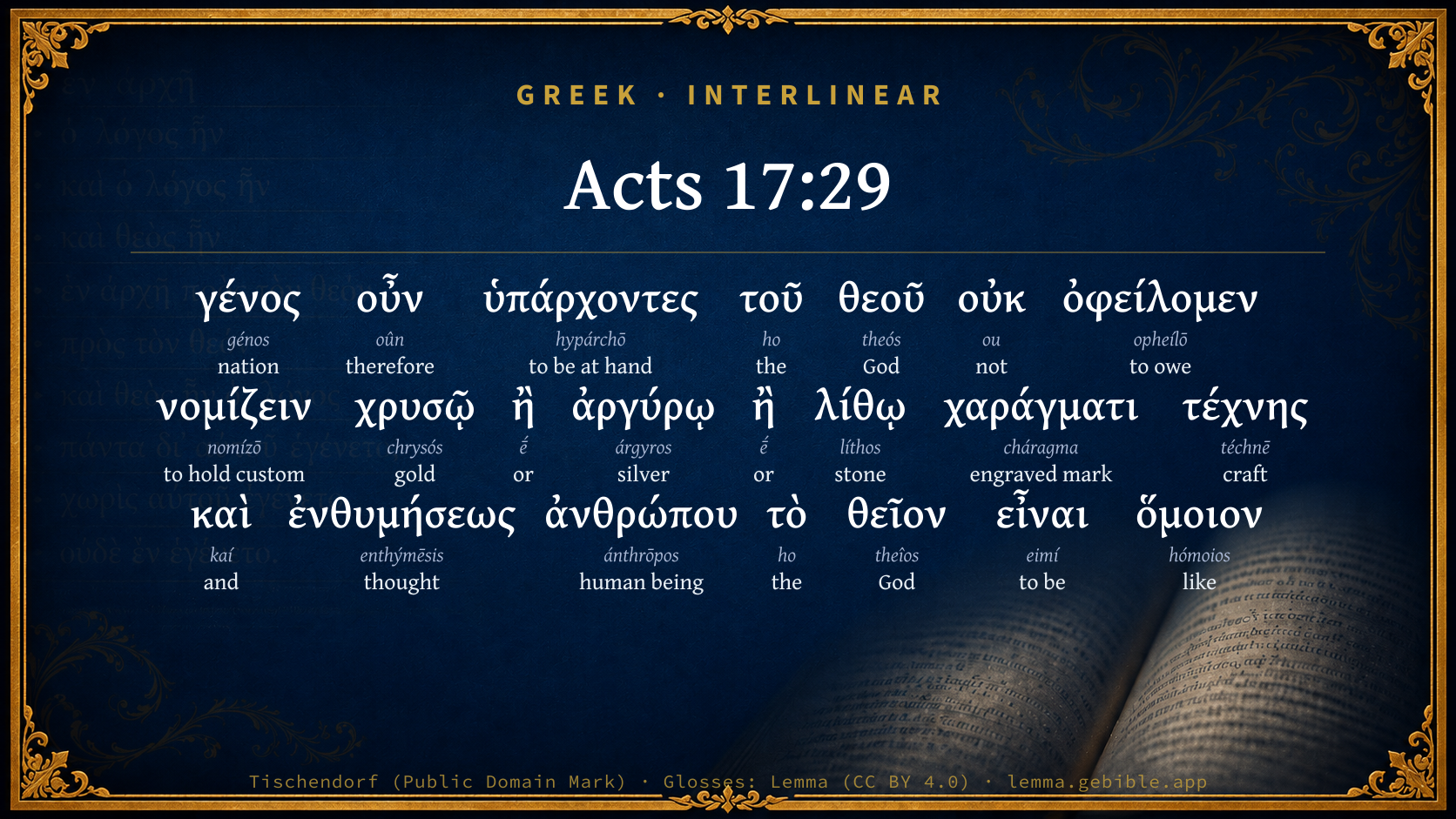
Greek (Tischendorf 8th ed.) Acts 17:29 appears in the Greek New Testament. The text above is from the Tischendorf 8th edition. Each word links to its Strong’s number and a concise gloss. Click any word for its full Thayer’s Greek Lexicon entry.
Download image
Cite this verse

Acts 17:29 (World English Bible). Public Domain. Lemma interlinear Bible study tool, https://lemma.gebible.app/v/acts/17/29.

Show BibTeX & RIS
BibTeX
RIS
English Translation
Being then the offspring of God, we ought not to think that the Divine Nature is like gold, or silver, or stone, engraved by art and design of man.
World English Bible · Public Domain
Highlights
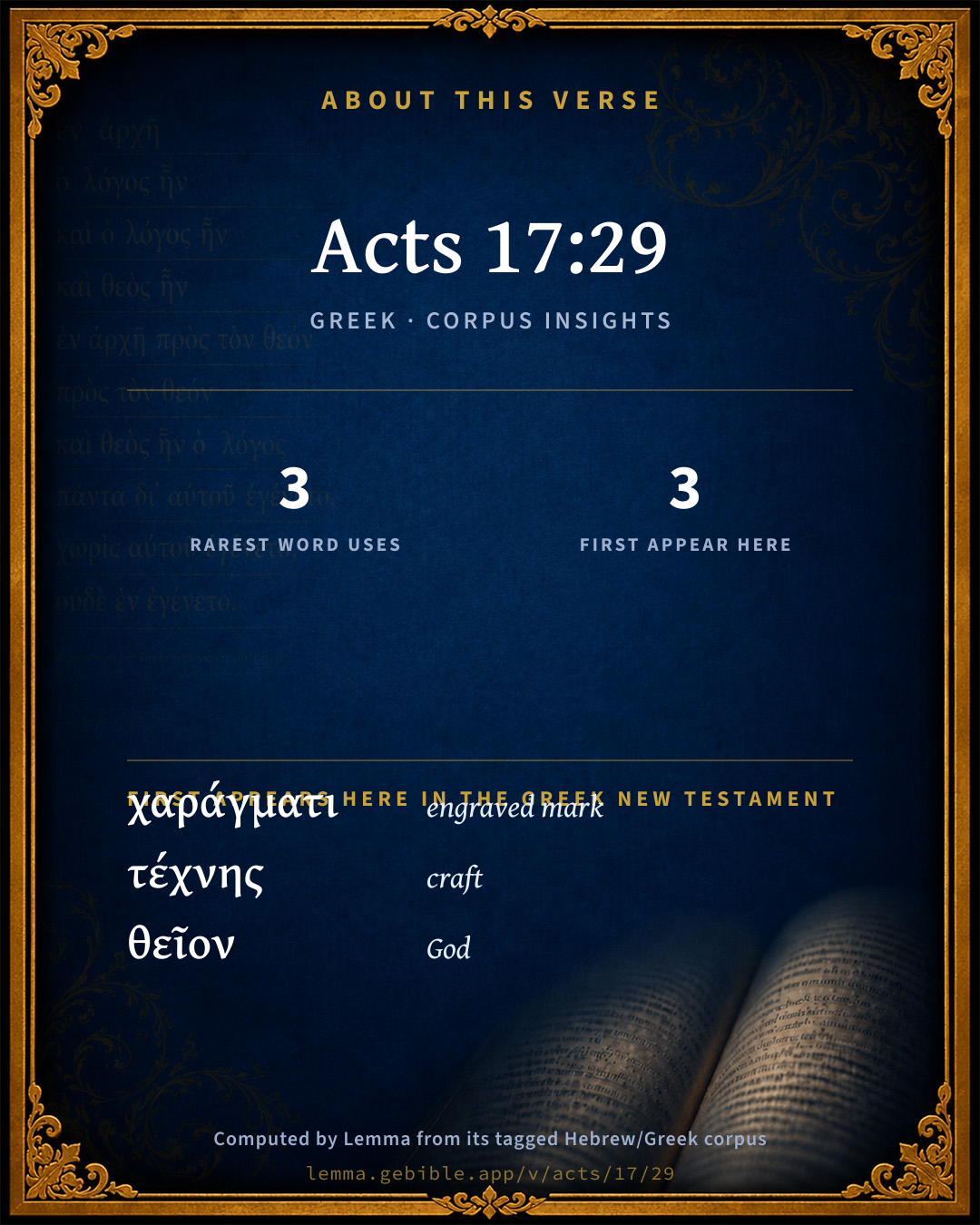
  • 3 first appearances in the Greek New Testament
Full analysis ↓
Download a study sheet

One document with this verse’s original text, its word-by-word gloss line, the meaning frame, cross-references with their text, attributed commentary, and full source and license credits — printable, and it pastes into notes with its structure intact.

This verse Autodidact and up

Study sheet (.html) Plain text (.txt)

A passage Seminary Student

Up to 50 verses in one chapter. A passage sheet keeps up to 6 commentary sources and 12 cross-references per verse, in the order this page ranks them, and says so on the sheet whenever that leaves anything out. Ask for a single verse and you get the Autodidact verse sheet above.

Everything on this page stays free to read, with no account — the sheet is a download of what is already on screen, not access to it.

Want to remove ads? Support Godless Engineer
Compare translations 3

The same verse in 3 English versions, stacked beneath the original-language interlinear above. Click any original word for its lexicon entry.

Each is an independent rendering of the whole verse — the interlinear is not word-aligned to these translations.

Highlighted words mark where these versions differ — a whole-verse word diff, not a word-by-word alignment.

  • World English Bible Public Domain
    Being then the offspring of God, we ought not to think that the Divine Nature is like gold, or silver, or stone, engraved by art and design of man.
  • King James Version Public Domain
    Forasmuch then as we are the offspring of God, we ought not to think that the Godhead is like unto gold, or silver, or stone, graven by art and man's device.
  • unfoldingWord Literal Text CC BY-SA 4.0
    Therefore, being offspring of God, we ought not to consider the Divine to be similar to gold or silver or stone—images of the skill and imagination of man.

unfoldingWord Literal Text — © unfoldingWord, licensed CC BY-SA 4.0. Word-aligned USFM3 via Door43 (git.door43.org/unfoldingWord/en_ult).

Versions to compare (up to 4)

3 of 4 selected

Show all 19 translations

Every available English version of this verse, each an independent rendering of the whole verse.

  • World English Bible Public Domain
    Being then the offspring of God, we ought not to think that the Divine Nature is like gold, or silver, or stone, engraved by art and design of man.
  • Berean Standard Bible Public Domain
    Therefore, being offspring of God, we should not think that the Divine Being is like gold or silver or stone, an image formed by man’s skill and imagination.
  • Majority Standard Bible Public Domain
    Therefore, being offspring of God, we should not think that the Divine Being is like gold or silver or stone, an image formed by man’s skill and imagination.
  • King James Version Public Domain
    Forasmuch then as we are the offspring of God, we ought not to think that the Godhead is like unto gold, or silver, or stone, graven by art and man's device.
  • American Standard Version (1901) Public Domain
    Being then the offspring of God, we ought not to think that the Godhead is like unto gold, or silver, or stone, graven by art and device of man.
  • Revised Version (1885) Public Domain
    Being then the offspring of God, we ought not to think that the Godhead is like unto gold, or silver, or stone, graven by art and device of man.
  • Geneva Bible (1599) Public Domain
    Forasmuch then, as we are the generation of God, we ought not to thinke that ye Godhead is like vnto gold, or siluer, or stone grauen by arte and the inuention of man.
  • Douay-Rheims (1899) Public Domain
    Being therefore the offspring of God, we must not suppose the divinity to be like unto gold, or silver, or stone, the graving of art, and device of man.
  • Young's Literal Translation Public Domain
    `Being, therefore, offspring of God, we ought not to think the Godhead to be like to gold, or silver, or stone, graving of art and device of man;
  • Literal Standard Version CC BY-SA 4.0
    Being, therefore, offspring of God, we ought not to think the Godhead to be like to gold, or silver, or stone, [an] engraving of art and imagination of man;
  • Unlocked Literal Bible CC BY-SA 4.0
    Therefore, since we are God's offspring, we ought not to think that the qualities of deity are like gold, or silver, or stone—images created by the art and imagination of man.
  • unfoldingWord Literal Text CC BY-SA 4.0
    Therefore, being offspring of God, we ought not to consider the Divine to be similar to gold or silver or stone—images of the skill and imagination of man.
  • Darby Bible Public Domain
    Being therefore [the] offspring of God, we ought not to think that which is divine to be like gold or silver or stone, [the] graven form of man's art and imagination.
  • World Messianic Bible Public Domain
    Being then the offspring of God, we ought not to think that the Divine Nature is like gold, or silver, or stone, engraved by art and design of man.
  • Webster's Bible Public Domain
    Being then the offspring of God, we ought not to think that the Godhead is like to gold, or silver, or stone graven by art and man's device.
  • Free Bible Version CC BY-SA 4.0
    “Since we are his family we shouldn't think that God is like gold, or silver, or stone, shaped by human artistry and thinking.
  • Bible in Basic English Public Domain
    If then we are the offspring of God, it is not right for us to have the idea that God is like gold or silver or stone, formed by the art or design of man.
  • Text-Critical English NT CC BY 4.0
    Being then the offspring of God, we ought not to think that the divine being is like gold, silver, or stone, an image formed by the skill and imagination of man.
  • Tyndale New Testament (1534) Public Domain
    For as moche then as we are the generacion of God we ought not to thynke that the godhed is lyke vnto golde silver or stone graven by crafte and ymaginacion of man.

Literal Standard Version (2020), Covenant Press — licensed CC BY-SA 4.0. Text via the HelloAO Bible API (eBible.org). Unlocked Literal Bible (unfoldingWord) — licensed CC BY-SA 4.0. Text via the HelloAO Bible API (eBible.org). unfoldingWord Literal Text — © unfoldingWord, licensed CC BY-SA 4.0. Word-aligned USFM3 via Door43 (git.door43.org/unfoldingWord/en_ult). Free Bible Version, Dr. Jonathan Gallagher — licensed CC BY-SA 4.0. Text via the HelloAO Bible API (eBible.org).

Word by word

More ways to search: Search by grammar → Find every occurrence → Compare this word →

Practice this passage: Drill this verse → Learn its vocabulary →

τέχνης
téchnē
G5078
“craft”
Noun, Genitive, Singular, Feminine
Part of Speech
Noun
Case
Genitive
Number
Singular
Gender
Feminine
Full Thayer's Definition

Origin: from the base of G5088

TDNT: None

1. of the plastic art 2. of a trade
  1. γένος génos G1085 “nation” Noun, Nominative, Singular, Neuter
  2. οὖν oûn G3767 “therefore” Conjunction
  3. ὑπάρχοντες hypárchō G5225 “to be at hand” Verb, Present, Active, Participle, Nominative, Plural, Masculine
  4. τοῦ ho G3588 “the” Article, Genitive, Singular, Masculine
  5. θεοῦ theós G2316 “God” Noun, Genitive, Singular, Masculine
  6. οὐκ ou G3756 “not” Particle, Negative
  7. ὀφείλομεν opheílō G3784 “to owe” Verb, Present, Active, Indicative, 1st person, Plural
  8. νομίζειν nomízō G3543 “to hold custom” Verb, Present, Active, Infinitive
  9. χρυσῷ chrysós G5557 “gold” Noun, Dative, Singular, Masculine
  10. ἢ ḗ G2228 “or” Particle
  11. ἀργύρῳ árgyros G696 “silver” Noun, Dative, Singular, Masculine
  12. ἢ ḗ G2228 “or” Particle
  13. λίθῳ líthos G3037 “stone” Noun, Dative, Singular, Masculine
  14. χαράγματι cháragma G5480 “engraved mark” Noun, Dative, Singular, Neuter
  15. καὶ kaí G2532 “and” Conjunction
  16. ἐνθυμήσεως enthýmēsis G1761 “thought” Noun, Genitive, Singular, Feminine
  17. ἀνθρώπου ánthrōpos G444 “human being” Noun, Genitive, Singular, Masculine
  18. τὸ ho G3588 “the” Article, Accusative, Singular, Neuter
  19. θεῖον theîos G2304 “God” Adjective, Accusative, Singular, Neuter
  20. εἶναι eimí G1510 “to be” Verb, Present, Active, Infinitive
  21. ὅμοιον hómoios G3664 “like” Adjective, Accusative, Singular, Neuter

About this verse

These counts appear in no published source. They are computed here, from the morphology-tagged text and Lemma’s own curated glosses. What Lemma adds →

22
words
20
distinct lemmas
Acts
section

Notable vocabulary

The rarest word here is τέχνης craft G5078 — appearing just 3 times in the whole Greek New Testament.

First appearance in Scripture

These words make their first canonical appearance in the Greek New Testament here:

  • χαράγματι engraved mark G5480
  • τέχνης craft G5078
  • θεῖον God G2304

Shared distinctive vocabulary

τέχνης craft G5078 occurs in 3 verses of the Greek New Testament. Also found in:
Repetition

Words recur within this verse:

Cross-references

12

Topical passages linked to Acts 17:29 in the Treasury of Scripture Knowledge — connected by theme and wording, ordered by reader-vote popularity; previews shown in the World English Bible.

  • Isaiah 40:25 To whom then will you liken me, that I should be equal [to him]? says the Holy One.
  • Exodus 20:4 "You shall not make for yourselves an idol, nor any image of anything that is in the heavens above, or that is in the earth beneath, or that is in the water under the earth:
  • Isaiah 46:5–6 To whom will you liken me, and make me equal, and compare me, that we may be like?
  • Psalms 115:4–8 Their idols are silver and gold, The work of men's hands.
  • Habakkuk 2:19–20 Woe to him who says to the wood, 'Awake!' or to the mute stone, 'Arise!' Shall this teach? Behold, it is overlaid with gold and silver, and there is no breath at all in the midst of it.
  • Jeremiah 10:4–10 They deck it with silver and with gold; they fasten it with nails and with hammers, that it not move.
  • Romans 1:20–23 For the invisible things of him since the creation of the world are clearly seen, being perceived through the things that are made, even his everlasting power and divinity; that they may be without excuse.
  • Psalms 106:20 Thus they exchanged their glory For an image of a bull that eats grass.
  • Exodus 32:4 He received what they handed him, and fashioned it with an engraving tool, and made it a molten calf; and they said, "These are your gods, Israel, which brought you up out of the land of Egypt."
  • Psalms 94:7–9 They say, "Yah will not see, Neither will Jacob's God consider."
  • Isaiah 40:12–20 Who has measured the waters in the hollow of his hand, and meted out the sky with the span, and comprehended the dust of the earth in a measure, and weighed the mountains in scales, and the hills in a balance?
  • Isaiah 44:9–20 Those who fashion an engraved image are all of them vanity; and the things that they delight in shall not profit; and their own witnesses don't see, nor know: that they may be disappointed.

Cross-references courtesy of OpenBible.info (CC BY 4.0).

Commentary

Notes on Acts 17:29 from classic Christian and Jewish commentators (each source and its license shown beneath its notes). The classic Christian expositions comment on the surrounding passage and are grouped to its opening verse, so a note may address several verses; the Jewish commentaries on the Tanakh (Rashi and others) are per-verse, so they appear only where the commentator wrote on this verse.

Lemma curates 59 commentaries, every one of them public domain or Creative Commons licensed, each selected and text-cleaned for this edition rather than reprinted as found. About our sources →

The Biblical Illustrator

Joseph S. Exell

Act_17:29

Forasmuch then … we ought not to think that the Godhead is like unto gold.

Pauls cumulative argument

Up to this verse Paul has made a general statement respecting God. Here he lays down the groundwork of a true and abiding Christian philosophy. The armoury of the Church is in the word forasmuch. It throws man back on himself, and says, If you want to know what God is, know yourself. Forasmuch then as we are the offspring of God, we ought not to think, etc. He made us; as certain of your own poets have said. Then judge the Father by the child; the Creator by the creature made in His own image and likeness, and rise from the human to the Divine--the ascent of reason and the way of faith. Now I know of a surety that the Bible representation of God is true, because it is true of myself. My reasoning is now invincible, because it takes this turn, namely--

I. Forasmuch, then, as we are not entirely comprehended, even by those who know us best and love us most, even so is God a mystery.

II. Forasmuch, then, as we have not been seen by our dearest admirers, we ought not to think that the Godhead can be seen. You have never seen your friend; you have never seen your own self. Any mystery that we find in God we find initially and typically in our own nature.

III. As we express our thought and feeling through body and form, so does God. We proceed by incarnation. Forasmuch, then, as our love must incarnate and embody itself, so as to touch us, we ought not to think that the Godhead is independent of the method which amongst ourselves He has made essential to union and happiness. If we have come upon this doctrine through the deep study of our own nature and ways of self-revelation, when we come to the historical Bethlehem we feel we have only come home. That Bethlehem has been in our hearts, and is the inner circle of our sacred home.

IV. Forasmuch, then, as we forgive our children who repent of their sins, we ought not to think that the Godhead is unwilling to forgive. Forasmuch, then, as that man did so to that sinning son, we ought not to think that the Godhead is a carved statue in the sky. Like as a father pitieth his children, etc. (J. Parker, D. D.)

The Biblical Illustrator, edited by Joseph S. Exell (c. 1880s–1900s) — public domain. Text from a community e-Sword module.

Joseph Benson's Commentary

Act 17:29. For as much then as we are the offspring of God — We, with all the powers and faculties of our rational nature, and since these bear but a very imperfect and distant resemblance of those original, consummate, and infinite glories which shine forth in him; we ought not surely to think — A tender expression; especially in the first person plural: that the Godhead is like unto gold and silver. &c., graven by art and man’s device — For such things, conveying no idea of mind, if they be likenesses of God, they represent him as being mere matter, void of intelligence; but if he be so, how could he give intelligence, and all the other faculties of mind to us? As if he had said, Can God himself be a less noble Being than we who are his offspring? Nor does he only deny here that these images are like God, but he denies, also, that they have any analogy to him at all, so as to be capable of representing him in any degree or respect.

Joseph Benson's Commentary on the Old and New Testaments (1811–1818) — public domain. Text from a community e-Sword module.

Bengel's Gnomon

Johann Albrecht Bengel

Act 17:29. Οὐκ ὀφείλομεν, we ought not) A mild mode of expression, especially in the first person plural. “He hath breathed into us a something divine. Therefore, since we are the offspring of God, and have life and breath, it is foolish to believe that the Divinity is in dumb stone or silver, since it is undoubtedly the highest life which hath given us life.”—Jonas.—χαράγματι) The Ablative.—τέχνης, of art) which is external.—ἐνθυμήσεως, of man’s device) which is internal.—τὸ θεῖον) An appropriate appellation of God among men who are still far removed from the knowledge of Him.—ὅμοιον, like) Man is in some measure midway between God and matter. Man is not like metal. Therefore God is much less like metal: for man, the offspring of God, is like God. And not only is likeness in this place denied, but any correspondence whatsoever, which might furnish a foundation for making an image, so as that from it the expectation might be formed, that the nature of God takes delight in such things. The statues (themselves) were not esteemed by the Athenians as gods: but Paul does not even leave them the power, which they were presumed to have, of vividly presenting (representing) the Deity before us.

Bengel's Gnomon of the New Testament — English translation (T&T Clark, Edinburgh, 1860) — public domain. Text from a community e-Sword module.

Meyer's Critical & Exegetical Commentary

Heinrich August Wilhelm Meyer

Act_17:29. Since, then, we (according to this poetical saying) are offspring of God, so must our self-consciousness, kindred to God, tell us that the Godhead has not resemblance to gold, etc. We cannot suppose a resemblance of the Godhead to such materials, graven by human art, without denying ourselves as the progenies of God.[70] Therefore we ought not (οὐκ ὀφείλομεν). What a delicate and penetrating attack on heathen worship! That Paul with the reproach, which in οὐκ ὀφείλομεν κ.τ.λ. is expressed with wise mildness (Bengel: clemens locutio, praesertim in prima persona plurali), does no injustice to heathenism, whose thinkers had certainly in great measure risen above anthropomorphism, but hits the prevailing popular opinion (πρὸς τοὺς πολλοὺς ὁ λόγος ἦν αὐτῷ, Chrysostom), may be seen in Baumgarten, p. 566 ff.

γένος] placed first and separated from τ. Θεοῦ, as the chief point of the argument. For, if we are proles Dei, and accordingly homogeneous with God, it is a preposterous error at variance with our duty to think, with respect to things which are entirely heterogeneous to us, as gold, silver, and stone, that the Godhead has resemblance with them.

χαράγματι τέχν. κ. ἐνθυμ. ἀνθρώπου] a graven image which is produced by art and deliberation of a man (for the artist made it according to the measure of his artistic meditation and reflection): an apposition to χρυσῷ κ.τ.λ., not in the ablative (Bengel).

τὸ θεῖον] the divine nature, divinum numen (Herod. iii. 108, i. 32; Plat. Phaedr. p. 242 C, al.). The general expression fitly corresponds to the discourse on heathenism, as the real object of the latter. Observe also the striking juxtaposition of ἀνθρώπου and τὸ θεῖον; for χαράγμ. τέχν. κ. ἐνθ. ἀνθρ. serves to make the οὐκ ὀφείλομεν νομίζειν still more palpably felt: inasmuch as metal and stone serve only for the materials of human art and artistic thoughts, but far above human artistic subjectivity, which wishes to represent the divine nature in these materials, must the Godhead be exalted, which is not similar to the human image, but widely different from it. Comp. Wis_15:15 ff.

[70] Graf views it otherwise, but against the clear words of the passage, in the Stud. u. Krit. 1859, p. 232.

Meyer — Critical and Exegetical Commentary on the New Testament — English translation by Peter Christie, edited by Frederick Crombie (T&T Clark, 1880) — public domain. Text from a community e-Sword module.

Expositor's Greek Testament

ed. W. Robertson Nicoll

Act 17:29 . γένος οὖν ὑπάρχοντες : for ὑπάρχειν , see above on Act 17:24 ; is the inference simply that because we are dependent upon God for all things, it is absurd to suppose that the divine nature can be like to the work of men’s hands? This is correct so far as it goes, but is not the further thought implied that as men are the offspring of God, they ought not to think that man is the measure of God, or that the divine nature, which no man hath seen at any time, can be represented by the art of man, but rather as conscious of a sonship with a Father of spirits they ought to worship a Father in spirit and in truth? see quotations from Seneca in Lightfoot, Philippians , p. 290: “The whole world is the temple of the immortal gods. Temples are not to be built to God of stones piled on high.…” Fragm. 123 in Lactant. Div. Inst. , vi., 25: “God is near thee; He is with thee; He is within,” Ep. Mor. , xcv., 47: “Thou shalt not form Him of silver and gold, a true likeness of God cannot be moulded of this material,” Ep. Mor. , xxxi., 11. See also the striking parallels from Letters of Pseudo-Heracleitus , Gore, Ephesians , p. 254. For a recent view of the possible acquaintance of Seneca with the Christian teaching of St. Paul see Orr, Some Neglected Factors in Early Christianity , pp. 178 ff. τὸ θεῖον : not “godhead,” but “that which is divine,” R.V. margin, “the divine nature”; probably the word which the Athenians themselves used, Xen., Mem. , i., 4, 18, see instances in Grimm, sub v. , of its use in Philo and Josephus, who employ it in the neuter of the one God, Grimm thinks, out of regard for Greek usage. χρυσῷ ἢ ἀργ . ἢ λίθῳ : (on the form of the word see Blass and critical notes) including, we may suppose, the chryselephantine statues of Phidias in the Parthenon, and a reference to the silver mines of Laurium, and the marble hewn from Pentelicus, cf. Epist. ad Diognetum , ii., 2. χαράγματι : in apposition to χρύσῳ . χαράσσω , Latin, sculpo, insculpo , only here in N.T. in this sense. Polyb. uses the words of coins stamped (so in Anth. ., v., 30) τὸ χαραχθὲν νόμισμα . τέχνης καὶ ἐνθ .: “artis externæ, cogitationis internæ”. ἐνθ .: a rare word (in the plural, thoughts, cf. Mat 9:4 , etc.), but used by Thuc., Eur., and also by Hippocrates. See the remarks of Curtius ( Gesammelte Abhandlungen , ii., 535) on the words, as indicating that Paul was acquainted with the phrases of Greek authors. The passage in Wis 13:6 should be carefully noted (see Act 17:27 above), and also Act 17:10 , in which the writer speaks of gods which are the work of men’s hands, gold and silver to show art in, i.e. , lit [315] , an elaboration of art, ἐμμελέτημα τέχνης . In the words Bethge further sees an intimation that the Apostle had an eye for the forms of beauty represented in the carved statues and idols which met his gaze in Athens; but for a very different view of St. Paul’s estimate of art see Renan, Saint Paul , p. 172, Farrar, St. Paul , i., 525, McGiffert, Apostolic Age , p. 260. ἀνθρώπου : stands contrasted with τὸ θεῖον ; it is the device of man which forms the material into the idol god, and thus human thought becomes the measure of the divine form; Xenophanes (570 B.C.) had ridiculed the way in which the Thracians represented their gods, with blue eyes and fair complexions, whilst the Æthiopians had represented their gods as flat-nosed and swarthy. Zeno had renewed the protest, but some of the best of the heathen philosophers had spoken in inconsistent language on the subject; St. Paul’s plain and direct words were the utterances of a man who had in mind the severe and indignant protests of the Hebrew prophets, cf. Isa 44:12 . οὐκ ὀφείλομεν : at the same time the use of the 1st person plural again points to the conciliatory tone of the speech, “clemens locutio” (so Bengel, Wendt); or possibly the words may mean that he is referring in a general way to the beliefs of the people, to the crowd and not to the philosophers: πρὸς τοὺς πολλοὺς ὁ λόγος ἦν αὐτῷ , Chrys. But Nestle has lately called attention to the question as to whether we should not translate: “we are not obliged, not bound to think, we are at liberty not to think so,” and thus, instead of a reproof, the words become a plea for freedom of religious thought. The first shade of meaning, he adds, i.e. , “clemens locutio,” as above, comes nearer to ὀφειλ . μὴ νομίζειν , the second agrees with the other passage in the N.T., 2Co 12:14 , where the negative particle is connected with ὀφείλειν ; see Nestle’s note in Expository Times , March, 1898, p. 381.

[315] literal, literally.

The Expositor's Greek Testament, edited by W. Robertson Nicoll (1897–1910) — public domain. Text from a community e-Sword module.

Geneva Bible (1599)

Geneva Bible translators

Which stuff, as gold, silver, stones, are customably graven as a man’s wit can devise, for men will not worship that gross stuff as it is, unless by some art it have gotten some shape upon it.

Geneva Bible (1599) marginal notes — public domain. Text via Bolls.life.

Jamieson, Fausset & Brown

Robert Jamieson, A. R. Fausset & David Brown

Forasmuch then as we are the offspring of God, we ought not to think--The courtesy of this language is worthy of notice.

that the Godhead is like unto gold, or silver, or stone, graven by art and man's device--("graven by the art or device of man"). One can hardly doubt that the apostle would here point to those matchless monuments of the plastic art, in gold and silver and costliest stone, which lay so profusely beneath and around him. The more intelligent pagan Greeks no more pretended that these sculptured gods and goddesses were real deities, or even their actual likenesses, than Romanist Christians do their images; and Paul doubtless knew this; yet here we find him condemning all such efforts visibly to represent the invisible God. How shamefully inexcusable then are the Greek and Roman churches in paganizing the worship of the Christian Church by the encouragement of pictures and images in religious service! (In the eighth century, the second council of Nicea decreed that the image of God was as proper an object of worship as God Himself).

Jamieson, Fausset & Brown — Commentary Critical and Explanatory on the Whole Bible (1871) — public domain (CC PDM 1.0). Text via the HelloAO Bible API.

Adam Clarke's Commentary

Verse 29. Forasmuch then as we are the offspring of God, c.] This inference of the apostle was very strong and conclusive and his argument runs thus: "If we are the offspring of God, he cannot be like those images of gold, silver, and stone, which are formed by the art and device of man; for the parent must resemble his offspring. Seeing, therefore, that we are living and intelligent beings, HE from whom we have derived that being must be living and intelligent. It is necessary, also, that the object of religious worship should be much more excellent than the worshipper; but a man is, by innumerable degrees, more excellent than an image made out of gold, silver, or stone; and yet it would be impious to worship a man: how much more so to worship these images as gods! Every man in the Areopagus must have felt the power of this conclusion; and, taking it for granted that they had felt it, he proceeds:-

Adam Clarke's Commentary on the Bible (1810–1826) — public domain. Text from a community e-Sword/MySword module.

John Calvin's Commentaries

29. Therefore seeing that. He gathereth that God cannot be figured or resembled by any graven image forasmuch as he would have his image extant in us. For the soul wherein the image of God is properly engraven cannot be painted; therefore it is a thing more absurd to go about to paint God. Now, we see what great injury they do to God which give him a bodily shape; when as man’s soul, which doth scarce resemble a small sparkle of the infinite glory of God, cannot be expressed in any bodily shape.

Furthermore, forasmuch as it is certain that Paul doth in this place inveigh against the common superstition of all the Gentiles, because they would worship God under bodily shapes, we must hold this general doctrine that God is falsely and wickedly transfigured, and that his truth is turned into a lie so often as his Majesty is represented by any visible shape; as the same Paul teacheth in the first chapter to the Romans, (Romans 1:23.) And though the idolaters of all times wanted not their cloaks and colors, yet that was not without cause always objected to them by the prophets which Paul doth now object that God is made like to wood, or stone or gold, when there is any image made to him of dead and corruptible matter. The Gentiles used images that, according to their rudeness, they might better conceive that God was nigh unto them. But seeing that God doth far surpass the capacity of our mind, whosoever attempteth with his mind to comprehend him, he deformeth and disfigureth his glory with a wicked and false imagination. Wherefore, it is wickedness to imagine anything of him according to our own sense. Again, that which worse is, it appeareth plainly that men erect pictures and images to God for no other cause, save only because they conceive some carnal thing of him, wherein he is blasphemed.

The Papists also are at this day no whit more excusable. For what colors soever they invent to paint and color those images, whereby they go about to express God, yet because they be enwrapped in the same error, wherein the men of old time were entangled, they be urged with the of the prophets. And that the heathen did use the same excuses in times past, wherewith the Papists go about to cover themselves at this day, it is well known out of their own books. Therefore, the prophets do not escape the mocks of certain, as if they laid too great grossness to their charge, yea, burthen them with false accusations; but when all things are well weighed, those who will judge rightly shall find, that whatsoever starting holes [evasions] even the most witty men have sought, yet were they taken with this madness, that God is well pleased with the sacrifice done before images. Whereas we, with Erasmus, translate it numen, Luke putteth [θειον] in the neuter gender for divinity or godhead. When Paul denieth that God is like to gold, or silver, or stone, and addeth afterward, graven by cunning or invention of man, he excludeth both matter and form, and doth also condemn all inventions of men, which disfigure the true nature of God.

John Calvin's Commentaries (1540-1563) — public domain. Text from the Calvin Translation Society English edition (1840s-50s) via the Christian Classics Ethereal Library (ccel.org). Calvin's coverage is partial (roughly two-thirds of the Bible); uncommented books and verses are honest gaps, never fabricated. The 19th-century editor's footnotes and remarks are omitted so the notes are faithfully Calvin's own voice.

Ellicott's Commentary for English Readers

(29) Forasmuch then as we are the offspring of God.—One consequence from the thought of son-ship is pressed home at once. If we are God’s offspring our conception of Him should mount upward from what is highest in ourselves, from our moral and spiritual nature, instead of passing downward to that which, being the creature of our hands, is below us. Substantially asserting the same truth, the tone of St. Paul in speaking of idolatry is very different from that which we find in the older prophets (1Ki_18:27; Psa_135:15-18; Isa_44:9-20). He has, as it were, studied the genesis of idolatry, and instead of the burning language of scorn, and hatred, and derision, can speak of it, though not with tolerance, yet with pity, to those who are its victims.

The Godhead.—The Greek term is neuter, and corresponds to the half-abstract, half-concrete forms of the “Divine Being,” the “Deity.”

Gold, or silver, or stone.—The first word reminds us of the lavish use of gold in the colossal statue of Zeus by Phidias. Silver was less commonly used, but the shrines of Artemis at Ephesus (see Note on Act_19:24) supply an instance of it. “Stone” was the term commonly applied to the marble of Pentelicus, which was so lavishly employed in the sculpture and architecture of Athens.

A Bible Commentary for English Readers, edited by Charles John Ellicott (1878–1897) — public domain. Text from a community e-Sword module.

The Cambridge Bible for Schools and Colleges

gen. ed. J. J. S. Perowne

29. we ought not to think, &c.] As man is of more honour than material things, how far above these must the Godhead be. The Athenians, the Apostle would teach them, had formed not too high but too low a conception of themselves.

The Cambridge Bible for Schools and Colleges (gen. ed. J. J. S. Perowne; Cambridge University Press, 1878–1918) — public domain. Text from a community e-Sword module.

John Gill's Exposition

Forasmuch then as we are the offspring of God,.... In the sense before given; for the apostle is not here speaking of himself, and other saints, as being the children of God, by adoption, and by regenerating grace, and faith in Christ Jesus, but as men in common with others, and with these Athenians:

we ought not to think that the Godhead is like unto gold, or silver, or stone, graven by art and man's device; for men themselves, who are the offspring of God, and made after his image, are not to be compared to graven images of gold, silver, and stone, but are vastly preferable to them, they being formed by their art, and the device of their minds; and much less then should God, the Creator of men, and from whom they spring, be likened to, or represented by, any such thing; for so to think of God, is to think very unworthily of him; for if to think thus of ourselves, who are descended from him, would be a debasing of us, then much more to think so of God, the Father of spirits, must be a depreciating of him; and which by no means ought to be done, and argues great stupidity: if living rational creatures are not to be equalled to, and compared with, senseless statues, much less God, the former of men and angels.

John Gill's Exposition of the Whole Bible (1746–1763) — public domain (CC PDM 1.0). Text via the HelloAO Bible API.

Trapp's Complete Commentary

John Trapp

29 Forasmuch then as we are the offspring of God, we ought not to think that the Godhead is like unto gold, or silver, or stone, graven by art and man’s device.

Ver. 29. That the Godhead is like] Qui primi deorum simulachra induxerunt, errorem auxerunt, metum dempserunt, saith Varro, as Calvin cites his words. Plutarch saith it is sacrilege to worship by images. They were atheists by night that worshipped the sun and atheists by day that worshipped the moon, as Cyril wittily speaketh.

John Trapp, A Commentary or Exposition upon All the Books of the Old and New Testament (1647–1656) — public domain. Text from a community e-Sword module.

Albert Barnes' Notes on the Bible

Forasmuch then - Admitting or assuming this to be true. The argument which follows is drawn from the concessions of their own writers.

We ought not to think - It is absurd to suppose. The argument of the apostle is this: “Since we are formed by God; since we are like him, living and intelligent beings; since we are more excellent in our nature than the most precious and ingenious works of art, it is absurd to suppose that the original source of our existence can be like gold, and silver, and stone. Man himself is far more excellent than an image of wood and stone; how much more excellent still must be the great Fountain and Source of all our wisdom and intelligence.” See this thought pursued at length in Isa 40:18-23.

The Godhead - The divinity (τὸ Θεῖον to Theion), the divine nature, or essence. The word used here is an adjective employed as a noun, and does not occur elsewhere in the New Testament.

Is like unto gold ... - All these things were used in making images or statues of the gods. It is absurd to think that the source of all life and intelligence resembles a lifeless block of wood or stone. Even degraded pagan, one would think, might see the force of an argument like this.

Graven - Sculptured; made into an image.

Albert Barnes' Notes on the Bible (1834–1885) — public domain. Text from a community e-Sword/MySword module.

Haydock's Catholic Bible Commentary

Cherubim, which extended wings, were ordered by God to be made, and placed over the propitiatory; (Exodus xxxvii. 7.) the brazen serpent is declared by Jesus Christ himself to have been a figure of him; therefore to blame the universally received practice of the Catholic Church, with regard to pictures and images, betrays either great prevention, or great ignorance. St. Gregory says: "What writing does for readers, that a picture does for the ignorant; for in it they see what they ought to follow, and in it they read, who know no letters." And he sharply rebukes Serenus’s indiscreet zeal for removing pictures, instead of teaching the people what use may be made of them. (lib. ix. ep. 9.)

George Leo Haydock (1774–1849), Haydock's Catholic Family Bible and Commentary, 1859 edition — public domain. Excludes Psalms (Douay-Rheims chapter numbering differs from Protestant) and Deuterocanonical books (Catholic canon only).

Matthew Poole's English Annotations

We are the offspring of God; this is spoken by the apostle in a poetical expression, according unto what he had cited. We are indeed the children, and in our souls bear the image of God. But as many as have the Spirit of adoption, they partake of God’s holiness, and imitate his goodness, and are more like unto him, by whom they are begotten again unto a lively hope, 1Pe 1:3; and at the resurrection they will appear unto all to be his children, when they shall be acknowledged his heirs, and coheirs with Jesus Christ, Rom 8:17.

We ought not to think that the Godhead is like unto gold, or silver: taking man in his natural principles, consisting of soul and body, he is not made of gold and silver; much less can God be made of them. Our soul in which we bear the image of God, cannot be expressed by any graving or painting; much less God, whose image it is. There are two things to be considered in every image: its matter, and its form or shape. The matter of an image, let it be never so precious, is much inferior to man; for it lies in the earth, (be it gold or silver), for man to trample upon, until he dig it up, and take it out. As for the form of the image, it is that which men please to give it, and man is a kind of creator of it; howsoever, it is his workmanship, and the work is more ignoble than the workman, at least not to be adored by him.

By art and man’s device; according to man’s will and pleasure, for the image cannot determine itself to be made as it would.

Matthew Poole's English Annotations on the Holy Bible (1683–1685) — public domain. Text from a community e-Sword/MySword module.

Whedon's Commentary on the Bible

Daniel D. Whedon

29. Forasmuch—The apostle then draws his inference: if we are God’s offspring, as spirits, and of spirits there can be neither picture nor image, we ought so to appreciate the omnipotent Spirit as to see that he cannot be represented by base marble or metal, with which he is in absolute contrast.

Graven—Carved or sculptured. The Greek word is a noun in apposition with the preceding norms: “gold, silver, or stone, the shapement of man’s art and device.”

Daniel D. Whedon (gen. ed.), Commentary on the Old and New Testaments (1874–1909) — public domain. Text from a community e-Sword module.

The Pulpit Commentary

Being then for forasmuch then as we are, A.V.; device of man for mans device, A.V. Graven by art, etc. In the Greek the substantive caragmata, graven images, things engraven, is in apposition with the gold, silver, and stone, and a further description of them. Art, tecnh, is the manual skill, the device; ejnqumhsiv is the genius and mental power which plans the splendid temple, or exquisite sculpture, or the statue which is to receive the adoration of the idolater. Compare the withering sarcasm of Isaiah. (Isa_44:9-17)

The Pulpit Commentary (1880–1919), ed. H.D.M. Spence-Jones & Joseph S. Exell — public domain. Text from a community e-Sword module.

John Wesley's Explanatory Notes

We ought not to think - A tender expression especially in the first per son plural. As if he had said, Can God himself be a less noble being than we who are his offspring? Nor does he only here deny, that these are like God, but that they have any analogy to him at all, so as to be capable of representing him.

John Wesley, Explanatory Notes Upon the Whole Bible (1754–1765) — public domain. Text via the GEBible commentary corpus.

Scofield Reference Notes

C. I. Scofield

offspring of God

(Greek - γένος = "race)." The reference is to the creation-work of God in which He made man (i.e. mankind, the race in Adam) in his own likeness, Gen 1:26; Gen 1:27 thus rebuking the thought that "the Godhead is like unto gold," etc. The word "Father" is not used, not does the passage affirm anything concerning fatherhood or sonship, which are relationships based on faith, and the new birth.

Cf Joh 1:12; Joh 1:13; Gal 3:26; Gal 4:1-7; Joh 5:1.

The Scofield Reference Bible (1917 edition), notes by C. I. Scofield — public domain. Text from a community e-Sword module.

Kretzmann's Popular Commentary

Paul E. Kretzmann

The conclusion of Paul and the effect of his sermon:

v. 29. Forasmuch, then, as we are the offspring of God, we ought not to think that the Godhead is like unto gold, or silver, or stone, graven by art and man’s device.

v. 30. And the times of this ignorance God winked at, but now commandeth all men everywhere to repent,

v. 31. because He hath appointed a day in the which He will judge the world in righteousness by that Man whom He hath ordained; whereof He hath given assurance unto all men in that He hath raised Him from the dead.

v. 32. And when they heard of the resurrection of the dead, some mocked; and others said, We will hear thee again of this matter.

v. 33. So Paul departed from among them.

v. 34. Howbeit, certain men clave unto him and believed, among the which was Dionysius, the Areopagite, and a woman named Damaris, and-others with them.

If his hearers have kept the facts in mind concerning the essence of God and the relation of men to God, so the argument of Paul runs, and if they accept the statement that men are the offspring of God, that they, as creatures of God, are sustained by His providence, then it follows that idol worship is altogether unworthy of the lofty descent of human beings. They must conclude not only against the worship of images, but also against the habit of thought which made such worship possible, as both foolish and senseless. It is not only an affront to God, but an insult to sound common sense to think that the Godhead is like gold or silver or stone, fashioned and sculptured by the art and produced according to the deliberation of a man. What a man’s mind, his imagination, had designed, what the skill of his fingers had then executed in metal or marble, this surely could not be reasonably endowed with the qualities of the Deity! And in addition to this his hearers were to know that God had indeed overlooked the times of ignorance, not as though He had not punished the sins of the heathen, but that He showed great patience with and forbearance toward them in not punishing them in the degree which their idolatry had merited. Now, however, since the full revelation of God has been made in Jesus Christ, God demands a change of mind and of life, complete repentance on the part of all men; this message comes in the nature of an emphatic demand. They should give heed, therefore, since God has fixed, or set, a day in which He intends to judge the entire world, all men without exception, in righteousness, in such a way that everyone will receive full justice. This judgment will be executed in the person of a Man, through a Judge whom God has appointed for that purpose, Joh 5:22. But in the meantime God is offering faith to all men, having raised this man, Jesus Christ, from the dead. To all men without exception faith is brought near, is offered, the faith based upon the resurrection of Jesus Christ, made possible by that great miracle of God’s grace. So the address of Paul ends in a triumphant burst of Gospel-preaching, intended to impress these Gentiles with the wonderful beauty of this message and to open their hearts for Christ. But the idea of a resurrection of the dead, so indissolubly connected with Christian teaching, was to these wise Athenians the acme of foolishness. As long as Paul had demonstrated the folly of their idolatrous worship, they had listened with respectful attention, but now that he brought the essential teaching of Christ, some of the men in the audience interrupted him with cries of derision, while others, rendered thoughtful by the powerful exposition, did not merely express a cold interest in the matters presented, but voiced their willingness to hear him again at some other time. They wanted some time to think over the truths which they had heard so far. So Paul left the assembly of the Court without further opposition. And the Word also in Athens was not without immediate fruit, for there were several people in the audience in whose hearts faith had been kindled, and who therefore joined Paul as his companions and as disciples of the Lord. Among these was a member of the Athenian Council, a man of distinction in the city, by the name of Dionysius, and a woman, very likely a foreign woman, well-educated and influential, and a few others with them. In the midst of His enemies Christ reigns and gains victories, though proud Athens yielded only a few converts, 1Co 1:26-27. Let all the wisdom and art of this world proudly exclaim in denunciation of the Gospel-truth, yet the foolishness of God is wiser than men; it teaches the heavenly wisdom which was revealed in Christ.

Summary

Paul and Silas preach the Gospel in Thessalonica and Berea, Paul traveling ahead of his companions from the latter city to Athens, where he also preaches the truth of the Scriptures and faith in Jesus.

Paul E. Kretzmann, Popular Commentary of the Bible (1921–1924) — public domain. Text from a community e-Sword module.

Burkitt's Expository Notes on the New Testament

William Burkitt

Observe here, 1. How our apostle quotes one of the heathen poets in his divine discourse. This poet was Aratus; what he attributes to Jupiter, St. Paul attributes to the true God; We are his off-spring.

Where note, for the honour of human learning and the lawfulness of making use of it in our sermons, the Holy Ghost is pleased several times in the New Testament to make mention of the heathen poets; of Aratus here, Act 17:28 of Menander, 1Co 15:33 of Epimenides, Tit 1:12. Truth is God’s wherever it is found; as a mine of gold is the king’s on whose ground soever it is discovered.

Observe, 2. The force of the apostle’s argument: seeing we are God’s off-spring: that is, seeing God is our Creator, we cannot suppose him to be the workmanship of our hands, as an image of gold, silver, or stone is; and consequently how irrational it is for a man to adore an image made by his own hands, for and instead of God.

Learn, That there is a strong propensity and inclination in the heart of man to the sin of idolatry.

2. That the sin of idolatry is not only a very great sin, but a very unreasonable and absurd sin; it is not only sacrilegious but silly for a man to worship his own workmanship, and to fall down upon his knees to the work of his own hands.

William Burkitt's Expository Notes on the New Testament (1700–1703) — public domain. Text from a community e-Sword module.

McGarvey & Pendleton's Commentaries

J. W. McGarvey

See notes on verse 22

J. W. McGarvey (with Philip Y. Pendleton), Commentaries on the New Testament (The Fourfold Gospel, 1914; Acts; and the epistles) — public domain. Text from a community e-Sword/MySword module.

Cambridge Greek Testament for Schools and Colleges

29. οὐκ ὀφείλομεν νομίζειν κ.τ.λ., we ought not to think, &c. As man is of more honour than material things, how far above these must the Godhead be. The Athenians, the Apostle would teach them, had formed not too high but too low a conception of themselves.

Cambridge Greek Testament for Schools and Colleges (Cambridge University Press, 1896; 21 vols, various authors incl. Carr, Maclear, Plummer, Farrar, Lumby, Moule, M. R. James, Simcox) — public domain. Text from a community e-Sword module.

Vincent's Word Studies in the New Testament

Marvin R. Vincent

The Godhead [το θειον] . Lit., that which is divine.

Like to gold, etc. These words must have impressed his hearers profoundly, as they looked at the multitude of statues of divinities which surrounded them.

Graven [χαραγματι] . Not a participle, as A. V., but a noun, in apposition with gold, silver, and stone : "a graving or carved work of art," etc.

Marvin R. Vincent, Word Studies in the New Testament (1887–1900) — public domain. Text from a community e-Sword/MySword module.

Lesson kit

Teaching starters — assembled from the data on this page, not authored interpretation. Every prompt links to the verse data it draws on. Edit before teaching.

Acts, in the Acts, opens this verse with 22 words (20 distinct Greek lemmas). Its most distinctive word is téchnē (“craft”). A historical commentator’s framing appears above. Read the whole chapter for the surrounding context.

Discussion questions

  1. What does “craft” (téchnē) contribute to the verse as a whole?
  2. 3 words here appear for the first time in Scripture. What is being introduced at this debut?
  3. Acts 18:3 shares the word «craft» with this verse. How do the two illuminate each other?
  4. “the” occurs 2× in this one verse. What is the effect of the repetition?
  5. These translations render this verse differently; the difference is in the English rendering, not the original. What questions does that raise?
  6. Reading how The Biblical Illustrator and Joseph Benson's Commentary read this verse, where do the two commentators agree and where do they part?

Things to notice

  • 3 words make their first canonical appearance in Scripture here.
  • These translations choose different wording for 20 words in this verse.
  • “the” occurs 2× in this single verse.
  • 20 distinct Greek lemmas span 22 words in this verse.

Reading settings

Reading text

Shown beneath each verse's original-language words.

Old Testament
Old Testament edition

Read the OT as the Masoretic Hebrew (MT) or the Greek Septuagint (LXX).

English shown for the Greek Septuagint (in the Hebrew ↔ Greek comparison).

Comparing translations? Open the Compare panel on any verse page to stack up to four side by side.