Galatians 1:20

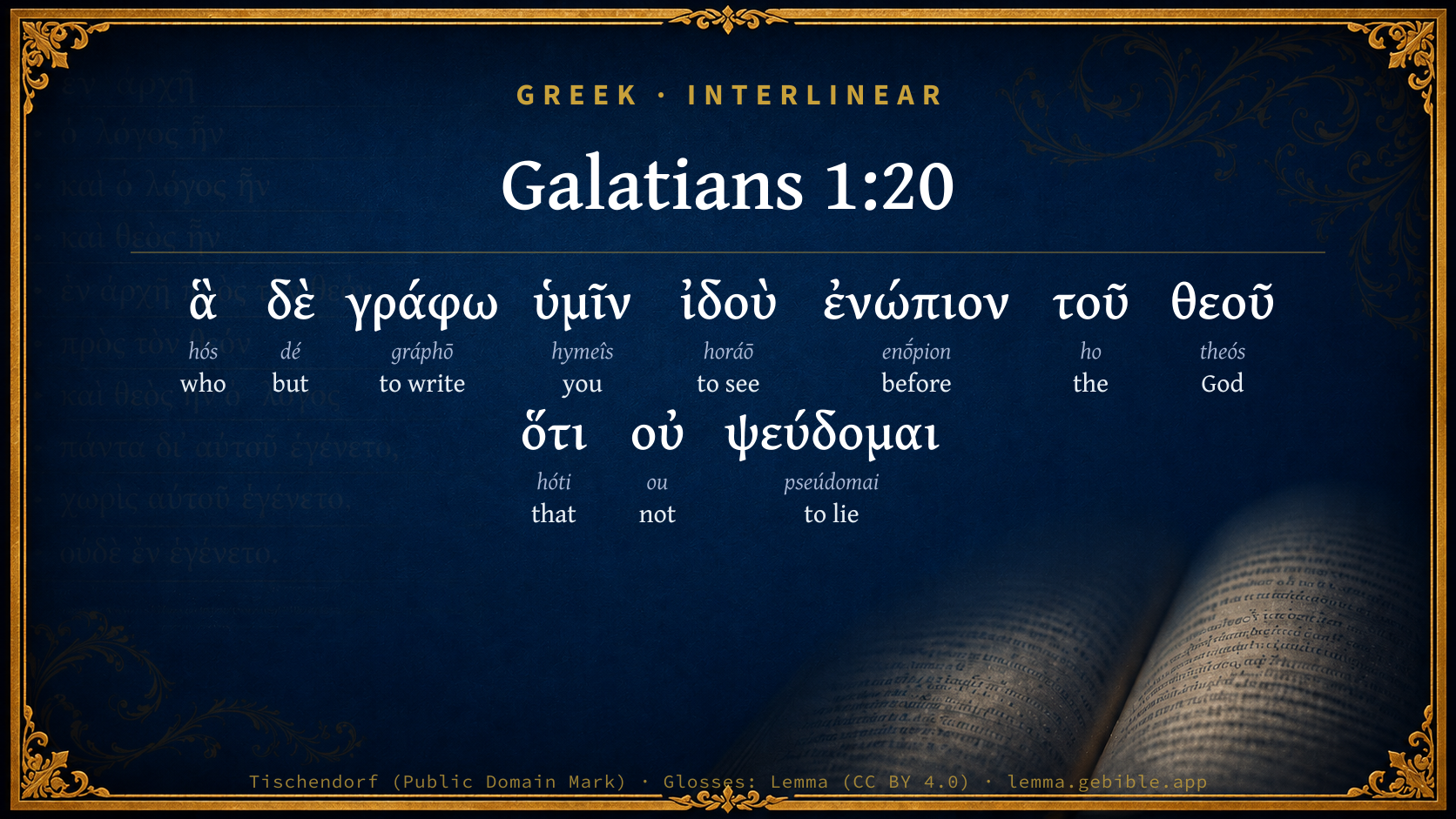
Greek (Tischendorf 8th ed.) Galatians 1:20 appears in the Greek New Testament. The text above is from the Tischendorf 8th edition. Each word links to its Strong’s number and a concise gloss. Click any word for its full Thayer’s Greek Lexicon entry.
Download image
Cite this verse

Galatians 1:20 (World English Bible). Public Domain. Lemma interlinear Bible study tool, https://lemma.gebible.app/v/galatians/1/20.

Show BibTeX & RIS
BibTeX
RIS
English Translation
Now about the things which I write to you, behold, before God, I'm not lying.
World English Bible · Public Domain
Download a study sheet

One document with this verse’s original text, its word-by-word gloss line, the meaning frame, cross-references with their text, attributed commentary, and full source and license credits — printable, and it pastes into notes with its structure intact.

This verse Autodidact and up

Study sheet (.html) Plain text (.txt)

A passage Seminary Student

Up to 50 verses in one chapter. A passage sheet keeps up to 6 commentary sources and 12 cross-references per verse, in the order this page ranks them, and says so on the sheet whenever that leaves anything out. Ask for a single verse and you get the Autodidact verse sheet above.

Everything on this page stays free to read, with no account — the sheet is a download of what is already on screen, not access to it.

Want to remove ads? Support Godless Engineer
Compare translations 3

The same verse in 3 English versions, stacked beneath the original-language interlinear above. Click any original word for its lexicon entry.

Each is an independent rendering of the whole verse — the interlinear is not word-aligned to these translations.

Highlighted words mark where these versions differ — a whole-verse word diff, not a word-by-word alignment.

  • World English Bible Public Domain
    Now about the things which I write to you, behold, before God, I'm not lying.
  • King James Version Public Domain
    Now the things which I write unto you, behold, before God, I lie not.
  • unfoldingWord Literal Text CC BY-SA 4.0
    Now what I write to you, behold, before God, I am not lying.

unfoldingWord Literal Text — © unfoldingWord, licensed CC BY-SA 4.0. Word-aligned USFM3 via Door43 (git.door43.org/unfoldingWord/en_ult).

Versions to compare (up to 4)

3 of 4 selected

Show all 19 translations

Every available English version of this verse, each an independent rendering of the whole verse.

  • World English Bible Public Domain
    Now about the things which I write to you, behold, before God, I'm not lying.
  • Berean Standard Bible Public Domain
    I assure you before God that what I am writing to you is no lie.
  • Majority Standard Bible Public Domain
    I assure you before God that what I am writing to you is no lie.
  • King James Version Public Domain
    Now the things which I write unto you, behold, before God, I lie not.
  • American Standard Version (1901) Public Domain
    Now touching the things which I write unto you, behold, before God, I lie not.
  • Revised Version (1885) Public Domain
    Now touching the things which I write unto you, behold, before God, I lie not.
  • Geneva Bible (1599) Public Domain
    Nowe the things which I write vnto you, beholde, I witnes before God, that I lie not.
  • Douay-Rheims (1899) Public Domain
    Now the things which I write to you, behold, before God, I lie not.
  • Young's Literal Translation Public Domain
    And the things that I write to you, lo, before God -- I lie not;
  • Literal Standard Version CC BY-SA 4.0
    And the things that I write to you, behold, before God—I do not lie;
  • Unlocked Literal Bible CC BY-SA 4.0
    In what I write to you, I assure you before God, that I am not lying.
  • unfoldingWord Literal Text CC BY-SA 4.0
    Now what I write to you, behold, before God, I am not lying.
  • Darby Bible Public Domain
    Now what I write to you, behold, before God, I do not lie.
  • World Messianic Bible Public Domain
    Now about the things which I write to you, behold, before God, I’m not lying.
  • Webster's Bible Public Domain
    Now the things which I write to you, behold, before God, I lie not.
  • Free Bible Version CC BY-SA 4.0
    (Let me assure you before God that I'm not lying about what I'm writing to you!)
  • Bible in Basic English Public Domain
    Now God is witness that the things which I am writing to you are true.
  • Text-Critical English NT CC BY 4.0
    (Now in what I am writing to you, I assure you before God that I am not lying.)
  • Tyndale New Testament (1534) Public Domain
    The thinges which I write beholde God knoweth I lye not.

Literal Standard Version (2020), Covenant Press — licensed CC BY-SA 4.0. Text via the HelloAO Bible API (eBible.org). Unlocked Literal Bible (unfoldingWord) — licensed CC BY-SA 4.0. Text via the HelloAO Bible API (eBible.org). unfoldingWord Literal Text — © unfoldingWord, licensed CC BY-SA 4.0. Word-aligned USFM3 via Door43 (git.door43.org/unfoldingWord/en_ult). Free Bible Version, Dr. Jonathan Gallagher — licensed CC BY-SA 4.0. Text via the HelloAO Bible API (eBible.org).

Word by word

More ways to search: Search by grammar → Find every occurrence → Compare this word →

Practice this passage: Drill this verse → Learn its vocabulary →

About this verse

These counts appear in no published source. They are computed here, from the morphology-tagged text and Lemma’s own curated glosses. What Lemma adds →

11
words
11
distinct lemmas
Pauline Epistles
section

Notable vocabulary

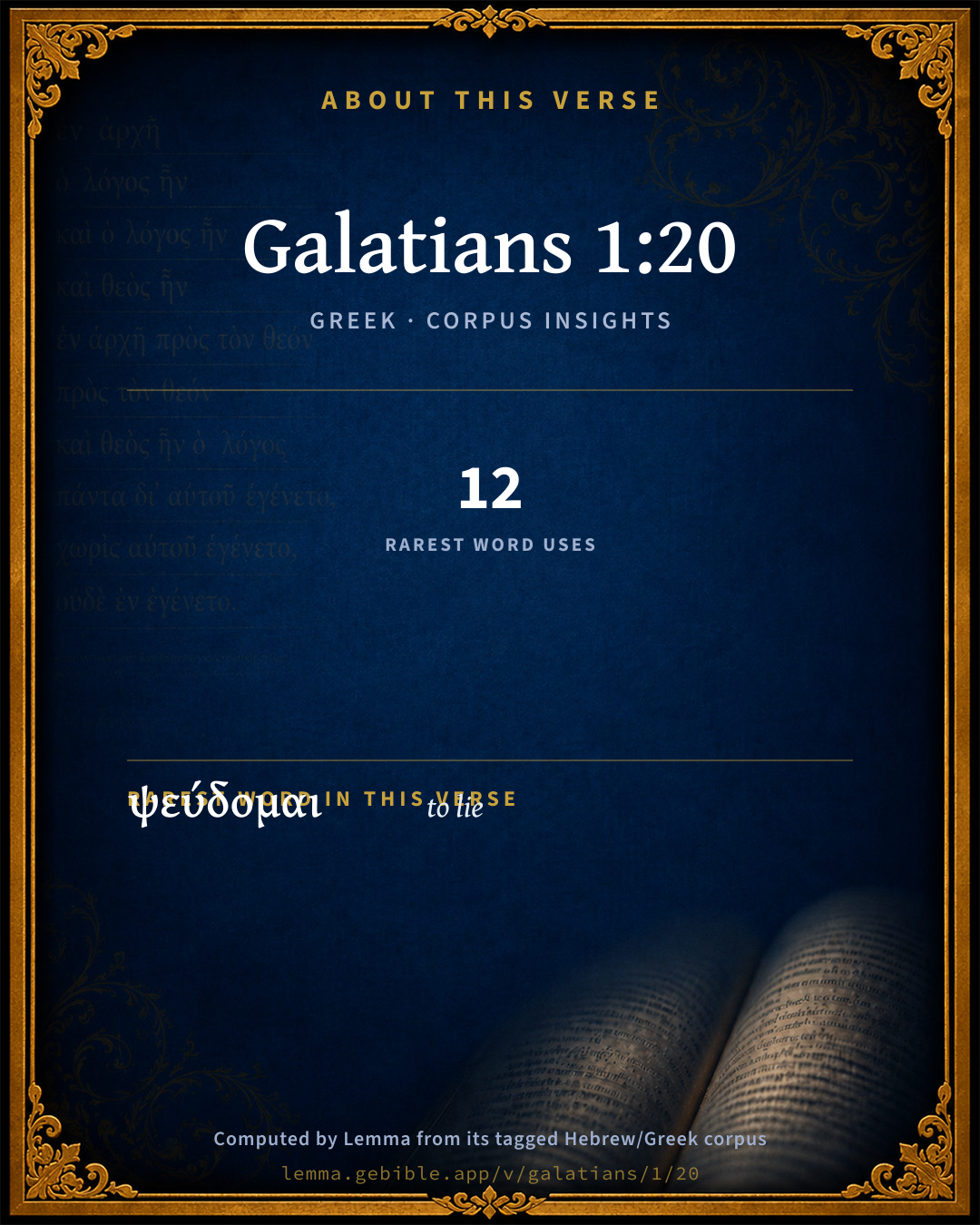
The rarest word here is ψεύδομαι to lie G5574 — appearing just 12 times in the whole Greek New Testament.

Shared distinctive vocabulary

ψεύδομαι to lie G5574 occurs in 12 verses of the Greek New Testament. Also found in:

Cross-references

3

Topical passages linked to Galatians 1:20 in the Treasury of Scripture Knowledge — connected by theme and wording, ordered by reader-vote popularity; previews shown in the World English Bible.

  • Romans 9:1 I tell the truth in Christ. I am not lying, my conscience testifying with me in the Holy Spirit,
  • 2 Corinthians 11:31 The God and Father of the Lord Jesus Christ, he who is blessed forevermore, knows that I don't lie.
  • 2 Corinthians 11:10–11 As the truth of Christ is in me, no one will stop me from this boasting in the regions of Achaia.

Cross-references courtesy of OpenBible.info (CC BY 4.0).

Commentary

Notes on Galatians 1:20 from classic Christian and Jewish commentators (each source and its license shown beneath its notes). The classic Christian expositions comment on the surrounding passage and are grouped to its opening verse, so a note may address several verses; the Jewish commentaries on the Tanakh (Rashi and others) are per-verse, so they appear only where the commentator wrote on this verse.

Lemma curates 59 commentaries, every one of them public domain or Creative Commons licensed, each selected and text-cleaned for this edition rather than reprinted as found. About our sources →

The Biblical Illustrator

Joseph S. Exell

Gal_1:20

I lie not.

Truthfulness; its violation

Untruthfulness is something more than direct and deliberate misstatement, e.g., by the practice of making excuses for faults in conduct which do not fairly admit of them; by exaggeration, which from carelessness or vanity overstates the case; by equivocation, in which the words may be true, but the impression conveyed false; by dissimulation, which by silence or some assumed attitude allows a false impression of our position to go abroad; by the breaking of promises, whether from inability to fulfil a promise rashly made, or from neglect to fulfil one to which we have the power of giving effect; and by falsehood in act, such as is exemplified in schools in copying or prompting. To inspire even a moderate love of this virtue, it is necessary to set the highest value of it before the child; the teacher must therefore be on the alert to check all its violations.

Truthfulness excites trust

Talent is by no means rare in the world; nor is even genius. But can talent be trusted, or even genius? Not unless based on truthfulness. It is this quality more than any other that commands the esteem and respect, and secures the confidence of others. Truthfulness is at the foundation of all personal excellence. (S. Smiles, LL. D.)

The truth-teller--his reward and work

Honour to the truthful man! Hail to the people with whom veracity prevails! Joy to mankind, when this daughter of light wins the victory over falsehood, and thrusts her back to that kingdom of darkness whence she sprang. (De Wette.)

A solemn declaration of the truth

I. Paul asseverates the truth of definite statements.

II. His declaration of truth was comprehensive.

III. His truthfulness commended itself to the judgment of men, and to the approval of God.

1. Men were invited to witness it. Behold.

2. God was the witness of the truth. It had been spoken, and acted in His sight. All things are naked and open unto the eyes of Him with whom we have to do.

Lessons:

1. The best of men are sometimes suspected of wrong-doing, and are liable to misrepresentation.

2. Every Christian man should speak and act as in the presence of God.

3. Very solemn avowals, as oaths, ought to be used only under constraint. (R. Nicholls.)

Perfect truthfulness necessary

Concave mirrors magnify the features nearest to them into undue and monstrous propertions; and in common mirrors that are ill cast, and of uneven surface, the most beautiful face is distorted into deformity. So there are many minds of this description: they distort or magnify, diminish or discolour, almost every gospel truth which they reflect. (Dr. Guthrie.)

Galeazius, a gentleman of great wealth, who suffered martyrdom at St. Angelo in Italy, being much entreated by his friends to recant, replied, Death is much sweeter to me with the testimony of truth than life with its least denial.

Lying scorned

The minister of the seminary at Clermont, France, having been siezed at Autun by the populace, the mayor, who wished to save him, advised him not to take the oath, but to allow him to tell the people that he had taken it. I would myself make known your falsehood to the people replied the clergyman: it is not permitted me to ransom my life by a lie. The God who prohibits my taking this oath will not allow me to make it believed that I have taken it. The mayor was silent, and the minister was martyred. (Foster.)

The Biblical Illustrator, edited by Joseph S. Exell (c. 1880s–1900s) — public domain. Text from a community e-Sword module.

Joseph Benson's Commentary

Gal 1:20-24. Now the things which I write unto you — With respect to all these circumstances of them; I lie not — As I affirm before God, who searcheth the heart, and from whom nothing is hid. Afterward — Departing from Jerusalem; I went into the regions of Syria and Cilicia — To exercise my ministry there, and, if possible, to bring those among whom I was born and brought up, to the knowledge of Christ and his gospel. It appears from Act 9:30, that some of the brethren in Jerusalem, who advised him to depart, kindly accompanied him to Cesarea, a well known sea-port town on the Mediterranean, from whence it seems he intended to go by sea to Tarsus. But, as he here says that he went into the regions of Syria and Cilicia, it is probable, that after embarking at Cesarea, contrary winds forced him into some of the ports of Syria; so that, altering his plan, he went through that country preaching the gospel, and from thence proceeded to Cilicia by land. And was personally unknown to the churches in Judea — Except to that of Jerusalem. In travelling from Damascus to Jerusalem, after his return from Arabia, it seems by this, that he did not preach or make himself known to any of the Christians in the cities of Judea through which he passed. But they had heard only — This wonderful account in general, which would doubtless spread rapidly through all the land; that he which persecuted us in times past — To imprisonment and death, was become a convert to the religion of Jesus; so that he now preacheth the faith which once he destroyed — That is, the great truths of the gospel, which he once laboured with all his might to extirpate from the minds of men, and from the face of the earth; and they glorified God in me — That is, on my account, as they well might, beholding in me so wonderful an instance of the power and grace of God. This the apostle mentions, because it implied that the Christians in Judea believed him to be a sincere convert, and were persuaded that his conversion would be an additional proof of the divine original of the gospel.

Joseph Benson's Commentary on the Old and New Testaments (1811–1818) — public domain. Text from a community e-Sword module.

The Preacher's Complete Homiletical Commentary

Joseph S. Exell (gen. ed.)

CRITICAL AND EXPLANATORY NOTES

Gal_1:24. They glorified God in me.—He does not say, adds Chrysostom, they marvelled at me, they praised me, they were struck with admiration of me, but he attributes all to grace. They glorified God in me. How different, he implies to the Galatians, their spirit from yours.

MAIN HOMILETICS OF THE PARAGRAPH.—Gal_1:20-24

God glorified in His Servant—

I. By the undoubted truthfulness of his statements.—“Now the things which I write unto you, behold, before God, I lie not” (Gal_1:20). The assertions of the apostle flatly contradicted the allegations of his enemies. They insinuated that Paul was but a messenger of the authorities of the Church at Jerusalem, and that all he knew of the gospel had been learned from the twelve. So far from this being the case it is evident that for several years he had been preaching the gospel, and had not seen any of the twelve, except Peter and James, and that only for a fortnight at Jerusalem about three years after his conversion. “In the present case,” remarks Professor Jowett, “it is a matter of life and death to the apostle to prove his independence of the twelve.” Having said all he can to substantiate his point, he concludes by a solemn appeal to God as to his veracity: “Behold, before God, I lie not.” The apostle never makes an appeal like this lightly, but only in support of a vital truth he is specially anxious to enforce (Rom_9:1; 2Co_1:17-18; 2Co_1:23; 1Th_2:5).

“When fiction rises pleasing to the eye,

Men will believe, because they love the lie;

But truth herself, if clouded with a frown,

Must have some solemn proof to pass her down.”

Churchill.

The vigorous and faithful maintenance of the truth brings glory to God.

II. By his evangelistic activity.—“Afterwards I came into the regions of Syria and Cilicia” (Gal_1:21). During this tour very probably the Churches were founded, referred to in Act_15:23; Act_15:41. “A man’s work,” says George Macdonald, “does not fall upon him by chance, but it is given him to do; and everything well done belongs to God’s kingdom, and everything ill done to the kingdom of darkness.” God is the sublime end of all human activity, and our powers can never be more nobly employed than in expounding His will, unfolding His gracious character, advancing the interests of His kingdom, and striving to promote His glory among the children of men. Man is never so great, so luminous, so grand as when he is doing work for God with the light and help of God; and all such work is a revelation of the character and purposes of God open to the eyes of all who will see.

III. By the reputation of his changed life.—“And was unknown by face unto the Churches: … they had heard only, That he which persecuted us in times past now preached the faith which once he destroyed” (Gal_1:22-23). The conversion of Saul of Tarsus was one of the most striking events in the early history of the Church. It was a marvel to all who had known his previous life. It was an unanswerable testimony to the power of the gospel, and an argument that has been used in all ages to illustrate the possibility of the salvation of the worst of sinners. It is said the Duke of Burgundy was born terrible. He would indulge in such paroxysms of rage that those who were standing by would tremble for his life. He was hard-hearted, passionate, incapable of bearing the least opposition to his wishes, fond of gambling, violent hunting, the gratifications of the table, abandoned to his pleasures, barbarous, and born to cruelty. With this was united a genius of the most extraordinary kind; quickness of humour, depth and justice of thought, versatility and acuteness of mind. The prodigy was, that in a short space of time the grace of God made him a new man. He became a prince, affable, gentle, moderate, patient, modest, humble, austere only to himself, attentive to his duties, and sensible of their extent. If we could lay a hand on the fly-wheel of the Scotch express, running fifty or sixty miles an hour, and stop it, we should perform an astounding miracle. But this is what God does in His miracles of conversion. He laid His mighty hand on the fly-wheel of Paul’s life, and not only stopped its mad career, but turned it right round in the opposite direction. The persecutor becomes a preacher.

IV. By the recognition of His divine call.—“And they glorified God in me” (Gal_1:24). The attempt to disparage the authority of Paul was the work of a few malcontents, who sought to ruin his influence in order to extend their own. The Churches of Jerusalem and Judea, though many of them had not seen the apostle, acknowledged and praised God for the divine work done in him and by him. A few false teachers may work much mischief, but they cannot overturn the work of God, nor prevent its full recognition. The faithful servant may safely leave his reputation in the hands of God. It lifts humanity, especially Christianised humanity, into special dignity, when it is discovered that God is glorified in man.

Lessons.—

1. The gospel elevates man by transforming him.

2. The conscientious worker has God on his side.

3. God is glorified by obedient toil.

GERM NOTES ON THE VERSES

Gal_1:20. Self-conscious Truth.—

1. The choicest servants of Christ may be looked upon as liars and unworthy to be trusted, even by those to whom they are sent, and yet they must not give over to preach as knowing that the word spoken by them doth still get credit from some, and will beget trust to itself from others, and for the rest it will seal up their condemnation and make them inexcusable.

2. It is not unlawful for Christians to take an oath, providing it be with these conditions:

(1) That the thing we swear be truth.

(2) That there be weighty reasons for taking an oath.

(3) That we swear only by the name of God, and not by the creatures, seeing none but God can bear witness to the secrets of the heart.—Fergusson.

Gal_1:21-24. The Self-evidencing Proof of a divinely commissioned Messenger.—

1. Seen in disinterested labours and travels (Gal_1:21-22).

2. Seen in a remarkable change of character and conduct (Gal_1:23).

3. Seen in that the glory of his work is ascribed to God (Gal_1:24).

Practical Proofs of Apostleship.

I. Paul went from Jerusalem into Syria and Cilicia.—

1. Because he was ordained specially to be the apostle of the Gentiles.

2. Because Cilicia was his own country, and his love to his country was great. If any apostle above the rest be the pastor and universal bishop of the Church over the whole world, it is Paul and not Peter.

II. Paul was known to the Christian Jews only by hearsay, because it is the office of an apostle not to build on the foundation of another or to succeed any man in his labour, but to plant and found the Church of the New Testament.

III. Seeing the intent of the devil and wicked men is to destroy the faith, we must have a special care of our faith.—

1. We must look that our faith be a true faith.

2. We must keep and lock up our faith in some safe and sure place—in the storehouse or treasury of a good conscience.

3. Our care must be to increase in faith that our hearts may be rooted and grounded in the love of God.

IV. Our duty is to sanctify and glorify the name of God in every work of His.—Neglect in glorifying and praising God is a great sin.—Perkins.

Gal_1:24. God glorified in Good Men.—We are taught to honour God in man and man in God. We are taught to avoid, on the one hand, all creature idolatry, and, on the other, that cynical severity, or ungrateful indifference to the Author of all good in man, which undervalues or neglects the excellencies which ought to be held up to admiration that they may be imitated by ourselves and others. Each of these extremes robs God of His just revenue of grateful praise. In what does creature idolatry consist but in honouring and trusting in the natural and acquired excellencies of creatures to the exclusion of God? But is there then no wisdom, no might, no excellence, in man? As it were absurd to deny this, it would be affectation to pretend to overlook it. Admire and deny not this wisdom, acknowledge this efficiency, and affect not to lower its estimate; only glorify God who worketh all in all. If He has chosen any of them to be more eminently His instruments for the furtherance of His purposes of mercy to mankind, He does it by virtue of His sovereignty. If he continues their useful lives, whilst you have their light rejoice in the light and glorify Him from whom it comes as its original and source; and when He chooses to quench these stars of His right hand in the darkness of death, still glorify Him. As to us, this is to remind us of our dependence on Him, who appointed their orbit and invested them with their different degrees of glory; and as to them, though their lustre fades from these visible skies, it is that it may be rekindled in superior glory in the kingdom of their Father.—R. Watson.

The Preacher's Complete Homiletical Commentary (gen. ed. Joseph S. Exell; Funk & Wagnalls, c. 1892) — public domain (pre-1929). A full-Bible homiletical/sermon-outline anthology covering 65 of 66 books (2 John is absent from the source module). Text from a community e-Sword module.

Tyndale Open Study Notes

Tyndale Open Resources

1:20 I declare before God: Paul here takes an oath to emphasize the truthfulness of his account of his trip to Jerusalem.

Tyndale Open Study Notes — © Tyndale Open Resources, licensed CC BY-SA 4.0. Text via the HelloAO Bible API.

Bengel's Gnomon

Johann Albrecht Bengel

Gal 1:20. Ἰδοὺ, behold) viz. ἐστὶ, it is; for ὅτι means that.[6]

[6] It is the case before God, that, etc.—ED.

Bengel's Gnomon of the New Testament — English translation (T&T Clark, Edinburgh, 1860) — public domain. Text from a community e-Sword module.

Meyer's Critical & Exegetical Commentary

Heinrich August Wilhelm Meyer

Gal_1:20. Not a parenthesis, but, at the conclusion of what Paul has just related of that first sojourn of his at Jerusalem after his conversion (namely, that he had travelled thither to make the acquaintance of Cephas, had remained with him fifteen days, and had seen none of the other apostles besides, only James the brother of the Lord), an affirmation by oath that in this he had spoken the pure truth. The importance of the facts he had just related for his objectto prove his apostolic independenceinduced him to make this sacred assurance. For if Paul had ever been a disciple of the apostles, he must have become so then, when he was with the apostles at Jerusalem for the first time after his conversion; but not only had he been there with another object in view, and for so few days, but he had also met with James only, besides Peter. The reference to all that had been said from Gal_1:12 (Calvin, Koppe, Winer, Matthies), or at least to Gal_1:15-19 (Hofmann), is precluded by the fact that ἔπειτα in Gal_1:18 begins a fresh section of the report (comp. Gal_1:21; Gal_2:1), beyond which there is no reason to go back.

The sentence is so constructed that ἃ δὲ γράφω ὑμῖν stands emphatically by itself as an anacoluthon; and before ὅτι, that, we have again to supply γράφω, But what I write to youbehold in the sight of God I write, that I lie not; that is, in respect to what I write to you, I write, I assure you before the face of God (לִפְנֵי יְהֹוָה, so that I have God present as witness), that I lie not. Comp. Buttmann, neut. Gr. p. 338. Schott takes ὅτι as since, coram Deo scribo, siquidem non mentior, whereby ἃ δὲ γρ. ὑμ. does not appear as an anacoluthon. But this siquidem non mentior would be very flat; whereas the anacoluthon of the prefixed relative sentence is precisely in keeping with the fervency of the language (comp. Mat_10:14; Luk_21:6, and the note thereon). The completely parallel protestation also, ὁ Θεὸς … οἶδεν … ὅτι οὐ ψεύδομαι (2Co_11:31; comp. Rom_1:9; 2Co_1:23), is quite unfavourable to the explanation of ὅτι as siquidem. To supply with Bengel, Paulus, and Rückert (comp. Jerome), an ἐστί after Θεοῦ (ὅτι, that), does not make the construction easier (Rückert); on the contrary, it is arbitrary, and yields an unprecedented mode of expression.

Meyer — Critical and Exegetical Commentary on the New Testament — English translation by Peter Christie, edited by Frederick Crombie (T&T Clark, 1880) — public domain. Text from a community e-Sword module.

Expositor's Greek Testament

ed. W. Robertson Nicoll

Gal 1:20 . The solemnity of this appeal to God in attestation of His truth marks at once the importance which Paul attached to his independence of human teachers, and the persistency of the misrepresentation to which he had been exposed. ἰδοὺ . This imperative is always used interjectionally in Scriptures: the subsequent ὅτι depends on ἐνώπιον τ . Θεοῦ , which has the force of an attestation.

The Expositor's Greek Testament, edited by W. Robertson Nicoll (1897–1910) — public domain. Text from a community e-Sword module.

Geneva Bible (1599)

Geneva Bible translators

This is a kind of an oath.

Geneva Bible (1599) marginal notes — public domain. Text via Bolls.life.

Jamieson, Fausset & Brown

Robert Jamieson, A. R. Fausset & David Brown

Solemn asseveration that his statement is true that his visit was but for fifteen days and that he saw no apostle save Peter and James. Probably it had been reported by Judaizers that he had received a long course of instruction from the apostles in Jerusalem from the first; hence his earnestness in asserting the contrary facts.

Jamieson, Fausset & Brown — Commentary Critical and Explanatory on the Whole Bible (1871) — public domain (CC PDM 1.0). Text via the HelloAO Bible API.

Adam Clarke's Commentary

Verse 20. Before God I lie not.] This he speaks in reference to having seen only Peter and James at Jerusalem; and consequently to prove that he had not learned the Gospel from the assembly of the apostles at Jerusalem, nor consequently received his commission from them.

Adam Clarke's Commentary on the Bible (1810–1826) — public domain. Text from a community e-Sword/MySword module.

John Calvin's Commentaries

20. Now the things which I write to you. This affirmation extends to the whole narrative. The vast earnestness of Paul on this subject is evinced by his resorting to an oath, which cannot lawfully be employed but on great and weighty occasions. Nor is it wonderful that he insists with so much earnestness on this point; for we have already seen to what expedients the impostors had recourse in order to take from him the name and credit of an apostle. Now the modes of swearing used by good men deserve our attention; for we learn from them that an oath must be viewed simply as an appeal to the judgment-seat of God for the integrity and truth of our words and actions; and such a transaction ought to be guided by religion and the fear of God.

John Calvin's Commentaries (1540-1563) — public domain. Text from the Calvin Translation Society English edition (1840s-50s) via the Christian Classics Ethereal Library (ccel.org). Calvin's coverage is partial (roughly two-thirds of the Bible); uncommented books and verses are honest gaps, never fabricated. The 19th-century editor's footnotes and remarks are omitted so the notes are faithfully Calvin's own voice.

Ellicott's Commentary for English Readers

(20) A solemn asseveration of the truth of these statements as to the extent of the Apostle’s relation with the elder disciples.

A Bible Commentary for English Readers, edited by Charles John Ellicott (1878–1897) — public domain. Text from a community e-Sword module.

The Cambridge Bible for Schools and Colleges

gen. ed. J. J. S. Perowne

20. Considering that the vital question of St Paul’s credentials was at stake, we need not wonder at this solemn asseveration and appeal to the judgment of God.

The Cambridge Bible for Schools and Colleges (gen. ed. J. J. S. Perowne; Cambridge University Press, 1878–1918) — public domain. Text from a community e-Sword module.

John Gill's Exposition

Now the things which I write unto you,.... Concerning his education, his religion, his principles and practices before conversion; concerning his call by the grace of God, the revelation of Christ in him, and his preaching of him among the Heathen; concerning his travels to several places for this purpose, and especially concerning his not receiving the Gospel from men, not from any of the apostles; and how that upon his conversion he did not go up to Jerusalem to any of them, to be taught and sent forth by them; and that it was not till three years after that he wept thither to see Peter, with whom he stayed but fifteen days, and saw no other apostle, but James the Lord's brother. Now this being a matter of moment, and what he had been charged with by the false teachers, that the Gospel he preached he had received from men, in order to disqualify him and bring him into contempt as an apostle, and which they had insinuated to the Galatians; he therefore not only wrote these things, but for the confirmation of them solemnly appeals to God the searcher of hearts for the truth of them;

behold, before God I lie not; which is not only a strong asseveration, but a formal oath; it is swearing by the God of truth, calling him to be witness of the things that he had written; whence it is manifest that an oath upon proper occasions, where there is a necessity for it, and a good end to be answered by it, may be lawfully made.

John Gill's Exposition of the Whole Bible (1746–1763) — public domain (CC PDM 1.0). Text via the HelloAO Bible API.

Trapp's Complete Commentary

John Trapp

20 Now the things which I write unto you, behold, before God, I lie not.

Ver. 20. Behold, before God, I lie not] This he solemnly sweareth for their satisfaction. An oath may be lawfully taken to help the truth in necessity, and not otherwise. Hence the Hebrew word Nishbang is a passive, and signifieth "to be sworn," rather than to swear.

John Trapp, A Commentary or Exposition upon All the Books of the Old and New Testament (1647–1656) — public domain. Text from a community e-Sword module.

Albert Barnes' Notes on the Bible

Behold, before God I lie not - This is an oath, or a solemn appeal to God; see the note at Rom 9:1. The design of this oath here is to prevent all suspicion of falsehood, It may seem to be remarkable that Paul should make this solemn appeal to God in this argument, and in the narrative of a plain fact, when his statement could hardly be called in question by anyone. But we may remark:

(1) That the oath here refers not only to the fact that he was with Peter and James only fifteen days, but to the entire group of facts to which he had referred in this chapter. “The things which I wrote unto you.” It included, therefore, the narrative about his conversion, and the direct revelation which he had from the Lord Jesus.

(2) There were no radios which he could appeal to in this case, and he could, therefore, only appeal to God. It was probably not practicable for him to appeal to Peter or James, since neither of them were in Galatia, and a considerable part of the transactions here referred to occurred where there were no witnesses. It pertained to the direct revelation of truth from the Lord Jesus. The only way, therefore, was for Paul to appeal directly to God for the truth of what he said.

(3) The importance of the truth here affirmed was such as to justify this solemn appeal to God. It was an extraordinary and miraculous revelation of the truth by Jesus Christ himself. He received information of the truth of Christianity from no human being. He had consulted no one in regard to its nature. That fact was so extraordinary, and it was so remarkable that the system thus communicated to him should harmonize so entirely with that taught by the other apostles with whom he had had no contact, that it was not improper to appeal to God in this solemn manner. It was, therefore, no trifling matter in which Paul appealed to God; and a solemn appeal of the same nature and in the same circumstances can never be improper.

Albert Barnes' Notes on the Bible (1834–1885) — public domain. Text from a community e-Sword/MySword module.

Matthew Poole's English Annotations

Whether those words, before God, make this sentence an oath, is not material to determine; they are either an oath, or a very serious asseveration. If the apostle designed to call God for a witness, to the correspondence of his words with the truth of the things he had spoken, they make up an assertory oath, which was lawful enough (though privately taken) in so serious a matter as this, where the apostle is vindicating his apostleship from some acts, of which probably he had no witnesses at hand to produce; but they may be understood (by the supplement of, I speak, or, I say this) only as a form of serious assertion, to confirm the truth of what he asserted. He minds them, that he was sensible of God’s presence in all places, and particular taking notice of the things spoken; as being spoken before him, who knew that what he spake was truth.

Matthew Poole's English Annotations on the Holy Bible (1683–1685) — public domain. Text from a community e-Sword/MySword module.

Whedon's Commentary on the Bible

Daniel D. Whedon

20. Before God—This earnest reminder that we speak as in God’s presence has the solemnity of an oath, but not its profanity.

Daniel D. Whedon (gen. ed.), Commentary on the Old and New Testaments (1874–1909) — public domain. Text from a community e-Sword module.

The Pulpit Commentary

Now the things which I write unto you (a defw uJmin); now as to the things which I am writing to you. The looseness in the Greek of the connection of this clause with the words which follow is similar to what we find in the ease of the clause, tauta a qewreite, in Luk_21:6. The particular things meant are those which are affirmed in vers. 15-19 and to the end of the chapter; points which the Galatians would hardly have become apprised of except upon the apostle"s own testimony. What preceded in vers. 13, 14 they had become acquainted with before, on the testimony of others ("Ye have heard," ver. 13). Behold, before God, I lie not (ijdou ejnwpion tou Qeou, oti ouj yeudomai); behold, before God, verily I lie not. The use here of oti, which in "verily" is paraphrased rather than translated, in this as well as in several other passages of solemn asseveration (2Co_1:18 2Co_11:10; possibly, Rom_9:2) savours strongly of Hebraism, being very probably identical with its use for yKi, the Hebrew "that," in the Septuagint, e.g. in Isa_49:18, Zw ejgw legei Kuriov oti pantev aujtousmon ejndush. So in St. Paul"s inexact citation in Rom_14:11. On this use of the Hebrew conjunction, see Gesenius, "Thes.," p. 678, B, 1, n, who observes that in such cases there is an evident ellipsis of some such verb as "I protest," "I swear." The apostle was frequently led by the gainsaying of adversaries vitally affecting his official or personal character, to have recourse to forms of the most solemn asseveration. In addition to the passages cited above, 2Co_1:23 2Co_11:31; Rom_1:9; Php_1:8; 1Th_2:5; 1Ti_2:7. If, as Alford in effect observes, a report had been spread among the Galatians that, after his conversion, he had spent years at Jerusalem, receiving instruction in the faith at the hands of the apostles, the facts which he has now stated would have seemed to his readers so astoundingly in contradiction to the impression which they had received, as to require a strong confirmatory asseveration." In the present case," as Professor Jowett remarks, "it is a matter of life and death to the apostle to prove his independence of the twelve." And his independence of them is strongly evinced by the fact that, for several years of his Christian life, during all which he was preaching the same gospel as he now preached, he had not even seen any of them except Peter and James the Lord"s brother (if James could be reckoned as an apostle) and these only during a short visit of a fortnight at Jerusalem some three years after his conversion.

The Pulpit Commentary (1880–1919), ed. H.D.M. Spence-Jones & Joseph S. Exell — public domain. Text from a community e-Sword module.

Luther on Galatians

Martin Luther

VERSE 20. Now the things which I write unto you, behold, before God, I lie not.

Was it necessary for Paul to go under oath? Yes. Paul is reporting personal history. How else would the churches believe him? The false apostles might say, "Who knows whether Paul is telling the truth?" Paul, the elect vessel of God, was held in so little esteem by his own Galatians to whom he had preached Christ that it was necessary for him to swear an oath that he spoke the truth. If this happened to Paul, what business have we to complain when people doubt our words, or hold us in little regard, we who cannot begin to compare ourselves with the Apostle?

Martin Luther — Commentary on the Epistle to the Galatians (1535), English translation by Theodore Graebner (Zondervan, 1939) — public domain (U.S. copyright not renewed). Text from a community e-Sword module.

Burkitt's Expository Notes on the New Testament

William Burkitt

Observe, here, that St. Paul, having to do with the false apostles and the seduced Galatians, whom, he had just cause to suspect, would not (as they ought) give much credit to his word; he asserts the truth of what he affirmed, upon oath, appealing to the all-knowing and heart-searching God, as witness and judge of the truth of what he said: Behold before God, I lie not.

Where, note, 1. That it is no new thing for the faithfulest and ablest ministers and servants of Christ to be looked upon as liars, unworthy to be trusted, and to have the truth of what they deliver, though in God’s name, questioned and suspected. Our apostle’s purging of himself here from lying, doth import, that some did suspect him for a liar. And if an inspired apostle be, what private minister may not be, suspected!

Note, 2. The mean which St. Paul makes use of, for purging himself from the imputation of falsehood; it was, by taking an oath in a solemn manner.

Learn thence, that though rash swearing, false swearing, and upon every light occasion to take or multiply oaths, be a very great sin; yet to swear, and bear witness to the truth, and to take an oath upon due consideration, and for weighty reasons, and to swear by the name of God, is certainly a lawful, and sometimes a very necessary and important duty.

William Burkitt's Expository Notes on the New Testament (1700–1703) — public domain. Text from a community e-Sword module.

McGarvey & Pendleton's Commentaries

J. W. McGarvey

Now touching the things which I write unto you, behold, before God, I lie not.

J. W. McGarvey (with Philip Y. Pendleton), Commentaries on the New Testament (The Fourfold Gospel, 1914; Acts; and the epistles) — public domain. Text from a community e-Sword/MySword module.

The People's New Testament

B. W. Johnson

20. Behold, before God, I lie not. This statement, an important one in view of the declarations of the Judaizers, Paul makes very solemnly.

B. W. Johnson's The People's New Testament with Notes (1889–1891) — public domain. Electronic text from the Christian Classics Ethereal Library (CCEL) ThML edition.

Cambridge Greek Testament for Schools and Colleges

20. ἃ δὲ γράφω ὑμῖν κ.τ.λ. “It is a matter of life and death to the Apostle to prove his independence of the twelve” (Jowett). St Paul’s asseveration refers primarily to what he has already stated about his true relation to them, but naturally its force is carried on to his following words also.

ἐνώπιον τοῦ θεοῦ. 1Ti 6:13; 2Ti 2:14; 2Ti 4:1. Cf. Rom 1:9.

ὅτι. “This has no regular construction. It depends upon the idea, ‘I declare,’ ‘I asseverate,’ contained in ἰδοὺ ἐνώπιον τοῦ θεοῦ” (Jowett).

οὐ ψεύδομαι. Rom 9:1; 2Co 11:31; 1Ti 2:7.

Cambridge Greek Testament for Schools and Colleges (Cambridge University Press, 1896; 21 vols, various authors incl. Carr, Maclear, Plummer, Farrar, Lumby, Moule, M. R. James, Simcox) — public domain. Text from a community e-Sword module.

Alford’s Greek Testament

Henry Alford

20.] This asseveration (cf. 2Co 11:31) applies most naturally to the important fact just asserted—his short visit to Jerusalem, and his having seen only Peter and James, rather than to the whole subject of the chapter. If a report had been spread in Galatia that after his conversion he spent years at Jerusalem and received regular institution in Christianity at the hands of the Apostles, this last fact would naturally cause amazement, and need a strong confirmatory asseveration.

As regards the construction, ἃ … ὑμῖν stands alone, (with regard to) the things which I am writing to you,—and the word necessary to be supplied to carry on the sense from ἰδοὺ ἐνώπ. τ. θεοῦ to ὅτι, lies under the ἰδού, which here answers to such words as διαμαρτύρομαι, 1Ti 5:21; 2Ti 2:14; 2Ti 4:1,—παραγγέλλω, 1Ti 6:13. Meyer would supply γράφω, which seems harsh: others take ὅτι as ‘for,’ which is worse still (cf. 2Co 11:21, ὁ θεὸς οἶδεν … ὅτι οὐ ψεύδομαι),—and this too, understanding ἐστίν after θεοῦ (Bengel).

Henry Alford, The Greek Testament (1849–1861) — public domain. Text from a community e-Sword module.

International Critical Commentary

20. ἃ δὲ γράφω ὑμῖν, ἰδοὺ ἐνώπιον τοῦ θεοῦ ὅτι οὐ ψεύδομαι. “Now as respects the things which I write to you, behold, before God, I am not lying.” For similar affirmations of Paul that in the presence of God he is speaking truly, see 1Th 2:5, 2Co 1:23, 2Co 11:31. Its use here shows clearly that the facts just stated are given not simply for their historical value, but as evidence of what he has before asserted, his independence of the Twelve. ἃ γράφω doubtless refers to all that precedes, from v. 13 (or 15) on. Even so one can not but wonder why Paul should use such very strong language unless he had been charged with misstating the facts about his visits to the other apostles.

(d) Evidence of his independent apostleship drawn from the period of his stay in Syria and Cilicia (1:21-24)

The apostle now turns to a period, which 2:1 compared with 1:18 shows to have been eleven or even fourteen years, during which he was out of Judea and not in touch with the other apostles, yet was carrying on his work as a preacher of the gospel.

21Then I went into the regions of Syria and Cilicia, 22and I was unknown by face to the churches of Judea that are in Christ; 23only they heard (kept hearing), Our former persecutor is now preaching the faith which formerly he ravaged; and they glorified God in me.

International Critical Commentary — older volumes (1896–1929), various authors — public domain. Text from a community e-Sword module.

Vincent's Word Studies in the New Testament

Marvin R. Vincent

I lie not. Comp. Rom 9:1; 2Co 11:31; 1Ti 2:7.

Marvin R. Vincent, Word Studies in the New Testament (1887–1900) — public domain. Text from a community e-Sword/MySword module.

Lesson kit

Teaching starters — assembled from the data on this page, not authored interpretation. Every prompt links to the verse data it draws on. Edit before teaching.

Galatians, in the Pauline Epistles, opens this verse with 11 words (11 distinct Greek lemmas). Its most distinctive word is pseúdomai (“to lie”). A historical commentator’s framing appears above. Read the whole chapter for the surrounding context.

Discussion questions

  1. The word pseúdomai carries the sense “to lie.” How does it shape the verse?
  2. How does Matthew 5:11, which shares the word «to lie», read alongside this verse?
  3. The translations on this page render this verse differently — a whole-verse word diff, not a word-by-word alignment. What might account for the different wordings?
  4. Compare how The Biblical Illustrator and Joseph Benson's Commentary read this verse. Where do they agree or differ?

Things to notice

Reading settings

Reading text

Shown beneath each verse's original-language words.

Old Testament
Old Testament edition

Read the OT as the Masoretic Hebrew (MT) or the Greek Septuagint (LXX).

English shown for the Greek Septuagint (in the Hebrew ↔ Greek comparison).

Comparing translations? Open the Compare panel on any verse page to stack up to four side by side.