2 Corinthians 13:4

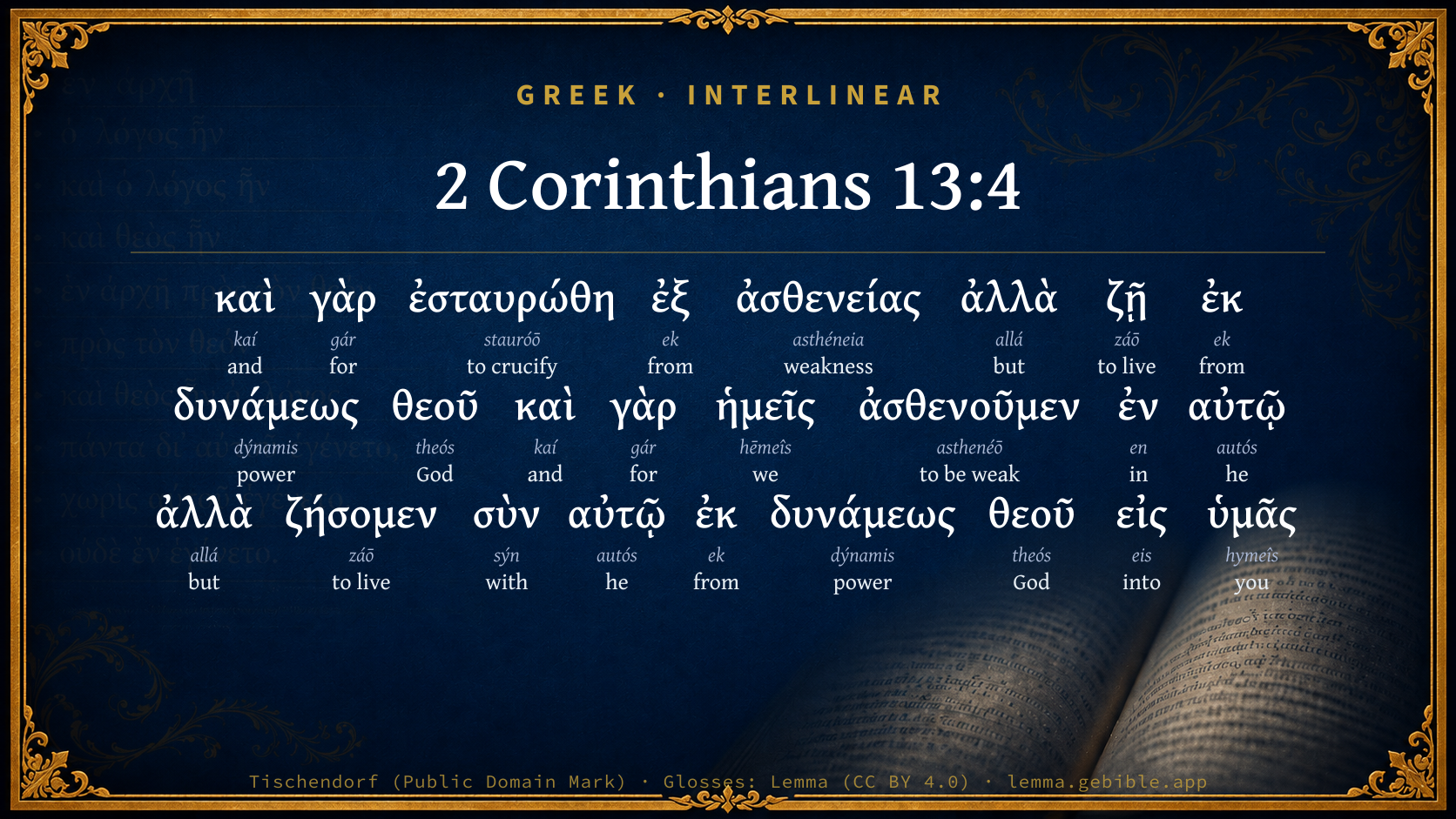
Greek (Tischendorf 8th ed.) 2 Corinthians 13:4 appears in the Greek New Testament. The text above is from the Tischendorf 8th edition. Each word links to its Strong’s number and a concise gloss. Click any word for its full Thayer’s Greek Lexicon entry.
Download image
Cite this verse

2 Corinthians 13:4 (World English Bible). Public Domain. Lemma interlinear Bible study tool, https://lemma.gebible.app/v/2-corinthians/13/4.

Show BibTeX & RIS
BibTeX
RIS
English Translation
For he was crucified through weakness, yet he lives through the power of God. For we also are weak in him, but we will live with him through the power of God toward you.
World English Bible · Public Domain
Download a study sheet

One document with this verse’s original text, its word-by-word gloss line, the meaning frame, cross-references with their text, attributed commentary, and full source and license credits — printable, and it pastes into notes with its structure intact.

This verse Autodidact and up

Study sheet (.html) Plain text (.txt)

A passage Seminary Student

Up to 50 verses in one chapter. A passage sheet keeps up to 6 commentary sources and 12 cross-references per verse, in the order this page ranks them, and says so on the sheet whenever that leaves anything out. Ask for a single verse and you get the Autodidact verse sheet above.

Everything on this page stays free to read, with no account — the sheet is a download of what is already on screen, not access to it.

Want to remove ads? Support Godless Engineer
Compare translations 3

The same verse in 3 English versions, stacked beneath the original-language interlinear above. Click any original word for its lexicon entry.

Each is an independent rendering of the whole verse — the interlinear is not word-aligned to these translations.

Highlighted words mark where these versions differ — a whole-verse word diff, not a word-by-word alignment.

  • World English Bible Public Domain
    For he was crucified through weakness, yet he lives through the power of God. For we also are weak in him, but we will live with him through the power of God toward you.
  • King James Version Public Domain
    For though he was crucified through weakness, yet he liveth by the power of God. For we also are weak in him, but we shall live with him by the power of God toward you.
  • unfoldingWord Literal Text CC BY-SA 4.0
    For he was also crucified as a result of weakness, but he lives as a result of God’s power. For we also are weak in him, but we will live with him as a result of God’s power toward you.

unfoldingWord Literal Text — © unfoldingWord, licensed CC BY-SA 4.0. Word-aligned USFM3 via Door43 (git.door43.org/unfoldingWord/en_ult).

Versions to compare (up to 4)

3 of 4 selected

Show all 19 translations

Every available English version of this verse, each an independent rendering of the whole verse.

  • World English Bible Public Domain
    For he was crucified through weakness, yet he lives through the power of God. For we also are weak in him, but we will live with him through the power of God toward you.
  • Berean Standard Bible Public Domain
    For He was indeed crucified in weakness, yet He lives by God’s power. And though we are weak in Him, yet by God’s power we will live with Him to serve you.
  • Majority Standard Bible Public Domain
    For although He was indeed crucified in weakness, yet He lives by God’s power. For we are also weak in Him, yet by God’s power we will live with Him concerning you.
  • King James Version Public Domain
    For though he was crucified through weakness, yet he liveth by the power of God. For we also are weak in him, but we shall live with him by the power of God toward you.
  • American Standard Version (1901) Public Domain
    for he was crucified through weakness, yet he liveth through the power of God. For we also are weak in him, but we shall live with him through the power of God toward you.
  • Revised Version (1885) Public Domain
    for he was crucified through weakness, yet he liveth through the power of God. For we also are weak in him, but we shall live with him through the power of God toward you.
  • Geneva Bible (1599) Public Domain
    For though hee was crucified concerning his infirmitie, yet liueth hee through the power of God. And wee no doubt are weake in him, but we shall liue with him, through the power of God towarde you.
  • Douay-Rheims (1899) Public Domain
    For although he was crucified through weakness, yet he liveth by the power of God. For we also are weak in him: but we shall live with him by the power of God towards you.
  • Young's Literal Translation Public Domain
    for even if he was crucified from infirmity, yet he doth live from the power of God; for we also are weak in him, but we shall live with him from the power of God toward you.
  • Literal Standard Version CC BY-SA 4.0
    for even if He was crucified from weakness, yet He lives from the power of God; for we also are weak in Him, but we will live with Him from the power of God toward you.
  • Unlocked Literal Bible CC BY-SA 4.0
    For he was crucified in weakness, but he is alive by God's power. For we also are weak in him, but we will live with him by the power of God among you.
  • unfoldingWord Literal Text CC BY-SA 4.0
    For he was also crucified as a result of weakness, but he lives as a result of God’s power. For we also are weak in him, but we will live with him as a result of God’s power toward you.
  • Darby Bible Public Domain
    for if indeed he has been crucified in weakness, yet he lives by God's power; for indeed *we* are weak in him, but we shall live with him by God's power towards you,)
  • World Messianic Bible Public Domain
    For he was crucified through weakness, yet he lives through the power of God. For we also are weak in him, but we will live with him through the power of God toward you.
  • Webster's Bible Public Domain
    For though he was crucified through weakness, yet he liveth by the power of God. For we also are weak in him, but we shall live with him by the power of God towards you.
  • Free Bible Version CC BY-SA 4.0
    Even though he was crucified in weakness, now he lives through the power of God. We too are weak in him, but you will see that we live with him through the power of God.
  • Bible in Basic English Public Domain
    For he was feeble in that he was put to death on the cross, but he is living by the power of God. And we are feeble in him, but we will be living with him through the power of God in relation to you.
  • Text-Critical English NT CC BY 4.0
    For though he was crucified in weakness, he lives by the power of God. Now we also are weak in him, but in dealing with you we will live with him by the power of God.
  • Tyndale New Testament (1534) Public Domain
    And verely though it came of weaknes that he was crucified yet liveth he thorow the power of God. And we no dout are weake in him: but we shall live with him by the myght of God amonge you.

Literal Standard Version (2020), Covenant Press — licensed CC BY-SA 4.0. Text via the HelloAO Bible API (eBible.org). Unlocked Literal Bible (unfoldingWord) — licensed CC BY-SA 4.0. Text via the HelloAO Bible API (eBible.org). unfoldingWord Literal Text — © unfoldingWord, licensed CC BY-SA 4.0. Word-aligned USFM3 via Door43 (git.door43.org/unfoldingWord/en_ult). Free Bible Version, Dr. Jonathan Gallagher — licensed CC BY-SA 4.0. Text via the HelloAO Bible API (eBible.org).

Word by word

More ways to search: Search by grammar → Find every occurrence → Compare this word →

Practice this passage: Drill this verse → Learn its vocabulary →

ἀσθενείας
asthéneia
G769
“weakness”
Noun, Genitive, Singular, Feminine
Part of Speech
Noun
Case
Genitive
Number
Singular
Gender
Feminine
Full Thayer's Definition

Origin: from G772

TDNT: 09:10,8

1. want of strength, weakness, infirmity a. of the body 1. its native weakness and frailty 2. feebleness of health or sickness b. of the soul 1. want of strength and capacity requisite 1b c. to understand a thing 1b d. to do things great and glorious 1b e. to restrain corrupt desires 1b f. to bear trials and troubles
  1. καὶ kaí G2532 “and” Conjunction
  2. γὰρ gár G1063 “for” Conjunction
  3. ἐσταυρώθη stauróō G4717 “to crucify” Verb, Aorist, Passive, Indicative, 3rd person, Singular
  4. ἐξ ek G1537 “from” Preposition
  5. ἀλλὰ allá G235 “but” Conjunction
  6. ζῇ záō G2198 “to live” Verb, Present, Active, Indicative, 3rd person, Singular
  7. ἐκ ek G1537 “from” Preposition
  8. δυνάμεως dýnamis G1411 “power” Noun, Genitive, Singular, Feminine
  9. θεοῦ theós G2316 “God” Noun, Genitive, Singular, Masculine
  10. καὶ kaí G2532 “and” Conjunction
  11. γὰρ gár G1063 “for” Conjunction
  12. ἡμεῖς hēmeîs G2249 “we” Personal pronoun, 1st person, Nominative, Plural
  13. ἀσθενοῦμεν asthenéō G770 “to be weak” Verb, Present, Active, Indicative, 1st person, Plural
  14. ἐν en G1722 “in” Preposition
  15. αὐτῷ autós G846 “he” Personal pronoun, Dative, Singular, Masculine
  16. ἀλλὰ allá G235 “but” Conjunction
  17. ζήσομεν záō G2198 “to live” Verb, Future, Active, Indicative, 1st person, Plural
  18. σὺν sýn G4862 “with” Preposition
  19. αὐτῷ autós G846 “he” Personal pronoun, Dative, Singular, Masculine
  20. ἐκ ek G1537 “from” Preposition
  21. δυνάμεως dýnamis G1411 “power” Noun, Genitive, Singular, Feminine
  22. θεοῦ theós G2316 “God” Noun, Genitive, Singular, Masculine
  23. εἰς eis G1519 “into” Preposition
  24. ὑμᾶς hymeîs G5210 “you” Personal pronoun, 2nd person, Accusative, Plural

About this verse

These counts appear in no published source. They are computed here, from the morphology-tagged text and Lemma’s own curated glosses. What Lemma adds →

25
words
16
distinct lemmas
Pauline Epistles
section

Notable vocabulary

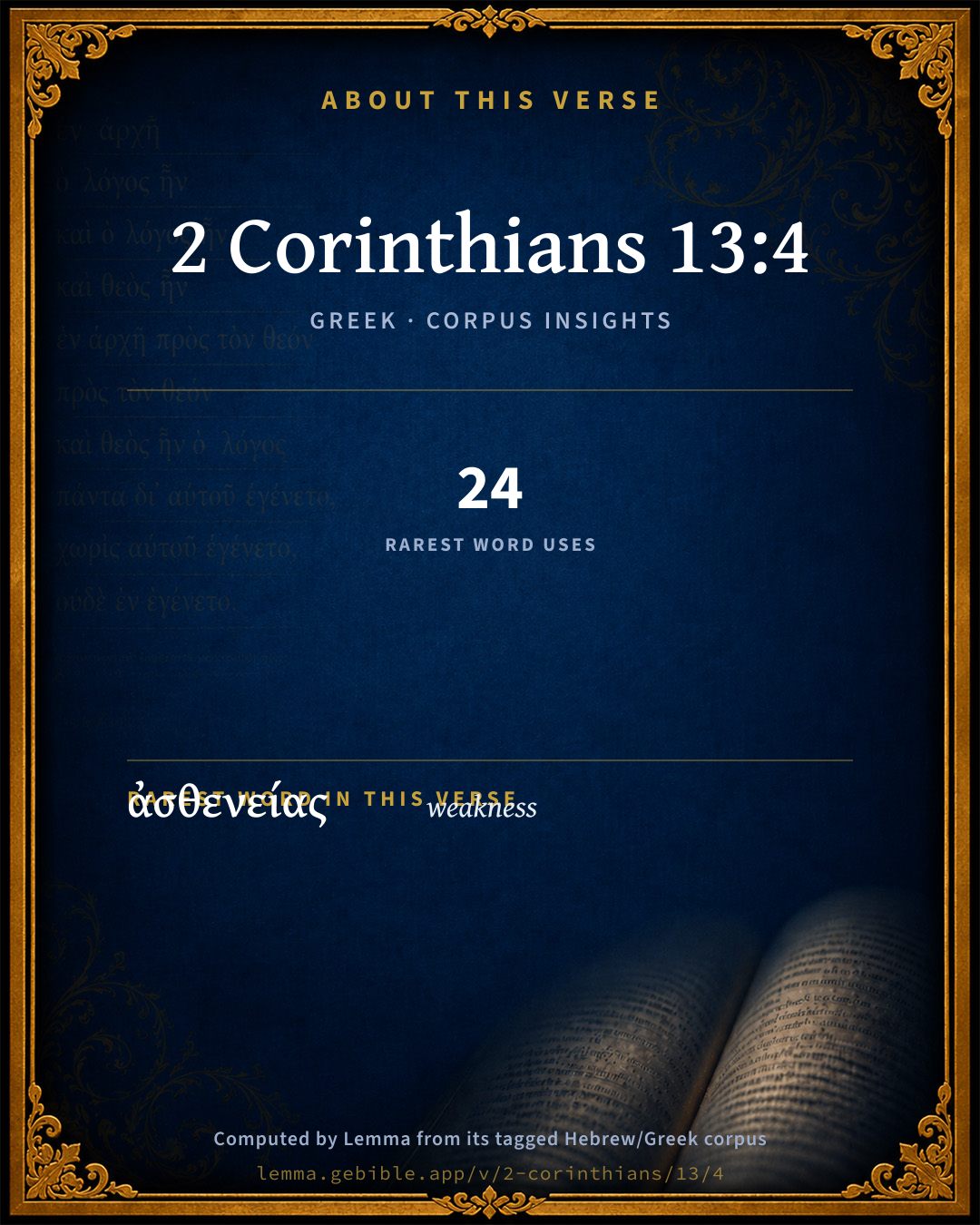
The rarest word here is ἀσθενείας weakness G769 — appearing just 24 times in the whole Greek New Testament.

Shared distinctive vocabulary

ἀσθενείας weakness G769 occurs in 23 verses of the Greek New Testament. Also found in:

Repetition

Words recur within this verse:

  • ζῇ to live G2198 ×2
  • δυνάμεως power G1411 ×2
  • θεοῦ God G2316 ×2
  • ἐξ from G1537 ×3
  • καὶ and G2532 ×2
  • γὰρ for G1063 ×2
  • ἀλλὰ but G235 ×2
  • αὐτῷ he G846 ×2

Cross-references

21

Topical passages linked to 2 Corinthians 13:4 in the Treasury of Scripture Knowledge — connected by theme and wording, ordered by reader-vote popularity; previews shown in the World English Bible.

  • 1 Peter 3:18 Because Christ also suffered for sins once, the righteous for the unrighteous, that he might bring you to God; being put to death in the flesh, but made alive in the spirit;
  • Romans 6:4 We were buried therefore with him through baptism to death, that just like Christ was raised from the dead through the glory of the Father, so we also might walk in newness of life.
  • 2 Corinthians 10:3–4 For though we walk in the flesh, we don't wage war according to the flesh;
  • Romans 6:8–11 But if we died with Christ, we believe that we will also live with him;
  • 2 Timothy 2:11–12 This saying is faithful: For if we died with him, We will also live with him.
  • 1 Corinthians 2:3 I was with you in weakness, in fear, and in much trembling.
  • 1 Corinthians 15:43 It is sown in dishonor; it is raised in glory. It is sown in weakness; it is raised in power.
  • Philippians 2:7–11 but emptied himself, taking the form of a servant, being made in the likeness of men.
  • Hebrews 5:7 He, in the days of his flesh, having offered up prayers and petitions with strong crying and tears to him who was able to save him from death, and having been heard for his godly fear,
  • Luke 22:43–44 An angel from heaven appeared to him, strengthening him.
  • John 10:18 No one takes it away from me, but I lay it down by myself. I have power to lay it down, and I have power to take it again. I received this commandment from my Father."
  • Acts 4:10–12 be it known to you all, and to all the people of Israel, that in the name of Jesus Christ of Nazareth, whom you crucified, whom God raised from the dead, in him does this man stand here before you whole.
  • Romans 14:9 For to this end Christ died, rose, and lived again, that he might be Lord of both the dead and the living.
  • Ephesians 1:19–23 and what is the exceeding greatness of his power toward us who believe, according to that working of the strength of his might
  • Philippians 3:10 that I may know him, and the power of his resurrection, and the fellowship of his sufferings, becoming conformed to his death;
  • Acts 2:36 "Let all the house of Israel therefore know assuredly that God has made him both Lord and Christ, this Jesus whom you crucified."
  • Romans 1:4 who was declared to be the Son of God with power, according to the Spirit of holiness, by the resurrection from the dead, Jesus Christ our Lord,
  • 2 Corinthians 4:7–12 But we have this treasure in clay vessels, that the exceeding greatness of the power may be of God, and not from ourselves.
  • 2 Corinthians 10:10 For, "His letters," they say, "are weighty and strong, but his bodily presence is weak, and his speech is despised."
  • 1 Peter 3:22 who is at the right hand of God, having gone into heaven, angels and authorities and powers being made subject to him.
  • Acts 3:16 By faith in his name has his name made this man strong, whom you see and know. Yes, the faith which is through him has given him this perfect soundness in the presence of you all.

Cross-references courtesy of OpenBible.info (CC BY 4.0).

Where the printed editions differ

1 variant

Places in this verse where the major printed Greek editions disagree on the wording in a way that affects the translation — a comparison of editions, not a manuscript-by-manuscript collation. The editions are the modern critical texts (Nestlé-Aland 28/27, SBL, Westcott-Hort, Tregelles, Tyndale House) and the traditional texts behind the KJV (the Textus Receptus and the Byzantine/Majority text). It is not a claim about which reading is original.

  1. Extra text
    εἰ

    “if”

    In TRByz Not in NA28NA27TynSBLWHTreg

    εἰ (ei) 'if' is only in traditional manuscripts (TR+Byz)

Textual data: Translators Amalgamated Greek New Testament (STEPBible TAGNT) · CC BY 4.0.

Commentary

Notes on 2 Corinthians 13:4 from classic Christian and Jewish commentators (each source and its license shown beneath its notes). The classic Christian expositions comment on the surrounding passage and are grouped to its opening verse, so a note may address several verses; the Jewish commentaries on the Tanakh (Rashi and others) are per-verse, so they appear only where the commentator wrote on this verse.

Lemma curates 59 commentaries, every one of them public domain or Creative Commons licensed, each selected and text-cleaned for this edition rather than reprinted as found. About our sources →

Bengel's Gnomon

Johann Albrecht Bengel

2Co 13:4. Εἰ, if [though]) a concessive particle.—ἐσταυρώθη, was crucified) The cross, the utmost weakness; it includes death, for life, is put in antithesis to it.—ἐξ ἀσθενείας, owing to [through] weakness) It is the part of weakness to be crucified. This is the force of the particle.—ἀσθενοῦμεν ἐν αὐτῳ, we are weak in Him) Presently after, the particle is varied, σύν, with Him, being employed instead of the ἐν here; we are weak, we do not exercise δύναμιν, power, and therefore we ourselves are less sensible of it, inasmuch as the sense of tribulation prevails.

Bengel's Gnomon of the New Testament — English translation (T&T Clark, Edinburgh, 1860) — public domain. Text from a community e-Sword module.

Meyer's Critical & Exegetical Commentary

Heinrich August Wilhelm Meyer

2Co_13:4. Καὶ γὰρ ἐσταυρ. ἐξ ἀσθ., ἀλλὰ ζῇ ἐκ δυνάμ. θεοῦ] Reason assigned for the previous ὃς εἰς ὑμᾶς οὐκ ἀσθενεῖ, ἀλλὰ δυνατεῖ ἐν ὑμῖν. for even crucified was He from weakness, but He is living from the power of God.[396] Without μέν after ἐσταυρ. the contrast comes in with the more striking effect. ἐξ ἀσθενείας denotes the causal origin of the ἐσταυρώθη, and is not, with Chrysostom (who complains of the difficulty of this passage), to be interpreted of apparent weakness, but finds its explanation in 2Co_8:9; Php_2:7 f. Jesus, namely, had, in the state of His exinanition and humiliation, obedient to the Father, entered in such wise into the condition of powerless endurance as man, that He yielded to the violence of the most ignominious execution, to which He had, according to the Fathers will, submitted Himself; and accordingly it came ἐξ ἀσθενείας, that He was crucified. But since His resurrection He lives (Rom_5:10; Rom_6:9; Rom_14:9, al.), and that from the power of God, for God has, by His power, raised Him up (see on Rom_6:4) and exalted Him to glory (Act_2:33; Eph_1:20 ff.; Php_2:9). To make the θεοῦ refer to ἀσθενείας also (Hofmann, who inappropriately compares 1Co_1:25) would yield a thought quite abnormal and impossible for the apostle, which the very οὐκ ἀσθενεῖ, 2Co_13:3, ought to have preclude.

καὶ γὰρ ἡμεῖς κ.τ.λ.] Confirmation of the immediately preceding καὶ γὰρ … θεοῦ, and that in respect of the two points ἐξ ἀσθενείας and ζῇ ἐκ δυνάμεως θεοῦ. That the case stands so with Christ as has just been said, is confirmed from the fact, that these two relations, on the one hand of weakness, and on the other of being alive ἐκ δυνάμ. θεοῦ, are found also in us in virtue of our fellowship with Him. It is an argumentum ab effectu ad causam issuing from the lofty sense of this fellowship, a bold experiential certainty, the argumentative stress of which, contained in ἐν αὐτῷ and σὺν αὐτῷ, bears the triumphant character of strength in weakness. Hofmann wrongly, in opposition to the clear and simple connection, desires to take καὶ γὰρ ἡμεῖς ἀσθ. ἐν αὐτῷ, which he separates from the following ἀλλὰ κ.τ.λ., as a proof for the clause ὃς εἰς ὑμᾶς οὐκ ἀσθενεῖ, ἀλλὰ δυνατεῖ ἐν ὑμῖν, for which reason he imports into ἐν αὐτῷ the contrast: not a weakness of the natural man. This contrast, although in substance of itself correct, is not here, any more than afterwards in σὺν αὐτῷ, intentionally present to the mind of the apostl.

ἀσθενοῦμεν ἐν αὐτῷ] Paul represents his sparing hitherto observed towards the Corinthians (for it is quite at variance with the context to refer ἀσθ, with Chrysostom, Theodoret, Theophylact, Grotius, Estius, and others, to sufferings and persecutions) as a powerlessness based on his fellowship with Christ, inasmuch as Christ also had been weak and ἐσταυρώθη ἐξ ἀσθενείας.[397] But that is only a transient powerlessness; we shall be alive with Him through the power of God in reference to you. As he is conscious, namely, of that impotence as having its ground in Christ, he is conscious also of this being alive in union with Christ as fellowship with His life (σὺν αὐτῷ), and hence proceeding ἘΚ ΔΥΝΆΜΕΩς ΘΕΟῦ, as Christs being alive also flowed from this source, Rom_1:4; Rom_6:4, al.

Εἰς ὑμᾶς, lastly, gives to the ΖΉΣΟΜΕΝ (which is not, with Theodoret, Anselm, and Grotius, to be referred to the future life) its concrete direction and special reference of its meaning:[398] we shall be alive (vigere, comp. 1Th_3:8) in reference to you, namely, through the effective assertion of the power divinely conferred on us, especially through apostolic judging and punishing (see 2Co_13:1-2). Non est vivere, sed valere vita, Martial, vi. 70. Comp. for the pregnant reference of ζῶ, Xen. Mem. iii. 3. 11; Plato, Legg. vii. p. 809 D; Dio Cass. lxix. 19. Calvin well observes: Vitam opponit infirmitati, ideoque hoc nomine florentem et plenum dignitatis statum intelligit.

[396] The Recepta καὶ γὰρ εἰ ἐσταυρ. would yield the quite unsuitable sense: for even if, i.e. even in the event that, He has been crucified, etc. Καὶ εἰ should not, with the Vulgate and the majority of expositors, be taken as although, for in that case it would be confounded with εἰ καί. Καὶ εἰ means even if, so that the climactic καί applies to the conditional particle. See Hartung, I. p. 140 f.; Haack. ad Thuc. p. 562 f.; Stallbaum, ad Plat. Ap. S. p. 32 A, Gorg. p. 509 A. De Wette wrongly rejects my view of the Recepta, making καὶ γάρ signify merely for. It always means for even. See Hartung, I. p. 148; Stallbaum, ad Plat. Gorg. p. 467 B. So, too, immediately in the καὶ γὰρ ἡμεῖς that follows. Hofmann quite erroneously takes the Recepta in such a way, that Paul with καὶ εἰ merely expresses a real fact conditionally on account of his wishing to keep open the possibility of looking at it also otherwise. In that case ἐξ ἀσθενείας would really be the point of consequence in the protasis, and the apostle must at least have written καὶ γὰρ εἰ ἐξ ἀσθενείας ἐσταυρώθη. Besides, the leaving open a possible other way of regarding the matter would have no ground at all in the text. A mistaken view is adopted also by Osiander, who has taken καί as the also of comparison, namely, of Christ with His servant (consequently, as if καὶ γὰρ αὐτός had stood in the text).

[397] This impotence is not to be conceived as involuntary (de Wette, following Schwarz in Wolf), but as voluntary (comp. οὐ φείσομαι, ver. 2), as Christs weakness also was voluntary, namely, the impotence of deepest resignation and self-surrender, and this was its very characteristic. Comp. Heb_12:2.

[398] Hence εἰς ὑμᾶς is not, with Castalio and Rückert, to be joined to δυνάμ. θεοῦ.

Meyer — Critical and Exegetical Commentary on the New Testament — English translation by Peter Christie, edited by Frederick Crombie (T&T Clark, 1880) — public domain. Text from a community e-Sword module.

Expositor's Greek Testament

ed. W. Robertson Nicoll

2Co 13:4 . ( a ) καὶ γὰρ ἐσταυρώθη κ . τ . λ .: for He was crucified through weakness ( cf. Phi 2:8 , 1Pe 3:18 ; ἐκ indicating that it was His self-assumed ἀσθένεια which made the Passion possible), but liveth through ( ἐκ again indicating the ultimate condition) the Power of God (see reff. and cf. Rom 8:11 , Eph 1:20 , Phi 2:9 ). ( b ) καὶ f1γὰρ ἡμεῖς κ . τ . λ .: for we also are weak with Him (the reading ἐν αὐτῷ might be explained from such passages as 2Co 1:5 , 2Co 4:10-11 ; but it is so startling that we hesitate to adopt it, when the MS. evidence is so evenly balanced; σὺν αὐτῷ means simply “we are weak, as He was weak, in the world’s eyes”; see 2Co 12:10 ), but we shall live with Him , not only in the Resurrection Life of believers (Joh 14:19 , Rom 5:10 ; Rom 6:8 ), but through the Power of God toward you, i.e. , through the powerful sanctions with which He will confirm our exercise of Apostolic discipline at Corinth ( cf. 1Co 5:5 ). The thought is that already expressed in 2Co 12:10 . He now resumes the argument of 2Co 13:3 a, sc ., you are claiming to test my claims: you should look to yourselves; your faith is a witness to mine that Christ dwells in you is a proof that He dwells in me, who preached Him to you. Cf. chap. 2Co 1:24 , 2Co 3:2 .

The Expositor's Greek Testament, edited by W. Robertson Nicoll (1897–1910) — public domain. Text from a community e-Sword module.

Geneva Bible (1599)

Geneva Bible translators

As touching that base form of a servant which he took upon him when he abased himself.

Geneva Bible (1599) marginal notes — public domain. Text via Bolls.life.

Jamieson, Fausset & Brown

Robert Jamieson, A. R. Fausset & David Brown

though--omitted in some of the oldest manuscripts; then translate, "For He was even crucified," &c.

through weakness--Greek, "from weakness"; that is, His assumption of our weakness was the source, or necessary condition, from which the possibility of His crucifixion flowed (Heb 2:14; Phi 2:7-8).

by--Greek, "from"; "owing to."

the power of God--the Father (Rom 1:4; Rom 6:4; Eph 1:20).

weak in him--that is, in virtue of our union with Him, and after His pattern, weakness predominates in us for a time (exhibited in our "infirmities" and weak "bodily presence," Co2 10:10; Co2 12:5, Co2 12:9-10; and also in our not putting into immediate exercise our power of punishing offenders, just as Christ for a time kept in abeyance His power).

we shall live with him--not only hereafter with Him, free from our present infirmities, in the resurrection life (Phi 3:21), but presently in the exercise of our apostolic authority against offenders, which flows to us in respect to you from the power of God, however "weak" we now seem to you. "With Him," that is, even as He now exercises His power in His glorified resurrection life, after His weakness for a time.

Jamieson, Fausset & Brown — Commentary Critical and Explanatory on the Whole Bible (1871) — public domain (CC PDM 1.0). Text via the HelloAO Bible API.

Adam Clarke's Commentary

Verse 4. For though he was crucified through weakness] It is true Christ was crucified, and his crucifixion appeared to be the effect of his weakness; yet even this was not so; he gave up his life, none could take it away from him; and in his last struggle, had he even been deficient in power, he could have had more than twelve legions of angels to support him against the high priest's mob, Mt 26:53; but how then could the Scripture be fulfilled? And had he not died, how could the human race have been saved?

Yet he liveth by the power of God.] Though he appeared to be crucified through his own weakness, yet he now liveth by the power of God; exerting an almighty energy by which all things are subject to him.

We also are weak in him] Because we are on Christ's side we appear to you as weak as he did to the Jews; but it is not so, for we live with him-under the same influence, and partaking of the same life; manifesting by our preaching and miracles the power of God towards you. While I do not use the rod, I appear to you weak; I will use it, and then you shall find me to be strong.

Adam Clarke's Commentary on the Bible (1810–1826) — public domain. Text from a community e-Sword/MySword module.

John Calvin's Commentaries

4. For though he was crucified. He speaks, with particular intention, of Christ’s abasement, with the view of intimating indirectly, that nothing was despised in him, but what they would have been prepared to despise, also, in Christ himself, inasmuch as he

emptied himself, even to the death of the cross. (Philippians 2:8.)

He shows, however, at the same time, how absurd it is to despise in Christ the abasement of the cross, inasmuch as it is conjoined with the incomparable glory of his resurrection. “Shall Christ be esteemed by you the less, because he showed signs of weakness in his death, as if his heavenly life, that he leads subsequently to his resurrection, were not a clear token of his Divine power?” For as the term flesh here means Christ’s human nature, so the word God is taken here to denote his Divinity.

Here, however, a question arises — whether Christ labored under such infirmity as to be subjected to necessity against his will; for, what we suffer through weakness, we suffer from constraint, and not from our own choice. As the Arians of old abused this pretext for effectually opposing the divinity of Christ, the orthodox Fathers gave this explanation of it — that it was effected by appointment, inasmuch as Christ so desired, and not from his being constrained by any necessity. This answer is true, provided it be properly understood. There are some, however, that mistakenly extend the appointment to Christ’s human will — as if this were not the condition of his nature, but a permission contrary to his nature. For example: “His dying,” they say, “did not happen because his humanity was, properly speaking, liable to death, but by appointment, because he chose to die.” I grant, indeed, that he died, because he chose to do so; but, whence came this choice, but from this — that he had, of his own accord, clothed himself with a mortal nature If, however, we make Christ’s human nature so unlike ours, the main support of our faith is overturned. Let us, therefore, understand it in this way — that Christ suffered by appointment, not by constraint, because, being in the form of God he could have exempted himself from this necessity, but, nevertheless, he suffered through weakness, because he emptied himself (Philippians 2:6.)

We are weak in him. To be weak in Christ means here to be a partaker of Christ’s weakness. Thus he makes his own weakness glorious, because in it he is conformed to Christ, and he no longer shrinks back from the disgrace, that he has in common with the Son of God; but, in the mean time, he says that he will live towards them after Christ’s example. “I also,” says he, “will be a partaker of Christ’s life, after I shall have been exempted from weakness.” To weakness he opposes life, and, accordingly, he understands by this term a condition that is flourishing, and full of honor. The clause towards you may also be taken in connection with the power of God, but it is of no importance, as the meaning always remains the same — that the Corinthians, when they began to judge aright, would have respectful and honorable views of the power of God, which was in Paul, and would no longer despise outward infirmity.

John Calvin's Commentaries (1540-1563) — public domain. Text from the Calvin Translation Society English edition (1840s-50s) via the Christian Classics Ethereal Library (ccel.org). Calvin's coverage is partial (roughly two-thirds of the Bible); uncommented books and verses are honest gaps, never fabricated. The 19th-century editor's footnotes and remarks are omitted so the notes are faithfully Calvin's own voice.

Ellicott's Commentary for English Readers

(4) For though he was crucified through weakness . . .—The better MSS. give another reading, without the contingent or concessive clause: For even He was crucified. St. Paul seems to see in Christ the highest representative instance of the axiomatic law by which he himself had been comforted, that strength is perfected in infirmities. For He too lived encompassed with the infirmities of man’s nature, and the possibility of the crucifixion flowed from that fact, as a natural sequel.

For we also are weak in him, but we shall live with him.—The thought that underlies the apparently hard saying is that the disciples of Christ share at once in their Lord’s weakness and in His strength. “We, too, are weak,” the Apostle says; “we have our share in infirmities and sufferings, which are ennobled by the thought that they are ours because we are His; but we know that we shall live in the highest sense, in the activities of the spiritual life, which also we share with Him, and which comes to us by the power of God; and this life will be manifested in the exercise of our spiritual power towards you and for your good.” To refer the words “we shall live” to the future life of the resurrection, though the thought is, of course, true in itself, is to miss the special force of the words in relation to the context.

A Bible Commentary for English Readers, edited by Charles John Ellicott (1878–1897) — public domain. Text from a community e-Sword module.

The Cambridge Bible for Schools and Colleges

gen. ed. J. J. S. Perowne

4. For though he was crucified through weakness] Chrysostom observes that these words were a great difficulty to the weaker sort. But he explains them by Joh_11:3-4; Php_2:27; 1Ti_5:23, where the word in the original is the same as, or cognate to, that employed here. There is another reading here, which by omitting ‘though,’ or rather ‘if,’ in the original, strengthens the Apostle’s statement. There need be no difficulty. Our Lord assumed our human nature with all its infirmities (Heb_2:10-18; Heb_4:15; Heb_5:2-3; see also ch. 2Co_8:9, and Php_2:7-8), although they were the result of sin. He bore all those infirmities, death itself included. And then He shook them all off for ever when He rose again ‘by the power of God.’ Cf. Rom_1:4; 1Co_1:24.

For we also are weak in him] In this present life the Apostles of Christ were like their Master. Upborne by the power of God within, they had nevertheless to bear the load of human infirmity, to ‘take up their Cross and follow Him.’ See notes on ch. 2Co_4:10-12, and cf. Gal_6:17. And not only so, but the words ‘in Him’ shew that it was a necessary part of their union with Him that they should be partakers of His tribulation, before they were translated into the fulness of His glory. See 2Th_1:4-7; 1Pe_1:5-7; 1Pe_5:10.

we shall live with him] Not, as the following words shew, hereafter, but in the Apostle’s ministry to the Corinthians. Cf. 2Co_13:3. Also Rom_1:16; Joh_14:19; 1Co_1:18, and ch. 2Co_10:4-6, and note on ch. 2Co_4:14. The Gospel was a power which enabled men to change their lives, in that it was a ministering to them of the Spirit of Jesus Christ. Compare ch. 2Co_3:3; 2Co_3:6; 2Co_3:8-9 with Rom_8:9-10 and Php_1:19.

The Cambridge Bible for Schools and Colleges (gen. ed. J. J. S. Perowne; Cambridge University Press, 1878–1918) — public domain. Text from a community e-Sword module.

John Gill's Exposition

For though he was crucified through weakness,.... Of the human nature; for the nature which Christ assumed was in all things like to ours, excepting sin; it was subject to all sinless infirmities; it was mortal, passible, liable to sufferings, and death, and so he came to be crucified; though not against his will, or without his previous assent; as God, he was able to have prevented his crucifixion if he would; he gave an instance of his power over men, at the time of his apprehension, by striking them down to the ground; and told Pilate his judge at his trial, that he could have no power to crucify him, if it was not given him from above; and he showed his superiority over devils when upon the cross, by spoiling principalities and powers; so that his crucifixion was not owing to want of power as God, but he became capable of it through his weakness as man:

but yet he lives by the power of God; he was raised from the dead by a divine power; by his own power as God, as well as by his Father's, and so was declared to be the Son of God with power; and he lives at the right hand of God as man and Mediator, vested with all power in heaven and in earth; though, in the days of his flesh, he appeared so weak, mean, and despicable: now the apostle mentions this case of our Lord's, to deter the Corinthians from despising him, on account of his outward weakness and meanness; and from hence buoying themselves up, and in which they were encouraged by the false apostles, that he had not, and could not exercise the power he talked of; they had observed what mean figure he made when he was among them; and whatever weight there might be in his letters, yet his bodily presence was weak, and his speech contemptible; wherefore he sets before them the instance of Christ, who though he appeared very weak in his state of humiliation, yet he now lives in power, to assist and strengthen his ministers, in every branch of their work; and suggests, that as it was with Christ, it was, and would be in some measure with him, and his fellow ministers:

for we also are weak in him: like him, and for his sake, they were subject to infirmities, reproaches, persecutions, and distresses; carried about daily the dying of the Lord Jesus; bore a very great resemblance to him in his state of humiliation; were very much as he was in this world, and bore much for his name's sake; the Alexandrian copy and the Syriac version read, "with him"; being crucified with him, and dead with him:

but we shall live with him by the power of God towards you; which is not to be understood of being raised by Christ to an immortal life, and of living with him in glory; though this is a certain truth, that such who suffer with Christ, shall live and reign, and be glorified together with him; but of the life, power, and efficacy of the ministers of Christ, and of Christ in and with them, displayed in the lively ministration of the word and ordinances, in the vigorous discharge of all the branches of their office; not only in preaching, but in rebuking, admonishing, laying on of censures, and punishing criminals; and especially regards the powerful exertion and use of the apostolic rod; for this life is not only with Christ, or through Christ being in them, notwithstanding all their outward weakness, and by the power of God, which supports them under all, and enables them to perform their work, but is "towards you"; the Corinthians, to be exercised towards them, to be seen among them, and felt by them.

John Gill's Exposition of the Whole Bible (1746–1763) — public domain (CC PDM 1.0). Text via the HelloAO Bible API.

Trapp's Complete Commentary

John Trapp

4 For though he was crucified through weakness, yet he liveth by the power of God. For we also are weak in him, but we shall live with him by the power of God toward you.

Ver. 4. Crucified through weakness] i.e. Ex afflicto eius statu, as Gal 4:14; (Aug.), as having voluntarily subjected himself to all sorts of sufferings for our sakes.

John Trapp, A Commentary or Exposition upon All the Books of the Old and New Testament (1647–1656) — public domain. Text from a community e-Sword module.

Albert Barnes' Notes on the Bible

For though he was crucified through weakness - Various modes have been adopted of explaining the phrase “through weakness.” The most probable explanation is that which refers it to the human nature which he had assumed Phi 2:7-8; 1Pe 3:18, and to the appearance of weakness which he manifested. He did not choose to exert his power. He appeared to his enemies to be weak and feeble. This idea would be an exact illustration of the point before the apostle. He is illustrating his own conduct, and especially in the fact that he had not exerted his miraculous powers among them in the punishment of offenders; and he does it by the example of Christ, who though abundantly able to have exerted his power and to have rescued himself from his enemies, yet was willing to appear weak, and to be crucified. It is very clear:

(1) That the Lord Jesus seemed to his enemies to be weak and incapable of resistance.

(2) That he did not put forth his power to protect his life. He in fact offered no resistance, as if he had no power.

(3) He had a human nature that was especially sensitive, and sensible to suffering; and that was borne down and crushed under the weight of mighty woes; see my notes on Isa 53:2-3. From all these causes he seemed to be weak and feeble; and these appear to me to be the principal ideas in this expression.

Yet he liveth - He is not now dead. Though he was crucified, yet he now lives again, and is now capable of exerting his great power He furnishes proof of his being alive, in the success which attends the gospel, and in the miracles which are performed in his name and by his power. There is a living Redeemer in heaven; a Redeemer who is able to exert all the power which he ever exerted when on earth; a Redeemer, therefore, who is able to save the soul; to raise the dead; to punish all his foes.

By the power of God - In raising him from the dead and placing him at his own right hand; see Eph 1:19-21. Through the power of God he was brought from the tomb, and has a place assigned him at the head of the universe.

For we also are weak in him - Margin, “with him.” We his apostles, also, are weak in virtue of our connection with him. We are subject to infirmities and trials; we seem to have no power; we are exposed to contempt; and we appear to our enemies to be destitute of strength. Our enemies regard us as feeble; and they despise us.

But we shall live with him ... - That is, we shall show to you that we are alive. By the aid of the power of God we shall show that we are not as weak as our foes pretend; that we are invested with power; and that we are able to inflict the punishment which we threaten. This is one of the numerous instances in which Paul illustrated the case before him by a reference to the example and character of Christ. The idea is, that Christ did not exert his power, and appeared to be weak, and was put to death. So Paul says that he had not exerted his power, and seemed to be weak. But, says he, Christ lives, and is clothed with strength; and so we, though we appear to be weak, shall exert among you, or toward you, the power with which he has invested us, in inflicting punishment on our foes.

Albert Barnes' Notes on the Bible (1834–1885) — public domain. Text from a community e-Sword/MySword module.

Haydock's Catholic Bible Commentary

He was crucified through weakness. That is, he took upon him our weak and infirm nature, in which he was made capable of suffering, and of laying down willingly his life for us on the cross. But he liveth again by the power of God, of his divine power. --- We also are weak in him, like him liable to sufferings, undergoing sufferings by his example; but we shall live with him by the power of God, of which you have also a share. (Witham)

George Leo Haydock (1774–1849), Haydock's Catholic Family Bible and Commentary, 1859 edition — public domain. Excludes Psalms (Douay-Rheims chapter numbering differs from Protestant) and Deuterocanonical books (Catholic canon only).

Matthew Poole's English Annotations

He had before said, that Christ in him was not weak, but mighty; here he showeth, that there was a time when Christ himself was weak, in a low and contemptible state, in which state he was crucified; this state of weakness subjected him to a death upon the cross: but,

by the power of God, he rose again from the dead, ascended up into heaven, where he liveth for ever to make intercession for us.

For we also are weak in him; in conformity to Christ (he saith) he and the rest of the apostles were

weak; in a low, abject, contemptible condition, exposed to reproaches, deaths, &c.

But we shall live; which some understand of life eternal, consequent to the resurrection of believers; but others better, of the life and vigour of the apostle’s ministry. Through the mighty power of God, flowing from a living Christ, who hath ascended up on high, and given gifts unto men, our ministry shall be a living, powerful, efficacious ministry toward you.

Matthew Poole's English Annotations on the Holy Bible (1683–1685) — public domain. Text from a community e-Sword/MySword module.

Whedon's Commentary on the Bible

Daniel D. Whedon

4. For—The present verse seems to imply that some of the Christines held Christ to have been not only a mere man, but a man without a miraculous resurrection. St. Paul therefore affirms that Christ was not only mighty, as speaking in him, but though crucified through his human weakness, yet he still liveth through divine power. We are humanly weak in him as human.

Live with him… toward you—Christ, in his resurrection, is living and ruling over the Church.

We… live with… him—Not yet in resurrection, but in apostleship, derived and endowed from the power of God toward you.

Daniel D. Whedon (gen. ed.), Commentary on the Old and New Testaments (1874–1909) — public domain. Text from a community e-Sword module.

The Pulpit Commentary

For though. The "though" should be omitted. Through weakness; literally, out of weakness; i.e. as a result of that human weakness of our nature which he took upon him, and which rendered him liable to agony and death (2Co_8:9; Php_2:7, 8; 1Pe_3:18; Heb_2:10-18) But we shall live with him toward you. This thought of participation alike in Christ"s humiliation and his glory, alike in his weakness and his might, was very familiar to St. Paul (2Co_4:10-12; Eph_1:19, Eph_1:20) Here, however, the following words," toward you," i.e. " with reference to you," show that the life of which he is thinking is the vigorous reestablishment of his spiritual authority in Christ over the Church of Corinth.

HOMILIES BY J.R. THOMSON

Ver. 4.

Weakness and power.

It must have been very painful to the sensitive and benevolent mind of the apostle to have written thus to any congregation of Christians, especially to a congregation so intimately connected with him as was this at Corinth. The whole society was to blame for suffering the Judaizers and the questioners of St. Paul"s authority; when they should have taken the part of their spiritual benefactor, and have indignantly resented the slights and misrepresentations which they tolerated. In the prospect of visiting Corinth, the apostle requires that the people shall put themselves to the test and shall give a proof of their reformation; otherwise, he will be compelled to give them a proof of his supernatural power and thus to silence calumny and opposition.

I THE WEAKNESS OF CHRIST IS SHARED EVEN BY HIS SINCEREST AND MOST FAITHFUL FOLLOWERS.

1. In the Lord Jesus were, both in his person and in his ministerial career,many circumstances of humiliation. His helpless childhood; his subjection to hunger, thirst, and weariness; his liability to pain; his endurance of death, are instances of the former. His submission to calumny and insult, to betrayal and desertion, to hatred and rejection, are proofs of the latter.

2. Now, our Lord himself forewarned his disciples that they should sharetheir Master"s lot. Paul certainly took up the cross. The thorn or stake in the flesh, the feeble body, the scourgings and imprisonments which he was called upon to endure, were not regarded by him as accidents and misfortunes, but rather as proofs of true discipleship, as participations in the sufferings of the Lord. And this is the light in which all followers of the Lord Jesus are justified in regarding the endurances and calamities which befall them in treading in his steps and in executing his commission. It is the moral glory of Christianity that it dignifies the sufferings of those who partake their Leader"s spirit in self-denying endeavours for the salvation of their fellow men. Such servants of the Divine Master may well "glory in infirmity." Their wounds are the honourable scars telling of the severity of the conflict in which they have been engaged.

II THE POWER OF GOD WHICH WAS UPON CHRIST SHALL BE DISPLAYED IN THOSE WHO, SHARING THE MASTER"S SERVICE, SHARE ALSO HIS WEAKNESS. Paul was content that men should perceive the weakness manifest in the crucifixion of the Redeemer but he preached to them a risen, reigning, and glorified King. The resurrection and ascension of Christ were both proofs of the acceptance of the Son by the Father, and they were an inspiriting omen of the approaching victory of the cause for which Jesus deigned to die. From the throne of might and dominion, possessed of all authority, the victorious Lord governs his Church on earth, and secures its safety and well being. St. Paul felt himself entrusted with abundant means of maintaining his spiritual authority as the "ambassador of Christ." He might possess marks of the dying of the Lord Jesus; but he wielded a might which no foe could resist. Let all faithful servants of Jesus and true soldiers of the cross be encouraged by the reflection that their Commander is omnipotent, and that he must reign until every foe is beneath his feet. T.

HOMILIES BY E. HURNDALL Ver. 4.

The death and resurrection of Christ contrasted.

I THE FORMER WAS THROUGH WEAKNESS.

1. Christ assumed a nature which was capable of crucifixion. Who could crucify God? But the God-Man might walk in weariness and weakness to Golgotha. What a pathetic consideration that Christ voluntarily chose a nature which was subject to suffering and death!

2. Christ repressed his innate power.

(1) His Divine power. Thus he laid down his life; no man took it from him. But a flash of that power, and the cross would never have been reared. But a word from his lips, and his persecutors would have been dead men. But then the gospel would never have been told to man; so for man omnipotence became impotence.

(2) His human power. Man power as well as God power was discarded. There was no resistance. He became "as a sheep before her shearers." He voluntarily became the weakest of the weak that he might be strong to redeem. Learn here that repression is often a triumph. Not always does the putting forth of power mean success. It is sometimes our wisdom to sit still, to submit, to be silent.

II THE LATTER WAS IN POWER.

1. A marvellous event. What a contrast between the first day and the third! How mighty men seem on the former! how unutterably impotent on the latter! How weak Christ seems on the one! how omnipotent on the other!

2. Demanding Divine energy. This power was not of man. Man stands completely helpless at the grave. Here his boastings are silenced. But the Author of life can restore life. The Divine power manifested in our Lord"s resurrection we find sometimes ascribed to God the Father, (Eph_1:20) sometimes to the Son. (Mar_14:58) "I and my Father are one". (Joh_10:30)

3. Complete.

(1) Christ arose in perfect power. The cross and the grave left no marks of weakness upon him. His omnipotence was untainted.

(2) He has reigned since in power above.

(3) He works in power today on earth through his Word and Spirit.

III THE DEATH AND RESURRECTION OF CHRIST, THOUGH IN CONTRAST, ARE IN CLOSE ASSOCIATION. They are in point of time. A few hours only separated the weakness of the cross from the power of the restoration. But there is real dependence also. In a certain sense the one was the natural result of the other. Without so perfect a crucifixion there could not have been so triumphant a resurrection. Christ was perfect alike when he was in weakness and when he was in power. Had there been any less "weakness" in the death, there had been less "power" in the resurrection. The humiliation was, in its order, as truly glorious as the exaltation. So with us if we are abased with Christ here we shall be glorified with him hereafter. We have the crossmust have the cross if we would have the crown. H.

HOMILIES BY R. TUCK Ver. 4.

Crucified through weakness.

This is a very characteristic view of the crucifixion of our Lord, St. Paul never dwelt upon it complacently, as we do. There is no trace of his having ever elaborately described it, or endeavoured to move the feelings of his hearers or readers by the persuasions of his Lord"s dying distresses. The Crucifixion was a painful subject to him. It was Christ"s time of weakness. The apostle always seems to hasten away from that theme to what he can glory in, even Christ, the risen One, the living One, who now can save. Dean Plumptre explains the expression taken as our text thus: For even he was crucified. St. Paul seems to see in Christ the highest representative instance of the axiomatic law by which he himself had been ccmforted, that strength is perfected in infirmities. For he too lived encom passed with the infirmities of man"s nature, and the possibility of the Crucifixion flowed from that fact as a natural sequel." Professor Lias says, "Our Lord assumed our human nature with all its infirmities, (Heb_2:10-18 Heb_4:15 Heb_5:2, Heb_5:3) and although they were the result of sin. He bore all those infirmities, death itself included. And then he shook them all off forever when he rose again "by the power of God.

I CHRIST WAS BODILY WEAK. We may fairly assume that our Lord had a healthy body; but it was subject to ordinary human infirmities. He felt fatigue, hunger, thirst, need of sleep; and spiritual work exhausted his nervous system as it does ours. We may even assume that his must have been a nervously sensitive body, since this is found to be the characteristic of all highly intellectual and all highly spiritual men and women. It will be easy to show how St. Paul would feel a special sympathy with the Lord Jesus in all this, since his too was a frail, sensitively organized body. Those who are easily depressed, readily affected by outward circumstances, and conscious of physical frailty, seldom realize how near to them in sympathetic experience comes the Lord Jesus Christ, and, after him, the great apostle of the Gentiles.

II CHRIST WAS SOUL STRONG. And therefore he could go through all the lot which God appointed for him, even though that included the bitter and terrible experiences of the Crucifixion. The soul strength St. Paul thought of as Christ living in the very midst of his weakness and suffering. His idea may be thus expressed: "We too are weak; we have our share in infirmities and sufferings, which are ennobled by the thought that they are ours because they are his; but we know that we shall live in the highest sense, in the activities of the spiritual life, which also we share with him, and which comes to us by the power of God; and this life will be manifested in the exercise of our spiritual power towards you and for your good." Reference is to the present ministry and not to the hereafter time. If Christ"s weakness was, like St. Paul"s, frailty of belly, he might rejoice that Christ"s strength was soul strength, and, like his, the strength of God made perfect in weakness. R.T.

The Pulpit Commentary (1880–1919), ed. H.D.M. Spence-Jones & Joseph S. Exell — public domain. Text from a community e-Sword module.

John Wesley's Explanatory Notes

He was crucified through weakness - Through the impotence of human nature. We also are weak with him - We appear weak and despicable by partaking of the same sufferings for his sake. But we shall live with him - Being raised from the dead. By the power of God in you - By that divine energy which is now in every believer, 2 Cor. xiii, 5.

John Wesley, Explanatory Notes Upon the Whole Bible (1754–1765) — public domain. Text via the GEBible commentary corpus.

McGarvey & Pendleton's Commentaries

J. W. McGarvey

for he was crucified through weakness, yet he liveth through the power of God. For we also are weak in him, but we shall live with him through the power of God toward you . [The apostle here gives the reason why he had so fully decided to discipline: they had tauntingly desired it. You ascribe, says he, weakness to the Christ who speaks in me, and strength to the Christ, who, according to their profession, speaks in these false apostles, and you would put me to the test. Their Christ, ye say, is the mighty Keeper of the Jewish law, while mine is the weak, crucified Christ. But you should remember that he has not been weak toward you, either in my ministry ( 2Co_12:12 ), or in miracles and judgments ( 2Co_6:7 ; 1Co_2:4-5 ; 1Co_11:30 ), or in the bestowal of gifts ( 1Co_1:7 ), for, though he did indeed manifest through the weakness of our humanity a mortal life susceptible to death by crucifixion ( Phi_2:7-8 ; 1Co_1:23 ; Heb_2:14 ); yet, per contra, through the power of God the Father working in him ( Rom_1:4 ; Rom_6:4 ; Eph_1:20 ), he overcome this weakness and lives again. And by virtue of our union with him, we follow the pattern of his life in our dealings with you; for you who have beheld our physical weakness, infirmities, gentle forbearance, etc. ( 2Co_10:10 ; 2Co_12:5 ; 2Co_12:9-10 ), and have, as it were, put our influence and power to death among you, shall behold also in me the same divine power of God effecting a resurrection of us because of our union with Christ, that we may exercise our rightful authority over you. We should note the direct assertion of inspiration, and the willingness to have it tested contained in 2Co_13:3 ]

J. W. McGarvey (with Philip Y. Pendleton), Commentaries on the New Testament (The Fourfold Gospel, 1914; Acts; and the epistles) — public domain. Text from a community e-Sword/MySword module.

The People's New Testament

B. W. Johnson

4. For though he was crucified through weakness. Christ submitted himself unto death, voluntarily choosing the weakness of mortality. He “emptied himself” (Phil. 2:7, 8). But by the power of God he was raised from death to life. So it shall be with us. His life is reproduced in us. Those who suffer and die with him shall live with him through the Divine power.

B. W. Johnson's The People's New Testament with Notes (1889–1891) — public domain. Electronic text from the Christian Classics Ethereal Library (CCEL) ThML edition.

Cambridge Greek Testament for Schools and Colleges

4. καὶ γὰρ ἐσταυρώθη (אBDFGKP, d g Copt. Aeth.) rather than καὶ γὰρ εἰ ἐστ. (א3AD2D3L, f Vulg. Syrr. Arm. Goth.): also καὶ γὰρ ἡμεῖς (אABDLP, Latt. Goth.) rather than καὶ γὰρ καὶ ἡμεῖς (some cursives, f g Copt., Chrys.): also ἀσθενοῦμεν ἐν αὐτῷ (BDKLP, Vulg. Goth.) rather than ἀσθ. σὺν αὐ. (אAFG, Copt.) from the following σὺν αὐτῷ, for which D and some Latin texts have ἐν αὐτῷ. εἰς ὑμᾶς (אADFGKLP, Latt. Syrr. Copt. Aeth. Goth.) is probably genuine, although BD3, Arm., Chrys. omit.

4. καὶ γὰρ ἐσταυρώθη. See critical note. The καί is either intensive or concessive, while γάρ explains; for he was even crucified (His weakness went as far as that); or, for he was certainly crucified (no doubt that is quite true); see Ellicott on 1Co 5:7 and Php 2:27. There is manifest contrast between ἐξ ἀσθ. and ἐκ δυν. θ., and therefore ἐκ must be rendered alike in both clauses; through weakness, … through the power of God. The ἐκ marks the source in each case; comp. 2Co 11:26. Note the change from aor. to pres.; ‘He was crucified once for all, yet He lives continually,’ ζῶν ἐστι εἰς τοὺς αἰῶνας τῶν αἰώνων (Rev 1:18). With ἐξ ἀσθ. comp. Php 2:8; with ἐκ δυν. θ. comp. Rom 6:4; Rom 8:11; Eph 1:20; Php 2:9: it was God who raised Him from the dead and glorified Him.

καὶ γὰρ ἡμεῖς. This expression explains the previous καὶ γάρ sentence, which it rhetorically balances; and both ἀλλὰ and ἐκ must be translated as before; For we also are weak in him, yet we shall live with him through the power of God. See Briggs, The Messiah of the Apostles, p. 123. Comp. the balance between the two ἵνα clauses in 2Co 11:12; Gal 3:14; Rom 7:13. The argument here is, that the transition from weakness to life in us, who have such close fellowship with Him, confirms the similar transition in Him. The two cases would be likely to be similar. See critical note. If εἰς ὑμᾶς is genuine, ἡμεῖς must mean ‘we Apostles’; and it probably means that in any case. The εἰς ὑμᾶς might be dropped accidentally, through homoeoteleuton, or deliberately, to make the balance with the previous sentence more exact.

N.T. usage varies as to the fut. of ζάω. If we include συνζάω, the fut. occurs 22 times, 11 with the form ζήσω, and 11 with the later form ζήσομαι. Of the passages with ζήσομαι, 6 are quotations from the LXX. In Gal 3:11-12; Rom 1:17; Rom 8:13; Rom 10:5 S. Paul uses the later form; Gal 3:11-12 and Rom 1:17; Rom 10:5 are quotations, and in 2Co 8:13 he may be thinking of Eze 37:6; Eze 37:14. Here Rec. with D3KL has ζησόμεθα, but אABD have ζήσομεν. In Rom 6:2 the evidence is still stronger; in Gal 2:19 ζήσω is undisputed.

The fut. here does not refer to a future life beyond the grave, but to future vigorous action in this life, especially in dealing with the Corinthians. non est vivere, sed valere, vita (Mart. VI. lxx. 15). In this sense of ‘to be vigorous’ ζῇν is sometimes contrasted with βιοῦν (1Pe 4:2; Job 29:18) = ‘to pass time’; βιοὺς μὲν ἔτη τόσα, ζήσας δὲ ἔτη ἑπτά (Dio Cass. lxix. 19): comp. Xen. Mem. III. iii. 11, and the proverb φοίνικος ἔτη βιοῦν. But the expression has nothing to do with ‘the ecclesiastical pomp and splendour which are the ensigns’ of ecclesiastical authority, and ought not to be quoted as a warrant for them.

Cambridge Greek Testament for Schools and Colleges (Cambridge University Press, 1896; 21 vols, various authors incl. Carr, Maclear, Plummer, Farrar, Lumby, Moule, M. R. James, Simcox) — public domain. Text from a community e-Sword module.

Alford’s Greek Testament

Henry Alford

4.] Confirmation of the foregoing οὐκ ἀσθενεῖ, ἀλλὰ δυνατεῖ. The rec. text, καὶ γὰρ εἰ, would be quite beside the purpose, and would mean, ‘For even if He were crucified’, ‘for even putting the case that He was crucified:’ καὶ εἰ cannot he = εἰ καί, though, as in Vulg. ‘etsi,’—and E. V. Hartung, Partikellehre i. 139, shews that in καὶ εἰ, the climax belongs only to the hypothetical particle εἰ, not as in εἰ καί, to the fact presupposed: ‘even if,’ not ‘if even,’ or ‘although.’ Examples of καὶ εἰ are Plato, Sympos. 185, καὶ ἐὰν τοῦτο ποιήσῃς ἅπαξ ἢ δίς, καὶ εἰ πάνυ ἰσχυρά ἐστι, παύσεται. Eur. Androm. 266, καὶ γὰρ εἰ πέριξ σʼ ἔχει τηκτὸς μόλυβδος, ἐξαναστήσω σʼ ἐγώ. Sappho, καὶ γὰρ αἰ φεύγει, ταχέως διώξει. See more in Hartung, l. c.

For he was even crucified (that καὶ γάρ always means ‘for … even’ …, or ‘for … also,’ and never simply ‘for,’ see Hartung, i. 137 f., where he has collected many examples, e.g.: Il. α. 63, καὶ γάρ τʼ ὄναρ ἐκ Διός ἐστιν,—Herod. i. 77, καὶ γὰρ πρὸς τούτους αὐτῷ ἐπεποίητο συμμαχίη) from (as the source,—the conditional element,—by which His crucifixion became possible) weakness, yet He lives by (source [of His life]) the Power of God (which raised Him from the dead, Rom 6:4; Rom 8:11; Eph 1:20; Php 2:9). For we also are weak in Him (i.e. in Him, in our communion with and imitation of Christ, we, as He did, lay aside our power and spare you: we partake of His voluntary abnegation of power which we might have used. The context requires this explanation, and refutes that of Chrys., p. 644, τί ἐστιν, ἀσθ. ἐν αὐτῷ; διωκόμεθα, ἐλαυνόμεθα, τὰ ἔσχατα πάσχομεν, so Theodoret, Theophyl., Grot., Estius, al.), but shall live (exercise our apostolic authority, in contrast to the ἀσθένεια above) with Him (as He now exercises His power in His glorified resurrection life) from (source) the power of God [with respect to you (εἰς ὑμᾶς, if genuine, may belong either to δυνάμεως θεοῦ, = δυνάμ. θεοῦ τῆς εἰς ὑμᾶς, the art. being often omitted in such constructions,—or to ζήσομεν, ‘we shall live with respect to you,’ which agrees better with the parallelism, but not so well with the arrangement of the sentence. The sense seems to require the latter interpretation, for the δύναμις θεοῦ εἰς ὑμ. would be rather the result, than the source of the apostolic energy indicated by ζήσομεν)]. I have taken ζήσομεν, as the context plainly requires, figuratively (see ref.): but many Commentators take it literally, of the resurrection: e.g. Grot.—‘vitam consequemur immortalem.’

Henry Alford, The Greek Testament (1849–1861) — public domain. Text from a community e-Sword module.

International Critical Commentary

4. καὶ γὰρ ἐσταυρώθη ἐξ ἀσθενείας. ‘For it is quite true (καί) that He was crucified through weakness.’ This explains v. 3, as v. 3 explains v. 2, and in each case there should not be more than a semicolon between the verses. To those who were on the broad way that leads to destruction the doctrine of a crucified Christ was, of course, foolishness (1Co 1:18), and St Paul is here anticipating the objection that there could not be much power in a Christ who could not save Himself from crucifixion. He admits that in a sense it was through weakness that Christ was crucified; His father and He willed that He should submit to an infamous death. But that took place once for all (aor.), and now through the power of God He is alive for evermore. The ἐκ in each case marks the source; cf. 11:26. With ἐξ ἀσθενείας cf. Php 2:7, Php 2:8; Heb 5:8; with ἐκ δυνάμεως Θεοῦ cf. Rom 6:4, Rom 6:8:11; Php 2:9.

καὶ γὰρ ἡμεῖς ἀσθενοῦμεν ἐν αὐτῷ. Another explanation of what immediately precedes. The fact that both weakness and power have been exhibited in the case of Christ is all the more credible, because the very same surprising change is found to take place in those who have such real union with Him; ‘For we also are weak in Him, yet we shall live with Him through the power of God toward you.’ Incidentally we here see how intensely real to St Paul was his union with Christ. In this he is ever a mystic. He is again referring to vigorous action during the remainder of his life, especially to what will be manifested in his impending visit to Corinth. Even if εἰς ὑμᾶς is not original, ἡμεῖς probably means ‘we Apostles’ rather than ‘we Christians.’ The Corinthians have to deal with a Christ who was raised from death to power, and with Christ’s Apostle who has been saved from many deaths to do work for Him.

St Paul uses both the classical fut. of ζάω as well as the later form ζήσομαι, but the latter occurs mostly in quotations from LXX.

The εἰ before ἐσταυρὡθη (א3 A D3 E L, f Vulg. Syrr.) may be omitted with א* B D* G K P 17, d e g Memph. After ἀσθενοῦμεν it is difficult to decide between ἐν B D E K L P, d e Vulg.) and σύν (א A F G, f g Copt.). ζήσομεν (א A B D* 17) rather than ζήσωμεν (G) or ζησόμεθα (D3 E K L). B D3 E, Arm., Chrys. (twice) omit εἰς ὑμᾶς, which Vulg. renders in vobis, as if we had ἐν ὑμῖν, as in v. 3.

International Critical Commentary — older volumes (1896–1929), various authors — public domain. Text from a community e-Sword module.

Lesson kit

Teaching starters — assembled from the data on this page, not authored interpretation. Every prompt links to the verse data it draws on. Edit before teaching.

2 Corinthians, in the Pauline Epistles, opens this verse with 25 words (16 distinct Greek lemmas). Its most distinctive word is asthéneia (“weakness”). A historical commentator’s framing appears above. Read the whole chapter for the surrounding context.

Discussion questions

  1. How does “weakness” (asthéneia) shape what this verse is saying?
  2. Matthew 8:17 shares the word «weakness» with this verse. How do the two illuminate each other?
  3. “to live” occurs 2× in this one verse. What is the effect of the repetition?
  4. These translations render this verse differently. What is at stake in choosing one wording over another?
  5. Reading how Bengel's Gnomon and Meyer's Critical & Exegetical Commentary read this verse, where do the two commentators agree and where do they part?

Things to notice

  • These translations choose different wording for 9 words in this verse.
  • “to live” occurs 2× in this single verse.
  • 16 distinct Greek lemmas span 25 words in this verse.

Reading settings

Reading text

Shown beneath each verse's original-language words.

Old Testament
Old Testament edition

Read the OT as the Masoretic Hebrew (MT) or the Greek Septuagint (LXX).

English shown for the Greek Septuagint (in the Hebrew ↔ Greek comparison).

Comparing translations? Open the Compare panel on any verse page to stack up to four side by side.