
Romans 9:11

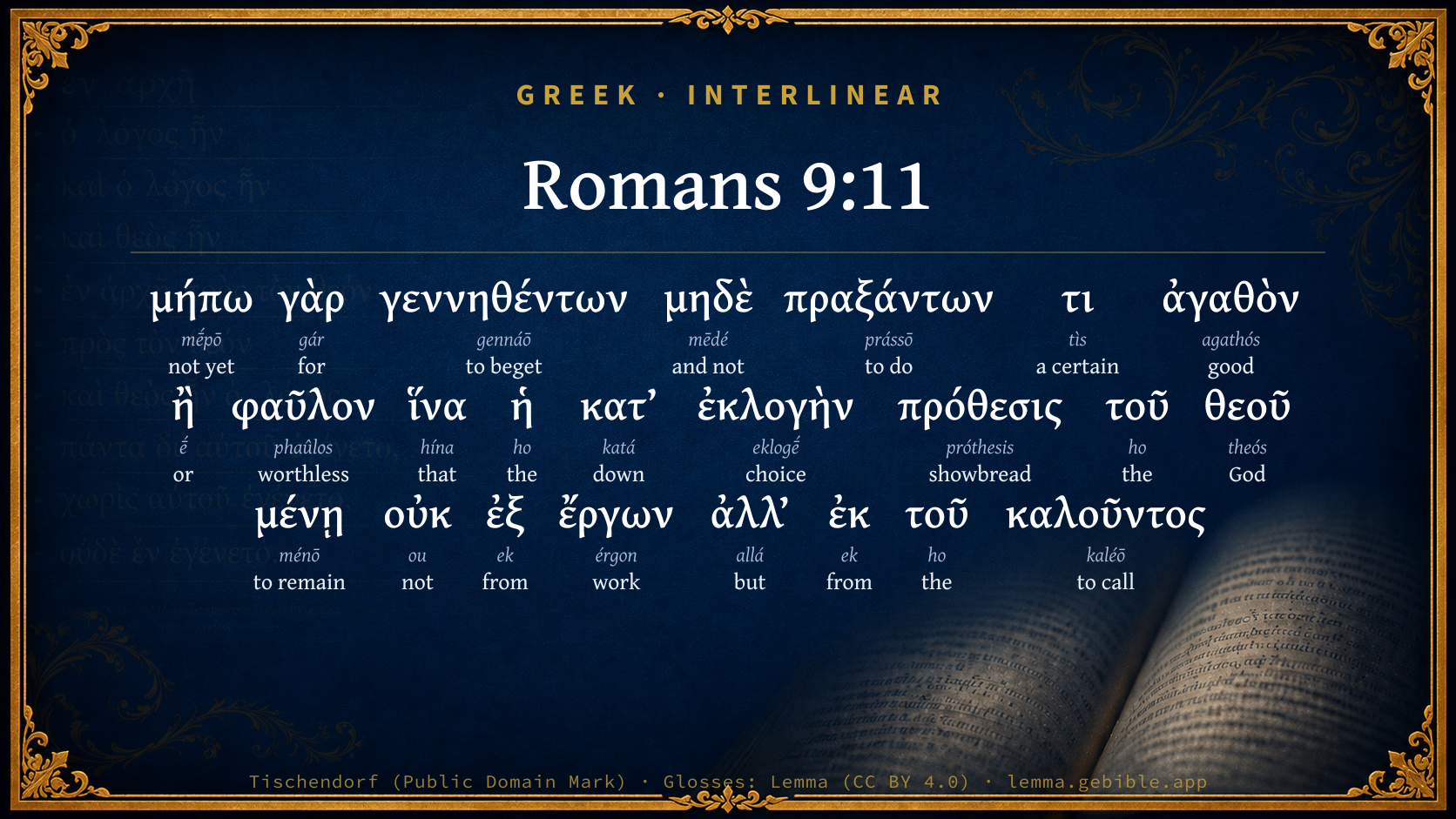
Greek (Tischendorf 8th ed.) Romans 9:11 appears in the Greek New Testament. The text above is from the Tischendorf 8th edition. Each word links to its Strong’s number and a concise gloss. Click any word for its full Thayer’s Greek Lexicon entry.
Download image
Cite this verse

Romans 9:11 (World English Bible). Public Domain. Lemma interlinear Bible study tool, https://lemma.gebible.app/v/romans/9/11.

Show BibTeX & RIS
BibTeX
RIS
English Translation
For being not yet born, neither having done anything good or bad, that the purpose of God according to election might stand, not of works, but of him who calls,
World English Bible · Public Domain
Highlights
  • 1 first appearance in the Greek New Testament
Full analysis ↓
Download a study sheet

One document with this verse’s original text, its word-by-word gloss line, the meaning frame, cross-references with their text, attributed commentary, and full source and license credits — printable, and it pastes into notes with its structure intact.

This verse Autodidact and up

Study sheet (.html) Plain text (.txt)

A passage Seminary Student

Up to 50 verses in one chapter. A passage sheet keeps up to 6 commentary sources and 12 cross-references per verse, in the order this page ranks them, and says so on the sheet whenever that leaves anything out. Ask for a single verse and you get the Autodidact verse sheet above.

Everything on this page stays free to read, with no account — the sheet is a download of what is already on screen, not access to it.

Want to remove ads? Support Godless Engineer
Compare translations 3

The same verse in 3 English versions, stacked beneath the original-language interlinear above. Click any original word for its lexicon entry.

Each is an independent rendering of the whole verse — the interlinear is not word-aligned to these translations.

Highlighted words mark where these versions differ — a whole-verse word diff, not a word-by-word alignment.

  • World English Bible Public Domain
    For being not yet born, neither having done anything good or bad, that the purpose of God according to election might stand, not of works, but of him who calls,
  • King James Version Public Domain
    (For the children being not yet born, neither having done any good or evil, that the purpose of God according to election might stand, not of works, but of him that calleth;)
  • unfoldingWord Literal Text CC BY-SA 4.0
    for not yet having been born, nor indeed having done anything good or bad, so that the purpose of God according to election might endure,

unfoldingWord Literal Text — © unfoldingWord, licensed CC BY-SA 4.0. Word-aligned USFM3 via Door43 (git.door43.org/unfoldingWord/en_ult).

Versions to compare (up to 4)

3 of 4 selected

Show all 19 translations

Every available English version of this verse, each an independent rendering of the whole verse.

  • World English Bible Public Domain
    For being not yet born, neither having done anything good or bad, that the purpose of God according to election might stand, not of works, but of him who calls,
  • Berean Standard Bible Public Domain
    Yet before the twins were born or had done anything good or bad, in order that God’s plan of election might stand,
  • Majority Standard Bible Public Domain
    Yet before the twins were born or had done anything good or evil, in order that God’s plan of election might stand,
  • King James Version Public Domain
    (For the children being not yet born, neither having done any good or evil, that the purpose of God according to election might stand, not of works, but of him that calleth;)
  • American Standard Version (1901) Public Domain
    for `the children' being not yet born, neither having done anything good or bad, that the purpose of God according to election might stand, not of works, but of him that calleth,
  • Revised Version (1885) Public Domain
    for the children being not yet born, neither having done anything good or bad, that the purpose of God according to election might stand, not of works, but of him that calleth,
  • Geneva Bible (1599) Public Domain
    For yer the children were borne, and when they had neither done good, nor euill (that the purpose of God might remaine according to election, not by workes, but by him that calleth)
  • Douay-Rheims (1899) Public Domain
    For when the children were not yet born, nor had done any good or evil (that the purpose of God, according to election, might stand,)
  • Young's Literal Translation Public Domain
    (for they being not yet born, neither having done anything good or evil, that the purpose of God, according to choice, might remain; not of works, but of Him who is calling,) it was said to her --
  • Literal Standard Version CC BY-SA 4.0
    (for they being not yet born, neither having done anything good or evil, that the purpose of God, according to [divine] selection, might remain; not of works, but of Him who is calling),
  • Unlocked Literal Bible CC BY-SA 4.0
    for the children were not yet born and had not yet done anything good or bad, so that the purpose of God according to choice might stand, not because of actions, but because of him who calls—
  • unfoldingWord Literal Text CC BY-SA 4.0
    for not yet having been born, nor indeed having done anything good or bad, so that the purpose of God according to election might endure,
  • Darby Bible Public Domain
    [the children] indeed being not yet born, or having done anything good or worthless (that the purpose of God according to election might abide, not of works, but of him that calls),
  • World Messianic Bible Public Domain
    For being not yet born, neither having done anything good or bad, that the purpose of God according to election might stand, not of works, but of him who calls,
  • Webster's Bible Public Domain
    (For the children being not yet born, neither having done any good or evil, that the purpose of God, according to election might stand, not of works, but of him that calleth)
  • Free Bible Version CC BY-SA 4.0
    But even before the children were born, and before they'd done anything right or wrong (so that God's purpose could continue, proving God's calling of people is not based on human performance),
  • Bible in Basic English Public Domain
    Before the children had come into existence, or had done anything good or bad, in order that God's purpose and his selection might be effected, not by works, but by him whose purpose it is,
  • Text-Critical English NT CC BY 4.0
    though her sons were not yet born and had done nothing good or evil, in order for the purpose of God's choice to stand (not because of works but because of him who calls),
  • Tyndale New Testament (1534) Public Domain
    yeer the chyldren were borne when they had nether done good nether bad: that the purpose of God which is by election myght stonde it was sayde vnto her not by the reason of workes but by grace of the caller:

Literal Standard Version (2020), Covenant Press — licensed CC BY-SA 4.0. Text via the HelloAO Bible API (eBible.org). Unlocked Literal Bible (unfoldingWord) — licensed CC BY-SA 4.0. Text via the HelloAO Bible API (eBible.org). unfoldingWord Literal Text — © unfoldingWord, licensed CC BY-SA 4.0. Word-aligned USFM3 via Door43 (git.door43.org/unfoldingWord/en_ult). Free Bible Version, Dr. Jonathan Gallagher — licensed CC BY-SA 4.0. Text via the HelloAO Bible API (eBible.org).

Word by word

More ways to search: Search by grammar → Find every occurrence → Compare this word →

Practice this passage: Drill this verse → Learn its vocabulary →

μήπω
mḗpō
G3380
“not yet”
Adverb, Negative
Part of Speech
Adverb
Degree
Negative
Full Thayer's Definition

Origin: from G3361 and G4452

TDNT: None

1. not yet
  1. γὰρ gár G1063 “for” Conjunction
  2. γεννηθέντων gennáō G1080 “to beget” Verb, Aorist, Passive, Participle, Genitive, Plural, Masculine
  3. μηδὲ mēdé G3366 “and not” Conjunction, Negative
  4. πραξάντων prássō G4238 “to do” Verb, Aorist, Active, Participle, Genitive, Plural, Masculine
  5. τι tìs G5100 “a certain” Indefinite pronoun, Accusative, Singular, Neuter
  6. ἀγαθὸν agathós G18 “good” Adjective, Accusative, Singular, Neuter
  7. ἢ ḗ G2228 “or” Particle
  8. φαῦλον phaûlos G5337 “worthless” Adjective, Accusative, Singular, Neuter
  9. ἵνα hína G2443 “that” Conjunction
  10. ἡ ho G3588 “the” Article, Nominative, Singular, Feminine
  11. κατ’ katá G2596 “down” Preposition
  12. ἐκλογὴν eklogḗ G1589 “choice” Noun, Accusative, Singular, Feminine
  13. πρόθεσις próthesis G4286 “showbread” Noun, Nominative, Singular, Feminine
  14. τοῦ ho G3588 “the” Article, Genitive, Singular, Masculine
  15. θεοῦ theós G2316 “God” Noun, Genitive, Singular, Masculine
  16. μένῃ ménō G3306 “to remain” Verb, Present, Active, Subjunctive, 3rd person, Singular
  17. οὐκ ou G3756 “not” Particle, Negative
  18. ἐξ ek G1537 “from” Preposition
  19. ἔργων érgon G2041 “work” Noun, Genitive, Plural, Neuter
  20. ἀλλ’ allá G235 “but” Conjunction
  21. ἐκ ek G1537 “from” Preposition
  22. τοῦ ho G3588 “the” Article, Genitive, Singular, Masculine
  23. καλοῦντος kaléō G2564 “to call” Verb, Present, Active, Participle, Genitive, Singular, Masculine

About this verse

These counts appear in no published source. They are computed here, from the morphology-tagged text and Lemma’s own curated glosses. What Lemma adds →

24
words
21
distinct lemmas
Pauline Epistles
section

Notable vocabulary

The rarest word here is μήπω not yet G3380 — appearing just 2 times in the whole Greek New Testament.

First appearance in Scripture

This word makes its first canonical appearance in the Greek New Testament here:

Shared distinctive vocabulary

μήπω not yet G3380 occurs in 2 verses of the Greek New Testament. Also found in:
Repetition

Words recur within this verse:

Cross-references

21

Topical passages linked to Romans 9:11 in the Treasury of Scripture Knowledge — connected by theme and wording, ordered by reader-vote popularity; previews shown in the World English Bible.

  • 2 Timothy 1:9 who saved us and called us with a holy calling, not according to our works, but according to his own purpose and grace, which was given to us in Christ Jesus before times eternal,
  • Ephesians 1:4–5 even as he chose us in him before the foundation of the world, that we would be holy and without blemish before him in love;
  • 2 Peter 1:10 Therefore, brothers, be more diligent to make your calling and election sure. For if you do these things, you will never stumble.
  • Romans 8:28–30 We know that all things work together for good for those who love God, to those who are called according to his purpose.
  • Ephesians 1:9–11 making known to us the mystery of his will, according to his good pleasure which he purposed in him
  • Titus 3:5 not by works of righteousness, which we did ourselves, but according to his mercy, he saved us, through the washing of regeneration and renewing by the Holy Spirit,
  • Isaiah 14:24 Yahweh of Hosts has sworn, saying, Surely, as I have thought, so shall it happen; and as I have purposed, so shall it stand:
  • Romans 11:5–7 Even so then at this present time also there is a remnant according to the election of grace.
  • 2 Thessalonians 2:13–14 But we are bound to always give thanks to God for you, brothers loved by the Lord, because God chose you from the beginning for salvation through sanctification of the Spirit and belief in the truth;
  • 1 Peter 5:10 But may the God of all grace, who called you to his eternal glory by Christ Jesus, after you have suffered a little while, perfect, establish, strengthen, and settle you.
  • Revelation 17:14 These will war against the Lamb, and the Lamb will overcome them, for he is Lord of lords, and King of kings. They also will overcome who are with him, called and chosen and faithful."
  • Romans 4:17 As it is written, "I have made you a father of many nations." This is in the presence of him whom he believed: God, who gives life to the dead, and calls the things that are not, as though they were.
  • Psalms 51:5 Behold, I was brought forth in iniquity. In sin my mother conceived me.
  • Isaiah 14:26–27 This is the purpose that is purposed on the whole earth; and this is the hand that is stretched out on all the nations.
  • Isaiah 46:10–11 declaring the end from the beginning, and from ancient times things that are not [yet] done; saying, My counsel shall stand, and I will do all my pleasure;
  • Ephesians 2:9 not of works, that no one would boast.
  • Isaiah 23:9 Yahweh of hosts has purposed it, to stain the pride of all glory, to bring into contempt all the honorable of the earth.
  • Ephesians 2:3 among whom we also all once lived in the lust of our flesh, doing the desires of the flesh and of the mind, and were by nature children of wrath, even as the rest.
  • 1 Thessalonians 1:4 We know, brothers loved by God, that you are chosen,
  • Ephesians 3:11 according to the eternal purpose which he purposed in Christ Jesus our Lord;
  • 1 Thessalonians 2:12 to the end that you should walk worthily of God, who calls you into his own Kingdom and glory.

Cross-references courtesy of OpenBible.info (CC BY 4.0).

Commentary

Notes on Romans 9:11 from classic Christian and Jewish commentators (each source and its license shown beneath its notes). The classic Christian expositions comment on the surrounding passage and are grouped to its opening verse, so a note may address several verses; the Jewish commentaries on the Tanakh (Rashi and others) are per-verse, so they appear only where the commentator wrote on this verse.

Lemma curates 59 commentaries, every one of them public domain or Creative Commons licensed, each selected and text-cleaned for this edition rather than reprinted as found. About our sources →

Bengel's Gnomon

Johann Albrecht Bengel

Rom 9:11. Μήπω γεννηθέντων, when they were not yet born) Carnal descent profiteth nothing, Joh 1:13.—μηδὲ πραξάντων, and when they had done nothing) This is added, because some one might think as to Ishmael, that he was driven out, not so much because he was the son of a bondmaid, as because he was a mocker; although this slave-like scurrility afterwards shows itself in [lays hold of] the son of the bondmaid, so that he [מצחק, and κακόζηλος τοῦ יצחק] laughs and mocks at Isaac, whom he envies and insults.—κατʼ ἐκλογὴι) The purpose, which is quite free, has its reason founded on election alone; comp. κατὰ ch. Rom 16:25; Tit 1:9. It might be said, in Latin, propositum Dei electivum, the elective purpose of God.—μένῃ, might stand [remain]) incapable of being set aside. It is presupposed that the πρόθεσιν, the purpose, is prior to the, might stand.—οὐκ ἐξ ἔργων, not of works) not even of works foreseen. Observe, it is not faith, which is opposed to election, but works.—ἐκ τοῦ καλοῦντος, of Him that calleth) even Him, who called Jacob to be the superior, Esau to be the servant: comp. Rom 9:25.

Bengel's Gnomon of the New Testament — English translation (T&T Clark, Edinburgh, 1860) — public domain. Text from a community e-Sword module.

Meyer's Critical & Exegetical Commentary

Heinrich August Wilhelm Meyer

Rom_9:11-12. Although, forsooth, they were not yet born, and had not done anything good or evil, in order that the purpose of God according to election might have its continued subsistence, not from works, but from Him who calls, it was said to her, etc.

μήπω] not οὔπω, because the negative relation is intended to be expressed subjectively, that is, as placed before the view of God and weighed by Him in delivering His utterance. See Winer, p. 450 [E. T. 608]; Baeumlein, Partik. p. 295. Comp. Xen. Cyr. iii. 1. 37.

The subject (αὐτῶν) to the participles is not expressed, according to a well-known classical usage (Matthiae, § 563; Kühner, ad Xen. Anab. i. 2. 17), but it would be self-evident to the reader from the history familiar to him, that the twins of Rebecca were intended; Winer, p. 548 [E. T. 736].

The sentence expressive of purpose, ἵνα … καλοῦντος, is placed with emphasis before ἐῤῥέθη, and therefore not to be placed in a parenthesis.

ἵνα] introduces the purpose which God had in this, that, notwithstanding they were not yet born, etc., He yet gave forth already the declaration of Rom_9:12. He thereby purposed, namely, that His resolveconceived in the mode of an election made amongst mento bestow the blessings of the Messianic salvation should subsist, etc.

ἡ κατʼ ἐκλογ. πρόθεσις] can neither be so taken, that the ἐκλογή precedes the πρόθεσις in point of time (comp. Rom_8:28), which is opposed to the nature of the relation, especially seeing that the πρόθεσις pertains to what was antecedent to time (see on Rom_8:28); nor so that the ἐκλογή follows the πρόθεσις, whether it be regarded as the act of its fulfilment (Reiche) or as its aim (Krehl). These latter interpretations might certainly be justified linguistically (see Kühner, II. 1, pp. 412, 413), but they would yield no specific peculiarity of the act of the πρόθεσις. Yet, since ΚΑΤʼ ἘΚΛΟΓΉΝ must be the characteristically distinctive mark of the purpose, it cannot by any means denote: the resolution adopted in respect of an election (Grotius, Rückert); but it must be apprehended as an essential inherent of the πρόθεσις, expressing the modal character of this divine act: the purpose according to election, i.e. the purpose which was so formed, that in it an election was made. The πρόθεσις would have been no πρόθ. κατʼ ἐκλογήν, no propositum Dei electivum (Bengel), if God had resolved to bless all without exception. His resolve to vouchsafe the Messianic blessedness did not, however, concern all, but those only who were to be comprehended in this very resolve (by virtue of His πρόγνωσις, Rom_8:29), and who were thereby, by means of the ΠΡΌΘΕΣΙς itself, chosen out from the rest of men (Rom_11:5), and thus the πρόθεσις was no other than Ἡ ΚΑΤʼ ἘΚΛΟΓῊΝ ΠΡΌΘΕΣΙς (comp. Bengel, Flatt, Tholuck, Beck, Fritzsche, Philippi, Lamping). In a linguistic aspect ΚΑΤʼ ἘΚΛΟΓ. (frequently in Polybius, see Raphel) comes under the same category with the well-known expressions ΚΑΤᾺ ΚΡΆΤΟς, ΚΑΘʼ ὙΠΕΡΒΟΛΉΝ Κ.Τ.Λ. (Bornem. ad Cyrop. i. 4. 23; Bernhardy, p. 241). Comp. Rom_11:21; 1Ti_6:3. But it is incorrect to alter, with Carpzov, Ernesti, Cramer, Böhme, Ammon, Rosenmüller, the signification of ἐκλ., and to explain Ἡ ΚΑΤʼ ἘΚΛ. ΠΡΌΘ. as propositum Dei liberum. For, as election and freedom are in themselves different conceptions, so in those passages which are appealed to (Joseph. Bell. Jud. ii. 8. 14; Psalt. Sal. ix. 7), ἐκλ. is none other than electio; and especially in the N. T. ἐκλογή, ἐκλέγεσθαι, and ἘΚΛΕΚΤΌς are so statedly used for the dogmatic sense of the election to salvation, that no alteration can be admitted. In general, Hofmann has rightly understood it of the quality, which the purpose has from the fact that God chooses; along with which, however, he likewise transposes the notion of the ἐκλογή into that of the free act of will, which has its presupposition only in the chooser, not on the side of the chosen. This anticipates the following, which, moreover, joins itself not to ἐκλογή, but to the abiding of the ΚΑΤʼ ἘΚΛ. ΠΡΌΘΕΣΙς; hence ἘΚΛΟΓΉ must be left in its strict verbal sense of election. The ἐκλογή may in and by itself be even an unfree act of will; its freedom does not lie in the notion in itself, but it is only to be inferred mediately from what is further to be said of the ΜΈΝΕΙΝ of the ΚΑΤʼ ἘΚΛ. ΠΡΌΘΕΣΙς, viz. ΟὐΚ ἘΞ ἜΡΓΩΝ Κ.Τ.Λ.

ΜΈΝῌ] The opposite of ἘΚΠΈΠΤΩΚΕΝ, Rom_9:6. Comp. Xen. Anab. ii. 3. 24; Eurip. Iph. T. 959; Herod. iv. 201. It is the result aimed at in such a declaration as God caused to be given to Rebecca before the birth of her two sons: His purpose according to election is meant to remain unchangeable, etc., so much He would have to be settled in His giving that declaration.

οὐκ ἐξ ἔργων κ.τ.λ.] is by most joined, through a supplied ΟὖΣΑ, to ΠΡΌΘΕΣΙς Τ. ΘΕΟῦ; by Fritzsche regarded even as a supplementary definition to κατʼ ἐκλογήν, in which he is followed by Lamping, as though Paul had written ἡ οὐκ ἐξ ἔργων κ.τ.λ. But for rejecting the natural and nearest connection with μένῃ there is absolutely no ground from the sense which thus results: the elective resolution must have its abiding character not on account of works, which the subjects concerned would perform, but on account of God Himself, who calls to the Messianic salvation. Accordingly, ΟὐΚ ἘΞ ἜΡΓΩΝ Κ.Τ.Λ. is a causal specification annexed to thein itself independent

ΜΈΝῌ, namely, of its objective actual relation (hence Οὐ, not ΜΉ), and should be separated from ΜΈΝῌ by a comma (Paul might more formally have written: ΚΑῚ ΤΟῦΤΟ ΟὐΚ ἘΞ ἜΡΓΩΝ Κ.Τ.Λ.). Hence the objection that ΜΈΝΕΙΝ ἘΚ is not found is of no importance, since ΜΈΝῌ in itself stands absolutely, and ἘΚ is constantly employed in the sense of by virtue of, by reason of. See Bernhardy, p. 230; Ellendt, Lex. Soph. I. p. 551.

On the form ἘῤῬΈΘΗ, which, instead of the Recepta ἘῤῬΉΘΗ, is to be adopted with Lachmann and Tischendorf, following the preponderance of testimony, in all passages in Paul, see on Mat_5:21, and Kühner, I. p. 810 f.

The quotation is Gen_25:23, closely following the LXX.; ὅτι forms no part of it, but is recitative. In the connection of the original text, ὁ μείζων and Ὁ ἘΛΆΣς., the greater and the smaller, refer to the two nations represented by the elder and younger twin sons, of which they were to be ancestors; and this prediction was fulfilled first under David, who conquered the Edomites (2Sa_8:14); then, after they had freed themselves in the time of Joram (2Ki_8:21), under Amaziah (2Ki_14:7; 2Ch_25:11) and Uzziah (2Ki_14:22; 2Ch_26:2), who again reduced them to slavery; and lastly, after they had once more broken loose in the time of Ahaz (2Ch_28:17; according to 2Ki_16:6, they had merely wrested the port of Elath from the Jews), under Johannes Hyrcanus, who completely vanquished them, forced them to be circumcised, and incorporated them in the Jewish state (Joseph. Ant. xiii. 9. 1). Paul, however, has in view, as the entire context Rom_9:10-11; Rom_9:13 evinces, in ὁ μείζ. and Τῷ ἘΛΆΣς., Esau and Jacob themselves, not their nations; so that the fulfilment of the δουλ. is to be found in the theocratic subjection into which Esau was reduced through the loss of his birthright and of the paternal blessing, whereby the theocratic lordship passed to Jacob. But inasmuch as in Gen. l.c. the two brothers are set forth as representatives of the nations, and their persons and their destiny are not consequently excluded,as, indeed, the relation indicated in the divine utterance took its beginning with the brothers themselves, by virtue of the preference of Jacob through the paternal blessing (Gen_27:29; Gen_27:37; Gen_27:40),the apostles apprehension of the passage, as he adapts it to his connection, has its ground and its warrant, especially in view of similar hermeneutic freedom in the use of O. T. expressions.

ὁ μείζων and Τῷ ἘΛΆΣς. have neither in the original nor in Greek the signification: the first-born and the second-born, which indeed the words do not denote; but Esau, who is to come to birth first, is regarded as the greater of the twins in the womb, and Jacob as the smaller.

Meyer — Critical and Exegetical Commentary on the New Testament — English translation by Peter Christie, edited by Frederick Crombie (T&T Clark, 1880) — public domain. Text from a community e-Sword module.

Expositor's Greek Testament

ed. W. Robertson Nicoll

Rom 9:11 . μήπω γὰρ γεννηθέντων μηδὲ πραξάντων : “the conditional negatives ( μήπω , μηδὲ ) represent the circumstances not as mere facts of history, but as conditions entering into God’s counsel and plan. The time of the prediction was thus chosen, in order to make it clear that He Who calls men to be heirs of His salvation makes free choice of whom He will, unfettered by any claims of birth or merit” (Gifford). πρόθεσις in this theological sense is a specially Pauline word. The purpose it describes is universal in its bearings, for it is the purpose of One who works all things according to the counsel of His will, Eph 1:11 ; it is eternal, a πρόθεσις τῶν αἰώνων , Eph 3:11 ; it is God’s ἰδία πρόθεσις , 2Ti 1:9 , a purpose, the meaning, contents, and end of which find their explanation in God alone; it is a purpose κατʼ ἐκλογήν , i.e. , the carrying of it out involves choice and discrimination between man and man, and between race and race; and in spite of the side of mystery which, belongs to such a conception, it is a perfectly intelligible purpose, for it is described as πρόθεσις ἣν ἐποίησεν ἐν Χριστῷ Ἰησοῦ , and what God means by Christ Jesus no one can doubt. God’s eternal purpose, the purpose carried out κατʼ ἐκλογὴν , yet embracing the universe, is clearly revealed in His Son. The permanent determining element, wherever this purpose is concerned, is not the works of men, but the will and call of God; and to make this plain was the intention of God in speaking as He did, and when He did, to Rebecca about her children. If we look to Gen 25:23 , it is indisputably the nations of Israel and Edom that are referred to: “Two nations are in thy womb, and two manner of peoples shall be separated from thy bowels; and the one people shall be stronger than the other people, and the elder shall serve the younger”. The same is true also of Mal 1:2 : “I loved Jacob, but Esau I hated, and made his mountains a desolation,” etc. Yet it would not be right to say that Paul is here considering merely the parts assigned by God to nations in the drama of providence; He is obviously thinking of Jacob and Esau as individuals, whose own relation to God’s promise and inheritance (involving no doubt that of their posterity) was determined by God before they were born or had done either good or ill. On the other hand, it would not be right to say that Paul here refers the eternal salvation or perdition of individuals to an absolute decree of God which has no relation to what they are or do, but rests simply on His inscrutable will. He is engaged in precluding the idea that man can have claims of right against God, and with it the idea that the exclusion of the mass of Israel from the Messiah’s kingdom convicts God of breach of faith toward the children of Abraham; and this He can do quite effectually, on the lines indicated, without consciously facing this tremendous hypothesis.

The Expositor's Greek Testament, edited by W. Robertson Nicoll (1897–1910) — public domain. Text from a community e-Sword module.

International Critical Commentary

11. μήπω γάρ, κ.τ.λ. In this verse a new thought is introduced, connected with but not absolutely necessary for the subject under discussion. The argument would be quite complete without it. St. Paul has only to prove that to be of Jewish descent did not in itself imply a right to inherit the promise. That Esau was rejected and Jacob chosen is quite sufficient to establish this. But the instance suggests another point which was in the Apostle’s mind, and the change in construction shows that a new difficulty, or rather another side of the question—the relation of these events to the Divine purpose—has come forward. It is because he desires to bring in this point that he breaks off the previous sentence. The γάρ then, as so often, refers to something latent in the Apostle’s mind, which leads him to introduce his new point, and is explained by the sentence ἵνα … μένῃ, ‘and this incident shows also the absolute freedom of the Divine election and purpose, for it was before the children were born that the choice was made and declared.’

μήπω … μηδέ: ‘although they were not yet born nor had done anything good or evil.’ The subjective negative shows that the note of time is introduced not merely as an historical fact but as one of the conditions which must be presumed in estimating the significance of the event. The story is so well known that the Apostle is able to put first without explanation the facts which show the point as he conceives it.

ἵνα … μένῃ. What is really the underlying principle of the action is expressed as if it were its logical purpose; for St. Paul represents the events as taking place in the way they did in order to illustrate the perfect freedom of the Divine purpose.

ἡ κατʼ ἐκλογὴν πρόθεσις τοῦ Θεοῦ: ‘the Divine purpose which has worked on the principle of selection.’ These words are the key to chaps. 9-11 and suggest the solution of the problem before St. Paul. πρόθεσις is a technical Pauline term occurring although not frequently in the three later groups of Epistles: Rom 8:28; Rom 9:11; Eph 1:10, Eph 1:11 ἐν αὐτῷ, ἐν ᾧ καὶ ἐκληρώθημεν, προορισθέντες κατὰ πρόθεσιν τοῦ τὰ πάντα ἐνεργοῦντος κατὰ τὴν βουλὴν τοῦ θελήματος αὐτοῦ: 3:11 κατὰ πρόθεσιν τῶν αἰώνων ἣν ἐποίησεν ἐν τῷ Χ. Ἰ. τῷ Κυρίῳ ἡμῶν: 2Ti 1:9 τοῦ σώσαντος ἡμᾶς καὶ καλέσαντος κλήσει ἁγίᾳ, οὐ κατὰ τὰ ἔργα ἡμῶν, ἀλλὰ κατʼ ἰδίαν πρόθεσιν καὶ χάριν: the verb also is found once in the same sense, Eph 1:9 κατὰ τὴν εὐδοκίαν αὐτοῦ, ἥν προέθετο ἐν αὐτῷ. From Aristotle onwards πρόθεσις had been used to express purpose; with St. Paul it is the ‘Divine purpose of God for the salvation of mankind,’ the ‘purpose of the ages’ determined in the Divine mind before the creation of the world. The idea is apparently expressed elsewhere in the N. T. by βουλή (Luk 7:30; Act 2:23; Act 4:28; Act 20:27) which occurs once in St. Paul (Eph 1:11), but no previous instance of the word πρόθεσις in this sense seems to be quoted. The conception is worked out by the Apostle with greater force and originality than by any previous writer, and hence he needs a new word to express it. See further the longer note on St. Paul’s Philosophy of History, p. 342. ἐκλογή expresses an essentially O. T. idea (see below) but was itself a new word, the only instances quoted in Jewish literature earlier than this Epistle being from the Psalms of Solomon, which often show an approach to Christian theological language. It means (1) ‘the process of choice,’ ‘election.’ Ps. Sol. 18:6 καθαρίσαι ὁ Θεὸς Ἰσραὴλ εἰς ἡμέραν ἐλέου ἐν εὐλογίᾳ, εἰς ἡμέραν ἐκλογῆς ἐν ἀνάξει Χριστοῦ αὐτοῦ; 9:7; Jos. B. J. II. viii. 14; Act 9:15; Rom 11:5, Rom 11:28; 1Th 1:4; 2Pe 1:10. In this sense it may be used of man’s election of his own lot (as in Josephus and perhaps in Ps. Sol. 9:7), but in the N. T. it is always used of God’s election. (2) As abstract for concrete it means ἐκλεκτοί, those who are chosen, Rom 11:7. (3) In Aquila Isa 22:7; Symmachus and Theodotion, Isa 37:24, it means ‘the choicest,’ being apparently employed to represent the Hebrew idiom.

μένῃ: the opposite to ἐκπέπτωκεν (ver. 6): the subjunctive shows that the principles which acted then are still in force.

οὐκ ἐξ ἔργων ἀλλʼ ἐκ τοῦ καλοῦντος. These words qualify the whole sentence and are added to make more clear the absolute character of God’s free choice.

We must notice (1) that St. Paul never here says anything about the principle on which the call is made; all he says is that it is not the result of ἔργα. We have no right either with Chrysostom (ἵνα φανῇ φησὶ τοῦ Θεοῦ ἡ ἐκλογὴ ἡ κατὰ πρόθεσιν καὶ πρόγνωσιν γενομένη) to read into the passage foreknowledge or to deduce from the passage an argument against Divine foreknowledge. The words are simply directed against the assumption of human merit. And (2) nothing is said in this passage about anything except ‘election’ or ‘calling’ to the kingdom. The gloss of Calvin dum alios ad salutem praedestinat, alios ad aeternam damnationem is nowhere implied in the text.

So Gore (Studia Biblica, iii. p. 44) ‘The absolute election of Jacob,—the “loving” of Jacob and the “hating” of Esau,—has reference simply to the election of one to higher privileges as head of the chosen race, than the other. It has nothing to do with their eternal salvation. In the original to which St. Paul is referring Esau is simply a synonym for Edom.’

φαῦλον is the reading of the RV. and modern editors with א A B, a few minuscules, and Orig. κακόν which occurs in TR. with D F G K L etc. and Fathers after Chrysostom was early substituted for the less usual word. A similar change has been made in 2Co 5:10.

For the πρόθεσις τοῦ Θεοῦ of the RV. the TR. reads τοῦ Θεοῦ πρόθεσις with the support of only a few minuscules.

International Critical Commentary — older volumes (1896–1929), various authors — public domain. Text from a community e-Sword module.

Hodge's Commentary on Romans, Ephesians & First Corinthians

Charles Hodge

Rom_9:11

For the children being not yet born, neither having done any good or evil, etc. The force of for is clear by a reference to the preceding verse, and the object of the apostle. Not only does the case of Isaac and Ishmael evince the sovereignty of God, but that of Rebecca and her children does the same, in a still more striking manner, for the decision between her children was made previously to their birth, for the very purpose of showing that it was not made on the ground of works, but of the sovereign pleasure of God. This is an example which cannot be evaded. With regard to Ishmael, it might be supposed that either the circumstances of his birth, or his personal character, was the ground of his rejection; but with regard to Esau neither of these suppositions can be made. The circumstances of his birth were identical with those of his favored brother, and the choice was made before either had done any thing good or evil. The case of Ishmael was, indeed, sufficient to prove that having Abraham for a father was not enough to secure the inheritance of the promise, but it could not prove the entire sovereignty of the act of election on the part of God, as is so fully done by that of Jacob and Esau. This passage shows clearly that the design of the apostle is not simply to show that natural descent from Abraham was a title to Messianic blessings, but that works also were excluded; that the choice of God was sovereign.

Neither having done good or evil. The design of the introduction of these words is expressly stated in the next clause. It was to show that the ground of choice was not in them, but in God; and this is the main point in regard to the doctrine of election, whether the choice be to the privileges of the external theocracy, or to the spiritual and eternal blessings of the kingdom of Christ.

That the purpose of God, according to election, might stand. This is the reason why the choice was made prior to birth. The original here admits of various interpretations, which, however, do not materially alter the sense. The word rendered purpose, is that which was used in the previous chapter, Rom_8:28, and means here, as there, a determination of the will, and of itself expresses the idea of its being sovereign, i.e., of having its ground in the divine mind and not in its objects. Hence, in 2Ti_1:9, it is said, Who Hath called us not according to our works, but according to his own purpose, etc., see Eph_1:11; Eph_3:11. The words (κατ ̓ ἐκλογήν) according to election, are designed to fix more definitely the nature of this purpose. The word election often means the act of choice itself, as 1Th_1:4, Knowing, brethren beloved, your election of God. In this sense, the clause means, the purpose of God in reference to election, or in relation to this choice. This view of the passage is perfectly consistent with the context. The choice was made prior to birth, in order that the true nature of the purpose of God in reference to it might appear. It is objected to this interpretation that the ἐκλογή (election) follows the πρόθεσις; (the purpose) and not the reverse. This does not amount to muRomans It relates merely to the order of conception. We can conceive of Gods electing some to eternal life, and then purposing to save them, as well as his purposing to save them and then electing them. The real meaning is expressed by giving κατ ̓ ἐκλογήν an adjective force, the electing purpose, electivum Dei propositum, as Bengel renders it. Others give ἐκλογή here the sense of free choice, or free will. The purpose according to free choice, for, free or sovereign purpose. Many commentators adopt this view of the passage. This is, perhaps the most common interpretation. But as the word does not occur in this sense in the New Testament, the former mode of explanation is perhaps to be preferred. Should stand, i.e. should be established and recognized in its true character, that is, that it might be seen it was not of works, but of him that calleth. This purpose of God, in reference to election, or the choice itself, is not of works, i.e. does not depend on works, but on him that calleth. It is not to be traced to works as its source. That is, as plainly as language can express the idea, the ground of the choice is not in those chosen, but in God who chooses In the same sense our justification is said to be not of works, Gal_2:16, and often; i.e. is not on the ground of works; see Rom_11:6; 2Ti_1:9. The language of the apostle in this verse, and the nature of his argument, are so perfectly plain, that there is little diversity of opinion as to his general meaning. It is almost uniformly admitted that he here teaches that the election spoken of is perfectly sovereign, that the ground on which the choice is made is not in men, but in God. Commentators of every class unite in admitting that the apostle does here teach the sovereignty of God in election. Unde sensus totius loci sic constituitur; ut appareret, quicquid Deus decernit, libere eum decernere non propter hominis meritum, sed pro sua decernentis voluntate. Koppe. Ut benevola Dei voluntas maneret, ut quae non a meritis cujus quam pendeat, sed benefactore ipso. Noesselt. Das der Rathschluss Gottes fest stehe, als ein solcher, der nicht abhange von menschlichen Verdiensten, sondern von dem gnädigen oder freien Willen Gottes. That the degree of God might stand firm, as one which depended not on human merit, but the gracious or free will of God. Flatt. And even Tholuck makes Paul argue thus, Dass wie Gott, ohne Anrechte anzuerkennen, die äussere Theoklatie und mancherlei Vortheile übertrug wem er wollte, er so auch jetzt die innere dem überträgt, oder den darein eingehen lässt welchen er will. That as God, without recognising any claims, committed the external theocracy and manifold advantages to whom he pleased, so also now he commits the internal to whom he will, or allows whom he will to enter it. To the same effect Meyer says, Er wollte nämlich dadurch für immer festsetzen, dass sein zufolge einer Auswahl unter den Menschen eintretender Beschluss, mit den Messianischen Heile zu beglücken, unabhängig sei von menschlichen Leistungen, und nur von seinem, des zuni Messiasheil Berufenden, eigenen Willen dependire. His design was to establish, once for all, (the principle) that his purpose in reference to the choice of those who were to enter the Messiahs kingdom, was independent of human conduct, and was determined by the will of him who calls.

The opposers of the doctrine of personal election endeavor to escape the force of this passage, by saying that the choice of which the apostle speaks, is not to eternal life, but to the external advantages of the theocracy, and that it was not so much individuals as nations or communities which were chosen or rejected. With regard to this latter objection, it may be answered,

1. That the language quoted by the apostle from the Old Testament is there applied to the individuals, Jacob and Esau; and that Jacob, as an individual, was chosen in preference to his brother; and that Pauls whole argument turns on this very point.

2. That the choice of nations involves and consists in the choice of individuals; and that the same objections obviously lie against the choice in the one case as in the other. With regard to the former objection, that the choice here spoken of is to the external theocracy and not to eternal life, it may be answered,

1. Admitting this to be the case, how is the difficulty relieved? Is there any more objection to Gods choosing men to a great than to a small blessing, on the ground of his own good pleasure? The foundation of the objection is not the character of the blessings we are chosen to inherit, but the sovereign nature of the choice. Of course it is not met by making these blessings either greater or less.

2. A choice to the blessings of the theocracy, i.e. of a knowledge and worship of the true God, involved, in a multitude of cases at least, a choice to eternal life; as a choice to the means is a choice to the end. And it is only so far as these advantages were a means to this end, that their value was worth consideration.

3. The whole design and argument of the apostle show that the objection is destitute of force. The object of the whole epistle is to exhibit the method of obtaining access to the Messiahs kingdom. The design here is to show that God is at liberty to choose whom he pleases to be the recipients of the blessings of this kingdom, and that he was not confined in his choice to the descendants of Abraham.

His argument is derived from the historical facts recorded in the Old Testament. As God chose Isaac in preference to Ishmael, and Jacob in preference to Esau, not on the ground of their works, but of his own good pleasure, so now he chooses whom he will to a participation of the blessings of the kingdom of Christ: these blessings are pardon, purity, and eternal life, etc., etc. That such is the apostles argument and doctrine, becomes, if possible, still more plain, from his refutation of the objections urged against it, which are precisely the objections which have ever been urged against the doctrine of election.

Charles Hodge — Commentary on Romans (1835), First Corinthians (1857), and Ephesians (1856) — public domain. Text from a community e-Sword module.

Geneva Bible (1599)

Geneva Bible translators

God’s decree, which proceedeth of his mere good will, whereby it pleased him to choose one, and refuse the other.

Paul saith not, might be made, but being made, might remain. Therefore they are deceived which make foreseen faith the cause of election, and foreknown infidelity, the cause of reprobation.

Geneva Bible (1599) marginal notes — public domain. Text via Bolls.life.

Adam Clarke's Commentary

Verse 11. For the children being not yet born] As the word children is not in the text, the word nations would be more proper; for it is of nations that the apostle speaks, as the following verses show, as well as the history to which he refers.

Neither having done any good] To merit the distinction of being made the peculiar people of God; nor evil, to deserve to be left out of this covenant, and the distinguishing national blessings which it conferred; that the purpose of God according to election might stand-that such distinctions might appear to depend on nothing but God's free choice, not of works, or any desert in the people or nations thus chosen; but of the mere purpose of him who calleth any people he pleases, to make them the depositories of his especial blessings, and thus to distinguish them from all others.

Adam Clarke's Commentary on the Bible (1810–1826) — public domain. Text from a community e-Sword/MySword module.

John Calvin's Commentaries

11. For when the children, etc. He now begins to ascend higher, even to show the cause of this difference, which he teaches us is nowhere else to be found except in the election of God. He had indeed before briefly noticed, that there was a difference between the natural children of Abraham, that though all were adopted by circumcision into a participation of the covenant, yet the grace of God was not effectual in them all; and hence that they, who enjoy the favor of God, are the children of the promise. But how it thus happened, he has been either silent or has obscurely hinted. Now indeed he openly ascribes the whole cause to the election of God, and that gratuitous, and in no way depending on men; so that in the salvation of the godly nothing higher (nihil superius) must be sought than the goodness of God, and nothing higher in the perdition of the reprobate than his just severity.

Then the first proposition is, — “As the blessing of the covenant separates the Israelitic nation from all other people, so the election of God makes a distinction between men in that nation, while he predestinates some to salvation, and others to eternal condemnation.” The second proposition is, — “There is no other basis for this election than the goodness of God alone, and also since the fall of Adam, his mercy; which embraces whom he pleases, without any regard whatever to their works.” The third is, — “The Lord in his gratuitous election is free and exempt from the necessity of imparting equally the same grace to all; but, on the contrary, he passes by whom he wills, and whom he wills he chooses.” All these things Paul briefly includes in one sentence: he then goes on to other things.

Moreover, by these words, When the children had not yet been born, nor had done any good or evil, he shows, that God in making a difference could not have had any regard to works, for they were not yet done. Now they who argue on the other side, and say, that this is no reason why the election of God should not make a difference between men according to the merits of works, for God foresees who those are who by future works would be worthy or unworthy of his grace, are not more clear-sighted than Paul, but stumble at a principle in theology, which ought to be well known to all Christians, namely, that God can see nothing in the corrupt nature of man, such as was in Esau and Jacob, to induce him to manifest his favor. When therefore he says, that neither of them had then done any good or evil, what he took as granted must also be added, — that they were both the children of Adam, by nature sinful, and endued with no particle of righteousness.

I do not dwell thus long on explaining these things, because the meaning of the Apostle is obscure; but as the Sophists, being not content with his plain sense, endeavour to evade it by frivolous distinctions, I wished to show, that Paul was by no means ignorant of those things which they allege.

It may further be said, that though that corruption alone, which is diffused through the whole race of man, is sufficient, before it breaks out, as they say, into action, for condemnation, and hence it follows, that Esau was justly rejected, for he was naturally a child of wrath, it was yet necessary, lest any doubt should remain, as though his condition became worse through any vice or fault, that sins no less than virtues should be excluded. It is indeed true, that the proximate cause of reprobation is the curse we all inherit from Adam; yet, that we may learn to acquiesce in the bare and simple good pleasure of God, Paul withdraws us from this view, until he has established this doctrine, — That God has a sufficiently just reason for electing and for reprobating, in his own will.

That the purpose of God according to election, etc. He speaks of the gratuitous election of God almost in every instance. If works had any place, he ought to have said, — “That his reward might stand through works;” but he mentions the purpose of God, which is included, so to speak, in his own good pleasure alone. And that no ground of dispute might remain on the subject, he has removed all doubt by adding another clause, according to election, and then a third, not through works, but through him who calls. Let us now then apply our minds more closely to this passage: Since the purpose of God according to election is established in this way, — that before the brothers were born, and had done either good or evil, one was rejected and the other chosen; it hence follows, that when any one ascribes the cause of the difference to their works, he thereby subverts the purpose of God. Now, by adding, not through works, but through him who calls, he means, not on account of works, but of the calling only; for he wishes to exclude works altogether. We have then the whole stability of our election inclosed in the purpose of God alone: here merits avail nothing, as they issue in nothing but death; no worthiness is regarded, for there is none; but the goodness of God reigns alone. False then is the dogma, and contrary to God’s word, — that God elects or rejects, as he foresees each to be worthy or unworthy of his favor.

John Calvin's Commentaries (1540-1563) — public domain. Text from the Calvin Translation Society English edition (1840s-50s) via the Christian Classics Ethereal Library (ccel.org). Calvin's coverage is partial (roughly two-thirds of the Bible); uncommented books and verses are honest gaps, never fabricated. The 19th-century editor's footnotes and remarks are omitted so the notes are faithfully Calvin's own voice.

The Cambridge Bible for Schools and Colleges

gen. ed. J. J. S. Perowne

11. being not yet born, &c.] Nothing could go beyond this verse in stating that the reasons of the Divine Choice lie wholly within the Divine Mind, and not in the works and characters of the chosen.

the purpose of God according to election] So according to the best order of the Gr. words. Another order, not so well supported, gives “the purpose according to God’s election.” The meaning is the same in either case.—On “the purpose,” see last note on Rom_8:28.—“According to election”:—i.e. as determined, or characterized, by the sovereign Choice of the Divine Mind. In the case of Esau and Jacob, the “purpose according to election” does not, at least explicitly, mean a purpose of eternal salvation. But St Paul is evidently here treating the Divine Choice in the widest and most absolute respects; and the sovereign gift to Jacob of sacred privileges, determining his whole course and that of his posterity, is thus taken as illustrating the fact of an equally sovereign gift, to “whomsoever God will,” of the capacity to repent, believe, and love. Throughout the argument we must remember who the “elect” are in the grand special case in hand, viz. the “remnant” who actually (not only potentially) are true believers, under both the Old and New Dispensations. See especially Rom_11:2-8.

Election

On the general subject of the Divine Election we may remark,

(1) That “the arguments of the Apostle are founded on two assumptions. The first is, that the Scriptures are the word of God; and the second, that whatever God actually does cannot be unrighteous. Consequently, any objection which can be shewn to militate against either an express declaration of Scripture, or an obvious fact in providence, is fairly answered.” (Dr Hodge, in loc.) It is almost needless to add that such a submission to the Divine Righteousness, while in one sense a surrender of reason, is in another its truest exercise. It is the surrender instinctively yielded by the soul which, conscious of its own sin, lies open to the full impression of the overwhelming purity and majesty of its Creator. It is absolute trust, under complete mystery, in Him who in one respect is truly known, but in another cannot (by the created being) be “found out unto perfection.” See Rom_11:33-36.

(2) It must be remembered that Divine Election affects a world not of righteous beings, nor even of neutral beings, but of “sinners,” “enemies” (ch. Rom_5:8-9.)[41] We come to face its mystery only when we have first faced, and owned, the unfathomable mystery of sin. We see it, not making the good evil, nor the evil arbitrarily worse, but judicially leaving the sinner to himself; (as we are bound to believe every sinner might righteously have been left; for otherwise Salvation would be our Right, not our Mercy;) save in cases—determined by the Divine Mind by reasons within Itself—in which, of mere mercy, a positive and prevailing influence intervenes, producing spiritual life, the life of repentance, faith and love.

[41] The abstruse questions which have been raised in controversy on this point may be fairly said to “intrude into” what lies wholly outside the Scripture Revelation.

(3) This view of the case, which is indeed full of distressing mystery, yet owes what is most distressing in it to the riddle which lies beneath all others connected with it—that of the Existence of Sin at all. But meantime it also assures us that while the will (influenced by sin) is the cause of ruin, it is also the will (influenced by grace) which, acting strictly as the will, lays hold on salvation. In neither case is the will forced, unless indeed we call every influence on the will compulsion, so far as it is successful. The lost “will not come;” the saved come as “whosoever will.” (Joh_5:40; Rev_22:17.)

(4) The doctrine of Election is, in Scripture, never made the foreground of doctrine; and it is always so presented as also to assure us, however little we can reconcile the vast range of spiritual truths, that we are in the hands of Righteousness as well as Power, and that our will, affections, and aspirations, are perfectly real. Lastly, the doctrine, if studied in Scripture, is viewed always from the only safe view-point—the foot of the Cross.—See further, Appendix F.

might stand] i.e., continue to act on its necessary principle—“not of works, but of Him that calleth.”

of works] Based on, or resulting from, “works;” in the largest sense of “works;” actions whose aggregate is character.

calleth] See on Rom_1:6.

The Cambridge Bible for Schools and Colleges (gen. ed. J. J. S. Perowne; Cambridge University Press, 1878–1918) — public domain. Text from a community e-Sword module.

John Gill's Exposition

It was said unto her,.... To Rebecca, Gen 25:23,

the elder shall serve the younger, or "the greater shall serve the lesser", an Hebrew way of speaking; so Japheth is called "the great", or, as we render it, "the elder", Gen 10:21; and the evil imagination is said (i) to be "greater", that is, elder than the good, thirteen years; See Gill on Luk 22:26; The sense is, Esau shall be a servant to Jacob; which is to be understood, not of temporal servitude; for in this sense he never was a servant to him; so far from it, that as soon as Jacob had got the birthright and blessing, he was obliged to flee from the face and fury of Esau; and upon his return after many years, he sent messengers to Esau in a very submissive manner, charging them after this manner, "thus shall ye shall say to my lord Esau, thy servant Jacob saith thus", &c. Gen 32:4, and when he found that his brother was coming to meet him, which threw him into a panic fear, lest he should "smite him, and the mother with the children", Gen 32:11, he prepares presents for him; and when he came to him, bowed himself seven times, and his wives and children bowed likewise; and the language in which he addressed his brother Esau, all the while they were together, was that of "my lord": now if this oracle was to be understood of outward temporal servitude, it is strange it should have no appearance, nor any shadow of an accomplishment in the persons of Jacob and Esau, supposing it was to have one in their posterity; and indeed the completion of it, in this sense, is not very evident in their offspring. It is certain, there was a long train of dukes and kings in Esau's family, before there was any king in Israel; the posterity of Esau were in lordly grandeur and splendour, when the children of Israel were grievously oppressed with hard bondage in Egypt. The single instance usually referred to, when the Edomites became tributaries to David, was near a thousand years after the giving out of this oracle; and this show of servitude did not last long, for in Joram's time they revolted, and so continued; and it is evident, that at the time of the Babylonish captivity, the children of Edom were prosperous and triumphant, and said concerning Jerusalem, "Raze it, raze it, even to the foundation thereof", Psa 137:7, this servitude therefore is to be understood in a spiritual sense, of Esau's exclusion from the favour of God, and blessings of grace, signified by his being rejected from inheriting the blessing, which was given to Jacob; and it appeared that he was not a son, but a servant, by his departure, and pitching his dwelling elsewhere; which showed he had no interest in spiritual adoption, no right to the covenant of grace, nor was he an heir of heaven, all which were peculiar to Jacob: Esau was a servant of sin, under the dominion of it, and in bondage to it; whilst Jacob was the Lord's freeman, and, as a prince, had power with God and with men, and prevailed: Esau was serviceable to Jacob, both in things temporal and spiritual; as reprobates are to the elect, for all things are for their sakes, and work together for their good; Jacob's being obliged to flee from his brother, was for his good; by this means he got him a suitable wife, and large substance: his brother's meeting him on his return, which gave him so much pain and uneasiness, issued in his spiritual good; this sent him to the throne of grace, to humble himself before God, acknowledge his mercies, and his dependence on him, to implore his help, and plead his promises; and thus the oracle was verified in the persons of Jacob and Esau.

(i) Midrash Kohelet, fol. 80. 1.

John Gill's Exposition of the Whole Bible (1746–1763) — public domain (CC PDM 1.0). Text via the HelloAO Bible API.

Trapp's Complete Commentary

John Trapp

11 (For the children being not yet born, neither having done any good or evil, that the purpose of God according to election might stand, not of works, but of him that calleth;)

Ver. 11. For the children, &c.] Here the apostle wadeth into that profundum sine fundo, bottomless subject, predestination.

Being not yet born] Sapores son of Misdates, king of Persia, began his reign before his life. For his father dying, left his mother with child, and the Persian nobility set the crown on his mother’s belly, acknowledging thereby her issue for their prince, before she as yet had felt herself quick. God elects not of foreseen faith or works, but of free grace.

John Trapp, A Commentary or Exposition upon All the Books of the Old and New Testament (1647–1656) — public domain. Text from a community e-Sword module.

Albert Barnes' Notes on the Bible

For the children being not yet born - It was not, therefore, by any works of theirs. It was not because they had formed a character and manifested qualities which made this distinction proper. It was laid back of any such character, and therefore had its foundation in the purpose or plan of God.

Neither having done any good or evil - That is, when the declaration Rom 9:12 was made to Rebecca. This is a very important passage in regard to the question about the purposes of God.

(1) They had done nothing good or bad; and when that is the case, there can be, properly speaking, no moral character, for “a character is not formed when the person has not acquired stable and distinctive qualities.” Webster.

(2) That the period of moral agency had not yet commenced; compare Gen 25:22-23. When that agency commences, we do not know; but here is a case of which it is alarmed that it had not commenced.

(3) The purpose of God is antecedent to the formation of character, or the performance of any actions, good or bad.

(4) It is not a purpose formed because he sees anything in the individuals as a ground for his choice, but for some reason which he has not explained, and which in the Scripture is simply called purpose and good pleasure; Eph 1:5.

(5) If it existed in this case, it does in others. If it was right then, it is now. And if God then dispensed his favors on this principle, he will now. But,

(6) This affirmation respecting Jacob and Esau does not prove that they had not a nature inclined to evil; or a corrupt and sensual propensity; or that they would not sin as soon as they became moral agents. It proves merely that they had not yet committed actual sin. That they, as well as all others, would certainly sin as soon as they committed moral acts at all, is proved everywhere in the Sacred Scriptures.

The purpose of God - Note, Rom 8:28.

According to election - To dispense his favors according to his sovereign will and pleasure. Those favors were not conferred in consequence of the merits of the individuals; but according to a wise plan “lying back” of the formation of their characters, and before they had done good or evil. The favors were thus conferred according to his choice, or election.

Might stand - Might be confirmed; or might be proved to be true. The case shows that God dispenses his favors as a sovereign. The purpose of God was thus proved to have been formed without respect to the merits of either.

Not of works - Not by anything which they had done either to merit his favor or to forfeit it. It was formed on other principles than a reference to their works. So it is in relation to all who shall be saved. God has good reasons for saving those who shall be saved. What the reasons are for choosing some to life, he has not revealed; but he has revealed to us that it is not on account of their works, either performed or foreseen.

But of him that calleth - According to the will and purpose of him that chooses to dispense those favors in this manner. It is not by the merit of man, but it is by a purpose having its origin with God, and formed and executed according to his good pleasure. It is also implied here that it is formed in such a way as to secure his glory as the primary consideration.

Albert Barnes' Notes on the Bible (1834–1885) — public domain. Text from a community e-Sword/MySword module.

Matthew Poole's English Annotations

For the children being not yet born: q.d. As there was nothing in the birth of those twins, so neither in their works, that occasioned the difference that God made between them; for when God spake of what should happen to them, they were unborn, and had done neither good nor evil.

Neither having done any good or evil; he means, actual good or evil, such as might difference them one from another. As for original sin, they were both alike tainted therewith.

That the purpose of God; this purpose of God is to be understood about reprobation, or (if you will) rejection, or preterition, as well as about election.

Might stand; be firm or stable.

Not of works, either done or foreseen.

But of him that calleth; i.e. of the good pleasure and undeserved favour of God, who also effectually calleth those that he hath elected, as Rom 8:30. See a parallel place, 2Ti 1:9.

Matthew Poole's English Annotations on the Holy Bible (1683–1685) — public domain. Text from a community e-Sword/MySword module.

Whedon's Commentary on the Bible

Daniel D. Whedon

11. Neither… done… good or evil—The apostle assumes here, 1. That no child can be responsible for its impulsive acts or emotions before its birth. 2. That no responsibility exists upon man for any thing done in any supposed state of preexistence.

Purpose… according to election— Purpose in regard to election. The purpose of electing is antecedent and eternal, (Eph_1:11;) the act of election under the purpose is in time.

Him that calleth—To works the apostle does not here oppose faith, as we might expect from his usual antithesis, but God himself. Rightly, because faith does, of itself, deny itself to be the cause of salvation, and ascribes all to God. (See note on Rom_3:24.) To be justified by works is to justify ourselves; to be justified by faith is to be justified gratuitously by God—by him that calleth us to that very faith. As condition by us performed, and a means and method by God used, it is right to say in a subordinate sense that faith saves us. But the true, sole, original, and efficient Agent in our salvation is God. So that, as the apostle here maintains, our election is not of works, but of God.

Daniel D. Whedon (gen. ed.), Commentary on the Old and New Testaments (1874–1909) — public domain. Text from a community e-Sword module.

The Pulpit Commentary

Vers. 11-13. For the children being not yet born, neither having done any good or evil, that the purpose of God according to election (i.e. the principle of his electing to privileges of his own good will and purpose, and not on the ground of any fancied human claims) might stand (menh , i.e. should remain in force, ever applicable), not of works, but of him that calleth; it was said unto her, The elder shall serve the younger. (Gen_25:23) As it is written, Jacob I loved, but Esau I hated. (Mal_1:2, Mal_1:3) It is here to be carefully observed that, though Jacob and Esau were individuals, yet it is not as such, but as the progenitors and representatives of races, that they are here spoken of. So it was, too, in both the passages quoted from the Old Testament. In Gen_25:23 the words are, "Two nations are in thy womb, and two manner of people shall be separated from thy bowels; and the one people shall be stronger than the other people; and the elder shall serve the younger." In Mal_1:2 the prophet"s entire drift is to set forth the Divine favour shown, from the first and still, to the race of Israel as compared with the race of Edom. Hence, as well as from the purport of the chapter as announced at its beginning, it is evident that the subject of individual predestination does not really come in, as it did in Ro 8, but only that of nations or races of men to a position of privilege as inheritors of promises. It will be seen, also, as we go on, that the introduction in illustration of the case of the individual Pharaoh does not really affect the drift of the chapter as above explained. The strong expression, "Esau I hated" (applicable, as shown above, not to the individual Esau, but to the race of Edom) is capable of being explained as meaning, "I excluded him from the love I showed to Israel." The evidence of such alleged hatred the prophet expresses thus: "and laid his mountains and his heritage waste for the dragons of the wilderness;" whereas Israel, it is implied, had been protected from such desolation. As to the necessary force of the word in the Hebrew (ak we may compare Gen_29:30, Gen_29:31, where in ver. 30 it is said that Jacob loved Rachel more than Leah, and in ver. 31, as meaning the same thing, that Leah was hated; and Deu_21:15, "If a man have two wives, one beloved and another hated." In both these passages the same verb is used as in Malachi, and need not, in either case, mean more than disregarding one in comparison with another who is loved. For the use, in the New Testament, of the Greek word misein in a sense for the expression of which our English "to hate," in its usual acceptation, is evidently too strong, cf. Luk_14:26 (to be compared with Mat_10:37) and Joh_12:25; so also, though not so distinctly, Mat_6:24 and Luk_16:13. It is, moreover, not improbable that the Prophet Malachi, in his patriotic ardour, had in his mind the idea of wrath against the race of Edom on the part of the LORD, as "the people," as he afterwards says, "against whom the LORD hath indignation for ever." But even so, the glowing language of prophets need not be taken as dogmatic assertion; and certainly not as binding us to believe that any race of men is, in the literal sense of the expression, hated of Cod. Such a view is in evident contradiction to the general teaching of Scripture, and notably so to that of St. Paul, who has so emphatically declared that God "made of one blood all nations of men," and is One to all.

The Pulpit Commentary (1880–1919), ed. H.D.M. Spence-Jones & Joseph S. Exell — public domain. Text from a community e-Sword module.

Godbey's Commentary on the New Testament

William B. Godbey

11. “For the children not having yet been born, nor done anything good nor evil, in order that the purposes of God may stand according to election, not of works but of him that calleth.” This was because Jacob was elected to the progenitorship before he was born, and Esau reprobated from the same. Yet the atonement was as free and efficacious for Esau as for Isaac, for the Arabs as the Jews.

William B. Godbey, Commentary on the New Testament (1896–1900) — public domain. Text from a community e-Sword module.

McGarvey & Pendleton's Commentaries

J. W. McGarvey

for the children being not yet born, neither having done anything good [as might be supposed of Jacob] or bad [as might be presumed of Esau], that the purpose of God according to election [choosing] might stand [might be made apparent and be fully and finally confirmed], not of works, but of him that calleth [not a choosing enforced on God by the irresistible, meritorious claims of man, in keeping the law of works, human and divine; but a free choosing on God's part manifested in his calling those who suit his purpose],

J. W. McGarvey (with Philip Y. Pendleton), Commentaries on the New Testament (The Fourfold Gospel, 1914; Acts; and the epistles) — public domain. Text from a community e-Sword/MySword module.

The People's New Testament

B. W. Johnson

11. For the children. The children, yet unborn, were both Isaac's seed according to the flesh; hence, according to the flesh, of the promised seed, and both equally without works, neither having done good nor evil. That the purpose of God according to election might stand. That it might stand forth that he made the choice of his own will, freely. Of his own will he chose Jacob, yet unborn, to become the head of the chosen race, rather than Esau. Note that this election was not to eternal salvation, but to become the head of a people. As Moses, Samuel, and John the Baptist were raised up for a great work of God, so was Jacob.

B. W. Johnson's The People's New Testament with Notes (1889–1891) — public domain. Electronic text from the Christian Classics Ethereal Library (CCEL) ThML edition.

Cambridge Greek Testament for Schools and Colleges

11. ἵνα ἡ κατ’ ἐκλογὴν κ.τ.λ. The purpose of GOD (the execution of His promise to bless the Gentiles) is carried out by a principle of selection, not as a matter of favour bestowed on merit but as a choice of fit instruments for attaining the end. πρόθεσις, cf. Rom 8:28, here primarily of the purpose indicated in the promise. ἐκλογή, cf. Heb 9:15 (below Rom 9:21), selection: GOD selects nations and individuals not primarily for their own interest, but for work to be done for Him: the ἐκλογὴ becomes definite in a ‘call,’ κλῆσις; both are subservient to His purpose; men and nations are His σκεύη; cf. 1Th 1:4; 2Pe 1:10: infra Rom 11:5; Hort, 1Pe 1:1.

οὐκ ἐξ ἕργων κ.τ.λ., with ἐρρέθη. The word which determined their position was not the result of works already done by them by way of reward, but the result of GOD’S call to service.

Cambridge Greek Testament for Schools and Colleges (Cambridge University Press, 1896; 21 vols, various authors incl. Carr, Maclear, Plummer, Farrar, Lumby, Moule, M. R. James, Simcox) — public domain. Text from a community e-Sword module.

Alford’s Greek Testament

Henry Alford

11.] And not only (εο) (i.e. not only have we an example of the election of a son of Abraham by one woman, and the rejection of a son by another, but also of election and rejection of the children of the same woman, Rebecca, and that before they were born. οὐ μόνον δέ introduces an à fortiori consideration.

In the construction supply τοῦτο only), but when Rebecca also had conceived (see ref. Num. and ch. 13:13, where the meaning is not exactly the same though cognate) by one man (in the former case, the children were by two wives; the difference between that case and this being, that there, was diversity of parents, here, identity. The points of contrast being then this diversity and identity, the identity of the father also is brought into view. This is well put by Chrys.: ἡ γὰρ Ῥεβέκκα καὶ μόνη τῷ Ἰσαὰκ γέγονε γυνή, καὶ δύο τεκοῦσα παῖδας, ἐκ τοῦ Ἰσαὰκ ἔτεκεν ἀμφοτέρους· ἀλλʼ ὅμως οἱ τεχθέντες τοῦ αὐτοῦ πατρὸς ὄντες, τῆς αὐτῆς μητρός, τὰς αὐτὰς λύσαντες ὠδῖνας, καὶ ὁμοπάτριοι ὄντες καὶ ὁμομήτριοι, καὶ πρὸς τούτοις καὶ δίδυμοι, οὐ τῶν αὐτῶν ἀπήλαυσαν. Hom. xvi. p. 610), our father Isaac (τ. πατ. ἡμ., probably said without any special reference, the Apostle speaking as a Jew. If with any design it might be, as Thol. remarks, to shew that even among the Patriarchs’ children such distinction took place.

Christians being τέκνα ἐπαγγελίας, the expression might apply to them: but, as the same Commentator observes, the argument here is to shew that not all the children of promise belonged to the ἐκλογή. See ch. 4:1-12. As to the construction here, it is best to regard ἀλλὰ καὶ … ἔχουσα … ἡμῶν as a sentence begun but intercepted by the remark following, and resumed in another form at ἐῤῥ. αὐτῇ),—for (not answering to ‘furnishes us an example’ supplied after ἔχουσα, but elliptically put, answering to the apprehension in the Apostle’s mind of the force of the example which he is about to adduce. For this use of γάρ see Joh 4:44, note; Herod. i. 8, Γύγη, οὐ γὰρ.…; 30, ξεῖνε Ἀθ. παρʼ ἡμέας γὰρ.… Thucyd. i. 72, τῶν δὲ Ἀθ. ἔτυχε γὰρ …; and other examples in Hartung, Partikellehre, i. 467) without their having been yet born (the subject, the children, is to be supplied partly from the fact of her pregnancy just stated, partly from the history, well known to the readers.

μή instead of οὐ is frequently used by later Greek writers in participial clauses: Winer, edn. 6, § 55. 5; so Act 9:9, ἦν … μὴ βλέπων κ. οὐκ ἔφαγεν …, and Luk 13:11, μὴ δυναμένη ἀνακύψαι. See Schäfer, Demosth. iii. 395, and Hartung, ii. 130-132) or having done anything good or ill (φαῦλ. an unusual word with Paul = properly ἁπλοῦν, ῥᾴδιον, εὐτελές, as Timæus in Lex. to Plato, with whom it is a very common word in this sense. Ruhnken, on the word in Timæus, gives from the Lex. Rhetor. MS., τὸ φ. σημαίνει δέκα· ἐπί τε προσώπου καὶ πράγματος τὸ κακόν. τὸ μικρόν, κ. τὸ εὐκαταφρόνητον, κ. τὸ ἀσθενές. κ. τὸ ἄδοξον. κ. τὸ ἀνόητον, κ.τ.λ. This will shew the connexion of the strict and the wider meaning), [to the end] that the purpose of God according to (purposed in pursuance of, or in accordance with, or (Thol.) with reference to His) election (Thol. prefers taking κατʼ ἐκλ. adjectively, as Bengel has rendered it, ‘propositum electivum,’ and as in Polyb. vi. 34. 8, εἷς ἑκάστης ἀνὴρ λαμβάνεται κατʼ ἐκλογήν, ‘electively’) may (not might; the purpose is treated as one in all time, which would be nullified if once thwarted) abide (stand firm; the opposite of ἐκπίπτειν, see reff. 1 Pet., Isa.),—not [depending on] works (ch. 3:20; 4:2) but on Him that calleth,—(this clause does not seem to depend on any one word of the foregoing or following, as on ἐῤῥέθη, Calv., Luth.;—or μένῃ, Rückert, Meyer;—or κατʼ ἐκλογήν, Fritz.;—but to be a general characteristic of the whole transaction; see a similar ἐκ in ch. 1:17. Thol., De W.

Thus viewed, or indeed however taken, it is decisive against the Pelagianism of the Romanists, who by making our faith as foreseen by God the cause of our election, affirm it to be ἐξ ἔργων. See the matter discussed in Thol.),—it was said to her (ὅτι is recitantis; the LXX have καί), “The elder shall serve the younger” (this prophecy is distinctly connected in Gen_25 with the prophetic description of the children as two nations,—λαὸς λαοῦ ὑπερέξει, καὶ ὁ μείζων κ.τ.λ. But the nations must be considered as spoken of in their progenitors, and the elder nation = that sprung from the elder brother. History records several subjugations of Edom by the kings of Judah; first by David (2Sa 8:14);—under Joram they rebelled (2Ki 8:20), but were defeated by Amaziah (2Ki 14:7), and Elath taken from them by Uzziah (2Ki 14:22); under Ahaz they were again free, and troubled Judah (2Ch 28:16, 2Ch 28:17, compare 2Ki 16:6, 2Ki 16:7),—and continued free, as prophesied in Gen 27:40, till the time of John Hyrcanus, who (Jos. Antt. xiii. 9. 1) reduced them finally, so that thenceforward they were incorporated among the Jews): as it is written, Jacob I loved, but Esau I hated (there is no necessity here to soften the ‘hated’ into ‘loved less:’ the words in Malachi proceed on the fullest meaning of ἐμίσησα, see ver. 4 there, “The people against whom the Lord hath indignation for ever”).

Henry Alford, The Greek Testament (1849–1861) — public domain. Text from a community e-Sword module.

Vincent's Word Studies in the New Testament

Marvin R. Vincent

Evil [φαυλον] . See on Joh 3:20; Jas 3:16.

Purpose according to election [η κατ εκλογην προθεσις] For proqesiv purpose, see on the kindred verb proeqeto, ch. Rom 3:25, and compare ch Rom 8:28. The phrase signifies a purpose so formed that in it an election was made. The opposite of one founded upon right or merit. For similar phrases see Act 19:20; kata kratov according to might, mightily; Rom 7:13, kaq' uJperbolhn according to excess, exceedingly See note Might stand [μενη] . Lit., abide, continue : remain unchangeable. This unchangeableness of purpose was conveyed in His declaration to Rebecca. Contrast with come to nought (ver. 6).

Of works [εξ] . Lit., out of By virtue of.

Calleth [καλουντος] . Eternal salvation is not contemplated. "The matter in question is the part they play regarded from the theocratic stand - point" (Godet).

Marvin R. Vincent, Word Studies in the New Testament (1887–1900) — public domain. Text from a community e-Sword/MySword module.

Godet's Commentaries

Frédéric Louis Godet

Vv. 11. Nay more, the preference given to Jacob was expressed even before the birth of the twins, before they had done any act whatever; so true is it, that it was not founded on any particular merit which Jacob might possess. The two subjective negations μήπω and μηδέ are used here because they contain a reflection of the author on the fact; as is expressed in the translation. No doubt it might have been said in answer to the apostle, that God foresaw the good works of Jacob and the evil acts of Esau, and that His predilection for the former was founded on this prevision. The view might even have been supported by a word used by the apostle, that of foreknowledge, Rom 8:29. But supposing the apostle had wished to discuss the question thoroughly, he might have replied in turn that the divine prevision, on which election rests, relates not to any work whatever as being able to establish some merit in favor of the elect, but on his faith, which cannot be a merit, since faith consists precisely in renouncing all merit, in the humble acceptance of the free gift. Faith foreseen is therefore a wholly different thing from works foreseen. The latter would really establish a right: the former contains only a moral condition, that, namely, which follows from the fact that possession in the case of a free being supposes acceptance. Work foreseen would impose obligation on God and take away from the freedom of His grace; faith foreseen only serves to direct its exercise. To accept and to merit are two different things. But the apostle does not enter on this discussion, and simply states the fact that it was no merit on Jacob’s part which constrained God to organize His plan as He did. This plan certainly was not arbitrarily conceived, but it contains nothing which gives it the character of an obligation or debt.

Before citing the oracle which he intends to quote here (Rom 9:12), the apostle explains the object of God’s way of acting, announced in the oracle. What God meant by choosing the youngest of the two sons and setting aside the eldest was, that His liberty of organizing His plans in virtue of His free choice between individuals might remain perfectly intact.

We know already what the πρόθεσις is, the purpose formed beforehand (see on Rom 8:27). This purpose to be realized needs human instruments; and it is to the choice of these individuals that the word ἐκλογή, election, refers. The expression: the purpose of God according to election (not as in the T. R.: the purpose according to the election of God), denotes therefore a plan of conduct in the preparation of salvation, which God draws out in virtue of a choice which He has made between certain individuals, in order to secure the man who best suits his purpose. Such a plan is the opposite of one founded on the right or merit of one or other of those individuals. God’s free will indeed would be at an end if any man whatever might say to Him: “I have a right to be chosen, and used by Thee rather than that other.” Suppose Saul had been chosen king in consequence of some merit of his own, when the time came for substituting David for him, God would have had His hands bound. In like manner, if in virtue of his right of seniority Esau must necessarily have become the heir of the promise, a man who suited His purposes less than another would have been imposed on God. The plan and choice of God must not therefore be tied up by any human merit, that the will of the only wise and good may be exercised without hindrance. This is the principle of His government which God wished to guard by choosing, in the case of which Paul speaks, the younger instead of the elder. It was easy for the Jews, who pretended to have a right to the divine election, to apply this principle to themselves.

The word μένῃ, may stand, may be understood in the logical sense: “may stand well established in the conscience;” but is there not something more in Paul’s thought? Does he not mean: “may stand in reality”? It is not only in the thought of man, but really that the liberty of God would be compromised if any human merit regulated His choice. God, who had determined to use Jacob and put aside Esau, might have caused Jacob to be born first. If He has not done so, it is precisely that His right of free choice may stand not only established, but intact.

Tholuck rightly observes that the apostle, by using the present μένῃ, may stand, instead of the aor. μείνῃ, might stand, extends this consequence of the fact to all times: it applies therefore also to the Jews of Paul’s day.

The two regimens: “not of works, but”...might be made to depend on a participle understood: οὖσα, being, which would be a qualification of the verb μένῃ, may stand. But it is more natural to take this verb in an absolute sense, and to connect the two clauses with the subject of the sentence: the purpose according to election. Paul adds: “purpose not of works, but”...; that is to say, the choice on which the plan rests was not made in accordance with a merit of works, but solely according to the will of the caller. Chap. Rom 8:29 has shown us that though this choice is unmerited, yet neither is it arbitrary.

Frédéric Louis Godet — Commentaries on Luke, John, Romans, and 1 Corinthians — English translation (T&T Clark, Edinburgh, 1870s–1890s) — public domain. Text from a community e-Sword module.

Lesson kit

Teaching starters — assembled from the data on this page, not authored interpretation. Every prompt links to the verse data it draws on. Edit before teaching.

Romans, in the Pauline Epistles, opens this verse with 24 words (21 distinct Greek lemmas). Its most distinctive word is mḗpō (“not yet”). A historical commentator’s framing appears above. Read the whole chapter for the surrounding context.

Discussion questions

  1. How does “not yet” (mḗpō) shape what this verse is saying?
  2. This is the first place “not yet” appears in Scripture (first appears here). What does its debut here establish?
  3. How does Hebrews 9:8, which shares the word «not yet», read alongside this verse?
  4. What does the repetition of “the” (3× in this one verse) do in this verse?
  5. These translations render this verse differently; the difference is in the English rendering, not the original. What questions does that raise?
  6. Compare how Bengel's Gnomon and Meyer's Critical & Exegetical Commentary read this verse. Where do they agree or differ?

Things to notice

  • 1 word makes its first canonical appearance in Scripture here.
  • These translations choose different wording for 16 words in this verse.
  • “the” occurs 3× in this single verse.
  • 21 distinct Greek lemmas span 24 words in this verse.

Reading settings

Reading text

Shown beneath each verse's original-language words.

Old Testament
Old Testament edition

Read the OT as the Masoretic Hebrew (MT) or the Greek Septuagint (LXX).

English shown for the Greek Septuagint (in the Hebrew ↔ Greek comparison).

Comparing translations? Open the Compare panel on any verse page to stack up to four side by side.