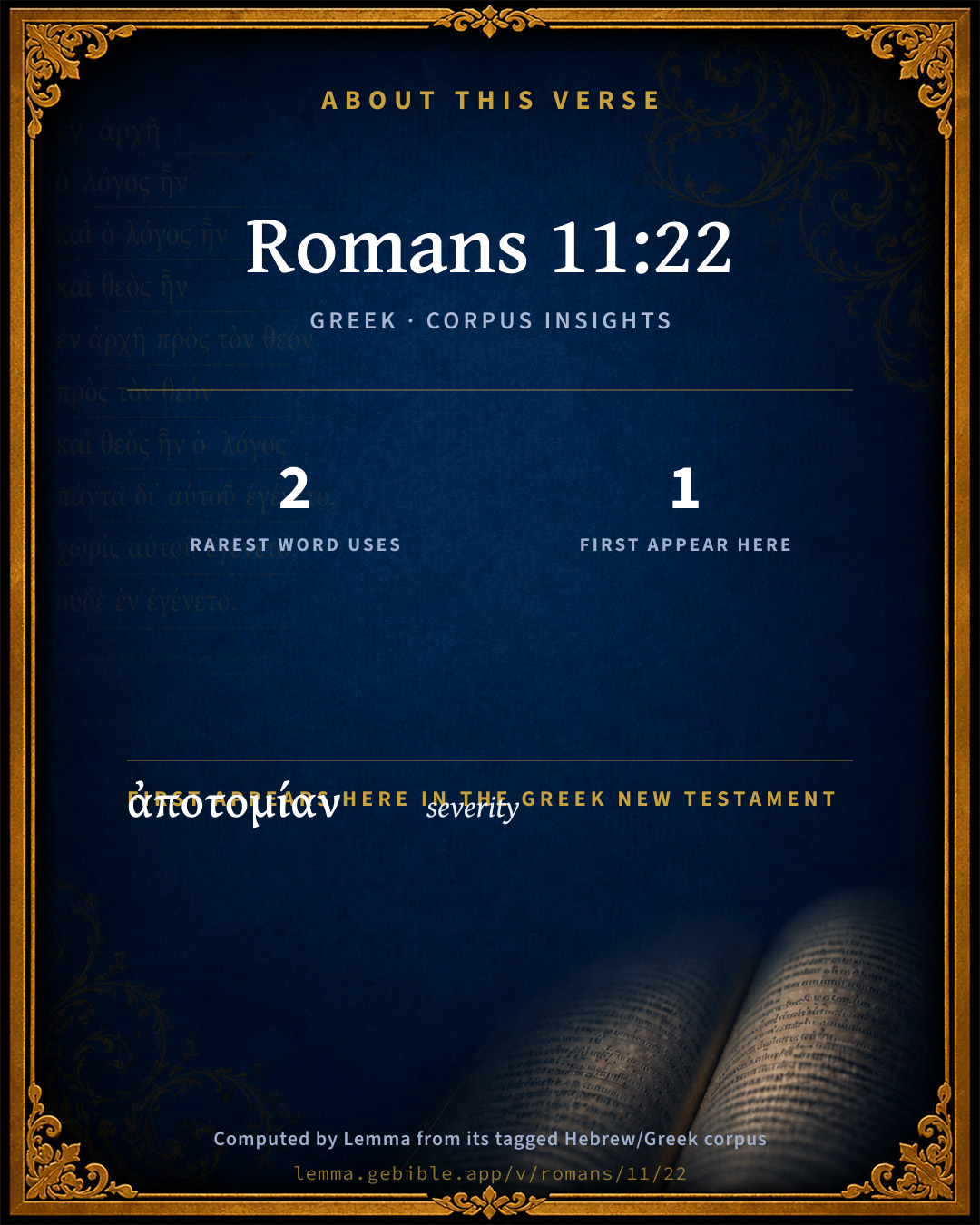
Romans 11:22

Greek (Tischendorf 8th ed.) Romans 11:22 appears in the Greek New Testament. The text above is from the Tischendorf 8th edition. Each word links to its Strong’s number and a concise gloss. Click any word for its full Thayer’s Greek Lexicon entry.

Download image
Cite this verse

Romans 11:22 (World English Bible). Public Domain. Lemma interlinear Bible study tool, https://lemma.gebible.app/v/romans/11/22.

Show BibTeX & RIS
BibTeX
RIS
English Translation
See then the goodness and severity of God. Toward those who fell, severity; but toward you, goodness, if you continue in his goodness; otherwise you also will be cut off.
World English Bible · Public Domain
Highlights
  • 1 first appearance in the Greek New Testament
Full analysis ↓
Download a study sheet

One document with this verse’s original text, its word-by-word gloss line, the meaning frame, cross-references with their text, attributed commentary, and full source and license credits — printable, and it pastes into notes with its structure intact.

This verse Autodidact and up

Study sheet (.html) Plain text (.txt)

A passage Seminary Student

Up to 50 verses in one chapter. A passage sheet keeps up to 6 commentary sources and 12 cross-references per verse, in the order this page ranks them, and says so on the sheet whenever that leaves anything out. Ask for a single verse and you get the Autodidact verse sheet above.

Everything on this page stays free to read, with no account — the sheet is a download of what is already on screen, not access to it.

Want to remove ads? Support Godless Engineer
Compare translations 3

The same verse in 3 English versions, stacked beneath the original-language interlinear above. Click any original word for its lexicon entry.

Each is an independent rendering of the whole verse — the interlinear is not word-aligned to these translations.

Highlighted words mark where these versions differ — a whole-verse word diff, not a word-by-word alignment.

  • World English Bible Public Domain
    See then the goodness and severity of God. Toward those who fell, severity; but toward you, goodness, if you continue in his goodness; otherwise you also will be cut off.
  • King James Version Public Domain
    Behold therefore the goodness and severity of God: on them which fell, severity; but toward thee, goodness, if thou continue in his goodness: otherwise thou also shalt be cut off.
  • unfoldingWord Literal Text CC BY-SA 4.0
    See, then, the kindness and the severity of God: severity on the ones having fallen, but kindness of God on you, if you continue in his kindness. Otherwise you yourself also will be cut off.

unfoldingWord Literal Text — © unfoldingWord, licensed CC BY-SA 4.0. Word-aligned USFM3 via Door43 (git.door43.org/unfoldingWord/en_ult).

Versions to compare (up to 4)

3 of 4 selected

Show all 19 translations

Every available English version of this verse, each an independent rendering of the whole verse.

  • World English Bible Public Domain
    See then the goodness and severity of God. Toward those who fell, severity; but toward you, goodness, if you continue in his goodness; otherwise you also will be cut off.
  • Berean Standard Bible Public Domain
    Take notice, therefore, of the kindness and severity of God: severity to those who fell, but kindness to you, if you continue in His kindness. Otherwise you also will be cut off.
  • Majority Standard Bible Public Domain
    Take notice, therefore, of the kindness and severity of God: severity to those who fell, but kindness to you, if you continue in His kindness. Otherwise you also will be cut off.
  • King James Version Public Domain
    Behold therefore the goodness and severity of God: on them which fell, severity; but toward thee, goodness, if thou continue in his goodness: otherwise thou also shalt be cut off.
  • American Standard Version (1901) Public Domain
    Behold then the goodness and severity of God: toward them that fell, severity; but toward thee, God's goodness, if thou continue in his goodness: otherwise thou also shalt be cut off.
  • Revised Version (1885) Public Domain
    Behold then the goodness and severity of God: toward them that fell, severity; but toward thee, God’s goodness, if thou continue in his goodness: otherwise thou also shalt be cut off.
  • Geneva Bible (1599) Public Domain
    Beholde therefore the bountifulnesse, and seueritie of God: towarde them which haue fallen, seueritie: but toward thee, bountifulnesse, if thou continue in his bountifulnesse: or els thou shalt also be cut off.
  • Douay-Rheims (1899) Public Domain
    See then the goodness and the severity of God: towards them indeed that are fallen, the severity; but towards thee, the goodness of God, if thou abide in goodness, otherwise thou also shalt be cut off.
  • Young's Literal Translation Public Domain
    Lo, then, goodness and severity of God -- upon those indeed who fell, severity; and upon thee, goodness, if thou mayest remain in the goodness, otherwise, thou also shalt be cut off.
  • Literal Standard Version CC BY-SA 4.0
    Behold, then, goodness and severity of God—on those indeed who fell, severity; and on you, goodness, if you may remain in the goodness, otherwise, you also will be cut off.
  • Unlocked Literal Bible CC BY-SA 4.0
    Look at, then, the kind actions and the severity of God: severity came on the Jews who fell, but God's kindness comes on you, if you continue in his kindness. Otherwise you also will be cut off.
  • unfoldingWord Literal Text CC BY-SA 4.0
    See, then, the kindness and the severity of God: severity on the ones having fallen, but kindness of God on you, if you continue in his kindness. Otherwise you yourself also will be cut off.
  • Darby Bible Public Domain
    Behold then [the] goodness and severity of God: upon them who have fallen, severity; upon thee goodness of God, if thou shalt abide in goodness, since [otherwise] *thou* also wilt be cut away.
  • World Messianic Bible Public Domain
    See then the goodness and severity of God. Toward those who fell, severity; but toward you, goodness, if you continue in his goodness; otherwise you also will be cut off.
  • Webster's Bible Public Domain
    Behold therefore the goodness and severity of God: on them who fell, severity; but towards thee, goodness, if thou shalt continue in his goodness: otherwise thou also shalt be cut off.
  • Free Bible Version CC BY-SA 4.0
    You should recognize both God's kindness and toughness—he was tough on the fallen, but God is kind to you so long as you trust in his kindness—otherwise you'll be removed too.
  • Bible in Basic English Public Domain
    See then that God is good but his rules are fixed: to those who were put away he was hard, but to you he has been good, on the condition that you keep in his mercy; if not, you will be cut off as they were.
  • Text-Critical English NT CC BY 4.0
    Consider therefore the kindness and severity of God: to those who have fallen, severity; but to yoʋ, kindness, if yoʋ continue in his kindness; otherwise yoʋ too will be cut off.
  • Tyndale New Testament (1534) Public Domain
    Beholde the kyndnes and rigorousnes of God: on the which fell rigorousnes: but towardes the kyndnes yf thou cotinue in his kyndnes. Or els thou shalt be hewen of

Literal Standard Version (2020), Covenant Press — licensed CC BY-SA 4.0. Text via the HelloAO Bible API (eBible.org). Unlocked Literal Bible (unfoldingWord) — licensed CC BY-SA 4.0. Text via the HelloAO Bible API (eBible.org). unfoldingWord Literal Text — © unfoldingWord, licensed CC BY-SA 4.0. Word-aligned USFM3 via Door43 (git.door43.org/unfoldingWord/en_ult). Free Bible Version, Dr. Jonathan Gallagher — licensed CC BY-SA 4.0. Text via the HelloAO Bible API (eBible.org).

Word by word

More ways to search: Search by grammar → Find every occurrence → Compare this word →

Practice this passage: Drill this verse → Learn its vocabulary →

ἀποτομίαν
apotomía
G663
“severity”
Noun, Accusative, Singular, Feminine
Part of Speech
Noun
Case
Accusative
Number
Singular
Gender
Feminine
Full Thayer's Definition

Origin: from the base of G664

TDNT: 09:46,1

1. severity, roughness, rigour
  1. ἴδε horáō G3708 “to see” Verb, Aorist, Active, Imperative, 2nd person, Singular
  2. οὖν oûn G3767 “therefore” Conjunction
  3. χρηστότητα chrēstótēs G5544 “goodness” Noun, Accusative, Singular, Feminine
  4. καὶ kaí G2532 “and” Conjunction
  5. θεοῦ theós G2316 “God” Noun, Genitive, Singular, Masculine
  6. ἐπὶ epí G1909 “upon” Preposition
  7. μὲν mén G3303 “truly” Particle
  8. τοὺς ho G3588 “the” Article, Accusative, Plural, Masculine
  9. πεσόντας píptō G4098 “to fall” Verb, Aorist, Active, Participle, Accusative, Plural, Masculine
  10. ἀποτομία apotomía G663 “severity” Noun, Nominative, Singular, Feminine
  11. ἐπὶ epí G1909 “upon” Preposition
  12. δὲ dé G1161 “but” Conjunction
  13. σὲ sý G4771 “you” Personal pronoun, 2nd person, Accusative, Singular
  14. χρηστότης chrēstótēs G5544 “goodness” Noun, Nominative, Singular, Feminine
  15. θεοῦ theós G2316 “God” Noun, Genitive, Singular, Masculine
  16. ἐὰν eán G1437 “if” Conditional
  17. ἐπιμένῃς epiménō G1961 “to remain” Verb, Present, Active, Subjunctive, 2nd person, Singular
  18. τῇ ho G3588 “the” Article, Dative, Singular, Feminine
  19. χρηστότητι chrēstótēs G5544 “goodness” Noun, Dative, Singular, Feminine
  20. ἐπεὶ epeí G1893 “when” Conjunction
  21. καὶ kaí G2532 “and” Conjunction
  22. σὺ sý G4771 “you” Personal pronoun, 2nd person, Nominative, Singular
  23. ἐκκοπήσῃ ekkóptō G1581 “to cut off” Verb, Future, Passive, Indicative, 2nd person, Singular

About this verse

These counts appear in no published source. They are computed here, from the morphology-tagged text and Lemma’s own curated glosses. What Lemma adds →

24
words
16
distinct lemmas
Pauline Epistles
section

Notable vocabulary

The rarest word here is ἀποτομίαν severity G663 — appearing just 2 times in the whole Greek New Testament.

First appearance in Scripture

This word makes its first canonical appearance in the Greek New Testament here:

  • ἀποτομίαν severity G663

Repetition

Words recur within this verse:

  • χρηστότητα goodness G5544 ×3
  • ἀποτομίαν severity G663 ×2
  • θεοῦ God G2316 ×2
  • ἐπὶ upon G1909 ×2
  • καὶ and G2532 ×2
  • τοὺς the G3588 ×2
  • σὲ you G4771 ×2

Cross-references

31

Topical passages linked to Romans 11:22 in the Treasury of Scripture Knowledge — connected by theme and wording, ordered by reader-vote popularity; previews shown in the World English Bible.

  • Hebrews 3:14 For we have become partakers of Christ, if we hold fast the beginning of our confidence firm to the end:
  • 1 Corinthians 15:2 by which also you are saved, if you hold firmly the word which I preached to you--unless you believed in vain.
  • Hebrews 3:6 but Christ is faithful as a Son over his house; whose house we are, if we hold fast our confidence and the glorying of our hope firm to the end.
  • John 15:2 Every branch in me that doesn't bear fruit, he takes away. Every branch that bears fruit, he prunes, that it may bear more fruit.
  • Revelation 2:5 Remember therefore from where you have fallen, and repent and do the first works; or else I am coming to you swiftly, and will move your lampstand out of its place, unless you repent.
  • Galatians 6:9 Let us not be weary in doing good, for we will reap in due season, if we don't give up.
  • Romans 2:4–5 Or do you despise the riches of his goodness, forbearance, and patience, not knowing that the goodness of God leads you to repentance?
  • Romans 2:7 to those who by patience in well-doing seek for glory and honor and incorruptibility, eternal life;
  • Hebrews 10:35–39 Therefore don't throw away your boldness, which has a great reward.
  • John 8:31 Jesus therefore said to those Jews who had believed him, "If you remain in my word, then you are truly my disciples.
  • Acts 14:22 confirming the souls of the disciples, exhorting them to continue in the faith, and that through many afflictions we must enter into the Kingdom of God.
  • Romans 9:22–23 What if God, willing to show his wrath, and to make his power known, endured with much patience vessels of wrath made for destruction,
  • Hebrews 10:23 let us hold fast the confession of our hope unyieldingly. For he who promised is faithful.
  • Jude 1:20–21 But you, beloved, keep building up yourselves on your most holy faith, praying in the Holy Spirit.
  • Isaiah 66:14 You shall see [it], and your heart shall rejoice, and your bones shall flourish like the tender grass: and the hand of Yahweh shall be known toward his servants; and he will have indignation against his enemies.
  • Ezekiel 33:17–19 Yet the children of your people say, The way of the Lord is not equal: but as for them, their way is not equal.
  • Matthew 3:9–10 Don't think to yourselves, 'We have Abraham for our father,' for I tell you that God is able to raise up children to Abraham from these stones.
  • Luke 8:15 That in the good ground, these are such as in an honest and good heart, having heard the word, hold it tightly, and bring forth fruit with patience.
  • Acts 11:23 who, when he had come, and had seen the grace of God, was glad. He exhorted them all, that with purpose of heart they should remain near to the Lord.
  • 1 Thessalonians 3:8 For now we live, if you stand fast in the Lord.
  • Numbers 14:18–22 Yahweh is slow to anger, and abundant in loving kindness, forgiving iniquity and disobedience; and that will by no means clear [the guilty], visiting the iniquity of the fathers on the children, on the third and on the fourth generation.
  • Deuteronomy 32:39–43 See now that I, even I, am he, There is no god with me: I kill, and I make alive; I wound, and I heal; There is none who can deliver out of my hand.
  • Joshua 23:15–16 It shall happen, that as all the good things are come on you of which Yahweh your God spoke to you, so will Yahweh bring on you all the evil things, until he have destroyed you from off this good land which Yahweh your God has given you.
  • Psalms 58:10–11 The righteous shall rejoice when he sees the vengeance. He shall wash his feet in the blood of the wicked;
  • Psalms 78:49–52 He threw on them the fierceness of his anger, Wrath, indignation, and trouble, And a band of angels of evil.
  • Psalms 136:15–22 But overthrew Pharaoh and his host in the Red Sea; For his loving kindness endures forever:
  • Ezekiel 3:20 Again, when a righteous man does turn from his righteousness, and commit iniquity, and I lay a stumbling block before him, he shall die: because you have not given him warning, he shall die in his sin, and his righteous deeds which he has done shall not be remembered; but his blood will I require at your hand.
  • Ezekiel 18:24 But when the righteous turns away from his righteousness, and commits iniquity, and does according to all the abominations that the wicked man does, shall he live? None of his righteous deeds that he has done shall be remembered: in his trespass that he has trespassed, and in his sin that he has sinned, in them shall he die.
  • John 15:4–10 Remain in me, and I in you. As the branch can't bear fruit by itself, unless it remains in the vine, so neither can you, unless you remain in me.
  • 1 Thessalonians 3:5 For this cause I also, when I couldn't stand it any longer, sent that I might know your faith, for fear that by any means the tempter had tempted you, and our labor would have been in vain.
  • 1 John 2:19 They went out from us, but they didn't belong to us; for if they had belonged to us, they would have continued with us. But they left, that they might be revealed that none of them belong to us.

Cross-references courtesy of OpenBible.info (CC BY 4.0).

Where the printed editions differ

2 variants

Places in this verse where the major printed Greek editions disagree on the wording in a way that affects the translation — a comparison of editions, not a manuscript-by-manuscript collation. The editions are the modern critical texts (Nestlé-Aland 28/27, SBL, Westcott-Hort, Tregelles, Tyndale House) and the traditional texts behind the KJV (the Textus Receptus and the Byzantine/Majority text). It is not a claim about which reading is original.

  1. Extra text
    θεοῦ,

    “of God,”

    In NA28NA27TynSBLWHTreg Not in TRByz

    θεοῦ, (theou) 'of God,' is only in older manuscripts (NA28+NA27+Tyn+SBL+WH+Treg)

  2. Different wording
    ἐπιμένῃς

    “you shall continue in”

    In NA28NA27TynSBLWHTregKJV Not in TRByz

    ἐπιμείνῃς (epimeinēs) 'they shall continue in' occurs in a few manuscripts (TR+Byz) instead of ἐπιμένῃς (epimenēs) 'you shall continue in' in older manuscripts (NA28+NA27+Tyn+SBL+WH+Treg+KJV)

Textual data: Translators Amalgamated Greek New Testament (STEPBible TAGNT) · CC BY 4.0.

Commentary

Notes on Romans 11:22 from classic Christian and Jewish commentators (each source and its license shown beneath its notes). The classic Christian expositions comment on the surrounding passage and are grouped to its opening verse, so a note may address several verses; the Jewish commentaries on the Tanakh (Rashi and others) are per-verse, so they appear only where the commentator wrote on this verse.

Lemma curates 59 commentaries, every one of them public domain or Creative Commons licensed, each selected and text-cleaned for this edition rather than reprinted as found. About our sources →

Joseph Benson's Commentary

Rom 11:22-23. Behold, therefore — In this dispensation; the goodness and severity of God — Consider them maturely, and lay them deeply to heart: on them which fell — The unbelieving Jews, who took offence at the mean appearance of Jesus, and so fell into unbelief, and were cut off for it; severity — Or the exercise of strict justice; for God laid righteousness to the line, and judgment to the plummet, and dealt with them according to their sins, after many ages of astonishing patience and long-suffering exercised toward them. Observe, reader, God is most severe toward those who have been most distinguished by advantages on the one hand, and the abuse of them on the other. Divine patience, and privileges abused, turn to the greatest wrath. The word αποτομια, here rendered severity, literally means, a cutting off; the effect being put for severity, the cause. But toward thee — Who art called to faith in Christ, without any merit in thyself; goodness — Benignity and gentleness, as χρηστοτης signifies; if thou continue in his goodness — That is, walk worthy of this privilege, into which thou art brought by God’s goodness: or, if thou be careful to maintain thine interest in God’s favour by continuing to depend upon, and comply with the design of his free grace, and endeavouring to please him continually: otherwise thou also shalt be cut off — From communion with God and his people. And they also — The Jewish nation; if they abide not in unbelief — And thereby continue to reject Christ; shall be grafted in — Restored to union with Christ and his church; for God is able to graft them in again — And willing also, as the word δυνατος is frequently taken: (see Rom 4:21; Rom 14:4; Heb 2:18:) for it was to no purpose to mention God’s ability to graft in the Jews, unless it had been accompanied with willingness. Locke says, “This grafting in again seems to import, that the Jews shall be a flourishing nation again, professing Christianity in the land of promise; for that is to be reinstated again in the promise made to Abraham, Isaac, and Jacob. This Paul might, for good reasons, be withheld from speaking out here. But in the prophets there are very plain intimations of it.”

Joseph Benson's Commentary on the Old and New Testaments (1811–1818) — public domain. Text from a community e-Sword module.

Tyndale Open Study Notes

Tyndale Open Resources

11:22 if you stop trusting, you also will be cut off: Scripture consistently emphasizes that only believers who persevere to the end will be saved. However, Paul’s warning leads to debate over the theological implications of his statement. Some think that it implies that genuine believers can stop believing and therefore not be saved in the end. Others argue that we should not press the metaphor so far and that Paul is referring to people who appear to be believers but whose lack of real faith ultimately reveals itself.

Tyndale Open Study Notes — © Tyndale Open Resources, licensed CC BY-SA 4.0. Text via the HelloAO Bible API.

Bengel's Gnomon

Johann Albrecht Bengel

Rom 11:22. Χρηστότητα καὶ ἀποτομίαν, goodness and severity) An important disjunction.—ἐπιμείνῃς, thou shalt have continued) To continue is in respect to what is good, in this verse; in respect to what is evil in the next [ἐπιμείνωσιν, abide in unbelief]. The one is described on the part of God, the other on the part of man comp. Rom 11:28; Rom 11:30, etc. The Roman [Church] has not remained in goodness, since the righteousness of works has been introduced.—ἐπεὶ, otherwise) Believers may utterly fall away.—ἑκκοπήοῃ, thou shalt be cut off) by the sword; not merely, shalt be broken off [ἑκκλασθήσῃ], as they were, by the hand. כרת, LXX., ἐκκόπτω, I cut off, Jer 44:8, not however generally in that sense, in which, I utterly destroy, (ἐξολοθρεύω), is used.

Bengel's Gnomon of the New Testament — English translation (T&T Clark, Edinburgh, 1860) — public domain. Text from a community e-Sword module.

Meyer's Critical & Exegetical Commentary

Heinrich August Wilhelm Meyer

Rom_11:22-23. An exhortation inferred from Rom_11:21, and corresponding to μὴ ὑψηλοφρόνει, ἀλλὰ φοβοῦ in Rom_11:20

Behold, therefore, the goodness and the severity of God, how both divine attributes present themselves before thee side by side. That χρηστ. and ἀποτ. should be without the article is, on account of the following Θεοῦ being anarthrous, quite regular, and does not entitle us artificially to educe (as Hofmann does) the sense of a goodness (which is here exhibited), etc. According to the correct reading (see the critical notes), a point is, with Lachmann, to be placed after ἀποτομίαν Θεοῦ; and with the following nominatives, ἈΠΟΤΟΜΊΑ and ΧΡΗΣΤΌΤΗς ΘΕΟῦ, ἘΣΤΊ is to be supplied: Towards the fallen there is severity, but towards thee (directed to thee) goodness. The fallen are the Jews who have refused to believe,so designated, because they are conceived as branches broken off and thereby fallen from the tree. Comp. ἕστηκας, Rom_11:20. In allusion to this, the severity of God is also designated as ἀποτομία (only here in the N. T., but see on 2Co_13:10; Kypke, II. p. 179; Grimm on Wis_5:21). This reference to the figure, which certainly pervades the whole representation, it is arbitrary to deny (de Wette, Fritzsche).

ἘᾺΝ ἘΠΙΜΕΊΝ. Τῇ ΧΡΗΣΤΌΤ.] if thou shalt abide (see on Rom_6:1) by the goodness, i.e. if thou shalt not have separated thyself from the divine goodness (through apostasy from faith), but shalt have remained true to it; comp. Act_13:43. Rightly, therefore, as respects the mode of the ἐπιμένειν τ. χρ., Clemens Alex. Paedag. I. p. 140 Pott.: τῇ εἰς Χριστὸν πίστει. But it is erroneous, because contrary to the context (for the emphasis lies on ἘΠΙΜΕΊΝ., and Τῇ ΧΡΗΣΤΌΤ. is but the repetition of the divine attribute just mentioned) and un-Pauline, to take ΧΡΗΣΤΌΤΗς, with Fritzsche, following Ch. Schmidt, in the sense of human rightness of conduct (Rom_3:12). Comp. rather on χρηστότ., Rom_2:4, and on Eph_2:7; also Tit_3:4.

ἘΠΕῚ ΚΑῚ ΣῪ ἘΚΚΟΠΉΣῌ] for otherwise thou also (like those broken-off branches) shalt be cut off. The threatening tenor of the discourse suggests unsought the stronger word ἐκκοπ., which is also in Rom_11:24 retained of the wild olive tree.

Since κἀκεῖνοι δὲ κ.τ.λ. does not depend on the condition previously to be supplied with ἐπεί, but has its own conditional sentence, a point is to be placed (in opposition to Hofmann) after ἐκκοπ.; and with κἀκεῖνοι δέ a new sentence, still further repressing Gentile self-exaltation, must be begun, which usual punctuation Lachmann, ed. maj., has again adopted: And those, too, if they shall not have persisted in unbelief, will be grafted in,whereby the reception into the true divine community (Rom_11:25; Rom_11:31) is figuratively depicted. The καί puts the ἐκεῖνοι on a parallel to the ingrafted wild olive branches (Rom_11:17).

δυνατὸς γάρ] if, namely, the cause has ceased to exist, on account of which God had to break off these branches, the power of God (comp. Rom_4:21, Rom_14:4) leaves no doubt, etc. In πάλιν the conception is, that by the ingrafting their restoration to their previous condition is accomplished. Comp. Winer, p. 576.

We may notice that this is a probative passage for the possibility of forfeiture of the state of grace, for the conversio resistibilis and for reiterabilitas gratiae, and also against absolute predestination.

Meyer — Critical and Exegetical Commentary on the New Testament — English translation by Peter Christie, edited by Frederick Crombie (T&T Clark, 1880) — public domain. Text from a community e-Sword module.

Expositor's Greek Testament

ed. W. Robertson Nicoll

Rom 11:22 . Behold then God’s goodness and severity, sc. , in the case of the Gentiles and Jews as now before us. ἀποτομία : here only in N.T. The moral idea is that of peremptoriness, inexorableness; in Greek writers it is contrasted with ἡμερότης , τὸ ἐπιεικές , πρᾳότης . Cf. 2Co 13:10 . ἐὰν ἐπιμένῃς τῇ χρηστότητι : if you remain on in the goodness, i.e. , continue to be indebted to it, and to it alone, for your religious position. This excludes presumption, and in general all such temper as is be trayed in taking an attitude of superiority to the Jews. The Jews lost their standing because they had come to believe that it was indefectible, and independent of moral conditions; and if the Gentiles commit the same mistake they will incur the same doom. It is not to Israel only God may say, The kingdom is taken from you, and given to a nation bringing forth the fruits thereof. ἐπεὶ , otherwise: see Rom 11:6 .

The Expositor's Greek Testament, edited by W. Robertson Nicoll (1897–1910) — public domain. Text from a community e-Sword module.

Hodge's Commentary on Romans, Ephesians & First Corinthians

Charles Hodge

Rom_11:22

Behold, therefore, the goodness and severity of God: on them which fell, severity; but on thee, goodness. Instead of the accusatives ἀποτομίαν and χρηστότητα, Lachmann and Tischendorf read ἀποτομία and χρηστότης. If this reading be adopted, ἐστίν must be supplied. Towards the one class there is severity, towards the other kindness. The effect which the consideration of these dispensations of God should produce, is gratitude and fear. Gratitude, in view of the favor which we Gentiles have received, and fear lest we should be cut off; for our security does not depend upon our now enjoying the blessings of the church of God, but is dependent on our continuing in the divine goodness or favor, (Rom_2:4; Tit_3:4) that is, on our doing nothing to forfeit that favor; its continuance being suspended on the condition of our fidelity. If thou continue in (his) goodness, ἐὰν ἐπιμείνῃς τῇ χρηστότητι, is sometimes explained to mean, if thou continue in goodness, i.e. in being good, according to the analogy of the following clause, μὴ ἐπιμείνωσι τῇ ἀπιστίᾳ, if they continue not in unbelief. But this is inconsistent with the context. The χρηστότης spoken of, is the goodness or love of God. Compare Act_13:43, προσμένειν τῇ χάριτι τοῦ Θεοῦ, to remain in the grace of God. Otherwise thou also shalt be cut off, ἐπεὶ καὶ σὺ ἐκκοπήσῃ, since, in that case, (i.e., if thou continuest not in his goodness,) thou also shalt be cut off; ἐκκοπήσῃ, second future indicative passive. There is nothing in this language inconsistent with the doctrine of the final perseverance of believers, even supposing the passage to refer to individuals; for it is very common to speak thus hypothetically, and say that an event cannot or will not come to pass, unless the requisite means are employed, when the occurrence of the event had been rendered certain by the previous purpose and promise of God; see Act_27:31. The foundation of all such statements is the simple truth, that He who purposes the end, purposes also the means; and he brings about the end by securing the use of the means. And when rational agents are concerned, he secures the use of the means by rational considerations presented to their minds, and rendered effectual by his grace, when the end contemplated is good. This passage, however, has no legitimate bearing on this subject. Paul is not speaking of the connection of individual believers with Christ, which he had abundantly taught in Romans 8 and elsewhere, to be indissoluble, but of the relation of communities to the church and its various privileges. There is no promise or covenant on the part of God, securing to the gentiles the enjoyment of these blessings through all generations, any more than there was any such promise to protect the Jews from the consequences of their unbelief. The continuance of these favors depends on the conduct of each successive generation. Paul therefore says to the Gentile, that he must continue in the divine favor, otherwise thou also shalt be cut off.

Charles Hodge — Commentary on Romans (1835), First Corinthians (1857), and Ephesians (1856) — public domain. Text from a community e-Sword module.

Geneva Bible (1599)

Geneva Bible translators

The tender and loving heart.

Seeing the matter itself declareth that election cometh not by inheritance (although the fault be in men, and not in God, why the blessing of God is not perpetual) we must take good heed, that that be not found in ourselves, which we think blameworthy in others, for the election is sure, but they that are truly elect and ingrafted, are not proud in themselves with contempt of others, but with due reverence to God, and love towards their neighbor, run to the mark which is set before them.

In that state which God’s bountifulness hath advanced thee unto: and we must mark here, that he speaketh not of the election of every private man, which remaineth steadfast forever, but of the election of the whole nation.

Geneva Bible (1599) marginal notes — public domain. Text via Bolls.life.

Jamieson, Fausset & Brown

Robert Jamieson, A. R. Fausset & David Brown

Behold therefore the goodness and severity of God: on them that fell, severity--in rejecting the chosen seed.

but toward thee, goodness--"God's goodness" is the true reading, that is, His sovereign goodness in admitting thee to a covenant standing who before wert a "stranger to the covenants of promise" (Eph 2:12-20).

if thou continue in his goodness--in believing dependence on that pure goodness which made thee what thou art.

Jamieson, Fausset & Brown — Commentary Critical and Explanatory on the Whole Bible (1871) — public domain (CC PDM 1.0). Text via the HelloAO Bible API.

Adam Clarke's Commentary

Verse 22. Behold therefore the goodness] The exclamation, Behold the goodness of God! is frequent among the Jewish writers, when they wish to call the attention of men to particular displays of God's mercy, especially towards those who are singularly unworthy. See several instances in Schoettgen.

And severity of God] As χρηστοτης, goodness, signifies the essential quality of the Divine nature, the fountain of all good to men and angels, so αποτομια, severity, as it is here translated, signifies that particular exercise of his goodness and holiness which leads him to sever from his mystical body whatsoever would injure, corrupt, or destroy it. The apostle in these verses uses a metaphor taken from engrafting, εγκεντρισις, from the verb εγκεντριζω, from εν, in, and κεντριζω, to puncture, because engrafting was frequently done by making a puncture in the bark of a tree, and then inserting a bud taken from another. This was the practice in the Roman agriculture, as we learn from Virgil, Georg. ii, ver. 73:-

Nam qua se medio trudunt de cortice gemmae,

Et tenues rumpunt tunicas, angustus in ipso

Fit nodo sinus: huc aliena ex arbore germen

Includunt, udoque docent inolescere libro.

For where the tender rinds of trees disclose

Their shooting gems, a swelling knot there grows;

Just in that space a narrow slit we make,

Then other buds from bearing trees we take;

Inserted thus, the wounded rind we close,

ln whose moist womb the admitted infant grows.

DRYDEN.

In all countries the principle is the same, though the mode is various.

The apostle, having adopted this metaphor as the best he could find to express that act of God's justice and mercy by which the Jews were rejected, and the Gentiles elected in their stead, and, in order to show that though the Jewish tree was cut down, or its branches lopped off, yet it was not rooted up, he informs the Gentile believers that, as it is customary to insert a good scion in a bad or useless stock, they who were bad, contrary to the custom in such cases, were grafted in a good stock, and their growth and fruitfulness proclaimed the excellence and vegetative life of the stock in which they were inserted. This was the goodness of the heavenly gardener to them; but it was severity, αποτομια, an act of excision to the Jews.

The reader will observe that this term belongs to engrafting: often, in this operation, a part of a branch is cut off; in that part which remains in connection with the tree a little slit is made, and then a small twig or branch taken from another tree is, at its lower end, shaved thin, wedge-like, and then inserted in the cleft, after which the whole is tied together, clayed round, c., and the bark unites to bark and the stock and the scion become thus one tree, the juices of the whole stock circulating through the tubes of the newly-inserted twig; and thus both live, though the branch inserted bears a very different fruit from that which the parent stock bore. I have often performed this operation, and in this very way, with success: and I cannot conceive that the apostle could have chosen a more apt or more elegant metaphor. The Jewish tree does not bring forth proper fruit; but it will answer well to ingraft a proper fruit-bearing tree on. The Gentiles are a wild olive, which is a tree that bears no fruit; but it may be made to bear if grafted on the Jewish stock. Some of the branches were cut off, that the branches of this wild olive might be inserted: the act by which this insertion is made is termed αποτομια, goodness, benignity: the act by which the branches of the original stock are broken off is termed αποτομια, excision; from απο, from, and τεμνω, I cut, still keeping the metaphor taken from engrafting in view. Now, let the apostle's mode of reasoning be observed: the tree is cut down, or its branches lopped off; but the tree is not rooted up. The Jews have stumbled, but not so as to fall irrecoverably; for if they abide not still in unbelief, they shall be grafted in, Ro 11:23. The Gentiles which are grafted in on these cut-off branches, like the scion inserted into another stock, partake of the root, which absorbs from the earth the nutritious juices, and the fatness of the Jewish tree, the blessings and privileges which that people have long enjoyed, in consequence of the Abrahamic covenant, Ro 11:17; the root, the Jewish covenant, bears them: not they the root, Ro 11:18. As, therefore, the continuance of the Gentiles as the Church and people of God depends upon their interest in the Abrahamic covenant, the blessings of which they derive through the medium of the Jews, they should be grateful to God, and tolerant to those through whom they have received such blessings. And as, in the case of grafting, the prosperity of the engrafted scion depends on the existence of the parent stock, so the continuance of the Gentiles in this state of favour, (following the metaphor,) in a certain way depends on the continuance of the Jewish people: and they are preserved, as so many scions which are in process of time to be engrafted on the Gentiles; and thus the Gentiles shall become the means of salvation to the Jews, as the Jews have been the means of salvation to the Gentiles. Following, therefore, the metaphor a little farther, which seems to have been so well chosen in all its parts, the continued existence of the Jews as a distinct people, together with the acknowledgment of the Gentiles, that they have derived their salvation and state of blessedness through them-of which Jesus Christ, born of the stock of David, is the author; and the Jewish Scriptures, which the Gentiles receive as inspired by God, are the evidence-then, the restoration of the Jews to the favour of God is a necessary consequence, and indeed seems to be the principal end in reference to which the apostle reasons. The Gentiles, however, are to take care that the restoration of the Jews be not at their expense; as their calling and election were at the expense of the Jews: the latter being cut off, that the former might be grafted in, Ro 11:19. Of this there is no kind of necessity, for the original stock, the Abrahamic covenant, is sufficient to receive them all; and so Jews and Gentiles become one eternal flock, under one Bishop and Shepherd of all their souls.

Adam Clarke's Commentary on the Bible (1810–1826) — public domain. Text from a community e-Sword/MySword module.

John Calvin's Commentaries

22. See then, etc. By laying the case before their eyes he more clearly and fully confirms the fact, — that the Gentiles had no reason to be proud. They saw in the Jews an example of God’s severity, which ought to have terrified them; while in themselves they had an evidence of his grace and goodness, by which they ought to have been stimulated to thankfulness only, and to exalt the Lord and not themselves. The words import the same, as though he had said, — “If thou exultest over their calamity, think first what thou hast been; for the same severity of God would have impended over thee, hadst thou not been delivered by his gratuitous favor: then consider what thou art even now; for salvation shall not continue to thee, except thou humbly recognisest the mercy of God; for if thou forgettest thyself and arrogantly exultest, the ruin, into which they have fallen, awaits thee: it is not indeed enough for thee to have once embraced the favor of God, except thou followest his call through the whole course of thy life.” They indeed who have been illuminated by the Lord ought always to think of perseverance; for they continue not in the goodness of God, who having for a time responded to the call of God, do at length begin to loathe the kingdom of heaven, and thus by their ingratitude justly deserve to be blinded again.

But he addresses not each of the godly apart, as we have already said, but he makes a comparison between the Gentiles and the Jews. It is indeed true that each individual among the Jews received the reward due to his own unbelief, when they were banished from the kingdom of God, and that all who front among the Gentiles were called, were vessels of God’s mercy; but yet the particular design of Paul must be borne in mind. For he would have the Gentiles to depend on the eternal covenant of God, so as to connect their own with the salvation of the elect people, and then, lest the rejection of the Jews should produce offense, as though their ancient adoption were void, he would have them to be terrified by this example of punishment, so as reverently to regard the judgment of God. For whence comes so great licentiousness on curious questions, except that we almost neglect to consider those things which ought to have duly taught us humility?

But as he speaks not of the elect individually, but of the whole body, a condition is added, If they continued in his kindness I indeed allow, that as soon as any one abuses God’s goodness, he deserves to be deprived of the offered favor; but it would be improper to say of any one of the godly particularly, that God had mercy on him, when he chose him, provided he would continue in his mercy; for the perseverance of faith, which completes in us the effect of God’s grace, flows from election itself. Paul then teaches us, that the Gentiles were admitted into the hope of eternal life on the condition, that they by their gratitude retained possession of it. And dreadful indeed was the defection of the whole world, which afterwards happened; and this dearly proves, that this exhortation was not superfluous; for when God had almost in a moment watered it with his grace, so that religion flourished everywhere, soon after the truth of the gospel vanished, and the treasure of salvation was taken away. And whence came so sudden a change, except that the Gentiles had fallen away from their calling?

Otherwise thou also shalt be cut off, etc. We now understand in what sense Paul threatens them with excision, whom he has already allowed to have been grafted into the hope of life through God’s election. For, first, though this cannot happen to the elect, they have yet need of such warning, in order to subdue the pride of the flesh; which being really opposed to their salvation, ought justly to be terrified with the dread of perdition. As far then as Christians are illuminated by faith, they hear, for their assurance, that the calling of God is without repentance; but as far as they carry about them the flesh, which wantonly resists the grace of God, they are taught humility by this warning, “Take heed lest thou be cut off.” Secondly, we must bear in mind the solution which I have before mentioned, — that Paul speaks not here of the special election of individuals, but sets the Gentiles and Jews in opposition the one to the other; and that therefore the elect are not so much addressed in these words, as those who falsely gloried that they had obtained the place of the Jews: nay, he speaks to the Gentiles generally, and addresses the whole body in common, among whom there were many who were faithful, and those who were members of Christ in name only.

But if it be asked respecting individuals, “How any one could be cut off from the grafting, and how, after excision, he could be grafted again,” — bear in mind, that there are three modes of insition, and two modes of excision. For instance, the children of the faithful are ingrafted, to whom the promise belongs according to the covenant made with the fathers; ingrafted are also they who indeed receive the seed of the gospel, but it strikes no root, or it is choked before it brings any fruit; and thirdly, the elect are ingrafted, who are illuminated unto eternal life according to the immutable purpose of God. The first are cut off, when they refuse the promise given to their fathers, or do not receive it on account of their ingratitude; the second are cut off, when the seed is withered and destroyed; and as the danger of this impends over all, with regard to their own nature, it must be allowed that this warning which Paul gives belongs in a certain way to the faithful, lest they indulge themselves in the sloth of the flesh. But with regard to the present passage, it is enough for us to know, that the vengeance which God had executed on the Jews, is pronounced on the Gentiles, in case they become like them.

John Calvin's Commentaries (1540-1563) — public domain. Text from the Calvin Translation Society English edition (1840s-50s) via the Christian Classics Ethereal Library (ccel.org). Calvin's coverage is partial (roughly two-thirds of the Bible); uncommented books and verses are honest gaps, never fabricated. The 19th-century editor's footnotes and remarks are omitted so the notes are faithfully Calvin's own voice.

Ellicott's Commentary for English Readers

(22) As Providence had been appealed to, the Apostle states the true Providential aspect of God’s rejection of Israel. It had a double side—one of goodness towards the Gentile, one of deserved severity towards the Jew. But, at the same time, the fact that the covenant was made originally with the Jew, and that he was the natural heir to the promises which it contained, is a guarantee for his restoration if he would only dismiss his unbelief.

A Bible Commentary for English Readers, edited by Charles John Ellicott (1878–1897) — public domain. Text from a community e-Sword module.

The Cambridge Bible for Schools and Colleges

gen. ed. J. J. S. Perowne

22. goodness] See on ch. Rom_2:4.

severity] In the special sense of summary sternness. The word is akin to that rendered “sharply,” Tit_1:13.

on them which fell, &c.] Better, in view of the best-supported reading of the Gr., on them that fell came severity, but on thee came goodness.

if thou continue] On the verb and construction here, see on Rom_6:1. The idea of the word is adherence, either rightly resolute or wrongly obstinate as the case may be.—Observe that expressions like the present, implying contingency in man’s continuance in the mercy of God, and the reality of the exertion of man’s will in such continuance, are in real practical harmony with the truth, so fully stated in previous chapters, of sovereign and prevailing Divine grace (Rom_8:28-30). The whole reason of the harmony is indeed past our finding out, perhaps for ever; but thus much we can see, that sovereign grace acts on men, not on automatons; that it acts on them through the human conscience and will; and that these, in this matter as always, are affected by warnings as truly as by promises. Grace imparts perseverance by imparting and maintaining faith, (1Pe_1:5;) and it freely uses all means by which such faith is properly animated and energized. Amongst such means are these warnings of the results that must follow if faith loses hold of its object. Cp. Judges 20, 21.

otherwise] The lit. Gr. is simply since; but the E. V. expresses the implied sense.

The Cambridge Bible for Schools and Colleges (gen. ed. J. J. S. Perowne; Cambridge University Press, 1878–1918) — public domain. Text from a community e-Sword module.

John Gill's Exposition

Behold therefore the goodness, and severity of God,.... The consideration of both the grace and kindness of God to some, and his severity or strict justice towards others, is recommended by the apostle as very proper to abate pride, vain glory, and haughtiness of spirit; and to engage to humility, fear, care, and caution;

on them which fell, severity: the Jews who stumbled at Christ and his Gospel, and fell by unbelief, God in strict justice and righteous judgment not only destroyed, as afterwards their nation, city, and temple, and scattered them abroad in the world to be a reproach, a proverb, a taunt, and a curse in all places; but cast them off as his people, broke his covenant with them, took away his Gospel from them, left them out of a Gospel church state, except a few, and gave up the generality of them to blindness and hardness of heart; so that wrath is come upon them to the uttermost, both with respect to things civil and religious, and they continue as living standing monuments of God's severity and justice, to be beheld by us Gentiles with pity and concern, and to excite in us the fear of God, and caution as to our conduct and behaviour in the world, and in the church:

but towards thee, goodness; the Gentiles, who not only share in the goodness and grace of God, displayed in the election of many of them to eternal life, in their redemption by Christ, and the effectual calling of them by the grace of God; but in their church state, they being made fellow citizens with the saints, fellow heirs, and of the same body, and having a place and a name in God's house, better than that of sons and daughters; and therefore under great obligation to fear the Lord, and his goodness, and to walk worthy of the calling wherein they are called, in all humility and lowliness of mind:

if thou continue in his goodness; meaning not the love, grace, and free favour of God, or the grace of the Spirit, a continuance in which no "if" is to be put upon; for such who are interested in the love of God always continue in it, and nothing can separate them from it; and such as have the graces of the Spirit implanted in them, as faith, hope, and love, can never lose them; these always remain in them, and they in the possession of them, though not always in the exercise of them; but the goodness of God in a church state is here meant, as the means of grace and comfort, the ministration of the word and ordinances; and the sense is, if thou dost not despise the riches of divine goodness in a church relation, if thou dost not abuse it, or walk unworthy of it, if thou abidest by it, and retainest a value for it, thou wilt still share the advantages of it:

otherwise thou also shall be cut off; from the good olive tree, the Gospel church state, into which the Gentiles were taken; and which, with respect to particular persons, may intend the act of excommunication by the church, expressed in Scripture by purging the old leaven, putting away the wicked person, withdrawing from such that are disorderly, and rejecting heretics, that is, from the communion of the church; and with respect to whole bodies and societies, an entire unchurching of them by removing the Gospel, and the ordinances of it; which threatening has been awfully fulfilled in many Gentile churches, in Asia, Africa, and Europe; and therefore may serve to awaken our fear, care, and caution, lest we should be treated in like manner.

John Gill's Exposition of the Whole Bible (1746–1763) — public domain (CC PDM 1.0). Text via the HelloAO Bible API.

Trapp's Complete Commentary

John Trapp

22 Behold therefore the goodness and severity of God: on them which fell, severity; but toward thee, goodness, if thou continue in his goodness: otherwise thou also shalt be cut off.

Ver. 22. Severity] Gr. Λποτομιαν, Resection or cutting off, as a surgeon cutteth off proud and dead flesh. The dispersion of the Jews for this sixteen hundred years and upward is such, as that one of their own Rabbis concludeth from thence that their Messiah must needs be come; and they must needs suffer so much for killing him. Epiphanius testifieth, that after the destruction of Jerusalem, the Jews of Tiberius had this custom, when any of their friends or kindred were at the point of death, they would secretly whisper them in the ear to this purpose: Believe in Jesus of Nazareth, whom our rulers crucified; for he shall come again to judge thee at the last day. Fincelius also (Lib. iii. de miraculis) tells of a certain converted Jew of Ratisbon, who being demanded (among other questions put to him by the Christians) why the Jews did so exceedingly desire the blood of Christians, answered that that was a great secret among them, known to none but their chiefest Rabbis; but this was their custom, to anoint their dying friends with the blood of Christians, and to use words to this effect: If he that was promised in the law and prophets hath already appeared, and that Jesus who was crucified were the true Messiah, let this blood of an innocent man, who died in the faith of Jesus, cleanse thee from thy sins, and be a means to further thine eternal happiness. Oh, the severity of God! and, oh, the obstinace and misery of this hard hearted people!

John Trapp, A Commentary or Exposition upon All the Books of the Old and New Testament (1647–1656) — public domain. Text from a community e-Sword module.

Albert Barnes' Notes on the Bible

Behold, therefore ... - Regard, or contemplate, for purposes of your own improvement and benefit, the dealings of God. We should look on all his dispensations of judgment or of mercy, and derive lessons from all to promote our own steadfast adherence to the faith of the gospel.

The goodness - The benevolence or mercy of God toward you in admitting you to his favor. This calls for gratitude, love, confidence. It demands expressions of thanksgiving. It should be highly prized, in order that it may excite to diligence to secure its continuance.

The severity of God - That is, toward the Jews. The word “severity” now suggests sometimes the idea of harshness, or even of cruelty. (Webster.) But nothing of this kind is conveyed in the original word here. It properly denotes “cutting off,” ἀποτομίαν apotomian from ἀποτέμνω apotemnō, to cut off; and is commonly applied to the act of the gardener or vine-dresser in trimming trees or vines, and cutting off the decayed or useless branches. Here it refers to the act of God in cutting off or rejecting the Jews as useless branches; and conveys no idea of injustice, cruelty, or harshness. It was a just act, and consistent with all the perfections of God. It indicated a purpose to do what was right, though the inflictions might seem to be severe, and though they must involve them in many heavy calamities.

On them which fell, severity - On the Jews, who had been rejected because of their unbelief.

But towards thee, goodness - Toward the Gentile world, benevolence. The word “goodness” properly denotes benignity or benevolence. Here it signifies the kindness of God in bestowing these favors on the Gentiles.

If thou continue in his goodness - The word “his” is not in the original. And the word “goodness” may denote integrity, probity, uprightness, as well as favor; Rom 3:12, “There is none that doeth good.” The Septuagint often thus uses the word; Psa 13:1, Psa 13:3, etc. This is probably the meaning here; though it may mean “if thou dost continue in a state of favor;” that is, if your faith and good conduct shall be such as to make it proper for God to continue his kindness toward you. Christians do not merit the favor of God by their faith and good works; but their obedience is an indispensable condition on which that favor is to be continued. It is thus that the grace of God is magnified, at the same time that the highest good is done to man himself.

Otherwise thou also shalt be cut off - Compare Joh 15:2. The word “thou” refers here to the Gentile churches. In relation to them the favor of God was dependent on their fidelity. If they became disobedient and unbelieving, then the same principle which led him to withdraw his mercy from the Jewish people would lead also to their rejection and exclusion. And on this principle, God has acted in numberless cases. Thus, his favor was withdrawn from the seven churches of Asia Rev. 1–3, from Corinth, from Antioch, from Philippi, and even from Rome itself.

Albert Barnes' Notes on the Bible (1834–1885) — public domain. Text from a community e-Sword/MySword module.

Matthew Poole's English Annotations

In this verse, he further persuades the Gentiles to humility and godly fear, and suggesteth several reasons for it. The first is taken from the example of God’s

severity to the Jews; they falling into apostacy and unbelief, are generally cut off and cast away. A second reason is taken from the free grace and undeserved goodness of God to the poor Gentiles, who were mercifully planted or grafted in the room of the Jews. A third reason is taken from the condition of their present standing, which is, if they

continue in his goodness; i.e. if they continue in that state wherein his goodness hath set them. Some think the cause is here put for the effect, the goodness of God for faith, which was wrought in them by the goodness or grace of God. The antithesis, in the next verse, shows this to be the sense; for there he speaks of the Jews not continuing or abiding still in unbelief. A fourth reason is from the danger that would follow; if, through pride and security, they should fall and miscarry, they would be cut off, as the Jews, the natural branches, are. Some observe the change of the word; the Jews are said to be broken off, but the Gentiles would be cut off; they would, as it were, be stocked up by the roots: but that seems too critical and curious.

Matthew Poole's English Annotations on the Holy Bible (1683–1685) — public domain. Text from a community e-Sword/MySword module.

Whedon's Commentary on the Bible

Daniel D. Whedon

22. Goodness… severity—These are the two alternatives from God, conditioned on the continue and the fall in man. To add to this that God has infallibly secured either one or the other, is to mar the apostle’s doctrine, destroy the freedom of man, and the moral government of God.

Daniel D. Whedon (gen. ed.), Commentary on the Old and New Testaments (1874–1909) — public domain. Text from a community e-Sword module.

The Pulpit Commentary

Vers. 22, 23. Behold therefore the goodness and severity of God: toward them that fell, severity (to be a warning to thee); but toward thee, God"s goodness, if thou continue in his goodness: otherwise thou also shalt be cut off. And they, if they abide not still in their unbelief, shall be grafted in: for God is able to graft them in again. The reference here to God"s power to graft them in again may be suggested by the apparent impossibility, from a human point of view, of the Jews as a nation, having rejected Christ in person, and being so inveterately set against the gospel as they were, ever coming into the Church. But "with God all things are possible". (cf. Mat_19:26 Mar_10:27 Luk_18:27) Nay so the thought goes on it would seem in itself more likely, and according to the nature of things, that the Jews should be brought into the Church, which is really their own, and the true fulfilment of their own oracles, than that Gentiles, who had had no similar preparation, should have been so.

The Pulpit Commentary (1880–1919), ed. H.D.M. Spence-Jones & Joseph S. Exell — public domain. Text from a community e-Sword module.

John Wesley's Explanatory Notes

Else shalt thou - Also, who now "standest by faith," be both totally and finally cut off.

John Wesley, Explanatory Notes Upon the Whole Bible (1754–1765) — public domain. Text via the GEBible commentary corpus.

Burkitt's Expository Notes on the New Testament

William Burkitt

Our apostle, in these and the following verses, proceeds in his exhortation to the Gentiles, not to insult over the rejected Jews, but to carry it towards them with great modesty and Christian humility; and he useth several arguments by way of motive to excite and quicken them thereunto.

The two first are drawn from the severity of God in cutting off the Jews, and the goodness and bounty of God in calling of the Gentiles; Behold the goodness and severity of God, &c. Justice and mercy, goodness and severity, are attributes or qualities eminently found in God; and contrary only in their effects upon men. The same God is merciful and severe, with respect to different persons and different qualifications. All mercy is not a virtue, but that which is consistent with other perfections of wisdom and righteousness.

The next argument is taken from the condition upon which the Gentiles hold their present standing in the favour and grace of God; namely, If they continue in his goodness; that is, if they walk worthy of this favour from God, and suitably to such a kind and gracious dispensation; otherwise they, the Gentiles, shall be cut off and cast away, as well as the stubborn and unbelieving Jews. The Lord is with a people only whilst they are with him; if they serve and seek him, he will be found of them; but if they forsake him, he will cast them off for ever.

The next argument to suppress arrogancy and pride in the Gentiles, and to prevent their insulting over the fallen Jews, is taken from the hopes of the Jews’ restoration; which the apostle proves to be both possible and probable.

They shall be graffed in, if they abide not in unbelief; for God is able to graff them in again. As if the apostle had said, "The same God that rejected them, is able to restore them, and re-ingraff them; the only obstacle is their unbelief, and this God is also able to remove."

Lastly, He shows the probability as well as the possibility of the Jews’ conversion; namely, because God had done that which was more unlikely already, to wit, in graffing the Gentiles, who were wild olives, into the true olive, which was more difficult and unlikely than to graff in the Jews again, which were natural branches.

The argument runs thus: "If the Gentiles, which were a kind of wild scion into a good stock; how much more shall the Jews, which are the natural branches of the good olive, be graffed again into their own olive-tree, to which they formerly did belong! The one is according to the order of nature, but the other is against and contrary to nature."

Learn hence, How improbable and unlikely, how difficult and impossible soever, the conversion and calling of the Jews to the Christian religion may seem to us, it is neither contrary to right reason nor true faith.

The greatest obstacle in the way of the Jews’ conversion to Christianity, it is to be feared, lies in the wicked and scandalous lives of those that call themselves Christians.

William Burkitt's Expository Notes on the New Testament (1700–1703) — public domain. Text from a community e-Sword module.

McGarvey & Pendleton's Commentaries

J. W. McGarvey

Behold then the goodness and severity of God: toward them [the Jews] that fell, severity [for lack of faith, not want of merit]; but toward thee [O Gentile], God's goodness [kindness not won by thy merit, else it were justice, not goodness; but goodness toward thee by reason of thy faith: a goodness which will be continued to thee], if thou continue [by faith, and the works thereof, to keep thyself] in his goodness: otherwise thou also [even as was the Jew for like reasons before thee] shalt be cut off . [From the theocratic tree. Severity and goodness, as used here, are merely relative. They do not express the true condition, but merely the state of affairs as viewed by those who still clung to the idea of legal justification and salvation by merit. To those holding such views it seemed severe indeed that the better man should be cut off for lack of faith, and a strange act of goodness that the worse should be received by reason of it and given opportunity to become fruitful; but the seeming severity vanishes and only the goodness remains when we reflect that according to the righteous judgment of God it was impossible that either of them should be received any other way. The apostle's next purpose is to present a further argument against Gentile pride; viz., the final restoration of the Jewish people and the restitution of all their original privileges and rights. This prophetic fact is revealed as a possibility in the next two verses, and established fully as a decreed event in the next section.]

J. W. McGarvey (with Philip Y. Pendleton), Commentaries on the New Testament (The Fourfold Gospel, 1914; Acts; and the epistles) — public domain. Text from a community e-Sword/MySword module.

The People's New Testament

B. W. Johnson

22. Behold, therefore, the goodness and severity of God. “Severity” is shown in breaking off the Jewish branches on account of their unbelief; “goodness,” in admitting Gentile believers.

B. W. Johnson's The People's New Testament with Notes (1889–1891) — public domain. Electronic text from the Christian Classics Ethereal Library (CCEL) ThML edition.

unfoldingWord translationNotes

Door43 World Missions Community

the kind actions and the severity of God

Paul is reminding the Gentile believers that although God may act very kindly toward them, he will not hesitate to judge and punish them.

severity came on the Jews who fell ... God's kindness comes on you

This can be restated to remove the abstract nouns "severity" and "kindness." AT: "God dealt harshly with the Jews who fell ... but God acts kindly toward you" (See: Abstract Nouns)

the Jews who fell

Doing what is wrong is spoken of as if it is falling down. AT: "the Jews who have done wrong" or "the Jews who have refused to trust in Christ" (See: Metaphor)

if you continue in his kindness

This can be restated to remove the abstract noun "kindness." AT: "if you continue doing what is right so that he continues being kind to you" (See: Abstract Nouns)

Otherwise you also will be cut off

Paul again uses the metaphor of a branch, which God can "cut off" if he needs to. Here "cut off" is a metaphor for rejecting someone. You can translate this in an active form. AT: "Otherwise God will cut you off" or "Otherwise God will reject you" (See: Metaphor and Active or Passive)

translationWords

God

Jew

unfoldingWord translationNotes — © Distant Shores Media and the Door43 World Missions Community, licensed CC BY-SA 4.0. Source: git.door43.org/Door43/en_tn.

Cambridge Greek Testament for Schools and Colleges

22. ἴδε οὖν. This being so observe how in GOD there is both goodness and severity, meeting in each case the position taken by man.

ἴδε only here w. accus. N. the absence of articles.

ἐπιμένῃς. With dat., Rom 6:1; Php 1:24; Col 1:23; 1Ti 4:16 only. He says τῇ χρ. not τῇ πίστει to emphasise this absence of all merit and the need of dependence on GOD’s grace exclusively; the thought of πίστει is included in ἐπιμένῃς.

ἐπεὶ, otherwise; cf. Rom 11:6.

Cambridge Greek Testament for Schools and Colleges (Cambridge University Press, 1896; 21 vols, various authors incl. Carr, Maclear, Plummer, Farrar, Lumby, Moule, M. R. James, Simcox) — public domain. Text from a community e-Sword module.

Alford’s Greek Testament

Henry Alford

22.] The caution of the preceding verse is unfolded into a setting before the Gentile of the true state of the matter. Behold therefore (posito, that thou enterest into the feeling prompted by the last verse) the goodness and the severity (no allusion to ἀποτέμνω in its literal sense) of God:—towards those who fell (see on ver. 11).

Here the πεσόντες are opposed to σύ, the figure being for the moment dropped: for πίπτειν can hardly be used of the branches, but of men) severity; but towards thee, the goodness of God (the nominatives here, as involving a departure from the construction, are preferable: and the repetition of θεοῦ is quite in the manner of the Apostle: see 1Co 1:24, 1Co 1:25. Rückert thinks that because Clem. Alex. Pædag. i. 8 [70], p. 140 P., understands χρηστότης, in ἐὰν ἐπιμείνῃς τῇ χρηστότητι, of the χρηστότης of men (τουτέστι τῇ εἰς χριστὸν πίστει), θεοῦ may have been a marginal gloss to guard against this mistake, and may have found its way into the text, misplaced. But this is hardly probable: θεοῦ is much more likely to have been erased as unnecessary), if thou abide by (reff.) that goodness; for ([supply otherwise:] assuming that thou dost not abide by that goodness) thou also shalt be cut off (ind. fut. The placing only a comma at ἐκκοπήσῃ, as Meyer,—not Lachm. (Exo_2) and Tischend.(Exo_7 [and 8]),—prevents the break evidently intended between the treatment of the case of the Gentile and that of the Jews).

Henry Alford, The Greek Testament (1849–1861) — public domain. Text from a community e-Sword module.

International Critical Commentary

22. The Apostle sums up this part of his argument by deducing from this instance the two sides of the Divine character. God is full of goodness (χρηστότης, cf. 2:4) and loving-kindness towards mankind, and that has been shown by His conduct towards those Gentiles who have been received into the Christian society. That goodness will always be shown towards them if they repose their confidence on it, and do not trust in their own merits or the privileged position they enjoy. On the other hand the treatment of the Jews shows the severity which also belongs to the character of God; a severity exercised against them just because they trusted in themselves. God can show the same severity against the Gentiles and cut them off as well as the Jew.

ἀποτομία and χρηστότης should be read in the second part of the verse, with א A B C Orig. Jo.-Damasc. against the accusative of the Western and Syrian text. D has a mixed reading, ἀποτομίαν and χρηστότης: the assimilation was easier in the first word than in the second. The Θεοῦ after χρηστότης is omitted by later MSS. with Clem.-Alex., Orig. from a desire for uniformity.

ἐὰν ἐπιμείνῃς. The condition of their enjoying this goodness is that they trust in it, and not in their position.

καὶ σύ: emphatic like the ἐγώ of ver. 19 ‘You too as well as the Jews.’

International Critical Commentary — older volumes (1896–1929), various authors — public domain. Text from a community e-Sword module.

Vincent's Word Studies in the New Testament

Marvin R. Vincent

Goodness and severity [χρηστοτητα και αποτομιαν] . For goodness, see on ch. Rom 3:12. Apotomia severity, only here in the New Testament. The kindred adverb, ajpotomwv sharply, occurs 2Co 13:10; Tit 1:13. From ajpotemnw to cut off. Hence that which is abrupt, sharp.

Thou shalt be cut off [εκκοπηση] . Lit., cut out. See on Luk 13:7.

Marvin R. Vincent, Word Studies in the New Testament (1887–1900) — public domain. Text from a community e-Sword/MySword module.

Godet's Commentaries

Frédéric Louis Godet

Vv. 22-24 derive for believers of Gentile origin the practical application of all they have been reminded of in Rom 11:17-21.

Vv. 22. “Behold, therefore, the goodness and severity of God: on them which fell, severity;but toward thee, goodness, if thou continue in this goodness: otherwise thou also shalt be cut off.”

The readers have just been contemplating two examples, the one of severity, the other of grace; the first, in the person of the Jews; the second, in their own. Hence two lessons to be derived which the apostle entreats them not to neglect. In opposition to χρηστότής, goodness, from χρηστός (literally: that may be handled), the apostle uses the forcible term ἀποτομία (from ἀποτέμνω, to cut right off, to cut short): a rigor which does not bend. We may read in the second clause the two substantives in the nominative with the Alexs., and then we shall have either to understand the verb is (“severity is on those who”), which is excessively clumsy, or to make these two words absolute nominatives, as sometimes happens in Greek appositions. But the Received Reading puts these words in the accusative, which is much simpler. It is, besides, sufficiently supported.

In passing to the application of God’s two modes of acting which he has just characterized, the apostle begins with the second; and he connects it directly with what precedes by this grave restriction: “if thou continue in this goodness.” Continuance is effected by the same disposition whereby grace was appropriated at the first, humble faith. Unhappy is the believer for whom grace is no longer grace on the hundredth or the thousandth day, as it was on the first! For the slightest feeling of self-exaltation which may take possession of him on occasion of grace received or of its fruits, destroys in his case grace itself and paralyzes it. There is nothing more for him to expect in this condition than to be himself also cut off from the stem. Καὶ σύ, thou also, as well as the Jews. The future passive ἐκκοπήσῃ, thou shalt be cut off, abruptly closes the sentence, like the stroke of the axe cutting down this proud branch.

It is but too clear to any one who has eyes to see, that our Gentile Christendom has now reached the point here foreseen by St. Paul. In its pride it tramples under foot the very notion of that grace which has made it what it is. It moves on, therefore, to a judgment of rejection like that of Israel, but which shall not have to soften it a promise like that which accompanied the fall of the Jews.

For the rest, I do not think that any conclusion can be drawn from this passage against the doctrine of an unconditional decree relative to individuals; for the matter in question here is Gentile Christendom in general, and not such or such of its members in particular (see Hodge).

In Rom 11:23-24 the idea of severity is applied, as that of goodness was in the foregoing verse. As the goodness which the Gentiles have enjoyed may through their fault be transformed into severity, so the severity with which the Jews had been treated may be changed for them into compassionate goodness, if they consent to believe as the Gentiles formerly did. With the close of this verse the apostle returns to his principal subject, the future of Israel.

Frédéric Louis Godet — Commentaries on Luke, John, Romans, and 1 Corinthians — English translation (T&T Clark, Edinburgh, 1870s–1890s) — public domain. Text from a community e-Sword module.

Lesson kit

Teaching starters — assembled from the data on this page, not authored interpretation. Every prompt links to the verse data it draws on. Edit before teaching.

Romans, in the Pauline Epistles, opens this verse with 24 words (16 distinct Greek lemmas). Its most distinctive word is apotomía (“severity”). A historical commentator’s framing appears above. Read the whole chapter for the surrounding context.

Discussion questions

  1. How does “severity” (apotomía) shape what this verse is saying?
  2. The word “severity” first appears here in Scripture. What is being introduced at this debut?
  3. Hebrews 3:14 shares this passage’s theme. How do the two illuminate each other?
  4. “goodness” occurs 3× in this one verse. What is the effect of the repetition?
  5. These translations render this verse differently. What is at stake in choosing one wording over another?
  6. Reading how Joseph Benson's Commentary and Tyndale Open Study Notes read this verse, where do the two commentators agree and where do they part?

Things to notice

  • 1 word makes its first canonical appearance in Scripture here.
  • These translations choose different wording for 15 words in this verse.
  • “goodness” occurs 3× in this single verse.
  • 16 distinct Greek lemmas span 24 words in this verse.

Reading settings

Reading text

Shown beneath each verse's original-language words.

Old Testament
Old Testament edition

Read the OT as the Masoretic Hebrew (MT) or the Greek Septuagint (LXX).

English shown for the Greek Septuagint (in the Hebrew ↔ Greek comparison).

Comparing translations? Open the Compare panel on any verse page to stack up to four side by side.