
Romans 15:19

Greek (Tischendorf 8th ed.) Romans 15:19 appears in the Greek New Testament. The text above is from the Tischendorf 8th edition. Each word links to its Strong’s number and a concise gloss. Click any word for its full Thayer’s Greek Lexicon entry.
Download image
Cite this verse

Romans 15:19 (World English Bible). Public Domain. Lemma interlinear Bible study tool, https://lemma.gebible.app/v/romans/15/19.

Show BibTeX & RIS
BibTeX
RIS
English Translation
in the power of signs and wonders, in the power of God's Spirit; so that from Jerusalem, and around as far as to Illyricum, I have fully preached the Gospel of Christ;
World English Bible · Public Domain
Highlights
  • 1 hapax legomenon — only here in the Greek New Testament
  • 1 first appearance in the Greek New Testament
Full analysis ↓
Download a study sheet

One document with this verse’s original text, its word-by-word gloss line, the meaning frame, cross-references with their text, attributed commentary, and full source and license credits — printable, and it pastes into notes with its structure intact.

This verse Autodidact and up

Study sheet (.html) Plain text (.txt)

A passage Seminary Student

Up to 50 verses in one chapter. A passage sheet keeps up to 6 commentary sources and 12 cross-references per verse, in the order this page ranks them, and says so on the sheet whenever that leaves anything out. Ask for a single verse and you get the Autodidact verse sheet above.

Everything on this page stays free to read, with no account — the sheet is a download of what is already on screen, not access to it.

Want to remove ads? Support Godless Engineer
Compare translations 3

The same verse in 3 English versions, stacked beneath the original-language interlinear above. Click any original word for its lexicon entry.

Each is an independent rendering of the whole verse — the interlinear is not word-aligned to these translations.

Highlighted words mark where these versions differ — a whole-verse word diff, not a word-by-word alignment.

  • World English Bible Public Domain
    in the power of signs and wonders, in the power of God's Spirit; so that from Jerusalem, and around as far as to Illyricum, I have fully preached the Gospel of Christ;
  • King James Version Public Domain
    Through mighty signs and wonders, by the power of the Spirit of God; so that from Jerusalem, and round about unto Illyricum, I have fully preached the gospel of Christ.
  • unfoldingWord Literal Text CC BY-SA 4.0
    in the power of signs and wonders, in the power of the Spirit of God—so that from Jerusalem, and round about as far as Illyricum, I have fulfilled the gospel of Christ;

unfoldingWord Literal Text — © unfoldingWord, licensed CC BY-SA 4.0. Word-aligned USFM3 via Door43 (git.door43.org/unfoldingWord/en_ult).

Versions to compare (up to 4)

3 of 4 selected

Show all 19 translations

Every available English version of this verse, each an independent rendering of the whole verse.

  • World English Bible Public Domain
    in the power of signs and wonders, in the power of God's Spirit; so that from Jerusalem, and around as far as to Illyricum, I have fully preached the Gospel of Christ;
  • Berean Standard Bible Public Domain
    by the power of signs and wonders, and by the power of the Spirit of God. So from Jerusalem all the way around to Illyricum, I have fully proclaimed the gospel of Christ.
  • Majority Standard Bible Public Domain
    by the power of signs and wonders, and by the power of the Spirit of God. So from Jerusalem all the way around to Illyricum, I have fully proclaimed the gospel of Christ.
  • King James Version Public Domain
    Through mighty signs and wonders, by the power of the Spirit of God; so that from Jerusalem, and round about unto Illyricum, I have fully preached the gospel of Christ.
  • American Standard Version (1901) Public Domain
    in the power of signs and wonders, in the power of the Holy Spirit; so that from Jerusalem, and round about even unto Illyricum, I have fully preached the gospel of Christ;
  • Revised Version (1885) Public Domain
    in the power of signs and wonders, in the power of the Holy Ghost; so that from Jerusalem, and round about even unto Illyricum, I have fully preached the gospel of Christ;
  • Geneva Bible (1599) Public Domain
    With the power of signes and wonders, by the power of the Spirit of God: so that from Hierusalem, and round about vnto Illyricum, I haue caused to abound the Gospel of Christ.
  • Douay-Rheims (1899) Public Domain
    By the virtue of signs and wonders, in the power of the Holy Ghost, so that from Jerusalem round about as far as unto Illyricum, I have replenished the gospel of Christ.
  • Young's Literal Translation Public Domain
    in power of signs and wonders, in power of the Spirit of God; so that I, from Jerusalem, and in a circle as far as Illyricum, have fully preached the good news of the Christ;
  • Literal Standard Version CC BY-SA 4.0
    in power of signs and wonders, in power of the Spirit of God; so that I, from Jerusalem, and in a circle as far as Illyricum, have fully preached the good news of the Christ;
  • Unlocked Literal Bible CC BY-SA 4.0
    by the power of signs and wonders, and by the power of the Holy Spirit. This was so that from Jerusalem, and round about as far as Illyricum, I might fully carry out the gospel of Christ.
  • unfoldingWord Literal Text CC BY-SA 4.0
    in the power of signs and wonders, in the power of the Spirit of God—so that from Jerusalem, and round about as far as Illyricum, I have fulfilled the gospel of Christ;
  • Darby Bible Public Domain
    in [the] power of signs and wonders, in [the] power of [the] Spirit of God; so that I, from Jerusalem, and in a circuit round to Illyricum, have fully preached the glad tidings of the Christ;
  • World Messianic Bible Public Domain
    in the power of signs and wonders, in the power of God’s Spirit; so that from Jerusalem and around as far as to Illyricum, I have fully preached the Good News of Messiah;
  • Webster's Bible Public Domain
    Through mighty signs and wonders, by the power of the Spirit of God; so that from Jerusalem, and around to Illyricum, I have fully preached the gospel of Christ.
  • Free Bible Version CC BY-SA 4.0
    through the power of signs and miracles done with the Holy Spirit's power. From Jerusalem all the way over to Illyricum, everywhere I've shared fully the good news of Christ.
  • Bible in Basic English Public Domain
    By signs and wonders, in the power of the Holy Spirit; so that from Jerusalem and round about as far as Illyricum I have given all the good news of Christ;
  • Text-Critical English NT CC BY 4.0
    by the power of signs and wonders, and by the power of the Spirit of God, so that from Jerusalem all the way around to Illyricum, I have fully preached the gospel of Christ.
  • Tyndale New Testament (1534) Public Domain
    in myghty signes and wonders by the power of the sprete of God: so that from Ierusalem and the costes rounde aboute vnto Illyricum I have fylled all countres with the gladde tydynges of Christ.

Literal Standard Version (2020), Covenant Press — licensed CC BY-SA 4.0. Text via the HelloAO Bible API (eBible.org). Unlocked Literal Bible (unfoldingWord) — licensed CC BY-SA 4.0. Text via the HelloAO Bible API (eBible.org). unfoldingWord Literal Text — © unfoldingWord, licensed CC BY-SA 4.0. Word-aligned USFM3 via Door43 (git.door43.org/unfoldingWord/en_ult). Free Bible Version, Dr. Jonathan Gallagher — licensed CC BY-SA 4.0. Text via the HelloAO Bible API (eBible.org).

Word by word

More ways to search: Search by grammar → Find every occurrence → Compare this word →

Practice this passage: Drill this verse → Learn its vocabulary →

Ἰλλυρικοῦ
Illyrikón
G2437
“Illyricum”
Noun, Genitive, Singular, Neuter
Part of Speech
Noun
Case
Genitive
Number
Singular
Gender
Neuter
Full Thayer's Definition

Origin: from an adjective from a name of uncertain derivation

TDNT: None

Illyricum = "the lyric band" 1. a region lying between Italy, Germany, Macedonia and Thrice, having on one side the Adriatic Sea, and on the other the Danube
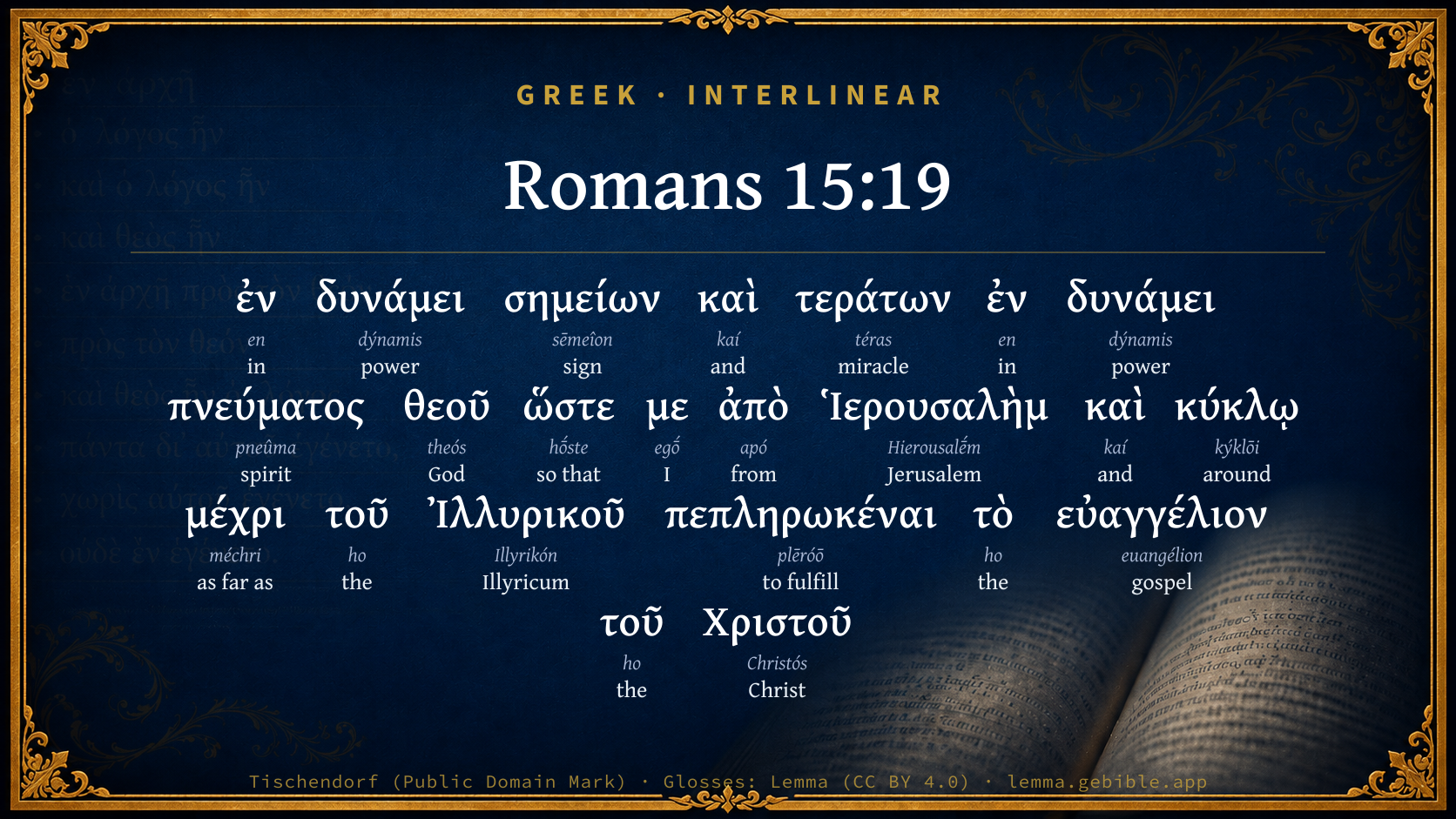
  1. ἐν en G1722 “in” Preposition
  2. δυνάμει dýnamis G1411 “power” Noun, Dative, Singular, Feminine
  3. σημείων sēmeîon G4592 “sign” Noun, Genitive, Plural, Neuter
  4. καὶ kaí G2532 “and” Conjunction
  5. τεράτων téras G5059 “miracle” Noun, Genitive, Plural, Neuter
  6. ἐν en G1722 “in” Preposition
  7. δυνάμει dýnamis G1411 “power” Noun, Dative, Singular, Feminine
  8. πνεύματος pneûma G4151 “spirit” Noun, Genitive, Singular, Neuter
  9. θεοῦ theós G2316 “God” Noun, Genitive, Singular, Masculine
  10. ὥστε hṓste G5620 “so that” Conjunction
  11. με egṓ G1473 “I” Personal pronoun, 1st person, Accusative, Singular
  12. ἀπὸ apó G575 “from” Preposition
  13. Ἱερουσαλὴμ Hierousalḗm G2419 “Jerusalem” Noun, Proper, indeclinable
  14. καὶ kaí G2532 “and” Conjunction
  15. κύκλῳ kýklōi G2945 “around” Noun, Dative, Singular, Masculine
  16. μέχρι méchri G3360 “as far as” Adverb
  17. τοῦ ho G3588 “the” Article, Genitive, Singular, Neuter
  18. πεπληρωκέναι plēróō G4137 “to fulfill” Verb, Perfect, Active, Infinitive
  19. τὸ ho G3588 “the” Article, Accusative, Singular, Neuter
  20. εὐαγγέλιον euangélion G2098 “gospel” Noun, Accusative, Singular, Neuter
  21. τοῦ ho G3588 “the” Article, Genitive, Singular, Masculine
  22. Χριστοῦ Christós G5547 “Christ” Noun, Genitive, Singular, Masculine

About this verse

These counts appear in no published source. They are computed here, from the morphology-tagged text and Lemma’s own curated glosses. What Lemma adds →

23
words
18
distinct lemmas
Pauline Epistles
section

Notable vocabulary

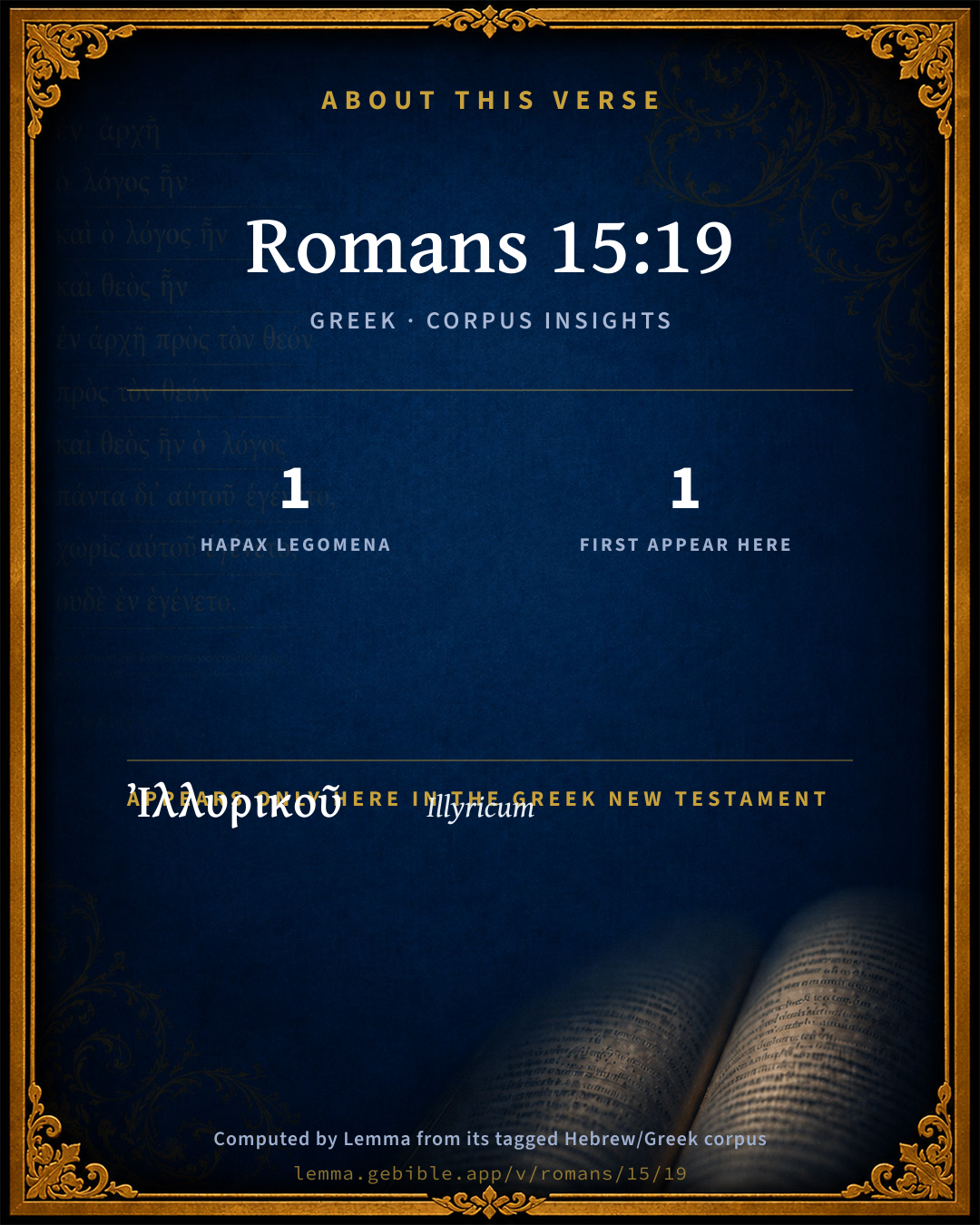
1 hapax legomenon — a word that appears only here in the entire Greek New Testament:

  • Ἰλλυρικοῦ Illyricum G2437

First appearance in Scripture

This word makes its first canonical appearance in the Greek New Testament here:

  • Ἰλλυρικοῦ Illyricum G2437

Shared distinctive vocabulary

κύκλῳ around G2945 occurs in 8 verses of the Greek New Testament. Also found in:
Repetition

Words recur within this verse:

Cross-references

33

Topical passages linked to Romans 15:19 in the Treasury of Scripture Knowledge — connected by theme and wording, ordered by reader-vote popularity; previews shown in the World English Bible.

  • 2 Corinthians 12:12 Truly the signs of an apostle were worked among you in all patience, in signs and wonders and mighty works.
  • Hebrews 2:4 God also bearing witness with them, both by signs and wonders, and by various works of power, and by gifts of the Holy Spirit, according to his own will?
  • Acts 19:11–12 God worked special miracles by the hands of Paul,
  • Galatians 3:5 He therefore who supplies the Spirit to you, and works miracles among you, does he do it by the works of the law, or by hearing of faith?
  • 1 Corinthians 12:4–11 Now there are various kinds of gifts, but the same Spirit.
  • 2 Timothy 4:17 But the Lord stood by me, and strengthened me, that through me the message might be fully proclaimed, and that all the Gentiles might hear; and I was delivered out of the mouth of the lion.
  • Acts 17:10 The brothers immediately sent Paul and Silas away by night to Beroea. When they arrived, they went into the Jewish synagogue.
  • Acts 20:6 We sailed away from Philippi after the days of Unleavened Bread, and came to them at Troas in five days, where we stayed seven days.
  • Matthew 12:28 But if I by the Spirit of God cast out demons, then the Kingdom of God has come upon you.
  • John 4:48 Jesus therefore said to him, "Unless you see signs and wonders, you will in no way believe."
  • Acts 1:8 But you will receive power when the Holy Spirit has come upon you. You will be witnesses to me in Jerusalem, in all Judea and Samaria, and to the uttermost parts of the earth."
  • Acts 9:28–29 He was with them entering into Jerusalem,
  • Acts 13:4–5 So, being sent out by the Holy Spirit, they went down to Seleucia. From there they sailed to Cyprus.
  • Acts 13:14 But they, passing on from Perga, came to Antioch of Pisidia. They went into the synagogue on the Sabbath day, and sat down.
  • Acts 13:51 But they shook off the dust of their feet against them, and came to Iconium.
  • Acts 14:6 they became aware of it, and fled to the cities of Lycaonia, Lystra, Derbe, and the surrounding region.
  • Acts 14:10 said with a loud voice, "Stand upright on your feet!" He leaped up and walked.
  • Acts 14:20 But as the disciples stood around him, he rose up, and entered into the city. On the next day he went out with Barnabas to Derbe.
  • Acts 14:25 When they had spoken the word in Perga, they went down to Attalia.
  • Acts 15:12 All the multitude kept silence, and they listened to Barnabas and Paul reporting what signs and wonders God had done among the Gentiles through them.
  • Acts 16:6–12 When they had gone through the region of Phrygia and Galatia, they were forbidden by the Holy Spirit to speak the word in Asia.
  • Acts 16:18 She was doing this for many days. But Paul, becoming greatly annoyed, turned and said to the spirit, "I charge you in the name of Jesus Christ to come out of her!" It came out that very hour.
  • Acts 17:15 But those who escorted Paul brought him as far as Athens. Receiving a commandment to Silas and Timothy that they should come to him very quickly, they departed.
  • Acts 18:1 After these things Paul departed from Athens, and came to Corinth.
  • Acts 18:19 He came to Ephesus, and he left them there; but he himself entered into the synagogue, and reasoned with the Jews.
  • Acts 19:1 It happened that, while Apollos was at Corinth, Paul, having passed through the upper country, came to Ephesus, and found certain disciples.
  • Acts 20:1–2 After the uproar had ceased, Paul sent for the disciples, took leave of them, and departed to go into Macedonia.
  • Acts 20:20 how I didn't shrink from declaring to you anything that was profitable, teaching you publicly and from house to house,
  • Acts 22:17–21 "It happened that, when I had returned to Jerusalem, and while I prayed in the temple, I fell into a trance,
  • Romans 1:14–16 I am debtor both to Greeks and to foreigners, both to the wise and to the foolish.
  • Romans 15:24 whenever I journey to Spain, I will come to you. For I hope to see you on my journey, and to be helped on my way there by you, if first I may enjoy your company for a while.
  • Colossians 1:25 of which I was made a servant, according to the stewardship of God which was given me toward you, to fulfill the word of God,
  • 1 Peter 1:12 To them it was revealed, that not to themselves, but to you, did they minister these things, which now have been announced to you through those who preached the Gospel to you by the Holy Spirit sent out from heaven; which things angels desire to look into.

Cross-references courtesy of OpenBible.info (CC BY 4.0).

Where the printed editions differ

1 variant

Places in this verse where the major printed Greek editions disagree on the wording in a way that affects the translation — a comparison of editions, not a manuscript-by-manuscript collation. The editions are the modern critical texts (Nestlé-Aland 28/27, SBL, Westcott-Hort, Tregelles, Tyndale House) and the traditional texts behind the KJV (the Textus Receptus and the Byzantine/Majority text). It is not a claim about which reading is original.

  1. Different wording
    θεοῦ,

    “of God,”

    In NA28NA27TynTRByz Not in SBLWHTreg

    ἁγίου (hagiou) 'holy' occurs in a few manuscripts (WH+Treg) instead of θεοῦ, (theou) 'of God,' in older manuscripts (NA28+NA27+Tyn+TR+Byz)

Textual data: Translators Amalgamated Greek New Testament (STEPBible TAGNT) · CC BY 4.0.

Commentary

Notes on Romans 15:19 from classic Christian and Jewish commentators (each source and its license shown beneath its notes). The classic Christian expositions comment on the surrounding passage and are grouped to its opening verse, so a note may address several verses; the Jewish commentaries on the Tanakh (Rashi and others) are per-verse, so they appear only where the commentator wrote on this verse.

Lemma curates 59 commentaries, every one of them public domain or Creative Commons licensed, each selected and text-cleaned for this edition rather than reprinted as found. About our sources →

Tyndale Open Study Notes

Tyndale Open Resources

15:19 I have fully presented the Good News of Christ: Paul was not claiming that the work of evangelism had been completed in these regions. His point was that churches had been planted in enough major population centers so that those churches could carry on the work of evangelism themselves. Paul’s own distinctive ministry of planting foundational and strategic churches had been fulfilled. • An arc drawn from Jerusalem all the way to Illyricum would include the areas where Paul had planted churches (southern Galatia, Asia Minor, Macedonia, and Greece). Illyricum was a Roman province that occupied most of the coastlands northeast of Italy along the Adriatic Sea, from modern-day Albania to Croatia.

Tyndale Open Study Notes — © Tyndale Open Resources, licensed CC BY-SA 4.0. Text via the HelloAO Bible API.

Bengel's Gnomon

Johann Albrecht Bengel

Rom 15:19. Ἐν δυνάμει σημείων καὶ τεράτων, [Engl. V. through mighty] in the power of signs and wonders) This expression should be referred to, by deed.—ἐν δυνάμει πνεύματος Θεοῦ, [by] in the power of the Spirit of God) This should be referred to, by word. We have here a gradation, [ascending climax]: for he attributes more to the Spirit of God, than to the signs.—ἀπὸ—μέχρι, from—unto) A large tract of country.—Ἰλλυρικοῦ, Illyricum) of which Dalmatia is a part; 2Ti 4:10.—τὸ εὐαγγέλιον, the Gospel) the office of preaching the Gospel.

Bengel's Gnomon of the New Testament — English translation (T&T Clark, Edinburgh, 1860) — public domain. Text from a community e-Sword module.

Meyer's Critical & Exegetical Commentary

Heinrich August Wilhelm Meyer

Rom_15:19. In virtue of what powers Christ, by means of word and work, has wrought through the apostle as His organ: (1) ἐν δυνάμ. σημείων κ. τερ.,this refers back to ἔργῳ; (2) ἐν δυν. πνεύματος,this applies to λόγῳ and ἔργῳ together, and is co-ordinated to the above ἐν δυν. σημ. κ. τερ., not subordinated, as Beza, Glöckler, and others think, whereby the language would lose its simplicity and half of its import (the δύναμις πνεύμ would pass into the background). According to Hofmann, who reads in Rom_15:20 φιλοτιμοῦμαι (see the critical notes), a new sentence is meant to begin with λόγῳ κ. ἔργῳ, the verb of which would be φιλοτιμοῦμαι. This yields, instead of the simple course of the language, a complicated structure of sentence which is in nowise indicated by Paul himself, as he has not written ἐν λόγῳ κ. ἔργῳ (conformably to the following). Besides, the εὐαγγελίξεσθαι by word and deed (thus the preaching through deeds), would be a modern conception foreign to the N. T. The ἔργα accompany and accredit the preaching (Joh_10:38; Joh_14:11), but they do not preach. Comp. Luk_24:19; Act_7:22; 2Co_10:11. If φιλοτιμοῦμαι is to be read, then with Lachmann a new sentence is to be begun with Rom_15:20, so that all that precedes remains assigned to the efficiency of Christ, which is not the case with the view of Hofmann, although it is only in entire keeping with the language of humility which Paul here uses. The genitives are those of derivation: power, which went forth from signs and wonders (which Paul, as instrument of Christ, has performed), and power, which went forth from the, (Holy) Spirit (who was communicated to the apostle through Christ) upon the minds of men. Comp. on ἐν δυν. πνεύμ., 1Co_2:4-5.

σημεῖα κ. τέρατα] not different in substance; both miracles, both also denoting their significant aspect. See Fritzsche, p. 270 f. The collocation corresponds to the Heb. אֹתוֹת וּמֹפְתִים, hence usually (the converse only in Act_2:22; Act_2:43; Act_6:8; Act_7:36, comp. Rom_2:19) σημεῖα stands first, and where only one of the two words is used, it is always σημεῖα, because אתות was the striking word giving more immediately the character of the thing designated. Contrary to the constant usage of the N. T., Reiche understands not outward miraculous facts, but mental miracles, which the preaching of the gospel has produced in the hearts of the newly-converted. Even 2Co_12:12 is not to be thus understood; see in loc. Miracles belonged to the σημεῖα τοῦ ἀποστόλου (2 Cor. l.c.), hence there is already of itself motive enough for their mention in our passage, and there is no need for the precarious assumption of a reference to pseudo-apostolic jugglers in Rome (Ewald).

ἐν δυνάμ. πνεύμ. ἁγ.] is related, not awkwardly (Hofmann), to ὧν οὐ κατειργ. Χριστός; for Christ has, for the sake of His working to be effected through the apostle (διʼ ἐμοῦ), given to him the Spirit. Very unnecessarily, and just as inappropriately,since ὥστε must comprise all the preceding elements,

Hofmann forces ἐν δυν. πν. ἁγ., by means of an hyperbaton, into special connection with ὥστε.

ὥστε κ.τ.λ.] Result, which this working of Christ through Paul has had in reference to the extension of Christianity.

ἀπὸ Ἱερους.] From this spot, where Paul first entered the apostolical fellowship, Act_9:26 ff. (he had already previously worked three years, including the sojourn in Arabia, at Damascus; see on Gal_1:17-18), he defines the terminus a quo, because he intends to specify the greatest extension of his working in space (from south-east to north-west).[24]

καὶ κύκλῳ] enlarges the range of the terminus a quo: and round about, embracing not merely Judaea, but, in correspondence to the magnitude of the measure of length, Arabia and Syria also. Of course, however, κύκλῳ is not included in the dependence on ἈΠΌ, but stands in answer to the question Where? inasmuch as it adds to the statement from, whence the working took place, the notice of the local sphere, which had been jointly affected by that local beginning as its field of action: from Jerusalem, and in a circuit round, Paul has fulfilled the gospel as far as Illyria. Flacius, Calovius, Paulus, Glöckler, following Chrysostom, Theodoret, and others, refer κύκλῳ to the arc which Paul described in his journey from Jerusalem by way of Syria, Asia, Troas, Macedonia, and Greece to Illyria. According to this, κύκλῳ would specify the direction in which he, starting from Jerusalem, moved forward. So also Hofmann. This direction would be that of a curve. But κύκλῳ never denotes this, and is never merely the opposite of straight out, but always circumcirca (comp. Jdt_1:2; Mar_3:34; Mar_6:6; Mar_6:36; Luk_9:12; Rev_4:6; very frequently in the Greek writers); and the addition, and in the arc of a circle would have been very superfluous and indeed like an empty piece of ostentation, seeing that in truth the straight direction from Jerusalem to Illyria passes for the most part through water. No reason also would be discoverable for Pauls adding the καί, and not merely writing ΚΎΚΛῼ, in order to express: from Jerusalem in a circular direction as far as Illyria.

μέχρι τοῦ Ἰλλυρ.] The idea that Paul, as has recently been for the most part assumed, did not get to Illyria at all, but only to the frontier of this western region during a Macedonian bye-journey, throws upon him an appearance of magnifying his deeds, for which the silence of the Acts of the Apostles, furnishing, as it does, no complete narrative, supplies no warrant. Now, since in Rom_15:23 Illyria may not, without arbitrariness, be excluded from the regions where he has already laboured, because this country would otherwise have still afforded scope for labour, we must assume that Paul had really made an intermediate journey to Illyria. From what starting-point, cannot indeed be shown; hardly so soon as Act_18:11, but possibly during the journey mentioned in Act_20:1-3 (see Anger, temp. rat. p. 84), so that his short sojourn in Illyria took place not long before his sojourn in Achaia, where he at Corinth wrote the Epistle to the Romans. Tit_3:12 can only be employed in confirmation of this by those who assume the authenticity of the Epistle to Titus, and its composition thus early (see Wieseler, Philippi).

πεπληρωκέναι τὸ εὐαγγ. τ. Χ.] have brought to fulfilment (comp. Col_1:25) the gospel of Christ. This πληροῦν has taken place in an extensive sense through the fact that the gospel is spread abroad everywhere from Jerusalem to Illyria, and has met with acceptance. Analogous is the conception: ὁ λόγος τοῦ Θεοῦ ἠύξανε, Act_6:7; Act_12:24; Act_19:20. So long as the news of salvation has not yet reached its full and destined diffusion, it is still in the course of growth and increase; but when it has reached every quarter, so that no place any longer remains for the labour of the preacher (Rom_15:23), it has passed from the state of growing increase into the full measure of its dimensions. This view of the sense is alone strictly textual (see Rom_15:23), while closely adhering to the literal signification of εὐαγγ., which denotes the message itself, not the act of proclamation (Th. Schott, Mangold); and hence excludes the many divergent interpretations, namely: (1) That of Beza, Piscator, Grotius, Bengel, de Wette, Rückert, in substance also Köllner, Tholuck, van Hengel, and permissively, Reiche, that ΕὐΑΓΓ. is equivalent to munus praedicandi evang., which it does not mean; similarly Ewald: the executed commission of preaching. (2) That of Luther, Flacius, Castalio, and others: that I have fulfilled everything with the gospel, which is opposed to the words as they stand, although repeated by Baur. (3) That of Theophylact, Erasmus, and others, including Reiche and Olshausen: πληρ. τὸ εὐαγγ. denotes completely to proclaim the gospel. But the completely would in fact have here no relevant weight at all (such as at Act_20:27); for that Paul had not incompletely preached the gospel, was understood of itself. Others arbitrarily take it otherwise still, e.g. Calvin: praedicationem ev. quasi supplendo diffundere; coeperunt enim alii priores, sed ipse longius sparsit; Krehl: that I have put the gospel into force and validity; Philippi: that I have realized the gospel, have introduced it into life (the gospel appearing as empty, before it is taught, accepted, understood); Hofmann, with comparison of the not at all analogous expression πληροῦν τὸν νόμον: the message of salvation misses its destination, if it remain unproclaimedwhereby πληροῦν would be reduced simply to the notion of ΚΗΡΎΣΣΕΙΝ.

The whole of the remark, Rom_15:19 f., connected with Rom_15:24, is to be explained, according to Baur, I. p. 307, simply from the intention (of the later writer) to draw here, as it were, a geographical line between two apostolic provinces, of which the one must be left to Peter. In opposition to such combinations, although Lucht still further elaborates them, it is sufficient simply to put into the scale the altogether Pauline character and emotional stamp of the language in Rom_15:19-33, in its inner truth, simplicity, and chasteness.

[24] Yet he does not say from Arabia (Gal. l.c.), because it was very natural for him significantly to place the beginning at that spot where all the other apostles had begun their work and the apostolic church itself had arisenin doing which, however, he, by adding καὶ κύκλῳ, does nothing to the prejudice of history. The less is there to be found in ἀπὸ Ἱερους. an inconsistency with the statements of the Epistle to the Galatians. This in opposition to Lucht, who sees also in μέχρι τ. Ἰλλυρ. an incorrect statement, and attributes to both points a special design.

Meyer — Critical and Exegetical Commentary on the New Testament — English translation by Peter Christie, edited by Frederick Crombie (T&T Clark, 1880) — public domain. Text from a community e-Sword module.

Hodge's Commentary on Romans, Ephesians & First Corinthians

Charles Hodge

Rom_15:18, Rom_15:19

In these verses the apostle explains more fully what he had intended by saying he gloried, or exalted. It was that God had born abundant testimony to his claims as a divinely commissioned preacher of the gospel: so that he had no need to refer to what others had done; he was satisfied to rest his claims on the results of his own labors and the testimony of God. For I will not dare to speak of any of those things which Christ hath not wrought by me. That is, I will not claim the credit due to others, or appeal to results which I have not been instrumental in effecting. According to another view, the meaning is, I will not speak of any thing as the ground of boasting which Christ has not done by me. The contrast implied, therefore, is not between what he had done and what others had accomplished, but between himself and Christ. He would not glory in the flesh, or in any thing pertaining to himself, but only in Christ, and in what he had accomplished. The conversion of the Gentiles was Christs work, not Pauls; and therefore Paul could glory in it without self-exaltation. It is to be remarked that the apostle represents himself as merely an instrument in the hands of Christ for the conversion of men; the real efficiency he ascribes to the Redeemer. This passage, therefore, exhibits evidence that Paul regarded Christ as still exercising a controlling agency over the souls of men, and rendering effectual the labors of his faithful ministers. Such power the sacred writers never attribute to any being but God. To make the Gentiles obedient, i.e. to the gospel; compare Rom_1:5, where the same form of expression occurs. The obedience of which Paul speaks is the sincere obedience of the heart and life. This result he says Christ effected, through his instrumentality, by word and deed, not merely by truth, but also by that operation which Christ employed to render the truth effectual. It was not only by the truth as presented in the word, but also by the effectual inward operation of his power, that Christ converted men to the faith.

Rom_15:19

Through mighty signs and wonders, by the power of the Spirit of God, i.e. by miracles, and by the influences of the Holy Ghost. The Greek is, ἐν δυνάμει σημείων καὶ τεράτων, ἐν δυνάμει πνεύματος ἁγίου, that is, by the power of (i.e., which comes from) signs and wonders, and, the power which flows from the Holy Spirit. It was thus Christ rendered the labors of Paul successful. He produced conviction, or the obedience of faith in the minds of the Gentiles, partly by miracles, partly and mainly by the inward working of the Holy Ghost. That Christ thus exercises divine power both in the external world, and in the hearts of men, clearly proves that he is a divine person. Signs and wonders are the constantly recurring words to designate those external events which are produced, not by the operation of second causes, but by the immediate efficiency of God. They are called signs because evidences of the exercise of Gods power, and proofs of the truth of His declarations, and wonders because of the effect which they produce on the minds of men. This passage is, therefore, analogous to that in 1Co_2:4, My speech and preaching was not in the enticing words of mans wisdom, but in demonstration of the Spirit and of power. That is, he relied for success not on his own skill or eloquence, but on the powerful demonstration of the Spirit. This demonstration of the Spirit consisted partly in the miracles which He enabled the first preachers of the gospel to perform, and partly in the influence with which he attended the truth to the hearts and consciences of those that believed; see Gal_3:2-5; Heb_2:4.

So that from Jerusalem, and round about unto Illyricum, I have fully preached the gospel of Christ. Round about, καὶ κύκλῳ, in a circle. Jerusalem was the center around which Paul prosecuted his labors. He means to say, that throughout a most extensive region I have successfully preached the gospel. God had given his seal to Pauls apostleship, by making him so abundantly useful. I have, fully preached, expresses no doubt, the sense of the original, (πεπληρωκέναι τὸ εὐαγγέλιον) to bring the gospel (i.e., the preaching of it) to an end, to accomplish it thoroughly; see Col_1:25. In this wide circuit had the apostle preached, founding churches, and advancing the Redeemers kingdom with such evidence of the divine cooperation, as to leave no ground of doubt that he was a divinely appointed minister of Christ.

Charles Hodge — Commentary on Romans (1835), First Corinthians (1857), and Ephesians (1856) — public domain. Text from a community e-Sword module.

Geneva Bible (1599)

Geneva Bible translators

In the first place this word, Power, signifieth the force, and working of the wonders in piercing men’s minds: and in the latter, it signifieth God’s mighty power which was the worker of those wonders.

Geneva Bible (1599) marginal notes — public domain. Text via Bolls.life.

Jamieson, Fausset & Brown

Robert Jamieson, A. R. Fausset & David Brown

Through mighty--literally, "in the power of"

signs and wonders--that is, glorious miracles.

by the power of the Spirit of God--"the Holy Ghost," as the true reading seems to be. This seems intended to explain the efficacy of the word preached, as well as the working of the miracles which attested it.

so that from Jerusalem, and round about unto--"as far as"

Illyricum--to the extreme northwestern boundary of Greece. It corresponds to the modern Croatia and Dalmatia (Ti2 4:10). See Act 20:1-2.

I have fully preached the gospel of Christ.

Jamieson, Fausset & Brown — Commentary Critical and Explanatory on the Whole Bible (1871) — public domain (CC PDM 1.0). Text via the HelloAO Bible API.

Adam Clarke's Commentary

Verse 19. Through mighty signs and wonders] This more fully explains the preceding clause: through the power of the Holy Ghost he was enabled to work among the Gentiles mighty signs and wonders; so that they were fully convinced that both his doctrine and mission were Divine; and therefore they cheerfully received the Gospel of the Lord Jesus.

Round about unto Illyricum] Among ancient writers this place has gone by a great variety of names, Illyria, Illyrica, Illyricum, Illyris, and Illyrium. It is a country of Europe, extending from the Adriatic gulf to Pannonia: according to Pliny, it extended from the river Arsia to the river Drinius, thus including Liburnia on the west, and Dalmatia on the east. Its precise limits have not been determined by either ancient or modern geographers. It seems, according to an inscription in Gruter, to have been divided by Augustus into two provinces, the upper and lower. It now forms part of Croatia, Bosnia, Istria, and Slavonia. When the apostle says that he preached the Gospel from Jerusalem round about to Illyricum, he intends his land journeys chiefly; and, by looking at the map annexed to the Acts of the Apostles, the reader will see that from Jerusalem the apostle went round the eastern coast of the Mediterranean Sea, and that he passed through Syria, Phoenicia, Arabia, Cilicia, Pamphylia, Pisidia, Lycaonia, Galatia, Pontus, Paphlagonia, Phrygia, Troas, Asia, Caria, Lycia, lonia, Lydia, Thrace, Macedonia, Thessaly, and Achaia; besides the isles of Cyprus and Crete. And no doubt he visited many other places which are not mentioned in the New Testament.

I have fully preached the Gospel] πεπληρωκεναι το ευαγγελιον, I have successfully preached-I have not only proclaimed the word, but made converts and founded Churches. See Clarke on Mt 5:17, where this sense of the word πληρουν is noticed; for it signifies not only fully or perfectly, but also to teach with prosperity and success.

Adam Clarke's Commentary on the Bible (1810–1826) — public domain. Text from a community e-Sword/MySword module.

John Calvin's Commentaries

19. So that from Jerusalem, etc. He joins also a testimony from the effect; for the success which followed his preaching exceeded all the thoughts of men. For who could have gathered so many churches for Christ, without being aided by the power of God? “From Jerusalem,” he says, “I have propagated the gospel as far as Illyricum, and not by hastening to the end of my course by a straight way, but by going all around, and through the intervening countries.” But the verb πεπληρωκέναι, which after others I have rendered filled up or completed, means both to perfect and to supply what is wanting. Hence πλήρωμα in Greek means perfection as well as a supplement. I am disposed to explain it thus, — that he diffused, as it were by filling up, the preaching of the gospel; for others had before begun, but he spread it wider.

John Calvin's Commentaries (1540-1563) — public domain. Text from the Calvin Translation Society English edition (1840s-50s) via the Christian Classics Ethereal Library (ccel.org). Calvin's coverage is partial (roughly two-thirds of the Bible); uncommented books and verses are honest gaps, never fabricated. The 19th-century editor's footnotes and remarks are omitted so the notes are faithfully Calvin's own voice.

Ellicott's Commentary for English Readers

(19) Through mighty signs and wonders.—Literally, through the might of signs and wonders—i.e., through those extraordinary powers which found their expression in signs and wonders. “Signs and wonders” is the phrase regularly used throughout the New Testament for the Christian miracles: so frequently in the Gospels. (Comp. also 2Co_12:12; 2Th_2:9; Heb_11:4.) The two words are very similar in meaning. They denote the same acts, but they connote different aspects in which those acts may be regarded. The word “signs” tends to bring out the symbolical character of the miracle, the spiritual truth of which it was, as it were, the physical expression. In the word “wonders” stress is laid rather upon its character as a portent, a manifestation of supernatural, divine power. That St. Paul himself claimed miraculous powers is a face that cannot be doubted.

By the power of the Spirit of God.—The two clauses at the beginning of this verse correspond roughly to “by word and deed” at the end of the last. “Signs and wonders” are the manifestation of the effectual working of Christ in “deed.” The “power of the Spirit of God” is exemplified both in “deed” and in “word.”

So that . . .—It is to be noticed that the language of the Apostle becomes more and more definite and concrete, till he ends by describing the geographical extent of his own labours.

Jerusalem.—The Apostle naturally takes this as the terminus à quo, partly because it was at this time the centre and head-quarters of Christianity, and also more especially because it was the extreme point eastwards and southwards of his own public ministry. (His sojourn in “Arabia,” which may include the desert of Sinai, appears to have been of a more private character.)

And round about . . .—In a sort of rough curve, embracing a large portion of Asia Minor, and finally turning towards the starting-point again in Illyricum.

Illyricum.—A Roman province, stretching along the eastern coast of the Adriatic, and forming the northern boundary of Epirus, and the north-western of Macedonia. Whether St. Paul had actually visited Illyricum does not appear from his language in this passage. Illyricum is the terminus ad quem of his journeyings, but it may be inclusive, or it may be exclusive. The description would be sufficiently satisfied if he had approached the outskirts of Illyricum during his journey through Macedonia. That journey must be the one recorded in Act_20:2. The earlier journey of Acts 16, 17 can be traced clearly from place to place, and did not extend far enough inland, while the vague expression which we find in Act_20:2, “When he had gone over those parts,” affords ample room for the circuit in question. This would place it at the end of the year 57 A.D.

Fully preached.—Literally, fulfilled. The translation of our version can perhaps hardly be improved, though, at the same time, it seems probable that what is intended is the publication of the gospel to its full geographical extent, and not the subjective sense in the Apostle of his own fulfilment of the duty of preaching the gospel laid upon him.

A Bible Commentary for English Readers, edited by Charles John Ellicott (1878–1897) — public domain. Text from a community e-Sword module.

The Cambridge Bible for Schools and Colleges

gen. ed. J. J. S. Perowne

19. through mighty signs, &c.] Lit., and better, in the might of signs and wonders, in the might of the Spirit of God. The second clause seems to explain the first; q. d., “and that might was not mine, but of the Spirit.”—The “might of signs, &c.” is the might (of influence and effect) resulting from the display of miracle.

signs and wonders] Same words as Mat_24:24; Mar_13:22; Joh_4:48; Act_2:19; Act_2:22; Act_15:12, &c.; 2Co_12:12; 2Th_2:9; Heb_2:4. There is, no doubt, a difference of precise meaning between the two words; but taken together they are a summary phrase for supernatural works of all kinds.

from Jerusalem, and round about unto Illyricum] These words are interpreted by some, “from Jerusalem, and thence in a circuitous track to Illyricum.” But the Gr. more properly means, “from Jerusalem and its surroundings even to Illyricum.” The “surroundings” of Jerusalem would be (1) Judæa, where St Paul did a work known only from Act_26:20; and (2) neighbouring regions, as Syria, and perhaps “Arabia;” (Gal_1:17 : but see Introduction, i. § 8 not[47]). St Paul’s work really began at Damascus; but Jerusalem was his most distant centre of operations.—Acts 13-19 forms the best comment on this verse.

[47] note Arabia, however, was then a largely inclusive term. Some have explained St Paul’s absence in Arabia as if it were a first missionary effort; but the context in Galatians 1 points rather to an occasion of Divine intercourse and revelations.

Illyricum] The Acts contains no mention of Illyricum; and some commentators doubt whether St Paul did more than approach it. But Meyer rightly says that, if so, this verse would be tainted with just that boastfulness (Grossthuerei) which was so earnestly renounced in Rom_15:18. The narrative of the Acts is manifestly a selection; and see Act_20:1-2 for a suggestion of the possible time of this visit. (See Introduction i. § 22).

Illyricum was “an extensive district lying along the E. coast of the Adriatic, from the boundary of Italy on the N. to Epirus on the S., and contiguous to Mœsia and Macedonia on the East.” It was divided “into two portions, Illyris Barbara, the northern, and Illyris Græca, the southern. Within these limits was included Dalmatia.” (Smith’s Dict. Bibl.) Illyricum thus included the whole or parts of the modern Croatia, Dalmatia, Bosnia, Montenegro, and Albania.

fully preached] Lit. fulfilled. Meyer well compares Act_6:7, &c., “the word of God increased;” i.e. in extent of influence. So here, St Paul “fulfilled” the whole possible scope of the Gospel-message, in point of geographical space, in the direction taken by his work. A fair paraphrase would thus be, “I have carried the Gospel everywhere.”—The idea of unreserved doctrinal faithfulness (for which see Act_20:20; Act_20:27), is not suggested by the context here, where the emphasis is on extent of area.

The Cambridge Bible for Schools and Colleges (gen. ed. J. J. S. Perowne; Cambridge University Press, 1878–1918) — public domain. Text from a community e-Sword module.

John Gill's Exposition

Yea, so have I strived to preach the Gospel,.... The sense is, not barely that he strove to preach the Gospel and not the law, the pure Gospel, and, not a mixed one; nor only that he endeavoured to preach it fully, and leave out nothing; but that he had an holy ambition to preach it,

not where Christ was named; as in Judea, where he had been for many ages spoken of and expected, and where he had lately appeared, lived, suffered, and died, and where his Gospel had been preached by all the apostles; as also in such parts of the Gentile world, where others of the apostles had been, and had made mention of his name, and published the glad tidings of salvation by him; but he chose rather to go to such Heathen nations, as were wholly without any knowledge of him; who had only the dim light of nature to guide them; had had no promises nor prophecies of the Messiah, nor so much as any hints, at least very distant ones, concerning him; and where as yet the sound of the Gospel bad not reached:

lest I should build on another man's foundation; meaning not the law of Moses, nor the doctrines of the false teachers, but the foundation of the true apostles, and which was no other than the foundation Christ, he himself laid; but he chose not to go where they had laid the foundation by preaching Christ and his Gospel, that he might not take another man's crown, or boast in another man's line, or of other men's labours; but rather to go where others had never been, that he might first lay the foundation himself, by preaching Christ, and him crucified, and so the more act up to his character as an apostle, and as the apostle to the Gentiles.

John Gill's Exposition of the Whole Bible (1746–1763) — public domain (CC PDM 1.0). Text via the HelloAO Bible API.

Trapp's Complete Commentary

John Trapp

19 Through mighty signs and wonders, by the power of the Spirit of God; so that from Jerusalem, and round about unto Illyricum, I have fully preached the gospel of Christ.

Ver. 19. So that from Jerusalem] Chrysostom observeth, that Plato came three times to Sicily to convert Dionysius the tyrant to moral philosophy, and could not. But Paul fetched a great compass, converted many souls, planted many Churches; and why? Christ sat upon him as upon one of his white horses, and went forth conquering and to conquer, Rev 6:2.

John Trapp, A Commentary or Exposition upon All the Books of the Old and New Testament (1647–1656) — public domain. Text from a community e-Sword module.

Albert Barnes' Notes on the Bible

Through mighty signs and wonders - By stupendous and striking miracles; see the note at Act 2:43. Paul here refers, doubtless, to the miracles which he had himself performed; see Act 19:11-12, “And God wrought special miracles by the hands of Paul,” etc.

By the power of the Spirit of God - This may either be connected with signs and wonders, and then it will mean that those miracles were performed by the power of the Holy Spirit; or it may constitute a new subject, and refer to the gift of prophecy, the power of speaking other languages. Which is its true meaning cannot, perhaps, be ascertained. The interpretations “agree” in this, that he traced his success in “all” things to the aid of the Holy Spirit.

So that from Jerusalem - Jerusalem, as a “center” of his work; the center of all religious operations and preaching under the gospel. This was not the place where “Paul” began to preach Gal 1:17-18, but it was the place where the “gospel” was first preached, and the apostles began to reckon their success from that as a point; compare the note at Luk 24:49.

And round about - καί κύκλῳ kai kuklō. In a circle. That is, taking Jerusalem as a center, he had fully preached round that center until you come to Illyricum.

Unto Illyricum - Illyricum was a province lying to the northwest of Macedonia, bounded north by a part of Italy and Germany, east by Macedonia, south by the Adriatic, west by Istria. It comprehended the modern Croatia and Dalmatia. So that taking Jerusalem as a center, Paul preached not only in Damascus and Arabia, but in Syria, in Asia Minor, in all Greece, in the Grecian Islands, and in Thessaly and Macedonia. This comprehended no small part of the then known world; “all” of which had heard the gospel by the labors of one indefatigable man There is no where in the Acts express mention of Paul’s going “into” Illyricum; nor does the expression imply that he preached the gospel “within” it, but only “unto” its borders. It may have been, however, that when in Macedonia, he crossed over into that country; and this is rendered somewhat probable from the fact that “Titus” is mentioned as having gone into “Dalmatia” 2Ti 4:10, which was a part of Illyricum.

I have fully preached - The word used here means properly “to fill up” πεπληρωκέναι peplērōkenai, “to complete,” and here is used in the sense of “diffusing abroad,” or of “filling up” all that region with the gospel; compare 2Ti 4:17. It means that he had faithfully diffused the knowledge of the gospel in all that immense country.

Albert Barnes' Notes on the Bible (1834–1885) — public domain. Text from a community e-Sword/MySword module.

Matthew Poole's English Annotations

Through mighty signs and wonders; or, by the power of signs and wonders, which served to confirm my commission from God, and the truth of what I preached, and so helped forward the obedience and conversion of the Gentiles: see 2Co 12:12. If there be any difference betwixt

signs and wonders, it is only gradual. I find them often conjoined in Scripture, Mat 24:24; Joh 4:48; Act 2:43; 5:12; Act 7:36; 14:3.

By the power of the Spirit of God; which blessed the words, deeds, and miracles of the apostle, and wrought effectually by them in the Gentiles. The word δυναμις, power, or virtue, is twice used in this verse; it is first applied to signs and wonders, to show their efficacy; and then to the Spirit of God, to show that he was the efficient cause of that efficacy.

So that from Jerusalem, and round about unto Illyricum: this showeth the pains and travail of the apostle, to bring the Gentiles to the obedience of faith. Illyricum is said to be in the utmost parts of Greece, bordering upon the sea, which is thereupon called Illyricum Mare. It is thought to be the country now called Sclavonia, and that is distant from Jerusalem about three hundred and fifty German miles, which make above a thousand English miles; yet it seems he did not travel in a direct and straight line, but round about, or in a circle, as the word imports, fetching a circuit. Some writers have given us out of the Acts a particular history of his peregrination from Damascus, where he began his ministry: he went into Arabia, and after three years returned to Damascus, and from thence to Jerusalem; from Jerusalem he went to Caesarea, and so to Tarsus; from Tarsus Barnabas brought him to Antioch, and from thence to Jerusalem, to carry relief to the Jews. From Jerusalem they returned to Antioch; from Antioch he and Barnabas went to Seleucia, then to Cyprus, and to some cities of Pamphylia, and so to another Antioch in Pisidia; from thence to Lycaonia, and then returned to Antioch, from whence they had been recommended by the church. From Antioch they were sent to Jerusalem about the question of the circumcision, and returned to Antioch with the apostles’ decree. From thence he went through Syria and Cilicia, visiting the churches. Then he went through Phrygia, Galatia, and Mysia; then to Troas, where by a vision he was called unto Macedonia, and so came into the parts of Europe; first to Philippi in Macedonia, then to Thessalonica; from thence to Athens, and then to Corinth; from thence to Ephesus; and going to visit the churches of Galatia and Phrygia, returned to Ephesus. From Ephesus he went again to Macedonia; from thence to Troas and Miletus; and thence, by Tyrus and Caesarea, and other cities, he came to Jerusalem, where he was taken and put in bonds. Thus you have an account of the apostle’s travels, which he abridgeth here, when he says, that it was from Jerusalem round about unto Illyricum.

I have fully preached the gospel of Christ; i.e. I have filled all these countries with the gospel of Christ. The word signifieth to fulfil; see Col 4:17. This he calleth the finishing his ministry, Act 20:24.

Matthew Poole's English Annotations on the Holy Bible (1683–1685) — public domain. Text from a community e-Sword/MySword module.

Whedon's Commentary on the Bible

Daniel D. Whedon

19. Through—The sentence proceeds as if the previous verse affirmed what Paul had wrought.

We give the meaning in which commentators are so unanimous that we hardly dare specify a meaning spontaneously taken by our own mind from the words before reading a commentator. Let Rom_15:18 be read with a strong emphasis on not and the following meaning will arise: So great are the things wrought by Christ through me that I will scarce dare to say what he hath not wrought! And then no twist is required to make Rom_15:18-19 run uniform.

Signs—As evidences of a supernatural Christianity.

Wonders—To arouse the minds of the world.

So that—As he has just given the might and power of his mission work, so now he traces its geographical extent. Jerusalem and round about Jerusalem. The English translators seem to understand by κυκλω, in circle, the sort of geographical curve described by the apostle’s missions from Jerusalem to Illyricum. It more probably means his first circuiting around the region of Jerusalem. (Act_9:28.)

Unto Illyricum—(See note on Act_17:9.) Had the apostle prosecuted his westward career from Thessalonica he would have soon gone into Illyricum, which was the next province.

Daniel D. Whedon (gen. ed.), Commentary on the Old and New Testaments (1874–1909) — public domain. Text from a community e-Sword module.

Godbey's Commentary on the New Testament

William B. Godbey

19. “In the power of signs and wonders, in the power of the Spirit of God, so that I from Jerusalem around about unto Illyricum have fully preached the gospel of Christ.

William B. Godbey, Commentary on the New Testament (1896–1900) — public domain. Text from a community e-Sword module.

McGarvey & Pendleton's Commentaries

J. W. McGarvey

in the power of signs and wonders, in the power of the Holy Spirit; so that from Jerusalem, and round about even unto Illyricum, I have fully preached the gospel of Christ [I, as I have intimated, would not dare to glory in anything that I find in myself, but I glory in the manifest powers of the Holy Spirit, both in speech and miracle which have been mine by reason of my apostolic office, and which have enabled me to convincingly preach the gospel, not in any limited field, but far and wide in that great curve of the earth which begins at Jerusalem in the east and ends at Illyricum in the west. "Chrysostom observeth," says Trapp, "that Plato came three times to Sicily to convert Dionysius the tyrant to philosophy, and could not. But Paul set a great compass, converted many souls, planted many churches: and why? Christ sat upon him as one of his white horses, and went forth conquering and to conquer ( Rev_6:2 )." Paul began preaching at Damascus, but took a second start at Jerusalem under special commission to the Gentiles ( Act_9:19-20 ; Act_9:27-29 ; Gal_1:17-18 ; Act_22:17-21 ). Acts makes no direct mention of Paul's labors in Illyricum. However, the Romans incorporated Illyricum as part of Macedonia, and hence the journey thither may be included in the trip described at Act_20:1-2 . Note the calm, sane way in which Paul speaks of his miraculous powers as a trust from Christ and a seal of his apostleship, both being mere accessories to that all-important task, the preaching of the gospel];

J. W. McGarvey (with Philip Y. Pendleton), Commentaries on the New Testament (The Fourfold Gospel, 1914; Acts; and the epistles) — public domain. Text from a community e-Sword/MySword module.

The People's New Testament

B. W. Johnson

19. Through mighty signs and wonders. This describes what extraordinary help had been given—the power to work miracles and the gifts of the Holy Spirit. So that from Jerusalem, and around about unto Illyricum. Jerusalem was near the southeast corner of the Mediterranean; Illyricum lay north of Greece, on the Adriatic, so that his gospel labors had embraced a circuit clear around the east and northeast shores of the sea.

B. W. Johnson's The People's New Testament with Notes (1889–1891) — public domain. Electronic text from the Christian Classics Ethereal Library (CCEL) ThML edition.

Cambridge Greek Testament for Schools and Colleges

19. ἐν δ. σημείων καὶ τεράτων. Cf. 2Co 12:12. There is no doubt that S. Paul himself claimed to work miracles; cf. Heb 2:4; Acts pass.

ἐν δυνάμει πν. ἁγ. Cf. 13, the climax of the manifestation of the power of the Gospel.

ὥστε after κατειργάσατο.

ἀπὸ Ἰερ.—Ἰλλυρικοῦ. This geographical measure of his work in the Gospel is in conception exactly |[303] 2Co 10:14-16 (there too, as he is addressing the Corinthians, Corinth itself is the limit): n. that in S. Paul’s view Jerusalem is the beginning for himself as for the other Apostles (cf. Hort, R. E. pp. 39 ff).

[303] | parallel to

κύκλῳ. With μέχρι τ. Ἰ., marking the course of his missionary journey: as S. H. with the Greek commentators whose verdict on such a question of language is weighty. Al[304] take it with Ἰερ. but (1) S. Paul did not preach as a missionary in Judea, (2) κύκλῳ could hardly include Syria, (3) it would need the article.

[304] Al. alibi

Ἰλλυρικοῦ clearly marks the furthest point as towards Rome which his preaching had reached at the time he was writing this letter (in Corinth). The name was given to the western districts of the province of Macedonia (Mommsen, Provv. I., p. 299 f.). It would mark his nearest approach to Rome: as at Thessalonica he had been on the direct road to Dyrrhachium, the most direct route from the East to Rome. It is most probable that μέχρι is exclusive; (1) it is not easy to find a place in the Acts for any preaching in the interior of the province of Macedonia, scarcely in Act 20:2; (2) there were then no important towns till the sea coast was reached, the inhabitants being “a confused mass of non-Greek peoples.” It was not S. Paul’s practice to preach in such country districts: (3) in marking limits μέχρι would be more naturally exclusive; cf. Mommsen, ib[305], 256 n.; but see Ramsay, Gal. p. 276.

[305] ib. ibidem

πεπληρ. τὸ εὐ. τ. χρ. ‘The Gospel of the Christ’ has special reference to the call of the Gentiles and missionary work among them; cf. 1Co 9:12; 2Co 2:12; 2Co 9:13; 2Co 10:14; Gal 1:7; Php 1:27. πεπληρ. he has completed the preaching throughout all this area—by establishing the Gospel in all the principal centres. The statement must be taken in connexion with S. Paul’s own conception of his mission and of the methods by which it could be carried out: cf. again 2Co 10:13 f.; cf. Ramsay, Pauline Studies, p. 77 f. For constr. cf. Col 1:25; Act 14:26.

Cambridge Greek Testament for Schools and Colleges (Cambridge University Press, 1896; 21 vols, various authors incl. Carr, Maclear, Plummer, Farrar, Lumby, Moule, M. R. James, Simcox) — public domain. Text from a community e-Sword module.

Alford’s Greek Testament

Henry Alford

19.] in the power of signs and wonders, in the power of the [Holy] Spirit (the signs and wonders (reff.) are not spiritual, but external miraculous acts,—see 2Co 12:12), so that (result of the κατειργάσατο) from Jerusalem (the eastern boundary of his preaching) and the neighbourhood (κύκλῳ is not to be joined with μέχρι τ. Ἰλλ. as Calov., al., but refers (reff.) to Jerusalem, meaning perhaps its immediate neighbourhood, perhaps Arabia (?), Gal 1:17,—but hardly Damascus and Cilicia, as De W. suggests, seeing that they would come into the route afterwards specified, from Jerusalem to Illyricum), as far as Illyricum (Illyricum bordered on Macedonia to the S. It is possible that Paul may literally have advanced to its frontiers during his preaching in Macedonia; but I think it more probable, that he uses it broadly as the ‘terminus ad quem,’ the next province to that in which he had preached), I have fulfilled (ref.:—‘executed my office of preaching,’so that εὐαγγέλιον τοῦ χρ. = τὸ εὐαγγελίζεσθαι τὸν χρ.) the Gospel of Christ.

Henry Alford, The Greek Testament (1849–1861) — public domain. Text from a community e-Sword module.

International Critical Commentary

19. ἐν δυνάμει σημείων κ.τ.λ.: cf. 2Co 12:12 τὰ μὲν σημεῖα τοῦ ἀποστόλου κατειργάσθη ἐν ὑμῖν ἐν πάσῃ ὑπομονῇ, σημείοις τε καὶ τέρασι καὶ δυνάμεσι: Heb 2:4 συνεπιμαρτυροῦντος τοῦ Θεοῦ σημείοις τε καὶ τέρασι καὶ ποικίλαις δυνάμεσι καὶ Πνεύματος Ἁγίου μερισμοῖς κατὰ τὴν αὐτοῦ θέλησιν: 1Co 12:28.

The combination σημεῖα καὶ τέρατα is that habitually used throughout the N. T. to express what are popularly called miracles. Both words have the same denotation, but different connotations. τέρας implies anything marvellous or extraordinary in itself, σημεῖον represents the same event, but viewed not as an objectless phenomenon but as a sign or token of the agency by which it is accomplished or the purpose it is intended to fulfil. Often a third word δυνάμεις is added which implies that these ‘works’ are the exhibition of more than natural power. Here St. Paul varies the expression by saying that his work was accomplished in the power of signs and wonders; they are looked upon as a sign and external exhibition of the Apostolic χάρις. See Trench, Miracles xci; Fri. ad loc.

There can be no doubt that St. Paul in this passage assumes that he possesses the Apostolic power of working what are ordinarily called miracles. The evidence for the existence of miracles in the Apostolic Church is twofold: on the one hand the apparently natural and unobtrusive claim made by the Apostles on behalf of themselves or others to the power of working miracles, on the other the definite historical narrative of the Acts of the Apostles. The two witnesses corroborate one another. Against them it might be argued that the standard of evidence was lax, and that the miraculous and non-miraculous were not sufficiently distinguished. But will the first argument hold against a personal assertion? and does not the narrative of the Acts make it clear that miracles in a perfectly correct sense of the word were definitely intended?

ἐν δυνάμει Πνεύματος Ἁγίοὺ: cf. ver. 13, and on the reading here see below. St. Paul’s Apostolic labours are a sign of commission because they have been accompanied by a manifestation of more than natural gifts, and the source of his power is the Holy Spirit with which he is filled.

This seems one of those passages in which the value of the text of B where it is not vitiated by Western influence is conspicuous (cf. 4:1). It reads (alone or with the support of the Latin Fathers) πνεύματος without any addition. א L P &c., Orig.-lat. Chrys. &c., add θεοῦ, A C D F G Boh. Vulg. Arm., Ath. &c. read ἁγίου. Both were corrections of what seemed an unfinished expression.

ἀπὸ Ἱερουσαλὴμ καὶ κύκλῳ μέχρι τοῦ Ἰλλυρικοῦ. These words have caused a considerable amount of discussion.

International Critical Commentary — older volumes (1896–1929), various authors — public domain. Text from a community e-Sword module.

Vincent's Word Studies in the New Testament

Marvin R. Vincent

Signs - wonders. See on Mt 11:20.

Round about [κυκλω] . Not, in a circuitous track to Illyricum, but Jerusalem and the regions round it. For the phrase, see Mr 3:34; Mr 6:6, 36; Luk 9:12; Rev 4:6. For the facts, Acts 13, 19.

Illyricum. Lying between Italy, Germany, Macedonia, and Thrace, bounded by the Adriatic and the Danube. The usual Greek name was Illyris. The name Illyria occurs in both Greek and Latin. Though the shore was full of fine harbors and the coast - land fertile, Greek civilization never spread on the coast. Dyrrachium or Epidamnus was almost the only Greek colony, and its history for centuries was a continuous conflict with the barbarous nations. In the time of the Roman Empire the name spread over all the surrounding districts. In the division between the Eastern and Western Empire it was divided into Illyris Barbara, annexed to the Western Empires and Illyris Graeca, to the Eastern, including, Greece, Epirus, and Macedonia. The name gradually disappeared, and the country was divided between the states of Bosnia, Croatia, Servia, Rascia, and Dalmatia. No mention of a visit of Paul occurs in the Acts. It may have taken place in the journey mentioned Act 20:1 - 3. 6 9 Fully preached [πεπληρωκεναι] . Lit., fulfilled Some explain, have given the Gospel its fall development so that it has reached every quarter.

Marvin R. Vincent, Word Studies in the New Testament (1887–1900) — public domain. Text from a community e-Sword/MySword module.

Lesson kit

Teaching starters — assembled from the data on this page, not authored interpretation. Every prompt links to the verse data it draws on. Edit before teaching.

Romans, in the Pauline Epistles, opens this verse with 23 words (18 distinct Greek lemmas). Its most distinctive word is Illyrikón (“Illyricum”). A historical commentator’s framing appears above. Read the whole chapter for the surrounding context.

Discussion questions

  1. How does “Illyricum” (Illyrikón) shape what this verse is saying?
  2. This verse holds 1 word here found nowhere else in the Greek New Testament. What might the rare word draw attention to?
  3. The word “Illyricum” first appears here in Scripture. What is being introduced at this debut?
  4. Mark 3:34 shares the word «around» with this verse. How do the two illuminate each other?
  5. “power” occurs 2× in this one verse. What is the effect of the repetition?
  6. These translations render this verse differently. What is at stake in choosing one wording over another?
  7. Reading how Tyndale Open Study Notes and Bengel's Gnomon read this verse, where do the two commentators agree and where do they part?

Things to notice

  • 1 word in this verse appears nowhere else in the Greek New Testament.
  • 1 word makes its first canonical appearance in Scripture here.
  • These translations choose different wording for 12 words in this verse.
  • “power” occurs 2× in this single verse.
  • 18 distinct Greek lemmas span 23 words in this verse.

Reading settings

Reading text

Shown beneath each verse's original-language words.

Old Testament
Old Testament edition

Read the OT as the Masoretic Hebrew (MT) or the Greek Septuagint (LXX).

English shown for the Greek Septuagint (in the Hebrew ↔ Greek comparison).

Comparing translations? Open the Compare panel on any verse page to stack up to four side by side.