

Romans 2:5
Greek (Tischendorf 8th ed.) Romans 2:5 appears in the Greek New Testament. The text above is from the Tischendorf 8th edition. Each word links to its Strong’s number and a concise gloss. Click any word for its full Thayer’s Greek Lexicon entry.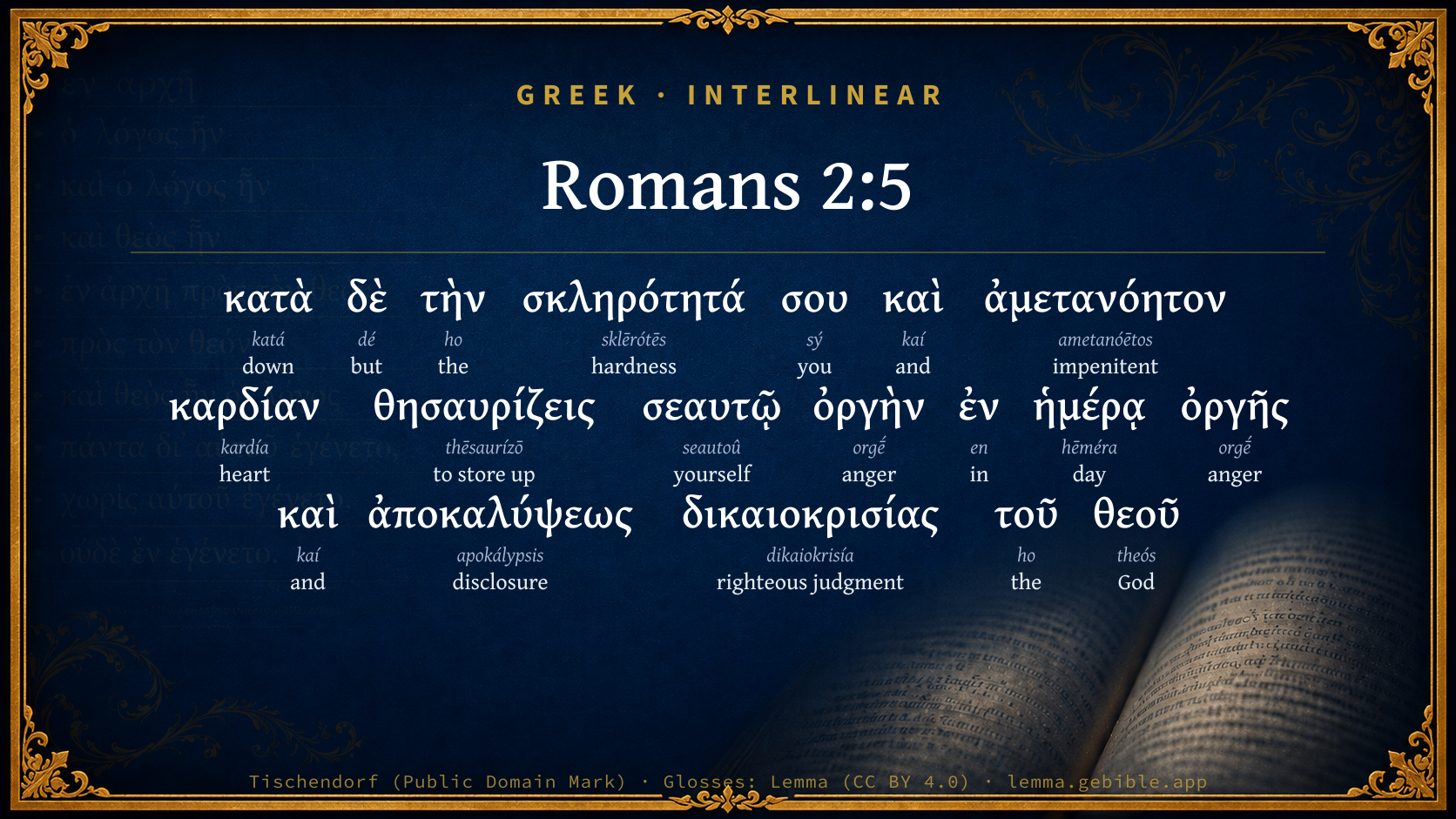
But according to your hardness and unrepentant heart you are treasuring up for yourself wrath in the day of wrath, revelation, and of the righteous judgment of God;
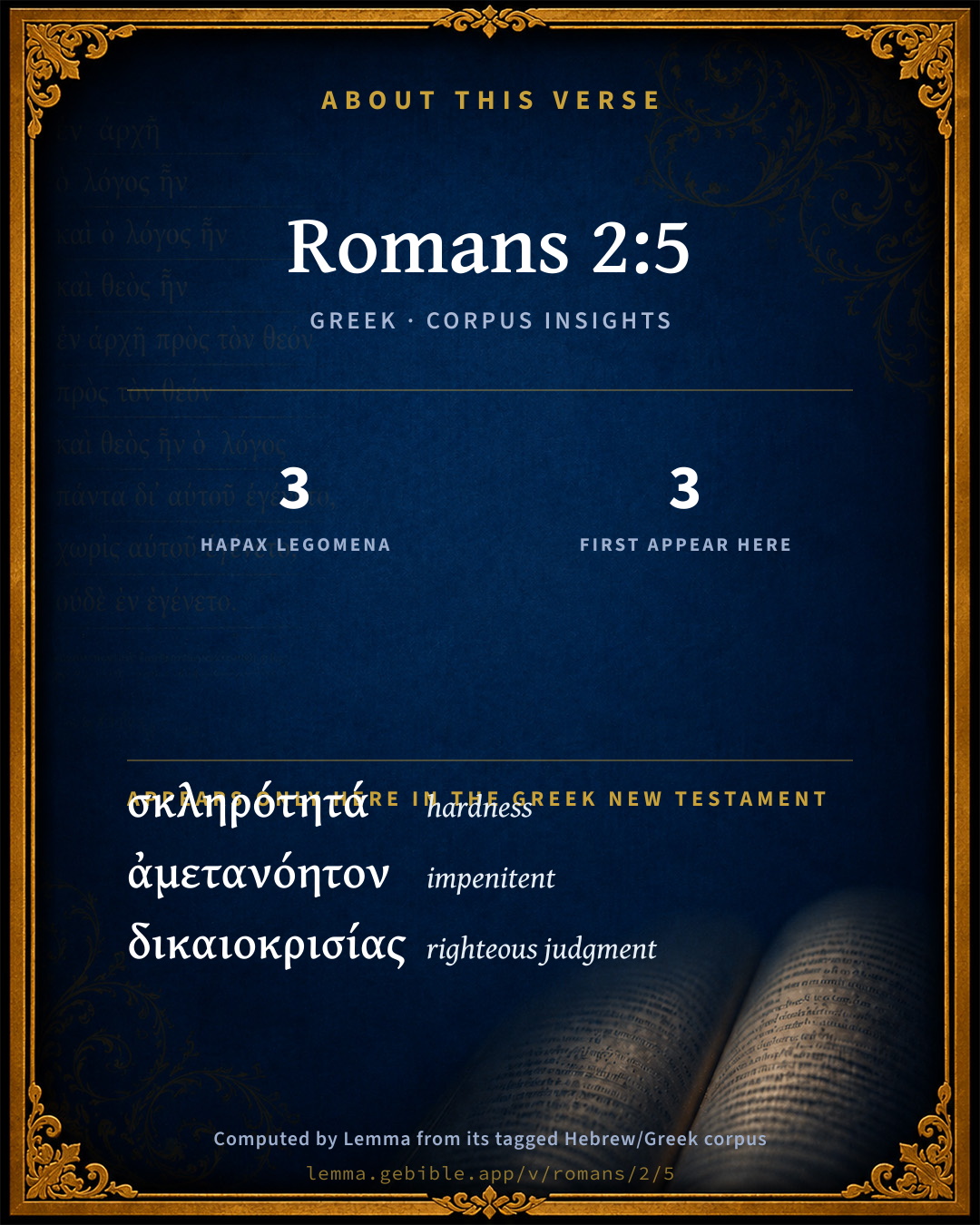
- 3 hapax legomena — only here in the Greek New Testament
- 3 first appearances in the Greek New Testament
Download a study sheet
One document with this verse’s original text, its word-by-word gloss line, the meaning frame, cross-references with their text, attributed commentary, and full source and license credits — printable, and it pastes into notes with its structure intact.
This verse Autodidact and up
A passage Seminary Student
Up to 50 verses in one chapter. A passage sheet keeps up to 6 commentary sources and 12 cross-references per verse, in the order this page ranks them, and says so on the sheet whenever that leaves anything out. Ask for a single verse and you get the Autodidact verse sheet above.
Everything on this page stays free to read, with no account — the sheet is a download of what is already on screen, not access to it.
Compare translations 3
The same verse in 3 English versions, stacked beneath the original-language interlinear above. Click any original word for its lexicon entry.
Each is an independent rendering of the whole verse — the interlinear is not word-aligned to these translations.
Highlighted words mark where these versions differ — a whole-verse word diff, not a word-by-word alignment.
-
World English Bible Public Domain
But according to your hardness and unrepentant heart you are treasuring up for yourself wrath in the day of wrath, revelation, and of the righteous judgment of God;
-
King James Version Public Domain
But after thy hardness and impenitent heart treasurest up unto thyself wrath against the day of wrath and revelation of the righteous judgment of God;
-
unfoldingWord Literal Text CC BY-SA 4.0
But according to your hardness and unrepentant heart, you are storing up for yourself wrath on the day of wrath and of the revelation of the righteous judgment of God,
unfoldingWord Literal Text — © unfoldingWord, licensed CC BY-SA 4.0. Word-aligned USFM3 via Door43 (git.door43.org/unfoldingWord/en_ult).
Show all 19 translations
Every available English version of this verse, each an independent rendering of the whole verse.
-
World English Bible Public Domain
But according to your hardness and unrepentant heart you are treasuring up for yourself wrath in the day of wrath, revelation, and of the righteous judgment of God;
-
Berean Standard Bible Public Domain
But because of your hard and unrepentant heart, you are storing up wrath against yourself for the day of wrath, when God’s righteous judgment will be revealed.
-
Majority Standard Bible Public Domain
But because of your hard and unrepentant heart, you are storing up wrath against yourself for the day of wrath, revelation, and God’s righteous judgment.
-
King James Version Public Domain
But after thy hardness and impenitent heart treasurest up unto thyself wrath against the day of wrath and revelation of the righteous judgment of God;
-
American Standard Version (1901) Public Domain
but after thy hardness and impenitent heart treasurest up for thyself wrath in the day of wrath and revelation of the righteous judgment of God;
-
Revised Version (1885) Public Domain
but after thy hardness and impenitent heart treasurest up for thyself wrath in the day of wrath and revelation of the righteous judgment of God;
-
Geneva Bible (1599) Public Domain
But thou, after thine hardnesse, and heart that canot repent, heapest vp as a treasure vnto thy selfe wrath against the day of wrath, and of the declaration of the iust iudgement of God,
-
Douay-Rheims (1899) Public Domain
But according to thy hardness and impenitent heart, thou treasurest up to thyself wrath, against the day of wrath, and revelation of the just judgment of God.
-
Young's Literal Translation Public Domain
but, according to thy hardness and impenitent heart, thou dost treasure up to thyself wrath, in a day of wrath and of the revelation of the righteous judgment of God,
-
Literal Standard Version CC BY-SA 4.0
But according to your hardness and impenitent heart, you treasure up wrath to yourself in [the] day of wrath and of the revelation of the righteous judgment of God,
-
Unlocked Literal Bible CC BY-SA 4.0
But it is to the extent of your hardness and unrepentant heart that you are storing up for yourself wrath on the day of wrath, that is, the day of the revelation of God's righteous judgment.
-
unfoldingWord Literal Text CC BY-SA 4.0
But according to your hardness and unrepentant heart, you are storing up for yourself wrath on the day of wrath and of the revelation of the righteous judgment of God,
-
Darby Bible Public Domain
but, according to thy hardness and impenitent heart, treasurest up to thyself wrath, in [the] day of wrath and revelation of [the] righteous judgment of God,
-
World Messianic Bible Public Domain
But according to your hardness and unrepentant heart you are treasuring up for yourself wrath in the day of wrath, revelation, and of the righteous judgment of God,
-
Webster's Bible Public Domain
But after thy hardness and impenitent heart, treasurest up to thyself wrath against the day of wrath, and revelation of the righteous judgment of God;
-
Free Bible Version CC BY-SA 4.0
Due to your hard-hearted attitude and your refusal to repent, you're making things far worse for yourself on the day of retribution when God's judgment is demonstrated to be absolutely right.
-
Bible in Basic English Public Domain
But by your hard and unchanged heart you are storing up wrath for yourself in the day of the revelation of God's judging in righteousness;
-
Text-Critical English NT CC BY 4.0
But according to yoʋr stubbornness and yoʋr unrepentant heart, yoʋ are storing up wrath for yoʋrself on the day of wrath, revelation, and the righteous judgment of God,
-
Tyndale New Testament (1534) Public Domain
But thou after thyne harde herte that cannot repet heapest ye togedder the treasure of wrath agaynste the daye of vengeauce when shalbe opened the rightewes iudgement of god
Literal Standard Version (2020), Covenant Press — licensed CC BY-SA 4.0. Text via the HelloAO Bible API (eBible.org). Unlocked Literal Bible (unfoldingWord) — licensed CC BY-SA 4.0. Text via the HelloAO Bible API (eBible.org). unfoldingWord Literal Text — © unfoldingWord, licensed CC BY-SA 4.0. Word-aligned USFM3 via Door43 (git.door43.org/unfoldingWord/en_ult). Free Bible Version, Dr. Jonathan Gallagher — licensed CC BY-SA 4.0. Text via the HelloAO Bible API (eBible.org).
Word by word
More ways to search: Search by grammar → Find every occurrence → Compare this word →
Practice this passage: Drill this verse → Learn its vocabulary →
- Appears 1× in the Greek New Testament
- First appears here
- Part of Speech
- Noun
- Case
- Accusative
- Number
- Singular
- Gender
- Feminine
Full Thayer's Definition
- κατὰ katá G2596 “down” Preposition
- δὲ dé G1161 “but” Conjunction
- τὴν ho G3588 “the” Article, Accusative, Singular, Feminine
- σκληρότητά sklērótēs G4643 “hardness” Noun, Accusative, Singular, Feminine
- σου sý G4771 “you” Personal pronoun, 2nd person, Genitive, Singular
- καὶ kaí G2532 “and” Conjunction
- ἀμετανόητον ametanóētos G279 “impenitent” Adjective, Accusative, Singular, Feminine
- καρδίαν kardía G2588 “heart” Noun, Accusative, Singular, Feminine
- θησαυρίζεις thēsaurízō G2343 “to store up” Verb, Present, Active, Indicative, 2nd person, Singular
- σεαυτῷ seautoû G4572 “yourself” Reflexive pronoun, 2nd person, Dative, Singular, Masculine
- ὀργὴν orgḗ G3709 “anger” Noun, Accusative, Singular, Feminine
- ἐν en G1722 “in” Preposition
- ἡμέρᾳ hēméra G2250 “day” Noun, Dative, Singular, Feminine
- ὀργῆς orgḗ G3709 “anger” Noun, Genitive, Singular, Feminine
- καὶ kaí G2532 “and” Conjunction
- ἀποκαλύψεως apokálypsis G602 “disclosure” Noun, Genitive, Singular, Feminine
- δικαιοκρισίας dikaiokrisía G1341 “righteous judgment” Noun, Genitive, Singular, Feminine
- τοῦ ho G3588 “the” Article, Genitive, Singular, Masculine
- θεοῦ theós G2316 “God” Noun, Genitive, Singular, Masculine
About this verse
These counts appear in no published source. They are computed here, from the morphology-tagged text and Lemma’s own curated glosses. What Lemma adds →
- 19
- words
- 16
- distinct lemmas
- Pauline Epistles
- section
Notable vocabulary
3 hapax legomena — words that appear only here in the entire Greek New Testament:
First appearance in Scripture
These words make their first canonical appearance in the Greek New Testament here:
Shared distinctive vocabulary
θησαυρίζεις to store up G2343 occurs in 8 verses of the Greek New Testament. Also found in:
Cross-references
31Topical passages linked to Romans 2:5 in the Treasury of Scripture Knowledge — connected by theme and wording, ordered by reader-vote popularity; previews shown in the World English Bible.
- Ecclesiastes 12:14 For God will bring every work into judgment, with every hidden thing, whether it is good, or whether it is evil.
- Romans 1:18 For the wrath of God is revealed from heaven against all ungodliness and unrighteousness of men, who suppress the truth in unrighteousness,
- Romans 2:2–3 We know that the judgment of God is according to truth against those who practice such things.
- Hebrews 3:15 while it is said, "Today if you will hear his voice, Don't harden your hearts, as in the rebellion."
- 2 Peter 3:7 But the heavens that now are, and the earth, by the same word have been stored up for fire, being reserved against the day of judgment and destruction of ungodly men.
- Jude 1:6 Angels who didn't keep their first domain, but deserted their own dwelling place, he has kept in everlasting bonds under darkness for the judgment of the great day.
- Deuteronomy 32:34 Isn't this laid up in store with me, Sealed up among my treasures?
- Romans 9:22 What if God, willing to show his wrath, and to make his power known, endured with much patience vessels of wrath made for destruction,
- 1 Samuel 6:6 Why then do you harden your hearts, as the Egyptians and Pharaoh hardened their hearts? When he had worked wonderfully among them, didn't they let the people go, and they departed?
- 2 Chronicles 30:8 Now don't you be stiff-necked, as your fathers were; but yield yourselves to Yahweh, and enter into his sanctuary, which he has sanctified forever, and serve Yahweh your God, that his fierce anger may turn away from you.
- Psalms 110:5 The Lord is at your right hand. He will crush kings in the day of his wrath.
- Zechariah 7:11–12 But they refused to listen, and turned their backs, and stopped their ears, that they might not hear.
- Hebrews 3:13 but exhort one another day by day, so long as it is called "today;" lest any one of you be hardened by the deceitfulness of sin.
- Hebrews 4:7 he again defines a certain day, today, saying through David so long a time afterward (just as has been said), "Today if you will hear his voice, Don't harden your hearts."
- 2 Peter 2:9 the Lord knows how to deliver the godly out of temptation and to keep the unrighteous under punishment for the day of judgment;
- Exodus 8:15 But when Pharaoh saw that there was a respite, he hardened his heart, and didn't listen to them, as Yahweh had spoken.
- Deuteronomy 2:30 But Sihon king of Heshbon would not let us pass by him; for Yahweh your God hardened his spirit, and made his heart obstinate, that he might deliver him into your hand, as at this day.
- Joshua 11:20 For it was of Yahweh to harden their hearts, to come against Israel in battle, that he might utterly destroy them, that they might have no favor, but that he might destroy them, as Yahweh commanded Moses.
- 2 Chronicles 36:13 He also rebelled against king Nebuchadnezzar, who had made him swear by God: but he stiffened his neck, and hardened his heart against turning to Yahweh, the God of Israel.
- Job 21:30 That the evil man is reserved to the day of calamity? That they are led forth to the day of wrath?
- Psalms 95:8 Don't harden your heart, as at Meribah, As in the day of Massah in the wilderness,
- Proverbs 11:4 Riches don't profit in the day of wrath, But righteousness delivers from death.
- Proverbs 29:1 He who is often rebuked and stiffens his neck Will be destroyed suddenly, with no remedy.
- Isaiah 48:4 Because I knew that you are obstinate, and your neck is an iron sinew, and your brow brass;
- Ezekiel 3:7 But the house of Israel will not listen to you; for they will not listen to me: for all the house of Israel are of hard forehead and of a stiff heart.
- Daniel 5:20 But when his heart was lifted up, and his spirit was hardened so that he dealt proudly, he was deposed from his kingly throne, and they took his glory from him:
- Romans 11:25 For I don't desire, brothers, to have you ignorant of this mystery, so that you won't be wise in your own conceits, that a partial hardening has happened to Israel, until the fullness of the Gentiles has come in,
- James 5:3 Your gold and your silver are corroded, and their corrosion will be for a testimony against you, and will eat your flesh like fire. You have laid up your treasure in the last days.
- Revelation 6:17 for the great day of his wrath has come; and who is able to stand?"
- Exodus 14:17 I, behold, I will harden the hearts of the Egyptians, and they shall go in after them: and I will get myself honor over Pharaoh, and over all his host, over his chariots, and over his horsemen.
- Amos 3:10 "Indeed they don't know to do right," says Yahweh, "Who hoard plunder and loot in their palaces."
Cross-references courtesy of OpenBible.info (CC BY 4.0).
Where the printed editions differ
1 variantPlaces in this verse where the major printed Greek editions disagree on the wording in a way that affects the translation — a comparison of editions, not a manuscript-by-manuscript collation. The editions are the modern critical texts (Nestlé-Aland 28/27, SBL, Westcott-Hort, Tregelles, Tyndale House) and the traditional texts behind the KJV (the Textus Receptus and the Byzantine/Majority text). It is not a claim about which reading is original.
-
Extra text
καὶ
“and”
In Byz Not in NA28NA27TynSBLWHTregTRκαὶ (kai) 'and' is only in a few manuscripts (Byz)
Textual data: Translators Amalgamated Greek New Testament (STEPBible TAGNT) · CC BY 4.0.
Lesson kit
Teaching starters — assembled from the data on this page, not authored interpretation. Every prompt links to the verse data it draws on. Edit before teaching.
Romans, in the Pauline Epistles, opens this verse with 19 words (16 distinct Greek lemmas). Its most distinctive word is sklērótēs (“hardness”). A historical commentator’s framing appears above. Read the whole chapter for the surrounding context.
Discussion questions
- The word sklērótēs carries the sense “hardness.” How does it shape the verse?
- 3 words here appear nowhere else in the Greek New Testament. Why might the author reach for such rare wording?
- 3 words make their first appearance in Scripture here. What does this debut establish?
- How does Matthew 6:19, which shares the word «to store up», read alongside this verse?
- What does the repetition of “anger” (2× in this one verse) do in this verse?
- The translations on this page render this verse differently — a whole-verse word diff, not a word-by-word alignment. What might account for the different wordings?
- Compare how The Biblical Illustrator and Joseph Benson's Commentary read this verse. Where do they agree or differ?
Things to notice
- 3 words in this verse appear nowhere else in the Greek New Testament.
- 3 words make their first canonical appearance in Scripture here.
- These translations choose different wording for 11 words in this verse.
- “anger” occurs 2× in this single verse.
- 16 distinct Greek lemmas span 19 words in this verse.
Commentary
Notes on Romans 2:5 from classic Christian and Jewish commentators (each source and its license shown beneath its notes). The classic Christian expositions comment on the surrounding passage and are grouped to its opening verse, so a note may address several verses; the Jewish commentaries on the Tanakh (Rashi and others) are per-verse, so they appear only where the commentator wrote on this verse.
Lemma curates 59 commentaries, every one of them public domain or Creative Commons licensed, each selected and text-cleaned for this edition rather than reprinted as found. About our sources →
The Biblical Illustrator
Joseph S. Exell
The Biblical Illustrator, edited by Joseph S. Exell (c. 1880s–1900s) — public domain. Text from a community e-Sword module.
Joseph Benson's Commentary
Joseph Benson's Commentary on the Old and New Testaments (1811–1818) — public domain. Text from a community e-Sword module.
The Preacher's Complete Homiletical Commentary
Joseph S. Exell (gen. ed.)
The Preacher's Complete Homiletical Commentary (gen. ed. Joseph S. Exell; Funk & Wagnalls, c. 1892) — public domain (pre-1929). A full-Bible homiletical/sermon-outline anthology covering 65 of 66 books (2 John is absent from the source module). Text from a community e-Sword module.
Bengel's Gnomon
Johann Albrecht Bengel
Bengel's Gnomon of the New Testament — English translation (T&T Clark, Edinburgh, 1860) — public domain. Text from a community e-Sword module.
Meyer's Critical & Exegetical Commentary
Heinrich August Wilhelm Meyer
Meyer — Critical and Exegetical Commentary on the New Testament — English translation by Peter Christie, edited by Frederick Crombie (T&T Clark, 1880) — public domain. Text from a community e-Sword module.
Expositor's Greek Testament
ed. W. Robertson Nicoll
The Expositor's Greek Testament, edited by W. Robertson Nicoll (1897–1910) — public domain. Text from a community e-Sword module.
Godet's Commentaries
Frédéric Louis Godet
Frédéric Louis Godet — Commentaries on Luke, John, Romans, and 1 Corinthians — English translation (T&T Clark, Edinburgh, 1870s–1890s) — public domain. Text from a community e-Sword module.
Hodge's Commentary on Romans, Ephesians & First Corinthians
Charles Hodge
Charles Hodge — Commentary on Romans (1835), First Corinthians (1857), and Ephesians (1856) — public domain. Text from a community e-Sword module.
Geneva Bible (1599)
Geneva Bible translators
Geneva Bible (1599) marginal notes — public domain. Text via Bolls.life.
Jamieson, Fausset & Brown
Robert Jamieson, A. R. Fausset & David Brown
Jamieson, Fausset & Brown — Commentary Critical and Explanatory on the Whole Bible (1871) — public domain (CC PDM 1.0). Text via the HelloAO Bible API.
Adam Clarke's Commentary
Adam Clarke's Commentary on the Bible (1810–1826) — public domain. Text from a community e-Sword/MySword module.
John Calvin's Commentaries
John Calvin's Commentaries (1540-1563) — public domain. Text from the Calvin Translation Society English edition (1840s-50s) via the Christian Classics Ethereal Library (ccel.org). Calvin's coverage is partial (roughly two-thirds of the Bible); uncommented books and verses are honest gaps, never fabricated. The 19th-century editor's footnotes and remarks are omitted so the notes are faithfully Calvin's own voice.
Ellicott's Commentary for English Readers
A Bible Commentary for English Readers, edited by Charles John Ellicott (1878–1897) — public domain. Text from a community e-Sword module.
The Cambridge Bible for Schools and Colleges
gen. ed. J. J. S. Perowne
The Cambridge Bible for Schools and Colleges (gen. ed. J. J. S. Perowne; Cambridge University Press, 1878–1918) — public domain. Text from a community e-Sword module.
John Gill's Exposition
John Gill's Exposition of the Whole Bible (1746–1763) — public domain (CC PDM 1.0). Text via the HelloAO Bible API.
Trapp's Complete Commentary
John Trapp
John Trapp, A Commentary or Exposition upon All the Books of the Old and New Testament (1647–1656) — public domain. Text from a community e-Sword module.
Albert Barnes' Notes on the Bible
Albert Barnes' Notes on the Bible (1834–1885) — public domain. Text from a community e-Sword/MySword module.
Haydock's Catholic Bible Commentary
George Leo Haydock (1774–1849), Haydock's Catholic Family Bible and Commentary, 1859 edition — public domain. Excludes Psalms (Douay-Rheims chapter numbering differs from Protestant) and Deuterocanonical books (Catholic canon only).
Matthew Poole's English Annotations
Matthew Poole's English Annotations on the Holy Bible (1683–1685) — public domain. Text from a community e-Sword/MySword module.
Whedon's Commentary on the Bible
Daniel D. Whedon
Daniel D. Whedon (gen. ed.), Commentary on the Old and New Testaments (1874–1909) — public domain. Text from a community e-Sword module.
The Pulpit Commentary
The Pulpit Commentary (1880–1919), ed. H.D.M. Spence-Jones & Joseph S. Exell — public domain. Text from a community e-Sword module.
John Wesley's Explanatory Notes
John Wesley, Explanatory Notes Upon the Whole Bible (1754–1765) — public domain. Text via the GEBible commentary corpus.
Kretzmann's Popular Commentary
Paul E. Kretzmann
Paul E. Kretzmann, Popular Commentary of the Bible (1921–1924) — public domain. Text from a community e-Sword module.
Godbey's Commentary on the New Testament
William B. Godbey
William B. Godbey, Commentary on the New Testament (1896–1900) — public domain. Text from a community e-Sword module.
McGarvey & Pendleton's Commentaries
J. W. McGarvey
J. W. McGarvey (with Philip Y. Pendleton), Commentaries on the New Testament (The Fourfold Gospel, 1914; Acts; and the epistles) — public domain. Text from a community e-Sword/MySword module.
The People's New Testament
B. W. Johnson
B. W. Johnson's The People's New Testament with Notes (1889–1891) — public domain. Electronic text from the Christian Classics Ethereal Library (CCEL) ThML edition.
unfoldingWord translationNotes
Door43 World Missions Community
unfoldingWord translationNotes — © Distant Shores Media and the Door43 World Missions Community, licensed CC BY-SA 4.0. Source: git.door43.org/Door43/en_tn.
Cambridge Greek Testament for Schools and Colleges
Cambridge Greek Testament for Schools and Colleges (Cambridge University Press, 1896; 21 vols, various authors incl. Carr, Maclear, Plummer, Farrar, Lumby, Moule, M. R. James, Simcox) — public domain. Text from a community e-Sword module.
Alford’s Greek Testament
Henry Alford
Henry Alford, The Greek Testament (1849–1861) — public domain. Text from a community e-Sword module.
International Critical Commentary
International Critical Commentary — older volumes (1896–1929), various authors — public domain. Text from a community e-Sword module.
Vincent's Word Studies in the New Testament
Marvin R. Vincent
Marvin R. Vincent, Word Studies in the New Testament (1887–1900) — public domain. Text from a community e-Sword/MySword module.