
2 Corinthians 11:2

Greek (Tischendorf 8th ed.) 2 Corinthians 11:2 appears in the Greek New Testament. The text above is from the Tischendorf 8th edition. Each word links to its Strong’s number and a concise gloss. Click any word for its full Thayer’s Greek Lexicon entry.
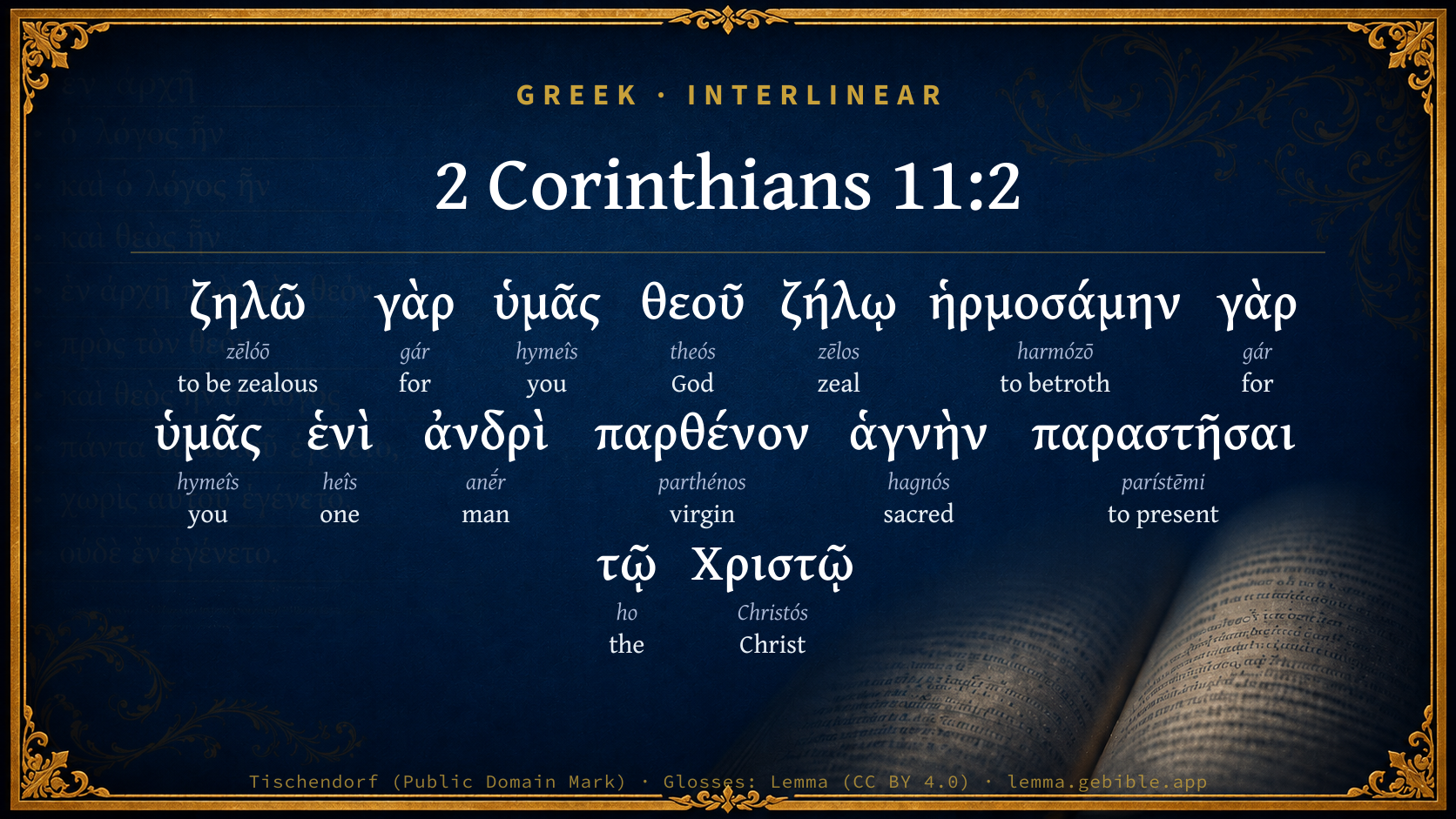
Download image
Cite this verse

2 Corinthians 11:2 (World English Bible). Public Domain. Lemma interlinear Bible study tool, https://lemma.gebible.app/v/2-corinthians/11/2.

Show BibTeX & RIS
BibTeX
RIS
English Translation
For I am jealous over you with a godly jealousy. For I married you to one husband, that I might present you as a pure virgin to Christ.
World English Bible · Public Domain
Highlights
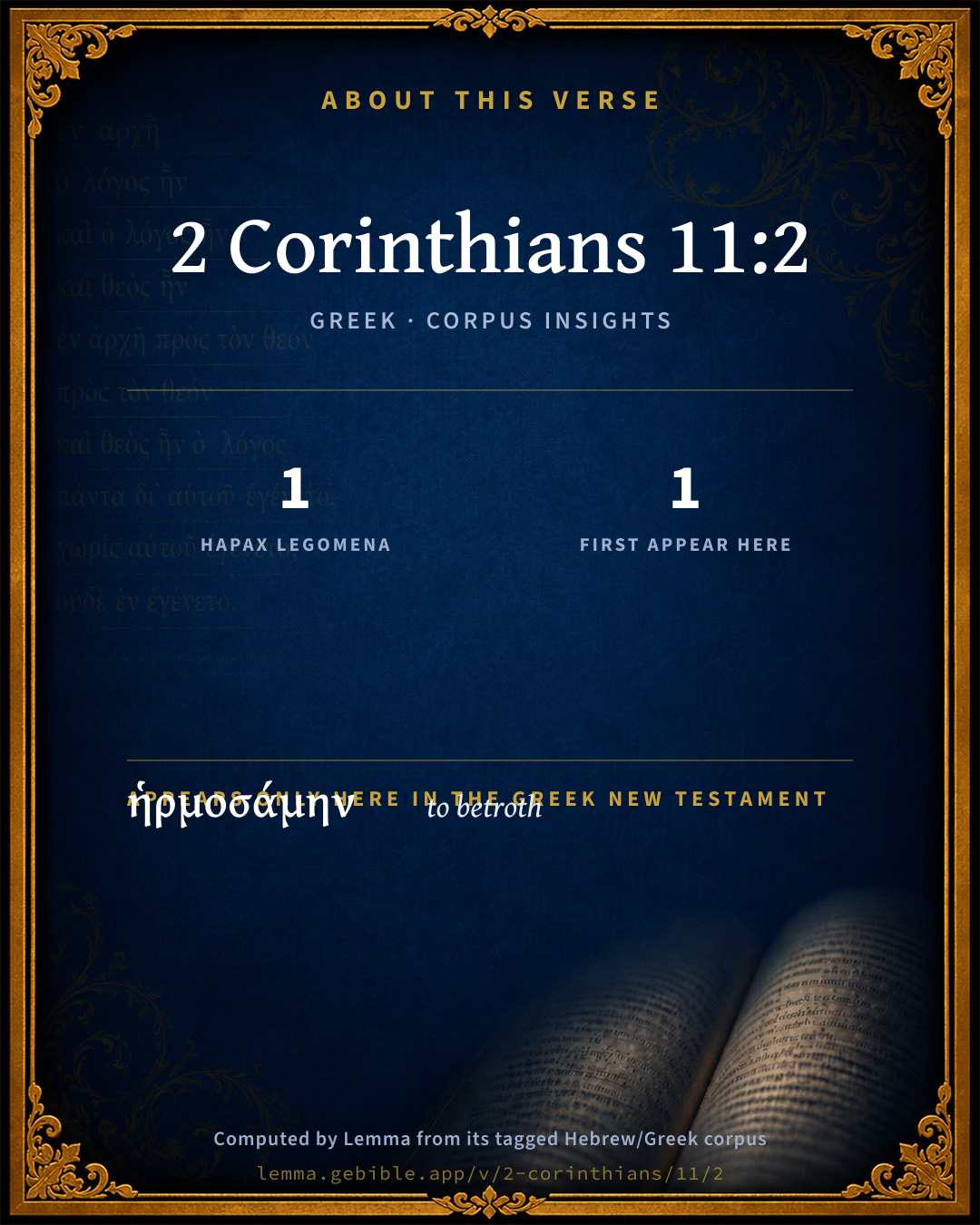
  • 1 hapax legomenon — only here in the Greek New Testament
  • 1 first appearance in the Greek New Testament
Full analysis ↓
Download a study sheet

One document with this verse’s original text, its word-by-word gloss line, the meaning frame, cross-references with their text, attributed commentary, and full source and license credits — printable, and it pastes into notes with its structure intact.

This verse Autodidact and up

Study sheet (.html) Plain text (.txt)

A passage Seminary Student

Up to 50 verses in one chapter. A passage sheet keeps up to 6 commentary sources and 12 cross-references per verse, in the order this page ranks them, and says so on the sheet whenever that leaves anything out. Ask for a single verse and you get the Autodidact verse sheet above.

Everything on this page stays free to read, with no account — the sheet is a download of what is already on screen, not access to it.

Want to remove ads? Support Godless Engineer
Compare translations 3

The same verse in 3 English versions, stacked beneath the original-language interlinear above. Click any original word for its lexicon entry.

Each is an independent rendering of the whole verse — the interlinear is not word-aligned to these translations.

Highlighted words mark where these versions differ — a whole-verse word diff, not a word-by-word alignment.

  • World English Bible Public Domain
    For I am jealous over you with a godly jealousy. For I married you to one husband, that I might present you as a pure virgin to Christ.
  • King James Version Public Domain
    For I am jealous over you with godly jealousy: for I have espoused you to one husband, that I may present you as a chaste virgin to Christ.
  • unfoldingWord Literal Text CC BY-SA 4.0
    For I am jealous you with a godly jealousy, for I joined you to one husband, to present a pure virgin to Christ.

unfoldingWord Literal Text — © unfoldingWord, licensed CC BY-SA 4.0. Word-aligned USFM3 via Door43 (git.door43.org/unfoldingWord/en_ult).

Versions to compare (up to 4)

3 of 4 selected

Show all 19 translations

Every available English version of this verse, each an independent rendering of the whole verse.

  • World English Bible Public Domain
    For I am jealous over you with a godly jealousy. For I married you to one husband, that I might present you as a pure virgin to Christ.
  • Berean Standard Bible Public Domain
    I am jealous for you with a godly jealousy. For I promised you to one husband, to present you as a pure virgin to Christ.
  • Majority Standard Bible Public Domain
    I am jealous for you with a godly jealousy. For I promised you to one husband, to present you as a pure virgin to Christ.
  • King James Version Public Domain
    For I am jealous over you with godly jealousy: for I have espoused you to one husband, that I may present you as a chaste virgin to Christ.
  • American Standard Version (1901) Public Domain
    For I am jealous over you with a godly jealousy: for I espoused you to one husband, that I might present you `as' a pure virgin to Christ.
  • Revised Version (1885) Public Domain
    For I am jealous over you with a godly jealousy: for I espoused you to one husband, that I might present you as a pure virgin to Christ.
  • Geneva Bible (1599) Public Domain
    For I am ielous ouer you, with godly ielousie: for I haue prepared you for one husband, to present you as a pure virgine to Christ:
  • Douay-Rheims (1899) Public Domain
    For I am jealous of you with the jealousy of God. For I have espoused you to one husband that I may present you as a chaste virgin to Christ.
  • Young's Literal Translation Public Domain
    for I am zealous for you with zeal of God, for I did betroth you to one husband, a pure virgin, to present to Christ,
  • Literal Standard Version CC BY-SA 4.0
    for I am zealous for you with zeal of God, for I betrothed you to one Husband, a pure virgin, to present to Christ,
  • Unlocked Literal Bible CC BY-SA 4.0
    For I am jealous about you. I have a godly jealousy for you, since I promised you in marriage to one husband. I promised to present you as a pure virgin to Christ.
  • unfoldingWord Literal Text CC BY-SA 4.0
    For I am jealous you with a godly jealousy, for I joined you to one husband, to present a pure virgin to Christ.
  • Darby Bible Public Domain
    For I am jealous as to you with a jealousy [which is] of God; for I have espoused you unto one man, to present [you] a chaste virgin to Christ.
  • World Messianic Bible Public Domain
    For I am jealous over you with a godly jealousy. For I promised you in marriage to one husband, that I might present you as a pure virgin to Messiah.
  • Webster's Bible Public Domain
    For I am jealous over you with godly jealousy: for I have espoused you to one husband, that I may present you as a chaste virgin to Christ.
  • Free Bible Version CC BY-SA 4.0
    I agonize over you with a divine kind of jealousy, for I promised you to a single husband—Christ—so that I could present you as a pure virgin to him.
  • Bible in Basic English Public Domain
    For I have a very great care for you: because you have been married by me to one husband, and it is my desire to give you completely holy to Christ.
  • Text-Critical English NT CC BY 4.0
    I am jealous for you with a godly jealousy, because I promised you in marriage to one husband, to present you as a pure virgin to Christ.
  • Tyndale New Testament (1534) Public Domain
    For I am gelous over you with godly gelousy. For I coupled you to one man to make you a chaste virgen to Christ.

Literal Standard Version (2020), Covenant Press — licensed CC BY-SA 4.0. Text via the HelloAO Bible API (eBible.org). Unlocked Literal Bible (unfoldingWord) — licensed CC BY-SA 4.0. Text via the HelloAO Bible API (eBible.org). unfoldingWord Literal Text — © unfoldingWord, licensed CC BY-SA 4.0. Word-aligned USFM3 via Door43 (git.door43.org/unfoldingWord/en_ult). Free Bible Version, Dr. Jonathan Gallagher — licensed CC BY-SA 4.0. Text via the HelloAO Bible API (eBible.org).

Word by word

More ways to search: Search by grammar → Find every occurrence → Compare this word →

Practice this passage: Drill this verse → Learn its vocabulary →

ἡρμοσάμην
harmózō
G718
“to betroth”
Verb, Aorist, Middle, Indicative, 1st person, Singular
Part of Speech
Verb
Tense
Aorist
Voice
Middle
Mood
Indicative
Person
1st person
Number
Singular
Full Thayer's Definition

Origin: from G719

TDNT: None

1. to join, to fit together a. of carpenter's, fastening together beams and planks to build houses, ships, etc. 2. to betroth a daughter to any one a. to join to one's self, i.e. to marry the daughter of any one b. to betroth, to give one in marriage to any one
  1. ζηλῶ zēlóō G2206 “to be zealous” Verb, Present, Active, Indicative, 1st person, Singular
  2. γὰρ gár G1063 “for” Conjunction
  3. ὑμᾶς hymeîs G5210 “you” Personal pronoun, 2nd person, Accusative, Plural
  4. θεοῦ theós G2316 “God” Noun, Genitive, Singular, Masculine
  5. ζήλῳ zēlos G2205 “zeal” Noun, Dative, Singular, Masculine
  6. γὰρ gár G1063 “for” Conjunction
  7. ὑμᾶς hymeîs G5210 “you” Personal pronoun, 2nd person, Accusative, Plural
  8. ἑνὶ heîs G1520 “one” Adjective, Dative, Singular, Masculine
  9. ἀνδρὶ anḗr G435 “man” Noun, Dative, Singular, Masculine
  10. παρθένον parthénos G3933 “virgin” Noun, Accusative, Singular, Feminine
  11. ἁγνὴν hagnós G53 “sacred” Adjective, Accusative, Singular, Feminine
  12. παραστῆσαι parístēmi G3936 “to present” Verb, Aorist, Active, Infinitive
  13. τῷ ho G3588 “the” Article, Dative, Singular, Masculine
  14. Χριστῷ Christós G5547 “Christ” Noun, Dative, Singular, Masculine

About this verse

These counts appear in no published source. They are computed here, from the morphology-tagged text and Lemma’s own curated glosses. What Lemma adds →

15
words
13
distinct lemmas
Pauline Epistles
section

Notable vocabulary

1 hapax legomenon — a word that appears only here in the entire Greek New Testament:

  • ἡρμοσάμην to betroth G718

First appearance in Scripture

This word makes its first canonical appearance in the Greek New Testament here:

  • ἡρμοσάμην to betroth G718

Shared distinctive vocabulary

ἁγνὴν sacred G53 occurs in 8 verses of the Greek New Testament. Also found in:
Repetition

Words recur within this verse:

Cross-references

15

Topical passages linked to 2 Corinthians 11:2 in the Treasury of Scripture Knowledge — connected by theme and wording, ordered by reader-vote popularity; previews shown in the World English Bible.

  • Hosea 2:19–20 I will betroth you to me forever. Yes, I will betroth you to me in righteousness, in justice, in loving kindness, and in compassion.
  • Ephesians 5:26–27 that he might sanctify it, having cleansed it by the washing of water with the word,
  • Isaiah 54:5 For your Maker is your husband; Yahweh of Hosts is his name: and the Holy One of Israel is your Redeemer; the God of the whole earth shall he be called.
  • Colossians 1:28 whom we proclaim, admonishing every man and teaching every man in all wisdom, that we may present every man perfect in Christ Jesus;
  • Leviticus 21:13–15 "'He shall take a wife in her virginity.
  • John 3:29 He who has the bride is the bridegroom; but the friend of the bridegroom, who stands and hears him, rejoices greatly because of the bridegroom's voice. This, my joy, therefore is made full.
  • Isaiah 62:4–5 You shall no more be termed Forsaken; neither shall your land any more be termed Desolate: but you shall be called Hephzibah, and your land Beulah; for Yahweh delights in you, and your land shall be married.
  • Romans 7:4 Therefore, my brothers, you also were made dead to the law through the body of Christ, that you would be joined to another, to him who was raised from the dead, that we might bring forth fruit to God.
  • Genesis 24:2–5 Abraham said to his servant, the elder of his house, who ruled over all that he had, "Please put your hand under my thigh.
  • Genesis 24:58–67 They called Rebekah, and said to her, "Will you go with this man?" She said, "I will go."
  • Psalms 45:10–11 Listen, daughter, consider, and turn your ear. Forget your own people, and also your father's house.
  • Ezekiel 44:22 Neither shall they take for their wives a widow, nor her who is put away; but they shall take virgins of the seed of the house of Israel, or a widow who is the widow of a priest.
  • 2 Corinthians 4:14 knowing that he who raised the Lord Jesus will raise us also with Jesus, and will present us with you.
  • Galatians 4:17–19 They zealously seek you in no good way. No, they desire to alienate you, that you may seek them.
  • Philippians 1:8 For God is my witness, how I long after all of you in the tender mercies of Christ Jesus.

Cross-references courtesy of OpenBible.info (CC BY 4.0).

Commentary

Notes on 2 Corinthians 11:2 from classic Christian and Jewish commentators (each source and its license shown beneath its notes). The classic Christian expositions comment on the surrounding passage and are grouped to its opening verse, so a note may address several verses; the Jewish commentaries on the Tanakh (Rashi and others) are per-verse, so they appear only where the commentator wrote on this verse.

Lemma curates 59 commentaries, every one of them public domain or Creative Commons licensed, each selected and text-cleaned for this edition rather than reprinted as found. About our sources →

Tyndale Open Study Notes

Tyndale Open Resources

11:2 The church is called to be a pure bride to one husband—Christ. This metaphor goes back to the Old Testament, where Israel is the bride of the Lord (Isa 54:5; 62:5). Paul saw himself as the “best man” (the bridegroom’s close friend) who acted for the bridegroom (cp. John 3:29).

Tyndale Open Study Notes — © Tyndale Open Resources, licensed CC BY-SA 4.0. Text via the HelloAO Bible API.

Bengel's Gnomon

Johann Albrecht Bengel

2Co 11:2. Ζηλῶ γὰρ, for I am jealous) In this and the following verse the cause of his folly is set before us: for lovers seem to be out of their wits.[75] The cause of the forbearance due to Paul is explained 2Co 11:4, comp. 2Co 11:20.—Θεοῦ ζήλῳ, with a godly jealousy) a great and holy jealousy. [If I am immoderate, says he, I am immoderate to God.—V. g.]—ἡρμοσάμην, I have espoused) There is an apposition, to one husband, viz. Christ, and both are construed with, that I may present you [viz. to one husband, Christ]. Therefore I espoused is put absolutely. [But Engl. V. I have espoused you to one husband.] Moreover ἁρμόζομαι, I espouse, is usually applied to the bridegroom. But here Paul speaks of himself in the same feeling of mind as when he ascribes to himself ‘jealousy,’ which belongs properly to the husband; for all that he felt, and all that he did, was for the sake of Christ.—παρθἑνον ἁγνὴν, a chaste virgin) not singly [the individual members], but conjointly [the whole body together]. He does not say, chaste virgins, παρθένους ἁγνάς.

[75] The Latin words are, “amantes enim videntur amentes,” which cannot be imitated in a translation.—T.

Bengel's Gnomon of the New Testament — English translation (T&T Clark, Edinburgh, 1860) — public domain. Text from a community e-Sword module.

Meyer's Critical & Exegetical Commentary

Heinrich August Wilhelm Meyer

2Co_11:2. Ground of the ἀλλὰ καὶ ἀνέχεσθέ μου: My jealousy for you is, in fact, a divine jealousy; how can you then refuse to me the ἀνέχεσθαι! Rückert refers γάρ to ὄφελον … ἀφροσύνης, but in this way ἀλλὰ καὶ ἀνέχεσθέ μου is overleaped all the more violently, seeing that it is a correction of what goes before. Calvin (comp. Chrysostom and Bengel): en cur desipiat, nam hominem zelotypia quasi transversum rapit. Against this may be urged the emphatic θεοῦ, in which lies the very point of the reason assigne.

ζηλῶ γὰρ ὑμᾶς κ.τ.λ.] As Paul, in what follows, represents himself as a marriage-friend (comp. Joh_3:29) who has betrothed the bride to the bridegroom, and is now anxious that she may not let herself be led astray by another, ζηλῶ is to be taken in the narrowest sense as equivalent to ζηλοτυπῶ: I am jealous concerning you (comp. Num_5:14; Sir_9:1), for the marriage-friend very naturally takes the bridegrooms part. The more indefinite interpretation: I am zealous concerning you (Flatt and others), is therefore, according to the context, too general, and the explanation: vehementer amo vos (Rosenmüller, comp. Fritzsche), is at variance with the contex.

θεοῦ ζήλῳ] with a jealousy, which God has; which is no human passion, but an emotion belonging to God, which I therefore have in common with Him. Paul consequently conceives of God as likewise jealous concerning the Corinthian church (ὑμᾶς), that she might not, as the bride of Christ, suffer herself to be led astray. God appears in the O. T. as the spouse of His people, and therefore jealous regarding it (Isa_54:5; Isa_62:5; Jer_3:1 ff.; Eze_16:8 ff., Eze_16:23; Hos_2:18-19). Now, as the representative of God in the theocracy of the N. T. is Christ, with whom, therefore, the church appears connected, partly as spouse (see on Rom_7:4), partly as betrothed (with reference to the completion of the marriage at the Parousia), as here (comp. Eph_5:25 ff.); the falling away from Christ must therefore be the object of divine jealousy, and so Paul knows his ζῆλος, the ζῆλος of the marriage-friend, as the ζῆλος of God. θεοῦ has been taken as genitivus auctoris (Wolf and others, comp. Flatt, de Wette), or as: zeal for God (Rom_10:2, so Calvin, Grotius, Estius, Semler, Schulz), or as: zeal pleasing to God (Billroth, comp. Flatt), or as: zeal extraordinarily great (Emmerling, so also Fritzsche; comp. Bengel: zelo sancto et magno); but all these interpretations lie beyond the necessary definite reference to what follows, in which a reason is given for the very predicate θεοῦ.

ἡρμοσάμην γὰρ κ.τ.λ.] for I have betrothed you … but I fear, etc., 2Co_11:3, so that, with Lachmann, only a comma is to be put after 2Co_11:2. ἁρμόζειν, adaptare, then specially in the sense of betroth; see Wetstein. The more Attic form is ἁρμόττειν. See Gregor. p. 154, Schaef.; Lobeck, ad Phryn. p. 241. That Paul has expressed himself contrary to the Greek usage (according to which ἁρμόζεσθαί τινα means: to betroth oneself to a woman, Herod. v. 32, 47, vi. 65), is only to be said, in so far as a classical writer would certainly have used the active (Herod. ix. 108; Pind. Pyth. ix. 207), although in late writers the middle also occurs in the active sense (see the passages from Philo in Loesner, p. 320, e.g. de Abr. p. 364 B; γάμος ὃν ἁρμόζεται ἡδονή), and here the following ἑνὶ ἀνδρί leaves no doubt of the reference: I have joined (i.e. according to the context, betrothed) you to one husband. Paul regards himself as a marriage-friend (προμνήστωρ ὑμῶν ἐγενόμην καὶ τοῦ γάμου μεσίτης, Theodoret), by whose intervention the betrothal of the Corinthians with Christ was brought to pass. Chrysostom aptly says on the figurative representation of the matter: μνηστείας γάρ ἐστι καιρὸς ὁ παρὼν καιρός· ὁ δὲ τῶν παστάδων ἕτερος, ὅταν λέγωσιν· ἀνέστη ὁ νυμφίος … Ὃ μάλιστα τούτοις (to the readers) ἔφερεν ἀξίωμα, τοῦτο τίθησιν, ἑαυτὸν μὲν ἐν χώρᾳ τῆς προμνηστρίας, ἐκείνους δὲ ἐν τάξει τῆς νύμφης στήσας. Pelagius, Elsner, Mosheim, Emmerling wrongly hold that he conceives himself as father of the Corinthians; their father (but this figure is here quite out of place) he has, in fact, only come to be through their conversion to Christ (1Co_4:17; 2Co_12:14; comp. Tit_1:4); he had not been so already before. Regarding the marriage-friend of the Jews, שׁוֹשְּׁבֵן, παρανύμφιος, who not only wooed the bride for the bridegroom, but who was the constant medium between the two, and at the wedding itself was regulator of the feast, see Schöttgen, Hor. ad Joh. iii. 29. With the Rabbins, Moses is represented as such a marriage-friend. See Rab. Sal. ad Exod. xxxiv. 1, al.

ἑνὶ ἀνδρί] to one husband, to belong to no one furthe.

παρθένον ἁγνὴν κ.τ.λ.] Aim, with which he had betrothed the Corinthians to a single husband: in order to present a pure virgin to Christ (παραστ., comp. 2Co_4:14), namely, at the Parousia, when Christ appears as bridegroom, to fetch home the bride, Mat_25:1 ff.; Eph_5:27; Rev_19:7-9. The church in its entirety, as a moral person, is this virgin. On ἁγνήν, comp. Dem. 1371. 23; Plut. Mor. p. 268 E, 438 C; Plat. Legg. viii. p. 840 D. The whole emphasis is on παρθένον ἁγνήν. When this is attended to, there disappears the semblance of εἷς ἀνήρ and ὁ Χριστός being different persons,a semblance for which Rückert blames the apostle. Fritzsche regards τῷ Χριστῷ as apposition to ἑνὶ ἀνδρί (in which Rückert agrees with him), and encloses παραστῆσαι between two commas; but this is an unnecessary and enfeebling breaking up of the passage. Beza and Bengel connect ἑνὶ ἀνδρί with παραστ., and take τῷ Χριστῷ likewise epexegetically. But the absolute ἡρμοσάμην ὑμᾶς would in fact mean: I have betrothed myself to you! In order that it may not mean this, it must necessarily be joined to ἑνὶ ἀνδρί.

Meyer — Critical and Exegetical Commentary on the New Testament — English translation by Peter Christie, edited by Frederick Crombie (T&T Clark, 1880) — public domain. Text from a community e-Sword module.

Expositor's Greek Testament

ed. W. Robertson Nicoll

2Co 11:2 . ζηλῶ γὰρ ὑμᾶς κ . τ . λ .: for I am jealous over you with a godly jealousy ( cf. Zec 1:14 , and for Θεοῦ ζήλῳ cf. Act 22:3 , Rom 10:2 ; this “jealousy” of St. Paul is on behalf of God); for I espoused you to one husband, that I might present you as a pure virgin to Christ, sc. , at His Coming. The figure of Israel as a Bride presented to Jehovah as the Bridegroom was frequently used by the O.T. prophets (Isa 54:5 ; Isa 62:5 , Hos 2:19 ); and, according to the Rabbis, Moses was the bridesman or paranymph. Here St. Paul conceives of himself as the paranymph ( cf. Joh 3:29 ) who presents the Church as a pure Bride ( cf. Rev 21:2 ) to Christ, the heavenly Spouse, the “one husband” to whom she is bound to remain faithful. Some critics have found here an echo of Christ’s words at Mat 9:15 ; Mat 25:1-12 ; but the similarity does not extend further than the employment of the same image demands. ἁρμόζω in the act. is regularly used of the father of the bride; in the pass. of the bride herself (Pro 19:14 ); and in the mid. generally of the bridegroom, but sometimes (as here) of others.

The Expositor's Greek Testament, edited by W. Robertson Nicoll (1897–1910) — public domain. Text from a community e-Sword module.

Geneva Bible (1599)

Geneva Bible translators

To marry you together.

He speaketh as a woer, but yet as one that seeketh them not for himself, but for God.

Geneva Bible (1599) marginal notes — public domain. Text via Bolls.life.

Jamieson, Fausset & Brown

Robert Jamieson, A. R. Fausset & David Brown

For I am jealous--The justification of his self-commendations lies in his zealous care lest they should fall from Christ, to whom he, as "the friend of the Bridegroom" (Joh 3:29), has espoused them; in order to lead them back from the false apostles to Christ, he is obliged to boast as an apostle of Christ, in a way which, but for the motive, would be "folly."

godly jealousy--literally, "jealousy of God" (compare Co2 1:12, "godly sincerity," literally, "sincerity of God"). "If I am immoderate, I am immoderate to God" [BENGEL]. A jealousy which has God's honor at heart (Kg1 19:10).

I . . . espoused you--Paul uses a Greek term applied properly to the bridegroom, just as he ascribes to himself "jealousy," a feeling properly belonging to the husband; so entirely does he identify himself with Christ.

present you as a chaste virgin to Christ--at His coming, when the heavenly marriage shall take place (Mat 25:6; Rev 19:7, Rev 19:9). What Paul here says he desires to do, namely, "present" the Church as "a chaste virgin" to Christ, Christ Himself is said to do in the fuller sense. Whatever ministers do effectively, is really done by Christ (Eph 5:27-32). The espousals are going on now. He does not say "chaste virgins"; for not individual members, but the whole body of believers conjointly constitute the Bride.

Jamieson, Fausset & Brown — Commentary Critical and Explanatory on the Whole Bible (1871) — public domain (CC PDM 1.0). Text via the HelloAO Bible API.

Adam Clarke's Commentary

Verse 2. I am jealous over you, c.] The apostle evidently alludes either to the שושבינים shoshabinim or paranymphs among the Hebrews, whose office is largely explained in the notes on Joh 3:29, and the observations at the end of that chapter "Joh 3:36" or to the harmosyni, a sort of magistrates among the Lacedemonians who had the care of virgins, and whose business it was to see them well educated, kept pure, and properly prepared for married life.

That I may present you as a chaste virgin] The allusion is still kept up; and there seems to be a reference to Le 21:14, that the high priest must not marry any one that was not a pure virgin. Here, then, Christ is the high priest, the spouse or husband; the Corinthian Church the pure virgin to be espoused; the apostle and his helpers the shoshabinim, or harmosyni, who had educated and prepared this virgin for her husband, and espoused her to him. See the observations already referred to at the end of the third chapter of John. "Joh 3:36"

Adam Clarke's Commentary on the Bible (1810–1826) — public domain. Text from a community e-Sword/MySword module.

John Calvin's Commentaries

2. For I am jealous Mark why it is that he acts the fool, for jealousy hurries a man as it were headlong. “Do not demand that I should show the equable temper of a man that is at ease, and not excited by any emotion, for that vehemence of vehemence of jealousy, with which I am inflamed towards you, does not suffer me to be at ease.” As, however, there are two kinds of jealousy — the one springs from self love, and of a wicked and perverse nature, while the other is cherished by us on God’s account, he intimates of what sort his zeal is. For many are zealous — for themselves, not for God. That on the other hand, is the only pious and right zeal, that has an eye to God, that he may not be defrauded of the honors that of right belong to him.

For I have united you to one man. That his zeal was of such a nature, he proves from the design of his preaching, for its tendency was to join them to Christ in marriage, and retain them in connection with him. Here, however, he gives us in his own person a lively picture of a good minister; for One alone is the Bridegroom of the Church — the Son of God. All ministers are the friends of the Bridegroom, as the Baptist declares respecting himself. (John 3:29.) Hence all ought to be concerned, that the fidelity of this sacred marriage remain unimpaired and inviolable. This they cannot do, unless they are actuated by the dispositions of the Bridegroom, so that every one of them may be as much concerned for the purity of the Church, as a husband is for the chastity of his wife. Away then with coldness and indolence in this matter, for one that is cold will never be qualified for this office. Let them, however, in the mean time, take care, not to pursue their own interest rather than that of Christ, that they may not intrude themselves into his place, lest while they give themselves out as his paranymphs, they turn out to be in reality adulterers, by alluring the bride to love themselves.

To present you as a chaste virgin. We are married to Christ, on no other condition than that we bring virginity as our dowry, and preserve it entire, so as to be free from all corruption. Hence it is the duty of ministers of the gospel to purify our souls, that they may be chaste virgins to Christ; otherwise they accomplish nothing. Now we may understand it as meaning, that they individually present themselves as chaste virgins to Christ, or that the minister presents the whole of the people, and brings them forward into Christ’s presence. I approve rather of the second interpretation. Hence I have given a different rendering from Erasmus.

John Calvin's Commentaries (1540-1563) — public domain. Text from the Calvin Translation Society English edition (1840s-50s) via the Christian Classics Ethereal Library (ccel.org). Calvin's coverage is partial (roughly two-thirds of the Bible); uncommented books and verses are honest gaps, never fabricated. The 19th-century editor's footnotes and remarks are omitted so the notes are faithfully Calvin's own voice.

Ellicott's Commentary for English Readers

(2) For I am jealous over you . . .—The word is used with the same sense as in the nearly contemporary passage of Gal_4:17, and the whole passage may be paraphrased thus: “I court your favour with a jealous care, which is not a mere human affection, but after the pattern of that of God.” There is probably an implied contrast between the true jealousy which thus worked in his soul and the false jealousy of which he speaks in the passage just referred to.

For I have espoused you . . .—The word is not found elsewhere in the New Testament. It appears in this sense in the LXX. version of Pro_19:14 : “A man’s wife is espoused to him from the Lord.” Strictly speaking, it is used of the act of the father who gives his daughter in marriage; and this, rather than the claim to act as “the friend of the bridegroom” (see Note on Joh_3:29), is probably the idea here. He claims the office as the “father” of the Corinthian Church (1Co_4:15). The underlying idea of the comparison is that the Church at large, and every separate portion of it, is as the bride of Christ. On the earlier appearances of this thought, see Notes on Mat_22:2; Mat_25:1; Joh_3:29; and, for its more elaborated forms, on Eph_5:25-32; Rev_19:7-9; Rev_21:2; Rev_21:9). What the Apostle now urges is that it is as natural for him to be jealous for the purity of the Church which owes its birth to him, as it is for a father to be jealous over the chastity of the daughter whom he has betrothed as to a kingly bridegroom.

A Bible Commentary for English Readers, edited by Charles John Ellicott (1878–1897) — public domain. Text from a community e-Sword module.

The Cambridge Bible for Schools and Colleges

gen. ed. J. J. S. Perowne

2. with godly jealousy] Literally, with a jealousy of God, i.e. either (1) which comes from Him, or (2) which is pleasing in His sight, or (3) as Chrysostom, with the jealousy with which God is jealous, or (4) with a jealousy for God “like that of the paranymph,” Estius (see next note). The literal rendering in this verse is zealous, zeal. See notes on ch. 2Co_7:7; 2Co_7:11, 2Co_9:2.

for I have espoused you] Rather, I espoused you, i.e. at your conversion, it being the act, rather than its completion, to which St Paul asks attention. Cf. Mat_22:2; Joh_3:29; Eph_5:25; Eph_5:27; Rev_21:2; Rev_21:9; Rev_12:17. Also Isa_54:5; Jer_3:14; Eze_16:8; Hos_2:19-20. St Paul, like St John the Baptist, here represents himself as the friend of the bridegroom, who often (see Art. Marriage in the Dictionary of the Bible) took a prominent part in the negotiation of the marriage.

to one husband] The reference is to such passages as Jer_3:1; Eze_16:15. St Paul betrothed them to Christ, but they gave heed to ‘divers and strange doctrines,’ Heb_13:8-9.

present you as a chaste virgin to Christ] i.e. at His coming. Cf. Eph_5:27, where Christ is said Himself to present the Church to Himself. The betrothal, in St Paul’s day, as in some Christian countries at the present time, preceded the marriage sometimes by a considerable interval. There is a reference here also to the passages from the O.T. cited above, and to Ezekiel 23 &c.

The Cambridge Bible for Schools and Colleges (gen. ed. J. J. S. Perowne; Cambridge University Press, 1878–1918) — public domain. Text from a community e-Sword module.

John Gill's Exposition

For I am jealous over you with godly jealousy,.... He lets them know it was not so much on his own account, or at all with any selfish views, or for any secular interest of his own, that he was so concerned, but it was "a godly jealousy", or a "zeal of God"; which he was inspired with by God, and which was for the honour and glory of God, even Jesus Christ, who is God overall; and for their real good and spiritual welfare, as a church of Christ, that possessed him, which put him upon saying what he was about to do; and what affected him the more was, when he considered himself as a friend of the bridegroom, who had been concerned in the betrothing of them to Christ:

for I have espoused you to one husband; by whom is meant Christ, as the following clause explains it: Christ stands in the relation of an husband to the church catholic and universal; to the whole general assembly and church of the firstborn, whose names are written in heaven; even to all the elect of God, that ever were, are, or shall be; and so he does to particular congregated churches, as he did to this church at Corinth, and so he does to every individual believer: which character he responds to, by loving them with a love prior to theirs, a love of complacency and delight, which is single, special, and peculiar, strong and affectionate, wonderful and inconceivable, constant, and what will last for ever; by sympathizing with them under all their afflictions, temptations, desertions, and exercises of every kind; by nourishing and cherishing them, which phrases are expressive of the spiritual food and clothing he provides for them, of that intimate communion he admits them to, and of that whole care he takes of them; by paying all their debts, supplying all their wants, supporting them with his right hand, protecting them against all their enemies, giving them grace here, and glory hereafter; and, last of all, by interesting them in his person, and all that he has, in all the blessings and promises of the covenant in his wisdom, righteousness, sanctification, and redemption. The act of espousing, the apostle here, with respect to this church, takes to himself, though in another sense, and which is the principal one, it is ascribed to Christ himself, who betroths all his to himself in righteousness, in judgment, in lovingkindness, and tender mercies; he saw them in his Father's purposes and decrees, in all the glory they were designed to be brought unto, when he loved them as his Father did, and desired them for his spouse and bride, which was granted to him; and then secretly in covenant betrothed them to himself, and ever after looked upon them as in a conjugal relation to him; wherefore though they fell in Adam, and became guilty and filthy, he gave himself for them as his church and bride, to sanctify and cleanse them, that he might present them to himself, just such a glorious church he had seen them before. In consequence of this, the Spirit of God attends the ministration of the Gospel, to the conversion of each of these souls, when they become willing to be the Lord's, and give their free and full consent to have him for their husband; and this is the day of their open espousal to him, and in this the apostle had, and other ministers of the Gospel have a concern; he was a means, in the hands of the Spirit, of their regeneration, a minister by whom they believed, an instrument in directing their souls to Christ, by setting forth his unsearchable riches, the glory of his person, and fulness of his grace: as Abraham's servant set forth the greatness of his master, and the large possessions his son was heir to, and brought out his bracelets and ear rings, his jewels of gold and silver, and thereby gained his point, a wife for Isaac; so the Spirit of God going along with the ministration of the apostle so wrought upon these Corinthians, as to give up themselves to the Lord, and take him for their head and husband, Saviour and Redeemer. This was the concern the apostle had herein, and his view, desire, and hope were, to set them before Christ their husband, pure and incorrupt:

that I may present you as a chaste virgin to Christ; that is, single in their love to, him, strictly adhering to him, and him only, as standing in such a relation to them; pure in the principles of faith, sincere and upright in their worship, and holy in their lives and conversations; nothing was more desirable to him than this, that he might thus present them to Christ at the great day; whereby it would appear, that his labour was not in vain in the Lord: now having been concerned in this affair of espousing them to Christ, and they not yet presented to him, or took home by him, he could not, as things were circumstanced, but entertain a godly jealousy over them in his own breast, lest the false apostles should draw them aside in any degree from their love to Christ, and faith in him.

John Gill's Exposition of the Whole Bible (1746–1763) — public domain (CC PDM 1.0). Text via the HelloAO Bible API.

Trapp's Complete Commentary

John Trapp

2 For I am jealous over you with godly jealousy: for I have espoused you to one husband, that I may present you as a chaste virgin to Christ.

Ver. 2. For I am jealous] q.d. My dear love to you puts me upon thus praising myself.

With a godly jealousy] Gr. with a zeal of God, called the flame of God, Son 8:6, such as was that of Job over his children, for fear they should sin against God; not such as was that of the Pharisees over the Galatians, the hypocrisy of jealousy, Gal 4:17.

For I have espoused you] Gr. I have fitted you, as things that are pieced together are glued or soldered. ηρμοσαμην, Velut ea quae glutino aut ferrumine committuntur. (Erasm.)

To one husband] Here the cedar taketh the thistle to wife ( tantus tantillos), and doth all the offices of a husband to her, 2Ki 14:9; Eze 16:8; Eze 1:1-28. He first loveth his Church, and then purifieth her, Eph 5:25-26. (Ahasuerus had the virgins first purified and perfumed before he took them to his bed.) 2. He puts upon her his own comeliness, as Eleazar put the jewels upon Rebecca (hence she is called Callah of the perfection of her attire, ornaments, and beauty, Jer 2:32). 3. He maketh love to her by his paranymphs, his ministers, who woo for him, and present her to Christ as a chaste virgin. 4. He cohabits with her; Son 7:5; "The king is tied in the rafters." 5. He rejoiceth over her, Isa 62:4-5. 6. He doth the marriage duty to her, and maketh her the mother of us all, Gal 4:26; Rom 7:1; Rom 7:1-25. He nourisheth and cherisheth her, Eph 5:29; 8. He hateth putting away, Mal 2:16, and provideth for her eternal welfare, Eph 1:7; Col 1:21-22.

John Trapp, A Commentary or Exposition upon All the Books of the Old and New Testament (1647–1656) — public domain. Text from a community e-Sword module.

Albert Barnes' Notes on the Bible

For I am jealous over you - This verse expresses the reason why he was disposed to speak of his attainments, and of what he had done. It was because he loved them, and because he feared that they were in danger of being seduced from the simplicity of the gospel. The phrase “I am jealous” (Ζηλῶ Zēlō) means properly, I ardently love you; I am full of tender attachment to you. The word was usual among the Greeks to denote an ardent affection of any kind (from ζέω zeō, to boil, to be fervid or fervent). The precise meaning is to be determined by the connection; see the note on 1Co 12:31. The word may denote the jealousy which is felt by an apprehension of departure from fidelity on the part of those whom we love; or it may denote a fervid and glowing attachment. The meaning here probably is, that Paul had a strong attachment to them.

With godly jealousy - Greek, “with the zeal of God” Θεοῦ ζήλῳ Theou zēlō). That is, with very great or vehement zeal - in accordance with the Hebrew custom when the name God is used to denote any thing signally great, as the phrase “mountains of God,” meaning very elevated or lofty mountains. The mention of this ardent attachment suggested what follows. His mind reverted to the tenderness of the marriage relation, and to the possibility that in that relation the affections might be estranged. He makes use of this figure, therefore, to apprize them of the change which he apprehended.

For I have espoused you ... - The word used here (ἁρμόζω harmozō) means properly “to adapt, to fit, to join together.” Hence, “to join in wedlock, to marry.” Here it means to marry to another; and the idea is, that Paul had been the agent employed in forming a connection, similar to the marriage connection. between them and the Saviour. The allusion here is not certain. It may refer to the custom which prevailed when friends made and procured the marriage for the bridegroom; or it may refer to some custom like that which prevailed among the Lacedemonians where persons were employed to form the lives and manners of virgins and prepare them for the duties of the married life. The sense is clear. Paul claims that it was by his instrumentality that they had been united to the Redeemer. Under him they had been brought into a relation to the Saviour similar to that sustained by the bride to her husband; and he felt all the interest in them which naturally grew out of that fact and from a desire to present them blameless to the pure Redeemer. The relation of the Church to Christ is often represented by marriage; see Eph 5:23-33; Rev 19:7; Rev 21:9.

To one husband - To the Redeemer.

That I may present you as a chaste virgin to Christ - The allusion here, according to Doddridge, is, to the custom among the Greeks “of having an officer whose business it was to educate and form young women, especially those of rank and figure, designed for marriage, and then to present them to those who were to be their husbands, and if this officer through negligence permitted them to be corrupted between the espousals and the consummation of the marriage, great blame would fall upon him.” Such a responsibility Paul felt. So anxious was he for the entire purity of that church which was to constitute “the bride, the Lamb’s wife;” so anxious that all who were connected with that church should be presented pure in heaven.

Albert Barnes' Notes on the Bible (1834–1885) — public domain. Text from a community e-Sword/MySword module.

Haydock's Catholic Bible Commentary

With the jealousy of God, or that came from God: it may also signify a great, or godly jealousy. --- To present you, that is, the Church of Corinth, a chaste virgin to Christ, as the whole Catholic Church is called the chaste spouse of Christ. See Matthew ix. 13.; Apocalypse xxi. 2. (Witham) --- I cannot suffer these false prophets thus to destroy what has been prepared with so much labour, but I am not jealous for my own sake; it is for the honour of God; for I do not wish to prepare this spouse for myself, but for God. (Tirinus) --- It is a duty incumbent on me to preserve you in the purity of the faith you have received, to present you to him as a virgin, holy, and free from every spot or blemish, and hence arise my fear and solicitude, lest by insinuating and designing men, you suffer yourselves to be drawn away from the simplicity of your faith in Christ Jesus, the Lord.

George Leo Haydock (1774–1849), Haydock's Catholic Family Bible and Commentary, 1859 edition — public domain. Excludes Psalms (Douay-Rheims chapter numbering differs from Protestant) and Deuterocanonical books (Catholic canon only).

Matthew Poole's English Annotations

Jealousy is a passion in a person which makes him impatient of any rival or partner in the thing or person beloved. The apostle tells them, that he was jealous over them, and thereby lets them know, that he so passionately loved them, as that he was not patient that any should pretend more kindness to them than he had for them; and withal, that he had some fear of them, lest they should be perverted and drawn away from the simplicity of the gospel; upon this account he calls it a

godly jealousy. For (saith he) I have been instrumental to bring you to Christ; this he calls an espousing of them, the union of persons with Christ being expressed in Scripture under the notion of a marriage, Eph 5:23, &c. And he expresseth his earnest desire to present them to Christ uncorrupted, like a chaste virgin.

Matthew Poole's English Annotations on the Holy Bible (1683–1685) — public domain. Text from a community e-Sword/MySword module.

Whedon's Commentary on the Bible

Daniel D. Whedon

2. For—Reason for his earnest desire for their patient acceptance of the boast he is about to rehearse.

Espoused you—Of the verb here used in the Greek there is a noun from the same root, signifying an espouser, whose office it was to procure and arrange the marriage. Among the Spartans a noun of the same root signified the educator and preparer of the virgin for marriage. St. Paul’s language, though the allusion to either here is not to be pressed, is doubtless suggested and shaped by these customs peculiar to antiquity.

Chaste virgin—So the Church is the bride, the Lamb’s wife. Such, as many suppose, is the allegorical basis of Solomon’s Song.

Daniel D. Whedon (gen. ed.), Commentary on the Old and New Testaments (1874–1909) — public domain. Text from a community e-Sword module.

The Pulpit Commentary

For. This gives the reason why they bore with him. It was due to a reciprocity of affection. I am jealous over you. The word implies both jealousy and zeal. (2Co_7:7 2Co_9:2) With a godly jealousy; literally, with a jealousy of God. My jealousy is not the poor earthly vice, (Num_5:14; Ecc_9:1) but a heavenly zeal of love. For I have espoused you; rather, for I betrothed you; at your conversion. I acted as the paranymph, or "bridegroom"s friend", (Joh_3:29) in bringing you to Christ, the Bridegroom. The metaphor is found alike in the Old and New Testaments (Isa_54:5 Eze 23; Hos_2:19; Eph_5:25-27) To one husband (Jer_3:1; Eze_16:15) Our Lord used an analogous metaphor in the parable of the king"s wedding feast, the virgins, etc. That I may present you. The same word 2Co_4:14. The conversion of the Church was its betrothal to Christ, brought about by St. Paul as the paranymph; and, in the same capacity, at the final marriage feast, he would present their Church as a pure bride to Christ at his coming. (Rev_19:7-9)

HOMILIES BY E. HURNDALL Vers. 2, 3.

Pastoral anxiety.

How little understood by most believers! What strange notions many form of ministerial experience! To not a few the pastor appears a monarch with a minimum of duties and cares, and whose lot has thus fallen in singularly easy and pleasant places. But what a heavy burden is carried by the most prosperous minister! He who seems to be surrounded by all that can make his ministry cheering and his life happy is agitated by a host of disquieting thoughts and pressed upon by innumerable anxieties. So was it with that amazingly successful minister, the Apostle Paul Following his line of thought, we may gain some knowledge of a true pastor"s experience.

I THE PASTOR"S EARNEST DESIRE.

1. That his testimony may not be ineffective. Sorely burdened is that pastor"s heart whose words seem to fall to the ground. He has a great object in his earnest appeals; if these fail, his strength has been spent for nought, his life fails. To preach on and on, and yet to see no spiritual result, strains his heartstrings till they threaten to snap. Hope deferred makes the heart sick, and, if the people of his charge are merely interested or amused by his preaching, he cries, "Woe is me!

2. That those to whom he preaches may be truly converted. He desires that they may be united to Christ as a bride to her husband (ver. 2). He is not satisfied with their thinking or speaking well of Christianity, or with their outward observance of religious duties; his longing is for their real redemption and for their thorough consecration to Christ. If he be faithful, he aims to attach them, not to himself, but to his Master. His joy is full only when they are married to Christ, and live as those who are no longer their own. For this he longs, prays, labours, agonizes.

3. That at last they may appear in holiness before Christ. "That I might present you as a pure virgin to Christ" (ver. 2). The true pastor desires, not only that his people should start in the Christian race, but that they should continue, and at last attain to the "crown of righteousness." Flash-in-the-pan conversions please none but fools. Pastoral anxiety is largely the anxiety of watching development. The man of God has the toil and care of building up spiritual life. He counts that labour lost, so far as the objects of it are concerned, which has no abiding effects. The merest flash of thought will reveal the multitude of disappointments certain to crowd upon his soul.

II THE PASTOR"S CONSTANT DREAD. This dread is lest his converts should fall away. Lest it should be made evident that the good seed has, after all, fallen upon the wayside, or into stony places, or amongst destructive thorns. He remembers:

1. The power of the tempter. Perhaps, like Paul, he calls to mind the fall of Eve, and remembers how much the children are like their mother. He feels the power of temptation in himself; he sees others fall; he wonders whether his own converts will yield. They are his crown of rejoicing when they stand fast; his crown of thorns when they fall.

2. The weakness of the human heart. He remembers the old nature still within them their infirmities, their tendencies to trust to their own strength. They seem to be easy prey for the devil.

3. The subtlety of false human teachers. So many other gospels besides the true will be preached to them adroitly contrived, it may be, to pander to the carnality still remaining within them. Called by seductive names bearing the name of Christ possibly, and yet inimical to his kingdom and person. Philosophies falsely so called, and philosophers as full of confidence and conceit as of emptiness, and yet presenting to shallow judgments the appearance of the fulness of wisdom.

III THE PASTOR"S JEALOUSY.

1. A watchful jealousy. He will have to give account of the souls entrusted to his care, so dares not be careless. He loves his flock, and therefore watches over it. He watches for the approach of peril, if peradventure he may avert it. tie jealously scrutinizes all influences affecting his charge. His Master is the shepherd; he is the watch-dog.

2. A warning jealousy. His keen feelings lead to solemn admonitions when needed. He barks, and, when occasion arises, even bites; faithful are the wounds of such a friend. A short shrift is the desert of a pastor who is but a dumb dog. Pity it is if our feelings are so fine that we cannot rebuke men to save them from perdition. Silver bells are all very well for seasons of festivity, but when the fire blazes forth we must swing lustily the rough alarm bell in the turret. He is a poor surgeon who is too tender hearted to use the knife, if we love people very much we shall be willing to hurt them that we may heal them. An unwarning jealousy is not worth a farthing a bushel, it is a poor sham.

3. A godly jealousy. (Ver. 2.)

(1) Jealousy which centres in the welfare of others rather than in gratification at their attachment to the minister of Christ.

(2) Jealousy which is concerned pre-eminently with the honour of God. The falls of professed Christians bring dishonour upon the cause of Christ.

(3) Jealousy wrought in the heart by God himself. A right feeling, since God has given it place in the pastor"s heart.

(4) Jealousy which allies with God. Leading to prayer, communion with God, dependence upon him in every strait. H.

The Pulpit Commentary (1880–1919), ed. H.D.M. Spence-Jones & Joseph S. Exell — public domain. Text from a community e-Sword module.

John Wesley's Explanatory Notes

For - The cause of his seeming folly is expressed in this and the following verse; the cause why they should bear with him, 2 Cor. xi, 4.

John Wesley, Explanatory Notes Upon the Whole Bible (1754–1765) — public domain. Text via the GEBible commentary corpus.

McGarvey & Pendleton's Commentaries

J. W. McGarvey

For I am jealous over you with a godly jealousy: for I espoused you to one husband, that I might present you as a pure virgin to Christ .

J. W. McGarvey (with Philip Y. Pendleton), Commentaries on the New Testament (The Fourfold Gospel, 1914; Acts; and the epistles) — public domain. Text from a community e-Sword/MySword module.

The People's New Testament

B. W. Johnson

2. For I am jealous over you. His course was induced because of his jealousy for them, not in behalf of himself, but of Christ. He had espoused them to Christ, the Bridegroom of whom the church is the bride (Rev. 21:2). He has a fear lest this bride may be led astray.

B. W. Johnson's The People's New Testament with Notes (1889–1891) — public domain. Electronic text from the Christian Classics Ethereal Library (CCEL) ThML edition.

Cambridge Greek Testament for Schools and Colleges

2. ζηλῶ γὰρ ὑμᾶς θεοῦ ζήλῳ. This explains the second half of 2Co 11:1: because his feeling for them is of so lofty a character, he is sure that they will not refuse him toleration, however foolish they may think him. As the first half of 2Co 11:1 has been corrected by the second (ἀλλά), we must not refer the γάρ to the first half. The accent is on θεοῦ: ‘it is with a zeal of God that he is zealous over them.’ ‘Of God’ may mean, ‘which comes from God,’ or ‘which is on God’s behalf,’ i.e. to His glory, or ‘such as God has’ (Zec 1:14; Zec 8:2). In any case, it is no mere human passion which inspires the Apostle. Comp. εἰλικρινίᾳ τοῦ θεοῦ (2Co 1:12). On ζηλῶ in the sense of ‘I take interest in’ see Lightfoot on Gal 4:17: but some understand it of jealousy in the literal sense. “What the Apostle now urges is that it is as natural for him to be jealous for the purity of the Church which owes its birth to him, as it is for a father to be jealous over the chastity of the daughter whom he has betrothed as to a kingly bridegroom” (Plumptre).

ἡρμοσάμην γὰρ ὑμᾶς ἑνὶ ἀνδρί. For I betrothed you to one husband. The betrothal of the Corinthians took place when S. Paul converted them; and as the friend of the Bridegroom he takes the keenest interest in the bride’s character. See ‘Bride’ and ‘Bridegroom’ in Hastings’ DB. and comp. Genesis 24. The verb occurs nowhere else in the N.T. In the LXX. it occurs Pro 19:14, παρὰ δὲ κυρίου ἁρμόζεται γυνὴ ἀνδρί. In classical Greek ἡρμοσάμην ὑμᾶς would mean ‘I betrothed myself to you,’ the active being used of betrothing another person to a spouse. But here ἑνί ἀνδρί places the meaning beyond doubt (see Winer, p. 323): προμνήστωρ ὑμων ἐγενόμην καὶ τοῦ γάμου μεσίτης (Theodoret). The ἑνί implies that she can have no such relations with any one else. There is probably no such definite idea as ‘the ἄλλος Ἰησοῦς whom the Judaizers preached.’

παρθένον ἁγνὴν παραστῆσαι τῷ χριστῷ. To present a pure (2Co 7:11; Php 4:8; 1Ti 5:22; Jas 3:17) virgin to the Christ, when the Lamb at His Return is married to the Church. At Christ’s first Advent John was the παρανύμφιος: in reference to the Second Advent S. Paul claims that office. In Eph 5:27 Christ is said to present the Church to Himself. Comp. Col 1:22; 1Th 3:13. For παραστῆσαι Cyprian (Ep. lxxv. 14) has adsignare, the Vulgate exhibere.

Here again (see the last note on 2Co 10:17) it is evident that the Apostle is addressing the whole Church of Corinth. The theory that the first nine chapters are addressed to the loyal many, while these four severe chapters are for the disobedient few, is untenable. Was it the rebels that he specially betrothed to Christ? Comp. 2Co 11:8-9, and see note on 2Co 12:14-19.

2. What is the precise meaning of ἐθνάρχης here? In the Nabataean kingdom of Aretas, the government was by tribes, and in inscriptions in the Haurân ἐθνάρχης occurs of the head of a tribal district (Schürer, Studien und Kritiken, 1899, 95–99). The title was also used of Jewish governors in Palestine and Alexandria, and perhaps came to mean a viceroy who was somewhat higher than a tetrarch (1Ma 14:47; 1Ma 15:1-2; Joseph. B. J. II. vi. 3). Origen says that in his day the ethnarch in Palestine differed in nothing from a king.

Cambridge Greek Testament for Schools and Colleges (Cambridge University Press, 1896; 21 vols, various authors incl. Carr, Maclear, Plummer, Farrar, Lumby, Moule, M. R. James, Simcox) — public domain. Text from a community e-Sword module.

Alford’s Greek Testament

Henry Alford

2.] ‘That forbearance which you do really extend to me, and for more of which I now pray, is due from you, and I claim to have it exercised by you, because I have undertaken to present you to Christ as a chaste bride to her husband, and (ver. 3) I am jealous for fear of your falling away from Him.’

θεοῦ ζήλῳ] so εἰλικρινείᾳ τοῦ θεοῦ, ch. 1:12: a godly jealousy: see note there. Meyer after Chrys., Estius, al., would render it, ‘with God’s jealousy,’ ‘with such a jealousy as God has.’ But though θεοῦ ζήλῳ and τῷ τοῦ θεοῦ ζήλῳ are for most purposes identical, I cannot but think that the latter expression would have been chosen to express such an idea as ‘with the zeal which God has.’ And the rendering, ‘with a godly zeal,’ i.e. one which has God’s honour at heart, satisfies well what follows: see below.

ἡρμοσάμην] I betrothed you (viz. at your conversion: προμνήστωρ ὑμῶν ἐγενόμην καὶ τοῦ γάμου μεσίτης, Theodoret. Ordinarily, the father, or the bridesman (παρανύμφιος) is said ἁρμόζειν: the middle voice is used of the bridegroom only. So among other examples in Wetst.,—εἶχεν ἐν δόμοις Αἴγισθος, οὐδʼ ἥρμοζε νυμφίῳ τινί, Eur. Electr. 24,—and ἁρμοσαμένου Λευτυχίδεω Πέρκαλον τὴν Χίλωνος θυγατέρα, καὶ σχὼν γυναῖκα …, Herod, vi. 65. But in Philo we have γάμος ὃν ἁρμόζεται ἡδονή, ed Abr. § 20, vol. ii. p. 15) to one husband, to present (i.e. in order that I may present in you [, present you as]) a chaste virgin to Christ (viz. at His coming: ὁ μὲν οὖν παρὼν καιρὸς μνηστείας ἐστίν· ὁ δὲ μέλλων τῶν γάμων, ὅτε κραυγὴ γίνεται, ἰδοὺ ὁ νυμφίος. Theophyl.) τῷ χρ. is not in constructive apposition with ἑνὶ ἀνδρί, but explains and fixes it: the emphasis being on παρθένον ἁγνήν.

Henry Alford, The Greek Testament (1849–1861) — public domain. Text from a community e-Sword module.

International Critical Commentary

2. ζηλῶ γὰρ ὑμᾶς Θεοῦ ζήλῳ. ‘For I am jealous over you with a divine jealousy.’ The exact meaning of Θεοῦ is uncertain, but it implies that the honour of God is involved in the matter. Something will depend on the meaning which we give to ζηλῶ and ζήλῳ whether ‘am zealous with zeal’ or ‘am jealous with jealousy.’ Such renderings as ‘zeal for God’s glory,’ or ‘zeal such as God loves,’ or ‘very great zeal’ (cf. τοῦ Θεοῦ, 1:12, and τῷ Θεῷ, 10:4) are unsatisfactory, and ‘I love you with very great love’ is impossible. Lightfoot on Gal 4:17 suggests that ‘I take interest in you with a divine interest’ is the meaning here; but what follows indicates that jealousy rather than zeal is meant, jealousy in the higher sense, as when we are jealous about our own or another person’s honour. St Paul assumes for himself the part of the person who has arranged the betrothal, and who watched jealously over the bride’s conduct in the interval before the marriage, which is to take place when Christ returns at the παρουσία.† In O.T. Israel is represented as the spouse of Jehovah, who is jealous of anything like unfaithfulness (Isa 54:5, Isa 54:6, 62:5; Jer 3:1; Eze 16:23-33); but there is no third person who is concerned with this relationship. In most cases it was the parents who arranged the betrothal, and St Paul is here regarding himself as the parent of the Corinthian Church (12:14; 1Co 4:17). In Hos 2:19, Hos 2:20 the relationship between Jehovah and Israel is represented as betrothal rather than marriage, but again there is no third person; Jehovah acts for Himself, just as in Eph 5:27 Christ presents the Church to Himself, without the intervention of any Apostle.

ἡρμοσάμην γὰρ ὑμᾶς ἑνὶ ἀνδρι. ‘For I betrothed you to one husband.’ In class. Grk. the midd. would be used of the man betrothing himself, and in Pro 19:14 it is used of the woman, παρὰ δὲ κυρίου ἁρμόζεται ψυνὴ ἀνδρί: the act. would be used of betrothing another person, either ἀνδρὶ τήν θυγατέρα (Hdt. ix. 108) or κόρᾳ ἄνδρα (Pind. Pyth. ix. 207). In the Testaments (Iss. 1:10) Rachel says to Leah, Μὴ καυχῶ μηδὲ δόξαζε σεαυτήν, ὅτι ἐμὲ πρότερόν σου ἡρμόσατο(Ἰακώβ) in accordance with classical usage. But here the context fixes the meaning (Winer, p. 323), and the midd. may indicate the Apostle’s interest in the matter; as προμνήστωρ καὶ γάμου μεσίτης (Thdrt.) he was jealously anxious that nothing should interfere with the marriage. The betrothed woman must devote herself exclusively to her destined Husband, and must not allow her thoughts to be diverted to any other. The ἑνί implies this, and is probably aimed at those who were distracting the Corinthians from their loyatly to the Christ preached by St Paul. Bachmann with Beza and Bengel takes ἑνὶ ἀνδρί with παραστῆσαι, ‘to present a pure virgin to one husband, viz. the Christ’; but that leaves ἡρμοσάμην without anything to fix its meaning, and it would inevitably mean, ‘I betrothed you to myself.’ See Hastings, DB. and DCG. artt. ‘Bride’ and ‘Bridegroom.’

παρθένον ἁγνὴν παραστῆσαι τῷ Χριστιῷ.‘To present a pure (7:11; Php 4:8; 1Ti 5:22) virgin to the Christ. Neither AV nor RV. put ‘you’ after ‘present’ in italics; it is not required in English any more than in the Greek.

Here again, as in the concluding verses of 10., it is clear that St Paul is addressing the whole Church of Corinth, and not the rebellious minority. Cf. vv. 7-11. The statement that in 1-9. the loyal Corinthians are addressed, and in 10-13. the disloyal, and that this explains the extraordinary change of tone, is not in harmony with the facts.

2. But it is not impossible, though hardly probable, that the subtle Tiberius may have thought it worth while to secure the friendship of Aretas by letting him have Damascus. If so, this must have taken place before the complaints of Antipas reached Tiberius, and in that case the conversion of St Paul might be placed still nearer to the Crucifixion.

International Critical Commentary — older volumes (1896–1929), various authors — public domain. Text from a community e-Sword module.

Vincent's Word Studies in the New Testament

Marvin R. Vincent

I am jealous [ζηλω] . The translation is correct. The word is appropriate to the image which follows, in which Paul represents himself as the marriage - friend who has betrothed the bride to the bridegroom, and consequently shares the bridegroom's jealousy of his bride (see on Joh 3:29). Compare the Old - Testament passages in which God is represented as the spouse of His people : Isa 54:5; Isa 61:5; Jer 3:1; Eze 16:8; Hos 2:18, 19. For the different senses of the word, see on envying, Jas 3:14. 15 6 Theodoret's comment on the passage is : "I was your wooer for your husband, and the mediator of your marriage; through me you received the bridegroom's gifts; wherefore I am now affected with jealousy."

I have espoused [ηρμοσαμην] . Only here in the New Testament. Lit., have fitted together. Used in the classics of carpenter 's or joiner's work; of arranging music, tuning instruments, and fitting clothes or armor. As here, of betrothing or taking to wife. The Septuagint usage is substantially the same.

Present. Compare Eph 5:27.

Marvin R. Vincent, Word Studies in the New Testament (1887–1900) — public domain. Text from a community e-Sword/MySword module.

Lesson kit

Teaching starters — assembled from the data on this page, not authored interpretation. Every prompt links to the verse data it draws on. Edit before teaching.

2 Corinthians, in the Pauline Epistles, opens this verse with 15 words (13 distinct Greek lemmas). Its most distinctive word is harmózō (“to betroth”). A historical commentator’s framing appears above. Read the whole chapter for the surrounding context.

Discussion questions

  1. What does “to betroth” (harmózō) contribute to the verse as a whole?
  2. This verse holds 1 word here found nowhere else in the Greek New Testament. What might the rare word draw attention to?
  3. The word “to betroth” first appears here in Scripture. What is being introduced at this debut?
  4. 2 Corinthians 7:11 shares the word «sacred» with this verse. How do the two illuminate each other?
  5. “for” occurs 2× in this one verse. What is the effect of the repetition?
  6. These translations render this verse differently; the difference is in the English rendering, not the original. What questions does that raise?
  7. Reading how Tyndale Open Study Notes and Bengel's Gnomon read this verse, where do the two commentators agree and where do they part?

Things to notice

  • 1 word in this verse appears nowhere else in the Greek New Testament.
  • 1 word makes its first canonical appearance in Scripture here.
  • These translations choose different wording for 9 words in this verse.
  • “for” occurs 2× in this single verse.
  • 13 distinct Greek lemmas span 15 words in this verse.

Reading settings

Reading text

Shown beneath each verse's original-language words.

Old Testament
Old Testament edition

Read the OT as the Masoretic Hebrew (MT) or the Greek Septuagint (LXX).

English shown for the Greek Septuagint (in the Hebrew ↔ Greek comparison).

Comparing translations? Open the Compare panel on any verse page to stack up to four side by side.