1 Corinthians 11:16

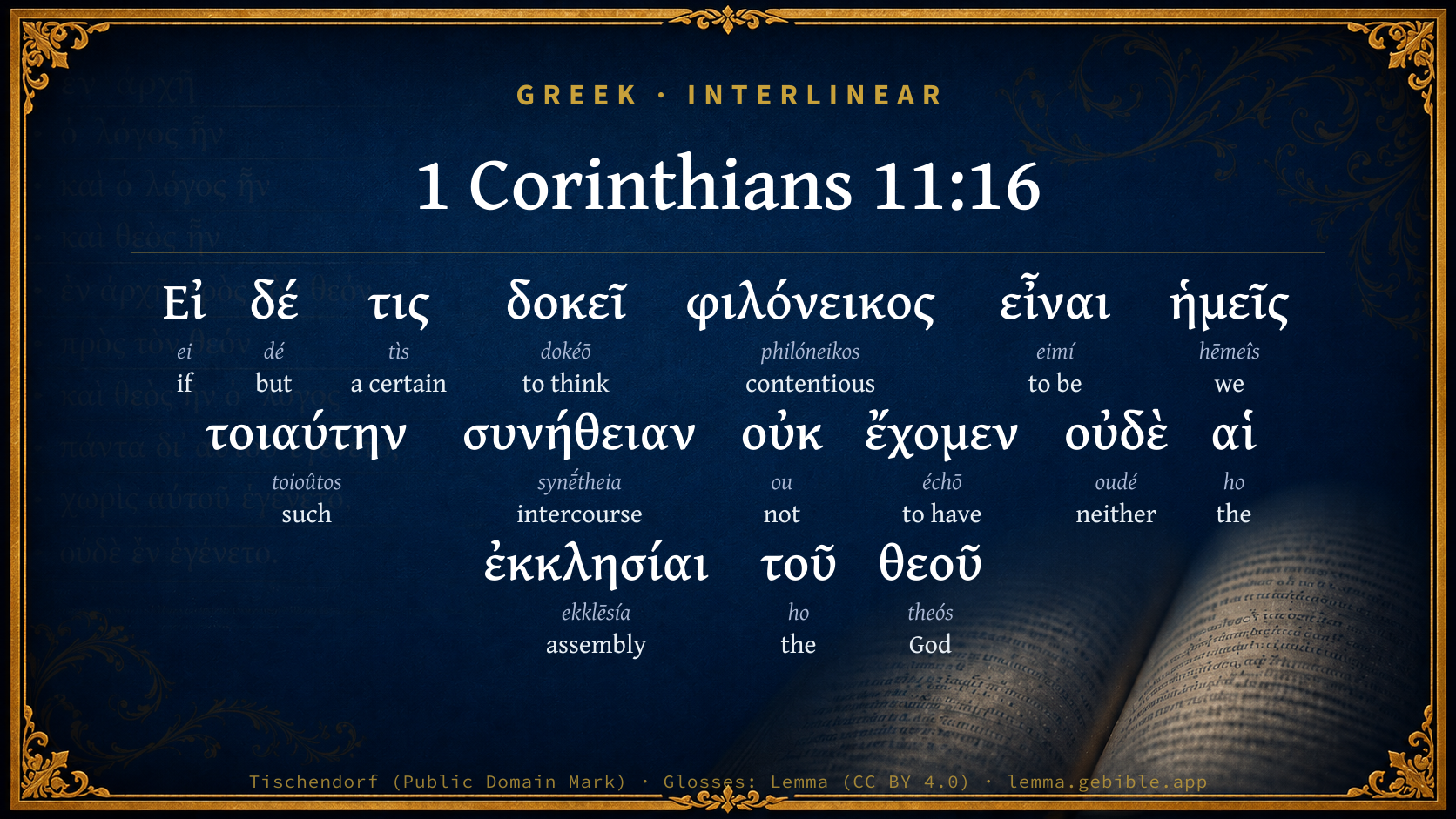
Greek (Tischendorf 8th ed.) 1 Corinthians 11:16 appears in the Greek New Testament. The text above is from the Tischendorf 8th edition. Each word links to its Strong’s number and a concise gloss. Click any word for its full Thayer’s Greek Lexicon entry.
Download image
Cite this verse

1 Corinthians 11:16 (World English Bible). Public Domain. Lemma interlinear Bible study tool, https://lemma.gebible.app/v/1-corinthians/11/16.

Show BibTeX & RIS
BibTeX
RIS
English Translation
But if any man seems to be contentious, we have no such custom, neither do God's assemblies.
World English Bible · Public Domain
Highlights
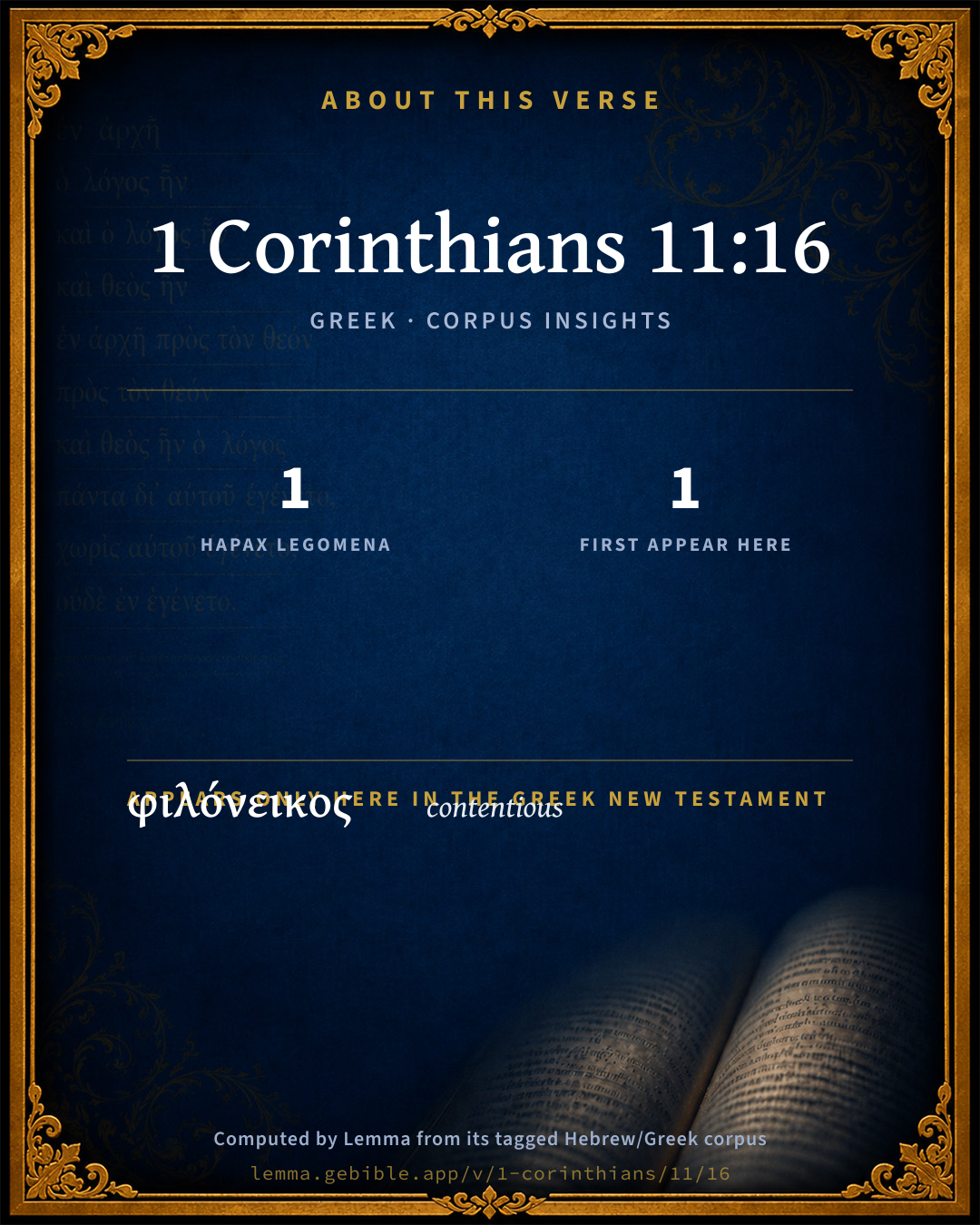
  • 1 hapax legomenon — only here in the Greek New Testament
  • 1 first appearance in the Greek New Testament
Full analysis ↓
Download a study sheet

One document with this verse’s original text, its word-by-word gloss line, the meaning frame, cross-references with their text, attributed commentary, and full source and license credits — printable, and it pastes into notes with its structure intact.

This verse Autodidact and up

Study sheet (.html) Plain text (.txt)

A passage Seminary Student

Up to 50 verses in one chapter. A passage sheet keeps up to 6 commentary sources and 12 cross-references per verse, in the order this page ranks them, and says so on the sheet whenever that leaves anything out. Ask for a single verse and you get the Autodidact verse sheet above.

Everything on this page stays free to read, with no account — the sheet is a download of what is already on screen, not access to it.

Want to remove ads? Support Godless Engineer
Compare translations 3

The same verse in 3 English versions, stacked beneath the original-language interlinear above. Click any original word for its lexicon entry.

Each is an independent rendering of the whole verse — the interlinear is not word-aligned to these translations.

Highlighted words mark where these versions differ — a whole-verse word diff, not a word-by-word alignment.

  • World English Bible Public Domain
    But if any man seems to be contentious, we have no such custom, neither do God's assemblies.
  • King James Version Public Domain
    But if any man seem to be contentious, we have no such custom, neither the churches of God.
  • unfoldingWord Literal Text CC BY-SA 4.0
    But if anyone thinks to be contentious, we do not have any such practice, nor the churches of God.

unfoldingWord Literal Text — © unfoldingWord, licensed CC BY-SA 4.0. Word-aligned USFM3 via Door43 (git.door43.org/unfoldingWord/en_ult).

Versions to compare (up to 4)

3 of 4 selected

Show all 19 translations

Every available English version of this verse, each an independent rendering of the whole verse.

  • World English Bible Public Domain
    But if any man seems to be contentious, we have no such custom, neither do God's assemblies.
  • Berean Standard Bible Public Domain
    If anyone is inclined to dispute this, we have no other practice, nor do the churches of God.
  • Majority Standard Bible Public Domain
    If anyone is inclined to dispute this, we have no other practice, nor do the churches of God.
  • King James Version Public Domain
    But if any man seem to be contentious, we have no such custom, neither the churches of God.
  • American Standard Version (1901) Public Domain
    But if any man seemeth to be contentious, we have no such custom, neither the churches of God.
  • Revised Version (1885) Public Domain
    But if any man seemeth to be contentious, we have no such custom, neither the churches of God.
  • Geneva Bible (1599) Public Domain
    But if any man lust to be contentious, we haue no such custome, neither the Churches of God.
  • Douay-Rheims (1899) Public Domain
    But if any man seem to be contentious, we have no such custom, nor the church of God.
  • Young's Literal Translation Public Domain
    and if any one doth think to be contentious, we have no such custom, neither the assemblies of God.
  • Literal Standard Version CC BY-SA 4.0
    and if anyone thinks to be contentious, we have no such custom, neither the assemblies of God.
  • Unlocked Literal Bible CC BY-SA 4.0
    But if anyone wants to argue about this, we do not have any other practice, nor do the churches of God.
  • unfoldingWord Literal Text CC BY-SA 4.0
    But if anyone thinks to be contentious, we do not have any such practice, nor the churches of God.
  • Darby Bible Public Domain
    But if any one think to be contentious, *we* have no such custom, nor the assemblies of God.
  • World Messianic Bible Public Domain
    But if any man seems to be contentious, we have no such custom, neither do God’s assemblies.
  • Webster's Bible Public Domain
    But if any man seemeth to be contentious, we have no such custom, neither the churches of God.
  • Free Bible Version CC BY-SA 4.0
    But if anyone wants to argue about this, we don't have any other custom than this, and neither do any other of God's churches.
  • Bible in Basic English Public Domain
    But if any man will not be ruled in this question, this is not our way of doing things, and it is not done in the churches of God.
  • Text-Critical English NT CC BY 4.0
    But if anyone is inclined to be contentious, we have no such custom, and neither do the churches of God.
  • Tyndale New Testament (1534) Public Domain
    If there be eny man amonge you that lusteth to stryve let him knowe that we have no soche custome nether the congregacions of God.

Literal Standard Version (2020), Covenant Press — licensed CC BY-SA 4.0. Text via the HelloAO Bible API (eBible.org). Unlocked Literal Bible (unfoldingWord) — licensed CC BY-SA 4.0. Text via the HelloAO Bible API (eBible.org). unfoldingWord Literal Text — © unfoldingWord, licensed CC BY-SA 4.0. Word-aligned USFM3 via Door43 (git.door43.org/unfoldingWord/en_ult). Free Bible Version, Dr. Jonathan Gallagher — licensed CC BY-SA 4.0. Text via the HelloAO Bible API (eBible.org).

Word by word

More ways to search: Search by grammar → Find every occurrence → Compare this word →

Practice this passage: Drill this verse → Learn its vocabulary →

φιλόνεικος
philóneikos
G5380
“contentious”
Adjective, Nominative, Singular, Masculine
Part of Speech
Adjective
Case
Nominative
Number
Singular
Gender
Masculine
Full Thayer's Definition

Origin: from G5384 and neikos (a quarrel, probably akin to G3534 )

TDNT: None

1. fond of strife, contentious a. in a good sense, emulous
  1. Εἰ ei G1487 “if” Conditional
  2. δέ dé G1161 “but” Conjunction
  3. τις tìs G5100 “a certain” Indefinite pronoun, Nominative, Singular, Masculine
  4. δοκεῖ dokéō G1380 “to think” Verb, Present, Active, Indicative, 3rd person, Singular
  5. εἶναι eimí G1510 “to be” Verb, Present, Active, Infinitive
  6. ἡμεῖς hēmeîs G2249 “we” Personal pronoun, 1st person, Nominative, Plural
  7. τοιαύτην toioûtos G5108 “such” Demonstrative pronoun, Accusative, Singular, Feminine
  8. συνήθειαν synḗtheia G4914 “intercourse” Noun, Accusative, Singular, Feminine
  9. οὐκ ou G3756 “not” Particle, Negative
  10. ἔχομεν échō G2192 “to have” Verb, Present, Active, Indicative, 1st person, Plural
  11. οὐδὲ oudé G3761 “neither” Conjunction, Negative
  12. αἱ ho G3588 “the” Article, Nominative, Plural, Feminine
  13. ἐκκλησίαι ekklēsía G1577 “assembly” Noun, Nominative, Plural, Feminine
  14. τοῦ ho G3588 “the” Article, Genitive, Singular, Masculine
  15. θεοῦ theós G2316 “God” Noun, Genitive, Singular, Masculine

About this verse

These counts appear in no published source. They are computed here, from the morphology-tagged text and Lemma’s own curated glosses. What Lemma adds →

16
words
15
distinct lemmas
Pauline Epistles
section

Notable vocabulary

1 hapax legomenon — a word that appears only here in the entire Greek New Testament:

  • φιλόνεικος contentious G5380

First appearance in Scripture

This word makes its first canonical appearance in the Greek New Testament here:

  • φιλόνεικος contentious G5380

Shared distinctive vocabulary

συνήθειαν intercourse G4914 occurs in 3 verses of the Greek New Testament. Also found in:

Repetition

A word recurs within this verse:

Cross-references

7

Topical passages linked to 1 Corinthians 11:16 in the Treasury of Scripture Knowledge — connected by theme and wording, ordered by reader-vote popularity; previews shown in the World English Bible.

  • 1 Corinthians 7:17 Only, as the Lord has distributed to each man, as God has called each, so let him walk. So I command in all the assemblies.
  • 1 Timothy 6:3–4 If anyone teaches a different doctrine, and doesn't consent to sound words, the words of our Lord Jesus Christ, and to the doctrine which is according to godliness,
  • 1 Thessalonians 2:14 For you, brothers, became imitators of the assemblies of God which are in Judea in Christ Jesus; for you also suffered the same things from your own countrymen, even as they did from the Jews;
  • Acts 21:24 Take them, and purify yourself with them, and pay their expenses for them, that they may shave their heads. Then all will know that there is no truth in the things that they have been informed about you, but that you yourself also walk keeping the law.
  • 1 Corinthians 14:33–34 for God is not a God of confusion, but of peace. As in all the assemblies of the saints,
  • Acts 21:21 They have been informed about you, that you teach all the Jews who are among the Gentiles to forsake Moses, telling them not to circumcise their children neither to walk after the customs.
  • 1 Corinthians 16:1 Now concerning the collection for the saints, as I commanded the assemblies of Galatia, you do likewise.

Cross-references courtesy of OpenBible.info (CC BY 4.0).

Commentary

Notes on 1 Corinthians 11:16 from classic Christian and Jewish commentators (each source and its license shown beneath its notes). The classic Christian expositions comment on the surrounding passage and are grouped to its opening verse, so a note may address several verses; the Jewish commentaries on the Tanakh (Rashi and others) are per-verse, so they appear only where the commentator wrote on this verse.

Lemma curates 59 commentaries, every one of them public domain or Creative Commons licensed, each selected and text-cleaned for this edition rather than reprinted as found. About our sources →

Tyndale Open Study Notes

Tyndale Open Resources

11:16 if anyone wants to argue about this: Some in the cosmopolitan Corinthian church did not agree with Paul. • Paul’s final argument is that the use of a head covering was an established custom of the church. Most contemporary interpreters take this verse to mean that the custom was culturally based.

Tyndale Open Study Notes — © Tyndale Open Resources, licensed CC BY-SA 4.0. Text via the HelloAO Bible API.

Bengel's Gnomon

Johann Albrecht Bengel

1Co 11:16. Εἰ δὲ, but if) A curt [abrupt] hint,[95] as at 1Co 14:37. Paul perceives, that some exceptions may be taken, but he authoritatively represses them.—δοκεῖ φιλόνεικος, seems contentious) A disputer of this sort might think that he was contending rightly; but Paul calls him contentious. This is what he says: If any one wishes to contend, and deems himself right in doing so. In this passage it is rather intended to teach the Corinthians modesty, than to bind all: comp. 2Co 2:9. For he especially restrains their φυσίωσιν, puffed up spirit: comp. 1Co 14:34-38.—ἡμεῖς, we) your teachers, of the Hebrew nation.—συνήθειαν, custom) that a woman should not cover her head, especially when she prays.—αἱ ἐκκλησίαι τοῦ Θεοῦ, the churches of God) which ought not to be despised, 1Co 14:36.

[95] The word in the original is præcisio, explained by Cicero to be a figure which rather gives a hint to the understanding, and leaves it to supply what is not expressed.—See De Or. iii. 53, Her. iv. 30.—T.

Bengel's Gnomon of the New Testament — English translation (T&T Clark, Edinburgh, 1860) — public domain. Text from a community e-Sword module.

Meyer's Critical & Exegetical Commentary

Heinrich August Wilhelm Meyer

1Co_11:16. The apostle has done with the subject; but one word more of warning now against all controversy about it.

δοκεῖ] Vulg.: si quis autem videtur contentiosus esse. This would imply that sort of forbearing courtesy in the δοκεῖ, according to which one videri aliquid esse, quam vere esse dicere maluit, Fritzsche, a[1803] Matth. p. 129. Comp Frotscher, a[1805] Xen. Hier. p. 92. Sturz, Lex. Xen. I. p. 757 f. So de Wette and Winer, p. 570 [E. T. 766]. But one can see no reason for Pauls choosing any such special delicacy of phrase. If, again, we understand the words to mean: if any one likes to be, or has pleasure in being, contentious (Luther, Grotius, Rückert), that is to confound the expression with the construction δοκεῖ μοι.[1806] The simplest explanation, and, at the same time, quite literally faithful, is, as in Mat_3:9, Php_3:4 : if any one is of opinion, if he thinks, or is minded to be, etc.; but to import the notion of permission into the infinitive here, in connection with this rendering (Billroth), would be arbitrary, because without warrant from the text (Kühner, a[1807] Xen. Mem. ii. 1. 1).

ἡμεῖς τοιαύτην κ.τ.λ[1808]] declarative: Let him be told that we, etc. Comp Rom_11:18. See Winer, p. 575 [E. T. 773].

ἩΜΕῖς] I and those who are like-minded with me.

τοιαύτην συνήθ.] such a custom. Interpreters refer this either to the censured practice of the women being unveiled (Theodoret, Erasmus, Grotius, Bengel, Michaelis, Semler, Rosenmüller, Heydenreich, Flatt, Billroth, Olshausen, Ewald, Neander, Maier, Hofmann), or to the custom of contention (Chrysostom, Ambrosiaster, Beza, Calvin, Piscator, Estius, Calovius, and others, including Rückert and de Wette). The latter suits the immediate context, and is required by ἡμεῖς; hence we cannot, with Theophylact and Osiander, leave it an open question which of the two references should be preferred. The ΟὐΔῈ ΑἹ ἘΚΚΛ. Τ. ΘΕΟῦ is not against this view; for what is asserted is not that all individual members were free from the love of strife, but only that the churches as a whole were so. These last are distinguished by οὐδὲ αἱ ἐκκλ. τ. Θεοῦ from the individuals implied in ἡμεῖς. Neither does the expression ΣΥΝΉΘΕΙΑ throw any difficulty in the way of our interpretation; on the contrary, occurring as it does in this short concluding sentence of deprecation, it lends to it a certain point against the readers, some of whom seem to have allowed this vice of contentiousness to grow with them into a habit; it was their miserable custom!

The abnormal position of isolation, into which their controversial tendencies would bring them, should surely suffice to prevent their indulging them!

[1803] d refers to the note of the commentator or editor named on the particular passage.

[1805] d refers to the note of the commentator or editor named on the particular passage.

[1806] So, too, δοκῶ μοι, lubet, volo. See Ast, ad Plat. Phaed. p. 251. Also δέδοκταί μοι. See Ast, Lex. Plat. I. p. 552.

[1807] d refers to the note of the commentator or editor named on the particular passage.

[1808] .τ.λ. καὶ τὰ λοιπά.

Meyer — Critical and Exegetical Commentary on the New Testament — English translation by Peter Christie, edited by Frederick Crombie (T&T Clark, 1880) — public domain. Text from a community e-Sword module.

Expositor's Greek Testament

ed. W. Robertson Nicoll

1Co 11:16 closes the discussion sharply, with its appeal to established Christian rule. If, after all that the Ap. has advanced in maintenance of the modest distinction between the sexes, any one is still minded to debate, he must be put down by authority that of P. himself and his colleagues ( ἡμεῖς ), supported by universal Christendom; cf. 1Co 14:33 ; 1Co 14:37 ff. δοκεῖ φιλόνεικος εἶναι , not “seems,” but “ thinks ( presumes ; see parls.) to be contentious”; εἴ τις takes ind [1660] of the case supposed (as in 1Co 10:27 ), and too likely in quarrelsome Cor [1661] φιλόνεικος , not amans victoriœ (Est.) as if from νική , but avidus litium (from νεῖκος ), a disputer for disputation’s sake. ἡμεῖς , in contrast with αἱ ἐκκλησίαι , means not “I and those likeminded” (Mr [1662] ), but “I and my fellowministers” or “I and the Apostles generally” ( cf. 1Co 4:6-13 , 1Co 15:11 , 2Co 1:19 ; 2Co 4:13 , etc.). τοιαύτην συνήθειαν , the custom described in 1Co 11:4 f. above, which gave rise to the whole discussion; not, as many understand it, the custom of being contentious (a temper , surely, rather than a custom): no one could think of the App. ( ἡμεῖς ) indulging such a habit! The advocates of feminine emancipation may have supposed that P., the champion of liberty, was himself on their side, and that the rejection of the veil was in vogue elsewhere; he denies both. For συνήθεια , Lat. con-suetudo , see 1Co 8:7 ; for αἱ ἐκκλησίαι τοῦ Θεοῦ , 1Co 1:2 , 1Co 4:17 , the pl [1663] conveying the idea of unanimity amongst many. Those who explain “such a custom” as that of “being contentious,” usually link this ver. with 1Co 11:17 ff. It is true that the σχίσματα of the sequel, like the ἔριδες of 1Co 1:11 , tended to φιλονεικία ; in truth the disputatiousness of the Cor [1664] ran into everything a woman’s shawl, or the merits of the Arch-apostles!

[1660] indicative mood.

[1661] Corinth, Corinthian or Corinthians.

[1662] Meyer’s Critical and Exegetical Commentary (Eng. Trans.).

[1663] plural.

[1664] Corinth, Corinthian or Corinthians.

The Expositor's Greek Testament, edited by W. Robertson Nicoll (1897–1910) — public domain. Text from a community e-Sword module.

Hodge's Commentary on Romans, Ephesians & First Corinthians

Charles Hodge

1Co_11:16

But if any man seem to be contentious, we have no such custom, neither the churches of God.

The arguments against the custom of women appearing in public unveiled having been presented, the apostle says, if any man, notwithstanding these arguments, is disposed to dispute the matter, or appears to be contentious, we have only further to say, that we (the apostles) have no such custom, neither have the churches of God. To be contentious, i.e. disposed to dispute for the sake of disputation. With such persons all argument is useless. Authority is the only end of controversy with such disturbers of the peace. The authority here adduced is that of the apostles and of the churches. The former was decisive, because the apostles were invested with authority not only to teach the gospel, but also to organize the church, and to decide every thing relating to Christian ordinances and worship. The authority of the churches, although not coercive, was yet great. No man is justified, except on clearly scriptural grounds, and from the necessity of obeying God rather than man, to depart from the established usages of the church in matters of public concern.

Calvin, and many of the best modern commentators, give a different view of this passage. They understand the apostle to say, that if any one seems to be disputatious, neither we nor the churches are accustomed to dispute. It is not our wont to waste words with those who wish merely to make contention. The only reason assigned for this interpretation, is Pauls saying we have no such custom; which they say cannot mean the custom of women going unveiled. But why not? The apostles and the churches constituted a whole neither the one nor the other, neither the churches nor their infallible guides, sanctioned the usage in question. Besides, no other custom is mentioned in the context than the one which he has been discussing. If any one appear contentious, is not a custom and suggests nothing to which the words such a custom can naturally refer.

Charles Hodge — Commentary on Romans (1835), First Corinthians (1857), and Ephesians (1856) — public domain. Text from a community e-Sword module.

Geneva Bible (1599)

Geneva Bible translators

Against such as are stubbornly contentious we have to oppose this, that the Churches of God are not contentious.

Geneva Bible (1599) marginal notes — public domain. Text via Bolls.life.

Jamieson, Fausset & Brown

Robert Jamieson, A. R. Fausset & David Brown

A summary close to the argument by appeal to the universal custom of the churches.

if any . . . seem--The Greek also means "thinks" (fit) (compare Mat 3:9). If any man chooses (still after all my arguments) to be contentious. If any be contentious and thinks himself right in being so. A reproof of the Corinthians' self-sufficiency and disputatiousness (Co1 1:20).

we--apostles: or we of the Jewish nation, from whom ye have received the Gospel, and whose usages in all that is good ye ought to follow: Jewish women veiled themselves when in public, according to TERTULLIAN [ESTIUS]. The former explanation is best, as the Jews are not referred to in the context: but he often refers to himself and his fellow apostles, by the expression, "we--us" (Co1 4:9-10).

no such custom--as that of women praying uncovered. Not as CHRYSOSTOM, "that of being contentious." The Greek term implies a usage, rather than a mental habit (Joh 18:39). The usage of true "churches (plural: not, as Rome uses it, 'the Church,' as an abstract entity; but 'the churches,' as a number of independent witnesses) of God" (the churches which God Himself recognizes), is a valid argument in the case of external rites, especially, negatively, for example, Such rites were not received among them, therefore, ought not to be admitted among us: but in questions of doctrine, or the essentials of worship, the argument is not valid [SCLATER] (Co1 7:17; Co1 14:33).

neither--nor yet. Catholic usage is not an infallible test of truth, but a general test of decency.

Jamieson, Fausset & Brown — Commentary Critical and Explanatory on the Whole Bible (1871) — public domain (CC PDM 1.0). Text via the HelloAO Bible API.

Adam Clarke's Commentary

Verse 16. But if any man seem to be contentious] Ει δε τις δοκει φιλονεικος ειναι· If any person sets himself up as a wrangler-puts himself forward as a defender of such points, that a woman may pray or teach with her head uncovered, and that a man may, without reproach, have long hair; let him know that we have no such custom as either, nor are they sanctioned by any of the Churches of God, whether among the Jews or the Gentiles. We have already seen that the verb δοκειν, which we translate to seem, generally strengthens and increases the sense. From the attention that the apostle has paid to the subject of veils and hair, it is evident that it must have occasioned considerable disturbance in the Church of Corinth. They have produced evil effects in much later times.

Adam Clarke's Commentary on the Bible (1810–1826) — public domain. Text from a community e-Sword/MySword module.

John Calvin's Commentaries

16. But if any man seem A contentious person is one whose humor inclines him to stir up disputes, and does not care what becomes of the truth. Of this description are all who, without any necessity, abolish good and useful customs — raise disputes respecting matters that are not doubtful — who do not yield to reasonings — who cannot endure that any one should be above them. Of this description, also, are those (ἀκοινώνητοι) would be singular persons who, from a foolish affectation, aim at some new and unusual way of acting. Such persons Paul does not reckon worthy of being replied to, inasmuch as contention is a pernicious thing, and ought, therefore, to be banished from the Churches. By this he teaches us, that those that are obstinate and fond of quarrelling, should rather be restrained by authority than confuted by lengthened disputations. For you will never have an end of contentions, if you are disposed to contend with a combative person until you have vanquished him; for though vanquished a hundred times, he would argue still. Let us therefore carefully mark this passage, that we may not allow ourselves to be carried away with needless disputations, provided at the same time we know how to distinguish contentious persons. For we must not always reckon as contentious the man who does not acquiesce in our decisions, or who ventures to contradict us; but when temper and obstinacy show themselves, let us then say with Paul, that contentions are at variance with the custom of the Church

John Calvin's Commentaries (1540-1563) — public domain. Text from the Calvin Translation Society English edition (1840s-50s) via the Christian Classics Ethereal Library (ccel.org). Calvin's coverage is partial (roughly two-thirds of the Bible); uncommented books and verses are honest gaps, never fabricated. The 19th-century editor's footnotes and remarks are omitted so the notes are faithfully Calvin's own voice.

Ellicott's Commentary for English Readers

(16) But if any man seem to be contentious.—The argument, and the appeal to their own good sense having been completed, the Apostle now adds that if, after all, some one continues to argue the matter captiously, and is not satisfied with the reason given, the answer to such a one must be simply—We, the Apostles and the churches of God, have no such custom as that women should pray and teach with uncovered head. It has been suggested that the word “custom” refers, not to the uncovering the head, but to the “contention” just mentioned. But the former interpretation seems more natural; and the Apostle’s object here is, not so much to merely censure the contentious spirit, as to show how such an objector must be dealt with. It is noticeable that the appeal is made to the practice of the churches (plural), not the Church. Thus it is not the authority of the Church as such that is quoted, but it is the uniformity of practice in the several Christian churches that is appealed to. The Church in Corinth has no right to become exceptional.

It may be well to make two general remarks on the scope and bearing of this remarkable passage.

1. As St. Paul taught regarding Slavery (1Co_7:21) that the object of Christianity was not to suddenly efface existing political arrangements, so he teaches here that Christianity did not seek to obliterate these social distinctions which were universally recognised. We know now how mighty an instrument Christ’s Religion has been in elevating the social condition of woman, but this has been accomplished by gradually leavening the world with Christian principle, and not by sudden external revolution. The arguments and illustrations which the Apostle here employs have a more abiding and a wider application than the particular case to which he applied them. They have been written “for our learning” as well as for the instruction of those to whom they were originally addressed. And the lesson which they teach us is, that Christianity did not come to unsex woman, but to raise, dignify, and ennoble her as woman—to abolish for ever her real wrongs, but not to yield to a revolutionary clamour for imaginary rights. Old and New Testament alike emphasise the truth that (as has been quaintly and truly said) “woman was not made from man’s head to be his ruler, nor from his feet to be his slave, but from his side to be his equal, and from beneath his strong arm to demand his protection.”

2. The influence of St. Paul’s instruction as to women not uncovering their heads in public worship has lasted long after the necessity for that particular expression of her relationship to man has passed away. While, in succeeding ages, again and again, some have forgotten the principles of the teaching, which are eternal, the particular application of them, which was only temporary, has been continuously and universally observed. Surely this is an illustration and evidence of the Divine Wisdom which withheld the apostolic writers from, as a rule, laying down minute directions for worship, or dogmatic formulas of faith. Men would, in a servile obedience to rules, have soon and completely forgotten the living principles on which they were based. To this day the universal custom in Christian places of worship, of women being covered and men uncovered, and the increasing revolt against the acknowledgment of the subordination of woman to man, of which that practice was originally the avowed symbol, is a striking proof of how the same spirit, which led Jews of old to be scrupulous in their observance of certain external ordinances, while forgetting the weighter matters of which they were to be the outward expression, was not merely a Jewish but a human weakness.

A Bible Commentary for English Readers, edited by Charles John Ellicott (1878–1897) — public domain. Text from a community e-Sword module.

The Cambridge Bible for Schools and Colleges

gen. ed. J. J. S. Perowne

16. But if any man seem to be contentious] Some commentators refer these words to what follows; but it would seem best to apply them to what has gone before. The Apostle would deprecate further argument, and appeal to the custom of the Churches as decisive on a point of this kind. See note on ch. 1Co_14:33.

we have no such custom, neither the churches of God] The word custom has been interpreted (1) as referring to contention, “it is not our custom to be contentious,” or (3) to the practice of permitting women to appear unveiled at the services of the Church. The latter yields the best sense. This appeal to the Churches must not be understood to imply that all Churches ought in all respects to have the same ritual. But in a matter such as this, involving the position of women in Christian society, it were far wiser for the Corinthian Church to follow the universal practice of Christendom.

The Cambridge Bible for Schools and Colleges (gen. ed. J. J. S. Perowne; Cambridge University Press, 1878–1918) — public domain. Text from a community e-Sword module.

John Gill's Exposition

Now in this that I declare unto you,.... The Syriac version reads, "this is what I command"; which some refer to what he had been discoursing of, adding to his arguments, and the examples of the church, his own orders and command, that men should worship God publicly, uncovered, and women covered; though it seems rather to respect what follows, what the apostle was about to declare unto them; concerning which he says,

I praise you not; as he did in Co1 11:2 that they were mindful of him, remembered his doctrines, and kept the ordinances in the manner he had delivered them to them: and it should seem by this, that the greater part of them were not to be blamed, though some few were, for their irregular and indecent appearance in public worship, men with a covering on their heads, and women without one; but in what he was about to say, he could not praise them at all:

that you come together; to the house of God, to pray unto him, to sing his praises, to hear his word, and attend his ordinances, particularly the Lord's supper:

not for the better; for edification and instruction, for the quickening and comforting of your souls; that you may grow in grace and knowledge, become more holy, zealous, fruitful, and useful:

but for the worse; to indulge luxury and intemperance, to encourage heresies, schisms, and divisions, and so grow more carnal, scandalous, and useless.

John Gill's Exposition of the Whole Bible (1746–1763) — public domain (CC PDM 1.0). Text via the HelloAO Bible API.

Trapp's Complete Commentary

John Trapp

16 But if any man seem to be contentious, we have no such custom, neither the churches of God.

Ver. 16. Seem to be contentious] A doctore glorioso, et pastore contentioso, et inutilibus questionibus, liberet Ecclesiam suam Domiuus, said Luther. From a vain-glorious doctor, from a contentious pastor, and from endless and needless controversies, the good Lord deliver his Church. The word rendered "seem," signifieth, "is pleased to be, desires and hath a will to be, yea, boasts and prides himself in it," δοκει δοκησισοφος. This is a foul fault in any, but especially in ministers; who must see (saith Luther) that those three dogs follow them not into the pulpit, pride, covetousness, and contentiousness. A quarrelsome person is like a cock of the kind, ever bloody with the blood of others and himself; and divisions are Satan’s gun powder plot to blow up religion.

We have no such custom] viz. To strive about trifles, but to submit to our teachers, Heb 13:17. It is a vile thing, saith Bifield, {on 1Pe 3:1-22} to vex our ministers by our obstinace; yea, though they were not able to make so full demonstration, yet when they reprove such things, out of a spiritual jealousy and fear that they corrupt the people’s hearts, they are to be heard and obeyed.

John Trapp, A Commentary or Exposition upon All the Books of the Old and New Testament (1647–1656) — public domain. Text from a community e-Sword module.

Albert Barnes' Notes on the Bible

But if any man seem to be contentious - The sense of this passage is probably this: “If any man, any teacher, or others, “is disposed” to be strenuous about this, or to make it a matter of difficulty; if he is disposed to call in question my reasoning, and to dispute my premises and the considerations which I have advanced, and to maintain still that it is proper for women to appear unveiled in public, I would add that in Judea we have no such custom, neither does it prevail among any of the churches. This, therefore, would be a sufficient reason why it should not be done in Corinth, even if the abstract reasoning should not convince them of the impropriety. It would be singular; would be contrary to the usual custom; would offend the prejudices of many and should, therefore, be avoided.”

We have no such custom - We the apostles in the churches which we have elsewhere founded; or we have no such custom in Judea. The sense is, that it is contrary to custom there for women to appear in public unveiled. This custom, the apostle argues, ought to be allowed to have some influence on the church of Corinth, even though they should not be convinced by his reasoning.

Neither the churches of God - The churches elsewhere. It is customary there for the woman to appear veiled. If at Corinth this custom is not observed, it will be a departure from what has elsewhere been regarded as proper; and will offend these churches. Even, therefore, if the reasoning is not sufficient to silence all cavils and doubts, yet the propriety of uniformity in the habits of the churches, the fear of giving offence should lead you to discountenance and disapprove the custom of your females appearing in public without their veil.

Albert Barnes' Notes on the Bible (1834–1885) — public domain. Text from a community e-Sword/MySword module.

Haydock's Catholic Bible Commentary

In this chapter are three instructions: 1. That women must have a veil on their heads at public prayers, to ver. 17. --- 2ndly, he corrects the abuses in their banquets of charity, called Agape, to ver. 23. --- 3rdly, he teaches that in the sacrament of the holy Eucharist, is the body and blood of Christ. (Witham)

If any man seem to be contentious about this matter, or any other, we have no such custom, nor hath the Church; that is, says St. John Chrysostom, to have such quarrels and divisions. Or, as others understand it, we have no such custom for women to be in the Church uncovered. (Witham)

George Leo Haydock (1774–1849), Haydock's Catholic Family Bible and Commentary, 1859 edition — public domain. Excludes Psalms (Douay-Rheims chapter numbering differs from Protestant) and Deuterocanonical books (Catholic canon only).

Matthew Poole's English Annotations

If any man seem to be contentious; if any man hath a mind to quarrel out of a love to show his wit in discoursing what may be said on the other side, or out of a desire to hold up a party, and contradict us.

We have no such custom, of women’s praying or prophesying with their heads uncovered, or men’s praying or prophesying with their heads covered; or we have no such custom of contending for these little frivolous things;

neither any of the churches of God; and good Christians, in their practices, ought, in things of this nature, to have an eye and regard to the custom of their own church, and also of other Christian churches. Thus the apostle closeth this discourse, and proceedeth in the next verses to tax other abuses which were crept into this famous church.

Matthew Poole's English Annotations on the Holy Bible (1683–1685) — public domain. Text from a community e-Sword/MySword module.

Whedon's Commentary on the Bible

Daniel D. Whedon

16. Contentious—The whole question had, it seems, been a subject of Corinthian debate. Men, perhaps, maintained, that according to Jewish and Roman custom their heads should be uncovered in worship. Women, perhaps, maintained that Christ had emancipated woman from her reserve and subjection. The apostle replaces the law of propriety and of God in their proper authority.

Such custom—As these mistaken reformers would introduce.

Churches—The debate, probably, had scarce extended beyond Corinth. At least propriety and apostolic and churchly authority had elsewhere settled the question. The authority of the churches of God in this, the age of the gifted Church, was co-ordinate with the authority of the inspired apostles.

Daniel D. Whedon (gen. ed.), Commentary on the Old and New Testaments (1874–1909) — public domain. Text from a community e-Sword module.

The Pulpit Commentary

But if any man seem to be contentious. St. Paul cuts the question short, as though impatient of any further discussion of a subject already settled by instinctive decorum and by the common sense of universal usage. "Seem to be contentious" is (like the Latin videtur) only a courteous way of saying is contentious. If any of you wish to be disputatious and quarrelsome about this minor matter of ritual, I must content myself with saying that he must take his own course (for a similar use of the euphemistic "seem," (see Php_3:4; Heb_4:1; Jam_1:26) We have no such custom. The emphatic "we" means the apostles and the leaders of the Church at Jerusalem and Antioch. Such custom. Not referring to "contentiousness," but to the women appearing with uncovered heads. Neither the Churches of God. If you Corinthians prefer these abnormal practices in spite of reason, common sense, and my arguments, you must stand alone in your innovations upon universal Christian practice. But catholic custom is against your "self opinionated particularism."

The Pulpit Commentary (1880–1919), ed. H.D.M. Spence-Jones & Joseph S. Exell — public domain. Text from a community e-Sword module.

John Wesley's Explanatory Notes

We have no such custom here, nor any of the other churches of God - The several churches that were in the apostles' time had different customs in things that were not essential; and that under one and the same apostle, as circumstances, in different places, made it convenient. And in all things merely indifferent the custom of each place was of sufficient weight to determine prudent and peaceable men. Yet even this cannot overrule a scrupulous conscience, which really doubts whether the thing be indifferent or no. But those who are referred to here by the apostle were contentious, not conscientious, persons.

John Wesley, Explanatory Notes Upon the Whole Bible (1754–1765) — public domain. Text via the GEBible commentary corpus.

Godbey's Commentary on the New Testament

William B. Godbey

16. “If any one seem to be contentious, we have no such custom, neither do the churches of God.” During Paul’s absence of three years in Asia many changes had taken place among them. A multitude of preachers from Judea, and other countries, had been there preaching; Peter, Apollos and other godly heralds of truth and righteousness, and still others whose Christian character was probably to be discounted. Many had backslidden. The church was racked with controversies on many different lines. Among other things, they wrote to Paul in reference to the women who were preaching among them bareheaded, like men, raising no controversy about their preaching and praying and taking an active part in the public worship, as Priscilla and others had done while Paul was with them. But there was quite a criticism against the habit of some of their women preaching and praying bareheaded, like men, the costume at that day being so identical among men and women that the veil of the latter and the shorn locks of the former became the ordinary designation of the sexes. While Paul is disposed to lay no emphasis on the latter, stating to them that it is unworthy of controversy, because the churches have no fixed custom requiring the woman to have something on her head when she exercises in public, yet, for the sake of harmony and to obviate unprofitable criticism, he advises all of the sisters to put something on their heads when they pray and preach in the meetings, setting forth a beautiful concatenation, beginning with God, then Christ, then the husband and then the wife. God is over Christ, and Christ over the husband, and the husband over the wife in the domestic government, which is the basis of all civil society and state government. The man is to have nothing on his head, indicative of the fact that he is king in the home government, no earthly authority being over him; while the woman is to have something on her head, symbolic of her husband’s authority over her. The apostle reminds them that the angels are present in their meetings, which is a beautiful and consolatory truth. We should remember that a portion of our congregations is unseen by mortal eyes, and yet present, i. e., “ministering angels hovering round.” As we fix up to go out in company, we ought to be decorous in the presence of the angels. Hence he advises the women to extend courtesy not only to the human portion of the audience, but to the angels present, by putting something on their heads so they wouldn’t look odd nor uncouth. While he thus answers their questions, advising the women praying and preaching to wear something on their heads by way of decorum, relieving them of unnecessary criticism, at the same time he attaches no gravity to it, as there is no such principle settled in the churches.

William B. Godbey, Commentary on the New Testament (1896–1900) — public domain. Text from a community e-Sword module.

McGarvey & Pendleton's Commentaries

J. W. McGarvey

But if any man seemeth to be [a mild way of saying, "if any man is"] contentious, we have no such custom, neither the churches of God . [Knowing the argumentative spirit of the Greeks, and being conscious that it was likely that some would even yet want to dispute the matter, despite his three reasons to the contrary, Paul takes it entirely out of the realm of discussion into that of precedent. The settled and established practice of the church had from the beginning followed the course outlined by Paul, which showed that other apostles besides himself had either established it by rule, or endorsed it in practice. In this appeal for uniformity Paul makes it clear that all churches should strive to make their practices uniform, not variant. Paul is here discussing how men and women should be attired when they take a leading part in public worship. He will speak later as to whether or not women should take any such part at all in public worship ( 1Co_14:34-35 ; 1Ti_2:12 ). We to-day as males worship with uncovered heads in consequence of Paul's instruction; but not for his reasons. It is now an expression of reverence, which the Jew then expressed by taking off his sandals. "Holland," says Stanley, "is the only exception. In Dutch congregations, men uncover their heads during the psalmody only." In Western countries a woman's hat has never had any symbolism whatever. We see nothing in Paul's argument which requires us to make it symbolic. The problem in Western assemblies is how best to persuade women to take their hats off, not how to prevail upon them to keep them on. The principle, however, still holds good that the woman is subordinate to the man, and should not make any unseemly, immodest, vaunting display of an independence which she does not possess.]

J. W. McGarvey (with Philip Y. Pendleton), Commentaries on the New Testament (The Fourfold Gospel, 1914; Acts; and the epistles) — public domain. Text from a community e-Sword/MySword module.

The People's New Testament

B. W. Johnson

16. But if a man seem to be contentious. If, in spite of nature's lessons, a man contentiously opposes, let him know that no such custom exists in the churches. Many suppose that custom refers to being contentious. I think, rather, that it refers to covering the head, etc. The lesson of this whole passage is that we must not defy existing social usages in such a way as to bring reproach on the church.

B. W. Johnson's The People's New Testament with Notes (1889–1891) — public domain. Electronic text from the Christian Classics Ethereal Library (CCEL) ThML edition.

Cambridge Greek Testament for Schools and Colleges

16. εἰ δέ τις. Not ‘any man’ as A.V., but ‘any one,’ a material difference. The Apostle had special reason to apprehend difficulties on this point. See 1Co 14:33; 1Co 14:38, and notes. Thus it would be better to apply the words to what follows, rather than with some commentators, to what has gone before. The Apostle would deprecate further argument, and appeal to the custom of the Churches as decisive on a point of this kind.

δοκεῖ. Thinks fit, not seemeth, as A.V.

φιλόνεικος. Admirably translated contentious in A.V., implying that pleasure is taken in strife for its own sake.

ἡμεῖς. Emphatic. If he like to be contentious, let him be so. It is quite sufficient for us who desire to live in peace that the custom of the Churches is otherwise.

συνήθειαν. See note on 1Co 8:7. The word has been interpreted (1) as referring to contention, ‘it is not our custom to be contentious,’ or (2) to the practice of permitting women to appear unveiled at the services of the Church. The latter yields the best sense. This appeal to the Churches must not be understood to imply that all Churches ought in all respects to have the same customs. But in a matter such as this, involving the position of women in Christian society, and their reputation in the world at large—a matter of no small importance—it were far wiser for the Corinthian Church to follow the universal practice of Christendom.

Cambridge Greek Testament for Schools and Colleges (Cambridge University Press, 1896; 21 vols, various authors incl. Carr, Maclear, Plummer, Farrar, Lumby, Moule, M. R. James, Simcox) — public domain. Text from a community e-Sword module.

Alford’s Greek Testament

Henry Alford

16.] Cuts off the subject, already abundantly decided, with a settlement of any possible difference, by appeal to universal apostolic and ecclesiastic custom. But if any man seems to be contentious (i.e. ‘if any arises who appears to dispute the matter, who seems not satisfied with the reasons I have given, but is still disputatious;’—this is the only admissible sense of δοκεἶ in this construction: see reff.:—for the meaning, ‘if it pleases any one,’ &c. would require τινι δοκεῖ: and ‘if any one thinks that he may,’ &c. would not agree with φιλονεικεῖν, which is in itself wrong).

ἡμεῖς] declarative: let him know that …; so, εἰ δὲ κατακαυχᾶσαι, οὐ σὺ τὴν ῥίζαν βαστάζεις, ἀλλʼ ἡ ῥίζα σέ, Rom 11:18. We,—the Apostles and their immediate company,—including the women who assembled in prayer and supplication with them at their various stations, see Act 16:13.

τοιαύτην συνήθειαν] The best modern Commentators, e.g. Meyer and De Wette, agree with Chrys. in understanding this, τοιαύτ. συνήθ., ὥστε φιλονεικεῖν κ. ἐρίζειν κ. ἀντιτάττεσθαι. p. 235. And so Ambrose, Beza, Calvin, Estius, Calov., al. But surely it would be very unlikely, that after so long a treatment of a particular subject, the Apostle should wind up all by merely a censure of a fault common to their behaviour on this and all the other matters of dispute. Such a rendering seems to me almost to stultify the conclusion:—‘If any will dispute about it still, remember that it is neither our practice, nor that of the Churches, to dispute.’ It would seem to me, but for the weighty names on the other side, hardly to admit of a question, that the συνήθεια alludes to the practice (see ref. John) of women praying uncovered. So Theodoret, Grot. Michaelis, Rosenm., Billroth, Olsh., al., and Theophyl. altern. He thus cuts off all further disputation on the matter by appealing to universal Christian usage: and to make the appeal more solemn, adds τοῦ θεοῦ to αἱ ἐκκλ.,—the assemblies which are held in honour of and for prayer to God, and are His own Churches. Obs. αἱ ἐκκλησίαι, not ἡ ἐκκλησία. The plurality of independent testimonies to the absence of the custom, is that on which the stress is laid. This appeal, ‘to the Churches,’ was much heard again at the Reformation: but has since been too much forgotten. See, on the influence of this passage on the Christian church, the general remarks of Stanley, edn. 2, pp. 198-200.

Henry Alford, The Greek Testament (1849–1861) — public domain. Text from a community e-Sword module.

International Critical Commentary

16. This is best taken as concluding the subject of the veil; it makes a clumsy opening to the next subject. ‘But if any one seemeth to be (or is minded to be)† contentious, we have no such custom, not yet the Churches of God’. There are people who are so fond of disputing that they will contest the clearest conclusions, and the Corinthians were fond of disputation. But the Apostle will not encourage them. If such should question the dictates of decorum and of nature in this matter, they may be told that the teachers have no such usage as permitting women to be unveiled,—a thing unheard of in Christian congregations. It is possible that ἡμεῖς means only himself, but he probably means that he knows of no Apostle who allows this.†

Throughout the section he appeals to principles. The wearing or not wearing a veil may seem to be a small matter. Everything depends upon what the wearing or not wearing implies, and what kind of sanction the one practice or the other can claim. He does not use δεῖ about the matter; there is no intrinsic necessity (v. 19): but he does use both ὀφείλει (7, 10) and πρέπον ἐστί (13); for there is both moral obligation and natural fitness. His final appeal—to the practice of all congregations—would be of special weight in democratic Corinth. For αἱ ἐκκλησίαι τοῦ Θεοῦ comp. 2Th 1:4. See Hort, The Christian Ecclesia, pp. 108, 117, 120. There is no need to conjecture that v. 16 is an interpolation, or that συνήθεια refers to contentiousness. Would St Paul think it necessary to say that Apostles have no habit of contentiousness? For Greek and Roman customs respecting the hair and veils, see Smith, Dict. of Ant. Artt. ‘Coma,’, ‘Flammeum’ ‘Vestales.’. The cases in which males, both Greek and Roman, wore long hair do not interfere with the argument.* Such cases were either exceptional or temporary; and they were temporary because nature taught men otherwise. For men to wear their hair long, and for women to wear it short, for men to veil their heads in public assemblies, and for women not to do so, were alike attempts to obliterate natural distinctions of sex. In the Catacombs the men are represented with short hair.

11:17-34. Disorders Connected with the Lord’s Supper

There are abuses of a grave kind in your public worship; a chronic state of dissension, and gross selfishness and excess in your love feasts and celebrations of the Lord’s Supper. This profanation brings grievous judgments on you. Avert the judgments by putting a stop to the profanation.

17 Now, in giving you this charge about the veiling of women, I do not commend you that your religious gatherings do you more harm than good. 18 First of all, when you meet as a Christian congregation, you are split into sets:—so I am told, and to some extent I am afraid that it is true. 19 Indeed, party divisions among you can hardly be avoided if men of proved worth are not to be lost in the crowd.

20 Well then, as to your religious gatherings: it cannot be said that it is the Lord’s Supper that you eat. 21 For everybody’s first thought is to be beforehand in getting his own supper; and so, while the poor man who brings nothing cannot get enough even to eat, the rich man who brings abundance takes a great deal too much even to drink. 22 Surely you do not mean that you have no homes in which you can satisfy hunger and thirst? Or do you think that you need have no reverence for God’s congregation; or that because a man is poor you may treat him with contempt? What am I to say to you? Do you expect me to commend you? In this matter that is impossible.

23 Quite impossible; for I know that you know better. I myself received from the Lord that which in turn I transmitted to you, namely, that the Lord Jesus, in the night in which He was being delivered up, took bread: 24 and when He had given thanks, He brake it, and said, ‘This is My Body, which is for you. This do ye, in remembrance of Me’. 25 In like manner also the cup, after supper was over, saying, ‘This cup is the new covenant in virtue of My Blood. This do ye, as often as ye drink it, in remembrance of Me.’

26 Yes, He gave this command; for as often as you eat this bread and drink this cup, it is the death of the Lord that you are proclaiming,—nothing less than that,—until His return. 27 It follows, therefore, that whoever eats the bread or drinks the cup of the Lord in a way that dishonours Him, shall be held responsible for profaning the Body and Blood of the Lord. 28 But, in order to avoid this profanation, let a man scrutinize his own spiritual condition and his motives; then, and not till then, let him eat of the bread and drink of the cup. 29 For he who eats and drinks is thereby eating and drinking a sentence on himself, if he fails to recognize the sanctity of the Body. 30 The proof of this is within your own experience; for it is because people fail to recognize this sanctity that so many of you are sick and ill, while not a few have died. 31 But if we recognized our own condition and motives, we should escape this sentence. 32 Yet, when we are thus sentenced, we are being chastened by the Lord, to save us from being involved in the final condemnation of the world.

33 So then, my brothers, at your religious gatherings for a common meal, wait until all are ready. 34 If any one is too hungry to wait, let him stay at home and eat; so that your gatherings may not have these fatal results. All the other matters in which you need instruction I will regulate whenever I come.

The shocking desecration of the Lord’s Supper by the disorders which St Paul here censures was, no doubt, the primary reason why he is so severe in his condemnation of the conduct of those Corinthians who profaned it by their selfish misbehaviour, but it was not the only reason for distress and indignation. “In the whole range of history there is no more striking contrast than that of the Apostolic Churches with the heathenism round them. They had shortcomings enough, it is true, and divisions and scandals not a few, for even apostolic times were no golden age of purity and primitive simplicity. Yet we can see that their fulness of life, and hope, and promise for the future was a new power in the world. Within their own limits they had solved almost by the way the social problem which baffled Rome, and baffles Europe still. They had lifted woman to her rightful place, restored the dignity of labour, abolished beggary, and drawn the sting of slavery. The secret of the revolution is that the selfishness of race and class was forgotten in the Supper of the Lord, and a new basis for society found in love of the visible image of God in men for whom Christ died” (Gwatkin, Early Church History, p. 73). The Corinthian offenders were reviving the selfishness of class, were treating with contumely the image of God visible in their fellowmen, and were thus bringing into serious peril the best results of this blessed revolution. The Apostle does not hesitate to declare (vv. 30-32) that this evil work of theirs is bringing upon them the manifest judgments of God.

It is worth noting that he appeals to what ‘the Lord Jesus’ did at the Supper, not to what ‘Jesus’ did. There is no basis for the hypothesis that St Paul did not regard Jesus as the Son of God until after His Resurrection, comp. v. 4, 5. See Introduction, § ‘Doctrine.’

International Critical Commentary — older volumes (1896–1929), various authors — public domain. Text from a community e-Sword module.

Vincent's Word Studies in the New Testament

Marvin R. Vincent

Custom. Not the custom of contentiousness, but that of women speaking unveiled. The testimonies of Tertullian and Chrysostom show that these injunctions of Paul prevailed in the churches. In the sculptures of the catacombs the women have a close - fitting head - dress, while the men have the hair short.

Marvin R. Vincent, Word Studies in the New Testament (1887–1900) — public domain. Text from a community e-Sword/MySword module.

Godet's Commentaries

Frédéric Louis Godet

Vv. 16. “But if any man seem to be contentious...we have no such custom, neither the Churches of God.”

Holsten and others regard this saying as a kind of confession that the apostle feels the insufficiency of the proofs which he has just alleged. But such a supposition would do violence to his moral character, and Paul’s words do not really signify anything of the kind. They simply prove that there are at Corinth controversial spirits, who, on such a subject, will never tire of arguing and raising objections indefinitely. That does not mean that, as to himself, he does not regard the question as solved and well solved. — The word δοκεῖν is used here in the same sense as 1Co 3:18, 1Co 10:12, Gal 6:3, to denote a vain pretence. Undoubtedly nobody takes glory from a fault, such as love of disputation (φιλόνεικος); but Paul means to say: “If any one wishes to play the part of a man whom it is impossible to reduce to silence, who has always something to answer...” This was one of the natural features of the Greek character.

The principal proposition does not correspond logically to the subordinate one beginning with if; we must understand a clause such as this: “Let him know that...” or: “I have only one thing to say to him, namely, that...” I cannot understand how eminent critics, such as the old Greek expositors, then Calvin, de Wette, Meyer, Kling, Reuss, Edwards, could imagine that the custom of which the apostle speaks is that of disputing! The love of disputation is a fault, a bad habit, but not a custom. To call the habit of discussion an ecclesiastical usage! No. The only custom of which there can be any question here is that on which the whole passage has turned: women speaking without being veiled. Paul means that neither he, nor the Christians formed by him, nor in general any of the Churches of God, either those which he has not founded or those properly his own, allow such procedure in their ecclesiastical usages; comp. 1Co 14:36-37, where the idea simply indicated here is developed.

The material proof of this assertion of Paul’s is found in the Christian representations which have been discovered in the Catacombs, where the men always wear their hair cut short, and the women the palla, a kerchief falling over the shoulders, and which can be raised so as to conceal the face (Heinrici, p. 324).

The complement of God is intended to bring out the dignity and holiness of all these Churches, and consequently the respect due to their religious sentiment, which contrasts with the presumptuous levity of the Corinthians.

We hope we have justified the thought expressed by the apostle regarding the social position of woman, as well as the particular application which he deduces from it. Holsten thinks that whatever may be said, the apostle thereby puts himself in contradiction to the principle so often enunciated by him: “In Christ there is neither male nor female,” and on this account when he came to the end of the passage, he felt, as it were, the ground going from under him. But the apostle’s personal conviction, as he expresses it here, was certainly very deliberate; the loyalty of his character forbids us to doubt it. Was this conviction solely a matter of time and place, so that it is possible to suppose, that if he lived now, and in the West, the apostle would express himself differently? This supposition is not admissible; for the reasons which he alleges are taken, not from contemporary usages, but from permanent facts, which will last as long as the present earthly economy. The physical constitution of woman (1Co 11:13-15) is still the same as it was when Paul wrote, and will continue so till the renewing of all things. The history of creation, to which he appeals (1Co 11:8-12), remains the principle of the social state now as in the time of the apostle; and the sublime analogies between the relations of God to Christ, Christ to man, and man to woman, have not changed to this hour, so that it must be said either that the apostle was wholly wrong in his reasoning, or that his reasons, if they were true for his time, are still so for ours, and will be so to the end. As to the parity of man and woman in Christ, it is clear, and that from this very passage, that Paul means to speak of their relation to Christ in redemption, and not of the social part they are called to play.

Frédéric Louis Godet — Commentaries on Luke, John, Romans, and 1 Corinthians — English translation (T&T Clark, Edinburgh, 1870s–1890s) — public domain. Text from a community e-Sword module.

Lesson kit

Teaching starters — assembled from the data on this page, not authored interpretation. Every prompt links to the verse data it draws on. Edit before teaching.

1 Corinthians, in the Pauline Epistles, opens this verse with 16 words (15 distinct Greek lemmas). Its most distinctive word is philóneikos (“contentious”). A historical commentator’s framing appears above. Read the whole chapter for the surrounding context.

Discussion questions

  1. The word philóneikos carries the sense “contentious.” How does it shape the verse?
  2. This verse holds 1 word here found nowhere else in the Greek New Testament. What might the rare word draw attention to?
  3. The word “contentious” first appears here in Scripture. What is being introduced at this debut?
  4. John 18:39 shares the word «intercourse» with this verse. How do the two illuminate each other?
  5. “the” occurs 2× in this one verse. What is the effect of the repetition?
  6. These translations render this verse differently. What is at stake in choosing one wording over another?
  7. Reading how Tyndale Open Study Notes and Bengel's Gnomon read this verse, where do the two commentators agree and where do they part?

Things to notice

  • 1 word in this verse appears nowhere else in the Greek New Testament.
  • 1 word makes its first canonical appearance in Scripture here.
  • These translations choose different wording for 13 words in this verse.
  • “the” occurs 2× in this single verse.
  • 15 distinct Greek lemmas span 16 words in this verse.

Reading settings

Reading text

Shown beneath each verse's original-language words.

Old Testament
Old Testament edition

Read the OT as the Masoretic Hebrew (MT) or the Greek Septuagint (LXX).

English shown for the Greek Septuagint (in the Hebrew ↔ Greek comparison).

Comparing translations? Open the Compare panel on any verse page to stack up to four side by side.