

Galatians 3:17
Greek (Tischendorf 8th ed.) Galatians 3:17 appears in the Greek New Testament. The text above is from the Tischendorf 8th edition. Each word links to its Strong’s number and a concise gloss. Click any word for its full Thayer’s Greek Lexicon entry.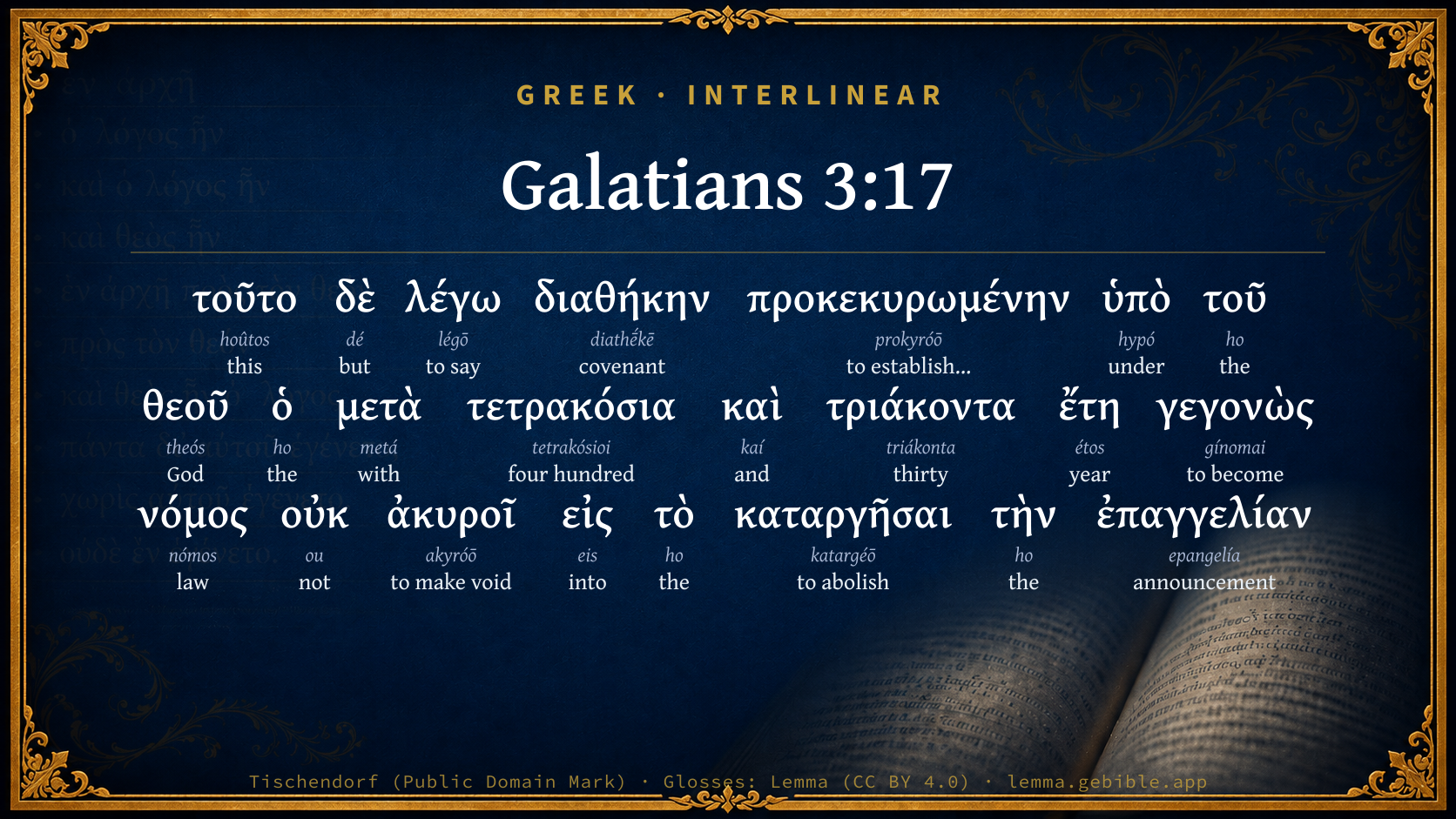
Now I say this. A covenant confirmed beforehand by God in Christ, the law, which came four hundred thirty years after, does not annul, so as to make the promise of no effect.
- 1 hapax legomenon — only here in the Greek New Testament
- 1 first appearance in the Greek New Testament
Download a study sheet
One document with this verse’s original text, its word-by-word gloss line, the meaning frame, cross-references with their text, attributed commentary, and full source and license credits — printable, and it pastes into notes with its structure intact.
This verse Autodidact and up
A passage Seminary Student
Up to 50 verses in one chapter. A passage sheet keeps up to 6 commentary sources and 12 cross-references per verse, in the order this page ranks them, and says so on the sheet whenever that leaves anything out. Ask for a single verse and you get the Autodidact verse sheet above.
Everything on this page stays free to read, with no account — the sheet is a download of what is already on screen, not access to it.
Compare translations 3
The same verse in 3 English versions, stacked beneath the original-language interlinear above. Click any original word for its lexicon entry.
Each is an independent rendering of the whole verse — the interlinear is not word-aligned to these translations.
Highlighted words mark where these versions differ — a whole-verse word diff, not a word-by-word alignment.
-
World English Bible Public Domain
Now I say this. A covenant confirmed beforehand by God in Christ, the law, which came four hundred thirty years after, does not annul, so as to make the promise of no effect.
-
King James Version Public Domain
And this I say, that the covenant, that was confirmed before of God in Christ, the law, which was four hundred and thirty years after, cannot disannul, that it should make the promise of none effect.
-
unfoldingWord Literal Text CC BY-SA 4.0
Now I say this: The law, having come after 430 years, does not set aside the covenant previously established by God to nullify the promise.
unfoldingWord Literal Text — © unfoldingWord, licensed CC BY-SA 4.0. Word-aligned USFM3 via Door43 (git.door43.org/unfoldingWord/en_ult).
Show all 19 translations
Every available English version of this verse, each an independent rendering of the whole verse.
-
World English Bible Public Domain
Now I say this. A covenant confirmed beforehand by God in Christ, the law, which came four hundred thirty years after, does not annul, so as to make the promise of no effect.
-
Berean Standard Bible Public Domain
What I mean is this: The law that came 430 years later does not revoke the covenant previously established by God, so as to nullify the promise.
-
Majority Standard Bible Public Domain
What I mean is this: The law that came 430 years later does not revoke the covenant previously established by God in Christ, so as to nullify the promise.
-
King James Version Public Domain
And this I say, that the covenant, that was confirmed before of God in Christ, the law, which was four hundred and thirty years after, cannot disannul, that it should make the promise of none effect.
-
American Standard Version (1901) Public Domain
Now this I say: A covenant confirmed beforehand by God, the law, which came four hundred and thirty years after, doth not disannul, so as to make the promise of none effect.
-
Revised Version (1885) Public Domain
Now this I say; A covenant confirmed beforehand by God, the law, which came four hundred and thirty years after, doth not disannul, so as to make the promise of none effect.
-
Geneva Bible (1599) Public Domain
And this I say, that the couenant that was confirmed afore of God in respect of Christ, the Lawe which was foure hundreth and thirtie yeeres after, can not disanull, that it shoulde make the promise of none effect.
-
Douay-Rheims (1899) Public Domain
Now this I say, that the testament which was confirmed by God, the law which was made after four hundred and thirty years, doth not disannul, to make the promise of no effect.
-
Young's Literal Translation Public Domain
and this I say, A covenant confirmed before by God to Christ, the law, that came four hundred and thirty years after, doth not set aside, to make void the promise,
-
Literal Standard Version CC BY-SA 4.0
and this I say, a covenant confirmed before by God to Christ, the Law, that came four hundred and thirty years after, does not set aside, to make void the promise,
-
Unlocked Literal Bible CC BY-SA 4.0
Now what I mean is this: The law, which came 430 years afterward, does not set aside the covenant previously established by God.
-
unfoldingWord Literal Text CC BY-SA 4.0
Now I say this: The law, having come after 430 years, does not set aside the covenant previously established by God to nullify the promise.
-
Darby Bible Public Domain
Now I say this, A covenant confirmed beforehand by God, the law, which took place four hundred and thirty years after, does not annul, so as to make the promise of no effect.
-
World Messianic Bible Public Domain
Now I say this: A covenant confirmed beforehand by God in Messiah, the law, which came four hundred thirty years after, does not annul, so as to make the promise of no effect.
-
Webster's Bible Public Domain
And this I say, that the covenant that was confirmed before by God in Christ, the law, which was four hundred and thirty years after, cannot disannul, that it should make the promise of no effect.
-
Free Bible Version CC BY-SA 4.0
Let me explain. The law, coming four hundred and thirty years later, doesn't cancel the previous agreement that God made, breaking the promise.
-
Bible in Basic English Public Domain
Now this I say: The law, which came four hundred and thirty years after, does not put an end to the agreement made before by God, so as to make the undertaking without effect.
-
Text-Critical English NT CC BY 4.0
My point is this: The law, which came four hundred and thirty years later, cannot annul a covenant previously ratified by God to Christ, so as to invalidate the promise.
-
Tyndale New Testament (1534) Public Domain
This I saye that the lawe which beganne afterwarde beyonde. iiii.C and. xxx. yeares doth not disanull the testament that was confermed afore of God vnto Christ ward to make the promes of none effect.
Literal Standard Version (2020), Covenant Press — licensed CC BY-SA 4.0. Text via the HelloAO Bible API (eBible.org). Unlocked Literal Bible (unfoldingWord) — licensed CC BY-SA 4.0. Text via the HelloAO Bible API (eBible.org). unfoldingWord Literal Text — © unfoldingWord, licensed CC BY-SA 4.0. Word-aligned USFM3 via Door43 (git.door43.org/unfoldingWord/en_ult). Free Bible Version, Dr. Jonathan Gallagher — licensed CC BY-SA 4.0. Text via the HelloAO Bible API (eBible.org).
Word by word
More ways to search: Search by grammar → Find every occurrence → Compare this word →
Practice this passage: Drill this verse → Learn its vocabulary →
- Appears 1× in the Greek New Testament
- First appears here
- Part of Speech
- Verb
- Tense
- Perfect
- Voice
- Passive
- Mood
- Participle
- Case
- Accusative
- Number
- Singular
- Gender
- Feminine
Full Thayer's Definition
- τοῦτο hoûtos G3778 “this” Demonstrative pronoun, Accusative, Singular, Neuter
- δὲ dé G1161 “but” Conjunction
- λέγω légō G3004 “to say” Verb, Present, Active, Indicative, 1st person, Singular
- διαθήκην diathḗkē G1242 “covenant” Noun, Accusative, Singular, Feminine
- προκεκυρωμένην prokyróō G4300 “to establish beforehand” Verb, Perfect, Passive, Participle, Accusative, Singular, Feminine
- ὑπὸ hypó G5259 “under” Preposition
- τοῦ ho G3588 “the” Article, Genitive, Singular, Masculine
- θεοῦ theós G2316 “God” Noun, Genitive, Singular, Masculine
- ὁ ho G3588 “the” Article, Nominative, Singular, Masculine
- μετὰ metá G3326 “with” Preposition
- τετρακόσια tetrakósioi G5071 “four hundred” Adjective, Accusative, Plural, Neuter
- καὶ kaí G2532 “and” Conjunction
- τριάκοντα triákonta G5144 “thirty” Adjective, Numeral (indeclinable)
- ἔτη étos G2094 “year” Noun, Accusative, Plural, Neuter
- γεγονὼς gínomai G1096 “to become” Verb, Perfect, Active, Participle, Nominative, Singular, Masculine
- νόμος nómos G3551 “law” Noun, Nominative, Singular, Masculine
- οὐκ ou G3756 “not” Particle, Negative
- ἀκυροῖ akyróō G208 “to make void” Verb, Present, Active, Indicative, 3rd person, Singular
- εἰς eis G1519 “into” Preposition
- τὸ ho G3588 “the” Article, Accusative, Singular, Neuter
- καταργῆσαι katargéō G2673 “to abolish” Verb, Aorist, Active, Infinitive
- τὴν ho G3588 “the” Article, Accusative, Singular, Feminine
- ἐπαγγελίαν epangelía G1860 “announcement” Noun, Accusative, Singular, Feminine
About this verse
These counts appear in no published source. They are computed here, from the morphology-tagged text and Lemma’s own curated glosses. What Lemma adds →
- 23
- words
- 20
- distinct lemmas
- Pauline Epistles
- section
Notable vocabulary
1 hapax legomenon — a word that appears only here in the entire Greek New Testament:
- προκεκυρωμένην to establish beforehand G4300
First appearance in Scripture
This word makes its first canonical appearance in the Greek New Testament here:
- προκεκυρωμένην to establish beforehand G4300
Shared distinctive vocabulary
ἀκυροῖ to make void G208 occurs in 3 verses of the Greek New Testament. Also found in:
Repetition
A word recurs within this verse:
- τοῦ the G3588 ×4
Cross-references
37Topical passages linked to Galatians 3:17 in the Treasury of Scripture Knowledge — connected by theme and wording, ordered by reader-vote popularity; previews shown in the World English Bible.
- Genesis 15:13 He said to Abram, "Know for sure that your seed will live as foreigners in a land that is not theirs, and will serve them. They will afflict them four hundred years.
- Exodus 12:40–41 Now the time that the children of Israel lived in Egypt was four hundred thirty years.
- Romans 4:13–14 For the promise to Abraham and to his seed that he should be heir of the world wasn't through the law, but through the righteousness of faith.
- Hebrews 11:39–40 These all, having had testimony given to them through their faith, didn't receive the promise,
- 2 Corinthians 1:20 For however many are the promises of God, in him is the "Yes." Therefore also through him is the "Amen," to the glory of God through us.
- Hebrews 6:13–18 For when God made a promise to Abraham, since he could swear by none greater, he swore by himself,
- Romans 3:3 For what if some were without faith? Will their lack of faith nullify the faithfulness of God?
- Isaiah 14:27 For Yahweh of Hosts has purposed, and who shall annul it? and his hand is stretched out, and who shall turn it back?
- John 1:17 For the law was given through Moses. Grace and truth came through Jesus Christ.
- 1 Corinthians 1:17 For Christ sent me not to baptize, but to preach the Gospel--not in wisdom of words, so that the cross of Christ wouldn't be made void.
- Galatians 3:15 Brothers, I speak like men. Though it is only a man's covenant, yet when it has been confirmed, no one makes it void, or adds to it.
- Galatians 5:4 You are alienated from Christ, you who desire to be justified by the law. You have fallen away from grace.
- Colossians 2:4 Now this I say that no one may delude you with persuasiveness of speech.
- Genesis 15:18 In that day Yahweh made a covenant with Abram, saying, "To your seed have I given this land, from the river of Egypt to the great river, the river Euphrates:
- Genesis 17:7–8 I will establish my covenant between me and you and your seed after you throughout their generations for an everlasting covenant, to be a God to you and to your seed after you.
- Genesis 17:19 God said, "No, but Sarah, your wife, will bear you a son. You shall call his name Isaac. I will establish my covenant with him for an everlasting covenant for his seed after him.
- Numbers 23:19 God is not a man, that he should lie, Neither the son of man, that he should repent: Has he said, and will he not do it? Or has he spoken, and will he not make it good?
- Numbers 30:8 But if her husband disallow her in the day that he hears it, then he shall make void her vow which is on her, and the rash utterance of her lips, with which she has bound her soul: and Yahweh will forgive her.
- Job 40:8 Will you even annul my judgment? Will you condemn me, that you may be justified?
- Psalms 33:10 Yahweh brings the counsel of the nations to nothing. He makes the thoughts of the peoples to be of no effect.
- Isaiah 28:18 Your covenant with death shall be annulled, and your agreement with Sheol shall not stand; when the overflowing scourge shall pass through, then you shall be trodden down by it.
- Luke 1:68–79 "Blessed be the Lord, the God of Israel, For he has visited and worked redemption for his people;
- John 8:56–58 Your father Abraham rejoiced to see my day. He saw it, and was glad."
- Acts 7:6 God spoke in this way: that his seed would live as aliens in a strange land, and that they would be enslaved and mistreated for four hundred years.
- Romans 3:25 whom God set forth to be an atoning sacrifice, through faith in his blood, for a demonstration of his righteousness through the passing over of prior sins, in God's forbearance;
- 1 Corinthians 1:12 Now I mean this, that each one of you says, "I follow Paul," "I follow Apollos," "I follow Cephas," and, "I follow Christ."
- 1 Corinthians 7:29 But I say this, brothers: the time is short, that from now on, both those who have wives may be as though they had none;
- 1 Corinthians 10:19 What am I saying then? That a thing sacrificed to idols is anything, or that an idol is anything?
- 2 Corinthians 9:6 Remember this: he who sows sparingly will also reap sparingly. He who sows bountifully will also reap bountifully.
- Galatians 3:21 Is the law then against the promises of God? Certainly not! For if there had been a law given which could make alive, most assuredly righteousness would have been of the law.
- Ephesians 4:17 This I say therefore, and testify in the Lord, that you no longer walk as the rest of the Gentiles also walk, in the futility of their mind,
- Hebrews 7:18 For there is an annulling of a foregoing commandment because of its weakness and uselessness
- Hebrews 11:13 These all died in faith, not having received the promises, but having seen them and embraced them from afar, and having confessed that they were strangers and pilgrims on the earth.
- Hebrews 11:17–19 By faith, Abraham, being tested, offered up Isaac. Yes, he who had gladly received the promises was offering up his one and only son;
- 1 Peter 1:11–12 searching for who or what kind of time the Spirit of Christ, which was in them, pointed to, when he predicted the sufferings of Christ, and the glories that would follow them.
- 1 Peter 1:20 who was foreknown indeed before the foundation of the world, but was revealed at the end of times for your sake,
- Galatians 5:16 But I say, walk by the Spirit, and you won't fulfill the lust of the flesh.
Cross-references courtesy of OpenBible.info (CC BY 4.0).
Where the printed editions differ
1 variantPlaces in this verse where the major printed Greek editions disagree on the wording in a way that affects the translation — a comparison of editions, not a manuscript-by-manuscript collation. The editions are the modern critical texts (Nestlé-Aland 28/27, SBL, Westcott-Hort, Tregelles, Tyndale House) and the traditional texts behind the KJV (the Textus Receptus and the Byzantine/Majority text). It is not a claim about which reading is original.
-
Extra text
εἰς Χριστὸν
“into Christ”
In TRByz Not in NA28NA27TynSBLWHTregεἰς Χριστὸν (eis Christon) 'into Christ' is only in traditional manuscripts (TR+Byz)
Textual data: Translators Amalgamated Greek New Testament (STEPBible TAGNT) · CC BY 4.0.
Lesson kit
Teaching starters — assembled from the data on this page, not authored interpretation. Every prompt links to the verse data it draws on. Edit before teaching.
Galatians, in the Pauline Epistles, opens this verse with 23 words (20 distinct Greek lemmas). Its most distinctive word is prokyróō (“to establish beforehand”). A historical commentator’s framing appears above. Read the whole chapter for the surrounding context.
Discussion questions
- The word prokyróō carries the sense “to establish beforehand.” How does it shape the verse?
- 1 word here appears nowhere else in the Greek New Testament. Why might the author reach for such rare wording?
- This is the first place “to establish beforehand” appears in Scripture (first appears here). What does its debut here establish?
- How does Matthew 15:6, which shares the word «to make void», read alongside this verse?
- What does the repetition of “the” (4× in this one verse) do in this verse?
- These translations render this verse differently. What is at stake in choosing one wording over another?
- Compare how The Biblical Illustrator and Joseph Benson's Commentary read this verse. Where do they agree or differ?
Things to notice
- 1 word in this verse appears nowhere else in the Greek New Testament.
- 1 word makes its first canonical appearance in Scripture here.
- These translations choose different wording for 26 words in this verse.
- “the” occurs 4× in this single verse.
- 20 distinct Greek lemmas span 23 words in this verse.
Commentary
Notes on Galatians 3:17 from classic Christian and Jewish commentators (each source and its license shown beneath its notes). The classic Christian expositions comment on the surrounding passage and are grouped to its opening verse, so a note may address several verses; the Jewish commentaries on the Tanakh (Rashi and others) are per-verse, so they appear only where the commentator wrote on this verse.
Lemma curates 59 commentaries, every one of them public domain or Creative Commons licensed, each selected and text-cleaned for this edition rather than reprinted as found. About our sources →
The Biblical Illustrator
Joseph S. Exell
The Biblical Illustrator, edited by Joseph S. Exell (c. 1880s–1900s) — public domain. Text from a community e-Sword module.
Joseph Benson's Commentary
Joseph Benson's Commentary on the Old and New Testaments (1811–1818) — public domain. Text from a community e-Sword module.
Tyndale Open Study Notes
Tyndale Open Resources
Tyndale Open Study Notes — © Tyndale Open Resources, licensed CC BY-SA 4.0. Text via the HelloAO Bible API.
Bengel's Gnomon
Johann Albrecht Bengel
Bengel's Gnomon of the New Testament — English translation (T&T Clark, Edinburgh, 1860) — public domain. Text from a community e-Sword module.
Meyer's Critical & Exegetical Commentary
Heinrich August Wilhelm Meyer
Meyer — Critical and Exegetical Commentary on the New Testament — English translation by Peter Christie, edited by Frederick Crombie (T&T Clark, 1880) — public domain. Text from a community e-Sword module.
Expositor's Greek Testament
ed. W. Robertson Nicoll
The Expositor's Greek Testament, edited by W. Robertson Nicoll (1897–1910) — public domain. Text from a community e-Sword module.
Geneva Bible (1599)
Geneva Bible translators
Geneva Bible (1599) marginal notes — public domain. Text via Bolls.life.
Jamieson, Fausset & Brown
Robert Jamieson, A. R. Fausset & David Brown
Jamieson, Fausset & Brown — Commentary Critical and Explanatory on the Whole Bible (1871) — public domain (CC PDM 1.0). Text via the HelloAO Bible API.
Adam Clarke's Commentary
Adam Clarke's Commentary on the Bible (1810–1826) — public domain. Text from a community e-Sword/MySword module.
John Calvin's Commentaries
John Calvin's Commentaries (1540-1563) — public domain. Text from the Calvin Translation Society English edition (1840s-50s) via the Christian Classics Ethereal Library (ccel.org). Calvin's coverage is partial (roughly two-thirds of the Bible); uncommented books and verses are honest gaps, never fabricated. The 19th-century editor's footnotes and remarks are omitted so the notes are faithfully Calvin's own voice.
Ellicott's Commentary for English Readers
A Bible Commentary for English Readers, edited by Charles John Ellicott (1878–1897) — public domain. Text from a community e-Sword module.
The Cambridge Bible for Schools and Colleges
gen. ed. J. J. S. Perowne
The Cambridge Bible for Schools and Colleges (gen. ed. J. J. S. Perowne; Cambridge University Press, 1878–1918) — public domain. Text from a community e-Sword module.
John Gill's Exposition
John Gill's Exposition of the Whole Bible (1746–1763) — public domain (CC PDM 1.0). Text via the HelloAO Bible API.
Trapp's Complete Commentary
John Trapp
John Trapp, A Commentary or Exposition upon All the Books of the Old and New Testament (1647–1656) — public domain. Text from a community e-Sword module.
Albert Barnes' Notes on the Bible
Albert Barnes' Notes on the Bible (1834–1885) — public domain. Text from a community e-Sword/MySword module.
Matthew Poole's English Annotations
Matthew Poole's English Annotations on the Holy Bible (1683–1685) — public domain. Text from a community e-Sword/MySword module.
Whedon's Commentary on the Bible
Daniel D. Whedon
Daniel D. Whedon (gen. ed.), Commentary on the Old and New Testaments (1874–1909) — public domain. Text from a community e-Sword module.
The Pulpit Commentary
The Pulpit Commentary (1880–1919), ed. H.D.M. Spence-Jones & Joseph S. Exell — public domain. Text from a community e-Sword module.
John Wesley's Explanatory Notes
John Wesley, Explanatory Notes Upon the Whole Bible (1754–1765) — public domain. Text via the GEBible commentary corpus.
Luther on Galatians
Martin Luther
Martin Luther — Commentary on the Epistle to the Galatians (1535), English translation by Theodore Graebner (Zondervan, 1939) — public domain (U.S. copyright not renewed). Text from a community e-Sword module.
McGarvey & Pendleton's Commentaries
J. W. McGarvey
J. W. McGarvey (with Philip Y. Pendleton), Commentaries on the New Testament (The Fourfold Gospel, 1914; Acts; and the epistles) — public domain. Text from a community e-Sword/MySword module.
The People's New Testament
B. W. Johnson
B. W. Johnson's The People's New Testament with Notes (1889–1891) — public domain. Electronic text from the Christian Classics Ethereal Library (CCEL) ThML edition.
unfoldingWord translationNotes
Door43 World Missions Community
unfoldingWord translationNotes — © Distant Shores Media and the Door43 World Missions Community, licensed CC BY-SA 4.0. Source: git.door43.org/Door43/en_tn.
Cambridge Greek Testament for Schools and Colleges
Cambridge Greek Testament for Schools and Colleges (Cambridge University Press, 1896; 21 vols, various authors incl. Carr, Maclear, Plummer, Farrar, Lumby, Moule, M. R. James, Simcox) — public domain. Text from a community e-Sword module.
Alford’s Greek Testament
Henry Alford
Henry Alford, The Greek Testament (1849–1861) — public domain. Text from a community e-Sword module.
International Critical Commentary
International Critical Commentary — older volumes (1896–1929), various authors — public domain. Text from a community e-Sword module.
Vincent's Word Studies in the New Testament
Marvin R. Vincent
Marvin R. Vincent, Word Studies in the New Testament (1887–1900) — public domain. Text from a community e-Sword/MySword module.