Ephesians 4:13

Greek (Tischendorf 8th ed.) Ephesians 4:13 appears in the Greek New Testament. The text above is from the Tischendorf 8th edition. Each word links to its Strong’s number and a concise gloss. Click any word for its full Thayer’s Greek Lexicon entry.
Download image
Cite this verse

Ephesians 4:13 (World English Bible). Public Domain. Lemma interlinear Bible study tool, https://lemma.gebible.app/v/ephesians/4/13.

Show BibTeX & RIS
BibTeX
RIS
English Translation
until we all attain to the unity of the faith, and of the knowledge of the Son of God, to a full grown man, to the measure of the stature of the fullness of Christ;
World English Bible · Public Domain
Download a study sheet

One document with this verse’s original text, its word-by-word gloss line, the meaning frame, cross-references with their text, attributed commentary, and full source and license credits — printable, and it pastes into notes with its structure intact.

This verse Autodidact and up

Study sheet (.html) Plain text (.txt)

A passage Seminary Student

Up to 50 verses in one chapter. A passage sheet keeps up to 6 commentary sources and 12 cross-references per verse, in the order this page ranks them, and says so on the sheet whenever that leaves anything out. Ask for a single verse and you get the Autodidact verse sheet above.

Everything on this page stays free to read, with no account — the sheet is a download of what is already on screen, not access to it.

Want to remove ads? Support Godless Engineer
Compare translations 3

The same verse in 3 English versions, stacked beneath the original-language interlinear above. Click any original word for its lexicon entry.

Each is an independent rendering of the whole verse — the interlinear is not word-aligned to these translations.

Highlighted words mark where these versions differ — a whole-verse word diff, not a word-by-word alignment.

  • World English Bible Public Domain
    until we all attain to the unity of the faith, and of the knowledge of the Son of God, to a full grown man, to the measure of the stature of the fullness of Christ;
  • King James Version Public Domain
    Till we all come in the unity of the faith, and of the knowledge of the Son of God, unto a perfect man, unto the measure of the stature of the fulness of Christ:
  • unfoldingWord Literal Text CC BY-SA 4.0
    until we all reach to the unity of the faith and the knowledge of the Son of God, to a mature man, to the measure of the stature of the fullness of Christ,

unfoldingWord Literal Text — © unfoldingWord, licensed CC BY-SA 4.0. Word-aligned USFM3 via Door43 (git.door43.org/unfoldingWord/en_ult).

Versions to compare (up to 4)

3 of 4 selected

Show all 19 translations

Every available English version of this verse, each an independent rendering of the whole verse.

  • World English Bible Public Domain
    until we all attain to the unity of the faith, and of the knowledge of the Son of God, to a full grown man, to the measure of the stature of the fullness of Christ;
  • Berean Standard Bible Public Domain
    until we all reach unity in the faith and in the knowledge of the Son of God, as we mature to the full measure of the stature of Christ.
  • Majority Standard Bible Public Domain
    until we all reach unity in the faith and in the knowledge of the Son of God, as we mature to the full measure of the stature of Christ.
  • King James Version Public Domain
    Till we all come in the unity of the faith, and of the knowledge of the Son of God, unto a perfect man, unto the measure of the stature of the fulness of Christ:
  • American Standard Version (1901) Public Domain
    till we all attain unto the unity of the faith, and of the knowledge of the Son of God, unto a fullgrown man, unto the measure of the stature of the fulness of Christ:
  • Revised Version (1885) Public Domain
    till we all attain unto the unity of the faith, and of the knowledge of the Son of God, unto a fullgrown man, unto the measure of the stature of the fulness of Christ:
  • Geneva Bible (1599) Public Domain
    Till we all meete together (in the vnitie of faith and that acknowledging of the Sonne of God) vnto a perfite man, and vnto the measure of the age of the fulnesse of Christ,
  • Douay-Rheims (1899) Public Domain
    Until we all meet into the unity of faith, and of the knowledge of the Son of God, unto a perfect man, unto the measure of the age of the fulness of Christ;
  • Young's Literal Translation Public Domain
    till we may all come to the unity of the faith and of the recognition of the Son of God, to a perfect man, to a measure of stature of the fulness of the Christ,
  • Literal Standard Version CC BY-SA 4.0
    until we may all come to the unity of faith and of the recognition of the Son of God, to a perfect man, to a measure of stature of the fullness of the Christ,
  • Unlocked Literal Bible CC BY-SA 4.0
    He continues to build up his body until we all reach the unity of faith and knowledge of the Son of God, and that we become mature and so reach the measure of the fullness of Christ.
  • unfoldingWord Literal Text CC BY-SA 4.0
    until we all reach to the unity of the faith and the knowledge of the Son of God, to a mature man, to the measure of the stature of the fullness of Christ,
  • Darby Bible Public Domain
    until we all arrive at the unity of the faith and of the knowledge of the Son of God, at [the] full-grown man, at [the] measure of the stature of the fulness of the Christ;
  • World Messianic Bible Public Domain
    until we all attain to the unity of the faith and of the knowledge of the Son of God, to a full grown man, to the measure of the stature of the fullness of Messiah,
  • Webster's Bible Public Domain
    Till we all come in the unity of the faith, and of the knowledge of the Son of God, to a perfect man, to the measure of the stature of the fullness of Christ:
  • Free Bible Version CC BY-SA 4.0
    We grow together until we all reach the state of being one in our trust in and knowledge of the Son of God, completely grown up, measuring up to full maturity in Christ.
  • Bible in Basic English Public Domain
    Till we all come to the harmony of the faith, and of the knowledge of the Son of God, to full growth, to the full measure of Christ:
  • Text-Critical English NT CC BY 4.0
    until we all reach unity in the faith and in the knowledge of the Son of God, growing into maturity with a stature measured by Christ's fullness.
  • Tyndale New Testament (1534) Public Domain
    tyll we every one (in the vnitie of fayth and knowledge of the sonne of god) growe vp vnto a parfayte man after the measure of age of the fulnes of Christ.

Literal Standard Version (2020), Covenant Press — licensed CC BY-SA 4.0. Text via the HelloAO Bible API (eBible.org). Unlocked Literal Bible (unfoldingWord) — licensed CC BY-SA 4.0. Text via the HelloAO Bible API (eBible.org). unfoldingWord Literal Text — © unfoldingWord, licensed CC BY-SA 4.0. Word-aligned USFM3 via Door43 (git.door43.org/unfoldingWord/en_ult). Free Bible Version, Dr. Jonathan Gallagher — licensed CC BY-SA 4.0. Text via the HelloAO Bible API (eBible.org).

Word by word

More ways to search: Search by grammar → Find every occurrence → Compare this word →

Practice this passage: Drill this verse → Learn its vocabulary →

ἑνότητα
henótēs
G1775
“unity”
Noun, Accusative, Singular, Feminine
Part of Speech
Noun
Case
Accusative
Number
Singular
Gender
Feminine
Full Thayer's Definition

Origin: from G1520

TDNT: None

1. unity 2. unanimity, agreement
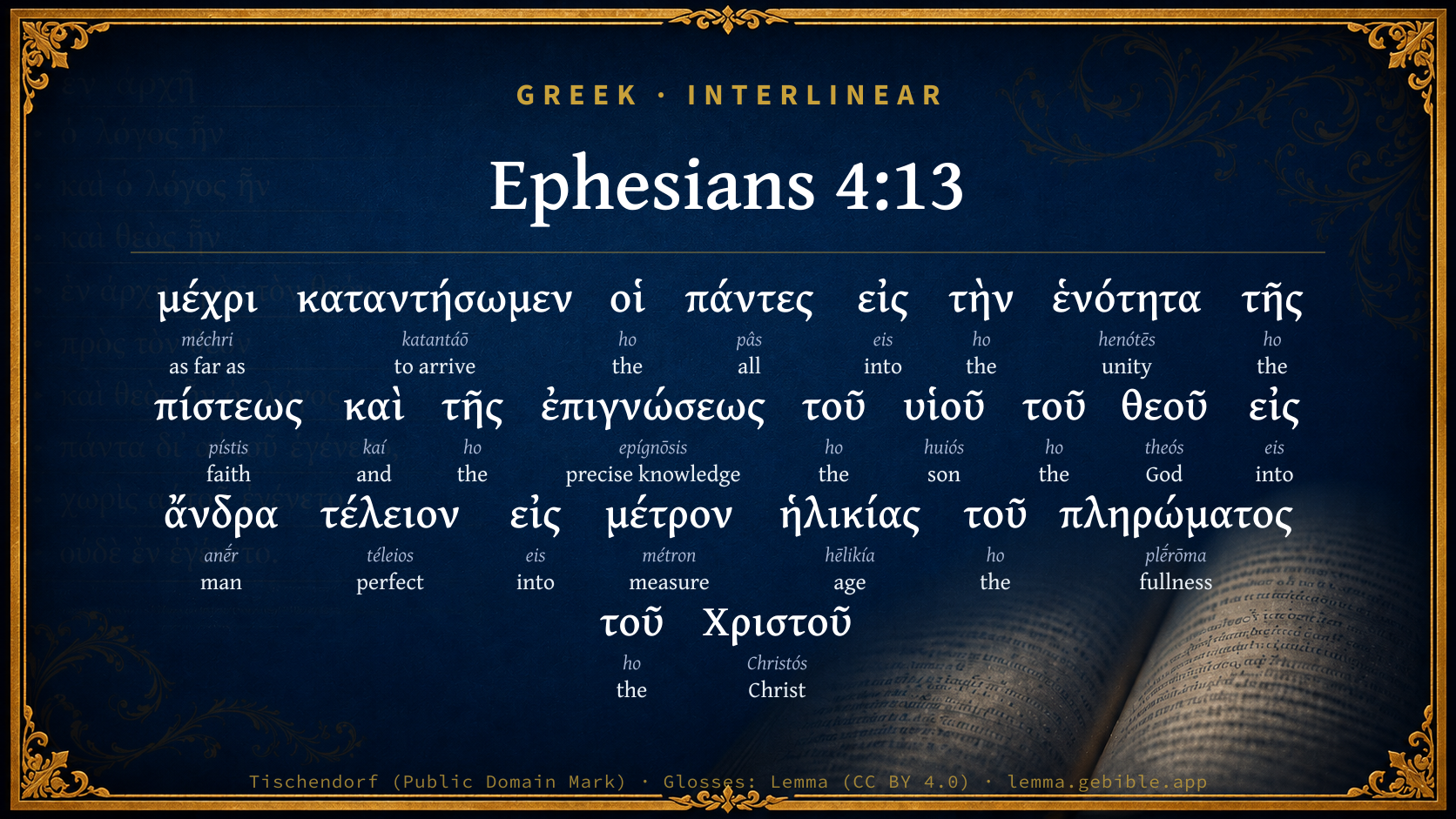
  1. μέχρι méchri G3360 “as far as” Adverb
  2. καταντήσωμεν katantáō G2658 “to arrive” Verb, Aorist, Active, Subjunctive, 1st person, Plural
  3. οἱ ho G3588 “the” Article, Nominative, Plural, Masculine
  4. πάντες pâs G3956 “all” Adjective, Nominative, Plural, Masculine
  5. εἰς eis G1519 “into” Preposition
  6. τὴν ho G3588 “the” Article, Accusative, Singular, Feminine
  7. τῆς ho G3588 “the” Article, Genitive, Singular, Feminine
  8. πίστεως pístis G4102 “faith” Noun, Genitive, Singular, Feminine
  9. καὶ kaí G2532 “and” Conjunction
  10. τῆς ho G3588 “the” Article, Genitive, Singular, Feminine
  11. ἐπιγνώσεως epígnōsis G1922 “precise knowledge” Noun, Genitive, Singular, Feminine
  12. τοῦ ho G3588 “the” Article, Genitive, Singular, Masculine
  13. υἱοῦ huiós G5207 “son” Noun, Genitive, Singular, Masculine
  14. τοῦ ho G3588 “the” Article, Genitive, Singular, Masculine
  15. θεοῦ theós G2316 “God” Noun, Genitive, Singular, Masculine
  16. εἰς eis G1519 “into” Preposition
  17. ἄνδρα anḗr G435 “man” Noun, Accusative, Singular, Masculine
  18. τέλειον téleios G5046 “perfect” Adjective, Accusative, Singular, Masculine
  19. εἰς eis G1519 “into” Preposition
  20. μέτρον métron G3358 “measure” Noun, Accusative, Singular, Neuter
  21. ἡλικίας hēlikía G2244 “age” Noun, Genitive, Singular, Feminine
  22. τοῦ ho G3588 “the” Article, Genitive, Singular, Neuter
  23. πληρώματος plḗrōma G4138 “fullness” Noun, Genitive, Singular, Neuter
  24. τοῦ ho G3588 “the” Article, Genitive, Singular, Masculine
  25. Χριστοῦ Christós G5547 “Christ” Noun, Genitive, Singular, Masculine

About this verse

These counts appear in no published source. They are computed here, from the morphology-tagged text and Lemma’s own curated glosses. What Lemma adds →

26
words
17
distinct lemmas
Pauline Epistles
section

Notable vocabulary

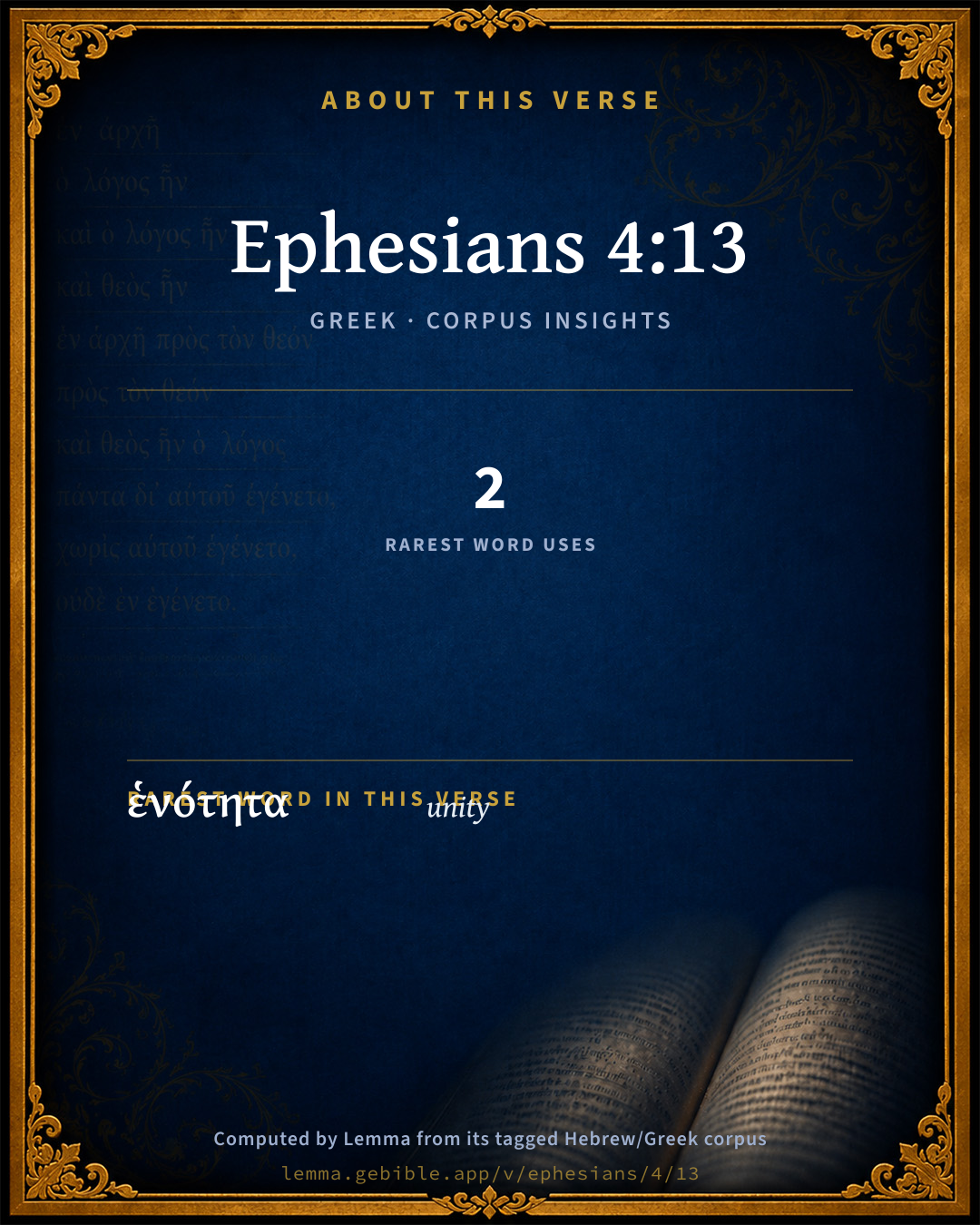
The rarest word here is ἑνότητα unity G1775 — appearing just 2 times in the whole Greek New Testament.

Shared distinctive vocabulary

ἑνότητα unity G1775 occurs in 2 verses of the Greek New Testament. Also found in:

Repetition

Words recur within this verse:

Cross-references

26

Topical passages linked to Ephesians 4:13 in the Treasury of Scripture Knowledge — connected by theme and wording, ordered by reader-vote popularity; previews shown in the World English Bible.

  • Colossians 1:28 whom we proclaim, admonishing every man and teaching every man in all wisdom, that we may present every man perfect in Christ Jesus;
  • John 17:21 that they may all be one; even as you, Father, are in me, and I in you, that they also may be one in us; that the world may believe that you sent me.
  • Ephesians 4:3 being eager to keep the unity of the Spirit in the bond of peace.
  • Ephesians 4:5 one Lord, one faith, one baptism,
  • 1 Corinthians 14:20 Brothers, don't be children in thoughts, yet in malice be babies, but in thoughts be mature.
  • Hebrews 5:14 But solid food is for those who are full grown, who by reason of use have their senses exercised to discern good and evil.
  • 2 Peter 3:18 But grow in the grace and knowledge of our Lord and Savior Jesus Christ. To him be the glory both now and forever. Amen.
  • Jeremiah 32:38–39 and they shall be my people, and I will be their God:
  • Philippians 3:8 Yes most assuredly, and I count all things to be loss for the excellency of the knowledge of Christ Jesus, my Lord, for whom I suffered the loss of all things, and count them nothing but refuse, that I may gain Christ
  • Zechariah 14:9 Yahweh will be King over all the earth. In that day Yahweh will be one, and his name one.
  • Colossians 2:2 that their hearts may be comforted, they being knit together in love, and gaining all riches of the full assurance of understanding, that they may know the mystery of God, both of the Father and of Christ,
  • Acts 4:32 The multitude of those who believed were of one heart and soul. Not one of them claimed that anything of the things which he possessed was his own, but they had all things in common.
  • Ephesians 1:23 which is his body, the fullness of him who fills all in all.
  • Zephaniah 3:9 For then I will purify the lips of the peoples, that they may all call on the name of Yahweh, to serve him shoulder to shoulder.
  • Philippians 2:1–3 If there is therefore any exhortation in Christ, if any consolation of love, if any fellowship of the Spirit, if any tender mercies and compassion,
  • 1 John 5:20 We know that the Son of God has come, and has given us an understanding, that we know him who is true, and we are in him who is true, in his Son Jesus Christ. This is the true God, and eternal life.
  • Ezekiel 37:21–22 Say to them, Thus says the Lord Yahweh: Behold, I will take the children of Israel from among the nations, where they are gone, and will gather them on every side, and bring them into their own land:
  • John 16:3 They will do these things because they have not known the Father, nor me.
  • John 17:3 This is eternal life, that they should know you, the only true God, and him whom you sent, Jesus Christ.
  • John 17:25–26 Righteous Father, the world hasn't known you, but I knew you; and these knew that you sent me.
  • 1 Corinthians 1:10 Now I beg you, brothers, through the name of our Lord, Jesus Christ, that you all speak the same thing and that there be no divisions among you, but that you be perfected together in the same mind and in the same judgment.
  • 2 Corinthians 4:6 seeing it is God who said, "Light will shine out of darkness," who has shone in our hearts, to give the light of the knowledge of the glory of God in the face of Jesus Christ.
  • Ephesians 2:15 having abolished in the flesh the hostility, the law of commandments contained in ordinances, that he might create in himself one new man of the two, making peace;
  • Ephesians 4:12 for the perfecting of the saints, to the work of serving, to the building up of the body of Christ;
  • 2 Peter 1:1–3 Simon Peter, a servant and apostle of Jesus Christ, to those who have obtained a like precious faith with us in the righteousness of our God and Savior, Jesus Christ:
  • Isaiah 53:11 He shall see of the travail of his soul, [and] shall be satisfied: by the knowledge of himself shall my righteous servant justify many; and he shall bear their iniquities.

Cross-references courtesy of OpenBible.info (CC BY 4.0).

Commentary

Notes on Ephesians 4:13 from classic Christian and Jewish commentators (each source and its license shown beneath its notes). The classic Christian expositions comment on the surrounding passage and are grouped to its opening verse, so a note may address several verses; the Jewish commentaries on the Tanakh (Rashi and others) are per-verse, so they appear only where the commentator wrote on this verse.

Lemma curates 59 commentaries, every one of them public domain or Creative Commons licensed, each selected and text-cleaned for this edition rather than reprinted as found. About our sources →

The Biblical Illustrator

Joseph S. Exell

Eph_4:13

Till we all come in the unity of the faith, and of the knowledge of the Son of God, unto a perfect man, unto the measure of the stature of the fulness of Christ.

Development

I. Christian unity.

1. Oneness of faith.

2. Oneness of knowledge. This signifies practical acquaintance, or what you sometimes term a saving knowledge of Christ.

3. Oneness of aim or object. Seeking to become perfect men in Christ, full-grown men, to attain to the loftiest standard of perfection, both in strength and beauty, in the universe.

II. Christian stability. Christian men are not to be like children in weakness, credulity, waywardness, changeableness, and much else peculiar to childhood; but to be strong, robust, fixed, settled in their religious belief and manner of life, showing that their faith had so inwrought itself with the very fibre of their spiritual life as to impart moral stamina, enabling them to stand like men, and not be tossed about like feeble children. But the apostles figures supply something more than the thought of childish weakness. Tossed about with every wind, suggests the idea of a drifting, unmanageable ship, dismasted, and without rudder or compass, driven before every wind. A plight most pitiable. This suggests the thought of instability and unrest. The vessel pursues no course but such as the wind dictates, and you know how unsafe a ship master that is when it has sole command. Now Paul knew the danger of this restlessness, not only to the individual possessed by it, but the damage it might be to others. Hence he desires all Christians to be united in the grand verities of the gospel, vigorous in faith, clear in personal acquaintance with Christ, that they might have a life of uniform stability, be firm, fixed, and unwavering in mind and heart, faith and life. The doctrine, then, that comes out here is that of Christian stability, not obstinacy; steadfastness, not stupidity.

III. Christian growth.

1. Growth is gradual. Little by little is the principle on which it proceeds. A child does not become a man at one bound, a picture is not painted by the magic of a single stroke, a building is not reared by one single supreme effort, nor does the oak tree mature in a single day. Line upon line, layer upon layer, here a little and there a little, are the lines upon which all things move ere maturity and perfection are reached. Continuity, progression, development, evolution--or whatever else you may please to call it--this is the great governing law.

2. This growth is constant. Day and night, summer and winter, in storm and calm, the principle is in operation. It may appear sometimes to the good man as if no progress could be registered, he seems to himself to be putting forth no fresh blossoms, and yielding little or no fruit. And yet, those very times, that seem so unpropitious to him, may be the most successful periods of his life, his roots may be striking deeper, and spreading wider in preparation of richer foliage and fruitage in the future. Always growing--though not always giving the same outward indications of growth--this is the law of the Saviours kingdom.

3. This growth is silent, and imperceptible. You can neither see nor hear its actual operation. Growth is one of the most effective forces in nature, and yet the most silent.

4. The growth spoken of in the text is upward. It is growing up into Christ the Head in all things. Upward growth is a marked speciality of the Christian life. Aspiration is the thought. Upward, heavenward, is the Christians watchword.

IV. Christian cohesion. The Church is likened to the human body. A few points of comparison between the two will show the beauty and appropriateness of the figure.

1. Fitness of position and work. Fitly joined. So it is in the Church when it is under the entire governance of the Master, every man occupies his own place and does the work for which he is fitted by gifts and opportunity.

2. Here is compactness--fitly joined and compacted together. Heart, mind, sympathy, principle, motive, aspiration, and wish, so closely blended as to become one heart and one mind, that there be no schism in the body, but working together with the greatest order for the one purpose, the well-being of the body, and the glory of its Head.

3. Here is also mutual aid--by that which every joint supplieth. Helping together is the thought, every joint contributing its share so as to promote the general good of the whole body. You see the beauty of this comparison where the Church of Christ is, in its best sense, a mutual aid society, where every joint is supplying its quota of aid for the good of the whole. (J. T. Higgins.)

The reunion of Christendom

Augustus Harts superb description of the Rhine falls may well serve as an analogue of the reunion of the Church. The cross streams, which had been prancing along sideways, arching their necks like war horses that hear the trumpet broke from the main stream and forced their way into it. From the valley of thunder, where they encountered, rose a towering misty column, behind which the river unites unseen, as though unwilling that any should witness the awfully tender reconcilement. That awfully tender reconcilement of the long conflicting currents of Church life is even now being solemnized behind the mist of our encounters. What a yearning for unity pervades the Churches. This very desire is, in its intensity, a presage and pledge of its own fulfilment; only the spirit of love could have inspired it. He is brooding, moving on the cloudy chaos. What a perceptible giving there is in that ice of exclusiveness! (B. Gregory, D. D.)

One faith

Some think variety of religions as pleasing to God as variety of flowers. Now there can be but one religion which is true, and the God of troth cannot be pleased with falsehood for the sake of variety. (Bp. Horns.)

The designs of the Christian ministry

1 To bring Christians to the unity of the faith.

2. To bring Christians to the knowledge of Christ.

3. To bring Christians to the perfection of Christian character.

4. To bring Christians to the enjoyment of the fulness of Christ. (G. Brooks.)

The Church a school for heaven

I. The teachers in this school.

1. God, the great and effectual instructor of the Church.

2. The human teachers--the ushers under God.

3. The Church collectively.

II. The manuals used;

1. Conscience.

2. The Scriptures.

3. Gods providence.

III. The learners.

1. The universal race of man.

2. The private members of the Church.

3. Pastors.

4. The angels. (Dr. W. R. Williams.)

The importance of preparatory instruction for the ministry

I. The relation subsisting between Christ and the Church. Christ the Head, the Church the body.

II. The officers given by Christ for the service of the Church.

1. Apostles.

2. Prophets.

3. Evangelists.

4. Pastors and teachers.

III. The special ends for which these officers were given.

1. To instruct men for the ministry.

2. To edify the Church. (W. Roby.)

Development of spiritual life

I. The progressive development of the spiritual life.

1. Intellectual.

2. Emotional.

3. Moral.

4. Harmonious.

II. The obstacles to this development.

1. They arise from the necessary limitations of our nature.

2. They arise from indwelling sin.

3. They arise from the influence of the world.

4. They arise from the power of temptation. (G. Brooks.)

The model Man

We all have a certain ideal of manly character before our minds, formed of the elements we most admire and fain would imitate; and that ideal is very often embodied in some actual hero, living or dead. But our ideals are not seldom defective or false: our heroes fall short even of these. The poor copy we set before us has a still poorer copy made from it, in our own characters and lives. Let us aim at once at the highest mark. We may not reach it, but we shall obtain more than with any lower one. Our blessed Saviour is the absolutely perfect type of the manly character.

I. When we think of an ideal man, we think of a being with a body as the perfection of beauty in form, and movement, healthy and strong, full of capacity to do and to endure. There have been very noble minds in weak bodies; but being in such tabernacles, they groaned, being burdened. The true ideal motto is that of the Latins, mens sana in copore sano. There is every reason to believe that our Lord Jesus Christ wore such a body. As the taint of hereditary depravity did not cleave to His soul, neither did the curse of ancestral disease infect His body. He that was so obedient to law of every kind, saying: It becometh us to fulfil all righteousness,--would faithfully observe the laws of health, as to food, air, exercise and rest--never guilty of any excess, never exposing Himself to needless injury. The purity and peacefulness of His spirit were every way promotive of bodily health. Therefore we say to those who would be like Jesus Christ,--be healthy and strong if you can be; cultivate your physique religiously, and understand your bodily system, that you may intelligently work out your Makers plans.

II. The second element in model manhood is strength of mind; we mean, at present, of the intellectual powers, rather than of the will or the affections. Mind is necessary to understand, to plan, to execute, to rule over Nature, ourselves, and ether men. In the case of our Saviour, goodness and knowledge were blended together.

III. The third element in manhood is strength of will The manliest man, to our thinking, is the one who stands upright on his own feet, self-poised, not leaning on anyone else, thinking out his own thoughts, making up his own mind, adhering to his own purpose, master of himself, bending all his powers to his one aim, undismayed by difficulty, conquering opposition, resolute in suffering as vigorous in action, and so victorious in the end.

IV. One more constituent of manly character is strength of heart. (F. H. Marling.)

Christ the model of the Christian life

I purpose to inquire, What, from the New Testament, was Christs own teaching respecting His relations to man?

1. Christ confirmed and enlarged the ethical truths which existed in His age. Whatever was just, and pure, and true, and good, from whatsoever quarter it may have been derived, and whether it was held by the Jews or by the enlightened heathen, was accepted at His hands. The moral precepts of the gospel were not originated by the Saviour when He came upon the earth. They belong to a system of natural ethics. They are the outworkings of natural laws which were made when man was made, and when the world was made. They were partly found out, they were imperfectly known, they shone dimly, before the coming of Christ; but they were unveiled at the time of Christs advent more perfectly, and accepted more fully, and carried back to their true source, and arranged so, with reference to their real character, as that they should become transcendently more fruitful than ever they had been in isolation and twilight under heathen civilization.

2. He delivered men from bondage to vehicles and forms of worship; not, however, that He might destroy these things, not that He might detach them from these things, but that He might deepen their sense of the truths and principles which these things had been employed to express. He taught that, whenever there was any conflict between the inward principle and any external law, or custom, or ordinance, the law, or custom, or ordinance, must go down. He taught that the physical must be subordinate to the spiritual, for whose sake it was originally created. He taught that the spirit was to be master of the flesh.

3. Our Saviour cleansed and amplified the knowledge of spiritual truth, and carried that truth far higher than it had ever gone before.

4. He added to the realm of spiritual truths most important elements which had never before been clearly known. The nature of God; the certainty of immortality, etc.

5. More important than all was the fact of the vital intercourse between Gods soul and ours.

6. Christ came, by His sufferings and by His death, to open the way for the universal forgiveness of sin, and for redemption from it.

7. The last point that I shall make in this category is that Christ taught Himself to be Divine; and that His divinity is such a true divinity as makes it proper for men to offer, and for Him to receive, all that it is possible for a human soul to give to its God. (H. W. Beecher.)

The characteristic element of the Christian life

Love was the design of the Old Testament economy as much as it is of the New. But, while they contemplate the same thing, they do so from different points of view. The economy employed by the Old Testament to bring men up spiritually into that condition in which they should live by love, succeeded only in getting men to live by conscience. Christ came under new conditions, and with new influences, and re-asserted the grand truth that the economy of God in life began with the manifestation, first, of the Divine nature. He taught men that God was love; that love was the essential characteristic element of the Divine nature; not that there were not justice, and reason, and intelligence, and many noble attributes; but that these were all enfolded in love, and that they acted under the influence of love, which was the characteristic element of divinity. Christs own character, also, and His peculiar life work, were manifested round about this centre of love. For by love God sent Him; and He executed the errand on which He was sent in the spirit of self-sacrificing love.

1. A true Christian has, or may have, large elements of reason and knowledge; of veneration and worship; of faith and aspiration; of activity and obedience; of earnestness and zeal; and yet not one of these, nor all of them, will make him a Christian, until the soul pours a whole summer of love round about them. Then the presence of this love in the midst of these other qualities will determine that he is a Christian. It is not knowledge that is evidence that you are a Christian; it is not a sense of duty; it is not mere outward conduct of any sort; it is the benevolent tendency of the heart; it is the souls sweetness and love power.

2. The peculiar Christian graces which are enjoined upon us in the Bible are all love children. Not only are they to be known by their likeness to love, but they cannot be born without love. And there is not a Christian grace that is not easy to those who love enough. I have sometimes stood and marvelled at the vastness of the water wheel that lay silent by the side of the mill, and wondered by what power it could be turned. Meanwhile there was the trickling of water through a small pipe, which fell on the far side of it, and did not stir it. At last the miller went to the gate further up, and lifted it, and the flood poured down in larger measure; and the moment enough water had flowed into it, the great slave wheel began instantly to toil and turn; and all day, and all night, and so long as the water continued to pour upon it, it ground out its treasure, singing and spilling its musical water as it rolled round. And so it is with that wheel of the soul, in its revolutions of daily life. If the stream of love pours on it abundantly, how, it revolves! How does it work out every interior fruit of the heart and life, only so that the stream of love pours on it!

3. We can trace, in the light of this truth, the progress of Christian life, or growing in grace. The test that you are growing in grace is that you are growing in more perfect moral qualities in the direction of love.

4. And as it is in the individual, so it is collectively, or in Churches. The spread of Christianity is to be measured by the spread of its distinctive spirit. As growth in conscience, or reason, is no evidence of growth in grace with the individual, so growth in these things is no evidence of growth in grace with the Church. Growth in beneficence is the test in both cases. The Church is taking possession of the world, not geographically, but in the degree in which it is able to stimulate and maintain the summer of benevolence among men. The union of Christians--and of Churches, for that matter--is to come from this characteristic spirit of love, or from nothing at all. And the aggression of the Church on the world will be victorious only when a whole Christianity brings the whole human soul to bear upon the world in the power and plenitude of love. And we are talking about the Church owning the world. Christian hearts will own the world, but Christian Churches never will. For, when we take the world captive, it will be by the subduing power of Christian love. (H. W. Beecher.)

The perfect Manhood

All Churches, all ordinances, all doctrines, all sorts of moral teachers, are ordained for the sake of making perfect men; and Christianity may be said to be, in a general way, the art of being whole men, in distinction from partial men, and make-believe men. It is not enough to say that Christianity tends to make men better. Its aim is to develop a perfect manhood. Till we all come unto a perfect man. And that manhood can never be reached except in Christ Jesus. We hold a nature in common with the Divine nature. When we can work out from it the accidental, the transient, the local, that which is left is strictly Divine--it is like Christ. No man can be Divine in scope and degree; but in kind he may. Every oak tree in the nursery is like the oak tree of a hundred years. Not in size, but in nature, it is just as much an oak tree as the biggest. We are not of the Divine magnitude, nor of the Divine scope, nor of the Divine power; but we are of the Divine nature. There is no picture that was ever painted, there is no statue that was ever carved, there was no work of art ever conceived of, that was half so beautiful as is a living man, thoroughly developed upon the pattern of Christ Jesus.

1. To live well for the life to come is the surest way of living well for this world. And to live rightly for this world is the surest way of living rightly for the world to come. The world is grandly constituted to develop manhood in those who know how to use it. But how base and ignoble are they who squander their manhood in this world; who pass through the most wondrously organized system of education--namely, the natural, civil, and social world--and parcel out their noble nature, as it were, for sale; who coin conscience; who suppress their spiritual nature; who dignify success in worldly things; who live, not for manhood, but for selfishness, for pride, for pitiful pelf! How does a tool or machine pass through the various shops in its construction? It goes in a lump of pig-iron. Melted and rudely shaped it is at first. It passes out from the first set of hands into the second. There something more is given to it, not of fineness, not of polish, but of shape, adapting it to its final uses. The next shop takes something from it, it may be, trimming away the clumsiness, reducing it in bulk, that it may be finer in adaptation. And, still going on from shop to shop, it passes through some twenty different sets of hands, and gains something from every single man that touches it. And it is a perfect tool or machine when it issues from the other side. This great world, my young friends, is Gods workshop. You are put in on one side, and every single shop, every single experience, is to take from you something that you are better without, or add something to you that shall fit you for use. And blessed is the man, who gathers as he goes, symmetry, shapeliness, temper, quality, adaptation, so that when he issues from the further side he is a perfect man. But what a base thing for a man to be put into Gods workshop, which was set up on purpose to make man, and come out on the other side without a single attribute of manhood. Ah 1 such wastes as there are! For a man to walk through cities and towns, and see what becomes of manhood, is enough to turn his head into a fountain of tears. It is enough to see the wastes of antiquity--the battered statues; the toppled-down columns; the fractured walls; the ruins of the Parthenon. But of all the destructions that have gone on in this world, and that are now going on every day in the great cities which are grinding and crushing out manhood, the destruction of men is the saddest. And woe be to the man that is burned, or that is crushed, and that comes out worthless, and goes into the rubbish heap of the universe!

2. I call you, young men, to a Christian life, not simply because it is the way of duty, but because it is the only way in which you can find your own selves. There are reasons springing from the eternal government of God, from the rightful authority of God, from the issues of the eternal world, why you should be Christians; but there are other reasons springing from the nature of your own soul--from your makeup. I hold that no man can be a man who is not a Christian. I hold that the true Christian is the noblest man, the strongest man, the freest man, the largest man. He is like a harp, not subjected to rude and random, touches, but handled by a skilful player. His soul is so organized and acted upon that there is melody produced from every single chord, and from all of them matchless harmonies.

3. I call you to discriminate between Gods men and the Churchs men. I do not call you to be men in the Church, or to be men according to the sects, whether they have prevailed in times past, or do now prevail. As a vine, growing in a garden by the side of the road, does not confine all its flowers and clusters to the garden side, but hangs over the wall, and bears blossoms and clusters in the road; so a man, wherever he grows, should be larger than the thing he grows in. Wherever you go, let your manhood be bigger than any human institution. It is a shame for an institution to be bigger than the man it has reared. God did not call you to be canary birds in a little cage, and to hop up and down on three sticks, within a space no larger than the size of the cage. God calls you to be eagles, and to fly from sun to sun, over continents.

4. I use this truth as a matter of criticism, to ask you to discern between the true man and the current gentleman of life. In life man has occasion for pride of gentlemanliness whose manhood has nothing in it of religion. A man must be a Christian who would be a gentleman. Christianity, as I have said, is the science of being a whole man.

5. Let me beseech you to take heed to the substitution of class character for manhood. Beware of classes and sets. Be larger than any class will ever let its members be.

6. Beware of the narrowness of professional character, which will be your temptation. For no profession has so many claims upon a man as mankind has. No man can afford to live for his profession, and in his profession. No man can afford, by the side of the sounding sea, to build his but on a little rivulet that runs into it, and never go down to wet his feet in the flood, or try its depths. Men need mixing. Men need to feel a sympathy with the whole of human life, Therefore, remember that you are not to be educated out from among your fellow men, but for them. (H. W. Beecher.)

How perfection is attained

Everything in the universe comes to its perfection by drill and marching--the seed, the insect, the animal, the man, the spiritual man. God created man at the lowest point, and put him in a world where almost nothing would be done for him, and almost everything should tempt him to do for himself. (H. W. Beecher.)

Christian perfection a lengthy process

The process of Christian perfection is like that which a portrait goes through under the hand of the artist. When a man is converted, he is but the outline sketch of a character which he is to fill up. He first lays in the dead colouring. Then comes the work of laying in the colours; and he goes on day after day, week after week, month after month, and year after year, blending them, and heightening the effect. It is a lifes work; and when he dies he is still laying in and blending the colours, and heightening the effect. (H. W. Beecher.)

Christian perfection is attainable

Christian perfection is attainable, from the fact that it is commanded. Does God command us to be perfect, and still shall we say that it is an impossibility? Are we not always to infer, when God commands a thing, that there is a natural possibility of doing that which He commands? I recollect hearing an individual say he would preach to sinners that they ought to repent, because God commands it; but he would not preach that they could repent, because God has nowhere said that they can. What consummate trifling! Suppose a man were to say he would preach to citizens that they ought to obey the laws of the country because the government had enacted them, but would not tell them that they could obey, because it is nowhere in the statute book enacted that they have the ability. It is always to be understood, when God requires anything of men, that they possess the requisite faculties to do it. Otherwise God requires of us impossibilities, on pain of death, and sends sinners to hell for not doing what they were in no sense able to do. (J. Finney.)

Difficulty of Christian perfection

There are things precious, not from the materials of which they are made, but from the risk and difficulty of bringing them to perfection. The speculum of the largest telescope foils the opticians skill in casting. Too much or too little heat--the interposition of a grain of sand, a slight alteration in the temperature of the weather, and all goes to pieces--it must be recast. Therefore, when successfully finished, it is a matter for almost the congratulation of a country. Rarer, and more difficult still than the costliest part of the most delicate of instruments, is the completion of Christian character. Only let there come the heat of persecution--or the cold of human desertion--a little of the worlds dust--and the rare and costly thing is (liable) to be cracked, and become a failure. (F. W. Robertson, M. A.)

Ministers to continue tilt the Church be perfect

I. That the office and work of the ministry is to continue till all the elect of God be fully perfected, and the Church arrive at its full growth.

1. That Christs presence is promised to the ministry always, even to the end of the world (Mat_28:20); now this supposeth the existence of the ministry till then.

2. The sacraments are to continue till then, and consequently a ministry by which they may be dispensed. As to baptism, it is plain from that (Mat_28:20). And as for the sacrament of the supper, it must continue till the Lord come again.

3. The Scripture holds forth public ordinances, in which the Lord keeps communion with His people, never to be laid aside till they come to glory. It is one of the singularities of the upper house, that there is no temple there (Rev_21:22). Here they look through the lattices of ordinances, till they come to see face to face in heaven. Reasons of the doctrine. It must continue.

1. Because the ministry is a mean of the salvation of the elect. While there is a lost sinner to seek, the Lord will not blow out the candle; and while the night remains, and till the sun arise, these less lights are necessary to be continued in the Church.

2. The ministry is appointed of Christ, in some measure to supply the want of His bodily presence in the world.

3. Because their work which they have to do, will continue till then. They are ambassadors for Christ, and while He has a peace to negotiate with sinners, He will still employ His ambassadors.

4. What society can be preserved without government and governors. Every society hath its governors, and so the Church must have hers also.

II. The diversity of gifts bestowed on ministers hath a tendency to, and is designed for advancing of unity among Gods elect people, for unity is the centre of all these divers gifts. These are as the strings of a vial, some sounding higher, others lower; yet altogether making a pleasing harmony. There are many things necessary to make a compact building, such as the Church is. Some must procure the stones, some lay them; some smooth and join the wood, and altogether make a compact uniform house.

III. Whatever differences are now among the godly, yet a perfect unity is abiding them, in which they shall all have the same apprehensions and views of spiritual things. To confirm this, consider--

1. The perfect unity of the elect of God, is that which is purchased by the blood of Christ, and therefore must needs take effect.

2. This unity is prayed for, by the great Mediator, whom the Father heareth always, and whose intercession must needs be effectual (Joh_17:21-23).

3. The same Spirit dwells in the head and in all the members, though not in the same measure. This Spirit hath begun that union, and is still at the uniting work; and it consists not with the honour of God, not to perfect that which He hath begun.

4. The occasion of the discordant judgments that are among the people of God, will at length be taken away. There is great darkness now, in those that have the greatest share of light and knowledge.

IV. That the Church of Christ shall at length arrive at its full growth in glory, as a man come to perfect age. Then shall it be perfect in parts, every member being brought in, and in degrees every member being at its full growth. How does the heir long till the time of his minority be overpast that he may get the inheritance in his hands.

V. Then, and not till then, comes the Church to perfection, when every member thereof is brought to a perfect conformity with Christ, bearing a just proportion to Him, as members proportioned to the head.

VI. As is our faith and knowledge of Christ, so is our growth and perfection. It is the knowledge of Christ, that introduces us to the blessed state of perfection. The more we believe in, and know Christ, the nearer are we to perfection; and when these are come to their perfection, then are we at our full growth. (T. Boston, D. D.)

The saints meeting; or, progress to glory

Obs. 1. Teacheth us, that God hath ordained the ministry of the gospel to last to the end of the world. The ministration of the law had an end; but there is none to the ministration of the gospel, before the end of the world. Here may be given a double excellency to the gospel. It is more gracious and more glorious.

Obs. 2. This until gives matter of exhortation; instructing us to wait with patience for this blessed time; to be content to stay for Gods until. It is a sweet mixture of joy in trouble, the certain hope of future ease. We are got through the gate, let us now enter the city; wherein we shall find five principal passages or streets.

1. What? There shall be a meeting.

2. Who? We, yea, we all: all the saints.

3. Wherein? In unity; that unity.

4. Whereof? Of the faith and knowledge of Gods Son.

5. Whereunto? To a perfect man, unto the measure of the stature of the fulness of Christ.

I. What? meet. The meeting of friends is ever comfortable: When the brethren heard of us, they came to meet us as far as Appii Forum; whom when Paul saw, he thanked God and took courage (Act_28:15).

II. Who? We. There is a time when the elect shall meet in one universality.

III. Wherein? In the unity. A perfect unity is not to be expected in this life; it is enough to enjoy it in heaven. Though a kingdom have in it many shires, more cities, and innumerable towns, yet is itself but one; because one king governs it, by one law: so the Church, though universally dispersed, is one kingdom; because it is ruled by one Christ, and professeth one faith. But that unity which is on earth may be offended, in regard of the parts subjectual to it. What family hath not complained of distraction? What fraternity not of dissension? What man hath ever been at one with himself? I would our eyes could see what hurt the breach of unity doth us. Sciluruss arrows, taken singly out of the sheaf, are broken with the least finger; the whole unsevered bundle fears no stress. We have made ourselves weaker by dispersing our forces.

IV. Whereof? This unity hath a double reference: first, to faith; secondly, to knowledge. And the object to both these is the Son of God.

1. Of the faith. Faith is taken two ways: either passively or actively. Either for that whereby a man believes, or for that which a man believes. So it is used both for the instrument that apprehends, and for the object that is apprehended.

(1) If we take it for the former, we may say there is also a unity of faith, but by distinction. Faith is one--one in respect of the object on which it rests, not one in respect of the subject in which it resides. Every man hath his own faith; every faith resteth on Christ: The just shall live by his own faith.

(2) But if me rather take it--for Christ in whom we have believed--we Shall all meet in the unity of those joys and comforts which we have faithfully expected.

2. Of the knowledge. That knowledge which we now have is shallow in all of us, and dissonant in some of us. There is but one way to know God, that is by Jesus Christ; and but one way to know Christ, and that is by the gospel. Yet there are many that go about to know Him by other ways; they will know Him by traditions images, revelations, miracles, deceivable fables. But the saints shall meet in the unity of the knowledge of the Son of God; there shall be union and perfection in their knowledge at that day.

V. Whereunto? To a perfect man. Before, he speaks in the plural number of a multitude, We shall all meet; now by a sweet kind of solecism he compacts it into the singular--all into one. We shall all meet to a perfect man. Here lie three notes, not to be balked.

1. This shows what the unity of the saints shall be: one man. O sweet music, where the symphony shall exceedingly delight us, without division, without frets!

2. The whole Church is compared to a man; we have often read it compared to a body, here to a man.

3. Full perfection is only reserved for heaven, and not granted till we meet in glory; then shall the Church be one perfect man. This implies a spiritual stature whereunto every saint must grow.

Whence infer--

1. That we must grow up so fast as we can in this life, joining to faith virtue, to virtue knowledge, etc., (2Pe_1:5). We must increase our talents, enlarge our graces, shoot up in tallness, grow up to this stature. For Gods family admits no dwarfs: stunted profession was never sound. If a tabe and consumption take our graces, they had never good lungs, the true breath of Gods Spirit in them.

2. God will so ripen our Christian endeavours, that though we come short on earth, we shall have a full measure in heaven. We have a great measure of comfort here, but withal a large proportion of distress; there we shall have a full measure, heapen and shaken, and thrust together, and yet running over, without the least bitterness to distaste it. This is a high and a happy measure. Regard not what measure of outward things thou hast, so thou get this measure. (T. Adams.)

Fulness of Christ

We know a little of Christ our Saviour, but, oh! how small a portion have we seen of the fulness that is in Him! Like the Indians, when America was first discovered, we are not aware of the amazing value of the gold and treasure in our hands. (Bishop Ryle.)

The Biblical Illustrator, edited by Joseph S. Exell (c. 1880s–1900s) — public domain. Text from a community e-Sword module.

The Preacher's Complete Homiletical Commentary

Joseph S. Exell (gen. ed.)

CRITICAL AND EXPLANATORY NOTES

Eph_4:13. Till we all come.—Suggestive of standing opposite to something towards which we have been toiling. Can one think without a tremor of joy, of the moment when he will find himself in perfect correspondence with the divine Archetype? In the unity of the faith.—The world has seen many attempts to bring about uniformity of creed, after the manner of Procrustes, by stretching or chopping. “The unity of the faith” is a very different thing, and much to be desired. The knowledge of the Son of God.—Lit. the complete knowledge. Unto a full-grown man.—As above intimated, a child does not become a man by means of the rack. The significance of the word “man” here is as great as when we bid some one who has lost his self-respect to “be a man.”

Eph_4:14. That we henceforth be no more children.—In what respects his readers are not to be children the apostle makes plain, viz. in helplessness and credulity. Tossed to and fro.—With no more power of resistance than a cork on the waves. By the sleight of men and cunning craftiness.—As some poor simpleton, who thinks himself capable, falls a victim to card-sharpers, so unstable souls fall victims to those who say with Falstaff, “If the young dace be a bite for the old pike, I see no reason in the law of nature but I may snap at him.”

Eph_4:15. But speaking the truth in love.—If it be possible to make the medicine palatable without destroying its efficacy—to capsule the bitter pill—its chances are so much the greater of doing good. The A.V. margin gives “being sincere,” and the R.V. “dealing truly,” the different renderings indicating the difficulty of finding an English equivalent. May grow up into Him in all things, which is the Head, even Christ.—The embodied Truth of God, who could say without blasphemy, “I am—not simply I teach—the Truth.”

Eph_4:16. Fitly joined together and compacted.—R.V. “fitly framed and knit together.” Bengel suggests that the first expression means the fitting together, and the second the fastening together. Meyer, denying this, says the distinction is that the former corresponds to the figure, the latter to the thing represented. The grammar, like the physiology, of this verse is difficult. Are we to read, “The whole body … maketh increase of the body”? Apparently we must, for the body “builds itself up in love.”

MAIN HOMILETICS OF THE PARAGRAPH.—Eph_4:13-16

True Christian Manhood—

I. Attained by the unity of an intelligent faith in Christ.—

1. This faith must be based on knowledge. “Till we all come in the unity of the faith, and of the knowledge of the Son of God” (Eph_4:13). A faith, so called, not based on knowledge is fanaticism. True faith is the result of conviction—a profound consciousness of the truth. Many reach this stage. They have heard the evidence, examined it, and are clearly persuaded of its truth; but they never get beyond that. They are like the neap tide that comes rolling in as if it would sweep everything before it; but when it arrives at a certain point, it stops, and with all the ocean at its back it never passes the mark where it is accustomed to pause. It is well to get to the neap-tide mark of conviction; but there is no salvation till the soul is carried by the full spring tide of conviction into a voluntary and complete surrender to Christ. It is weak, it is cowardly, when convinced of the right, not to do it promptly and heartily. Faith acquires its full-rounded unity when it is exercised, not on any abstract truth, but on a person who is the living embodiment of all truth. The final object of faith is “the Son of God,” and any truth is valuable only as it helps us to Him. Christ has Himself revealed the truth essential to be believed in order to salvation: He is Himself that truth.

2. Perfect manhood is a complete Christ-likeness.—“Unto a perfect man, unto the measure of the stature of the fulness of Christ” (Eph_4:13). Man is so great that he is perpetually striving after a loftier ideal; nothing that has limits can satisfy him. “It is because there is an infinite in Him which with all his cunning he cannot quite bury under the finite. Will the whole finance ministers and upholsterers and confectioners of modern Europe undertake in joint-stock company to make one shoeblack happy? They cannot accomplish it above an hour or two; for the shoeblack also has a soul quite other than his stomach, and would require, if you consider it for his permanent satisfaction and saturation, simply this allotment, no more and no less—God’s infinite universe altogether to himself, therein to enjoy infinitely and fill every wish as fast as it arose. Try him with half a universe of an omnipotence, he sets to quarrelling with the proprietor of the other half and declares himself the most maltreated of men” (Carlyle). True manhood does not consist in the development of a fine physique, or of a brilliant mentality, or in the pursuit of heroic ambitions. It lies in the nobleness of the soul at peace with God, seeking in all things to please Him, and to possess and exhibit the mind of Christ. The pagan hero is the warrior, the ruler, the poet, the philosopher; the Christian hero is the Christ-like man. The supreme type of manhood is Christ-likeness. The ideal is conceived by faith, and the actual is attained only by the exercise of the same grace.

II. Superior to the childish vacillation induced by deceptive teaching (Eph_4:14).—The false teachers played with truth, as men play with dice, with the reckless indifference of gamblers, and they and their victims were swayed to and fro, with ruin for the ultimate goal. Like a rudderless ship they were tossed about at the caprice of every current, with the inevitable result of wreckage among the rocks and quicksands. Professing a zeal for truth, they deceived themselves and others by ever changing their point of view, and craftily avoiding the practical bearing of truth in its aims to change the heart and reform the life. The moment the application of truth pressing upon the conscience made them uncomfortable, they tacked about and sailed off under another issue. As the restless seaweed, waving to and fro in the ever-changing tide, can never grow to the dignity of a tree, so those who are swayed by every changing phase of error can never grow up to the strength and stability of true Christian manhood. We can sympathise with the doubts and perplexities of an earnest seeker after truth; but our sympathy changes into impatience when we discover that the seeker is more in search of novelty than truth, of variety rather than certainty. To be for ever in doubt is to be in the fickle stage of mental and moral infancy. It is the worst phase of childishness.

III. Is a continual growth in the truth and love of Christ (Eph_4:15-16).—It is the high distinction of man that he is susceptible of almost unlimited growth in mental and moral attainments. One of the greatest distances between animalism and man is seen in the unbridged gulf of progress. The animal remains where he was, but man has been progressing in every department of life from the very first. There is between them all the breadth of history. The animal builds its nest as it ever did, the ant by the same marvellous instinct constructs its geometrical cells now as at the first; but man is a genius—he creates. His first rude efforts in shaping his dwellings have gone on progressing and improving until we have the architectural development of to-day. In every kind of art it is the same—rude flint knives, lance heads, needles, were his first weapons and implements; to them succeeded bronze, and then iron—each marking stages in that history of progress up to the beautiful cutlery, stores, and arsenals of the present day. The animal roars or chatters to-day as it has done all along. It has made no progress towards intelligent speech—a rubicon the animal will never cross. But man, who began with one speech, and a very limited vocabulary of words, has developed speech into the great languages of ancient and modern literature. A wider gulf than this is hardly conceivable. But the moral growth of man is more remarkable. The era of the gospel is a revelation of the power of love. With the ancients a mere sentiment, Christianity teaches that love is the essence of religion; and that nature is the manliest and noblest that advances in the knowledge of divine truth and in the self-sacrificing love of Christ. The whole fabric of the Christian character is built up in the ever-increasing exercise of Christ-like love.

Lessons.—Christian manhood is—

1. Acquired by an intelligent faith in Christ.

2. Developed by an imitation of Christ.

3. Maintained and strengthened by constant fidelity to Christ.

GERM NOTES ON THE VERSES

Eph_4:13-16. The Growth of the Church.

I. The goal of the Church’s life (Eph_4:13).—The mark at which the Church is to arrive is set forth in a twofold way—in its collective and its individual aspects. We must all unitedly attain the oneness of the faith and the knowledge of the Son of God; and we must attain, each of us, a perfect manhood, the measure of the stature of the fulness of Christ. All our defects are, at the bottom, deficiencies of faith. We fail to apprehend and appropriate the fulness of God in Christ. The goal of the regenerate life is never absolutely won; it is hid with Christ in God. But there is to be a constant approximation to it, both in the individual believer and in the body of Christ’s people. And a time is coming when that goal will be practically attained, so far as earthly conditions allow. The Church after long strife will be reunited, after long trial will be perfected. Then this world will have had its use, and will give place to the new heavens and earth.

II. The malady which arrests its development (Eph_4:14).—The childishness of so many Christian believers exposed them to the seductions of error, and ready to be driven this way and that by the evil influences active in the world of thought around them. So long as the Church contains a number of unstable souls, so long she will remain subject to strife and corruption. At every crisis in human thought there emerges some prevailing method of truth, or of error, the resultant of current tendencies, which unites the suffrages of a large body of thinkers, and claims to embody the spirit of the age. Such a method of error our own age has produced as the outcome of the anti-Christian speculation of modern times, in the doctrines current under the names of Positivism, Secularism, or Agnosticism. Modern Agnosticism removes God farther from us, beyond the reach of thought, and leaves us with material nature as the one positive and accessible reality, as the basis of life and law. Faith and knowledge of the Son of God it banishes as dreams of our childhood. This materialistic philosophy gathers to a head the unbelief of the century. It is the living antagonist of divine revelation.

III. The means and conditions of its growth (Eph_4:15-16).—To the craft of false teachers St. Paul would have his Churches oppose the weapons only of truth and love. Sincere believers, heartily devoted to Christ, will not fall into fatal error. A healthy life instinctively repels disease. Next to the moral condition lies the spiritual condition of advancement—the full recognition of the supremacy and sufficiency of Christ. He is the perfect ideal for each, the common source of life and progress for all. He is the Head of the Church and the heart of the world. Another practical condition of Church growth is organisation—“all the body fitly framed and knit together.” A building or a machine is fitted together by the adjustment of its parts. A body needs, besides this mechanical construction, a pervasive life, a sympathetic force, knitting it together. And so it is in love that this body of the Church builds up itself. The perfect Christian and the perfect Church are taking shape at once. Each of them requires the other for its due realisation. The primary condition of Church health and progress is that there shall be an unobstructed flow of the life of grace from point to point through the tissues and substance of the entire frame.—Findlay.

Eph_4:13-15. Christian Manhood.

I. Christian manhood is a growth.—

1. A growth having its inception in the simple fact of becoming a Christian. This is a decided advance upon the most moral and cultivated state otherwise attainable. It involves the quickening into a new life which is to grow.

2. A growth marking a continual advancement till we all come in the unity—the respect in which one grows—the union, conjunction of faith and of knowledge.

3. A growth resulting from culture under divinely appointed agencies. The most splendid growth, other things being equal, is the result of the highest culture. The highest culture is possible only through the most rigid conformity to the laws of development and the appliance of the best agencies.

4. A growth the standard of whose completeness is the fulness of Christ. The stature—the adultness, the full-grown manhood of Christ—is the standard of growth, whose attainment is the Christian’s noblest zeal.

II. The elements of Christian manhood.—

1. Largeness—in the Christian’s views of truth, of man’s need, of Christ’s work, of schemes and plans for its greater furtherance.

2. Dignity.—That deep, inwrought sense of the true worth and greatness of his nature, as a renewed man, and of his position as a child of God and joint-heir with Christ. Christian ethics are the best ethics; highest, purest, noblest, safest. He lives by these naturally who has a well-developed Christian manhood.

3. Courageousness and strength.—Courage makes a man put forth his best strength, while strength enables courage to achieve its best deeds.

III. The outworking of Christian manhood.—It gives:—

1. Steadfastness.—No more children. No more carried about—borne round and round as in the swiftly whirling eddy of the sea—by every wind of doctrine.

2. Sincerity.—“Speaking the truth in love” refers both to the sincerity of life and our relation to the truth.

3. A further growth.—As the full-grown tree, leaves and blossoms and bears; as fruit, after it is full-grown, mellows, matures, sweetens: ripening as wheat for the garner.—J. M. Frost.

Eph_4:14-16. Christian Maturity.

I. The negative part of this description.—

1. Christians must not remain children.—In humility, meekness, and teachableness, let them be children; but in understanding, constancy, and fortitude they should be men. Children have but little knowledge and a weak judgment. They believe hastily and act implicitly. They are governed by passion more than reason, by feeling more than judgment.

2. The apostle cautions that we be not tossed to and fro like a ship rolling on the waves.—The man without principle, knowledge, and judgment is at the mercy of every rude gust. He is driven in any direction, as the wind happens to blow. He makes no port, but is every moment in danger of shipwreck.

3. We must not be carried about with every wind of doctrine.—False doctrines, like winds, are blustering and unsteady. They blow from no certain point, but in all directions, and frequently shift their course. The light and chaffy Christian, the hypocritical and unprincipled professor, is easily carried about by divers and strange doctrines. He shifts his course and changes his direction, as the wind of popular opinion happens to drive.

4. We are in danger from the cunning craftiness of men.—True ministers use plainness of speech, and by manifestation of the truth commend themselves to the consciences of men. Corrupt teachers use sleight and craft, that they may ensnare the simple, decoy the unsuspecting, and thus make proselytes to their party. They pretend to superior sanctity. They are watchful to take advantage of an unhappy circumstance in a Church. They unsettle men’s minds from the established order of the gospel, and prejudice them against the regular maintenance of the ministry, representing all order in Churches as tyranny and all stated provision for the ministry as oppression. They promise men liberty, but are themselves the servants of corruption.

II. The positive part.—

1. The mature Christian must speak the truth in love. Be sincere in love. We should acquire a good doctrinal knowledge of the truth as it is in Jesus. We should be well established in the truth. We should see that our hearts are conformed to the truth. We must walk in the truth.

2. We must grow up in all things into Christ.—A partial religion is not that which the gospel teaches. We must have respect to the whole character of Christ, to the whole compass of duty, to every known doctrine and precept of Scripture. All the graces of the gospel unite in forming the Christian’s temper. They all operate in harmony. His religion is one continued, uniform, consistent work.

III. How Christian maturity is attained.—From the growth of the human body the apostle borrows a similitude to illustrate the spiritual growth of the Christian Church. It is as absurd to expect growth in knowledge and holiness without the means instituted for the edifying of the body of Christ as it would be to expect the growth of a natural body without supplies of food.

Lessons.—

1. There is no Christian growth where love is wanting.

2. Christians are bound to seek the peace in order to the edification of the Church.—Lathrop.

Eph_4:14. The Case of Deceivers and Deceived considered.

I. Consider the case of deceivers or seducers such as by their sleight and cunning craftiness lie in wait to deceive.—The particular motives by which men may be led to beguile others are reducible to three—pride, avarice, and voluptuousness: love of honour, or profit, or pleasure.

1. There is often a great deal of pride and vanity in starting old notions and broaching new doctrines. It is pretending to be wiser than the rest of the world, and is thought to be an argument of uncommon sagacity. Upon this footing some are perpetually in quest of new discoveries. Nothing pleases them, if they have not the honour of inventing it or of receiving it in their times. When once a man has thus far given loose to his vanity and thinks himself significant enough to be head of a sect, then he begins first to whisper out his choice discoveries to a few admirers and confidants, who will be sure to flatter him in it; and next to tell aloud to all the world how great a secret he had found out, with the inestimable value of it. And now at length comes in the use of sleight and cunning craftiness and all imaginable artifices; first to find out proper agents to commend and cry up the conceit, next to spread it in the most artful manner among the simple and least suspecting, and after that to form interests and make parties; and so, if possible, to have a public sanction set to it or a majority at least contending for it. Love of fame and glory is a very strong passion, and operates marvellously in persons of a warm complexion.

2. Observe how avarice or love of profit may sometimes do the same thing. There is a gain to be made in some junctures by perverting the truth and deceiving the populace. Men who are not worthy to teach in the Church, or who have been set aside for their insufficiency or immorality, may bring up new doctrines and draw disciples after them, for the sake of protection and maintenance or for filthy lucre. With such the vending of false doctrine is a trade and preaching a merchandise. Thus has avarice been the mother of heresies and has brought many deceivers into the Church of Christ; but they have contrived generally to give some plausible turn and colour to their inventions through their “sleight” and “cunning craftiness,” in order to deceive the hearts of the simple and to beguile unwary and unstable souls.

3. One motive more—voluptuousness, or love of pleasure. As religious restraints set not easy upon flesh and blood, but bear hard upon corrupt nature, so men of corrupt minds will be ever labouring to invent and publish smooth and softening doctrines, such as may either qualify the strictness of the gospel rule or sap the belief of a future reckoning. Many ancient heretics had such views as these in the first broaching of their heresies. Their design was to take off the awe and dread of a future judgment, and thereby to open a door to all licentiousness of life and dissoluteness of manners.

II. Consider the case of the deceived who suffer themselves to be “tossed to and fro with every wind of doctrine.”—They are supposed to be ignorantly, and in a manner blindly, led on by others, otherwise they would be rather confederates and confidants in managing the deceit, and so would be more deceivers than deceived.

1. Now as to those who are so ignorantly imposed upon. They are more or less to blame, according as their ignorance is more or less blamable; and that, again, will be more or less blamable, according as it is more or less affected or wilful. There are, I think, three cases which will take in all sorts of men who suffer themselves to be deceived in things of this kind. The first is of those who have no opportunity, no moral possibility of informing themselves better; the second is of those who might inform themselves better, but do not; the third of those who might also be better informed, but will not. If they be “like children tossed to and fro with every wind of doctrine,” yet if they are really children in understanding and are overborne by others in such a way as is morally irresistible considering their circumstances, then it seems to be their misfortune to be so imposed upon rather than their fault, and so is not imputable.

2. A second case is of those who may inform themselves better but neglect to do it. I suppose it to be merely neglect in them, not design. Perhaps they have little or no leisure for inquiries; they are taken up with worldly cares and business. They have a very great esteem and value for the man who so misleads them, and they know no better, but swallow everything he says without considering; or they are not aware of any ill consequences of the doctrine, see or suspect no harm in it. They are much to blame in this affair, because God has given them the faculty of reason, which ought not to be thus left to lie dormant and useless. Men who can be sharp enough in secular affairs to prevent being imposed upon may and ought to have some guard upon themselves with respect also to their spiritual concernments.

3. There is yet a third sort of men, worse than the former, who suffer themselves to be deceived and might know better, but will not; that is to say, their ignorance is affected and wilful, they “love darkness rather than light because their deeds are evil.” These are such as readily run in with “every wind of doctrine” which hits their taste and chimes in with their favourite inclinations. They admit the doctrine because they like it, and they easily believe it true because they would have it so. It is with this kind of men that deceivers prevail most and make their harvest.

III. Some advices proper to prevent our falling in with either.—The best preservative in this case is an honest and good heart, well disposed towards truth and godliness, having no by-ends to serve, no favourite lust or passion to indulge. If any man is but willing to know and to do God’s commandments, he will easily discern in most cases whether a doctrine be of God or whether it be of men. The evidences of the true religion and of its main doctrines are so bright and strong when carefully attended to, that common sense and reason are sufficient to lead us, when there is no bias to mislead us. For several years last past rude and bold attacks have been made against the important doctrines of Christianity and against all revealed religion, and this is what they are still carrying on with exquisite subtlety and craftiness many ways and with a great deal of fruitless pains and labour. For I may have leave to suppose that no man can in this case be deceived who has not first a desire to be so, and is not the dupe and bubble to his own lust and vices.—Dr. Waterland.

Eph_4:15. Speaking the Truth in Love—

1. A different thing from the irritating candour of the professed friend.

2. Implies an experimental knowledge of the truth and its spiritual mission.

3. Is the most effectual way of winning a hearing and gaining adherents.

4. A method conspicuously exemplified in the teaching of Christ.

Growth into Christ in Love and Truth.

I. The standard of Christian excellence—Christ’s headship.—

1. The prominent notion suggested is His rank in the universe. He rules as God in creation. But evidently the apostle does not mean this in the text. We are to grow into Him as Head. Growth into Christ’s Godhead is impossible. God-like we may, God we cannot even by truth and love, become.

2. He is the Head as being the Source of spiritual life. This is implied in metaphor. The highest life-powers—sensation, feeling, thought—come from the brain. To one who has read the history of those times, there is an emphatic truth in Christ’s being the life of the world. The world was like a raft becalmed in the tropics—some of its freight dead and baking in the sun, some sucking as if for moisture from dried casks, and some sadly, faintly looking for a sail. Christ’s coming to that world was as life to the dead, imparting new impulse to human heart and human nature. It was like rain and wind coming to that bark—once more it cuts the sea, guided by a living hand. So also with each man who drinks Christ’s Spirit. He becomes a living character. Not sustained on dogmas or taken-up opinions, but alive with Christ.

3. He is Head as chief of the human race. Never had the world seen, never again will it see, such a character. Humanity found in Him a genial soil, and realised God’s idea of what man was meant to be. He is chief. Nothing comes near Him.

II. Progress towards the standard of Christian excellence.—“We grow up into Him in all things.

1. Growth in likeness to Him.—The human soul was formed for growth, and that growth is infinite. The acorn grows into the oak, the child into the philosopher. And at death the soul is not declining; it is as vigorous as ever. Hence nothing but an infinite standard will measure the growth of the soul of man.

2. Growth in comprehension of Him.—Christ is not comprehensible at first. Words cannot express the awe with which a man contemplates that character when it is understood. This is the true heroic, this the only God-like, this the real divine. From all types of human excellence I have made my choice for life and death—Christ.

III. The approved means of growth the mode of progress.—“Speaking the truth in love.” Truth and love—and these joined. To “grow into Christ” we must have both traits of character. Would you be like Christ? Cultivate love of beauty and tenderness. His soul was alive to beauty. He noted the rising and the setting sun, the waving corn, the lily of the field. His was love which insult could not ruffle nor ribaldry embitter, and which only grew sweeter and sweeter. Would you be like Christ? Be true! He never swerved. He was a martyr to truth. Would He soften down truth for the young man whom He loved, or make it palatable? No; not for friendship, not for love, nor for all the lovely things this world has to show. “One thing thou lackest: sell all that thou hast, and distribute unto the poor, and thou shalt have treasure in heaven: and come, follow Me.” That was “speaking the truth in love.” There is no good to be got out from Christ, except by being made like Him. There is no pardon, no blessing, separate from inward improvement. Sanctity of character alone blesses. Each man is his own hell and his own heaven. God Himself cannot bless you unless He gives you His own character.—F. W. Robertson.

Eph_4:16. The Law of Mutual Dependence.

I. This text admonishes us of the manifold instruments and agencies on whose concurrence and harmonious action the prosperity and the perfection of the Christian Church depend.—It likens the Church to that most complicated, admirable machine, the human body, which only produces its proper results, the preservation and comfort of human life, by the healthful tone and right performance of its various powers and functions. We live, and are at ease, in virtue of the sound condition and regular operation of all the multitude of parts and organs which compose our corporeal frame. Should the heart refuse to circulate the blood, and to diffuse through all the various channels of inter-communication with the members of the body its life-sustaining pulses, death ensues in a moment.

II. The same law of mutual dependence reigns in improved civilised society.—In man, social as well as individual, the body politic and social must prosper, or its members suffer. The individual too cannot suffer without inflicting, by so much, an injury on the community. The ruler and the subject, the capitalist and the operative, the merchant, the farmer, the scholar and the artisan, the manufacturer and the sailor, perform functions alike indispensable to the great result aimed at or desired by all communities. They are mutually dependent, are indissolubly united in interest by ties not always visible, but yet real and essential to the well-being of all parties.

III. I hasten to apply my subject to the Church, where the text finds illustration yet more pertinent and affecting. The Church is a community, organised, with special ends to be accomplished, and endowed with special capabilities and adaptations, yet having many points of resemblance to human society in general. All the members and all the officers of the Church are appointed and honoured of God to be co-workers with Himself, co-agents with the Holy Ghost, in the edification of the body of Christ. The pastor, not less in the study, when he gathers things new and old from holy books and common, than in the pulpit, or in breaking the bread of the sacrament at the altar, or in the sick-chamber—all the subordinate lay ministries devoted to godly counsel, to faithful admonition, or to the management and conversation of the material interests of the Church—the pious mother nurturing up her children in God’s love—the sufferer on a bed of languishing, giving forth blessed examples of patience and resignation and faith—the teacher of the Sabbath school—they who, in the Spirit, lift up our joyous songs of praise in the sanctuary—all who pray in the closet or in the congregation, are, and should be deemed, essential parts of that good, great system through whose wondrous, harmonious working God is pleased to renew and sanctify souls and train them up to be heirs of glory. Who, in this great co-partnership for honouring Christ, has any ground of complaint?—the foot, that it is not the head? the eye, that it is too feeble to do the functions of the brawny arm? the ears, that they cannot do the office of locomotion? Every part is indispensable. None can say which is most important in God’s plan; and achievements, ascribed hastily to the eloquence of the preacher, often stand credited in the record kept above to the prayer of faith.—Dr. Olin.

The Preacher's Complete Homiletical Commentary (gen. ed. Joseph S. Exell; Funk & Wagnalls, c. 1892) — public domain (pre-1929). A full-Bible homiletical/sermon-outline anthology covering 65 of 66 books (2 John is absent from the source module). Text from a community e-Sword module.

MacLaren's Expositions of Holy Scripture

Alexander MacLaren

EPHESIANS

THE GOAL OF PROGRESS

Eph 4:13

The thought of the unity of the Church is much in the Apostle’s mind in this epistle. It is set forth in many places by his two favourite metaphors of the body and the temple, by the relation of husband and wife and by the family. It is contemplated in its great historical realisation by the union of Jew and Gentile in one whole. In the preceding context it is set forth as already existing, but also as lying far-off in the future. The chapter begins with an earnest exhortation to preserve this unity and with an exhibition of the oneness which does really exist in body, spirit, hope, lord, faith, baptism. But the Apostle swiftly passes to the corresponding thought of diversity. There are varieties in the gifts of the one Spirit; whilst each individual in the one whole receives his due portion, there are broad differences in spiritual gifts. These differences do not break the oneness, but they may tend to do so; they are not causes of separation and do not necessarily interfere with unity, but they may be made so. Their existence leaves room for brotherly helpfulness, and creates a necessity for it. The wiser are to teach; the more advanced are to lead; the more largely gifted are to encourage and stimulate the less richly endowed. Such outward helps and brotherly impartations of gifts is, on the one hand, a result of the one gift to the whole body, and is on the other a sign of, because a necessity arising from, the imperfect degree in which each individual has received of Christ’s fulness; and these helps of teaching and guidance have for their sole object to make Christian men able to do without them, and are, as the text tells us, to cease when, and to last till, we all attain to the fulness of Christ. To Paul, then, the manifest unity of the Church was to be the end of its earthly course, but it also was real, though incomplete, in the present, and the emphasis of our text is not so much laid on telling us when this oneness was to be manifested as in showing us in what it consists. We have here a threefold expression of the true unity, as consisting in a oneness of relation to Christ, a consequent maturity of manhood and a perfect possession of all which is in Christ.

I. The true unity is oneness of relation to Christ.

The Revised Version is here to be preferred, and its ‘attain unto’ brings out the idea which the Authorised Version fails to express, that the text is intended to point to the period at which Christ’s provision of helpful gifts to the growing Church is to cease, when the individuals composing it have come to their destined unity and maturity in Him. The three clauses of our text are each introduced by the same preposition, and there is no reason why in the second and third it should be rendered ‘unto’ and in the first should be watered down to ‘in.’

There are then two regions in which this unity is to be realised. These are expressed by the great words, ‘the unity of the faith and knowledge of the Son of God.’ These words are open to a misunderstanding, as if they referred to a unity as between faith and knowledge; but it is obvious to the slightest reflection that what is meant is the unity of all believers in regard to their faith, and in regard to their knowledge. It is to be noted that the Apostle has just said that there is one faith, now he points to the realisation of that oneness as the very end and goal of all discipline and growth. I suppose that we have to think here of the manifold and sad differences existing in Christian men, in regard to the depth and constancy and formative power of their faith. There are some who have it so strong and vigorous that it is a vision rather than a faith, a trust, deep and firm and settled, to which the present is but the fleeting shadow, and the unseen the eternal and only reality; but, alas! there are others in whom the light of faith burns feebly and flickers. Nor are these differences the attributes of different men, but the same man varies in the power of his faith, and we all of us know what it is to have it sometimes dominant over our whole selves, and sometimes weak and crushed under the weight of earthly passions. To-day we may be all flame, to-morrow all ice. Our faith may seem to us to be strong enough to move mountains, and before an hour is past we may find it, by experience, to be less than a grain of mustard seed. ‘Action and reaction are always equal and contrary,’ and that law is as true in reference to our present spiritual life as it is true in regard to physical objects. We have, then, the encouragement of such a word as that of our text for looking forward to and straining towards the reversal of these sad alterations in a fixed and continuous faith which should grasp the whole Christ and should always hold Him. There may still be diversities and degrees, but each should have his measure always full. ‘Thy Sun shall no more go down’; there will no longer be the contrast between the flashing waters of a flood-tide and the dreary mud-banks disclosed at low water. We shall stand at different points, but the faces of all will be turned to Him who is the Light of all, and every face will shine with the likeness of His, when we see Him as He is.

But our text points us to another form of unity-the oneness of the knowledge of the Son of God.

The Apostle uses an emphatic term which is very familiar on his lips to designate this knowledge. It means not a mere intellectual apprehension, but a profound and vital acquaintance, dependent indeed upon faith, and realised in experience. It is the knowledge for which Paul was ready to ‘count all things but loss’ that he might know Jesus, and winning which he would count himself to ‘have apprehended.’ The unity in this deep and blessed knowledge has nothing to do with identity of opinion on the points which have separated Christians. It is not to be sought by outward unanimity, nor by aggregation in external communities. The Apostle’s great thought is made small and the truth of it is falsified when it is over-hastily embodied in institutions. It has been sought in a uniformity which resembles unity as much as a bundle of faggots, all cut to the same length, and tied together with a rope, resemble the tree from which they were chopped, waving in the wind and living one life to the tips of its furthest branches. Men have made out of the Apostle’s divine vision of a unity in the faith and knowledge of the Son of God ‘a staunch and solid piece of framework as any January could freeze together,’ and few things have stood more in the way of the realisation of his glowing anticipations than the formation of the great Corporation, imposing from its bulk and antiquity, to part from which was branded as breaking the unity of the spirit.

Paul gives no clear definition here of the time when the one body of Christian believers should have attained to the unity of the faith and knowledge of the Son of God, and the question may not have presented itself to him. It may appear that in view of the immediate context he regards the goal as one to be reached in our present life, or it may be that he is thinking rather of the Future, when the Master ‘should bring together every joint and member and mould them into an immortal feature of loveliness and perfection.’ But the time at which this great ideal should be attained is altogether apart from the obligation pressing upon us all, at all times, to work towards it. Whensoever it is reached it will only be by our drawing ‘nearer, day by day, each to his brethren, all to God,’ or rather, each to God and so all to his brethren. Take twenty points in a great circle and let each be advanced by one half of its distance to the centre, how much nearer will each be to each? Christ is our unity, not dogmas, not polities, not rituals: our oneness is a oneness of life. We need for our centre no tower with a top reaching to heaven, we have a living Lord who is with us, and in Him, we being many, are one.

II. Oneness in faith and knowledge knits all into a ‘perfect man.’

‘Perfect,’ the Apostle here uses in opposition to the immediately following expression in the next verse, of ‘children.’ It therefore means not so much moral perfection as maturity or fulness of growth. So long as we fall short of the state of unity we are in the stage of immaturity. When we come to be one in faith and knowledge we have reached full-grown manhood. The existence of differences belongs to the infancy and boyhood of the Church, and as we grow one we are putting away childish things. What a contrast there is between Paul’s vision here and the tendency which has been too common among Christians to magnify their differences, and to regard their obstinate adherence to these as being ‘steadfastness in the faith’! How different would be the relations between the various communities into which the one body has been severed, if they all fully believed that their respective shibboleths were signs that they had not yet attained, neither were already perfect! When we began to be ashamed of these instead of glorying in them we should be beginning to grow into the maturity of our Christian life.

But the Apostle speaks of ‘a perfect man’ in the singular and not of ‘men’ in the plural, as he has already described the result of the union of Jew and Gentile as being the making ‘of twain one new man.’ This remarkable expression sets forth, in the strongest terms, the vital unity which connects all members of the one body so closely that there is but one life in them all. There are many members, but one body. Their functions differ, but the life in them all is identical. The eye cannot say to the hand, ‘I have no need of thee,’ nor again the head to the feet, ‘I have no need of you.’ Each is necessary to the completeness of the whole, and all are necessary to make up the one body of Christ. It is His life which manifests itself in every member and which gives clearness of vision to the eye, strength and deftness to the hand. He needs us all for His work on the world and for His revelation to the world of the fulness of His life. In some parts of England there are bell-ringers who stand at a table on which are set bells, each tuned to one note, and they can perform most elaborate pieces of music by swiftly catching up and sounding each of these in the right place. All Christian souls are needed for the Master’s hand to bring out the note of each in its place. In the lowest forms of life all vital functions are performed by one simple sac, and the higher the creature is in the scale the more are its organs differentiated. In the highest form of all, ‘as the body is one, and hath many members, and all the members of the body, being many, are one body, so also is Christ.’

III. This perfect manhood is the possession of all who are in Christ.

The fulness of Christ is the fulness which belongs to Him, or that of which He is full. All which He is and has is to be poured into His servants, and when all this is communicated to them the goal will be reached. We shall be full-grown men, and more wonderful still, we all shall make one perfect man, and individual completenesses will blend into that which is more complete than any of these, the one body, which corresponds to the measure of the stature of the fulness of Christ.

This is the goal of humanity in which, and in which alone, the dreams of thinkers about perfectibility will become facts, and the longings that are deeply rooted in every soul will find their fulfilment. By our personal union with Jesus Christ through faith, our individual perfection, both in the sense of maturity and in that of the realisation of ideal manhood, is assured, and in Him the race, as well as the individual, is redeemed, and will one day be glorified. The Utopias of many thinkers are but partial and distorted copies of the kingdom of Christ. The reality which He brings and imparts is greater than all these, and when the New Jerusalem comes down out of heaven, and is planted on the common earth, it will outvie in lustre and outlast in permanence all forms of human association. The city of wisdom which was Athens, the city of power which was Rome, the city of commerce which is London, the city of pleasure which is Paris, ‘pale their ineffectual fires’ before the city in the light whereof the nations should walk.

The beginning of the process, of which the end is this inconceivable participation in the glory of Jesus, is simple trust in Him. ‘He that is joined to the Lord is one spirit,’ and he who trusts in Him, loves Him, and obeys Him, is joined to Him, and thereby is started on a course which never halts nor stays so long as the faith which started him abides, till he ‘grows up into Him in all things which is the head, even Christ.’ The experience of the Christian life as God means it to be, and by the communication of His grace makes it possible for it to become, is like that of men embarked on some sun-lit ocean, sailing past shining headlands, and ever onwards, over the boundless blue, beneath a calm sky and happy stars. The blissful voyagers are in full possession at every moment of all which they need and of all of His fulness which they can contain, but the full possession at every moment increases as they, by it, become capable of fuller possession. Increasing capacity brings with it increasing participation in the boundless fulness of Him who filleth all in all.

Alexander MacLaren, Expositions of Holy Scripture (1904–1910) — public domain. Text from a community e-Sword module.

The Expositor's Bible

Chapter 18

THE GROWTH OF THE CHURCH

Eph_4:13-16

We must spend a few moments in unravelling this knotty paragraph and determining the relation of its involved clauses to each other, before we can expound it. This passage is enough to prove St. Pauls hand in the letter. No writer of equal power was ever so little of a literary craftsman. His epistles read, as M. Renan says, like "a rapid conversation stenographed." Sometimes, as in several places in Colossians 2, his ideas are shot out in disjointed clauses, hardly more continuous than shorthand notes; often, as in this epistle, they pour in a full stream, sentence hurrying after sentence and phrase heaped upon phrase with an exuberance that bewilders us. In his spoken address the interpretation of tone and gesture, doubtless, supplied the syntactical adjustments so often wanting in Pauls written composition.

The gifts pertaining to special office in the Church were bestowed to promote its corporate efficiency and to further its general growth (Eph_4:11-12). Now the purpose of these endowments sets a limit to their use. "Christ gave apostles, prophets," and the rest-"till we all arrive at our perfect manhood and reach the stature of His fulness." Such is the connection of Eph_4:13 with the foregoing context. The aim of the Christian ministry is to make itself superfluous, to raise men beyond its need. Knowledge and prophesyings, apostolates and pastorates, the missions of the evangelist and the schools of the teacher will one day cease; their work will be done, their end gained, when all believers are brought "to the unity of faith, to the full knowledge of the Son of God." The work of Christs servants can have no grander aim, no further goal lying beyond this. Eph_4:14, therefore, does not disclose an ulterior purpose arising out of that affirmed in the previous sentence; it restates the same purpose. To make men of us (Eph_4:13) and to prevent our being children (Eph_4:14) is the identical object for which apostles, prophets, pastors, teachers are called to office. The goal marked out for all believers in the knowledge and the moral likeness of Christ (Eph_4:13), is set up. that it may direct the Churchs course through dangers shunned and enemies vanquished (Eph_4:14) to the attainment of her corporate perfection (Eph_4:15-16). The whole thought of this section turns upon the idea of "the perfecting of the saints" in Eph_4:12. Eph_4:16 looks backward to this; Eph_4:7 looked forward to it.

So much for the general construction of the period. As to its particular words and phrases, we must observe:-

(1) The "perfect [full-grown] man" of Eph_4:13 is the individual, not the generic man, not "the one [collective] new man" of Eph_2:15. The Greek words for man in these two places differ. The apostle proposes to the Christian ministry the end that he was himself pursuing, viz., to "present every man perfect in Christ."

(2) "Sleight of men" (A.V and R.V) does not seem to us to express the precise meaning of the words so translated in Eph_4:14. Kubeia (from kubos, a cube, or die) occurs only here in the New Testament; in classical Greek it appears in its literal sense of dice-play, gambling. The interpreters have drawn from this the idea of trickery, cheating-the common accompaniment of gambling. But the, kindred verb (to play dice, to gamble) has another well-established use in Greek, namely, to froward: this supplies for St. Pauls noun the signification of sport or hazarding, preferred by Beza among the older expositors and by von Soden amongst the newest. In the sport of men, says von Soden: "conduct wanting in every kind of earnestness and clear purpose. These men play with religion, and with the welfare of Christian souls." This metaphor accords admirably with that of the restless waves and uncertain winds just preceding it; while it leads fittingly to the further qualification "in craftiness," which is almost an idle synonym after "sleight."

(3) Another rare word is found in this verse, not very precisely rendered as "wiles"-a translation suiting it better in Eph_6:11. Here the noun is singular in number: methodeia. It signifies methodising, reducing to a plan; and then, in a bad sense, scheming, plotting. "Error" is thus personified: it "schemes" just as in 2Th_2:7 it "works." Amid the reckless speculations and the unscrupulous perversions of the gospel now disturbing the infant faith of the Asian Churches, the apostle saw the outline of a great system of error shaping itself. There was a method in this madness. Unto the scheme of error-into the meshes of its net-those were being driven who yielded to the prevailing tendencies of speculative thought. With all its cross currents and capricious movements, it was bearing steadily in one direction. Reckless pilots steered ignorant souls this way and that over the windswept seas of religious doubt; but they brought them at last to the same rocks and quicksands.

(4) As the contrast between manhood and childhood links Eph_4:13-14, so it is by the contrast of error and craftiness with truth that we pass from Eph_4:14-15. "Speaking truth" insufficiently renders the opening word of the latter verse. The "dealing truly" of the Revised margin is preferable. In Gal_4:16 the apostle employs the same verb, signifying not truth of speech alone, but of deed and life. {comp. Eph_5:9} The expression resembles that of 1Jn_3:19 : "We are of the truth, and shall assure our hearts before Him," where truth and love are found in the like union.

(5) The last difficulty of this kind we have to deal with, lies in the connection of the clauses of Eph_4:16. "Through every joint of supply" is an incongruous adjunct to the previous clause, "fitly framed and knit together," although the rendering "joint" gives this connection a superficial aptness. The apostles word means juncture, rather than joint. The points of contact between the members of Christs body form the channels of supply through which the entire frame receives nourishment. The clause "through every juncture of the supply"-an expression somewhat obscure at the best-points forwards, not backwards. It describes the means by which the Church of Christ, compacted in its general framework by those larger ligatures which its ministry furnishes (Eph_4:11-12), builds up its inward life, through a communion wherein "each single part" of the body shares, and every tie that binds one Christian soul to another serves to nourish the common life of grace. We may paraphrase the sentence thus: "Drawing its life from Christ, the entire body knit together in a well-compacted frame, makes use of every link that unites its members and of each particular member in his place to contribute to its sustenance, thus building itself up in love evermore."

These difficult verses unfold to us three main conceptions: The goal of the Churchs life (Eph_4:13), the malady which arrests its development (Eph_4:14), and the means and conditions of its growth (Eph_4:15-16).

I. The mark at which the Church has to arrive is set forth, in harmony with the tenor of the epistle, in a twofold way, -in its collective and its individual aspects. We must all "unitedly attain the oneness of the faith and the knowledge of the Son of God"; and we must attain, each of us, "a perfect manhood, the measure of the stature of the fulness of Christ."

The "one faith" of the Churchs foundation (Eph_4:5) is, at the same time, its end and goal. The final unity will be the unfolding of the primal unity; the implicit will become explicit; the germ will be reproduced in the developed organism. "The faith" is still, in St. Paul, the tides qua credimus, not quam credimus; it is the living faith of all hearts in the same Christ and gospel. When "we all" believe heartily and understandingly in "the word of truth, the gospel of our salvation," the goal will be in sight. All, our defects are, at the bottom, deficiencies of faith. We fail to apprehend and appropriate the fulness of God in Christ. Faith is the essence of the hearts life: it forms the common consciousness of the body of Christ.

While faith is the central organ of the Churchs life, the Son of God is its central object. The dangers assailing the Church and the divisions threatening its unity touch His Person; and whatever touches the Head, vitally affects the health of the body and the well-being of every member in it. Many had believed in Jesus as the Christ and received blessing from Him, whose knowledge of Him as the Son of God was defective. This ignorance exposed their faith to perversion by the plausible errors circulating in the Churches of Asia Minor. The haze of speculation dimmed His glory and distorted His image. Dazzled by the "philosophy and empty deceit" of specious talkers, these half-instructed believers formed erroneous or uncertain views of Christ. And a divided Christ makes a divided Church. We may hold divergent opinions upon many points of doctrine-in regard to Church order and the Sacraments, in regard to the nature of the future judgment, in regard to the mode and limits of inspiration, in regard to the dialect and expression of our spiritual life-and yet retain, notwithstanding, a large measure of cordial unity and find ourselves able to co-operate with each other for many Christian purposes. But when our difference concerns the Person of Christ, it is felt at once "to be fundamental." There is a gulf between those who worship and those who do not worship the Son of God.

"Whosoever shall confess that Jesus is the Son of God, God abideth in him and he in God.". {1Jn_4:15} This is the touchstone of catholic truth that the apostles have laid down; and by this we must hold fast. The kingship of the Lord Jesus is the rallying-point of Christendom. In His name we set up our banners. There are a thousand differences we can afford to sink, and quarrels we may well forget, if our hearts are one towards Him. Let me meet a man of any sect or country, who loves and worships my Lord Christ with all his mind and strength, he is my brother; and who shall forbid us "with one mind and one mouth to glorify the God and Father of our Lord Jesus Christ"? It is nothing but our ignorance of Him, and of each other, that prevents us doing this already. Let us set ourselves again to the study of Christ. Let us strive "all of us" to "attain to the full knowledge of the Son of God"; it is the way to reunion. As we approach the central revelation, and the glory of Christ who is the image of God shines in its original brightness upon our hearts, prejudices will melt away; the opinions and interests and sentiments that divide us will be lost in the transcendent and absorbing vision of the one Lord Jesus Christ.

"Names and sects and parties fall: Thou, O Christ, art all in all!"

The second and third unto of Eph_4:13 are parallel with the first, and with each other. A truer faith and better knowledge of Christ, uniting believers to each other, at the same time develop in each of them a riper character. Jesus Christ was the "perfect man." In Him our nature attained, without the least flaw or failure, its true end, -which is to glorify God. In His fulness the plenitude of God is embodied; it is made human, and attainable to faith. In Jesus Christ humanity rose to its ideal stature; and we see what is the proper level of our nature, the dignity and worth to which we have to rise. We are "predestinated to be conformed to the image of Gods Son." All the many brethren of Jesus measure themselves against the stature of the Firstborn; and they will leave to say to the end with St. Paul: "Not as though I had attained, either were already perfect. I follow after; I press towards the mark." A true heart that has seen perfection will never rest short of it. "Till we arrive-till we all arrive" at this, the work of the Christian ministry is incomplete. Teachers must still school us, pastors shepherd us, evangelists mission us. There is work enough and to spare for them all-and will be, to all appearance, for many a generation to come. The goal of the regenerate life is never absolutely won; it is hid with Christ in God. But there is to be a constant approximation to it, both in the individual believer and in the body of Christs people. And a time is coming when that goal will be practically attained, so far as earthly conditions allow. The Church after long strife will be reunited, after long trial will be perfected; and Christ will "present her to Himself" a bride worthy of her Lord, "without spot or wrinkle or any such thing." Then this world will have had its use, and will give place to the new heavens and earth.

II. The goal that the apostle marked out did not appear to him to be in immediate prospect. The childishness of so many Christian believers stood in the way of its attainment. In this condition they were exposed to the seductions of error, and ready to be driven this way and that by the evil influences active in the world of thought around them. So long as the Church contains a number of unstable souls, so long she will remain subject to strife and corruption. When he says in verse 14, "that we may be no longer children tossed to and fro," etc., this implies that many Christian believers at that time were of this childish sort, and were being so distracted and misled. The apostle writes on purpose to instruct these "babes" and to raise them to a more manly style of Christian thought and life.

It is a grievous thing to a minister of Christ to see those who for the time ought to be teachers, fit for the Churchs strong meat and the harder tasks of her service, remaining still infantile in their condition, needing to be nursed and humoured, narrow in their views of truth, petty and personal in their aims, wanting in all generous feeling and exalted thought. Some men, like St. Paul himself, advance from the beginning to a settled faith, to a large intelligence and a full and manly consecration to God. Others remain "babes in Christ" to the end. Their souls live, but never thrive. They suffer from every change in the moral atmosphere, from every new wind of doctrine. These invalids are objects full of interest to the moral pathologist; they are marked not unfrequently by fine and delicate qualities. But they are a constant anxiety to the Church. Till they grow into something more robust they must remain to crowd the Churchs nursery, instead of taking part in her battle like brave and strenuous men.

The appearance of false doctrine in the Asian Churches made their undeveloped condition a matter for peculiar apprehension to the apostle. The Colossian heresy, for example, with which he is dealing at this present moment, would have no attraction for ripe and settled Christians. But such a "scheme of error" was exactly suited to catch men with a certain tincture of philosophy and in general sympathy with current thought, who had embraced Christianity under some vague sense of its satisfaction for their spiritual needs, but without an intelligent grasp of its principles or a thorough experience of its power.

St. Paul speaks of "every wind of the doctrine," having in his mind a more or less definite form of erroneous teaching, a certain "plan of error." Reading this verse in the light of the companion letter to Colossae and the letters addressed to Timothy when at Ephesus a few years later, we can understand its significance. We can watch the storm that was rising in the Graeco-Asiatic Churches. The characteristics of early Gnosticism are well defined in the miniature picture of Eph_4:14. We note, in the first place, its protean and capricious form, half Judaistic, half philosophical-ascetic in one direction, libertine in another: "tossed by the waves, and carried about with every wind." In the next place, its intellectual spirit, -that of a loose and reckless speculation: "in the hazarding of men,"-not in the abiding truth of God. Morally, it was vitiated by "craftiness." And in its issue and result, this new teaching was leading "to the scheme of error" which the apostle four years ago had sorrowfully predicted, in bidding farewell to the Ephesian elders at Miletus. {Acts 20} This scheme was no other than the gigantic Gnostic system, which devastated the Eastern Churches and inflicted deep and lasting wounds upon them.

The struggle with legalism was now over and past, at least in. its critical phase. The apostle of the Gentiles had won the battle with Judaism and saved the Church in its first great conflict. But another strife is impending; {Eph_6:10} a most pernicious error has made its appearance within the Church itself. St. Paul was not to see more than the commencement of the new movement, which took two generations to gather its full force; but he had a true prophetic insight, and he saw that the strength of the Church in the coming day of trial lay in the depth and reality of her knowledge of the Son of God.

At every crisis in human thought there emerges some prevailing method of truth, or of error, the resultant of current tendencies, which unites the suffrages of a large body of thinkers and claims to embody the spirit of "the age." Such a method of error our own age has produced as the outcome of the anti-Christian speculation of modern times, in the doctrines current under the names of Positivism, Secularism, or Agnosticism. While the Gnosticism of the early ages asserted the infinite distance of God from the world and the intrinsic evil of matter, modern Agnosticism removes God still further from us, beyond the reach of thought, and leaves us with material nature as the one positive and accessible reality, as the basis of life and law. Faith and knowledge of the Son of God it banishes as dreams of our childhood. The supernatural, it tells us, is an illusion; and we must resign ourselves to be once more without God in the world and without hope beyond death.

This materialistic philosophy gathers to a head the unbelief of the century. It is the living antagonist of Divine revelation. It supplies the appointed trial of faith for educated men of our generation, and the test of the intellectual vigour and manhood of the Church.

III. In the midst of the changing perils and long delays of her history, the Church is called evermore to press towards the mark of her calling. The conditions on which her progress depends are summed up in Eph_4:15-16.

To the craft of false teachers St. Paul would have his Churches oppose the weapons only of truth and love. "Holding the truth in love," they will "grow up in all things unto Christ." Sincere believers, heartily devoted to Christ, will not fall into fatal error. A healthy life instinctively repels disease. They "have an anointing from the Holy One" which is their protection. {1Jn_2:20-29} In all that belongs to godliness and a noble manhood, such natures will expand; temptation and the assaults of error stimulate rather than arrest their growth. And with the growth and ripening in her fellowship of such men of God, the whole Church grows. Next to the moral condition lies the spiritual condition of advancement, -viz., the full recognition of the supremacy and sufficiency of Christ. Christ assumes here two opposite relations to the members of His body. He is the Head into (or unto) which we grow in all things; but at the same time, from whom all the body derives its increase (Eph_4:16). He is the perfect ideal for us each; He is the common source of life and progress for us all. In our individual efforts after holiness and knowledge, in our personal aspirations and struggles, Jesus Christ is our model, our constant aim: we "grow into Him" (Eph_4:15). But as we learn to live for others, as we merge our own aims in the life of the Church and of humanity, we feel, even more deeply than our personal needs had made us to do, our dependence upon Him. We see that the forces which are at work to raise mankind, to stay the strifes and heal the wounds of humanity, emanate from the living Christ (Eph_4:16). He is the head of the Church and the heart of the world.

The third, practical condition of Church growth is brought out by the closing words of the paragraph. It is organisation: "all the body fitly framed {comp. Eph_2:21} and knit together." Each local ecclesia, or assembly of saints, will have its stated officers, its regulated and seemly order in worship and in work. And within this fit frame, there must be the warm union of hearts, the frank exchange of thought add feeling, the brotherly counsel in all things touching the kingdom of God, by which Christian men in each place of their assembling are "knit together." From these local and congregational centres, the Christian fellowship spreads out its arms to embrace all that love our Lord Jesus Christ.

A building or a machine is fitted together by the adjustment of its parts. A body needs, besides this mechanical Construction, a pervasive life, a sympathetic force knitting it together: "knit together in love," the apostle says in Col_2:2; and so it is "in love" that this "body builds up itself." The tense of the participles in the first part of Eph_4:16 is present (continuous); we see a body in process of incorporation, whose several organs, imperfectly developed and imperfectly co-operant, are increasingly drawn to each other and bound more firmly in one as each becomes more complete in itself. The perfect Christian and the perfect Church are taking shape at once. Each of them requires the other for its due realisation.

The rest of the sentence, following the comma that we place at "knit together," has its parallel in Col_2:19 : "All the body, through its junctures and bands being supplied and knit together, increaseth with the increase of God." According to St. Pauls physiology, the "bands" knit the body together, but the "junctures" are its means of supply. Each point of contact is a means of nourishment to the frame. In touch with each other, Christians communicate the life flowing from the common Head. The apostle would make Christian intercourse a universal means of grace. No two Christian men should meet anywhere, upon any business, without themselves and the whole Church being the better for it.

"Wherever two or three are met together in my name," said Jesus, "there am I in the midst." In the multitude of these obscure and humble meetings of brethren who love each other for Christs sake, is the grace supplied, the love diffused abroad, by which the Church lives and thrives. The vitality of the Church of Christ does not depend so much upon the large and visible features of its construction-upon Synods and Conferences, upon Bishops and Presbyteries and the like, influential and venerable as these authorities may be; but upon the spiritual intercourse that goes on amongst the body of its people. "Each several part" of Christs great body, "according to the measure" of its capacity, is required to receive and to transmit the common grace.

However defective in other points of organisation, the society in which this takes place fulfils the office of an ecclesiastical body. It will grow into the fulness of Christ; it "builds up itself in love." The primary condition of Church health and progress is that there shall be an unobstructed flow of the life of grace from point to point through the tissues and substance of the entire frame.

William Robertson Nicoll, ed., The Expositor's Bible (London: Hodder & Stoughton, 1887–1910) — public domain. 65 of 66 books (1 Corinthians is not separately keyed, as that volume carries no machine-parseable verse references); section-level commentary keyed to the opening verse. Introductory and overview sections not keyed to a specific passage are excluded.

Tyndale Open Study Notes

Tyndale Open Resources

4:13 The goal of ministry is for the whole Christian community to understand and experience the Christian faith more deeply and gain a deeper knowledge of God’s Son. In this way, believers will be mature in the Lord (see 1 Cor 2:6; 14:20; Phil 3:15; Col 1:28; 4:12; cp. Heb 5:14; Jas 1:4; 3:2). The standard of maturity is Christ himself; the Spirit’s transforming work is to make people fully like Christ (Rom 8:29).

Tyndale Open Study Notes — © Tyndale Open Resources, licensed CC BY-SA 4.0. Text via the HelloAO Bible API.

Bengel's Gnomon

Johann Albrecht Bengel

Eph 4:13. Μέχρι, till) Not even the apostles thought themselves to have reached the goal, Philippians 3; much less the Church. They had always to go forward, not to stand still, much less to fall behind. And now the Church must not contemplate from behind the idea of its own excellence, but keep before its eyes that idea as a future one, which is yet to be attained. Attend to this, ye who do not so much follow antiquity as make it an excuse.—καταντήσωμεν, till we arrive at) This tense, following the past tense, is imperfect [He gave some apostles, etc., till, and in order that, we all might arrive at]. This ought to have already taken place at the time when Paul wrote; for faith [which he speaks of, “the unity of the faith”] belongs to travellers.[59]—οἱ πάντες) all, viz. the saints.—εἰς—ΕἸς—ΕἸς, unto—unto—unto) [Asyndeton] The repetition is without a connective particle. The natural age (life) grows up towards wisdom, strength, and stature. The things which correspond to these in the spiritual age (life), are, unity of faith, the mind strengthened [Eph 4:13, τέλειον ἄνδρα, and Eph 4:16, answer to this], and the fulness of Christ.—ἑνότητα, unity) This unity is placed in friendly opposition to the variety of gifts, and to the whole body [“we all”] of the saints; and the contrary of this unity is every wind, Eph 4:14.—τῆς πίστεως καὶ τῆς ἐπιγνώσεως, of faith and knowledge) These two words both agree and differ; for knowledge means something more perfect than faith.—τοῦ Υἱοῦ τοῦ Θεοῦ, of the Son of God) The highest point in the knowledge of Christ is, that He is the Son of God.—εἰς ἄνδρα τέλειον, to a perfect man) The concrete for the abstract; for unity and measure are abstract nouns: concerning perfection, comp. Php 3:15.—ἡλικίας, of the stature) that Christ may be all and in all: ἡλικία, spiritual stature is the fulness of Christ.

[59] The sense seems, though not very clear, owing to Bengel’s extreme brevity, All ought to have been by this time on the one and the same path of faith. For faith is the distinguishing characteristic of those who, as travellers, are seeking to arrive at the goal.—ED.

Bengel's Gnomon of the New Testament — English translation (T&T Clark, Edinburgh, 1860) — public domain. Text from a community e-Sword module.

Meyer's Critical & Exegetical Commentary

Heinrich August Wilhelm Meyer

Eph_4:13. Goal, up to the contemplated attainment of which Christ has bestowed the different teachers, Eph_4:11, for the purpose specified in Eph_4:12. μέχρι is put without ἄν (comp. Mar_13:30) because the thought of conditioning circumstances is remote from the apostles mind. See Lobeck, ad Phryn p. 14 ff.; Hartung, Partikellehre, II. p. 291 ff.

καταντήσωμεν] shall have attained to unity, i.e. shall have reached it as the goal. Comp. Act_26:7; Php_3:11; 2Ma_6:14; Polyb. iv. 34; Diod. Sic. i. 79, al. Some have found therein the coming together from different places (Vatablus, Cornelius a Lapide, and others), or from different paths of error (Michaelis); but this is purely imported.

οἱ πάντες] the whole, in our totality, i.e. the collective body of Christians, not all men (Jerome, Moras, and others), Jews and Gentiles (Hammond), which is at variance with the use of the first person and with the preceding context (πρὸς τὸν καταρτισμὸν τῶν ἁγίων).

εἰς τὴν ἑνότητα τῆς πίστ. καὶ τῆς ἐπιγν. τοῦ υἱοῦ τοῦ Θεοῦ] does not stand for ἐν τῇ ἑνότητι κ.τ.λ. (Grotius), but is that which is to be attained with the καταντ. The article is put with ἑνότ., because not any kind of unity is meant, but the definite unity, the future realization of which was the task of the teachers activity, the definite ideal which was to be realized by it.

τοῦ υἱοῦ τοῦ Θεοῦ is the objectaccordant with their specific confession[219]not only of the ἐπίγνωσις, but also of the πίστις (see on Rom_3:22; Gal_2:16). The goal then in question, to which the whole body of believers are to attain, is, that the πίστις in the Son of God and the full knowledge (more than γνῶσις; see Valckenaer in Luc. p. 14 f., and comp. on Eph_1:17) of the Son of God may be in all one and the same; no longeras before the attainment of this goalvarying in the individuals in proportion to the influences of different teaching (Eph_4:14). καὶ τῆς ἐπιγν., however, is not to be taken as epexegesis of τῆς πίστ. (Calvin, Calovius, and others), which is precluded not by καί (see on Gal_6:16), but by the circumstance that there is no ground at all for the epexegetic view, and that πίστις and ἐπίγνωσις are different notions, although the two are mutually related, the former as the necessary condition of the latter (Php_3:9-10; 1Jn_4:16). Peculiar, but erroneous, is the view of Olshausen (whom Bisping has followed), that the unity between faith and knowledge is to be understood, and that the development, of which Paul speaks, consists in faith and knowledge becoming one, i.e. in the faith, with which the Christian life begins, becoming truly raised to knowledge. At variance with the context, since the connection speaks of the unity which is to combine the different individuals (Eph_4:3 ff.); and also opposed to the whole tenor of the apostles teaching elsewhere, inasmuch as faith itself after the Parousia is not to cease as such (he merged in knowledge), but is to abide (1Co_13:13).

εἰς ἄνδρα τέλειον] concrete figurative apposition to what precedes: unto a full-grown man, sc. shall have attained, i.e. shall have at length grown up, become ultimately developed into such an one.[220] The state of the unity of the faith, etc., is thought of as the full maturity of manhood; to which the more imperfect state, wherein the ἑνότης is not yet attained (Eph_4:14), is opposed as a yet immature age of childhood. Comp. 1Co_13:11. Paul does not say εἰς ἄνδρας τελείους, because he looks upon the πάντες as one ethical person; comp. Eph_2:15 f. On τέλειος, of the maturity of manhood, comp. 1Co_2:6; 1Co_14:20; Heb_5:14 (and Bleek thereon); Plato, Legg. xi. p. 929 C, i. p. 643 D; Xen. Cyr. i. 2. 4; Polyb. iv. 8. 1, v. 29. 2. Comp. also, for the figurative sense, Philo, de agric. I. p. 301, Leg. ad Caium, init.

εἰς μέτρον κ.τ.λ.] second apposition, for the more precise definition of the former. The measure of the age of the fulness of Christ is the measure, which one has attained with the entrance upon that age to which the reception of the fulness of Christ is attached (see the further explanation below), or, without a figure: the degree of the progressive Christian development which conditions the reception of that fulness. The ἡλικία in question, namely, is conceived of as the section of a dimension in space, beginning at a definite place, so that the ἡλικία is attained only after one has traversed the measured extent, whose terminal point is the entrance into the ἡλικία. Comp. Hom. Il. xi. 225: ἐπὶ ῥʼ ἥβης ἐρικυδέος ἵκετο μέτρον, Od. xi. 317: εἰ ἥβης μέτρον ἵκοιτο, 18:21. ἡλικία, however, is not statura (Luk_19:3), as is supposed by Erasmus, Beza, Homberg, Grotius, Calixtus, Erasmus Schmid, Wolf, Bengel, Zachariae, Rückert, and others, which would be suitable only if the ἀνὴρ τέλειος always had a definite measure of bodily size; but it is equivalent to aetas (Mat_6:27), and that not, as it might in itself imply (Dem. 17. 11; 1352. 11; Xen. Mem. iv. 2. 3), specially aetas virilis (so Morus, Koppe, Storr, Flatt, Matthies, Holzhausen, Harless, and others), since, on the contrary, the more precise definition of the aetas in itself indefinite is only given by τοῦ πληρ. τ. Χρ., which belongs to it (Winer, p. 172 [E. T. 238]); so that ἡλικία τοῦ πληρ. τ. Χρ. taken together characterizes the adult age of the Christians.

τοῦ πληρώματος τ. Χρ.] defines the age which is meant, as that to which the fulness of Christ is peculiar, i.e. in which one receives the fulness of Christ. Before the attainment thereof, i.e. before one has attained to this degree of Christian perfection, one has received, indeed, individual and partial charismatic endowment from Christ, but not yet the fulness, the whole largas capias of gifts of grace, which Christ communicates. πλήρωμα is here, just as at Eph_3:19, not the church of Christ (Storr, Koppe, Stolz, Flatt, Baumgarten-Crusius), which in Eph_1:23 is doubtless so characterized, but not so named. This also in opposition to Baur, p. 438, according to whom τὸ πλήρ. τ. Χρ. means: Christs being filled, or the contents with which Christ fills Himself, thus the church. All explanations, moreover, which resolve πλήρωμα into an adjectival notion (πληρωθείς) are arbitrary changes of the meaning of the word and of its expressive representation, whether this adjectival notion be connected with ἡλικίας[221] or with τοῦ Χριστοῦ.[222] Grotius, doubtless, leaves πλήρ. as a substantive; but, at variance with linguistic usage, makes of it the being full, and of τ. Χρ (so already Oecumenius), the knowledge of Christ (ad eum staturae modum, qui est plenus Christi, i. e. cognitionis de Christo). Rückert takes πλήρωμα as perfection, and τοῦ Χριστοῦ as genitive of the possessor. The meaning of the word he takes to be: We are to become just as perfect a man as Christ is. Christ stands before us as the ideal of manly greatness and beauty, the church not yet grown to maturity, but destined to be like Him, as perfect as He is,which is a figure of spiritual perfection and completion. But πλήρωμα nowhere signifies perfection (τελειότης), and nowhere is Christ set forth, even in a merely figurative way, as an ideal of manly greatness and beauty. He stands there as Head of His body (Eph_4:12; Eph_4:15-16). As little, finally, as at Eph_3:19, does πλήρωμα τοῦ Χρ. here signify the full gracious presence of Christ (Harless; comp. Holzhausen). So also Matthies: the fulness of the Divinity manifest in Christ and through Him also embodied in the church. Where the πλήρωμα τοῦ Χρ. is communicated, there the full gracious presence of Christ is in mans heart (Rom_8:10; Gal_3:20), but τὸ πλήρ. τοῦ Χρ. does not mean this.

[219] The sum of the confession, in which all are to become one in faith and knowledge,not merely, as Bleek turns it, are to feel themselves one in the communion of faith and of the knowledge of Christ.

[220] The most involved way, in which the whole following passage can be taken, is to be found in Hofmann, Schriftbew. II. 2, p. 129 ff. He begins, in spite of the absence of a particle (οὖν or δέ), with εἰς ἄνδρα τέλειον a new sentence, of which the verb is αὐξήσωμεν, ver. 15; the latter is a self-encouragement to growth; but ἵνα μηκέτι κ.τ.λ. is dependent on αὐξήσωμεν. In this way, in place of the simple evolution of the discourse, such as is so specially characteristic of this Epistle, there is forced upon it an artificially-involved period, and there is introduced an exhortation as yet entirely foreign to the connection (only with ver. 17 does Paul return to the hortatory address).

[221] So Luther: of the perfect age of Christ. Comp. Castalio, Calvin (plena aetas), Estius, Michaelis, and others; in which case τοῦ Χριστοῦ has by some been taken sensu mystico of the church, by others (see Morus and Rosenmüller) ad quam Chr. nos ducit, or the like, has been inserted.

[222] So most expositors, who take ἡλικία as stature. It is explained: stature of the full-grown Christ, as to which Beza says, Dicitur … Christus non in sese, sed in nobis adolescere; Wolf, on the other hand: Christus … in exemplum proponitur corpori suo mystico, … ut, quemadmodum ipse qua homo se ostendit sapientia crescentem, prout annis et statura auctus fuit, ita fideles quoque sensim incrementa capiant in fide et cognitione, tandemque junctim perfectum virum Christo … similem sistunt. Comp. Erasmus, Paraphr.

REMARK 1.

The question whether the goal to be attained, indicated by Paul in Eph_4:13, is thought of by him as occurring in the temporal life, or only in the αἰὼν μέλλων, is answered in the former sense by Chrysostom, Theophylact, Oecumenius, Jerome, Ambrosiaster, Thomas, Luther, Cameron, Estius, Calovius, Michaelis, Morcs, and others, including Flatt (who thinks of the last times of the church on earth), Rückert, Meier, de Wette, Schenkel; in the latter sense,[223] by Theodoret (τῆς δὲ τελειότητος ἐν τῷ μέλλοντι βίῳ τευξόμεθα), Calvin, Zanchius, Koppe, and others, including Holzhausen; while Harless judges that Paul sets forth the goal as the goal of the life of Christian fellowship here upon earth, but says nothing on the question as to whether it is to be attained here or in the life to come; as also Olshausen is of opinion that Paul had not even thought of the contrast between here below and there. But Eph_4:14-15 show most distinctly that Paul thought of the goal in Eph_4:13 as setting in even before the Parousia; and to this points also the comparison of Eph_3:19, where, in substance, the same thing as is said at our passage by εἰς μέτρον ἡλικίας κ.τ.λ., is expressed by ἵνα πληρωθῆτε εἰς πᾶν τὸ πλήρωμα τοῦ Θεοῦ. The development of the whole Christian community to the goal here described Paul has thus thought of as near at hand, beyond doubt setting in (Eph_4:14) after the working of the antichristian principle preceding the Parousia (see on Eph_6:11; Usteri, Lehrbegr. p. 348 f.), as a consequence of this purifying process, and then the Parousia itself. We have consequently here a pointing to the state of unity of faith and knowledge,[224] which sets in after the last storms τοῦ ἐνεστῶτος αἰῶνος πονηροῦ (Gal_1:4), and then is at once followed by the consummation of the kingdom of Christ by the Parousia.[225] With this view 1Co_13:11 is not at variance, where the time after is compared with the age of manhood; the same figure is rather employed by Paul to describe different future conditions, according as the course of the discussion demanded. Comp. 1Co_14:20; 1Co_3:1. On the other hand, the reason adduced for the reference to an earthly goal (Calovius and Estius), namely, that after the Parousia there is not faith, but sight, is invalid; for see on 1Co_13:13.

[223] In fact, Fathers of the church (Augustine, de Civ. ii. 15; and see also Jerome, Epit. P. 12) and scholastic writers (Anselm, Thomas) have referred our passage to the resurrection of the dead, of whom it is held to be here said, that they would all be raised in full manly age like Christ. Several (already Origen, as is asserted by Jerome, ad Pammach. Ep. 61, and afterwards Scotus) have even inferred that all women (with the exception of Mary) would arise of the male sex!

[224] This ἐπίγνωσις is consequently not yet the perfect one, which occurs after the Parousia, as it is described 1Co_13:12.

[225] According to Schwegler, l.c. p. 381, our passage betrays the later author, who, taking a retrospective view from the Montanistic standpoint, could conceive the thought of such a division into epochs. As though Paul himself, looking forward from his view, as he expresses it, e.g., 1Co_12:4 ff., could not also have hoped for a speedy development unto unity of the faith, etc.! The hypothesis of a certain time-interest (Baur) was not needed for this purpose.

REMARK 2.

Μέχρι καταντήσωμεν κ.τ.λ. is not to be interpreted to the effect, that with the setting in of the unity, etc., the functions thought of in Eph_4:11 would cease,which rather will be the case only at the Parousia (1Co_13:8-10; 1Co_3:13 ff.),but the time of the unity, etc., is itself included in the (last) period of the duration of those churchly ministrations, so that only the Parousia is their terminus. The distinction made by Titmann, Synon. p. 33 f., between ἄχρι and μέχριwhich in fact receive merely from the connection the determination of the point, whether the until is to be taken inclusively or exclusivelyis invented. See Fritzsche, ad Rom. I. p. 308 f. The distinction of the two words lies not in the signification, but in the original sensuous mode of conception which was associated with the until: quum altera particula spatium illud, quoad aliquid pertinere diceretur, metiretur ex altitudine, altera vero ex longitudine, Klotz, ad Devar. p. 225.

Meyer — Critical and Exegetical Commentary on the New Testament — English translation by Peter Christie, edited by Frederick Crombie (T&T Clark, 1880) — public domain. Text from a community e-Sword module.

Expositor's Greek Testament

ed. W. Robertson Nicoll

Eph 4:13 . μέχρι καταντήσωμεν οἱ πάντες εἰς τὴν ἑνότητα : until we all attain unto the unity . The AV wrongly makes it “come in”; Tynd., “grow up unto”; Cran., better, “come to”. But best, “arrive at,” or (with RV) “attain unto”. The statement of the great object of Christ’s gifts and the provision made by Him for its fulfilment is now followed by a statement of the time this provision and the consequent service are to last, or the point at which the great end in view is to be realised. It is when the members of the Church have all come to their proper unity and maturity in their Head. The tendency of late Greek to use the subj. without ἄν , especially after temporal particles, renders it doubtful whether much may be made of the unconditioned μέχρι here. The absence of ἄν , however, and the use of the subj. , seem to point to the event as expected , and not as a mere hypothetical possibility; cf. Mar 13:30 ; and see Hartung, Partikl. , ii., p. 291; Hermann, Part. , ἄν , p. 66; Win.-Moult., pp. 378, 387. καταντάω , followed in NT by εἰς , elsewhere also by ἐπί , conveys the idea of arriving at a goal ( cf. Act 26:7 ; Phi 3:11 ), the aor. subj. also having the force of “shall have attained”. οἱ πάντες evidently refers not to men generally, but to Christians and to these in their totality. The article goes appropriately with the ἑνότητα , the unity in view being the definite unity denoted by the words that follow. τῆς πίστεως καὶ τῆς ἐπιγνώσεως τοῦ υἱοῦ τοῦ Θεοῦ : of the faith and the knowledge of the Son of God . τοῦ υἱοῦ is the gen. obj. , and it is best taken as dependent on both nouns. Some ( e.g. , Haupt), however, are of opinion that the repetition of the article before ἐπιγνώσεως implies that the τοῦ υἱοῦ τοῦ Θεοῦ is dependent only on the latter. The καί shows that the ἐπιγνώσεως is not an epexegesis of the πίστεως ; and the πίστις (here in its usual Pauline sense of trusting, saving faith) and the ἐπίγνωσις express distinct, though related, ideas ( cf. Phi 3:9-10 ; 1Jn 4:16 ). The unity in view, therefore, is oneness in faith in Christ and oneness also in the full experimental knowledge of Him. The point of the clause is not any unity between faith and knowledge themselves, to the effect, e.g. , of rising from the former to the latter as a higher Christian endowment (Olsh.), but a unity which shall make all the members of Christ’s body at one in believing in Him and knowing Him. The title υἱὸς τοῦ Θεοῦ as applied to Christ occurs frequently in the Pauline as well as in the Johannine writings, but never in 2 Thess., Phil., Philem., or the Pastoral Epistles. In passages like the present, if they stood by themselves, it might be difficult to say whether the metaphysical, the theocratic, or the ethical idea is in view. But the analogy of such statements as those in Rom 1:4 ; Rom 8:3 ; Rom 8:32 ; Gal 4:4 , and the general Pauline conception of Christ as a transcendent Personality, different from men as such, and to be named together with God, point to a relation to God in respect of nature as the force of the designation here. εἰς ἄνδρα τέλειον : unto a perfect man . τέλειος , as in 1Co 2:6 ; 1Co 14:20 ; Heb 5:14 , and as is suggested by the subsequent νήπιοι , means perfect in the sense of full grown . The state in which unity is lacking is the stage of immaturity; the state in which oneness in faith and knowledge is reached is the state of mature manhood in Christ ( cf. 1Co 13:11 ). The singular ἄνδρα instead of ἄνδρας is appropriately used (as we have already had ὁ καινὸς ἄνθρωπος ) when the idea of unity is in view. The goal to be reached is that of a new Humanity, regenerated and spiritually mature in all its members. εἰς μέτρον ἡλικίας : unto the measure of the stature . A clause in apposition to the former, further defining the τέλειον , and giving a fuller and yet more precise description of the goal which is to be reached. Is ἡλικίας , however, to be rendered age or stature? The noun appears to have both senses. In Luk 19:3 it is certainly = stature , and probably so also in Luk 2:52 ; while in Joh 9:21 ; Joh 9:23 it is clearly = age , and most probably so also in Mat 6:27 and Luk 12:25 , altho’ the latter two are held by some to be referable to the other meaning; cf. Field, Otium Norv. , iii., p. 4. The adj. ἥλικος in the NT has the idea of magnitude (Col 2:1 ; Jas 3:5 ), and that is its most frequentsense in non-Biblical Greek. Much depends, therefore on the context. The antithesis between τέλειον and νήπιοι favours the idea of age (so Mey., Harl., Abb., etc.). But the idea of stature is suggested by the μέτρον , the πληρώματος , the αὐξήσωμεν and the αὔξησιν , and is on the whole to be preferred (so Syr., Goth., Copt., Eth. prob., AV., RV., Erasm., Grot., Beng., Rück., Alf., Ell., etc.). τοῦ πληρώματος τοῦ Χριστοῦ : of the fulness of Christ . The πλήρωμα here is taken by some in the sense of perfection . So Rück., who makes it “the perfection possessed by Christ,” and Oltramare who renders it “the measure of the height of the perfection of Christ”. But τελείοτης is one idea, and πλήρωμα another. Not less foreign to the real meaning of the noun are such interpretations as “the gracious presence of Christ” (Harl.); “the perfect age of Christ” (Luth.; cf. Calvin’s plena aetas ); “the stature of the full grown Christ ,” etc. Nor can the phrase be taken as a designation of the Church (Storr; also Baur, who holds it = that with which Christ fills Himself or is completed, i.e. , the Church). For that would give the incongruous idea that we are to attain to the Church . The Χριστοῦ is the poss. gen. , and the phrase means the fulness that belongs to Christ, the sum of the qualities which make Him what He is. These are to be imaged in the Church ( cf. Eph 1:23 ), and when these are in us we shall have reached our maturity and attained to the goal set before us. Thus the whole idea will be this “the measure of the age, or (better) the stature, that brings with it the full possession on our side of that which Christ has to impart the embodiment in us the members, of the graces and qualities which are in Him the Head”. It has also been asked whether the goal thus set before us is regarded as one to be reached in our present temporal life by way of development, or one to be attained to only in the future life. As between these two ideas the preference must be given (with Chrys., Oec, Jer., Luth., de Wette, etc.) to the former, in view of the general tenor of the exhortation introducing the paragraph, the point of Eph 3:19 , the place given to unity and maturity , etc. So Mey. thinks it refers to the Christian condition to be reached “after the last storms and before the Parousia”. Not a few of the Fathers, however, take the resurrection to be specially in view, and interpreters like Theod., Calv., etc., think it looks to the perfected life of the other world. But Paul gives no clear indication of the time , and it may be, therefore, that he has in view only the goal itself and the attainment of it at whatever time that may take effect.

The Expositor's Greek Testament, edited by W. Robertson Nicoll (1897–1910) — public domain. Text from a community e-Sword module.

Hodge's Commentary on Romans, Ephesians & First Corinthians

Charles Hodge

Eph_4:13

The ministry is not a temporary institution, it is to continue until the church has reached the goal of its high calling. This does not prove that all the offices mentioned above are permanent. By common consent the prophets were temporary officers. It is the ministry and not those particular offices, that is to continue. The goal of the church is here described in three equivalent forms:

1. Unity of faith and knowledge of the Son of God.

2. A perfect man.

3. The measure of the stature of the fullness of Christ.

1. Till we all come to the unity, etc., μέχρι καταντήσωμεν οἱ πάντες. The all here mentioned is not all men, but all the people of Christ. The reference is not to the confluence of nations from all parts of the earth, but to the body of Christ, the company of saints of which the context speaks. The church is tending to the goal indicated.‹14› Our version has in unity, but the Greek is εἰς τὴν ἑνότητα, and therefore should be rendered to or unto, just as in the following clauses, εἰς ἄνδρα τέλειον and εἰς μέτρον, κτλ. The unity of faith is the end to which all are to attain. The genitive υἱοῦ τοῦ θεοῦ belongs equally to πίστις and ἐπίγνωσις. The Son of God is the object both of the faith and of the knowledge here spoken of. Many commentators understand knowledge and faith as equivalent, and therefore make the latter member of the clause explanatory of the former: to the unity of the faith, that is, to the knowledge of the Son of God. But this overlooks the καὶ. The apostle says, faith and knowledge. Thus distinguishing the one from the other. And they are in fact different, however intimately related, and however often the one term may be used for the other. Faith is a form of knowledge, and therefore may be expressed by that word. But knowledge is not a form of faith, and therefore cannot be expressed by it. Knowledge is an element of faith; but faith, in its distinctive sense, is not an element of knowledge. The Greek word here used is not γνῶσις but ἐπίγνωσις. We have no word to express the distinction as the Germans have in their Kennen and Erkennen. It is not merely cognition but recognition. Faith and knowledge πίστις and ἐπίγνωσις express or comprehend all the elements of that state of mind of which the Son of God, God manifested in the flesh, who loved us and gave himself for us, who died on Calvary and is now enthroned in heaven, is the object. A state of mind which includes the apprehension of his glory, the appropriation of his love, as well as confidence and devotion. This state of mind is in itself eternal life. It includes excellence, blessedness, and the highest form of activity, i.e. the highest exercise of our highest powers. We are like him when we see him. Perfect knowledge is perfect holiness. Therefore when the whole church has come to this perfect knowledge which excludes all diversity, then it has reached the end. Then it will bear the image of the heavenly.

The object of faith and knowledge is the Son of God. This designation of our Lord declares him to be of the same nature with the Father, possessing the same attributes and entitled to the same honor. Were this not the case the knowledge of Christ as the Son of God, could not be eternal life; it could not fill, enlarge, sanctify, and render blessed the soul; nor constitute the goal of our high calling; the full perfection of our nature.

It has excited surprise that the apostle should here present unity of faith as the goal of perfection, whereas in Eph_4:6, Christians are said now to have one faith, as they have one Lord and one baptism. Some endeavor to get over this difficulty by laying the emphasis upon all. The progress of the church consists in bringing all to this state of unity. But Paul includes all in his assertion in Eph_4:6. And if the one faith of that verse, and unity of faith here are the same, then the starting point and the goal of the church are identical. Others say that the unity of faith and knowledge means not that all should be united in faith and knowledge, but that all should attain that state in which faith and knowledge are identified faith is to be lost in knowledge. The unity, therefore, here intended, is unity between faith and knowledge, and not the unity of believers. But this is evidently unnatural. We all come to unity, can only mean, we are all united. There is no real difficulty in the case. Unity is a matter of degrees. The church is now and ever has been one body, but how imperfect is their union! Our Lords praying that his people may be one, does not prove that they are not now one. It is here as in other cases. Holiness is the beginning and holiness is the end. We must be holy to belong to the church, and yet holiness is the ultimate perfection of the church. The unity of faith is now confined to the first principles; the unity of faith contemplated in this place is that perfect unity which implies perfect knowledge and perfect holiness.

Unto a perfect man, εἰς ἄνδρα τέλειον. This clause is explanatory of the former and determines its meaning. Perfection is the end; perfect manhood. Τέλειος signifies ad finem perductus; when used of a man, it means an adult, one who has reached the end of his development as a man. When applied to a Christian it means one who has reached the end of his development as a Christian, Heb_12:23; and the church is perfect when it has reached the end of its development and stands complete in glory. In 1Co_13:10, τὸ τέλειον stands opposed to τὸ ἐκ μέρους, and there as here indicates the state which is to be attained hereafter when we shall know even as we are known.

The standard of perfection for the church is complete conformity to Christ. It is to attain εἰς μέτρον ἡλικίας τοῦ πληρώματος τοῦ Χριστοῦ. These words are explanatory of the preceding. The church becomes adult, a perfect man, when it reaches the fullness of Christ. However these words may be explained in detail, this is the general idea. Whether ἡλικιά means stature or age depends upon the context. Most commentators prefer the latter signification here, because τέλειος in the preceding clause means adult, in reference to age rather than to stature, and νήπιος in the following verse means a child as to age and not as to size.

If the phrase fullness of Christ, be explained according to the analogy of the phrases fullness of God, fullness of the Godhead, etc., it must mean the plenitude of excellence which Christ possesses or which he bestows. And the age of the fullness of Christ, means the age at which the fullness of Christ is attained. Compare Eph_3:19, where believers are said to be filled unto the fullness of God.

If, however, reference is had to the analogy of such expressions as fullness of the blessing of the Gospel, Rom_15:29, which means the full or abundant blessing, then the passage before us means the full age (or stature) of Christ. The church is to become a perfect man, i.e. it is to attain the measure of the full maturity of Christ. In other words, it is to be completely conformed to him, perfect as he is perfect. This interpretation which supposes πληρώματος to qualify adjectively ἡλικίας, is in accordance with a familiar characteristic of Pauls style, who frequently connects three genitives in this way, the one governing the others, where one is to be taken adjectively. See Col_1:13, εἰς βασιλείαν τοῦ υἱοῦ τῆς ἀγάπης αὐτοῦ, Son of his love, for his beloved Son; age of fullness, for full age. Col_2:2, Col_2:18; 2Th_1:9.

Commentators are much divided on the question whether the goal, the terminus ad quem of the churchs progress here spoken of, is to be attained in this world or the next. Those who say it is to be attained here, rely principally on the following verse: We are to become men in order that we should be no longer children, etc. To determine this question it would seem to be enough to state what the contemplated consummation is. It is perfection, and perfection of the whole church. We are to become perfect men, we are to attain complete conformity to Christ; and we are all to reach this high standard. The Bible, however, never represents the consummation of the church as occurring in this life. Christ gave himself for the church that he might present it to himself a glorious church without spot or wrinkle, but this presentation is not to take place until he comes a second time to be glorified in the saints and admired in all them that believe. The context instead of forbidding, demands this view of the apostles meaning. It would be incongruous to say we must reach perfection in order to grow. But it is not incongruous to say that perfection is made the goal in order that we may constantly strive after it.

Charles Hodge — Commentary on Romans (1835), First Corinthians (1857), and Ephesians (1856) — public domain. Text from a community e-Sword module.

Geneva Bible (1599)

Geneva Bible translators

In that most near conjunction which is knit and fastened together by faith.

Christ is said to grow up to full age, not in himself, but in us.

The use of this ministry is perpetual so long as we are in this world, that is, until that time that having put off the flesh, and thoroughly and perfectly agreeing betwixt ourselves, we shall be joined with Christ our head. Which thing is done by that knowledge of the Son of God increasing in us, and he himself by little and little growing up in us until we come to be a perfect man, which shall be in the world to come, when God shall be all in all.

Geneva Bible (1599) marginal notes — public domain. Text via Bolls.life.

Jamieson, Fausset & Brown

Robert Jamieson, A. R. Fausset & David Brown

come in--rather, "attain unto." ALFORD expresses the Greek order, "Until we arrive all of us at the unity," &c.

faith and . . . knowledge--Full unity of faith is then found, when all alike thoroughly know Christ, the object of faith, and that in His highest dignity as "the Son of God" [DE WETTE] (Eph 3:17, Eph 3:19; Pe2 1:5). Not even Paul counted himself to have fully "attained" (Phi 3:12-14). Amidst the variety of the gifts and the multitude of the Church's members, its "faith" is to be ONE: as contrasted with the state of "children carried about with EVERY WIND OF DOCTRINE." (Eph 4:14).

perfect man--unto the full-grown man (Co1 2:6; Phi 3:15; Heb 5:14); the maturity of an adult; contrasted with children (Eph 4:14). Not "perfect men"; for the many members constitute but one Church joined to the one Christ.

stature, &c.--The standard of spiritual "stature" is "the fulness of Christ," that is, which Christ has (Eph 1:23; Eph 3:19; compare Gal 4:19); that the body should be worthy of the Head, the perfect Christ.

Jamieson, Fausset & Brown — Commentary Critical and Explanatory on the Whole Bible (1871) — public domain (CC PDM 1.0). Text via the HelloAO Bible API.

Adam Clarke's Commentary

Verse 13. In the unity of the faith] Jews and Gentiles being all converted according to the doctrines laid down in the faith-the Christian system.

The knowledge of the Son of God] A trite understanding of the mystery of the incarnation; why God was manifest in the flesh, and why this was necessary in order to human salvation.

Unto a perfect man] εις ανδρα τελειον. One thoroughly instructed; the whole body of the Church being fully taught, justified, sanctified, and sealed.

Measure of the stature] The full measure of knowledge, love, and holiness, which the Gospel of Christ requires. Many preachers, and multitudes of professing people, are studious to find out how many imperfections and infidelities, and how much inward sinfulness, is consistent with a safe state in religion but how few, very few, are bringing out the fair Gospel standard to try the height of the members of the Church; whether they be fit for the heavenly army; whether their stature be such as qualifies them for the ranks of the Church militant! The measure of the stature of the fulness is seldom seen; the measure of the stature of littleness, dwarfishness, and emptiness, is often exhibited.

Adam Clarke's Commentary on the Bible (1810–1826) — public domain. Text from a community e-Sword/MySword module.

John Calvin's Commentaries

13. Till we all come. Paul had already said, that by the ministry of men the church is regulated and governed, so as to attain the highest perfection. But his commendation of the ministry is now carried farther. The necessity for which he had pleaded is not confined to a single day, but continues to the end. Or, to speak more plainly, he reminds his readers that the use of the ministry is not temporal, like that of a school for children, (παιδαγωγία, Galatians 3:24,) but constant, so long as we remain in the world. Enthusiasts dream that the use of the ministry ceases as soon as we have been led to Christ. Proud men, who carry their desire of knowledge beyond what is proper, look down with contempt on the elementary instruction of childhood. But Paul maintains that we must persevere in this course till all our deficiencies are supplied; that we must make progress till death, under the teaching of Christ alone; and that we must not be ashamed to be the scholars of the church, to which Christ has committed our education.

In the unity of the faith. But ought not the unity of the faith to reign among us from the very commencement? It does reign, I acknowledge, among the sons of God, but not so perfectly as to make them come together. Such is the weakness of our nature, that it is enough if every day brings some nearer to others, and all nearer to Christ. The expression, coming together, denotes that closest union to which we still aspire, and which we shall never reach, until this garment of the flesh, which is always accompanied by some remains of ignorance and weakness, shall have been laid aside.

And of the knowledge of the Son of God. This clause appears to be added for the sake of explanation. It was the apostle’s intention to explain what is the nature of true faith, and in what it consists; that is, when the Son of God is known. To the Son of God alone faith ought to look; on him it relies; in him it rests and terminates. If it proceed farther, it will disappear, and will no longer be faith, but a delusion. Let us remember, that true faith confines its view so entirely to Christ, that it neither knows, nor desires to know, anything else.

Into a perfect man. This must be read in immediate connection with what goes before; as if he had said, “What is the highest perfection of Christians? How is that perfection attained?” Full manhood is found in Christ; for foolish men do not, in a proper manner, seek their perfection in Christ. It ought to be held as a fixed principle among us, that all that is out of Christ is hurtful and destructive. Whoever is a man in Christ, is, in every respect, a perfect man.

The AGE of fullness means — full or mature age. No mention is made of old age, for in the Christian progress no place for it is found. Whatever becomes old has a tendency to decay; but the vigor of this spiritual life is continually advancing.

John Calvin's Commentaries (1540-1563) — public domain. Text from the Calvin Translation Society English edition (1840s-50s) via the Christian Classics Ethereal Library (ccel.org). Calvin's coverage is partial (roughly two-thirds of the Bible); uncommented books and verses are honest gaps, never fabricated. The 19th-century editor's footnotes and remarks are omitted so the notes are faithfully Calvin's own voice.

Ellicott's Commentary for English Readers

(13) Till we all come.—The marginal rendering is correct: till we all arrive at the unity of the faith. The “one faith” has been spoken of above; the full grasp of that faith by each and all is the first object of all the ministries of the Church, since by it both the individual perfection and the corporate unity begin to be secured. Such faith always goes on to knowledge, that is (as in Eph_1:17) “full knowledge” of Him in whom we have believed. So in 2Pe_1:17, “Add to your faith virtue” (that is, energy in well-doing), “and to virtue knowledge.” This knowledge (see Eph_3:17-19) is gained mainly through the love in which faith is made perfect.

Of the Son of God.—These words should be connected with the word “faith” (as in Gal_2:20) as well as “knowledge.” They are probably to be considered as a distinctive phrase, designating our Lord especially as glorified and exalted to the right hand of the Father in “the glory which he had with the Father before the world was.” So in Rom_1:4, He is “declared to be the Son of God by the Resurrection;” and in Heb_4:14, “Jesus the Son of God” is “the High Priest ascended into the heavens.” Compare also our Lord’s declaration that “if any man speaks against the Son of Man it shall be forgiven him” (Mat_12:32) with the declaration of the certain vengeance on him who “treads under foot the Son of God” (Heb_10:29). Note again, in St. John’s First Epistle, the constant reference to the belief in and confession of Jesus as “the Son of God” as the one thing needful (Eph_4:15; Eph_5:5; Eph_5:10-12; Eph_5:20). For on the belief not only of what He was on earth, but of what He is in heaven, all distinctive Christianity depends. If He is only “Son of Man” He cannot be the universal Saviour.

Unto a perfect (that is, full-grown) man, unto the measure of the stature of the fulness of Christ.—In these words are described the second great object of the ministries of the Church—not only the production of faith and knowledge of the Son of God, but the formation of Christ in the soul, as “dwelling in the heart through faith.” This image of Christ in “fullness” is the absolutely perfect humanity, showing forth the image of God. Each can partake of it only up to “the measure” which God gives him. (See Eph_4:7.) When he so partakes of it to the utmost, he is “full-grown” (relatively, not absolutely, perfect) up to the spiritual “stature” assigned to him, although (as in the body) that stature may vary in different persons, and in none can perfectly attain to the whole “fulness” of Christ. The rendering, “stature” is preferable to age, as suiting better the context, though both are fully admissible under New Testament usage. On the word “fulness,” see Note to Eph_1:23.

A Bible Commentary for English Readers, edited by Charles John Ellicott (1878–1897) — public domain. Text from a community e-Sword module.

The Cambridge Bible for Schools and Colleges

gen. ed. J. J. S. Perowne

13. till we all come in] Render, come unto. The thought is of the holy Community converging into the spiritual harmony of a developed, equal, identical faith in and knowledge of the Son of God, under the mutual influence of individual believers stimulated and guided by the spiritual ministry. This would take place by growth and development in the faith and knowledge of individuals; but the cohesion of the true Church would bring these individual growths to converge and result in the maturity of the collective faith and knowledge, so to speak, of the whole Body, the ideal “fullgrown Man” of which the “fullgrown men” were the elements and miniatures.

of the faith, and of the knowledge of] I.e., faith in Him and knowledge of Him. “Faith of” often, in the N.T., means “faith in”; e.g. Gal_2:20 (A.V., “the faith of the Son of God,” identically as here). See above on Eph_3:12.—“Knowledge”:—the Gr. word indicates true, full, developed spiritual knowledge, but too delicately, perhaps, to admit translation. See above on Eph_1:17.

the Son of God] This sacred Title belongs to the Saviour specially, among other respects, as He is the Head of the Church, the Firstborn, “in Whom” the “children” have adoption and regeneration; “in Whom” they are one with the Father. Their progress in the regenerate life and likeness will be largely effected through their “faith in Him and true knowledge of Him” as such.

perfect] Better, as R.V., full-grown. The maturity of the life to come is in view; the state in which the mutual “edification” of the present life will have done its work.

man] The Gr. corresponds to the Latin vir, not homo. It indicates man as against child. See next verse.

unto the measure of the stature] The metaphor is of height, not age, though the word rendered “stature” means “age” as readily, by itself. The imagery of growth in this passage decides the alternative here.—“The measure”:—the allotted, proper, standard.

the fulness of Christ] Cp. the phrases “fulness of the Gentiles” (Rom_11:25), and “fulness of the time” (Gal_4:4), and note on Eph_1:23. The phrase here appears to be analogous: the total, at length attained, of what is meant by Christ. And “Christ” in this passage (so full of the idea of the oneness in and with the Lord of His mystical Body) is, in effect, Christ and His Church (see above on Eph_1:23); as in 1Co_12:12, “as the body is one, and hath many limbs … so also is Christ.” The Lord the Son becomes in accomplished fact all that He wills, and is willed, to be, only when He is the Head of a perfected mystical Body which lives by His sacred Life and is His incorporate “limbs,” His immortal vehicle of action, if we may so speak. So He and they are guardedly and reverently spoken of here and there as One Christ, with full reservation, from other Scriptures, of the truth of the undying personality of each individual “limb” of the glorious Head, and of His Divine Personality.—See further above on Eph_1:22.

It is possible to explain the present phrase to mean “the fulness which flows from Christ,” the full, ideal, supply of grace and glory derived to the members from the Head. But we think this less probable, in view of the passage above quoted, 1Co_12:12. See also below, Eph_4:15-16.

The Cambridge Bible for Schools and Colleges (gen. ed. J. J. S. Perowne; Cambridge University Press, 1878–1918) — public domain. Text from a community e-Sword module.

John Gill's Exposition

Till we all come in the unity of the faith,.... These words regard the continuance of the Gospel ministry in the church, until all the elect of God come in: or "to the unity of the faith"; by which is meant, not the union between the saints, the cement of which is love; nor that which is between Christ and his people, of which his love, and not their faith, is the bond; but the same with the "one faith", Eph 4:5 and designs either the doctrine of faith, which is uniform, and all of a piece; and the sense is, that the ministration of the Gospel will continue until the saints entirely unite in their sentiments about it, and both watchmen and churches see eye to eye: or else the grace of faith, which as to its nature, object, author, spring, and cause, is the same; and it usually comes by hearing; and all God's elect shall have it; and the work and office of the ministry will remain until they are all brought to believe in Christ;

and of the knowledge of the Son of God; which is but another phrase for faith in Christ, for faith is a spiritual knowledge of Christ; it is that grace by which a soul beholds his glory and fulness, approves of him, trusts in him, and appropriates him to itself; and such an approbatory, fiducial, appropriating, practical, and experimental knowledge of Christ, is here intended; and which is imperfect in those that have it, and is not yet in many who will have it; and inasmuch as the Gospel ministry is the means of it, this will be continued until every elect soul partakes of it, and arrives to a greater perfection in it: for it follows,

unto a perfect man; meaning either Christ, who is in every sense a perfect man; his human nature is the greater and more perfect tabernacle, and he is perfectly free from sin, and has been made perfect through sufferings in it; and coming to him may be understood either of coming to him now by faith, which the Gospel ministry is the means of, and encourages to; or of coming to him hereafter, for the saints will meet him, and be ever with him, and till that time the Gospel will be preached: or else the church, being a complete body with all its members, is designed; for when all the elect of God are gathered in and joined together, they will be as one man; or it may respect every individual believer, who though he is comparatively perfect, and with regard to parts, but not degrees, and as in Christ Jesus, yet is in himself imperfect in holiness and knowledge, though hereafter he will be perfect in both; when he comes

unto the measure of the stature of the fulness of Christ: not of Christ's natural body, but of his mystical body the church, which will be his fulness when all the elect are gathered in; and when they are filled with his gifts and graces, and are grown up to their proportion in it, they will be come to the measure and stature of it: or it may be understood of every particular believer, who has Christ formed in him; who when the work of grace is finished in him, will be a perfect man in Christ, and all this will be true of him; till which time, and during this imperfect state, the Gospel ministry will be maintained: the phrase is taken from the Jews, who among the forms and degrees of prophecy which the prophets arrived to, and had in them the vision of God and angels, make , "the measure of the stature" (z), a principal one; and is here used for the perfection of the heavenly state in the vision, and enjoyment of God and Christ.

(z) Maimon. in Misn. Sanhedrin, c. 11. sect. 1. Cosri, par. 4. sect. 3. p. 213. 2.

John Gill's Exposition of the Whole Bible (1746–1763) — public domain (CC PDM 1.0). Text via the HelloAO Bible API.

Trapp's Complete Commentary

John Trapp

13 Till we all come in the unity of the faith, and of the knowledge of the Son of God, unto a perfect man, unto the measure of the stature of the fulness of Christ:

Ver. 13. Unto the measure of the stature] Or age; that age wherein Christ filleth all in all, as Eph 3:19. The saints (say some) shall rise again in that vigour of age that a perfect man is at about 33 years old, each in their proper sex; whereunto they think the apostle here alludeth. In heaven (say others) we shall all have an equal grace, though not an equal glory.

John Trapp, A Commentary or Exposition upon All the Books of the Old and New Testament (1647–1656) — public domain. Text from a community e-Sword module.

Albert Barnes' Notes on the Bible

Till we all come - Until all Christians arrive at a state of complete unity, and to entire perfection.

In the unity of the faith - Margin, into. The meaning is, until we all hold the same truths, and have the same confidence in the Son of God; see the notes on Joh 17:21-23.

And of the knowledge of the Son of God - That they might attain to the satire practical acquaintance with the Son of God, and might thus come to the maturity of Christian piety; see the notes on Eph 3:19.

Unto a perfect man - Unto a complete man. This figure is obvious. The apostle compares their condition then to a state of childhood. The perfect man here refers to the man “grown up,” the man of mature life. He says that Christ had appointed pastors and teachers that the infant church might be conducted to “maturity;” or become strong - like a man. He does not refer to the doctrine of “sinless perfection” - but to the state of manhood as compared with that of childhood - a state of strength, vigor, wisdom, when the full growth should be attained; see 1Co 14:20.

Unto the measure of the stature - Margin, or age. The word “stature” expresses the idea. It refers to the growth of a man. The stature to be attained to was that of Christ. He was the standard - not in size, not in age - but in moral character. The measure to be reached was Christ; or we are to grow until we become like him.

Of the fulness of Christ - see the notes on Eph 1:23. The phrase “the measure of the fulness,” means, probably, the “full measure” - by a form of construction that is common in the Hebrew writings, where two nouns are so used that one is to be rendered as an adjective - “as trees of greatness” - meaning great trees. Here it means, that they should so advance in piety and knowledge as to become wholly like him.

Albert Barnes' Notes on the Bible (1834–1885) — public domain. Text from a community e-Sword/MySword module.

Haydock's Catholic Bible Commentary

Unto a perfect man, unto the measure of the age [2] of the fulness of Christ; that is, according to the measure of the full and perfect age of Christ. Of the ancient interpreters, some expound this of what shall happen in the next world, after the resurrection, when all the elect shall have bodies every way perfect; and as some conjecture, (when all who rise by a happy resurrection) shall seem to be about thirty, of the stature and age of Christ when he suffered. But others, especially the Greek interpreters, understand this verse of a spiritual perfection in this life, by which the members of Christ’s mystical body meet in the unity of faith, and increase in grace and virtue by imitating Christ, and following his doctrine and example. And this seems more agreeable to what follows: that we may not now be children, tossed to and fro by the wickedness,[3] of men. The Greek word, as St. Jerome observes, may signify by the deceit or fallacy of men; by illusion, says St. Augustine. And St. John Chrysostom tells us it is spoken by a metaphor, taken from those who cheat at dice, to gain all to themselves, to draw men into errors and heresies. Such, about that time, were the disciples of Simon the magician. (Witham) --- Every one must labour to become perfect in the state in which he is placed, by increasing in the knowledge and love of God, which knowledge and love of God constitute the full measure of a Christian. (St. John Chrysostom) --- St. Augustine also admits to another interpretation of this place, but prefers the former. According to him, it may mean: that all people, at the resurrection, will be raised in such a state as they would have had if they lived to the age of Christ, viz. thirty-three years. (St. Thomas Aquinas) --- This text of the apostle, assuring to the one true Church a perpetual and visible succession of pastors, in the ministry, successors of the apostles, warranted the holy Fathers in the early ages of the Church, as it does Catholics of the present day, to try all seceders by the most famous succession of the popes or bishops of Rome. See this in St. Irenæus, lib. iii. chap. 3; Tertullian, in præscript. Optatus. lib. ii. contr. Parmen.; St. Augustine, cont. ep. Manic. chap. iv., Ep. 165 & alibi.; St. Epiphanius, hæres. 27.

===============================

[BIBLIOGRAPHY]

In mensuram ætatis plenitudinis Christi; Greek: eis metron elikias (ætatis vel staturæ) Greek: tou pleromatos tou Christou. See St. Augustine, lib. xxii. de Civ. Dei, chap. xv. et seq. tom. vii. p. 678.; St. Jerome in Epitaphio Paulæ. tom. iv. part 2. p. 635.; St. John Chrysostom, hom. xi.

George Leo Haydock (1774–1849), Haydock's Catholic Family Bible and Commentary, 1859 edition — public domain. Excludes Psalms (Douay-Rheims chapter numbering differs from Protestant) and Deuterocanonical books (Catholic canon only).

Matthew Poole's English Annotations

Till we all come, or meet; all we believers, both Jews and Gentiles, (who while in the world not only are dispersed in several places, but have our several degrees of light and knowledge), meet, or come together, in the unity of, &c.

In the unity of the faith; either that perfect unity whereof faith is the bond, or rather that perfect uniformity of faith in which we shall all have the same thoughts and apprehensions of spiritual things, to which as yet, by reason of our remaining darkness, we are not arrived.

And of the knowledge of the Son of God; or acknowledgment, i.e. not a bare speculative knowledge, but such as is joined with appropriation and affection.

Unto a perfect man: he compares the mystical body of Christ to a man, who hath his several ages and degrees of growth and strength, till he come to the height of both, and then he is a perfect man, or a man simply, in opposition to a child, 1Co 13:11. The church of Christ (expressed by a man, in the singular number, to show its unity) hath its infancy, its childhood, its youth, and is to have hereafter its perfect manhood and state of consistency in the other life, when, being arrived to its full pitch, it shall be past growing.

Unto the measure of the stature of the fulness of Christ; either actively, that measure of stature or age which Christ fills up in it, or hath allotted to it, Eph 4:7; or rather passively, that measure which, though it do not equal, yet it shall resemble, being perfectly conformed to the fulness of Christ. As in Eph 4:12 he showed the end of Christ’s appointing officers in his church, so here he shows how long they are to continue, viz. till their work be done, the saints perfected, which will not be till they all come to the unity of the faith, &c.

Matthew Poole's English Annotations on the Holy Bible (1683–1685) — public domain. Text from a community e-Sword/MySword module.

Whedon's Commentary on the Bible

Daniel D. Whedon

13. St. Paul gives, in this verse, a picture of growth into churchly manhood, contrasted, in the next verse, by a picture of doctrinal childhood.

All come—That is, all attain unto three things: oneness of faith and knowledge, the perfect man, and the measure of Christ’s fulness.

Daniel D. Whedon (gen. ed.), Commentary on the Old and New Testaments (1874–1909) — public domain. Text from a community e-Sword module.

The Pulpit Commentary

Until we all come. This marks the duration of the office of the ministry. Some maintain that it implies that all these offices are to continue in the Church until the result specified is obtained (Catholic Apostolic or Irvingite Church): this is contradicted by Scripture and by experience, so far as apostles and prophets are concerned, for the gifts for these offices were not continued, and without the gifts the offices are impossible. The meaning is that, till the event specified, there is to be a provision in the Church of the offices that are needed, and the apostle, in using "until," probably had in view the last office in his list pastors and teachers. To the unity of the faith, and of the knowledge of the Son of God. Both genitives are governed by unity; already there is one faith (ver. 5), but we all, i.e. all who compose or are yet to compose the body of Christ, the totality of this body, have to be brought to this faith. As in ver. 5 "faith" is not equivalent to "creed," or truth believed, but the act of believing; so here the consummation which the ministers of the Church are given to bring about is a state in which faith in the Son of God shall characterize all, and that, not a blind faith, but a faith associated with knowledge. Usually faith and knowledge are opposed to each other; but here faith has more the meaning of trust than of mere belief trust based on knowledge, trust in the Son of God based on knowledge of his Person, his work, and his relation to them that receive him. To bring all the elect to this faith is the object of the ministry; when they are all brought to it, the body of Christ will be complete, and the functions of the Christian ministry will cease.

Unto a perfect man, unto the measure of the stature of the fullness of Christ. The idea of organic completeness is more fully expressed by these two clauses; the consummation is the completeness of the whole body of Christ as such; but that involves the maturity of each individual who is a constituent part of that body; and the measure or sign of maturity, both for the individual and for the whole, is the stature of the fullness of Christ. (Rom_8:29, "Whom he did foreknow, them he also foredained to be conformed to the image of his Son The question has been put Will this consummation be in this life or the next? The one seems to melt into the other; the idea of a complete Church and that of a new economy seem inseparable; as the coming of Christ will terminate the observance of the Lord"s Supper, so it will terminate the ministries ordained by Christ for the completion of his Church.

The ministry not a temporary institution.

It is to continue till the Church shall have arrived at its completed unity. This does not imply that there are still apostles and prophets in the Church. It is the ministry, not these particular offices, that is to continue in the Church. The ministry is to continue till the Church reaches its destined goal, which is here described in three forms.

I UNITY OF FAITH AND KNOWLEDGE OF THE SON OF GOD. This implies:

1. That faith and knowledge are distinct from each other in nature, though they are inseparable in the experience of Christian men. Faith is fed by knowledge, and knowledge, especially in the sphere of Divine realities, is based on faith.

2. That religion is not a mere matter of feeling, but intellectual as well, resting upon correct apprehensions of Divine truth.

3. That the central Object of religion is the Son of God, not only apprehended, but appropriated by faith. It is eternal life to know him.

4. That saints have yet to attain to a truer faith and a larger knowledge of the Son of God. All believers, it is true, have "one faith;" yet they are to attain to the unity of faith. Unity is a matter of degrees. The apostle does not, however, say that we are to begin with it, but to end with it. It is to be realized, net in the course of the dispensation, but as one of its blessed results. The unity of the faith includes more than the unity of the Spirit that unity of mutual kindness and forbearance that will promote the other unity for it points to the result of the Spirit"s continuous working in the Church. There is an absolute truth independent of all our opinions, and the same to every man, whether he believes it or not. We shall not here attain to it; but we shall reach it when we are at length set free from our imperfections and our infirmities. We shall then be of one mind, because we shall be conformed to one image.

II A PERFECT MAN. This points to the full development of our manhood. We are fragmentary, one-sided, without a true adjustment of powers. The believer is imperfect both in faith and in knowledge, but he is growing into that unity of life which involves perfect knowledge and perfect holiness.

III THE MEASURE OF THE STATURE OF THE FULLNESS OF CHRIST. The true standard is conformity to Christ. The stature of the Church is ever expanding, as it receives of Christ"s fullness, into that very fullness. The end of this growth cannot be seen in this life. The Bible nowhere represents the perfection of the Church as occurring on earth. It is to be without spot or wrinkle when the day of its glorious presentation comes. Thus the design of the Christian ministry is to labor for the perfection of the Church. T.C.

Vers. 13-16.

The full-grown man.

The object for which the various gifts that flow from the ascension of Christ (see ver. 8) are bestowed is here described. That object is not the mere enjoyment of the gifts themselves. It is practical and for a distinct purpose, viz. to accomplish "the building up of the body of Christ." For this same end the offices of the Christian ministry and all other ordinances and institutions of Christianity are now ordained. It is not enough to hold services and gather together decorous congregations. Nor is it even enough to secure converts. The final object is to build up the Church itself, by developing its manhood and cementing its unity. The end is twofold; and though the two parts of it are as intimately connected in experience as they are here blended together in the language of St. Paul, they can be considered separately. The first element in the building up of the Church is the development of individual Christians from spiritual infancy to spiritual manhood; the second is the consolidation of the several members of the Church into the one body of Christ the inward growth to the stature of the fullness of Christ, the outward growth of the various parts of that great organism of which Christ is the Head.

I THE INWARD GROWTH OF SPIRITUAL MANHOOD, Individual Christians must grow if the whole Church is to grow.

1. The characteristics of the growth. It is the gradual attainment of manhood. There are babes in Christ among men who are old in years. The work of the gospel is not accomplished till it has made strong men of us. A religion of soft sentiment and imbecile intelligence, such as some would commend as a rebuke to our pride, would find no favor with St. Paul. He was a man of robust intellect and vigorous energy. The childlikeness of the Christian is far from the childishness of the sentimental religionist. Many of the greatest heroes have had a singular childlikeness which has only enhanced the manliness of their lives. The perfect Christian is just the perfect man. In particular he must have:

(1) Increase of knowledge.

(2) Stability of belief;

the lack of personal convictions that is so common among us is a symptom of intellectual feebleness. We do not want rigid dogmatism, but surely as our thinking and experience progress some truths should emerge out of the mist of doubt clear and certain, some ground should be securely won, though much must still be beyond our comprehension.

(3) Fidelity; "speaking the truth," or rather "dealing truly;" for this a manly firmness must be acquired.

(4) Love; "in love," etc.

2. The relation of this growth to Christ.

(1) Christ is the object of our growing knowledge; we have to grow in "the knowledge of the Son of God.

(2) Christ is the standard of Christian manliness. "The measure of the stature of the fullness of Christ" is what we are called to grow up to.

(3) Christ is the end of Christian effort. We have to grow into him." The degree of our Christian progress may be determined by our nearness to Christ. Apparent increase of knowledge, energy, etc., is real decline if we are drifting further from Christ. The perfect Christian is at once he who is most Christ-like in character and he who is nearest to Christ in living communion.

II THE OUTWARD GROWTH OF THE CHURCH. The whole body grows with the gradual increase of its several parts. But this general increase has a character and a history of its own. The Church grows up to manhood. Through all the ages of Christendom it has been the object of Christ to develop and educate his people till the infant Church of the first age should become the manly Church of the last. This thought warns us against the foolish veneration for antiquity which Lord Bacon repudiated, reminding us that these later days are the truly ancient times when the world has grown old in experience. Doubtless we may learn much by the study of patristic and primitive Christianity. But we shall be in error if we imagine that all we have to do is to revive the days of the Church"s childhood; and we shall be far from the broad, strong, spirit of St. Paul if we timidly shrink from those new advances that make for the increase of the Church"s manhood. The Church, as well as the individual Christian must grow in knowledge; it should also grow in fixity of established faith, in fidelity, and in love. The true growth of the Church will also show

(1) more harmony and unity of sympathy and co-operation in work "fitly framed and knit together;

(2) at the same time more elasticity, versatility, and variety of life and action joint" supplying its own share of work;

(3) enlargement in numbers and size "increase of the body;" and

(4) closer union with Christ the whole body must "grow up in all things unto him which is the Head. W.F.A.

The Pulpit Commentary (1880–1919), ed. H.D.M. Spence-Jones & Joseph S. Exell — public domain. Text from a community e-Sword module.

John Wesley's Explanatory Notes

Till we all - And every one of us. Come to the unity of the faith, and knowledge of the Son of God - To both an exact agreement in the Christian doctrine, and an experimental knowledge of Christ as the Son of God. To a perfect man - To a state of spiritual manhood both in understanding and strength. To the measure of the stature of the fulness of Christ - To that maturity of age and spiritual stature wherein we shall be filled with Christ, so that he will be all in all.

John Wesley, Explanatory Notes Upon the Whole Bible (1754–1765) — public domain. Text via the GEBible commentary corpus.

The People's New Testament

B. W. Johnson

13. Till we all come. These offices are given in order that all may come to a goal that is named just below. They must be continued in some form until that goal is reached. Unto the unity of the faith. This is one of the great objects to be attained through these offices. In verse 2, Paul, as an apostle and a prophet, exhorts to the same end. As an apostle and prophets, he so exhorts still. Every evangelist and pastor who is under God's spirit should labor to the same end. Not only “unity of the faith,” but unity of the knowledge of the Son of God is aimed at. Full unity of the faith will be found when all alike know Christ. Unto a full-grown man (Revision). The second end to be attained is a noble manhood, fully developed, after the modes of life furnished in Christ Jesus. This must be the aim of all teaching, and of all living. If we cannot attain fully to it in the flesh, we certainly can aim at it and grow more and more into Christ's likeness.

B. W. Johnson's The People's New Testament with Notes (1889–1891) — public domain. Electronic text from the Christian Classics Ethereal Library (CCEL) ThML edition.

Cambridge Greek Testament for Schools and Colleges

13. καταντήσωμεν. Cf. Php 3:11; Act 26:7.

οἱ πάντες. ‘One and all.’ The whole of redeemed humanity. Cf. Rom 11:32.

εἰς τὴν ἑνότητα τῆς πίστεως κ.τ.λ. Cf. on Eph 4:3. Unity is at once our starting point and our goal. The unity from which we start is the unity of the Spirit among those who are already disciples of the One Lord, the unity which we have to achieve is the unity of humanity brought to realize their true relationship to one another and to their Head by the exercise of Christian faith. The sequence of thought is closely parallel to that in Joh 17:20 ff. ἴνα πάντες (sc. οἱ πιστευόντες διὰ τοῦ λόγου αὐτῶν εἰς ἐμέ) ἔν ὦσιν … ἴνα ὁ κόσμος πιστεύῃ ὅτι σύ με ἀπέστειλας … ἵνα ὦσιν τετελειωμένοι εἰς ἔν, ἵνα γινώσκῃ ὁ κόσμος ὅτι σύ με ἀπέστειλας, where, as here, the unity of believers is to bring the world to faith in and the knowledge of the mission of the Son.

ἐπιγνώσεως. The stress on knowledge as a further development of faith is characteristic of this group of Epp. See esp. Col 2:2; Col 3:10.

τοῦ υἱοῦ τοῦ θεοῦ. The use of this title is rare in St Paul. In this form only Gal 2:20 and Act 9:20. Yet cf. Rom 1:4; Rom 1:9; Gal 4:6. It recalls the thought of the Fatherhood which runs through the Ep.

εἰς ἄνδρα τέλειον. Each up to the standard of a fully developed man. Cf. 1Co 13:11 ὅτε γέγονα ἀνήρ, and Hort on Jas 3:2. St Paul is fond of the contrast between the full-grown and the babes (cf. νήπιοι Eph 4:14), 1Co 2:6; 1Co 14:20. The thought is connected esp. with intellectual maturity, cf. Php 3:15; Col 1:28; Col 4:12. The maturity of the whole and the maturity of the parts are interdependent. See Heb 11:40. But St Paul is here thinking of the perfection of each individual (cf. Eph 4:14) as in Col 1:28. He uses ἄνθρωπος (Eph 2:15) not ἀνὴρ for ‘the New Man.’

εἰς μέτρον ἡλικίας τοῦ πληρώματος τοῦ χριστοῦ. ‘Up to the measure of maturity provided by the perfection of the Christ.’ It is difficult to fix any point at which a man may be regarded as having attained to the full realization of all the capacities of his being. Our nature is complex and the different parts mature at different times. ‘The fulness of the Christ’ supplies at once the standard and the power by which that standard can be attained universally.

Cambridge Greek Testament for Schools and Colleges (Cambridge University Press, 1896; 21 vols, various authors incl. Carr, Maclear, Plummer, Farrar, Lumby, Moule, M. R. James, Simcox) — public domain. Text from a community e-Sword module.

International Critical Commentary

13. μέχρι καταντήσωμεν οἱ πάντες εἰς τὴν ἑνότητα τῆς πίστεως καὶ τῆς ἐπιγνώσεως τοῦ υἱοῦ τοῦ Θεοῦ εἰς ἄνδρα τέλειον, εἰς μέτρον ἡλικίας τοῦ πληρώματος τοῦ Χριστοῦ. “Till we all (we as a whole) attain to the oneness of the faith, and of the thorough knowledge of the Son of God, to a full-grown man, to the measure of the stature (or maturity) of the fulness of Christ.” μέχρι is without ἄν because the result is not uncertain. οἱ πάντες, “we, the whole body of us,” namely, all believers, not all men (as Jerome), which is against the preceding context (τῶν ἁγίων). The oneness of the faith is opposed to the κλυδωνιζόμενοι καὶ περιφερόμενοι, κ.τ.λ. ver. 14. “Contrarius unitati est omnis ventus,” Bengel. ἐπίγνωσις is not merely explanatory of πίστις, which is indeed a condition of it, but a distinct notion. τοῦ υἱοῦ τοῦ Θεοῦ belongs to both substantives. The Son of God is the specific object of Christian faith as well as knowledge.

εἰς ἄνδρα τέλειον, a perfect, mature man, to which the following νήπιοι is opposed. Comp. Polyb. p. 523, ἐλπίσαντες ὡς παιδίῳ νηπίῳ χρήσασθαι τῷ Φιλίππῳ, διά τε τὴν ἡλικίαν καὶ τὴν ἀπειρίαν τὸν μὲν Φ. εὗρον τέλειον ἄνδρα. The singular is used because it refers to the Church as a whole; it corresponds to the εἷς καινὸς ἄνθρωπος. It is doubtful whether we are to take ἡλικία as “age” or “stature”; not only ἡλικία itself but μέτρον ἡλικίας occurs in both senses, the ripeness of full age, and the measure of stature. In the N.T. ἡλικία has the meaning “stature” in Luk 19:3, ἠλικίᾳ μικρὸς ἦν, and “age” in Joh 9:21, ἡλικίαν ἔχει. “Mature age” is the most common signification in Greek writers, whereas the adjective ἡλικός most frequently refers to magnitude. It would appear, therefore, that to a Greek reader it is only the connexion in which it stands that would decide. There is nothing here to decide for “stature”; μέτρον, indeed, might at first sight seem to favour this, but we have in Philostratus, Vit. Soph. p. 543, τὸ μέτρον τῆς ἡλικίας ταῖς μὲν ἄλλαις ἐπιστήμαις γήρως ἀρχή.

On the other hand, what the context refers to is the idea of “maturity”; if “stature” were unambiguously expressed, it could only be understood as a mark of maturity; any comparison with physical magnitude would be out of the question. See on Luk 2:52.

“Of the fulness of Christ,” i.e. to which the fulness of Christ belongs.

Some expositors take πληρωμα here as if used by a Hebraism for πεπληρωμένος = perfect, complete, either agreeing with Χριστοῖ (πεπληρωμένου) or with ἡλικίας (πεπληρωμένης), thus interpreting either “the measure of the perfect (mature) Christ,” or “of the perfect stature of Christ,” which again may be explained as that which Christ produces. But this supposition is inadmissible. We cannot separate τὸ πλήρωμα τοῦ Χριστοῦ. Or, again, τὸ πλήρωμα τοῦ Χριστοῦ is understood to mean, “what is filled by Christ,” i.e. the Church, which is so called in 1:23. But apart from the wrong sense thus given to πλήρωμα, there is a wide difference between predicating τὸ πλ. of the Church, and using the term as synonymous with ἐκκλησία. We may ask, too, How can we all arrive at the maturity of the Church? A better interpretation is that which makes τὸ πλ. τοῦ Χρ. = the fulness of Christ, i.e. the maturity is that to which belongs the full possession of the gifts of Christ. Oltramare objects that this interpretation rests on an erroneous view of the sense of πλήρωμα τοῦ Χρ., which does not mean the full possession of Christ, nor the full gracious presence of Christ. Moreover, it makes μέτρον superfluous, and makes the whole clause a mere repetition of εἰς ἄνδρα τέλειον. With his view of πλήρωμα = perfection (see 1:23), there is a distinct advance, “to the measure of the stature (i.e. to the height) of the perfection of Christ.” This is also Rückert’s view.

It is questioned whether St. Paul here conceives this ideal as one to be realised in the present life or only in the future. Amongst the ancients, Chrysostom, Theoph., Oecum., Jerome, took the former view, Theodoret the latter. It would probably be an error to suppose that the apostle meant definitely either one or the other. He speaks of an ideal which may be approximated to. But though it may not be perfectly attainable it must be aimed at, and this supposes that its attainment is not to be represented as impossible. See Dale, Lect. xv. p. 283.

International Critical Commentary — older volumes (1896–1929), various authors — public domain. Text from a community e-Sword module.

Vincent's Word Studies in the New Testament

Marvin R. Vincent

Till [μεχρι] . Specifying the time up to which this ministry and impartation of gifts are to last.

Come [καταντησωμεν] . Arrive at, as a goal. See Act 16:1; Act 18:19; Act 25:13. Rev., attain.

In the unity [εις] . Rev., correctly, unto. Compare one faith, ver. 5. Knowledge [της επιγνωσεως] . The full knowledge. Not identical with faith, since the article puts it as a distinct conception; but related to faith. Compare Phi 3:9, 10; 1Jo 4:16. "Christians are not to be informed merely on different sections of truth and erring through defective information on other points, but they are to be characterized by the completeness and harmony of their ideas of the power, work, history, and glory of the Son of God" (Eadie).

Of the Son of God. Belongs to both faith and knowledge. Faith in Him, knowledge of Him.

Perfect [τελειον] . Rev., full grown. See on 1Co 2:6.

Measure of the stature [μετρον ηλικιας] . Defining perfect man. For stature, see on Luk 12:25. The word is rendered age, Joh 9:21, 23; Heb 11:11. So here, by some, the age when the fullness of Christ is received. But fullness and grow up (ver. 15) suggest rather the idea of magnitude.

Fullness of Christ. Which belongs to Christ and is imparted by Him. See Joh 1:16, and compare ch. 3 19.

Marvin R. Vincent, Word Studies in the New Testament (1887–1900) — public domain. Text from a community e-Sword/MySword module.

Lesson kit

Teaching starters — assembled from the data on this page, not authored interpretation. Every prompt links to the verse data it draws on. Edit before teaching.

Ephesians, in the Pauline Epistles, opens this verse with 26 words (17 distinct Greek lemmas). Its most distinctive word is henótēs (“unity”). A historical commentator’s framing appears above. Read the whole chapter for the surrounding context.

Discussion questions

  1. The word henótēs carries the sense “unity.” How does it shape the verse?
  2. Ephesians 4:3 shares the word «unity» with this verse. How do the two illuminate each other?
  3. “into” occurs 3× in this one verse. What is the effect of the repetition?
  4. These translations render this verse differently; the difference is in the English rendering, not the original. What questions does that raise?
  5. Reading how The Biblical Illustrator and The Preacher's Complete Homiletical Commentary read this verse, where do the two commentators agree and where do they part?

Things to notice

Reading settings

Reading text

Shown beneath each verse's original-language words.

Old Testament
Old Testament edition

Read the OT as the Masoretic Hebrew (MT) or the Greek Septuagint (LXX).

English shown for the Greek Septuagint (in the Hebrew ↔ Greek comparison).

Comparing translations? Open the Compare panel on any verse page to stack up to four side by side.