
2 Corinthians 1:4

Greek (Tischendorf 8th ed.) 2 Corinthians 1:4 appears in the Greek New Testament. The text above is from the Tischendorf 8th edition. Each word links to its Strong’s number and a concise gloss. Click any word for its full Thayer’s Greek Lexicon entry.

Download image
Cite this verse

2 Corinthians 1:4 (World English Bible). Public Domain. Lemma interlinear Bible study tool, https://lemma.gebible.app/v/2-corinthians/1/4.

Show BibTeX & RIS
BibTeX
RIS
English Translation
who comforts us in all our affliction, that we may be able to comfort those who are in any affliction, through the comfort with which we ourselves are comforted by God.
World English Bible · Public Domain
Download a study sheet

One document with this verse’s original text, its word-by-word gloss line, the meaning frame, cross-references with their text, attributed commentary, and full source and license credits — printable, and it pastes into notes with its structure intact.

This verse Autodidact and up

Study sheet (.html) Plain text (.txt)

A passage Seminary Student

Up to 50 verses in one chapter. A passage sheet keeps up to 6 commentary sources and 12 cross-references per verse, in the order this page ranks them, and says so on the sheet whenever that leaves anything out. Ask for a single verse and you get the Autodidact verse sheet above.

Everything on this page stays free to read, with no account — the sheet is a download of what is already on screen, not access to it.

Want to remove ads? Support Godless Engineer
Compare translations 3

The same verse in 3 English versions, stacked beneath the original-language interlinear above. Click any original word for its lexicon entry.

Each is an independent rendering of the whole verse — the interlinear is not word-aligned to these translations.

Highlighted words mark where these versions differ — a whole-verse word diff, not a word-by-word alignment.

  • World English Bible Public Domain
    who comforts us in all our affliction, that we may be able to comfort those who are in any affliction, through the comfort with which we ourselves are comforted by God.
  • King James Version Public Domain
    Who comforteth us in all our tribulation, that we may be able to comfort them which are in any trouble, by the comfort wherewith we ourselves are comforted of God.
  • unfoldingWord Literal Text CC BY-SA 4.0
    the one comforting us in all our affliction so that we are able to comfort the ones in every affliction with the comfort with which we ourselves are comforted by God.

unfoldingWord Literal Text — © unfoldingWord, licensed CC BY-SA 4.0. Word-aligned USFM3 via Door43 (git.door43.org/unfoldingWord/en_ult).

Versions to compare (up to 4)

3 of 4 selected

Show all 19 translations

Every available English version of this verse, each an independent rendering of the whole verse.

  • World English Bible Public Domain
    who comforts us in all our affliction, that we may be able to comfort those who are in any affliction, through the comfort with which we ourselves are comforted by God.
  • Berean Standard Bible Public Domain
    who comforts us in all our troubles, so that we can comfort those in any trouble with the comfort we ourselves have received from God.
  • Majority Standard Bible Public Domain
    who comforts us in all our troubles, so that we can comfort those in any trouble with the comfort we ourselves have received from God.
  • King James Version Public Domain
    Who comforteth us in all our tribulation, that we may be able to comfort them which are in any trouble, by the comfort wherewith we ourselves are comforted of God.
  • American Standard Version (1901) Public Domain
    who comforteth us in all our affliction, that we may be able to comfort them that are in any affliction, through the comfort wherewith we ourselves are comforted of God.
  • Revised Version (1885) Public Domain
    who comforteth us in all our affliction, that we may be able to comfort them that are in any affliction, through the comfort wherewith we ourselves are comforted of God.
  • Geneva Bible (1599) Public Domain
    Which comforteth vs in all our tribulation, that we may be able to comfort them which are in any affliction by the comfort wherewith we our selues are comforted of God.
  • Douay-Rheims (1899) Public Domain
    Who comforteth us in all our tribulation; that we also may be able to comfort them who are in all distress, by the exhortation wherewith we also are exhorted by God.
  • Young's Literal Translation Public Domain
    who is comforting us in all our tribulation, for our being able to comfort those in any tribulation through the comfort with which we are comforted ourselves by God;
  • Literal Standard Version CC BY-SA 4.0
    who is comforting us in all our tribulation, for our being able to comfort those in any tribulation through the comfort with which we are comforted ourselves by God;
  • Unlocked Literal Bible CC BY-SA 4.0
    God comforts us in all our affliction, so that we can comfort those who are in any affliction. We comfort others with the same comfort that God used to comfort us.
  • unfoldingWord Literal Text CC BY-SA 4.0
    the one comforting us in all our affliction so that we are able to comfort the ones in every affliction with the comfort with which we ourselves are comforted by God.
  • Darby Bible Public Domain
    who encourages us in all our tribulation, that we may be able to encourage those who are in any tribulation whatever, through the encouragement with which we ourselves are encouraged of God.
  • World Messianic Bible Public Domain
    who comforts us in all our affliction, that we may be able to comfort those who are in any affliction, through the comfort with which we ourselves are comforted by God.
  • Webster's Bible Public Domain
    Who comforteth us in all our tribulation, that we may be able to comfort them who are in any trouble by the consolation with which we ourselves are comforted by God.
  • Free Bible Version CC BY-SA 4.0
    He comforts us in all our troubles, so that we can comfort those who are also in trouble with the comfort we ourselves receive from God.
  • Bible in Basic English Public Domain
    Who gives us comfort in all our troubles, so that we may be able to give comfort to others who are in trouble, through the comfort with which we ourselves are comforted by God.
  • Text-Critical English NT CC BY 4.0
    who comforts us in all our affliction, so that we can comfort those experiencing any kind of affliction with the comfort we ourselves have received from God.
  • Tyndale New Testament (1534) Public Domain
    which comforteth vs in all oure tribulacion in so moche that we are able to comforte them which are troubled in whatsoever tribulacion it be with the same comforte wher with we oure selves are conforted of God.

Literal Standard Version (2020), Covenant Press — licensed CC BY-SA 4.0. Text via the HelloAO Bible API (eBible.org). Unlocked Literal Bible (unfoldingWord) — licensed CC BY-SA 4.0. Text via the HelloAO Bible API (eBible.org). unfoldingWord Literal Text — © unfoldingWord, licensed CC BY-SA 4.0. Word-aligned USFM3 via Door43 (git.door43.org/unfoldingWord/en_ult). Free Bible Version, Dr. Jonathan Gallagher — licensed CC BY-SA 4.0. Text via the HelloAO Bible API (eBible.org).

Word by word

More ways to search: Search by grammar → Find every occurrence → Compare this word →

Practice this passage: Drill this verse → Learn its vocabulary →

παρακλήσεως
paráklēsis
G3874
“exhortation”
Noun, Genitive, Singular, Feminine
Part of Speech
Noun
Case
Genitive
Number
Singular
Gender
Feminine
Full Thayer's Definition

Origin: from G3870

TDNT: 17:53,8

1. a calling near, summons, (esp. for help) 2. importation, supplication, entreaty 3. exhortation, admonition, encouragement 4. consolation, comfort, solace; that which affords comfort or refreshment a. thus of the Messianic salvation (so the Rabbis call the Messiah the consoler, the comforter) 5. persuasive discourse, stirring address a. instructive, admonitory, conciliatory, powerful hortatory discourse
  1. ὁ ho G3588 “the” Article, Nominative, Singular, Masculine
  2. παρακαλῶν parakaléō G3870 “to call beside” Verb, Present, Active, Participle, Nominative, Singular, Masculine
  3. ἡμᾶς hēmeîs G2249 “we” Personal pronoun, 1st person, Accusative, Plural
  4. ἐπὶ epí G1909 “upon” Preposition
  5. πάσῃ pâs G3956 “all” Adjective, Dative, Singular, Feminine
  6. τῇ ho G3588 “the” Article, Dative, Singular, Feminine
  7. θλίψει thlîpsis G2347 “affliction” Noun, Dative, Singular, Feminine
  8. ἡμῶν hēmeîs G2249 “we” Personal pronoun, 1st person, Genitive, Plural
  9. εἰς eis G1519 “into” Preposition
  10. τὸ ho G3588 “the” Article, Accusative, Singular, Neuter
  11. δύνασθαι dýnamai G1410 “to be able” Verb, Present, Middle or Passive deponent, Infinitive
  12. ἡμᾶς hēmeîs G2249 “we” Personal pronoun, 1st person, Accusative, Plural
  13. παρακαλεῖν parakaléō G3870 “to call beside” Verb, Present, Active, Infinitive
  14. τοὺς ho G3588 “the” Article, Accusative, Plural, Masculine
  15. ἐν en G1722 “in” Preposition
  16. πάσῃ pâs G3956 “all” Adjective, Dative, Singular, Feminine
  17. θλίψει thlîpsis G2347 “affliction” Noun, Dative, Singular, Feminine
  18. διὰ diá G1223 “through” Preposition
  19. τῆς ho G3588 “the” Article, Genitive, Singular, Feminine
  20. ἧς hós G3739 “who” Relative pronoun, Genitive, Singular, Feminine
  21. παρακαλούμεθα parakaléō G3870 “to call beside” Verb, Present, Passive, Indicative, 1st person, Plural
  22. αὐτοὶ autós G846 “he” Personal pronoun, Nominative, Plural, Masculine
  23. ὑπὸ hypó G5259 “under” Preposition
  24. τοῦ ho G3588 “the” Article, Genitive, Singular, Masculine
  25. θεοῦ theós G2316 “God” Noun, Genitive, Singular, Masculine

About this verse

These counts appear in no published source. They are computed here, from the morphology-tagged text and Lemma’s own curated glosses. What Lemma adds →

26
words
15
distinct lemmas
Pauline Epistles
section

Shared distinctive vocabulary

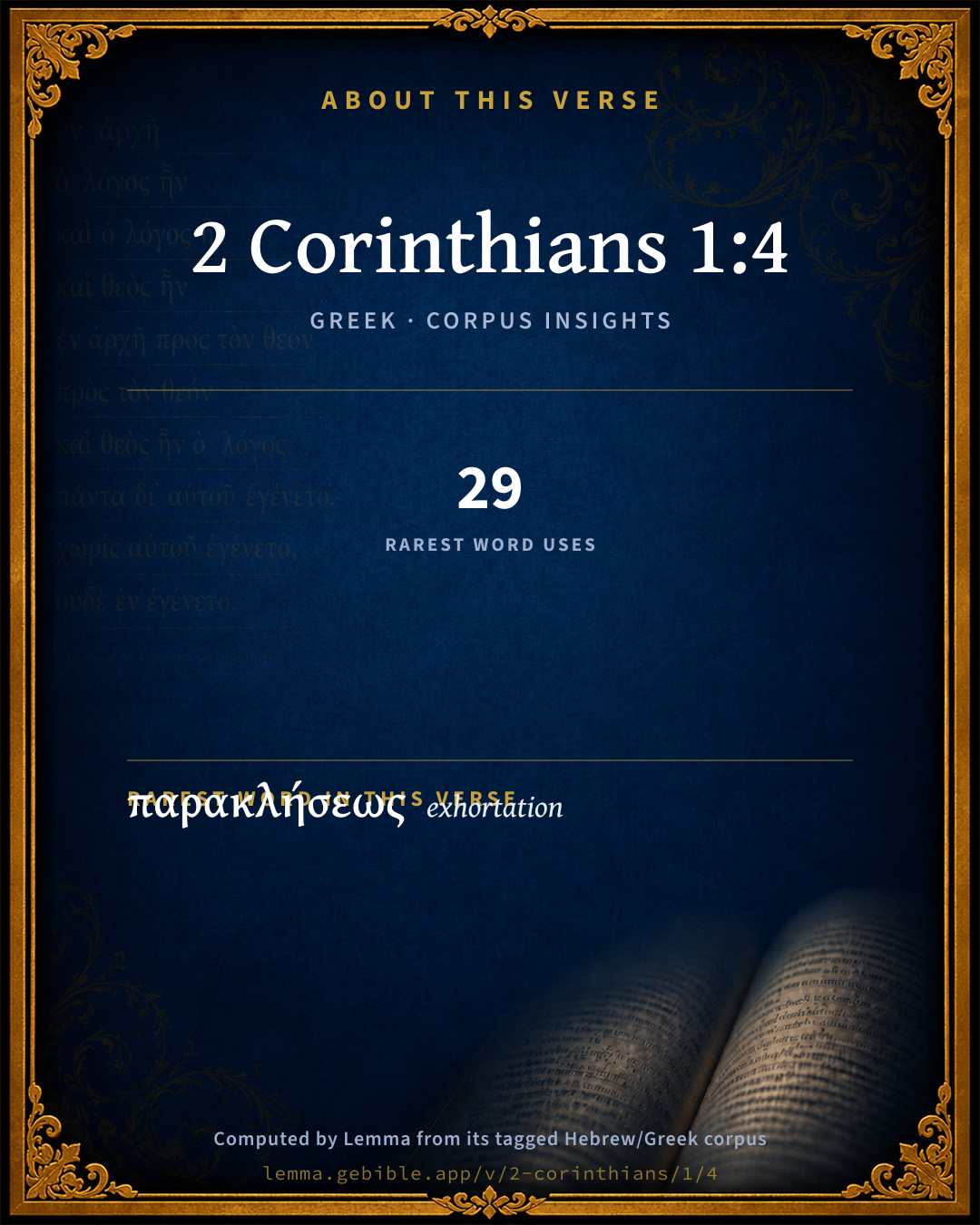
παρακλήσεως exhortation G3874 occurs in 28 verses of the Greek New Testament. Also found in:
Repetition

Words recur within this verse:

  • παρακαλῶν to call beside G3870 ×3
  • πάσῃ all G3956 ×2
  • θλίψει affliction G2347 ×2
  • ὁ the G3588 ×6
  • ἡμᾶς we G2249 ×3

Cross-references

23

Topical passages linked to 2 Corinthians 1:4 in the Treasury of Scripture Knowledge — connected by theme and wording, ordered by reader-vote popularity; previews shown in the World English Bible.

  • 1 Thessalonians 5:11 Therefore exhort one another, and build each other up, even as you also do.
  • Isaiah 51:12 I, even I, am he who comforts you: who are you, that you are afraid of man who shall die, and of the son of man who shall be made as grass;
  • 2 Thessalonians 2:16–17 Now our Lord Jesus Christ himself, and God our Father, who loved us and gave us eternal comfort and good hope through grace,
  • 2 Corinthians 7:6–7 Nevertheless, he who comforts the lowly, God, comforted us by the coming of Titus;
  • Isaiah 40:1 Comfort you, comfort you my people, says your God.
  • Psalms 32:7 You are my hiding place. You will preserve me from trouble. You will surround me with songs of deliverance. Selah.
  • John 14:18 I will not leave you orphans. I will come to you.
  • Psalms 34:2–6 My soul shall boast in Yahweh. The humble shall hear of it, and be glad.
  • John 14:16 I will pray to the Father, and he will give you another Counselor, that he may be with you forever,--
  • Hebrews 12:12 Therefore, lift up the hands that hang down and the feeble knees,
  • Isaiah 12:1 In that day you will say, "I will give thanks to you, Yahweh; for though you were angry with me, your anger has turned away and you comfort me.
  • Isaiah 66:12–14 For thus says Yahweh, Behold, I will extend peace to her like a river, and the glory of the nations like an overflowing stream: and you shall suck [of it]; you shall be borne on the side, and shall be dandled on the knees.
  • John 14:26 But the Counselor, the Holy Spirit, whom the Father will send in my name, he will teach you all things, and will remind you of all that I said to you.
  • Psalms 32:5 I acknowledged my sin to you. I didn't hide my iniquity. I said, I will confess my transgressions to Yahweh, And you forgave the iniquity of my sin. Selah.
  • Psalms 66:16 Come, and hear, all you who fear God. I will declare what he has done for my soul.
  • Isaiah 52:9 Break forth into joy, sing together, you waste places of Jerusalem; for Yahweh has comforted his people, he has redeemed Jerusalem.
  • 2 Corinthians 1:5–6 For as the sufferings of Christ abound to us, even so our comfort also abounds through Christ.
  • Psalms 86:17 Show me a sign of your goodness, That those who hate me may see it, and be shamed, Because you, Yahweh, have helped me, and comforted me.
  • Isaiah 51:3 For Yahweh has comforted Zion; he has comforted all her waste places, and has made her wilderness like Eden, and her desert like the garden of Yahweh; joy and gladness shall be found therein, thanksgiving, and the voice of melody.
  • 2 Corinthians 7:13 Therefore we have been comforted. In our comfort we rejoiced the more exceedingly for the joy of Titus, because his spirit has been refreshed by you all.
  • 1 Thessalonians 4:18 Therefore comfort one another with these words.
  • Isaiah 49:10 They shall not hunger nor thirst; neither shall the heat nor sun strike them: for he who has mercy on them will lead them, even by springs of water will he guide them.
  • Philippians 1:14 and that most of the brothers in the Lord, being confident through my bonds, are more abundantly bold to speak the word of God without fear.

Cross-references courtesy of OpenBible.info (CC BY 4.0).

Commentary

Notes on 2 Corinthians 1:4 from classic Christian and Jewish commentators (each source and its license shown beneath its notes). The classic Christian expositions comment on the surrounding passage and are grouped to its opening verse, so a note may address several verses; the Jewish commentaries on the Tanakh (Rashi and others) are per-verse, so they appear only where the commentator wrote on this verse.

Lemma curates 59 commentaries, every one of them public domain or Creative Commons licensed, each selected and text-cleaned for this edition rather than reprinted as found. About our sources →

Ellicott's Commentary for English Readers

(4) Who comforteth us.—For the writer, the name “God of all comfort” was the outcome of a living personal experience. He had felt that ever-continuing comfort flowing into his soul, and he knew that it had not been given to him for his own profit only, but that it might flow forth to others. Heathen poets had asserted one side of the truth. Sophocles had said—

“They comfort others who themselves have mourned;”

—Fragm.

and Virgil—

“Not ignorant of ill, I, too, have learnt

To succour those that suffer.”—Æn. i. 630.

There was a yet deeper truth in the thought that the power to comfort varies with the measure in which we have been comforted ourselves. Sorrow alone may lead to sympathy, but it falls short of that power to speak a word in season to them that are weary (Isa_1:4), which is of the very essence of the work of comforting. The words imply that he had passed through a time of tribulation himself. They imply also that he knew of their troubles. (Comp. 2Co_7:7-11.)

A Bible Commentary for English Readers, edited by Charles John Ellicott (1878–1897) — public domain. Text from a community e-Sword module.

The Biblical Illustrator

Joseph S. Exell

2Co_1:4

Who comforteth us.

.. that we may be able to comfort them which are in any trouble.

Divine comfort in tribulation

1. There is no tribulation either for the kind or degree of it, but God can and doth comfort His people therein, and Gods comforts do far exceed all philosophical remedies, as much as the sun doth a glow-worm.

2. It is very useful to know what are these apples of comfort (Son_2:1-17; Son_3:1-11; Son_4:1-16; Son_5:1-16), because many of Gods children--

(1) Are in a great manner ignorant of what foundations and sure grounds they have of comfort. They are like Elishas servant, who, though there was a great host of angels to help him, yet did not see them. So that the Spirit of God not only illuminates us in the matter of duty, but also in matter of comfort.

(2) Though they know many arguments of comfort, yet their memory faileth them, that in the very hour of their temptations they forget what comfortable supports they might make use of. So that it is good to preach of these principles of consolation, that thereby we may be remembrancers to you.

3. Come we then to lead you up into the mount of transfiguration, let us see, even in this life, what are the good things God hath prepared for those that love Him. And take this for a foundation, that God comforts through and by the Scriptures.

I. All tribulation is precisely determined by God as a Father out of much love.

1. In regard of the beginning, the degree, and the continuance of it. Here is matter of comfort enough; here is more oil than we have vessels to receive (Mat_5:1-48.; Heb_12:9-10). Now as winter and cold is necessary in its season as well as summer, and the night hath its use as well as the day, a time of tribulation is as necessary as a time of rest and quietness.

2. In regard to the time of deliverance from it. The tribulation shall not stay an hour longer than while it may do good to thee; He will not take one drop of blood more from thee than is necessary to prevent thy disease, or abate it (Rev_2:10). Even as the artificer knoweth how long the gold must be in the fire to take away the dross, and will not suffer it to abide any longer.

II. Another Scripture-cordial is from Christ, with all the fulness that is in him. Christ received by faith is able to make us gather grapes of thorns and figs of thistles. He that hath this sun cannot be in the dark night. What makes Paul (Rom_8:1-39.) to triumph in all manner of tribulations? Is not the foundation of all this Christ dead and Christ risen again? And if He hath given us Christ, how shall He not with Him give us all things? Thus the spiritual influence of Christ into the soul taketh away the bitterness of all troubles.

III. Another Scripture discovery for comfort is to press and command the life of faith upon Gods promise. So that, whatsoever the principles of the world and sense do suggest, yet faith rectifieth all. That finds honey to come out of a dead lion, that can suck honey from a bitter herb. Gods thoughts and ours are wholly different; only faith enableth us to know the mind of God; and where flesh is ready to say, God is casting off and utterly forsaking, there faith seeth Him drawing near. The disciples in a tempest thought they had seen a spirit, and were affrighted, but it was Christ. The promise of God and faith applying it, do bear up the soul, and make it rejoice in troubles (Heb_6:18).

IV. Eternal glory is to be possessed after the troubles (2Co_4:16-17). (A. Burgess.)

Comforting others

Circumstances of life not unfrequently become aids to the revelations of God to the soul. Most of us know how troubles have helped us in the translation of the Bible.

I. Our afflictions and comfortings are the source of our fitness for influencing others.

1. These together bring a peculiar kind of power.

(1) How often the very tone of stricken ones has had its power upon us: They were not morbid; not talking always about their past griefs; but our spirits felt as we listened to them the hallowing influence of the passage through suffering. Compare their conversation with that of those whom God has but seldom and lightly smitten. Take those efforts which are made for the conversion of others; hear also the men of sanctified afflictions. They who have been brought to Christ without any great struggles seldom gain the power to aid the early seekings of others.

(2) Take any endeavour to express sympathy with those who may now be suffering. The unstricken can find beautiful words, but the stricken can express unutterable things in silence.

2. Then it will but be reasonable to expect that if God has valuable influence for us to exert, He will need to bring us through troubles. The same truth shines out, even more clearly, from the life and Cross of Christ. He is able to succour because in all points tempted. Should you not, then, bless God for sorrows that win you Christly powers to bless others?

II. Our afflictions and comfortings gain for us all the power of a noble example, There is an unconscious as well as a conscious influence, forming an atmosphere, living in which men insensibly grow better. Sometimes Gods more suffering children become despondent because they can do so little actual work for Christ; but God has done some of His very best things by the example of suffering patience.

1. Estimate the moral influence of sanctified afflictions on men who are living with no sense of spiritual and eternal things. What touches these men? Do sermons? Alas! but faintly. Does Christian life around them? Alas! its witness is too feeble. Does their own part of human trouble? Only a little, for they accept it as their part of the common lot. But in the presence of a sanctified Christian sufferer many a worldly, thoughtless man has said in his heart, I would gladly change places with him, if I could but know his heart peace.

2. Then estimate the influence exerted by such on doubting and imperfect Christians. For all of us the Christian life is difficult; it is easy for us all to fall into careless, unworthy living, and into doubt and despair. Now those who have passed under Gods afflictions and comfortings have a higher life; they excite us all to try and reach up to it.

3. Then think of the power exerted by these sanctified sufferers on children. Religion is in this way set before the young as no mere theory, but the very noblest power to sanctify their life. (R. Tuck, B. A.)

Affliction a school of comfort

1. If there is one point of character more than another which belonged to St. Paul it was his power of sympathy. He went through trials of every kind, and this was their issue. He knew how to persuade, for he knew where lay the perplexity; he knew how to console, for he knew the sorrow. His spirit was as some delicate instrument which, as the weather changed about him, accurately marked all its variations, and guided him what to do. To the Jews he became as a Jew, etc. (2Co_11:23-30). The same law was fulfilled not only in the case of Christs servants, but even He Himself condescended to learn to strengthen man, by the experiencing of mans infirmities (Heb_2:17-18; Heb_4:14-15).

2. Now, in speaking of the benefits of suffering, we should never forget that by itself it has no power to make us more heavenly. It makes many men morose and selfish. The only sympathy it creates in many is the wish that others should suffer with them, not they with others. The devils are not incited by their own torments to any endeavour but that of making others devils also. It is only when grace is in the heart that anything outward or inward turns to a mans salvation.

3. And while affliction does not necessarily make us kind, and may even make us cruel, the want of affliction does not mend matters. There is a buoyancy and freshness of mind in those who have never suffered, which, beautiful as it is, is perhaps scarcely suitable and safe in sinful man. Pain and sorrow are the almost necessary medicines of the impetuosity of nature. Without these, men, like spoilt children, act as if they considered everything must give way to their own wishes and conveniences.

4. Such is worldly happiness and worldly trial; but God, while He chose the latter as the portion of His saints, sanctified it. He rescues them from the selfishness of worldly comfort without surrendering them to the selfishness of worldly pain. He brings them into pain, that they may be like Christ, and may be led to think of Him, not of themselves. When they mourn, they are more intimately in His presence than at any other time. Pain, anxiety, bereavement, distress, are to them His forerunners. He who has been long under the rod of God becomes Gods possession (Lam_3:1-2; Lam_3:12). And they who see him gather around like Jobs acquaintance, speaking no word to him, yet more reverently than if they did; looking at him with fear yet with confidence, as one who is under Gods teaching and training for the work of consolation towards his brethren. Him they will seek when trouble comes on themselves; turning from all such as delighted them in their prosperity.

5. Surely this is a great blessing to be thus consecrated by affliction as a minister of Gods mercies to the afflicted. Thus, instead of being the selfish creatures which we were by nature, grace, acting through suffering, tends to make us ready teachers and witnesses of Truth to all men. Time was when, even at the most necessary times, we found it difficult to speak of heaven to another; but now our affection is eloquent, and out of the abundance of the heart our mouth speaketh.

6. Such was the high temper of mind instanced in our Lord and His apostles, and thereby impressed upon the Church. And for this we may thank God that the Church has never forgotten that we must all, through much tribulation enter into the kingdom of God. She has never forgotten that she was set apart for a comforter of the afflicted, and that comfort well we must first be afflicted ourselves. Those who are set on their own ease most certainly are bad comforters of others; thus the rich man, who fared sumptuously every day, let Lazarus lie at his gate, and left him to be comforted after this life by angels. As to comfort the poor and afflicted is the way to heaven, so to have affliction ourselves is the way to comfort them. (J. H. Newman, D. D.)

Vishal

Affliction

I. As a school of comfort. Affliction and comfort--a remarkable connection of two apparent opposites, and yet how indissoluble! For heavenly, as distinguished from mere earthly gladness, is inseparable from suffering. It was so in the life of Christ; it was immediately after the temptation that angels came and ministered to Him; it was in His agony that the angel strengthened Him. And as in His life so in ours, these two are never separated, for the first earnest questions of personal and deep religion are ever born out of personal suffering. As if God had said, In the sunshine thou canst not see Me; but when the sun is withdrawn the stars of heaven shall appear.

II. A school of assurance.

1. There is nothing so hard to force upon the soul as the conviction that life is a real, earnest, awful thing. Only see the butterfly life of pleasure men and women are living day by day, flitting from one enjoyment to another; living, working, spending, and exhausting themselves for nothing else but the seen and temporal and unreal.

2. Nothing is harder than to believe in God. When you are well, when hours are pleasant and friends abundant, it is an easy thing to speculate about God; but when sorrow comes, speculation will not do. It is like casting the lead from mere curiosity, when you have a sound strong ship in deep water. But when she is grinding on the rocks, then we sound for God. For God becomes a living God, a home, when once we feel that we are helpless anti homeless in this world without Him.

III. A school of sympathy.

1. Some Christians are rough, hard, and rude: you cannot go to them for sympathy. They have not suffered. Tenderness is got by suffering. Would you be a Barnabas and give something beyond commonplace consolation to a wounded spirit? then you must suffer being tempted.

2. Now here we have a very peculiar source of consolation in suffering. The thought that the apostles suffering benefited others soothed him in his afflictions, and this is a consolation which is essentially Christian. Consider how the old Stoicism groped in the dark to solve the mystery of grief, telling you it must be, and that it benefits and perfects you. Yes, that is true enough. But Christianity says much more; it says, Your suffering blesses others; it gives them firmness. Here is the law of the Cross: No man dieth to himself; for his pain and loss is for others, and brings with it to others joy and gain. (F. W. Robertson, M. A.)

The Biblical Illustrator, edited by Joseph S. Exell (c. 1880s–1900s) — public domain. Text from a community e-Sword module.

Tyndale Open Study Notes

Tyndale Open Resources

1:4-6 One purpose of suffering is to qualify Christ’s servants to enter sympathetically into the experience of others. Paul is not an aloof pastor, remote from the people to whom he ministers.

Tyndale Open Study Notes — © Tyndale Open Resources, licensed CC BY-SA 4.0. Text via the HelloAO Bible API.

Bengel's Gnomon

Johann Albrecht Bengel

2Co 1:4. Πάσῃ· πάσῃ, in all, in all) He who has experienced one kind of affliction is peculiarly qualified to console those in the same circumstances; he who has experienced all is able to console men under all kinds of affliction, Heb 4:15.—θλίψει, in tribulation) The antithetic words on the one side are παθήματα, adversities [the sufferings], and θλίψις, distress [straitness] of mind; of which the one is implied in the signification of the other—and on the other side, σωτηρία, salvation; and παράκλησις, consolation; of which the one is in like manner implied in the signification of the other. The frequent occurrence of these words will be greatly relished, but only by the experienced. [How great need is there of experience! how ill-qualified a guide is he, who is without it!—V. g.] Adversity is treated of from 2Co 1:8; consolation from ch. 2Co 7:2, etc. Paul speaks generally of comfort at the beginning; he, however, refers especially to that, which he derived from the obedience of the Corinthians.—αὐτοὶ) we ourselves.

Bengel's Gnomon of the New Testament — English translation (T&T Clark, Edinburgh, 1860) — public domain. Text from a community e-Sword module.

Meyer's Critical & Exegetical Commentary

Heinrich August Wilhelm Meyer

2Co_1:4. Ἡμᾶς] Where Paul in this Epistle does not mean himself exclusively, but wishes to include Timothy also (or others, according to the context), although often only as quite subordinate, he speaks in the plural. He does not express himself communicativè, but in the singular, where he gives utterance to his own personal conviction or, in general, to anything concerning himself individually (2Co_1:13; 2Co_1:15; 2Co_1:17; 2Co_1:23; 2Co_2:1-10; 2Co_2:12-13; 2Co_7:4; 2Co_7:7 ff., al.). Hence the frequent interchange between the singular and plural forms of expression.[122]

Chrysostom already gives the force of the present παρακαλῶν correctly: ὍΤΙ ΟὐΧ ἍΠΑΞ, ΟὐΔῈ ΔῚς, ἈΛΛᾺ ΔΙΗΝΕΚῶς ΤΟῦΤΟ ΠΟΙΕῖ … ΔΙῸ ΕἾΠΕΝ Ὁ ΠΑΡΑΚΑΛῶΝ, ΟὐΧ Ὁ ΠΑΡΑΚΑΛΈΣΑς.

ἘΠῚ ΠΆΣῌ Τῇ ΘΛΊΨΕΙ] concerning all our affliction. The collective sufferings are regarded as one whole. Afterwards, on the other hand, ἐν πάσῃ θλ.: in every affliction. ἐπί marks the ethical foundation, i.e. here the cause, on account of which. See Matthiae, p. 1373. Comp. 2Ma_7:5 f.; Deu_32:36. According to Rück., παρακαλ. denotes the delivering, and hence he takes ἐπί of the circumstances: in. See Matthiae, p. 1370. But throughout the passage παρακ. means to comfort; and it is quite an open question, how the comforting takes place, whether by calming or by delivering. God did both in the apostles cas.

εἰς τὸ δύνασθαι κ.τ.λ.] in order that we may be able, etc. For he, who for himself received comfort from God, is by his experience placed in the position of being able to comfort others. And how important was this teleological view of his own sorrows for the apostolic calling! Omnia sua P. ad utilitatem ecclesiae refert, Grotiu.

τοὺς ἐν πάσῃ θλίψει] is erroneously and arbitrarily taken as equivalent to ΠΆΝΤΑς ΤΟῪς ἘΝ ΘΛΊΨΕΙ (see Emmerling, Flatt, Rückert). It means: those to be found in every trouble, the all-distressed; not: those to be found in whatever sort of trouble (Hofmann), but ἐν παντὶ θλιβόμενοι, 2Co_4:8, 2Co_7:5.

ΔΙᾺ Τῆς ΠΑΡΑΚΛ. Κ.Τ.Λ.] i.e. through communication of our own comfort, which we experience from God. This more precise determination of the sense is demanded both by the preceding mention of the purpose εἰς τὸ δύνασθαι κ.τ.λ., and by the ΑὐΤΟΊ. Olshausen, it is true, holds that Paul conceives the comfort to be a real power of the Spirit, which may again be conveyed to others by the recei2Colossians 1 :But there is no analogy in the whole N. T. for this conception; for Mat_10:13 is merely a concrete illustration of the efficacy or non-efficacy of the ΕἸΡΉΝΗ ὙΜῖΝ.

Ἧς] Attracted, as in Eph_1:6; Eph_4:1, because one can say ΠΑΡΆΚΛΗΣΙΝ ΠΑΡΑΚΑΛΕῖΝ. See Gieseler in Rosenmüller, Repert. II. p. 124; Buttmann, neut. Gr. p. 247 [E. T. 287]. The attracted genitive instead of the dative in other cases is very rare. See Kühner, ad Xen. Mem. ii. 2. 5.

αὐτοί] ipsi, for our own selves, in contrast to the others to be comforted.

[122] Even in the plural mode of expression, however, he has always himself and his own relations primarily in view; and, owing to the versatility of his mode of conception, it is often quite a matter of accident whether he expresses himself singulariter or communicative. Hence the interchange of the two modes of expression in one sentence, e.g. 2Co_11:6 f.

Meyer — Critical and Exegetical Commentary on the New Testament — English translation by Peter Christie, edited by Frederick Crombie (T&T Clark, 1880) — public domain. Text from a community e-Sword module.

Expositor's Greek Testament

ed. W. Robertson Nicoll

2Co 1:4 . ὁ f1παρακαλῶν ἡμᾶς κ . τ . λ .: who comforteth us in all our affliction (the def. art. indicating trials actually existing). The verb παρακαλεῖν has three shades of meaning, ( a ) to beseech , eighteen times in St. Paul, ( b ) to exhort , seventeen times, ( c ) to comfort , thirteen times, of which seven are in this Epistle, where the word occurs altogether seventeen times. Cf. 2Co 1:6 , 2Co 2:7-8 , 2Co 5:20 , 2Co 6:1 , 2Co 7:6-7 ; 2Co 7:13 , 2Co 8:6 , 2Co 9:5 , 2Co 10:1 , 2Co 12:8 ; 2Co 12:18 , 2Co 13:11 . εἰς τὸ δύνασθαι κ . τ . λ .: to the end that we may be able to comfort them that are in any affliction ( sc. , any that may happen to arise). This is the final purpose of God’s gifts of grace, viz. , that they may not only be a blessing to the individual, but through him and as reflected from him to his fellows. ἧς παρακαλούμεθα : through the comfort wherewith we ourselves are being comforted of God . ἧς , for ἥν , has been attracted into the case of παρακλήσεως ( cf. 1Co 6:19 , chap. 2Co 10:13 , Eph 2:10 ).

The Expositor's Greek Testament, edited by W. Robertson Nicoll (1897–1910) — public domain. Text from a community e-Sword module.

Geneva Bible (1599)

Geneva Bible translators

The Lord doth comfort us to this end and purpose, that we may so much the more surely comfort others.

Geneva Bible (1599) marginal notes — public domain. Text via Bolls.life.

Jamieson, Fausset & Brown

Robert Jamieson, A. R. Fausset & David Brown

us--idiomatic for me (Th1 2:18).

that we may . . . comfort them which are in any trouble--Translate, as the Greek is the same as before, "tribulation." The apostle lived, not to himself, but to the Church; so, whatever graces God conferred on him, he considered granted not for himself alone, but that he might have the greater ability to help others [CALVIN]. So participation in all the afflictions of man peculiarly qualified Jesus to be man's comforter in all his various afflictions (Isa 50:4-6; Heb 4:15).

Jamieson, Fausset & Brown — Commentary Critical and Explanatory on the Whole Bible (1871) — public domain (CC PDM 1.0). Text via the HelloAO Bible API.

Adam Clarke's Commentary

Verse 4. Who comforteth us] Who shows himself to be the God of tender mercy, by condescending to notice us, who have never deserved any good at his hand; and also the God of all consolation, by comforting us in all our tribulation-never leaving us a prey to anxiety, carking care, persecution, or temptation; but, by the comforts of his Spirit, bearing us up in, through, and above, all our trials and difficulties.

That we may be able to comfort them] Even spiritual comforts are not given us for our use alone; they, like all the gifts of God, are given that they may be distributed, or become the instruments of help to others. A minister's trials and comforts are permitted and sent for the benefit of the Church. What a miserable preacher must he be who has all his divinity by study and learning, and nothing by experience! If his soul have not gone through all the travail of regeneration, if his heart have not felt the love of God shed abroad in it by the Holy Ghost, he can neither instruct the ignorant nor comfort the distressed. See 2Co 1:6.

Adam Clarke's Commentary on the Bible (1810–1826) — public domain. Text from a community e-Sword/MySword module.

John Calvin's Commentaries

4. That we may be able to comfort There can be no doubt, that, as he had a little before cleared his afflictions from reproach and unfavorable reports, so now he instructs the Corinthians, that his having come off victorious through heavenly consolation was for their sake and with a view to their advantage, that they may stir themselves up to fellowship in suffering, instead of haughtily despising his conflicts. As, however, the Apostle lived not for himself but for the Church, so he reckoned, that whatever favors God conferred upon him, were not given for his own sake merely, but in order that he might have more in his power for helping others. And, unquestionably, when the Lord confers upon us any favor, he in a manner invites us by his example to be generous to our neighbours. The riches of the Spirit, therefore, are not to be kept by us to ourselves, but every one must communicate to others what he has received. This, it is true, must be considered as being applicable chiefly to ministers of the Word. It is, however, common to all, according to the measure of each. Thus Paul here acknowledges, that he had been sustained by the consolation of God, that he might be able himself to comfort others

John Calvin's Commentaries (1540-1563) — public domain. Text from the Calvin Translation Society English edition (1840s-50s) via the Christian Classics Ethereal Library (ccel.org). Calvin's coverage is partial (roughly two-thirds of the Bible); uncommented books and verses are honest gaps, never fabricated. The 19th-century editor's footnotes and remarks are omitted so the notes are faithfully Calvin's own voice.

The Cambridge Bible for Schools and Colleges

gen. ed. J. J. S. Perowne

4. tribulation] Tribulatio, Vulgate. The word thus translated is rendered trouble in the next clause, and in the Vulgate by pressura, and is derived from a verb signifying to squeeze, press. The English word tribulation is derived from the Latin tribulo, to thresh. See Trench, Study of Words, Lect. 11.

that we may be able to comfort them which are in any trouble] St Paul represents affliction (1) as a school of sympathy, (2) as a school of comfort (or rather encouragement), 2Co_1:5, (3) as a school of assurance, 2Co_1:10.—Robertson.

by the comfort wherewith we ourselves are comforted of God] We may observe here, as elsewhere in Scripture, that no gift is bestowed upon any one to keep to himself. If St Paul is encouraged by God, it is not only for his own sake, but that he may be able to impart to others the encouragement which he has received. See notes on First Epistle, especially on ch. 1Co_6:12, 1Co_8:13, 1Co_10:23, 1Co_14:5; 1Co_14:12. Cf. also Joh_15:1-17; Romans 14; 1Co_3:9; 1Co_4:7; Eph_4:16; Col_2:19.

The Cambridge Bible for Schools and Colleges (gen. ed. J. J. S. Perowne; Cambridge University Press, 1878–1918) — public domain. Text from a community e-Sword module.

John Gill's Exposition

Who comforteth us in all our tribulation,.... The apostle in this verse gives a reason of the former thanksgiving, and at the same time confirms the above character of God, as "the God of all comfort", by his own experience, and that of his fellow ministers; who, though they had been in great tribulation and affliction for the sake of Christ, and his Gospel, yet were not left destitute of divine help and support under their trials; but had much consolation and sweet refreshment administered to them by the presence of God with them, the application of his promises to them, the shedding abroad of his love in them, and the fellowship and communion they enjoyed with Father, Son, and Spirit. The end of this, or why God was pleased to comfort them in such a manner, was not so much on their own account; though it showed that they were loved, and not hated and rejected of God, but for the good of others:

that we may be able to comfort them which are in any trouble, by the comfort wherewith we ourselves are comforted of God; many are the troubles and afflictions of the saints in this life, but it is the will of God that they should be comforted: and the persons he employs and makes use of in this way are his ministering servants, whose principal work and business it is to speak comfortably to the people of God; see Isa 40:1, and that they may be able to do so, that they may be fitted and furnished for so good a work, they are blessed with a rich experience of divine consolation in themselves, under the various troubles and exercises they are attended with in the course of their ministry; and such persons are, of all others, the fittest, and indeed the only proper persons to speak a word in season to weary souls.

John Gill's Exposition of the Whole Bible (1746–1763) — public domain (CC PDM 1.0). Text via the HelloAO Bible API.

Trapp's Complete Commentary

John Trapp

4 Who comforteth us in all our tribulation, that we may be able to comfort them which are in any trouble, by the comfort wherewith we ourselves are comforted of God.

Ver. 4. By the comfort wherewith] How forcible are right words, especially when uttered more from the bowels than the brain, and from our own experience; which made even Christ himself a more compassionate High Priest, and Luther such a heart affecting preacher, because from his tender years he was much beaten and exercised with spiritual conflicts, as Melancthon testifieth (in Vita) He was also wont to say, that three things make a preacher, reading, prayer, and temptation. Reading maketh a full man, prayer a holy man, temptation an experienced man.

Wherewith we ourselves are comforted] Goodness is communicative. Mr Knox, a little before his death, rose out of his bed; and being asked wherefore, being so sick, he would offer to rise? He answered, that he had had sweet meditations of the resurrection of Jesus Christ that night, and now he would go into the pulpit, and impart to others the comforts that he felt in his soul. (Melch. Adam.)

John Trapp, A Commentary or Exposition upon All the Books of the Old and New Testament (1647–1656) — public domain. Text from a community e-Sword module.

Albert Barnes' Notes on the Bible

Who comforteth us - Paul here doubtless refers primarily to himself and his fellow apostles as having been filled with comfort in their trials; to the support which the promises of God gave; to the influences of the Holy Spirit, the Comforter; and to the hopes of eternal life through the gospel of the Redeemer.

That we may be able to comfort ... - Paul does not say that this was the only design which God had in comforting them that they might be able to impart comfort to others; but he does say that this is an important and main purpose. It is an object which he seeks, that his people in their afflictions should be supported and comforted; and for this purpose he fills the hearts of his ministers with consolation; gives them personal experience of the sustaining power of graco in their trials; and enables them to speak of what they have felt in regard to the consolations of the gospel of the Lord Jesus.

By the comfort ... - By the same topics of consolation; by the same sources of joy which have sustained us. They would have experience; and by that experience they would be able to minister consolation to those who were in any manner afflicted. It is only by personal experience that we are able to impart consolation to others. Paul refers here undoubtedly to the consolations which are produced by the evidence of the pardon of sin, and of acceptance with God, and the hope of eternal life. These consolations abounded in him and his fellow apostles richly; and sustained by them he was able also to impart like consolation to others who were in similar circumstances of trial.

Albert Barnes' Notes on the Bible (1834–1885) — public domain. Text from a community e-Sword/MySword module.

Haydock's Catholic Bible Commentary

Wherewith we also are exhorted by God. The Latin interpreter sometimes translates the same Greek word by exhorted, sometimes by comforted: so the sense may be, with which we are comforted by God. (Witham) --- St. Paul knew that his former letter had afflicted them exceedingly; here he comforts them by telling them that God had filled him with consolation in order to comfort them. The Greek rather signifies, by the consolation with which we are comforted. Either explanation is sufficiently clear, though the latter is stronger. We may here remark the great tenderness St. Paul had for the Corinthians, since he here insinuates that he had received comfort from God merely to communicate it to them. (Calmet)

George Leo Haydock (1774–1849), Haydock's Catholic Family Bible and Commentary, 1859 edition — public domain. Excludes Psalms (Douay-Rheims chapter numbering differs from Protestant) and Deuterocanonical books (Catholic canon only).

Matthew Poole's English Annotations

Who comforteth us in all our tribulation; us, who are the ministers of the gospel, (as it may appear by what followeth), for the apostle saith, that God doth it, that ministers might, from the comforts wherewith God had comforted them, be able to comfort his people when they are under any trouble, either of body or mind, by the same methods and arguments which the Holy Spirit had used and brought to their minds under trouble to relieve any of them. Two things are observable from this verse:

1. That the apostle attributeth all the support, relief, and comfort, which he had under any tribulation, to God, as the Fountain and Author of all mercy; for though possibly our comforts may be caused from the application of some promises in holy writ, either called to our minds by the act of our own minds, or brought to our remembrance by some others; yet it is God who must make those plasters to stick, and to become healing and sanative to our souls: so that he is the principal efficient cause, though the Scriptures, or men, may be instrumental causes.

2. That the gifts, graces, and mercies that God bestowed upon his ministers, are bestowed upon them, not merely for their own use, but for the use and good of others; to enable them to be serviceable in doing good to others’ souls.

Matthew Poole's English Annotations on the Holy Bible (1683–1685) — public domain. Text from a community e-Sword/MySword module.

Whedon's Commentary on the Bible

Daniel D. Whedon

4. Able to comfort—The consolations St. Paul receives from God, he receives not for himself alone. They are gifts wherewith he is able to console and enrich others. The fulness of the generous heart overflows, nay, empties itself, in blessings upon its fellow-sufferers.

Daniel D. Whedon (gen. ed.), Commentary on the Old and New Testaments (1874–1909) — public domain. Text from a community e-Sword module.

The Pulpit Commentary

Who comforteth us. The "us" implies here, not only St. Paul and Timothy, but also the Corinthians, who are one with them in a bond of Christian unity which was hitherto undreamed of, and was a new phenomenon in the world. St. Paul always uses the first person in passages where he is speaking directly of individual feelings and experiences. In other passages he likes to lose himself, as it were, in the Christian community. The delicate play of emotion is often shown by the rapid interchanges of singular and plural (see 2Co_1:13, 2Co_1:15, 17 2Co_2:1, 2Co_2:11, 2Co_2:14, etc.) The present, "comforteth," expresses a continuous experience, with which the Christians of the first age were most happily familiar (Joh_14:16-18 2Th_2:16, 2Th_2:17) In all our affliction. The collective experience of affliction is sustained by the collective experience of comfort. That we may be able to comfort. Thus St. Paul takes "a teleological view of sorrow." It is partly designed as a school of sympathy. It is a part of the training of an apostle, just as suffering is essential to one who is to be a sympathetic high priest. (Heb_5:1, Heb_5:2) In any trouble. The original more forcibly repeats the words, "in all affliction." Wherewith we ourselves are comforted. By means of the comfort which God gives us, we can, by the aid of blessed experience, communicate comfort to others.

Vers. 4-7.

Comfort, Divine and human.

The human heart is so sensitive, and the human lot is so sorrowful, that it cannot excite surprise when it is found that religion lays great stress upon the provision for true and lasting comfort which Divine wisdom furnishes and offers to the pious. And whilst the consolations of friendship and of philosophy are superficial, those of Christianity go down to the depths of the nature and extend throughout the whole period of life.

I THE SUPREME AUTHOR OF SPIRITUAL COMFORT. Instead of looking merely to the earthly streams, the apostle goes straight to the living Fountain.

1. The universal sufficiency of this Divine consolation. God is the God of all comfort, and he comforts us in all our tribulation. For he is omniscient and knows all our sorrows: "He knoweth our frame; he remembereth that we are dust." He is infinitely sympathetic: "In all our afflictions he is afflicted.

2. Divine comfort abounds by Christ. Christ is all to his people. If, then, weshare his sufferings and benefit by them, the ministration of his consolatory grace is enjoyed by us who recognize him as upon the mediatorial throne.

II THE MINISTERS OF DIVINE COMPORT TO THEIR FELLOW MEN. The apostle says of himself here what in a measure may be said of all true pastors.

1. They are qualified for this office by their participation in those sorrowswhich are the common lot of humanity.

2. By their experimental participation in the sufferings of the Redeemer.They know something of that pain which human sin inflicted upon Christ"s heart, and something of that sympathy which showed itself in Christ"s tears and sighs.

3. By their interest and affection cherished towards those for whosespiritual welfare they are concerned.

III THE RECIPIENTS OF SPIRITUAL COMFORT.

1. In order to the enjoyment of true consolation, Christians must submitthemselves with humility and resignation to the will of God.

2. If they have committed sin or neglected duty, they must not expectconsolation except through contrition and repentance.

3. By whatever ministrations consolation may be administered, in orderthat it may be received aright, it must be. sought from the God of comfort, and it must be sought in the Name and for the sake of Christ. T.

Comforted, and therefore comforters.

It may seem strange that the Bible, and Christian ministers following its example, should deal so frequently and so largely with troubles and afflictions. You sometimes half suspect that Christian people must have a larger share of earthly sorrow than fails to the lot of others. We may admit a sense in which this is true. The higher susceptibilities of the Christian man, his clearer vision of unseen things, and his separateness from the world, do seem to involve some special kinds of suffering from which the heedless and the godless are free. The influences on personal character and on individual life, wrought by God through the sorrows he sends, are often presented. In the passage now before us the apostle puts another side of their influence. Our afflictions and our comfortings become a blessing to others. "That we may be able to comfort them which are in any trouble." Our sorrows have by no means exhausted their stores of blessing when they have dispelled our doubts, delivered us from our dangers, and cultured our characters; they have stores of blessing left in them still, with which, through us, to enrich and comfort others. This may be set before us in two of its aspects.

I OUR AFFLICTIONS AND COMFORTINGS ARE THE SOURCES WHENCE COMES OUR FITNESS FOR INFLUENCING OTHERS. It may be a question beyond present solution, what exact share have the sorrows of our past lives had in the formation and nourishment of our present abilities for Christian work and influence? And yet surely no man can reach middle life or old age, and feel the respect in which he is held, his power to comfort and help others, and the value that is set upon his judgment and counsel, without recognizing how much of that fitness for influence has come out of his experience of sorrow. Precisely what qualities are nourished by particular forms of trouble we may not be able to decide, but the whole result we can estimate, and there is not one true Christian who would hesitate to say, "Blessed be God for the afflictions of my life; yes, even for those which bruised and almost broke my heart, because, as sanctified by God, they have fitted me to sympathize with and to comfort others" Experience brings power. But the Christian"s experiences are not of griefs only; they are of griefs together with Divine comfortings, and these together bring a peculiar kind of power. This may be illustrated from any of the spheres of Christian influence.

1. Take the power of a Christian"s ordinary conversation. We can discoverm the very tones of the voice the holy subduedness that tells of some great woe that has put into the words and the voice that humbleness and gentleness. How often this tone of the stricken ones has had its power upon us!

2. Take the special efforts which are made, by conversation, for theconversion and instruction of others.

3. Take any endeavour to express sympathy with those who may now besuffering under God"s mighty hand. How different are the consolations offered by stricken and by unstricken ones! The unstricken can find beautiful words, and be truly sincere as they utter them. But the stricken ones can express unutterable things in silence and look. Send the long-widowed woman to cheer the newly widowed. Send the mother who has children in heaven to comfort the mother who sits so still, with broken heart, beading over the baby"s coffin. The plant of healing sympathies grows and blossoms and fruitens out of our very wounds and tears and deaths. Then it will but be reasonable to expect that, if God has high places of work for us, and valuable influence for us to exert, he will need to bring us through great and sore troubles, St. Paul recognizes this necessity in our text. How his life was filled with anxieties and sorrows we seldom worthily estimate. Great soul! He did not care to be always talking about himself; only once or twice does he lift the veil and show his secret history; but there in much affliction awaiting him everywhere, and the comfortings of God abounding in all is the explanation of his mighty and gracious influence. He was "comforted of God that he might be able to comfort them which are in any trouble." The same truth shines out even more clearly from the life and cross of our Lord Jesus Christ. He is able to succour because in all points tempted. Lifted up, "he draws all men unto him." Gaining his influence by his own sufferings borne in patience and faith. Winning power to save and help the world by dying an agonizing death and knowing, in the uttermost needs of a dying hour, the gracious comfortings of God.

II OUR AFFLICTIONS AND COMFORTINGS GAIN FOR US ALL THE POWER OF A NOBLE EXAMPLE. In the previous part of the subject our conscious efforts to help and bless others have been chiefly considered; but the good man"s influence is by no means to be limited to them. There is an unconscious influence, less easily calculated, but more mighty, reaching more widely, blessing as does the bracing air of the hills, or the fresh blowing of sea breezes, or the face of a long-lost friend. And this kind of power to bless belongs peculiarly to those who have come out of God"s tribulations and comfortings.

1. Estimate the moral influence of those in whom afflictions have beensanctified upon men who are living with no sense of spiritual and eternal things.

2. Estimate their influence on doubting and imperfect Christians.

3. Estimate the influence of such persons on children. You may havethought that your afflictions have set you aside from your work. Nay, they have just lifted you up to the trust of some of God"s highest and best work. Tribulation worketh patience, experience, and hope. It matures the finer elements of character. But it does more it fits us for work, for higher influence on others, enabling us to set before men all the power of a noble example. Our afflictions and comfortings are really our clothing with the soldier"s dress, our putting on the soldier"s armour, our grasping the soldier"s weapons, our drilling for the soldier"s service, that we may be good soldiers of the cross. Each one of us may become a Barnabas, a son of consolation. Comforted of God, let us learn to comfort others. R.T.

The Pulpit Commentary (1880–1919), ed. H.D.M. Spence-Jones & Joseph S. Exell — public domain. Text from a community e-Sword module.

John Wesley's Explanatory Notes

Who comforteth us in all our affliction, that we may be able to comfort them who are in any affliction - He that has experienced one kind of affliction is able to comfort others in that affliction. He that has experienced all kinds of affliction is able to comfort them in all.

John Wesley, Explanatory Notes Upon the Whole Bible (1754–1765) — public domain. Text via the GEBible commentary corpus.

Scofield Reference Notes

C. I. Scofield

comforteth

encourages; and so also where "comfort," etc., occurs in following verses.

The Scofield Reference Bible (1917 edition), notes by C. I. Scofield — public domain. Text from a community e-Sword module.

McGarvey & Pendleton's Commentaries

J. W. McGarvey

who comforteth us in all our affliction, that we may be able to comfort them that are in any affliction, through the comfort wherewith we ourselves are comforted of God . [Paul regarded affliction as a school wherein one who is comforted of God is thereby instructed and fitted to become a dispenser of comfort unto others. He blesses God for such lofty and blessed instruction.]

J. W. McGarvey (with Philip Y. Pendleton), Commentaries on the New Testament (The Fourfold Gospel, 1914; Acts; and the epistles) — public domain. Text from a community e-Sword/MySword module.

The People's New Testament

B. W. Johnson

4. Who comforteth us in all our tribulation. He who had tribulation and has learned the comfort of faith in God is best fitted to comfort others.

B. W. Johnson's The People's New Testament with Notes (1889–1891) — public domain. Electronic text from the Christian Classics Ethereal Library (CCEL) ThML edition.

Cambridge Greek Testament for Schools and Colleges

4. ἐπὶ πάσῃ τῇ θλίψει ἡμῶν. In all our affliction. S. Paul repeats θλίψις (4, 8, 2Co 2:4) and θλίβω (2Co 1:6) as he repeats παράκλησις and παρακαλεῖν and the repetition should be preserved in translation.

The ἡμᾶς and ἡμῶν are probably not a gentle substitute for με and μου. Where he means himself exclusively he commonly uses the singular (2Co 1:15; 2Co 1:17; 2Co 1:23, 2Co 2:1-13, 2Co 7:4; 2Co 7:8-12; 2Co 7:14-16, 2Co 9:1-2, &c.), sometimes with pronouns added which make the singular more emphatic (2Co 1:23, 2Co 2:2; 2Co 2:10, 2Co 10:1, 2Co 12:13). Where he uses the plural he perhaps generally includes Timothy or others, according to the context: see Lightfoot on 1Th 2:4. But changes of number are frequent and rapid (2Co 7:3-16), sometimes in the same verse (2Co 1:13). On the other hand, while the plural prevails 2Co 1:3-12 and 2Co 2:14 to 2Co 7:1, in 2Co 1:15-17 and 2Co 2:1-10 the singular is constant. It is more certain that the singular is always personal than that the plural commonly includes someone else. In 2Co 7:5 ἡ σὰρξ ἡμῶν must mean S. Paul only; comp. 1Th 3:1-5. Here ἡμᾶξ may mean all believers.

Θλίψις implies being pressed down or in great straits. The Vulgate has tribulatio here, 2Co 1:8, 2Co 4:8; 2Co 4:17, 2Co 6:4, 2Co 7:4, 2Co 8:2; pressura next line, Joh 16:21; Joh 16:33; Php 1:16; passio Col 1:24, where it is used of the sufferings of Christ. It is under the influence of the Vulgate that the A. V. here has first ‘tribulation’ and then ‘trouble.’ In the first case it is affliction as a whole that is meant, in the second, every kind of affliction (Mat 3:10; Mat 3:17; Mat 12:31; Luk 4:13): Blass, Gram. N.T. § 47. 9. The ἐπί expresses the occasion on which the comfort is bestowed.

εἰς τὸ δύνασθαι ἡμᾶς παρακαλεῖν. It is part of the Divine purpose in giving comfort, that it should be communicated to others. Dat ut demus. Community of feeling with others is the note of the Church (Joh 13:35). It was his intense sympathy which gave S. Paul such power in winning, regaining, and retaining converts. Note the attraction of ἦς for ᾖ, as in Eph 1:6; Eph 4:1, a form of attraction which is rare: attraction is common in the N.T., but is not so varied as in classical Greek.

Cambridge Greek Testament for Schools and Colleges (Cambridge University Press, 1896; 21 vols, various authors incl. Carr, Maclear, Plummer, Farrar, Lumby, Moule, M. R. James, Simcox) — public domain. Text from a community e-Sword module.

Alford’s Greek Testament

Henry Alford

4.] The Apostle in this Epistle uses mostly the first person plur., perhaps as including Timothy, perhaps, inasmuch as he writes apostolically (cf. ἡμᾶς τοὺς ἀποστόλους, of himself and Apollos, 1Co 4:9), as speaking of the Apostles in common. This however will not explain all places where it occurs elsewhere: e.g. 1Th 2:18, ἠθελήσαμεν ἐλθεῖν πρὸς ὑμᾶς, ἐγὼ μὲν Παῦλος, καὶ ἅπαξ κ. δίς,—where see note. So that after all perhaps it is best to regard it merely as an idiomatic way of speaking, when often only the singular is intended.

In order that we may be able: not, ‘so that we are able.’ διὰ τοῦτο γὰρ παρεκάλεσεν ἡμᾶς, φησίν, ἵνα ἡμεῖς ἀλλήλους παοακαλῶμεν. Chrys. ib. “Non sibi vivebat Apostolus, sed Ecclesiæ: ita quicquid gratiarum in ipsum conferebat Deus, non sibi soli datum reputabat, sed quo plus ad alios juvandos haberet facultatis.” Calv.

ἧς, attr. for ᾗ, or perhaps (Winer, edn. 6, § 24. 1) for ἣν (παράκλησιν παρακαλεῖν).

Henry Alford, The Greek Testament (1849–1861) — public domain. Text from a community e-Sword module.

International Critical Commentary

4. Vulg. Qui consolatur nos in omni tribulatione nostra, ut possimus et ipsi consolari eos qui in omni pressura sunt, per exhortationem qua exhortamur et ipsi a Deo.

ὁ παρακαλῶν. ‘Who continually comforts us’; not once or twice, but always; the παράκλησις is without break (Chrys.); and it is supplied in various ways— vel per Scripturas, vel per alios sanctos, vel per occultam inspirationenem, vel per tribulationis allevationem (Herveius).

The ἡμᾶς need not be confined to Paul and Timothy, still less to Paul alone. It probably includes all missionaries, and perhaps indirectly all sufferers; Isa 40:1. It is unreasonable to suppose that St Paul always uses the Ist pers. plur. of himself in his Apostolic character, and the 1st pers. sing. when he speaks as a private individual; and it would be rash to assert that he never uses the plur. without including others; but the latter statement is nearer the truth than the former. He seems to use the 1st pers. plur. with varying degrees of plurality, from himself with one colleague to himself with all Christians or even all mankind; and he probably uses it sometimes of himself alone. Some elasticity may be allowed in this passage. Each case must be judged by its context. But we cannot be sure that, when he employs the plur. of himself, he is emphasizing his official authority, for Milligan (Thess. p. 131) has shown that this use of the plur. is found in the ordinary correspondence of the time, and also in inscriptions. In Epistles written without any associate (Gal. Rom. Eph. Past.), the sing. is dominant. In 2 Cor., the plur. is frequent, and sometimes changes rapidly with the sing. (1:13, 5:11, 7:2, 3, 4, 5, 6, 7, 12, 14, 9:4, 10:2, 8, 11:6, 21, 12:19, 20, 13:6-10). It is very unlikely that all the plurals are virtually singular and also official; but in 7:5 ἡ σὰρξἡμῶν must mean St Paul only. See Lightfoot on 1Th 2:4.

ἐπὶ πάσῃ τῇ θλίψει ἡμῶν. As in 7:4 and 1Th 3:7, the ἐπί expresses the occasion on which the comfort is given; and the article indicates that the θλίψις is regarded as a whole, ‘in all our affliction,’ whereas ἐν πάσῃ θλ means ‘in every kind of affliction’ that can occur, whether of mind or body (Blass, Gram. d. N. T. Gr. § 47. 9, p. 158). There is no exception on God’s side (Psa 94:19), and there must be none on ours. Both AV and RV. mark the difference by change from ‘all’ to any. The change from ἐπί to ἐν can hardly be marked in English without awkwardness: Latin versions make no change, and some Greek texts read ἐν for ἐπί. Θλίψις (or θλῖψις) is found in all Pauline groups, except the Pastorals. It is rare in class. Grk.,—perhaps never before Aristotle, and then always in the literal sense of ‘crushing.’ In LXX it is very frequent, especially in Psalms and Isaiah. AV obliterates its frequency here by varying between ‘tribulation’ and ‘trouble’ (vv. 4, 7, 8) and ‘affliction’ (2:4, 4:17, etc.). RV. has ‘affliction’ always in 2 Cor., but in other Epistles has ‘tribulation’ also: it retains ‘tribulation’ always in Rev. and in the Gospels, except Joh 16:21, where ‘anguish’ is retained. Vulg. usually has tribulatio, which is not classical, but sometimes has pressura: in v. 4 it has both, as if St Paul used two different words. In Col 1:24 it has passio.

εἰς τὸ δύνασθαι κ.τ.λ. With the construction comp. 1Co 9:18. The teleological standpoint is Pauline: non sibi vivebat Apostolus, sed Ecclesiae (Calv.). Evangelists are comforted, not for any merit of their own, but in order that they may be able to comfort others. In missionary work sympathy is the great condition of success (1Co 9:22), and it was part of the training of the Apostles that they should need and receive comfort in order to know how to impart it; and the comfort is deliverance, not necessarily from the suffering, but from the anxiety which suffering brings. There is the assurance that sufferers are in the hands of a loving Father, and this assurance they can pass on to others in all their afflictions. But we need not confine ἡμᾶς to Apostles and missionaries; the words apply to all Christians. It is, however, exaggeration to say that only those who have received consolation know how to impart it.

It is not impossible that St Paul is here thinking of the affliction which the Corinthians had recently been experiencing in their agony of self-reproach and remorse when the severe letter of the Apostle and the remonstrances of Titus, who had brought the letter to them, had convinced them that they had treated their spiritual father abominably in listening to the misrepresentations and slanders of the Judaizing teachers and in rebelling against him. These emotional Greeks, as Titus had reported to St Paul, had been crushed by the thought of their own waywardness and ingratitude. The Apostle, hardly less emotional than themselves, longs to comfort them, and he knows how to do it. They, by their rebellion and maltreatment of him had taught his tender and affectionate heart what affliction, in one of its most intense forms, could be; and God had comforted him and sustained him in it all. Now he knows how to comfort them. “The affliction had intensified Paul’s capacity as a son of consolation” (Massie, The Century Bible, p. 71).

ἧς παρακαλούμεθα. This kind of attraction is not common in N.T.; comp. τῆς χάριτος αὐτοῦ, ἧς ἐχαρίτωσεν ἡμᾶς and τῆς κλήσεως, ἧς ἐκλήθητε (Eph 1:6, Eph 4:1). In these cases it may be “simplest” to take ἧς as ᾗ but in all of them the acc. is possible, as in Mar 10:38 and Joh 17:26; and in all five cases a substantive is followed by its cognate verb. Eph 1:19, τὴν ἐνέργειαν … ἣν ἐνέργηκεν, and 2:4, τὴν πολλὴν ἀγάπην αὐτοῦ, ἣν ἠγάπησεν ἡμᾶς, suggest the acc. rather than the dat. The attraction of the dat. is very rare, but we find it Psa 90:15; Hag 2:18.

For ἐπί, C, Eus. Chrys. have ἐν. M, Hil. Ambr. omit ἡμῶν. For εἰς, F has ἵνα. Vulg. ins. καί before ἡμᾶς D E F G, Latt. (not r) ins. καί before αὐτοί. For ὑπό, F has ἀπό.

International Critical Commentary — older volumes (1896–1929), various authors — public domain. Text from a community e-Sword module.

Vincent's Word Studies in the New Testament

Marvin R. Vincent

In all our tribulation - in any trouble [επι παση τη θλιψει ημων - εν παση θλιψει] . Note the nice use of the article : all our tribulation, collectively; any or every trouble, specifically. In is literally upon; the trouble forming the ground of the comfort. So in hope, Rom 4:18; Rom 5:2. We ourselves are comforted. An illustration of the personal character which pervades this epistle. Paul had been oppressed with anxiety concerning the reception of his first epistle by the Corinthian Church, by the delay of tidings, and by his disappointment in meeting Titus. The tidings, when at last they did arrive, aroused his gratitude for the wholesome effect of his rebuke upon the Church, and his indignation at the aggressions of the Judaizing teachers. With these feelings mingled his anxiety to hasten, in the Corinthian Church, the contribution for the poor saints in Judaea. This second letter therefore bears the marks of the high tension of feeling which finds expression in frequent personal allusions, especially to his afflictions. 139

Marvin R. Vincent, Word Studies in the New Testament (1887–1900) — public domain. Text from a community e-Sword/MySword module.

Lesson kit

Teaching starters — assembled from the data on this page, not authored interpretation. Every prompt links to the verse data it draws on. Edit before teaching.

2 Corinthians, in the Pauline Epistles, opens this verse with 26 words (15 distinct Greek lemmas). Its most distinctive word is paráklēsis (“exhortation”). A historical commentator’s framing appears above. Read the whole chapter for the surrounding context.

Discussion questions

  1. How does “exhortation” (paráklēsis) shape what this verse is saying?
  2. How does Luke 2:25, which shares the word «exhortation», read alongside this verse?
  3. What does the repetition of “to call beside” (3× in this one verse) do in this verse?
  4. These translations render this verse differently; the difference is in the English rendering, not the original. What questions does that raise?
  5. Compare how Ellicott's Commentary for English Readers and The Biblical Illustrator read this verse. Where do they agree or differ?

Things to notice

  • These translations choose different wording for 14 words in this verse.
  • “to call beside” occurs 3× in this single verse.
  • 15 distinct Greek lemmas span 26 words in this verse.

Reading settings

Reading text

Shown beneath each verse's original-language words.

Old Testament
Old Testament edition

Read the OT as the Masoretic Hebrew (MT) or the Greek Septuagint (LXX).

English shown for the Greek Septuagint (in the Hebrew ↔ Greek comparison).

Comparing translations? Open the Compare panel on any verse page to stack up to four side by side.