Ephesians 3:7

Greek (Tischendorf 8th ed.) Ephesians 3:7 appears in the Greek New Testament. The text above is from the Tischendorf 8th edition. Each word links to its Strong’s number and a concise gloss. Click any word for its full Thayer’s Greek Lexicon entry.
Download image
Cite this verse

Ephesians 3:7 (World English Bible). Public Domain. Lemma interlinear Bible study tool, https://lemma.gebible.app/v/ephesians/3/7.

Show BibTeX & RIS
BibTeX
RIS
English Translation
of which I was made a servant, according to the gift of that grace of God which was given me according to the working of his power.
World English Bible · Public Domain
Download a study sheet

One document with this verse’s original text, its word-by-word gloss line, the meaning frame, cross-references with their text, attributed commentary, and full source and license credits — printable, and it pastes into notes with its structure intact.

This verse Autodidact and up

Study sheet (.html) Plain text (.txt)

A passage Seminary Student

Up to 50 verses in one chapter. A passage sheet keeps up to 6 commentary sources and 12 cross-references per verse, in the order this page ranks them, and says so on the sheet whenever that leaves anything out. Ask for a single verse and you get the Autodidact verse sheet above.

Everything on this page stays free to read, with no account — the sheet is a download of what is already on screen, not access to it.

Want to remove ads? Support Godless Engineer
Compare translations 3

The same verse in 3 English versions, stacked beneath the original-language interlinear above. Click any original word for its lexicon entry.

Each is an independent rendering of the whole verse — the interlinear is not word-aligned to these translations.

Highlighted words mark where these versions differ — a whole-verse word diff, not a word-by-word alignment.

  • World English Bible Public Domain
    of which I was made a servant, according to the gift of that grace of God which was given me according to the working of his power.
  • King James Version Public Domain
    Whereof I was made a minister, according to the gift of the grace of God given unto me by the effectual working of his power.
  • unfoldingWord Literal Text CC BY-SA 4.0
    for which I became a servant by the gift of the grace of God that was given to me through the working of his power.

unfoldingWord Literal Text — © unfoldingWord, licensed CC BY-SA 4.0. Word-aligned USFM3 via Door43 (git.door43.org/unfoldingWord/en_ult).

Versions to compare (up to 4)

3 of 4 selected

Show all 19 translations

Every available English version of this verse, each an independent rendering of the whole verse.

  • World English Bible Public Domain
    of which I was made a servant, according to the gift of that grace of God which was given me according to the working of his power.
  • Berean Standard Bible Public Domain
    I became a servant of this gospel by the gift of God’s grace, given me through the working of His power.
  • Majority Standard Bible Public Domain
    I became a servant of this gospel by the gift of God’s grace, given me through the working of His power.
  • King James Version Public Domain
    Whereof I was made a minister, according to the gift of the grace of God given unto me by the effectual working of his power.
  • American Standard Version (1901) Public Domain
    whereof I was made a minister, according to the gift of that grace of God which was given me according to the working of his power.
  • Revised Version (1885) Public Domain
    whereof I was made a minister, according to the gift of that grace of God which was given me according to the working of his power.
  • Geneva Bible (1599) Public Domain
    Whereof I am made a minister by the gift of the grace of God giuen vnto me through the effectuall working of his power.
  • Douay-Rheims (1899) Public Domain
    Of which I am made a minister, according to the gift of the grace of God, which is given to me according to the operation of his power:
  • Young's Literal Translation Public Domain
    of which I became a ministrant, according to the gift of the grace of God that was given to me, according to the working of His power;
  • Literal Standard Version CC BY-SA 4.0
    of which I became a servant, according to the gift of the grace of God that was given to me, according to the working of His power;
  • Unlocked Literal Bible CC BY-SA 4.0
    For I became a servant of this gospel by the gift of God's grace given to me through the working of his power.
  • unfoldingWord Literal Text CC BY-SA 4.0
    for which I became a servant by the gift of the grace of God that was given to me through the working of his power.
  • Darby Bible Public Domain
    of which I am become minister according to the gift of the grace of God given to me, according to the working of his power.
  • World Messianic Bible Public Domain
    of which I was made a servant according to the gift of that grace of God which was given me according to the working of his power.
  • Webster's Bible Public Domain
    Of which I was made a minister, according to the gift of the grace of God given to me by the effectual working of his power.
  • Free Bible Version CC BY-SA 4.0
    I became a minister of this good news through the gift of God's grace that I was given by his power that was at work in me.
  • Bible in Basic English Public Domain
    Of which I was made a preacher, through that grace of God which was given to me in the measure of the working of his power.
  • Text-Critical English NT CC BY 4.0
    I became a servant of this gospel according to the gift of God's grace that was given to me by the working of his power.
  • Tyndale New Testament (1534) Public Domain
    whereof I am made a minister by the gyfte of the grace of god geve vnto me thorow the workynge of his power.

Literal Standard Version (2020), Covenant Press — licensed CC BY-SA 4.0. Text via the HelloAO Bible API (eBible.org). Unlocked Literal Bible (unfoldingWord) — licensed CC BY-SA 4.0. Text via the HelloAO Bible API (eBible.org). unfoldingWord Literal Text — © unfoldingWord, licensed CC BY-SA 4.0. Word-aligned USFM3 via Door43 (git.door43.org/unfoldingWord/en_ult). Free Bible Version, Dr. Jonathan Gallagher — licensed CC BY-SA 4.0. Text via the HelloAO Bible API (eBible.org).

Word by word

More ways to search: Search by grammar → Find every occurrence → Compare this word →

Practice this passage: Drill this verse → Learn its vocabulary →

ἐνέργειαν
enérgeia
G1753
“working”
Noun, Accusative, Singular, Feminine
Part of Speech
Noun
Case
Accusative
Number
Singular
Gender
Feminine
Full Thayer's Definition

Origin: from G1756

TDNT: 12:52,3

1. working, efficiency a. in the NT used only of superhuman power, whether of God or of the Devil
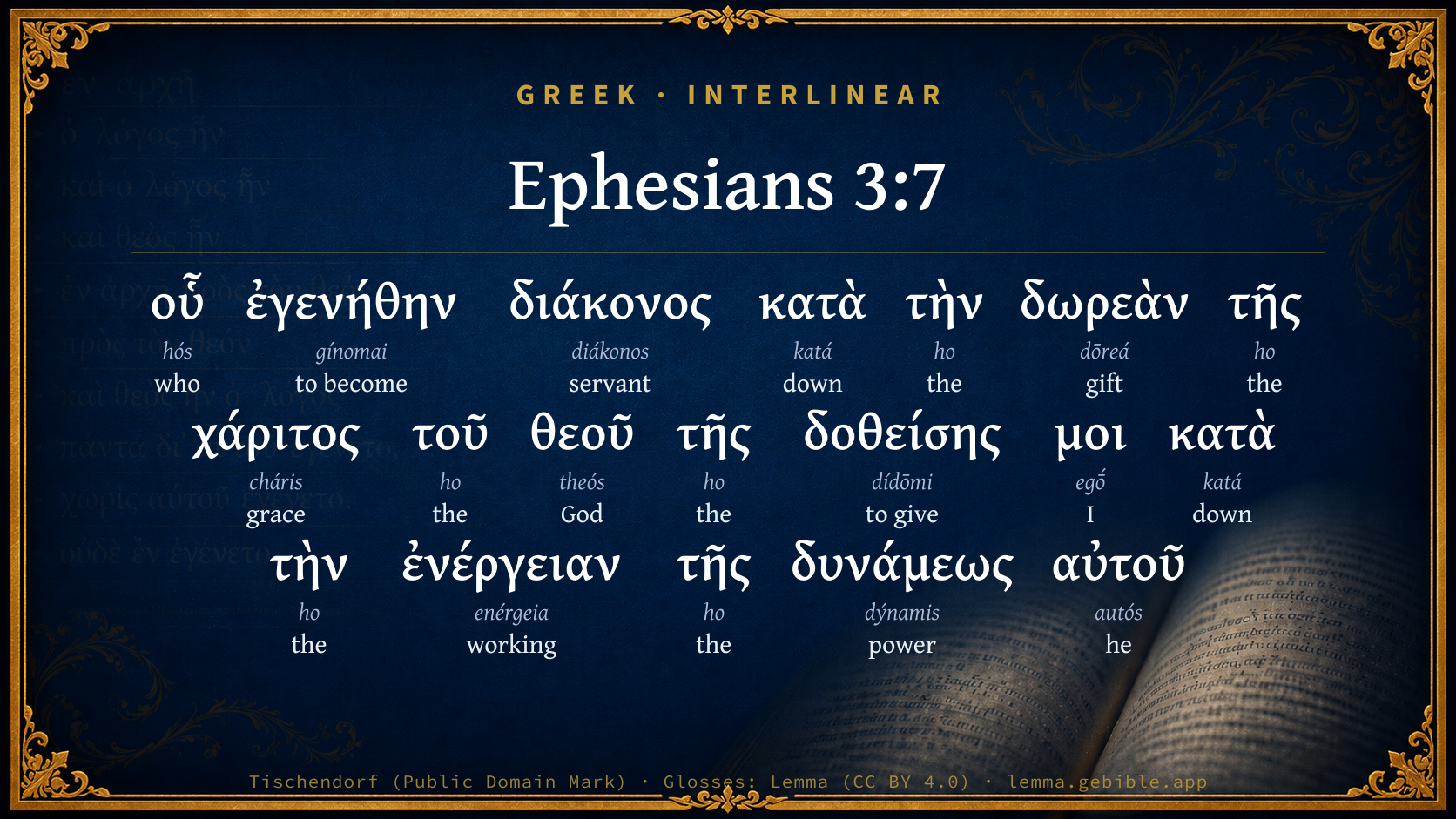
  1. οὗ hós G3739 “who” Relative pronoun, Genitive, Singular, Neuter
  2. ἐγενήθην gínomai G1096 “to become” Verb, Aorist, Passive deponent, Indicative, 1st person, Singular
  3. διάκονος diákonos G1249 “servant” Noun, Nominative, Singular, Masculine
  4. κατὰ katá G2596 “down” Preposition
  5. τὴν ho G3588 “the” Article, Accusative, Singular, Feminine
  6. δωρεὰν dōreá G1431 “gift” Noun, Accusative, Singular, Feminine
  7. τῆς ho G3588 “the” Article, Genitive, Singular, Feminine
  8. χάριτος cháris G5485 “grace” Noun, Genitive, Singular, Feminine
  9. τοῦ ho G3588 “the” Article, Genitive, Singular, Masculine
  10. θεοῦ theós G2316 “God” Noun, Genitive, Singular, Masculine
  11. τῆς ho G3588 “the” Article, Genitive, Singular, Feminine
  12. δοθείσης dídōmi G1325 “to give” Verb, Aorist, Passive, Participle, Genitive, Singular, Feminine
  13. μοι egṓ G1473 “I” Personal pronoun, 1st person, Dative, Singular
  14. κατὰ katá G2596 “down” Preposition
  15. τὴν ho G3588 “the” Article, Accusative, Singular, Feminine
  16. τῆς ho G3588 “the” Article, Genitive, Singular, Feminine
  17. δυνάμεως dýnamis G1411 “power” Noun, Genitive, Singular, Feminine
  18. αὐτοῦ autós G846 “he” Personal pronoun, Genitive, Singular, Masculine

About this verse

These counts appear in no published source. They are computed here, from the morphology-tagged text and Lemma’s own curated glosses. What Lemma adds →

19
words
13
distinct lemmas
Pauline Epistles
section

Notable vocabulary

The rarest word here is ἐνέργειαν working G1753 — appearing just 8 times in the whole Greek New Testament.

Shared distinctive vocabulary

ἐνέργειαν working G1753 occurs in 8 verses of the Greek New Testament. Also found in:

Repetition

Words recur within this verse:

Cross-references

20

Topical passages linked to Ephesians 3:7 in the Treasury of Scripture Knowledge — connected by theme and wording, ordered by reader-vote popularity; previews shown in the World English Bible.

  • Ephesians 1:19 and what is the exceeding greatness of his power toward us who believe, according to that working of the strength of his might
  • 2 Corinthians 3:6 who also made us sufficient as servants of a new covenant; not of the letter, but of the Spirit. For the letter kills, but the Spirit gives life.
  • Ephesians 3:2 if it is so that you have heard of the administration of that grace of God which was given me toward you;
  • Ephesians 3:20 Now to him who is able to do exceedingly abundantly above all that we ask or think, according to the power that works in us,
  • Hebrews 13:21 make you complete in every good work to do his will, working in you that which is well pleasing in his sight, through Jesus Christ, to whom be the glory forever and ever. Amen.
  • Colossians 1:23–25 if it is so that you continue in the faith, grounded and steadfast, and not moved away from the hope of the Gospel which you heard, which is being proclaimed in all creation under heaven; of which I, Paul, was made a servant.
  • 1 Corinthians 3:5 Who then is Apollos, and who is Paul, but servants through whom you believed; and each as the Lord gave to him?
  • Colossians 1:29 for which I also labor, striving according to his working, which works in me mightily.
  • Romans 1:5 through whom we received grace and apostleship, for obedience of faith among all the nations, for his name's sake;
  • Romans 15:16 that I should be a servant of Christ Jesus to the Gentiles, ministering as a priest the Gospel of God, that the offering up of the Gentiles might be made acceptable, sanctified by the Holy Spirit.
  • 1 Corinthians 15:10 But by the grace of God I am what I am. His grace which was bestowed on me was not futile, but I worked more than all of them; yet not I, but the grace of God which was with me.
  • 1 Thessalonians 2:13 For this cause we also thank God without ceasing, that, when you received from us the word of the message of God, you accepted it not as the word of men, but, as it is in truth, the word of God, which also works in you who believe.
  • Isaiah 43:13 Yes, since the day was I am he; and there is none who can deliver out of my hand: I will work, and who can hinder it?
  • 2 Corinthians 4:1 Therefore seeing we have this ministry, even as we obtained mercy, we don't faint.
  • Galatians 2:8 (for he who appointed Peter to the apostleship of the circumcision appointed me also to the Gentiles);
  • Ephesians 4:16 from whom all the body, being fitted and knit together through that which every joint supplies, according to the working in measure of each individual part, makes the body increase to the building up of itself in love.
  • 1 Timothy 1:14–15 The grace of our Lord abounded exceedingly with faith and love which is in Christ Jesus.
  • Romans 15:18–19 For I will not dare to speak of any things except those which Christ worked through me, for the obedience of the Gentiles, by word and deed,
  • Ephesians 3:8 To me, the very least of all saints, was this grace given, to preach to the Gentiles the unsearchable riches of Christ,
  • 2 Corinthians 10:4–5 for the weapons of our warfare are not of the flesh, but mighty before God to the throwing down of strongholds,

Cross-references courtesy of OpenBible.info (CC BY 4.0).

Commentary

Notes on Ephesians 3:7 from classic Christian and Jewish commentators (each source and its license shown beneath its notes). The classic Christian expositions comment on the surrounding passage and are grouped to its opening verse, so a note may address several verses; the Jewish commentaries on the Tanakh (Rashi and others) are per-verse, so they appear only where the commentator wrote on this verse.

Lemma curates 59 commentaries, every one of them public domain or Creative Commons licensed, each selected and text-cleaned for this edition rather than reprinted as found. About our sources →

The Biblical Illustrator

Joseph S. Exell

Eph_3:7

Whereof I was made a minister, according to the gift of the grace of God given unto me by the effectual working of His power.

The ministerial gift

1. The ministerial gift, which God of grace giveth, makes a minister.

2. Ministers differ in their gifts and qualifications.

3. Gods power accompanies the gift of the ministry. (Paul Bayne.)

A true minister

The Rev. S. Pearce, being one week day evening in London, asked a friend where he could hear a good sermon. Two places were mentioned. Well, said he, tell me the characters of the preachers, that I may choose. Mr. D--, said his friend, exhibits the orator, and is much admired for his pulpit eloquence. And what is the other? Why, I hardly know what to say of Mr. C--; he always throws himself in the background, and you see his Master only. Thats the man for me, then, said the amiable Pearce; let us go and hear him. (W. Baxendale.)

Gifts differ

A violet shed its modest beauties at the turfy foot of an old oak. It lived there many days during the kind summer in obscurity. The winds and the rains came and fell, but they did not hurt the violet. Storms often crashed among the boughs of the oak. And one day said the oak, Are you not ashamed of yourself when you look up at me, you little thing down there, when you see now large I am and how small you are; when you see how small a space you fill, and how widely my branches are spread? No, said the violet; we are both where God has placed us; and God has given us both something. He has given to you strength, to me sweetness; and I offer Him back my fragrance, and I am thankful! Sweetness is all nonsense, said the oak; a few days--a month at most--where and what will you be? You will die, and the place of your grave will not lift the ground higher by a blade of grass. I hope to stand some time--ages perhaps; and then, when I am cut down, I shall be a ship, to bear men over the sea, or a coffin to hold the dust of a prince. What is your lot to mine? But, cheerfully breathed the violet back, we are both what God made us, and we are both where He placed us. I suppose I shall die soon. I hope to die fragrantly, as I have lived fragrantly. You must be cut down at last; it does not matter, that I see, a few days or a few ages, my littleness or your largeness; it comes to the same thing at last. We are what God made us. We are where God placed us. God gave you strength; God gave me sweetness. (W. Baxendale.)

All gifts come from God

In the year 1808, a grand performance of the Creation took place at Vienna. Haydn was present, but he was so old and feeble that he had to be wheeled in a chair into the theatre, where a princess of the house of Esterhazy took her seat by his side. This was the last time that Haydn appeared in public, and a very impressive sight it must have been to see the aged father of music listening to the Creation of his younger days, but too old to take any active share in the performance. The presence of the old man roused intense enthusiasm among the audience, which could no longer be suppressed as the chorus and orchestra burst in fall power upon the superb passage, And there was light. Amid the tumult of the enraptured audience the old composer was seen striving to raise himself. Once on his feet, he mustered up all his strength, and in reply to the applause of the audience, he cried out as loud as he was able. No, no! not from me, but, pointing to heaven, from thence--from heaven above--comes all! saying which, he fell back in his chair, faint and exhausted, and had to be carried out of the room. (Frederick Crowest.)

The Christians personal duty towards the gospel

Every Christian hath his talent given him, his service enjoined him. The gospel is a depositum, a public treasure, committed to the keeping of every Christian; each man having, as it were, a several key of the Church, a several trust for the honour of this kingdom delivered unto him. As, in the solemn coronation of the prince, every peer of the realm hath his station about the throne, and with touch of his hand upon the royal crown, declareth the personal duty of that honour, which he is called unto, namely, to hold on the crown on the head of his sovereign; to make it the main end of his greatness, to study, and by all means endeavour, the establishment of his princes throne; so every Christian, as soon as he hath the honour to be called unto the kingdom and presence of Christ, hath immediately no meaner a depositum committed to his care than the very throne and crown of his Saviour, than the public honour, peace, victory, and stability of his Masters kingdom. (Bishop Reynolds.)

The Biblical Illustrator, edited by Joseph S. Exell (c. 1880s–1900s) — public domain. Text from a community e-Sword module.

The Pulpit Commentary

Of which I became a minister; did not gradually grow up to the office, but became, at a given time and place, a minister, a diakonov, a servant. According to the gift of the grace of God. The office of serving Christ was a gift, most undeserved on Paul"s part, who had been a persecutor and injurious, but flowing from the free grace of God, his sovereign, unmerited mercy. Which was given me according to the working of his power. This denotes the manner of the gift; the gift itself, apostleship to the Gentiles, would have been little had it not been accompanied with Divine power. Spiritual office without spiritual power is miserable; but in Paul"s case there was the power as well as the office; not merely the power of working miracles, as some have held, but besides this, the power of spiritual insight into the meaning of Scripture power of exposition, power of demonstration, power of persuasion. (comp. 1Th_1:5; Act_14:1; 1Co_4:7, etc.) Paul gratefully acknowledged that all the power of his ministry was God"s, not his own. (1Co_3:6, 1Co_3:7)

The Pulpit Commentary (1880–1919), ed. H.D.M. Spence-Jones & Joseph S. Exell — public domain. Text from a community e-Sword module.

The Preacher's Complete Homiletical Commentary

Joseph S. Exell (gen. ed.)

CRITICAL AND EXPLANATORY NOTES

Eph_3:7. Whereof I was made a minister.—A deacon, a runner of errands. A lowly word, which reminds us of his own self-estimate—“not worthy to be called an apostle”—and prepares us for the strange expression in Eph_3:8.

Eph_3:8. Less than the least of all saints.—“As though we said, ‘Leaster than all Christians’ ” (Bishop Alexander). “The greatest sinner, the greatest saint, are equidistant from the goal where the mind rests in satisfaction with itself. With the growth in goodness grows the sense of sin. One law fulfilled shows a thousand neglected” (Mozley, quoted by Farrar). The unsearchable riches.—“The untrackable wealth” (Farrar), inexplicable by creaturely intelligences, unspeakable therefore by human tongues.

Eph_3:9. And to make all men see.—He says to the Galatians (Eph_3:1), “Christ was placarded before you”—so here he wants men to see for themselves.

MAIN HOMILETICS OF THE PARAGRAPH.—Eph_3:7-9

An Exalted Ministerial Commission—

I. To distribute the unbounded wealth of the gospel—“Unto me … is this grace given, that I should preach the unsearchable riches of Christ” (Eph_3:8). In calling the gospel “the unsearchable riches of Christ” the apostle signifies that Christ, the whole truth about Him and centred in Him, is the theme of his preaching, and that in Christ he finds a mine of inexhaustible wealth, a treasure of truth which cannot be told. He speaks as one who has searched—searched so long, so far, as to have had produced on his mind the impression of unsearchableness. His whole style of writing in this chapter is that of a man overwhelmed with a sense of the infinite grace of God revealed in Christ. The expression “unsearchable riches,” while conveying the same impression of infinitude as the words “breadth,” “length,” “height,” “depth,” suggests a different idea—that of a mine of precious metal, rather than that of a vast continent of great length and breadth with high mountains and deep valleys spread over its surface. Paul speaks as a man digging in a recently discovered gold-field, who finds particles of the precious metal in such abundance that he cannot refrain from exclaiming ever and anon, “What an inexhaustible supply of gold is here!” He speaks further as one who feels it his special business to let all the world know of this goldfield, and invite all to come and get a share of its wealth (A. B. Bruce).

II. To reveal to men the secret mind of God.—

1. The gospel was for long hidden alone in God. “Which from the beginning of the world hath been hid in God” (Eph_3:9). It was a mystery hid in God, not from God. The idea of the universality of the gospel, though veiled for ages by the limitations of the divine dealings with the Jewish people, was never absent from the mind of God. Down through the rolling years one eternal purpose runs, and now and then the most gifted of the Hebrew seers caught a glimpse of its ever-widening range. This great secret of the ages was revealed to Paul in such clearness and fulness that he regarded it as the one purpose of his life—his heaven-sent commission—to make it known to his fellow-men, of whatever nationality.

2. The purpose of the creation of all things by Christ was also a part of the divine mystery.—“Who created all things by Jesus Christ” (Eph_3:9). The statement of this fact—thrown in by way of parenthesis—links the whole created things with the development of the divine purpose, and asserts the absolute sovereignty of Jesus over all worlds. In some way yet to be more fully explained as the divine purpose ripens all created beings are to be advantaged by the sublime redemptive work unfolded in the gospel. “For He hath created all things, and by Him all things consist.”

3. The mystery was revealed to one for the benefit of all.—“And to make all men see what is the fellowship [the stewardship] of the mystery” (Eph_3:9). It was well for us and the race that the revelation and commission were committed to one who by training and gifts was so well qualified to explain and propagate the grand divine idea. The barriers of Jewish prejudice in Paul were swept away by the vastness and universality of the message. He saw it included his Hebrew brethren—and to them the gospel was first preached—but he saw also it included all in its comprehensive sweep. Paul was not alone among the apostles in comprehending the breadth of the gospel; but he was foremost and most resolute and unbending in battling for the right of the Gentiles to be admitted to all its blessed privileges. He thought out the gospel for himself, and he became the fearless and astute champion of the sinning race. What is accepted as a commonplace to-day was not won without argument, suffering, and struggle.

III. Bestowed as an act of divine grace.—

1. As an act of divine grace it was confirmed by the conscious possession of divine power. “Given unto me by the effectual working of His power” (Eph_3:7). Paul himself experienced the transforming power of the gospel. He was deeply convinced of its truth, he believed and embraced its provisions, he accepted Christ as the living core of the gospel, and he was thrilled with the divine power that wrought in him a great moral change. He spoke not only with the force and authority of clearly apprehended truth, but with the unfaltering certitude of personal experience. He was henceforth the willing agent of the divine power working within him.

2. As an act of divine grace his commission overwhelmed him with a sense of personal unworthiness.—“Unto me, who am less than the least of all saints, is this grace given” (Eph_3:8). The immense favour humbles him to the dust. That Saul, the Pharisee and the persecutor, the most unworthy and unlikely of men, should be the chosen vessel to bear Christ’s riches to the Gentile world, how shall he sufficiently give thanks for this! how express his wonder at the unfathomable wisdom and goodness that the choice displays in the mind of God! But we can see that this choice was precisely the fittest. A Hebrew of the Hebrews, steeped in Jewish traditions and glorying in his sacred ancestry, none knew better than the apostle Paul how rich were the treasures stored in the house of Abraham that he had to make over to the Gentiles. A true son of that house, he was the fittest to lead in the aliens, to show them its precious things, and make them at home within its walls (Findlay).

Lessons.—

1. The minister of the gospel has a solemn responsibility.

2. Should be faithful and earnest in his work.

3. Should guard against temptations to pride.

GERM NOTES ON THE VERSES

Eph_3:7. A God-made Minister.—

1. It is not sufficient warrant for any to meddle with the ministerial office that he hath competent gifts, except he have also ministerial power and authority conveyed to him, either immediately by God, as it was in the calling of the apostles, or mediately according to that order which God has established in His Church, as in the calling of ordinary ministers.

2. As it is required to make a man a minister that he be endued with competent abilities and gifts for that employment, so it is no less requisite that God concur with him. God giveth not to all one and the same gift, or in the same measure, but to some a greater, to others a less, as He hath more or less to do with them.

3. So great and many are the difficulties of ministers before they attain to freedom and boldness in exercising their ministerial gift that no less is required than the power of God, working effectually with a kind of pith and energy. A minister will be always ready to acknowledge his gifts as from God and His powerful working in him, and not to his own dignity, diligence, or parts.—Fergusson.

Eph_3:8-9. The Apostle’s View of his Ministry.

I. Consider what a humble opinion the apostle had of himself.—“Who am less than the least of all saints.” In his abilities and gifts he was not a whit behind the chiefest apostles, and in sufferings he was more frequent and in labours more abundant than they all. But in respect of worthiness he esteemed them his superiors; for they had not, like him, persecuted the Church, and they were in Christ and became apostles before him. Good Christians in honour prefer one another. True religion will produce self-abasing thoughts. The true convert forgets not his former character. He reflects often on his past guilty life, that he may be more humble in himself, more thankful, more watchful, more diligent.

II. The apostle expresses his admiring apprehensions of God’s grace in calling him to the ministry.—To the same grace which had called him he ascribes all his furniture for the ministry and all his success. However contemptible some render themselves in the gospel ministry, the office itself is honourable.

III. The apostle’s elevated sentiments concerning the gospel—He calls it “the unsearchable riches of Christ.” The blessings of the gospel, being purchased by the blood of Christ, are called His riches. They are called riches on account of their excellency, fulness, and variety. They are undiscoverable by human reason, and made known only by revelation. They were but imperfectly made known in the prophetic revelation. They are of inestimable value.

IV. Consider the grand and enlarged conceptions the apostle entertained of the design and importance of his ministry (Eph_3:9).—It was to open to mankind that mighty scheme which the wisdom of God had formed, and which His goodness had for ages been carrying into execution, for the redemption of our fallen race. His ministry was designed for the benefit, not of men only, but of angels too (Eph_3:10).—Lathrop.

Eph_3:8. Christian Humility illustrated in the Character of Paul.

I. The apostle remembered his past sins.—Wherever there is a quickened conscience, it will prompt the possessor to think of his past sins, and this even when he has reason to believe that they have been forgiven. The apostle continued to remember the natural and deeply seated pride and self-righteousness which he had so long cherished. Allusion is made in every one of his public apologies and in a number of his epistles to the circumstance of his once having been an enemy of the cross of Christ and a persecutor. It is for the benefit of the believer to remember his past sinfulness. The recollection of his infirmities may enable him to guard against their recurrence. Our sins, even when past and forgiven, are apt to leave a prejudicial influence behind. Our sins are like wounds, which even when cured and closed are apt to leave a scar behind. It is most meet and becoming, and in every respect for his own profit and the advantage of the Church and world, that the sinner, and more particularly the man whose former life has been known, should walk humbly before God and his fellow-men all the days of his life. Nor let it be forgotten that the remembrance of past sin is one of the motives impelling the Christian to be “zealously affected in every good thing.” The remembrance of the injury he had done to the Church stimulated him to make greater endeavours to benefit it. The persecution which he had inflicted on others made him more steadfast in bearing the sufferings to which he was now exposed. According to the account handed down from the early Church, the apostle had to suffer a violent death in the reign of Nero, when Christians were covered with pitch and burned as torches, or clothed with the skins of wild beasts and dogs let loose upon them. We can conceive that as he saw the terrible preparations for putting him to death, his memory would go back thirty years, and he would remember how he himself had stood by and consented to the death of the holy martyr Stephen, and he would feel himself thereby the more strengthened to endure what the Lord was now pleased to lay upon him.

II. The apostle mourned over the sin yet cleaving to him.—He had not only a recollection of past sin, he had a sense of present sin. This sense of indwelling sin is one of the elements that conduce to the onward progress of the believer. Why is it that so many professing Christians, ay, and too many true Christians, are not advancing in the spiritual life; are the same this week as they were the previous week; the same this year as they were the last year; and to all appearance, and unless God arouse them, will be the same the next week or next year as they are this? It is because they are contented with themselves and with their condition, they have reached a state of self-complacency, they have “settled upon their lees,” and they do not wish to be disturbed by so much as an allusion to their sin. Very different was the temper of the apostle. Conscious of the sin that still adhered to him, he longed to have it completely exterminated, and sought the heavenly aid which might enable him to reach that after which he was always striving—“unto a perfect man, unto the measure of the stature of the fulness of Christ.”

III. The apostle acknowledged God to be the Author of all the gifts and graces possessed by him.—Paul on more than one occasion found it necessary to speak of his gifts. And when he follows this train of reflection, he arrests himself to explain that his faults are his own, and to ascribe the glory of his gifts to God. There may be circumstances requiring us to speak of our attainments in the spiritual life; but there can be no excuse for our thinking of them or alluding to them in a spirit of complacency. Of all pride, spiritual pride is the most hateful, and the most lamentably inconsistent. How often does it happen that, when persons are suddenly elevated to places of honour, they see nothing but their own merits, their own talent, their own skill or good management. Elevation of rank thus leads in too many cases to an increase of pride and vanity. This is painfully illustrated in the history of Saul, the son of Kish. Setting out in search of his father’s asses, he received before he returned a kingdom for the discharge of the offices of which he had many qualifications. But his rise seems to have fostered the morbid vanity of his mind; and when this was not fed by constant incense, when the Israelites cried; “Saul hath slain his thousands, and David his tens of thousands,” it led to envy and revenge, which goaded him on to deeds of utter infatuation. How different with Saul of Tarsus! At every step of his elevation in the Church he saw the finger of God, and was the more impressed with his own unworthiness.

IV. The apostle took a high standard of excellence: he took as his model the law of God and the character of Jesus.—All actual excellence, whether earthly or spiritual, has been attained by the mind keeping before it and dwelling upon the ideas of the great, the good, the beautiful, the grand, the perfect. The tradesman and mechanic reach the highest eminence by never allowing themselves to rest till they can produce the most finished specimens of their particular craft. The painter and sculptor travel to distant lands that they may see and as it were fill their eye and mind with the sight of the most beautiful models of their arts. Poets have had their yet undiscovered genius awakened into life as they contemplated some of the grandest of nature’s scenes; or as they listened to the strains of other poets the spirit of inspiration has descended upon them, as the spirit of inspiration descended on Elisha while the minstrel played before him. The soldier’s spirit has been aroused even more by the stirring sound of the war-trumpet than by the record of the courage and heroism of other warriors. The fervour of one patriot has been created as he listened to the burning words of another patriot; and many a martyr’s zeal has been kindled at the funeral pile of other martyrs. In this way fathers have handed down their virtues to their children, and those who could leave their offspring no other have in their example left them the very richest legacy; and the deeds of those who perform great achievements have lived far longer than those who do them, and have gone down from one generation to another. Now the believer has such a model set before him in the character of Jesus, which as it were embodies the law and exhibits it in the most attractive and encouraging light. We may copy others in some things; we should copy Christ in all.—Dr. J. McCosh.

Eph_3:8. Paul’s Humility.

I. In what it consisted.—

1. In the unreserved submission of his reason to the authority of revelation. He was a great thinker, and he was a great scholar.

2. In the unwavering reliance of his heart on Christ for the salvation of his soul. Self-righteous by constitution and education.

3. In ascribing to God alone the glory of all that he was and of all that he did. He could not but be conscious how far he stood above the ordinary in point of Christian excellence and supernatural gifts and ministerial usefulness. He never took any part of the praise to himself: “Yet not I, but the grace of God which was with me.”

4. In cherishing a sense of his unworthiness and guilt: “Sinners, of whom I am chief.”

5. In forming a lowly estimate of his own comparative standing: “Less than the least of all saints.”

II. How it was cultivated.—

1. By frequent meditation on the holiness of God.

2. By looking away from self to Christ.

3. By gratitude to God and to Christ for an interest in the blessings of redemption.

4. By a due appreciation of the importance of humility. It is ornamental, but it is also useful. It lies at the very root of all the graces of the Christian character.—G. Brooks.

Humility a Growth.—The progress which St. Paul made in humility has often been given by comparing three expressions in his epistles with the supposed dates when they were written: “Not meet to be called an apostle” (1Co_15:9); A.D. 59); “Less than the least of all saints” (Eph_3:8; A.D. 64); “Sinners, of whom I am chief” (1Ti_1:15; A.D. 65).

The Unsearchable Riches of Christ.—The riches of Christ’s divinity are unsearchable, the riches of His condescension are unsearchable, the riches of His tenderness are unsearchable, the riches of His redeeming love are unsearchable, the riches of His intercession are unsearchable, the riches of His faithfulness are unsearchable, and the riches of His supporting grace are unsearchable. These riches will never be expressed, even to all eternity. No! not by the noble army of martyrs, nor the glorious company of the apostles, nor the goodly fellowship of the prophets, nor the general assembly and Church of the first-born, nor the innumerable company of angels, nor the spirits of just men made perfect, nor by all the ransomed throng of heaven. It will form their most ecstatic employment in heaven. Join, all ye happy throng—join, holy Abel and Enoch, upright Job, perfect Noah, souls of Abraham, Isaac, and Jacob, grand souls of Moses, Samuel, and Elijah, pardoned David and Manasseh, soul of Isaiah the prophet. Join, all ye whose souls under the altar cry, “How long, O Lord, wilt Thou not avenge our blood upon the earth?” Join, holy Stephen and Polycarp, holy Latimer, Ridley, Hooper, Rowland Taylor, and Anne Askew. Join, brave Wicklif, gallant Luther, stern John Knox, sweet John Bunyan, and praying George Fox. Join, pious Doddridge and tuneful Watts, noble George Whitefield, holy Fletcher, exhaustless John Wesley, dauntless Rowland Hill, and grand though lowly Robert Hall. Ye sweetest trebles of the eternal choir, ye million million babes who died without actual sin, join all your notes of praise! Pull out every stop of the grand organ of heaven, from the deep swell diapason to the lofty flute and cornet! Gabriel, strike the loftiest note of thy harp of gold. And let all the host of heaven, angels and men, begin the grand anthem, “Worthy is the Lamb.” And let the eternal Amen peal and roll and reverberate through all the arches of heaven! But never through all eternity shall the gathered host be able fully to express the unsearchable riches of Christ.—Thomas Cooper.

Eph_3:9. The Fellowship of the Mystery.

I. It is a mystery it should be so long hid; a mystery, because when it was plainly revealed it was not understood by those to whom it was manifested; a mystery, for God was pleased to raise up a special apostle to explain and reveal, to make an epiphany of this great truth—the will of God that all men should be saved, that His gospel should be universally known, should be open to all for acceptance.

II. Our share and fellowship in the work of the gospel is to make all men see their interest in it, to make them understand its true catholicity, to make all men see that it is from the first the will of God that the Gentiles should be fellow-heirs. By the Church is to be made known the manifold wisdom of God. Every member of the Church is to have his or her part in doing this work. We are all to take part in it by our lives, our conversation, our example, our good works and words. By availing ourselves of opportunities we are to help to make known this manifold wisdom of God.

III. Think for a moment what is the state of those men who do not know what is their fellowship with this mystery.—I am not speaking of the entirely ignorant. Even religious people do not half understand or appreciate the deep meaning of such words as these. Christianity means expansion, comprehension; it embraces all, and all men must see in it what is the fellowship of the mystery that we have received and that has been made known to us. We must be a light that cannot be hid—Bishop Claughton.

The Preacher's Complete Homiletical Commentary (gen. ed. Joseph S. Exell; Funk & Wagnalls, c. 1892) — public domain (pre-1929). A full-Bible homiletical/sermon-outline anthology covering 65 of 66 books (2 John is absent from the source module). Text from a community e-Sword module.

Tyndale Open Study Notes

Tyndale Open Resources

3:7 grace: See study note on 1:2. • serving him: Paul speaks of himself as a servant of the Good News (see also Col 1:23), of God (1 Cor 3:5; 2 Cor 6:4), of Christ (2 Cor 11:23), of the church (Col 1:25), and of the new covenant (2 Cor 3:6).

Tyndale Open Study Notes — © Tyndale Open Resources, licensed CC BY-SA 4.0. Text via the HelloAO Bible API.

Bengel's Gnomon

Johann Albrecht Bengel

Eph 3:7. Οὗ, of which) viz. the Gospel.—κατὰ τὴν ἐνέργειαν, according to the working) Eph 3:20; ch. Eph 1:19.

Bengel's Gnomon of the New Testament — English translation (T&T Clark, Edinburgh, 1860) — public domain. Text from a community e-Sword module.

Meyer's Critical & Exegetical Commentary

Heinrich August Wilhelm Meyer

Eph_3:7. Διάκονος] Comp. Col_1:23; 2Co_3:6; also Luk_1:2. Paul became a servant of the gospel when he was enjoined by God through Christ (Gal_1:1; Gal_1:15 ff.; Act_9:22; Act_9:26) to devote his activity to the proclamation of the gospel. The distinction from ὑπηρέτης (used by Paul only at 1Co_4:1) is not, as Harless supposes, that διάκονος denotes the servant in his activity for the service, while ὑπηρέτης denotes him in his activity for the Master (see, in opposition to this, 1Co_12:3; Rom_13:4; 2Co_6:3; Col_1:7; Col_4:6); but both words indicate without distinction of reference the relation of service, and the difference lies only in this, that the two designations, in accordance with their etymology, are originally borrowed from different concrete relations of service (διάκ., runner; ὑπηρ., rower; see the Lexicons, and on διάκονος, Buttm. Lexil. I. p. 218 ff.); in the usage, however, of the N.T., both words have retained merely the general notion of servant, as very frequently also with Greek writers. In opposition to Harless it may be also urged that not only is the expression διακονεῖν τινί τι used, but also in like manner ὑπηρετεῖν τινί τι (Xen. Anal, vii. 7. 46, Cyr. i. 6. 39; Soph. Phil. 1012). The gift, which was conferred upon Paul by the divine grace, and in consequence of which he became a servant of the gospel, is, agreeably to the context, the apostolic office (comp. Eph_3:2; Eph_3:8), not the donum linguarum (Grotius), nor yet the gift of the Holy Spirit (Flatt, after older expositors).

κατὰ τὴν ἐνέργ. τ. δυν. αὐτοῦ] belongs to τὴν δοθεῖσάν μοι. To the efficacious action of the power of God (comp. Eph_3:20, and on Eph_1:19) the bestowal of the gift of grace leads back the mind of the apostle, in the consciousness of what he had been before, Gal_1:13 ff. Haec est potentiae ejus efficacia, ex nihilo grands aliquid efficere, Calvin. By the bestowal, in fact, of that gift of the divine grace Saul had become changed into Paul; hence κατὰ τὴν ἐνέργ. τ. δυν. αὐτοῦ.

Meyer — Critical and Exegetical Commentary on the New Testament — English translation by Peter Christie, edited by Frederick Crombie (T&T Clark, 1880) — public domain. Text from a community e-Sword module.

Expositor's Greek Testament

ed. W. Robertson Nicoll

Eph 3:7 . οὗ ἐγενόμην διάκονος κατὰ τὴν δωρεὰν τῆς χάριτος τοῦ Θεοῦ : of which I became a minister according to the gift of the grace of God . The TR reads ἐγενόμην (with [239] [240] [241] [242] , etc.). The less usual form ἐγενήθην , however, is given by [243] [244] [245] [246] , 17, etc., and is to be preferred. There is no difference, however, in the sense; ἐγενήθην being simply the Doric equivalent to ἐγενόμην , which reappeared in the LXX and in later Greek generally. διάκονος is a servant, attendant of any kind; also a deacon in particular (Phi 1:1 ; 1Ti 3:8 ; 1Ti 3:12 ), or a deaconess (Rom 16:1 ), and perhaps a waiter , one who serves at table (Joh 2:5 ; Joh 2:9 ). Here it has the general sense of minister , as Paul designates himself again in 2Co 3:6 ; Col 1:23 . Once he calls himself ὑπηρέτης (1Co 4:1 ); but with no tangible difference in idea, except that ὑπηρέτης may suggest a still greater degree of subordination than διάκονος . The distinction drawn by some (Harless) between the two terms, as if διάκονος expressed activity in relation to the service and ὑπηρέτης activity in relation to the master , cannot be made good. τῆς χάριτος is probably the ger. of apposition or identity (as the χάρις in Eph 3:8 indicates), = the gift consisting in the grace; and the particular “grace” in view is the office of the apostleship or the ministry to the Gentiles (as Eph 3:2 ; Eph 3:8 suggest), not the gift of tongues (Grot.) or the gift of the Holy Ghost (Flatt, etc.). That “grace,” too, was God’s gift ( τοῦ Θεοῦ ). τὴν δοθεῖσάν μοι κατὰ τὴν ἐνέργειαν τῆς δυνάμεως αὐτοῦ : which was given to me according to the working of His power . F r the τὴν δοθεῖσαν , qualifying the δωρεάν , of the TR (with [247] [248] [249] [250] , etc.) the better reading is τῆς δοθείσης , qualifying the χάριτος (with [251] [252] [253] [254] [255] , 17, etc.; so LTTrWHRV). As the former sentence affirmed the gift of the grace, this one states the manner of the bestowal. The standard or proportion of the giving was the efficiency , the efficacious working ( ἐνέργειαν ) of God’s own power. The change in Paul when God made him an Apostle of Christ to the Gentiles was so great that he saw in it nothing less than the result of the Divine omnipotence.

[239] Codex Ephraemi (sæc. v.), the Paris palimpsest, edited by Tischendorf in 1843.

[240] Codex Claromontanus (sæc. vi.), a Græco-Latin MS. at Paris, edited by Tischendorf in 1852.

[241] Codex Mosquensis (sæc. ix.), edited by Matthæi in 1782.

[242] Codex Angelicus (sæc. ix.), at Rome, collated by Tischendorf and others.

[243] Codex Vaticanus (sæc. iv.), published in photographic facsimile in 1889 under the care of the Abbate Cozza-Luzi.

[244] Codex Sinaiticus (sæc. iv.), now at St. Petersburg, published in facsimile type by its discoverer, Tischendorf, in 1862.

[245] Codex Claromontanus (sæc. vi.), a Græco-Latin MS. at Paris, edited by Tischendorf in 1852.

[246] Codex Augiensis (sæc. ix.), a Græco-Latin MS., at Trinity College, Cambridge, edited by Scrivener in 1859. Its Greek text is almost identical with that of G, and it is therefore not cited save where it differs from that MS. Its Latin version, f, presents the Vulgate text with some modifications.

[247] Codex Ephraemi (sæc. v.), the Paris palimpsest, edited by Tischendorf in 1843.

[248] Codex Claromontanus (sæc. vi.), a Græco-Latin MS. at Paris, edited by Tischendorf in 1852.

[249] Codex Mosquensis (sæc. ix.), edited by Matthæi in 1782.

[250] Codex Angelicus (sæc. ix.), at Rome, collated by Tischendorf and others.

[251] Codex Vaticanus (sæc. iv.), published in photographic facsimile in 1889 under the care of the Abbate Cozza-Luzi.

[252] Codex Sinaiticus (sæc. iv.), now at St. Petersburg, published in facsimile type by its discoverer, Tischendorf, in 1862.

[253] Codex Alexandrinus (sæc. v.), at the British Museum, published in photographic facsimile by Sir E. M. Thompson (1879).

[254] Codex Claromontanus (sæc. vi.), a Græco-Latin MS. at Paris, edited by Tischendorf in 1852.

[255] Codex Augiensis (sæc. ix.), a Græco-Latin MS., at Trinity College, Cambridge, edited by Scrivener in 1859. Its Greek text is almost identical with that of G, and it is therefore not cited save where it differs from that MS. Its Latin version, f, presents the Vulgate text with some modifications.

The Expositor's Greek Testament, edited by W. Robertson Nicoll (1897–1910) — public domain. Text from a community e-Sword module.

Hodge's Commentary on Romans, Ephesians & First Corinthians

Charles Hodge

Eph_3:7

Of which (Gospel) I was made a minister; a διάκονος, a runner, servant, minister. Minister of the Gospel, means one whose business it is to preach the Gospel. This is his service; the work for which he is engaged, and to which he is bound to devote himself. There are two things which Paul here and in the verse following says in reference to his introduction into the ministry; first, it was a great favor; and secondly, it involved the exercise of divine power.

He was made a minister, κατὰ τὴν δωρεὰν τῆς χάριτος τοῦ θεοῦ, according to the gift of the grace of God given to him. According to the common text (δωρεὰν δουεῖσαν), the gift was given. The gift of the grace of God, may mean the gracious gift, i.e. the gift due to the grace of God; or, the gift which is the grace of God; so that the χάρις, grace, as Paul often calls his apostleship, is the thing given. In either way the gift referred to was his vocation to be an apostle. That he who was a persecutor and blasphemer should be called to be an apostle, was in his view a wonderful display of the grace of God.

The gift in question was given, κατὰ τὴν ἐνέργειαν τῆς δυνάμεως αὐτοῦ, by the effectual working of his (Gods) power. Pauls vocation as an apostle involved his conversion, and his conversion was the effect of the power of God. This refers to the nature of the work, and not to its mere circumstances. It was not the blinding light, not the fearful voice, which he refers to the power of God, but the inward change, by which he, a malignant opposer of Christ, was instantly converted into an obedient servant. The regeneration of the soul is classed among the mighty works of God, due to the exceeding greatness of his power. See Eph_1:19.

Charles Hodge — Commentary on Romans (1835), First Corinthians (1857), and Ephesians (1856) — public domain. Text from a community e-Sword module.

Jamieson, Fausset & Brown

Robert Jamieson, A. R. Fausset & David Brown

Whereof--"of which" Gospel.

according to--in consequence of, and in accordance with, "the gift of the grace of God."

given--"which (gift of grace) was given to me by (Greek, 'according to,' as in Eph 3:20; Eph 1:19 : as the result of, and in proportion to) the effectual working (Greek, 'energy,' or 'in-working') of His power."

Jamieson, Fausset & Brown — Commentary Critical and Explanatory on the Whole Bible (1871) — public domain (CC PDM 1.0). Text via the HelloAO Bible API.

Adam Clarke's Commentary

Verse 7. Whereof I was made a minister] διακονος. A deacon, a servant acting under and by the direction of the great Master, Jesus Christ; from whom, by an especial call and revelation, I received the apostolic gifts and office, and by την ενεργειαντηςδυναμεωςαυτου, the energy, the in-working of his power, this Gospel which I preached was made effectual to the salvation of vast multitudes of Jews and Gentiles.

Adam Clarke's Commentary on the Bible (1810–1826) — public domain. Text from a community e-Sword/MySword module.

John Calvin's Commentaries

7. Of which I was made a minister. Having declared the gospel to be the instrument employed in communicating grace to the Gentiles, he now adds, that he was made a minister of the Gospel; and thus applies to himself the general statements which had been made. But, to avoid claiming for himself more than is proper, he affirms that it is the gift of the grace of God, and that this gift was an exhibition of divine power. As if he had said, “Inquire not what I have deserved; for in the free exercise of kindness, the Lord made me an apostle of the Gentiles, not for any excellence of mine, but by his own grace. Inquire not what I formerly was; for it is the Lord’s prerogative to ‘exalt them of low degree.’” (Luke 1:52.) To produce something great out of nothing, shews the effectual working of his power.

John Calvin's Commentaries (1540-1563) — public domain. Text from the Calvin Translation Society English edition (1840s-50s) via the Christian Classics Ethereal Library (ccel.org). Calvin's coverage is partial (roughly two-thirds of the Bible); uncommented books and verses are honest gaps, never fabricated. The 19th-century editor's footnotes and remarks are omitted so the notes are faithfully Calvin's own voice.

Ellicott's Commentary for English Readers

(7) According to the gift of the grace of God given unto me by the effectual working of his power.—The words “given by” should be rendered given according to. The working of God’s power is described, not as the means, but as the measure of the gift of His grace. In fact, what is a “gift” in its source, is “effectual working” in its actual nature. On the phrase “effectual working of power”—a divine force in the soul, not latent but energetic—see Eph_1:19. In the whole of this passage, however, the chief emphasis is laid, not on the spiritual power, but on the freedom of God’s gift to the Apostle of this high privilege of preaching the mystery of the gospel.

A Bible Commentary for English Readers, edited by Charles John Ellicott (1878–1897) — public domain. Text from a community e-Sword module.

The Cambridge Bible for Schools and Colleges

gen. ed. J. J. S. Perowne

7. a minister] Diâconos, a worker, helper. Cp. Col_1:23. The word implies activity and subordination.—“I” here is not emphatic.

according to the gift, &c.] See above on Eph_3:2. The “gift” includes the commission and the inspiration. His “ministry,” both in field and in effect, was “according to” this great gift.

given] I.e. (by the best attested reading) the grace which was given. So R.V. “the gift of that grace which was given.”

by the effectual working &c.] Read certainly, according to the working, &c. For similar phrases cp. Eph_1:19; Php_3:21; and esp. Col_1:29, where, as here, he speaks of working “according to” a power experienced by himself.—A comma should be read before this second “according to.” The statement is that he “became a minister, according to,” in a way explained by, two things, a Divine Gift, and a Divine working Power. Observe the recognition, at once restful and energizing, that the actual movements of the power of God were the force behind all his apostolic activity. “By Him he moves, in Him he lives.” Cp. besides Col_1:29 just cited, 1Co_15:10; 2Co_3:5; 2Co_4:7; 2Co_12:9-10; Gal_2:20; Php_4:13; Col_1:11.

The Cambridge Bible for Schools and Colleges (gen. ed. J. J. S. Perowne; Cambridge University Press, 1878–1918) — public domain. Text from a community e-Sword module.

John Gill's Exposition

Whereof I was made a minister,.... That is, of the Gospel, not by men, but by God: and he is a true minister of the Gospel who is called of God to the work of the ministry, and is qualified by him with grace and gifts for it; and who faithfully discharges it according to the ability God has given; and such an one was the apostle:

according to the gift of the grace of God given unto me; not according to his natural capacity, his liberal education, or acquired learning; but according to a gift, a ministerial gift bestowed upon him, for such service: for this gift of grace does not design the grace of God wrought in his soul; nor the doctrines of grace, the subject of the Gospel ministry; nor the efficacious grace of God, which makes that successful and useful to the souls of men; but a gift of interpreting the Scriptures, and of explaining the truths of the Gospel to the edification of men; and which is a distinct thing from natural abilities, human learning, or internal grace; for there may be all these, and yet a man not fit to be a minister of the Gospel; what qualifies men for that is the above gift, which God, of his sovereign good will and pleasure, gives to some of the sons of men:

by the effectual working of his power; the power of God is seen in working grace in the hearts of men, thereby making them believers in Christ; and it is also displayed in the gifts of the Spirit bestowed on men, which is called a being endued with a power from on high; thereby making men, and not angels, and these oftentimes the meanest and weakest, ministers of Christ; and likewise in assisting them in their work, and in carrying them through it, and in making them successful in it, to the conversion of sinners, and the edification of saints.

John Gill's Exposition of the Whole Bible (1746–1763) — public domain (CC PDM 1.0). Text via the HelloAO Bible API.

Trapp's Complete Commentary

John Trapp

7 Whereof I was made a minister, according to the gift of the grace of God given unto me by the effectual working of his power.

Ver. 7. By the effectual working, &c.] Enabling me to accept and improve that gift of God’s grace; whereunto I should otherwise turn not the palm, but the backside of the hand.

John Trapp, A Commentary or Exposition upon All the Books of the Old and New Testament (1647–1656) — public domain. Text from a community e-Sword module.

Albert Barnes' Notes on the Bible

Whereof I was made a minister - see the notes at Eph 3:2.

According to the gift of the grace of God - It was not by my own seeking or merit; it was a free gift.

Of the grace of God - The sentiment is, that throughout it was a mere matter of grace that he was called into the ministry, and that so important an office was entrusted to him as that of bearing the gospel to the Gentiles.

By the effectual working of his power - Not by any native inclination which I had to the gospel, and not by any power which I have put forth. It is by “the energy of his power;” compare notes, Gal 2:8. Locke understands this of the energy or power which God put forth in converting the Gentiles under his ministry. But it seems to me that it refers rather to the power which God put forth in the conversion of Paul himself, and putting him into the ministry. This is clear from the following verse. The meaning is, that such was his opposition to the gospel by nature, that nothing but the “energy of God” could overcome it, and that his conversion was to be traced to that alone.

Albert Barnes' Notes on the Bible (1834–1885) — public domain. Text from a community e-Sword/MySword module.

Haydock's Catholic Bible Commentary

I am made a minister, &c. i.e. an apostle, to preach this same doctrine of the gospel of Christ. (Witham)

George Leo Haydock (1774–1849), Haydock's Catholic Family Bible and Commentary, 1859 edition — public domain. Excludes Psalms (Douay-Rheims chapter numbering differs from Protestant) and Deuterocanonical books (Catholic canon only).

Matthew Poole's English Annotations

According to the gift of the grace of God; either according to the free gift of God, and which was given merely of grace; or by

gift he understands all those several gifts (as of knowledge, utterance, &c.) which were the necessary qualifications and furniture of an apostle for the due discharge of his office, all which were freely given to him.

Given unto me by the effectual working of his power; whereby God made him a preacher of the gospel, who had been a persecutor of believers, and wrought effectually by the Spirit with his preaching for the conversion of thousands, and spreading the gospel in many countries; and likewise wrought miracles for the confirmation of the truth, and conviction of hearers, Act 19:12; 28:8.

Matthew Poole's English Annotations on the Holy Bible (1683–1685) — public domain. Text from a community e-Sword/MySword module.

Whedon's Commentary on the Bible

Daniel D. Whedon

7. This stupendous mystery brings us again to the apostle’s Ego.

Minister—Not an originator or composer, but a mere servitor, an agent in distributing.

The gift—Consisting of the grace, or endowment.

According to… power—As in the similar phrase in Eph_1:19, the reference is to the divine power exerted in accomplishing the redemptive scheme.

Paul’s apostolic endowment was bestowed in accordance with that powerful display of God’s omnipotence.

Daniel D. Whedon (gen. ed.), Commentary on the Old and New Testaments (1874–1909) — public domain. Text from a community e-Sword module.

John Wesley's Explanatory Notes

According to the gift of the grace of God - That is, the apostle- ship which he hath graciously given me, and which he hath qualified me for. By the effectual working of his power - In me and by me.

John Wesley, Explanatory Notes Upon the Whole Bible (1754–1765) — public domain. Text via the GEBible commentary corpus.

Burkitt's Expository Notes on the New Testament

William Burkitt

As if the apostle had said, "Of this gospel it pleased God to make me a successful minister or dispenser, furnishing me with ordinary and extraordinary gifts and graces from his Holy Spirit, for that weighty work and sevice; unto me, even unto me, I say, was this special favour granted, though unworthy, (being less than the least of all saints, because once a great persecutor,) yet unto me was the apostolic office committed, to preach unto the Gentiles the incomparable and incomprehensible riches of God’s mercy towards them in Christ, in receiving them fully, freely and finally, in covenant with himself; and to make known unto all men what is the communion or fellowship of this mystery, namely, that the Gentiles with the Jews should have one faith, one Lord, one hope, one heavenly inheritance; which was a mystery hid in the secret intention and decree of God, until discovered by divine revelation.

Observe here, 1. How careful the apostle was to assert his authority and apostolical commission, I was made a minister; and how he refers his calling immediately to the grace of God, Unto me was this grace given. It was the grace of God converted him, it was the grace of God revealed the gospel to him, and that called him to reveal it unto others.

Observe, 2. How the apostle attributes the success of his ministry to the power of God, and not to his own endeavours; By the effectual working of his own power. The grace of God in him, and the power of God accompanying him, was effectual to the conversion of very many sinners, and to the producing of great signs and miracles which were wrought by him.

Observe, 3. The noble subject of St. Paul’s sermons, what it was he preached amongst the Gentiles; namely, the unsearchable riches of Christ. Riches imply abundance, and abundance of such things as are of worth and value: in Christ are riches, all riches, eminently and transcendently found; riches of grace, and riches of glory: and these are called unsearchable; not as if it were unlawful to search after them, but because after our utmost search after them we can never fully discover them.

Learn hence, that there are such mazes, such mysteries of love and goodness, in our Lord Jesus Christ, as, though it be our duty to be continually searching after them, yet we can never, by our utmost searching, fully discover them and find them out.

Observe,4. The humble and low opinion which the great apostle had of himself, not barely the least, but less than the least of all saints; he was, in his own esteem, as little as could be, less than the least; a double dimunitive; a comparative made of a superlative.

Thus he debases himself, upon consideration of his former enmity against Christ and his church: lower he could not lie than he lays himself, the greatest and chiefest of sinners; the least, yea, less than the least, of all saints; growth in grace, and increase in humility accompany one another.

William Burkitt's Expository Notes on the New Testament (1700–1703) — public domain. Text from a community e-Sword module.

The People's New Testament

B. W. Johnson

7. Whereof I was made a minister. A minister to make known this mystery; God's gracious purpose to the Gentiles. According to the gift of the grace of God. The apostolic office with all the accompanying signs of apostleship.

B. W. Johnson's The People's New Testament with Notes (1889–1891) — public domain. Electronic text from the Christian Classics Ethereal Library (CCEL) ThML edition.

Cambridge Greek Testament for Schools and Colleges

7. οὗ ἐγενήθην διάκονος. Cf. Col 1:23; Col 1:25; Act 20:24; 2Co 4:1; 2Co 5:18; 1Ti 1:12. A humble word for servant which may have owed its attractiveness for St Paul to its use in words of the Lord (Mar 10:43; Luk 22:26; Joh 12:26).

κατὰ τὴν ἐνέργειαν τῆς δυνάμεως αὐτοῦ. Cf. Eph 1:19, Eph 3:20. St Paul is conscious in himself of the working of the power which he prays that others may know. Cf. Col 1:29.

Cambridge Greek Testament for Schools and Colleges (Cambridge University Press, 1896; 21 vols, various authors incl. Carr, Maclear, Plummer, Farrar, Lumby, Moule, M. R. James, Simcox) — public domain. Text from a community e-Sword module.

International Critical Commentary

7. οὗ ἐγενήθην διάκονος. “Of which I became a minister” (ἐγενήθην, א A B D* G; but ἐγενόμην, C Dc K L). The use of γενηθῆναι instead of the Attic γενέσθαι is condemned by Phrynichus, who calls it Doric; but it is frequent in later Greek writers (Polybius, Diodorus, Dion. Hal. etc.), as is shown by Lobeck (ad Phryn. p. 109). There is no ground, then, for assigning to the word here a passive shade of meaning, as is done by Oecum., οὐδὲν γὰρ ἐγὼ ἔργον ἐμὸν συνεισήνεγκα τῇ χάριτι ταύτῃ. Compare, on the contrary, Col 4:11, ἐγενήθησάν μοι παρηγορία; 1Th 2:14, μιμηταὶ ἐγενήθητε.

διάκονος. Harless maintains that δ. denotes the servant in his activity for that service, while ὑπηρέτης denotes him in his activity for the Master, apparently on the ground that διακονεῖν τι or τινί τι is said, and he compares 1Co 4:1 with Col 1:7. But ὑπηρετεῖν τινί τι is also said (Xen. Anab. vii. 7. 46; Soph. Phil. 1012), and the distinction cannot be maintained; see 2Co 11:23, διάκονοι Χριστοῦ εἰσι; 1Ti 4:6; and for ὑπηρέτης, Act 26:16; Luk 1:2.

κατὰ τὴν δωρεὰν τῆς χάριτος τοῦ Θεοῦ τῆς δοθείσης μοι κατὰ τὴν ἐνέργειαν τῆς δυνάμεως αὐτοῦ. According to the gift of that grace of God which was given to me “by virtue of the exercise of His power.” τῆς δοθείσης is the reading of א A B C D* G, Vulg., Boh. The accusative is read by Dc K L, Syr., Chrys. The genitive is one of apposition, the gift being the grace given, so that the two readings do not differ in sense; but logically the genitive has the advantage, as the grace required this further definition more than the gift.

κατὰ τὴν ἐν. αὐτοῦ. These words, which are to be connected with δοθείσης, are by no means superfluous, but express the everpresent consciousness of St. Paul that his mission as an apostle was not due to anything in himself, it was the grace of God given with Divine power that alone changed the persecutor into the apostle. Hence the accumulation δωρεά, χάρις δοθείσης ἐνέργεια, δύναμις, proceeding from the feeling of his own unworthiness, suggested by οὗ διάκ. ἐγενήθην. “Nolite respicere quid sim meritus, quia dominus ultro mihi sua liberalitate hoc contulit ut sim apostolus gentium; non mea dignitate sed ejus gratia. Nolite etiam respicere qualis fuerim; nam domini est homines nihili extollere. Haec est potentiae ejus efficacia, ex nihilo grande aliquid effcere.” See Dale, Lect. xiii. p. 235.

International Critical Commentary — older volumes (1896–1929), various authors — public domain. Text from a community e-Sword module.

Vincent's Word Studies in the New Testament

Marvin R. Vincent

Gift of the grace. The gift in which the grace of God consisted, the apostleship to the Gentiles.

By the effectual working of His power [κατα την ενεργειαν της δυναμεως αυτου] . Rev., better, according to the working, etc. The gift was bestowed in accordance with that efficiency which could transform Saul the persecutor into Paul the apostle to the Gentiles.

Marvin R. Vincent, Word Studies in the New Testament (1887–1900) — public domain. Text from a community e-Sword/MySword module.

Lesson kit

Teaching starters — assembled from the data on this page, not authored interpretation. Every prompt links to the verse data it draws on. Edit before teaching.

Ephesians, in the Pauline Epistles, opens this verse with 19 words (13 distinct Greek lemmas). Its most distinctive word is enérgeia (“working”). A historical commentator’s framing appears above. Read the whole chapter for the surrounding context.

Discussion questions

  1. What does “working” (enérgeia) contribute to the verse as a whole?
  2. Ephesians 1:19 shares the word «working» with this verse. How do the two illuminate each other?
  3. “down” occurs 2× in this one verse. What is the effect of the repetition?
  4. These translations render this verse differently; the difference is in the English rendering, not the original. What questions does that raise?
  5. Reading how The Biblical Illustrator and The Pulpit Commentary read this verse, where do the two commentators agree and where do they part?

Things to notice

  • These translations choose different wording for 9 words in this verse.
  • “down” occurs 2× in this single verse.
  • 13 distinct Greek lemmas span 19 words in this verse.

Reading settings

Reading text

Shown beneath each verse's original-language words.

Old Testament
Old Testament edition

Read the OT as the Masoretic Hebrew (MT) or the Greek Septuagint (LXX).

English shown for the Greek Septuagint (in the Hebrew ↔ Greek comparison).

Comparing translations? Open the Compare panel on any verse page to stack up to four side by side.