
Romans 13:6

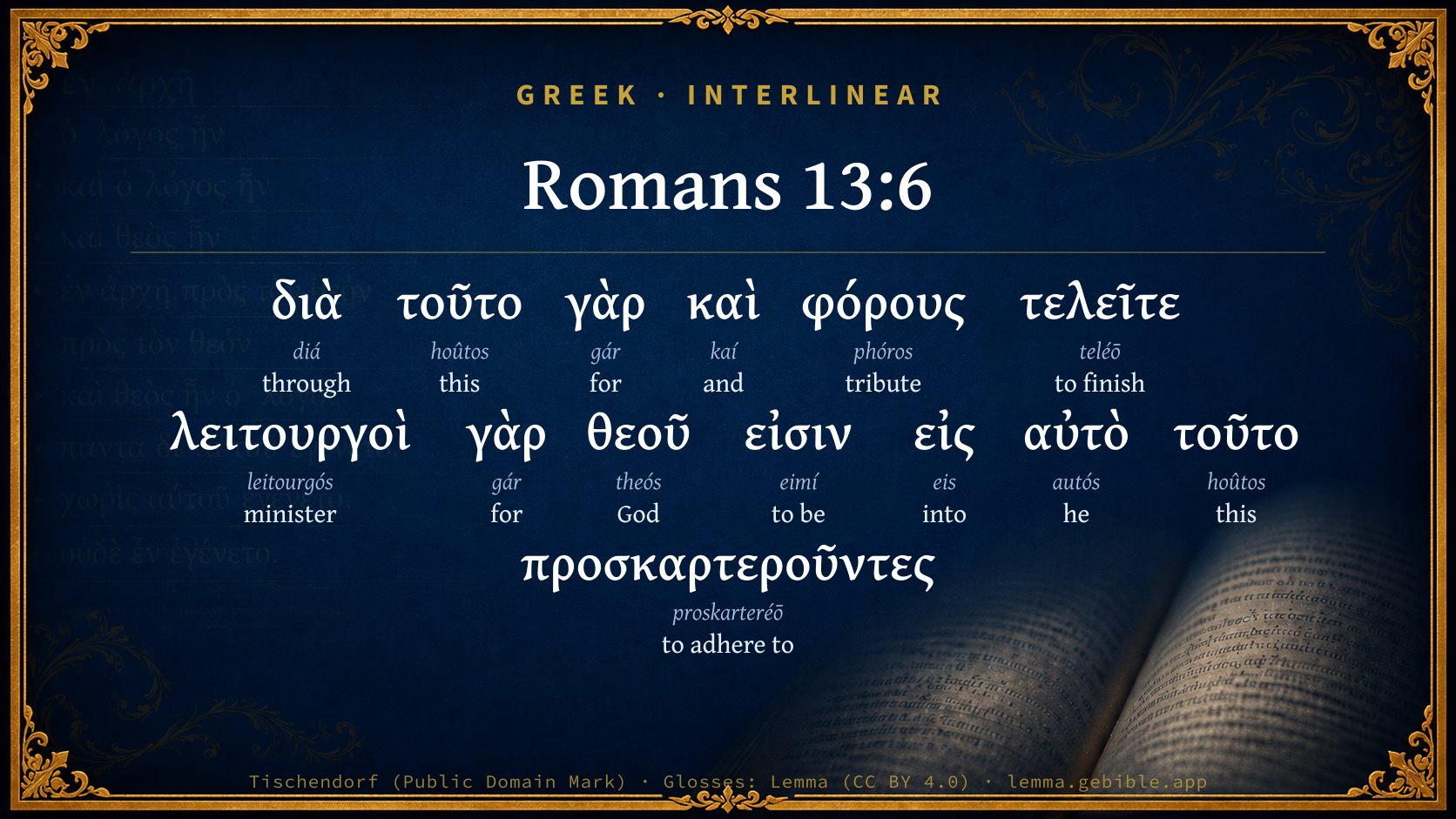
Greek (Tischendorf 8th ed.) Romans 13:6 appears in the Greek New Testament. The text above is from the Tischendorf 8th edition. Each word links to its Strong’s number and a concise gloss. Click any word for its full Thayer’s Greek Lexicon entry.
Download image
Cite this verse

Romans 13:6 (World English Bible). Public Domain. Lemma interlinear Bible study tool, https://lemma.gebible.app/v/romans/13/6.

Show BibTeX & RIS
BibTeX
RIS
English Translation
For this reason you also pay taxes, for they are ministers of God's service, attending continually on this very thing.
World English Bible · Public Domain
Highlights
  • 1 first appearance in the Greek New Testament
Full analysis ↓
Download a study sheet

One document with this verse’s original text, its word-by-word gloss line, the meaning frame, cross-references with their text, attributed commentary, and full source and license credits — printable, and it pastes into notes with its structure intact.

This verse Autodidact and up

Study sheet (.html) Plain text (.txt)

A passage Seminary Student

Up to 50 verses in one chapter. A passage sheet keeps up to 6 commentary sources and 12 cross-references per verse, in the order this page ranks them, and says so on the sheet whenever that leaves anything out. Ask for a single verse and you get the Autodidact verse sheet above.

Everything on this page stays free to read, with no account — the sheet is a download of what is already on screen, not access to it.

Want to remove ads? Support Godless Engineer
Compare translations 3

The same verse in 3 English versions, stacked beneath the original-language interlinear above. Click any original word for its lexicon entry.

Each is an independent rendering of the whole verse — the interlinear is not word-aligned to these translations.

Highlighted words mark where these versions differ — a whole-verse word diff, not a word-by-word alignment.

  • World English Bible Public Domain
    For this reason you also pay taxes, for they are ministers of God's service, attending continually on this very thing.
  • King James Version Public Domain
    For for this cause pay ye tribute also: for they are God's ministers, attending continually upon this very thing.
  • unfoldingWord Literal Text CC BY-SA 4.0
    For because of this you pay taxes also; for they are servants of God, persisting in this very thing.

unfoldingWord Literal Text — © unfoldingWord, licensed CC BY-SA 4.0. Word-aligned USFM3 via Door43 (git.door43.org/unfoldingWord/en_ult).

Versions to compare (up to 4)

3 of 4 selected

Show all 19 translations

Every available English version of this verse, each an independent rendering of the whole verse.

  • World English Bible Public Domain
    For this reason you also pay taxes, for they are ministers of God's service, attending continually on this very thing.
  • Berean Standard Bible Public Domain
    This is also why you pay taxes. For the authorities are God’s servants, who devote themselves to their work.
  • Majority Standard Bible Public Domain
    This is also why you pay taxes. For the authorities are God’s servants, who devote themselves to their work.
  • King James Version Public Domain
    For for this cause pay ye tribute also: for they are God's ministers, attending continually upon this very thing.
  • American Standard Version (1901) Public Domain
    For this cause ye pay tribute also; for they are ministers of God's service, attending continually upon this very thing.
  • Revised Version (1885) Public Domain
    For for this cause ye pay tribute also; for they are ministers of God’s service, attending continually upon this very thing.
  • Geneva Bible (1599) Public Domain
    For, for this cause ye pay also tribute: for they are Gods ministers, applying themselues for the same thing.
  • Douay-Rheims (1899) Public Domain
    For therefore also you pay tribute. For they are the ministers of God, serving unto this purpose.
  • Young's Literal Translation Public Domain
    for because of this also pay ye tribute; for servants of God they are, on this very thing attending continually;
  • Literal Standard Version CC BY-SA 4.0
    for because of this you also pay tribute; for they are servants of God, on this very thing attending continually;
  • Unlocked Literal Bible CC BY-SA 4.0
    Because of this you pay taxes also. For authorities are servants of God, who attend to this very thing continually.
  • unfoldingWord Literal Text CC BY-SA 4.0
    For because of this you pay taxes also; for they are servants of God, persisting in this very thing.
  • Darby Bible Public Domain
    For on this account ye pay tribute also; for they are God's officers, attending continually on this very thing.
  • World Messianic Bible Public Domain
    For this reason you also pay taxes, for they are servants of God’s service, continually doing this very thing.
  • Webster's Bible Public Domain
    For, for this cause ye pay tribute also: for they are God's ministers, attending continually upon this very thing.
  • Free Bible Version CC BY-SA 4.0
    That's why you have to pay taxes, for the authorities are God's servants taking care of such things.
  • Bible in Basic English Public Domain
    For the same reason, make payment of taxes; because the authority is God's servant, to take care of such things at all times.
  • Text-Critical English NT CC BY 4.0
    That is also why you pay taxes, for the authorities are servants of God, attending continually to this work.
  • Tyndale New Testament (1534) Public Domain
    And even for this cause paye ye tribute. For they are goddes ministers servynge for the same purpose.

Literal Standard Version (2020), Covenant Press — licensed CC BY-SA 4.0. Text via the HelloAO Bible API (eBible.org). Unlocked Literal Bible (unfoldingWord) — licensed CC BY-SA 4.0. Text via the HelloAO Bible API (eBible.org). unfoldingWord Literal Text — © unfoldingWord, licensed CC BY-SA 4.0. Word-aligned USFM3 via Door43 (git.door43.org/unfoldingWord/en_ult). Free Bible Version, Dr. Jonathan Gallagher — licensed CC BY-SA 4.0. Text via the HelloAO Bible API (eBible.org).

Word by word

More ways to search: Search by grammar → Find every occurrence → Compare this word →

Practice this passage: Drill this verse → Learn its vocabulary →

φόρους
phóros
G5411
“tribute”
Noun, Accusative, Plural, Masculine
Part of Speech
Noun
Case
Accusative
Number
Plural
Gender
Masculine
Full Thayer's Definition

Origin: from G5342

TDNT: 10:18,1

1. tribute, esp. the annual tax levied upon houses, lands, and persons
  1. διὰ diá G1223 “through” Preposition
  2. τοῦτο hoûtos G3778 “this” Demonstrative pronoun, Accusative, Singular, Neuter
  3. γὰρ gár G1063 “for” Conjunction
  4. καὶ kaí G2532 “and” Conjunction
  5. τελεῖτε teléō G5055 “to finish” Verb, Present, Active, Indicative, 2nd person, Plural
  6. λειτουργοὶ leitourgós G3011 “minister” Noun, Nominative, Plural, Masculine
  7. γὰρ gár G1063 “for” Conjunction
  8. θεοῦ theós G2316 “God” Noun, Genitive, Singular, Masculine
  9. εἰσιν eimí G1510 “to be” Verb, Present, Active, Indicative, 3rd person, Plural
  10. εἰς eis G1519 “into” Preposition
  11. αὐτὸ autós G846 “he” Personal pronoun, Accusative, Singular, Neuter
  12. τοῦτο hoûtos G3778 “this” Demonstrative pronoun, Accusative, Singular, Neuter
  13. προσκαρτεροῦντες proskarteréō G4342 “to adhere to” Verb, Present, Active, Participle, Nominative, Plural, Masculine

About this verse

These counts appear in no published source. They are computed here, from the morphology-tagged text and Lemma’s own curated glosses. What Lemma adds →

14
words
12
distinct lemmas
Pauline Epistles
section

Notable vocabulary

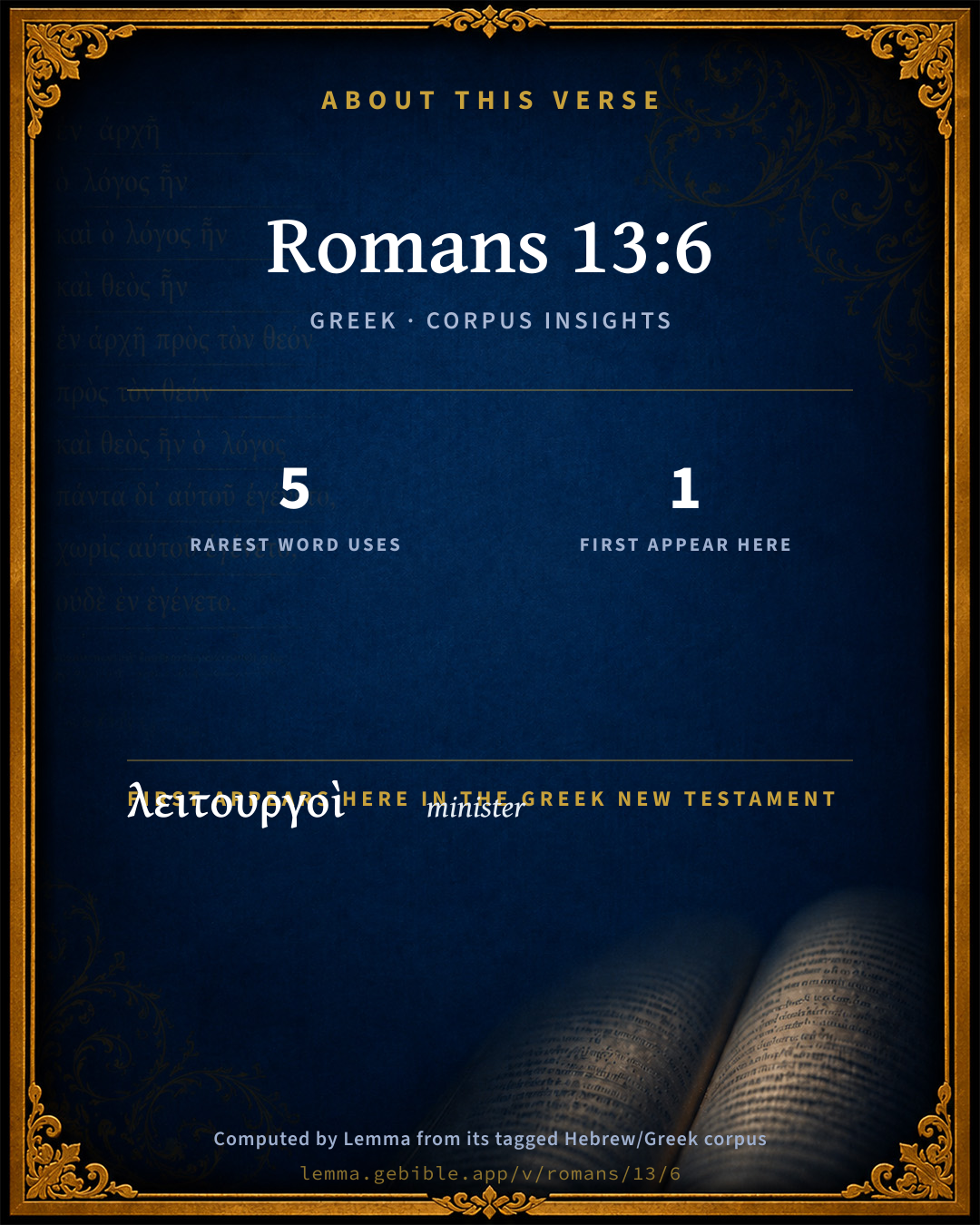
The rarest word here is φόρους tribute G5411 — appearing just 5 times in the whole Greek New Testament.

First appearance in Scripture

This word makes its first canonical appearance in the Greek New Testament here:

  • λειτουργοὶ minister G3011

Shared distinctive vocabulary

φόρους tribute G5411 occurs in 4 verses of the Greek New Testament. Also found in:
Repetition

Words recur within this verse:

  • τοῦτο this G3778 ×2
  • γὰρ for G1063 ×2

Cross-references

16

Topical passages linked to Romans 13:6 in the Treasury of Scripture Knowledge — connected by theme and wording, ordered by reader-vote popularity; previews shown in the World English Bible.

  • Matthew 22:17–21 Tell us therefore, what do you think? Is it lawful to pay taxes to Caesar, or not?"
  • Luke 20:21–26 They asked him, "Teacher, we know that you say and teach what is right, and aren't partial to anyone, but truly teach the way of God.
  • Luke 23:2 They began to accuse him, saying, "We found this man perverting the nation, forbidding paying taxes to Caesar, and saying that he himself is Christ, a king."
  • Matthew 17:24–27 When they had come to Capernaum, those who collected the didrachma coins came to Peter, and said, "Doesn't your teacher pay the didrachma?"
  • Mark 12:14–17 When they had come, they asked him, "Teacher, we know that you are honest, and don't defer to anyone; for you aren't partial to anyone, but truly teach the way of God. Is it lawful to pay taxes to Caesar, or not?
  • 1 Chronicles 18:14 David reigned over all Israel; and he executed justice and righteousness to all his people.
  • Exodus 18:13–27 It happened on the next day, that Moses sat to judge the people, and the people stood around Moses from the morning to the evening.
  • Deuteronomy 1:9–17 I spoke to you at that time, saying, I am not able to bear you myself alone:
  • 2 Samuel 8:5 When the Syrians of Damascus came to help Hadadezer king of Zobah, David struck of the Syrians two and twenty thousand men.
  • Ezra 4:13 Be it known now to the king that if this city is built, and the walls finished, they will not pay tribute, custom, or toll, and in the end it will be hurtful to the kings.
  • Ezra 4:20 There have been mighty kings also over Jerusalem, who have ruled over all [the country] beyond the River; and tribute, custom, and toll, was paid to them.
  • Ezra 6:8 Moreover I make a decree what you shall do to these elders of the Jews for the building of this house of God: that of the king's goods, even of the tribute beyond the River, expenses be given with all diligence to these men, that they be not hindered.
  • Nehemiah 5:4 There were also that said, We have borrowed money for the king's tribute [on] our fields and our vineyards.
  • Job 29:7–17 When I went forth to the city gate, When I prepared my seat in the street,
  • Romans 12:8 or he who exhorts, to his exhorting: he who gives, let him do it with liberality; he who rules, with diligence; he who shows mercy, with cheerfulness.
  • 1 Samuel 7:16–17 He went from year to year in circuit to Bethel and Gilgal, and Mizpah; and he judged Israel in all those places.

Cross-references courtesy of OpenBible.info (CC BY 4.0).

Commentary

Notes on Romans 13:6 from classic Christian and Jewish commentators (each source and its license shown beneath its notes). The classic Christian expositions comment on the surrounding passage and are grouped to its opening verse, so a note may address several verses; the Jewish commentaries on the Tanakh (Rashi and others) are per-verse, so they appear only where the commentator wrote on this verse.

Lemma curates 59 commentaries, every one of them public domain or Creative Commons licensed, each selected and text-cleaned for this edition rather than reprinted as found. About our sources →

Joseph Benson's Commentary

Rom 13:6. For this cause pay ye tribute also — Not only in token of the duty and subjection you owe them, but because they are the ministers (officers) of God — For the public good; attending continually on this very thing — Giving the whole of their time, care, and labour to it. “The phrase, λειτουργοι Θεου, rendered ministers of God, signifies ministers appointed by God in behalf of the people. The thing to which the magistrates attend, or ought to attend continually, is the good of the people; which they should promote by restraining evil-doers, distributing justice, and repelling the attacks of foreign enemies. Now these things they cannot do, unless taxes are paid to them.”

Joseph Benson's Commentary on the Old and New Testaments (1811–1818) — public domain. Text from a community e-Sword module.

Tyndale Open Study Notes

Tyndale Open Resources

13:6 Pay your taxes: Jesus referred to paying taxes in his famous pronouncement about the disciples’ relationship to government (Matt 22:21). A tax revolt occurred in Rome at about the time that Paul was writing, so Paul’s whole discussion of the Christian’s responsibility to government might have been sparked by his knowledge that Roman Christians were participating in this tax revolt (see Tacitus, Annals 13).

Tyndale Open Study Notes — © Tyndale Open Resources, licensed CC BY-SA 4.0. Text via the HelloAO Bible API.

Bengel's Gnomon

Johann Albrecht Bengel

Rom 13:6. Λειτουργοὶ, ministers) The ministry and the magistracy are adorned with the same titles. So Rom 13:4, διάκονος, comp. Isa 44:28; Jer 25:9.—προσκαρτεροῦντες, [attending continually] persevering) O that all men would do so rightly.

Bengel's Gnomon of the New Testament — English translation (T&T Clark, Edinburgh, 1860) — public domain. Text from a community e-Sword module.

Meyer's Critical & Exegetical Commentary

Heinrich August Wilhelm Meyer

Rom_13:6. For on this account you pay taxesthis is the confirmation of Rom_13:5, from the actually subsisting payment of taxes; γάρ retains its sense assigning a reason, and the emphatic διὰ τοῦτο (from this ground) is exactly in accordance with the context: ὅτι οὐ μόνον διὰ τὴν ὀργὴν, ἀλλὰ καὶ διὰ τὴν συνείδησιν ἀνάγκη ἐστιν ὑποτάσσεσθαι. At the basis of the argument lies the view, that the existing relation of tax-paying is a result of the necessity indicated in Rom_13:5, and consequently the confirmation of it. If διὰ τοῦτο be referred to Rom_13:1-4 : ut magistratus Dei mandatu homines maleficos puniant, proborum saluti prospiciant, Fritzsche (comp. Calvin, Tholuck, de Wette, Borger), Rom_13:5 is arbitrarily passed over. It follows, moreover, from our passage, that the refusal of taxes is the practical rejection of the necessity stated in Rom_13:5. Others take τελεῖτε as imperative (Heumann, Morus, Tholuck, Klee, Reiche, Köllner, Hofmann). Against this the γάρ, which might certainly be taken with the imperative (see on Rom_6:19), is not indeed decisive; but Paul himself gives by his οὖν, Rom_13:7, the plain indication that he is passing for the first time in Rom_13:7 to the language of summons, which he now also introduces, not with the present, but with the aorist.

καί] also denotes the relation corresponding to Rom_13:5. It is not a downward climax (Hofmann: even this most external performance of subjection), of which there is no indication at all either in the text or in the thing itself. The latter is, on the contrary, the immediate practical voucher most accordant with the experience of every subject.

τελεῖτε] Paul does not in this appeal to his readers own recognition of what was said in Rom_13:5 (the summons in Rom_13:7 is opposed to this), but to what subsists as matter of fact.

λειτουργοὶ γὰρ Θεοῦ κ.τ.λ.] justifies the fundamental statement, expressed by διὰ τοῦτο, of the actual bearing of the payment of taxes: for they are ministering servants of God, persevering in activity on this very behalf (on no other). The thought in Rom_13:4, that the magistracy is Θεοῦ διάκονος, is here by way of climax more precisely defined through λειτουργοί (which is therefore prefixed with emphasis) according to the official sacredness of this relation of service, and that conformably to the Christian view of the magisterial calling. Accordingly, those who rule, in so far as they serve the divine counsel and will, and employ their strength and activity to this end, are to be regarded as persons whose administration has the character of a divinely consecrated sacrificial service, a priestly nature (Rom_15:16; Php_2:17, et al.). This renders the proposition the more appropriate for confirmation of the διὰ τοῦτο κ.τ.λ., which is a specifically religious one.

λειτουργοὶ Θεοῦ is predicate, and the subject is understood of itself from the context: they, namely magisterial persons (οἱ ἄρχοντες). Incorrectly as regards linguistic usage, Reiche, Köllner, Olshausen take προσκαρτ. to be the subject, in which case certainly the article before the participle would be quite indispensable (Reiche erroneously appeals to Mat_20:16; Mat_22:14).

εἰς αὐτὸ τοῦτο] Telic direction not of λειτουργ. (Hofmann), but of προσκαρτ.: for this very object, by which is meant not the administration of tax-paying (Olshausen, Philippi, and older interpreters), but the just mentioned λειτουργεῖν τῷ Θεῷ, in which vocation, so characteristically sacred, the magistracy is continually and assiduously active, and the subject gives to it the means of being so, namely, taxes. Thus the payment of taxes is placed by Paul under the highest point of view of a religious conscientious duty, so that by means of it the divine vocation of the magistracy to provide a constantly active sacrificial cultus of God is promoted and facilitated. If εἰς αὐτὸ τοῦτο was to be referred to the administration of taxes, this would not indeed be nonsensical (Hofmann), but the emphatic mode of expression αὐτὸ τοῦτο would be without due motive, nor could we easily perceive why Paul should have selected the verb προσκαρτ., which expresses the moral notion perseverare. The reference of it to the nearest great thought, λειτουργοὶ κ.τ.λ., excludes, the more weighty and appropriate that it is, any other reference, even that of Hofmann, that αὐτὸ τοῦτο points back to the same proposition as διὰ τοῦτο.

Instead of εἰς αὐτὸ τοῦτο, Paul might have said αὐτῷ τούτῳ (Rom_12:12); he has, however, conceived προσκαρτ. absolutely, and given with εἰς the definition of its aim. Comp. on the absolute προσκατερεῖν, Num_13:20; Xen. Hell. vii. 5, 14.

Meyer — Critical and Exegetical Commentary on the New Testament — English translation by Peter Christie, edited by Frederick Crombie (T&T Clark, 1880) — public domain. Text from a community e-Sword module.

Hodge's Commentary on Romans, Ephesians & First Corinthians

Charles Hodge

Rom_13:6

For, for this cause, pay ye tribute also. This verse may be connected, by the words (διὰ τοῦτο) rendered for this cause, with the preceding, thus, Wherefore (i.e., for conscience sake) ye should pay tribute also. But it is better to consider this clause as containing an inference from the foregoing exhibition of the nature and design of civil government: Since civil government is constituted for the benefit of society, for the punishment of evil doers and for the praise of those that do well, ye should cheerfully pay the contributions requisite for its support.

For they are the ministers of God, attending continually on this very thing. This clause introduces another reason for the payment of tribute. They, not the tax-gatherers, but οἱ ἄρχοντες, the rulers, to whom the tribute is due. Magistrates are not only appointed for the public good, but they are the ministers of God, and consequently it is his will that we should contribute whatever is necessary to enable them to discharge their duty. The word (λειτουργοί) rendered ministers, means public servants, men appointed for any public work, civil or religious. Among the Greek democratical states, especially at Athens, those persons were particularly so called, who were required to perform some public service at their own expense. It is used in Scripture in a general sense, for Servants or ministers, Rom_15:16; Heb_1:7; Heb_8:2. The words εἰς αὐτὸ τοῦτο, to this very thing, may refer to tax-gathering. The magistrates are divinely commissioned, or authorized to collect tribute. This is necessary to the support of government; and government being a divine institution, God, in ordaining the end, has thereby ordained the means. It is because magistrates, in the collection of taxes, act as the λειτουργοὶ θεοῦ, the executive officers of God, that we are bound to pay them. Others make the αὐτὸ τοῦτο refer to the λειτουργία, or service of God, which is implied in magistrates being called λειτουργοί. They are the ministers of God attending constantly to their ministry. The former interpretation is the more consistent with the context.

Charles Hodge — Commentary on Romans (1835), First Corinthians (1857), and Ephesians (1856) — public domain. Text from a community e-Sword module.

Geneva Bible (1599)

Geneva Bible translators

He reckoneth up the chiefest things wherein consisteth the obedience of subjects.

Geneva Bible (1599) marginal notes — public domain. Text via Bolls.life.

Jamieson, Fausset & Brown

Robert Jamieson, A. R. Fausset & David Brown

For, for this cause pay ye--rather, "ye pay"

tribute also--that is, "This is the reason why ye pay the contributions requisite for maintaining the civil government."

for they are God's ministers, attending continually upon this very thing--"to this very thing."

Jamieson, Fausset & Brown — Commentary Critical and Explanatory on the Whole Bible (1871) — public domain (CC PDM 1.0). Text via the HelloAO Bible API.

Adam Clarke's Commentary

Verse 6. For this cause pay ye tribute also] Because civil government is an order of God, and the ministers of state must be at considerable expense in providing for the safety and defence of the community, it is necessary that those in whose behalf these expenses are incurred should defray that expense; and hence nothing can be more reasonable than an impartial and moderate taxation, by which the expenses of the state may be defrayed, and the various officers, whether civil or military, who are employed for the service of the public, be adequately remunerated. All this is just and right, but there is no insinuation in the apostle's words in behalf of an extravagant and oppressive taxation, for the support of unprincipled and unnecessary wars; or the pensioning of corrupt or useless men. The taxes are to be paid for the support of those who are God's ministers-the necessary civil officers, from the king downwards, who are attending CONTINUALLY on this very thing. And let the reader observe, that by God's ministers are not meant here the ministers of religion, but the civil officers in all departments of the state.

Adam Clarke's Commentary on the Bible (1810–1826) — public domain. Text from a community e-Sword/MySword module.

John Calvin's Commentaries

6. For this reason also, etc. He takes occasion to introduce the subject of tributes, the reason for which he deduces from the office of magistrates; for if it be their duty to defend and safely preserve the peace of the good, and to resist the mischievous attempts of the wicked, this they cannot do unless they are aided by sufficient force. Tributes then are justly paid to support such necessary expenses. But respecting the proportion of taxes or tributes, this is not the place to discuss the subject; nor does it belong to us either to prescribe to princes how much they ought to expend in every affair, or to call them to an account. It yet behooves them to remember, that whatever they receive from the people, is as it were public property, and not to be spent in the gratification of private indulgence. For we see the use for which Paul appoints these tributes which are to be paid — even that kings may be furnished with means to defend their subjects.

John Calvin's Commentaries (1540-1563) — public domain. Text from the Calvin Translation Society English edition (1840s-50s) via the Christian Classics Ethereal Library (ccel.org). Calvin's coverage is partial (roughly two-thirds of the Bible); uncommented books and verses are honest gaps, never fabricated. The 19th-century editor's footnotes and remarks are omitted so the notes are faithfully Calvin's own voice.

Ellicott's Commentary for English Readers

(6) Ministers.—The words thus translated here and in Rom_13:4 are not the same, but both are words commonly used in the New Testament of a sacred office; that in Rom_13:4 is the original of our word “deacon,” that used in this verse is (in another form) the original of our word “liturgy.” The choice of such terms harmonises with the conception which is presented in this chapter of the divine origin and character of the state system.

A Bible Commentary for English Readers, edited by Charles John Ellicott (1878–1897) — public domain. Text from a community e-Sword module.

The Cambridge Bible for Schools and Colleges

gen. ed. J. J. S. Perowne

6. The passage assumes, of course, that where human law, or its minister, contradicts Divine precepts, (as when a Christian is commanded to do wrong,) then obedience to the Higher Authority must take precedence. Christian officials, for instance, under a despot must not plot against him, but also must not do wrong for him.

6. for this cause] i.e. because of “the conscience” that they are God’s appointed agency, and act in His name when they demand contributions for the public revenues, which are a vital part of the machinery of civil order.

tribute] taxes.

attending continually] persevering in, “devoting themselves to.” Same word as e.g. Rom_12:12, (“continuing instant.”) The word points to government as the life-work of the governor; a thing not of pride or privilege so much as of incessant duty.

upon this very thing] Better, with a view to this very thing; i.e., probably, “with a view to the service of God.” The governor may not consciously “serve God” in his office; but in his office he does a work which is “the ordinance of God,” and must be recognized as such by Christian subjects.—To refer the words “this very thing” to taxes, or tax-gathering, is to limit what is evidently a solemn summary clause, and greatly to lessen its intended weight.

The Cambridge Bible for Schools and Colleges (gen. ed. J. J. S. Perowne; Cambridge University Press, 1878–1918) — public domain. Text from a community e-Sword module.

John Gill's Exposition

For, for this cause pay you tribute also,.... To show that we are subject to the higher powers, and as a proof and evidence of our subjection to them, we do and ought to pay tribute to them, to support them in their office and dignity; and this is done not for fear of trouble, of distress on goods and estate, or imprisonment of person, but for conscience sake: payment of taxes is not a mere matter of prudence, and done to avoid dangerous consequence, but is and ought to be a case of conscience; whatever is anyone's due, and of right belongs to him, conscience dictates it ought to be paid him; as therefore it tells a man, that whatever is God's should be rendered to him, so whatever is Caesar's, should be given him; and indeed to do otherwise, to refuse to pay tribute, or by any fraudulent means to deprive the civil magistrate of his due, is not only to do an injury to him, but to the whole body politic, which has a greater concern therein than he himself; and such a person forfeits all right and claim to his protection:

for they are God's ministers. This is another reason why tribute should be paid them, not only to testify subjection to them, and keep conscience clear, but because they are called unto, and put into this high office by God; for promotion to such honour and high places comes not from east, west, north, or south; but is by the providence of God, who puts down, and sets up at pleasure; they are his vicegerents, they act under him, are in his stead, and represent his majesty; and therefore, in some sort, what is done to them is done to him:

attending continually upon this very thing; not of laying, collecting, and receiving tribute, but of service and ministry under God, for the welfare of their subjects; for rightly to administer the office of magistracy requires great pains, care, diligence, and assiduity; and as great wisdom and thoughtfulness in making laws for the good of the body, so a diligent constant concern to put them in execution, to secure the lives of subjects from cut throats and murderers, and their properties and estates from thieves and robbers; and they are not only obliged diligently to attend to such service at home, but to keep a good lookout abroad, and penetrate into, and watch the designs of foreign enemies, to defend from their invasions, and fight for their country; that the inhabitants thereof may live peaceable and quiet lives, enjoying their respective rights and privileges; and since therefore civil government is a business of so much care, and since our rulers are so solicitous, and constantly concerned for our good, and which cannot be done without great expense, as well as diligence, we ought cheerfully to pay tribute to them.

John Gill's Exposition of the Whole Bible (1746–1763) — public domain (CC PDM 1.0). Text via the HelloAO Bible API.

Trapp's Complete Commentary

John Trapp

6 For for this cause pay ye tribute also: for they are God’s ministers, attending continually upon this very thing.

Ver. 6. Attending continually] As born for the benefit of many. The Parliament in the 25 Edward III is known to posterity by the name of Benedictam Parliamentum, Blessed Parliament. So shall this present Parliament (A.D. 1646) for their continual attendance upon the Lord’s work, bending themselves to the business (as the word προσκαρτερουντες signifies) and holding out therein with unparalleled patience.

John Trapp, A Commentary or Exposition upon All the Books of the Old and New Testament (1647–1656) — public domain. Text from a community e-Sword module.

Albert Barnes' Notes on the Bible

For this cause - Because they are appointed by God; for the sake of conscience, and in order to secure the execution of the laws. As they are appointed by God, the tribute which is needful for their support becomes an act of homage to God, an act performed in obedience to his will, and acceptable to him.

Tribute also - Not only be subject Rom 13:5, but pay what may be necessary to support the government. “Tribute” properly denotes the “tax,” or annual compensation, which was paid by one province or nation to a superior, as the price of protection, or as an acknowledgment of subjection. The Romans made all conquered provinces pay this “tribute;” and it would become a question whether it was “right” to acknowledge this claim, and submit to it. Especially would this question be agitated by the Jews and by Jewish Christians. But on the principle which the apostle had laid down Rom 13:1-2, it was right to do it, and was demanded by the very purposes of government. In a larger sense, the word “tribute” means any tax paid on land or personal estate for the support of the government.

For they are God’s ministers - His servants; or they are appointed by him. As the government is “his” appointment, we should contribute to its support as a matter of conscience, because we thus do honor to the arrangement of God. It may be observed here, also, that the fact that civil rulers are the ministers of God, invests their character with great sacredness, and should impress upon “them” the duty of seeking to do his will, as well as on others the duty of submitting to them.

Attending continually - As they attend to this, and devote their time and talents to it, it is proper that they should receive a suitable support. It becomes then a duty for the people to contribute cheerfully to the necessary expenses of the government. If those taxes should be unjust and oppressive, yet, like other evils, they are to be submitted to, until a remedy can be found in a proper way.

Albert Barnes' Notes on the Bible (1834–1885) — public domain. Text from a community e-Sword/MySword module.

Matthew Poole's English Annotations

For this cause, i.e. in token, or in testimony, of that subjection you owe to magistracy,

pay ye tribute: the word is plural in the original, and thereby is intended all taxes and burdens, which are legally and customarily imposed.

For they are God’s ministers, attending continually upon this very thing: this is a reason why tribute should be paid to rulers; but it is for the support of their authority, and a due recompence for their great care and industry. When he says, they attend

continually upon this very thing, the meaning is not, they attend always upon the receiving of tribute; but it is to be understood of the duty of magistrates, which is, to be continually promoting the good and welfare of their subjects; to encourage the good, and punish the evil-doer, which is the very thing he had been before speaking of.

Matthew Poole's English Annotations on the Holy Bible (1683–1685) — public domain. Text from a community e-Sword/MySword module.

Whedon's Commentary on the Bible

Daniel D. Whedon

6. For this cause—From the fact that government is of divine authority.

Pay ye tribute—Primarily, the payment imposed upon us by a foreign power, such as the Romans over the Jews. Secondarily, it means the tax necessary to the support of government.

Attending continually— Spending their time and abilities in the very business of government, and therefore entitled to support.

Daniel D. Whedon (gen. ed.), Commentary on the Old and New Testaments (1874–1909) — public domain. Text from a community e-Sword module.

The Pulpit Commentary

For for this cause ye pay (so, rather than, as in the Authorized Version, pay ye. The gar suggests this interpretation. So in the Vulgate, ideo enim et tributa praestatis. The Christians, we may suppose, did pay all legal dues and taxes; it was a recognized principle that they were bound to do so; perhaps because of Christ himself having settled the question in his dictum about the tribute-money. (Mat_22:21) And what the apostle means may be that the same principle on which they paid their taxes extended to all legal requirements) tribute also: for they (i.e. the officers who exact tribute) are God"s ministers (not, as in ver. 4, diakonoi , but leitourgoi . This word, with its correlatives, is used in the New Testament especially with reference to the ceremonial services of the temple, and to their counterpart in Christian devotion; but not exclusively so. (see Rom_15:27 Php_2:25) In classical Greek it denotes peculiarly persons performing public duties, or works of public use. This well-known use of the word may have suggested it here, the apostle meaning to say that such as in any such way served the state were in fact serving God, attending continually upon this very thing; i.e. on leitourgia for God.

The Pulpit Commentary (1880–1919), ed. H.D.M. Spence-Jones & Joseph S. Exell — public domain. Text from a community e-Sword module.

John Wesley's Explanatory Notes

For this cause - Because they are the ministers (officers) of God for the public good. This very thing - The public good.

John Wesley, Explanatory Notes Upon the Whole Bible (1754–1765) — public domain. Text via the GEBible commentary corpus.

Burkitt's Expository Notes on the New Testament

William Burkitt

From the duty of subjection unto magistrates, the apostle proceeds to urge and enforce the duty and necessity of paying tribute to them, or allowing them an honourable maintenance, for and towards the support of the government which they sustain and bear. The payment of taxes and tribute to the supreme magistrate is necessary upon several accounts:

1. As it is an acknowledgment of the power which God hath set over us.

2. As it tends to the support of the government which we live under.

3. As it is a small recompence for the governor’s continual care and industry, he attending, that is, watching perpetually, and taking pains continually, for procuring and maintaining the good and happiness of his subjects; and therefore both duty and obligation, both religion and gratitude, do bind and engage us to aid and assist him, and, so far as it is in our power, to requite and reward him for his care of the common safety, and regard to the public good.

William Burkitt's Expository Notes on the New Testament (1700–1703) — public domain. Text from a community e-Sword module.

McGarvey & Pendleton's Commentaries

J. W. McGarvey

For [epexigetic, introducing a detail or illustrative fact proving the principle] for this cause ye pay tribute also [i. e., among other acts of submission]; for they [the recipients of the taxes] are ministers of God's service, attending continually upon this very thing . [I. e., acting continually as servants of God in his civil administrations. The apostle cites the conduct of subjects in the payment of taxes, for no matter what theories the Jews or the Judaistic Christians might have as to the rights of government to his allegiance, he never failed to pay his taxes, being moved thereby by the very influences here named by the apostle; viz., fear and conscience. He feared the penal consequences of refusing to pay, and he conscientiously felt that the government deserved some compensation for maintaining peace and order, especially since, as Paul notes, they made this their business, gave their whole time to it, and made no other provision for their livelihood than their salaries as public functionaries, all of which is implied in "attending continuously," etc. Christians in our age have well-nigh universally forgotten that the tax assessor and the tax collector are ministers of God, and many evade making true returns with as little compunction as they would were the tax officials the servants of the devil. This sin has become so universal that it is well-nigh regarded as a virtue.]

J. W. McGarvey (with Philip Y. Pendleton), Commentaries on the New Testament (The Fourfold Gospel, 1914; Acts; and the epistles) — public domain. Text from a community e-Sword/MySword module.

The People's New Testament

B. W. Johnson

6, 7. For this cause pay ye tribute also. Taxes. The taxes gathered from the Roman provinces were called tribute. As the rulers are God's ministers, his agents to attend to necessary duties, it is right that they should be supported.

B. W. Johnson's The People's New Testament with Notes (1889–1891) — public domain. Electronic text from the Christian Classics Ethereal Library (CCEL) ThML edition.

unfoldingWord translationNotes

Door43 World Missions Community

Because of this

"Because the government punishes evildoers"

you ... Pay to everyone

Paul is addressing the believers here. (See: Forms of You)

For authorities

"This is why you should pay taxes: authorities"

attend to

"administer" or "work on"

Tax to whom tax is due, toll to whom toll is due; fear to whom fear is due, honor to whom honor is due.

The word "Pay" is understood from the previous sentence. AT: "Pay tax to whom tax is due and toll to whom toll is due. Pay fear to whom fear is due and honor to him to whom honor is due" (See: Ellipsis)

fear to whom fear is due, honor to whom honor is due

Here paying fear and honor is a metaphor for fearing and honoring those who deserve to be feared and honored. AT: "Fear those who deserve to be feared, and honor those who deserved to be honored" or "Respect those whom you ought to respect, and honor those whom you ought to honor" (See: Metaphor)

toll

This is a kind of tax.

translationWords

tax

authority

servant

fear

honor

unfoldingWord translationNotes — © Distant Shores Media and the Door43 World Missions Community, licensed CC BY-SA 4.0. Source: git.door43.org/Door43/en_tn.

Cambridge Greek Testament for Schools and Colleges

6. φόρους. Luk 20:22; Luk 23:2 only, direct taxes on persons, houses or land. τέλος of customs, taxes on trades.

λειτουργοί, of public service or office; here as administering public functions committed to them by GOD: the connexion of the word with public service of religion is secondary.

εἰς αὐτὸ τοῦτο, to this very end, i.e. of securing social order and obedience, τὸ ὑποτάσσεσθαι.

προσκαρτεροῦντες, absol.: cf. Act 2:46.

Cambridge Greek Testament for Schools and Colleges (Cambridge University Press, 1896; 21 vols, various authors incl. Carr, Maclear, Plummer, Farrar, Lumby, Moule, M. R. James, Simcox) — public domain. Text from a community e-Sword module.

Alford’s Greek Testament

Henry Alford

6.] διὰ τοῦτο … καί is parallel with διό, ver. 5,—giving another result of the divine appointment of the civil power;—not dependent on ver. 5.

τελεῖτε is indicative, not imperative: the command follows ver. 7.

For they (the ἄρχοντες) are ministers of God, attending upon this very duty, viz. λειτουργεῖν,—hardly (as Koppe, Olsh., Meyer) φόρους τελεῖν, for in ver. 7 the Apostle has evidently in view the whole official character of these λειτουργοί. Reiche, al., construe, “For those who wait upon this very thing are ministers of God,” which would require οἱ εἰς αὐτ. τ. προσκ.:—Koppe, ‘For λειτουργοί are of God:’—but this again would require οἱ γὰρ λειτ.—Tertullian remarks, Apolog. xlii. vol. i. p. 494, that what the Romans lost by the Christians refusing to bestow gifts on their temples, they gained by their conscientious payment of taxes.

Henry Alford, The Greek Testament (1849–1861) — public domain. Text from a community e-Sword module.

International Critical Commentary

6. διὰ τοῦτο γὰρ καί, sc. διὰ τὴν συνείδησιν: ‘and it is for this reason also.’ St. Paul is appealing to a principle which his readers will recognize. It is apparently an admitted rule of the Christian communities that taxes are to be paid, and he points out that the principle is thus recognized of the moral duty of obeying rulers. That he could thus appeal to a recognized practice seems to imply that the words of our Lord (Luk 20:20-25) had moulded the habits of the early Church, and this suggestion is corroborated by ver. 7 (see the longer note below).

λειτουργοί, ‘God’s ministers.’ Although the word is used in a purely secular sense of a servant, whether of an individual or of a community (1Ki 10:5; Ecclus. 10:2), yet the very definite meaning which λειτουργὸς Θεοῦ had acquired (Ecclus 7:30; Heb 8:2; see especially the note on Rom 15:16) adds emphasis to St. Paul’s expression.

προσκαρτεροῦντες must apparently be taken absolutely (as in Xen. Hell. VII. v. 14), ‘persevering faithfully in their office,’ and εἰς αὐτὸ τοῦτο gives the purpose of the office, the same as that ascribed above to the state. These words cannot be taken immediately with προσκαρτεροῦντες, for that verb, as in 12:13, seems always to govern the dative.

International Critical Commentary — older volumes (1896–1929), various authors — public domain. Text from a community e-Sword module.

Vincent's Word Studies in the New Testament

Marvin R. Vincent

Pay ye tribute [φορους τελειτε] . Teleite ye pay is, literally, ye accomplish or fulfill carrying the sense of the fulfillment of an obligation. Forouv tribute is from ferw to bring something brought. Rev. makes the verb indicative, ye pay.

God 's ministers [λειτουργοι θεου] . See on ministration, Luk 1:23, and ministered, Act 13:2. In ver. 4, diakonov is used for minister. The word here brings out more fully the fact that the ruler, like the priest, discharges a divinely ordained service. Government is thus elevated into the sphere of religion. Hence Rev., ministers of God 's service.

Attending continually. The same word as continuing steadfastly in ch. 12 12.

Marvin R. Vincent, Word Studies in the New Testament (1887–1900) — public domain. Text from a community e-Sword/MySword module.

Godet's Commentaries

Frédéric Louis Godet

Vv. 6, 7. “For it is for this cause also that ye pay tribute; for they are God’s ministers for this very thing, attending thereto continually. Render to all their dues: tribute to whom tribute; custom to whom custom; fear to whom fear; honor to whom honor.”

There is a usage universally practised, and whose propriety no one disputes: that is, the payment of tribute for the support of the state. How are we to explain the origin of such a usage, except by the general conviction of the indispensable necessity of the state? The: for this cause, does not refer specially to the idea of Rom 13:5, but to the whole preceding development from Rom 13:1. The for makes the practical consequence (the payment of tribute) the proof of the principle, and the also refers to the agreement between the general idea and the particular fact. It is unnecessary, therefore, with Hofmann, to make the verb τελεῖτε, ye pay, an imperative: Pay. It is a simple fact which Paul states.

The apostle, to designate the divine character of the state, here uses a still graver term than that of servant, Rom 13:4. He calls him λειτουργός, minister. This term, compounded of the words λαός, people, and ἔργον, work, denotes one who labors for the people, who fills a public office, and with the complement Θεοῦ, of God, a public office in the religious sphere, like the priests and Levites in the theocracy. Among the Jews these divine functionaries were supported by means of the tithe; the same principle, in the view of the apostle, explains the tribute paid by citizens to the state: for the state performs a function for God.

Some have translated: “For ministers are of God.” The meaning is impossible grammatically; it would require the article before λειτουργοί.

The clause which follows: for this very thing, might depend on the participle προσκαρτεροῦντες, applying themselves to. But it is more natural to make it depend on the expression λειτουργοί: “ministers for this very thing”—that is to say, to make justice reign by checking evil and upholding good. Olshausen and Philippi apply the words: for this very thing, to the payment of tribute, which would signify that the state is God’s minister to levy tribute, or that it may watch continually on this levying. Neither the one nor the other of these two ideas rises to the height of the notion of the state as it has just been expounded. This appendix: προσκαρτεροῦντες, attending thereto continually, seems at the first glance superfluous; but it is intended to account for the payment of tribute because the magistrates, devoting their whole time to the maintenance of public order and the well-being of the citizens, cannot themselves provide for their support, and ought consequently to be maintained at the expense of the nation.

Vv. 7. After thus confirming the notion of the state which he has enunciated, the apostle deduces from it some practical applications. Four MSS. reject the therefore, which is read in all the others. We may indeed be content to understand this particle. The imperative render thus becomes somewhat livelier.

Foremost is placed the general obligation which is afterward specified. The verb ἀπόδοτε, render, belongs to the four principal propositions which follow. The verb of the four dependent propositions is understood; it is ὀφείλετε, ye owe, to be taken from the substantive ὀφειλάς: “him to whom ye [owe] tribute, [render] tribute.”—Πᾶσι, to all, denotes all persons in office.

The term, φόρος, tribute, refers to a personal impost, the annual capitation (the tributum); the word is connected with συμφέρειν, to contribute regularly to a common expenditure; the word τέλος, custom, denotes the custom duty on goods (vectigal); it comes from the verb τελεῖν, to pay (occasionally); φόβος, fear, expresses the feeling due to the highest authorities, to supreme magistrates before whom the lictor walks, and who are invested with the power of life and death; τιμή, honor, applies generally to all men in office.

The church did not neglect the faithful discharge of all these obligations. The author of the Epistle to Diognetus, describing in the second century the conduct of Christians during a time of persecution, characterizes it by these two words: “They are outraged, and honor (ὑβρίζονται καὶ τιμῶσι).” The passage, 1Pe 2:13-17, presents, especially in Rom 13:14, a striking resemblance to ours. The Apostle Paul is too original to allow us to suppose that he imitated Peter. Could the latter, on the other hand, know the Epistle to the Romans? Yes, if he wrote from Rome; hardly, if he wrote from Babylon. But it is probable that the two apostles, when they lived together at Jerusalem or Antioch, conversed on a subject so important for the guidance of the church, and so the thoughts, and even the most striking expressions of the Apostle Paul, might have been impressed on the mind of Peter.

From the duty of submission to the state, Paul passes to that of justice in private relations.

Frédéric Louis Godet — Commentaries on Luke, John, Romans, and 1 Corinthians — English translation (T&T Clark, Edinburgh, 1870s–1890s) — public domain. Text from a community e-Sword module.

Lesson kit

Teaching starters — assembled from the data on this page, not authored interpretation. Every prompt links to the verse data it draws on. Edit before teaching.

Romans, in the Pauline Epistles, opens this verse with 14 words (12 distinct Greek lemmas). Its most distinctive word is phóros (“tribute”). A historical commentator’s framing appears above. Read the whole chapter for the surrounding context.

Discussion questions

  1. How does “tribute” (phóros) shape what this verse is saying?
  2. The word “minister” first appears here in Scripture. What is being introduced at this debut?
  3. Luke 20:22 shares the word «tribute» with this verse. How do the two illuminate each other?
  4. “this” occurs 2× in this one verse. What is the effect of the repetition?
  5. These translations render this verse differently; the difference is in the English rendering, not the original. What questions does that raise?
  6. Reading how Joseph Benson's Commentary and Tyndale Open Study Notes read this verse, where do the two commentators agree and where do they part?

Things to notice

  • 1 word makes its first canonical appearance in Scripture here.
  • These translations choose different wording for 15 words in this verse.
  • “this” occurs 2× in this single verse.
  • 12 distinct Greek lemmas span 14 words in this verse.

Reading settings

Reading text

Shown beneath each verse's original-language words.

Old Testament
Old Testament edition

Read the OT as the Masoretic Hebrew (MT) or the Greek Septuagint (LXX).

English shown for the Greek Septuagint (in the Hebrew ↔ Greek comparison).

Comparing translations? Open the Compare panel on any verse page to stack up to four side by side.