Ruth 1:15

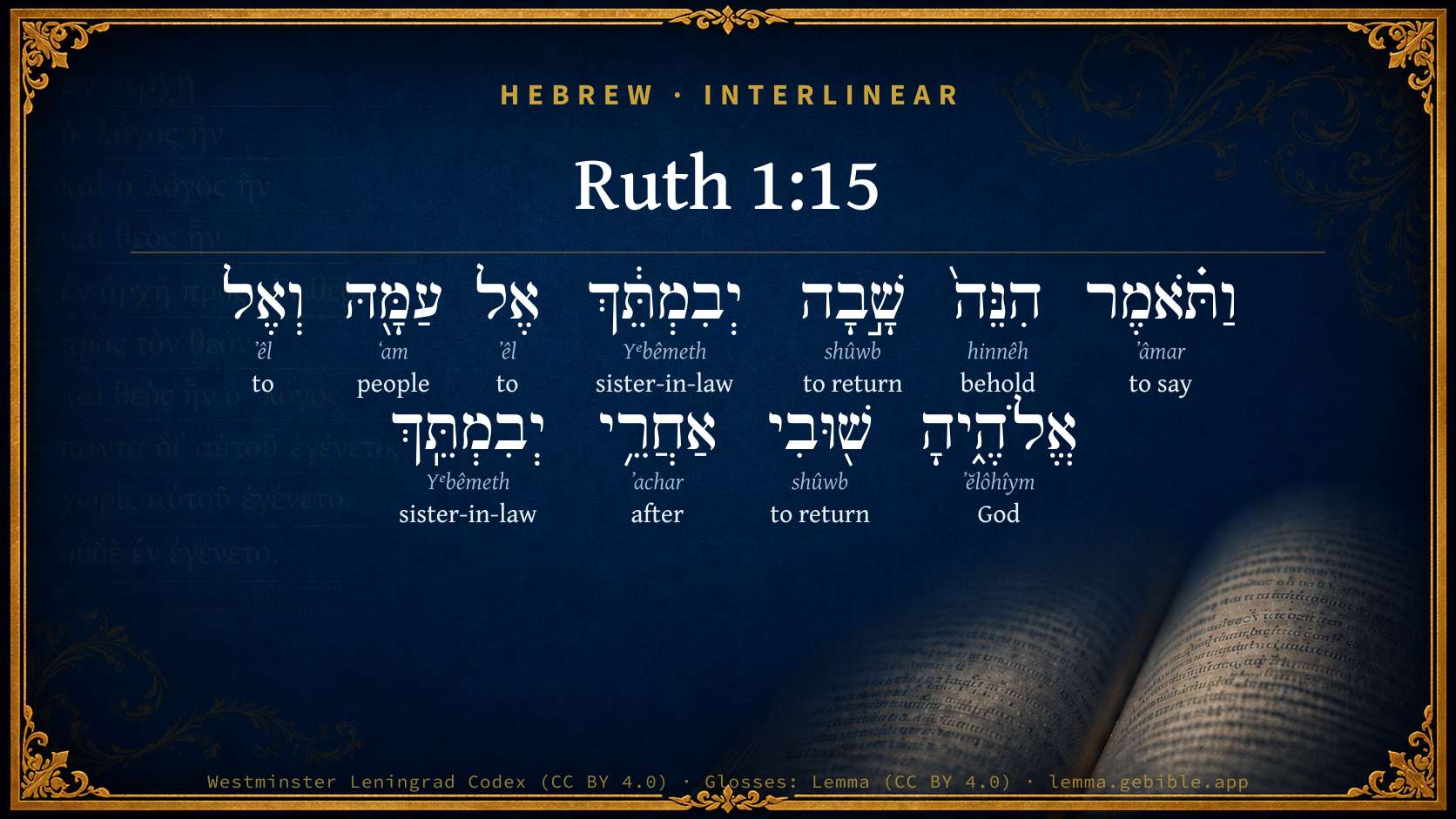
Hebrew (Westminster Leningrad Codex) Ruth 1:15 appears in the Hebrew Old Testament. The text above is from the Westminster Leningrad Codex. Each word links to its Strong’s number, a concise gloss, and parsing drawn from the Open Scriptures Hebrew Bible morphology. Click any word for its full Brown-Driver-Briggs (BDB) entry.
Download image
Cite this verse

Ruth 1:15 (World English Bible). Public Domain. Lemma interlinear Bible study tool, https://lemma.gebible.app/v/ruth/1/15.

Show BibTeX & RIS
BibTeX
RIS
English Translation
She said, Behold, your sister-in-law is gone back to her people, and to her god: return you after your sister-in-law.
World English Bible · Public Domain
Download a study sheet

One document with this verse’s original text, its word-by-word gloss line, the meaning frame, cross-references with their text, attributed commentary, and full source and license credits — printable, and it pastes into notes with its structure intact.

This verse Autodidact and up

Study sheet (.html) Plain text (.txt)

A passage Seminary Student

Up to 50 verses in one chapter. A passage sheet keeps up to 6 commentary sources and 12 cross-references per verse, in the order this page ranks them, and says so on the sheet whenever that leaves anything out. Ask for a single verse and you get the Autodidact verse sheet above.

Everything on this page stays free to read, with no account — the sheet is a download of what is already on screen, not access to it.

Want to remove ads? Support Godless Engineer
Compare translations 3

The same verse in 3 English versions, stacked beneath the original-language interlinear above. Click any original word for its lexicon entry.

Each is an independent rendering of the whole verse — the interlinear is not word-aligned to these translations.

Highlighted words mark where these versions differ — a whole-verse word diff, not a word-by-word alignment.

  • World English Bible Public Domain
    She said, Behold, your sister-in-law is gone back to her people, and to her god: return you after your sister-in-law.
  • King James Version Public Domain
    And she said, Behold, thy sister in law is gone back unto her people, and unto her gods: return thou after thy sister in law.
  • unfoldingWord Literal Text CC BY-SA 4.0
    Then she said, “Behold, your sister-in-law has turned back to her people and to her god. Go back after your sister-in-law.”

unfoldingWord Literal Text — © unfoldingWord, licensed CC BY-SA 4.0. Word-aligned USFM3 via Door43 (git.door43.org/unfoldingWord/en_ult).

Versions to compare (up to 4)

3 of 4 selected

Show all 18 translations

Every available English version of this verse, each an independent rendering of the whole verse.

  • World English Bible Public Domain
    She said, Behold, your sister-in-law is gone back to her people, and to her god: return you after your sister-in-law.
  • Berean Standard Bible Public Domain
    “Look,” said Naomi, “your sister-in-law has gone back to her people and her gods; follow her back home.”
  • Majority Standard Bible Public Domain
    “Look,” said Naomi, “your sister-in-law has gone back to her people and her gods; follow her back home.”
  • King James Version Public Domain
    And she said, Behold, thy sister in law is gone back unto her people, and unto her gods: return thou after thy sister in law.
  • American Standard Version (1901) Public Domain
    And she said, Behold, thy sister-in-law is gone back unto her people, and unto her god: return thou after thy sister-in-law.
  • Revised Version (1885) Public Domain
    And she said, Behold, thy sister in law is gone back unto her people, and unto her god: return thou after thy sister in law.
  • Geneva Bible (1599) Public Domain
    And Naomi said, Beholde, thy sister in law is gone backe vnto her people and vnto her gods: returne thou after thy sister in lawe.
  • Douay-Rheims (1899) Public Domain
    And Noemi said to her: Behold thy kinswoman is returned to her people, and to her gods, go thou with her.
  • Young's Literal Translation Public Domain
    And she saith, `Lo, thy sister-in-law hath turned back unto her people, and unto her god, turn thou back after thy sister-in-law.'
  • Literal Standard Version CC BY-SA 4.0
    And she says, “Behold, your sister-in-law has turned back to her people, and to her god, turn back after your sister-in-law.”
  • Unlocked Literal Bible CC BY-SA 4.0
    Naomi said, “Listen, your sister-in-law has gone back to her people and to her gods. Go back with your sister-in-law.”
  • unfoldingWord Literal Text CC BY-SA 4.0
    Then she said, “Behold, your sister-in-law has turned back to her people and to her god. Go back after your sister-in-law.”
  • Darby Bible Public Domain
    And she said, Behold, thy sister-in-law is gone back to her people and to her gods: return after thy sister-in-law.
  • World Messianic Bible Public Domain
    She said, “Behold, your sister-in-law has gone back to her people and to her god. Follow your sister-in-law.”
  • Webster's Bible Public Domain
    And she said, Behold, thy sister-in-law hath gone back to her people, and to her gods: return thou after thy sister-in-law.
  • Free Bible Version CC BY-SA 4.0
    “Look, your sister-in-law is going back to her people and her gods. Go back home with her,” said Naomi.
  • Bible in Basic English Public Domain
    And Naomi said, See, your sister-in-law has gone back to her people and to her gods: go back after your sister-in-law.
  • JPS Tanakh (1917) Public Domain
    And she said: 'Behold, thy sister-in-law is gone back unto her people, and unto her god; return thou after thy sister-in-law.'

Literal Standard Version (2020), Covenant Press — licensed CC BY-SA 4.0. Text via the HelloAO Bible API (eBible.org). Unlocked Literal Bible (unfoldingWord) — licensed CC BY-SA 4.0. Text via the HelloAO Bible API (eBible.org). unfoldingWord Literal Text — © unfoldingWord, licensed CC BY-SA 4.0. Word-aligned USFM3 via Door43 (git.door43.org/unfoldingWord/en_ult). Free Bible Version, Dr. Jonathan Gallagher — licensed CC BY-SA 4.0. Text via the HelloAO Bible API (eBible.org).

Word by word

More ways to search: Search by grammar → Find every occurrence → Compare this word →

Practice this passage: Drill this verse → Learn its vocabulary →

יְבִמְתֵּ֔ךְ
Yᵉbêmeth
H2994
“sister-in-law · your”
Noun, Common, Feminine, Singular, Construct + Suffix, Personal, 2nd Person, Feminine, Singular
Part of Speech
Noun
Type
Common
Gender
Feminine
Number
Singular
State
Construct
Full BDB Definition

Origin: participle of H2992

TWOT: 836b

sister-in-law, brother's wife, brother's widow
  1. וַתֹּ֗אמֶר ʼâmar H559 “and · to say” Conjunction + Verb, Qal, Sequential Imperfect, 3rd Person, Feminine, Singular
  2. הִנֵּה֙ hinnêh H2009 “behold” Particle, Demonstrative
  3. שָׁ֣בָה shûwb H7725 “to return” Verb, Qal, Perfect, 3rd Person, Feminine, Singular
  4. אֶל ʼêl H413 “to” Preposition
  5. עַמָּ֖הּ ʻam H5971 “people · her” Noun, Common, Masculine, Singular, Construct + Suffix, Personal, 3rd Person, Feminine, Singular
  6. וְאֶל ʼêl H413 “and · to” Conjunction + Preposition
  7. אֱלֹהֶ֑יהָ ʼĕlôhîym H430 “God(s) · her” Noun, Common, Masculine, Plural, Construct + Suffix, Personal, 3rd Person, Feminine, Singular
  8. שׁ֖וּבִי shûwb H7725 “return” Verb, Qal, Imperative, 2nd Person, Feminine, Singular
  9. אַחֲרֵ֥י ʼachar H310 “after” Preposition
  10. יְבִמְתֵּֽךְ Yᵉbêmeth H2994 “sister-in-law · your” Noun, Common, Feminine, Singular, Construct + Suffix, Personal, 2nd Person, Feminine, Singular

About this verse

These counts appear in no published source. They are computed here, from the morphology-tagged text and Lemma’s own curated glosses. What Lemma adds →

11
words
8
distinct lemmas
Historical
section

Notable vocabulary

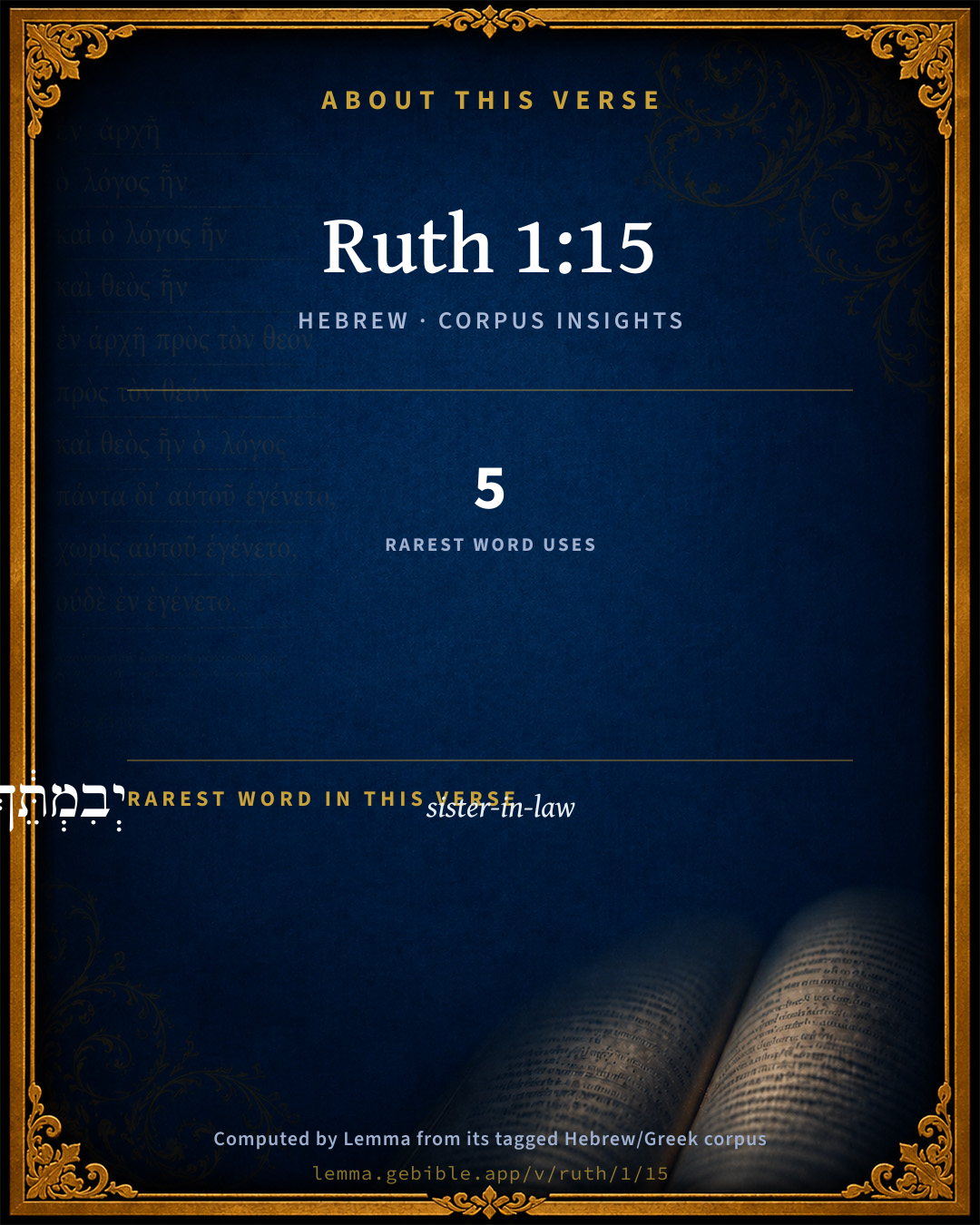
The rarest word here is יְבִמְתֵּ֔ךְ sister-in-law H2994 — appearing just 5 times in the whole Hebrew Bible.

Shared distinctive vocabulary

יְבִמְתֵּ֔ךְ sister-in-law H2994 occurs in 3 verses of the Hebrew Bible. Also found in:

Grammatical profile

  • 3 verbs
  • 4 nouns
  • 3 prepositions
  • 1 particle

Verb forms

  • וַתֹּ֗אמֶר Qal · Sequential Imperfect
  • שָׁ֣בָה Qal · Perfect
  • שׁ֖וּבִי Qal · Imperative

Repetition

Words recur within this verse — often emphatic in Hebrew:

  • שָׁ֣בָה to return H7725 ×2
  • יְבִמְתֵּ֔ךְ sister-in-law H2994 ×2
  • אֶל to H413 ×2

Hebrew & Septuagint length

In English translation the verse runs 20 words from the Hebrew and 24 from the Septuagint (LXX English) — closely comparable.

A rough comparison of the two English renderings, which tokenize alike — not a word-level alignment.

Word counts can differ between the Hebrew and the Greek without any difference in meaning — e.g. the Hebrew direct-object marker אֵת has no separate Greek word, and Greek often adds the article ὁ.

Cross-references

13

Topical passages linked to Ruth 1:15 in the Treasury of Scripture Knowledge — connected by theme and wording, ordered by reader-vote popularity; previews shown in the World English Bible.

  • Judges 11:24 Won't you possess that which Chemosh your god gives you to possess? So whoever Yahweh our God has dispossessed from before us, them will we possess.
  • Zephaniah 1:6 those who have turned back from following Yahweh, and those who haven't sought Yahweh nor inquired after him.
  • Joshua 24:15 If it seem evil to you to serve Yahweh, choose you this day whom you will serve; whether the gods which your fathers served that were beyond the River, or the gods of the Amorites, in whose land you dwell: but as for me and my house, we will serve Yahweh.
  • 2 Kings 2:2 Elijah said to Elisha, Please wait here, for Yahweh has sent me as far as Bethel. Elisha said, As Yahweh lives, and as your soul lives, I will not leave you. So they went down to Bethel.
  • Psalms 125:5 But as for those who turn aside to their crooked ways, Yahweh will lead them away with the workers of iniquity. Peace be on Israel.
  • Joshua 24:19 Joshua said to the people, You can't serve Yahweh; for he is a holy God; he is a jealous God; he will not forgive your disobedience nor your sins.
  • 2 Samuel 15:19–20 Then said the king to Ittai the Gittite, Why go you also with us? return, and abide with the king: for you are a foreigner, and also an exile; [return] to your own place.
  • Psalms 36:3 The words of his mouth are iniquity and deceit. He has ceased to be wise and to do good.
  • Matthew 13:20–21 What was sown on the rocky places, this is he who hears the word, and immediately with joy receives it;
  • Luke 14:26–33 "If anyone comes to me, and doesn't hate his own father, mother, wife, children, brothers, and sisters, yes, and his own life also, he can't be my disciple.
  • Luke 24:28 They drew near to the village, where they were going, and he acted like he would go further.
  • Hebrews 10:38 But the righteous will live by faith. If he shrinks back, my soul has no pleasure in him."
  • 1 John 2:19 They went out from us, but they didn't belong to us; for if they had belonged to us, they would have continued with us. But they left, that they might be revealed that none of them belong to us.

Cross-references courtesy of OpenBible.info (CC BY 4.0).

Hebrew and Greek witnesses Masoretic Hebrew ↔ Greek Septuagint

The same verse in the two great witnesses to the Old Testament, shown verse-for-verse.

These are two independent witnesses, not word-aligned to each other, and the Septuagint is shown in lemma (dictionary) form.

Hebrew Ruth 1:15 Masoretic · Westminster Leningrad Codex

וַתֹּ֗אמֶר הִנֵּה֙ שָׁ֣בָה יְבִמְתֵּ֔ךְ אֶל עַמָּ֖הּ וְאֶל אֱלֹהֶ֑יהָ שׁ֖וּבִי אַחֲרֵ֥י יְבִמְתֵּֽךְ

She said, Behold, your sister-in-law is gone back to her people, and to her god: return you after your sister-in-law.

World English Bible · Public Domain

Greek LXX Ruth 1:15 Septuagint · lemma form

καί εἶπον νωεμιν πρός ρουθ ἰδού ἀναστρέφω ὁ συννυμφός σύ πρός λαός αὐτός καί πρός ὁ θεός αὐτός ἐπιστρέφω δή καί σύ ὀπίσω ὁ συννυμφός σύ

And Noemin said to Ruth, Behold, your sister-in-law has returned to her people and to her gods; turn now you also after your sister-in-law.

LXX2012 (modern English Septuagint) · Public Domain

Hebrew: Westminster Leningrad Codex (CC BY 4.0). Greek: Septuagint (public domain); English from LXX2012 (modern English Septuagint) (Public Domain). How the Septuagint differs from the Hebrew →

Commentary

Notes on Ruth 1:15 from classic Christian and Jewish commentators (each source and its license shown beneath its notes). The classic Christian expositions comment on the surrounding passage and are grouped to its opening verse, so a note may address several verses; the Jewish commentaries on the Tanakh (Rashi and others) are per-verse, so they appear only where the commentator wrote on this verse.

Lemma curates 59 commentaries, every one of them public domain or Creative Commons licensed, each selected and text-cleaned for this edition rather than reprinted as found. About our sources →

Trapp's Complete Commentary

John Trapp

Rth 1:15 And she said, Behold, thy sister in law is gone back unto her people, and unto her gods: return thou after thy sister in law.

Ver. 15. Behold, thy sister-in-law is gone back.] A great temptation to Ruth - {Heb 11:37, "they were tempted"} - as it was likewise to the disciples, when many fell off; {Joh 6:66} to the primitive Christians, when Hymenaeus and Philetus made defection; {2Ti 2:17} to Galeacius, when forsaken of all.

And unto her gods.] Her devil gods, Baalpeor, Chemosh, Milchom, &c. In finita deorum lerna ad triginta millia Hesiodi tempore excreverat. The Chinese are said to have a hundred thousand.

John Trapp, A Commentary or Exposition upon All the Books of the Old and New Testament (1647–1656) — public domain. Text from a community e-Sword module.

The Biblical Illustrator

Joseph S. Exell

Rth_1:15

Thy sister-in-law is gone back unto her people, and unto her gods.

Backsliding

1. The backslidings of such as set out fair, and do begin well, is a sore temptation to young converts and proselytes. It was no less to the very disciples themselves (Joh_6:66-67). Thus it was also an occasion of stumbling unto the primitive Christians to behold the backslidings of two such forward professors as Hymenaeus and Philetus had been; insomuch that the apostle saith to them, Nevertheless the foundation (of Gods election) standeth sure; the Lord knoweth them that are His, etc. As the multitude of sinners cannot give any patronage to the evil ways of sin, so neither can the paucity of saints put any disgrace or disparagement upon the good ways of God.

2. Some forward followers of the only true and living God may apostatise from thence to embrace the vanities of the Gentiles.

3. That love to the ways and worship of God is a sincere love which doth undergo trials and temptations, yet bears up against all: godly Ruth rides out the storm against wind and tide of both the sisters pattern and the mothers precept. (C. Ness.)

The painful separation

Nothing can be more encouraging to the Christian heart than to see the young setting out to seek the Lord. It is a beautiful exercise and exhibition of youth. Never do the morning hours appear so bright or so promising. We cannot suspect the sincerity of any, and therefore we encourage them to press forward. We have seen these youthful travellers going with Naomi out of the place where they dwelt, on the way to return unto the land of Judah. For a time they travel together happily and affectionately. There is a line which divides Moab from Judah. This is a painful but an inevitable crisis. The two sisters must separate. There is just such a line in our souls history where similar entire separation must take place. The awakened mind sees its own sinfulness and need, acknowledges the darkness and emptiness of the Moab in which it has dwelt, and truly feels the importance of those blessed offers which the gospel proclaims. The Holy Spirit has taught the sinner the guiltiness and wretchedness of his past life. He knows, he sees, he feels the truth. But he does not love the truth. He does not embrace and choose it for his own, his portion for ever. If he would really do this, all would be well. His heart he cannot, will not, give to Christ. Anything else he will do. But nothing else will avail him anything. Poor Orpah! How often have I seen young travellers to eternity stopping just where you stop; hesitating just where you hesitate. Nothing more can be done for you where you are. There is Moab. You have tried that, and found it empty and unhappy. There is Judah. All its provisions and offers are before you, and brought for your acceptance. Never will you be sorry if you take your portion there. Here are Naomi and Ruth. They are journeying to the land which the Lord hath promised them. Soon they will be far from you, out of your sight. Then you will mourn over the separation which you foolishly made. You may go back to Moab, and bury yourself in its sins and follies. But you will find no peace or happiness there. Your conscience will never again allow you to rest. Orpah goes back to her people and her gods. This is a most important fact in her history. She does not, cannot remain where they part. That is a place most unnatural and unattractive. No; she goes back, while Ruth and Naomi go forward. The separation grows wider every hour. This is a most affecting illustration. The awakened and convinced mind can never abide at the line where a Saviour is refused. There is no permanency in such a state of mind. There is no home for the soul there. You go back. It may be to self-indulgence, dissipation, and sensual delights. It may be to giddiness, frivolity, and empty, cheerless mirth. It may be to business, covetousness, and unceasing occupation. It may be to infidelity and assumed unbelief and argument. It may be to open hostility and persecution of the gospel, and those who love it. It may be to absolute and dreadful hardness of heart. But to whatever it shall be, you still go back. The worst opposers of the gospel we ever meet are those who once were almost Christians. But you say you will hereafter return to Christ. You cannot do this but by His own Spirit. And that Spirit you have driven far from you. There is a spring that returneth in creation when the winter has gone. But you have buried the sacred seed of your souls welfare beneath a winter which knows no coming spring. You will mourn at the last, when your flesh and your body are consumed. But it will be with a worldly sorrow which worketh death, and not with a godly sorrow which worketh repentance unto salvation. This is the fearful prospect in your return with Orpah. (S. H. Tyng, D. D.)

Orpah

I. Orpah was a Moabitish woman--had been married to one of the sons of Elimelech--and was now a widow. She had been brought up amid the absurdities and impurities and superstitions of idolatry. But her connection with an Israelitish family was a great advantage to her, and ought to have been improved by her, to the benefit of her soul, and deemed a peculiar privilege and blessing. Oh, then, let us associate with those who live for another world whose spirit and words and conduct diffuse the savour of heaven, and are calculated to keep God and eternity in our minds.

II. Orpah possessed many natural excellences, which made her lovely and amiable, though still lacking that new heart and that devotedness to God without which no man can be saved.

1. Orpah acted well in the character of a wife.

2. Orpah conducted herself with kindness and tenderness and affection towards her mother-in-law, Naomi, also.

3. Another valuable feature, which we cannot view but with great interest, in the character of Orpah, was her intention to accompany Naomi to the land of Judah. It is well to see hopeful beginnings--to see the careless aroused, the indifferent in some degree alarmed about their sins, and paying more attention than before to the welfare of their souls. It is well to see the profane putting on the decencies of morality, and renouncing their vile habits and pursuits. It is well, we say, to see these hopeful signs. But, alas! they often disappoint our fondest hopes.

III. Orpahs fatal deficiency, She only began her march to Canaan--her resolution failed--she persevered not, but returned to her own land! Naomi wished not to prevent either Ruth or Orpah from accompanying her to Canaan, but from doing so for her sake. She had no earthly inducement to hold out to them. If they came, she wished them to come from religious considerations alone. If we take up the cause of God from any but spiritual motives--if we attach ourselves to the cause and people of God from earthly views, our religion is hateful in heaven. The loaves and fishes are to have nothing to do with our pursuit of Christ, but the attractions of His grace--the privilege of serving Him, and a supreme desire to be His--His alone--His for ever.

1. Orpah forsook the cause of God--she returned to her people. Their maxims and their habits, after all, were more congenial with her mind. Woe awaits those who are kept from following the Lord fully from regard to earthly connections and associates.

2. Orpah forsook the cause of God with great reluctance. Agrippa-like, she was almost persuaded to go with her to the land of Judah, yet, though with many misgivings, she retraced her steps to her own country, and saw her no more. Now, with the view of inducing these wavering characters, who are thus daily withstanding the convictions of their own minds--who return to Moab, but with many tears--to hasten out of their present condition, we beg to say a few words concerning their danger. It is a great mercy to have our minds in the smallest degree impressed with Divine things, and awakened to the importance of the things which accompany salvation. It is a mercy to be made to feel some measure of anxiety about our never-dying souls and their everlasting welfare. It is the Holy Ghost striving with us, and bidding us to consider our peril while yet it may be avoided. With the view of urging these characters to a speedy determination to be altogether on the Lords side, we beg to add a few remarks likewise concerning their present folly. When man neglects to follow the admonitions of his conscience, he deprives himself of all comfort. He cannot enjoy inward tranquillity in this state. There is something within him constantly telling him that his end cannot be desirable if a radical spiritual change does not take place in him. He cannot have real joy in this condition. If your religion resembles that of Orpah, give God no rest till the weight of your transgression drives you to the Saviour, and a believing view of His matchless love constrains you to devote your persons and your talents to His service and glory. (John Hughes.)

Orpah and Ruth

I. Family sorrows.

1. Want.

2. Separation.

3. Death.

II. Family errors.

1. Preference of worldly comfort before religious privileges.

2. Formation of worldly connections.

III. Family attachments.

1. Their power. The amiableness of Naomi has so attached these idolaters to her that they are willing to forsake even their own mother.

2. Their weakness. The case of Orpah may teach us that an attachment to religious people is not religion; nor can it, of itself, produce religion in the heart.

IV. Family mercies.

1. The return of moderate prosperity.

2. Converting grace bestowed upon an idolater. (Homilist.)

The danger of religious indifference

A family perished, not long ago, by a fire in their own house. They were not consumed by the flames, but suffocated by the smoke. No blaze was visible at all, nor could any alarming sign of fire be discovered from the street, and yet death came as effectually upon them as if they had been burned to ashes. Thus is sin fatal in its consequences, few being destroyed by outrageous forms of it, flaming up with lurid glare, but multitudes perishing by the stifling smoke of indifference and spiritual slumber. (J. H. Norton.)

Unto her people, and unto her gods

When Christian set out from the City of Destruction, he too, for a short part of his journey, was attended by two companions: the first indeed, Obstinate, only went with him in order to try and bring him back to what he considered wiser courses, but the other, Pliable, was absolutely sincere in his desire to reach the Celestial City. I intend to go along with this good man, he said, and to cast in my lot with him; he might have availed himself of the words of sincerely-meant devotion in which Orpah joined with Ruth, and have declared, Surely I will return with thee unto thy people. Yet, as we know, when the pilgrims, being heedless, fell into the Slough of Despondency, poor Pliable, his virtuous intentions notwithstanding, gave a desperate struggle or two, and got out of the mire, on that side of the Slough which was next to his own house. So away he went, and Christian saw him no more. There are one or two particulars in which the behaviour of Orpah was not unlike that of well meaning Pliable. To begin with, there can be no question but that she had a sincere affection and regard for Naomi, and would genuinely have liked to spend the remainder of her days in her society; but the attachment was purely personal, and in all such friendships there is a breaking point, a limit to the extent to which others are prepared to follow us. For it is only us whom they are following, and our path may lead us into circumstances more trying than they are prepared to undergo whose hearts are not buoyed up by the hope which animates our own. Another somewhat sad reflection respecting the history of Orpah springs from the fact that she actually started for the better land, and indeed went some considerable way on the journey. The thought of those fellow-travellers of ours who set out so cheerily with us and yet failed after all to persevere is one of the saddest that comes into our memory when we review our pilgrimage. We call to mind their fervour, their enthusiasm, their kindly interest; we shall never forget how our heart sank within us when they announced their intention of turning back. And in the case of Orpah our feelings are the more regretful because we bear in mind that she was full of the best possible resolutions of going further still. Surely, she said, no less earnestly than did Ruth herself, Surely we will return with thee unto thy people. But, as we have already noticed, the desire in her mind was to be, as she put it, with thee ; it was the personal element in her relation to Naomi which, however charming in itself, constituted the weakness of her position--it was on this rock that her frail vessel was wrecked at last. Further, if Orpahs decision pains us, can we remain unmoved at Orpahs tears? She is quite clear in her own mind that she can go no further; she will leave no inconsiderable portion of her heart behind her when she says farewell to Naomi; she lifted up her voice and wept; she lifted up her voice and wept again. Alas for the impotence of tears! The question for each to ask himself is not, What have I felt? but, What have I done? Orpah loved Naomi dearly, and wept bitterly at the prospect of parting from her, but returned to her people and her gods nevertheless. And here we must pause to inquire how far Naomi was to blame for the failure of Orpah. We recognise the honesty with which the older woman points out to her companions the sacrifice which they will be called upon to make if they elect to go further with her. She must have known, she evidently did know, that by turning back Orpah was losing her reversionary interest in the property of her deceased husband, yet we do not find Naomi telling her of this. Warn people by all means that life in the kingdom of heaven is the life of a servant and a soldier, but tell them too that their entry into the kingdom has made them inheritors of a possession greater and more real than anything than the world can offer, and which it would be the most fearful madness to throw away. Love had brought Orpah a long way towards the land of Judah: might not a little affectionate entreaty have brought her further still? It is important that before passing away from the story of Orpah we should try to realise what it was that she lost by turning back. And with the inheritance, redeemed as it was by Boaz, Orpah had also lost the honour--Ruths chiefest glory in the ages yet to come--of being the ancestress of David and of the Messiah. Of all the promises to Abraham, that upon which in all probability the patriarch set the greatest store was Gods pledge that in him all the nations of the world should be blessed. To be an inheritor of the kingdom of heaven is in itself a marvel of grace, the true meaning of which we shall never fully know here, but to have it in ones power to bring redemption within the reach of others, surely this is an infinitely greater marvel still. God offers us salvation as the satisfaction of the needs of our own heart; but He also offers it to us in order that we may be qualified as the possessors of it to work with Him in plucking from the burning those who are the bondsmen of Satan and of sin. What answer shall we give to Him that speaketh? (H. A. Hall, B. D.)

The parting-place

Where was it that Orpah parted from her companions? She went with them some way, possibly a great way, but at last they reached a point in the journey which was geographically, so to speak, one of decision, one beyond which no one could pass without committing herself to new things and a new life, and at this point Orpah made up her mind to return. What more likely than that this point was the river itself, which if they adopted the southern route would form the boundary between Moab and the land of Judah? The river flows still, and each pilgrim has to make up his mind whether or not he shall cross it. There, then, flows the river: shall we cross? Sometimes it seems to us to be the river of surrender. Can I give myself wholly and unreservedly to God? And can I give up, or consent to His taking from me, whatever is contrary to His will and therefore to my happiness, love it as I may? Sometimes the river is one of confession. We have travelled thus far without our life or our relation to the world being appreciably affected or altered, and God, who is infinitely tender in His dealing with the returning soul, often postpones the necessity of or the occasion for a definite confession of our allegiance to Him until we are strong enough to make it. Yet sooner or later the river has to be crossed, and the more definitely the confession is made the better it always is for the soul. And sometimes the river is that of a consistent life. I would not shrink from throwing in my lot with that of the people of God, says many an one, if I could only hope to lead a consistent life: I will make no profession unless I can carry it out, and I fail to see how under my circumstances that can be possible. Certainly God requires that those who follow Him shall follow Him fully, as Caleb did, but God asks no one to lead the life of faith in his own strength or trusting to his own resources. A new life lies before you; but to enable you to live it, God offers you new strength. (H. A. Hall, B. D.)

The Biblical Illustrator, edited by Joseph S. Exell (c. 1880s–1900s) — public domain. Text from a community e-Sword module.

Joseph Benson's Commentary

Rth 1:15. Is gone back to her people and to her gods — By this it appears, if Orpah had been a proselyte to the Jewish religion, she afterward apostatized. Those that forsake the communion of saints will certainly break off their communion with God. Return thou after thy sister-in-law — This she said to try Ruth’s sincerity and constancy, and in order that she might intimate to her that if she went with her she must be firm in her attachment to the true religion.

Joseph Benson's Commentary on the Old and New Testaments (1811–1818) — public domain. Text from a community e-Sword module.

Tyndale Open Study Notes

Tyndale Open Resources

1:15 to her gods: Every nation believed in its own territorial god. Naomi assumed that Ruth would continue to worship Moabite gods.

Tyndale Open Study Notes — © Tyndale Open Resources, licensed CC BY-SA 4.0. Text via the HelloAO Bible API.

Geneva Bible (1599)

Geneva Bible translators

No persuasions can prevail to turn them back from God, whom he hath chosen to be his.

Geneva Bible (1599) marginal notes — public domain. Text via Bolls.life.

Adam Clarke's Commentary

Verse 15. Gone back - unto her gods] They were probably both idolaters, their having been proselytes is an unfounded conjecture. Chemosh was the grand idol of the Moabites. The conversion of Ruth probably commenced at this time.

Adam Clarke's Commentary on the Bible (1810–1826) — public domain. Text from a community e-Sword/MySword module.

Ellicott's Commentary for English Readers

(15) Naomi, now armed with a fresh argument, urges Ruth to follow her sister-in-law’s example.

Her gods.—Naomi doubtless views the Moabite idols as realities, whose power is, however, confined to the land of Moab. She is not sufficiently enlightened in her religion to see in the Lord more than the God of Israel.

A Bible Commentary for English Readers, edited by Charles John Ellicott (1878–1897) — public domain. Text from a community e-Sword module.

The Cambridge Bible for Schools and Colleges

gen. ed. J. J. S. Perowne

15. unto her people, and unto her god] i.e. Chemosh, the god of the Moabites, Num_21:29, 1Ki_11:33. The ancient belief here receives its simplest expression: each land and people had its own Deity inseparably connected with it; outside lay the territory of another god. The Israelites, at any rate the popular religion in Israel, did not deny the divinity of the gods of the neighbouring lands, though for themselves Jehovah was the only God; cf. Jdg_11:24, 1Sa_26:19. So when Orpah goes back to Moab she goes back to her native god; similarly, when Ruth determines to make her home in Judah, she declares her intention of adopting the religion of her new country, Rth_1:16. See Rth_1:8 n.

The Cambridge Bible for Schools and Colleges (gen. ed. J. J. S. Perowne; Cambridge University Press, 1878–1918) — public domain. Text from a community e-Sword module.

John Gill's Exposition

And she said,.... That is, Naomi to Ruth, after Orpah was gone:

behold, thy sister in law is gone back unto her people, and unto her gods; meaning Orpah, who was the wife of her husband's brother, as the word used signifies; she was not only on the road turning back to her own country and people, but to the gods thereof, Baalpeor or Priapus, and Chemosh, Num 21:29 from whence Aben Ezra concludes, that she had been a proselyte to the true religion, and had renounced the gods of her nation, and retained the same profession while her husband lived, and unto this time, and now apostatized, since she is said to go back to her gods; and in this he is followed by some Christian interpreters (g), and not without reason:

return thou after thy sister in law: this she said, not that in good earnest she desired her to return, at least to her former religion, only relates, though not as approving of, the conduct of her sister, rather as upbraiding it; but to try her sincerity and steadfastness, when such an instance and example was before her.

(g) Clericus & Rambachius.

John Gill's Exposition of the Whole Bible (1746–1763) — public domain (CC PDM 1.0). Text via the HelloAO Bible API.

Haydock's Catholic Bible Commentary

To her gods, &c. Noemi did not mean to persuade Ruth to return to the false gods she had formerly worshipped; but by this manner of speech, insinuated to her, that if she would go with her, she must renounce her false gods, and turn to the Lord, the God of Israel. (Challoner) --- She wished to try her constancy. (Salien) --- Most infer from this passage, that Orpha was never converted, or that she relapsed. --- Her gods, may indeed be rendered in the singular, "god." But what god was peculiar to her and the Moabites, but Chamos! (Calmet) --- Noemi might well fear that Orpha would give way to the superstition of her countrymen, to which she had been addicted, even though she might have made profession of serving the true God, while she lived with her. (Haydock).

George Leo Haydock (1774–1849), Haydock's Catholic Family Bible and Commentary, 1859 edition — public domain. Excludes Psalms (Douay-Rheims chapter numbering differs from Protestant) and Deuterocanonical books (Catholic canon only).

Matthew Poole's English Annotations

Unto her people, and unto her gods; which she saith, partly, to try Ruth’s sincerity and constancy; partly, that by upbraiding Orpah with her idolatry she might consequently turn her from it; and partly, that she might intimate to her, that if she went with her, she must embrace the true God and religion.

Matthew Poole's English Annotations on the Holy Bible (1683–1685) — public domain. Text from a community e-Sword/MySword module.

The Pulpit Commentary

And she said, Behold, thy sister-in-law is gone back to her people, and to her gods: return thou after thy sister-in-law. The expression that stands in King James"s version thus, "and to her gods," is rendered by Dr. Cassel and to her God." The same interpretation, it is noteworthy, is given in the Targum of Jonathan, who renders the expression, "and to her Fear" (HRljD twlW). Such a translation assumes that the Moabites were not only theists, but monotheists. And yet in the mythology, or primitive theology, of Moab, we read both of Baal-Peor and of Chemosh. As to the former, see Num_25:8, Num_25:5; Deuteronomy Psa_106:28 Hos_9:10. As to the latter, see 1Ki_11:7, 33 Jer_48:7, Jer_48:13. In Numbers, moreover, Num_21:29, and in Jer_48:46, the Moabites are called the people of Chemosh, and frequently is their national god called Chemosh in the inscription of King Mesha on the Moabitish Stone, so recently discovered and deciphered. It is supposed, not without reason, that the two names belonged to one deity, Chemosh being the old native name. Nevertheless, the translation "to her god" is an interpretation, not a literal rendering, and, on the other hand, the translation "to her gods" would, on the hypothesis of the monotheism of the Moabites, be unidiomatic. The original expression, "to her Elohim," does not tell anything, and was not intended by Naomi to tell anything, or to hint anything, of a numerical character concerning the object or objects of the Moabitish worship. It was an expression equally appropriate whether there was, or was not, a plurality of objects worshipped. It might be liberally rendered, and to her own forms of religious worship . The word elohim was a survival of ancient polytheistic theology and worship, when a plurality of powers were held in awe. For," says Fuller, "the heathen, supposing that the whole world, with all the creatures therein, was too great a diocese to be daily visited by one and the same deity, they therefore assigned sundry gods to several creatures." The time arrived, however, when the great idea flashed into the Hebrew mind, The Powers are One and hence the plural noun, with its subtended conception of unity, became construed with verbs and adjectives in the singular number. It was so construed when applied to the one living God; but it readily retained its original applicability to a plurality of deifies, and hence, in such a passage as the one before us, where there is neither adjective nor verb to indicate the number, the word is quite incapable of exact rendering into English. Orpah had returned to her people and her Elohim. Return thou after thy sister-in-law. Are we then to suppose that Naomi desired Ruth to return to her Moabitish faith? Is it with a slight degree of criticism that she referred to Orpah"s palinode? Would she desire that Ruth should, in this matter, follow in her sister-in-law"s wake? We touch on tender topics. Not unlikely she had all along suspected or seen that Orpah would not have insuperable religious scruples. And not unlikely, too, she would herself be free from narrow religious bigotry, at least to the extent of dimly admitting that the true worship of the heart could reach the true God, even when offensive names, and forms, and symbolisms were present in the outer courts of the creed. Nevertheless, when she said to Ruth, "Return thou after thy sister-in-law," she no doubt was rather putting her daughter-in-law to a final test, and leading her to thorough self-sifting, than encouraging her to go back to her ancestral forms of worship. "God," says Fuller, wrestled with Jacob with desire to be conquered; so Naomi no doubt opposed Ruth, hoping and wishing that she herself might be foiled.

Vers. 15-22. Devoted attachment.

I Ruth was fixed in her desire and determination to CAST IS HER LOT WITH HER DESOLATE AND DESTITUTE MOTHER-IN-LAW. The absolute unselfishness of this determination is noteworthy, for

1. Be it noted that Naomi was not one of those who are always murmuring and complaining because they do not receive sufficient consideration.

2. Still less did she claim as a right, or urge as a duty, that her daughter-in-law should become her companion in travel, and wait upon her as an attendant.

3. On the contrary, she was careful to put Ruth in an attitude of entire freedom, so that, if she had a secret wish to go back to her Moabitish friends, she could have gratified her desire without laying herself open to the imputation of coldness or ingratitude.

4. Ruth was tested nevertheless, as all of us in our respective relations have either already been or will be. Eve, for instance, was emphatically tested. So was Adam. Abraham too. Joseph also. Very particularly the second Adam, our Lord Jesus Christ, when he was led up by the Spirit into the wilderness. Judas was tested when the demon of cupidity entered into his heart. So was Peter when he stood warming himself at the fire in the court of the high priest"s palace. All who are tried are tested. And all men without exception have to endure trial and tri als. It was as regards the strength of her attachment to her mother-in-law that Ruth was tested. Not only did Naomi hold out no hopes of home-comfort in Judah, she expressly said, dissuasively, when Orpah had gone back, "Behold, thy sister-in-law has gone back to her people, and to her Elohim: return thou after thy sister-in-law" (ver. 15).

5. Ruth stood the test. Not so did Eve. Not so Adam. But Abraham stood it. So Joseph. Emphatically did Jesus stand it, so that lib knows how to succor those who are tempted. Judas did not stand the test Nor at first did Peter, though afterwards He repented, and, when reconverted, was able to strengthen his brethren. Ruth, for love to Naomi, was able to say in her heart, "Farewell, Melchom! Farewell, Chemosh! Farewell, Moab! Welcome, Israeli Welcome, Canaan! Welcome, Bethlehem!" (Fuller).

6. She witnessed a good and most noble confession of love and devotedness (see vers. 16, 17). She said, "Insist not on me forsaking thee; for whither thou goest, I will go; wheresoever thou lodgest, I will lodge; thy people is my people, and thy God my God: where thou diest, will I die, and there will I be buried. So may Yahveh do to me, and still more, if aught but death part thee and me." "Nothing," says Matthew Henry, "could be said more fine, more brave." Truly," says Dr. Kitto, "the simple eloquence of the mouth that speaks out of the abundance of the heart never found more beautiful and touching expression than in these words of this young widow" ("Daily Bible-Illustrations"). "Her vow," says S. Cox, "has stamped itself on the very heart of the world; and that not because of the beauty of its form simply, though even in our English version it sounds like a sweet and noble music, but because it expresses in a worthy form, and once for all, the utter devotion of a genuine and self-conquering love. It is the spirit which informs and breathes through these melodious words that make them so precious to us, and that also renders it impossible to utter any fitting comment on them" ("Book of Ruth," pp. 72, 73). Be it borne in mind that something of the same enthusiasm of love, that dwelt in the heart of Ruth, should be found in the center of every home. Wheresoever a heart is swayed and dominated by the might and mastery of a great affection, the entire character becomes clothed with mingled dignity and beauty.

II THE ENTRY OF THE TWO WIDOWS INTO BETHLEHEM. There was no more talk, no more thought, of turning back. The hearts of the two widows were locked together forever. Hence they traveled on from stage to stage, until, worn and wearied, they entered Bethlehem.

1. Note the effect on the citizens, especially the female portion of them (see ver. 19). Naomi, passing along through the streets, was recognized. The news flew from individual to individual, from house to house, from lane to lane. There was a running to and fro of excited mothers and maidens. All were eager to see the returned emigrant, and her pensive Moabitish companion. Her old acquaintances, in particular, when they had seen and identified her, broke up into groups, and talked, and said, Is that Naomi? That, Naomi I Is this Naomi? This, Naomi! "So unlike is the rose when it is withered to what it was when it was blooming.

2. Note the effect on Naomi herself. As she looked on old scenes, and witnessed the excitement and commotion of old neighbors and acquaintances, her heart felt overwhelmed within her, and she said to the sympathizing friends who clustered around her, "Call me not Naomi, call me Mara: for the Almighty hath dealt very bitterly with me" (see vers. 20, 21). But it surely will be permitted to us not only to mingle our tears with those of the afflicted widow, but likewise to pause reverently ere we unreservedly accept or endorse her attribution of all her trials and woes to the hand and heart of the Lord. It should nevertheless be borne in mind that even those trials that come most directly from men"s own acts or choices come to pass by the permission of the Almighty, and are so overruled by him that they will be made to work for good to them who love him. (Rom_8:28)

The Pulpit Commentary (1880–1919), ed. H.D.M. Spence-Jones & Joseph S. Exell — public domain. Text from a community e-Sword module.

The Preacher's Complete Homiletical Commentary

Joseph S. Exell (gen. ed.)

CRITICAL AND EXEGETICAL NOTES.—And she [Naomi] said, Behold thy sister-in-law, i.e., wife of a husband’s brother; no English word exactly answering to the original Hebrew. The same word is rendered brother’s wife (Deu_25:7; Deu_25:9), being the feminine of that rendered (ib. 7) husband’s brother (Speaker’s Com.). Unto her gods [god]. “And to her god” (Luther’s Bible). The singular is to be preferred (Lange). Adam Clarke thinks that both Orpah and Ruth had been idolaters so far. With Ruth, however, a leaning towards the God of Israel and His laws (Keil). Wright argues from these words that Naomi viewed idolatry without serious disfavour, at least as practised by others. This held upon insufficient data. Naomi’s words do not necessarily contain any recognition of the Moabitish deity, or indicate (as Wright suggests) that she was possibly led astray by the false idea that Jehovah was only the God of Israel (Lange). Was Jephthah then (Jdg_11:21; Jdg_11:24) similarly led astray.’ (Lange.)

Return thou. Serious in her intentions, sincere in her advice (Keil). Perhaps said merely to prove Ruth’s constancy (Speaker’s Com.). (Cf. Jos_24:15-19.; 2Ki_2:2-6). Spoken that it might be made clear whether she would adhere steadfastly to the God of Israel (Seb. Schmidt). Not that she desired her to return, but to try her sincerity (Gill). She had simply the earthly prosperity of her mother-in-law in her mind (Keil, Carpzoe).

Theme.—THE THIRD AND LAST TRIAL OF AFFECTION

“What though the world unfaithful prove,

And earthly friends and joys remove?

With sure and certain hope of love,

Still would I cling to thee.”—Mrs. Elliot.

And she [Naomi] said, Behold thy sister-in-law is gone back.… Return thou, etc.

How sad is the history of a return to Moab (Tyng), both in its effects and in its influences! With Orpah, to go back to her people was to return to her gods. And yet how pregnant with meaning! Evident now that Orpah had mistaken a mere momentary feeling (cf. Rth_1:10) for something deeper and more lasting. Evident, too, that Naomi’s suspicions and surmises were correct. Note. (a) The “return” justifies the tests (Rth_1:8-9; Rth_1:11-13). Very naturally, also, it leads to this final trial of Ruth’s affection and steadfastness. Naomi anxious still; fears lest even now cleaving to her should be the result of a rash, unthinking choice; dreads a future apostate in a present convert. Could not really intend to persuade her beloved daughter to return to the service of Chemosh (Lawson). Said of those of whom the world was not worthy, “they were tempted” (Heb_11:37). So here. Note. (b) The trial is by no means intended to justify the “return.” In the present case, disobedience a virtue (Macgowan). When Christ said to Judas, “What thou doest do quickly,” He by no means authorised Judas to execute his wicked designs (Lawson). Orpah doubtless went back to Naomi’s grief (Lawson).

I. See where the strength of this last trial lay. An unfavourable example lends its weight to worldly disadvantages (M. Timson). These heavy enough before; now Ruth is to see one she loves turning away from Naomi, and lending her influence to lead her backwards. Orpah has “gone back,” too, although she cherished as warm an affection for Naomi as any a mother-in-law could expect. Note. (a) Example has a mighty influence, especially the example of those who are dear to us. Christ felt it to be so in that moment when the last link between Himself and His half-hearted followers was severed, and He turned to the rest with the question, Will ye also go away? (Joh_6:67.) A scriptural doctrine, that because iniquity shall abound, the love of many shall wax cold (Mat_24:12). Note. (b) The castle seems almost won where one-half the soldiers are overcome (Lawson). Orpah has yielded, and yet for all this Ruth stands steadfast.

II. See in what lies its meaning and purpose. It evidently settled the questions at issue once and for ever. Decision comes as the result of conflict. Distrust of one’s own judgment the most terrible spectre to fight (M. Timson). Especially so when the example of those we respect is adverse to our decisions. This mastered, however, the rest is easy.

LESSONS.

(1) The falls of some may justly bring others into trial (Bernard).

(2) Not the length or fury of the conflict which is important, but its results.

(3) The folly of apostacy must not damp but rather invigorate our zeal.

Fuller on this (condensed):—

Examples of others set before our eyes are very potent and prevalent arguments to make us follow and imitate them, whether they be good examples—so the forwardness of the Corinthians to relieve the Jews provoked many—or whether they be bad—so the dissembling of Peter at Antioch drew Barnabas and others into the same fault. But those examples, of all others, are most forcible with us which are set by such who are near to us by kindred, or gracious with us in friendship, or great over as in power.

USE [Lesson] I. Let men in eminent places, as magistrates, ministers, fathers, masters, and the like (seeing that others love to dance after their pipe, to sing after their tune, to tread after their track), endeavour to propound themselves patterns of piety and religion to those that be under them.

II. When we see any good example propounded unto us, let us strive with all possible speed to imitate it.… Follow not the adultery of David, but follow the chastity of Joseph; follow not the dissembling of Peter, but follow the sincerity of Nathanael; follow not the testiness of Jonah, but follow the meekness of Moses; follow not the apostacy of Orpah, but follow the perseverance of Ruth.

III. When any bad example is presented unto us, let us decline and detest it, though the men be never so many or so dear to us. Imitate Micaiah (1 Kings 22).… Yea, but one may say, “What if I find in the Scripture an action recorded whose doer is known to have been a godly and gracious man, may I not, without any further doubt or scruple, follow the same?” … The Holy Spirit hath not set these sins down with an intent they should be followed; but first to show the frailty of His dearest saints when He leaves them to themselves; as also to comfort us when we fall into grievous sins, when we see that as heinous offences of God’s servants stand upon the record in the Scriptures.

“Oh, Orpah, Orpah! that thou hadst been wise, at least in this thy day, to think of the things which belong unto thy peace! but now they are hidden from thy eyes.… And could we know her history, we should doubtless find in it many a sorrowful and weeping hour as she thought of these friends of her youth whom she was to see no more.… It is the history we have seen in the child of the world over and over again. You may renounce the Saviour, and walk with Him no more. You may go back to Moab, and bury yourself in its sins and follies. But you will find no peace or happiness there. Your conscience will never again allow you to rest.”—Tyng.

“Worldliness is not living in the world, possessing the world, using the world; worldliness is pursuing the world which is, to the forgetfulness and exclusion of that which is to come; it is a sacrificing of the future to the present, the enjoying of earth’s mess of pottage at the loss of the heavenly birthright.”—II. Wonnacott.

“Where the heart is indeed influenced by sovereign grace, and drawn by the eternal Father, opposition will only serve to inflame our love and zeal, as oil cast into the fire serves only to increase its ardour instead of extinguishing the flame.”—Macgowan.

“Still Naomi proves the spirit of Ruth. ‘Your sister has gone back to her people and her gods. If you mean ever to go back, now is your best time to go. Think well of what you give up, and of what you may encounter in accompanying me. Much as I would love to have you to go with me, I do not wish you hereafter to feel disappointed or grieved on my account. Remember, I have nothing to offer you. If you go with me, it must be as a partner of my griefs and wants.’ Thus God often proves the young disciple with new trials. He sends the east wind upon the young trees of His planting, not to weaken or destroy, but to give greater strength and endurance for the time to come.”—Tyng.

“Adam was soon drawn by Eve; Rehoboam’s heart was easily led after the advice of his familiars; the women of Judah by their husbands easily fell to idolatry.”—Bernard.

“This is Naomi’s last trial of Ruth; and these words show plainly all was to try her, because she telleth Ruth of Orpah’s going back, not only to her people, but also to her gods, which Naomi, a good woman, could not but hate, and could not so ill respect Ruth, and show so great coldness in religion and honour of the true God, as to dissuade Ruth from the same God of truth to return unto idols.”—Bernard.

“The Saviour Himself cared not so much to be followed by the crowd, as to be served and loved by the few. Let the promiscuous multitude be gone, so that the handful left prove faithful and worthy! And even these He tries again and again. Strong enough to deny Himself of every faint-hearted and faithless disciple, and yet tender enough to weep after every such denial and desertion, it is so He speaks those pregnant and searching words of His to every one of us, Will ye also go away?”—B.

The Preacher's Complete Homiletical Commentary (gen. ed. Joseph S. Exell; Funk & Wagnalls, c. 1892) — public domain (pre-1929). A full-Bible homiletical/sermon-outline anthology covering 65 of 66 books (2 John is absent from the source module). Text from a community e-Sword module.

John Wesley's Explanatory Notes

To her gods - Those that forsake the communion of saints, will certainly break off their communion with God. This she saith, to try Ruth's sincerity and constancy, and that she might intimate to her, that if she went with her, she must embrace the true religion.

John Wesley, Explanatory Notes Upon the Whole Bible (1754–1765) — public domain. Text via the GEBible commentary corpus.

Keil & Delitzsch

C. F. Keil & F. Delitzsch

To the repeated entreaty of Naomi that she would follow her sister-in-law and return to her people and her God, Ruth replied: "Entreat me not to leave thee, and to return away behind thee: for whither thou goest, I will go; and where thou stayest, I will stay; thy people is my people, and thy God my God! where thou diest, I will die, and there will I be buried. Jehovah do so to me, and more also (lit. and so may He add to do)! Death alone shall divide between me and thee." The words יסיף ... יעשׂה י כּה are a frequently recurring formula in connection with an oath (cf. Sa1 3:17; Sa1 14:44; Sa1 20:13, etc.), by which the person searing called down upon himself a severe punishment in case he should not keep his word or carry out his resolution. The following כּי is not a particle used in swearing instead of אם in the sense of "if," equivalent to "surely not," as in Sa1 20:12, in the oath which precedes the formula, but answer to ὅτι in the sense of quod introducing the declaration, as in Gen 22:16; Sa1 20:13; Kg1 2:23; Kg2 3:14, etc., signifying, I swear that death, and nothing else than death, shall separate us. Naomi was certainly serious in her intentions, and sincere in the advice which she gave to Ruth, and did not speak in this way merely to try her and put the state of her heart to the proof, "that it might be made manifest whether she would adhere stedfastly to the God of Israel and to herself, despising temporal things and the hope of temporal possessions' (Seb. Schmidt). She had simply the earthly prosperity of her daughter-in-law in her mind, as she herself had been shaken in her faith in the wonderful ways and gracious guidance of the faithful covenant God by the bitter experience of her own life.

(Note: "She thought of earthly things alone; and as at that time the Jews almost universally were growing lax in the worship of God, so she, having spent ten years among the Moabites, though it of little consequence whether they adhered to the religion of their fathers, to which they had been accustomed from their infancy or went over to the Jewish religion." - Carpzov.)

With Ruth, however, it was evidently not merely strong affection and attachment by which she felt herself so drawn to her mother-in-law that she wished to live and die with her, but a leaning of her heart towards the God of Israel and His laws, of which she herself was probably not yet fully conscious, but which she had acquired so strongly in her conjugal relation and her intercourse with her Israelitish connections, that it was her earnest wish never to be separated from this people and its God (cf. Rut 2:11).

Keil & Delitzsch — Biblical Commentary on the Old Testament (1861–1891) — public domain (CC PDM 1.0). Text via the HelloAO Bible API. (Old Testament only.)

Rashi

Rabbi Shlomo Yitzchaki (Rashi)

Lo, your sister-in-law has returned Heb. שָּׁבָה. In this word, the accent is above (on the first syllable) under the “shin,” because it is in the past tense, but [in the verse] (Esther 2:14): “and in the morning she would return (שָּׁבָה),” the accent is below (on the last syllable) on the “beth,” because it is the present tense, and so it is in all similar cases.

Rashi on the Tanakh — English translations: “The Judaica Press complete Tanach with Rashi, translated by A. J. Rosenberg” (CC BY 4.0); “Pentateuch with Rashi's commentary by M. Rosenbaum and A.M. Silbermann, 1929-1934” (public domain); “The Metsudah Tanach series, Lakewood, N.J” (CC BY 4.0); and “The Book of Joshua, Metsudah Publications, 1997” (CC BY 4.0). Text via Sefaria.

Ibn Ezra

Rabbi Abraham ibn Ezra

"Do not urge me": The meaning is to pacify, and it is always connected with the letter "bet" (ב), as in "and entreat Ephron for me" (Genesis 23:8). It is not an unusual word, just that "I will not urge a person" and in its place, I will explain it.

"Your people shall be my people": I will never abandon the Torah of Israel and the unity of God.

Ibn Ezra on the Tanakh — English translations: “Sefaria Community Translation” (CC0 1.0 (public-domain dedication)); “Yalkut, Sifsei Chachomim Chumash, Metsudah Publications, 2009” (CC BY 4.0); and “Commentary of Ibn Ezra on Isaiah - trans. by M. Friedlander, 1873” (public domain). Text via Sefaria.

Lesson kit

Teaching starters — assembled from the data on this page, not authored interpretation. Every prompt links to the verse data it draws on. Edit before teaching.

Ruth, in the Historical, opens this verse with 11 words (8 distinct Hebrew lemmas). Its most distinctive word is Yᵉbêmeth (“sister-in-law”). A historical commentator’s framing appears above. Read the whole chapter for the surrounding context.

Discussion questions

  1. What does “sister-in-law” (Yᵉbêmeth) contribute to the verse as a whole?
  2. Deuteronomy 25:7 shares the word «sister-in-law» with this verse. How do the two illuminate each other?
  3. “to return” occurs 2× in this one verse. What is the effect of the repetition?
  4. These translations render this verse differently. What is at stake in choosing one wording over another?
  5. The verb «וַתֹּ֗אמֶר» is Qal Sequential Imperfect. How does its form color the action?
  6. Reading how Trapp's Complete Commentary and The Biblical Illustrator read this verse, where do the two commentators agree and where do they part?

Things to notice

  • These translations choose different wording for 11 words in this verse.
  • “to return” occurs 2× in this single verse.
  • 8 distinct Hebrew lemmas span 11 words in this verse.

Reading settings

Reading text

Shown beneath each verse's original-language words.

Old Testament
Old Testament edition

Read the OT as the Masoretic Hebrew (MT) or the Greek Septuagint (LXX).

English shown for the Greek Septuagint (in the Hebrew ↔ Greek comparison).

Comparing translations? Open the Compare panel on any verse page to stack up to four side by side.