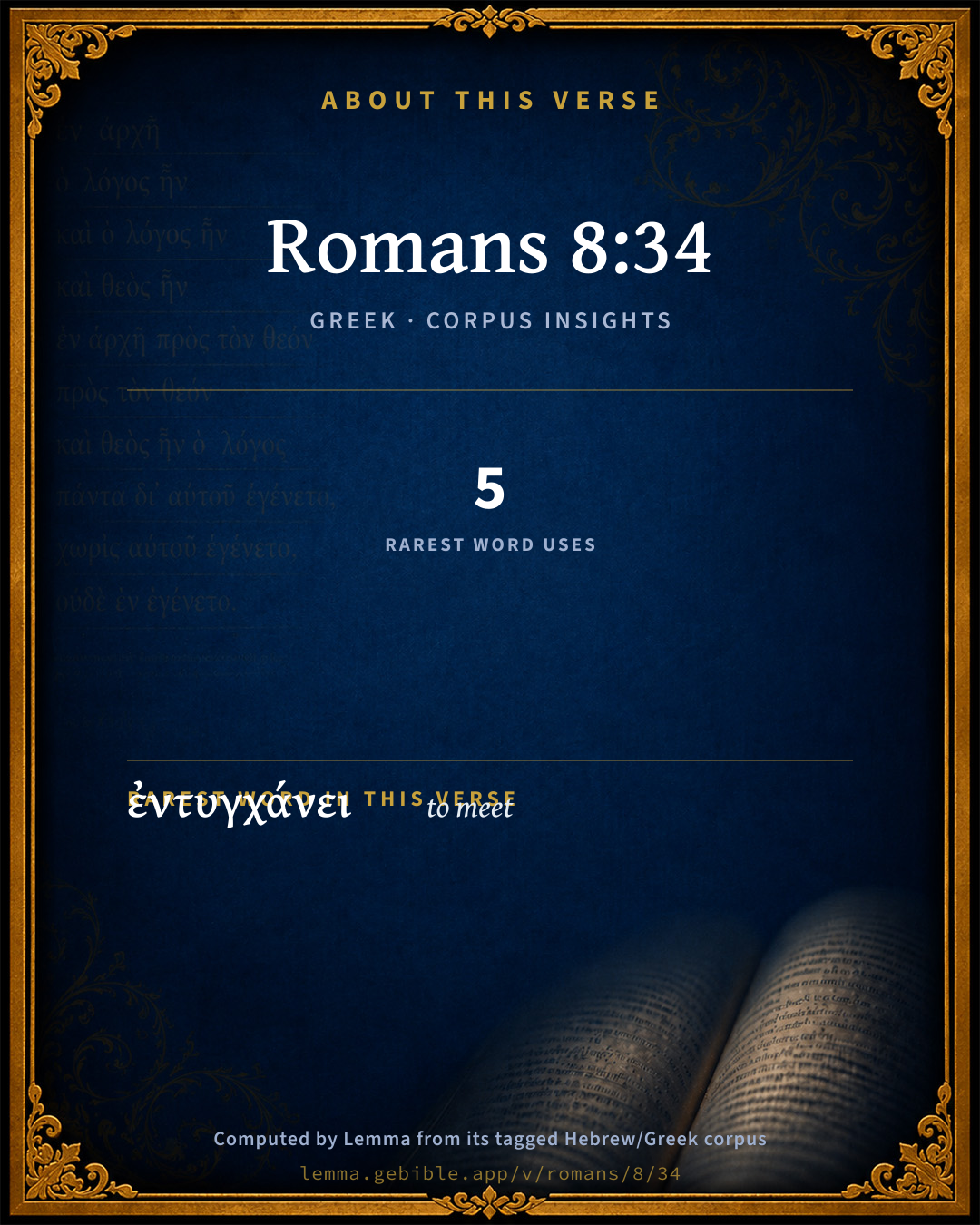
Romans 8:34

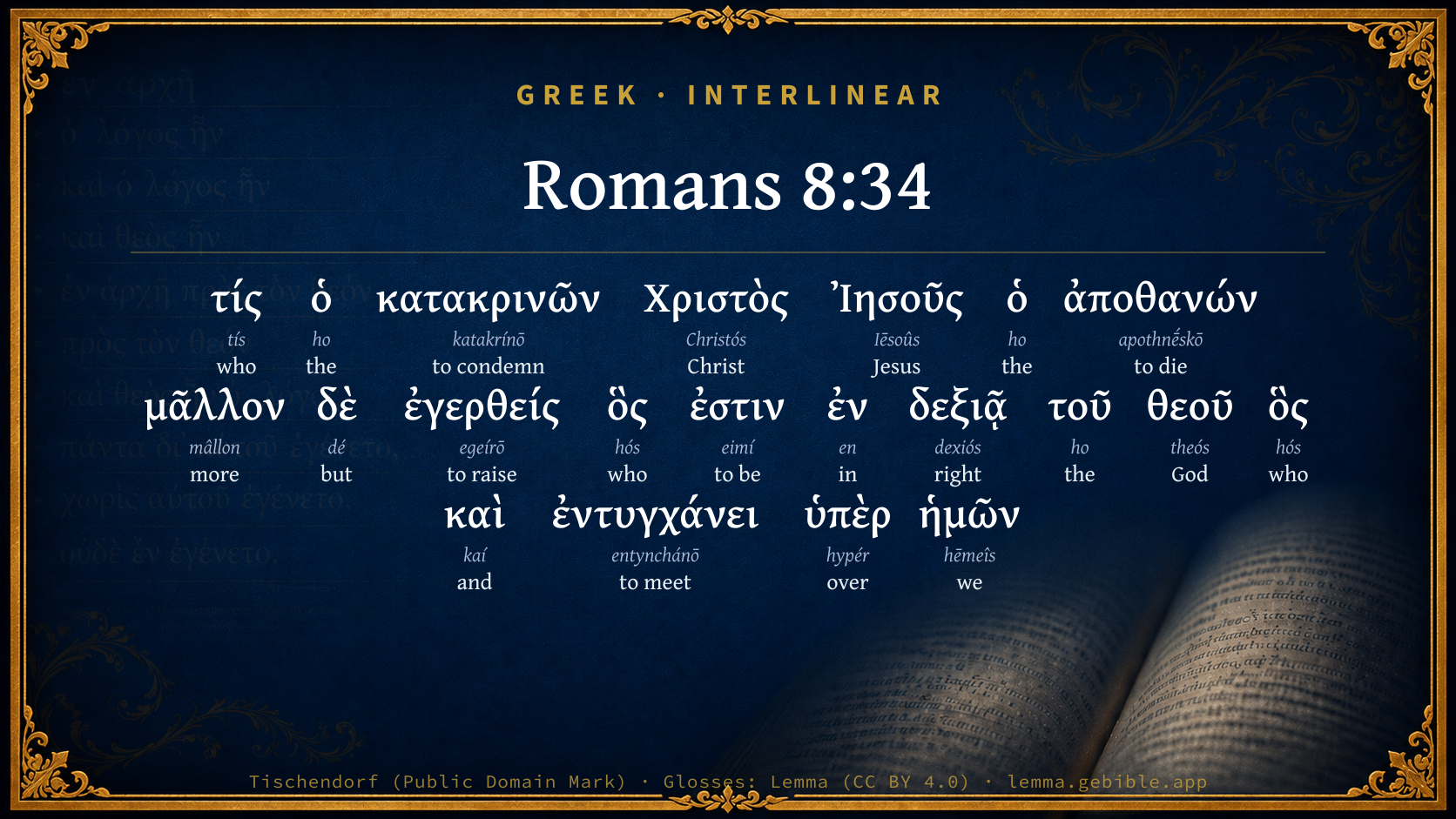
Greek (Tischendorf 8th ed.) Romans 8:34 appears in the Greek New Testament. The text above is from the Tischendorf 8th edition. Each word links to its Strong’s number and a concise gloss. Click any word for its full Thayer’s Greek Lexicon entry.
Download image
Cite this verse

Romans 8:34 (World English Bible). Public Domain. Lemma interlinear Bible study tool, https://lemma.gebible.app/v/romans/8/34.

Show BibTeX & RIS
BibTeX
RIS
English Translation
Who is he who condemns? It is Christ who died, yes rather, who was raised from the dead, who is at the right hand of God, who also makes intercession for us.
World English Bible · Public Domain
Download a study sheet

One document with this verse’s original text, its word-by-word gloss line, the meaning frame, cross-references with their text, attributed commentary, and full source and license credits — printable, and it pastes into notes with its structure intact.

This verse Autodidact and up

Study sheet (.html) Plain text (.txt)

A passage Seminary Student

Up to 50 verses in one chapter. A passage sheet keeps up to 6 commentary sources and 12 cross-references per verse, in the order this page ranks them, and says so on the sheet whenever that leaves anything out. Ask for a single verse and you get the Autodidact verse sheet above.

Everything on this page stays free to read, with no account — the sheet is a download of what is already on screen, not access to it.

Want to remove ads? Support Godless Engineer
Compare translations 3

The same verse in 3 English versions, stacked beneath the original-language interlinear above. Click any original word for its lexicon entry.

Each is an independent rendering of the whole verse — the interlinear is not word-aligned to these translations.

Highlighted words mark where these versions differ — a whole-verse word diff, not a word-by-word alignment.

  • World English Bible Public Domain
    Who is he who condemns? It is Christ who died, yes rather, who was raised from the dead, who is at the right hand of God, who also makes intercession for us.
  • King James Version Public Domain
    Who is he that condemneth? It is Christ that died, yea rather, that is risen again, who is even at the right hand of God, who also maketh intercession for us.
  • unfoldingWord Literal Text CC BY-SA 4.0
    Who the one condemning? Christ Jesus the one having died—but more, having been raised, who also is at the right hand of God—the one also interceding on our behalf.

unfoldingWord Literal Text — © unfoldingWord, licensed CC BY-SA 4.0. Word-aligned USFM3 via Door43 (git.door43.org/unfoldingWord/en_ult).

Versions to compare (up to 4)

3 of 4 selected

Show all 19 translations

Every available English version of this verse, each an independent rendering of the whole verse.

  • World English Bible Public Domain
    Who is he who condemns? It is Christ who died, yes rather, who was raised from the dead, who is at the right hand of God, who also makes intercession for us.
  • Berean Standard Bible Public Domain
    Who is there to condemn us? For Christ Jesus, who died, and more than that was raised to life, is at the right hand of God—and He is interceding for us.
  • Majority Standard Bible Public Domain
    Who is there to condemn us? For Christ, who died, and more than that was raised to life, is at the right hand of God—and He is interceding for us.
  • King James Version Public Domain
    Who is he that condemneth? It is Christ that died, yea rather, that is risen again, who is even at the right hand of God, who also maketh intercession for us.
  • American Standard Version (1901) Public Domain
    who is he that condemneth? It is Christ Jesus that died, yea rather, that was raised from the dead, who is at the right hand of God, who also maketh intercession for us.
  • Revised Version (1885) Public Domain
    who is he that shall condemn? It is Christ Jesus that died, yea rather, that was raised from the dead, who is at the right hand of God, who also maketh intercession for us.
  • Geneva Bible (1599) Public Domain
    Who shall condemne? it is Christ which is dead, yea, or rather, which is risen againe, who is also at the right hand of God, and maketh request also for vs.
  • Douay-Rheims (1899) Public Domain
    Who is he that shall condemn? Christ Jesus that died, yea that is risen also again; who is at the right hand of God, who also maketh intercession for us.
  • Young's Literal Translation Public Domain
    who `is' he that is condemning? Christ `is' He that died, yea, rather also, was raised up; who is also on the right hand of God -- who also doth intercede for us.
  • Literal Standard Version CC BY-SA 4.0
    who [is] he that is condemning? Christ [is] He that died, indeed, rather also, was raised up; who is also on the right hand of God—who also interceded for us.
  • Unlocked Literal Bible CC BY-SA 4.0
    Who is the one who condemns? Christ Jesus is the one who died—more than that, who was raised—who is at the right hand of God, and who also is interceding for us.
  • unfoldingWord Literal Text CC BY-SA 4.0
    Who the one condemning? Christ Jesus the one having died—but more, having been raised, who also is at the right hand of God—the one also interceding on our behalf.
  • Darby Bible Public Domain
    who is he that condemns? [It is] Christ who has died, but rather has been [also] raised up; who is also at the right hand of God; who also intercedes for us.
  • World Messianic Bible Public Domain
    Who is he who condemns? It is Messiah who died, yes rather, who was raised from the dead, who is at the right hand of God, who also makes intercession for us.
  • Webster's Bible Public Domain
    Who is he that condemneth? It is Christ that died, or rather that is risen again, who is even at the right hand of God, who also maketh intercession for us.
  • Free Bible Version CC BY-SA 4.0
    so who can condemn us? It's Christ Jesus who died—more importantly, who was raised from the dead—who stands at God's right-hand, presenting our case.
  • Bible in Basic English Public Domain
    Who will give a decision against us? It is Christ Jesus who not only was put to death, but came again from the dead, who is now at the right hand of God, taking our part.
  • Text-Critical English NT CC BY 4.0
    Who is to condemn? Christ is the one who died, but more than that, he was raised and is at the right hand of God, interceding for us.
  • Tyndale New Testament (1534) Public Domain
    who then shall condempne? it is Christ which is deed the rather which is rysen agayne which is also on the ryght honde of God and maketh intercession for vs.

Literal Standard Version (2020), Covenant Press — licensed CC BY-SA 4.0. Text via the HelloAO Bible API (eBible.org). Unlocked Literal Bible (unfoldingWord) — licensed CC BY-SA 4.0. Text via the HelloAO Bible API (eBible.org). unfoldingWord Literal Text — © unfoldingWord, licensed CC BY-SA 4.0. Word-aligned USFM3 via Door43 (git.door43.org/unfoldingWord/en_ult). Free Bible Version, Dr. Jonathan Gallagher — licensed CC BY-SA 4.0. Text via the HelloAO Bible API (eBible.org).

Word by word

More ways to search: Search by grammar → Find every occurrence → Compare this word →

Practice this passage: Drill this verse → Learn its vocabulary →

ἐντυγχάνει
entynchánō
G1793
“to meet”
Verb, Present, Active, Indicative, 3rd person, Singular
Part of Speech
Verb
Tense
Present
Voice
Active
Mood
Indicative
Person
3rd person
Number
Singular
Full Thayer's Definition

Origin: from G1722 and G5177

TDNT: 12:02,1

1. to light upon a person or a thing, fall in with, hit upon, a person or a thing 2. to go to or meet a person, esp. for the purpose of conversation, consultation, or supplication 3. to pray, entreat 4. make intercession for any one
  1. τίς tís G5101 “who” Interrogative pronoun, Nominative, Singular, Masculine
  2. ὁ ho G3588 “the” Article, Nominative, Singular, Masculine
  3. κατακρινῶν katakrínō G2632 “to condemn” Verb, Present, Active, Participle, Nominative, Singular, Masculine
  4. Χριστὸς Christós G5547 “Christ” Noun, Nominative, Singular, Masculine
  5. Ἰησοῦς Iēsoûs G2424 “Jesus” Noun, Nominative, Singular, Masculine
  6. ὁ ho G3588 “the” Article, Nominative, Singular, Masculine
  7. ἀποθανών apothnḗskō G599 “to die” Verb, Aorist, Active, Participle, Nominative, Singular, Masculine
  8. μᾶλλον mâllon G3123 “more” Adverb
  9. δὲ dé G1161 “but” Conjunction
  10. ἐγερθείς egeírō G1453 “to raise” Verb, Aorist, Passive, Participle, Nominative, Singular, Masculine
  11. ὃς hós G3739 “who” Relative pronoun, Nominative, Singular, Masculine
  12. ἐστιν eimí G1510 “to be” Verb, Present, Active, Indicative, 3rd person, Singular
  13. ἐν en G1722 “in” Preposition
  14. δεξιᾷ dexiós G1188 “right” Adjective, Dative, Singular, Feminine
  15. τοῦ ho G3588 “the” Article, Genitive, Singular, Masculine
  16. θεοῦ theós G2316 “God” Noun, Genitive, Singular, Masculine
  17. ὃς hós G3739 “who” Relative pronoun, Nominative, Singular, Masculine
  18. καὶ kaí G2532 “and” Conjunction
  19. ὑπὲρ hypér G5228 “over” Preposition
  20. ἡμῶν hēmeîs G2249 “we” Personal pronoun, 1st person, Genitive, Plural

About this verse

These counts appear in no published source. They are computed here, from the morphology-tagged text and Lemma’s own curated glosses. What Lemma adds →

21
words
18
distinct lemmas
Pauline Epistles
section

Notable vocabulary

The rarest word here is ἐντυγχάνει to meet G1793 — appearing just 5 times in the whole Greek New Testament.

Shared distinctive vocabulary

ἐντυγχάνει to meet G1793 occurs in 5 verses of the Greek New Testament. Also found in:

Repetition

Words recur within this verse:

Cross-references

34

Topical passages linked to Romans 8:34 in the Treasury of Scripture Knowledge — connected by theme and wording, ordered by reader-vote popularity; previews shown in the World English Bible.

  • Hebrews 7:25 Therefore he is also able to save to the uttermost those who draw near to God through him, seeing he ever lives to make intercession for them.
  • Romans 8:27 He who searches the hearts knows what is on the Spirit's mind, because he makes intercession for the saints according to God.
  • Hebrews 9:24 For Christ hasn't entered into holy places made with hands, which are representations of the true, but into heaven itself, now to appear in the presence of God for us;
  • 1 Peter 3:22 who is at the right hand of God, having gone into heaven, angels and authorities and powers being made subject to him.
  • Romans 8:1 There is therefore now no condemnation to those who are in Christ Jesus, who don't walk according to the flesh, but according to the Spirit.
  • Colossians 3:1 If then you were raised together with Christ, seek the things that are above, where Christ is, seated on the right hand of God.
  • Mark 16:19 So then the Lord Jesus, after he had spoken to them, was received up into heaven, and sat down at the right hand of God.
  • Hebrews 10:19–22 Having therefore, brothers, boldness to enter into the holy place by the blood of Jesus,
  • Hebrews 8:1–2 Now in the things which we are saying, the main point is this. We have such a high priest, who sat down on the right hand of the throne of the Majesty in the heavens,
  • 1 John 2:1–2 My little children, I write these things to you so that you may not sin. If anyone sins, we have a Counselor with the Father, Jesus Christ, the righteous.
  • Psalms 109:31 For he will stand at the right hand of the needy, To save him from those who judge his soul.
  • Isaiah 53:12 Therefore will I divide him a portion with the great, and he shall divide the spoil with the strong; because he poured out his soul to death, and was numbered with the transgressors: yet he bore the sin of many, and made intercession for the transgressors.
  • Hebrews 4:14–15 Having then a great high priest, who has passed through the heavens, Jesus, the Son of God, let us hold tightly to our confession.
  • Romans 5:6–10 For while we were yet weak, at the right time Christ died for the ungodly.
  • Romans 14:9 For to this end Christ died, rose, and lived again, that he might be Lord of both the dead and the living.
  • Romans 4:25 who was delivered up for our trespasses, and was raised for our justification.
  • Revelation 1:18 and the Living one. I was dead, and behold, I am alive forevermore. Amen. I have the keys of Death and of Hades.
  • Psalms 37:33 Yahweh will not leave him in his hand, Nor condemn him when he is judged.
  • Jeremiah 50:20 In those days, and in that time, says Yahweh, the iniquity of Israel shall be sought for, and there shall be none; and the sins of Judah, and they shall not be found: for I will pardon them whom I leave as a remnant.
  • Hebrews 12:1–2 Therefore let us also, seeing we are surrounded by so great a cloud of witnesses, lay aside every weight and the sin which so easily entangles us, and let us run with patience the race that is set before us,
  • John 16:23 "In that day you will ask me no questions. Most assuredly I tell you, whatever you may ask of the Father in my name, he will give it to you.
  • John 16:26–27 In that day you will ask in my name; and I don't say to you, that I will pray to the Father for you,
  • Romans 14:13 Therefore let's not judge one another any more, but judge this rather, that no man put a stumbling block in his brother's way, or an occasion for falling.
  • Hebrews 1:3 His Son is the radiance of his glory, the very image of his substance, and upholding all things by the word of his power, when he had by himself made purification for our sins, sat down on the right hand of the Majesty on high;
  • Hebrews 9:10–14 being only (with meats and drinks and various washings) fleshly ordinances, imposed until a time of reformation.
  • 1 Peter 3:18 Because Christ also suffered for sins once, the righteous for the unrighteous, that he might bring you to God; being put to death in the flesh, but made alive in the spirit;
  • Job 33:24 Then God is gracious to him, and says, 'Deliver him from going down to the pit, I have found a ransom.'
  • Matthew 20:28 even as the Son of Man came not to be served, but to serve, and to give his life as a ransom for many."
  • John 14:19 Yet a little while, and the world will see me no more; but you will see me. Because I live, you will live also.
  • John 17:20–24 Not for these only do I pray, but for those also who believe in me through their word,
  • Acts 7:56–60 and said, "Behold, I see the heavens opened, and the Son of Man standing at the right hand of God!"
  • Galatians 3:13–14 Christ redeemed us from the curse of the law, having become a curse for us. For it is written, "Cursed is everyone who hangs on a tree,"
  • Hebrews 10:10–14 by which will we have been sanctified through the offering of the body of Jesus Christ once for all.
  • Job 34:29 When he gives quietness, who then can condemn? When he hides his face, who then can see him? Alike whether to a nation, or to a man:

Cross-references courtesy of OpenBible.info (CC BY 4.0).

Where the printed editions differ

2 variants

Places in this verse where the major printed Greek editions disagree on the wording in a way that affects the translation — a comparison of editions, not a manuscript-by-manuscript collation. The editions are the modern critical texts (Nestlé-Aland 28/27, SBL, Westcott-Hort, Tregelles, Tyndale House) and the traditional texts behind the KJV (the Textus Receptus and the Byzantine/Majority text). It is not a claim about which reading is original.

  1. Extra text
    Ἰησοῦς

    “Jesus”

    In NA28NA27WH Not in TynSBLTregTRByz

    Ἰησοῦς (Iēsous) 'Jesus' is only in older manuscripts (NA28+NA27+WH)

  2. Extra text
    ἐκ νεκρῶν,

    “from dead”

    In WH Not in NA28NA27TynSBLTregTRByz

    ἐκ νεκρῶν, (ek nekrōn) 'from dead' is only in a few manuscripts (WH)

Textual data: Translators Amalgamated Greek New Testament (STEPBible TAGNT) · CC BY 4.0.

Commentary

Notes on Romans 8:34 from classic Christian and Jewish commentators (each source and its license shown beneath its notes). The classic Christian expositions comment on the surrounding passage and are grouped to its opening verse, so a note may address several verses; the Jewish commentaries on the Tanakh (Rashi and others) are per-verse, so they appear only where the commentator wrote on this verse.

Lemma curates 59 commentaries, every one of them public domain or Creative Commons licensed, each selected and text-cleaned for this edition rather than reprinted as found. About our sources →

Bengel's Gnomon

Johann Albrecht Bengel

Rom 8:34. Ὁ ἀποθανών, μᾶλλον δὲ—ὃς καὶ—ὃς καί, that died, yea rather—who even—who also) The order of the enumeration of the things contrary, Rom 8:35; Rom 8:38-39, corresponds to these four weighty turning points of his argument. In Rom 8:35, the former are lighter and less considerable [than in Rom 8:38], and may be all referred to [reduced to the one head, viz.] death, Rom 8:38, inasmuch as they are, as it were, previous tendencies towards death. The contraries in the way of the elect, enumerated in Rom 8:38-39, are more weighty ones. That topic will be by and by brought out more fully.—μᾶλλον, rather) ch. Rom 5:10. Our faith ought to lean on the death of Christ, but it ought rather also to make such progress, as to lean on His resurrection, kingly dominion, and second coming.—ἔστιν ἐν δεξιᾷ τοῦ Θεοῦ, is at the right hand of God) He is able to save; He Himself and the Father. The ascension is not previously mentioned, nor does the mention of His glorious coming follow: for the former is the act of sitting at the right hand of God, the latter entirely takes away all, that threatens separation from the love of God, and brings in the state of glory, of which Rom 8:30 treats.—ἐντυγχάνει, intercedes) He is willing to save: He Himself and the Father.

Bengel's Gnomon of the New Testament — English translation (T&T Clark, Edinburgh, 1860) — public domain. Text from a community e-Sword module.

Godet's Commentaries

Frédéric Louis Godet

Vv. 34. “Who is he that condemneth? It is Christ Jesus that died, yea rather, that is risen again, who is also, at the right hand of God, who also maketh intercession for us.”

The form τίς ὁ κατακρίνων, literally, who will be the condemning one? supposes only one judge possible, while the form of the previous question, Who will accuse? admitted a plurality of accusers. Why this difference? When accusing is the matter in question, all creatures may raise their voice. But as to judging? One only is appointed for that office, He who is called (Act 10:42) by St. Peter “the judge of quick and dead;” comp. also Act 17:31 and Rom 14:10; so that the question put amounts to this: Will Christ, at the day of judgment, condemn us? The verb understood must be will be, not is;comp. Rom 8:33; Rom 8:35. The negative answer arises from the following enumeration of the acts done by Christ in our behalf. There would be a contradiction between this series of merciful interpositions and a final condemnation. It has excited surprise that when saying Christ died, Paul did not add for us. But he is not speaking here of the death of Christ from the viewpoint of expiation; in this respect it was already implied in the answer to the previous question, “It is God that justifieth.” The death of Christ is mentioned here from the same standpoint as in chap. 6, implying, for the man who appropriates it, death to sin. The article ὁ, literally, the (one who died), reminds us that one only could condemn us, but that it is that very one who died that we might not be obliged to do it. The resurrection is likewise mentioned from the same point of view as in chap. 6, as the principle whereby a new life is communicated to believers, even the life of Christ Himself, of which, when once justified, we are made partakers (Eph 2:5-6).

His sitting at the right hand of God naturally follows, first as the principle of the outpouring of the Holy Spirit, and then as having put into the hands of Christ the government of the world and the direction of all the events of our life.

Finally, by His intercession we are assured of His precious interposition at such moments of spiritual weakness, as that in reference to which He declared to Peter: “I have prayed for thee, that thy faith fail not.” How, with such support, should the Christian not become the conqueror of the sin which still cleaves to him, and how should he not succeed in presenting himself before the judgment-seat in a state which will not dishonor his Lord? This is what the apostle had called (Rom 8:10), “being saved by His life,” in contrast to “being reconciled by His death” (same verse).

After the example of Erasmus, Meyer divides the questions and answers contained in this passage quite differently. According to him, the words: Who will be the condemner? still form part of the answer to the question: Who will accuse? (Rom 8:33), as if it were: “Since God justifieth, who then will condemn?” Then follows a second interrogation introduced by the affirmations: Christ died, etc., affirmations terminating in the conclusion expressed anew, Rom 8:35, in the interrogative form: Who will separate? that is to say: “who then will separate us?” But this grouping of questions and answers seems to me inadmissible, for the following reasons:—1. The question: Who will condemn? cannot be the reproduction (negatively) of the previous question: Who will accuse? For accusing and condemning are two entirely different functions; the one belongs to everybody, the other to one only. 2. Λ then would be indispensable in the two questions: who shall condemn (Rom 8:34)? and who shall separate (Rom 8:35)? intended, according to Meyer, to express the two conclusions. 3. The question: Who shall separate (Rom 8:35)? is so far from being intended to express the conclusion from what precedes, that it finds its answer in all that follows, and particularly in the words of Rom 8:39, which close the whole passage: Nothing shall separate us. 4. This same question: Who shall separate? is followed by a long enumeration of the sufferings calculated to separate the believer from his Saviour, which absolutely prevents us from taking this question as expressing a conclusion.

A more seducing proposition is that of the expositors who, after taking the words Θεὸς ὁ δικαιῶν interrogatively: God who justifieth? give the same turn to Rom 8:34: “Who is he that shall condemn? Will it be Christ, He who died, who”...? This form has something lively and piquant; and if it applied only to a single question, one might be tempted to hold by it. But the series of questions which would then succeed one another in the same interrogative, and almost ironical sense, does not seem to us to be compatible with the profound feeling of this whole passage.

The numerous variants (Rom 8:34) which we have indicated in the note have no importance. The name Jesus, added to the title Christ, by several Mjj., is in thorough keeping with the context; for in what follows there are summed up the phases of His existence as a historical person. It is the same with the καί, also, in the second and third proposition. It may even be said that the καί of the third does not admit of any doubt.

The apostle has defied accusers; their voice is silenced by the sentence of justification which covers believers. He has asked if at the last day the judge will not condemn, and he has seen sin, the object of condemnation, disappear from the believer’s life before the work of the crucified and glorified Christ. It remains to be known whether some hostile power will not succeed in violently breaking the bond which unites us to the Lord, and on which both our justification and sanctification rest. By this third question he reaches the subject treated in the last place, in this very chapter, from Rom 8:18: τὰ παθήματα, the sufferings of this present time; and thus it is that in the three questions of this passage the entire Epistle is really summed up. It is clearly seen how the logical form does not for an instant slip from the mind of Paul, even at the time when the most overflowing feeling charges his pen.

Frédéric Louis Godet — Commentaries on Luke, John, Romans, and 1 Corinthians — English translation (T&T Clark, Edinburgh, 1870s–1890s) — public domain. Text from a community e-Sword module.

Hodge's Commentary on Romans, Ephesians & First Corinthians

Charles Hodge

Rom_8:34

Who is he that condemneth? i.e., no one can condemn. In support of this assertion there are, in this verse, four conclusive reasons presented; the death of Christ, his resurrection, his exaltation, and his intercession. It is Christ that died. By his death, as an atonement for our sins, all ground of condemnation is removed. The death of Christ could not be a proof that the believer cannot be condemned, unless his death removed the ground of condemnation; and it could not remove the ground of condemnation, unless it satisfied the demands of justice. His death, therefore, was a satisfaction, and not merely an exhibition of love, or a didactic symbol meant to impress some moral truth. Yea, rather, that is risen again. The resurrection of Christ, as the evidence of the sacrifice of his death being accepted, and of the validity of all his claims, is a much more decisive proof of the security of all who trust in him, than his death could be. See on Rom_1:4; Rom_4:25; Act_17:31; 1Co_15:17, etc.

Who is even at the right hand of God, i.e., is associated with God in his universal dominion. Psa_110:1, Sit thou on my right hand, i.e., share my throne; Eph_1:20; Rev_3:21. As I also overcame and am set down with my Father in his throne. Heb_1:3, Who sat down at the right hand of the Majesty on high. From these and other passages in their connection, it is evident that Christ is exalted to universal dominion, all power in heaven and earth is given into his hands. If this is the case, how great the security it affords the believer! He who is engaged to effect his salvation is the Director of all events, and of all worlds.

Who also maketh intercession for us, i.e., who acts as our advocate, pleads our cause before God, presents those considerations which secure for us pardon and the continued supply of the divine grace; see on Rom_8:26; Heb_7:25; Heb_9:24; 1Jo_2:1. Christ, as seated at the right hand of God, and invested with universal dominion, is able to save: his interceding for us is the evidence that he is willing to save willing not only in the sense of being disposed to, but in the sense of purposing. He intends to save those who put their trust in him, and therefore in their behalf he presents before God the merit of his mediatorial work, and urges their salvation as the reward promised him in the covenant of redemption. He is our patron, in the Roman sense of the word, one who undertakes our case; an advocate, whom the Father heareth always. How complete, then, the security of those for whom he pleads!‹42› Of course this language is figurative; the meaning is, that Christ continues since his resurrection and exaltation to secure for his people the benefits of his death, every thing comes from God through him, and for his sake.

Charles Hodge — Commentary on Romans (1835), First Corinthians (1857), and Ephesians (1856) — public domain. Text from a community e-Sword module.

Jamieson, Fausset & Brown

Robert Jamieson, A. R. Fausset & David Brown

yea rather, that is risen again--to make good the purposes of His death. Here, as in some other cases, the apostle delightfully corrects himself (see Gal 4:9; and see on Rom 1:12); not meaning that the resurrection of Christ was of more saving value than His death, but that having "put away sin by the sacrifice of Himself"--which though precious to us was to Him of unmingled bitterness--it was incomparably more delightful to think that He was again alive, and living to see to the efficacy of His death in our behalf.

who is even--"also"

at the right hand of God--The right hand of the king was anciently the seat of honor (compare Sa1 20:25; Kg1 2:19; Psa 45:9), and denoted participation in the royal power and glory (Mat 20:21). The classical writings contain similar allusions. Accordingly Christ's sitting at the right hand of God--predicted in Psa 110:1, and historically referred to in Mar 16:19; Act 2:33; Act 7:56; Eph 1:20; Col 3:1; Pe1 3:22; Rev 3:21 --signifies the glory of the exalted Son of man, and the power in the government of the world in which He participates. Hence it is called "sitting on the right hand of Power" (Mat 26:64), and "sitting on the right hand of the Majesty on high" (Heb 1:3) [PHILIPPI].

who also maketh intercession for us--using all His boundless interest with God in our behalf. This is the top of the climax. "His Session at God's right hand denotes His power to save us; His Intercession, His will to do it" [BENGEL]. But how are we to conceive of this intercession? Not certainly as of one pleading "on bended knees and with outstretched arms," to use the expressive language of CALVIN. But yet, neither is it merely a figurative intimation that the power of Christ's redemption is continually operative [THOLUCK], or merely to show the fervor and vehemence of His love for us [CHRYSOSTOM]. It cannot be taken to mean less than this: that the glorified Redeemer, conscious of His claims, expressly signifies His will that the efficacy of His death should be made good to the uttermost, and signifies it in some such royal style as we find Him employing in that wonderful Intercessory Prayer which He spoke as from within the veil (see on Joh 17:11-12): "Father, I WILL that they also whom Thou hast given Me be with Me where I am" (see on Joh 17:24). But in what form this will is expressed is as undiscoverable as it is unimportant.

Jamieson, Fausset & Brown — Commentary Critical and Explanatory on the Whole Bible (1871) — public domain (CC PDM 1.0). Text via the HelloAO Bible API.

Adam Clarke's Commentary

Verse 34. Who is even at the right hand of God] To which he has exalted our human nature, which he took in conjunction with his Divinity; and there he maketh intercession for us-manages all the concerns of his own kingdom in general, and of every member of his Church in particular.

Adam Clarke's Commentary on the Bible (1810–1826) — public domain. Text from a community e-Sword/MySword module.

John Calvin's Commentaries

34. Who is he that condemns? etc. As no one by accusing can prevail, when the judge absolves; so there remains no condemnation, when satisfaction is given to the laws, and the penalty is already paid. Now Christ is he, who, having once for all suffered the punishment due to us, thereby declared that he undertook our cause, in order to deliver us: he then who seeks hereafter to condemn us, must bring back Christ himself to death again. But he has not only died, but also came forth, by a resurrection, as the conqueror of death and triumphed over all its power.

He adds still more, — that he now sits at the right hand of the Father; by which is meant, that he possesses dominion over heaven and earth, and full power and rule over all things, according to what is said in Ephesians 1:20. He teaches us also, that he thus sits, that he may be a perpetual advocate and intercessor in securing our salvation. It hence follows, that when any one seeks to condemn us, he not only seeks to render void the death of Christ, but also contends with that unequalled power with which the Father has honored him, and who with that power conferred on him supreme authority. This so great an assurance; which dares to triumph over the devil, death, sin, and the gates of hell, ought to lodge deep in the hearts of all the godly; for our faith is nothing, except we feel assured that Christ is ours, and that the Father is in him propitious to us. Nothing then can be devised more pestilent and ruinous, than the scholastic dogma respecting the uncertainty of salvation.

Who intercedes, etc. It was necessary expressly to add this, lest the Divine majesty of Christ should terrify us. Though, then, from his elevated throne he holds all things in subjection under his feet, yet Paul represents him as a Mediator; whose presence it would be strange for us to dread, since he not only kindly invites us to himself, but also appears an intercessor for us before the Father. But we must not measure this intercession by our carnal judgment; for we must not suppose that he humbly supplicates the Father with bended knees and expanded hands; but as he appears continually, as one who died and rose again, and as his death and resurrection stand in the place of eternal intercession, and have the efficacy of a powerful prayer for reconciling and rendering the Father propitious to us, he is justly said to intercede for us.

John Calvin's Commentaries (1540-1563) — public domain. Text from the Calvin Translation Society English edition (1840s-50s) via the Christian Classics Ethereal Library (ccel.org). Calvin's coverage is partial (roughly two-thirds of the Bible); uncommented books and verses are honest gaps, never fabricated. The 19th-century editor's footnotes and remarks are omitted so the notes are faithfully Calvin's own voice.

Ellicott's Commentary for English Readers

(34) It is Christ . . .—The remainder of this verse is to be closely connected with the opening of the next. “He that died, rose, &c., is Christ: who then shall separate us from His love?” The two questions, “Who is he that condemneth?” and “Who shall separate us?” are really parts of the reply to the main question thrown into an interrogative form. At another moment the sentence would probably have been differently cast, but the Apostle’s mind is in an attitude of challenge.

Yea rather.—Yea more. The pledges that Christ has given us of His love did not end, but only began with His death.

A Bible Commentary for English Readers, edited by Charles John Ellicott (1878–1897) — public domain. Text from a community e-Sword module.

The Cambridge Bible for Schools and Colleges

gen. ed. J. J. S. Perowne

34. condemneth] Or perhaps (by a change of Gr. accent) shall condemn (at the Great Day).

It is Christ] Here again, Is it Christ, &c.? should be read.—Observe the level on which “God” and “Christ” are set in the language of this great passage. The One is as truly the Supreme Judge as the Other.

that died]—“for us” (ch. Rom_5:8).

yea rather, that is risen again]—“by reason of our justification,” (Rom_4:25.) The Resurrection is “rather” emphasized because it not only involves the Death, but is the proof of its Divine efficacy.

who is even at the right hand] As the Incarnate, Slain, and Risen One; as wielding, in that character, “all power in heaven and earth;” not merely accepted as our Representative, but so accepted as to be on the eternal Throne.—Cp. Heb_1:3; Rev_5:6-9; &c., &c.—This is the only direct reference to the Ascension in the Epistle; but what a pregnant reference!

who also maketh intercession] Another item in this solemn enumeration. The enthroned Son of God is actually pleading for the justified, in such a sense as to secure “that their faith fail not.” (Luk_22:31-32)—The fullest comment is Heb_4:14-16; Heb_7:25; Heb_9:11-12; Heb_9:24; 1Jn_2:1; and such O. T. passages as Exo_28:29.

The Cambridge Bible for Schools and Colleges (gen. ed. J. J. S. Perowne; Cambridge University Press, 1878–1918) — public domain. Text from a community e-Sword module.

John Gill's Exposition

Who is he that condemneth,.... That is, the elect of God: all mankind are deserving of condemnation, and are under the sentence of it, as in Adam; some are foreordained to condemnation; all in final impenitence and unbelief, are condemned already; and the whole world of the ungodly will be condemned at the last day; but none of God's elect are, or shall be condemned: for they are loved with an everlasting love; they are chosen unto salvation; they are in Christ, where there is no condemnation; they are brought to believe in him, and by him are justified from all sin, and so are secure from condemnation. They are indeed deserving of it as others, considered in themselves; and are under the sentence of it, as in Adam, with the rest of mankind; and in their own apprehensions, when convinced of sin, righteousness, and judgment. And are there none that will condemn them? yes, their own hearts often condemn them; they are very forward to condemn one another; the world condemns them, and so does the god of it: but neither Father, Son, nor Spirit, will condemn them; not the Father, for he justifies; nor the Son, for

it is Christ that died: that he died is certain; the death he died was the death of the cross; the persons he died for were God's elect; the reason of his dying for them was to make atonement for their sins; this came to pass through his substitution in their room and stead; this death of his was but once, yet of an eternal efficacy, and so a full security of them from all condemnation: for sin, the cause of condemnation, was removed by it; the condemnation itself was bore by Christ in their stead; the law and justice of God were satisfied by it; pardon of sin was procured by his blood; and complete justification obtained by his active and passive obedience; all which is confirmed by his resurrection, session at God's right hand, and intercession: wherefore it is added,

yea, rather that is risen again. As the death, so the resurrection of Christ, is the security of God's elect from condemnation; inasmuch as Christ rose again, as a conqueror over death, and over sin, the sting of death, and over Satan, who had the power of death; and also as a surety, having given satisfaction to law and justice: he engaged as a surety for his people; God in justice, and according to his righteous law, dealt with him, and by him as such; he satisfied both, and therefore was set free by them; hence neither law nor justice can condemn; besides he rose again as a common person, head and representative of his people, and for their justification: he first stood charged with all their sins, which by his Father, and with his own consent, were imputed to him; he was condemned and suffered death for them; when he rose from the dead, he was justified and acquitted from them all; and all his people were justified in him, and with him: yea, the resurrection of Christ is rather a greater security from condemnation, than his death; Christ's death expiated sin, but his resurrection brought in the everlasting righteousness; notwithstanding Christ's death, had he not risen again, we should have been in our sins, and so liable to condemnation; Christ's dying showed that he was arrested and condemned, but his resurrection shows that he is discharged, and we in him:

who is even at the right hand of God. The ascension of Christ, his entrance into heaven, and session at the right hand of God, are also a very considerable security of God's elect from condemnation; for when he ascended from earth to heaven in human nature, accompanied by angels, of which they and his disciples were witnesses, he led captivity captive, or triumphed over those that led his people captive, as sin, Satan, the law, death, and every other enemy of theirs; he entered into heaven to prepare it for them, to take possession of it in their name, to appear in the presence of God for them, and as having obtained the eternal redemption of them, where he was received with a welcome, as the surety and head of the chosen ones, and then sat down at the right hand of God; which shows that he had done his work, and to satisfaction, is advanced above all, power is given to him, all things are put under him, and he is head over all things to the church: and since he is at the right hand of God, as an advocate and intercessor for his people, it will be to no purpose, and of no avail, that Satan, or any other enemy, is at their right hand to resist them:

who also maketh intercession for us; which is done, not by vocal prayer, as in the days of his flesh on earth; or as supplicating an angry judge; or as controverting: a point in the court of heaven; but by the appearance of his person for us, by the presentation of his sacrifice, by offering up the prayers and praises of his people, by declaring it as his will, that such and such blessings be bestowed upon them, and by seeing to it, that the benefits of his death are applied to those, for whom they were designed; which intercession of Christ proceeds upon the foot of a satisfaction made; it always continues, and is ever prevalent, and so has a considerable influence to secure from condemnation. The apostle, in this verse, seems to have in view a passage in Job 34:29; which the Septuagint render, "and he gives peace, and who is he that condemneth?"

John Gill's Exposition of the Whole Bible (1746–1763) — public domain (CC PDM 1.0). Text via the HelloAO Bible API.

Trapp's Complete Commentary

John Trapp

34 Who is he that condemneth? It is Christ that died, yea rather, that is risen again, who is even at the right hand of God, who also maketh intercession for us.

Ver. 34. Who is he that condemneth?] To the sentence of death he opposeth Christ’s death.

Who is even at the right hand] And as Christ is at the right hand of his Father, so is the Chruch at the right hand of Christ, Psa 45:9, a place of dignity and safety.

John Trapp, A Commentary or Exposition upon All the Books of the Old and New Testament (1647–1656) — public domain. Text from a community e-Sword module.

Albert Barnes' Notes on the Bible

Who is he that condemneth? - Who shall pass sentence of condemnation, and consign to perdition? The function of passing sentence of condemnation on people shall pertain to Christ, the judge of quick and dead, and the apostle proceeds to say that it was certain that he would not condemn the elect of God. They were therefore secure.

It is Christ that died - Or as it may be rendered, “Shall Christ who has died, condemn them?” The argument here is, that as Christ died to save them, and not to destroy them, he will not condemn them. His death for them is a security that he will not condemn them. As he died to save them, and as they have actually embraced his salvation, there is the highest security that he will not condemn them. This is the first argument for their security from the death of Christ.

Yea rather, that is risen again - This is a second consideration for their security from his work. “He rose for their justification” (Note, Rom 4:25); and as this was the object which he had in view, it follows that he will not condemn them.

Who is even at the right hand of God - Invested with power, and dignity, and authority in heaven. This is a third consideration to show that Christ will not condemn us, and that Christians are secure. He is clothed with power; he is exalted to honor; he is placed at the head of all things. And this solemn enthronement and investiture with power over the universe, is with express reference to the salvation of his church and people; Mat 28:18-19; Joh 17:2; Eph 1:20-23. The Christian is, therefore, under the protection of Christ, and is secure from being condemned by him.

Who also maketh intercession for us - Note, Rom 8:26. Who pleads our cause; who aids and assists us; who presents our interests before the mercy-seat in the heavens. For this purpose he ascended to heaven; Heb 7:25. This is the fourth consideration which the apostle urges for the security of Christians drawn from the work of Christ. By all these, he argues their complete security from being subject to condemnation by him who shall pronounce the doom of all mankind, and therefore their complete safety in the day of judgment. Having the Judge of all for our friend, we are safe.

Albert Barnes' Notes on the Bible (1834–1885) — public domain. Text from a community e-Sword/MySword module.

Matthew Poole's English Annotations

Who is he that condemneth? As none can accuse the elect of God, so much less can any condemn them, see Rom 8:1.

It is Christ that died; and it is he that is the Judge, and must condemn them, if they be condemned. His deatk frees them from condemnation; thereby he hath made a sufficient atonement and satisfaction for all their sins; and that which hath long ago satisfied in heaven for the sins of all the elect, may very well serve to satisfy the heart and conscience of a believing sinner here on earth. Such a one may thrown down the gauntlet, as the apostle doth, and challenge all the world. Let conscience, carnal reason, law, sin, hell, and devils, bring forth all they can, it will not be sufficient to condemnation; and that because of Christ’s death and satisfaction.

Yea rather, that is risen again: the resurrection of Christ hath a special influence upou our justification; and therefore the apostle puts a rather upon it, and that comparatively to the death of Christ: see Rom 4:25, and; See Poole on "Rom 4:25".

Who is even at the right hand of God, who also makes intercession for us: faith finds matter of triumph, not only from Christ’s death and resurrection, but from his session at the right hand of God, and intercession for us.

Matthew Poole's English Annotations on the Holy Bible (1683–1685) — public domain. Text from a community e-Sword/MySword module.

Whedon's Commentary on the Bible

Daniel D. Whedon

34. Condemneth—The reason why there can be no charge is because there can be no condemnation; and the reason why there can be no condemnation is this most conclusive one, Christ that dieth. The penalty of our sins hath been suffered, and the faithful are unpunishable and uncondemnable. He who hath so suffered claims us as his right. To assert this claim he is risen again, and to give decisive authority to his claim he is even at the right hand of God. The image is drawn from the custom of Oriental kings of seating persons of the highest honour at the right side of the throne. So Solomon seated his mother at his own right hand, (1Ki_2:19,) so Salome desired to place one of her sons at the right hand and the other at the left of the royal Messiah, (Mat_20:21,) and so the Psalmist seats the Messiah-Jehovah at the right hand of Jehovah, (Psa_110:1.)

Intercession—So in Heb_7:25, we learn that He ever liveth to make intercession for us. So also Heb_9:24, and 1Jn_2:1. What the precise form of this intercession of the ever living Jesus is we know not. Yet it can be no otherwise than an essential perpetuation of his high priestly prayer in John 17. Though, however, his glorified form kneel not, and no voice be uttered, still his presence, with the history and glory of his death about him, is a perpetual memorial of mercy unto God. His blood has a perpetual voice, speaking better things than the blood of Abel.

Daniel D. Whedon (gen. ed.), Commentary on the Old and New Testaments (1874–1909) — public domain. Text from a community e-Sword module.

John Wesley's Explanatory Notes

Yea rather, that is risen - Our faith should not stop at his death, but be exercised farther on his resurrection, kingdom, second coming. Who maketh intercession for us - Presenting there his obedience, his sufferings, his prayers, and our prayers sanctified through him.

John Wesley, Explanatory Notes Upon the Whole Bible (1754–1765) — public domain. Text via the GEBible commentary corpus.

Burkitt's Expository Notes on the New Testament

William Burkitt

The apostle here goes on with the triumphant challenge in the foregoing verse begun, Who shall condemn the justified believer?

And here observe, 1. The holy challenge of faith, it is ready for all comers, and bids defiance to all accusations. If the law implead, faith says, Christ, in the likeness of sinful flesh, has condemned sin in the flesh. If death looks the believer in the face, faith saith, Christ has abolished death, and brought life and immortality to light. If Satan roar, faith can scorn, and tell him to his teeth, he is a conquered enemy; that Christ by his death has destroyed him that had the power of death. Yea, if God himself frown upon the believer, faith can bring to God a righteousness that is highly pleasing to him, with respect to which God may be just, and yet the justifier of him that believeth in Jesus.

Observe, 2. The ground of this triumphant challenge which faith enables the believer to make, and that is the mediation of Jesus Christ, in the four eminent branches of it, his death, resurrection, exaltation and intercession. Christ died, is risen again, is even at God’s right hand, making continual intercession for us.

Thence learn, That a believer’s triumphs over condemnation, do eminently arise from the several acts of Christ’s mediation. Christ died and rose again; our debt is therefore paid, because our surety is discharged; he sits at God’s right hand as a testimony of the completeness of his sacrifice and satisfaction for us, and he continually intercedes, that is, presents himself to his Father in both his nature, and in our names, as our Surety, our Advocate and Mediator: Who then shall lay anything to the believer’s charge, or who shall condemn him?

William Burkitt's Expository Notes on the New Testament (1700–1703) — public domain. Text from a community e-Sword module.

McGarvey & Pendleton's Commentaries

J. W. McGarvey

who is he that condemneth? It is Christ Jesus that died, yea rather, that was raised from the dead, who is at the right hand of God, who also maketh intercession for us . ["But, Paul," says some doubting heart, "surely there are ten thousand things which will come to light to do us harm in the all-revealing hour of the judgment. It can not be that all these things shall then work us good." The apostle replies that these things will, at that time, certainly work us no evil, for in that august hour when all of all nations shall be called to give account before the throne of Christ the Judge, who is it that shall lay any charge against those whom the Father has chosen because of their faith in Christ and obedience to him? How could any one presume to attempt any such thing? or what difference would it make if he did attempt it? for it is the Father himself who speaks to the contrary, declaring that the sins of those who believe on Jesus are forgiven, and that they are justified in Jesus. Thus Christians shall be safe during the hearing; but when the hearing is closed, and the fate of each rests in the hands of the Judge, then shall they be equally safe as to the final sentence. Who shall condemn them? There is but one who has the power to do this, and that one is the Judge; and the Judge is none other than Christ Jesus, who died to expiate our sins, lest they should condemn us; who was raised for our justification; who was enthroned at the right hand of God to rule for our sakes, and to judge us; and who even now pleads as our intercessor against our condemnation. Surely the past and present attitudes of Christ towards us guarantee his future conduct, and confirm us in the confidence that he, the unchangeable, will acquit us in that hour, and save us from the condemnation against which he has made such ample preparation and provision. So far as the Father is concerned, the cause of man is settled and sealed, for he has committed judgment to the Son. Whatever contingency there is, lies, therefore, in the bosom of the Son. He has made the sacrifice, and accomplished the work necessary to acquit man at the judgment; but as his decree and sentence are not yet spoken, it is, of course, contingent. Will he change his mind, and condemn man? The apostle answers this question by asking another.]

J. W. McGarvey (with Philip Y. Pendleton), Commentaries on the New Testament (The Fourfold Gospel, 1914; Acts; and the epistles) — public domain. Text from a community e-Sword/MySword module.

The People's New Testament

B. W. Johnson

34. Who is he that condemneth? There can be no condemnation (8:1) since Christ died … is risen … and maketh intercession for us. There is no condemnation in Christ Jesus.

B. W. Johnson's The People's New Testament with Notes (1889–1891) — public domain. Electronic text from the Christian Classics Ethereal Library (CCEL) ThML edition.

Cambridge Greek Testament for Schools and Colleges

34. Χρ. Ἰ. The whole process of the Son’s action in redemption, from the Incarnation to the Ascended Life, is given in the succession of forcible phrases: in them His love is shown.

Cambridge Greek Testament for Schools and Colleges (Cambridge University Press, 1896; 21 vols, various authors incl. Carr, Maclear, Plummer, Farrar, Lumby, Moule, M. R. James, Simcox) — public domain. Text from a community e-Sword module.

International Critical Commentary

34. Χριστὸς Ἰησοῦς א A C F G L, Vulg. Boh. Arm. Aeth., Orig.-lat. Did. Aug.: Χριστός (om. Ἰησοῦς) B D E K &c., Syrr., Cyr.-Jerus. Chrys. al. Another instance of B in alliance with authorities otherwise Western and Syrian. WH. bracket Ἰης.

ἐγερθεὶς ἐκ νεκρῶν א* A C al. plur., RV. WH.1: om. ἐκ νεκρῶν אc B D E F G K L &c., Ti. WH.2. The group which inserts ἐκ νεκρῶν is practically the same as that which inserts Ἰησοῦς above.

ὅς καί. Stroke follows stroke, each driving home the last. ‘It is Christ who died—nay rather (immo vero) rose from the dead—who (καί should be omitted here) is at the right hand of God—who also intercedes for us.’ It is not a dead Christ on whom we depend, but a living. It is not only a living Christ, but a Christ enthroned, a Christ in power. It is not only a Christ in power, but a Christ of ever-active sympathy, constantly (if we may so speak) at the Father’s ear, and constantly pouring in intercessions for His struggling people on earth. A great text for the value and significance of the Ascension (cf. Swete, Apost. Creed, p. 67 f.).

International Critical Commentary — older volumes (1896–1929), various authors — public domain. Text from a community e-Sword module.

Vincent's Word Studies in the New Testament

Marvin R. Vincent

Rather [μαλλον] . "Our faith should rest on Christ 's death. but it should rather also so far progress as to lean on His resurrection, dominion, and second coming" (Bengel). "From the representations of the dead Christ the early believers shrank as from an impiety. To them He was the living, not the dead Christ - the triumphant, the glorified, the infinite, - not the agonized Christ in that one brief hour and power of darkness which was but the spasm of an eternal glorification" (Farrar, "Lives of the Fathers," 1. 14).

Marvin R. Vincent, Word Studies in the New Testament (1887–1900) — public domain. Text from a community e-Sword/MySword module.

Lesson kit

Teaching starters — assembled from the data on this page, not authored interpretation. Every prompt links to the verse data it draws on. Edit before teaching.

Romans, in the Pauline Epistles, opens this verse with 21 words (18 distinct Greek lemmas). Its most distinctive word is entynchánō (“to meet”). A historical commentator’s framing appears above. Read the whole chapter for the surrounding context.

Discussion questions

  1. What does “to meet” (entynchánō) contribute to the verse as a whole?
  2. How does Acts 25:24, which shares the word «to meet», read alongside this verse?
  3. What does the repetition of “the” (3× in this one verse) do in this verse?
  4. The translations on this page render this verse differently — a whole-verse word diff, not a word-by-word alignment. What might account for the different wordings?
  5. Compare how Bengel's Gnomon and Godet's Commentaries read this verse. Where do they agree or differ?

Things to notice

Reading settings

Reading text

Shown beneath each verse's original-language words.

Old Testament
Old Testament edition

Read the OT as the Masoretic Hebrew (MT) or the Greek Septuagint (LXX).

English shown for the Greek Septuagint (in the Hebrew ↔ Greek comparison).

Comparing translations? Open the Compare panel on any verse page to stack up to four side by side.