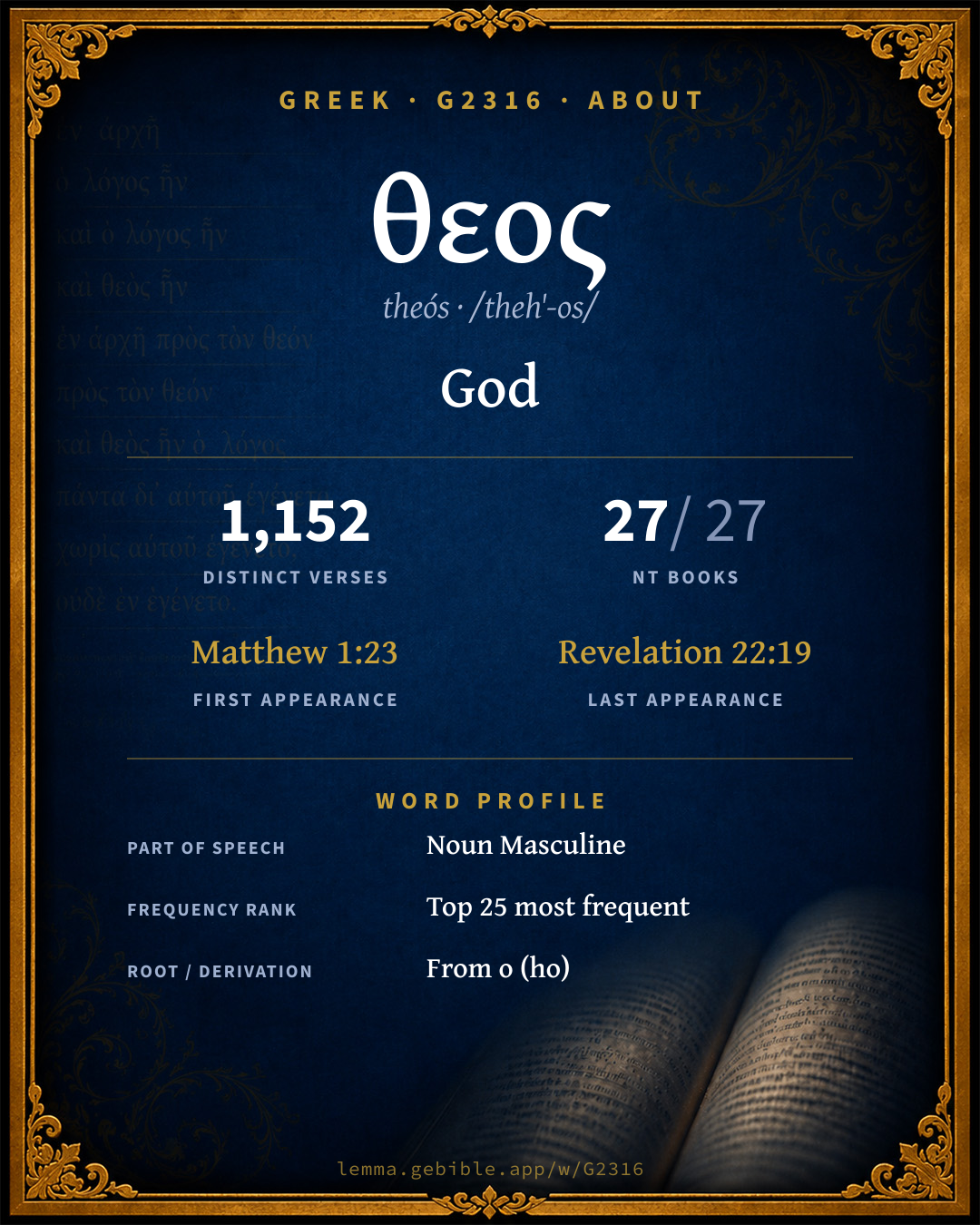
θεός
God
‘God’ is one of 6 main senses fuller range ↓
Full lexicon entry — Thayer's Greek Lexicon
From Thayer's Greek Lexicon
Where this word appears
See every Genitive-case word in the Greek New Testament →
Grammar key — what these labels mean
Part of speech
- Noun
- A naming word — a person, place, thing, or idea.
Case
- Genitive
- The case of source, possession, or “of” — answers “whose / from what.”
- Nominative
- The case of the subject (and the predicate nominative).
- Dative
- The case of the indirect object, means, or location — “to / for / with / in.”
- Accusative
- The case of the direct object and of extent.
- Vocative
- The case of direct address (“O Lord”).
Gender
- Masculine
- Grammatically masculine.
- Feminine
- Grammatically feminine.
Number
- Singular
- One.
- Plural
- More than one.
Every verse where G2316 appears in the Book of 2 Corinthians — 65 distinct verses. Click any verse to open its interlinear word-by-word view. Verse text shown in the World English Bible for context — . Each verse’s Greek form is shown with its reference; the English is not keyword-highlighted, since the data carries no word-level English alignment. Use “Compare translations” on any verse to read it across multiple English versions. This concordance covers the Greek New Testament; Septuagint (Greek Old Testament) occurrences of this word are not indexed here.
2 Corinthians
- 2 Corinthians 1:1 θεοῦ θεοῦ n gen sg masc n gen sg masc Paul, an apostle of Christ Jesus through the will of God, and Timothy our brother, to the assembly of God which is at Corinth, with all the saints who are in the whole of Achaia:
- 2 Corinthians 1:2 θεοῦ n gen sg masc Grace to you and peace from God our Father and the Lord Jesus Christ.
- 2 Corinthians 1:3 θεὸς θεὸς n nom sg masc n nom sg masc Blessed be the God and Father of our Lord Jesus Christ, the Father of mercies and God of all comfort;
- 2 Corinthians 1:4 θεοῦ n gen sg masc who comforts us in all our affliction, that we may be able to comfort those who are in any affliction, through the comfort with which we ourselves are comforted by God.
- 2 Corinthians 1:9 θεῷ n dat sg masc Yes, we ourselves have had the sentence of death within ourselves, that we should not trust in ourselves, but in God who raises the dead,
- 2 Corinthians 1:12 θεοῦ θεοῦ n gen sg masc n gen sg masc For our boasting is this: the testimony of our conscience, that in holiness and sincerity of God, not in fleshly wisdom but in the grace of God we behaved ourselves in the world, and more abundantly toward you.
- 2 Corinthians 1:18 θεὸς n nom sg masc But as God is faithful, our word toward you was not "Yes and no."
- 2 Corinthians 1:19 θεοῦ n gen sg masc For the Son of God, Jesus Christ, who was preached among you by us, by me, Silvanus, and Timothy, was not "Yes and no," but in him is "Yes."
- 2 Corinthians 1:20 θεοῦ θεῷ n gen sg masc n dat sg masc For however many are the promises of God, in him is the "Yes." Therefore also through him is the "Amen," to the glory of God through us.
- 2 Corinthians 1:21 θεός n nom sg masc Now he who establishes us with you in Christ, and anointed us, is God;
- 2 Corinthians 1:23 θεὸν n acc sg masc But I call God for a witness to my soul, that I didn't come to Corinth to spare you.
- 2 Corinthians 2:14 θεῷ n dat sg masc Now thanks be to God, who always leads us in triumph in Christ, and reveals through us the sweet aroma of his knowledge in every place.
- 2 Corinthians 2:15 θεῷ n dat sg masc For we are a sweet aroma of Christ to God, in those who are saved, and in those who perish;
- 2 Corinthians 2:17 θεοῦ θεοῦ θεοῦ n gen sg masc n gen sg masc n gen sg masc For we are not as so many, peddling the word of God. But as of sincerity, but as of God, in the sight of God, we speak in Christ.
- 2 Corinthians 3:3 θεοῦ n gen sg masc being revealed that you are a letter of Christ, ministered by us, written not with ink, but with the Spirit of the living God; not in tablets of stone, but in tablets that are hearts of flesh.
- 2 Corinthians 3:4 θεόν n acc sg masc Such confidence we have through Christ toward God;
- 2 Corinthians 3:5 θεοῦ n gen sg masc not that we are sufficient of ourselves, to account anything as from ourselves; but our sufficiency is from God;
- 2 Corinthians 4:2 θεοῦ θεοῦ n gen sg masc n gen sg masc But we have renounced the hidden things of shame, not walking in craftiness, nor handling the word of God deceitfully; but by the manifestation of the truth commending ourselves to every man's conscience in the sight of God.
- 2 Corinthians 4:4 θεὸς θεοῦ n nom sg masc n gen sg masc in whom the god of this world has blinded the minds of the unbelieving, that the light of the Gospel of the glory of Christ, who is the image of God, should not dawn on them.
- 2 Corinthians 4:6 θεὸς θεοῦ n nom sg masc n gen sg masc seeing it is God who said, "Light will shine out of darkness," who has shone in our hearts, to give the light of the knowledge of the glory of God in the face of Jesus Christ.
- 2 Corinthians 4:7 θεοῦ n gen sg masc But we have this treasure in clay vessels, that the exceeding greatness of the power may be of God, and not from ourselves.
- 2 Corinthians 4:15 θεοῦ n gen sg masc For all things are for your sakes, that the grace, being multiplied through the many, may cause the thanksgiving to abound to the glory of God.
- 2 Corinthians 5:1 θεοῦ n gen sg masc For we know that if the earthly house of our tent is dissolved, we have a building from God, a house not made with hands, eternal, in the heavens.
- 2 Corinthians 5:5 θεός n nom sg masc Now he who made us for this very thing is God, who also gave to us the down payment of the Spirit.
- 2 Corinthians 5:11 θεῷ n dat sg masc Knowing therefore the fear of the Lord, we persuade men, but we are revealed to God; and I hope that we are revealed also in your consciences.
- 2 Corinthians 5:13 θεῷ n dat sg masc For if we are beside ourselves, it is for God. Or if we are of sober mind, it is for you.
- 2 Corinthians 5:18 θεοῦ n gen sg masc But all things are of God, who reconciled us to himself through Jesus Christ, and gave to us the ministry of reconciliation;
- 2 Corinthians 5:19 θεὸς n nom sg masc namely, that God was in Christ reconciling the world to himself, not reckoning to them their trespasses, and having committed to us the word of reconciliation.
- 2 Corinthians 5:20 θεοῦ θεῷ n gen sg masc n dat sg masc We are therefore ambassadors on behalf of Christ, as though God were entreating by us. We beg you on behalf of Christ, be reconciled to God.
- 2 Corinthians 5:21 θεοῦ n gen sg masc For him who knew no sin he made to be sin on our behalf; so that in him we might become the righteousness of God.
- 2 Corinthians 6:1 θεοῦ n gen sg masc Working together, we entreat also that you not receive the grace of God in vain,
- 2 Corinthians 6:4 θεοῦ n gen sg masc but in everything commending ourselves, as servants of God, in great endurance, in afflictions, in hardships, in distresses,
- 2 Corinthians 6:7 θεοῦ n gen sg masc in the word of truth, in the power of God; by the armor of righteousness on the right hand and on the left,
- 2 Corinthians 6:16 θεοῦ θεοῦ θεὸς θεός n gen sg masc n gen sg masc n nom sg masc n nom sg masc What agreement has a temple of God with idols? For you are a temple of the living God. Even as God said, "I will dwell in them, and walk in them; and I will be their God, and they will be my people."
- 2 Corinthians 7:1 θεοῦ n gen sg masc Having therefore these promises, beloved, let us cleanse ourselves from all defilement of flesh and spirit, perfecting holiness in the fear of God.
- 2 Corinthians 7:6 θεὸς n nom sg masc Nevertheless, he who comforts the lowly, God, comforted us by the coming of Titus;
- 2 Corinthians 7:9 θεόν n acc sg masc I now rejoice, not that you were made sorry, but that you were made sorry to repentance. For you were made sorry in a godly way, that you might suffer loss by us in nothing.
- 2 Corinthians 7:10 θεὸν n acc sg masc For godly sorrow works repentance to salvation, which brings no regret. But the sorrow of the world works death.
- 2 Corinthians 7:11 θεὸν n acc sg masc For behold, this same thing, that you were made sorry in a godly way, what earnest care it worked in you. Yes, what defense, indignation, fear, longing, zeal, and vengeance! In everything you demonstrated yourselves to be pure in the matter.
- 2 Corinthians 7:12 θεοῦ n gen sg masc So although I wrote to you, I wrote not for his cause that did the wrong, nor for his cause that suffered the wrong, but that your earnest care for us might be revealed in you in the sight of God.
- 2 Corinthians 8:1 θεοῦ n gen sg masc Moreover, brothers, we make known to you the grace of God which has been given in the assemblies of Macedonia;
- 2 Corinthians 8:5 θεοῦ n gen sg masc This was not as we had hoped, but first they gave their own selves to the Lord, and to us through the will of God.
- 2 Corinthians 8:16 θεῷ n dat sg masc But thanks be to God, who puts the same earnest care for you into the heart of Titus.
- 2 Corinthians 9:7 θεός n nom sg masc Let each man give according as he has determined in his heart; not grudgingly, or under compulsion; for God loves a cheerful giver.
- 2 Corinthians 9:8 θεὸς n nom sg masc And God is able to make all grace abound to you, that you, always having all sufficiency in everything, may abound to every good work.
- 2 Corinthians 9:11 θεῷ n dat sg masc you being enriched in everything to all liberality, which works through us thanksgiving to God.
- 2 Corinthians 9:12 θεῷ n dat sg masc For this service of giving that you perform not only makes up for lack among the saints, but abounds also through many givings of thanks to God;
- 2 Corinthians 9:13 θεὸν n acc sg masc seeing that through the proof given by this service, they glorify God for the obedience of your confession to the Gospel of Christ, and for the liberality of your contribution to them and to all;
- 2 Corinthians 9:14 θεοῦ n gen sg masc while they themselves also, with supplication on your behalf, yearn for you by reason of the exceeding grace of God in you.
- 2 Corinthians 9:15 θεῷ n dat sg masc Now thanks be to God for his unspeakable gift!
- 2 Corinthians 10:4 θεῷ n dat sg masc for the weapons of our warfare are not of the flesh, but mighty before God to the throwing down of strongholds,
- 2 Corinthians 10:5 θεοῦ n gen sg masc throwing down imaginations and every high thing that is exalted against the knowledge of God, and bringing every thought into captivity to the obedience of Christ;
- 2 Corinthians 10:13 θεὸς n nom sg masc But we will not boast beyond proper limits, but within the boundaries with which God appointed to us, which reach even to you.
- 2 Corinthians 11:2 θεοῦ n gen sg masc For I am jealous over you with a godly jealousy. For I married you to one husband, that I might present you as a pure virgin to Christ.
- 2 Corinthians 11:7 θεοῦ n gen sg masc Or did I commit a sin in humbling myself that you might be exalted, because I preached to you God's Gospel free of charge?
- 2 Corinthians 11:11 θεὸς n nom sg masc Why? Because I don't love you? God knows.
- 2 Corinthians 11:31 θεὸς n nom sg masc The God and Father of the Lord Jesus Christ, he who is blessed forevermore, knows that I don't lie.
- 2 Corinthians 12:2 θεὸς n nom sg masc I know a man in Christ, fourteen years ago (whether in the body, I don't know, or whether out of the body, I don't know; God knows), such a one caught up into the third heaven.
- 2 Corinthians 12:3 θεὸς n nom sg masc I know such a man (whether in the body, or outside of the body, I don't know; God knows),
- 2 Corinthians 12:19 θεοῦ n gen sg masc Again, do you think that we are excusing ourselves to you? In the sight of God we speak in Christ. But all things, beloved, are for your edifying.
- 2 Corinthians 12:21 θεός n nom sg masc that again when I come my God would humble me before you, and I would mourn for many of those who have sinned before now, and not repented of the uncleanness and sexual immorality and lustfulness which they committed.
- 2 Corinthians 13:4 θεοῦ θεοῦ n gen sg masc n gen sg masc For he was crucified through weakness, yet he lives through the power of God. For we also are weak in him, but we will live with him through the power of God toward you.
- 2 Corinthians 13:7 θεὸν n acc sg masc Now I pray to God that you do no evil; not that we may appear approved, but that you may do that which is honorable, though we are as reprobate.
- 2 Corinthians 13:11 θεὸς n nom sg masc Finally, brothers, rejoice. Be perfected, be comforted, be of the same mind, live in peace, and the God of love and peace will be with you.
- 2 Corinthians 13:13 θεοῦ n gen sg masc All the saints greet you.
About this entry
At a glance — auto-summarized from this page’s data, not written by a person. Every figure links to its source below. This summary describes the numbers; it doesn’t interpret them.
The Greek name θεος centers on the idea of “God.” Its earliest occurrence is Matthew 1:23. It appears 1,152 verses across 27 books of the Greek New Testament, among its most common vocabulary. For the data behind this summary, explore 1,152-verse concordance and the renderings breakdown below.
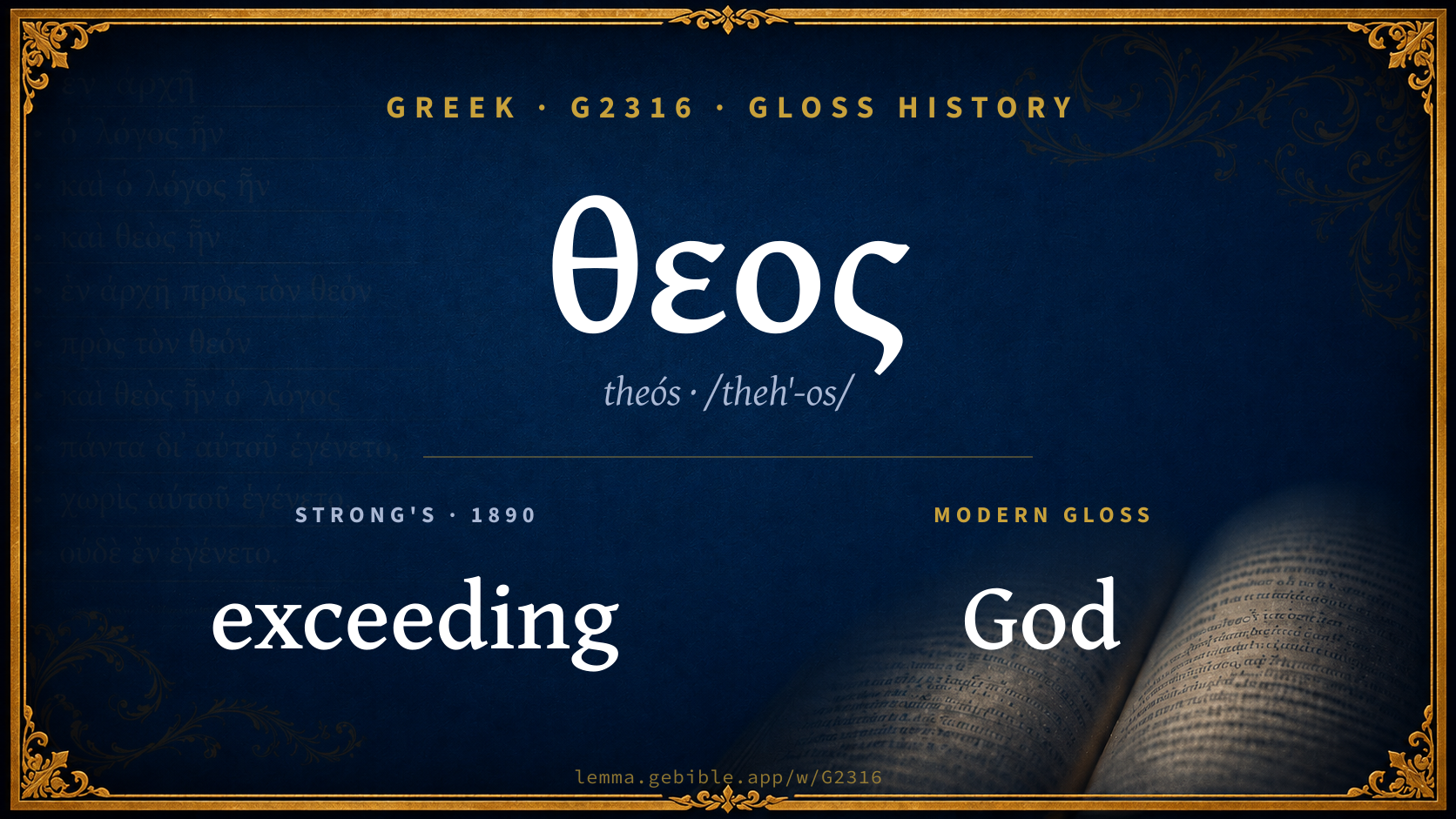
Gloss history
Strong's 1890 vs modern scholarship
About this word
Strong's G2316 catalogs a Greek word from the Greek New Testament.
These counts are not copied from any lexicon or concordance. They are computed here, from the morphology-tagged Greek New Testament. What Lemma adds →
- 1,152
- distinct verses
- The word appears in 1,152 distinct verses.
- 27 / 27
- NT books
- The word appears in 27 of 27 New Testament books.
- #14
- by frequency
- Top 25 most frequent Greek words (rank 14 of 5,347 Greek words by occurrence).
View all 1,152 occurrences in the concordance →
By section of the New Testament
By traditional corpus
Conventional, traditional groupings — biblical authorship is debated, so this is a traditional corpus grouping, not an authorship claim. Some books belong to more than one corpus (Luke is in both the Gospels and the Lukan corpus, and so on), so these shares overlap and need not total 100%. Each figure is a share of the word’s 1,152 distinct verses.
- Pauline corpus 479 verses · 42%
- Lukan (Luke–Acts) 269 verses · 23%
- Gospels 266 verses · 23%
- Johannine 199 verses · 17%
- General (Catholic) Epistles 102 verses · 9%
- Revelation 87 verses · 8%
- Hebrews 63 verses · 5%
How translations render this word
Counts come from each version’s own published word-to-Strong’s tagging or interlinear alignment — an approximate guide to how each version renders this word, not a word-level alignment the data otherwise carries. Because each total is that version’s own tagged count, the per-version totals vary from one another and need not match the appearance or distinct-verse counts above. These counts may also differ from a printed concordance because Lemma counts each distinctly tagged rendering and does not collapse phrase taggings into a single head-word total. This is a fixed set of word-tagged versions (KJV, ASV, BSB, ULT) and does not change with the reading translation you choose elsewhere. Each version’s license is shown beside its name below (and on Sources).
- King James Version: God 1,272×, God's 13×, Is god 10×
- American Standard Version: God 1,211×, Is god 9×, Gods 8×
- Berean Standard Bible: God 1,175×, God’s 87×, Gods 8×
- unfoldingWord Literal Text: God 1,285×, The 20×, Of 19×
King James Version Public Domain
Renders G2316 across 1,342 tagged occurrences — most commonly:
Plus 20 renderings that appear only once — usually multi-word phrases or single function words the recovered tagging swept in, not distinct renderings. Not rendered by a distinct English word in 1 further occurrence.
American Standard Version Public Domain
Renders G2316 across 1,315 tagged occurrences — most commonly:
Plus other, less common renderings. Plus 36 renderings that appear only once — usually multi-word phrases or single function words the recovered tagging swept in, not distinct renderings. Not rendered by a distinct English word in 5 further occurrences.
Berean Standard Bible Public Domain
Renders G2316 across 1,292 tagged occurrences — most commonly:
Plus 9 renderings that appear only once — usually multi-word phrases or single function words the recovered tagging swept in, not distinct renderings. Not rendered by a distinct English word in 26 further occurrences.
unfoldingWord Literal Text CC BY-SA 4.0
Renders G2316 across 1,361 tagged occurrences — most commonly:
Plus 15 renderings that appear only once — usually multi-word phrases or single function words the recovered tagging swept in, not distinct renderings.
Senses in Thayer's
The 6 senses Thayer's distinguishes for this word, in lexicon order (not ranked by frequency or importance). The full entry — with sub-senses — is in the Lexicon Entry tab.
- a god or goddess, a general name of deities or divinities
- God the Father, the first person in the trinity
- Christ, the second person of the trinity
- Holy Spirit, the third person in the trinity
- spoken of the only and true God
- whatever can in any respect be likened unto God, or resemble him in any way
Word origin
Derived from ο (ho) (G3588).
Of uncertain affinity; a deity especially (with G3588 ) the supreme Divinity ; figuratively a magistrate ; by hebraism very : - X exceeding God god [-ly -ward].
— Strong’s Exhaustive Concordance (1890), public domain.
Forms in the corpus
The 13 distinct written forms G2316 takes in the Greek New Testament, most frequent first — each parse links to that case’s occurrences in the concordance.
| Form | Parsing | Example | Uses |
|---|---|---|---|
| θεοῦ theoû | Noun, Genitive, Singular, Masculine | Matthew 3:16 | 688 |
| θεὸς theòs | Noun, Nominative, Singular, Masculine | Matthew 3:9 | 241 |
| θεῷ theō̂ | Noun, Dative, Singular, Masculine | Matthew 6:24 | 158 |
| θεόν theón | Noun, Accusative, Singular, Masculine | Matthew 4:7 | 75 |
| θεὸν theòn | Noun, Accusative, Singular, Masculine | Matthew 5:8 | 74 |
| θεός theós | Noun, Nominative, Singular, Masculine | Matthew 1:23 | 65 |
| θεοὶ theoì | Noun, Nominative, Plural, Masculine | Acts 14:11 | 4 |
| θεέ theé | Noun, Vocative, Singular, Masculine | Matthew 27:46 | 2 |
| θεοί theoí | Noun, Nominative, Plural, Masculine | John 10:34 | 1 |
| θεούς theoús | Noun, Accusative, Plural, Masculine | John 10:35 | 1 |
| θεοὺς theoùs | Noun, Accusative, Plural, Masculine | Acts 7:40 | 1 |
| θεοῖς theoîs | Noun, Dative, Plural, Masculine | Galatians 4:8 | 1 |
| θεῶ theō̂ | Noun, Dative, Singular, Masculine | Romans 1:8 | 1 |
Same root — word family
Other Thayer's entries built from the same root as G2316, grouped by Strong’s listed origin. These share a root / origin per the lexicon — not necessarily a shared meaning. Each links to that word’s own entry.
Derives from
Shares the same root
- τανυν tanŷn G3569 present
- οδε hóde G3592 this
- οιος hoîos G3634 what sort of
- ος hós G3739 who
- ουτος hoûtos G3778 this
- σημερον sḗmeron G4594 this day
- ταυτα tautá G5024 thus
- τηλικουτος tēlikoûtos G5082 of such size
- τοι toí G5104 truly
- τοσουτος tosoûtos G5118 so great
- τοτε tóte G5119 then
- του toû G5120 his
- τουναντιον tounantíon G5121 on the contrary
- τουνομα toúnoma G5122 by name
Derived from this word
- θεα theá G2299 goddess
- θεοδιδακτος theodídaktos G2312 taught of God
- θεομαχος theomáchos G2314 resisting God
- θεοπνευστος theópneustos G2315 inspired by God
- θεοσεβης theosebḗs G2318 pious
- θεοστυγης theostygḗs G2319 hateful to God
- θεοτης theótēs G2320 deity
Proper names from this root
People and places named from this root — a name, not an additional meaning of the word.
- ο ων και ο ην και ο ερχομενος ho ṑn kaí ho ēn kaí ho erchómenos G3801 He who is
- θειος theîos G2304 God
- Θεοφιλος Theóphilos G2321 Theophilus
Compare all same-root words → Showing 4 of 26 — not the complete family. 3 of the same-root words are proper names (people or places). They share a root, not necessarily a meaning.
Bible dictionary
Public-domain dictionary articles matched to this entry by name (God). A biblical name can be shared by more than one person or place, so an article may treat several.
Easton's Bible Dictionary · M. G. Easton, 1897
(A.S. and Dutch God; Dan. Gud; Ger. Gott), the name of the Divine Being. It is the rendering (1) of the Hebrew 'El, from a word meaning to be strong; (2) of 'Eloah_, plural _'Elohim. The singular form, Eloah, is used only in poetry. The plural form is more commonly used in all parts of the Bible, The Hebrew word Jehovah (q.v.), the only other word generally employed to denote the Supreme Being, is uniformly rendered in the Authorized Version by "LORD," printed in small capitals. The existence of God is taken for granted in the Bible. There is nowhere any argument to prove it. He who disbelieves this truth is spoken of as one devoid of understanding (Ps. 14:1).
The arguments generally adduced by theologians in proof of the being of God are:
(1.) The a priori argument, which is the testimony afforded by reason.
(2.) The a posteriori argument, by which we proceed logically from the facts of experience to causes. These arguments are,
(a) The cosmological, by which it is proved that there must be a First Cause of all things, for every effect must have a cause.
(b) The teleological, or the argument from design. We see everywhere the operations of an intelligent Cause in nature.
(c) The moral argument, called also the anthropological argument, based on the moral consciousness and the history of mankind, which exhibits a moral order and purpose which can only be explained on the supposition of the existence of God. Conscience and human history testify that "verily there is a God that judgeth in the earth."
The attributes of God are set forth in order by Moses in Ex. 34:6, 7. (see also Deut. 6:4; 10:17; Num. 16:22; Ex. 15:11; 33:19; Isa. 44:6; Hab. 3:6; Ps. 102:26; Job 34:12.) They are also systematically classified in Rev. 5:12 and 7:12.
God's attributes are spoken of by some as absolute, i.e., such as belong to his essence as Jehovah, Jah, etc.; and relative, i.e., such as are ascribed to him with relation to his creatures. Others distinguish them into communicable, i.e., those which can be imparted in degree to his creatures: goodness, holiness, wisdom, etc.; and incommunicable, which cannot be so imparted: independence, immutability, immensity, and eternity. They are by some also divided into natural attributes, eternity, immensity, etc.; and moral, holiness, goodness, etc.
Smith's Bible Dictionary · William Smith, 1863
(good). Throughout the Hebrew Scriptures two chief names are used for the one true divine Being--ELOHIM, commonly translated God in our version, and Jehovah, translated Lord . Elohim is the plural of Eloah (in Arabic Allah); it is often used in the short form EL (a word signifying strength, as in EL-SHADDAI, God Almighty, the name by which God was specially known to the patriarchs. (Genesis 17:1; 28:3; Exodus 6:3) The etymology is uncertain, but it is generally agreed that the primary idea is that of strength, power of effect, and that it properly describes God in that character in which he is exhibited to all men in his works, as the creator, sustainer and supreme governor of the world. The plural form of Elohim has given rise to much discussion. The fanciful idea that it referred to the trinity of persons in the Godhead hardly finds now a supporter among scholars. It is either what grammarians call the plural of majesty, or it denotes the fullness of divine strength, the sum of the powers displayed by God. Jehovah denotes specifically the one true God, whose people the Jews were, and who made them the guardians of his truth. The name is never applied to a false god, nor to any other being except one, the ANGEL-JEHOVAH who is thereby marked as one with God, and who appears again in the New Covenant as "God manifested in the flesh." Thus much is clear; but all else is beset with difficulties. At a time too early to be traced, the Jews abstained from pronouncing the name, for fear of its irreverent use. The custom is said to have been founded on a strained interpretation of (Leviticus 24:16) and the phrase there used, "THE NAME" (Shema), is substituted by the rabbis for the unutterable word. In reading the Scriptures they substituted for it the word ADONAI (Lord), from the translation of which by Kurios in the LXX., followed by the Vulgate, which uses Dominus, we have the Lord of our version. The substitution of the word Lord is most unhappy, for it in no way represents the meaning of the sacred name. The key to the meaning of the name is unquestionably given in God's revelation of himself to Moses by the phrase "I AM THAT I AM," (Exodus 3:14; 6:3) We must connect the name Jehovah with the Hebrew substantive verb to be, with the inference that it expresses the essential, eternal, unchangeable being of Jehovah. But more, it is not the expression only, or chiefly, of an absolute truth: it is a practical revelation of God, in his essential, unchangeable relation to this chosen people, the basis of his covenant.
Classic public-domain reference works; full attribution on Sources.
Septuagint usage
The same Greek word θεος appears 3,139 times in the Greek Old Testament (Septuagint), across 2,639 verses in 36 books.
- 3,139
- LXX occurrences
- Tagged occurrences of this Greek word in the Septuagint.
- 2,639
- verses
- Distinct Septuagint verses containing this word.
- 36 / 39
- OT books
- The word appears in 36 of the 39 Old Testament books.
Sample Septuagint occurrences
- Genesis 1:1 θεός
- Exodus 1:17 θεός
- Leviticus 2:13 θεός
- Numbers 6:7 θεός
- Deuteronomy 1:6 θεός
- Joshua 1:9 θεός
- Judges 1:7 θεός
- Ruth 1:15 θεός
- 1 Samuel 1:3 θεός
- 2 Samuel 3:9 θεός
- 1 Kings 1:17 θεός
- 2 Kings 1:2 θεός
Septuagint occurrences (same lexeme)
Every verse where the same Strong’s number (G2316) appears in the Greek Septuagint — showing the first 50 of 2,639. Verse text shown in the World English Bible for context; the Greek form is the matched word — the English is not keyword-highlighted.
- Genesis 1:1 θεός In the beginning God created the heavens and the earth.
- Genesis 1:2 θεός Now the earth was formless and empty. Darkness was on the surface of the deep. God's Spirit was hovering over the surface of the waters.
- Genesis 1:3 θεός God said, "Let there be light," and there was light.
- Genesis 1:4 θεός God saw the light, and saw that it was good. God divided the light from the darkness.
- Genesis 1:5 θεός God called the light Day, and the darkness he called Night. There was evening and there was morning, one day.
- Genesis 1:6 θεός God said, "Let there be an expanse in the midst of the waters, and let it divide the waters from the waters."
- Genesis 1:7 θεός God made the expanse, and divided the waters which were under the expanse from the waters which were above the expanse, and it was so.
- Genesis 1:8 θεός God called the expanse sky. There was evening and there was morning, a second day.
- Genesis 1:9 θεός God said, "Let the waters under the sky be gathered together to one place, and let the dry land appear," and it was so.
- Genesis 1:10 θεός God called the dry land Earth, and the gathering together of the waters he called Seas. God saw that it was good.
- Genesis 1:11 θεός God said, "Let the earth put forth grass, herbs yielding seed, and fruit trees bearing fruit after their kind, with its seed in it, on the earth," and it was so.
- Genesis 1:12 θεός The earth brought forth grass, herbs yielding seed after their kind, and trees bearing fruit, with its seed in it, after their kind: and God saw that it was good.
- Genesis 1:14 θεός God said, "Let there be lights in the expanse of sky to divide the day from the night; and let them be for signs, and for seasons, and for days and years;
- Genesis 1:16 θεός God made the two great lights: the greater light to rule the day, and the lesser light to rule the night. He also made the stars.
- Genesis 1:17 θεός God set them in the expanse of sky to give light to the earth,
- Genesis 1:18 θεός and to rule over the day and over the night, and to divide the light from the darkness. God saw that it was good.
- Genesis 1:20 θεός God said, "Let the waters swarm with swarms of living creatures, and let birds fly above the earth in the open expanse of sky."
- Genesis 1:21 θεός God created the large sea creatures, and every living creature that moves, with which the waters swarmed, after their kind, and every winged bird after its kind. God saw that it was good.
- Genesis 1:22 θεός God blessed them, saying, "Be fruitful, and multiply, and fill the waters in the seas, and let birds multiply on the earth."
- Genesis 1:24 θεός God said, "Let the earth bring forth living creatures after their kind, cattle, creeping things, and animals of the earth after their kind," and it was so.
- Genesis 1:25 θεός God made the animals of the earth after their kind, and the cattle after their kind, and everything that creeps on the ground after its kind. God saw that it was good.
- Genesis 1:26 θεός God said, "Let us make man in our image, after our likeness: and let them have dominion over the fish of the sea, and over the birds of the sky, and over the cattle, and over all the earth, and over every creeping thing that creeps on the earth."
- Genesis 1:27 θεός God created man in his own image. In God's image he created him; male and female he created them.
- Genesis 1:28 θεός God blessed them. God said to them, "Be fruitful, multiply, fill the earth, and subdue it. Have dominion over the fish of the sea, over the birds of the sky, and over every living thing that moves on the earth."
- Genesis 1:29 θεός God said, "Behold, I have given you every herb yielding seed, which is on the surface of all the earth, and every tree, which bears fruit yielding seed. It will be your food.
- Genesis 1:31 θεός God saw everything that he had made, and, behold, it was very good. There was evening and there was morning, the sixth day.
- Genesis 2:2 θεός On the seventh day God finished his work which he had made; and he rested on the seventh day from all his work which he had made.
- Genesis 2:3 θεός God blessed the seventh day, and made it holy, because he rested in it from all his work which he had created and made.
- Genesis 2:4 θεός This is the history of the generations of the heavens and of the earth when they were created, in the day that Yahweh God made earth and the heavens.
- Genesis 2:5 θεός No plant of the field was yet in the earth, and no herb of the field had yet sprung up; for Yahweh God had not caused it to rain on the earth. There was not a man to till the ground,
- Genesis 2:7 θεός Yahweh God formed man from the dust of the ground, and breathed into his nostrils the breath of life; and man became a living soul.
- Genesis 2:8 θεός Yahweh God planted a garden eastward, in Eden, and there he put the man whom he had formed.
- Genesis 2:9 θεός Out of the ground Yahweh God made every tree to grow that is pleasant to the sight, and good for food; the tree of life also in the midst of the garden, and the tree of the knowledge of good and evil.
- Genesis 2:15 θεός Yahweh God took the man, and put him into the garden of Eden to dress it and to keep it.
- Genesis 2:16 θεός Yahweh God commanded the man, saying, "Of every tree of the garden you may freely eat:
- Genesis 2:18 θεός Yahweh God said, "It is not good that the man should be alone; I will make him a helper suitable for him."
- Genesis 2:19 θεός Out of the ground Yahweh God formed every animal of the field, and every bird of the sky, and brought them to the man to see what he would call them. Whatever the man called every living creature, that was its name.
- Genesis 2:21 θεός Yahweh God caused a deep sleep to fall on the man, and he slept; and he took one of his ribs, and closed up the flesh in its place.
- Genesis 2:22 θεός He made the rib, which Yahweh God had taken from the man, into a woman, and brought her to the man.
- Genesis 3:1 θεός Now the serpent was more subtle than any animal of the field which Yahweh God had made. He said to the woman, "Yes, has God said, 'You shall not eat of any tree of the garden?'"
- Genesis 3:3 θεός but of the fruit of the tree which is in the midst of the garden, God has said, 'You shall not eat of it, neither shall you touch it, lest you die.'"
- Genesis 3:5 θεός for God knows that in the day you eat it, your eyes will be opened, and you will be like God, knowing good and evil."
- Genesis 3:8 θεός They heard the voice of Yahweh God walking in the garden in the cool of the day, and the man and his wife hid themselves from the presence of Yahweh God among the trees of the garden.
- Genesis 3:9 θεός Yahweh God called to the man, and said to him, "Where are you?"
- Genesis 3:13 θεός Yahweh God said to the woman, "What is this you have done?" The woman said, "The serpent deceived me, and I ate."
- Genesis 3:14 θεός Yahweh God said to the serpent, "Because you have done this, cursed are you above all cattle, and above every animal of the field. On your belly shall you go, and you shall eat dust all the days of your life.
- Genesis 3:21 θεός Yahweh God made coats of skins for Adam and for his wife, and clothed them.
- Genesis 3:22 θεός Yahweh God said, "Behold, the man has become like one of us, knowing good and evil. Now, lest he put forth his hand, and also take of the tree of life, and eat, and live forever..."
- Genesis 3:23 θεός Therefore Yahweh God sent him forth from the garden of Eden, to till the ground from whence he was taken.
- Genesis 4:1 θεός The man knew Eve his wife. She conceived, and gave birth to Cain, and said, "I have gotten a man with Yahweh's help."
These are occurrences of the same Greek lexeme (G2316) in the Septuagint — not a translation of any one Hebrew word. The store carries no word-level Hebrew↔Greek alignment, so no Hebrew original is asserted here. Counts come from the recovered LXX Strong's tagging — high-frequency vocabulary is well covered, while rare or late forms may be untagged — so they reflect tagged occurrences and may slightly undercount.