
Galatians 4:14

Greek (Tischendorf 8th ed.) Galatians 4:14 appears in the Greek New Testament. The text above is from the Tischendorf 8th edition. Each word links to its Strong’s number and a concise gloss. Click any word for its full Thayer’s Greek Lexicon entry.

Download image
Cite this verse

Galatians 4:14 (World English Bible). Public Domain. Lemma interlinear Bible study tool, https://lemma.gebible.app/v/galatians/4/14.

Show BibTeX & RIS
BibTeX
RIS
English Translation
That which was a temptation to you in my flesh, you didn't despise nor reject; but you received me as an angel of God, even as Christ Jesus.
World English Bible · Public Domain
Highlights
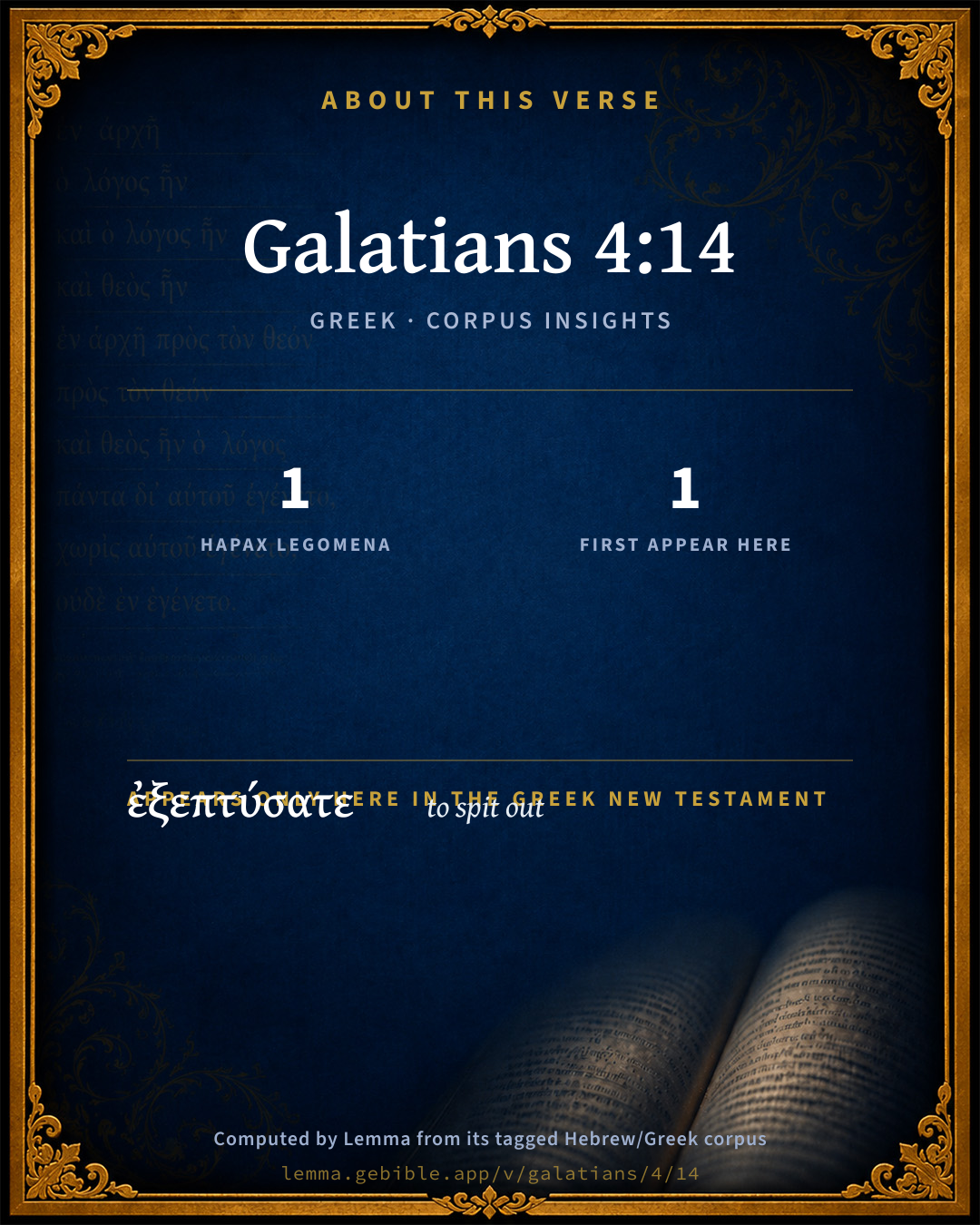
  • 1 hapax legomenon — only here in the Greek New Testament
  • 1 first appearance in the Greek New Testament
Full analysis ↓
Download a study sheet

One document with this verse’s original text, its word-by-word gloss line, the meaning frame, cross-references with their text, attributed commentary, and full source and license credits — printable, and it pastes into notes with its structure intact.

This verse Autodidact and up

Study sheet (.html) Plain text (.txt)

A passage Seminary Student

Up to 50 verses in one chapter. A passage sheet keeps up to 6 commentary sources and 12 cross-references per verse, in the order this page ranks them, and says so on the sheet whenever that leaves anything out. Ask for a single verse and you get the Autodidact verse sheet above.

Everything on this page stays free to read, with no account — the sheet is a download of what is already on screen, not access to it.

Want to remove ads? Support Godless Engineer
Compare translations 3

The same verse in 3 English versions, stacked beneath the original-language interlinear above. Click any original word for its lexicon entry.

Each is an independent rendering of the whole verse — the interlinear is not word-aligned to these translations.

Highlighted words mark where these versions differ — a whole-verse word diff, not a word-by-word alignment.

  • World English Bible Public Domain
    That which was a temptation to you in my flesh, you didn't despise nor reject; but you received me as an angel of God, even as Christ Jesus.
  • King James Version Public Domain
    And my temptation which was in my flesh ye despised not, nor rejected; but received me as an angel of God, even as Christ Jesus.
  • unfoldingWord Literal Text CC BY-SA 4.0
    And you did not despise your trial in my flesh nor reject me, but you welcomed me as an angel of God, as Christ Jesus.

unfoldingWord Literal Text — © unfoldingWord, licensed CC BY-SA 4.0. Word-aligned USFM3 via Door43 (git.door43.org/unfoldingWord/en_ult).

Versions to compare (up to 4)

3 of 4 selected

Show all 19 translations

Every available English version of this verse, each an independent rendering of the whole verse.

  • World English Bible Public Domain
    That which was a temptation to you in my flesh, you didn't despise nor reject; but you received me as an angel of God, even as Christ Jesus.
  • Berean Standard Bible Public Domain
    And although my illness was a trial to you, you did not despise or reject me. Instead, you welcomed me as if I were an angel of God, as if I were Christ Jesus Himself.
  • Majority Standard Bible Public Domain
    And although my illness was a trial to me, you did not despise or reject me. Instead, you welcomed me as if I were an angel of God, as if I were Christ Jesus Himself.
  • King James Version Public Domain
    And my temptation which was in my flesh ye despised not, nor rejected; but received me as an angel of God, even as Christ Jesus.
  • American Standard Version (1901) Public Domain
    and that which was a temptation to you in my flesh ye despised not, nor rejected; but ye received me as an angel of God, `even' as Christ Jesus.
  • Revised Version (1885) Public Domain
    and that which was a temptation to you in my flesh ye despised not, nor rejected; but ye received me as an angel of God, even as Christ Jesus.
  • Geneva Bible (1599) Public Domain
    And the trial of me which was in my flesh, ye despised not, neither abhorred: but ye receiued me as an Angel of God, yea, as Christ Iesus.
  • Douay-Rheims (1899) Public Domain
    You despised not, nor rejected: but received me as an angel of God, even as Christ Jesus.
  • Young's Literal Translation Public Domain
    and my trial that `is' in my flesh ye did not despise nor reject, but as a messenger of God ye did receive me -- as Christ Jesus;
  • Literal Standard Version CC BY-SA 4.0
    and you did not despise nor reject my trial that [is] in my flesh, but you received me as a messenger of God—as Christ Jesus;
  • Unlocked Literal Bible CC BY-SA 4.0
    Though my physical condition put you to the test, you did not despise or reject me. Instead you welcomed me as if I were an angel of God, as if I were Christ Jesus himself.
  • unfoldingWord Literal Text CC BY-SA 4.0
    And you did not despise your trial in my flesh nor reject me, but you welcomed me as an angel of God, as Christ Jesus.
  • Darby Bible Public Domain
    and my temptation, which [was] in my flesh, ye did not slight nor reject with contempt; but ye received me as an angel of God, as Christ Jesus.
  • World Messianic Bible Public Domain
    That which was a temptation to you in my flesh, you didn’t despise nor reject; but you received me as an angel of God, even as Messiah Yeshua.
  • Webster's Bible Public Domain
    And my temptation which was in my flesh ye despised not, nor rejected; but received me as an angel of God, even as Christ Jesus.
  • Free Bible Version CC BY-SA 4.0
    Even though my illness was difficult for you, you didn't despise or reject me—in fact you treated me like an angel of God, like Christ Jesus himself.
  • Bible in Basic English Public Domain
    And you did not have a poor opinion of me because of the trouble in my flesh, or put shame on it; but you took me to your hearts as an angel of God, even as Christ Jesus.
  • Text-Critical English NT CC BY 4.0
    And you did not despise or reject me even though my physical condition was a trial for me. On the contrary, you received me as an angel of God, as Christ Jesus.
  • Tyndale New Testament (1534) Public Domain
    And my temptacion which I suffered by reason of my flesshe ye despysed not nether abhorred: but receaved me as an angell of god: ye as Christ Iesus.

Literal Standard Version (2020), Covenant Press — licensed CC BY-SA 4.0. Text via the HelloAO Bible API (eBible.org). Unlocked Literal Bible (unfoldingWord) — licensed CC BY-SA 4.0. Text via the HelloAO Bible API (eBible.org). unfoldingWord Literal Text — © unfoldingWord, licensed CC BY-SA 4.0. Word-aligned USFM3 via Door43 (git.door43.org/unfoldingWord/en_ult). Free Bible Version, Dr. Jonathan Gallagher — licensed CC BY-SA 4.0. Text via the HelloAO Bible API (eBible.org).

Word by word

More ways to search: Search by grammar → Find every occurrence → Compare this word →

Practice this passage: Drill this verse → Learn its vocabulary →

ἐξεπτύσατε
ekptýō
G1609
“to spit out”
Verb, Aorist, Active, Indicative, 2nd person, Plural
Part of Speech
Verb
Tense
Aorist
Voice
Active
Mood
Indicative
Person
2nd person
Number
Plural
Full Thayer's Definition

Origin: from G1537 and G4429

TDNT: 09:28,2

1. to spit out 2. reject, spurn, loathe
  1. καὶ kaí G2532 “and” Conjunction
  2. τὸν ho G3588 “the” Article, Accusative, Singular, Masculine
  3. πειρασμὸν peirasmós G3986 “temptation” Noun, Accusative, Singular, Masculine
  4. ὑμῶν hymeîs G5210 “you” Personal pronoun, 2nd person, Genitive, Plural
  5. ἐν en G1722 “in” Preposition
  6. τῇ ho G3588 “the” Article, Dative, Singular, Feminine
  7. σαρκί sárx G4561 “flesh” Noun, Dative, Singular, Feminine
  8. μου egṓ G1473 “I” Personal pronoun, 1st person, Genitive, Singular
  9. οὐκ ou G3756 “not” Particle, Negative
  10. ἐξουθενήσατε exouthenéō G1848 “to despise” Verb, Aorist, Active, Indicative, 2nd person, Plural
  11. οὐδὲ oudé G3761 “neither” Conjunction, Negative
  12. ἀλλὰ allá G235 “but” Conjunction
  13. ὡς hōs G5613 “as” Adverb
  14. ἄγγελον ángelos G32 “angel” Noun, Accusative, Singular, Masculine
  15. θεοῦ theós G2316 “God” Noun, Genitive, Singular, Masculine
  16. ἐδέξασθέ déchomai G1209 “to receive” Verb, Aorist, Middle deponent, Indicative, 2nd person, Plural
  17. με egṓ G1473 “I” Personal pronoun, 1st person, Accusative, Singular
  18. ὡς hōs G5613 “as” Adverb
  19. Χριστὸν Christós G5547 “Christ” Noun, Accusative, Singular, Masculine
  20. Ἰησοῦν Iēsoûs G2424 “Jesus” Noun, Accusative, Singular, Masculine

About this verse

These counts appear in no published source. They are computed here, from the morphology-tagged text and Lemma’s own curated glosses. What Lemma adds →

21
words
18
distinct lemmas
Pauline Epistles
section

Notable vocabulary

1 hapax legomenon — a word that appears only here in the entire Greek New Testament:

  • ἐξεπτύσατε to spit out G1609

First appearance in Scripture

This word makes its first canonical appearance in the Greek New Testament here:

  • ἐξεπτύσατε to spit out G1609

Shared distinctive vocabulary

ἐξουθενήσατε to despise G1848 occurs in 12 verses of the Greek New Testament. Also found in:
Repetition

Words recur within this verse:

Cross-references

20

Topical passages linked to Galatians 4:14 in the Treasury of Scripture Knowledge — connected by theme and wording, ordered by reader-vote popularity; previews shown in the World English Bible.

  • Matthew 10:40 He who receives you receives me, and he who receives me receives him who sent me.
  • 1 Thessalonians 2:13 For this cause we also thank God without ceasing, that, when you received from us the word of the message of God, you accepted it not as the word of men, but, as it is in truth, the word of God, which also works in you who believe.
  • Hebrews 13:2 Don't forget to show hospitality to strangers, for in doing so, some have entertained angels without knowing it.
  • 2 Samuel 14:17 Then your handmaid said, Please let the word of my lord the king be comfortable; for as an angel of God, so is my lord the king to discern good and bad: and Yahweh your God be with you.
  • 2 Samuel 19:27 He has slandered your servant to my lord the king; but my lord the king is as an angel of God: do therefore what is good in your eyes.
  • Isaiah 53:2–3 For he grew up before him as a tender plant, and as a root out of a dry ground: he has no form nor comeliness; and when we see him, there is no beauty that we should desire him.
  • Zechariah 12:8 In that day Yahweh will defend the inhabitants of Jerusalem. He who is feeble among them at that day will be like David, and the house of David will be like God, like the angel of Yahweh before them.
  • Malachi 2:7 For the priest's lips should keep knowledge, and they should seek the law at his mouth; for he is the messenger of Yahweh of Hosts.
  • Luke 10:16 Whoever listens to you listens to me, and whoever rejects you rejects me. Whoever rejects me rejects him who sent me."
  • 2 Corinthians 5:20 We are therefore ambassadors on behalf of Christ, as though God were entreating by us. We beg you on behalf of Christ, be reconciled to God.
  • Job 12:5 In the thought of him who is at ease there is contempt for misfortune, It is ready for them whose foot slips.
  • Psalms 119:141 I am small and despised. I don't forget your precepts.
  • Ecclesiastes 9:16 Then said I, Wisdom is better than strength. Nevertheless the poor man's wisdom is despised, and his words are not heard.
  • Matthew 18:5 Whoever receives one such little child in my name receives me,
  • Matthew 25:40 "The King will answer them, 'Most assuredly I tell you, inasmuch as you did it to one of the least of these my brothers, you did it to me.'
  • John 13:20 Most assuredly I tell you, he who receives whomever I send, receives me; and he who receives me, receives him who sent me."
  • 1 Corinthians 1:28 and God chose the lowly things of the world, and the things that are despised, and the things that are not, that he might bring to nothing the things that are:
  • 1 Corinthians 4:10 We are fools for Christ's sake, but you are wise in Christ. We are weak, but you are strong. You have honor, but we have dishonor.
  • Galatians 4:13 but you know that because of weakness of the flesh I preached the Gospel to you the first time.
  • 1 Thessalonians 4:8 Therefore he who rejects doesn't reject man, but God, who has also given his Holy Spirit to you.

Cross-references courtesy of OpenBible.info (CC BY 4.0).

Where the printed editions differ

1 variant

Places in this verse where the major printed Greek editions disagree on the wording in a way that affects the translation — a comparison of editions, not a manuscript-by-manuscript collation. The editions are the modern critical texts (Nestlé-Aland 28/27, SBL, Westcott-Hort, Tregelles, Tyndale House) and the traditional texts behind the KJV (the Textus Receptus and the Byzantine/Majority text). It is not a claim about which reading is original.

  1. Different wording
    ὑμῶν

    “of you”

    In NA28NA27TynSBLWHTreg Not in TRByz

    μου (mou) 'of me' occurs in traditional manuscripts (TR+Byz) instead of ὑμῶν (humōn) 'of you' in older manuscripts (NA28+NA27+Tyn+SBL+WH+Treg)

Textual data: Translators Amalgamated Greek New Testament (STEPBible TAGNT) · CC BY 4.0.

Commentary

Notes on Galatians 4:14 from classic Christian and Jewish commentators (each source and its license shown beneath its notes). The classic Christian expositions comment on the surrounding passage and are grouped to its opening verse, so a note may address several verses; the Jewish commentaries on the Tanakh (Rashi and others) are per-verse, so they appear only where the commentator wrote on this verse.

Lemma curates 59 commentaries, every one of them public domain or Creative Commons licensed, each selected and text-cleaned for this edition rather than reprinted as found. About our sources →

The Biblical Illustrator

Joseph S. Exell

Gal_4:14

And my temptation which was in my flesh ye despised not.

Ministers and people

Here we see--

I. The goodness of God, who does not speak in His awful majesty, but sends ambassadors to beseech us to be reconciled to Him.

II. The responsibility of pastors, because they stand in the stead of Christ Jesus, and must, therefore,

(1) only declare what they know to be His will; and

(2) have a special care to maintain that holiness of life which befits their position.

III. The duty and privilege of the Church

1. Not to despise their ministers weakness.

2. To treat him with reverence and love, because a messenger of God and of Christ.

IV. The comfort of believers. Sure and certain, as though administered by an angel or by Christ Himself. (W. Perkins.)

The superficiality of Galatian religious life

If we picture to ourselves the apostle as he appeared before the Galatians, a friendless outcast, writhing under the tortures of a painful malady, yet instant in season and out of season, by turns denouncing and entreating, appealing to the agonies of a crucified Saviour, perhaps, also, as at Lystra, enforcing this appeal by some striking miracle, we shall be at no loss to conceive how the fervid temperament of the Gaul might have been aroused, while yet only the surface of his spirit and consciousness was ruffled. For the time, indeed, all seemed to be going on well. Ye were running bravely; but the very eagerness with which they had embraced the gospel was in itself a dangerous symptom, A material so easily moulded soon loses the impression it has taken. The passionate current of their Celtic blood, which flowed in this direction now, might only too easily be diverted into a fresh channel by some new religious impulse. Their reception of the gospel was not built on a deeply-rooted conviction of its truth, or a genuine appreciation of its spiritual power. (Bp. Lightfoot.)

St. Pauls infirmity

The right reading and rendering is: But ye know that by reason of an infirmity of my flesh I preached the gospel to you on the former visit; and your temptation in my flesh ye did not utterly despise (set at nought) nor loathe. The drift of the first of these clauses is that on the former of two visits, he had not purposed preaching in Galatia, but did so because he was detained there by his peculiar affliction. The drift of the second clause, which is rather irregularly expressed, is that the Galatians did not scorn his infirmity nor regard it with abhorrence, although it constituted a temptation to them to repudiate the gospel, when preached by one so afflicted. This passage and 2Co_12:7 taken together point to the following results:

1. The affliction was bodily. In my flesh. The effect of shocking and revolting those who witnessed it, which is pointed to in the word loathe, could only be produced by visible symptoms. Infirmity of my flesh also suggests most naturally, although not necessarily, that the infirmity attached to the body. From its tendency to bring him into contempt, the apostle looked upon it as a grievous impediment to his ministry. The words smite with the fist (2Co_12:7) indicate the violence and the suddenness of its approaches; and his detention in Galatia, where he had not meant to stay, shows that he could not forecast its coming on, and apparently also that its after-effects were of some duration. The current impression that it was attended by agonizing pain is not positively justified by anything that is stated. It was probably humiliating rather than painful.

2. It was an adjunct of his visions and special revelations in two ways.

(1) It served a disciplinary purpose in connection with them.

(2) Its particular visits were the immediate antecedent, if not the conditional, accompaniments of the visions and revelations themselves.

This last relation is not only indicated by the apostles general statement, but appears more distinctly from the fact that the answer, My grace is sufficient for thee is exactly one of the special revelations in question, and it is reasonable to suppose that it was given in direct reply to the third prayer for deliverance, uttered at a moment when he was painfully sensible of the pressure of his bodily trial. It is to be borne in mind that he is speaking in 2Co_12:1-21. of visions and revelations experienced by him while in an ecstatic condition, i.e., when the connection between the inner spiritual man and the body was either in complete abeyance or actually for a while severed, and this strongly commends the supposition that the abnormal state of body was a transition-stage to the ecstasy. The three petitions would, in this case, be made when the apostle, under some painfully humbling physical conditions, felt his conscious union with his material organism dissolving, and the Lords answer to the third petition would be heard by him when one of the ecstatic states had set in. The ecstasy, the visions and revelations, and the peculiar affection of the body, would thus be coincident in time, possibly of the same duration, and, in a certain sense, the complements of each other His conversion (Act_26:11-18) furnishes a most striking illustration of the manner in which he may have received his supernatural communications at the precise time when he was under the actual application of the stake for the flesh. Its close conjunction with the visions and revelations does not justify the conclusion that the suffering which it brought and the Divine communications alternated with one another during the ecstasy, so that the ecstatic, like the waking life of the apostle was a copy of the life of his Master in its contrary aspects of humiliation and suffering and of exaltation and glory. If the stake for the flesh was felt during the ecstasy, he could not have said that he did not know whether he was in the body or out of the body, for a sense of bodily suffering must imply the presence of the body One clear result of the intimate union of the stake with the visions and revelations is that the occasions of his suffering from it cannot be regarded and spoken of as if they came on like the attacks of a malady. They coincided with the times at which he stood in need of special disclosures of the Divine will. The date, fourteen years ago (2Co_12:2), points to directions given-him previously to quitting Arabia for a new province of ministerial work.

3. When St. Paul ascribes to the stake a twofold relation to the invisible world, and sees in it a concurrence of Divine and of Satanic agency, the latter controlled by the former, he is neither speaking figuratively, nor merely stating his own personal impressions in accordance with popular views, but affirming what he knew to be a truth, and his statement is amply supported by other representations in Scripture. This admixture of Satanic action makes the attempt precarious to identify the stake with any known malady or ailment, such as acute headache, earache, a complaint in the eyes, or epilepsy. The view which chiefly claims consideration under this head, although there is an ancient and sustained tradition in favour of headache, is that it was epilepsy. Both Jews and pagans deemed epilepsy a supernatural visitation, and hence its name morbus divinus, or sacer. Another designation of it, morbus comitialis, rested upon the same idea, for if any one was seized with it in the Roman Forum during an election it was supposed to be the intervention of a god, and business was suspended. The original for loathe in this verse means literally to spit out, and it is curious that epilepsy was also called morbus que sputalur, because those present were accustomed to spit upon the epileptic or into their own bosoms, either to express their abomination, or to avert the evil omen for themselves. Persons may become subject to epilepsy at middle age by a great shock, physical or moral, or both, such as St. Pauls conversion was. Almost all medical writers on epilepsy mention a patient who before a seizure imagined that he saw a figure approach and smite him a blow on the head, after which he lost consciousness. This has a resemblance to the expression smite with the fist, which might well represent the suddenness of epileptic attacks. Those who happen to have seen a person seized with epilepsy while officiating in Divine service, will comprehend how natural it would be for St. Paul to regard any bodily liability at all resembling it as a terrible hindrance to his ministry. After epileptic convulsions have ended there often ensues an insensibility, and patients sometimes fall into a profound stupor or coma, which has been known to last as long as a week. This symptom would harmonize with the apostles forced stay in Galatia. Still it is doubtful whether any of these points are more than superficial agreements. An epileptic remembers nothing of what passed during the fit, whereas St. Paul had the most vivid recollection of everything. Epilepsy, frequently suffered, generally impairs the intellect, and the cases of Julius Caesar, Mahomet, and Buonaparte, who are quoted as instances of high intellectual power remaining in spite of epilepsy, are not deemed by medical authorities to be of much value.

4. An attempt has been made to find an analogy of nature for the apostles cross from a different point of view, viz., by taking his visions and revelations for the starting-point. A large number of instances are upon record of religious visionaries, as they are called, and ecstatical persons, who have seemed to themselves to be translated into the invisible world, and to have seen and heard its inhabitants and transactions as sensibly as they could have seen and heard anything with their bodily organs. They have for the most part a strong conviction that they are under the immediate guidance and influence of spiritual beings during the disclosures made to them. The body is in many cases in a state resembling that of catalepsy, in which the will exercises no power over it; the expression of the eyes, though open, is extinguished; the limbs are like those of an automaton, and remain unaffected by the law of gravitation in any attitude in which they may be placed; and the face is like that of a dead person.

5. It may be questioned whether such inquiries and speculations as these, although interesting, can lead to any solid results, on account of the perfectly exceptional character of the apostles case. There is reason to think that no malady or bodily disorder brought about by demoniacal agency is ever identical with ordinary disease. If similarities are traceable, they are rather symptomatic than essential affinities. There are not sufficient data for determining what peculiar ingredient characteristic of Satanic malignity there was in the apostles affliction, but it would seem to have been something calculated to overwhelm him with ignominy rather than to excruciate him with pain. It is consolatory to know that, however hard it was to bear, the grace of Christ enabled him ultimately to rejoice and glory in it as a means whereby the power of the Lord more fully tabernacled upon him and invested him with the true strength for doing his Masters work. (Canon Waite.)

The Biblical Illustrator, edited by Joseph S. Exell (c. 1880s–1900s) — public domain. Text from a community e-Sword module.

Bengel's Gnomon

Johann Albrecht Bengel

Gal 4:14. Τὸν πειρασμόν μου, my temptation) i.e. me with [i.e. notwithstanding] my temptation. Holy men, even apostles, in former times did not conceal their temptations, as men do now, not even in public.—ἐν τῇ σαρκί μου, in my flesh) He mentions Paul in the flesh, 2Co 12:7.—οὐκ ἐξουθενήσατε, ye did not despise) through natural pride.—οὐδὲ ἐξεπτύσατε, nor rejected) through spiritual pride, with still greater contempt. There is a distinction—(1.) In respect to the object, the temptation in the flesh; and these temptations might have seemed worthy of contempt in a twofold way. (2.) In relation to the antithesis, which is twofold:

α) you did not despise [ἐξουθενήσατε] me, but—as an angel: who might be greatly esteemed from the place which he occupies in creation, for he has a most excellent nature, on account of which even carnal man cannot but magnify the angels:

β) nor rejected [ἐξεπτύσατε], but—as Christ: this is more from a spiritual point of view [His spiritual relation to us].—ἄγγελον, an angel) The flesh, infirmity, even temptation, are unknown to angels; wherefore to receive one as an angel, is to receive him with great veneration.—Χριστὸν, Christ) who is greater than the angels.

Bengel's Gnomon of the New Testament — English translation (T&T Clark, Edinburgh, 1860) — public domain. Text from a community e-Sword module.

Meyer's Critical & Exegetical Commentary

Heinrich August Wilhelm Meyer

Gal_4:14. Still dependent on ὅτι, as is logically required by the contrast to οὐδέν με ἠδικ., which is introduced by οἴδατε δὲ, ὅτι.

τὸν πειρασμὸν ὑμῶν ἐν τῇ σαρκί μου κ.τ.λ.] As to the reading ὑμῶν, see the critical notes. The sense is: that ye were put to the proof as respected my bodily weakness (namely, as to your receiving and accepting my announcements, demands, etc., notwithstanding this my suffering and impotent appearance; see the antithesis, ἀλλʼ ὡς κ.τ.λ.); this proof ye have not rejected with disdain and aversion, but on the contrary have submitted yourselves to it so excellently, that ye received me as an angel of God, as Christ Jesus. The καί is not and yet (Koppe, Winer, Matthies), but the simple and, continuing the address (οἴδατε, ὅτι κ.τ.λ.).

ἑν τῇ σαρκί μου] is the more precise definition of τὸν πειρασμ. ὑμῶν, specifying wherein the readers had to undergo a trial,namely, in the fact of Pauls having then preached to them in such bodily weakness. Comp. Plat. Phil. p. 21 A: ἐν σοὶ πειρώμεθα, upon thee we would make the trial. Hom. Il. xix. 384, πειρήθη … ἐν ἔντεσι. Comp. also βασανίζεσθαι ἐν, Plat. Pol. vi. p. 503 A. Hence ἐν τῇ σαρκί did not require the connecting article, as it is in reality blended with τὸν πειρασμὸν ὑμῶν so as to form one idea. See on Gal_3:26. And the definition of the sense of ἐν τῇ σαρκι μου is derived from διʼ ἀσθένειαν τῆς σαρκός in Gal_4:13. Fritzsche, l.c. p. 245, objects to the sense which is given by the reading ὑμῶν: 1. sententiam ab h. l. abhorrere. But how aptly does the negative assertion, that the Galatians, when they were put to the trial by the apostles sickness, did not despise and reject this trial, correspond with the positive idea, that, on the contrary, they have received him as an angel of God! And how suitable are the two ideas together to the previous οὐδέν με ἠδικήσατε! 2. Sententiam verbis parum aptis conceptam esse; expectaras καλῶς ὑπεμείνατε. But this καλῶς ὑπεμείνατε is in fact most exhaustively represented by the negative and positive testimony taken together; the negative testimony expresses the acceptance, and the positive the standing, of the πειρασμός. 3. The sense does not suit the following ἀλλʼ … ἐδέξασθέ με. But even with the adoption of the reading ὑμῶν the rejection of the apostle is in point of fact negatived; hence τὸν πειρασμὸν ὑμῶν … ἐξεπτύσατε cannot be inappropriate to the ἐδέξασθέ με which follows. Lachmann (comp. Buttmann in Stud. u. Krit. 1860, p. 379) makes καὶ τὸν πειρασμ. ὑμ. ἐν τ. σ. μ. dependent on οἴδατε (placing a colon after ἐν τῇ σαρκί μου), whereby the flow of the discourse is quite unnecessarily broken.

ἐξεπτύσατε] expresses the sense of ἐξουθ. figuratively and by way of climax, adding the idea of detestation. Comp. Rev_3:16, and the Latin despuere, respuere. So forcible an expression of the negative serves to give the greater prominence to the positive counterpart which follows. In the other Greek writers, besides the simple πτύειν (Soph. Ant. 649. 1217), there occur only καταπτύειν τινός, ἀποπτύειν τινά (4Ma_3:18; Eur. Troad. 668, Hec. 1265; Hes. ἔργ. 724), and διαπτύειν τινά (in Philo also παραπτύειν) in this metaphorical sense (see Kypke, II. p. 280; Ruhnk. Ep. crit. p. 149; Lobeck, ad Phryn. p. 17); but ἐκπτύειν is always used in the proper sense (Hom. Od. v. 322; Aristoph. Vesp. 792; Anthol. Theodorid. 2; Apoll. Rhod. 478), as also ἐμπτύειν τινί (Lobeck, ad Phryn. p. 17). Even in the passage quoted by Kypke, Plut. de fort. vel virt. Alex. I. p. 328, it is used in the proper sense, because ὥσπερ χαλινόν stands beside it. We are bound to acknowledge this deviation from the Greek usage, and it must be considered as caused by ἐξουθ., as in fact Paul is fond of repeating, not without emphasis, compounds presenting the same preposition (Gal_2:4; Gal_2:13; Rom_2:18; Rom_11:7, et al.).

ὡς Χριστὸν Ἰησοῦν] a climax added asyndetically in the excitement of feeling, and presenting to a still greater extent than ὡς ἄγγελ. Θεοῦ (Heb_1:4; Php_2:10; Col_1:16) the high reverence and love with which he had been received by them, and that as a divine messenger. Comp. Mat_10:40; Joh_13:20. Observe also, that even among the Galatians Paul doubtless preached in the first instance to the Jews (whose loving behaviour towards the apostle was then shared in by the Gentiles also); hence the comparison with an angel and with Christ in our passage is in keeping with the apostles historical recollection, and does not render it at all necessary to assume an ὕστερον πρότερον in the representation, which would thus anticipate the already Christian view.

Note.

According to the Recepta τ. πειρ. μου τὸν ἐν τ. σ. μ., or, as the first μου has special evidence against it, according to the reading τὸν πειρ. τὸν ἐν τ. σ. μ., the explanation must be: My bodily temptation ye have not despised or disdainfully rejected, that is, Ye have not on account of my sickness, by which I have been tried of God, rejected me, as the bodily impotence in which it exhibited me to you might have induced you to do. Taken by itself, this sense, and the mode of expressing it, would be suitable enough (in opposition to Wieseler), even without the hypothesis, based on ἐξεπτ., of some nauseous sickness (in opposition to Fritzsche).

Meyer — Critical and Exegetical Commentary on the New Testament — English translation by Peter Christie, edited by Frederick Crombie (T&T Clark, 1880) — public domain. Text from a community e-Sword module.

Expositor's Greek Testament

ed. W. Robertson Nicoll

Gal 4:14 . τὸν πειρασμὸν ὑμῶν . The best MSS. all read ὑμῶν , not μου or μου τον . The accusative τὸν πειρασμόν is not governed by ἐξουθενήσατε or ἐξεπτύσατε , whose real object is the με which follows ἐδέξασθε : it is really a pendent accusative in apposition to the sentence: As for the temptation to you in my flesh ( i.e. , the temptation to reject me with contempt and disgust on account of my diseased state), you did not .…

The Expositor's Greek Testament, edited by W. Robertson Nicoll (1897–1910) — public domain. Text from a community e-Sword module.

Geneva Bible (1599)

Geneva Bible translators

For my ministry’s sake.

Those daily troubles wherewith the Lord tried me amongst you.

Geneva Bible (1599) marginal notes — public domain. Text via Bolls.life.

Jamieson, Fausset & Brown

Robert Jamieson, A. R. Fausset & David Brown

my temptation--The oldest manuscripts read, "your temptation." My infirmity, which was, or might have been, a "temptation," or trial, to you, ye despised not, that is, ye were not tempted by it to despise me and my message. Perhaps, however, it is better to punctuate and explain as LACHMANN, connecting it with Gal 4:13, "And (ye know) your temptation (that is, the temptation to which ye were exposed through the infirmity) which was in my flesh. Ye despised not (through natural pride), nor rejected (through spiritual pride), but received me," &c. "Temptation does not mean here, as we now use the word, tendency to an evil habit, but BODILY TRIAL."

as an angel of God--as a heaven-inspired and sent messenger from God: angel means "messenger" (Mal 2:7). Compare the phrase, Sa2 19:27, a Hebrew and Oriental one for a person to be received with the highest respect (Zac 12:8). An angel is free from the flesh, infirmity, and temptation.

as Christ--being Christ's representative (Mat 10:40). Christ is Lord of angels.

Jamieson, Fausset & Brown — Commentary Critical and Explanatory on the Whole Bible (1871) — public domain (CC PDM 1.0). Text via the HelloAO Bible API.

Adam Clarke's Commentary

Verse 14. And my temptation which was in my flesh] On this verse there are a great many various readings, as there are various opinions.

Instead of μου, MY temptation, ABC*D*FG, some others, with the Coptic, Vulgate, Itala, and several of the primitive fathers, have υμων, YOUR temptation.

The word πειρασμον, which we translate temptation, signifies trial of any kind. The verse therefore may be read, "Ye despised not the trial which was in my flesh;" or, "Ye despised not your trial, which was in my flesh:" i.e. what my flesh suffered on your account, the afflictions I passed through in consequence of my severe labours on your account. You did not consider me less an apostle of God on account of my sinking for a time under the weight of my work. Had they been disaffected towards him at that time, they would have used this to the prejudice of his apostolic mission. "What! do you pretend to be an extraordinary messenger from God, and yet are suffered to fall into sickness under the severity of your labour? If God sent you, would he not sustain you?" This would have been quite natural, had they not been well affected toward him. But, on the contrary, notwithstanding these afflictions, they received him as an angel of God-as a messenger from heaven, and as Jesus Christ himself. This appears to me to be the simple meaning of the apostle, and that he neither alludes to a bodily nor mental infirmity, which generally or periodically afflicted him, as some have imagined. Nor does he appear at all to speak of the same case as that mentioned 2Co 12:7, where I wish the reader to consult the notes. That St. Paul had frequent and severe afflictions, in consequence of his constant and severe exertions in the Gospel ministry, we may readily believe, and of this his own words bear sufficient testimony.

See his affecting account, 2Co 11:23-29, and the notes there.

Adam Clarke's Commentary on the Bible (1810–1826) — public domain. Text from a community e-Sword/MySword module.

John Calvin's Commentaries

14. My temptation. That is, “Though ye perceived me to be, in a worldly point of view, a contemptible person, yet ye did not reject me.” He calls it a temptation or trial, because it was a thing not unknown or hidden, and he did not himself attempt to conceal it, as is usually done by ambitious men, who are ashamed of anything about them that may lower them in public estimation. It frequently happens that unworthy persons receive applause, before their true character has been discovered, and shortly afterwards are dismissed with shame and disgrace. But widely different was the case of Paul, who had used no disguise to impose on the Galatians, but had frankly told them what he was.

As an angel of God. In this light every true minister of Christ ought to be regarded. As God employs the services of angels for communicating to us his favors, so godly teachers are divinely raised up to administer to us the most excellent of all blessings, the doctrine of eternal salvation. Not without good reason are they, by whose hands God dispenses to us such a treasure, compared to angels: for they too are the messengers of God, by whose mouth God speaks to us. And this argument is used by Malachi.

“The priest’s lips should keep knowledge, and they should seek the law at his mouth, for he is the messenger of the Lord of hosts.” (Malachi 2:7.)

But the apostle rises still higher, and adds, even as Christ Jesus; for the Lord himself commands that his ministers shall be viewed in the same light as himself.

“He that heareth you heareth me, and he that despiseth you despiseth me.” (Luke 10:16.)

Nor is this wonderful; for it is in his name that they discharge their embassy, and thus they hold the rank of him in whose room they act. Such is the highly commendatory language which reveals to us at once the majesty of the gospel, and the honorable character of its ministry. If it be the command of Christ that his ministers shall be thus honored, it is certain that contempt of them proceeds from the instigation of the devil; and indeed they never can be despised so long as the word of God is esteemed. In vain do the Papists attempt to hold out this pretext for their own arrogant pretensions. As they are plainly the enemies of Christ, how absurd is it that they should assume the garb, and take to themselves the character, of Christ’s servants! If they wish to obtain the honors of angels, let them perform the duty of angels: if they wish that we should listen to them as to Christ, let them convey to us faithfully his pure word.

John Calvin's Commentaries (1540-1563) — public domain. Text from the Calvin Translation Society English edition (1840s-50s) via the Christian Classics Ethereal Library (ccel.org). Calvin's coverage is partial (roughly two-thirds of the Bible); uncommented books and verses are honest gaps, never fabricated. The 19th-century editor's footnotes and remarks are omitted so the notes are faithfully Calvin's own voice.

Ellicott's Commentary for English Readers

(14) My temptation which was in my flesh.—The true reading is here, your temptation in my flesh—i.e., my bodily infirmities, which might have been a temptation to you to reject me. St. Paul seems to have suffered from grievous bodily infirmity, which he elsewhere (2Co_12:7) describes as a “thorn (or rather, stake) in the flesh.” The effects of this were seen in his personal appearance, which his enemies described as “mean” (2Co_10:10); and he himself felt it as a corrective against any tendency to spiritual pride (2Co_12:7). An attack of this malady came upon him during his visit to Galatia, and it was with health shattered by this that he first preached the gospel to the Galatians. Still, to their credit, they took no notice of it, and gave him the warmest possible reception. As to the nature of the malady referred to, see Notes on 2 Corinthians 12.

Despised not, nor rejected.—The second of these two words is stronger than would appear from the English version. It is used of the expression of physical disgust: ye despised not, nor loathed. The Apostle says that the Galatians did not despise “their temptation,” meaning “the thing (malady) which they were tempted to despise.”

Even as Christ Jesus.—You showed to the ambassador of Christ as much enthusiasm, as deep and ardent an affection, as you could have shown to Christ Himself.

A Bible Commentary for English Readers, edited by Charles John Ellicott (1878–1897) — public domain. Text from a community e-Sword module.

The Cambridge Bible for Schools and Colleges

gen. ed. J. J. S. Perowne

14. And my temptation] The true reading is probably ‘your temptation’. The Apostle’s sickness was a trial of their faith. Like his Divine Master, he had no natural ‘form nor comeliness’ (2Co_10:10), and when to this natural disqualification bodily disorder was added, they might well have asked if such a teacher had any claim on their acceptance.

ye despised not nor rejected] Very strong expressions, implying that there was something repulsive in the character of the disease.

rejected] Nearly = ‘loathed’. The construction is simple, the ‘temptation’ being put for the ‘sickness’ which constituted it, and which they might have regarded with contempt and disgust.

even as Christ Jesus] An unconscious fulfilment on the part of the Galatians of our Lord’s words, ‘He that receiveth you, receiveth me’, Mat_10:40.

The Cambridge Bible for Schools and Colleges (gen. ed. J. J. S. Perowne; Cambridge University Press, 1878–1918) — public domain. Text from a community e-Sword module.

John Gill's Exposition

Where is then the blessedness you spake of?.... Or, as some copies read, "what was then your blessedness?" what, and how great was it? meaning, when the Gospel was first preached to them by him; when Christ was revealed to them as God's salvation; when the doctrines of free justification by the righteousness of Christ, and full pardon by his atonement and satisfaction by his sacrifice, were published among them; when the love of God was shed abroad in their hearts, and the Spirit of Christ was sent thither, crying "Abba", Father: but, alas! where was this blessedness now, since they were turning to the weak and beggarly elements of the ceremonial law, and were inclined to observe its ordinances, and bring themselves hereby into a state of bondage? They were happy persons while under the ministry of the apostle; as a Gospel ministry is a great happiness to any that enjoy it; for this is the way to find eternal life, to have spiritual peace and pleasure, joy and comfort, light and liberty, whereas a contrary doctrine leads to all the reverse. The apostle hereby puts them in mind how they were looked upon as happy persons by himself at that time, whom they received with so much respect and reverence, and his ministry with so much readiness and cheerfulness, and to so much profit and advantage; and also by other churches who were sensible of the high favour they enjoyed, by having so great a preacher of the Gospel among them; and even at that time they thought themselves the happiest persons in the world, and that they could not have been more so, unless they had had Christ himself in person among them; so beautiful were the feet of this bringer of glad tidings to them:

for I bear you record, that if it had been possible ye would have plucked out your own eyes, and have given them to me; so fully persuaded was the apostle of their strong and sincere affection for him at that time, that he was ready to attest the truth of this in any form to any persons; that were it a possible thing for them, and could it have been of any advantage to him, they would even have plucked out their eyes, than which nothing is dearer, or more useful to a man, and have parted with them to him, and for his sake; and doubtless persons so affected would cheerfully have laid down their lives for him; but things had taken another turn since.

John Gill's Exposition of the Whole Bible (1746–1763) — public domain (CC PDM 1.0). Text via the HelloAO Bible API.

Trapp's Complete Commentary

John Trapp

14 And my temptation which was in my flesh ye despised not, nor rejected; but received me as an angel of God, even as Christ Jesus.

Ver. 14. And my temptation] That is, mine afflictions, whereby the Lord tempts his, feels which way their pulses beat, and how they stand affected toward him.

Which was in my flesh] My spirit being haply untouched. For often the body is weak, the soul well. Afflictions may reach but to the outward man. Job never complained till he was wet through, till the waters went over his soul.

Nor rejected] Gr. εξετυσατε, ye spit not on, as they did that spat in Christ’s face.

Even as Christ Jesus] Who hath said, "He that receiveth you, receiveth me." It was a common saying at Constantinople, Better the sun should not shine than that Chrysostom should not preach.

John Trapp, A Commentary or Exposition upon All the Books of the Old and New Testament (1647–1656) — public domain. Text from a community e-Sword module.

Albert Barnes' Notes on the Bible

And my temptation - “My trial,” the thing which was to me a trial and calamity. The meaning is, that he was afflicted with various calamities and infirmities, but that this did not hinder their receiving him as an angel from heaven. There is, however, a considerable variety in the mss. on this verse. Many mss., instead of “my temptation,” read “your temptation;” and Mill maintains that this is the true reading. Griesbach hesitates between the two. But it is not very important to determine which is the true reading. If it should be “your,” then it means that they were tempted by his infirmities to reject him; and so it amounts to about the same thing. The general sense is, that he had some bodily infirmity, perhaps some periodically returning disease, that was a great trial to him, which they bore with, with great patience and affection. What that was, he has not informed us, and conjecture is vain.

But received me as an angel of God - With the utmost respect, as if I had been an angel sent from God.

Even as Christ Jesus - As you would have done the Redeemer himself. Learn hence:

(1) That the Lord Jesus is superior to an angel of God.

(2) That the highest proof of attachment to a minister, is to receive him as the Saviour would be received.

(3) It showed their attachment to the Lord Jesus, that they received his apostle as they would have received the Saviour himself; compare Mat 10:40.

Albert Barnes' Notes on the Bible (1834–1885) — public domain. Text from a community e-Sword/MySword module.

Matthew Poole's English Annotations

And my temptation which was in my flesh ye despised not, nor rejected; the apostle saith they were so far from injuring him, (as he had said, Gal 4:12), that they had expressed great kindness to him: for though, when he first came amongst them to preach the gospel, he was a man of no great presence; but, in the judgment of some, vile and base; or was full of bodily weakness and disease, was persecuted by men; yet they did not reject nor despise him, for those temptations he had in the flesh: by which he means, the same things he before meant by infirmities, for both bodily weaknesses, and sufferings for the gospel, are temptations, or, as the word signifieth, trials.

But received me as an angel of God, even as Christ Jesus; nay, (saith he), you were so for from rejecting or despising me upon that account, that (on the contrary) you received me as if I had been an angel; yea, if Jesus Christ himself had come amongst you, you could not have been more kind to him than you were to me. This he tells them, partly, to let them know, that what he had spoken was not out of any ill will or prejudice to them; partly, to retain their good will, that they might not show themselves uncertain and inconstant in their judgments and affections; and partly, (as the following verse testifieth), to show the levity of some of them, who had too much forgotten their first judgment of him, and value for him.

Matthew Poole's English Annotations on the Holy Bible (1683–1685) — public domain. Text from a community e-Sword/MySword module.

Whedon's Commentary on the Bible

Daniel D. Whedon

14. My temptation—The truer reading seems to be, your temptation. That is, your temptation, from my infirmity, to reject me with contempt.

Ye despised not—This verb seems to require that Paul considers temptation to be a sort of designation of his infirmity:—your temptation, to wit, my infirmity, you despised not. The Greek for despised not is an idiomatic term for that meaning; εξεπτυσατε, ye spit not out.

As an angel—So divine seemed my message that ye treated me as a divine messenger.

As Christ Jesus—Lord of all angels, whose testimony stands, even though contradicted by an angel, Gal_1:8.

Daniel D. Whedon (gen. ed.), Commentary on the Old and New Testaments (1874–1909) — public domain. Text from a community e-Sword module.

The Pulpit Commentary

And my temptation which was in my flesh (kai ton peirasmon uJmwn Receptus, peirasmon mou ton ejn th sarki mou) I and that which was a temptation for you in my flesh. "In my flesh;" that is, in my bodily appearance. Instead of uJmwn, the Textus Receptus gives mou ton: but uJmwn is the reading of the best manuscripts, and, as the more difficult one, was the one most likely to be tampered with; it is accordingly accepted by recent editors with great unanimity. "My trial "would add to the sentence a tinge of pathetic self-commiseration. "Your trial" brings out the sentiment how greatly his affliction would be likely to indispose his hearers to listen to his message; it "tested" very severely the sincerity and depth of their religious sensibility. Ye despised not, nor rejected (oujk ejxouqenhsate oujdesate); ye scouted not, nor loathed. The disfigurement on the apostle"s person, whatever it was, did not detain their attention; they did not, at least not long, occupy themselves with indulging their feelings of ridicule or disgust; their sense of it got to be soon absorbed in their admiration of the apostle"s character and in their delight in the heavenly message which he brought to them. The verb ejxouqenew, in the New Testament found only in St. Luke and St. Paul, means always, not merely "to despise," but to express contempt for a thing, "to scout" (Luk_18:9 Luk_23:11; Act_4:11; Rom_14:3, Rom_14:10; 1Co_1:28 1Co_6:4; 2Co_10:10; 1Th_5:20) Grotius observes of ejxeptusate that it is a figurative expression drawn from our spitting out of our mouth what greatly offends our taste; quoting Catullus ("Carm." 50, "Ad Lic."): "Precesque nostras, Oramus, ne despuas." Critics have remarked that ejkptuein, which is not found elsewhere used thus metaphorically as ajpoptuein is, is probably so applied here by the apostle to produce a kind of alliteration after ejxouqenhsate: as if it were "Non reprobastis, nec respuistis. " But received me as an angel of God, even as Christ Jesus (ajll wJv aggelon Qeou ejdexasqe me wJv Criston jIhsoun); but as an angel of God received ye me, as Christ Jesus. Their first feeling of aversation from his personal appearance gave place to emotions of delight in his message of which he seemed as it were the embodiment, and of reverential love and gratitude to himself. His manifest absorption in the glad tidings he brought, and in love to his Lord, irradiating his whole being with his unbounded benevolence and gladsomeness as the messenger of peace, (Eph_2:17) was recognized by them with a response of unspeakable enthusiasm. A faint parallel is afforded by 1Th_2:18.

The Pulpit Commentary (1880–1919), ed. H.D.M. Spence-Jones & Joseph S. Exell — public domain. Text from a community e-Sword module.

John Wesley's Explanatory Notes

And ye did not slight my temptation - That is, ye did not slight or disdain me for my temptation, my "thorn in the flesh."

John Wesley, Explanatory Notes Upon the Whole Bible (1754–1765) — public domain. Text via the GEBible commentary corpus.

Luther on Galatians

Martin Luther

see notes on vs 13

Martin Luther — Commentary on the Epistle to the Galatians (1535), English translation by Theodore Graebner (Zondervan, 1939) — public domain (U.S. copyright not renewed). Text from a community e-Sword module.

McGarvey & Pendleton's Commentaries

J. W. McGarvey

and that which was a temptation to you in my flesh ye despised not, nor rejected; but ye received me as an angel of God, even as Christ Jesus.

J. W. McGarvey (with Philip Y. Pendleton), Commentaries on the New Testament (The Fourfold Gospel, 1914; Acts; and the epistles) — public domain. Text from a community e-Sword/MySword module.

The People's New Testament

B. W. Johnson

14. And my temptation which was in my flesh. The Revision follows the best manuscripts: “Your temptation, which was in my flesh.” His “infirmity” is meant. It was probably some malady which hindered his work—might have disfigured him, and been a temptation to the Galatians to ridicule and despise him. Probably 2 Cor. 12:7 refers to the same affliction. Both these allusions show that the infirmity was one that he severely felt. But the Galatians despised not, nor rejected him on that account, but received him heartily, even as an angel of God, God's messenger.

B. W. Johnson's The People's New Testament with Notes (1889–1891) — public domain. Electronic text from the Christian Classics Ethereal Library (CCEL) ThML edition.

Cambridge Greek Testament for Schools and Colleges

14 τὸν πειρασμὸν ὑμῶν א*ABD*G vulg. τὸν πειρασμόν μου τὸν Text. Rec. with DbcKL etc. syrHarcl. τὸν πειρασμὸν τὸν אcC* (ut videtur) syrpesh. τὸν πειρασμὸν ὑμῶν τὸν C2 Orig. (ut videtur).

14. καὶ τὸν πειρασμὸν ὑμῶν. See notes on Textual Criticism. “And this which was a trial to you, I mean in my flesh.” His illness tested their character, καί is of course dependent on ὅτι.

ἐν τῇ σαρκί μου. Defining the sphere in which the trial lay.

οὐκ ἐξουθενήσατε, i.e. the illness which served as your test. ἐξουθ. is used of St Paul’s λόγος (2Co 10:10), and of our Lord’s treatment by Herod (Luk 23:11; cf. Mar 9:12). So of the Servant in lowly and even leper’s form Symmachus twice, and Aquila and Theodotion once, use the epithet ἐξουδενωμένος (Isa 53:3).

οὐδὲ ἐξεπτύσατε[124]. Elsewhere only literally. It may contain an allusion to the then superstitious habit of spitting when meeting sick persons, and especially epileptics, for fear of infection from them (see Clemen, Religionsgeschichtliche Erklärung des N.T., 1909, pp. 266, 288). Used here because “St Paul is fond of repeating, not without emphasis, compounds presenting the same preposition, Gal 2:4; Gal 2:13; Rom 2:17; Rom 11:7 et al.” (Meyer).

[124] Is affixed it means that all the passages are mentioned where the word occurs in the Greek Bible.

ἀλλὰ ὡς ἄγγελον θεοῦ ἐδέξασθέ με. ἄγγ. Gal 1:8. Probably “angel” (not “messenger”) as always in St Paul, though the commonness of the word prevents our laying stress on this fact. Observe that they receive him as this in spite of the illness from which he was evidently suffering at the time. This seems to exclude a reference, naturally made much of by Ramsay in support of the South Galatian theory, to the men of Lystra calling St Paul Hermes (the messenger of the gods) because he was the chief speaker (Act 14:12). Apparently the coincidence is purely accidental. See Introd. p. xxviii.

ὡς Χριστὸν Ἰησοῦν. The connexion in St Paul’s mind was probably due to his reminiscence of Mal 3:1 ἰδοὺ ἐξαποστέλλω τὸν ἄγγελόν μου … καὶ ἐξέφνης ἥξει εἰς τὸν ναὸν ἑαυτοῦ κύριος ὃν ὑμεῖς ζητεῖτε, καὶ ὁ ἄγγελος τῆς διαθήκης ὃν ὑμεῖς θέλετε, where, as here, ἄγγελος suggests both its meanings. St Paul means that they could not have received him better if he had been an angel, yea, if he had been Christ Himself.

Cambridge Greek Testament for Schools and Colleges (Cambridge University Press, 1896; 21 vols, various authors incl. Carr, Maclear, Plummer, Farrar, Lumby, Moule, M. R. James, Simcox) — public domain. Text from a community e-Sword module.

Alford’s Greek Testament

Henry Alford

14.] I had in some former editions retained the rec., feeling persuaded that out of it the other readings have arisen. The whole tenor of the passage seeming to shew that the Apostle’s weakness was spoken of as a trial to the Galatians, μου appeared to have been altered to ὑμῶν,—or to have been omitted by some who could not see its relevance, or its needfulness. But the principles of sounder criticism have taught me how unsafe is such ground of arguing, and have compelled me to adopt the text of the most ancient mss. The temptation seems to have been the ‘thorn in the flesh’ of 2Co 12:1 ff., whatever that was: perhaps something connected with his sight, or some nervous infirmity: see below, and notes on Act 13:9; Act 23:1.

ἐξεπτύσατε] “expresses figuratively and in a climax the sense of ἐξουθ. Cf. the Latin despuere, respuere. In other Greek writers we have only καταπτύειν τινός, ἀποπτύειν τινά (Eur. Troad. 668; Hec. 1265. Hes. ἔργ. 724), and διαπτύειν τινά in this metaphorical sense,—but ἐκπτύειν always in its literal sense (Hom. Od. ε. 322), as also ἐμπτύειν τινί. Even in the passage cited by Kypke from Plut., Alex. i. p. 328, it is in its literal sense, as ὥσπερ χαλινόν follows. We must treat this then as a departure from Greek usage, and regard it as occasioned by ἐξουθ., as Paul loves to repeat the same prepositions in composition (Rom 2:17; Rom 11:7 al.), not without emphasis.” Meyer.

ὡς ἄγγελ. θ., ὡς χρ. Ἰησ.] a climax:—besides the freedom of angels from fleshly weakness, there is doubtless an allusion to their office as messengers—and to His saying, who is above the angels, Luk 10:16. No inference can be drawn from these expressions being used of the Galatians’ reception of him, that they were already Christians when he first visited them: the words are evidently not to be pressed as accurate in point of chronology, but involve an ὕστερον πρότερον: not, ‘as you would have received,’ &c., but ‘as you would (now) receive.’

Henry Alford, The Greek Testament (1849–1861) — public domain. Text from a community e-Sword module.

International Critical Commentary

14. καὶ τὸν πειρασμὸν ὑμῶν ἐν τῇ σαρκί μου οὐκ ἐξουθενήσατε, οὐδὲ ἐξεπτύσατε, “and that which was a temptation to you in my flesh, ye did not reject or despise.” On ὑμῶν as objective genitive after πειρασμόν cf. Luk 22:28. The whole phrase, τὸν πειρασμὸν ὑμῶν ἐν τῇ σαρκί μου, stands, as the following verbs show, by metonymy for some such expression as ἐμὲ πειράζοντα ὑμᾶς διὰ τὴν ἀσθένειαν τῆς σαρκός μου. For similar metonymy, see Psa 22:24 (25). πειρασμόν is probably temptation rather than simply trial; there was something in the apostle’s physical condition which tempted them to reject him and his message. ἐξεπτύσατε, not found in the Lxx and here only in N. T., is found in Greek writers from Homer down.

Sief.’s attempt, following Lach. and Butt., to escape the difficulty that πειρασμόν is not logically the object of sἐξουθενήσατε and ἐξεπτύσατε by placing a colon after σαρκί μου, thus making πειρασμόν the object of οἴδατε, and ἐξουθενήσατε the beginning of a new sentence, is extremely forced, and in view of Psa 22:24 (25) is quite unnecessary.

Though in all other extant instances ἐκπτύω is used of a physical act, “to spit out,” the impossibility of such a sense here and the fact that the similar compounds of πτύειν (cf. ἀποπτ. Aesch. Eum. 303: ἀποπτύεις λόγους. Aesch. Ag. 1192: ἀπέπτυσαν εὐνὰς ἀδελφοῦ) and other words of similar meaning (cf. Rev 3:16: μέλλω σε ἐμέσαι ἐκ τοῦ στόματός μου) are used in the tropical sense, make it unnecessary to question the tropical meaning, “to reject,” here.

ἀλλὰ ὡς ἄγγελον θεοῦ ἐδέξασθέ με, ὡς Χριστὸν Ἰησοῦν, “but ye received me as an angel of God, as Christ Jesus.” ἄγγελος is commonly used by Paul not in its general sense of “messenger” (Mat 11:10, Luk 7:24, Luk 7:27, Luk 7:9:52, Mar 1:2, Jas 2:25), for which he uses ἀπόστολος (2Co 8:23, Php 2:25), but an “angel,” a superhuman being. Cf. 1:8, 3:19, 1Co 4:9, 1Co 4:13:1; M. and M. Voc. s. v. This is doubtless its sense here. That Paul was God’s “messenger” is implied by the context, not the word. The use of θεοῦ without the article emphasises the qualitative character of the phrase, and brings out more strongly the dignity ascribed to Paul as God’s representative. Cf. on v. 8. The sentence, however, means not that they supposed him actually to be superhuman, but that they accorded him such credence and honour as they would have given to an angel of God. Note ὡς Χριστὸν Ἰησοῦν and cf. Phm 1:17. ἐδέξασθε suggests the idea of welcome more distinctly than would have been done by ἐλάβετε or παρελάβετε. Cf. chap. 1:9, 12, 3:2; yet see also 2Co 11:4, where both verbs occur. ὡς Χριστὸν Ἰησοῦν is a climactic addition. Cf. Rom 8:38, Col 1:15, Col 1:16. The force of ὡς is the same as with ἄγγελον. As to the relation of the apostle to Christ Jesus which makes such reception possible, see 2Co 5:20.

The meaning of the sentence would not be materially different if ἄγγελον were taken in the not impossible sense of “messenger.” Cf. 2Co 12:7, where ἄγγελος Σατανᾶ is similarly ambiguous, the phrase referring figuratively to a bodily affliction of some kind. Yet, that in both cases the word itself denotes a superhuman being is rendered probable by Paul’s evident belief in such beings and his usual use of the word. See Everling, Die paulinische Angelologie und Dämonologie, pp. 59 ff. Dib. Gwt. pp. 45 ff.

International Critical Commentary — older volumes (1896–1929), various authors — public domain. Text from a community e-Sword module.

Vincent's Word Studies in the New Testament

Marvin R. Vincent

My temptation which was in my flesh [τον πειρασμον υμων εν τη σαρκι μου] . The correct reading is peirasmon uJmwn your temptation. The trial to which they were subjected by his bodily infirmity (verse 13), and which might have tempted them to treat him with indifference.

Ye despised not nor rejected [ουκ εξουθενησατε ουδε εξεπτυσατε] . Commonly explained by making both verbs govern your temptation. Thus the meaning would be : "You were tempted to treat my preaching contemptuously because of my bodily infirmity; but you did not despise nor reject that which was a temptation to you." This is extremely far fetched, awkward, and quite without parallel in Paul 's writings or elsewhere. It does not suit the following but received me, etc. It lays the stress on the Galatians' resistance of a temptation to despise Paul; whereas the idea of a temptation is incidental. On this construction we should rather expect Paul to say : "Ye did despise and repudiate this temptation." Better, make your temptation, etc., dependent on ye know (verse 13); place a colon after flesh, and make both verbs govern me in the following clause. Rend. "Ye know how through infirmity of the flesh I preached the gospel to you the first time, and (ye know) your temptation which was in my flesh : ye did not despise nor reject me, but received me." The last clause thus forms one of a series of short and detached clauses beginning with verse 10. Ouk ejxouqenhsate ye did not set at nought, from ouJuden nothing. The form oujqen occurs Luk 22:35; Luk 23:14; Act 19:27; Act 26:26; 1Co 13:2; 2Co 11:8. For the compound here, comp. Luk 18:9; Luk 23:11; Act 4:11; 2Co 10:10. o Class. Exeptusate spurned, N. T. o. Lit. spat out. A strong metaphor, adding the idea of contempt to that of setting at nought. Comp. Hom. Od. 5 322; Aristoph. Wasps, 792. The two verbs express contemptuous indifference. Emesai to vomit, as a figure of contemptuous rejection, is found in Rev 3:16. The simple ptuein to spit only in the literal sense in N. T. Mr 7:33; Mr 8:23; Joh 9:6, and no other compound occurs.

As an angel. Bengel says : "The flesh, infirmity, temptation, are known to angels; wherefore to receive as an angel is to receive with great veneration." As Jesus Christ. With even higher honor than an angel. Comp. Mt 10:40; Joh 13:20.

Marvin R. Vincent, Word Studies in the New Testament (1887–1900) — public domain. Text from a community e-Sword/MySword module.

Lesson kit

Teaching starters — assembled from the data on this page, not authored interpretation. Every prompt links to the verse data it draws on. Edit before teaching.

Galatians, in the Pauline Epistles, opens this verse with 21 words (18 distinct Greek lemmas). Its most distinctive word is ekptýō (“to spit out”). A historical commentator’s framing appears above. Read the whole chapter for the surrounding context.

Discussion questions

  1. What does “to spit out” (ekptýō) contribute to the verse as a whole?
  2. 1 word here appears nowhere else in the Greek New Testament. Why might the author reach for such rare wording?
  3. This is the first place “to spit out” appears in Scripture (first appears here). What does its debut here establish?
  4. How does Mark 9:12, which shares the word «to despise», read alongside this verse?
  5. What does the repetition of “the” (2× in this one verse) do in this verse?
  6. The translations on this page render this verse differently — a whole-verse word diff, not a word-by-word alignment. What might account for the different wordings?
  7. Compare how The Biblical Illustrator and Bengel's Gnomon read this verse. Where do they agree or differ?

Things to notice

  • 1 word in this verse appears nowhere else in the Greek New Testament.
  • 1 word makes its first canonical appearance in Scripture here.
  • These translations choose different wording for 13 words in this verse.
  • “the” occurs 2× in this single verse.
  • 18 distinct Greek lemmas span 21 words in this verse.

Reading settings

Reading text

Shown beneath each verse's original-language words.

Old Testament
Old Testament edition

Read the OT as the Masoretic Hebrew (MT) or the Greek Septuagint (LXX).

English shown for the Greek Septuagint (in the Hebrew ↔ Greek comparison).

Comparing translations? Open the Compare panel on any verse page to stack up to four side by side.