
1 Corinthians 6:9

Greek (Tischendorf 8th ed.) 1 Corinthians 6:9 appears in the Greek New Testament. The text above is from the Tischendorf 8th edition. Each word links to its Strong’s number and a concise gloss. Click any word for its full Thayer’s Greek Lexicon entry.
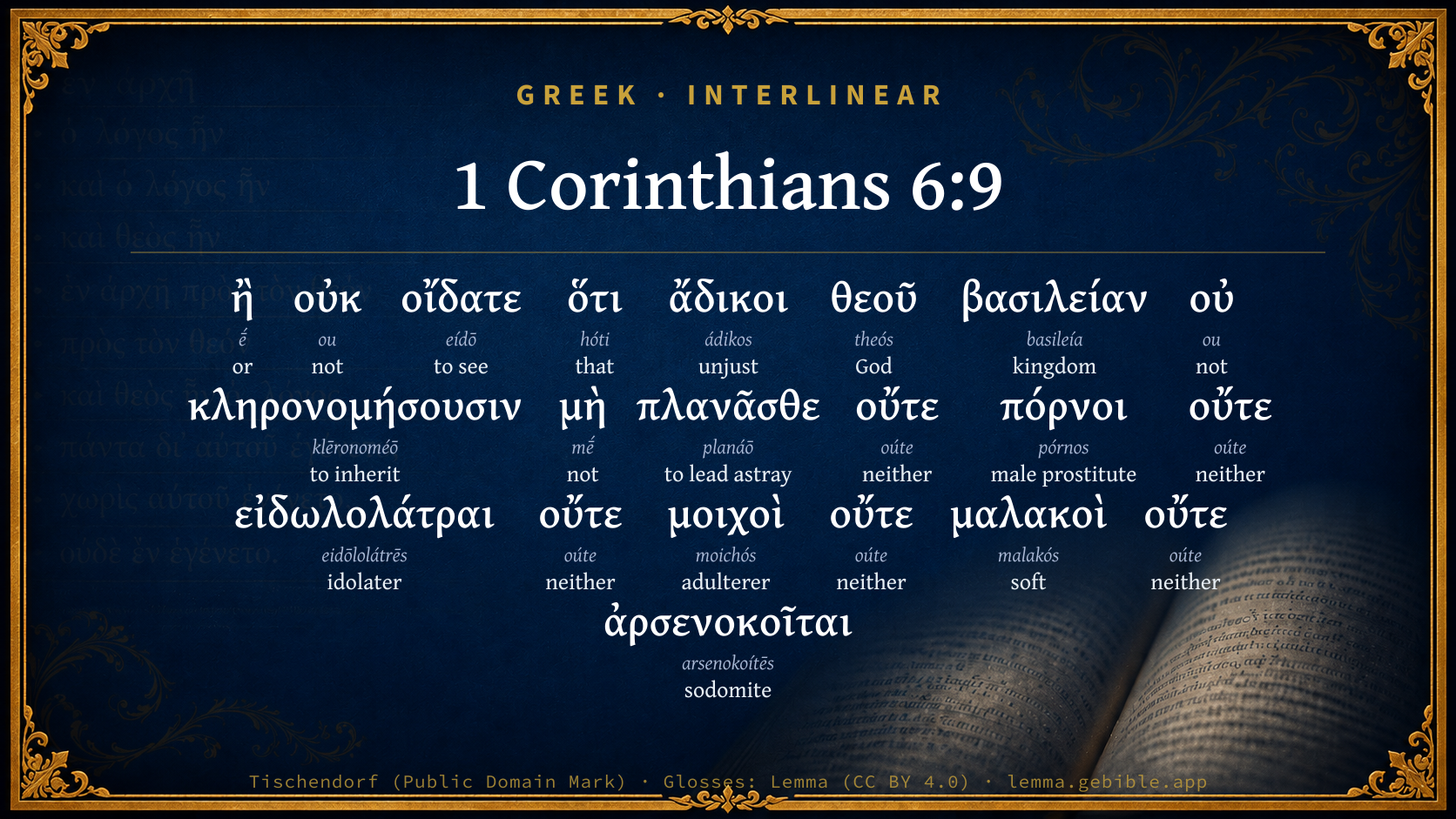
Download image
Cite this verse

1 Corinthians 6:9 (World English Bible). Public Domain. Lemma interlinear Bible study tool, https://lemma.gebible.app/v/1-corinthians/6/9.

Show BibTeX & RIS
BibTeX
RIS
English Translation
Or don't you know that the unrighteous will not inherit the Kingdom of God? Don't be deceived. Neither the sexually immoral, nor idolaters, nor adulterers, nor male prostitutes, nor homosexuals,
World English Bible · Public Domain
Highlights
  • 1 first appearance in the Greek New Testament
Full analysis ↓
Download a study sheet

One document with this verse’s original text, its word-by-word gloss line, the meaning frame, cross-references with their text, attributed commentary, and full source and license credits — printable, and it pastes into notes with its structure intact.

This verse Autodidact and up

Study sheet (.html) Plain text (.txt)

A passage Seminary Student

Up to 50 verses in one chapter. A passage sheet keeps up to 6 commentary sources and 12 cross-references per verse, in the order this page ranks them, and says so on the sheet whenever that leaves anything out. Ask for a single verse and you get the Autodidact verse sheet above.

Everything on this page stays free to read, with no account — the sheet is a download of what is already on screen, not access to it.

Want to remove ads? Support Godless Engineer
Compare translations 3

The same verse in 3 English versions, stacked beneath the original-language interlinear above. Click any original word for its lexicon entry.

Each is an independent rendering of the whole verse — the interlinear is not word-aligned to these translations.

Highlighted words mark where these versions differ — a whole-verse word diff, not a word-by-word alignment.

  • World English Bible Public Domain
    Or don't you know that the unrighteous will not inherit the Kingdom of God? Don't be deceived. Neither the sexually immoral, nor idolaters, nor adulterers, nor male prostitutes, nor homosexuals,
  • King James Version Public Domain
    Know ye not that the unrighteous shall not inherit the kingdom of God? Be not deceived: neither fornicators, nor idolaters, nor adulterers, nor effeminate, nor abusers of themselves with mankind,
  • unfoldingWord Literal Text CC BY-SA 4.0
    Or do you not know that the unrighteous will not inherit the kingdom of God? Do not be deceived; neither the sexually immoral nor idolaters nor adulterers nor male prostitutes nor practicing homosexuals

unfoldingWord Literal Text — © unfoldingWord, licensed CC BY-SA 4.0. Word-aligned USFM3 via Door43 (git.door43.org/unfoldingWord/en_ult).

Versions to compare (up to 4)

3 of 4 selected

Show all 19 translations

Every available English version of this verse, each an independent rendering of the whole verse.

  • World English Bible Public Domain
    Or don't you know that the unrighteous will not inherit the Kingdom of God? Don't be deceived. Neither the sexually immoral, nor idolaters, nor adulterers, nor male prostitutes, nor homosexuals,
  • Berean Standard Bible Public Domain
    Do you not know that the wicked will not inherit the kingdom of God? Do not be deceived: Neither the sexually immoral, nor idolaters, nor adulterers, nor men who submit to or perform homosexual acts,
  • Majority Standard Bible Public Domain
    Do you not know that the wicked will not inherit the kingdom of God? Do not be deceived: Neither the sexually immoral, nor idolaters, nor adulterers, nor men who submit to or perform homosexual acts,
  • King James Version Public Domain
    Know ye not that the unrighteous shall not inherit the kingdom of God? Be not deceived: neither fornicators, nor idolaters, nor adulterers, nor effeminate, nor abusers of themselves with mankind,
  • American Standard Version (1901) Public Domain
    Or know ye not that the unrighteous shall not inherit the kingdom of God? Be not deceived: neither fornicators, nor idolaters, nor adulterers, nor effeminate, nor abusers of themselves with men,
  • Revised Version (1885) Public Domain
    Or know ye not that the unrighteous shall not inherit the kingdom of God? Be not deceived: neither fornicators, nor idolaters, nor adulterers, nor effeminate, nor abusers of themselves with men,
  • Geneva Bible (1599) Public Domain
    Knowe yee not that the vnrighteous shall not inherite the kingdome of God? Be not deceiued: neither fornicatours, nor idolaters, nor adulterers, nor wantons, nor buggerers,
  • Douay-Rheims (1899) Public Domain
    Know you not that the unjust shall not possess the kingdom of God? Do not err: neither fornicators, nor idolaters, nor adulterers,
  • Young's Literal Translation Public Domain
    have ye not known that the unrighteous the reign of God shall not inherit? be not led astray; neither whoremongers, nor idolaters, nor adulterers, nor effeminate, nor sodomites,
  • Literal Standard Version CC BY-SA 4.0
    Have you not known that the unrighteous will not inherit the Kingdom of God? Do not be led astray; neither whoremongers, nor idolaters, nor adulterers, nor effeminate, nor sodomites,
  • Unlocked Literal Bible CC BY-SA 4.0
    Do you not know that the unrighteous will not inherit the kingdom of God? Do not believe lies. The sexually immoral, idolaters, adulterers, male prostitutes, those who practice homosexuality,
  • unfoldingWord Literal Text CC BY-SA 4.0
    Or do you not know that the unrighteous will not inherit the kingdom of God? Do not be deceived; neither the sexually immoral nor idolaters nor adulterers nor male prostitutes nor practicing homosexuals
  • Darby Bible Public Domain
    Do ye not know that unrighteous [persons] shall not inherit [the] kingdom of God? Do not err: neither fornicators, nor idolaters, nor adulterers, nor those who make women of themselves, nor who abuse themselves with men,
  • World Messianic Bible Public Domain
    Or don’t you know that the unrighteous will not inherit God’s Kingdom? Don’t be deceived. Neither the sexually immoral, nor idolaters, nor adulterers, nor male prostitutes, nor homosexuals,
  • Webster's Bible Public Domain
    Know ye not that the unrighteous shall not inherit the kingdom of God? Be not deceived; neither fornicators, nor idolaters, nor adulterers, nor effeminate, nor abusers of themselves with mankind,
  • Free Bible Version CC BY-SA 4.0
    Don't you know those who are unjust will not inherit the kingdom of God? Don't be fooled! People who are immoral, worship idols, commit adultery, are sexual perverts, homosexuals,
  • Bible in Basic English Public Domain
    Have you not knowledge that evil-doers will have no part in the kingdom of God? Have no false ideas about this: no one who goes after the desires of the flesh, or gives worship to images, or is untrue when married, or is less than a man, or makes a wrong use of men,
  • Text-Critical English NT CC BY 4.0
    Do you not know that the unrighteous will not inherit the kingdom of God? Do not be deceived! Neither fornicators, nor idolaters, nor adulterers, nor homosexuals, nor sodomites,
  • Tyndale New Testament (1534) Public Domain
    Do ye not remember how that the vnrighteous shall not inheret the kyngdome of God? Be not deceaved. For nether fornicators nether worshyppers of ymages nether whormongers nether weaklinges nether abusars of them selves with the mankynde

Literal Standard Version (2020), Covenant Press — licensed CC BY-SA 4.0. Text via the HelloAO Bible API (eBible.org). Unlocked Literal Bible (unfoldingWord) — licensed CC BY-SA 4.0. Text via the HelloAO Bible API (eBible.org). unfoldingWord Literal Text — © unfoldingWord, licensed CC BY-SA 4.0. Word-aligned USFM3 via Door43 (git.door43.org/unfoldingWord/en_ult). Free Bible Version, Dr. Jonathan Gallagher — licensed CC BY-SA 4.0. Text via the HelloAO Bible API (eBible.org).

Word by word

More ways to search: Search by grammar → Find every occurrence → Compare this word →

Practice this passage: Drill this verse → Learn its vocabulary →

ἀρσενοκοῖται
arsenokoítēs
G733
“sodomite”
Noun, Nominative, Plural, Masculine
Part of Speech
Noun
Case
Nominative
Number
Plural
Gender
Masculine
Full Thayer's Definition

Origin: from G730 and G2845

TDNT: None

1. one who lies with a male as with a female, sodomite, homosexual
  1. ἢ ḗ G2228 “or” Particle
  2. οὐκ ou G3756 “not” Particle, Negative
  3. οἴδατε eídō G1492 “to see” Verb, Perfect, Active, Indicative, 2nd person, Plural
  4. ὅτι hóti G3754 “that” Conjunction
  5. ἄδικοι ádikos G94 “unjust” Adjective, Nominative, Plural, Masculine
  6. θεοῦ theós G2316 “God” Noun, Genitive, Singular, Masculine
  7. βασιλείαν basileía G932 “kingdom” Noun, Accusative, Singular, Feminine
  8. οὐ ou G3756 “not” Particle, Negative
  9. κληρονομήσουσιν klēronoméō G2816 “to inherit” Verb, Future, Active, Indicative, 3rd person, Plural
  10. μὴ mḗ G3361 “not” Particle, Negative
  11. πλανᾶσθε planáō G4105 “to lead astray” Verb, Present, Passive, Imperative, 2nd person, Plural
  12. οὔτε oúte G3777 “neither” Conjunction, Negative
  13. πόρνοι pórnos G4205 “male prostitute” Noun, Nominative, Plural, Masculine
  14. οὔτε oúte G3777 “neither” Conjunction, Negative
  15. εἰδωλολάτραι eidōlolátrēs G1496 “idolater” Noun, Nominative, Plural, Masculine
  16. οὔτε oúte G3777 “neither” Conjunction, Negative
  17. μοιχοὶ moichós G3432 “adulterer” Noun, Nominative, Plural, Masculine
  18. οὔτε oúte G3777 “neither” Conjunction, Negative
  19. μαλακοὶ malakós G3120 “soft” Adjective, Nominative, Plural, Masculine
  20. οὔτε oúte G3777 “neither” Conjunction, Negative

About this verse

These counts appear in no published source. They are computed here, from the morphology-tagged text and Lemma’s own curated glosses. What Lemma adds →

21
words
16
distinct lemmas
Pauline Epistles
section

Notable vocabulary

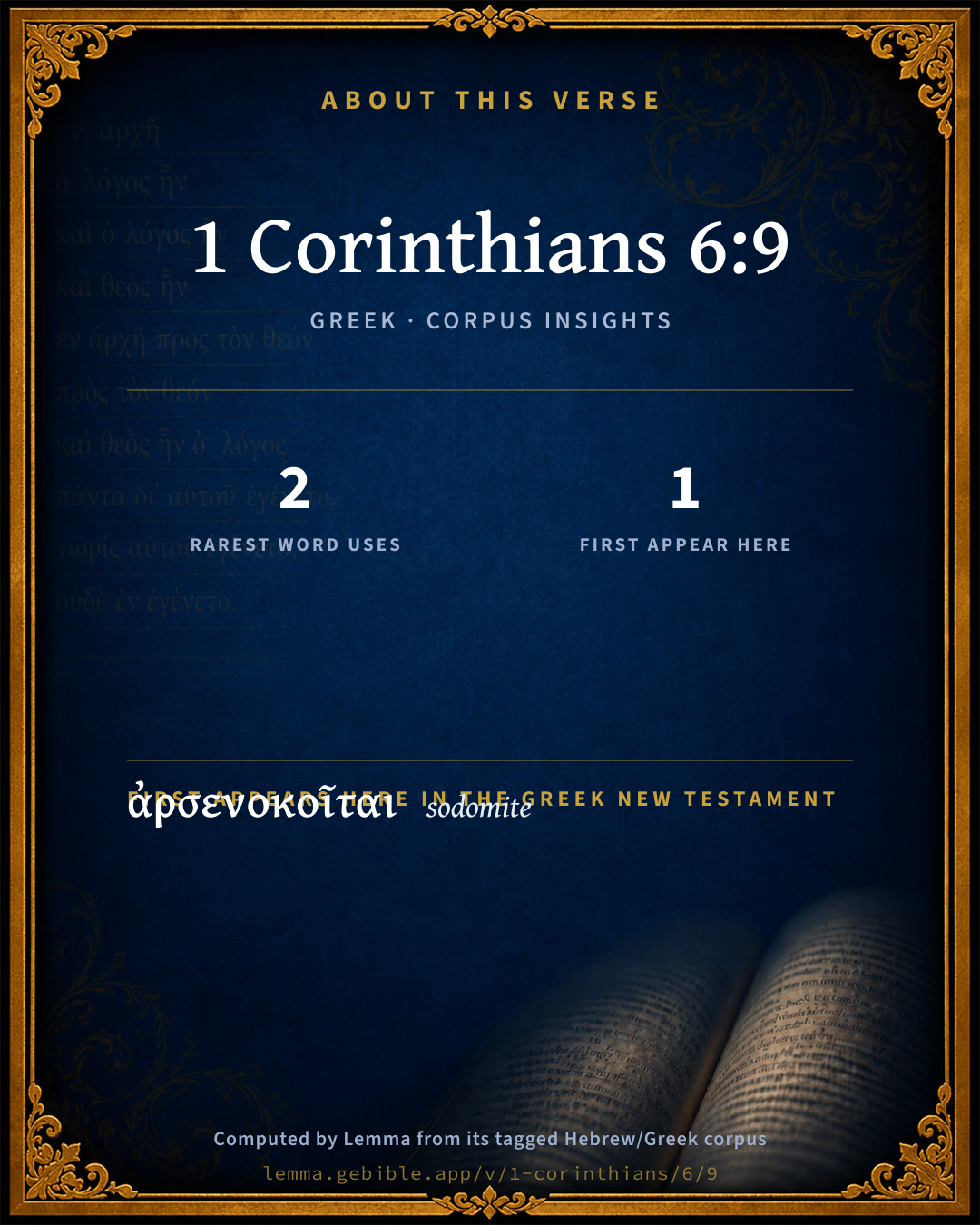
The rarest word here is ἀρσενοκοῖται sodomite G733 — appearing just 2 times in the whole Greek New Testament.

First appearance in Scripture

This word makes its first canonical appearance in the Greek New Testament here:

  • ἀρσενοκοῖται sodomite G733

Shared distinctive vocabulary

ἀρσενοκοῖται sodomite G733 occurs in 2 verses of the Greek New Testament. Also found in:
Repetition

Words recur within this verse:

  • οὔτε neither G3777 ×5
  • οὐκ not G3756 ×2

Cross-references

39

Topical passages linked to 1 Corinthians 6:9 in the Treasury of Scripture Knowledge — connected by theme and wording, ordered by reader-vote popularity; previews shown in the World English Bible.

  • 1 Timothy 1:9–10 as knowing this, that law is not made for a righteous man, but for the lawless and insubordinate, for the ungodly and sinners, for the unholy and profane, for murderers of fathers and murderers of mothers, for manslayers,
  • Galatians 5:19–21 Now the works of the flesh are obvious, which are: adultery, sexual immorality, uncleanness, lustfulness,
  • Ephesians 5:4–5 nor filthiness, nor foolish talking, nor jesting, which are not appropriate; but rather giving of thanks.
  • Leviticus 20:13 If a man lies with a male, as with a woman, both of them have committed an abomination: they shall surely be put to death; their blood shall be upon them.
  • Leviticus 18:22 "'You shall not lie with a man, as with a woman. That is detestible.
  • Revelation 22:15 Outside are the dogs, the sorcerers, the sexually immoral, the murderers, the idolaters, and everyone who loves and practices falsehood.
  • Revelation 21:8 But for the cowardly, unbelieving, sinners, abominable, murderers, sexually immoral, sorcerers, idolaters, and all liars, their part is in the lake that burns with fire and sulfur, which is the second death."
  • 1 Corinthians 6:10 nor thieves, nor covetous, nor drunkards, nor slanderers, nor extortioners, will inherit the Kingdom of God.
  • Romans 1:26–27 For this reason, God gave them up to vile passions. For their women changed the natural function into that which is against nature.
  • 1 Corinthians 6:19 Or don't you know that your body is a temple of the Holy Spirit which is in you, which you have from God? You are not your own,
  • 1 Corinthians 5:10 yet not at all meaning with the sexual sinners of this world, or with the covetous and extortioners, or with idolaters; for then you would have to leave the world.
  • Hebrews 13:4 Let marriage be held in honor among all, and let the bed be undefiled: but God will judge the sexually immoral and adulterers.
  • Deuteronomy 22:5 A woman shall not wear men's clothing, neither shall a man put on women's clothing; for whoever does these things is an abomination to Yahweh your God.
  • Romans 1:18 For the wrath of God is revealed from heaven against all ungodliness and unrighteousness of men, who suppress the truth in unrighteousness,
  • 1 Corinthians 15:33 Don't be deceived! "Evil companionships corrupt good morals."
  • 1 Corinthians 15:50 Now I say this, brothers, that flesh and blood can't inherit the Kingdom of God; neither does corruption inherit incorruption.
  • 1 Corinthians 3:16 Don't you know that you are a temple of God, and that God's Spirit lives in you?
  • Hebrews 12:14 Follow after peace with all men, and the sanctification without which no man will see the Lord,
  • Hebrews 12:16 lest there be any sexually immoral person, or profane person, as Esau, who sold his birthright for one meal.
  • Matthew 25:34 Then the King will tell those on his right hand, 'Come, blessed of my Father, inherit the Kingdom prepared for you from the foundation of the world;
  • Genesis 19:5 They called to Lot, and said to him, "Where are the men who came in to you this night? Bring them out to us, that we may have sex with them."
  • Isaiah 55:7 let the wicked forsake his way, and the unrighteous man his thoughts; and let him return to Yahweh, and he will have mercy on him; and to our God, for he will abundantly pardon.
  • Leviticus 19:35–36 "'You shall do no unrighteousness in judgment, in measures of length, of weight, or of quantity.
  • Deuteronomy 23:17 There shall be no prostitute of the daughters of Israel, neither shall there be a sodomite of the sons of Israel.
  • Judges 19:22 As they were making their hearts merry, behold, the men of the city, certain base fellows, beset the house round about, beating at the door; and they spoke to the master of the house, the old man, saying, Bring forth the man who came into your house, that we may know him.
  • 1 Corinthians 5:1 It is actually reported that there is sexual immorality among you, and such sexual immorality as is not even named among the Gentiles, that one has his father's wife.
  • 1 Corinthians 6:15–16 Don't you know that your bodies are members of Christ? Shall I then take the members of Christ, and make them members of a prostitute? May it never be!
  • Deuteronomy 25:13–16 You shall not have in your bag diverse weights, a great and a small.
  • Proverbs 22:8 He who sows wickedness reaps trouble, And the rod of his fury will be destroyed.
  • Zechariah 5:3 Then he said to me, "This is the curse that goes out over the surface of the whole land; for everyone who steals shall be cut off according to it on the one side; and everyone who swears falsely shall be cut off according to it on the other side.
  • Exodus 23:1 "You shall not spread a false report. Don't join your hand with the wicked to be a malicious witness.
  • Leviticus 19:15 "'You shall do no injustice in judgment: you shall not be partial to the poor, nor show favoritism to the great; but in righteousness shall you judge your neighbor.
  • Proverbs 11:1 A false balance is an abomination to Yahweh, But accurate weights are his delight.
  • Isaiah 10:1–2 Woe to those who decree unrighteous decrees, and to the writers who write perverseness;
  • Matthew 19:29 Everyone who has left houses, or brothers, or sisters, or father, or mother, or wife, or children, or lands, for my name's sake, will receive one hundred times, and will inherit eternal life.
  • 1 Corinthians 6:2–3 Don't you know that the saints will judge the world? And if the world is judged by you, are you unworthy to judge the smallest matters?
  • 1 Corinthians 9:24 Don't you know that those who run in a race all run, but one receives the prize? Run like that, that you may win.
  • James 1:16 Don't be deceived, my beloved brothers.
  • Acts 24:25 As he reasoned about righteousness, self-control, and the judgment to come, Felix was terrified, and answered, "Go your way for this time, and when it is convenient for me, I will summon you."

Cross-references courtesy of OpenBible.info (CC BY 4.0).

Commentary

Notes on 1 Corinthians 6:9 from classic Christian and Jewish commentators (each source and its license shown beneath its notes). The classic Christian expositions comment on the surrounding passage and are grouped to its opening verse, so a note may address several verses; the Jewish commentaries on the Tanakh (Rashi and others) are per-verse, so they appear only where the commentator wrote on this verse.

Lemma curates 59 commentaries, every one of them public domain or Creative Commons licensed, each selected and text-cleaned for this edition rather than reprinted as found. About our sources →

Matthew Henry's Commentary

Here he takes occasion to warn them against many heinous evils, to which they had been formerly addicted.

I. He puts it to them as a plain truth, of which they could not be ignorant, that such sinners should not inherit the kingdom of God. The meanest among them must know thus much, that the unrighteous shall not inherit the kingdom of God (Co1 6:9), shall not be owned as true members of his church on earth, nor admitted as glorious members of the church in heaven. All unrighteousness is sin; and all reigning sin, nay, every actual sin committed deliberately, and not repented of, shuts out of the kingdom of heaven. He specifies several sorts of sins: against the first and second commandments, as idolaters; against the seventh, as adulterers, fornicators, effeminate, and Sodomites; against the eighth, as thieves and extortioners, that by force or fraud wrong their neighbours; against the ninth, as revilers; and against the tenth, as covetous and drunkards, as those who are in a fair way to break all the rest. Those who knew any thing of religion must know that heaven could never be intended for these. The scum of the earth are no ways fit to fill the heavenly mansions. Those who do the devil's work can never receive God's wages, at least no other than death, the just wages of sin, Rom 6:23.

II. Yet he warns them against deceiving themselves: Be not deceived. Those who cannot but know the fore-mentioned truth are but too apt not to attend to it. Men are very much inclined to flatter themselves that God is such a one as themselves, and that they may live in sin and yet die in Christ, may lead the life of the devil's children and yet go to heaven with the children of God. But this is all a gross cheat. Note, It is very much the concern of mankind that they do not cheat themselves in the matters of their souls. We cannot hope to sow to the flesh and yet reap everlasting life.

III. He puts them in mind what a change the gospel and grace of God had made in them: Such were some of you (Co1 6:11), such notorious sinners as he had been reckoning up. The Greek word is tauta - such things were some of you, very monsters rather than men. Note, Some that are eminently good after their conversion have been as remarkably wicked before. Quantum mutatus ab illo! How glorious a change does grace make! It changes the vilest of men into saints and the children of God. Such were some of you, but you are not what you were. You are washed, you are sanctified, you are justified in the name of Christ, and by the Spirit of our God. Note, The wickedness of men before conversion is no bar to their regeneration and reconciliation to God. The blood of Christ, and the washing of regeneration, can purge away all guilt and defilement. Here is a rhetorical change of the natural order: You are sanctified, you are justified. Sanctification is mentioned before justification: and yet the name of Christ, by which we are justified, is placed before the Spirit of God, by whom we are sanctified. Our justification is owing to the merit of Christ; our sanctification to the operation of the Spirit: but both go together. Note, None are cleansed from the guilt of sin, and reconciled to God through Christ, but those who are also sanctified by his Spirit. All who are made righteous in the sight of God are made holy by the grace of God.

Matthew Henry's Commentary on the Whole Bible (1708–1710) — public domain (CC PDM 1.0). Text via the HelloAO Bible API.

The Biblical Illustrator

Joseph S. Exell

1Co_6:9-11

Know ye not Shall the unrighteous shall not inherit the kingdom of God?

Persistent self-deception

Sometimes we persistently deceive ourselves. We insist upon pursuing a policy for our benefit which all but ourselves clearly see to be absurd and useless. We cling to a pet project and nurse a worthless conceit long after the folly of both is recognised by everybody else. But we are not altogether to be blamed. For instinct itself is sometimes at fault, and its powers are uselessly applied. A hen will sit with the greatest tenacity on rounded pieces of chalk; and the Hamster rat breaks the wings of dead birds as well as of living ones before it devours them. Insects also occasionally err on the same principle, as when the blow-fly lays its eggs on the flower of the stapelia, deceived by its carrion-like odour. A spider, deprived of its egg-bag, will cherish with the same fondness a little pellet of cotton thrown to it. (Scientific Illustrations and Symbols.)

Who shall enter into the kingdom of God

1. The kingdom.

2. The danger of delusion in reference to it.

3. The certain exclusion of all unrighteousness.

4. The necessity of a change in those who enter it.

5. The means by which this change is effected. (J. Lyth, D. D.)

Our inheritance in peril

I. What our inheritance is--the kingdom of God, present, but chiefly future (2Pe_3:13). Heaven is rest, joy, purity, vision. This inheritance is in a sense the inheritance of all, since Christ died for the sins of the world. We disinherit ourselves.

II. The hindrances to it.

1. Sins of sensuality.

2. Idolatry. If we serve false gods how can we expect a reward from the true? Some have keen eyes for injuries done to men; idolatry is a pre-eminent sin against God. What is it that occupies the throne of our heart?

3. Theft, covetousness, extortion. These are much upon a par. Yet many a man who would be horrified at the thought of being a thief thinks nothing of covetousness or extortion. But what is covetousness but theft in the bud? and extortion but theft in the blossom! A man who steals mentally is as guilty as if he stole actually; for nothing but the restraints of society and the dock keep his hands still. Many a theft is committed in a court of justice with the assistance of counsel: e.g., when a man is striving to get more than his due.

4. Drunkenness. The curse of our land. What men lose by it--health, respect, friends, wealth, and the kingdom of God.

5. Foul language. Reviling, railing, sins of the tongue. Foul lips speak a foul heart. Plainly we are here taught that a nominal faith cannot save us. All the profession in the world will not secure our inheritance.

III. These hindrances may be removed. Here is consolation for great sinners--and who are small ones? When a man is deeply convinced of sin he is often tempted to despair. Can I, the unclean, &c., enter the holy heaven? It seems impossible. But the apostle turns upon his converts and says--And such were some of you. Of greatest sinners God has sometimes made the greatest saints. The barriers insuperable to man may be cast down by the might of God. No sickness is beyond the skill of the great Physician.

IV. The manner of removal. Paul speaks of washing in its twofold character.

1. Justification, which we receive through Christ (1Co_6:11).

2. Sanctification, which we receive through the operation of the Spirit of our Lord (1Co_6:11).

V. A caution implied--And such were some of you. Are ye becoming so again? Our great inheritance may be lost after all, and will be unless we endure to the end. (W. E. Hurndall, M. A.)

Genuine reformation

Reformation is an object most earnestly pursued by all who are alive to the wrongs of life. Some, however, are of questionable utility, and none of much value but that of the text. This reformation is--

I. Of the moral character of mankind. Sin which may be defined as self-gratification is here presented in a variety of forms. The principle of sin, like holiness, is one and simple, but the forms are multifarious. These morally corrupt Corinthians were changed in the very root and fountain of their character.

II. Indispensable to a happy destiny. The kingdom of God--the reign of truth, purity, love. To inherit that empire, to be in it, not as occasional visitors, but as permanent citizens, is our high destiny. For this we were made. Hence Christ urges us to seek it first. There is no getting into it without this moral reformation.

III. Effected by the redemptive agency of Christ. They had been cleansed from their moral foulness, washed; consecrated to holiness, sanctified; made right in their being and relationships, justified. And this in the name, &c. Nothing on earth will effect this moral change but the gospel; not legislative enactments, or scientific systems. (D. Thomas, D. D.)

Nor drunkards.

Drunkenness

1. No pestilence has ever wrought as much devastation and misery as the pestilence of drunkenness. Even its physical destructions are simply terrific. It is the origin of many of the worst forms of disease. Nor are the moral and social devastations of drunkenness less terrific than its physical devastations. Drunkenness extinguishes the fires of shame, profanes the shrines of self-respect, enfeebles the forces of resistance to evil; stifles conscience. And what shall we say of drunkenness in its ravages upon religion? And what is true of Christian work in foreign lands is not less true of Christian work at home. Drunkenness is a fearful hindrance to Christian enterprise. It counteracts, if it does not overweigh, all Christian endeavour to ameliorate the moral and social condition of the people.

2. The causes of drunkenness, it seems to me, are seldom sufficiently inquired into and considered. Some races of mankind, e.g., are constitutionally more temperate than others; and some climates foster intoxication more than others. Both the race and climate of Sweden, e.g., are eminently favourable to drunkenness. The Swedes are Goths, and the Goths are a proverbially drunken race. The long, cold, dark winter of Sweden are also calculated to encourage habits of intoxication. On the other hand, in many southern climates, where the people, under the genial influences of the radiant sun, feel little natural desire for stimulants, a strong artificial desire has been created by the facilities with which ardent spirits have been commercially introduced. There are also two other causes of drunkenness which, although in themselves irremovable, are yet capable of being brought under favourable control. These two causes are--

(1) An hereditary disposition to drink; and--

(2) A highly wrought nervous constitution. In both cases alike total abstinence is, I believe, essential, and moderate drinking impossible. And when I speak of total abstinence, I speak of it not as an irksome restraint but as a charter of freedom. But the cause of temperance is not exclusively the cause of total abstinence. Total abstainers need all the co-operation they can receive from non-abstainers in their crusade against drunkenness, and particularly in removing the causes of drunkenness wherever those causes are removable. It is said that people cannot be made sober by Act of Parliament. Whether this be so or not it is certainly true that multitudes are made drunk by the unnecessary and over-numerous temptations which are permitted by Act of Parliament. But the Licensing Laws are not the only removable cause of drunkenness. The most fruitful of all causes of drunkenness is, I believe, wretchedness; wretchedness social, moral, and personal. Look at the way our poor are herded together in our crowded towns, without air or light, with no comforts or recreations! Can you wonder they are drunken? Drunkenness is the Nemesis, the avenging punishment, of the utter selfishness of modern civilisation, which cares so little for the overcrowded poor. In other cases, also, wretchedness is the cause of drunkenness. Think of the wretched, empty, stagnant condition of many human lives. Think of the long, dreary hours which some operatives have to work; hours which leave no time for self-improvement or recreation. Can you wonder that such persons drink? Nor is the guilt of the sin wholly theirs. It is partly yours and mine for allowing such a frightful state of things to continue to exist. Three other causes of drunkenness only will I mention; viz., selfishness, the stings of an uneasy conscience, and the wretchedness of many homes--homes capable of comfort, peace, and joy, but homes made utterly miserable by indolence, stubbornness, evil tempers, artificial worries, and want of love.

3. These are, I think, the principal causes of drunkenness; and in most instances the remedies suggest themselves. We need great and fundamental reforms in our Licensing Laws. We need to Christianise our civilisation in the direction of ameliorating the lives of the multitudinous poor. We need less rush and more repose in daily life. We need a sounder and more indignant public opinion concerning drunkenness. We need also a great revival of the Christian ideals of marriage and domestic life--ideals which, when wrought in practice, make home the mirror of heaven on earth. We need, lastly, and above all things, to inculcate the eternal truth that wilful and deliberate drunkenness is sin; sin which brutalises every part of mans nature; sin which, if unforsaken, shuts the door of heaven against the drunkard. (Canon Diggle.)

The Biblical Illustrator, edited by Joseph S. Exell (c. 1880s–1900s) — public domain. Text from a community e-Sword module.

Joseph Benson's Commentary

1Co 6:9-11. Know ye not — With all your boasted knowledge; that the unrighteous — That is, not only the unjust, but those destitute of true righteousness and holiness, comprehending the various classes of sinners afterward mentioned, the term unrighteous here including them all: shall not inherit the kingdom of God — Namely, the kingdom of eternal glory. And can you contentedly sacrifice this great and glorious hope which the gospel gives you, for the sake of those pleasures of sin which are but for a short season? Be not deceived — By a vain imagination that the Christian name and privileges will save you, while you continue in the practice of your vices. Neither fornicators, nor idolaters, &c. — Idolatry is here placed between fornication and adultery, because these things generally accompanied it. Indeed, among the heathen idolatry was not only a great crime in itself, but was the parent of many other crimes. For the heathen were encouraged in the commission of fornication, adultery, sodomy, drunkenness, theft, &c., by the example of their gods. Nor effeminate — Who live in an easy, indolent way, taking up no cross, enduring no hardship. But how is this, that these good-natured, harmless people are ranked with idolaters and sodomites, those infamous degraders of human nature? We may learn hence, that we are never secure from the greatest sins, till we guard against those which are thought to be the least; nor indeed till we think no sin is little, since every one is a step toward hell. And such were some of you — Namely, in some kind or other; but ye are washed — Delivered from the guilt and power of those gross abominations. Ye are sanctified — Renewed in the spirit of your minds, dedicated to, and employed in the service of God; conformed, at least in a measure, to his image, and possessed of his divine nature, and this not before, but in consequence of your being justified. Or, Ye are regenerated and purified, as well as discharged, from the condemnation to which ye were justly obnoxious. See the nature of justification explained in the notes on Rom 3:21-22; and its fruits, on Rom 5:1-5. In the name of the Lord Jesus — Through his merits, or his sacrifice and intercession; and by the Spirit of our God — Creating you anew, and inspiring you with all those blessed graces which are the genuine fruits of his divine influences, Gal 5:22-23. You ought therefore, as if he had said, to maintain the most grateful sense of these important blessings which God hath conferred upon you, to stand at the utmost distance from sin, and to be tender of the peace and honour of a society which God hath founded by his extraordinary interposition, and into which he hath been pleased in so wonderful a manner to bring even you, who were in a most infamous and deplorable state.

Joseph Benson's Commentary on the Old and New Testaments (1811–1818) — public domain. Text from a community e-Sword module.

Whedon's Commentary on the Bible

Daniel D. Whedon

b. Sensualities and other vices exclude from the kingdom of God, 1Co_6:9-11.

St. Paul has just been holding up the highest ideal of the kingdom of God—the glorious judgeship [rulership] of the saints—as reason why his Corinthians should not humble each other before pagan courts. Their tendency to do so directs his thoughts to that cluster of vices, especially sensuality, by which, amid the dissoluteness of Corinth, they were in imminent danger of forfeiting their title to God’s glorious kingdom. Hence these words of earnest warning are pervaded throughout with a secret reference to their easy remissness in regard to the fornicator.

9. Kingdom of God—In which the holy do, through Christ, overrule the unholy.

Be not deceived—Middle voice, Deceive not yourselves. Neither your past rich experience nor your membership in Christ’s Church can save you in your sensuality and other vices.

Idolaters—A large share of whose ritual is sensual indulgence.

Effeminate—Pathics.

Abusers—Sodomites. Rom_1:26-27.

Daniel D. Whedon (gen. ed.), Commentary on the Old and New Testaments (1874–1909) — public domain. Text from a community e-Sword module.

The Preacher's Complete Homiletical Commentary

Joseph S. Exell (gen. ed.)

CRITICAL NOTES

TRANSITIONAL SECTION.—1Co_6:9-11

1Co_6:9.—Query, is the particular “wrong” and “defrauding” in 1Co_6:8-9 connected with 2Co_7:12, the case of “the incestuous person”? Had the father been ready to appeal to a secular court for redress? Some such connection would explain the transition in this verse from “litigation” to “fornication.” [In 2Co_7:2 Paul uses in negatived connection with himself “wrong” and “defraud.”] N.B., like Rom_1:24 usque ad fincm, this chapter gives a significant glimpse of the every-day corruption of the heathen world, with all the civilization of Greece and Rome. Effeminate.—Euphemistic.

1Co_6:10.—Note in what company we find “covetousness.” Stanley suggests a connection between “thieves” and the lawsuits (but query?). Revilers.—Virulent, foul abuse; generally, not always. Joh_9:28; Act_23:4; 1Co_4:12; 1Pe_2:13; 1Ti_5:14; 1Pe_3:9; 1Co_5:11; and here. Inherit.—Cf. Mat_25:34; Jas_2:5, “heirs of the kingdom.”

1Co_6:11.—Observe “were … were … were.” Partly historical, partly ideal. In ideal, Faith, Baptism, Renewal, Separation from sins of old character and life, coincide in time; in fact, Baptism may be pre- or post-dated in regard to Faith and Renewal; Separation may very imperfectly accompany the rest. Justified.—Protestantism rightly lays stress upon the relative change involved in pardon of sin; makes this its definition of Justification (Act_13:38-39). Yet (e.g. Wesley, Sermons) “some rare instances may be found wherein the terms ‘justified’ and ‘justification’ are used in so wide a sense as to include sanctification also; yet in general use they are sufficiently distinguished from each other both by St. Paul and the other inspired writers.” Also, cf. Rom_8:30, where attention is not so much fixed upon the initial act of God as upon the continuously accorded and maintained status of the justified man, covering the whole interval from pardon to glory. Also, no careful adherence here to the ordo salutis (Calvin, in Ellicott). Observe “in … in.” Observe “our God.”

HOMILETIC ANALYSIS.—1Co_6:9-11

I. The kingdom of God.—

1. Observe how the phrase and idea had got cleared in Paul’s mind from all the foolish and ridiculous Rabbinical accretions and anticipations of a great temporal monarchy under Messiah, in which, freed from the Roman or other yoke, Israel should be the nation, and the Gentile world exist for the sake of the Jew.

2. We have here a case of the true Evolution.

(1) Israel had been the kingdom of God on earth. As Babylon was Nebuchadnezzar’s, or Egypt was Pharaoh’s, or Damascus Rezin’s or Hazael’s. Jehovah was the only, the real, King of the realm. David, Solomon, etc., were understood to be only viceroys under Jehovah. Jehovah’s law was State law. Idolatry was treason. Citizens were born into the citizenship [cf. in contrast, Joh_1:13]; Israel, in the midst of the nations, stood distinguished as the nation of God in the land of God. But it never perfectly realised the idea. The land never was cleared of enemies for Jehovah. The people never did perfectly keep Jehovah’s law. They were not satisfied with, or mindful of, the true King Jehovah. At last, when the mob howled wildly around Pilate’s judgment seat, “We have no king but Cæsar,” came the beginning of the end of even this imperfect embodiment of God’s idea.

(2) Next, the Church of Christ is made to exhibit “God’s kingdom.” Again there is a separate people, God’s “peculiar people,” but of no one nation, located in no one land. The kingdom is wherever a heart is in which Christ is accepted as God’s anointed King of His new Israel. “Kingdom of God within you.” Every heart won is a new piece of territory added to God’s realm on earth. God’s “royal,” “perfect, law of liberty” (Jas_1:25; Jas_2:8) is the State law, and rules the hearts of the citizens of this better setting forth of the “kingdom of God.”

(3) “Better,” but not perfect, or ideal. For that we look to Eternity. Heaven is at last the idea of God realised. A people all holy, all happy, in a land without sin or curse; every heart beating pulse and pulse in communion with the King; love to the King the one sufficient, all-embracing law for every subject, written in the heart; God ruling over a race, all His people, dwelling in a world [perhaps “a new earth”] undisputedly His dominion. Thus, as Israel, the Church, the inner Experience of believers, Heaven—God’s recovered idea of a “kingdom of God” has progressively been exhibited “in many parts and in many manners” (Heb_1:1); each “illustration” traced on the same lines as its predecessor, with additions, modifications, added detail.

II. Its citizens.—Not “the unrighteous.”

1. Only an absolute exclusion when the kingdom of God is Heaven. Separation made (Mat_25:33; Mat_25:46). Impossible to conceive of the Holy City admitting “what defileth,” etc. (Rev_21:27; Rev_22:15); cannot pass the gates.

2. Very imperfectly attempted in Israel. Levitical law had many enactments whose sanction was, “That soul shall be cut off from among the People.” But those—never actually enforced to any great extent—missed nearly all forms of “unrighteousness” which did not culminate in overt action.

3. Only partially to be accomplished in the Christian Church. In the sub-Pentecostal, almost ideal, days of the Church, the King vindicated the principle by the cutting off of Ananias and Sapphira [the New Testament analogue of the death of Achan]. But God is not perpetually stepping forth in acts of holy self-vindication against sin in His world or in the Church of His Son. All Church discipline, and forms (or tests) of Church membership, are so many humanly devised, often God honoured, methods of endeavouring to keep out the “unrighteous,” or to exclude them when in. But they never can secure more than an approximation to the idea of a kingdom in which no “unrighteous” are found. No method, actual or proposed, ever gets worked with perfect intelligence, or perfect faithfulness; no method of human administration can deal with heart-unrighteousness.

4. There is a perfect, self-acting, discipline of exclusion; a Divine excommunication. Sin means real incapacity for understanding, seeing, entering, the kingdom here; an utter unfitness for heaven, a moral impossibility, hereafter. Sin forfeits justification; the “blood” no longer “cleanses” (1Jn_1:7); it negatives the possession of the holiness without some degree of which no man is really regenerate or sanctified, nor can be a child in the family or a citizen of the kingdom. “Every branch in Me that beareth not fruit He taketh away”; the Vine-dresser’s knife executes its sentence of excommunication. The Church must often leave the dead branch still attached to the Vine; or must be ignorant of the fulness of its death. “Be not deceived.”

III. Candidates for citizenship.—

1. Who but the “unrighteous”? What a catalogue! “Thieves,” “effeminate,” “drunkards,” cannibals, murderers, sinners of every type, degree, age, race! From such the citizens are recruited! No citizen who was not an alien once. [No quarry from which stones cannot be got fit for Christ’s building. No stone which cannot be utilised by Him. There is really no other stone than such as this in the building.] (Eph_2:1-3; Eph_2:11-13.) The life-history of every citizen follows the formula, “Such were you, but ye were washed.… Ye are citizens.”

2. To such the kingdom comes by “inheritance.” (True now, and true “when the Son of Man shall come in His glory,” ut supra.) Such became “joint-heirs with Christ” in the possession of the kingdom. By inheritance; a concomitant of the new status, the new life; so certainly as they are “washed,” etc., do they inherit. The “washing,” etc., brings with it, ipso facto, an entering into possession. And as certainly by-and-by, with an unbroken sequence, does the “washing,” etc., go with the “inheriting.” There is no other final goal and resting-place congruous with, and possible for, the renewed citizen life. No entering without a change preceding; no change without the inheritance following.

IV. The initiation.—“Washing, “sanctifying” justifying.” (See Critical Notes, above) Paul not speaking with any theological precision of order. Yet if sanctification be only the relative holiness, completed by a “separating” act (cf. 1Co_1:2), no necessary difficulty to find it followed by “justification” in the ordinary sense of pardon,—the (forensic) discharge from all liability to penalty on account of a broken law; the two acts of God’s grace, separable in thought. coincide in time. Or, better, remember that the status of a justified man is a perpetually renewed grace; underlying all after-developments of the gracious life; assumed as the foundation on which all the superstructure of holiness is reared. Even in heaven, the saint will be there, and will remain there, only as a sinner justified, accepted, for the sake of that “Lamb” in whose “blood” he has trusted for salvation. The basis of all is the objective work of that Christ, who is revealed in His name as exactly what He is to, and for, us. On this rests, and rises, the (subjective) work of the Spirit of God. As the eruption of the leprosy falls off when the new health courses through the system, so these old, foul sins fall away from the life, when the spiritual health is renewed and becomes full, by the entering and indwelling of the Spirit of God.

SEPARATE HOMILIES

1Co_6:11. Perpetual Miracles.

I. Changed men a patent evidence of the supernatural.—

1. Age of miracles past? Yes, in the technical sense. Miracles [and Inspiration] by definition coterminous, in time and extent of distribution, with the progressive impartation of Revelation. Outside that process they are not found; Revelation complete, they cease. Revelation and Christ its Centre and Subject are a standing miracle. [The miracles were credentials of the agents and messengers and message; but, still more, themselves parts of the Revelation.]

2. In lower sense, No. God always (and not only in “miracles”) was in closest touch with the visible, material, “natural” order; is still. The converted man, at Corinth or anywhere else, knows that a power has come upon him from without, and that not human, or creaturely, but Divine. Conversion meant the point when the unseen broke in effectively upon him and changed whole current of thought and will and life. The process has its “natural analogies.” “I live by the faith of [this truth, and in this Person] a Son of God, who loved me,” etc. (Gal_2:20). I.e. a new ruling idea has taken possession and revolutionised life. A new affection is expelling all old evil affections. And this new idea, the new affection, has come with the “demonstration of the Spirit” (1Co_2:4; cf. 1Th_1:5-7). “No man can say that Jesus is Lord [nor “my Lord”] but by the Spirit” (1Co_12:3).

3. The man is an evidence to himself, and to others also. Men look at, observe, wonder at, the man whom they knew, who was yesterday “such” as they are; who is now pure, “washed, sanctified,” who has evidently laid hold of a power to do, and be, right which they do not possess; and of the secret of a life, for which no interest, or force of will, or ordinary human motives, can account. “God has touched that man!” A compendious evidence, and striking, appealing to all.

II. Vindication of universality of power and applicability of Gospel.—No case it cannot touch, etc. (as in Homiletic Analysis). Workers need this. Temptation in mission-fields, and at home, when evangelistic work is at a discount and conversions are few, to look at the difficulties in the way of producing conviction, and of inducing open confession even where conviction is secured; to adjust expectations to one’s narrower success; to acquiesce in meagre success with the cultured or rich; “our hope is with the poor” [and much Scripture can be quoted!]; to give up hope of the adults: “must not expect much from the generation of to-day, brought up in heathenism, with habits, training, etc., set; our hope is in the children; educate them Christianly.” [Good work, but not to leave other undone.] Every now and again, at home and in mission-fields, God does some such wonders as these at Corinth, and rebukes little faith, and too ready acquiescence in the “hopelessness” of the adult generation. Paul’s success everywhere was mainly with adult heathen, adult Jews. The Evangelical revival of eighteenth century in England began amongst adults, thieves, pugilists, unclean, worldlings, fashionables, every type. Every such case rebukes unfaithful thinkers and workers, and reassures and heartens all faithful but despondent ones. Again and again the Gospel matches itself against adult heathenism, adult sin, and wins. “Such were some of you, but.” It can touch and save all ages, classes, types.

III. Happy Paul, happy anybody who can appeal to such personal verifications of the truth of the message he preaches!—How confidently he makes his next appeal, when he can recall a dozen instances where his formula of the spiritual life was verified. How conclusive his appeals and arguments, to the men whom he can claim as evidences of the truth of what he advances. “I know—you know—how true is all I say. Ye were … ye are,” etc. Happy the man who “has his quiver full” of such spiritual children (Psa_127:5). With such arrows he can meet “in the gate” his own doubts about his “call” or the denial of it by others. Good “letters of ordination” are such plain and unmistakable converts as these. The healed sick are the best diploma of a true physician.

HOMILETIC SUGGESTIONS

1Co_6:9-11.

I. Delusion.—Its danger. Its folly. Its source—ignorance, from a blinded heart: “the deceitfulness of sin.” All in danger. The worst hope for impunity.

II. Inclusion.—Even for such sinners. All may hope for mercy. Its method: “ye were washed,” etc. Into a kingdom, and that of God.

III. Exclusion.—The real excommunication. What? Who? Why? How?

1Co_6:9-11. “Soul, remember.”

I. What thou wert, with a gracious sadness.

II. What thou art, with a sober gladness.

III. How the change was wrought, with a hallowed thankfulness.

1Co_6:11. The Great Contrast.—

1. With skill of an artist, Paul represents two portraits of same persons: Corinthians,—wretched, polluted, in rags, enslaved by sin;—then, morally changed, cleansed, robed in righteousness, enjoying high Christian privileges.

2. Not to discourage, to wound feelings; to impress two thoughts—(a) impossibility for impure man to partake the blessings of … kingdom; (b) obligation laid on them to renounce sin, live holy life.

3. Therefore, “examine both portraits; mark contrast.”

I. Past state of redeemed.—Applicable to all redeemed, everywhere; all sinners, by nature governed and influenced by same principles. Heart impure. Four things true of their past unregenerate state:

1. Void of moral rectitude. Conscience burdened with guilt. Heart’s throne occupied by intruder; they enslaved by sin.

2. Subject to impure influences. Affections defiled. If conscience loses authority, nothing to prevent most debasing slavery. Love of self, of pleasure, of the world—three mighty powers control soul. Every thought, emotion, feeling, under power of one of these. In us—in appearance better than Corinthians—these more successfully checked in outward development.

3. Slaves of wrong habits. Deeds evil. Conscience and affections wrong, deeds must be inconsistent with truth and righteousness.

4. Incapable of spiritual enjoyment. No capacity, no taste, no fitness, for the exalted pleasures of religion, the pure joys of the heavenly world. “New creatures” alone adapted to “new heaven.” A foul, old portrait.

II. The present state of the redeemed.—

1. The change.

(1) An initiatory act. “Washed;” allusion to baptism, striking emblem of moral cleansing. But evidently also reference to another washing, which alone can take away sin,—work of Holy Spirit on heart. “The commencement of wonderful change in believer’s soul: opening of understanding, impressing of heart, moving of affections, enkindling of new thoughts and desires. Separation from world, conversion to God.”

(2) Progressive development. “Sanctified.” No faultless perfection. A process of spiritual cleansing. An ascent by slow, gradual, continued progress.

(3) Beautiful completion. “Justified.” Mentioned last, considered first. Three great causes at work in Justification. Illustrate by drowning man saved by rope; the friend who throws the rope, the grasp of the hand, parallel to the Spirit’s exhibition of Christ, Saviour’s work, penitent’s own faith.

2. The means. “The name,” etc. No other could have moved depraved hearts of Corinthians; no other can change a heart

3. The agency. “The Spirit,” etc. Giving effect to the word preached; appealing to conscience, subduing enmity, gaining heart.

Application.—Need of calm and solemn reflection. Will produce humility, gratitude, deep, lively sense of mercy of God. Also, evidently no sinner need despair.—Condensed from J. H. Hughes, “Homilist,” New Series, i. 125.

The Preacher's Complete Homiletical Commentary (gen. ed. Joseph S. Exell; Funk & Wagnalls, c. 1892) — public domain (pre-1929). A full-Bible homiletical/sermon-outline anthology covering 65 of 66 books (2 John is absent from the source module). Text from a community e-Sword module.

Tyndale Open Study Notes

Tyndale Open Resources

6:9-11 Those who willingly sin have no share in the Kingdom of God. The lives of Christians must reflect the faith they confess.

6:9 Don’t fool yourselves: Sin is deceptive; believers should not take it lightly, as if it were somehow acceptable (Jer 17:9). • Continuing to indulge unrepentantly in sexual sin indicates a heart that has not been renewed by the Holy Spirit. Sexual sins include adultery (see Exod 20:14; Matt 5:27-28) and practicing homosexuality (cp. Lev 18:22; 20:13; Rom 1:26-27; 1 Tim 1:10).

Tyndale Open Study Notes — © Tyndale Open Resources, licensed CC BY-SA 4.0. Text via the HelloAO Bible API.

Bengel's Gnomon

Johann Albrecht Bengel

1Co 6:9. Ἣ) Latin an [or; the second part of a disjunctive interrogation].—ἄδικοι, unrighteous) Comp. 1Co 5:8.—βασιλείαν Θεοῦ, the kingdom of God) In this kingdom righteousness flourishes.—οὐ κληρονομήσουσι, they shall not inherit) because they are not the sons of God.—μὴ πλανᾶσθε, be not deceived) by yourselves and others.—πόρνοι—ἅρπαγες, fornicators—extortioners) Scandalous crimes common at Corinth, 2Co 12:20-21; at Rome, Rom 13:13; in Galatia, Gal 5:19-20: at Ephesus, 1Ti 1:9-10: and in Crete, Tit 1:12. This remark applies to the act of fornication, etc., and much more to the habit.—εἰδωλολάτραι, idolaters) Idolatry is placed between fornication and adultery, for, it usually had these crimes joined to it.—μαλακοὶ, effeminate) Even the hand in the deepest solitude ought to be chaste, a necessary warning to youth.

Bengel's Gnomon of the New Testament — English translation (T&T Clark, Edinburgh, 1860) — public domain. Text from a community e-Sword module.

Meyer's Critical & Exegetical Commentary

Heinrich August Wilhelm Meyer

1Co_6:9. Ἤ οὐκ οἴδατε] See on 1Co_6:8. To supply an unexpressed thought here (Do not regard the matter lightly, Billroth; This is a far greater ἥττημα, Ruckert; that ἥττημα to the church they could only fail to perceive, if they did not know, etc., Hofmann) is just as arbitrary as to do so in 1Co_6:2.

ἄδικοι] the general conception (under which the preceding ἀδικεῖν and ἀποστ. are included): unrighteous, immoral. See the enumeration which follows.

Θεοῦ βασιλ.] the Θεοῦ coming close after ἄδικοι, and put first for emphasis (see the critical remarks). As to the truth itself, that ἀδικία excludes from the Messiahs kingdom, see on Gal_5:21; and as regards what is implied in the Messianic κληρονομία, on Gal_3:18; Eph_1:11.

μὴ πλανᾶσθε] for that moral fundamental law was more easily, it is plain, flung to the winds in frivolous Corinth than anywhere else! Possibly, too, some might even say openly: φιλάνθρωπος ὢν ὁ Θεὸς καὶ ἀγαθὸς, οὐκ ἐπεξέρχεται τοῖς πλημμελήμασι· μὴ δὴ φοβηθῶμεν! Chrysostom. Hence: be not mistaken (πλανᾶσθε, passive, as also in 1Co_15:33; Gal_6:7; Luk_21:8; Jam_1:16; comp the active form in 1Jn_3:7), followed by the emphatic repetition of that fundamental law with a many-sided breaking up of the notion ἄδικοι into particulars, not, however, arranged systematically, or in couples, nor reducible, save by force, to any logical scheme;[931] in this enumeration, owing to the state of matters in the place, the sins of sensuality are most amply specified.

πόρνοι, fornicators in general; μοιχοί, adulterers, Heb_13:4.

εἰδωλολ.] see on v. 11.

μαλακοί] effeminates, commonly understood as qui muliebria patiuntur, but with no sufficient evidence from the usage of the language (the passages in Wetstein and Kypke, even Dion. Hal. vii. 2, do not prove the point); moreover, such catamites (molles) were called πόρνοι or κίναιδοι. One does not see, moreover, why precisely this sin should be mentioned twice over in different aspects. Rather therefore: effeminate luxurious livers. Comp Aristotle, Eth. vii. 7 : μαλακὸς καὶ τρυφῶν, Xen. Mem. ii. 1, 20, also μαλακῶς, iii. 11. 10 : τρυφὴ δὲ καὶ μαλθακία, Plato, Rep. p. 590 B.

ἀρσενοκοῖται] sodomites, who defile themselves with men (1Ti_1:10; Eusebius, Praep. evang. p. 276 D). Regarding the wide diffusion of this vice, see the passages in Wetstein; comp on Rom_1:27, and Hermann, Privatalterth. § 29. 17 ff.

[931] Comp. Ernesti, Ursprung der Sünde, II. p. 29 f.

Meyer — Critical and Exegetical Commentary on the New Testament — English translation by Peter Christie, edited by Frederick Crombie (T&T Clark, 1880) — public domain. Text from a community e-Sword module.

Expositor's Greek Testament

ed. W. Robertson Nicoll

1Co 6:9-10 . On ἤ οὐκ οἴδατε ; see note to 1Co 6:2 . The wrongers of their brethren are surely unaware of the fact that “wrong-doers ( ἄδικοι ) will not inherit God’s kingdom” (which nevertheless they profess to seek, 1Co 1:7 ff.) an axiom of revelation, indeed of conscience, but the over-clever sometimes forget elementary moral principles; hence the μὴ πλανᾶσθε . Their conduct puts them on a level with the heathen ( οἱ ἄδικοι , 1). Θεοῦ βασιλείαν (doubly anarthrous; see note on 1Co 2:5 ), “ God’s kingdom” the expression indicating the region and nature of the realm from which unrighteousness excludes; “the kingdom of God is righteousness” (Rom 14:17 ; cf. Mat 5:10 ; Mat 13:43 , Luk 14:14 , Rev 1:18 ; Rev 2:8 f., etc.). The deception taking place on this fundamental point springs from the frivolity of the Hellenic nature; it had a specific cause in the libertinism deduced from the gospel of Free Grace and the abrogation of the Mosaic Law (1Co 6:12 f., see notes; cf. Rom 6:1 ; Rom 6:15 , Gal 5:13 ). In 1Co 6:9 b , 1Co 6:10 the general warning is carried into detail. Ten classes of sinners are distinguished, uncleanness and greed furnishing the prevailing categories ( cf. 1Co 5:9-11 ): “neither fornicators (the conspicuous sin of Cor.: 1Co 5:1 , etc.; 1Co 7:2 ) … neither covetous men no drunkards, no railers, no plunderers (see txtl. note) will inherit,” etc. Idolaters are ranged between fornicators and adulterers an association belonging to the cultus of Aphrodité Pandemos at Cor [953] μαλακοί , soft, voluptuous , appears in this connexion to signify general addiction to sins of the flesh; lexical ground is wanting for the sense of pathici , suggested to some interpreters by the following word and by the use of molles in Latin. For ἀρσενοκοῖται (cl [954] παιδερασταί ), whose sin of Sodom was widely and shamelessly practised by the Greeks; cf. Rom 1:24 ff., written from Cor [955] The three detached classes appended by οὐ to the οὔτε list were specified in 1Co 5:11 ; see notes.

[953] Corinth, Corinthian or Corinthians.

[954] classical.

[955] Corinth, Corinthian or Corinthians.

The Expositor's Greek Testament, edited by W. Robertson Nicoll (1897–1910) — public domain. Text from a community e-Sword module.

Hodge's Commentary on Romans, Ephesians & First Corinthians

Charles Hodge

1Co_6:9, 1Co_6:10

Know ye not that the unrighteous shall not inherit the kingdom of God? Be not deceived: neither fornicators, nor idolaters, nor adulterers, nor effeminate, nor abusers of themselves with mankind, nor thieves, nor covetous, nor drunkards, nor revilers, nor extortioners, shall inherit the kingdom of God.

The tendency to divorce religion from morality has manifested itself in all ages of the world, and under all forms of religion. The pagan, the Jew, the Mohammedan, the nominal Christian, have all been exact in the performance of religious services, and zealous in the assertion and defense of what they regarded as religious truth, while unrestrained in the indulgence of every evil passion. This arises from looking upon religion as an outward service, and God as a being to be feared and propitiated, but not to be loved and obeyed. According to the gospel, all moral duties are religious services; and piety is the conformity of the soul to the image and will of God. So that to be religious and yet immoral is, according to the Christian system, as palpable a contradiction as to be good and wicked. It is evident that among the members of the Corinthian church, there were some who retained their pagan notion of religion, and who professed Christianity as a system of doctrine and as a form of worship, but not as a rule of life. All such persons the apostle warned of their fatal mistake. He assures them that no immoral man, no man who allows himself the indulgence of any known sin, can be saved. This is one of the first principles of the gospel, and therefore the apostle asks, Know ye not that the unrighteous shall not inherit the kingdom of God? Are ye Christians at all, and yet ignorant of this first principle of the religion you profess? The unrighteous in this immediate connection, means the unjust; those who violate the principles of justice in their dealings with their fellow-men. It is not the unjust alone, however, who are to be thus debarred from the Redeemers kingdom but also those who break any of the commandments of God, as this and other passages of Scripture distinctly teach.

Believers are, in the Bible, often called heirs. Their inheritance is a kingdom; that kingdom which God has established, and which is to be consummated in heaven, Luk_12:32; Mat_24:34; etc. etc. From this inheritance all the immoral, no matter how zealous they may be in the profession of the truth, or how assiduous in the performance of religious services, shall be excluded. Let it also be remembered that immorality, according to the Bible, does not consist exclusively in outward sins, but also in sins of the heart; as covetousness, malice, envy, pride, and such like, Gal_5:21. No wonder that the disciples, on a certain occasion, asked their master, Lord, are there few that be saved? or that the Lord answered them by saying, Strait is the gate, and narrow is the way that leadeth unto life, and few there be that find it, Luk_13:24.

Charles Hodge — Commentary on Romans (1835), First Corinthians (1857), and Ephesians (1856) — public domain. Text from a community e-Sword module.

Geneva Bible (1599)

Geneva Bible translators

Now he prepareth himself to pass over to the fourth treatise of this Epistle, which concerneth matters indifferent: debating this matter first, how men may well use women or not: which question hath three branches, fornication, matrimony, and a single life. As for fornication, he utterly condemneth it. And marriage he commandeth to some, as a good and necessary remedy for them, to others he leaveth it free: And others some he dissuadeth from it, not as unlawful, but as discommodious, and that not without exception. As for singleness of life (under which also I comprehend virginity) he enjoineth it to no man: yet he persuadeth men unto it, but not for itself, but for another respect, neither all men nor without exception. And being about to speak against fornication, he beginneth with a general reprehension of those vices, wherewith that rich and riotous city most abounded: warning and teaching them earnestly, that repentance is unseparably joined with forgiveness of sins, and sanctification with justification.

Geneva Bible (1599) marginal notes — public domain. Text via Bolls.life.

Jamieson, Fausset & Brown

Robert Jamieson, A. R. Fausset & David Brown

unrighteous--Translate, "Doers of wrong": referring to Co1 6:8 (compare Gal 5:21).

kingdom of God--which is a kingdom of righteousness (Rom 14:17).

fornicators--alluding to Co1 5:1-13; also below, Co1 6:12-18.

effeminate--self-polluters, who submit to unnatural lusts.

Jamieson, Fausset & Brown — Commentary Critical and Explanatory on the Whole Bible (1871) — public domain (CC PDM 1.0). Text via the HelloAO Bible API.

Adam Clarke's Commentary

Verse 9. The unrighteous shall not inherit the kingdom] The unrighteous, αδικοι, those who act contrary to right, cannot inherit, for the inheritance is by right. He who is not a child of God has no right to the family inheritance, for that inheritance is for the children. If children, then heirs; heirs of God, and joint heirs with Christ, Ro 8:17. There are here ten classes of transgressors which the apostle excludes from the kingdom of God; and any man who is guilty of any one of the evils mentioned above is thereby excluded from this kingdom, whether it imply the Church of Christ here below, or the state of glory hereafter.

Several of the evils here enumerated will not bear to be particularly explained; they are, however, sufficiently plain of themselves, and show us what abominations were commonly practised among the Corinthians.

Adam Clarke's Commentary on the Bible (1810–1826) — public domain. Text from a community e-Sword/MySword module.

John Calvin's Commentaries

9. Know ye not, etc. By unrighteousness here you may understand what is opposed to strict integrity. The unrighteous, then, that is, those who inflict injury on their brethren, who defraud or circumvent others, who, in short, are intent upon their own advantage at the expense of injuring others, will not inherit the kingdom of God That by the unrighteous here, as for example adulterers, and thieves and covetous, and revilers, he means those who do not repent of their sins, but obstinately persist in them, is too manifest to require that it should be stated. The Apostle himself, too, afterwards expresses this in the words employed by him, when he says that the Corinthians formerly were such The wicked, then, do inherit the kingdom of God, but it is only in the event of their having been first converted to the Lord in true repentance, and having in this way ceased to be wicked. For although conversion is not the ground of pardon, yet we know that none are reconciled to God but those who repent. The interrogation, however, is emphatic, for it intimates that he states nothing but what they themselves know, and is matter of common remark among all pious persons.

Be not deceived He takes occasion from one vice to speak of many. I am of opinion, however, that he has pointed out those vices chiefly which prevailed among the Corinthians. He makes use of three terms for reproving those lascivious passions which, as all historical accounts testify, reigned, nay raged, to an extraordinary height in that city. For it was a city that abounded in wealth, (as has been stated elsewhere.) It was a celebrated mart, which was frequented by merchants from many nations. Wealth has luxury as its attendant — the mother of unchastity and all kinds of lasciviousness. In addition to this, a nation which was of itself prone to wantonness, was prompted to it by many other corruptions.

The difference between fornicators and adulterers is sufficiently well known. By effeminate persons I understand those who, although they do not openly abandon themselves to impurity, discover, nevertheless, their unchastity by blandishments of speech, by lightness of gesture and apparel, and other allurements. The fourth description of crime is the most abominable of all — that monstrous pollution which was but too prevalent in Greece.

He employs three terms in reproving injustice and injuries. He gives the name of thieves to those who take the advantage of their brethren by any kind of fraud or secret artifice. By extortioners, he means those that violently seize on another’s wealth, or like harpies drew to themselves from every quarter, and devour. With the view of giving his discourse a wider range, he afterwards adds all covetous persons too. Under the term drunkards you are to understand him as including those who go to excess in eating. He more particularly reproves revilers, because, in all probability, that city was full of gossip and slanders. In short, he makes mention chiefly of those vices to which, he saw, that city was addicted.

Farther, that his threatening may have more weight, he says, be not deceived; by which expression he admonishes them not to flatter themselves with a vain hope, as persons are accustomed, by extenuating their offenses, to inure themselves to contempt of God. No poison, therefore, is more dangerous than those allurements which encourage us in our sins. Let us, therefore, shun, not as the songs of the Sirens, but as the deadly bites of Satan, the talk of profane persons, when turning the judgment of God and reproofs of sins into matter of jest. Lastly, we must also notice here the propriety of the word κληρονομειν — to inherit; which shows that the kingdom of heaven is the inheritance of sons, and therefore comes to us through the privilege of adoption.

John Calvin's Commentaries (1540-1563) — public domain. Text from the Calvin Translation Society English edition (1840s-50s) via the Christian Classics Ethereal Library (ccel.org). Calvin's coverage is partial (roughly two-thirds of the Bible); uncommented books and verses are honest gaps, never fabricated. The 19th-century editor's footnotes and remarks are omitted so the notes are faithfully Calvin's own voice.

Ellicott's Commentary for English Readers

(9) Know ye not that the unrighteous . . .?—The force of this question comes out more strikingly in the original, where the word rendered “unrighteous” is the same as “ye do wrong” of 1Co_6:8. “You do wrong, apparently forgetting that no wrongdoers shall inherit God’s kingdom.”

Be not deceived.—There was great danger of their being led to think lightly of sins which were daily committed by those amongst whom they lived, hence these words of warning with which the sentence opens, as in 1Co_15:33. The mention of gross sensual sins in connection with idolaters points to the fact that they were practically associated in the ritual of the heathen, which, of course, intensified the danger against which the Apostle warns the Corinthians. The prevalence of such scandalous crimes in the heathen world is constantly referred to in the Epistles to Gentile churches (Rom_13:13; Gal_5:19-20; 1Ti_1:9-10; Tit_1:12).

A Bible Commentary for English Readers, edited by Charles John Ellicott (1878–1897) — public domain. Text from a community e-Sword module.

The Cambridge Bible for Schools and Colleges

gen. ed. J. J. S. Perowne

9. Know ye not that the unrighteous shall not inherit the kingdom of God?] The Apostle in this verse sums up what he has been saying in this chapter and the last. First generally, the unjust, wrong-doers, shall not inherit the kingdom of God, that is, His final kingdom in the ‘restitution of all things,’ for which we daily pray. He then proceeds to particulars, and declares that all who lived for themselves, whether set upon sensual indulgence or upon gain, would deprive themselves of the inheritance obtained through faith in Christ.

The Cambridge Bible for Schools and Colleges (gen. ed. J. J. S. Perowne; Cambridge University Press, 1878–1918) — public domain. Text from a community e-Sword module.

John Gill's Exposition

Know ye not that the unrighteous shall not inherit the kingdom of God?.... A way of speaking much like that in the Talmud, "know thou, that the world to come is not made but for the righteous?" (h) Without a righteousness there will be no entrance into the world of bliss and happiness hereafter; and this must be a better righteousness than what a sinful creature is capable of working out, and no other than the righteousness of Christ. It was a loss and want of righteousness that cast the angels down from heaven, and turned Adam out of paradise; and whoever of his posterity: are destitute of one, will fall short of enjoying the glory of God; for it is not agreeable to the holy nature of God, to his infinite justice and righteous law, to admit any into heaven without a righteousness: hence a judgment seat is erected, before which all must stand; and those that will be found without a righteousness, will be for ever excluded the kingdom of heaven; and could any unrighteous persons be received there, it would spoil the pleasure and happiness of the saints. Now this is said, partly to dissuade the Corinthians from going to law with each other before unrighteous persons, who have no right to the kingdom of God, and living and dying as they are, will have no share in it; and therefore since they are not to be fellow heirs and companions with them in another world, they should not bring their causes before them in this; and partly to reprove them for their injurious and unrighteous actions among themselves, their tricking and defrauding of one another, with other sins they were guilty of; which, if not repented of, would show, that notwithstanding their profession, they were destitute of the grace of God, were unfit to be in the kingdom of God, in a Gospel church state here below, and would be shut out of the kingdom of heaven hereafter.

Be not deceived imagining, that through your knowledge and profession you shall be saved, live as you will:

neither fornicators, such as are guilty of uncleanness with persons in a single state:

nor idolaters; who worship more gods than one, and not the true God; who do service to them that are not gods, and perform what the Jews call "strange service": and not only fall down to stocks and stones, but serve divers lusts and pleasures, the idols of their own hearts:

nor adulterers: such as have criminal conversation with persons in a married state:

nor effeminate; or "soft", or, as the Syriac renders it, "corrupters"; that is, of themselves, by voluntary pollution, such as are guilty of the sin of Onan, Gen 38:8.

Nor abusers of themselves with mankind; sodomites.

(h) T. Bab. Yebamot, fol 47. 1.

John Gill's Exposition of the Whole Bible (1746–1763) — public domain (CC PDM 1.0). Text via the HelloAO Bible API.

Trapp's Complete Commentary

John Trapp

9 Know ye not that the unrighteous shall not inherit the kingdom of God? Be not deceived: neither fornicators, nor idolaters, nor adulterers, nor effeminate, nor abusers of themselves with mankind,

Ver. 9. Shall not inherit] It is an undefiled inheritance, 1Pe 1:4; no dirty dog ever trampled on that golden pavement, Rev 22:15. Heaven spewed out the angels; shall it lick up the unrighteous? The serpent could screw himself into Paradise, but no wicked could ever get into heaven. There is no happiness to be had without holiness. Let none think to break God’s chain, as Balaam, Num 23:10.

John Trapp, A Commentary or Exposition upon All the Books of the Old and New Testament (1647–1656) — public domain. Text from a community e-Sword module.

Albert Barnes' Notes on the Bible

Know ye not ... - The apostle introduces the declaration in this verse to show the evil of their course, and especially of the injustice which they did one to another, and their attempt to enforce and maintain the evil by an appeal to the pagan tribunals. He assures them, therefore, that the unjust could not be saved.

The unrighteous - The unjust ἄδικοι adikoi - such as he had just mentioned - they who did injustice to others, and attempted to do it under the sanction of the courts.

Shall not inherit - Shall not possess; shall not enter into. The kingdom of heaven is often represented as an “inheritance;” Mat 19:29; Mat 25:34; Mar 10:17; Luk 10:25; Luk 18:18; 1Co 15:50; Eph 1:11, Eph 1:14; Eph 5:5.

The kingdom of God - Cannot be saved; cannot enter into heaven; see the note at Mat 3:2. This may refer either to the kingdom of God in heaven; or to the church on earth - most probably the former. But the sense is the same essentially, whichever is meant. The man who is not fit to enter into the one is not fit to enter into the other. The man who is fit to enter the kingdom of God on earth, shall also enter into that in heaven.

Be not deceived - A most important direction to be given to all. It implies:

(1) That they were in danger of being deceived:

Their own hearts might have deceived them. They might be deceived by their false opinions on these subjects. They might be in danger of being deceived by their leaders, who perhaps held the opinion that some of the persons who practiced these things could be saved.

(2) It implies, that there was “no necessity” of their being deceived. They might know the truth. They might easily understand these matters. It might be plain to them that those who indulged in these things could not be saved.

(3) It implies that it was of high importance that they should not be deceived. For:

The soul is of infinite value. To lose heaven - to be disappointed in regard to that, will be a tremendous loss. To inherit hell and its woes will be a tremendous curse. O how anxious should all be that they he not deceived, and that while they hope for life they do not sink down to everlasting death!

Neither fornicators - See Gal 5:19-21; Eph 5:4-5; Heb 12:14; Heb 13:4. See the note at Rom 1:29.

Nor effeminate - μαλακοὶ malakoi. This word occurs in Mat 11:8, and Luk 7:25, where it is applied to clothing, and translated “soft raiment;” that is, the light, thin garments worn by the rich and great. It occurs no where else in the New Testament except here. Applied to morals, as it is here, it denotes those who give themselves up to a soft, luxurious, and indolent way of living; who make self-indulgence the grand object of life; who can endure no hardship, and practice no self-denial in the cause of duty and of God. The word is applied in the classic writers to the Cinaedi, the Pathics, or Catamites; those who are given up to wantonness and sensual pleasures, or who are kept to be prostituted to others. Diog. Laer. Luk 7:5, Luk 7:4. Xenoph. Mem. Luk 3:7. 1. Ovid Fast. 4:342. The connection here seems to demand such an interpretation, as it occurs in the description of vices of the same class - sensual and corrupt indulgences - It is well known that this vice was common among the Greeks - and particularly prevailed at Corinth.

Abusers of themselves with mankind - ἀρσενοκοῖτοι arsenokoitoi. Paederastae or Sodomites. Those who indulged in a vice that was common among all the pagan; see the notes at Rom 1:27.

Albert Barnes' Notes on the Bible (1834–1885) — public domain. Text from a community e-Sword/MySword module.

Matthew Poole's English Annotations

That by the kingdom of God is here meant the kingdom of glory, the happiness of another life, is plain, because he speaketh in the future tense; this kingdom, he saith,

the unrighteous, that is, those who so live and die,

shall not inherit. If we take the term unrighteous here to be a generical term, the species, or some of the principal species, of which are afterwards enumerated, it signifieth here the same with notoriously wicked men. But if we take it to signify persons guilty of acts of injustice towards themselves or others, it cannot be here understood as a general term, relating to all those species of sinners after enumerated; for so idolaters cannot properly be called unrighteous, but ungodly men.

Be not deceived, ( saith the apostle), either by any false teachers, or by the many ill examples of such sinners that you daily have, nor by magistrates’ connivance at these sins.

Neither fornicators; neither such as, being single persons, commit uncleanness with others (for here the apostle distinguisheth these sinners from adulterers, whom he mentioneth afterward).

Nor idolaters; nor such as either worship the creature instead of God, or worship the true God before images.

Nor adulterers; nor such as, being married persons, break their marriage covenant, and commit uncleanness with such as are not their yokefellows.

Nor effeminate persons; nor persons that give up themselves to lasciviousness, burning continually in lusts.

Nor abusers of themselves with mankind; nor such as are guilty of the sin of Sodom, a sin not to be named amongst Christians or men.

Matthew Poole's English Annotations on the Holy Bible (1683–1685) — public domain. Text from a community e-Sword/MySword module.

The Pulpit Commentary

Know ye not; rather, Or know ye not, as before. Are you defying God, or does your sin arise from mere ignorance? The unrighteous; better, that wrong doers, the verb being the same as "ye do wrong" in ver. 8. Perhaps the Corinthians thought that they would be saved by the mere fact of having been admitted into God"s kingdom (the Christian Church in all its highest privileges) by baptism. St. Paul here lays down, as distinctly as St. James does, that faith without works is dead, and privileges without holiness are abrogated. The spirit of his warning is the same as that of Jer_7:4, "Trust ye not in lying words, saying, The temple of the Lord are these;" or that of St. John the Baptist, "Say not unto yourselves, We be Abraham"s sons." Christians have often been liable to the temptation of underrating the peril which results from the falling asunder of action from knowledge. There can be no greater danger than that of talking slightingly of "mere morality." Religion is not an outward service, but a spiritual life manifested by a holy living. Be not deceived. So our Lord says," Let no man deceive you". (Mar_13:5; comp. 1Jn_3:7) St. Paul uses the warning very solemnly again in 1Co_15:33 and Gal_6:7, and St. James in Jam_1:16. The self deception of merely verbal orthodoxy is the most dangerous of all. Neither fornicators. The first four classes of sinners were specially prevalent at Corinth, where, indeed, impurity formed part of the recognized cult of the local Aphrodite. (comp 2Co_12:21) Lists of these "works of the flesh," which were the all but universal curse and stain of heathendom, occur also in Gal_5:19-21; 1Ti_1:10, etc.; Col_3:5-7.

Vers. 9-11.

Genuine reformation.

ye not that the unrighteous shall not inherit the kingdom of God? Be not deceived: neither fornicators, nor idolaters, nor adulterers, nor effeminate, nor abusers of themselves with mankind, nor thieves, nor covetous, nor drunkards, nor revilers, nor extortioners, shall inherit the kingdom of God. And such were some of you: but ye are washed, but ye are sanctified, but ye are justified in the Name of the Lord Jesus, and by the Spirit of our God." Reformation of some kind or other is an object most earnestly pursued by all in every land who are alive to the woes and wrongs of life. Some of the reformations sought are of a questionable utility; none will prove of any essential and permanent service but that presented in the text. The reformation is

I A REFORMATION OF THE MORAL CHARACTER OF MANKIND. "Know ye not that the unrighteous shall not inherit the kingdom of God? Be not deceived: neither fornicators, nor idolaters, nor adulterers, nor effeminate, nor abusers of themselves with mankind," etc. Sin, which may be defined as self gratification, is here presented in a variety of forms idolatry, avarice, intemperance, etc. All these manifestations are hideous developments of the same ungodly principle, self gratification. The principle of sin, like holiness, is one and simple, but the forms are multifarious. Now, these morally corrupt classes we are here told were changed; they were "washed," and "sanctified," and "justified," which, stripped of figure, means, they were changed in the very root and fountain of their character. They were, to use Scripture phraseology, converted, regenerated, created anew in Christ Jesus to good works. The reformation was not doctrinal, ecclesiastical, or institutional, but moral.

II A REFORMATION INDISPENSABLE TO A HAPPY DESTINY. What is the only happy destiny for man? To "inherit the kingdom of God." What is the "kingdom of God"? Righteousness, peace, joy in the Holy Ghost. It is the reign of truth, purity, light, harmony, and blessedness. To "inherit" that empire, to be in it, not as occasional visitors, but as permanent citizens, holding fellowship with its Sovereign, and mingling with the great and the good of all worlds, this is our high destiny. For this we were made, and for nothing lower. Hence Christ urges us to "seek first the kingdom of God and his righteousness," which means come under the Divine reign of truth and right. Now, there is no getting into this kingdom without this moral reformation. All who have not undergone this reformation are excluded.

III A REFORMATION EFFECTED BY THE REDEMPTIVE AGENCY OF CHRIST. "And such were some of you: but ye are were washed, but ye are were sanctified, but ye are were justified in the Name of the Lord Jesus, and by the Spirit of our God." This means that they had been cleansed from all moral foulness, "washed;" that they had been consecrated to holiness, "sanctified;" that they had been made right in their being and relationships, "justified." And all this, how? "In the Name of the Lord Jesus, and by the Spirit of our God." This is the reformative measure, the gospel; nothing on this earth will effect this moral change but this. Not the enactments of legislations, not the creations of genius, not scientific systems. I disparage none of these, but they cannot effect this reformation of soul, the reformation which humanity wants, a reformation without which all other reformations are but reformations on parchment, a change in mere outward forms of life. "Marvel not that I said unto thee, Ye must be born again. "Without holiness no man shall see the Lord.

Vers. 9-11.

Our inheritance in peril

I WHAT OUR INHERITANCE IS. "The kingdom of God:" present, but chiefly future. Of which Peter speaks, (2Pe_3:13) "We, according to his promise, look for new heavens and a new earth, wherein dwelleth righteousness." Heaven, and the heavenly life, and the heavenly joys; the "rest that remaineth for the people of God;" the nightless, sinless, curseless, painless land; the "many mansions" of the Father"s house; the eternal home, where we "shall see his face." This inheritance is in a certain sense the inheritance of all, since Christ died for the sins of the world. The gospel invitation is addressed to all. We disinherit ourselves.

II SINS WHICH HINDER US FROM INHERITING THE KINGDOM OF GOD.

1. Sins of sensuality. Brutal lusts; unholy indulgence. Amongst the ancients (and also amongst the moderns too) vices existed which must not be so much as named amongst the decent and pure.

2. Idolatry. If we serve false gods, how can we expect a reward from the true God? Some have keen eyes for injuries done to men; idolatry is a preeminent sin against God. And we may be thorough idolaters whilst we are professed Christians. What is that which occupies the throne of our heart and of our life? Is it an idol or is it God?

3. Theft, covetousness, extortion. These may be grouped together. They do not seem so heinous as the foregoing, but they are associated with them and through them, equally with the others, may the inheritance be lost. Such sin shows that our heart is not right either towards man or God. And the three are much upon a par. Yet many a man would be horrified at the thought of being a thief who is not at all horrified at being undoubtedly covetous and extortionate. How names betray us! Why, what is covetousness but theft in the bud? And extortion is theft unmitigated theft in the blossom! Many a man steals mentally, and is as guilty as if he stole actually; for nothing but the restraints of society and the dock keep his hands still. And he passes for an honest man! Many a theft is committed in a court of justice before the very eyes of judge and jury, and sometimes with the assistance of a bewigged counsel; for example, when a man is striving to get more than his due.

4. Drunkenness. This curse of our land what men lose by it! Health, respect, friends, position, home, wealth and the kingdom of God.

5. Foul language. Reviling, railing, sins of the tongue. Foul lips which speak of a foul heart, for the sweet fountain sends not forth bitter waters. Sins such as these entail the forfeiture of the great inheritance. Plainly are we here taught that a nominal faith can never save us. All the profession in the world cannot carry us an inch towards the promised land. It is the old pagan notion that religion consists in outward observances and not in heart and life.

III THESE HINDRANCES MAY BE REMOVED. Here is consolation for great sinners and who are small ones? When a man is deeply convinced of sin he is often tempted to despair. Can I, the unclean, the immoral, the foul mouthed, the foul hearted, enter into the kingdom of ineffable holiness? It seems impossible. But after detailing some of the vilest acts of which humanity can be guilty, the apostle turns upon the Corinthians and says, "And such were some of you." Of greatest sinners God has sometimes made greatest saints. If the heart be contrite, there is no cause for the abandonment of hope. The barriers which are insuperable to man can be cast down by the might of God. In our sin we need look to God, for none besides can aid us. Our sickness is beyond all skill save that of the great Physician.

IV THE MANNER OF REMOVAL. The apostle speaks of "washing the great need of the defiled and then directs attention to its twofold character. That the impure may enter into the all pure kingdom of God, two things are necessary.

1. Justification which we receive through Christ (ver. 11). He took our place; he bore our sins; he made atonement for us. Our sins are imputed to him; his righteousness is imputed to us. Through him God can be just and yet the Justifier of the ungodly. "With his stripes we are healed; The blood of Jesus Christ his Son cleanseth us from all sin"; (1Jn_1:7) he is able to save "to the uttermost;" "Though your sins be as scarlet, they shall be as white as snow". (Isa_1:18)

2. Sanctification which we receive through the operation of "the Spirit of our God" (ver. 11), the Holy Ghost. Justification is that which is done for us; sanctification is that which is done in us. Yet one is not without the other. By the Divine Spirit we become "born again," "born of the Spirit," made pure inwardly; our affections purged, our desires corrected, our spiritual being controlled and purified. (see Joh_3:3)

V A CAUTION IMPLIED. "And such were some of you." Are ye becoming so again? We need beware of "going back" to those things which once barred our access to the kingdom of God, and which will do so again if indulged in. Our great inheritance may be lost after all! It will be, unless we "endure to the end." How earnest anxious, prayerful, watchful should we be lest we "come short"! There is One who is "able to keep us from falling". (Jud_1:24) "Cleave unto the Lord your God". H. (Jos_23:8)

Vers. 9-11.

Before and after: two pictures.

The apostle reminds them that wrong doing of every kind excludes from the kingdom of God, and that consequently their quarrels and litigation are bringing them into danger. They are forgetting the meaning of their conversion.

I OUR ORIGINAL CONDITION. Though this dark picture is meant to represent sinners at Corinth, its general features are universally applicable.

1. Sin is various, yet one. The branches are many, but they grow out of the same root. "For out of the heart come forth evil thoughts, murders," etc. (Mat_15:19) They are all "works of the flesh", (Gal_5:19-21) conceived in the heart and brought forth in the life. Some are sins directly against God; some against our neighbour"s person, estate, good name; some against ourselves. Let us not excuse ourselves by looking on another"s sin, and thanking God we are free from that. In some other form it besets us, and "Whosoever shall keep the whole Law, and yet stumble in one point, he is become guilty of all". (Jam_2:10, Jam_2:11) How awful a thing is sin! Let it work its way, and it will utterly corrupt soul and body, the family and society. Every man has in him by nature the seed whence these fruits of Sodom grow.

2. The practice of sin excludes from the kingdom of God. Between such sins and the kingdom there is an absolute contradiction. The kingdom is righteousness, (Rom_14:17) and these are forms of unrighteousness. Religion and morality, faith and works, creed and conduct, go together. "Regenerate thieves! regenerate libertines! regenerate extortioners! There is a horrible contradiction in the very thought" (F. W. Robertson). Let us guard against deception here. No amount of outward observance can atone for an immoral life. "Without are the dogs". (Rev_22:15)

II OUR CHANGED CONDITION, At conversion all this is changed. We become new creatures, the old things passing away. (2Co_5:17) Three aspects of this change are mentioned.

1. Washing. Sin is pollution, and from this we are cleansed by the blood of, (1Jn_1:7) "Through the washing of regeneration and renewing of the Holy Ghost". (Tit_3:5) This is set forth in baptism, and it was a prominent idea in the Old Testament ritual. (Exo_40:30-32; Psa_51:7)

1. Sanctification. Devoted to sin once, we arc now consecrated to God. We are separated from the world and devoted to the service of Christ.

2. Justification. The guilt of sin is removed, and we are accepted as righteous in Christ on the ground of what he has done for us. And this many sided blessing of salvation is procured for us by the Lord Jesus Christ, and applied to us by the Spirit of our God.

Compare these two pictures and:

1. Ask which of them represents you. Have you been washed, sanctified, justified? Is there a "but" in your spiritual history, dividing the new from the old?

2. Learn your indebtedness to saving grace, and be humble and grateful.

3. Have done with sin in every form. It is a return to the condition from which you have been delivered. "Put off the old man with his doings. B.

Inheriting the kingdom.

ye not that the unrighteous shall not inherit the kingdom of God?" The phrases "kingdom of heaven," "kingdom of God," are familiar enough to the New Testament reader, as synonyms for the new, the Christian dispensation. The apostles seem to use the term for a kingdom which, they conceive, will be set up at Christ"s second coming and the "restitution of all things." There is an important sense in which we are to recognize that the "kingdom" is actually now established; but it need not interfere with our cherishing the high hope of a day when that kingdom shall be fully perfected, and in some glorious way declared to be the kingdom of the world become the kingdom of God. The figure contained in he word "inherit" is taken from Israel"s long journey through the deserts to the promised land, which was a country to be "inherited." Under careful limitations, the figure may be carried over into Christianity, and the Christian may be spoken of as "seeking a city which hath foundations, whose builder and maker is God." We are "heirs of salvation," which is "ready to be revealed in the last time." John Bunyan makes his pilgrim talk persuasively to Pliable, and say, "There is an endless kingdom to be inhabited, and everlasting life to be given us, that we may inhabit that kingdom forever," etc. For gracious moral purposes, for the furtherance of his sanctifying work, God would have us think of the privileges of salvation as both realized now and to be realized more fully by and by. This St. Peter states with the utmost plainness in his Epistle. (1Pe_1:3-6) A present keeping and a present joy are directly associated with the "lively hope" of an "inheritance incorruptible, undefiled, and fading not away." Consider, then

I THE POWER OF A PROMISED FUTURE. That is, its bearing on the Christian

(1) spirit,

(2) character,

(3) opinions,

(4) conduct.

Hope is one of man"s most important moral forces; strong according to the reasonable grounds upon which it rests. A man is never lost until he has lost hope. A man can rise up out of the uttermost disability and distress so long as he can imagine a brighter future, and fix his hope on it. Explain the relation in which "faith" stands to "hope," so that it may give us a sense of the present possession of that we hope for. "Faith is the substance of things hoped for, the evidence of things not seen." Also show the influence of hope as:

1. Producing a restful feeling, a contentment with present circumstances. Illustrate from St. Paul, who could say, "I have learned in whatsoever state I am, therewith to be content," but only because he could also say, "There is laid up for me a crown of righteousness.

2. An inspiration to patient and earnest endeavour. Thousands are kept at work by the hope of success. The value and strength of the inspiration depend greatly on the character of the hope. How great, then, must be the inspiration of the Christian hope! and how practically purifying, seeing it is the hope of perfect and everlasting righteousness! "We shall be like him; for we shall see him as he is.

II THE INFLUENCE OF A SENSE OF RIGHT TO THE PROMISED FUTURE. That right we have; but it is not of merit or of mere birth, it is wholly by grace, and belongs to our new birth through the Spirit. Still, we have a distinct sense of right; and that we ought to keep and to cherish, recognizing that varying moods of feeling, or conditions of frame, can in no way affect our standing and our rights. "If we believe not, yet he abideth faithful: he cannot deny himself;" "Fear not, little flock; for it is your Father"s good pleasure to give you the kingdom." Illustrate by the influence of the sense of right and possession which the husband and wife have in each other. Also by the spirit of noblesse oblige, which gives tone and character to all the sayings and doings of the young heir. Also by the claim to nobility which the Roman felt was laid on him by his Roman rights, in whatever country he might reside. If we have a right of heritage in God"s everlasting and holy kingdom, we are under a constant impulsion to "walk worthy of our vocation. R.T.

The Pulpit Commentary (1880–1919), ed. H.D.M. Spence-Jones & Joseph S. Exell — public domain. Text from a community e-Sword module.

John Wesley's Explanatory Notes

Idolatry is here placed between fornication and adultery, because they generally accompanied it. Nor the effeminate - Who live in an easy, indolent way; taking up no cross, enduring no hardship. But how is this? These good-natured, harmless people are ranked with idolaters and sodomites! We may learn hence, that we are never secure from the greatest sins, till we guard against those which are thought the least; nor, indeed, till we think no sin is little, since every one is a step toward hell.

John Wesley, Explanatory Notes Upon the Whole Bible (1754–1765) — public domain. Text via the GEBible commentary corpus.

Kretzmann's Popular Commentary

Paul E. Kretzmann

A warning to the immoral Christians:

v. 9. Know ye not that the unrighteous shall not inherit the kingdom, of God? Be not deceived; neither fornicators, nor idolaters, nor adulterers, nor effeminate, nor abusers of themselves with mankind,

v. 10. nor thieves, nor covetous, nor drunkards, nor revilers, nor extortioners, shall inherit the kingdom of God.

v. 11. And such were some of you; but ye are washed, but ye are sanctified, but ye are justified in the name of the Lord Jesus and by the Spirit of our God.

The apostle had just told the Corinthians that they were far from showing the mind of Christ, that they were rather doing wrong, that they were exhibiting a vindictive, unrighteous disposition in bringing suits against their brethren before the Gentile courts. He now enlarges upon this thought: Or do you not know that the wrong-doers will not inherit the kingdom of God, will not realize the consummation of all Christian hopes? Their conduct, even though it be due to ignorance, places them on a level with the heathen. And so Paul adds a warning: Be not deceived; do not let foolish ideas take possession of your minds. His readers were not to make the mistake that the liberty of the Gospel was equivalent to libertinism and license; free grace does not imply the right to sin. On the contrary, the sins which were so widely prevalent at Corinth and to which some of the church-members had been addicted, absolutely excluded the transgressor from the inheritance of the kingdom of God. To these flagrant violators of the holy will of God belonged the fornicators, those that sought the gratification of their lust outside of the marriage-bond; the idolaters, that worshiped strange gods; the adulterers, that broke the marriage-tie;—these three sins were openly practiced in Corinth in the cult of the heathen goddess;—the voluptuous, that were addicted to all forms of sensuality; the sodomites, that were guilty of the unnatural vices as practiced by the Greeks in such a shameless manner; the thieves, the covetous persons, the drunkards, the revilers, the plunderers or extortioners. Mark how the repetition of the negation emphasizes the fact of their absolute exclusion from the blessings which God has reserved for the believers.

And now the apostle, after his usual manner, reminds the Corinthian Christians of the glorious gifts of mercy which they have received, contrasting their present state with that before their conversion: And these things some of you were. Such stuff, such a set, such abominations they had been, that is, some of them; the majority of them had fortunately not been guilty of such extremes of vice. But these things are now a thing of the past, for they were washed clean in Baptism, the power of God in the Sacrament took away all their uncleanness, Tit 3:5; Act 22:16; Col 2:11-12; Eph 5:26-27. They were sanctified; they were separated from the world and consecrated to God by that same sacred act, they were translated into fellowship with God. They were justified; they had entered into that state in which God looks upon them as just and righteous, in which He imputes to them the righteousness of Jesus Christ. And all this was done in the name of the Lord Jesus Christ, through whom all gifts of grace have been made possible, and in the Spirit of our God, through whose power regeneration is effected. The believers are the sacred and living property of Christ, because the Spirit of God lives in them. Thus the entrance of the Christians into their state of grace is brought out in all its glorious contrast to the vile condition of the unregenerate, in order that the remembrance of these privileges may always incite them to a life that agrees with their heavenly calling.

Paul E. Kretzmann, Popular Commentary of the Bible (1921–1924) — public domain. Text from a community e-Sword module.

Burkitt's Expository Notes on the New Testament

William Burkitt

Observe here, 1. Our apostle’s positive assertion, and categorical proposition, That the unrighteous shall not inherit the kingdom of God; where by unrighteousness, is meant injustice and injuriousness towards our neighbour, as appears by the context, which speaks of defrauding: unrighteousness will as certainly shut out of heaven, as ungodliness.

Observe next, The large catalogue of sins which the apostle reckons up, that will shut out of heaven: uncleanness, idolatry, inordinate love of this world, drunkenness, &c. For the confirmation of his proposition, he proceedeth to the enumeration of the several sins destructive of salvation: which are not to be understood copulatively, but disjunctively: not as if he only who is guilty of all these shall miss of heaven, but he that lives in any one of these unrepented of; if he doth not forsake his wicked course of life, he shall never see the kingdom of God: whoever allows and tolerates himself in any one sin, is certainly in a state of damnation.

Lord, how many thousand vain hopes are laid in the dust, and how many thousand of impenitently wicked souls are sentenced to hell, by this one scripture!

Observe lastly, The caution or cautionary direction given by St. Paul to the Corinthians, not to deceive themselves with a contrary expectation, (though one would think men could hardly be deceived in so plain a case,) as if their bare profession of Christianity would save them, whilst they allowed themselves to live in the practice of any of the aforementioned wickedness: Be not deceived.

Learn thence, That men are very prone to deceive themselves in this, that though they live wickedly, yet they shall die happily, and go to heaven gloriously. They have such unlimited apprehensions of the pardoning grace and mercy of God, that they bound it not to faith, and repentance, and an holy life; never considering whether they are qualified subjects or no for that grace and mercy. God is a merciful God, says the wicked man, therefore I shall not go to hell; God is a merciful God, says the devil, therefore I hope to come out of hell. No, say you, that doth not follow, for God has decreed and declared the contrary. And has he not decreed and determined, has he not said and sworn, That the impenitent sinner shall never enter into his rest? Be not then deceived, oh sinner; whilst thou continuest unreformed, thou canst not inherit the kingdom of God.

William Burkitt's Expository Notes on the New Testament (1700–1703) — public domain. Text from a community e-Sword module.

Godbey's Commentary on the New Testament

William B. Godbey

JUSTIFICATION AND SANCTIFICATION

9. “Do you not know that the unrighteous shall not inherit the kingdom of God? Be not deceived neither fornicators, nor idolaters, nor adulterers, nor effeminates” (i. e., masculine harlots), “nor Sodomites” (i. e., the paramours of the preceding). In this verse we have four nouns, significant of different phases of that awful prevailing vice, adultery. What a wonderful emphasis laid on that peculiar scene evidently because it was so prevalent and destructive at Corinth, the “Paris” of the ancient world, where, instead of receiving the antagonism of the popular religion, it was especially encouraged; e. g., a thousand priestesses of Venus serving in her temples and wielding so potent an influence to corrupt society.

William B. Godbey, Commentary on the New Testament (1896–1900) — public domain. Text from a community e-Sword module.

McGarvey & Pendleton's Commentaries

J. W. McGarvey

Or know ye not that the unrighteous shall not inherit the kingdom of God? [That glorious celestial kingdom of which the church is the earthly type.] Be not deceived [so as to think sin will not result in punishment-- Gal 6:7]: neither fornicators, nor idolaters, nor adulterers, nor effeminate [catamites], nor abusers of themselves with men [ Rom_1:26-27 ],

J. W. McGarvey (with Philip Y. Pendleton), Commentaries on the New Testament (The Fourfold Gospel, 1914; Acts; and the epistles) — public domain. Text from a community e-Sword/MySword module.

The People's New Testament

B. W. Johnson

9–11. Shall not inherit the kingdom of God. The glorious kingdom of which the church is the earthly type. The church is God's kingdom on earth, and its faithful members “inherit” the heavenly kingdom (Matt. 25:34). Be not deceived. Let no one make the mistake of thinking that any unrighteous man shall be an heir. Effeminate. This and the next clause refer to a shameful crime quite prevalent among the heathen, the first submitting themselves to the foul sensuality, and the second actively “abusing themselves with men,” contrary to nature. Both are Sodomites. None guilty of any one of the list of vices given can be an heir of heaven.

B. W. Johnson's The People's New Testament with Notes (1889–1891) — public domain. Electronic text from the Christian Classics Ethereal Library (CCEL) ThML edition.

unfoldingWord translationNotes

Door43 World Missions Community

Do you not know that

Paul emphasizes that they should already know this truth. AT: "You already know that" (See: Rhetorical Question)

inherit

Receiving what God has promised believers is spoken of as if it were inheriting property and wealth from a family member. (See: Metaphor)

inherit the kingdom of God

God will not judge them as righteous at the judgment, and they will not enter eternal life.

male prostitutes, those who practice homosexuality

Possible meanings are 1) this is a merism for all homosexual activity or 2) Paul is naming two different activities. (See: Merism)

male prostitutes

Possible meanings are 1) men who allow other men to sleep with them or 2) men who allow men who pay them to sleep with them or 3) men who allow other men to sleep with them as part of a religious activity.

those who practice homosexuality

men who sleep with other men

thieves

people who steal from others

the greedy

people who are willing to use evil means to take others' property

swindlers

people who steal from others who trust in them

you have been cleansed

This can be stated in active form. AT: "God has cleansed you" (See: Active or Passive)

you have been sanctified

This can be stated in active form. AT: "God has set you apart for himself" (See: Active or Passive)

you have been made right with God

This can be stated in active form. AT: "God has made you right with him" (See: Active or Passive)

in the name of the Lord Jesus Christ

"Name" here is a metonym for the power and authority of Jesus Christ. AT: "by the power and authority of our Lord Jesus Christ" (See: Metonymy)

translationWords

know

righteous

inherit

kingdom of God

sexual immorality

false god

adultery

prostitute

drunk

slander

clean

sanctify

lord

Jesus

Holy Spirit

unfoldingWord translationNotes — © Distant Shores Media and the Door43 World Missions Community, licensed CC BY-SA 4.0. Source: git.door43.org/Door43/en_tn.

Cambridge Greek Testament for Schools and Colleges

9. ἢ οὐκ οἴδατε. The Apostle in this verse sums up what he has been saying in this chapter and the last. First generally, the unjust, wrong-doers, shall not inherit the kingdom of God, that is, His final kingdom in the ‘restitution of all things,’ for which we daily pray. He then proceeds to particulars, and declares that all who lived for themselves, whether set upon sensual indulgence or upon gain, would deprive themselves of the inheritance obtained through faith in Christ.

μὴ πλανᾶσθε. Some, says Chrysostom, might say ‘God is good and kindly, He will not go to extremities over our transgressions. Let us not fear.’ Into such self-deception as this men might easily fall in a corrupt Society like that of Corinth.

μαλακοί, effeminate, i.e. self-indulgent. See Arist. Nic. Eth. VII. 7, ὁ δὲ περὶ λύπας μαλακός, ὁ δὲ καρτερικός, and again, ἡ τρυφὴ μαλακία τίς ἐστιν.

Cambridge Greek Testament for Schools and Colleges (Cambridge University Press, 1896; 21 vols, various authors incl. Carr, Maclear, Plummer, Farrar, Lumby, Moule, M. R. James, Simcox) — public domain. Text from a community e-Sword module.

Alford’s Greek Testament

Henry Alford

9.] ‘Ye commit wrong:’ this looks as if you had forgotten the rigid exclusion from the kingdom of God of all wrong-doers of every kind (included here under ἄδικοι); see Gal 5:21.

μὴ πλανᾶσθε] This caution would be most salutary and needful in a dissolute place like Corinth. It is similarly used, and with an express reference to ὁμιλίαι κακαί, ch. 15:33.

πόρνοι refers back to ch. 5, and is taken up again, vv. 12 ff.

μαλακοί = παθικοί (see in Wetst.).

μέθυσοι, see on ch. 5:11.

Henry Alford, The Greek Testament (1849–1861) — public domain. Text from a community e-Sword module.

International Critical Commentary

9-11. Unrighteousness in All Its Forms is a Survival from a Bad Past, Which the Corinthians Ought to Have Left Behind Them

Evil-doers, such as some of you were, cannot enter the Kingdom.

9 Is this wilfulness on your part, or is it that you do not know that wrong-doers will have no share in the Kingdom? Do not be led astray by false teachers. No fornicator, idolater, adulterer, sensualist, sodomite, 10 thief, cheat, drunkard, reviler, or extortioner will have any share in God’s Kingdom. 11 And of such vile sort some of you once were. But you washed your pollutions away, you were made holy, you were made righteous, by sharing in the Name of our Lord Jesus Christ and in the gift of the Spirit of God.

These three verses conclude the subject of vv. 1-8 by an appeal to wider principles, and thus prepare the way for the fourth matter of censure (12-20). The connexion with vv. 1-8 is definite, although not close. The Corinthians have shown themselves ἄδικοι, in the narrower sense of ‘unjust,’ by their conduct to one another (ἀδικεῖτε, v. 8). They need, however, to be reminded that ἀδικία in any sense (see note below) excludes a man from the heritage of God’s Kingdom. The Apostle goes on to specify several forms of ἀδικία which they ought to have abandoned, and finally returns to the subject of πορνεία.

9. ἢ οὐκ οἴδατε. See vv. 2 and 19. There is an alternative implied. ‘[Is it from a reckless determination to do as they please regardless of the consequences,] or is it from real ignorance of the consequences?’ In either case their error is disastrous.

ἄδικοι. The word is suggested by the previous ἀδικεῖτε, and this should be marked in translation; ‘ye do wrong’ … ‘wrongdoers shall not inherit.’ No English version preserves the connexion; nor does the Vulgate, injuriam facitis … iniqui: but Beza does so, injuriam facitis … injustos. Now the word takes a wider meaning; it is wrongdoing of any kind, and not the special kind of being unjust in matters of personal rights, that is meant; and here the Apostle passes to a more comprehensive survey of the spiritual state of his readers, and also to a sterner tone: εἰς ἀπειλὴν κατακλείει τὴν παραίνεσιν (Chrys.). The evil that he has now to deal with is the danger of Gentile licentiousness.

Θεοῦ βασιλείαν. When St Paul uses the shorter form, ‘God’s Kingdom’ (v. 10, 15:50; Gal 5:21), instead of the more usual ἡ βας. τοῦ Θ. (4:20; Rom 14:17; 2Th 1:5; cf. Eph 5:5), he elsewhere writes βας. Θεοῦ. Here Θεοῦ is placed first, in order to bring ἄδικοι and Θεοῦ into emphatic contrast by juxtaposition: ‘wrong-doers’ are manifestly out of place in ‘God’s Kingdom, Cf. πρόσωπον Θεὸς ἀνθρώπου οὐ λαμβάνει (Gal 2:6). ‘To inherit the Kingdom of God’s is a Jewish thought, in allusion to the promise given to Abraham; but St Paul, in accordance with his doctrine of grace, enlarges and spiritualizes the idea of inheritance. He reminds the Corinthians that, although all Christians are heirs, yet heirs may be disinherited. They may disqualify themselves. In 4:20, the Kingdom is regarded as present. Here and 15:50 it is regarded as future. It is both: see J. Kaftan, Jesus u. Paulus, p. 24; Dalman, Words, p. 125; Abbott, The Son of Man, p. 576.

Μὴ πλανᾶσθε. See on Luk 21:8. The verb is passive, ‘Do not be led astray’, and implies fundamental error.* The revisers sometimes correct the ‘deceived’ of AV. to ‘led astray,’ but here and 15:33 they retain ‘deceived.’ The charge is a sharper repetition of ἤ οὐκ οἴδατε. Some Jews held that the belief in one God sufficed without holiness of life. Judaizers may have been teaching in Corinth that faith sufficed.†

The order of the ten kinds of offenders is unstudied. He enumerates sins which were prevalent at Corinth just as they occur to him. Of the first five, three (and perhaps four) deal with sinners against purity, while the fifth, ‘idolaters,’ were frequently sinners of the same kind. Of the last five, three are sinners against personal property or rights, such as are censured in v. 8. All of them are in apposition to ἄδικοι, an apposition which would seem quite natural to Greeks, who were accustomed to regard δικαιοσύνη as the sum-total of virtues (Arist. Eth. Nic. v. i:15), and therefore ἀδικία as the sum-total of vices (ibid. § 19: see on Luk 13:27). Several of these forms of evil are dealt with in this Epistle (vv. 13-18, v. 1, 11, 8:10, 10:14, etc.): cf. Rom 1:27 and 3:13; Gal 5:19, Gal 5:20; 1Ti 1:10 *

For Θεοῦ βασιλείαν, L d e f Vulg. have the more usual βας. Θεοῦ. D* has οὐδέ throughout vv. 9, 10. οὐ μέθυσοι (א A C P 17) rather than οὐτὲ μέθ. (B D3 E L). L P insert οὐ before κληρονομἡσονσιν at the end of v. 10.

International Critical Commentary — older volumes (1896–1929), various authors — public domain. Text from a community e-Sword module.

Vincent's Word Studies in the New Testament

Marvin R. Vincent

Kingdom of God. See on Luk 6:20.

Fornicators. The besetting sin of Corinth. Hence the numerous solemn and emphatic allusions to it in this epistle. See ch. 1Co 5:11; 1Co 6:15 - 18; 1Co 10:8. Effeminate [μαλακοι] . Luxurious and dainty. The word was used in a darker and more horrible sense, to which there may be an allusion here. 92 Abusers, etc. See on Rom 1:7.

Marvin R. Vincent, Word Studies in the New Testament (1887–1900) — public domain. Text from a community e-Sword/MySword module.

Godet's Commentaries

Frédéric Louis Godet

Vv. 9, 10. “Or know ye not that the unrighteous shall not inherit the kingdom of God? Be not deceived: neither fornicators, nor idolaters, nor adulterers, nor effeminate, nor abusers of themselves with mankind, 10. nor thieves, nor covetous, nor drunkards, nor revilers, nor extortioners shall inherit the kingdom of God.”

The particle ἤ, or, signifies, as it usually does in this formula: “Or, if you think you can act thus without danger....” The Corinthians seemed to imagine that their religious knowledge and Christian talk would suffice to open heaven to them, whatever their conduct otherwise might be. But how do they fail to understand that by falling back into sin, from which faith had rescued them, they themselves destroy the effect of their transition from heathenism to the gospel?

The unrighteous are placed first and separately named; for righteousness is the matter now in question (1Co 6:8).

The notion of the kingdom of God is here taken in the eschatological sense, that is to say, from the standpoint of the final consummation of this Divine state of things; and the verb κληρονομεῖν, to inherit, is an allusion to the inheritance of Canaan given to Israel as a type of the blessedness to come.

The μὴ πλανᾶσθε, do not deceive yourselves, shows clearly that seductive arguments were in circulation by which the vicious succeeded in quieting their consciences.

The warning is generalized, as in chap. 1Co 5:9-11. The first five terms in the following enumeration relate more or less directly to the vice of impurity; the following five to the spoliation of another’s goods.

Idolatry was closely connected with licentiousness in morals (see on chap. 1Co 5:11).

The effeminate, μαλακοί, are either those who give themselves up to some unnatural vice, or all in general who pamper their body; abusers of themselves, ἀρσενοκοῖται, are those who give themselves over to monstrous vices (Rom 1:27). There is in the latter term the idea of activity; in μαλακοί rather that of passivity.

Vv. 10. The apostle closes the enumeration with ἅρπαγες, extortioners; this last term leads back to the principal subject of the whole passage, the ἀδίκειν and the ἀποστερεῖν. — In one of the last terms, for οὔτε, nor, the apostle substitutes οὐ, not, as if the feeling of repulsion rose in him with the accumulation of terms: “No, in spite of all your reasonings, it will be of no avail! The drunkard shall not enter...”

The kingdom of God is a holy state of things, it receives none but sanctified members.

Frédéric Louis Godet — Commentaries on Luke, John, Romans, and 1 Corinthians — English translation (T&T Clark, Edinburgh, 1870s–1890s) — public domain. Text from a community e-Sword module.

Lesson kit

Teaching starters — assembled from the data on this page, not authored interpretation. Every prompt links to the verse data it draws on. Edit before teaching.

1 Corinthians, in the Pauline Epistles, opens this verse with 21 words (16 distinct Greek lemmas). Its most distinctive word is arsenokoítēs (“sodomite”). A historical commentator’s framing appears above. Read the whole chapter for the surrounding context.

Discussion questions

  1. How does “sodomite” (arsenokoítēs) shape what this verse is saying?
  2. The word “sodomite” first appears here in Scripture. What is being introduced at this debut?
  3. 1 Timothy 1:10 shares the word «sodomite» with this verse. How do the two illuminate each other?
  4. “neither” occurs 5× in this one verse. What is the effect of the repetition?
  5. These translations render this verse differently. What is at stake in choosing one wording over another?
  6. Reading how Matthew Henry's Commentary and The Biblical Illustrator read this verse, where do the two commentators agree and where do they part?

Things to notice

  • 1 word makes its first canonical appearance in Scripture here.
  • These translations choose different wording for 16 words in this verse.
  • “neither” occurs 5× in this single verse.
  • 16 distinct Greek lemmas span 21 words in this verse.

Reading settings

Reading text

Shown beneath each verse's original-language words.

Old Testament
Old Testament edition

Read the OT as the Masoretic Hebrew (MT) or the Greek Septuagint (LXX).

English shown for the Greek Septuagint (in the Hebrew ↔ Greek comparison).

Comparing translations? Open the Compare panel on any verse page to stack up to four side by side.