

Acts 22:3
Greek (Tischendorf 8th ed.) Acts 22:3 appears in the Greek New Testament. The text above is from the Tischendorf 8th edition. Each word links to its Strong’s number and a concise gloss. Click any word for its full Thayer’s Greek Lexicon entry.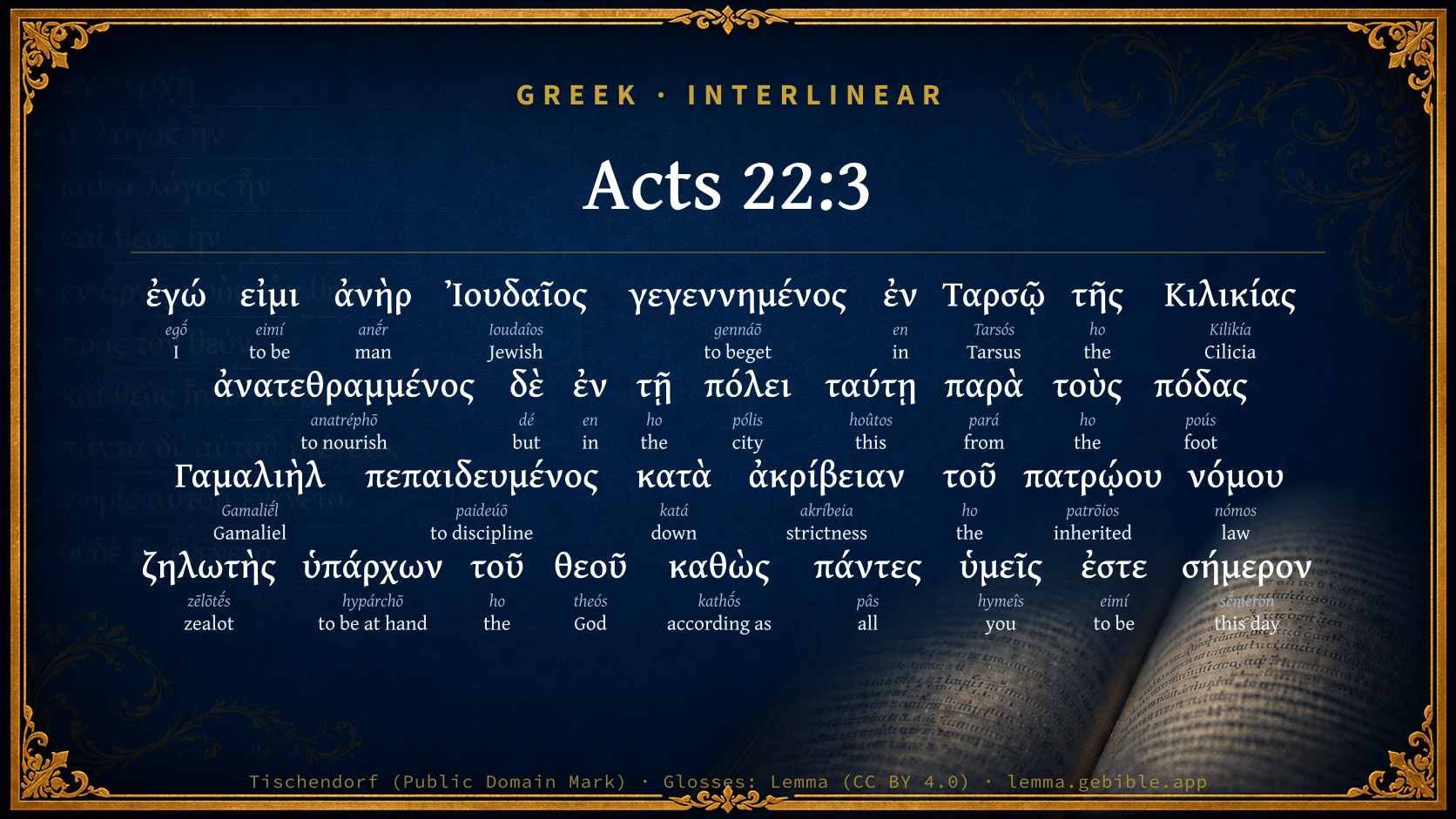
"I am indeed a Jew, born in Tarsus of Cilicia, but brought up in this city at the feet of Gamaliel, instructed according to the strict manner of the law of our fathers, being zealous for God, even as you all are this day.
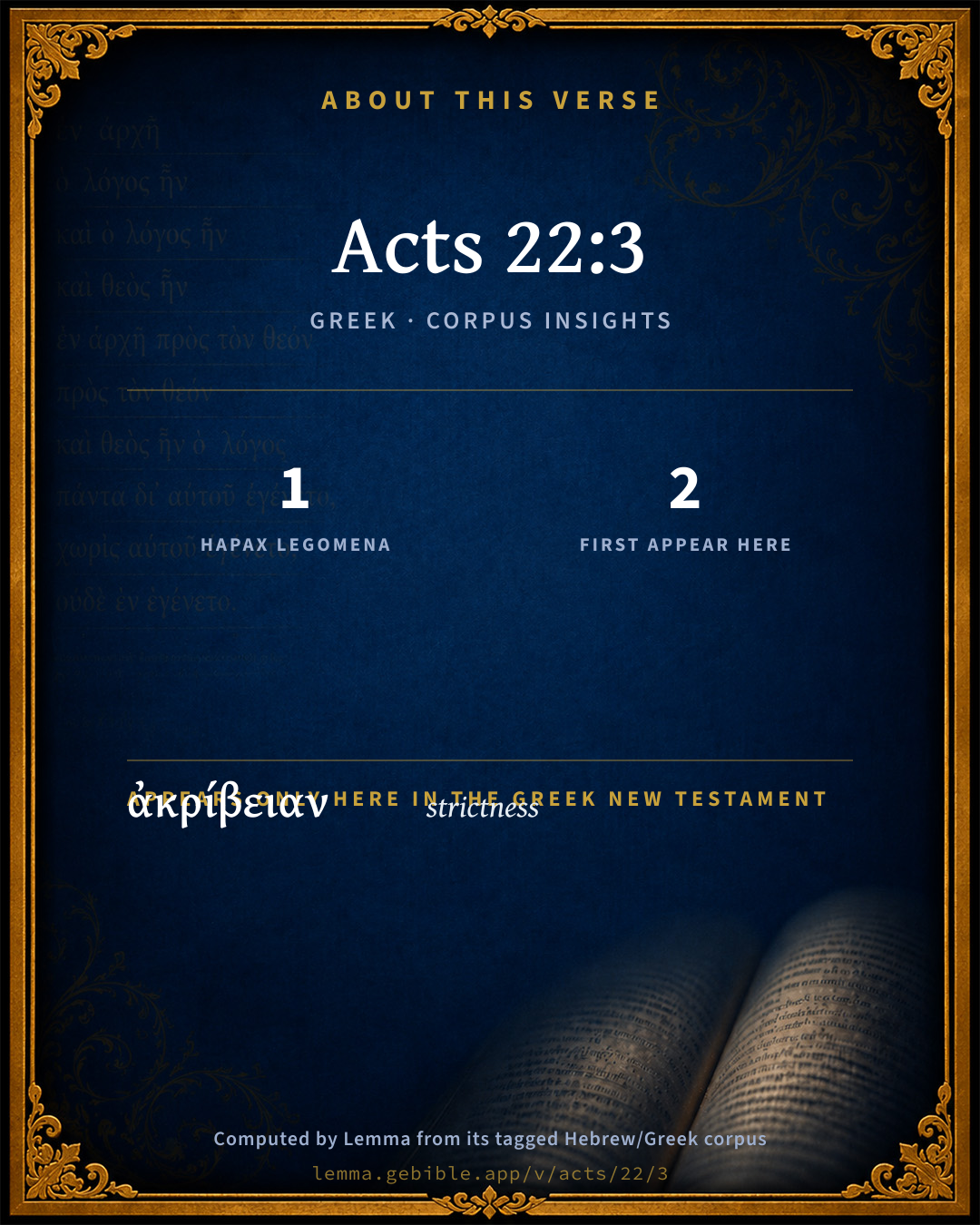
- 1 hapax legomenon — only here in the Greek New Testament
- 2 first appearances in the Greek New Testament
Download a study sheet
One document with this verse’s original text, its word-by-word gloss line, the meaning frame, cross-references with their text, attributed commentary, and full source and license credits — printable, and it pastes into notes with its structure intact.
This verse Autodidact and up
A passage Seminary Student
Up to 50 verses in one chapter. A passage sheet keeps up to 6 commentary sources and 12 cross-references per verse, in the order this page ranks them, and says so on the sheet whenever that leaves anything out. Ask for a single verse and you get the Autodidact verse sheet above.
Everything on this page stays free to read, with no account — the sheet is a download of what is already on screen, not access to it.
Compare translations 3
The same verse in 3 English versions, stacked beneath the original-language interlinear above. Click any original word for its lexicon entry.
Each is an independent rendering of the whole verse — the interlinear is not word-aligned to these translations.
Highlighted words mark where these versions differ — a whole-verse word diff, not a word-by-word alignment.
-
World English Bible Public Domain
"I am indeed a Jew, born in Tarsus of Cilicia, but brought up in this city at the feet of Gamaliel, instructed according to the strict manner of the law of our fathers, being zealous for God, even as you all are this day.
-
King James Version Public Domain
I am verily a man which am a Jew, born in Tarsus, a city in Cilicia, yet brought up in this city at the feet of Gamaliel, and taught according to the perfect manner of the law of the fathers, and was zealous toward God, as ye all are this day.
-
unfoldingWord Literal Text CC BY-SA 4.0
“I am a Jewish man, born in Tarsus of Cilicia but educated in this city at the feet of Gamaliel, instructed according to the strictness of the law of our fathers, being zealous for God, as you all are today,
unfoldingWord Literal Text — © unfoldingWord, licensed CC BY-SA 4.0. Word-aligned USFM3 via Door43 (git.door43.org/unfoldingWord/en_ult).
Show all 19 translations
Every available English version of this verse, each an independent rendering of the whole verse.
-
World English Bible Public Domain
"I am indeed a Jew, born in Tarsus of Cilicia, but brought up in this city at the feet of Gamaliel, instructed according to the strict manner of the law of our fathers, being zealous for God, even as you all are this day.
-
Berean Standard Bible Public Domain
“I am a Jew, born in Tarsus of Cilicia, but raised in this city. I was educated at the feet of Gamaliel in strict conformity to the law of our fathers. I am just as zealous for God as any of you here today.
-
Majority Standard Bible Public Domain
“I am indeed a Jew, born in Tarsus of Cilicia, but raised in this city. I was educated at the feet of Gamaliel in strict conformity to the law of our fathers. I was just as zealous for God as any of you are today.
-
King James Version Public Domain
I am verily a man which am a Jew, born in Tarsus, a city in Cilicia, yet brought up in this city at the feet of Gamaliel, and taught according to the perfect manner of the law of the fathers, and was zealous toward God, as ye all are this day.
-
American Standard Version (1901) Public Domain
I am a Jew, born in Tarsus of Cilicia, but brought up in this city, at the feet of Gamaliel, instructed according to the strict manner of the law of our fathers, being zealous for God, even as ye all are this day:
-
Revised Version (1885) Public Domain
I am a Jew, born in Tarsus of Cilicia, but brought up in this city, at the feet of Gamaliel, instructed according to the strict manner of the law of our fathers, being zealous for God, even as ye all are this day:
-
Geneva Bible (1599) Public Domain
I am verely a man, which am a Iew, borne in Tarsus in Cilicia, but brought vp in this citie at the feete of Gamaliel, and instructed according to the perfect maner of the Lawe of the Fathers, and was zealous toward God, as ye all are this day.
-
Douay-Rheims (1899) Public Domain
And he saith: I am a Jew, born at Tarsus in Cilicia, but brought up in this city, at the feet of Gamaliel, taught according to the truth of the law of the fathers, zealous for the law, as also all you are this day:
-
Young's Literal Translation Public Domain
`I, indeed, am a man, a Jew, having been born in Tarsus of Cilicia, and brought up in this city at the feet of Gamaliel, having been taught according to the exactitude of a law of the fathers, being zealous of God, as all ye are to-day.
-
Literal Standard Version CC BY-SA 4.0
“I, indeed, am a man, a Jew, having been born in Tarsus of Cilicia, and brought up in this city at the feet of Gamaliel, having been taught according to the exactness of a law of the fathers, being zealous of God, as all you are today.
-
Unlocked Literal Bible CC BY-SA 4.0
“I am a Jew, born in Tarsus of Cilicia, but educated in this city at the feet of Gamaliel. I was instructed according to the strict ways of the law of our fathers. I am zealous for God, just as all of you are today.
-
unfoldingWord Literal Text CC BY-SA 4.0
“I am a Jewish man, born in Tarsus of Cilicia but educated in this city at the feet of Gamaliel, instructed according to the strictness of the law of our fathers, being zealous for God, as you all are today,
-
Darby Bible Public Domain
*I* am a Jew, born in Tarsus of Cilicia, but brought up in this city, at the feet of Gamaliel, educated according to [the] exactness of the law of [our] fathers, being zealous for God, as *ye* are all this day;
-
World Messianic Bible Public Domain
“I am indeed a Jew, born in Tarsus of Cilicia, but brought up in this city at the feet of Gamaliel, instructed according to the strict tradition of the law of our fathers, being zealous for God, even as you all are today.
-
Webster's Bible Public Domain
I am verily a man who am a Jew, born in Tarsus, a city in Cilicia, yet brought up in this city at the feet of Gamaliel, and taught according to the perfect manner of the law of the fathers, being zealous towards God, as ye all are this day.
-
Free Bible Version CC BY-SA 4.0
“I am a Jew, born in Tarsus in Cilicia,” he began. “However, I was brought up here in this city, and sat at the feet of Gamaliel. I was taught to strictly observe the law of our fathers. I was zealous for God, just like all of you here today,
-
Bible in Basic English Public Domain
I am a Jew of Tarsus in Cilicia by birth, but I had my education in this town at the feet of Gamaliel, being trained in the keeping of every detail of the law of our fathers; given up to the cause of God with all my heart, as you are today.
-
Text-Critical English NT CC BY 4.0
“I am a Jewish man, born in Tarsus of Cilicia, but brought up in this city at the feet of Gamaliel and instructed according to the strict manner of the law of our fathers, being zealous for God, just as all of you are today.
-
Tyndale New Testament (1534) Public Domain
I am verely aman which am a Iewe borne in Tharsus a cite in Cicill: neverthelesse yet brought vp in this cite at the fete of Gamaliel and informed diligently in the lawe of the fathers and was fervent mynded to Godwarde as ye all are this same daye
Literal Standard Version (2020), Covenant Press — licensed CC BY-SA 4.0. Text via the HelloAO Bible API (eBible.org). Unlocked Literal Bible (unfoldingWord) — licensed CC BY-SA 4.0. Text via the HelloAO Bible API (eBible.org). unfoldingWord Literal Text — © unfoldingWord, licensed CC BY-SA 4.0. Word-aligned USFM3 via Door43 (git.door43.org/unfoldingWord/en_ult). Free Bible Version, Dr. Jonathan Gallagher — licensed CC BY-SA 4.0. Text via the HelloAO Bible API (eBible.org).
Word by word
More ways to search: Search by grammar → Find every occurrence → Compare this word →
Practice this passage: Drill this verse → Learn its vocabulary →
- Appears 1× in the Greek New Testament
- First appears here
- Part of Speech
- Noun
- Case
- Accusative
- Number
- Singular
- Gender
- Feminine
Full Thayer's Definition
- ἐγώ egṓ G1473 “I” Personal pronoun, 1st person, Nominative, Singular
- εἰμι eimí G1510 “to be” Verb, Present, Active, Indicative, 1st person, Singular
- ἀνὴρ anḗr G435 “man” Noun, Nominative, Singular, Masculine
- Ἰουδαῖος Ioudaîos G2453 “Jewish” Adjective, Nominative, Singular, Masculine
- γεγεννημένος gennáō G1080 “to beget” Verb, Perfect, Passive, Participle, Nominative, Singular, Masculine
- ἐν en G1722 “in” Preposition
- Ταρσῷ Tarsós G5019 “Tarsus” Noun, Dative, Singular, Feminine
- τῆς ho G3588 “the” Article, Genitive, Singular, Feminine
- Κιλικίας Kilikía G2791 “Cilicia” Noun, Genitive, Singular, Feminine
- ἀνατεθραμμένος anatréphō G397 “to nourish” Verb, Perfect, Passive, Participle, Nominative, Singular, Masculine
- δὲ dé G1161 “but” Conjunction
- ἐν en G1722 “in” Preposition
- τῇ ho G3588 “the” Article, Dative, Singular, Feminine
- πόλει pólis G4172 “city” Noun, Dative, Singular, Feminine
- ταύτῃ hoûtos G3778 “this” Demonstrative pronoun, Dative, Singular, Feminine
- παρὰ pará G3844 “from” Preposition
- τοὺς ho G3588 “the” Article, Accusative, Plural, Masculine
- πόδας poús G4228 “foot” Noun, Accusative, Plural, Masculine
- Γαμαλιὴλ Gamaliḗl G1059 “Gamaliel” Noun, Proper, indeclinable
- πεπαιδευμένος paideúō G3811 “to discipline” Verb, Perfect, Passive, Participle, Nominative, Singular, Masculine
- κατὰ katá G2596 “down” Preposition
- ἀκρίβειαν akríbeia G195 “strictness” Noun, Accusative, Singular, Feminine
- τοῦ ho G3588 “the” Article, Genitive, Singular, Masculine
- πατρῴου patrōios G3971 “inherited” Adjective, Genitive, Singular, Masculine
- νόμου nómos G3551 “law” Noun, Genitive, Singular, Masculine
- ζηλωτὴς zēlōtḗs G2207 “zealot” Noun, Nominative, Singular, Masculine
- ὑπάρχων hypárchō G5225 “to be at hand” Verb, Present, Active, Participle, Nominative, Singular, Masculine
- τοῦ ho G3588 “the” Article, Genitive, Singular, Masculine
- θεοῦ theós G2316 “God” Noun, Genitive, Singular, Masculine
- καθὼς kathṓs G2531 “according as” Adverb
- πάντες pâs G3956 “all” Adjective, Nominative, Plural, Masculine
- ὑμεῖς hymeîs G5210 “you” Personal pronoun, 2nd person, Nominative, Plural
- ἐστε eimí G1510 “to be” Verb, Present, Active, Indicative, 2nd person, Plural
- σήμερον sḗmeron G4594 “this day” Adverb
About this verse
These counts appear in no published source. They are computed here, from the morphology-tagged text and Lemma’s own curated glosses. What Lemma adds →
- 34
- words
- 28
- distinct lemmas
- Acts
- section
Notable vocabulary
1 hapax legomenon — a word that appears only here in the entire Greek New Testament:
- ἀκρίβειαν strictness G195
First appearance in Scripture
These words make their first canonical appearance in the Greek New Testament here:
Shared distinctive vocabulary
Γαμαλιὴλ Gamaliel G1059 occurs in 2 verses of the Greek New Testament. Also found in:
Cross-references
25Topical passages linked to Acts 22:3 in the Treasury of Scripture Knowledge — connected by theme and wording, ordered by reader-vote popularity; previews shown in the World English Bible.
- Philippians 3:5–6 circumcised the eighth day, of the stock of Israel, of the tribe of Benjamin, a Hebrew of Hebrews; concerning the law, a Pharisee;
- Acts 26:5 having known me from the first, if they are willing to testify, that after the strictest sect of our religion I lived a Pharisee.
- Acts 5:34 But one stood up in the council, a Pharisee named Gamaliel, a teacher of the law, honored by all the people, and commanded to put the apostles out for a little while.
- Acts 9:11 The Lord said to him, "Arise, and go to the street which is called Straight, and inquire in the house of Judas for one named Saul, a man of Tarsus. For behold, he is praying,
- Acts 21:20 They, when they heard it, glorified God. They said to him, "You see, brother, how many thousands there are among the Jews of those who have believed, and they are all zealous for the law.
- Acts 21:39 But Paul said, "I am a Jew, from Tarsus in Cilicia, a citizen of no insignificant city. I beg you, allow me to speak to the people."
- Luke 10:39 She had a sister called Mary, who also sat at Jesus' feet, and heard his word.
- 2 Corinthians 11:22 Are they Hebrews? So am I. Are they Israelites? So am I. Are they the seed of Abraham? So am I.
- Deuteronomy 33:3 Yes, he loves the people; All his saints are in your hand: They sat down at your feet; [Everyone] shall receive of your words.
- 2 Kings 4:38 Elisha came again to Gilgal. There was a dearth in the land; and the sons of the prophets were sitting before him; and he said to his servant, Set on the great pot, and boil stew for the sons of the prophets.
- 2 Samuel 21:2 The king called the Gibeonites, and said to them (now the Gibeonites were not of the children of Israel, but of the remnant of the Amorites; and the children of Israel had sworn to them: and Saul sought to kill them in his zeal for the children of Israel and Judah);
- Acts 6:9 But some of those who were of the synagogue called "The Libertines," and of the Cyrenians, of the Alexandrians, and of those of Cilicia and Asia arose, disputing with Stephen.
- Acts 15:23 They wrote these things by their hand: "The apostles, the elders, and the brothers, to the brothers who are of the Gentiles in Antioch, Syria, and Cilicia: greetings.
- Acts 23:6 But when Paul perceived that the one part were Sadducees and the other Pharisees, he cried out in the council, "Men and brothers, I am a Pharisee, a son of Pharisees. Concerning the hope and resurrection of the dead I am being judged!"
- Romans 11:1 I ask then, Did God reject his people? May it never be! For I also am an Israelite, a descendant of Abraham, of the tribe of Benjamin.
- Luke 2:46 It happened after three days they found him in the temple, sitting in the midst of the teachers, both listening to them, and asking them questions.
- Luke 8:35 People went out to see what had happened. They came to Jesus, and found the man from whom the demons had gone out, sitting at Jesus' feet, clothed and in his right mind; and they were afraid.
- Acts 9:30 When the brothers knew it, they brought him down to Caesarea, and sent him off to Tarsus.
- Acts 11:25 Barnabas went out to Tarsus to look for Saul.
- Acts 15:41 He went through Syria and Cilicia, strengthening the assemblies.
- Acts 23:34 When the governor had read it, he asked what province he was from. When he understood that he was from Cilicia, he said,
- Romans 10:2–3 For I testify about them that they have a zeal for God, but not according to knowledge.
- Galatians 1:14 I advanced in the Jews' religion beyond many of my own age among my countrymen, being more exceedingly zealous for the traditions of my fathers.
- Galatians 1:21 Then I came to the regions of Syria and Cilicia.
- Galatians 4:17–18 They zealously seek you in no good way. No, they desire to alienate you, that you may seek them.
Cross-references courtesy of OpenBible.info (CC BY 4.0).
Lesson kit
Teaching starters — assembled from the data on this page, not authored interpretation. Every prompt links to the verse data it draws on. Edit before teaching.
Acts, in the Acts, opens this verse with 34 words (28 distinct Greek lemmas). Its most distinctive word is akríbeia (“strictness”). A historical commentator’s framing appears above. Read the whole chapter for the surrounding context.
Discussion questions
- What does “strictness” (akríbeia) contribute to the verse as a whole?
- This verse holds 1 word here found nowhere else in the Greek New Testament. What might the rare word draw attention to?
- 2 words here appear for the first time in Scripture. What is being introduced at this debut?
- Acts 5:34 shares the word «Gamaliel» with this verse. How do the two illuminate each other?
- “to be” occurs 2× in this one verse. What is the effect of the repetition?
- The translations on this page render this verse differently — a whole-verse word diff, not a word-by-word alignment. What might account for the different wordings?
- Reading how Joseph Benson's Commentary and Tyndale Open Study Notes read this verse, where do the two commentators agree and where do they part?
Things to notice
- 1 word in this verse appears nowhere else in the Greek New Testament.
- 2 words make their first canonical appearance in Scripture here.
- These translations choose different wording for 21 words in this verse.
- “to be” occurs 2× in this single verse.
- 28 distinct Greek lemmas span 34 words in this verse.
Commentary
Notes on Acts 22:3 from classic Christian and Jewish commentators (each source and its license shown beneath its notes). The classic Christian expositions comment on the surrounding passage and are grouped to its opening verse, so a note may address several verses; the Jewish commentaries on the Tanakh (Rashi and others) are per-verse, so they appear only where the commentator wrote on this verse.
Lemma curates 59 commentaries, every one of them public domain or Creative Commons licensed, each selected and text-cleaned for this edition rather than reprinted as found. About our sources →
Joseph Benson's Commentary
Joseph Benson's Commentary on the Old and New Testaments (1811–1818) — public domain. Text from a community e-Sword module.
Tyndale Open Study Notes
Tyndale Open Resources
Tyndale Open Study Notes — © Tyndale Open Resources, licensed CC BY-SA 4.0. Text via the HelloAO Bible API.
Bengel's Gnomon
Johann Albrecht Bengel
Bengel's Gnomon of the New Testament — English translation (T&T Clark, Edinburgh, 1860) — public domain. Text from a community e-Sword module.
Expositor's Greek Testament
ed. W. Robertson Nicoll
The Expositor's Greek Testament, edited by W. Robertson Nicoll (1897–1910) — public domain. Text from a community e-Sword module.
Geneva Bible (1599)
Geneva Bible translators
Geneva Bible (1599) marginal notes — public domain. Text via Bolls.life.
Matthew Henry's Commentary
Matthew Henry's Commentary on the Whole Bible (1708–1710) — public domain (CC PDM 1.0). Text via the HelloAO Bible API.
Jamieson, Fausset & Brown
Robert Jamieson, A. R. Fausset & David Brown
Jamieson, Fausset & Brown — Commentary Critical and Explanatory on the Whole Bible (1871) — public domain (CC PDM 1.0). Text via the HelloAO Bible API.
Adam Clarke's Commentary
Adam Clarke's Commentary on the Bible (1810–1826) — public domain. Text from a community e-Sword/MySword module.
John Calvin's Commentaries
John Calvin's Commentaries (1540-1563) — public domain. Text from the Calvin Translation Society English edition (1840s-50s) via the Christian Classics Ethereal Library (ccel.org). Calvin's coverage is partial (roughly two-thirds of the Bible); uncommented books and verses are honest gaps, never fabricated. The 19th-century editor's footnotes and remarks are omitted so the notes are faithfully Calvin's own voice.
Ellicott's Commentary for English Readers
A Bible Commentary for English Readers, edited by Charles John Ellicott (1878–1897) — public domain. Text from a community e-Sword module.
The Cambridge Bible for Schools and Colleges
gen. ed. J. J. S. Perowne
The Cambridge Bible for Schools and Colleges (gen. ed. J. J. S. Perowne; Cambridge University Press, 1878–1918) — public domain. Text from a community e-Sword module.
John Gill's Exposition
John Gill's Exposition of the Whole Bible (1746–1763) — public domain (CC PDM 1.0). Text via the HelloAO Bible API.
Trapp's Complete Commentary
John Trapp
John Trapp, A Commentary or Exposition upon All the Books of the Old and New Testament (1647–1656) — public domain. Text from a community e-Sword module.
Albert Barnes' Notes on the Bible
Albert Barnes' Notes on the Bible (1834–1885) — public domain. Text from a community e-Sword/MySword module.
Haydock's Catholic Bible Commentary
George Leo Haydock (1774–1849), Haydock's Catholic Family Bible and Commentary, 1859 edition — public domain. Excludes Psalms (Douay-Rheims chapter numbering differs from Protestant) and Deuterocanonical books (Catholic canon only).
Matthew Poole's English Annotations
Matthew Poole's English Annotations on the Holy Bible (1683–1685) — public domain. Text from a community e-Sword/MySword module.
Whedon's Commentary on the Bible
Daniel D. Whedon
Daniel D. Whedon (gen. ed.), Commentary on the Old and New Testaments (1874–1909) — public domain. Text from a community e-Sword module.
The Pulpit Commentary
The Pulpit Commentary (1880–1919), ed. H.D.M. Spence-Jones & Joseph S. Exell — public domain. Text from a community e-Sword module.
John Wesley's Explanatory Notes
John Wesley, Explanatory Notes Upon the Whole Bible (1754–1765) — public domain. Text via the GEBible commentary corpus.
McGarvey & Pendleton's Commentaries
J. W. McGarvey
J. W. McGarvey (with Philip Y. Pendleton), Commentaries on the New Testament (The Fourfold Gospel, 1914; Acts; and the epistles) — public domain. Text from a community e-Sword/MySword module.
unfoldingWord translationNotes
Door43 World Missions Community
unfoldingWord translationNotes — © Distant Shores Media and the Door43 World Missions Community, licensed CC BY-SA 4.0. Source: git.door43.org/Door43/en_tn.
Cambridge Greek Testament for Schools and Colleges
Cambridge Greek Testament for Schools and Colleges (Cambridge University Press, 1896; 21 vols, various authors incl. Carr, Maclear, Plummer, Farrar, Lumby, Moule, M. R. James, Simcox) — public domain. Text from a community e-Sword module.
Alford’s Greek Testament
Henry Alford
Henry Alford, The Greek Testament (1849–1861) — public domain. Text from a community e-Sword module.
Vincent's Word Studies in the New Testament
Marvin R. Vincent
Marvin R. Vincent, Word Studies in the New Testament (1887–1900) — public domain. Text from a community e-Sword/MySword module.