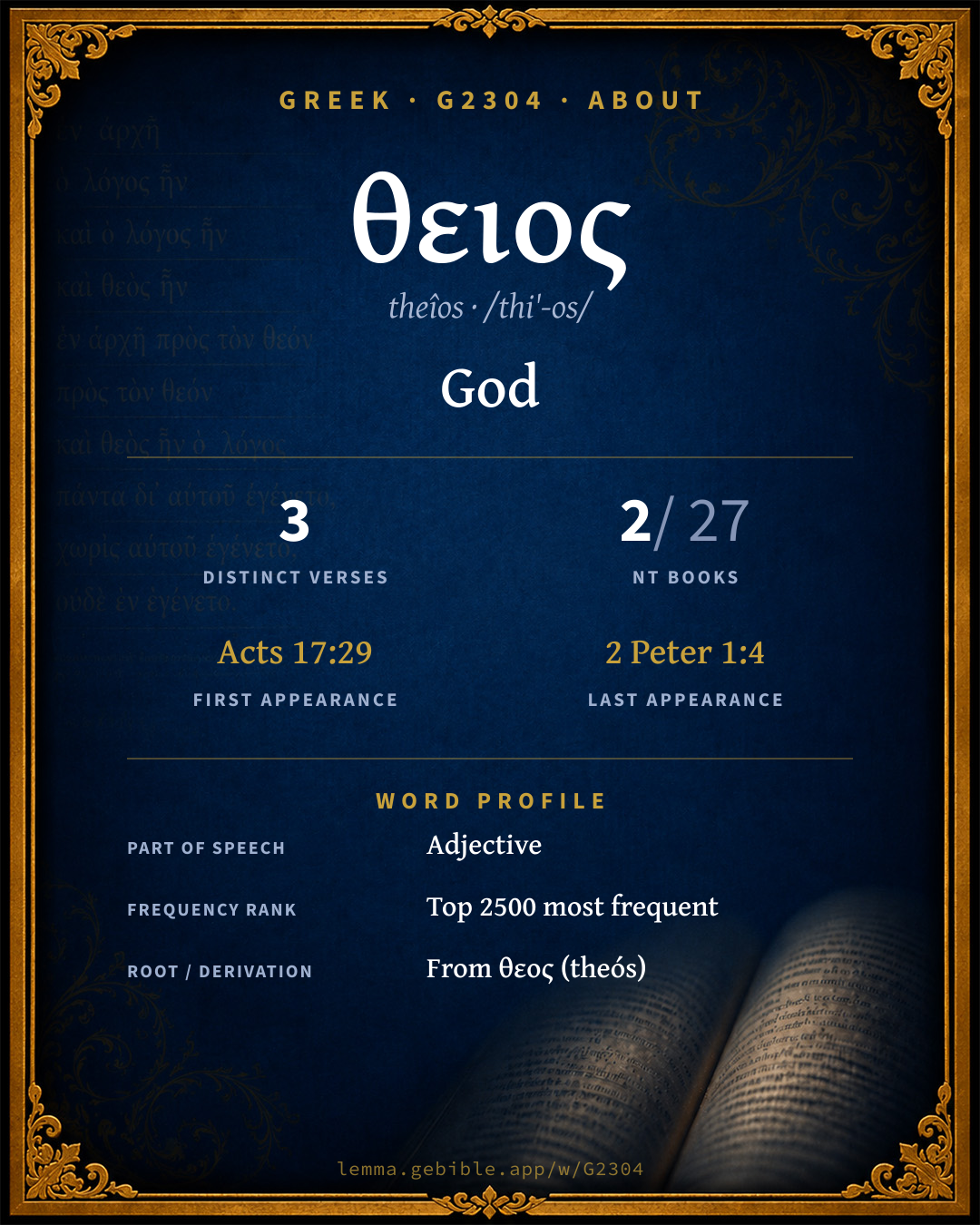
θεῖος
God
‘God’ is one of 2 main senses fuller range ↓
Full lexicon entry — Thayer's Greek Lexicon
From Thayer's Greek Lexicon
Where this word appears
See every Genitive-case word in the Greek New Testament →
Grammar key — what these labels mean
Part of speech
- Adjective
- A word that describes or qualifies a noun.
Case
- Genitive
- The case of source, possession, or “of” — answers “whose / from what.”
- Accusative
- The case of the direct object and of extent.
Gender
- Feminine
- Grammatically feminine.
- Neuter
- Grammatically neuter.
Number
- Singular
- One.
Grammatical forms
- Adjective, Genitive, Singular, Feminine 2 times (67%)
- Adjective, Accusative, Singular, Neuter 1 time (33%)
Parsed forms decoded from the imported morphology (Robinson–Tischendorf, public domain), counted across 3 parsed occurrences — not distinct verses.
Every verse where G2304 appears — 3 distinct verses across 2 books. Click any verse to open its interlinear word-by-word view. Verse text shown in the World English Bible for context — . Each verse’s Greek form is shown with its reference; the English is not keyword-highlighted, since the data carries no word-level English alignment. Use “Compare translations” on any verse to read it across multiple English versions. This concordance covers the Greek New Testament; Septuagint (Greek Old Testament) occurrences of this word are not indexed here.
Acts 1 verse
2 Peter 2 verses
- 2 Peter 1:3 θείας adj gen sg fem seeing that his divine power has granted to us all things that pertain to life and godliness, through the knowledge of him who called us by his own glory and virtue;
- 2 Peter 1:4 θείας adj gen sg fem by which he has granted to us his precious and exceedingly great promises; that through these you may become partakers of the divine nature, having escaped from the corruption that is in the world by lust.
About this entry
At a glance — auto-summarized from this page’s data, not written by a person. Every figure links to its source below. This summary describes the numbers; it doesn’t interpret them.
θειος — transliterated theîos — is a Greek name carrying the sense “God.” A scarce word — 3 verses in all of the Greek New Testament. More than two-thirds of its appearances fall in 2 Peter. Debuting at Acts 17:29, it then recurs through the corpus. See 3-verse concordance and the renderings breakdown below.
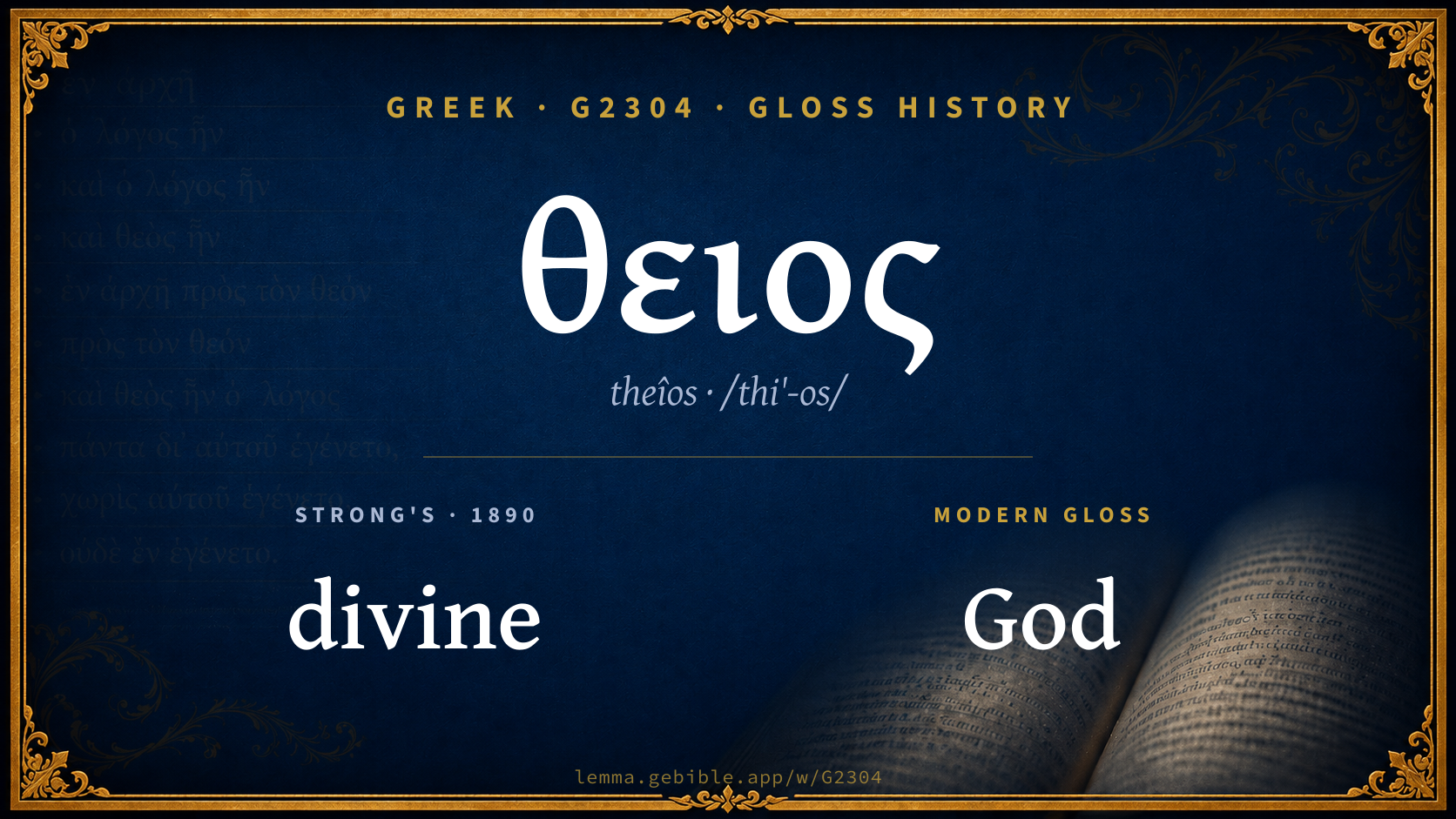
Gloss history
Strong's 1890 vs modern scholarship
About this word
Strong's G2304 catalogs a Greek word from the Greek New Testament.
These counts are not copied from any lexicon or concordance. They are computed here, from the morphology-tagged Greek New Testament. What Lemma adds →
- 3
- distinct verses
- The word appears in 3 distinct verses.
- 2 / 27
- NT books
- The word appears in 2 of 27 New Testament books.
- #2,203
- by frequency
- Top 2500 most frequent Greek words (rank 2,203 of 5,347 Greek words by occurrence).
View all 3 occurrences in the concordance →
By traditional corpus
Conventional, traditional groupings — biblical authorship is debated, so this is a traditional corpus grouping, not an authorship claim. Some books belong to more than one corpus (Luke is in both the Gospels and the Lukan corpus, and so on), so these shares overlap and need not total 100%. Each figure is a share of the word’s 3 distinct verses.
- General (Catholic) Epistles 2 verses · 67%
- Lukan (Luke–Acts) 1 verse · 33%
How translations render this word
Counts come from each version’s own published word-to-Strong’s tagging or interlinear alignment — an approximate guide to how each version renders this word, not a word-level alignment the data otherwise carries. Because each total is that version’s own tagged count, the per-version totals vary from one another and need not match the appearance or distinct-verse counts above. These counts may also differ from a printed concordance because Lemma counts each distinctly tagged rendering and does not collapse phrase taggings into a single head-word total. This is a fixed set of word-tagged versions (KJV, ASV, BSB, ULT) and does not change with the reading translation you choose elsewhere. Each version’s license is shown beside its name below (and on Sources).
- King James Version: Divine 2×
- American Standard Version: Divine 2×
- Berean Standard Bible: Divine 2×
- unfoldingWord Literal Text: Divine 3×
King James Version Public Domain
Renders G2304 across 3 tagged occurrences — most commonly:
Plus 1 rendering that appears only once — usually multi-word phrases or single function words the recovered tagging swept in, not distinct renderings.
American Standard Version Public Domain
Renders G2304 across 3 tagged occurrences — most commonly:
Plus 1 rendering that appears only once — usually multi-word phrases or single function words the recovered tagging swept in, not distinct renderings.
Berean Standard Bible Public Domain
Renders G2304 across 3 tagged occurrences — most commonly:
Plus 1 rendering that appears only once — usually multi-word phrases or single function words the recovered tagging swept in, not distinct renderings.
unfoldingWord Literal Text CC BY-SA 4.0
Renders G2304 across 3 tagged occurrences — most commonly:
Senses in Thayer's
The 2 senses Thayer's distinguishes for this word, in lexicon order (not ranked by frequency or importance). The full entry — with sub-senses — is in the Lexicon Entry tab.
- a general name of deities or divinities as used by the Greeks
- spoken of the only and true God, trinity
Word origin
Derived from θεος (theós) (G2316) — God.
From G2316 ; Godlike (neuter as noun divinity ): - divine godhead.
— Strong’s Exhaustive Concordance (1890), public domain.
Forms in the corpus
The 2 distinct written forms G2304 takes in the Greek New Testament, most frequent first — each parse links to that case’s occurrences in the concordance.
| Form | Parsing | Example | Uses |
|---|---|---|---|
| θείας theías | Adjective, Genitive, Singular, Feminine | 2 Peter 1:3 | 2 |
| θεῖον theîon | Adjective, Accusative, Singular, Neuter | Acts 17:29 | 1 |
Same root — word family
Other Thayer's entries built from the same root as G2304, grouped by Strong’s listed origin. These share a root / origin per the lexicon — not necessarily a shared meaning. Each links to that word’s own entry.
Derives from
Shares the same root
- θεα theá G2299 goddess
- θεοδιδακτος theodídaktos G2312 taught of God
- θεομαχος theomáchos G2314 resisting God
- θεοπνευστος theópneustos G2315 inspired by God
- θεοσεβης theosebḗs G2318 pious
- θεοστυγης theostygḗs G2319 hateful to God
- θεοτης theótēs G2320 deity
Derived from this word
Proper names from this root
People and places named from this root — a name, not an additional meaning of the word.
Compare all same-root words → Showing 4 of 12 — not the complete family. 2 of the same-root words are proper names (people or places). They share a root, not necessarily a meaning.
Bible dictionary
Public-domain dictionary articles matched to this entry by name (God). A biblical name can be shared by more than one person or place, so an article may treat several.
Easton's Bible Dictionary · M. G. Easton, 1897
(A.S. and Dutch God; Dan. Gud; Ger. Gott), the name of the Divine Being. It is the rendering (1) of the Hebrew 'El, from a word meaning to be strong; (2) of 'Eloah_, plural _'Elohim. The singular form, Eloah, is used only in poetry. The plural form is more commonly used in all parts of the Bible, The Hebrew word Jehovah (q.v.), the only other word generally employed to denote the Supreme Being, is uniformly rendered in the Authorized Version by "LORD," printed in small capitals. The existence of God is taken for granted in the Bible. There is nowhere any argument to prove it. He who disbelieves this truth is spoken of as one devoid of understanding (Ps. 14:1).
The arguments generally adduced by theologians in proof of the being of God are:
(1.) The a priori argument, which is the testimony afforded by reason.
(2.) The a posteriori argument, by which we proceed logically from the facts of experience to causes. These arguments are,
(a) The cosmological, by which it is proved that there must be a First Cause of all things, for every effect must have a cause.
(b) The teleological, or the argument from design. We see everywhere the operations of an intelligent Cause in nature.
(c) The moral argument, called also the anthropological argument, based on the moral consciousness and the history of mankind, which exhibits a moral order and purpose which can only be explained on the supposition of the existence of God. Conscience and human history testify that "verily there is a God that judgeth in the earth."
The attributes of God are set forth in order by Moses in Ex. 34:6, 7. (see also Deut. 6:4; 10:17; Num. 16:22; Ex. 15:11; 33:19; Isa. 44:6; Hab. 3:6; Ps. 102:26; Job 34:12.) They are also systematically classified in Rev. 5:12 and 7:12.
God's attributes are spoken of by some as absolute, i.e., such as belong to his essence as Jehovah, Jah, etc.; and relative, i.e., such as are ascribed to him with relation to his creatures. Others distinguish them into communicable, i.e., those which can be imparted in degree to his creatures: goodness, holiness, wisdom, etc.; and incommunicable, which cannot be so imparted: independence, immutability, immensity, and eternity. They are by some also divided into natural attributes, eternity, immensity, etc.; and moral, holiness, goodness, etc.
Smith's Bible Dictionary · William Smith, 1863
(good). Throughout the Hebrew Scriptures two chief names are used for the one true divine Being--ELOHIM, commonly translated God in our version, and Jehovah, translated Lord . Elohim is the plural of Eloah (in Arabic Allah); it is often used in the short form EL (a word signifying strength, as in EL-SHADDAI, God Almighty, the name by which God was specially known to the patriarchs. (Genesis 17:1; 28:3; Exodus 6:3) The etymology is uncertain, but it is generally agreed that the primary idea is that of strength, power of effect, and that it properly describes God in that character in which he is exhibited to all men in his works, as the creator, sustainer and supreme governor of the world. The plural form of Elohim has given rise to much discussion. The fanciful idea that it referred to the trinity of persons in the Godhead hardly finds now a supporter among scholars. It is either what grammarians call the plural of majesty, or it denotes the fullness of divine strength, the sum of the powers displayed by God. Jehovah denotes specifically the one true God, whose people the Jews were, and who made them the guardians of his truth. The name is never applied to a false god, nor to any other being except one, the ANGEL-JEHOVAH who is thereby marked as one with God, and who appears again in the New Covenant as "God manifested in the flesh." Thus much is clear; but all else is beset with difficulties. At a time too early to be traced, the Jews abstained from pronouncing the name, for fear of its irreverent use. The custom is said to have been founded on a strained interpretation of (Leviticus 24:16) and the phrase there used, "THE NAME" (Shema), is substituted by the rabbis for the unutterable word. In reading the Scriptures they substituted for it the word ADONAI (Lord), from the translation of which by Kurios in the LXX., followed by the Vulgate, which uses Dominus, we have the Lord of our version. The substitution of the word Lord is most unhappy, for it in no way represents the meaning of the sacred name. The key to the meaning of the name is unquestionably given in God's revelation of himself to Moses by the phrase "I AM THAT I AM," (Exodus 3:14; 6:3) We must connect the name Jehovah with the Hebrew substantive verb to be, with the inference that it expresses the essential, eternal, unchangeable being of Jehovah. But more, it is not the expression only, or chiefly, of an absolute truth: it is a practical revelation of God, in his essential, unchangeable relation to this chosen people, the basis of his covenant.
Classic public-domain reference works; full attribution on Sources.
Septuagint usage
The same Greek word θειος appears 11 times in the Greek Old Testament (Septuagint), across 11 verses in 8 books.
- 11
- LXX occurrences
- Tagged occurrences of this Greek word in the Septuagint.
- 11
- verses
- Distinct Septuagint verses containing this word.
- 8 / 39
- OT books
- The word appears in 8 of the 39 Old Testament books.
Sample Septuagint occurrences
- Genesis 19:24 θεῖος
- Exodus 31:3 θεῖος
- Deuteronomy 29:22 θεῖος
- Job 27:3 θεῖος
- Psalms 10:6 θεῖος
- Proverbs 2:17 θεῖος
- Isaiah 30:33 θεῖος
- Ezekiel 38:22 θεῖος
Septuagint occurrences (same lexeme)
Every verse where the same Strong’s number (G2304) appears in the Greek Septuagint. Verse text shown in the World English Bible for context; the Greek form is the matched word — the English is not keyword-highlighted.
- Genesis 19:24 θεῖος Then Yahweh rained on Sodom and on Gomorrah sulfur and fire from Yahweh out of the sky.
- Exodus 31:3 θεῖος and I have filled him with the Spirit of God, in wisdom, and in understanding, and in knowledge, and in all manner of workmanship,
- Exodus 35:31 θεῖος He has filled him with the Spirit of God, in wisdom, in understanding, in knowledge, and in all manner of workmanship;
- Deuteronomy 29:22 θεῖος The generation to come, your children who shall rise up after you, and the foreigner who shall come from a far land, shall say, when they see the plagues of that land, and the sicknesses with which Yahweh has made it sick;
- Job 27:3 θεῖος (For the length of my life is still in me, And the spirit of God is in my nostrils);
- Job 33:4 θεῖος The Spirit of God has made me, And the breath of the Almighty gives me life.
- Psalms 10:6 θεῖος He says in his heart, "I shall not be shaken; For generations I shall have no trouble."
- Proverbs 2:17 θεῖος Who forsakes the friend of her youth, And forgets the covenant of her God:
- Isaiah 30:33 θεῖος For a Topheth is prepared of old; yes, for the king it is made ready; he has made it deep and large; the pile of it is fire and much wood; the breath of Yahweh, like a stream of sulfur, does kindle it.
- Isaiah 34:9 θεῖος The streams of [Edom] shall be turned into pitch, and the dust of it into sulfur, and the land of it shall become burning pitch.
- Ezekiel 38:22 θεῖος With pestilence and with blood will I enter into judgment with him; and I will rain on him, and on his hordes, and on the many peoples who are with him, an overflowing shower, and great hailstones, fire, and sulfur.
These are occurrences of the same Greek lexeme (G2304) in the Septuagint — not a translation of any one Hebrew word. The store carries no word-level Hebrew↔Greek alignment, so no Hebrew original is asserted here. Counts come from the recovered LXX Strong's tagging — high-frequency vocabulary is well covered, while rare or late forms may be untagged — so they reflect tagged occurrences and may slightly undercount.