Romans 3:23

Greek (Tischendorf 8th ed.) Romans 3:23 appears in the Greek New Testament. The text above is from the Tischendorf 8th edition. Each word links to its Strong’s number and a concise gloss. Click any word for its full Thayer’s Greek Lexicon entry.
Download image
Cite this verse

Romans 3:23 (World English Bible). Public Domain. Lemma interlinear Bible study tool, https://lemma.gebible.app/v/romans/3/23.

Show BibTeX & RIS
BibTeX
RIS
English Translation
for all have sinned, and fall short of the glory of God;
World English Bible · Public Domain
Download a study sheet

One document with this verse’s original text, its word-by-word gloss line, the meaning frame, cross-references with their text, attributed commentary, and full source and license credits — printable, and it pastes into notes with its structure intact.

This verse Autodidact and up

Study sheet (.html) Plain text (.txt)

A passage Seminary Student

Up to 50 verses in one chapter. A passage sheet keeps up to 6 commentary sources and 12 cross-references per verse, in the order this page ranks them, and says so on the sheet whenever that leaves anything out. Ask for a single verse and you get the Autodidact verse sheet above.

Everything on this page stays free to read, with no account — the sheet is a download of what is already on screen, not access to it.

Want to remove ads? Support Godless Engineer
Compare translations 3

The same verse in 3 English versions, stacked beneath the original-language interlinear above. Click any original word for its lexicon entry.

Each is an independent rendering of the whole verse — the interlinear is not word-aligned to these translations.

Highlighted words mark where these versions differ — a whole-verse word diff, not a word-by-word alignment.

  • World English Bible Public Domain
    for all have sinned, and fall short of the glory of God;
  • King James Version Public Domain
    For all have sinned, and come short of the glory of God;
  • unfoldingWord Literal Text CC BY-SA 4.0
    For all sinned and fall short of the glory of God,

unfoldingWord Literal Text — © unfoldingWord, licensed CC BY-SA 4.0. Word-aligned USFM3 via Door43 (git.door43.org/unfoldingWord/en_ult).

Versions to compare (up to 4)

3 of 4 selected

Show all 19 translations

Every available English version of this verse, each an independent rendering of the whole verse.

  • World English Bible Public Domain
    for all have sinned, and fall short of the glory of God;
  • Berean Standard Bible Public Domain
    for all have sinned and fall short of the glory of God,
  • Majority Standard Bible Public Domain
    for all have sinned and fall short of the glory of God,
  • King James Version Public Domain
    For all have sinned, and come short of the glory of God;
  • American Standard Version (1901) Public Domain
    for all have sinned, and fall short of the glory of God;
  • Revised Version (1885) Public Domain
    for all have sinned, and fall short of the glory of God;
  • Geneva Bible (1599) Public Domain
    For there is no difference: for all haue sinned, and are depriued of the glorie of God,
  • Douay-Rheims (1899) Public Domain
    For all have sinned, and do need the glory of God.
  • Young's Literal Translation Public Domain
    for all did sin, and are come short of the glory of God --
  • Literal Standard Version CC BY-SA 4.0
    for all have sinned and fall short of the glory of God—
  • Unlocked Literal Bible CC BY-SA 4.0
    For all have sinned and come short of the glory of God,
  • unfoldingWord Literal Text CC BY-SA 4.0
    For all sinned and fall short of the glory of God,
  • Darby Bible Public Domain
    for all have sinned, and come short of the glory of God;
  • World Messianic Bible Public Domain
    for all have sinned, and fall short of the glory of God;
  • Webster's Bible Public Domain
    For all have sinned, and come short of the glory of God;
  • Free Bible Version CC BY-SA 4.0
    We have all sinned, and we fall far short of God's glorious ideal.
  • Bible in Basic English Public Domain
    For all have done wrong and are far from the glory of God;
  • Text-Critical English NT CC BY 4.0
    For all have sinned and fall short of the glory of God,
  • Tyndale New Testament (1534) Public Domain
    for all have synned and lacke the prayse that is of valoure before God:

Literal Standard Version (2020), Covenant Press — licensed CC BY-SA 4.0. Text via the HelloAO Bible API (eBible.org). Unlocked Literal Bible (unfoldingWord) — licensed CC BY-SA 4.0. Text via the HelloAO Bible API (eBible.org). unfoldingWord Literal Text — © unfoldingWord, licensed CC BY-SA 4.0. Word-aligned USFM3 via Door43 (git.door43.org/unfoldingWord/en_ult). Free Bible Version, Dr. Jonathan Gallagher — licensed CC BY-SA 4.0. Text via the HelloAO Bible API (eBible.org).

Word by word

More ways to search: Search by grammar → Find every occurrence → Compare this word →

Practice this passage: Drill this verse → Learn its vocabulary →

ὑστεροῦνται
hysteréō
G5302
“to fall short”
Verb, Present, Passive, Indicative, 3rd person, Plural
Part of Speech
Verb
Tense
Present
Voice
Passive
Mood
Indicative
Person
3rd person
Number
Plural
Full Thayer's Definition

Origin: from G5306

TDNT: 17:52,1

1. behind a. to come late or too tardily 1. to be left behind in the race and so fail to reach the goal, to fall short of the end 2. metaph. fail to become a partaker, fall back from b. to be inferior in power, influence and rank 1. of the person: to be inferior to c. to fail, be wanting d. to be in want of, lack 2. to suffer want, to be devoid of, to lack (be inferior) in excellence, worth
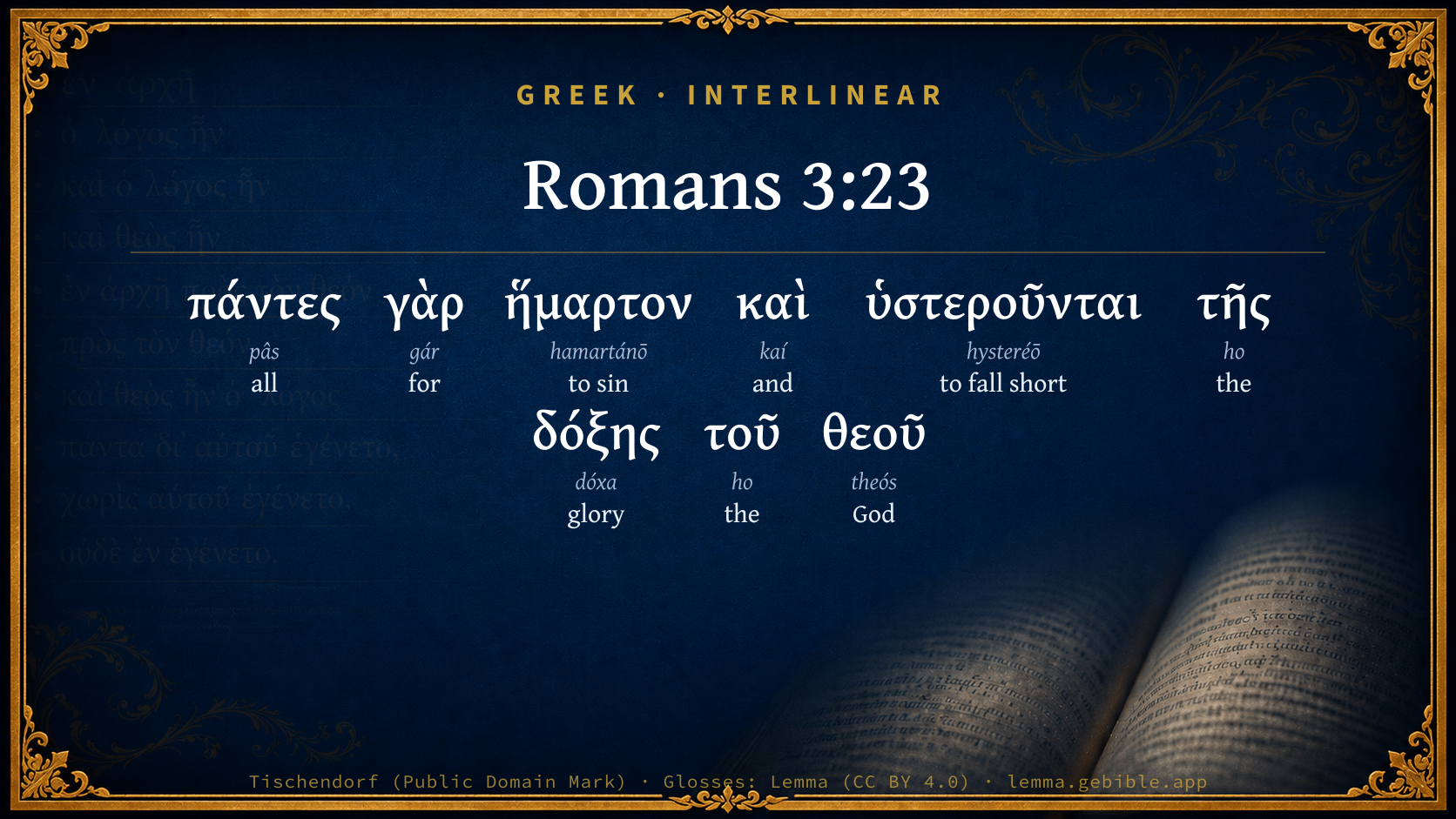
  1. πάντες pâs G3956 “all” Adjective, Nominative, Plural, Masculine
  2. γὰρ gár G1063 “for” Conjunction
  3. ἥμαρτον hamartánō G264 “to sin” Verb, Aorist, Active, Indicative, 3rd person, Plural
  4. καὶ kaí G2532 “and” Conjunction
  5. τῆς ho G3588 “the” Article, Genitive, Singular, Feminine
  6. δόξης dóxa G1391 “glory” Noun, Genitive, Singular, Feminine
  7. τοῦ ho G3588 “the” Article, Genitive, Singular, Masculine
  8. θεοῦ theós G2316 “God” Noun, Genitive, Singular, Masculine

About this verse

These counts appear in no published source. They are computed here, from the morphology-tagged text and Lemma’s own curated glosses. What Lemma adds →

9
words
8
distinct lemmas
Pauline Epistles
section

Notable vocabulary

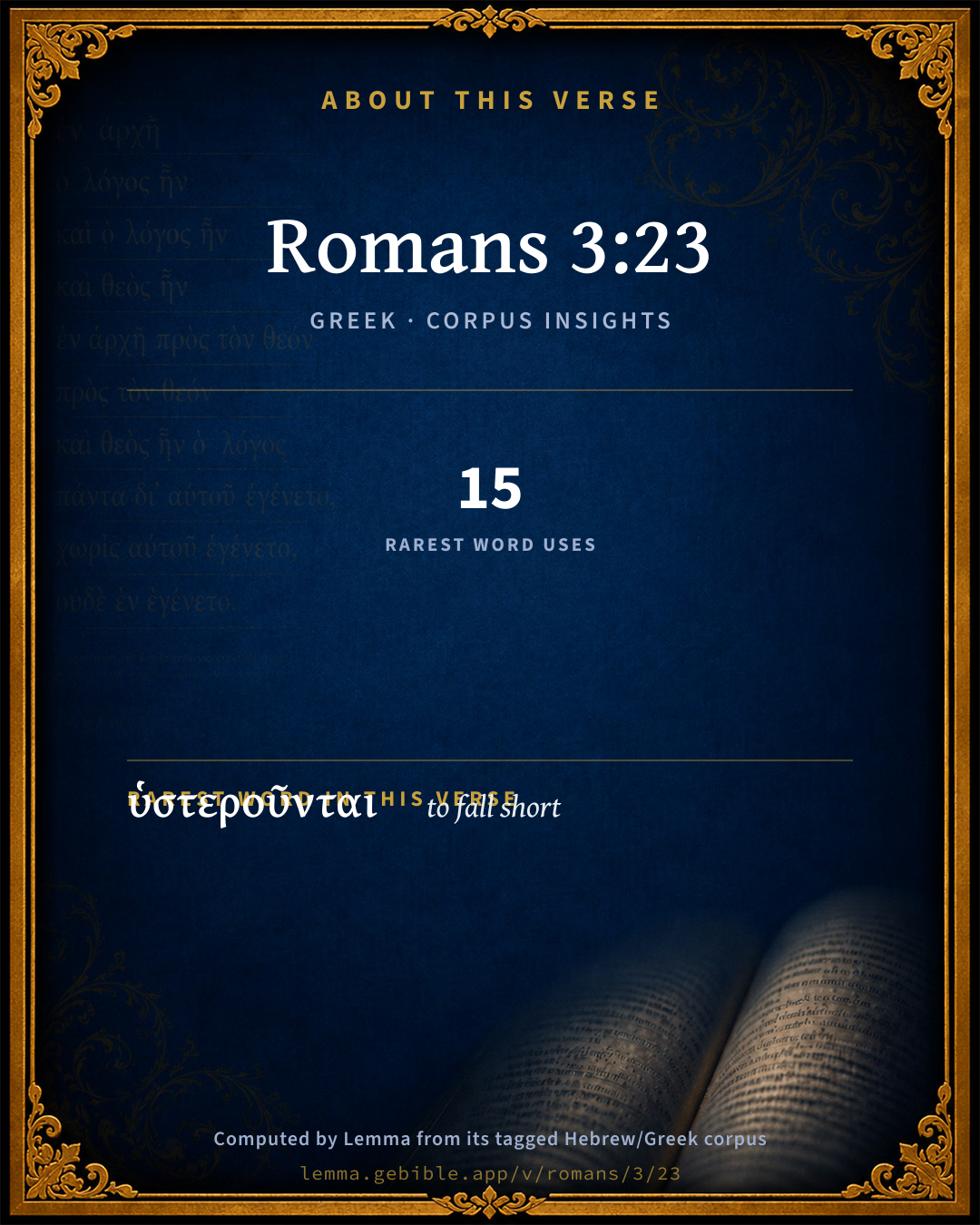
The rarest word here is ὑστεροῦνται to fall short G5302 — appearing just 15 times in the whole Greek New Testament.

Shared distinctive vocabulary

ὑστεροῦνται to fall short G5302 occurs in 15 verses of the Greek New Testament. Also found in:

Repetition

A word recurs within this verse:

Cross-references

14

Topical passages linked to Romans 3:23 in the Treasury of Scripture Knowledge — connected by theme and wording, ordered by reader-vote popularity; previews shown in the World English Bible.

  • Ecclesiastes 7:20 Surely there is not a righteous man on earth, who does good and doesn't sin.
  • 1 John 1:8–10 If we say that we have no sin, we deceive ourselves, and the truth is not in us.
  • Romans 3:9 What then? Are we better than they? No, in no way. For we previously charged both Jews and Greeks, that they are all under sin.
  • Galatians 3:22 But the Scriptures shut up all things under sin, that the promise by faith in Jesus Christ might be given to those who believe.
  • Romans 11:32 For God has shut up all to disobedience, that he might have mercy on all.
  • Romans 3:19 Now we know that whatever things the law says, it speaks to those who are under the law, that every mouth may be closed, and all the world may be brought under the judgment of God.
  • 1 Thessalonians 2:12 to the end that you should walk worthily of God, who calls you into his own Kingdom and glory.
  • 2 Thessalonians 2:14 to which he called you through our Gospel, for the obtaining of the glory of our Lord Jesus Christ.
  • Romans 5:2 through whom we also have our access by faith into this grace in which we stand. We rejoice in hope of the glory of God.
  • 1 Peter 4:13 But because you are partakers of Christ's sufferings, rejoice; that at the revelation of his glory also you may rejoice with exceeding joy.
  • Romans 1:28–2:16 Even as they refused to have God in their knowledge, God gave them up to a reprobate mind, to do those things which are not fitting;
  • 1 Peter 5:10 But may the God of all grace, who called you to his eternal glory by Christ Jesus, after you have suffered a little while, perfect, establish, strengthen, and settle you.
  • Hebrews 4:1 Let us fear therefore, lest perhaps a promise being left of entering into his rest, anyone of you should seem to have come short of it.
  • 1 Peter 5:1 I exhort the elders among you, as a fellow elder, and a witness of the sufferings of Christ, and who will also share in the glory that will be revealed.

Cross-references courtesy of OpenBible.info (CC BY 4.0).

Commentary

Notes on Romans 3:23 from classic Christian and Jewish commentators (each source and its license shown beneath its notes). The classic Christian expositions comment on the surrounding passage and are grouped to its opening verse, so a note may address several verses; the Jewish commentaries on the Tanakh (Rashi and others) are per-verse, so they appear only where the commentator wrote on this verse.

Lemma curates 59 commentaries, every one of them public domain or Creative Commons licensed, each selected and text-cleaned for this edition rather than reprinted as found. About our sources →

The Biblical Illustrator

Joseph S. Exell

Rom_3:23

For all have sinned, and come short of the glory of God.

Sin as a fact

I. The necessity of a clear sense of sin.

1. The gospel is a glorious remedy for a universal and otherwise incurable disease; and the first step must ever be to make us sensible of that disease. For one of its most dangerous symptoms is, that it makes men insensible of it. And, seeing that the remedy is not one which can be simply taken once for all, but requires long application, a man must be very thoroughly persuaded that he has the disease before he will take the necessary trouble to be cured of it. Let us try and see what all having sinned means.

2. When any of us looks cut upon mankind, or within himself, one thing can hardly fail to strike him. It is the presence of evil. From the first, mans history has been a history of going wrong and doing wrong. From the first, our own personal history has been a history of interrupted good and interfering bad.

3. Some have said, Dont tell people about it; forget that there is evil in yourself; and you and they will become good. It may be true that there is such a dark spot in nature; but gazing upon it is painful and useless; look at the bright side. But do you suppose that evil in our nature can be thus got rid of? Try it for a day--for an hour; then take strict unsparing account. And if more time is wanted, try it for a year; then retire and trace your path during the time. Does not every man see that it would be simply the tale of the silly ostrich over again, which imagines itself safe from the hunter by hiding him from its sight? No; a man who wants to get rid of evil must open his eyes to it, stand face to face with it, and conquer it.

II. Sin is distinguished from every other evil.

1. There are bodily pain, discomfort, misery, common to us and to all. Now, if we can manage to flee away from them, we thereby get rid of them. We need not study their nature. But the man who wishes to avoid evil in this world must be awake and alive to the forms and accesses of evil. His very safety consists in it. Therefore evil is a matter of a totally different kind from bodily pain, misery, or death.

2. Evil is not by any means our only inward source of annoyance and hindrance. Everyone has defects and infirmities. But none of these do we look upon as we look upon evil. Let it be shown that we are dull, or feeble, or inferior to some others, we put up with it, we excuse it, we make ourselves as comfortable as we may under it; but let it be once shown that we have wished, said, done, that which is evil, and we know at once that there is no excuse for it. We may try to show that we did it inadvertently, or by force of circumstances, or in some way to lessen our own share in it, but the very labour to construct an excuse shows that we hold the evil itself, as evil, to be inexcusable. So far, then, this evil is something which our nature itself teaches us to revolt from and abhor. No son of man ever said or could say, from his inmost heart, Evil, be thou my good. It requires more than man ever to say this.

III. Sin is the transgression of law.

1. What we have said shows that there is a law implanted in our nature by which evil is avoided and good desired. All our laws, public opinion, even our ways of thinking and speaking, are founded on this.

2. Now, when man says or acts evil, what sort of a thing does he do? Is it a necessary condition of our lives that we must enter into compact with evil? Certainly not. Every protest against, resistance to, victory over it, proves that evil is not necessary to our being. But true as this is, the freedom from and victory over evil is not that after which all men are striving. One man seeks sensual gratification; another wealth; a third power; a fourth reputation, etc., etc.; and so, not mans highest aim to be good, but an aim very far below this is followed by even the best of mankind sometimes. Now every one of these lower objects, if followed as an object, does necessarily bring a man into contact and compromise with evil. Greed, intemperance, injustice, unkindness, overweening opinion of self, and a hundred other evil things beset everyone in such courses of life.

3. When a man lives such a course he is disobeying that great first law of our being by which we choose the good and abhor the evil. Now, whenever we do this we sin. All sin is transgression of law.

4. Now, sin is committed against a person. And this law of good and evil of which we have been speaking, springs from that Holy and Just One who hath made us and to whom we are accountable. All sin is against Him.

IV. All have sinned. And in dwelling on this, the fact that all men have inherited the disposition to sin, necessarily comes first. And, inheriting this disposition, but with it inheriting also the great inward law of conscience warning us against evil, we have again and again followed, not the good law, but the evil propensity. In wayward childhood this has been so; in passionate youth; in calm, deliberate manhood. Now, then, this being so, can sin be safe? Can a sinner be happy? Sin is and must be the ruin of man, body and soul, here and hereafter. (Dean Alford.)

The charge of sin universal

I. The charge here brought is that of having sinned, and a most solemn and awful charge it is. Fools, indeed, make a mock at sin; and that they do so, is a proof of their folly. God is love; and consequently His law requires love. To love God with all the heart, and their fellow beings as themselves, is the essence of that law. To break this law is sin; and sin produces only misery and ruin. To charge a person with having sinned is to charge him with having acted contrary to the purpose for which he was made; with having failed to love and obey the best and greatest of beings; with being guilty of the same conduct with that which cast the angels out of heaven, and man out of Paradise. Surely this is a solemn charge. Do we want other examples of the evil of having sinned? Why the Flood? why the fire upon the people of Sodom and Gomorrah? etc. Because they had sinned. Or, to give a more awful and decisive example, why did the Son of God die on the Cross? Because He had taken upon Himself the nature and the cause of sinners.

II. The persons against whom it is brought. There is no difference; for all have sinned, in their progenitor and representative, and in their own persons also. But this is a truth unpalatable to the pride of man. And under the influence of this principle he will be disposed yet further to ask, What! is there no difference? no difference between righteous Abel and wicked Cain? between impenitent Saul and contrite David? Are they all equally guilty before God? In one sense all these persons are not alike. They have not all sinned in the same manner, in the same measure, to the same degree. Here there is a wide difference between them. But in the sense spoken of in the text they are all alike. They have all sinned; and here there is no difference. Though they may not be equally guilty, yet they are all guilty before God.

III. The extent of the charge here brought. All have sinned, and, by so doing, have come short of the glory of God. This expression signifies--

1. To fall short of rendering to God that glory to which He is entitled. He requires that all His creatures shall glorify Him. He has created them for His glory; and when they fulfil the purpose for which He created them, then they do glorify Him. Thus the heavens declare the glory of God. What, then, was the end and purpose for which man was made? To love, obey, and serve his Maker. By opposition to His will he comes short of the glory of God. Man, a living, rational being, is placed, not like the other works of creation, under a law of necessity which he cannot break, but under a moral restraint, by which he ought to be kept in the path of duty. But he is not so kept by it. He dishonours God in his very gifts, and endeavours, according to his power, to introduce confusion into His works, and to defeat His great and gracious designs.

2. The failing to obtain that glory which God originally designed for man. God originally designed man for a glorious immortality. But by sin he fell short of that glory; he forfeited and lost it. This, indeed, was the consequence of not rendering to God the glory due to Him. Having been unwilling to glorify God, he could no longer expect to be glorified with God. Conclusion: Perhaps you say, Why, this doctrine takes away all hope. Would you drive us to despair? No, not to a despair of salvation, but to a despair of justifying yourselves before God. But in Christ there is a full and gracious pardon for all your sins; there is glory offered to you again. (E. Cooper.)

The test of a sinner

A young man once said to me, I do not think I am a sinner. I asked him if he would be willing his mother or sister should know all he had done or said or thought--all his motives and desires. After a moment he said, No, indeed, not for all the world. Then can you dare to say, in the presence of a holy God, who knows every thought of your heart, I do not commit sin? (J. B. Gough.)

Mans sinfulness and inability

I. It is universally admitted that there is something wrong in mans nature.

1. In every one of us there is a something good which perceives a something bad; also something which whispers of an ideal state--a kind of reminiscence of a lost condition.

2. To account for this it suffices if we think of our nature as having had, originally controlling it, a supreme love which has been largely but by no means entirely lost. That in us which accuses us when we do wrong and commends us when we do right cannot be sinful, but must be holy. And so there is in us all a viceroy asserting kingship in the name of the true Sovereign of our souls. As a matter of fact we look upon one another as beings not entirely trustworthy. If man be not a depraved creature, why this universal suspicion? And yet we are not so depraved as not to know that we are depraved.

3. It is often argued that we are here in a state of probation. But man as man has had his probation and has fallen. Adams tree of knowledge of good and evil tested his obedience. Our Tree of Life--Jesus Christ--tests our obedience. Only with a difference. The first man, knowing only good, wanted to know what evil was. We, having in ourselves the knowledge of good and evil, are put upon trial, whether we will adhere persistently to that which is good--good personalised in Christ.

II. What does this condition mean?

1. There is suggested the explanation of incompleteness. Our nature, say some, is moving on gradually towards perfection. Give it time and it will come out according to the highest idea that the best and most intelligent man has of it. Unhappily, except under certain conditions, and in a certain environment, man as he grows older does not grow better. And this idea does not account for our sense of guilt. It leaves out too much. There are too many facts which lie outside of it. It only covers a part of the ground.

2. It needs along with it the idea of depravation. The sense of not being right, of being wrong, is in us all. And it is an internal trouble which men would get away from if they could. But no man can get away from himself. No external condition can eradicate it. Men try all sorts of devices to rid themselves of it. Sometimes they change their opinions, but that does not alter the inward condition. The bad consciousness is there all the time, and there is no other word but sinfulness which will express its nature. For it is certain that there are in man not only defects which mean weakness, but also a parent defect which means guilt.

III. This degeneration is total. It affects the whole nature. Our nature is so connected, part with part, that degeneration in one region means degeneration in every region. If a man be unjust in his feelings he will be unjust in his thinking and action. It is the merest rubbish to talk of a man being good at heart and bad everywhere else. Whatever affects the centre of our nature affects also every part of it to the outermost extremities. If there be impure blood in the heart there will be impure blood in every vein. And there is no kindness in any teaching which leads men to assume that sinfulness is only an eruption on the skin and not a disease of the heart. Only fools make a mock at sin.

IV. The view we take of this fact of sinfulness will influence our estimate of every other vital truth. If sinfulness be only ignorance we need only a Teacher; if only disease, a Physician; if only error, an Example. But if it be something more, we need in Him who is to deliver us from it a power other than that possessed by the Teacher, etc. Sinfulness means ignorance, error, disease; but it means a great deal more. In many a case it means that state of heart in which the idea of God is more hateful than the idea of the devil. I have known fallen men and women who never ceased praying God be merciful to me a sinner, and I cannot forget Christs words--The publicans and harlots enter the kingdom of God before you. There are sins of the flesh which destroy reputation, which bring misery, social degradation, and much else. There are sins of the spirit which bring none of these, and yet which put men and women at even a farther distance from God. Of what condition of heart is he who is amiable and placid until someone speaks to him such a truth as God is Love, God is Light, God so loved the world? etc. To err is human, but to contemn and reject the claims of Deity, that is not human, but fiendish. No one has ever taken a true measure of what sinfulness is until he has considered it in this, its most terrible form. I want you to feel the exceeding sinfulness of sin, for only then will you be able to appreciate the exceeding goodness of God who willeth not the death of a sinner, but that all should come to repentance. Where sin abounded grace did superabound. No man who looks away from his sin to his Saviour need despair, but then he must look to Him as Saviour. If a man can grow out of this condition of sinfulness by natural development; if every old man be nearer to the ideal of manhood than when he was young, then a Teacher, etc., is needed; but if man is helpless to deliver himself from sinfulness, then he who is to meet the necessities of the case must be human to understand him, but more than human to deliver him from an enemy stronger than man himself. (Reuben Thomas, D. D.)

Coming short of Gods glory

Different persons, according to the difference of their habits of thought, or their education, or their moral attainments, take a very different standard of what sin is. But here we have Gods definition--whatever comes short of the glory of God, that is sin.

I. God measures sin by the degree in which the act, or the word, or the thought, injures or grieves him. This must be so. The only true rule for the estimate of any sin must be taken from the mind of Him whose mind is law, and whom to offend against constitutes sinfulness. Do not say, Are not we forbidden to seek our own glory? How, then, can God seek His own glory? For the reason why no creature is to seek his own glory is because all glory belongs to the Creator. What does it mean to come short of the glory of God? It may mean to come short of heaven, or to be unworthy of any praise from God, or to come short of that which is indeed Gods glory--His perfect image and likeness; to fail to reach, in its purity, the only motive which God approves--a desire for His own glory. It appears to me that though all the other senses are included in the words, yet that their great primary intention is the last.

II. This brings me to the motive of human action.

1. You who can read only what speaks to the outward senses, think most of words and actions. And, as naturally, God will look at the sources more than at the streams of every mans moral being. So it will be at the last great account. All the deeds and sayings of a man will then stand forth to give evidence to a certain inward state of the man, according to which everyone will receive his sentence.

2. And yet even we judge of things by their motives. Why do we value the most trivial gift, the act of a moment, a smile, a glance of the eye, more than all the treasures of substance?

3. Note some of the legitimate motives which may actuate us.

(1) It is legitimate to wish to be happy. Therefore God stirs us up by promises, and lifts us up by beatitudes. It would be contrary to common sense to say that we may not do anything for the sake of going to heaven.

(2) It is a step above that--to do or bear with the desire that we may become holier.

(3) But higher, because less selfish, ranges the motive of a true ambition to make others happy.

(4) And still higher the lofty, Christ-like focus, concentrating the whole will upon this--Father, in me glorify Thyself.

4. To all these principles of action, except the last, there attaches a shadow. The wish to be happy, even where the things we desire are spiritual, may degenerate into religious selfishness. The longing to be holy will often turn into morbid self-examination and a restless disquietude. The ambition to be useful easily becomes vitiated with--I will not say the love of human applause--but a desire to be liked. But the motive to do anything for Gods glory has no shadow, and is that which makes all the other motives right. It is right to endeavour to be happy, mainly because our happiness gives glory to God as the result of the finished work of Christ. It is right to study to be holy, because where God sees holiness He sees His own reflection, and He is satisfied. It is right to set ourselves to be useful, because it extends the kingdom of God. Here, then, lies the wrongness of everything that is done on any inferior principle--it comes short of the glory of God. (J. Vaughan, M. A.)

Missing the mark

The word sin alike in the Hebrew and the Greek means missed the mark, as an archer might. When one is interested in rifle shooting the picture is easily realised and not easily forgotten.

I. The mark, the centre, the bulls eye, that man is to make his aim through life, is the glory of God.

1. And what is that? The outshining of Gods attributes; Christ is the brightness of His glory, and the express image of His person. We can, at best, be but broken images, interrupted rays of His light. But still that is what we are to aim at--becoming ourselves, and reflecting to the world around us some images of the holiness, goodness, and love of God.

2. In this shooting we are a spectacle to men. See us they will, and judge from us the character and the worth of the religion we profess. The various professions or trades we may follow are but the courses which our bullets take amidst the various influences to the right or to the left, to be allowed for by the shooter. Our bullets must pass through them without erring, and in all alike the aim is to be one--to manifest the character of the God we serve. Those occupations are not in themselves the true centre to be aimed at--they are but the means of reaching the glory of God.

II. Missing this mark is sin. St. Paul lays it to the charge of all alike.

1. The standard is a high one--to aim directly and always at Gods glory. But, then, man occupies a high position, made above all creation, blessed with faculties above all creatures for being the glory of God; placed with opportunities of being so now, and the promise of being more so hereafter.

2. Shall we complain that we are so high in the creation, or complacently stoop down from it and forfeit the crown held out for us to take, like Bunyans man with the muck rake? Was not he missing the mark of life? He took up, as many do, a handful of dirt--he lost the crown of gold. We speak of men having made a good hit when they have succeeded in a telling speech, or a successful speculation, or a fortunate match, but what have they hit if they have not sought to honour God? Certainly not the glory of God, nor have they advanced the true purposes of life.

3. Now a rifle is made to shoot straight; if it will not do so, however perfect the polish of its barrel, or the finish of its lock or stock, it is useless, and you throw it on one side or break it up. The more complete it seems the more vexed you are with it for its utter failure in the one work for which you had it made. God has made us for the one object of glorifying Him, and if we fail in that, then whatsoever else we have which decorates us--intellect, politeness, science, art, position, wealth--all tend not to diminish but to increase our condemnation.

4. What our condemnation may be I do not pretend to fathom; but if the words mean no more than that having been made for the highest purpose, and then having utterly failed, we are henceforth cast on one side as useless, our powers broken up, and our opportunities taken from us, they will mean enough to stir us to redeem the time. We should not like to meet the exposure of such a shame. Pindar describes the return of a combatant from the great National Games. He speaks of him as hiding himself along the byways, not venturing to enter by the gates into his city, or to be seen in any public place. Why? Because he had missed the mark. He went out in the name of his city, equipped by his fellow citizens, to win honour for their name, and to give them glory. But he has failed, and he dare not meet them. We have failed, and we must all appear before the judgment seat, that everyone may receive the things done in his body.

III. To what does this lead us?

1. We must realise more and more our condition as sinners. Let any man solemnly ask himself, How much of God has the world seen in me? How much of His glory have I reflected?

2. We must go back to the same butts and shoot again for a truer aim. Go to your seat in Parliament, or your books, or your shop, and there aim afresh at rising to the glory of God, forgetting those things which are behind, etc. True, it will not be so easy now that ones hand is unsteadied by neglecting to aim aright; true, it will not be so simple now that many Ere looking on and wondering what in the world you are changing for, to shoot straight under their critical eye; but such sense of sin, such turning from it to God in Christ again, such trusting hope that with His aid we may succeed, will bring with it His forgiveness for the past and His guidance for the future; and we may yet, with His encouragement, hit the mark and glorify Him. (Canon Morse.)

The Biblical Illustrator, edited by Joseph S. Exell (c. 1880s–1900s) — public domain. Text from a community e-Sword module.

MacLaren's Expositions of Holy Scripture

Alexander MacLaren

Romans

WORLD-WIDE SIN AND WORLD-WIDE REDEMPTION

Rom 3:19 - Rom 3:26.

Let us note in general terms the large truths which this passage contains. We may mass these under four heads:

I. Paul’s view of the purpose of the law.

He has been quoting a mosaic of Old Testament passages from the Psalms and Isaiah. He regards these as part of ‘the law,’ which term, therefore, in his view, here includes the whole previous revelation, considered as making known God’s will as to man’s conduct. Every word of God, whether promise, or doctrine, or specific command, has in it some element bearing on conduct. God reveals nothing only in order that we may know, but all that, knowing, we may do and be what is pleasing in His sight. All His words are law.

But Paul sets forth another view of its purpose here; namely, to drive home to men’s consciences the conviction of sin. That is not the only purpose, for God reveals duty primarily in order that men may do it, and His law is meant to be obeyed. But, failing obedience, this second purpose comes into action, and His law is a swift witness against sin. The more clearly we know our duty, the more poignant will be our consciousness of failure. The light which shines to show the path of right, shines to show our deviations from it. And that conviction of sin, which it was the very purpose of all the previous Revelation to produce, is a merciful gift; for, as the Apostle implies, it is the prerequisite to the faith which saves.

As a matter of fact, there was a far profounder and more inward conviction of sin among the Jews than in any heathen nation. Contrast the wailings of many a psalm with the tone in Greek or Roman literature. No doubt there is a law written on men’s hearts which evokes a lower measure of the same consciousness of sin. There are prayers among the Assyrian and Babylonian tablets which might almost stand beside the Fifty-first Psalm; but, on the whole, the deep sense of sin was the product of the revealed law. The best use of our consciousness of what we ought to be, is when it rouses conscience to feel the discordance with it of what we are, and so drives us to Christ. Law, whether in the Old Testament, or as written in our hearts by their very make, is the slave whose task is to bring us to Christ, who will give us power to keep God’s commandments.

Another purpose of the law is stated in Rom 3:21, as being to bear witness, in conjunction with the prophets, to a future more perfect revelation of God’s righteousness. Much of the law was symbolic and prophetic. The ideal it set forth could not always remain unfulfilled. The whole attitude of that system was one of forward-looking expectancy. There is much danger lest, in modern investigations as to the authorship, date, and genesis of the Old Testament revelation, its central characteristic should be lost sight of; namely, its pointing onwards to a more perfect revelation which should supersede it.

II. Paul’s view of universal sinfulness.

He states that twice in this passage {Rom 3:20 - Rom 3:24}, and it underlies his view of the purpose of law. In Rom 3:20 he asserts that ‘by the works of the law shall no flesh be justified,’ and in Rom 3:23 he advances from that negative statement to the positive assertion that all have sinned. The impossibility of justification by the works of the law may be shown from two considerations: one, that, as a matter of fact, no flesh has ever done them all with absolute completeness and purity; and, second, that, even if they had ever been so done, they would not have availed to secure acquittal at a tribunal where motive counts for more than deed. The former is the main point with Paul.

In Rom 3:23 the same fact of universal experience is contemplated as both positive sin and negative falling short of the ‘glory’ {which here seems to mean, as in Joh 5:44, Joh 12:43, approbation from God}. ‘There is no distinction,’ but all varieties of condition, character, attainment, are alike in this, that the fatal taint is upon them all. ‘We have, all of us, one human heart.’ We are alike in physical necessities, in primal instincts, and, most tragically of all, in the common experience of sinfulness.

Paul does not mean to bring all varieties of character down to one dead level, but he does mean to assert that none is free from the taint. A man need only be honest in self-examination to endorse the statement, so far as he himself is concerned. The Gospel would be better understood if the fact of universal sinfulness were more deeply felt. Its superiority to all schemes for making everybody happy by rearrangements of property, or increase of culture, would be seen through; and the only cure for human misery would be discerned to be what cures universal sinfulness.

III. So we have next Paul’s view of the remedy for man’s sin.

That is stated in general terms in Rom 3:21 - Rom 3:22. Into a world of sinful men comes streaming the light of a ‘righteousness of God.’ That expression is here used to mean a moral state of conformity with God’s will, imparted by God. The great, joyful message, which Paul felt himself sent to proclaim, is that the true way to reach the state of conformity which law requires, and which the unsophisticated, universal conscience acknowledges not to have been reached, is the way of faith.

The message is so familiar to us that we may easily fail to realise its essential greatness and wonderfulness when first proclaimed. That God should give righteousness, that it should be ‘of God,’ not only as coming from Him, but as, in some real way, being kindred with His own perfection; that it should be brought to men by Jesus Christ, as ancient legends told that a beneficent Titan brought from heaven, in a hollow cane, the gift of fire; and that it should become ours by the simple process of trusting in Jesus Christ, are truths which custom has largely robbed of their wonderfulness. Let us meditate more on them till they regain, by our own experience of their power, some of the celestial light which belongs to them.

Observe that in Rom 3:22 the universality of the redemption which is in Christ is deduced from the universality of sin. The remedy must reach as far as the disease. If there is no difference in regard to sin, there can be none in regard to the sweep of redemption. The doleful universality of the covering spread over all nations, has corresponding to it the blessed universality of the light which is sent forth to flood them all. Sin’s empire cannot stretch farther than Christ’s kingdom.

IV. Paul’s view of what makes the Gospel the remedy.

In Rom 3:21 - Rom 3:22 it was stated generally that Christ was the channel, and faith the condition, of righteousness. The personal object of faith was declared, but not the special thing in Christ which was to be trusted in. That is fully set forth in Rom 3:24. We cannot attempt to discuss the great words in these verses, each of which would want a volume. But we may note that ‘justified’ here means to be accounted or declared righteous, as a judicial act; and that justification is traced in its ultimate source to God’s ‘grace,’-His own loving disposition-which bends to unworthy and lowly creatures, and is regarded as having for the medium of its bestowal the ‘redemption’ that is in Christ Jesus. That is the channel through which grace comes from God.

‘Redemption’ implies captivity, liberation, and a price paid. The metaphor of slaves set free by ransom is exchanged in Rom 3:25 for a sacrificial reference. A propitiatory sacrifice averts punishment from the offerer. The death of the victim procures the life of the worshipper. So, a propitiatory or atoning sacrifice is offered by Christ’s blood, or death. That sacrifice is the ransom-price through which our captivity is ended, and our liberty assured. As His redemption is the channel ‘through’ which God’s grace comes to men, so faith is the condition ‘through’ which {Rom 3:25} we make that grace ours.

Note, then, that Paul does not merely point to Jesus Christ as Saviour, but to His death as the saving power. We are to have faith in Jesus Christ {Rom 3:22}. But that is not a complete statement. It must be faith in His propitiation, if it is to bring us into living contact with His redemption. A gospel which says much of Christ, but little of His Cross, or which dilates on the beauty of His life, but stammers when it begins to speak of the sacrifice in His death, is not Paul’s Gospel, and it will have little power to deal with the universal sickness of sin.

The last verses of the passage set forth another purpose attained by Christ’s sacrifice; namely, the vindication of God’s righteousness in forbearing to inflict punishment on sins committed before the advent of Jesus. That Cross rayed out its power in all directions-to the heights of the heavens; to the depths of Hades {Col 1:20}; to the ages that were to come, and to those that were past. The suspension of punishment through all generations, from the beginning till that day when the Cross was reared on Calvary, was due to that Cross having been present to the divine mind from the beginning. ‘The judge is condemned when the guilty is acquitted,’ or left unpunished. There would be a blot on God’s government, not because it was so severe, but because it was so forbearing, unless His justice was vindicated, and the fatal consequences of sin shown in the sacrifice of Christ. God could not have shown Himself just, in view either of age-long forbearance, or of now justifying the sinner, unless the Cross had shown that He was not immorally indulgent toward sin.

Alexander MacLaren, Expositions of Holy Scripture (1904–1910) — public domain. Text from a community e-Sword module.

Scofield Reference Notes

C. I. Scofield

sinned

Sin, Summary: The literal meanings of the Heb. and (Greek - ἀλεκτοροφωνία sin," "sinner," etc)., disclose the true nature of sin in its manifold manifestations. Sin is transgression, an overstepping of the law, the divine boundary between good and evil Psa 51:1; Luk 15:29, iniquity, an act inherently wrong, whether expressly forbidden or not; error, a departure from right; Psa 51:9; Rom 3:23, missing the mark, a failure to meet the divine standard; trespass, the intrusion of self-will into the sphere of divine authority Eph 2:1, lawlessness, or spiritual anarchy 1Ti 1:9, unbelief, or an insult to the divine veracity Joh 16:9.

Sin originated with Satan Isa 14:12-14, entered the world through Adam Rom 5:12, was, and is, universal, Christ alone excepted; Rom 3:23; 1Pe 2:22, incurs the penalties of spiritual and physical death; Gen 2:17; Gen 3:19; Eze 18:4; Eze 18:20; Rom 6:23 and has no remedy but in the sacrificial death of Christ; Heb 9:26; Act 4:12 availed of by faith Act 13:38; Act 13:39. Sin may be summarized as threefold: An act, the violation of, or want of obedience to the revealed will of God; a state, absence of righteousness; a nature, enmity toward God.

The Scofield Reference Bible (1917 edition), notes by C. I. Scofield — public domain. Text from a community e-Sword module.

Bengel's Gnomon

Johann Albrecht Bengel

Rom 3:23. Ἥμαρτον, have sinned) that is, they have contracted the guilt of sin. Both the original act of sin in paradise is denoted, and the sinful disposition, as also the acts of transgression flowing from it. The past tenses often have an inchoative meaning along with the idea of continued action; such as ἐπίστευσα, ἤλπικα, ἠγάπηκα, ὑπήκουσα, ἓστηκα, I have believed, and still continue to believe; I have hoped, and still continue to hope; I have loved, and still continue to love; I have obeyed, and still continue to obey; I have established myself, and still establish myself.—καὶ ὑστεροῦνται, and come short) From the past tense, have sinned, flows this present, come short, and by this word the whole peculiar advantage [Rom 3:1] of the Jews, and all the boasting of all flesh, are taken away; the former is a thing done [past], and the latter is a thing now established; each of them [ᾕμαρτον and ὑστεροῦνται] denotes deficiency; they do not attain, ch. Rom 9:31.—τῆς δόξης τοῦ Θεο͂υ, of the glory of God) The glory of the living God Himself is signified, which bestows life, ch. Rom 6:4; and to this, access was open to man if he had not sinned; but, as a sinner, he fell short of this end of his being; nor does he now attain to it, nor is he able, by any means, to endure that glory which would have [but for sin] shone forth in him, Heb 12:20, etc.: Psa 68:2. Hence he has become subject to death; for glory and immortality are synonymous terms, and so, also, are death and corruption; but Paul does not more expressly mention death itself, until after the process of justification, and its going forth even to [its issue in] life, have been consummated; he then looks at death as it were from behind. ch. Rom 5:12. Therefore, the whole state of sin is most exquisitely pourtrayed thus, in this masterly passage: They come short of, or are far from the glory of God; that is, they have missed [aberrarunt a: erred from] the chief end of man; and in this very fact is implied [included], at the same time, every lesser aberration. But those who are justified recover the hope of that glory, along with most immediately realized glorying [viz., in Christ] in the meanwhile (of which [i.e. of boasting] in themselves, they had been deprived, Rom 3:27), and [recover] the kingdom in life. See, by all means, ch. Rom 5:2; Rom 5:11; Rom 5:17, Rom 8:30, at the end of the verse. Wherefore, the antithetic idea to they have sinned, is explained at Rom 3:24, and the following verses; and ch. 4 throughout, on justification; the antithetic idea to they have come short, is set forth in ch. 5, with which, comp. ch. Rom 8:17, and the following verses.

Bengel's Gnomon of the New Testament — English translation (T&T Clark, Edinburgh, 1860) — public domain. Text from a community e-Sword module.

Meyer's Critical & Exegetical Commentary

Heinrich August Wilhelm Meyer

Rom_3:23. Ἥμαρτον] The sinning of every man is presented as a historical fact of the past, whereby the sinful state is produced. The perfect would designate it as a completed subsisting fact. Calvin, moreover, properly remarks that according to Paul there is nulla justitia nisi perfecta et absoluta, and si verum esset, nos partim operibus justificari, partim Dei gratia, non valeret hoc Pauli argumentum. Luther aptly observes: They are altogether sinners, etc., is the main article and the central point of this Epistle and of the whole Scripture.

καὶ ὑστερ.] They have sinned, and in consequence of this they lack, there is wanting to them, etc. This very present expression, as well as the present participle δικαιούμενοι, ought to have kept Hofmann from understanding πάντες of all believers; for in their case that ὑστερεῖσθαι no longer applies (Rom_5:1 f., Rom_8:1 al[820]), and they are not δικαιούμενοι but δικαιωθέντες; but, as becoming believers, they would not yet be πιστεύοντες.

τῆς δόξης τ. Θεοῦ] The genitive with ὑστερεῖσθαι (Diod. Sic. xviii. 71; Joseph. Antt. xv. 6, 7) determines for the latter the sense of destitui. See Lobeck, a[821] Phryn. p. 237. Comp on 1Co_1:7. They lack the honour which God gives,[823] they are destitute of the being honoured by God, which would be the case, if the ἥμαρτον did not occur; in that case they would possess the good pleasure of God, and this, regarded as honour, which they would have to enjoy from God: the δόξα τοῦ Θεοῦ. Comp Rom_2:29; Joh_12:43, compared with Joh_5:44. Köllners objection to this view, which first offers itself, of Τ. ΘΕΟῦ as the genitive auctoris, which is also held by Piscator, Hammond, Grotius, Fritzsche, Reiche, de Wette, Tholuck, and others, following Chrysostom (comp Philippi), that it is not the fault of men if they should not have an honour, which proceeds from God, is of no weight; since it certainly is the fault of men, if they render it impossible for a holy God to give them the honour which proceeds from Him. Moreover, Köllners own explanation: honour before God (quite so also Calvin; and comp Philippi), which is said according to the analogy of human relations, in point of fact quite coincides with the above view, since in fact honour before God, or with God (Winzer), is nothing else than the honour that accrues to us from Gods judgment. Comp Calvin: ita nos ab humani theatri plausu ad tribunal coeleste vocat. Accordingly, the genitive is here all the less to be interpreted coram, since in no other passage (and especially not in δικαιοσ. Θεοῦ, see on. Rom_1:17) is there any necessity for this interpretation. This last consideration may also be urged against the interpretation of others: gloriatio coram Deo; non habent, unde coram Deo glorientur, Estius. So Erasmus, Luther, Toletus, Wolf, Koppe, Rosenmüller, Reithmayr, and others. It is decisive against this view that in all passages where Paul wished to express gloriatio, he knew how to employ the proper word, καύχησις (Rom_3:27; 2Co_7:14; 2Co_8:24 al[828]). Others, again, following Oecumenius (Chrysostom and Theophylact express themselves too indefinitely, and Theodoret is altogether silent on the matter), explain the ΔΌΞΑ Τ. ΘΕΟῦ to mean the glory of eternal life, in so far as God either has destined it for man (Glöckler), or confers it upon him (Böhme, comp Morison); or in so far as it consists in partaking the glory of God (Beza, comp Bengel and Baumgarten-Crusius). Mehring allows a choice between the two last definitions of the sense. But the following ΔΙΚΑΙΟΎΜΕΝΟΙ proves that the ΔΌΞΑ ΤΟῦ ΘΕΟῦ cannot in reality be anything essentially different from the ΔΙΚΑΙΟΣΎΝΗ ΘΕΟῦ, and cannot be merely future. Utterly erroneous, finally, is the view of Chemnitz, Flacius, Sebastian Schmid, Calovius,[831] Hasaeus, Alting, Carpzov, Ernesti, recently revived by Rückert, Olshausen, and Mangold, that the δόξα τοῦ Θεοῦ is the image of God; a godlike δοξα, as Rückert puts it, and thus gets rid of the objection that δόξα is not synonymous with εἰκών. But how arbitrarily is the relation of the genitive thus defined, altogether without the precedent of a similar usage (2Co_11:2 is not a case in point)! That the idea of the image of God is not suggested by anything in the connection is self-evident, since, as the subsequent δικαιούμενοι κ.τ.λ[832] abundantly shows, it is the idea of the want of righteousness that is under discussion. Hofmann and Ewald have explained it in the same way as Rückert, though they take the genitive more accurately (a δόξα such as God Himself possesses). The latter[833] understands the glory of God which man indeed has by creation, Psa_8:8, but which by sin he may lose for time and eternity, and has now lost. Compare Hofmann: Whatsoever is of God has a share, after the manner of a creature, in the glory of God. If this therefore be not found in man, the reason is that he has forfeited the relation to God in which he was created. But even apart from the fact that such a participation in the glory of God had been lost already through the fall (Rom_5:12; 1Co_15:22), and not for the first time through the individual ἥμαρτον here meant, it is decisive against this exposition that the participation in the divine ΔΌΞΑ nowhere appears as an original blessing that has fallen into abeyance, but always as something to, be conferred only at the Parousia (Rom_5:2; 1Th_2:12) as the ΣΥΝΔΟΞΑΣΘῆΝΑΙ with Christ (Rom_8:17 f.; Col_3:4); as the glorious ΚΛΗΡΟΝΟΜΊΑ of God (comp also 2Ti_4:8; 1Pe_5:4); and consequently as the new blessing of the future αἰών (1Co_2:9). That is also the proleptic ἘΔΌΞΑΣΕ in Rom_8:30, which however would be foreign to the present connection.

[820] l. and others; and other passages; and other editions.

[821] d refers to the note of the commentator or editor named on the particular passage.

[823] The genitive τ. Θεοῦ cannot, without arbitrariness, be explained otherwise than was done in the case of δικαιοσύνη τ. Θεοῦ. In consequence of his erroneous exposition of δικαιοσ. τ. Θεοῦ (see on Rom_1:17), Matthias understands here glory such as is that of God, i.e. the glory of personal holiness.

[828] l. and others; and other passages; and other editions.

[831] He takes δόξα τοῦ Θεοῦ as gloria homini a Deo concessa in creatione; this gloria having been the divine image, which we forfeited after the fall.

[832] .τ.λ. καὶ τὰ λοιπά.

[833] Similarly already Melancthon: gloria Dei, i.e. luce Dei fulgente in natura incorrupta, seu ipso Deo carent, ostendente se et accendente ardentem dilectionem et alios motus legi congruentes sine ullo peccato. Previously (1540) he had explained: gloria, quam Deus approbat.

Meyer — Critical and Exegetical Commentary on the New Testament — English translation by Peter Christie, edited by Frederick Crombie (T&T Clark, 1880) — public domain. Text from a community e-Sword module.

Expositor's Greek Testament

ed. W. Robertson Nicoll

Rom 3:23 . ἥμαρτον must be rendered in English “have sinned”; see Burton, Moods and Tenses , § 54. ὑστεροῦνται expresses the consequence = and so come short of the glory of God. To emphasise the middle, and render “they come short, and feel that they do so,” though suggested by the comparison of Mat 19:20 with Luk 15:14 (Gifford), is not borne out by the use of the N.T. as a whole. The most one could say is that sibi is latent in the middle: to their loss (not necessarily to their sensible or conscious loss) they come short. The present tense implies that but for sin men might be in enjoyment of “ ἡ δόξα τοῦ θεοῦ ”. Clearly this cannot be the same as the future heavenly glory of God spoken of in Rom 5:2 : as in Joh 5:44 ; Joh 12:43 , it must be the approbation or praise of God. This sense of δόξα is easily derived from that of “reputation,” resting on the praise or approval of others. Of course the approbation which God would give to the sinless, and of which sinners fall short, would be identical with justification.

The Expositor's Greek Testament, edited by W. Robertson Nicoll (1897–1910) — public domain. Text from a community e-Sword module.

Hodge's Commentary on Romans, Ephesians & First Corinthians

Charles Hodge

Rom_3:23

For all have sinned. This is the reason why there is no difference as to the condition of men. All are sinners. The apostle uses the aorist ἣμαρτον, sinned, and not the perfect, have sinned. Rückert says this is an inaccuracy; Bengel explains it by assuming that the original act in paradise, and the sinful disposition, and also the acts of transgression flowing from it, are all denoted. Olshausen says that the reference is mainly to original sin; for where there are no peccata actualia, there is still need of redemption. Dr. Wordsworth, Canon of Westminster, gives the same explanation: All men sinned in Adam, all fell in him. Meyer says, The sinning of each man is presented as an historical fact of the past. The idea that all men now stand in the posture of sinners before God might be expressed either by saying, All have sinned (and are sinners), or all sinned. The latter is the form adopted by the apostle. And come short, ὑστεροῦνται, in the present tense. The sinning is represented as past; the present and abiding consequence of sin is the want of the glory of God. By δόξα τοῦ Θεοῦ is most naturally understood the approbation of God, the δόξα which comes from God; comp. Joh_12:43, They loved the praise of men rather than the praise (δόξαν) of God. Calvin explains it as the glory quae coram Deo locum habet, glory before God, i.e., in estimation, as he explains δικαιοσύνη Θεοῦ to be righteousness in his sight, what he regards as such. This is against the natural force of the genitive. Others understand δόξα in the sense of glorying, non habet, unds coram Deo glorientur, Estius; so also Luther, Tholuck, (who refers to Joh_5:44, δόξαν παρὰ τοῦ Θεοῦ,) and others. This idea would be expressed by the word καύχησις Rom_3:27, or καύχημα, Rom_4:2; 1Co_5:6; 1Co_9:16 etc. Others again say that the glory of God here means that glory which God promises to the righteous, as in Rom_3:22. So Beza, who says, δόξα est meta ad quam contendimus, id est, vita aeterna, quae in gloria Dei participatione consistit. Rückert and Olshausen say it means the image of God; Men are sinners, and are destitute of the image of God. But this is not the sense of the words; the glory of God does not mean a glory like to that of God. The first interpretation, which is the simplest, is perfectly suited to the context. All men are sinners and under the disapprobation of God. In this respect there is no difference between them; and therefore all need a righteousness not their own, in order to their justification before God.

Charles Hodge — Commentary on Romans (1835), First Corinthians (1857), and Ephesians (1856) — public domain. Text from a community e-Sword module.

Geneva Bible (1599)

Geneva Bible translators

By the Glory of God, is meant that mark which we all shoot at, that is, everlasting life, which standeth in that we are made partakers of the glory of God.

Geneva Bible (1599) marginal notes — public domain. Text via Bolls.life.

Jamieson, Fausset & Brown

Robert Jamieson, A. R. Fausset & David Brown

for all have sinned--Though men differ greatly in the nature and extent of their sinfulness, there is absolutely no difference between the best and the worst of men, in the fact that "all have sinned," and so underlie the wrath of God.

and come short of the glory--or "praise"

of God--that is, "have failed to earn His approbation" (compare Joh 12:43, Greek). So the best interpreters.

Jamieson, Fausset & Brown — Commentary Critical and Explanatory on the Whole Bible (1871) — public domain (CC PDM 1.0). Text via the HelloAO Bible API.

Adam Clarke's Commentary

Verse 23. For all have sinned:] And consequently are equally helpless and guilty; and, as God is no respecter of persons, all human creatures being equally his offspring, and there being no reason why one should be preferred before another, therefore his endless mercy has embraced ALL.

And come short of the glory of God] και υστερουνται της δοξης του θεου. These words have been variously translated. Failed of attaining the glory of God: Have not been able to bring glory to God: Stand in need of the glory, that is, the mercy of God. The simple meaning seems to be this: that all have sinned, and none can enjoy God's glory but they that are holy; consequently both Jews and Gentiles have failed in their endeavours to attain it, as, by the works of any law, no human being can be justified.

Adam Clarke's Commentary on the Bible (1810–1826) — public domain. Text from a community e-Sword/MySword module.

John Calvin's Commentaries

23. There is indeed no difference, etc. He urges on all, without exception, the necessity of seeking righteousness in Christ; as though he had said, “There is no other way of attaining righteousness; for some cannot be justified in this and others in that way; but all must alike be justified by faith, because all are sinners, and therefore have nothing for which they can glory before God.” But he takes as granted that every one, conscious of his sin, when he comes before the tribunal of God, is confounded and lost under a sense of his own shame; so that no sinner can bear the presence of God, as we see an example in the case of Adam. He again brings forward a reason taken from the opposite side; and hence we must notice what follows. Since we are all sinners, Paul concludes, that we are deficient in, or destitute of, the praise due to righteousness. There is then, according to what he teaches, no righteousness but what is perfect and absolute. Were there indeed such a thing as half righteousness, it would yet be necessary to deprive the sinner entirely of all glory: and hereby the figment of partial righteousness, as they call it, is sufficiently confuted; for if it were true that we are justified in part by works, and in part by grace, this argument of Paul would be of no force — that all are deprived of the glory of God because they are sinners. It is then certain, there is no righteousness where there is sin, until Christ removes the curse; and this very thing is what is said in Galatians 3:10, that all who are under the law are exposed to the curse, and that we are delivered from it through the kindness of Christ. The glory of God I take to mean the approbation of God, as in John 12:43, where it is said, that “they loved the glory of men more than the glory of God.” And thus he summons us from the applause of a human court to the tribunal of heaven.

John Calvin's Commentaries (1540-1563) — public domain. Text from the Calvin Translation Society English edition (1840s-50s) via the Christian Classics Ethereal Library (ccel.org). Calvin's coverage is partial (roughly two-thirds of the Bible); uncommented books and verses are honest gaps, never fabricated. The 19th-century editor's footnotes and remarks are omitted so the notes are faithfully Calvin's own voice.

Ellicott's Commentary for English Readers

(23) All have sinned and come short.—Strictly, all sinned; the Apostle looking back upon an act done in past time under the old legal dispensation, without immediate reference to the present: he then goes on to say that the result of that act (as distinct from the act itself) continues on into the present. The result is that mankind, in a body, as he now sees them, and before they come within the range of the new Christian system, fall short of, miss, or fail to obtain, the glory of God.

Glory of God.—What is this glory? Probably not here, as in Rom_8:18; Rom_8:21, the glory which will be inaugurated for the saints at the Parusià, or Second Coming of the Messiah—for that is something future—but, rather, something which is capable of being conferred in the present, viz., the glory which comes from the favour and approval of God. This favour and approval Jew and Gentile alike had hitherto failed to obtain, but it was now thrown open to all who became members of the Messianic kingdom. (Comp. for the sense, Rom_2:29, and for the use of the word, as well as the sense, Joh_12:43, “they loved the praise [glory] of men more than the praise [glory] of God.”)

A Bible Commentary for English Readers, edited by Charles John Ellicott (1878–1897) — public domain. Text from a community e-Sword module.

The Cambridge Bible for Schools and Colleges

gen. ed. J. J. S. Perowne

23. all have sinned] Lit. all sinned: the Gr. aorist. Probably the time-reference of the tense is to the original Fall of Man, regarded as involving the individual experience of sinfulness in the case of each person. See however on Rom_1:19.

come short] A present tense. The result of the Fall is that they are now “short of the glory of God.” The word translated “come short” is translated “to be in want” (Luk_15:14); “to suffer need” (Php_4:12); “to be destitute” (Heb_11:37). Here the context suggests that modification of its root-meaning given in E. V.: “to suffer from defect,” “to fail to attain.”—“The glory of God” must here be His moral glory, His holiness and its requirements. In many passages the Word “glory” is used with evident reference to the Divine moral attributes—mercy, faithfulness, love—as well as to Divine power. See Rom_6:4; 2Co_4:4 (“the gospel of the glory of Christ”); Eph_1:12; Eph_1:14; 1Ti_1:11 (“the gospel of the glory of the blessed God”). Fallen man lies hopelessly below the standard of the spiritual law which is the expression of the essential holiness of God.

The Cambridge Bible for Schools and Colleges (gen. ed. J. J. S. Perowne; Cambridge University Press, 1878–1918) — public domain. Text from a community e-Sword module.

John Gill's Exposition

Where is boasting then?.... There is no room nor reason for it, either in Jews or Gentiles: not in the Jews, who were very apt to boast of their being Abraham's seed; of their circumcision; of their being Israelites; of their having and keeping the law; of God being their God; and of their knowledge of him: nor in the Gentiles, who were ready to boast of their philosophy, wisdom, and learning; of their self-sufficiency, freewill, and of the things they had in their own power.

It is excluded; it is shut out of doors; the key is turned upon it; it is not allowed of; it is entirely exploded:

by what law? of works? nay; for, that establishes boasting when men seek life, righteousness, and salvation by the works of it, and fancy they shall be able to attain them this way:

but by the law of faith: not by a law requiring faith; nor as if the Gospel was a law, a new law, a remedial law, a law of milder terms; but the word "law" here answers to the Hebrew word which signifies any "doctrine" or "instruction", and oftentimes the doctrine of the Gospel, as in Isa 2:3, and here particularly, the doctrine of a sinner's justification by faith in the righteousness of Christ; according to which doctrine the most unlikely persons are justified, even ungodly persons, the worst and vilest of sinners; and that without any consideration of works, by faith only, which is freely given them; and by faith in Christ's righteousness only: so that there is not the least room for boasting in the creature, but all their boasting is in Christ, who is made unto them righteousness, and by whom they are justified.

John Gill's Exposition of the Whole Bible (1746–1763) — public domain (CC PDM 1.0). Text via the HelloAO Bible API.

Trapp's Complete Commentary

John Trapp

23 For all have sinned, and come short of the glory of God;

Ver. 23. All have sinned] The first man defiled the nature, and ever since the nature defileth the man. Adam was a parent, a public person, a parliament man, as it were; the whole country of mankind was in him, and fell with him.

Short of the glory of God] i.e. Of his image now obliterated, or of his kingdom, upon the golden pavement whereof no dirty dog must ever trample. It is an inheritance undefiled, 1Pe 1:4.

John Trapp, A Commentary or Exposition upon All the Books of the Old and New Testament (1647–1656) — public domain. Text from a community e-Sword module.

Albert Barnes' Notes on the Bible

For all have sinned - This was the point which he had fully established in the discussion in these chapters.

Have come short - Greek, “Are deficient in regard to;” are lacking, etc. Here it means, that they had failed to obtain, or were destitute of.

The glory of God - The praise or approbation of God. They had sought to be justified, or approved, by God; but all had failed. Their works of the Law had not secured his approbation; and they were therefore under condemnation. The word “glory” (δόξα doxa) is often used in the sense of praise, or approbation, Joh 5:41, Joh 5:44; Joh 7:18; Joh 8:50, Joh 8:54; Joh 12:43.

Albert Barnes' Notes on the Bible (1834–1885) — public domain. Text from a community e-Sword/MySword module.

Matthew Poole's English Annotations

For all have sinned: q.d. No wonder there is no difference, when both the one and the other have the guilt of Adam’s transgression imputed to them, and have original corruption inherent in them, from whence proceed very many actual transgressions.

And come short of the glory of God; i.e. of the glorious image of God, in which man was at first created; or, of communion with God, in which the glory of a rational creature doth consist; or rather, of the eternal glory, which they come short of, as men that run a race are weary, and fall short of the mark.

Matthew Poole's English Annotations on the Holy Bible (1683–1685) — public domain. Text from a community e-Sword/MySword module.

Whedon's Commentary on the Bible

Daniel D. Whedon

23. All have sinned—The all is all mankind, past, present, and future; the have sinned is, in the Greek, an instance of the apostle’s aoristic tenses, in which past, present, and future are comprehended. (See notes on Rom_4:12; Rom_8:29; Rom_9:22.) The tense is equivalent to a perpetual present, “an eternal now,” and so the phrase is tantamount to all men sin. It thus accords in sense with come short, which in the Greek is actually in the grammatical present. And the fact that both verbs express a perpetual fact explains, decisively, we think, the following phrase, about which commentators so much differ—the glory. The phrase come short is borrowed from a racer’s failure to attain the goal. The goal is the heavenly glorification. All men sin, and, apart from Christ, fail of the blessed goal, the final glory of God.

Daniel D. Whedon (gen. ed.), Commentary on the Old and New Testaments (1874–1909) — public domain. Text from a community e-Sword module.

The Pulpit Commentary

For all have sinned, and come short of the glory of God. The "glory of God," of which all men are here said to come short (userountai), has been taken to mean

(1) honour or praise from God. "Dei favore et approbatione carent" (Sehleusner). So decidedly Meyer, Tholuek, Alford, and others. In this case Yeou would be the gen. auctoris, which Meyer argues is probable from its being so in Yeou dikaiosunh . This argument (which is not worth much in any case) tells the other way if, as we hold, it is not so in the latter phrase. For the New Testament use of doxa in the sense of "praise" or "honour," 1Th_2:6 is adduced (Oute zhtountev en anyrwpoiv doxan); also Joh_5:44 (Doxan para allhlwn lambanontev kai thxan th tou monou Yeou ou zhteite); and especially Joh_12:43, where doxa is, as here, followed by the genitive Yeou without any connecting preposition: Hgaphsan gaxan twn anyrwpwn mallon hper thxan tou Yeou ("the praise of God," Authorized Version). But, even apart from the different, and in itself more obvious, meaning of the phrase, doxa tou Yeou , where it occurs elsewhere, it is at least a question whether in the last cited passage it can be taken to mean praise or honour from God. It comes immediately after the quotation from Isa_6:9, etc., followed By"these things said Esaias, when he saw his glory (thxa autou), and spoke of him." Hence the meaning of Joh_12:43 may probably be that the persons spoken of loved mundane glory (cf. Mat_4:8 Mat_6:29) rather than the Divine glory, seen in the vision of faith, manifested to the world in Christ, (cf. Joh_1:14, "We beheld his glory," etc.) and "loved" by those who have not the eyes blinded and the heart hardened. So, even in the previous passage of St. John"s Gospel, (Joh_5:41, Joh_5:44) h doxa h para tou Yeou may denote man"s participation in the Divine glory, rather than praise or honour, while doxa para allhlwn may mean the mundane glory conferred by men on each ether. These considerations commend, in the passage before us, the interpretation

(2) "Significatur ipsius Dei viventis gloria, vitam tribuens; (cf. Rom_6:4) ad quam homini, si non peccasset, patuit aditus: sod peccator ab illo fine sue excidit, neque jam eum assequitur, neque gloriam illam, quae in illo effulsisset, ullo mode tolerare potest: Heb_12:20, et seq.; 5:2, 11, 17; 8:30, etc." (Bengel). Further, the sense which the same expression seems evidently to bear in Rom_5:2 of this Epistle is of importance for our determination of its meaning here. We are not justified in understanding, with some interpreters, any specific reference to the "image of God" (cf. 1Co_11:7, eikw doxa Yeou uparcwn) in which man was created, and which has been lost by the Fall, there being nothing to suggest it, or, with others, exclusively to the future glory, since the present usterountai seems to denote a present deficiency. The general conception appears sufficiently plain in Bengel"s exposition above given, according to which "the glory of God" means the glory of the Divine righteousness, ("sempiterna ejus virtus et divinitas" Bengel on Heb_1:8) which man, through sin, falls short of.

A remedy for a universal need.

To assert that the righteousness of God manifested in Christ was "apart from the Law" relegated the Law to its proper position, as the servant, not the master, of religion. And the apostle"s substantiation of his further assertion, that this new method of righteousness was not so entirely unheard of as that its novelty should be a strong prejudice against its truth, but that, on the contrary, the Law itself and the prophets contain intimations of such a Divine manifestation, this cut the ground entirely from under the feet of objectors jealous of every innovation which could not be justified by an appeal to the sacred writings. And this righteousness through faith recognized Jew and Gentile as alike in their need of a gospel, and their freedom of access thereto.

I THERE IS NO DISTINCTION AMONGST MEN IN RESPECT OF THEIR NEED OF THE GOSPEL. Men are declared faulty in two respects.

1. By positive transgression. They "sinned," they have done wrong, and they wander continually from the right way. They are not adjudged criminal merely on the ground of Adam"s fall, but they themselves cross the line which separates obedience from disobedience. Scripture, history, and conscience testify to this fact.

2. By defect. They "fall short of the glory of God." Their past behaviour has been blameworthy, and their present condition is far below what was intended when man was formed in God"s image, to attain to his likeness. Compare the best of men with the example set by the Saviour of love to God and man, and of conformity to the highest standard discernible. Now, unless perfect, man cannot claim acquittal at the bar of judgment. Perfection is marred if one feature be distorted or one limb be missing or weak. This is not to be taken to signify that all men are equally sinful, that there are no degrees of enormity, and that all are equidistant from the kingdom of God. But it means that, without exception, all fail in the examination which Divine righteousness institutes, though some have more marks than others. Left to themselves, all men would drown in the sea of their iniquity, though some are nearer the surface than their fellows. The misunderstanding of this truth has done grievous harm to tender minds, fretting because they had not the same sense of awful misdoing that has been felt by notorious malefactors. We need not gauge the amount of contrition requisite; it suffices if the heart turn humbly to God for forgiveness. Thus the gospel does not flatter men. Soothing messages may comfort for a while till the awakening comes. Then we realize that it is of no use to be in a richly decorated cabin if the ship is sinking. To reveal the true state is the necessary preliminary to reformation. There is a downrightness about the gospel assertions which, like the deep probing of the surgeon"s lance, wounds in order to thorough healing. Alas! that the disease of sin should so frequently produce lethargy in the sick! they feel no need of a physician! Lax notions of sin lessen our sense of the necessity of an atonement. We fail to discern a rebellion against the government of God, and an offence against the moral universe. We treat it as if it only concerned ourselves and our neighbours. No sprinkling of rose-water can purge away the evil; it can be cleansed only by the blood of the Lamb.

II THERE IS NO DISTINCTION IN RESPECT OF THE MEANS OF SALVATION.

1. Justification comes in every case as a gift, not as a prize discovered or earned. "Being justified freely." Part of the beneficial influence of the gospel is the blow it administers to human notions of desert, and pride is a chief obstacle to enrichment by this gift of God.

2. To all men the kindness of God is the source of their salvation. God first loved and sought the sinner, not contrariwise. His "grace" is the fountain of redemption.

3. The same Divine method of deliverance is employed for all. "Through the redemption that is in Christ Jesus." There is but one way to the Father, whether men walk thereon consciously or unconsciously, in heathen twilight or gospel noontide, in Jewish anticipation or Christian realization. The one atonement can cover all transgression.

4. The same human mode of entrance into the kingdom is open to all, viz. by faith. Weakness, ignorance, degradation, cannot be pleaded as obstacles to salvation. The study of the philosopher is no nearer heaven than the cottage of the artisan. The capacity of trusting is possessed by every man; the remedy is not remote, therefore, from the reach of any of the sin-sick race. S.R.A.

The Pulpit Commentary (1880–1919), ed. H.D.M. Spence-Jones & Joseph S. Exell — public domain. Text from a community e-Sword module.

John Wesley's Explanatory Notes

For all have sinned - In Adam, and in their own persons; by a sinful nature, sinful tempers, and sinful actions. And are fallen short of the glory of God - The supreme end of man; short of his image on earth, and the enjoyment of him in heaven.

John Wesley, Explanatory Notes Upon the Whole Bible (1754–1765) — public domain. Text via the GEBible commentary corpus.

Godbey's Commentary on the New Testament

William B. Godbey

23. “For all sinned and came short of the glory of God.” “All have sinned” (E. V.) is a wrong translation, involving personality and condemning the infants. The Greek is the imperfect tense, only implying that all sinned seminally, which is true. There was but one creation, i. e., Adam; Eve being no exception, but an evolution from Adam’s rib. Hence when Adam sinned, the race sinned, and all fell together, all being in Adam seminally. Hence all the infants sinned seminally and received a corrupt nature, though they did not sin personally. Consequently they did not personally fall under condemnation. All infants are born depraved, i. e., with a sinful nature, though not actual sinners, but Christians by the redemption of Christ. They should be converted before they forfeit infantile justification by actual transgression, and then sanctified before they backslide. “Fall short” is in the present tense, stating a sad, though universally observable fact, resulting from the fall. This “falling short of the glory of God” appertains to all till this mortal shall put on immortality.

William B. Godbey, Commentary on the New Testament (1896–1900) — public domain. Text from a community e-Sword module.

McGarvey & Pendleton's Commentaries

J. W. McGarvey

for all have sinned, and fall short of the glory of God ;

J. W. McGarvey (with Philip Y. Pendleton), Commentaries on the New Testament (The Fourfold Gospel, 1914; Acts; and the epistles) — public domain. Text from a community e-Sword/MySword module.

The People's New Testament

B. W. Johnson

23. For all have sinned. This has been already shown. And come short of the glory of God. Wickliffe says, “Have need of the glory of God.” I believe this suggests the idea. Man was made originally in the image of God. He was then sinless. No sinner is in the Divine image. All have sinned, and to have the divine likeness restored, need to have their sins blotted out. Until this is done they come short of the glory of God.

B. W. Johnson's The People's New Testament with Notes (1889–1891) — public domain. Electronic text from the Christian Classics Ethereal Library (CCEL) ThML edition.

unfoldingWord translationNotes

Door43 World Missions Community

come short of the glory of God

Here the "glory of God" is a metonym that refers to the image of God and his nature. AT: "have failed to be like God" (See: Metonymy)

they are freely justified by his grace through the redemption that is in Christ Jesus

Here "justified" refers to being made right with God. You can translate this in an active form. AT: "God makes them right with himself as a free gift, because Christ Jesus sets them free" (See: Assumed Knowledge and Implicit Information and Active or Passive)

they are freely justified

This means that they are justified without having to earn or merit being justified. God freely justifies them. AT: "they are made right with God without earning it"

translationWords

sin

glory

God

just

grace

redeem

Jesus

unfoldingWord translationNotes — © Distant Shores Media and the Door43 World Missions Community, licensed CC BY-SA 4.0. Source: git.door43.org/Door43/en_tn.

Cambridge Greek Testament for Schools and Colleges

23. πάντες γὰρ … τ. θ. resumes Rom 1:19 to Rom 3:20. ἥμαρτον is the ‘constructive’ or summary aorist, “which regards the whole action simply as having occurred, without distinguishing any steps in its progress” (Moulton, p. 109; cf. Burton, M. T. § 54), and so should be translated by the perfect ‘have sinned,’ and is naturally coordinate with the durative present, describing the actual state; see on Rom 2:12.

ὑστεροῦνται. The middle of this verb seems to imply, not merely to fall short of a goal (act.), but to be lacking in something of which the need is felt or at least obvious. Cf. Mat 19:20 with 1Co 8:8 and 2Co 11:5 with Php 4:12; Heb 12:15: ‘comes short of, A.V., ‘fall short of, R.V. both therefore seem inadequate translations. Perhaps ‘lack’ will do. Their lives and characters obviously show the lack of ‘the glory of GOD.’

τῆς δόξης τοῦ θεοῦ consequently = that exhibition of GOD in their own character, which is man’s proper work: implying the idea of Gen 1:26-27; cf. 1Co 11:7; 2Co 3:18, and Irenaeus, “vivens homo gloria Dei,” and probably infra, Rom 5:2 and n. 1Co 6:20. See S. H. ad lo[109] GOD is not seen in them as He ought to be seen. The same thought is expressed by the verb in Rom 1:21. See n. on Rom 2:7.

[109] ad loc ad locum

Cambridge Greek Testament for Schools and Colleges (Cambridge University Press, 1896; 21 vols, various authors incl. Carr, Maclear, Plummer, Farrar, Lumby, Moule, M. R. James, Simcox) — public domain. Text from a community e-Sword module.

Alford’s Greek Testament

Henry Alford

23. [ὑστεροῦνται should be rendered fall short, not, as E. V., “come short,” since this latter may be taken for the past tense, after the auxiliary “have.”]

τῆς δόξης τοῦ θεοῦ] Of the praise which comes from God, see reff. (so Grot., Thol., Reiche, Fritz., Meyer, Rückert, De Wette): not, ‘of praise in God’s sight’ (Luther, Calv., Estius, Köllner): nor, ‘of glory with God,’ as ch. 5:2 (Œc., Beza, al.),—for the Apostle is not speaking here of future reward, but of present worthiness: nor, of the glorious image of God which we have lost through sin (Calov., al., Rückert, Olsh.), which is against both the usage of the word, and the context of the passage.

Henry Alford, The Greek Testament (1849–1861) — public domain. Text from a community e-Sword module.

International Critical Commentary

23. οὐ γάρ ἐστι διαστολή. The Apostle is reminded of one of his main positions. The Jew has (in this respect) no real advantage over the Gentile; both alike need a righteousness which is not their own; and to both it is offered on the same terms.

ἥμαρτον. In English we may translate this ‘have sinned’ in accordance with the idiom of the language, which prefers to use the perfect where a past fact or series of facts is not separated by a clear interval from the present: see note on 2:12.

ὑστεροῦνται: see Monro, Homeric Grammar, § 8 (3); mid. voice = ‘feel want.’ Gif. well compares Mat 19:20 τί ἔτι ὑστερῶ; (objective, ‘What, as a matter of fact, is wanting to me?’) with Luk 15:14 καὶ αὐτὸς ἥρξατο ὑστερεῖσθαι (subjective, the Prodigal begins to feel his destitution).

τῆς δόξης. There are two wholly distinct uses of this word: (1) = ‘opinion’ (a use not found in N. T.) and thence in particular ‘favourable opinion,’ ‘reputation’ (Rom 2:7, Rom 2:10; Joh 12:43 &c.); (2) by a use which came in with the LXX as translation of Heb. כָּבוֹד = (i) ‘visible brightness or splendour’ (Act 22:11; 1Co 15:40 ff.); and hence (ii) the brightness which radiates from the presence of God, the visible glory conceived as resting on Mount Sinai (Exo 24:16), in the pillar of cloud (Exo 16:10), in the tabernacle (Exo 40:34) or temple (1Ki 8:11; 2Ch 5:14), and specially between the cherubim on the lid of the ark (Psa 80:1; Exo 25:22; Rom 9:4 &c.); (iii) this visible splendour symbolized the Divine perfections, ‘the majesty or goodness of God as manifested to men’ (Lightfoot on Col 1:11; comp. Eph 1:6, Eph 1:12, Eph 1:17; Eph 3:16); (iv) these perfections are in a measure communicated to man through Christ (esp. 2Co 4:6, 2Co 3:18). Both morally and physically a certain transfiguration takes place in the Christian, partially here, completely hereafter (comp. e.g. Rom 8:30 ἐδόξασεν with Rom 5:2 ἐπʼ ἐλπίδι τῆς δόξης τοῦ Θεοῦ, 8:18 τὴν μέλλουσαν δόξαν ἀποκαλυφθῆναι, 2Ti 2:10 δόξης αἰωνίου). The Rabbis held that Adam by the Fall lost six things, ‘the glory, life (immortality), his stature (which was above that of his descendants), the fruit of the field, the fruits of trees, and the light (by which the world was created, and which was withdrawn from it and reserved for the righteous in the world to come).’ It is explained that ‘the glory’ was a reflection from the Divine glory which before the Fall brightened Adam’s face (Weber, Altsyn. Theol. p. 214). Clearly St. Paul conceives of this glory as in process of being recovered: the physical sense is also enriched by its extension to attributes that are moral and spiritual.

The meaning of δόξα in this connexion is well illustrated by 4 Ezr. 7:42 [ed. Bensly = vi. 14 O. F. Fritzsche, p. 607], where the state of the blessed is described as neque meridiem, neque noctem, neque ante lucem [perh. for antelucium; vid. Bensly ad loc.], neque nitorem, neque claritatem, neque lucem, nisi solummodo splendorem claritatis Altissimi [perh. = ἀπαύγασμα δόξης Ὑψίστου]. In quoting this passage Ambrose has sola Dei fulgebit claritas; Dominus enim erit lux omnium (cf. Rev 21:24). The blessed themselves shine with a brightness which is reflected from the face of God: ibid. vv. 97, 98 [Bensly = 71, 72 O. F. Fritzsche] quomodo incipiet (μέλλει) vultus eorum fulgere sicut sol, et quomodo incipient stellarum adsimilari lumini … festinant enim videre vultum [eius] cui serviunt viventes et a quo incipient gloriosi mercedem recipere (cf. Mat 13:43).

International Critical Commentary — older volumes (1896–1929), various authors — public domain. Text from a community e-Sword module.

Vincent's Word Studies in the New Testament

Marvin R. Vincent

Have sinned [ημαρτον] . Aorist tense : sinned, looking back to a thing definitely past - the historic occurrence of sin.

And come short [υστερουνται] . Rev., fall short : The present tense. The A. V. leaves it uncertain whether the present or the perfect have come is intended. They sinned, and therefore they are lacking. See on Luk 14:14. The word is not merely equivalent to they are wanting in, but implies want under the aspect of shortcoming.

The glory of God [της δοξης του θεου] . Interpretations vary greatly. The glory of personal righteousness; that righteousness which God judges to be glory; the image of God in man; the glorying or boasting of righteousness before God; the approbation of God; the state of future glory.

The dominant meanings of doxa in classical Greek are notion, opinion, conjecture, repute. See on Rev 1:6. In biblical usage : 1. Recognition, honor, Phi 1:11; 1Pe 1:7. It is joined with timh honor, 1Ti 1:17; Heb 2:7, 9; 2Pe 1:17. Opposed to ajtimia dishonor, 1Co 11:14, 15; 1Co 14:43; 2Co 6:8. With zhtew to seek, 1Th 2:6; Joh 5:44; Joh 7:18. With lambanw to receive, Joh 5:41, 44. With didwmi to give, Luk 17:18; Joh 9:24. In the ascriptive phrase glory be to, Luk 2:14, and ascriptions in the Epistles. Compare Luk 14:10 2. The glorious appearance which attracts the eye, Mt 4:8; Luk 4:6; Luk 12:27. Hence parallel with eijkwn image; morfh form; oJmoiwma likeness; eidov appearance, figure, Rom 1:23; Psa 17:15; Num 12:8.

The glory of God is used of the aggregate of the divine attributes and coincides with His self - revelation, Exo 33:22; compare proswpon face, ver. 23. Hence the idea is prominent in the redemptive revelation (Isa 60:3; Rom 6:4; Rom 5:2). It expresses the form in which God reveals Himself in the economy of salvation (Rom 9:23; 1Ti 1:11; Eph 1:12). It is the means by which the redemptive work is carried on; for instance, in calling, 2Pe 1:3; in raising up Christ and believers with Him to newness of life, Rom 6:4; in imparting strength to believers, Eph 3:16; Col 1:11; as the goal of Christian hope, Rom 5:2; Rom 8:18, 21; Tit 2:13. It appears prominently in the work of Christ - the outraying of the Father 's glory (Heb 1:3), especially in John. See Rom 1:14; Rom 2:11, etc.

The sense of the phrase here is : they are coming short of the honor or approbation which God bestows. The point under discussion is the want of righteousness. Unbelievers, or mere legalists, do not approve themselves before God by the righteousness which is of the law. They come short of the approbation which is extended only to those who are justified by faith. 30

Marvin R. Vincent, Word Studies in the New Testament (1887–1900) — public domain. Text from a community e-Sword/MySword module.

Godet's Commentaries

Frédéric Louis Godet

Vv. 23. This absence of difference in the mode of justification rests on the equality of all in respect of the fact of sin. In the aorist ἥμαρτον, have committed sin, no account is taken of the question whether they have done so once or a hundred times. Once suffices to deprive us of the title of righteous, and thereby of the glory of God.—Καί, and in consequence.

The verb ὑστερεῖσθαι, to lack, expresses in general the idea of a deficit, which consists either in remaining below the normal level, or in being behind others. Paul therefore means that they all want more or less a normal state, which he calls the glory of God. By this term some have understood the favorable opinion which God has of the just man, His approbation or favor (Grot. Turret. Fritzsche). This meaning is far from natural; Joh 12:43 does not suffice to justify it. Others understand by this expression: glory in God’s sight, that which we should possess if we were righteous (Mel. Calv. Philippi). This meaning is not much more natural than that which appears sometimes in Luther: the act of glorying in God; or than that of OEcumenius and Chalmers: the destination of every man to glorify God. There are really only two senses possible. The first is that of the many commentators who understand the glory of God as the future and eternal glory (Beza, Morison, Reuss, etc.). But in this case we must give to the verb ὑστερεῖσθαι a very forced meaning: to lack the necessary qualifications for obtaining this glory. The second meaning, and the only one which we think admissible, is this the divine splendor which shines forth from God Himself, and which He communicates to all that live in union with Him (see Hofmann, Meyer). This meaning includes that of Rückert and Olshausen, who understand it too specially, no doubt, to mean the original image of God in man. The complement Θεοῦ, of God, is at once a gen. possess. and a gen. auctor. God can communicate this glory, because He possesses it Himself, and it belongs to His nature. He had communicated a ray of it to man when He created him pure and happy; it was intended to shine more and more brightly in him as he rose from innocence to holiness. By sinning, man lost both what he had received of it and what he was yet to obtain. A dispossessed king, the crown has fallen from his head.

The consequence of this state of things is indicated, in close connection with the context, in Rom 3:24.

Frédéric Louis Godet — Commentaries on Luke, John, Romans, and 1 Corinthians — English translation (T&T Clark, Edinburgh, 1870s–1890s) — public domain. Text from a community e-Sword module.

Lesson kit

Teaching starters — assembled from the data on this page, not authored interpretation. Every prompt links to the verse data it draws on. Edit before teaching.

Romans, in the Pauline Epistles, opens this verse with 9 words (8 distinct Greek lemmas). Its most distinctive word is hysteréō (“to fall short”). A historical commentator’s framing appears above. Read the whole chapter for the surrounding context.

Discussion questions

  1. The word hysteréō carries the sense “to fall short.” How does it shape the verse?
  2. Matthew 19:20 shares the word «to fall short» with this verse. How do the two illuminate each other?
  3. “the” occurs 2× in this one verse. What is the effect of the repetition?
  4. These translations render this verse differently; the difference is in the English rendering, not the original. What questions does that raise?
  5. Reading how The Biblical Illustrator and MacLaren's Expositions of Holy Scripture read this verse, where do the two commentators agree and where do they part?

Things to notice

  • These translations choose different wording for 3 words in this verse.
  • “the” occurs 2× in this single verse.
  • 8 distinct Greek lemmas span 9 words in this verse.

Reading settings

Reading text

Shown beneath each verse's original-language words.

Old Testament
Old Testament edition

Read the OT as the Masoretic Hebrew (MT) or the Greek Septuagint (LXX).

English shown for the Greek Septuagint (in the Hebrew ↔ Greek comparison).

Comparing translations? Open the Compare panel on any verse page to stack up to four side by side.