Romans 3:2

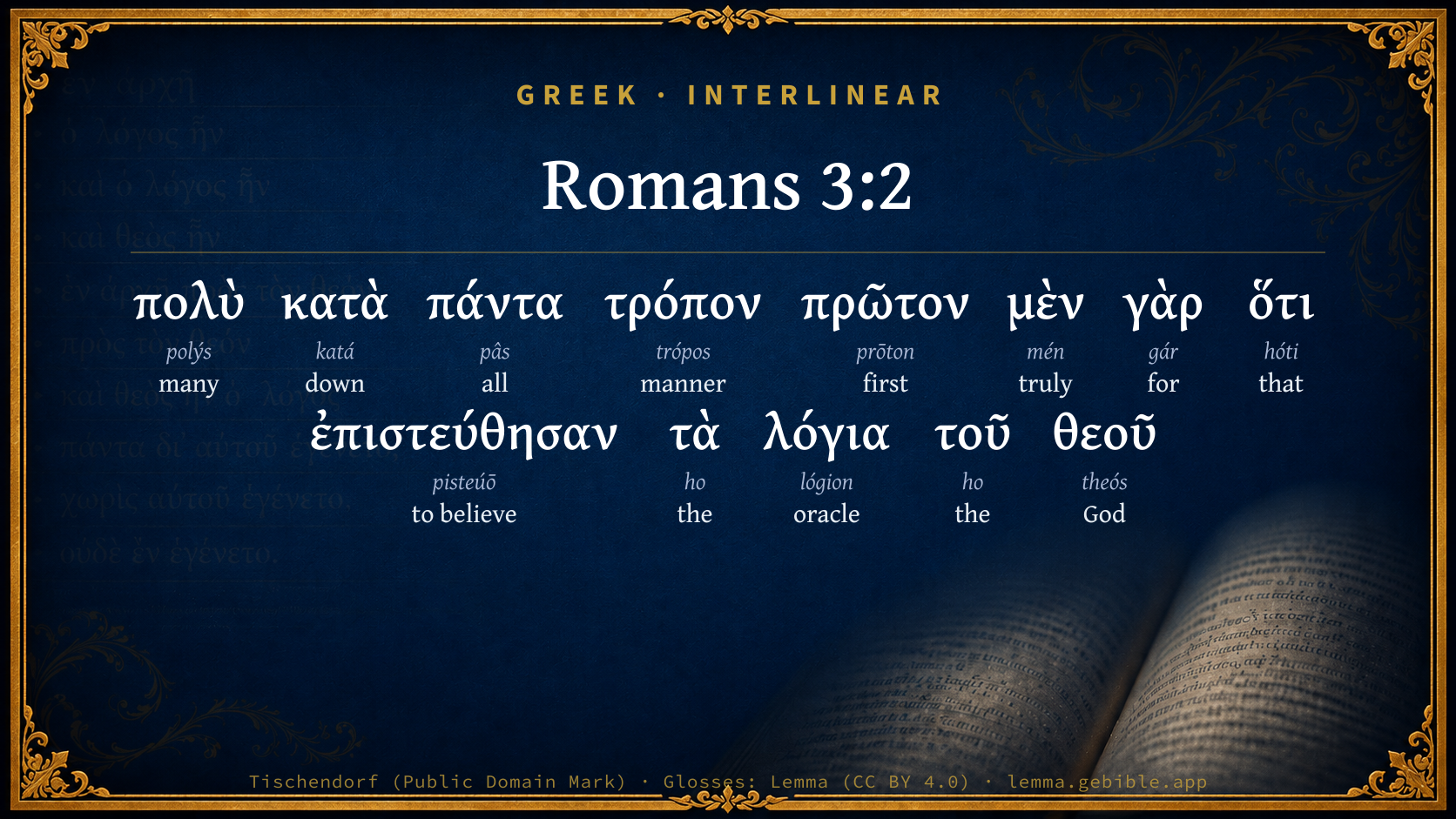
Greek (Tischendorf 8th ed.) Romans 3:2 appears in the Greek New Testament. The text above is from the Tischendorf 8th edition. Each word links to its Strong’s number and a concise gloss. Click any word for its full Thayer’s Greek Lexicon entry.
Download image
Cite this verse

Romans 3:2 (World English Bible). Public Domain. Lemma interlinear Bible study tool, https://lemma.gebible.app/v/romans/3/2.

Show BibTeX & RIS
BibTeX
RIS
English Translation
Much in every way! Because first of all, they were entrusted with the oracles of God.
World English Bible · Public Domain
Download a study sheet

One document with this verse’s original text, its word-by-word gloss line, the meaning frame, cross-references with their text, attributed commentary, and full source and license credits — printable, and it pastes into notes with its structure intact.

This verse Autodidact and up

Study sheet (.html) Plain text (.txt)

A passage Seminary Student

Up to 50 verses in one chapter. A passage sheet keeps up to 6 commentary sources and 12 cross-references per verse, in the order this page ranks them, and says so on the sheet whenever that leaves anything out. Ask for a single verse and you get the Autodidact verse sheet above.

Everything on this page stays free to read, with no account — the sheet is a download of what is already on screen, not access to it.

Want to remove ads? Support Godless Engineer
Compare translations 3

The same verse in 3 English versions, stacked beneath the original-language interlinear above. Click any original word for its lexicon entry.

Each is an independent rendering of the whole verse — the interlinear is not word-aligned to these translations.

Highlighted words mark where these versions differ — a whole-verse word diff, not a word-by-word alignment.

  • World English Bible Public Domain
    Much in every way! Because first of all, they were entrusted with the oracles of God.
  • King James Version Public Domain
    Much every way: chiefly, because that unto them were committed the oracles of God.
  • unfoldingWord Literal Text CC BY-SA 4.0
    Great in every way! For indeed first, that they were entrusted with the sayings of God.

unfoldingWord Literal Text — © unfoldingWord, licensed CC BY-SA 4.0. Word-aligned USFM3 via Door43 (git.door43.org/unfoldingWord/en_ult).

Versions to compare (up to 4)

3 of 4 selected

Show all 19 translations

Every available English version of this verse, each an independent rendering of the whole verse.

  • World English Bible Public Domain
    Much in every way! Because first of all, they were entrusted with the oracles of God.
  • Berean Standard Bible Public Domain
    Much in every way. First of all, they have been entrusted with the very words of God.
  • Majority Standard Bible Public Domain
    Much in every way. First of all, they have been entrusted with the very words of God.
  • King James Version Public Domain
    Much every way: chiefly, because that unto them were committed the oracles of God.
  • American Standard Version (1901) Public Domain
    Much every way: first of all, that they were intrusted with the oracles of God.
  • Revised Version (1885) Public Domain
    Much every way: first of all, that they were intrusted with the oracles of God.
  • Geneva Bible (1599) Public Domain
    Much euery maner of way: for chiefly, because vnto them were of credite committed the oracles of God.
  • Douay-Rheims (1899) Public Domain
    Much every way. First indeed, because the words of God were committed to them.
  • Young's Literal Translation Public Domain
    much in every way; for first, indeed, that they were intrusted with the oracles of God;
  • Literal Standard Version CC BY-SA 4.0
    Much in every way; for first, indeed, that they were entrusted with the oracles of God;
  • Unlocked Literal Bible CC BY-SA 4.0
    It is great in every way. First of all, the Jews were entrusted with revelation from God.
  • unfoldingWord Literal Text CC BY-SA 4.0
    Great in every way! For indeed first, that they were entrusted with the sayings of God.
  • Darby Bible Public Domain
    Much every way: and first, indeed, that to them were entrusted the oracles of God.
  • World Messianic Bible Public Domain
    Much in every way! Because first of all, they were entrusted with the revelations of God.
  • Webster's Bible Public Domain
    Much every way: chiefly, because that to them were committed the oracles of God.
  • Free Bible Version CC BY-SA 4.0
    Yes, there are many benefits! First of all, God's message was entrusted to them.
  • Bible in Basic English Public Domain
    Much in every way: first of all because the words of God were given to them.
  • Text-Critical English NT CC BY 4.0
    Much in every way. First of all, the Jews were entrusted with the oracles of God.
  • Tyndale New Testament (1534) Public Domain
    Surely very moche. Fyrst vnto them was committed the worde of God

Literal Standard Version (2020), Covenant Press — licensed CC BY-SA 4.0. Text via the HelloAO Bible API (eBible.org). Unlocked Literal Bible (unfoldingWord) — licensed CC BY-SA 4.0. Text via the HelloAO Bible API (eBible.org). unfoldingWord Literal Text — © unfoldingWord, licensed CC BY-SA 4.0. Word-aligned USFM3 via Door43 (git.door43.org/unfoldingWord/en_ult). Free Bible Version, Dr. Jonathan Gallagher — licensed CC BY-SA 4.0. Text via the HelloAO Bible API (eBible.org).

Word by word

More ways to search: Search by grammar → Find every occurrence → Compare this word →

Practice this passage: Drill this verse → Learn its vocabulary →

About this verse

These counts appear in no published source. They are computed here, from the morphology-tagged text and Lemma’s own curated glosses. What Lemma adds →

13
words
12
distinct lemmas
Pauline Epistles
section

Notable vocabulary

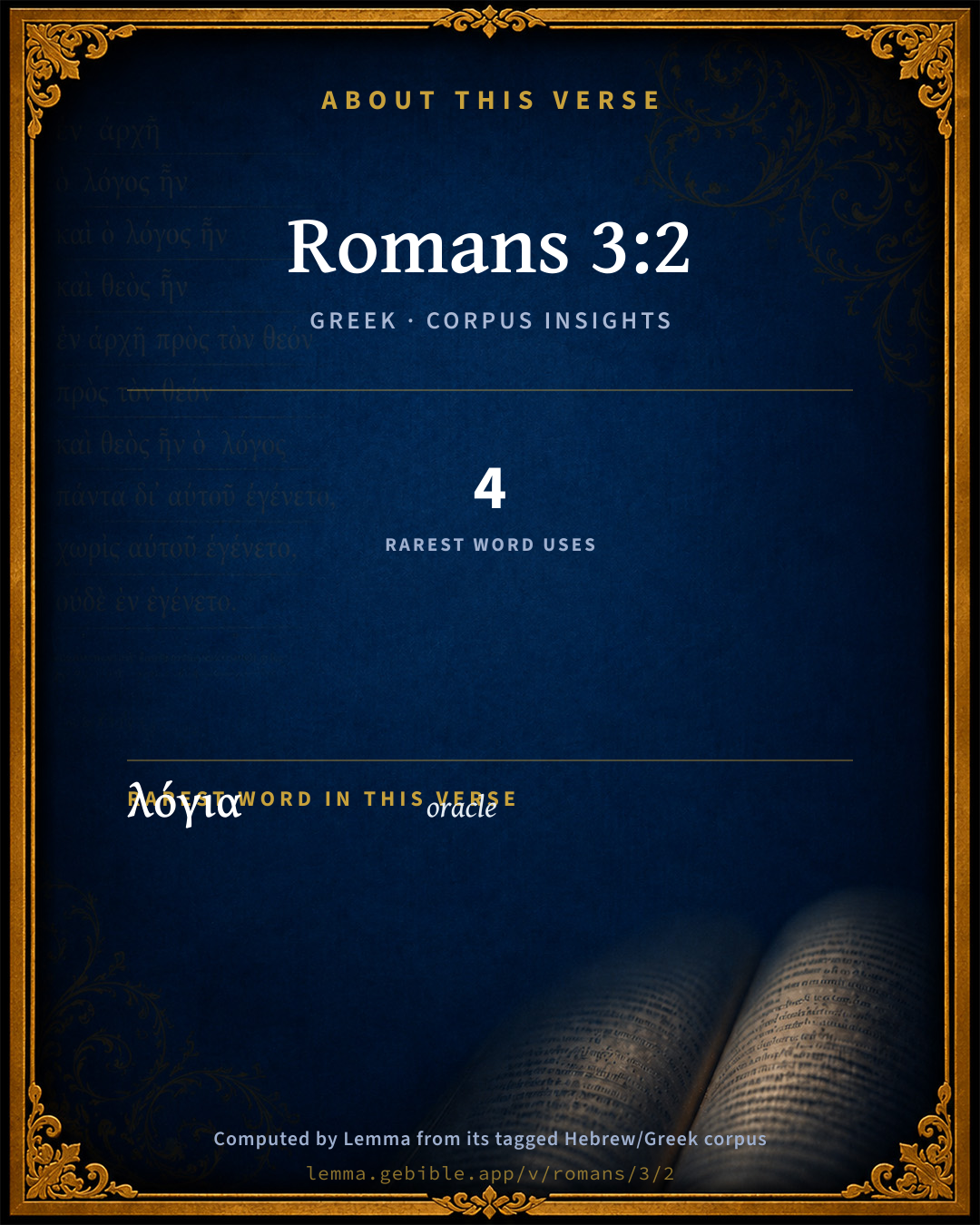
The rarest word here is λόγια oracle G3051 — appearing just 4 times in the whole Greek New Testament.

Shared distinctive vocabulary

λόγια oracle G3051 occurs in 4 verses of the Greek New Testament. Also found in:

Repetition

A word recurs within this verse:

Cross-references

28

Topical passages linked to Romans 3:2 in the Treasury of Scripture Knowledge — connected by theme and wording, ordered by reader-vote popularity; previews shown in the World English Bible.

  • Acts 7:38 This is he who was in the assembly in the wilderness with the angel that spoke to him on Mount Sinai, and with our fathers, who received living oracles to give to us,
  • Romans 9:4 who are Israelites; whose is the adoption, the glory, the covenants, the giving of the law, the service, and the promises;
  • Nehemiah 9:13–14 You came down also on Mount Sinai, and spoke with them from heaven, and gave them right ordinances and true laws, good statutes and commandments,
  • Psalms 147:19–20 He shows his word to Jacob; His statutes and his ordinances to Israel.
  • 1 Corinthians 9:17 For if I do this of my own will, I have a reward. But if not of my own will, I have a stewardship entrusted to me.
  • Hebrews 5:12 For when by reason of the time you ought to be teachers, you again need to have someone teach you the rudiments of the first principles of the oracles of God. You have come to need milk, and not solid food.
  • 1 Peter 4:11 If any man speaks, let it be as it were oracles of God. If any man serves, let it be as of the strength which God supplies, that in all things God may be glorified through Jesus Christ, to whom belong the glory and the dominion forever and ever. Amen.
  • Psalms 78:4–7 We will not hide them from their children, Telling to the generation to come the praises of Yahweh, His strength, and his wondrous works that he has done.
  • Ezekiel 20:11–12 I gave them my statutes, and shown them my ordinances, which if a man do, he shall live in them.
  • Romans 11:15–23 For if the rejection of them is the reconciling of the world, what would their acceptance be, but life from the dead?
  • 2 Timothy 3:15–17 From infancy, you have known the sacred writings which are able to make you wise for salvation through faith, which is in Christ Jesus.
  • 2 Peter 1:19–21 We have the more sure word of prophecy; whereunto you do well that you take heed, as to a lamp shining in a dark place, until the day dawns, and the day star arises in your hearts:
  • Deuteronomy 4:7–8 For what great nation is there, that has a god so near to them, as Yahweh our God is whenever we call on him?
  • Revelation 22:6 He said to me, "These words are faithful and true. The Lord God of the spirits of the prophets sent his angel to show to his bondservants the things which must happen soon."
  • Isaiah 8:20 To the law and to the testimony! if they don't speak according to this word, surely there is no morning for them.
  • Daniel 10:21 But I will tell you that which is inscribed in the writing of truth: and there is none who holds with me against these, but Michael your prince."
  • Luke 16:29–31 "But Abraham said to him, 'They have Moses and the prophets. Let them listen to them.'
  • John 5:39 "You search the Scriptures, because you think that in them you have eternal life; and these are they which testify about me.
  • Romans 1:2 which he promised before through his prophets in the holy Scriptures,
  • Romans 2:18 and know his will, and approve the things that are excellent, being instructed out of the law,
  • Romans 3:3 For what if some were without faith? Will their lack of faith nullify the faithfulness of God?
  • Romans 11:1–2 I ask then, Did God reject his people? May it never be! For I also am an Israelite, a descendant of Abraham, of the tribe of Benjamin.
  • Romans 11:28–29 Concerning the Gospel, they are enemies for your sake. But concerning the election, they are beloved for the fathers' sake.
  • 2 Corinthians 5:19 namely, that God was in Christ reconciling the world to himself, not reckoning to them their trespasses, and having committed to us the word of reconciliation.
  • Galatians 2:7 but to the contrary, when they saw that I had been entrusted with the Gospel for the uncircumcision, even as Peter with the Gospel for the circumcision
  • 1 Timothy 6:20 Timothy, guard that which is committed to you, turning away from the empty chatter and oppositions of the knowledge which is falsely so called;
  • Revelation 19:10 I fell down before his feet to worship him. He said to me, "Look! Don't do it! I am a fellow bondservant with you and with your brothers who hold the testimony of Jesus. Worship God, for the testimony of Jesus is the Spirit of Prophecy."
  • Psalms 119:140 Your promises have been thoroughly tested, And your servant loves them.

Cross-references courtesy of OpenBible.info (CC BY 4.0).

Commentary

Notes on Romans 3:2 from classic Christian and Jewish commentators (each source and its license shown beneath its notes). The classic Christian expositions comment on the surrounding passage and are grouped to its opening verse, so a note may address several verses; the Jewish commentaries on the Tanakh (Rashi and others) are per-verse, so they appear only where the commentator wrote on this verse.

Lemma curates 59 commentaries, every one of them public domain or Creative Commons licensed, each selected and text-cleaned for this edition rather than reprinted as found. About our sources →

Albert Barnes' Notes on the Bible

Much every way - Or, in every respect. This is the answer of the apostle to the objection in Rom 3:1.

Chiefly - That is, this is the principal advantage, and one including all others. The main benefit of being a Jew is, to possess the sacred Scriptures and their instructions.

Unto them were committed - Or were intrusted, were confided. The word translated “were committed,” is what is commonly employed to express “faith” or “confidence,” and it implied “confidence” in them on the part of God in intrusting his oracles to them; a confidence which was not misplaced, for no people ever guarded a sacred trust or deposit with more fidelity, than the Jews did the Sacred Scriptures.

The oracles - The word “oracle” among the pagan meant properly the answer or response of a god, or of some priest supposed to be inspired, to an inquiry of importance, usually expressed in a brief sententious way, and often with great ambiguity. The place from which such a response was usually obtained was also called an oracle, as the oracle at Delphi, etc. These oracles were frequent among the pagan, and affairs of great importance were usually submitted to them. The word rendered “oracles” occurs in the New Testament but four times, Act 7:38; Heb 5:12; 1Pe 4:11; Rom 3:2. It is evidently used here to denote the Scriptures, as being what was spoken by God, and particularly perhaps the divine promises. To possess these was of course an eminent privilege, and included all others, as they instructed them in their duty, and were their guide in everything that pertained to them in this life and the life to come. They contained, besides, many precious promises respecting the future dignity of the nation in reference to the Messiah. No higher favor can be conferred on a people than to be put in possession of the sacred Scriptures. And this fact should excite us to gratitude, and lead us to endeavor to extend them also to other nations; compare Deu 4:7-8; Psa 147:19-20.

Albert Barnes' Notes on the Bible (1834–1885) — public domain. Text from a community e-Sword/MySword module.

Tyndale Open Study Notes

Tyndale Open Resources

3:2 The advantage that Jews possessed was in having received God’s word. • First of all: Paul never adds a second or a third point to the list he begins here. He might have forgotten to continue the list, or first of all might mean “most importantly.” However, 9:4-5 provides a good indication of what a list of Jewish privileges would have included. • By using the word revelation (Greek logia, “oracles, messages”), Paul highlights God’s personal communication with his people (see Deut 33:9; Ps 105:19) through which he gives them special privileges and responsibilities.

Tyndale Open Study Notes — © Tyndale Open Resources, licensed CC BY-SA 4.0. Text via the HelloAO Bible API.

Bengel's Gnomon

Johann Albrecht Bengel

Rom 3:2. Πολύ, much) In the neuter gender; supply περισσίν. It rather refers to the concrete, concerning the Jew, than to the abstract, concerning circumcision, Rom 3:1; this will be treated of at ch. Rom 4:1; Rom 4:9, etc. So, ch. Rom 2:29, οὗ, viz. Ἰουδαίου, the Jew [instead of ἦς, though περιτομή had preceded].—πρῶτον) i.e. first, and therefore chiefly; the word signifying in the next place, does not always follow [after πρῶτον]. One privilege of the Jews, admirably adapted to Paul’s object, is set forth in this passage (the others will follow, ch. Rom 9:4-5); and by this very one, he is about, by and by, after he has ended this prefatory address of conciliation, so much the more to convict them.[33]—ἐπιστεύθησαν, they were intrusted with) He, to whom a treasure is intrusted, may manage it either faithfully and skilfully, or otherwise; and the Jews treated the Old Testament Scriptures in very different ways. But Paul says, that the oracles of God were intrusted to the Jews in such a manner [under this condition], that the good about to come, Rom 3:8, which they [the oracles] described, would belong to the Jews, if they would receive it by faith;—ideas extremely suggestive: God is true, faithful, intrusting His revelation to men, righteous; man is mendacious, perfidious, distrustful, unrighteous.—λόγια), a diminutive. The Divine answers were often brief, as in the Urim and Thummim: ΛΌΓΙΟΝ is also [God’s] saying [Rom 3:4], concerning circumcision, and the other privileges of the Israelites.

[33] On the προθεραπέιᾳ, i.e., precautionary address to disarm prejudices, when about to speak unwelcome truths. See Appendix.—ED.

Bengel's Gnomon of the New Testament — English translation (T&T Clark, Edinburgh, 1860) — public domain. Text from a community e-Sword module.

Hodge's Commentary on Romans, Ephesians & First Corinthians

Charles Hodge

Rom_3:2

Much, in every way. The answer to the objection implied in the preceding verse, is a denial of its correctness as an inference from the apostles reasoning. It does not follow, because the Jews are to be judged according to their works, that there is no advantage in being the peculiar people of God, having a divine revelation, etc. Πρῶτον μὲν γάρ. These words are rendered by Beza, primarium enim (illud est); comp. Luk_19:47; Act_25:2. Calvin says, πρῶτον significat praecipue vel praesertim, hoc sensu, Etsi unum istud esset, quod habent Dei oracula sibi commissa, satis valere debet ad eorum dignitatem. Our translators adopt the same view. But to both of the interpretations the particle γάρ furnishes an objection. The third and simplest view is, that the words in question mean first, in the first place, as in 1Co_11:18; γάρ is then namely, for example. That the enumeration is not carried on, is no serious objection to this explanation, as we have other examples of the same kind. See Rom_1:8. Because they were entrusted with the oracles of God. The subject of ἐπιστεύθησαν, viz. Ἰουδαῖοι is implied by the connection; τὰ λόγια is the accusative; comp. Gal_2:7; πεπίστευμαι τὸ ευσαγγέλιον, 1Co_9:17; 1 Thessalonians 2. Some, as Theodoret, Beza, etc., understand by τὰ λόγια τοῦ Θεοῦ, the law; others, as Grotius, Tholuck, etc., the Messianic promises; others, as Calvin, Rosenmüller, De Wette, the whole Scriptures. In favor of this last is the usage of the phrase which in the Old Testament is used for the revelation of God in general, and in the New Testament, for any divine communication. Heb_5:12; 1Pe_4:11. The words therefore are general in their meaning, and there is nothing in the context to limit them; for the apostle is speaking of the treasure committed to the safe custody of the Jews; that deposit of divine knowledge by which they were distinguished from all other nations. Here, as in innumerable other places, the sacred writers of the New Testament use forms of expression which clearly imply that they regarded the sacred writings of the Jews as really the word of God.

Charles Hodge — Commentary on Romans (1835), First Corinthians (1857), and Ephesians (1856) — public domain. Text from a community e-Sword module.

Geneva Bible (1599)

Geneva Bible translators

Words.

The Jews’ state and condition was chiefest.

Geneva Bible (1599) marginal notes — public domain. Text via Bolls.life.

Jamieson, Fausset & Brown

Robert Jamieson, A. R. Fausset & David Brown

Much every way; chiefly, because--rather, "first, that."

unto them were committed the oracles of God--This remarkable expression, denoting "divine communications" in general, is transferred to the Scriptures to express their oracular, divine, authoritative character.

Jamieson, Fausset & Brown — Commentary Critical and Explanatory on the Whole Bible (1871) — public domain (CC PDM 1.0). Text via the HelloAO Bible API.

Adam Clarke's Commentary

Verse 2. APOSTLE. Much every way] The Jews, in reference to the means and motives of obedience, enjoy many advantages beyond the Gentiles; and, principally, because to them were committed the oracles of God-that revelation of his will to Moses and the prophets, containing a treasure of excellencies, with which no other part of the world has been favoured; though they have most grievously abused these privileges.

Adam Clarke's Commentary on the Bible (1810–1826) — public domain. Text from a community e-Sword/MySword module.

John Calvin's Commentaries

2. Much in every way, etc.; that is, very much. He begins here to give the sacrament its own praise; but he concedes not, that on this account the Jews ought to have been proud; for when he teaches that they were sealed by the symbol of circumcision, by which they were counted the children of God, he does not allow that they became superior to others through any merit or worthiness of their own, but through the free mercy of God. If then regard be had to them as men, he shows that they were on a level with others; but if the favors of God be taken to the account, he admits that they possessed what made them more eminent than other men.

First indeed, because, intrusted to them, etc. Some think there is here an unfinished period, for he sets down what he does not afterwards complete. But the word first seems not to me to be a note of number, but means chiefly” or especially, and is to be taken in this sense — “Though it were but this one thing, that they have the oracles of God committed to them, it might be deemed sufficient to prove their superiority.” And it is worthy of being noticed, that the advantage of circumcision is not made to consist in the naked sign, but its value is derived from the word; for Paul asks here what benefit the sacrament conferred on the Jews, and he answers, that God had deposited with them the treasure of celestial wisdom. It hence follows, that, apart from the word, no excellency remained. By oracles he means the covenant which God revealed first to Abraham and to his posterity, and afterwards sealed and unfolded by the law and the Prophets.

Now the oracles were committed to them, for the purpose of preserving them as long as it pleased the Lord to continue his glory among them, and then of publishing them during the time of their stewardship through the whole world: they were first depositories, and secondly dispensers. But if this benefit was to be so highly esteemed when the Lord favored one nation only with the revelation of his word, we can never sufficiently reprobate our ingratitude, who receive his word with so much negligence or with so much carelessness, not to say disdain.

John Calvin's Commentaries (1540-1563) — public domain. Text from the Calvin Translation Society English edition (1840s-50s) via the Christian Classics Ethereal Library (ccel.org). Calvin's coverage is partial (roughly two-thirds of the Bible); uncommented books and verses are honest gaps, never fabricated. The 19th-century editor's footnotes and remarks are omitted so the notes are faithfully Calvin's own voice.

Ellicott's Commentary for English Readers

(2) Chiefly.—In the first place; “secondly,” &c., was to follow, but does not, as the Apostle is drawn away to other topics (see above).

Unto them were committed.—This is paraphrastic. “Oracle” is the object, and not the subject, of the sentence. “They were entrusted with.”

Oracles.—A good translation; the Scriptures of the Old Testament as containing a revelation of God.

A Bible Commentary for English Readers, edited by Charles John Ellicott (1878–1897) — public domain. Text from a community e-Sword module.

The Cambridge Bible for Schools and Colleges

gen. ed. J. J. S. Perowne

2. every way] For a comment see Rom_9:4-5; part of an argument of which this verse may be regarded as the germ or first suggestion.

chiefly] Lit. first. Perhaps this is the first step in an enumeration which is not carried on. Cp. Rom_1:8. But the rendering “chiefly” is quite possible and natural.

unto them were committed] Lit. they were trusted with; for their own benefit in the first place, and then as the “keepers of Holy Writ” for the world—for enquirers and proselytes under the Old Covenant, and for the universal Church under the New.

the oracles] the utterances. Same word as Act_8:38; Heb_5:12; 1Pe_4:11. The Gr. word is occasionally used in the LXX. for ordinary human utterances; e.g. Psalms 19 (LXX. 18):14: “the words of my mouth.” The context of the passages of N. T. just quoted leaves no doubt that it refers here to the utterances of God through the prophets of the Old Covenant; in short, to the O. T. Scriptures. The Apostle’s testimony to the unique dignity of the Scripture Revelation could not be stronger. And so when he elsewhere contrasts “letter” and “spirit,” his meaning, whatever it is, is not to diminish the Divine authority of the written “oracles.”

The Cambridge Bible for Schools and Colleges (gen. ed. J. J. S. Perowne; Cambridge University Press, 1878–1918) — public domain. Text from a community e-Sword module.

John Gill's Exposition

Much every way,.... The circumcised Jew has greatly the advantage of the uncircumcised Gentile, , "in all respects", , "on every side", as the Rabbins speak; phrases to which this in the text answers:

chiefly; more especially, particularly, and in the first place;

because that unto them were committed the oracles of God; by which are meant the law of Moses, and the writings of the prophets, the institutions of the ceremonial law, and the prophecies of the Messiah and the Gospel church state; and in a word, all the books of the Old Testament, and whatsoever is contained in them; which are called so, because they are of divine inspiration, contain the mind and will of God, and are infallible and authoritative: and it was the privilege and profit of the Jews that they were intrusted with them, when other nations were not, and so had the advantage of them; they had them for their own use; for hereby they had a more clear and distinct knowledge of God than the Gentiles could have by the light of nature; and besides, became acquainted with the doctrines of a trinity of persons in the Godhead, of the sonship and deity of the Messiah, of the sacrifice, satisfaction, and righteousness of the Redeemer, and of salvation by him; and also with the manner of worshipping of God according to his will; all which the Gentiles were ignorant of. Moreover, they had the honour of being the keepers of these sacred books, these divine oracles, and of transmitting them to posterity, for the use of others.

John Gill's Exposition of the Whole Bible (1746–1763) — public domain (CC PDM 1.0). Text via the HelloAO Bible API.

Trapp's Complete Commentary

John Trapp

2 Much every way: chiefly, because that unto them were committed the oracles of God.

Ver. 2. Chiefly, because that, &c.] This was their prime privilege, that they were God’s library keepers, that this heavenly treasure was concredited unto them. Other nations are said to have been without God, because without those lively oracles, 2Ch 15:3; Eph 2:12. Prize we this privilege, and improve it. You must never expect another edition of the faith once received, Jdg 1:3, once for all.

John Trapp, A Commentary or Exposition upon All the Books of the Old and New Testament (1647–1656) — public domain. Text from a community e-Sword module.

Matthew Poole's English Annotations

He answers the before mentioned objection by a liberal and free concession. The answer doth particularly relate to the first member of the objection, though comprehending the other.

Chiefly; this word is not to be referred to the order of speech, as Rom 1:8, for he doth not begin any discourse here; nor to the number of privileges and advantages, for he names but one in all; but to the quality, and so the excellency, of this privilege here spoken of; q.d. It is the chief of all.

Unto them were committed the oracles of God: profane writers make this word to signify the answer that was given by the demons, or heathen gods; and yet the Holy Ghost doth not disdain to make use of this word, (as well as divers others), though abused to heathenish superstition. The sense is, To the Jews were credited, or given in custody, the Holy Scriptures, containing all the books of the Old Testament, in particular the legal covenant, or law of God, given on Mount Sinai, which Stephen calls the lively oracles, Act 7:38; more especially yet the fundamental articles of religion, and doctrines of grace, and salvation by the Messias, called the oracles of God, Heb 5:12, though more hid, it is true, in types, promises, and predictions.

Matthew Poole's English Annotations on the Holy Bible (1683–1685) — public domain. Text from a community e-Sword/MySword module.

Whedon's Commentary on the Bible

Daniel D. Whedon

2. Much every way—A supernatural history, a succession of prophecies, a Messiah.

Chiefly—Literally, first; yet so comprehending all that he mentions no second. But he gives a fuller enumeration in Rom_9:4-5.

Oracles of God—There were plenty of heathen oracles, giving dubious responses from false gods, and, perhaps, daemons. To the Jews were given those pure oracles of the true Jehovah which constitute the Old Testament. Our apostle did not belong to that sect of rationalists, ancient or modern, which is anxious to separate the Old Testament from the New, denying the divine authority of the former. He based the New on the foundations of the Old.

Daniel D. Whedon (gen. ed.), Commentary on the Old and New Testaments (1874–1909) — public domain. Text from a community e-Sword module.

John Wesley's Explanatory Notes

Chiefly in that they were intrusted with the oracles of God - The scriptures, in which are so great and precious promises. Other prerogatives will follow, chap. ix, 4-5. St. Paul here singles out this by which, after removing the objection, he will convict them so much the more.

John Wesley, Explanatory Notes Upon the Whole Bible (1754–1765) — public domain. Text via the GEBible commentary corpus.

Godbey's Commentary on the New Testament

William B. Godbey

2. “Much every way. For indeed in the first place because the oracles of God were committed unto them.” Of course the visible church in all ages has enjoyed the wonderful blessing of God’s revealed word, which is absolutely inestimable. But we must remember that Christ Himself is the Word (John 1), whose meaning is revelation, and the incarnation of Christ for the apprehension of material senses is the very summary of all possible revelation of God to man. Yet we must remember that the Holy Ghost, who is identical with the Spirit of Christ and the Father (Ch. 9), is among the heathens in all ages, revealing to them their Savior in the interior conscience of all truly humble appreciative hearts.

William B. Godbey, Commentary on the New Testament (1896–1900) — public domain. Text from a community e-Sword module.

McGarvey & Pendleton's Commentaries

J. W. McGarvey

Much every way: first of all, that they were entrusted with the oracles of God . [To the circumcised Jew God had given the Scriptures. The law, the Psalms, the prophets were his, with all the revelations and promises therein contained. They revealed man's origin, his fall and his promised redemption; they also described the Redeemer who should come, and prepared men to receive him and to believe him. How unspeakable the advantage of the Jew in possessing such a record. But the Jew had not improved this advantage, and so we may regard him as asking the apostle this further question, "But, after all, the greatest part of us have not believed on this Jesus, and so what advantage were our oracles to us in reality?" The apostle now answers this objection.]

J. W. McGarvey (with Philip Y. Pendleton), Commentaries on the New Testament (The Fourfold Gospel, 1914; Acts; and the epistles) — public domain. Text from a community e-Sword/MySword module.

The People's New Testament

B. W. Johnson

2. Much every way. The Jew had great advantages. He had greater light, more knowledge, better privileges, higher honors. The greatest advantage was that they had the oracles of God, the Holy Scriptures, and hence the promises which revealed a Messiah of mankind. This was not the only advantage, but the first.

B. W. Johnson's The People's New Testament with Notes (1889–1891) — public domain. Electronic text from the Christian Classics Ethereal Library (CCEL) ThML edition.

Cambridge Greek Testament for Schools and Colleges

2. πρῶτον μὲν γὰρ.… The enumeration is not carried out, but cf. Rom 9:4-5. γὰρ simply introduces an explanation of the preceding statement. “γὰρ saepe ponitur ubi propositionem excipit tractatio,” Bengel on Lk. xii. 58, ap. Winer-M. p. 568 (b).

The drift of this very condensed argument is—the Jews received in charge the revelation of GOD’S will and purpose in the scriptures; the failure of some to believe, when Christ offered them the consummation of that revelation, does not affect the validity of the revelation or diminish the privilege of the Jew as offered to him by GOD. The scriptures are still there ready to be used and a charge upon believers; the advantage of the Jew is still for him to take. The failure of some only emphasises by contrast the faithfulness of GOD.

ἐπιστεύθησαν. This pass. only in S. Paul; cf. 1Co 9:17; 1Th 2:4, alibi

τὰ λόγια τοῦ θεοῦ. Heb 5:12; 1Pe 4:11; Act 7:38 only. The last passage is a close parallel in argument.

On the meaning cf. Westcott, Hebr. l.c[95]; Lft, Supern. Rel. p. 172 ff.; Sanday, Gospels, etc. p. 155. Orig. = brief sayings, oracles; but by use the word came to mean the scriptures. Cf. Clem. R. 1 Cor. 53:1; and probably here it means the whole written record, but specifically as the utterance of GOD’S Mind and Will.

[95] l.c. locus citatus

Cambridge Greek Testament for Schools and Colleges (Cambridge University Press, 1896; 21 vols, various authors incl. Carr, Maclear, Plummer, Farrar, Lumby, Moule, M. R. James, Simcox) — public domain. Text from a community e-Sword module.

Alford’s Greek Testament

Henry Alford

2.] πολύ answers the first question of ver. 1, but takes no account of the second, as it is virtually included in the first. Nor can it be properly regarded as answered in ch. 4:1 ff. (see there).

κατὰ πάντα τρ.] not merely omnino, but as E. V. (in) every way, i.e. in all departments of the spiritual life.

πρῶτον] The Apostle begins as if intending to instance several of these advantages, but having mentioned the greatest, leaves it to his reader to fill in the rest, and turns to establish what he has just asserted. For πρῶτον can only be first,—‘secondly,’ &c., being to follow:—not, ‘primarium illud’ (as Beza),—nor ‘præcipue’ (as Calv.),—nor ‘id quod præcipuum est’ (as Calov.), all of which are attempts to avoid the anacoluthon: compare a similar one at ch. 1:8.

ἐπιστ.] see reff.—they were entrusted with.

τὰ λόγια τ. θεοῦ] These words look very like a reminiscence of Stephen’s apology, see Act 7:38. These oracles are not only the law of Moses, but all the revelations of God hitherto made of Himself directly, all of which had been entrusted to Jews only. By these they were received into a special covenant, which advantage is therefore included in their being entrusted with the divine oracles.

Henry Alford, The Greek Testament (1849–1861) — public domain. Text from a community e-Sword module.

International Critical Commentary

2. πρῶτον μέν: intended to be followed by ἔπειτα δέ, but the line of argument is broken off and not resumed. A list of privileges such as might have followed here is given in ch. 9:4.

πρῶτον μὲν γάρ: om. γάρ B D* E G minusc. pauc., verss. plur., Chrys. Orig.-lat. al., [γάρ] WH.

ἐπιστεύθησαν. πιστεύω, in the sense of ‘entrust,’ ‘confide,’ takes acc. of the thing entrusted, dat. of the person; e. g. Joh 2:24 ὁ δὲ Ἰησοῦς οὐκ ἐπίστευεν ἑαυτὸν [rather αὑτὸν or αὐτόν] αὐτοῖς. In the passive the dat. becomes nom., and the acc. remains unchanged (Buttmann, pp. 175, 189, 190; Winer, xxxii. 5 [p. 287]; cf. 1Co 9:17; Gal 2:7).

τὰ λόγια. St. Paul might mean by this the whole of the O. T. regarded as the Word of God, but he seems to have in view rather those utterances in it which stand out as most unmistakably Divine; the Law as given from Sinai and the promises relating to the Messiah.

The old account of λόγιον as a dimin. of λόγος is probably correct, though Mey.-W.. make it neut. of λόγιος on the ground that λογίδιον is the proper dimin. The form λογίδιον is rather a strengthened dimin., which by a process common in language took the place of λόγιον when it acquired the special sense of ‘oracle.’ From Herod. downwards λόγιον = ‘oracle’ as a brief condensed saying; and so it came to = any ‘inspired, divine utterance’: e.g. in Philo of the ‘prophecies’ and of the ‘ten commandments’ (περὶ τῶν δέκα λογίων is the title of Philo’s treatise). So in LXX the expression is used of the ‘word of the Lord’ five times in Isaiah and frequently in the Psalms (no less than seventeen times in Psa 119 [118]). From this usage it was natural that it should be transferred to the ‘sayings’ of the Lord Jesus (Polyc. ad Phil. vii. 1 ὃς ἂν μεθοδεύῃ τὰ λόγια τοῦ Κυρίον: cf. Iren. Adv. Haer. 1 praef.; also Weiss, Einl. § 5. 4). But from the time of Philo onwards the word was used of any sacred writing, whether discourse or narrative; so that it is a disputed point whether the λόγια τοῦ Κυρίου which Papias ascribes to St. Matthew, as well as his own λογίων κυριακῶν ἐξηγήσεις (Eus. H. E. III. xxxix.16 and 1) were or were not limited to discourse (see especially Lightfoot, Ess. on Supern. Rel. p. 172 ff.).

International Critical Commentary — older volumes (1896–1929), various authors — public domain. Text from a community e-Sword module.

Vincent's Word Studies in the New Testament

Marvin R. Vincent

Chiefly [πρωτον] . Rev., first of all; i e., first in order. Paul, however, does not enumerate further, being led away by another thought.

The oracles [τα λογια] . Diminutive. Strictly, brief utterances. Both in classical and biblical Greek, of divine utterances. In classical Greek, of prose oracles. See Act 7:38; Heb 5:12; 1Pe 4:11. Not especially Messianic passages, but the Old Testament scriptures with the law and the promises.

Marvin R. Vincent, Word Studies in the New Testament (1887–1900) — public domain. Text from a community e-Sword/MySword module.

Godet's Commentaries

Frédéric Louis Godet

Vv. 2. Though the advantage of the Jew does not consist in exemption from judgment, he has an advantage, nevertheless, and it is very great.

The adjective πολύ, which we have translated by much, properly signifies numerous. As neuter, it is connected with the subject of the first proposition of Rom 3:1: the advantage; the second question was in reality only an appendix calculated to strengthen the first.

By adding every way, Paul means that the advantage is not only considerable, but very varied, “extending to all the relations of life” (Morison).

Of these numerous and varied advantages he quotes only one, which seems to him, if one may so speak, central. Commentators like Tholuck, Philippi, Meyer, suppose that when the apostle wrote the word πρῶτον, first, he purposed to enumerate all the other advantages, but that he was diverted from fully expressing his thought. To exemplify this style there are quoted, besides Rom 1:8 et seq., which we have had already before us, 1Co 6:12-13; 1Co 11:18 et seq. But the apostle has too logical a mind, and his writings bear the mark of too earnest elaboration, to allow us to admit such breaches of continuity in their texture. In the view of a sound exegesis, the passages quoted prove absolutely nothing of the kind. Others think that we may here give to first the meaning of chiefly; but the Greek has words for this idea. The preceding words: every way, suggest the translation; they signify: “I might mention many things under this head; but I shall confine myself to one which is in the front rank.” This form of expression, far from indicating that he purposes to mention others, shows, on the contrary, why he will not mention them. They all flow from that which he proceeds to indicate. Neither has the particle μέν (from μένειν, to remain) its ordinary counterpart (δέ) in the sequel. It therefore means: “Though this advantage were the only one, it nevertheless remains perfectly real.” The γάρ, for, is omitted by several Mjj. of both families, and by the old Vss. If it were kept, the ὅτι which follows would require to take the meaning of because, which is unnatural.

It is better, therefore, to reject it, and to translate ὅτι by in that.

This advantage, which takes the lead of all the others, so that after it, it is useless to announce them also, is the dignity granted to the Jews of being the depositaries of the divine oracles. The subject of ἐπιστεύθησαν is οἱ ᾿Ιουδαῖοι understood, according to a well-known Greek construction; comp. 1Co 9:17. The meaning of the verb in the passive is strictly: “to be esteemed faithful, so that men will confide to you a deposit.”

The deposit here is the divine oracles. The term λόγιον, oracle, has a graver meaning than λόγος, word, of which it is not at all a diminutive (Philippi); for it comes from the adjective λόγιος, eloquent. It always denotes even in the classics, a divine saying; so Act 7:38, the law of Moses; Heb 5:12, the gospel revelation; 1Pe 4:11, the immediate divine communications with which the church was then favored. In our passage, where the subject in question is the privilege granted to the Jews over the Gentiles, the word must be taken as referring to the whole Old Testament; but it is nevertheless true that the apostle thinks specially of the Messianic promises (Volkmar).

If Paul had intended to set forth the beneficial religious and moral influence exercised by these divine revelations on the national, domestic, and individual life of the Israelites, it is evident that he would have had a multitude of things to say. But it is equally clear that he would have been thus diverted from the object of this discussion. And hence he confines himself to establishing the point from which all the rest flows. This is the first phase of the discussion.

But an objection immediately rises: Has not this advantage, the possession of the Messianic promises, been rendered void by Israel’s unbelief? Here begins the second phase.

Frédéric Louis Godet — Commentaries on Luke, John, Romans, and 1 Corinthians — English translation (T&T Clark, Edinburgh, 1870s–1890s) — public domain. Text from a community e-Sword module.

Lesson kit

Teaching starters — assembled from the data on this page, not authored interpretation. Every prompt links to the verse data it draws on. Edit before teaching.

Romans, in the Pauline Epistles, opens this verse with 13 words (12 distinct Greek lemmas). Its most distinctive word is lógion (“oracle”). A historical commentator’s framing appears above. Read the whole chapter for the surrounding context.

Discussion questions

  1. How does “oracle” (lógion) shape what this verse is saying?
  2. How does Acts 7:38, which shares the word «oracle», read alongside this verse?
  3. What does the repetition of “the” (2× in this one verse) do in this verse?
  4. These translations render this verse differently. What is at stake in choosing one wording over another?
  5. Compare how Albert Barnes' Notes on the Bible and Tyndale Open Study Notes read this verse. Where do they agree or differ?

Things to notice

Reading settings

Reading text

Shown beneath each verse's original-language words.

Old Testament
Old Testament edition

Read the OT as the Masoretic Hebrew (MT) or the Greek Septuagint (LXX).

English shown for the Greek Septuagint (in the Hebrew ↔ Greek comparison).

Comparing translations? Open the Compare panel on any verse page to stack up to four side by side.