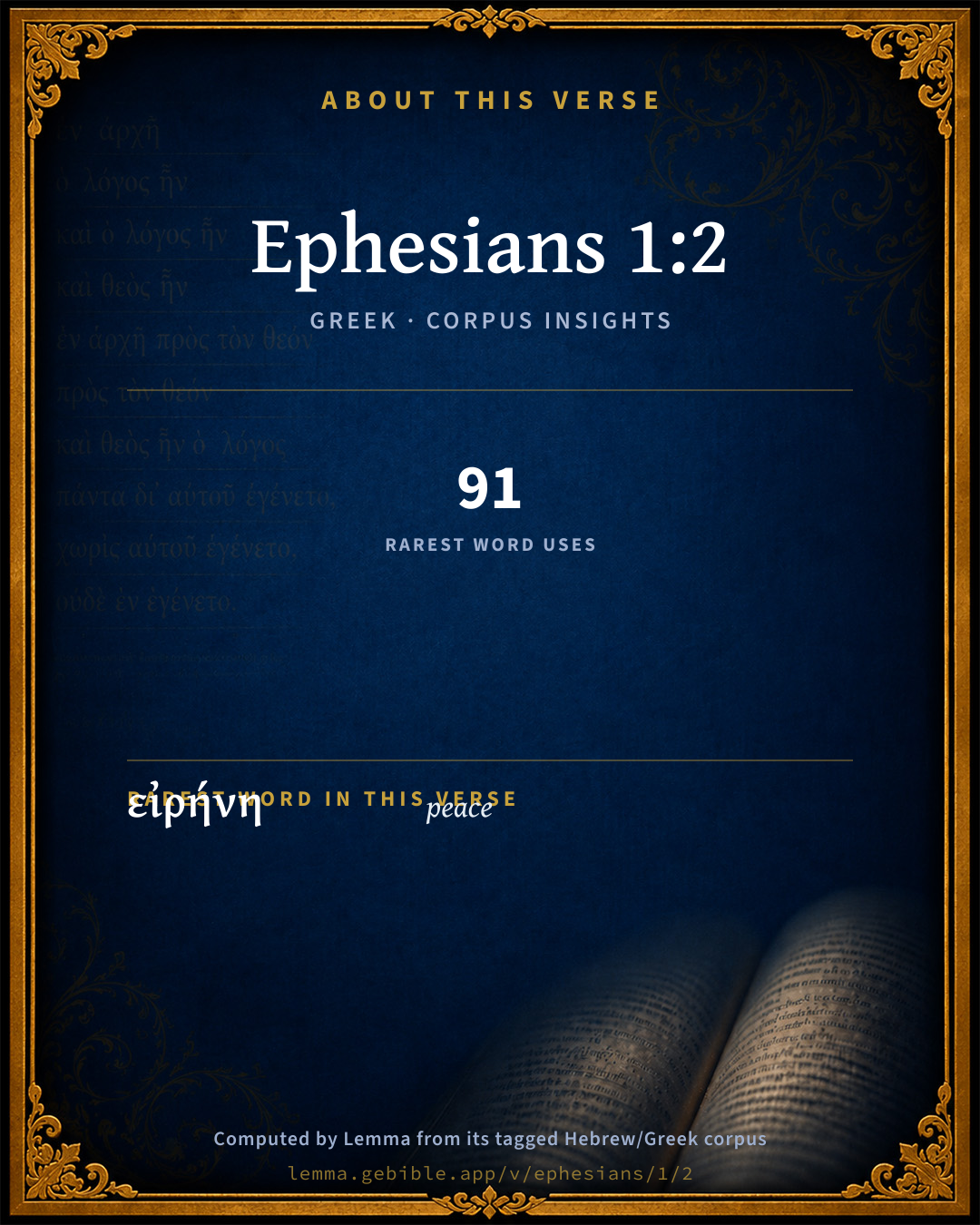
Ephesians 1:2

Greek (Tischendorf 8th ed.) Ephesians 1:2 appears in the Greek New Testament. The text above is from the Tischendorf 8th edition. Each word links to its Strong’s number and a concise gloss. Click any word for its full Thayer’s Greek Lexicon entry.
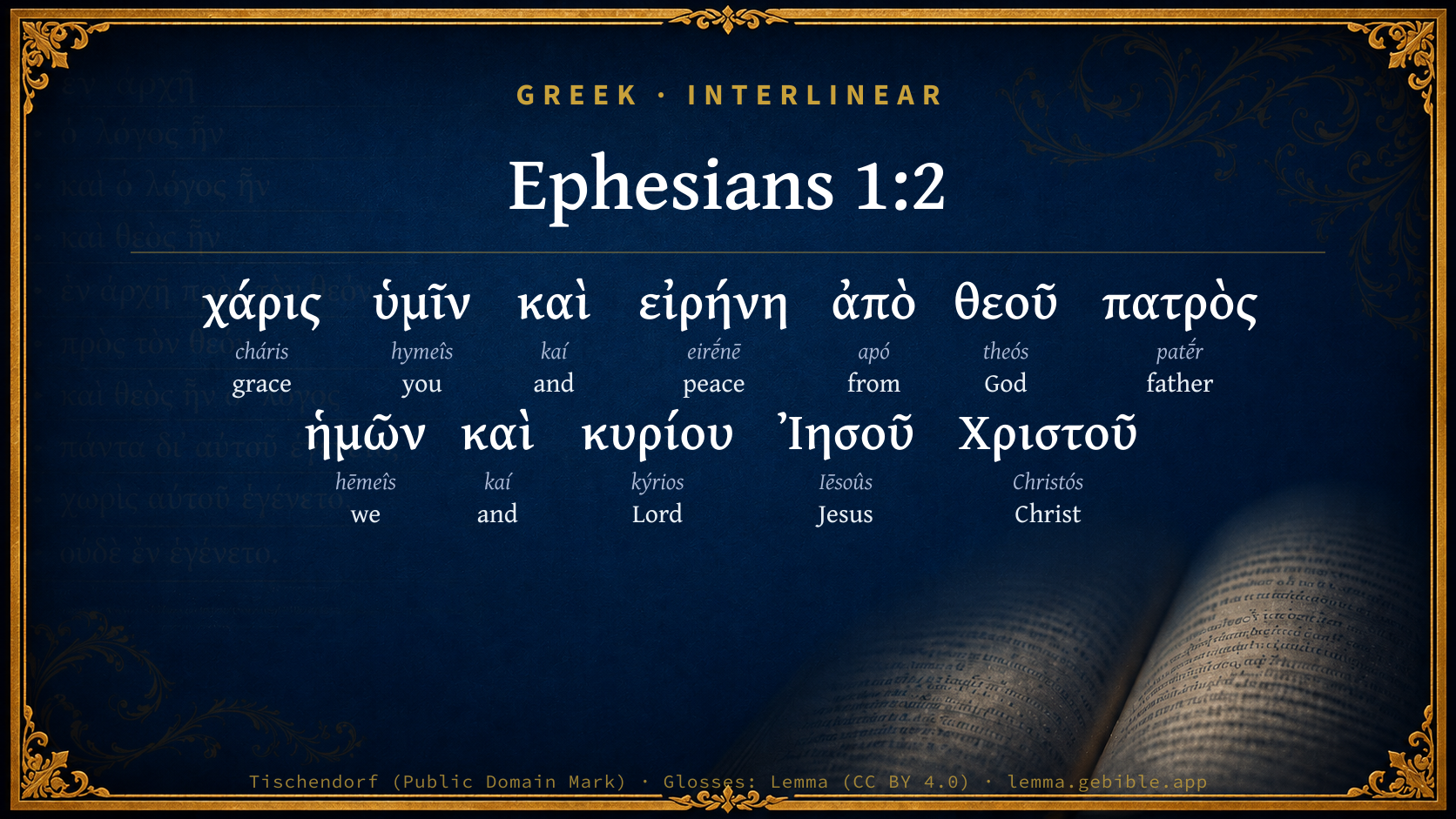
Download image
Cite this verse

Ephesians 1:2 (World English Bible). Public Domain. Lemma interlinear Bible study tool, https://lemma.gebible.app/v/ephesians/1/2.

Show BibTeX & RIS
BibTeX
RIS
English Translation
Grace to you and peace from God our Father and the Lord Jesus Christ.
World English Bible · Public Domain
Download a study sheet

One document with this verse’s original text, its word-by-word gloss line, the meaning frame, cross-references with their text, attributed commentary, and full source and license credits — printable, and it pastes into notes with its structure intact.

This verse Autodidact and up

Study sheet (.html) Plain text (.txt)

A passage Seminary Student

Up to 50 verses in one chapter. A passage sheet keeps up to 6 commentary sources and 12 cross-references per verse, in the order this page ranks them, and says so on the sheet whenever that leaves anything out. Ask for a single verse and you get the Autodidact verse sheet above.

Everything on this page stays free to read, with no account — the sheet is a download of what is already on screen, not access to it.

Want to remove ads? Support Godless Engineer
Compare translations 3

The same verse in 3 English versions, stacked beneath the original-language interlinear above. Click any original word for its lexicon entry.

Each is an independent rendering of the whole verse — the interlinear is not word-aligned to these translations.

Highlighted words mark where these versions differ — a whole-verse word diff, not a word-by-word alignment.

  • World English Bible Public Domain
    Grace to you and peace from God our Father and the Lord Jesus Christ.
  • King James Version Public Domain
    Grace be to you, and peace, from God our Father, and from the Lord Jesus Christ.
  • unfoldingWord Literal Text CC BY-SA 4.0
    Grace to you and peace from God our Father and the Lord Jesus Christ.

unfoldingWord Literal Text — © unfoldingWord, licensed CC BY-SA 4.0. Word-aligned USFM3 via Door43 (git.door43.org/unfoldingWord/en_ult).

Versions to compare (up to 4)

3 of 4 selected

Show all 19 translations

Every available English version of this verse, each an independent rendering of the whole verse.

  • World English Bible Public Domain
    Grace to you and peace from God our Father and the Lord Jesus Christ.
  • Berean Standard Bible Public Domain
    Grace and peace to you from God our Father and the Lord Jesus Christ.
  • Majority Standard Bible Public Domain
    Grace and peace to you from God our Father and the Lord Jesus Christ.
  • King James Version Public Domain
    Grace be to you, and peace, from God our Father, and from the Lord Jesus Christ.
  • American Standard Version (1901) Public Domain
    Grace to you and peace from God our Father and the Lord Jesus Christ.
  • Revised Version (1885) Public Domain
    Grace to you and peace from God our Father and the Lord Jesus Christ.
  • Geneva Bible (1599) Public Domain
    Grace be with you, and peace from God our Father, and from the Lord Iesus Christ.
  • Douay-Rheims (1899) Public Domain
    Grace be to you, and peace from God the Father, and from the Lord Jesus Christ.
  • Young's Literal Translation Public Domain
    Grace to you, and peace from God our Father, and the Lord Jesus Christ!
  • Literal Standard Version CC BY-SA 4.0
    Grace to you and peace from God our Father and the Lord Jesus Christ!
  • Unlocked Literal Bible CC BY-SA 4.0
    Grace to you and peace from God our Father and the Lord Jesus Christ.
  • unfoldingWord Literal Text CC BY-SA 4.0
    Grace to you and peace from God our Father and the Lord Jesus Christ.
  • Darby Bible Public Domain
    Grace to you and peace from God our Father, and [the] Lord Jesus Christ.
  • World Messianic Bible Public Domain
    Grace to you and peace from God our Father and the Lord Yeshua the Messiah.
  • Webster's Bible Public Domain
    Grace be to you, and peace from God our Father, and from the Lord Jesus Christ.
  • Free Bible Version CC BY-SA 4.0
    Grace and peace to you from God our Father and the Lord Jesus Christ.
  • Bible in Basic English Public Domain
    Grace to you and peace from God our Father and the Lord Jesus Christ.
  • Text-Critical English NT CC BY 4.0
    Grace to you and peace from God our Father and the Lord Jesus Christ.
  • Tyndale New Testament (1534) Public Domain
    Grace be with you and peace from God oure father and from the Lorde Iesus Christ.

Literal Standard Version (2020), Covenant Press — licensed CC BY-SA 4.0. Text via the HelloAO Bible API (eBible.org). Unlocked Literal Bible (unfoldingWord) — licensed CC BY-SA 4.0. Text via the HelloAO Bible API (eBible.org). unfoldingWord Literal Text — © unfoldingWord, licensed CC BY-SA 4.0. Word-aligned USFM3 via Door43 (git.door43.org/unfoldingWord/en_ult). Free Bible Version, Dr. Jonathan Gallagher — licensed CC BY-SA 4.0. Text via the HelloAO Bible API (eBible.org).

Word by word

More ways to search: Search by grammar → Find every occurrence → Compare this word →

Practice this passage: Drill this verse → Learn its vocabulary →

εἰρήνη
eirḗnē
G1515
“peace”
Noun, Nominative, Singular, Feminine
Part of Speech
Noun
Case
Nominative
Number
Singular
Gender
Feminine
Full Thayer's Definition

Origin: probably from a primary verb eiro (to join)

TDNT: 08:40,2

1. a state of national tranquillity a. exemption from the rage and havoc of war 2. peace between individuals, i.e. harmony, concord 3. security, safety, prosperity, felicity, (because peace and harmony make and keep things safe and prosperous) 4. of the Messiah's peace a. the way that leads to peace (salvation) 5. of Christianity, the tranquil state of a soul assured of its salvation through Christ, and so fearing nothing from God and content with its earthly lot, of whatsoever sort that is 6. the blessed state of devout and upright men after death
  1. χάρις cháris G5485 “grace” Noun, Nominative, Singular, Feminine
  2. ὑμῖν hymeîs G5210 “you” Personal pronoun, 2nd person, Dative, Plural
  3. καὶ kaí G2532 “and” Conjunction
  4. ἀπὸ apó G575 “from” Preposition
  5. θεοῦ theós G2316 “God” Noun, Genitive, Singular, Masculine
  6. πατρὸς patḗr G3962 “father” Noun, Genitive, Singular, Masculine
  7. ἡμῶν hēmeîs G2249 “we” Personal pronoun, 1st person, Genitive, Plural
  8. καὶ kaí G2532 “and” Conjunction
  9. κυρίου kýrios G2962 “Lord” Noun, Genitive, Singular, Masculine
  10. Ἰησοῦ Iēsoûs G2424 “Jesus” Noun, Genitive, Singular, Masculine
  11. Χριστοῦ Christós G5547 “Christ” Noun, Genitive, Singular, Masculine

About this verse

These counts appear in no published source. They are computed here, from the morphology-tagged text and Lemma’s own curated glosses. What Lemma adds →

12
words
11
distinct lemmas
Pauline Epistles
section

Repetition

A word recurs within this verse:

Cross-references

4

Topical passages linked to Ephesians 1:2 in the Treasury of Scripture Knowledge — connected by theme and wording, ordered by reader-vote popularity; previews shown in the World English Bible.

  • Romans 1:7 to all who are in Rome, beloved of God, called to be saints: Grace to you and peace from God our Father and the Lord Jesus Christ.
  • Galatians 1:3 Grace to you and peace from God the Father, and our Lord Jesus Christ,
  • Titus 1:4 to Titus, my true child according to a common faith: Grace, mercy, and peace from God the Father and the Lord Jesus Christ our Savior.
  • 2 Corinthians 1:2 Grace to you and peace from God our Father and the Lord Jesus Christ.

Cross-references courtesy of OpenBible.info (CC BY 4.0).

Commentary

Notes on Ephesians 1:2 from classic Christian and Jewish commentators (each source and its license shown beneath its notes). The classic Christian expositions comment on the surrounding passage and are grouped to its opening verse, so a note may address several verses; the Jewish commentaries on the Tanakh (Rashi and others) are per-verse, so they appear only where the commentator wrote on this verse.

Lemma curates 59 commentaries, every one of them public domain or Creative Commons licensed, each selected and text-cleaned for this edition rather than reprinted as found. About our sources →

Jamieson, Fausset & Brown

Robert Jamieson, A. R. Fausset & David Brown

(Rom 1:7; Co1 1:3; Co2 1:2; Gal 1:3).

Jamieson, Fausset & Brown — Commentary Critical and Explanatory on the Whole Bible (1871) — public domain (CC PDM 1.0). Text via the HelloAO Bible API.

Tyndale Open Study Notes

Tyndale Open Resources

1:2 Paul usually invokes God’s grace and peace on those to whom he is writing. Grace is undeserved blessing that comes from God’s kindness; peace is a sense of well-being and contentedness rooted in the Good News and brought about by the Holy Spirit (see Gal 5:22). Both are gifts from God our Father and the Lord Jesus Christ (see Rom 5:1-2).

Tyndale Open Study Notes — © Tyndale Open Resources, licensed CC BY-SA 4.0. Text via the HelloAO Bible API.

Expositor's Greek Testament

ed. W. Robertson Nicoll

Eph 1:2 . χάρις ὑμῖν καὶ εἰρήνη : Grace to you and peace . Supply εἴη , on the analogy of other optatives, e.g. , in 1Pe 1:2 ; 2Pe 1:2 ; Jud 1:2 . This is the Christian rendering of the greeting with which letters began. It combines the Greek form with the Hebrew, but translates the χαίρειν of the former into the evangelical χάρις . What Paul desires for his readers is the enjoyment of the free, loving favour of God and the peace which results from it. This is the usual form which the opening salutation takes in the Epistles of the NT. So it is in Romans , 1 and 2 Corinthians, Galatians, Philippians, Colossians , 1 and 2 Thessalonians, Phm 1:1 and 2 Peter; as also in Rev 1:4 . It is not, however, the only form. In James, but only in him, we have the old formula χαίρειν (Eph 1:1 ). In 1 and 2 Timothy and 2 John (but not in Titus according to the best reading) it is χάρις , ἔλεος , εἰρήνη ; and in Jude we find ἔλεος ὑμῖν καὶ εἰρήνη καὶ ἀγάπη πληθυνθείη . ἀπὸ Θεοῦ πατρὸς ἡμῶν καὶ Κυρίου Ἰησοῦ Χριστοῦ : from God our Father and the Lord Jesus Christ . The grace and peace desired for the readers by the writer are blessings which come only from God the Father and from Christ. The “Lord Jesus Christ” is named along with “God our Father” as the giver of the grace and peace a collocation impossible except on the supposition that the writer held Christ to be of the same rank with God or in a unique relation to Him. There is a distinction indicated here between God and Jesus Christ. But it is not in what they are able to give; for the gifts of grace and peace come from both. Nor is any distinction suggested here in respect of nature . But there is a distinction in respect of relation to believers. To the receivers of grace and peace God is in the relation of Father ; to the same subjects Christ is in the relation of Lord . God is Father , having made them His children by adoption. Christ is Lord , being constituted Head of the Church and having won the right to their loving obedience and honour; cf. MacP., in loco,

The Expositor's Greek Testament, edited by W. Robertson Nicoll (1897–1910) — public domain. Text from a community e-Sword module.

Cambridge Greek Testament for Schools and Colleges

2. χάρις ὑμῖν καὶ εἰρήνη. St Paul’s regular greeting, found also in 1 and 2 Peter. It is strengthened by the addition of ἔλεος in 1 and 2 Tim., 2 John. In Jude we find ἔλεος καὶ εἰρήνη καὶ ἀγάπη. Only in James do we find the usual classical χαίρειν. The source (see Hort on 1Pe 1:2) is probably to be found in the High Priestly Blessing, Num 6:25 f., where חֵן (grace or mercy) is combined with peace. Both words in a remarkable way run through the whole Epistle. For χάρις cf. Eph 1:6-7, Eph 2:5; Eph 2:7-8, Eph 3:2; Eph 3:7-8, Eph 4:7, (? 29), Eph 6:24. See on Eph 1:6. For εἰρήνη cf. Eph 2:14-15; Eph 2:17, Eph 4:3, Eph 6:15; Eph 6:23.

ἀπὸ θεοῦ πατρὸς ἡμῶν καὶ κυρίου Ἰησοῦ Χριστοῦ. This is St Paul’s usual way of describing the source of the grace and peace for which he prays, God now revealed as our Father and Jesus acknowledged as Christ and Lord. The combination of Jesus with God in one phrase under one preposition is a striking indication of faith in His Divinity. (See Lightfoot on Gal 1:2.) The Epistle is richer than any other Epistle of St Paul’s in reff. to the Fatherhood of God. See on Eph 2:18. The use of κύριος is also remarkably frequent, 23 times. On the whole title see Hort on 1Pe 1:3.

Cambridge Greek Testament for Schools and Colleges (Cambridge University Press, 1896; 21 vols, various authors incl. Carr, Maclear, Plummer, Farrar, Lumby, Moule, M. R. James, Simcox) — public domain. Text from a community e-Sword module.

Alford’s Greek Testament

Henry Alford

2.] Address and greeting.

2.] After χάρις ὑμ. κ. εἰρ. supply rather εἴη than ἔστω; see 1Pe 1:2; 2Pe 1:2; Jud 1:2. On the form of greeting, cf. Rom 1:7; 1Co 1:3; 2Co 1:2; Gal 1:3, &c.

The Socinian perversion of the words, ‘from God, who is the Father of us and of our Lord Jesus Christ,’ is decisively refuted by Tit 1:4, not to mention that nothing but the grossest ignorance of St. Paul’s spirit could ever allow such a meaning to be thought of. We must not fall into the error of refining too much, as Stier, on χάρις and εἰρήνη, as referring respectively to ἁγίοις and πιστοῖς: see above, where these last epithets do not occur.

Henry Alford, The Greek Testament (1849–1861) — public domain. Text from a community e-Sword module.

Hodge's Commentary on Romans, Ephesians & First Corinthians

Charles Hodge

Ephesians 1:2

Eph_1:2 contains the usual apostolic benediction. Paul prays that grace and peace may be granted to his readers. Grace is unmerited favor; and the grace or favor of God is the source of all good. Peace, according to the usage of the corresponding Hebrew word, means well-being in general. It comprehends all blessings flowing from the goodness of God. The apostle prays to Christ, and seeks from him blessings which God only can bestow. Christ therefore was to him the object of habitual worship. He lived in communion with Christ as a divine person, the ground of his confidence and the source of all good.

God is our Father:

· 1. As He is the author of our being;

· 2. As we were formed in his likeness. He as a spirit is the Father of spirits.

· 3. As we are born again by his Spirit and adopted into his family.

It is in reference to the last-mentioned relationship that the expression is almost always used in the New Testament. Those who are the children of God are such by regeneration and adoption.

Jesus Christ is our supreme and absolute Lord and proprietor. The word κύριος is indeed used in Scripture in the sense of master, and as a mere honorary title as in English Master or Sir. But, on the other hand, it is the translation of Adonai, supreme Lord, an incommunicable name of God, and the substitute for Jehovah, a name the Jews would not pronounce. It is in this sense that Christ is, The Lord, The Lord of Lords, The Lord God; Lord in that sense in which God alone can be Lordhaving a dominion of which divine perfection is the only adequate or possible foundation. This is the reason why no one can call him Lord, but by the Holy Ghost, 1Co_12:3. It is a confession which implies the apprehension of the glory of God as it shines in Him. It is an acknowledgment that he is God manifested in the flesh. Blessed are all they who make this acknowledgment with sincerity; for flesh and blood cannot reveal the truth therein confessed, but the Father who is in heaven.

Charles Hodge — Commentary on Romans (1835), First Corinthians (1857), and Ephesians (1856) — public domain. Text from a community e-Sword module.

Adam Clarke's Commentary

Verse 2. Grace be to you] See Clarke on Ro 1:7.

Adam Clarke's Commentary on the Bible (1810–1826) — public domain. Text from a community e-Sword/MySword module.

Ellicott's Commentary for English Readers

(2) Grace be to you, and peace.—On this, St. Paul’s all but invariable salutation in every Epistle (found also in the Epistles of St. Peter, 2 John, and Apocalypse), see Note on Rom_1:7.

(2 a.) In Eph_1:3-6, the first section of the Introduction, the Epistle ascends at once into “the heavenly places,” naturally catching therefrom the tone of adoration and thanksgiving. It dwells on the election of the children of God by His predestinating love—an election based on His will, designed for His glory, and carrying with it the blessings of the Spirit, through which they become holy and unblamable before Him. On the whole section comp. Rom_8:28-30.

A Bible Commentary for English Readers, edited by Charles John Ellicott (1878–1897) — public domain. Text from a community e-Sword module.

The Cambridge Bible for Schools and Colleges

gen. ed. J. J. S. Perowne

2. Grace be to you, and peace] So in the opening words of Rom., 1 Cor., 2 Cor., Gal., Phil., Col., 1 Thess., 2 Thess., Philem., 1 Pet., 2 Pet., and Rev. In the Pastoral Epistles, and in 2 John, the remarkable addition “mercy” appears; in Jude, “mercy, peace, and love.” In these salutations, “Grace” is all the free and loving favour of God in its spiritual efficacy; “Peace” is specially the complacency of reconciliation with which He regards His people, but so as to imply also its results in them; repose, serenity of soul; spiritual happiness, in the largest sense. See further on Eph_6:23-24 below.

from God our Father] To St Paul God is the Pater Noster of Christians, in the inner sense of their union by faith with His Son. The Scriptures, while not ignoring a universal Fatherhood of God towards mankind, always tend to put into the foreground the Fatherhood and Sonship of special connexion; that of covenant, of grace, of faith. Among many leading passages see, in N. T., Joh_1:12; Rom_8:14, &c.; Gal_3:26; 1Jn_3:1-2.

and from the Lord Jesus Christ] He, equally with His Father, is the Giver of eternal blessing, and the Lord of the soul. Incidental phrases of this kind form a testimony to the Proper Deity of the Saviour weightier, if possible, than even that of direct dogmatic passages. They indicate the drift of the main current of apostolic belief. See further on Eph_3:19 below.

The Cambridge Bible for Schools and Colleges (gen. ed. J. J. S. Perowne; Cambridge University Press, 1878–1918) — public domain. Text from a community e-Sword module.

John Gill's Exposition

Grace be to you, and peace from God,.... See Gill on Rom 1:7.

.

Ephesians 1:3

eph 1:3

eph 1:3

eph 1:3Blessed be the God and Father of our Lord Jesus Christ,.... God, the first person in the Trinity, is the God of Christ, as Christ is man and Mediator; he chose and appointed him to be the Mediator, and made a covenant with him as such; he formed and prepared an human nature for him, and anointed it with the Holy Ghost above measure, and supported it under all his trials and sufferings, and at last glorified it: and Christ, as man, prayed to him as his God, believed, hoped, and trusted in him as such, and loved him as in such a relation to him, and cheerfully obeyed his commands. And the same is the Father of Christ, as Christ is God; as such he is the Son of God; not by creation, as angels and Adam, nor by adoption, as saints, but by natural generation; he being the only begotten of the Father, his own proper Son, of the same nature and perfections with him, and equal to him. Now to "bless" God is neither to invoke nor confer a blessing on him; for there is none greater than he to be called upon; nor does he need anything, nor can he receive anything from his creature; but it is either to congratulate his greatness and goodness, to ascribe blessing, glory, and honour to him, or to give thanks unto him, both for temporal and spiritual mercies. And the reasons why he is blessed, or praised by the saints as the God and Father of Christ, are; because these are his New Testament titles, under which he is more clearly made known, and in which he delights; and because he is their God and Father in Christ; nor can they come to him in any other way, but through him; and because it is through him that all their blessings come to them, and therefore all their praises must go this way, as follows:

who hath blessed us with all spiritual blessings in heavenly places in Christ: God is the author and giver of all blessings; and he blesses his people with them, as he is the God and Father of Christ, and as he is their covenant God and Father in Christ; and he only can bless; if he blesses not, none can; and if he blesses, they are blessed indeed: the "us" that are blessed, are such who deserve, according to the tenor of the law, to be cursed; and are not all men, but some distinct from others; and who are before described as saints, and faithful in Christ Jesus; and include both Jews and Gentiles, who belong to the election of grace. And the blessings such are blessed with are spiritual, so called to distinguish them from temporal blessings. The Jews have the like distinction of , "temporal blessings", and , "spiritual blessings" (d); which latter are solid, substantial, and lasting blessings; and which concern the good of the soul or spirit of man; and are agreeable to, and desired by a spiritual man; and are applied by the Holy Spirit of God; and so the Ethiopic version renders it, "with every blessing of the Holy Spirit": and which are very comprehensive, and take in all the fulness of grace in Christ; all the blessings and sure mercies of the everlasting covenant; all things pertaining to life and godliness, such as justification, peace, pardon, adoption, sanctification, and eternal life: and with these the saints are blessed "in heavenly" places; God that blesses them is in heaven, and so is Christ, in whom they are blessed; and the completion of their blessedness will be in heaven, where their hope is laid up, and their inheritance is reserved: and this phrase may denote the safety of them, being out of the reach of any enemy, sin, Satan, or the world, to deprive them of them, as well as the nature of them; for it may be read, "in heavenly things", and so distinguishes these blessings from such as are of an earthly kind; and points at the original of them, being such as descend from above, come down from heaven; and also the tendency of them, which is to heaven; and being what give a right unto, and a meetness for the kingdom of heaven: and these they are blessed with "in Christ"; as he is their head and representative, and as they are members in him, and partakers of him; through whom, and for whose sake, they are conveyed unto them, and who himself is the sum and substance of them. Agreeably to this way of speaking, the Targumist, Jonathan ben Uzziel, on Num 6:27 paraphrases the last clause thus, "I will bless them", "in my word". The date of these blessings, "hath blessed us", may respect either first conversion, when the discovery and application of the blessings of grace are made to God's people; or the making of the covenant with Christ, their head, to whom all grace was then given, and to them in him, and their election was in Christ, as follows.

(d) Tzeror Hammor, fol. 79. 2.

John Gill's Exposition of the Whole Bible (1746–1763) — public domain (CC PDM 1.0). Text via the HelloAO Bible API.

Trapp's Complete Commentary

John Trapp

2 Grace be to you, and peace, from God our Father, and from the Lord Jesus Christ.

Ver. 2. Grace be to you, and peace] These go fitly together; because we must seek our peace in the free grace and favour of God. The ark and mercy seat were never sundered.

John Trapp, A Commentary or Exposition upon All the Books of the Old and New Testament (1647–1656) — public domain. Text from a community e-Sword module.

Albert Barnes' Notes on the Bible

Grace to you, ... - see the notes, Rom 1:7.

Albert Barnes' Notes on the Bible (1834–1885) — public domain. Text from a community e-Sword/MySword module.

Matthew Poole's English Annotations

Blessed be; i.e. thanked, praised. We bless God when we praise him for, and acknowledge him in, his excellencies or benefits.

Who hath blessed us; hath vouchsafed or communicated, all spiritual blessings to us. God blesseth us when he doeth good to us: and so the word blessed is taken in a different sense from what it was in the former clause.

With all; of all sorts or kinds.

Spiritual blessings; in opposition to temporal and worldly, which the carnal Jews principally expected, and the law mostly promised, {Deu 28:1-14} and which were but types and shadows of those spiritual blessings which immediately relate to the spiritual life and salvation of believers.

In heavenly places; Gr. supercelestial, or heavenly: understand either:

1. Things; and then it seems to be the same as spiritual blessings, only in other terms. Or:

2. Places, in opposition to earthly places, particularly the land of Canaan, in which God had formerly promised to bless his people. These spiritual blessings are in heavenly places, because, though they reach us here on earth, yet they are derived to us from God and Christ in heaven, and in heaven only have their full perfection and consummation hereafter.

In Christ; by or through Christ; upon the account of whose merit, and by whose efficiency, these spiritual blessings are derived from God to us. Or, in Christ as our Head, the repository and seat of all Divine blessings, from whom they flow down upon us as his members, receiving all we have out of his fulness. He seems to have respect to the promise made to Abraham, Gen 22:18; That in his seed all the nations of the earth should be blessed; pointing out Christ as that seed, and those blessings as spiritual. See Act 3:25,26.

Matthew Poole's English Annotations on the Holy Bible (1683–1685) — public domain. Text from a community e-Sword/MySword module.

Whedon's Commentary on the Bible

Daniel D. Whedon

2. Grace—The first of all blessings.

And peace—The blessed result.

God—The first fountain of grace.

Christ—The great maker of peace.

The benediction is the beautiful precursor of the delightful sunshine reigning through the whole epistle. Though a prisoner’s chain was on his arm, the rapture of blessing was in the apostle’s heart.

Daniel D. Whedon (gen. ed.), Commentary on the Old and New Testaments (1874–1909) — public domain. Text from a community e-Sword module.

The Pulpit Commentary

Grace unto you and peace from God our Father and the Lord Jesus Christ. As in most of Paul"s Epistles, "grace" is virtually the first word and the last, (Eph_6:24) equivalent to free, undeserved mercy in all its manifold forms and manifestations. This Epistle is so full of the subject, that it has been called "The Epistle of Grace." The apostle dwells more fully on it than even in the Epistle to the Romans, and with a more jubilant sense of its richness and sufficiency. Peace is conjoined with grace; they are like mother and daughter, or like twin sisters. Grace is the only foundation of true peace whether peace with God, peace of conscience, rest and satisfaction of soul, or peace toward our fellow-men. The source of grace and peace is "God our Father and the Lord Jesus Christ." The two are always in apposition as the Source of blessing, never in opposition. The notion is eminently unscriptural that the Father personally burned with anger until the Son rushed in to appease; both are in beautiful harmony in the scheme of grace. "God so loved the world, that he gave his only begotten Son," etc.

The Pulpit Commentary (1880–1919), ed. H.D.M. Spence-Jones & Joseph S. Exell — public domain. Text from a community e-Sword module.

Burkitt's Expository Notes on the New Testament

William Burkitt

These words may be considered two ways, 1. As a religious salutation, taken from the manner of the Jews, who expressed their desires for one another’s well-doing, by wishing peace, that is, all kind of happiness and prosperity to each other; Christianity doth neither forbid or abolish, but doth spiritualize and improve, civility, humanity, and common courtesy.

The words may be considered as an apostolical benediction, in imitation of the priest’s blessing, Num 6:1. The apostles were the patriarchs or spiritual fathers of the church of the New Testament, as the sons of Jacob were of the Old; accordingly they bless their children, wishing grace from God the Father, or grace from God as a Father; thereby denoting, that God bestows not his grace as a Creator, but as a Father in Christ, in a discriminating way and peculiar manner. And peace from our Lord Jesus Christ; he being the purchaser of our peace, he upon whom the chastisement of our peace was laid, and he that made peace for us by the blood of his cross; and thereupon God of his free grace accepts us, justifies us, and is at peace with us.

Learn, That such as have received most grace from God, stand in farther need of supplies of grace from him; they are thankful for peace, but they cannot content themselves with peace without grace; they desire both to have the heart and love of God set upon them, as well as pacified towards them; they desire to be pardoned, but above all seek to be beloved of the Father.

William Burkitt's Expository Notes on the New Testament (1700–1703) — public domain. Text from a community e-Sword module.

The People's New Testament

B. W. Johnson

2. Grace. For note on the salutation, see Rom. 1:7.

B. W. Johnson's The People's New Testament with Notes (1889–1891) — public domain. Electronic text from the Christian Classics Ethereal Library (CCEL) ThML edition.

Vincent's Word Studies in the New Testament

Marvin R. Vincent

Grace. One of the leading words of the epistle. 166 It is used thirteen times.

Marvin R. Vincent, Word Studies in the New Testament (1887–1900) — public domain. Text from a community e-Sword/MySword module.

Lesson kit

Teaching starters — assembled from the data on this page, not authored interpretation. Every prompt links to the verse data it draws on. Edit before teaching.

Ephesians, in the Pauline Epistles, opens this verse with 12 words (11 distinct Greek lemmas). Its most distinctive word is eirḗnē (“peace”). A historical commentator’s framing appears above. Read the whole chapter for the surrounding context.

Discussion questions

  1. How does “peace” (eirḗnē) shape what this verse is saying?
  2. How does Romans 1:7, which shares this passage’s theme, read alongside this verse?
  3. What does the repetition of “and” (2× in this one verse) do in this verse?
  4. Compare how Jamieson, Fausset & Brown and Tyndale Open Study Notes read this verse. Where do they agree or differ?

Things to notice

Reading settings

Reading text

Shown beneath each verse's original-language words.

Old Testament
Old Testament edition

Read the OT as the Masoretic Hebrew (MT) or the Greek Septuagint (LXX).

English shown for the Greek Septuagint (in the Hebrew ↔ Greek comparison).

Comparing translations? Open the Compare panel on any verse page to stack up to four side by side.