Acts 28:31

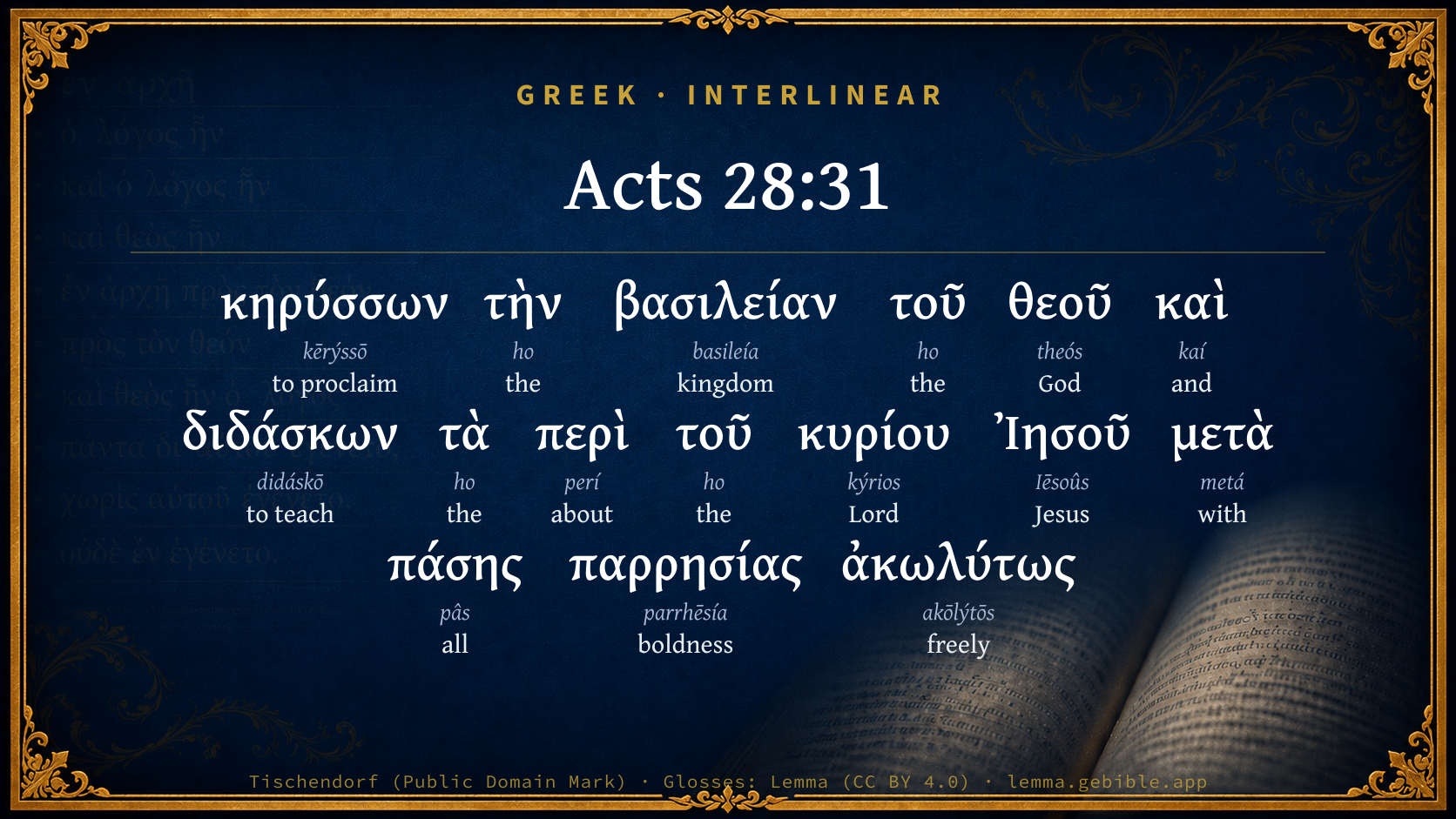
Greek (Tischendorf 8th ed.) Acts 28:31 appears in the Greek New Testament. The text above is from the Tischendorf 8th edition. Each word links to its Strong’s number and a concise gloss. Click any word for its full Thayer’s Greek Lexicon entry.
Download image
Cite this verse

Acts 28:31 (World English Bible). Public Domain. Lemma interlinear Bible study tool, https://lemma.gebible.app/v/acts/28/31.

Show BibTeX & RIS
BibTeX
RIS
English Translation
preaching the Kingdom of God, and teaching the things concerning the Lord Jesus Christ with all boldness, without hinderance.
World English Bible · Public Domain
Highlights
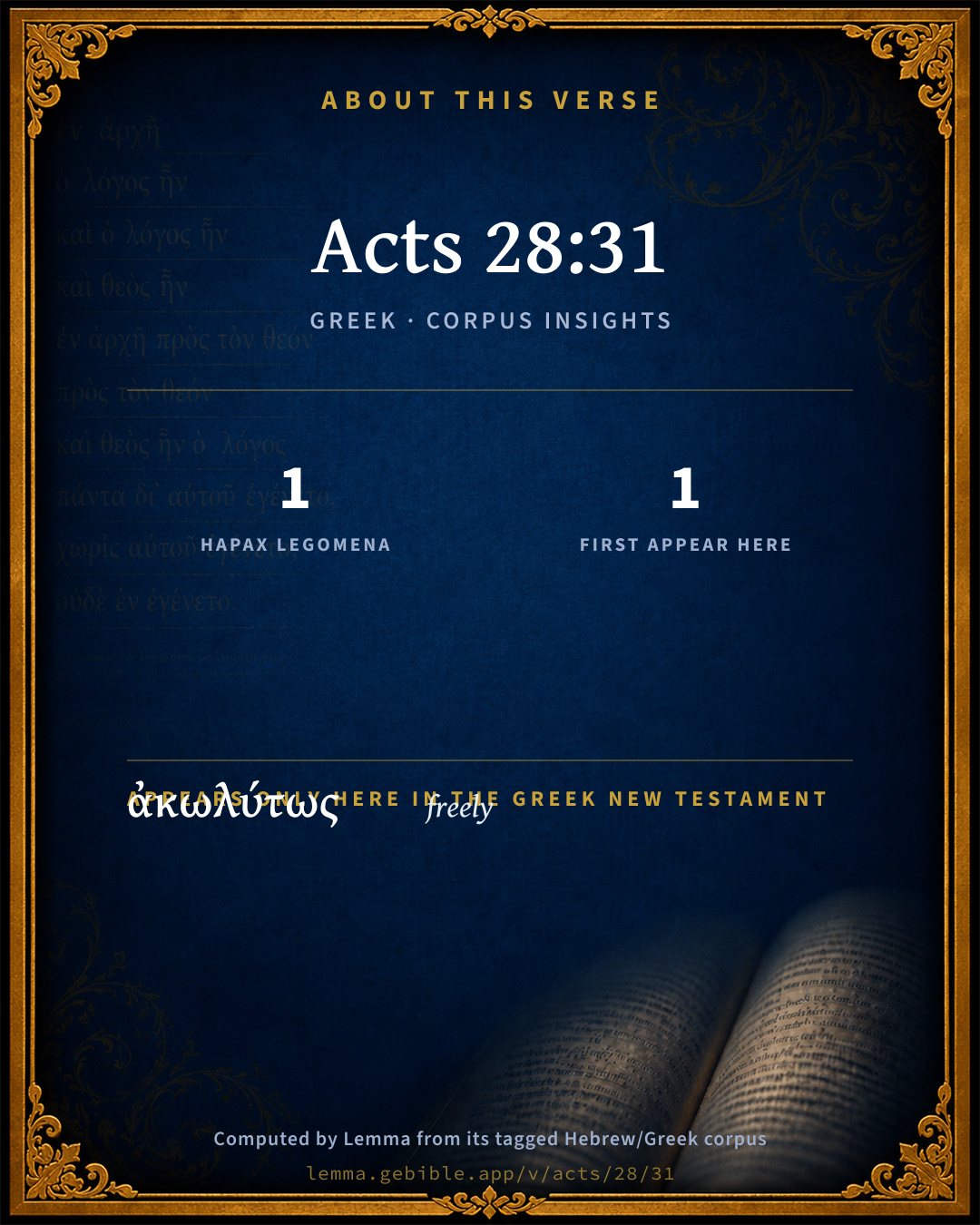
  • 1 hapax legomenon — only here in the Greek New Testament
  • 1 first appearance in the Greek New Testament
Full analysis ↓
Download a study sheet

One document with this verse’s original text, its word-by-word gloss line, the meaning frame, cross-references with their text, attributed commentary, and full source and license credits — printable, and it pastes into notes with its structure intact.

This verse Autodidact and up

Study sheet (.html) Plain text (.txt)

A passage Seminary Student

Up to 50 verses in one chapter. A passage sheet keeps up to 6 commentary sources and 12 cross-references per verse, in the order this page ranks them, and says so on the sheet whenever that leaves anything out. Ask for a single verse and you get the Autodidact verse sheet above.

Everything on this page stays free to read, with no account — the sheet is a download of what is already on screen, not access to it.

Want to remove ads? Support Godless Engineer
Compare translations 3

The same verse in 3 English versions, stacked beneath the original-language interlinear above. Click any original word for its lexicon entry.

Each is an independent rendering of the whole verse — the interlinear is not word-aligned to these translations.

Highlighted words mark where these versions differ — a whole-verse word diff, not a word-by-word alignment.

  • World English Bible Public Domain
    preaching the Kingdom of God, and teaching the things concerning the Lord Jesus Christ with all boldness, without hinderance.
  • King James Version Public Domain
    Preaching the kingdom of God, and teaching those things which concern the Lord Jesus Christ, with all confidence, no man forbidding him.
  • unfoldingWord Literal Text CC BY-SA 4.0
    proclaiming the kingdom of God and teaching the things about the Lord Jesus Christ with all boldness, without hindrance.

unfoldingWord Literal Text — © unfoldingWord, licensed CC BY-SA 4.0. Word-aligned USFM3 via Door43 (git.door43.org/unfoldingWord/en_ult).

Versions to compare (up to 4)

3 of 4 selected

Show all 19 translations

Every available English version of this verse, each an independent rendering of the whole verse.

  • World English Bible Public Domain
    preaching the Kingdom of God, and teaching the things concerning the Lord Jesus Christ with all boldness, without hinderance.
  • Berean Standard Bible Public Domain
    Boldly and freely he proclaimed the kingdom of God and taught about the Lord Jesus Christ.
  • Majority Standard Bible Public Domain
    Boldly and freely he proclaimed the kingdom of God and taught about the Lord Jesus Christ.
  • King James Version Public Domain
    Preaching the kingdom of God, and teaching those things which concern the Lord Jesus Christ, with all confidence, no man forbidding him.
  • American Standard Version (1901) Public Domain
    preaching the kingdom of God, and teaching the things concerning the Lord Jesus Christ with all boldness, none forbidding him.
  • Revised Version (1885) Public Domain
    preaching the kingdom of God, and teaching the things concerning the Lord Jesus Christ with all boldness, none forbidding him.
  • Geneva Bible (1599) Public Domain
    Preaching the kingdome of God, and teaching those things which concerne the Lord Iesus Christ, with all boldnesse of speache, without let.
  • Douay-Rheims (1899) Public Domain
    Preaching the kingdom of God, and teaching the things which concern the Lord Jesus Christ, with all confidence, without prohibition.
  • Young's Literal Translation Public Domain
    preaching the reign of God, and teaching the things concerning the Lord Jesus Christ with all boldness -- unforbidden.
  • Literal Standard Version CC BY-SA 4.0
    preaching the Kingdom of God, and teaching the things concerning the Lord Jesus Christ with all boldness—unforbidden.
  • Unlocked Literal Bible CC BY-SA 4.0
    He was proclaiming the kingdom of God and was teaching the things about the Lord Jesus Christ with all boldness. No one stopped him.
  • unfoldingWord Literal Text CC BY-SA 4.0
    proclaiming the kingdom of God and teaching the things about the Lord Jesus Christ with all boldness, without hindrance.
  • Darby Bible Public Domain
    preaching the kingdom of God, and teaching the things concerning the Lord Jesus Christ, with all freedom unhinderedly.
  • World Messianic Bible Public Domain
    proclaiming God’s Kingdom and teaching the things concerning the Lord Yeshua the Messiah with all boldness, without hindrance.
  • Webster's Bible Public Domain
    Preaching the kingdom of God, and teaching those things which concern the Lord Jesus Christ, with all confidence, no man forbidding him.
  • Free Bible Version CC BY-SA 4.0
    He spoke of the kingdom of God, and taught about the Lord Jesus Christ very boldly. No one prevented him.
  • Bible in Basic English Public Domain
    Preaching the kingdom of God and teaching about the Lord Jesus Christ without fear, and no orders were given that he was not to do so.
  • Text-Critical English NT CC BY 4.0
    preaching the kingdom of God and teaching about the Lord Jesus Christ with all boldness and without hindrance.
  • Tyndale New Testament (1534) Public Domain
    preachyng the kyngdome of God and teachynge those thinges which concerned the lorde Iesus with all confidence vnforboden.

Literal Standard Version (2020), Covenant Press — licensed CC BY-SA 4.0. Text via the HelloAO Bible API (eBible.org). Unlocked Literal Bible (unfoldingWord) — licensed CC BY-SA 4.0. Text via the HelloAO Bible API (eBible.org). unfoldingWord Literal Text — © unfoldingWord, licensed CC BY-SA 4.0. Word-aligned USFM3 via Door43 (git.door43.org/unfoldingWord/en_ult). Free Bible Version, Dr. Jonathan Gallagher — licensed CC BY-SA 4.0. Text via the HelloAO Bible API (eBible.org).

Word by word

More ways to search: Search by grammar → Find every occurrence → Compare this word →

Practice this passage: Drill this verse → Learn its vocabulary →

ἀκωλύτως
akōlýtōs
G209
“freely”
Adverb
Part of Speech
Adverb
Full Thayer's Definition

Origin: from a compound of G1 (as a negative particle) and a derivative of G2967

TDNT: None

1. without hindrances, freely
  1. κηρύσσων kērýssō G2784 “to proclaim” Verb, Present, Active, Participle, Nominative, Singular, Masculine
  2. τὴν ho G3588 “the” Article, Accusative, Singular, Feminine
  3. βασιλείαν basileía G932 “kingdom” Noun, Accusative, Singular, Feminine
  4. τοῦ ho G3588 “the” Article, Genitive, Singular, Masculine
  5. θεοῦ theós G2316 “God” Noun, Genitive, Singular, Masculine
  6. καὶ kaí G2532 “and” Conjunction
  7. διδάσκων didáskō G1321 “to teach” Verb, Present, Active, Participle, Nominative, Singular, Masculine
  8. τὰ ho G3588 “the” Article, Accusative, Plural, Neuter
  9. περὶ perí G4012 “about” Preposition
  10. τοῦ ho G3588 “the” Article, Genitive, Singular, Masculine
  11. κυρίου kýrios G2962 “Lord” Noun, Genitive, Singular, Masculine
  12. Ἰησοῦ Iēsoûs G2424 “Jesus” Noun, Genitive, Singular, Masculine
  13. μετὰ metá G3326 “with” Preposition
  14. πάσης pâs G3956 “all” Adjective, Genitive, Singular, Feminine
  15. παρρησίας parrhēsía G3954 “boldness” Noun, Genitive, Singular, Feminine

About this verse

These counts appear in no published source. They are computed here, from the morphology-tagged text and Lemma’s own curated glosses. What Lemma adds →

16
words
13
distinct lemmas
Acts
section

Notable vocabulary

1 hapax legomenon — a word that appears only here in the entire Greek New Testament:

  • ἀκωλύτως freely G209

First appearance in Scripture

This word makes its first canonical appearance in the Greek New Testament here:

  • ἀκωλύτως freely G209

Shared distinctive vocabulary

παρρησίας boldness G3954 occurs in 31 verses of the Greek New Testament. Also found in:

Repetition

A word recurs within this verse:

Cross-references

15

Topical passages linked to Acts 28:31 in the Treasury of Scripture Knowledge — connected by theme and wording, ordered by reader-vote popularity; previews shown in the World English Bible.

  • Acts 4:29 Now, Lord, look at their threats, and grant to your servants to speak your word with all boldness,
  • Ephesians 6:19–20 on my behalf, that utterance may be given to me in opening my mouth, to make known with boldness the mystery of the Gospel,
  • Matthew 4:23 Jesus went about in all Galilee, teaching in their synagogues, preaching the Gospel of the Kingdom, and healing every disease and every sickness among the people.
  • Acts 28:23 When they had appointed him a day, many people came to him at his lodging. He explained to them, testifying about the Kingdom of God, and persuading them concerning Jesus, both from the law of Moses and from the prophets, from morning until evening.
  • Acts 8:12 But when they believed Philip preaching good news concerning the Kingdom of God and the name of Jesus Christ, they were baptized, both men and women.
  • Acts 20:25 Now, behold, I know that you all, among whom I went about preaching the Kingdom of God, will see my face no more.
  • Philippians 1:14 and that most of the brothers in the Lord, being confident through my bonds, are more abundantly bold to speak the word of God without fear.
  • 2 Timothy 4:17 But the Lord stood by me, and strengthened me, that through me the message might be fully proclaimed, and that all the Gentiles might hear; and I was delivered out of the mouth of the lion.
  • Acts 4:31 When they had prayed, the place was shaken where they were gathered together. They were all filled with the Holy Spirit, and they spoke the word of God with boldness.
  • Acts 5:42 Every day, in the temple and at home, they never stopped teaching and preaching Jesus, the Christ.
  • Luke 8:1 It happened soon afterwards, that he went about through cities and villages, preaching and bringing the good news of the Kingdom of God. With him were the twelve,
  • Acts 23:11 The following night, the Lord stood by him, and said, "Cheer up, Paul, for as you have testified about me at Jerusalem, so you must testify also at Rome."
  • 2 Timothy 2:9 in which I suffer hardship to the point of chains as a criminal. But God's word isn't chained.
  • Mark 1:14 Now after John was taken into custody, Jesus came into Galilee, preaching the Gospel of the Kingdom of God,
  • Colossians 4:3–4 praying together for us also, that God may open to us a door for the word, to speak the mystery of Christ, for which I am also in bonds;

Cross-references courtesy of OpenBible.info (CC BY 4.0).

Commentary

Notes on Acts 28:31 from classic Christian and Jewish commentators (each source and its license shown beneath its notes). The classic Christian expositions comment on the surrounding passage and are grouped to its opening verse, so a note may address several verses; the Jewish commentaries on the Tanakh (Rashi and others) are per-verse, so they appear only where the commentator wrote on this verse.

Lemma curates 59 commentaries, every one of them public domain or Creative Commons licensed, each selected and text-cleaned for this edition rather than reprinted as found. About our sources →

Tyndale Open Study Notes

Tyndale Open Resources

28:31 Despite being under house arrest (28:16), Paul boldly proclaimed the Kingdom message. • And no one tried to stop him (Greek akōlutōs, “without hindrance”): This single word in Greek is the last word of the book of Acts and one of the keys to its meaning: God’s word cannot be chained, even when its messengers are (2 Tim 2:9; see Phil 1:12-14). Acts is the story of an unhindered message of Good News, available to all people throughout the world, whether Jew, Gentile, proselyte, rich, or poor. The mission of proclaiming this message is accomplished in the power of the Spirit (Acts 1:8); it embraces Jews (3:1–5:42), Samaritans (8:1-25), converts to Judaism (2:11; 13:43), “God-fearers” (8:26-40; 9:32–11:18), and Gentiles (13:1–28:28). • Luke ends his account with Paul still under house arrest in Rome (about AD 60–62). Paul was later released and traveled freely. According to tradition, Paul was imprisoned again in Rome about AD 64 and was martyred there during Nero’s persecution of believers.

Tyndale Open Study Notes — © Tyndale Open Resources, licensed CC BY-SA 4.0. Text via the HelloAO Bible API.

Bengel's Gnomon

Johann Albrecht Bengel

Act 28:31. Βασιλείαν, the kingdom) in the very seat of the empire (kingdom) of the whole earth. So presently, περὶ τοῦ Κυρίου, concerning the Lord. Comp. Act 28:23. The mention of the kingdom had been a matter of odium in the eyes of Pilate: now Rome bears its being publicly stated.—παῤῥησίας, confidence) internally.—ἀκωλύτως, without hindrance) externally, after having overcome so many hindrances. The Victory of the Word of God. Paul at Rome forms the climax (crowning point) of the Gospel preaching, and the end of the Acts; which Luke otherwise (2Ti 4:11) might have easily brought on to the death of Paul. He began at Jerusalem; he ends at Rome. [And at the close of this very period of two years the fourth thousand years from the Creation of the world was completed.—V. g.] Thou hast, O Church, thy form given to thee. It is thine to preserve it, and to keep the deposit committed to thee. In the Old Testament, Isaiah, the volume of the Twelve Prophets, Ecclesiastes and Lamentations, have a close threatening and severe; whence the Jews are wont to subjoin the penultimate verses, of a more joyful character, without the vowel points. But in the system of the books of the New Testament all the endings of books have all that is favourable and joyous.[158]

[158] Bengel, J. A. (1860). Vol. 2: Gnomon of the New Testament (M. E. Bengel & J. C. F. Steudel, Ed.) (A. R. Fausset, Trans.) (692–732). Edinburgh: T&T Clark.

Bengel's Gnomon of the New Testament — English translation (T&T Clark, Edinburgh, 1860) — public domain. Text from a community e-Sword module.

Meyer's Critical & Exegetical Commentary

Heinrich August Wilhelm Meyer

Act_28:31. Solemn close of the whole book, which is not to be regarded as incomplete (see Introd. § 3). The Gospel also concludes with a sonorous participial ending (but less full and solemn).

κηρύσσων κ.τ.λ.] thus his word was not bound in his bonds, 2Ti_2:9.

ἀκωλύτως] Plat. Crat. p. 415 D; Herodian. i. 12. 15; Victoria verbi Dei. Paulus Romae, apex evangelii, actorum finis, Bengel.

Meyer — Critical and Exegetical Commentary on the New Testament — English translation by Peter Christie, edited by Frederick Crombie (T&T Clark, 1880) — public domain. Text from a community e-Sword module.

Expositor's Greek Testament

ed. W. Robertson Nicoll

Act 28:31 . τὰ περὶ : on the phrase see p. 481. τοῦ Κ . Ἰ . Χ ., see critical note, and cf. Act 11:17 , Act 15:26 , the full phrase corresponds with the solemn conclusion of the book. μετὰ π . παῤῥ .: the phrase with or without πάσης four times in Acts, and nowhere else in N.T., see on p. 128. In Jerusalem by the Twelve, Act 4:29 , and in Rome no less than in Jerusalem by St. Paul, the witness was given “with all boldness,” cf. Phi 1:14 ; and so the promise in the vision vouchsafed to the Apostle of the Gentiles was verified, Act 23:11 , and the aim of the Gentile historian fulfilled when the Gospel was thus preached boldly and openly, ἕως ἐσχ . τῆς γῆς , see note on Act 1:8 . ἀκωλύτως : “eadem plane dicuntur in ep. ad Phil. Roma data, Act 1:12 sqq.,” Blass, and the word of God had free course and was glorified. The adverb is found in Plato, Epict., Herodian, and also in Josephus. In LXX the adjective is found in Wis 7:22 , and the adverb is used by Symm., Job 34:31 . There is a note of triumph in the word, Bengel, Zöckler, and we may note with Wordsworth and Page the cadence of these concluding words, μετα π . π . ἀκωλ . But all this does not forbid the view that the writer intended to give a third book to complete his work. This latter view is strongly insisted upon by Prof. Ramsay, St. Paul , p. 23 ff., while Bishop Lightfoot, B.D., i., 27, can see no conceivable plea for any third treatise, if the purpose of the narrative is completed by Paul coming to Rome and there delivering his message, so, although less strongly, Harnack, Chron. , i. p. 248, see note on Act 1:8 . But Prof. Ramsay has received the strong support not only of Zöckler, and curiously enough of Spitta, Apostelgeschichte , p. 318, but still more recently amongst English writers of Rendall, and in Germany of Dr. Zahn. Just as in St. Luke’s Gospel Luk 24:44 forms not merely a starting point for, but an anticipation of, the succeeding history, or just as Luk 24:44-53 contain in a summary what is afterwards related in greater detail, Act 1:2 , so in Act 28:30-31 of Act 28 we have, as it were, a brief sketch of what succeeded the events hitherto recorded, and an anticipation of what followed upon them. This probability remains quite apart from the additional force which is given to it if Ramsay is right in regarding πρῶτος , Act 1:1 , as signifying not simply πρότερος , but the first of a series, a view strongly supported by Zahn, Einleitung , ii., p. 371. Certainly the aorist, Act 28:30 (see above), and the expression διετίαν ὅλην seem to show that some fact was known to the writer which followed the close of the two years, and we can therefore hardly say that he wrote no more because he knew no more, unless we also suppose that he wrote his history at the conclusion and not during the course of the two years. This he may have done while the result of St. Paul’s first trial was still unknown, although Phi 1:25-27 ; Phi 2:24 , Phm 1:22 , show us plainly with what confidence the Apostle awaited the issue. At all events almost any conjecture seems more probable than that the writer should have concluded so abruptly if he had nothing more to chronicle than the immediate and tragic death of his hero! Zöckler, Apostelgeschichte , p. 162, Spitta, Zur Geschichte und Litteratur des Urchristentums , I., 15, 16. To say with Jülicher, Einleitung , p. 27, that he refrained from doing this because in such an event he would chronicle not the triumph but the defeat of the Gospel is certainly a strange argument, and no one has given a better answer to it than Harnack by asking, Since when did the early Christians regard martyrdom as a defeat? Is the death of Christ, or of Stephen, in the mind of the author of Acts a defeat? is it not rather a triumph? Chron. , i., 247. The elaborate discussion of the abrupt conclusion in Acts by Wendt, 1899, pp. 31, 32, is entirely based upon the assumption that Luke was not the author of Acts, and that therefore this author, whoever he was, wrote no more because his information failed him, and he knew no more. This could not have been so in the case of Luke, who was with the Apostle at Rome, as we have from undoubted testimony quite apart from Acts. See further Introd. For the release of St. Paul, his subsequent journeys to Spain and to the East, and his second imprisonment, see in support, Zahn, Einleitung , i., p. 435 ff., Harnack, Chron. , i., 239, Spitta, u. s. , Salmon, Introd. , p. 403 ff., Die zweite römische Gefangenschaft des Apostels Paulus , Steinmeyer (1897), and Critical Review (July), 1898. There were many possible reasons why the hearing of St. Paul’s appeal was so long delayed. The record of the previous proceedings forwarded by Festus may have been lost in the wreck, and it was therefore necessary to wait for fresh official information, as the prisoner’s accusers had not arrived. And when they arrived, it is very possible that they may have been glad to interpose fresh obstacles, and that they would be content to keep Paul bound as before; as evidence was probably wanted, not only from Jerusalem, but from various parts of the empire, the interposition of these fresh delays was easy. St. Paul had himself suggested that the Jews in Asia ought to be summoned, or to be present, Act 24:19 . That such delays would not be unusual we may learn from Tacitus, e.g., Ann. , xiii., 43; cf. Suet., Nero , 15. When we remember how long a delay occurred in the case of the Jewish priests, the friends of Josephus, Vita , 3, who were sent to Rome by Felix to plead their cause, it ceases to be surprising that St. Paul was detained so long without a trial; see on the whole question Lewin, St. Paul , ii., 277 ff.; Lightfoot, Phil. , p. 4; Knabenbauer, Actus Apostolorum , pp. 453, 454, 1899.

The Expositor's Greek Testament, edited by W. Robertson Nicoll (1897–1910) — public domain. Text from a community e-Sword module.

Jamieson, Fausset & Brown

Robert Jamieson, A. R. Fausset & David Brown

with all confidence, no man forbidding him--enjoying, in the uninterrupted exercise of his ministry, all the liberty of a guarded man. Thus closes this most precious monument of the beginnings of the Christian Church in its march from east to west, among the Jews first, whose center was Jerusalem; next among the Gentiles, with Antioch for its headquarters; finally, its banner is seen waving over imperial Rome, foretokening its universal triumphs. That distinguished apostle whose conversion, labors, and sufferings for "the faith which once he destroyed" occupy more than half of this History, it leaves a prisoner, unheard, so far as appears, for two years. His accusers, whose presence was indispensable, would have to await the return of spring before starting for the capital, and might not reach it for many months; nor, even when there, would they be so sanguine of success--after Felix, Festus, and Agrippa had all pronounced him innocent--as to be impatient of delay. And if witnesses were required to prove the charge advanced by Tertullus, that he was "a mover of sedition among all the Jews throughout the [Roman] world" (Act 24:5), they must have seen that unless considerable time was allowed them the case would certainly break down. If to this be added the capricious delays which the emperor himself might interpose, and the practice of Nero to hear but one charge at a time, it will not seem strange that the historian should have no proceedings in the case to record for two years. Begun, probably, before the apostle's arrival, its progress at Rome under his own eye would furnish exalted employment, and beguile many a tedious hour of his two years' imprisonment. Had the case come on for hearing during this period, much more if it had been disposed of, it is hardly conceivable that the History should have closed as it does. But if, at the end of this period, the Narrative only wanted the decision of the case, while hope deferred was making the heart sick (Pro 13:12), and if, under the guidance of that Spirit whose seal was on it all, it seemed of more consequence to put the Church at once in possession of this History than to keep it back indefinitely for the sake of what might come to be otherwise known, we cannot wonder that it should be wound up as it is in its two concluding verses. All that we know of the apostle's proceedings and history beyond this must be gathered from the Epistles of the Imprisonment--Ephesians, Philippians, Colossians, and Philemon--written during this period, and the Pastoral Epistles--to Timothy and Titus, which, in our judgment, are of subsequent date. From the former class of Epistles we learn the following particulars: (1) That the trying restraint laid upon the apostle's labors by his imprisonment had only turned his influence into a new channel; the Gospel having in consequence penetrated even into the palace, and pervaded the city, while the preachers of Christ were emboldened; and though the Judaizing portion of them, observing his success among the Gentiles, had been led to inculcate with fresh zeal their own narrower Gospel, even this had done much good by extending the truth common to both (See on Phi 1:12-18; Phi 4:22); (2) That as in addition to all his other labors, "the care of all the churches pressed upon him from day to-day" (Co2 11:28), so with these churches he kept up an active correspondence by means of letters and messages, and on such errands he lacked not faithful and beloved brethren enough ready to be employed--Luke; Timotheus; Tychicus; (John) Mark; Demas; Aristarchus; Epaphras; Onesimus; Jesus, called Justus; and, for a short time, Epaphroditus (See on Col 4:7; Col 4:9-12; Col 4:14; Plm 1:23-24; see Introduction to Ephesians, Introduction to Philippians, and Introduction to Philemon). That the apostle suffered martyrdom under Nero at Rome has never been doubted. But that the appeal which brought him to Rome issued in his liberation, that he was at large for some years thereafter and took some wide missionary circuits, and that he was again arrested, carried to Rome, and then executed--was the undisputed belief of the early Church, as expressed by CHRYSOSTOM, JEROME, and EUSEBIUS, in the fourth century, up to CLEMENT OF ROME, the "fellow laborer" of the apostle himself (Phi 4:3), in the first century. The strongest possible confirmation of this is found in the Pastoral Epistles, which bear marks throughout of a more advanced state of the Church, and more matured forms of error, than can well have existed at any period before the appeal which brought the apostle to Rome; which refer to movements of himself and Timothy that cannot without some straining (as we think) be made to fit into any prior period; and which are couched in a manifestly riper style than any of his other Epistles. (See Introduction to First Timothy, Introduction to Second Timothy Introduction to Titus and Notes). All this has been called in question by modern critics of great research and acuteness [PETAVIUS, LARDNER, DE WETTE, WIESELER, DAVIDSON, and others]. But those who maintain the ancient view are of equal authority and more numerous, while the weight of argument appears to us to be decidedly on their side.

Next: Romans Introduction

Jamieson, Fausset & Brown — Commentary Critical and Explanatory on the Whole Bible (1871) — public domain (CC PDM 1.0). Text via the HelloAO Bible API.

Adam Clarke's Commentary

Verse 31. Preaching the kingdom of God] Showing the spiritual nature of the true Church, under the reign of the Messiah. For an explanation of this phrase, See Clarke on Mt 3:2.

Those things which concern the Lord] The Redeemer of the world was to be represented as the LORD; as JESUS; and as the CHRIST. As the Lord, ὁ Κυριος, the sole potentate, upholding all things by the word of his power; governing the world and the Church; having all things under his control, and all his enemies under his feet; in short, the maker and upholder of all things, and the judge of all men. As Jesus-the Saviour; he who saves, delivers, and preserves; and especially he who saves his people from their sins. For the explanation of the word JESUS, see the note on Joh 1:17. As Christ-the same as Messiah; both signifying the ANOINTED: he who was appointed by the Lord to this great and glorious work; who had the Spirit without measure, and who anoints, communicates the gifts and graces of that Spirit to all true believers. St. Paul taught the things which concerned or belonged to the Lord Jesus Christ. He proved him to be the Messiah foretold by the prophets, and expected by the Jews; he spoke of what he does as the Lord, what he does as Jesus, and what he does as Christ. These contain the sum and substance of all that is called the Gospel of Christ. Yet, the things which concern the Lord Jesus Christ, necessarily include the whole account of his incarnation, preaching in Judea, miracles, persecutions, passion, death, burial, resurrection, ascension, intercession, and his sending down the gifts and graces of the Holy Spirit. These were the subjects on which the apostle preached for two whole years, during his imprisonment at Rome.

With all confidence] παρρησιας, Liberty of speech; perfect freedom to say all he pleased, and when he pleased. He had the fullest toleration from the Roman government to preach as he pleased, and what he pleased; and the unbelieving Jews had no power to prevent him.

It is supposed that it was during this residence at Rome that he converted Onesimus, and sent him back to his master Philemon, with the epistle which is still extant. And it is from Phm 1:23, Phm 1:24, of that epistle, that we learn that Paul had then with him Epaphras, Marcus, Aristarchus, Demas, and Luke.

Here St. Luke's account of Paul's travels and sufferings ends; and it is probable that this history was written soon after the end of the two years mentioned in Ac 28:30.

That the apostle visited many places after this, suffered much in the great cause of Christianity, and preached the Gospel of Jesus with amazing success, is generally believed. How he came to be liberated we are not told; but it is likely that, having been kept in this sort of confinement for about two years, and none appearing against him, he was released by the imperial order.

Concerning the time, place, and manner of his death, we have little certainty. It is commonly believed that, when a general persecution was raised against the Christians by Nero, about A.D. 64, under pretence that they had set Rome on fire, both St. Paul and St. Peter then sealed the truth with their blood; the latter being crucified with his head downward; the former being beheaded, either in A.D. 64 or 65, and buried in the Via Ostiensis. EUSEBIUS, Hist, Eccles. lib. ii. cap. 25, intimates that the tombs of these two apostles, with their inscriptions, were extant in his time; and quotes as his authority a holy man of the name of Caius, who wrote against the sect of the Cataphrygians, who has asserted this, as from his personal knowledge. See Eusebius, by Reading, vol. i. p. 83; and see Dr. Lardner, in his life of this apostle, who examines this account with his usual perspicuity and candour. Other writers have been more particular concerning his death: they say that it was not by the command of Nero that he was martyred, but by that of the prefects of the city, Nero being then absent; that he was beheaded at Aquae Salviae, about three miles from Rome, on Feb. 22; that he could not be crucified, as Peter was, because he was a freeman of the city of Rome. But there is great uncertainty on these subjects, so that we cannot positively rely on any account that even the ancients have transmitted to us concerning the death of this apostle; and much less on the accounts given by the moderns; and least of all on those which are to be found in the Martyrologists. Whether Paul ever returned after this to Rome has not yet been satisfactorily proved. It is probable that he did, and suffered death there, as stated above; but still we have no certainty.

THERE are several subscriptions to this book in different manuscripts: these are the principal:-

-The Acts of the Apostles

-The Acts of the holy Apostles

-The end of the Acts of the holy Apostles, written by Luke the Evangelist, and fellow traveller of the illustrious Apostle Paul

-By the holy Apostle and Evangelist Luke, c. c.

The versions are not less various in their subscriptions.

The end of the Acts, that is, the History of the holy Apostles.-SYRIAC.

Under the auspices and help of God, the book of the Acts of the pure Apostles is finished whom we humbly supplicate to obtain us mercy by all their prayers. Amen. And may praise be ascribed to God, the Lord of the universe! - ARABIC.

This (book) of the Acts of the Apostles, which has been by many translated into the Roman tongue, is translated from the Roman and Greek tongue into the AEthiopic. - AETHIOPIC.

On the nature and importance of the Acts of the Apostles, see what is said in the preface to this book. To which may be added the following observations, taken from the conclusion of Dr. Dodd's Commentary.

"The plainness and simplicity of the narration are strong circumstances in its favour the writer appears to have been very honest and impartial, and to have set down, very fairly, the objections which were made to Christianity, both by Jews and heathens, and the reflections which enemies cast upon it, and upon the first preachers of it. He has likewise, with a just and honest freedom, mentioned the weaknesses, faults, and prejudices, both of the apostles and their converts. There is a great and remarkable harmony between the occasional hints dispersed up and down in St. Paul's epistles, and the facts recorded in this history; insomuch as that it is generally acknowledged that the history of the Acts is the best clue to guide us in the studying of the epistles written by that apostle. The other parts of the New Testament do likewise agree with this history, and give great confirmation to it; for the doctrines and principles are every where uniformly the same; the conclusions of the gospels contain a brief account of those things which are more particularly related in the beginning of the Acts. And there are frequent intimations, in other parts of the gospels, that such an effusion of the Spirit was expected; and that with a view to the very design which the apostles and primitive Christians are said to have carried on, by virtue of that extraordinary effusion which Christ poured out upon his disciples after his ascension; and, finally, the epistles of the other apostles, as well as those of St. Paul, plainly suppose such things to have happened as are related in the Acts of the Apostles; so that the history of the Acts is one of the most important parts of the sacred history, for neither the gospels nor epistles could have been so clearly understood without it; but by the help of it the whole scheme of the Christian revelation is set before us in an easy and manifest view.

"Even the incidental things mentioned by St. Luke are so exactly agreeable to all the accounts which remain of the best ancient historians, among the Jews and heathens, that no person who had forged such a history, in later ages, could have had that external confirmation, but would have betrayed himself by alluding to some customs or opinions since sprung up; or by misrepresenting some circumstance, or using some phrase or expression not then in use. The plea of forgery, therefore, in later ages, cannot be allowed; and for a man to have published a history of such things so early as St. Luke wrote; (that is, while some of the apostles and many other persons were alive who were concerned in the transactions which he has recorded;) if his account had not been punctually true, could have been only to have exposed himself to an easy confutation and certain infamy.

"As, therefore, the Acts of the Apostles are in themselves consistent and uniform, the incidental things agreeable to the best ancient historians which have come down to us, and the main facts supported and confirmed by the other books of the New Testament, and by the unanimous testimony of so many of the ancient fathers, we may, I think, very fairly, and with great justness, conclude that, if any history of former times deserves credit, the Acts of the Apostles ought to be received and credited; and, if the history of the Acts of the Apostles be true, Christianity cannot be false: for a doctrine so good in itself, and attended with so many miraculous and Divine testimonies, has an the possible masks of a true revelation."

On St. PAUL'S character and conduct, see the observations at the end of Ac 9:43, where the subject is particularly considered.

The book of the ACTS is not only a history of the Church, the most ancient and most impartial, as it is the most authentic extant, but it is also a history of God's grace and providence, The manner in which he has exerted himself in favour of Christianity, and of the persons who were originally employed to disseminate its doctrines, shows us the highest marks of the Divine approbation. Had not that cause been of God, could he have so signally interposed in its behalf? Would he have wrought such a series of miracles for its propagation and support? And would all its genuine professors have submitted to sustain the loss of all things, had not his own Spirit, by its consolations in their hearts, given them to feel that his favour was better than life?

That the hardships suffered by the primitive apostles and Christians were great, the facts themselves related in this book sufficiently declare: that their consolation and happiness were abundant, the cheerful manner in which they met and sustained those hardships demonstrates. He who cordially embraced Christianity found himself no loser by it; if he lost earthly good in consequence, it was infinitely overbalanced by the spiritual good which he received. Paul himself, who suffered most, had this compensated by superabounding happiness. Wherever the Gospel comes, it finds nothing but darkness, sin, and misery; wherever it is received, it communicates light, holiness, and felicity. Reader, magnify thy God and Saviour, who hath called thee to such a state of salvation. Should thou neglect it, how grievous must thy punishment be! Not only receive its doctrines, as a system of wisdom and goodness, but receive them as motives of conduct, and as a rule of life; and show thy conscientious belief of them, by holding the truth in righteousness, and thus adorn these doctrines of God thy Saviour in all things.-Amen.

I have often with pleasure, and with great advantage to my subject, quoted Dr. Lardner, whose elaborate works in defense of Divine revelation are really beyond all praise. The conclusion of his Credibility of the Gospel History is peculiarly appropriate; and the introduction of it here can need no apology. I hope, with him, I may also say:-

"I have now performed what I undertook, and have shown that the account given by the sacred writers of persons and things is confirmed by other ancient authors of the best note. There is nothing in the books of the New Testament unsuitable to the age in which they are supposed to have been written. There appears in these writers a knowledge of the affairs of those times, not to be found in authors of later ages. We are hereby assured that the books of the New Testament are genuine, and that they were written by persons who lived at or near the time of those events of which they have given the history.

"Any one may be sensible how hard it is for the most learned, acute, and cautious man, to write a book in the character of some person of an earlier age; and not betray his own time by some mistake about the affairs of the age in which he pretends to place himself; or by allusions to customs or principles since sprung up; or by some phrase or expression not then in use. It is no easy thing to escape all these dangers in the smallest performance, though it be a treatise of theory or speculation: these hazards are greatly increased when the work is of any length; and especially if it be historical, and be concerned with characters and customs. It is yet more difficult to carry on such a design in a work consisting of several pieces, written, to all appearance, by several persons. Many indeed are desirous to deceive, but all hate to be deceived; and therefore, though attempts have been made to impose upon the world in this way, they have never, or very rarely, succeeded; but have been detected and exposed by the skill and vigilance of those who have been concerned for the truth.

"The volume of the New Testament consists of several pieces: these are ascribed to eight several persons; and there are the strongest appearances that they were not all written by any one hand, but by as many persons as they are ascribed to. There are lesser differences in the relations of some facts, and such seeming contradictions as would never have happened if these books had been all the work of one person, or of several who wrote in concert. There are as many peculiarities of temper and style as there are names of writers; divers of which show no depth of genius nor compass of knowledge! Here are representations of titles, posts, behaviour of persons of higher and lower ranks in many parts of the world; persons are introduced, and their characters are set in a full light; here is a history of things done in several cities and countries; and there are allusions to a vast variety of customs and tenets, of persons of several nations, sects, and religions. The whole is written without affectation, with the greatest simplicity and plainness, and is confirmed by other ancient writers of unquestionable authority. If it be difficult for a person of learning and experience to compose a small treatise concerning matters of speculation, with the characters of a more early age than that in which he writes, it is next to impossible that such a work of considerable length, consisting of several pieces, with a great variety of historical facts, representations of characters, principles, and customs of several nations, and distant countries, of persons of ranks and degrees, of many interests and parties, should be performed by eight several persons, the most of them unlearned, without any appearance of concert.

"I might perhaps call this argument a demonstration, if that term had not been often misapplied by men of warm imagination, and been bestowed upon reasonings that have but a small degree of probability. But though it should not be a strict demonstration that these writings are genuine, or though it be not absolutely impossible, in the nature of the thing, that the books of the New Testament should have been composed in a later age than that to which they are assigned, and of which they have innumerable characters, yet, I think, it is in the highest degree improbable, and altogether incredible.

"If the books of the New Testament were written by persons who lived before the destruction of Jerusalem, that is, if they were written at the time in which they are said to have been written, the things related in them are true. If they had not been matter of fact, they would not have been credited by any persons near that time, and in those parts of the world in which they are said to have been done, but would have been treated as the most notorious lies and falsehoods. Suppose three or four books should now appear amongst us, in the language most generally understood, giving an account of many remarkable and extraordinary events, which had happened in some kingdom of Europe, and in the most noted cities of the countries next adjoining to it; some of them said to have happened between sixty and seventy gears ago, others between twenty and thirty, others nearer our own time; would they not be looked upon as the most manifest and ridiculous forgeries and impostures that ever were contrived? Would great numbers of persons in those very places, change their religious principles and practices upon the credit of things reported to be publicly done, which no man ever heard of before? Or, rather, is it possible that such a design as this would be conceived by any sober and serious persons, or even the most wild and extravagant? If the history of the New Testament be credible, the Christian religion is true. If the things that were related to have been done by Jesus, and by his followers, by virtue of powers derived from him, do not prove a person to come from God, and that his doctrine is true and divine, nothing can. And as Jesus does here, in the circumstances of his birth, life, sufferings, and after exaltation, and in the success of his doctrine, answer the description of the great person promised and foretold in the Old Testament, he is at the same time showed to be the Messiah.

"From the agreement of the writers of the New Testament with other ancient writers, we are not only assured that these books are genuine, but also that they are come down to us pure and uncorrupted, without any considerable interpolations or alterations. If such had been made in them, there would have appeared some smaller differences at least between them and other ancient writings.

"There has been in all ages a wicked propensity in mankind to advance their own notions and fancies by deceits and forgeries: they have been practised by heathens, Jews, and Christians, in support of imaginary historical facts, religious schemes and practices, and political interests. With these views some whole books have been forged, and passages inserted into others of undoubted authority. Many of the Christian writers of the second and third centuries, and of the following ages, appear to have had false notions concerning the state of Judea between the nativity of Jesus and the destruction of Jerusalem; and concerning many other things occasionally mentioned in the New Testament. The consent of the best ancient writers with those of the New Testament is a proof that these books are still untouched, and that they have not been new modelled and altered by Christians of later times, in conformity to their own peculiar sentiments.

"This may be reckoned an argument that the generality of Christians had a very high veneration for these books; or else that the several sects among them have had an eye upon each other, that no alterations might be made in those writings to which they have all appealed. It is also an argument that the Divine providence has all along watched over and guarded these books, (a very fit object of especial care,) which contain the best of principles, were apparently written with the best views, and have in them inimitable characters of truth and simplicity."-See Dr. Lardner's WORKS, vol. i. p. 419.

Let him answer these arguments who can. - A. C.

Adam Clarke's Commentary on the Bible (1810–1826) — public domain. Text from a community e-Sword/MySword module.

Ellicott's Commentary for English Readers

(31) No man forbidding him.—The fact is interesting as showing the attitude of the Roman empire to the new faith. So far, even under Nero, it was tolerant, and even though the “sect” of the Christians was “everywhere spoken against,” a leading teacher of that sect was allowed free room to propagate his views. The rulers of the empire were not as yet alarmed at the thought of the wide-spread secret organisation of the Christian Society, and the influence of Seneca and Burrus may not have been without its share in this policy of toleration. The history closes somewhat abruptly. It may have been the intention of the writer to continue his narrative. It is a natural inference that when he closed it the two years had expired, or were on the point of expiring; that he, who had remained with the Apostle during his imprisonment, started with him on his eastward journey afterwards; and that some incidents to us unknown, hindered him from completing the work which he had begun. It is possible, on the other hand, that Theophilus, as an Italian convert (see Introduction), may have known what had passed in Rome during the Apostle’s first sojourn there, or subsequently, and that St. Luke did not aim at more than setting before his friend the stages by which St. Paul had been brought to the imperial city.

A Bible Commentary for English Readers, edited by Charles John Ellicott (1878–1897) — public domain. Text from a community e-Sword module.

John Gill's Exposition

Preaching the kingdom of God,.... That is, the Gospel, as in Luk 4:43; he preached up Jesus as the King Messiah, and declared that his kingdom was come, and opened the nature of it; that it consisted not in meats and drinks, but in righteousness and peace, and joy in the Holy Ghost; which is the kingdom of grace here, and is within a man, in his heart, where grace reigns through righteousness, unto eternal life: and he gave them same account of the kingdom of glory, and the way unto it; and showed, that without regeneration and sanctification, no one could be meet for it; and without the justifying righteousness of Christ, no man could have a right unto it, or be possessed of it:

and teaching those things which concern the Lord Jesus Christ: his person, as God and man; his office as Mediator, being prophet, priest, and King; his incarnation and birth; his life and miracles; his doctrine and obedience, sufferings and death; his resurrection, ascension, session at God's right hand; his intercession, and second coming to judgment; with all the truths of the Gospel, in which he has a concern; as redemption, peace, reconciliation and pardon, by his blood and sacrifice, and justification by his righteousness, and salvation and eternal life through him. These things had been the subject of the apostle's ministry, throughout the whole of it: he began at Damascus with preaching Jesus as the Son of God and the true Messiah; and he ends at Rome, with teaching the things concerning him: at his first setting out in the work of the Lord, he determined to make known none but Christ, and him crucified; and in this resolution he continued through the whole course of his life, and abode by it to the end: and this he did

with all confidence; with all freedom and liberty in his soul, though he was bound in his body with a chain; with all plainness, openness, and faithfulness; and with all courage and boldness, though in the midst of adversaries:

no man forbidding him; not the Roman emperor, nor the Roman senate, nor any other magistrate; nor could the Jews hinder him, nor was his mouth to be stopped by any; nor could the open door of the Gospel be shut, or its course be impeded; for though the apostle was bound, the word of God was not, but ran and was glorified; and was made known, and even owned in Caesar's palace; some say Nero's cupbearer, and Poppea his concubine, were converted by him: and he not only continued preaching the Gospel during the two years of his imprisonment at Rome, but also wrote several epistles to churches, and particular persons; as the epistles to the Galatians, Ephesians, Philippians, Colossians, and the Hebrews, and to Philemon, and the "second" epistle to Timothy: some copies add here, "Amen"; and at the close of the Alexandrian copy, stand these words, "the Acts of the holy Apostles"; and at the Syriac version these, "the End of the Acts of the blessed Apostles, that is, of their Histories".

Next: Romans Introduction

John Gill's Exposition of the Whole Bible (1746–1763) — public domain (CC PDM 1.0). Text via the HelloAO Bible API.

Trapp's Complete Commentary

John Trapp

31 Preaching the kingdom of God, and teaching those things which concern the Lord Jesus Christ, with all confidence, no man forbidding him.

Ver. 31. Preaching the kingdom, &c.] Mr Bradford, during the time of his imprisonment, preached twice a day continually, unless sickness hindered him; where also the sacrament was often ministered. And through his means (the keeper so well did bear with him) such resort of good people was daily at his lecture, and ministration of the sacrament, that commonly his chamber was well nigh filled.

" Deus dedit his quoque finem."

John Trapp, A Commentary or Exposition upon All the Books of the Old and New Testament (1647–1656) — public domain. Text from a community e-Sword module.

Albert Barnes' Notes on the Bible

Preaching the kingdom of God - See the notes on Act 20:25.

With all confidence - Openly and boldly, without anyone to hinder him. It is known also that Paul was not unsuccessful even when a prisoner at Rome. Several persons were converted by his preaching, even in the court of the emperor. The things which had happened to him, he says Phi 1:12-14, had fallen out rather to the furtherance of the gospel, so that his bonds in Christ were manifested in all the palace, and in all other places; and many brethren in the Lord, says he, waxing confident by my bonds, are much more bold to speak the Word without fear. In this situation he was remembered with deep interest by the church at Philippi, who sent Epaphroditus to him with a contribution to supply his needs. Of their kindness he speaks in terms of the tenderest gratitude in Phi 2:25; Phi 4:18. During his confinement also, he was the means of the Conversion of Onesimus, a runaway servant of Philemon, of Colosse in Phrygia Phm 1:10, whom he sent back to his master with a letter to himself, and with an epistle to the church at that place. See the Epistle to the Colossians, Col 4:8-9, Col 4:18. During this imprisonment, he wrote, according to Lardner, the following epistles, in the order and time mentioned, namely,:

Ephesians, April of

61 a.d.

2 Timothy, May of

61 a.d.

Philippians, before the end of

62 a.d.

Colossians

62 a.d.

Philemon

62 a.d.

Hebrews, the spring of

63 a.d.

Here closes the inspired account of the propagation of Christianity; of the organization of the Christian church, and of the toils and persecutions of the apostle Paul. Who can but be deeply affected when he comes to the conclusion of this inspired book recording the history of the spread of the Christian religion, and the labors and trials of that wonderful man, the apostle Paul. Who can help heaving a sigh of regret that the historian did not carry forward the history of Paul until his death, and that henceforward, in the history of the church, we want this faithful, inspired guide; and that, from the close of this book, everything becomes at once so involved in obscurity and uncertainty? Instead, however, of pouring forth unavailing regrets that the sacred historian has carried us no further onward, we should rather employ the language of praise that God inspired the writer of this book to give a history of the church for 30 years after the ascension of the Saviour; that he has recorded the accounts of the first great revivals of religion; that he has presented us the examples of the early missionary zeal; that he has informed us how the early Christians endured persecution and toil; that he has conducted us from land to land, and from city to city, showing us everywhere how the gospel was propagated, until we are led to the seat of the Roman power, and see the great apostle of Christianity there proclaiming, in that mighty capital of the world, the name of Jesus as the Saviour of people.

Perhaps there could be no more appropriate close to the book of the inspired history than thus to have conducted the apostle of the Gentiles to the capital of the Roman world, and to leave the principal agent in the establishment of the Christian religion in that seat of intelligence, influence, and power. It is the conducting of Christianity to the very height of its earthly victories; and having shown its power in the provinces of the empire, it was proper to close the account with the record of its achievements in the capital.

Why Luke closed his history here is not known. It may have been that he was not afterward the companion of Paul; or that he might have been himself removed by death. It is agreed on all hands that he did not attend Paul in his subsequent travels; and we should infer from the conclusion of this book that he did not survive the apostle, as it is almost incredible, if he did, that he did not mention his release and death. It is the uniform account of antiquity that Luke, after the transactions with which the Acts of the Apostles closes, passed over into Achaia, where he lived a year or two, and there died at the age of 84 years.

Everything in regard to the apostle Paul, after the account with which Luke closes this book, is involved in doubt and uncertainty. By what means he was set at liberty is not known; and there is a great contradiction of statements in regard to his subsequent travels, and even in regard to the time of his death. It is generally agreed, indeed, that he was set at liberty in the year of our Lord 63 a.d. After this some of the fathers assert that he traveled over Italy and passed into Spain. But this account is involved in great uncertainty. Lardner, who has examined all the statements with care, and than whom no one is better qualified to pronounce an opinion on these subjects, gives the following account of the subsequent life of Paul (Works, vol. v. pp. 331-336, London edition, 1829). He supposes that after his release he went from Rome to Jerusalem as soon as possible; that he then went to Ephesus, and from thence to Laodicea and Colosse; and that he returned to Rome by Troas, Philippi, and Corinth. The reason why he returned to Rome, Lardner supposes, was that he regarded that city as opening before him the widest and most important field of labor, and that, therefore, he proposed there to spend the remainder of his life.

In the year of our Lord 64 a.d., a dreadful fire happened at Rome which continued for six or seven days. It was generally supposed that the city had been set on fire by order of the Emperor Nero. In order to divert the attention of the people from this charge against himself, he accused the Christians of having been the authors of the conflagration, and excited against them a most furious and bloody persecution. In this persecution it is generally supposed that Paul and Peter suffered death, the former by being beheaded, and the latter by crucifixion. Paul is supposed to have been beheaded rather than crucified, because he was a Roman citizen, and because it was unlawful to put a Roman citizen to death on a cross. Lardher thinks that this occurred in the year 65. Where Paul was beheaded is not certainly known. It is generally supposed to have occurred at a place called the Salvian Waters, about 3 miles from Rome, and that he was buried in the Ostian Way, where a magnificent church was afterward built. But of this there is no absolute certainty.

It is far more important and interesting for us to be assured from the character which he evinced, and from the proofs of his zeal and toil in the cause of the Lord Jesus, that his spirit rested in the bosom of his Saviour and his God. Wherever he died, his spirit, we doubt not, is in heaven. And where that body rested at last, which he labored “to keep under,” and which he sought to bring “into subjection” 1Co 9:27, and which was to him so much the source of conflict and of sin Rom 7:5, Rom 7:23, is a matter of little consequence. It will be guarded by the eye of that Saviour whom he served, and will be raised up to eternal life. In his own inimitable language, it was “sown in corruption, it shall be raised in incorruption; it was sown in dishonor, it shall be raised in glory; it was sown in weakness, it shall be raised in power; it was sown a natural body, it shall be raised a spiritual body,” 1Co 15:42-44. And in regard to him, and to all other saints, “when that corruptible shall have put on incorruption, and that mortal shall have put on immortality, then shall be brought to pass the saying that is written, Death is swallowed up in victory,” 1Co 15:54.

To Paul now, what are all his sorrows, and persecutions, and toils in the cause of his Master? What but a source of thanksgiving that he was permitted thus to labor to spread the gospel through the world? So may we live - imitating his life of zeal, and self-denial, and faithfulness, that when we rise from the dead we may participate with him in the glories of the resurrection of the just.

Albert Barnes' Notes on the Bible (1834–1885) — public domain. Text from a community e-Sword/MySword module.

Haydock's Catholic Bible Commentary

Here terminates the history of St. Paul, as contained in the Acts of the Apostles. The other actions of this great apostle, for want of being recorded, are involved in much obscurity. That he obtained his liberty again, and made many voyages to carry the light of the gospel into many countries, is certain: but nothing is known as to the manner or time. He finished his labours by martyrdom, being beheaded at Rome in the 66th of the Christian æra [the year A.D. 66], and the 13th of Nero. What a degree of virtue might we not attain, were we animated by the spirit and courage of a St. Paul. Let us at least try to imitate his example; and, if in dangers and difficulties we cannot clothe our souls in adamant, as he did, we may certainly avoid yielding ingloriously to every light impression. Let us at an humble distance tread in his footsteps and live so that we may navigate in safety the boisterous ocean of life, and by the grace of Jesus Christ arrive at the port, where danger is no more to be apprehended. (St. John Chrysostom, hom. lv. in Act. at the end.)

====================

George Leo Haydock (1774–1849), Haydock's Catholic Family Bible and Commentary, 1859 edition — public domain. Excludes Psalms (Douay-Rheims chapter numbering differs from Protestant) and Deuterocanonical books (Catholic canon only).

Matthew Poole's English Annotations

The kingdom of God; the gospel is so called; as also Paul preached that kingdom of God which is to come at the end of the world, which falls in with the subject he was so often upon, concerning the resurrection; which if men did but believe effectually, all the other ends of preaching would be easily obtained.

Those things which concern the Lord Jesus Christ; Christ’s precepts and miracles, his death and resurrection.

No man forbidding him: God, who puts bounds to the raging sea, had stopped the Jews’ malice, and bidden it go no further; and he who delivered Daniel from the lions, had delivered Paul from Nero, and would have delivered him, had not his death been more for the glory of God, and the good of Paul himself, than his life; which at last he offered in confirmation of the truths which he had preached; which he foresaw, 2Ti 4:6, and, as Eusebius says, it came to pass accordingly.

This book may be called, not only πραξεις, but τερατα; not only the Acts, but the wonders, of the Apostles: though the holy penman and the apostles meekly contented themselves with that name by which at present it is called, yet what wonders are contained in it! Not only such as were wrought by the apostles, but for them, to deliver, preserve, and encourage them; insomuch as the attempt to silence them, and to hinder the progress of the gospel preached by them, proved as vain as if men had endeavoured to hinder the sun from shining, or the wind from blowing.

Now unto him, who is able to work so as none can hinder, be all honour and glory, dominion and power, for ever and ever. Amen.

Matthew Poole's English Annotations on the Holy Bible (1683–1685) — public domain. Text from a community e-Sword/MySword module.

John Wesley's Explanatory Notes

No man forbidding him - Such was the victory of the word of God. While Paul was preaching at Rome, the Gospel shone with its highest lustre. Here therefore the Acts of the Apostles end; and end with great advantage. Otherwise St. Luke could easily have continued his narrative to the apostle's death.

John Wesley, Explanatory Notes Upon the Whole Bible (1754–1765) — public domain. Text via the GEBible commentary corpus.

McGarvey & Pendleton's Commentaries

J. W. McGarvey

See notes on verse 30

J. W. McGarvey (with Philip Y. Pendleton), Commentaries on the New Testament (The Fourfold Gospel, 1914; Acts; and the epistles) — public domain. Text from a community e-Sword/MySword module.

Cambridge Greek Testament for Schools and Colleges

31. μετὰ πάσης παρρησίας ἀκωλύτως, with all confidence (Rev. Vers. ‘boldness’), no man forbidding him. παῤῥησία implies that ‘freedom of speech’ which was looked upon by the Athenians as the great mark of their liberty. For ἀκωλύτως cf. Josephus, Ant. XII. 1. 12.

For Englishmen there must arise the thought that perhaps from some of those Roman soldiers who heard Paul in his prison the message of the Gospel came first to our island.

The historian had now reached the end of his work, and does not even tell the manner of the Apostle’s release, though as he mentions the duration of the imprisonment, he must have known how he came to be liberated. But that concerned not the purpose of his record, and so he has no word more. “Victoria Verbi Dei. Paulus Romæ. Apex Evangelii. Actorum Finis” (Bengel).

Cambridge Greek Testament for Schools and Colleges (Cambridge University Press, 1896; 21 vols, various authors incl. Carr, Maclear, Plummer, Farrar, Lumby, Moule, M. R. James, Simcox) — public domain. Text from a community e-Sword module.

Alford’s Greek Testament

Henry Alford

31.] It is evident that Paul was not released from custody, but continued with the soldier who kept him,—(1) from the expressions here; he received all who came in to him, but we do not hear of his preaching in the synagogue or elsewhere: he preached and taught with all boldness and unhindered, both being mentioned as remarkable circumstances, and implying that there were reasons why this could hardly have been expected: and (2) from his constantly speaking of himself in the Epistles written during this period, as a prisoner, see Eph 6:19, Eph 6:20; Col 4:3, Col 4:4; Phm 1:9; Philipp. passim. On the whole question regarding the chronology of his imprisonment,—and the reason of this abrupt ending of the history, see Prolegg. to Acts, § iv. 4-7:—and on its probable termination and the close of St. Paul’s life, see the Prolegg. to the Pastoral Epistles, § ii. 7 ff.

Henry Alford, The Greek Testament (1849–1861) — public domain. Text from a community e-Sword module.

Lesson kit

Teaching starters — assembled from the data on this page, not authored interpretation. Every prompt links to the verse data it draws on. Edit before teaching.

Acts, in the Acts, opens this verse with 16 words (13 distinct Greek lemmas). Its most distinctive word is akōlýtōs (“freely”). A historical commentator’s framing appears above. Read the whole chapter for the surrounding context.

Discussion questions

  1. How does “freely” (akōlýtōs) shape what this verse is saying?
  2. 1 word here appears nowhere else in the Greek New Testament. Why might the author reach for such rare wording?
  3. This is the first place “freely” appears in Scripture (first appears here). What does its debut here establish?
  4. How does Mark 8:32, which shares the word «boldness», read alongside this verse?
  5. What does the repetition of “the” (4× in this one verse) do in this verse?
  6. These translations render this verse differently; the difference is in the English rendering, not the original. What questions does that raise?
  7. Compare how Tyndale Open Study Notes and Bengel's Gnomon read this verse. Where do they agree or differ?

Things to notice

  • 1 word in this verse appears nowhere else in the Greek New Testament.
  • 1 word makes its first canonical appearance in Scripture here.
  • These translations choose different wording for 14 words in this verse.
  • “the” occurs 4× in this single verse.
  • 13 distinct Greek lemmas span 16 words in this verse.

Reading settings

Reading text

Shown beneath each verse's original-language words.

Old Testament
Old Testament edition

Read the OT as the Masoretic Hebrew (MT) or the Greek Septuagint (LXX).

English shown for the Greek Septuagint (in the Hebrew ↔ Greek comparison).

Comparing translations? Open the Compare panel on any verse page to stack up to four side by side.