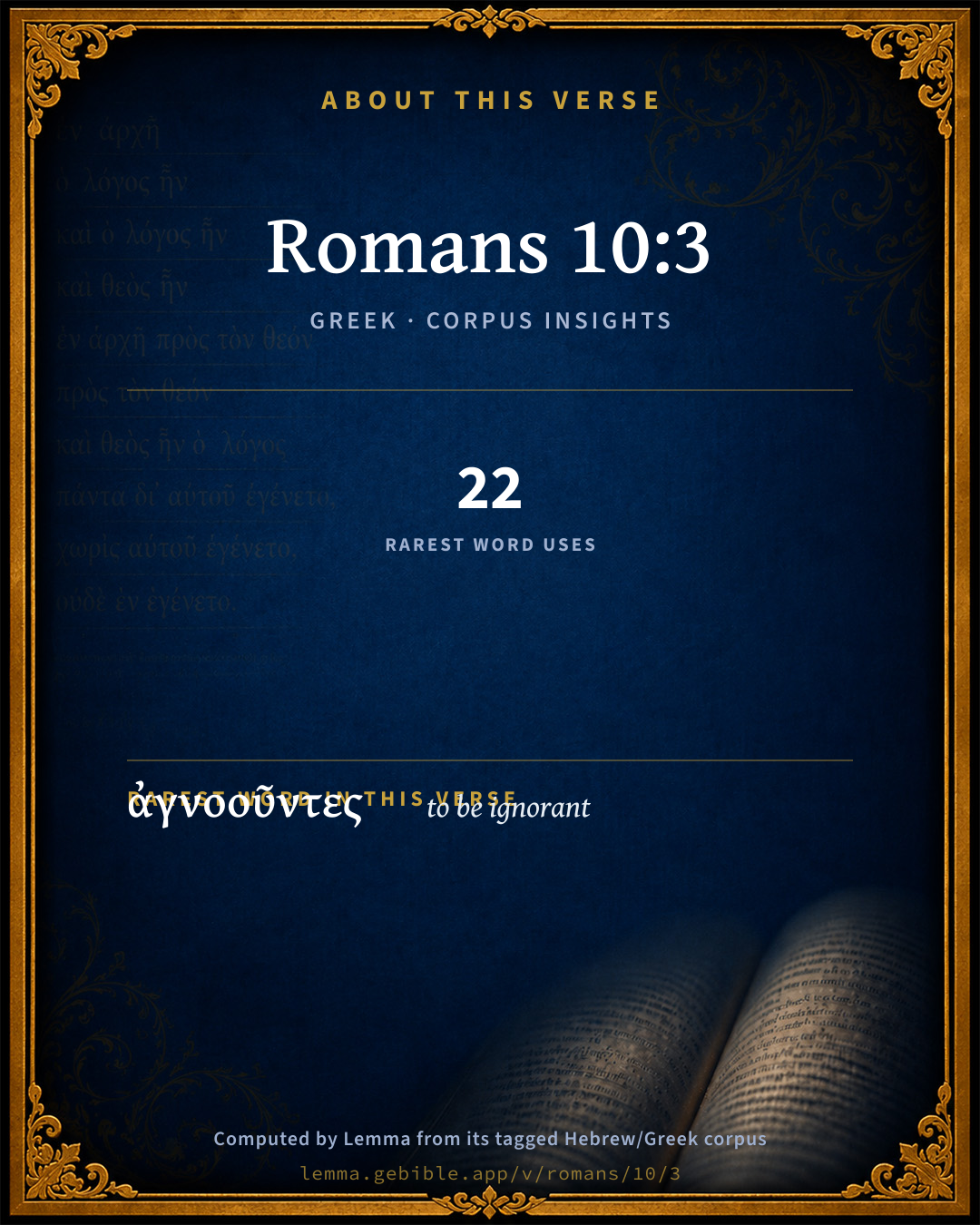
Romans 10:3

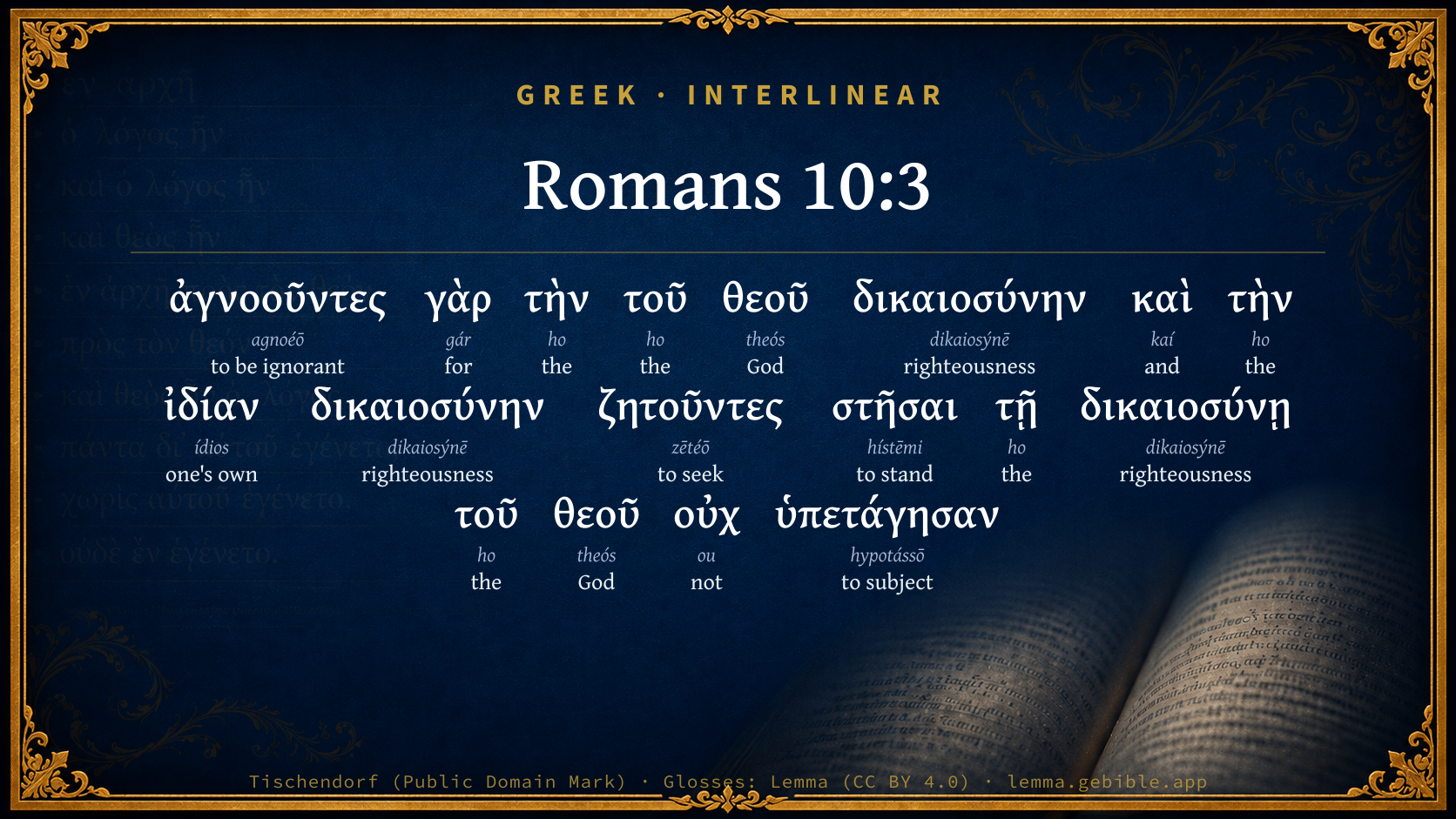
Greek (Tischendorf 8th ed.) Romans 10:3 appears in the Greek New Testament. The text above is from the Tischendorf 8th edition. Each word links to its Strong’s number and a concise gloss. Click any word for its full Thayer’s Greek Lexicon entry.
Download image
Cite this verse

Romans 10:3 (World English Bible). Public Domain. Lemma interlinear Bible study tool, https://lemma.gebible.app/v/romans/10/3.

Show BibTeX & RIS
BibTeX
RIS
English Translation
For being ignorant of God's righteousness, and seeking to establish their own righteousness, they didn't subject themselves to the righteousness of God.
World English Bible · Public Domain
Download a study sheet

One document with this verse’s original text, its word-by-word gloss line, the meaning frame, cross-references with their text, attributed commentary, and full source and license credits — printable, and it pastes into notes with its structure intact.

This verse Autodidact and up

Study sheet (.html) Plain text (.txt)

A passage Seminary Student

Up to 50 verses in one chapter. A passage sheet keeps up to 6 commentary sources and 12 cross-references per verse, in the order this page ranks them, and says so on the sheet whenever that leaves anything out. Ask for a single verse and you get the Autodidact verse sheet above.

Everything on this page stays free to read, with no account — the sheet is a download of what is already on screen, not access to it.

Want to remove ads? Support Godless Engineer
Compare translations 3

The same verse in 3 English versions, stacked beneath the original-language interlinear above. Click any original word for its lexicon entry.

Each is an independent rendering of the whole verse — the interlinear is not word-aligned to these translations.

Highlighted words mark where these versions differ — a whole-verse word diff, not a word-by-word alignment.

  • World English Bible Public Domain
    For being ignorant of God's righteousness, and seeking to establish their own righteousness, they didn't subject themselves to the righteousness of God.
  • King James Version Public Domain
    For they being ignorant of God's righteousness, and going about to establish their own righteousness, have not submitted themselves unto the righteousness of God.
  • unfoldingWord Literal Text CC BY-SA 4.0
    For not knowing about the righteousness of God, and seeking to establish their own righteousness, they did not submit themselves to the righteousness of God.

unfoldingWord Literal Text — © unfoldingWord, licensed CC BY-SA 4.0. Word-aligned USFM3 via Door43 (git.door43.org/unfoldingWord/en_ult).

Versions to compare (up to 4)

3 of 4 selected

Show all 19 translations

Every available English version of this verse, each an independent rendering of the whole verse.

  • World English Bible Public Domain
    For being ignorant of God's righteousness, and seeking to establish their own righteousness, they didn't subject themselves to the righteousness of God.
  • Berean Standard Bible Public Domain
    Because they were ignorant of God’s righteousness and sought to establish their own, they did not submit to God’s righteousness.
  • Majority Standard Bible Public Domain
    Because they were ignorant of God’s righteousness and sought to establish their own, they did not submit to God’s righteousness.
  • King James Version Public Domain
    For they being ignorant of God's righteousness, and going about to establish their own righteousness, have not submitted themselves unto the righteousness of God.
  • American Standard Version (1901) Public Domain
    For being ignorant of God's righteousness, and seeking to establish their own, they did not subject themselves to the righteousness of God.
  • Revised Version (1885) Public Domain
    For being ignorant of God’s righteousness, and seeking to establish their own, they did not subject themselves to the righteousness of God.
  • Geneva Bible (1599) Public Domain
    For they, being ignorant of the righteousnes of God, and going about to stablish their owne righteousnes, haue not submitted themselues to the righteousnes of God.
  • Douay-Rheims (1899) Public Domain
    For they, not knowing the justice of God, and seeking to establish their own, have not submitted themselves to the justice of God.
  • Young's Literal Translation Public Domain
    for not knowing the righteousness of God, and their own righteousness seeking to establish, to the righteousness of God they did not submit.
  • Literal Standard Version CC BY-SA 4.0
    for not knowing the righteousness of God, and seeking to establish their own righteousness, they did not submit to the righteousness of God.
  • Unlocked Literal Bible CC BY-SA 4.0
    For they do not know of God's righteousness, and they seek to establish their own righteousness. They did not submit to the righteousness of God.
  • unfoldingWord Literal Text CC BY-SA 4.0
    For not knowing about the righteousness of God, and seeking to establish their own righteousness, they did not submit themselves to the righteousness of God.
  • Darby Bible Public Domain
    For they, being ignorant of God's righteousness, and seeking to establish their own [righteousness], have not submitted to the righteousness of God.
  • World Messianic Bible Public Domain
    For being ignorant of God’s righteousness, and seeking to establish their own righteousness, they didn’t subject themselves to the righteousness of God.
  • Webster's Bible Public Domain
    For they, being ignorant of God's righteousness, and seeking to establish their own righteousness, have not submitted themselves to the righteousness of God.
  • Free Bible Version CC BY-SA 4.0
    They don't understand how God makes us right with him, and they try to make themselves right. They refuse to accept God's way of making people right.
  • Bible in Basic English Public Domain
    Because, not having knowledge of God's righteousness, and desiring to give effect to their righteousness, they have not put themselves under the righteousness of God.
  • Text-Critical English NT CC BY 4.0
    For they do not understand the righteousness of God, and by seeking to establish their own righteousness, they have not submitted to God's righteousness.
  • Tyndale New Testament (1534) Public Domain
    For they are ignoraunt of the rightewesnes which is alowed before God and goo about to stablisshe their awne rightewesnes and therfore are not obedient vnto the rightewesnes which is of valew before God.

Literal Standard Version (2020), Covenant Press — licensed CC BY-SA 4.0. Text via the HelloAO Bible API (eBible.org). Unlocked Literal Bible (unfoldingWord) — licensed CC BY-SA 4.0. Text via the HelloAO Bible API (eBible.org). unfoldingWord Literal Text — © unfoldingWord, licensed CC BY-SA 4.0. Word-aligned USFM3 via Door43 (git.door43.org/unfoldingWord/en_ult). Free Bible Version, Dr. Jonathan Gallagher — licensed CC BY-SA 4.0. Text via the HelloAO Bible API (eBible.org).

Word by word

More ways to search: Search by grammar → Find every occurrence → Compare this word →

Practice this passage: Drill this verse → Learn its vocabulary →

ἀγνοοῦντες
agnoéō
G50
“to be ignorant”
Verb, Present, Active, Participle, Nominative, Plural, Masculine
Part of Speech
Verb
Tense
Present
Voice
Active
Mood
Participle
Case
Nominative
Number
Plural
Gender
Masculine
Full Thayer's Definition

Origin: from G1 (as a negative particle) and G3539

TDNT: 02:55,2

1. to be ignorant, not to know 2. not to understand, unknown 3. to err or sin through mistake, to be wrong
  1. γὰρ gár G1063 “for” Conjunction
  2. τὴν ho G3588 “the” Article, Accusative, Singular, Feminine
  3. τοῦ ho G3588 “the” Article, Genitive, Singular, Masculine
  4. θεοῦ theós G2316 “God” Noun, Genitive, Singular, Masculine
  5. δικαιοσύνην dikaiosýnē G1343 “righteousness” Noun, Accusative, Singular, Feminine
  6. καὶ kaí G2532 “and” Conjunction
  7. τὴν ho G3588 “the” Article, Accusative, Singular, Feminine
  8. ἰδίαν ídios G2398 “one's own” Adjective, Accusative, Singular, Feminine
  9. δικαιοσύνην dikaiosýnē G1343 “righteousness” Noun, Accusative, Singular, Feminine
  10. ζητοῦντες zētéō G2212 “to seek” Verb, Present, Active, Participle, Nominative, Plural, Masculine
  11. στῆσαι hístēmi G2476 “to stand” Verb, Aorist, Active, Infinitive
  12. τῇ ho G3588 “the” Article, Dative, Singular, Feminine
  13. δικαιοσύνῃ dikaiosýnē G1343 “righteousness” Noun, Dative, Singular, Feminine
  14. τοῦ ho G3588 “the” Article, Genitive, Singular, Masculine
  15. θεοῦ theós G2316 “God” Noun, Genitive, Singular, Masculine
  16. οὐχ ou G3756 “not” Particle, Negative
  17. ὑπετάγησαν hypotássō G5293 “to subject” Verb, Aorist, Passive, Indicative, 3rd person, Plural

About this verse

These counts appear in no published source. They are computed here, from the morphology-tagged text and Lemma’s own curated glosses. What Lemma adds →

18
words
11
distinct lemmas
Pauline Epistles
section

Notable vocabulary

The rarest word here is ἀγνοοῦντες to be ignorant G50 — appearing just 22 times in the whole Greek New Testament.

Shared distinctive vocabulary

ἀγνοοῦντες to be ignorant G50 occurs in 21 verses of the Greek New Testament. Also found in:

Repetition

Words recur within this verse:

  • δικαιοσύνην righteousness G1343 ×3
  • θεοῦ God G2316 ×2
  • τὴν the G3588 ×5

Cross-references

29

Topical passages linked to Romans 10:3 in the Treasury of Scripture Knowledge — connected by theme and wording, ordered by reader-vote popularity; previews shown in the World English Bible.

  • Luke 16:15 He said to them, "You are those who justify yourselves in the sight of men, but God knows your hearts. For that which is exalted among men is an abomination in the sight of God.
  • Philippians 3:9 and be found in him, not having a righteousness of my own, that which is of the law, but that which is through faith in Christ, the righteousness which is from God by faith;
  • 2 Corinthians 5:21 For him who knew no sin he made to be sin on our behalf; so that in him we might become the righteousness of God.
  • Luke 18:9–12 He spoke also this parable to certain people who were convinced of their own righteousness, and who despised all others.
  • Romans 1:17 For in it is revealed God's righteousness from faith to faith. As it is written, "But the righteous shall live by faith."
  • Romans 5:19 For as through the one man's disobedience many were made sinners, even so through the obedience of the one will many be made righteous.
  • Revelation 3:17–18 Because you say, 'I am rich, and have gotten riches, and have need of nothing;' and don't know that you are the wretched one, miserable, poor, blind, and naked;
  • Isaiah 51:8 For the moth shall eat them up like a garment, and the worm shall eat them like wool; but my righteousness shall be forever, and my salvation to all generations.
  • Isaiah 57:12 I will declare your righteousness; and as for your works, they shall not profit you.
  • Romans 3:22 even the righteousness of God through faith in Jesus Christ to all and on all those who believe. For there is no distinction,
  • Nehemiah 9:33 However you are just in all that is come on us; for you have dealt truly, but we have done wickedly;
  • Isaiah 56:1 Thus says Yahweh, Keep you justice, and do righteousness; for my salvation is near to come, and my righteousness to be revealed.
  • Luke 10:29 But he, desiring to justify himself, asked Jesus, "Who is my neighbor?"
  • Leviticus 26:41 I also walked contrary to them, and brought them into the land of their enemies: if then their uncircumcised heart is humbled, and they then accept the punishment of their iniquity;
  • Job 33:27 He sings before men, and says, 'I have sinned, and perverted that which was right, And it didn't profit me.
  • Psalms 71:19 Your righteousness also, God, reaches to the heavens; You have done great things. God, who is like you?
  • Isaiah 64:6 For we are all become as one who is unclean, and all our righteousness are as a polluted garment: and we all do fade as a leaf; and our iniquities, like the wind, take us away.
  • Psalms 71:15–16 My mouth will tell about your righteousness, And of your salvation all day, Though I don't know its full measure.
  • Lamentations 3:22 [It is of] Yahweh's loving kindnesses that we are not consumed, because his compassion doesn't fail.
  • John 16:9–10 about sin, because they don't believe in me;
  • Romans 3:26 to demonstrate his righteousness at this present time; that he might himself be just, and the justifier of him who has faith in Jesus.
  • Romans 9:30–32 What shall we say then? That the Gentiles, who didn't follow after righteousness, attained to righteousness, even the righteousness which is of faith;
  • Galatians 5:3–4 Yes, I testify again to every man who receives circumcision, that he is a debtor to do the whole law.
  • 2 Peter 1:1 Simon Peter, a servant and apostle of Jesus Christ, to those who have obtained a like precious faith with us in the righteousness of our God and Savior, Jesus Christ:
  • Isaiah 51:6 Lift up your eyes to the heavens, and look on the earth beneath; for the heavens shall vanish away like smoke, and the earth shall wax old like a garment; and those who dwell therein shall die in like manner: but my salvation shall be forever, and my righteousness shall not be abolished.
  • Jeremiah 23:5–6 Behold, the days come, says Yahweh, that I will raise to David a righteous Branch, and he shall reign as king and deal wisely, and shall execute justice and righteousness in the land.
  • Daniel 9:6–9 neither have we listened to your servants the prophets, who spoke in your name to our kings, our princes, and our fathers, and to all the people of the land.
  • Daniel 9:24 Seventy weeks are decreed on your people and on your holy city, to finish disobedience, and to make an end of sins, and to make reconciliation for iniquity, and to bring in everlasting righteousness, and to seal up vision and prophecy, and to anoint the most holy.
  • Luke 15:17–21 But when he came to himself he said, 'How many hired servants of my father's have bread enough to spare, and I'm dying with hunger!

Cross-references courtesy of OpenBible.info (CC BY 4.0).

Commentary

Notes on Romans 10:3 from classic Christian and Jewish commentators (each source and its license shown beneath its notes). The classic Christian expositions comment on the surrounding passage and are grouped to its opening verse, so a note may address several verses; the Jewish commentaries on the Tanakh (Rashi and others) are per-verse, so they appear only where the commentator wrote on this verse.

Lemma curates 59 commentaries, every one of them public domain or Creative Commons licensed, each selected and text-cleaned for this edition rather than reprinted as found. About our sources →

Tyndale Open Study Notes

Tyndale Open Resources

10:3 God’s way of making people right with himself: See 1:17; 3:21-26. Paul uses this phrase to explain Israel’s failure in terms basic to the gospel. God manifested his righteousness through the ministry of Christ, but most Jews did not understand it, partly because they were so focused on the law as a way of securing their own righteousness.

Tyndale Open Study Notes — © Tyndale Open Resources, licensed CC BY-SA 4.0. Text via the HelloAO Bible API.

Bengel's Gnomon

Johann Albrecht Bengel

Rom 10:3. Ζητοῦντες, seeking) by all means.—οὐχʼ ὑπετάγησαν, have not been subject) and have not obeyed,” (ὑπήκουσαν) Rom 10:16. Ὑποταγὴ, submits itself to the Divine will, τῷ θέλειν, the will of GOD.

Bengel's Gnomon of the New Testament — English translation (T&T Clark, Edinburgh, 1860) — public domain. Text from a community e-Sword module.

Meyer's Critical & Exegetical Commentary

Heinrich August Wilhelm Meyer

Rom_10:3. Confirmatory elucidation of οὐ κατʼ ἐπίγνωσιν: for else they would not, unacquainted with the divine righteousness (see on Rom_1:17), have insisted on their own righteousness, and striven against the divine. This is just the actual proof that their zeal for God is wanting in knowledge.

ἀγνοοῦντες] does not mean any more than at Rom_2:4, 1Co_14:38, anything else than not knowing; Reiche, de Wette, Tholuck, Ewald, and several others: misapprehending; Hofmann: overlooking. The guilt of this not-knowing Paul does not further enter into, not so much (comp. Act_3:17; Act_17:30) from mild forbearance (Rückert and others), but because he had simply nothing else than the οὐ κατʼ ἐπίγνωσιν to explain.

ΤῊΝ ἸΔΊΑΝ ΔΙΚΑΙΟΣΎΝΗΝ] ΤῊΝ ἘΚ ΤΟῦ ΝΌΜΟΝ, ΤῊΝ ἘΞ ἜΡΓΩΝ ἸΔΊΩΝ ΚΑῚ ΠΌΝΩΝ ΚΑΤΟΡΘΟΥΜΈΝΗΝ, Theophylact. Comp. Php_3:9, and see on Rom_1:17.

ΣΤῆΣΑΙ] stabilire, to make valid. Comp. Rom_3:31; Heb_10:9.

ὑπετάγησαν] The ΔΙΚ. ΘΕΟῦ is conceived of as a divine ordinance, to which one subjects oneself (through faith). The sense is not that of the passive, as Rom_8:20, but that of the middle, as in Rom_8:7, Rom_13:1, and frequently, expressing the obedience. As to the subject-matter, comp. προσέκοψαν κ.τ.λ., Rom_9:32.

Meyer — Critical and Exegetical Commentary on the New Testament — English translation by Peter Christie, edited by Frederick Crombie (T&T Clark, 1880) — public domain. Text from a community e-Sword module.

Expositor's Greek Testament

ed. W. Robertson Nicoll

Rom 10:3 . This verse goes to the root of the matter, and explains the failure of the Gospel among the Jews. It was due to their ignorance of the righteousness of God. All men need and crave righteousness, and the Jews, in their ignorance of God’s, sought to establish a righteousness of their own. Their own is the key to the situation. Their idea was that they could be good men without becoming God’s debtors, or owing anything at all to Him. Such an idea, of course, shows complete ignorance of the essential relations of God and man, and when acted on fatally perverts life. It did so with the Jews. When the Gospel came, revealing the righteousness of God that for which man must be absolutely indebted to God’s grace, and which he can never boast of as “his own” it cut right across all the habits and prejudices of the Jews, and they did not submit themselves to it. Paul interprets the position of his nation through the recollection of his own experience as a Pharisee no doubt rightly on the whole. For ὑπετάγησαν in middle sense see Rom 8:7 , Rom 13:1 , Heb 12:9 , Jas 4:7 , 1Pe 2:13 .

Rom 10:4 . Further proof that the pursuit of a righteousness of one’s own by legal observances is a mistake, the act of men “in ignorance”. τέλος γὰρ νόμου χριστὸς εἰς δικαιοσύνην παντὶ τῷ πιστεύοντι : For Christ is law’s end, etc. The sense required a sense which the words very naturally yield is that with Christ in the field law as a means of attaining righteousness has ceased and determined. The moment a man sees Christ and understands what He is and what He has done, he feels that legal religion is a thing of the past: the way to righteousness is not the observance of statutes, no matter though they have been promulgated by God Himself; it is faith, the abandonment of the soul to the redeeming judgment and mercy of God in His Son. The meaning is virtually the same as that of our Lord’s words in Luk 16:16 . νόμου without the article is “law” in the widest sense; the Mosaic law is only one of the most important instances which come under this description; and it, with all statutory conceptions of religion, ends when Christ appears. It is quite true to say that Christ consummates or fulfils the law (hence Calvin would prefer complementum or perfectio to finis as a rendering of τέλος ); quite true also that He is the goal of the O.T. dispensation, and that it is designed to lead to Him ( cf. Mat 5:17 , Gal 3:24 ); but though both true and Pauline, these ideas are irrelevant here, where Paul is insisting, not on the connection, but on the incompatibility, of law and faith, of one’s own righteousness and the righteousness of God. Besides, in limiting νόμος to the Mosaic O.T. law, this interpretation does less than justice to the language, and misses the point of παντὶ τῷ πιστεύοντι : there is no believer, Gentile or Jew , for whom law, Mosaic or other , retains validity or significance as a way to δικαιοσύνη , after the revelation of the righteousness of God in Christ.

In Rom 10:5 ff. Paul describes more fully, and in O.T. terms, the two ways of attaining δικαιοσύνη law and faith. His aim is to show that they are mutually exclusive, but that the latter is open and accessible to all.

The Expositor's Greek Testament, edited by W. Robertson Nicoll (1897–1910) — public domain. Text from a community e-Sword module.

Hodge's Commentary on Romans, Ephesians & First Corinthians

Charles Hodge

Rom_10:3

For they being ignorant of Gods righteousness, and going about to establish their own righteousness, have not, etc. The grand mistake of the Jews was about the method of justification. Ignorance on this point implied ignorance of the character of God, of the requirements of the law, and of themselves. It was, therefore, and is, and must ever continue to be a vital point. Those who err essentially here, err fatally; and those who are right here, cannot be wrong as to other necessary truths. Their own righteousness, τὴν ἰδίαν δικαιοσύνηn, which Theophylact correctly interprets, τὴν ἐξ ἔργων ἰδίων καὶ πόνων κατορθουμένην. The phrase righteousness of God, admits here, as in other parts of the epistle, of various interpretations.

1. It may mean the divine holiness or general moral perfection of God. In this way the passage would mean, Being ignorant of the perfections or holiness of God, and, of course, of the extent of his demands, and going about to establish their own excellence, etc. This gives a good sense, but it is not consistent with the use of the expression righteousness of God, in other similar passages, as Rom_1:17; Rom_3:21, etc. And, secondly, it requires the phrase to be taken in two different senses in the same verse; for the last clause, have not submitted themselves to the righteousness of God, cannot mean, They have not submitted to the divine holiness.

2. The term may mean that righteousness of which God is the author, that which he approves and accepts. This interpretation is, in this case, peculiarly appropriate, from the opposition of the two expressions, righteousness of God and their own righteousness. Being ignorant of that righteousness which God has provided, and which he bestows, and endeavoring to establish their own, they refused to accept of his. The sense here is perfectly good, and the interpretation may be carried through the verse, being applicable to the last clause as well as to the others. A comparison of this passage with Phi_3:9, Not having my own righteousness, but the righteousness which is of God, is also in favor of this interpretation. For there the phrase the righteousness which is of God, can only mean that which he gives, and with this phrase the expression the righteousness of God, in this verse, seems to be synonymous.‹56›

3. Thirdly, Some interpreters take righteousness in the sense of justification, justification of God being taken as equivalent to Gods method of justification. Being ignorant of Gods method of justification, and going about to establish their own, they have not submitted themselves to the method which he has proposed. The cause of the rejection of the Jews was the rejection of the method of salvation through a crucified Redeemer, and their persisting in confiding in their own merits and advantages as the ground of their acceptance with God.

Although this is the meaning of the passage, it is not the sense of the words. Righteousness does not signify justification. It is that on which the sentence of justification is founded. Those who have righteousness, either personal and inherent, or imputed, are justified. As we have no righteousness of our own, nothing that we have done or experienced, nothing personal or subjective, that can answer the demands of the law, we can be justified only through the righteousness of God, imputed to us and received by faith.

Charles Hodge — Commentary on Romans (1835), First Corinthians (1857), and Ephesians (1856) — public domain. Text from a community e-Sword module.

Geneva Bible (1599)

Geneva Bible translators

The ignorance of the Law which we ought to know, excuseth none before God, especially it excuseth not them that are of his household.

The first entrance into the vocation unto salvation, is to renounce our own righteousness: the next is, to embrace that righteousness by faith, which God freely offereth us the Gospel.

Ignorance hath always pride joined with it.

Geneva Bible (1599) marginal notes — public domain. Text via Bolls.life.

Jamieson, Fausset & Brown

Robert Jamieson, A. R. Fausset & David Brown

For they being ignorant of God's righteousness--that is, for the justification of the guilty (see on Rom 1:17).

and going about--"seeking"

to establish their own righteousness, have not submitted themselves to the righteousness of God--The apostle views the general rejection of Christ by the nation as one act.

Jamieson, Fausset & Brown — Commentary Critical and Explanatory on the Whole Bible (1871) — public domain (CC PDM 1.0). Text via the HelloAO Bible API.

Adam Clarke's Commentary

Verse 3. For - being ignorant of God's righteousness] Not knowing God's method of saving sinners, which is the only proper and efficient method: and going about to establish their own righteousness - seeking to procure their salvation by means of their own contriving; they have not submitted - they have not bowed to the determinations of the Most High, relative to his mode of saving mankind, viz. through faith in Jesus Christ, as the only available sacrifice for sin - the end to which the law pointed.

Adam Clarke's Commentary on the Bible (1810–1826) — public domain. Text from a community e-Sword/MySword module.

John Calvin's Commentaries

3. For being ignorant of the righteousness of God, etc. See how they went astray through inconsiderate zeal! for they sought to set up a righteousness of their own; and this foolish confidence proceeded from their ignorance of God’s righteousness. Notice the contrast between the righteousness of God and that of men. We first see, that they are opposed to one another, as things wholly contrary, and cannot stand together. It hence follows, that God’s righteousness is subverted, as soon as men set up their own. And again, as there is a correspondence between the things contrasted, the righteousness of God is no doubt his gift; and in like manner, the righteousness of men is that which they derive from themselves, or believe that they bring before God. Then he who seeks to be justified through himself, submits not to God’s righteousness; for the first step towards obtaining the righteousness of God is to renounce our own righteousness: for why is it, that we seek righteousness from another, except that necessity constrains us?

We have already stated, in another place, how men put on the righteousness of God by faith, that is, when the righteousness of Christ is imputed to them. But Paul grievously dishonors the pride by which hypocrites are inflated, when they cover it with the specious mask of zeal; for he says, that all such, by shaking off as it were the yoke, are adverse to and rebel against the righteousness of God.

John Calvin's Commentaries (1540-1563) — public domain. Text from the Calvin Translation Society English edition (1840s-50s) via the Christian Classics Ethereal Library (ccel.org). Calvin's coverage is partial (roughly two-thirds of the Bible); uncommented books and verses are honest gaps, never fabricated. The 19th-century editor's footnotes and remarks are omitted so the notes are faithfully Calvin's own voice.

Ellicott's Commentary for English Readers

(3) God’s righteousness.—See Rom_1:17; Rom_3:21.

Their own righteousness.—A righteousness founded on their own works.

A Bible Commentary for English Readers, edited by Charles John Ellicott (1878–1897) — public domain. Text from a community e-Sword module.

The Cambridge Bible for Schools and Colleges

gen. ed. J. J. S. Perowne

3. being ignorant of] not knowing: the verb refers back to the “knowledge” just before mentioned.

God’s righteousness] His acceptance of the sinner as righteous, for Christ’s sake. See on Rom_1:17.

going about] seeking.

to establish] Same word as Heb_10:9. They sought to make it good enough to stand (in the judgment). On Jewish theories of merit, see Appendix A.

have not submitted themselves] Lit., and better, did not submit; perhaps with reference to the definite ideal occasion of the first appearance of the Gospel amongst them.—The Gr. verb is passive in form, but may bear a middle meaning; and so probably here, as in E. V.—For an illustration of this “submission” see 1Pe_1:2, where the election of the Father and the holy influences of the Spirit lead to “obedience and the sprinkling of the blood of Jesus Christ.” Acceptance of the one “hope set before us,” that of the Cross, is an act of submission as well as of trust. Human pride and human reason both, in different ways, have to bow before the Crucified.

The Cambridge Bible for Schools and Colleges (gen. ed. J. J. S. Perowne; Cambridge University Press, 1878–1918) — public domain. Text from a community e-Sword module.

John Gill's Exposition

For they being ignorant of God's righteousness,.... Either of the righteousness of God revealed in the Gospel, which is no other than the righteousness of Christ, and which they knew nothing of, the whole Gospel being a sealed book, and wholly hidden from them; or of the righteousness of God required in the law, they imagining that only an external conformity to the commands of the law, was all that was necessary to attain to a justifying righteousness by it, not knowing the spirituality of it, and that it required conformity of heart and nature, as well as life and conversation; or rather of the attribute of God's righteousness, the strictness of his justice, the purity and holiness of his nature: for though they knew that he was holy, just, and righteous, yet did not think he was so strict as to insist upon every punctilio, and to take notice of every little default and defect in obedience; and especially that he had any regard to the heart and the thoughts of it, and required perfect purity there or that he would accept of nothing less than an absolutely perfect and complete righteousness; nor justify any without full satisfaction to his justice: hence they were

going about to establish their own righteousness; which they would never have done, had they known the righteousness of God, in either of the above senses; the Alexandrian copy, and some others, omit the word "righteousness", and only read, "their own", leaving it to be understood, and which is easily done; and so reads the Vulgate Latin version: by "their own righteousness", as opposed to God's, is meant the righteousness of works, their obedience to the law, an outward conformity to it, an observance of the rituals of it, and a little negative holiness. This they endeavoured to "establish" or "make to stand" in the sight of God, as their justifying righteousness, which is all one as setting chaff and stubble, briers and thorns, to a consuming fire; as the attempt expresses madness in them, the phrase suggests weakness in their righteousness, which they would fain make to stand, but could not, it being like a spider's web before the besom, or like a dead carcass, which men would set upon its feet to stand alone, but it cannot; than which nothing can be a greater instance of egregious folly: their "going about" or "seeking" to do this, shows their ignorant zeal, and the toil, the pains, the labour they used to effect it, but all in vain, and to no purpose; as appears by their hearing, reading, fasting, praying, giving alms to the poor, and tithes of all they possessed; all which they were very careful and studious of, and especially to have them done in the sight of men: and so it was that they

have not submitted themselves to the righteousness of God; that is, the righteousness of Christ, so called, because approved and accepted of by God, imputed by him to his people, and given them by him as a free gift, and which only justifies in his sight; and because it is wrought by Christ, who is truly and properly God, and revealed and applied by the Spirit of God. This the Jews submitted not to, because they had no true humble sense of themselves as sinners, nor did they care to acknowledge themselves as such; which submission to Christ's righteousness requires and necessarily involves in it; no man will ever be subject to it, till he is made sensible of the exceeding sinfulness of sin, and brought to an humble acknowledgment of it; the Spirit of God first convinces of sin and then of righteousness; and because they had an overweening opinion of their own righteousness, which they trusted to, and depended upon, imagining it to be blameless, and to contain all that the law required, and therefore they stood in no need of any other; and as for the righteousness of Christ they had it in contempt, their carnal minds being enmity to him, were not subject to his righteousness, nor could they, nor can any be, without the powerful efficacious grace of God, making them willing in the day of his power. This phrase denotes the rebellion of their wills, against Christ and his righteousness, they acting as rebellious subjects against their sovereign prince.

John Gill's Exposition of the Whole Bible (1746–1763) — public domain (CC PDM 1.0). Text via the HelloAO Bible API.

Trapp's Complete Commentary

John Trapp

3 For they being ignorant of God’s righteousness, and going about to establish their own righteousness, have not submitted themselves unto the righteousness of God.

Ver. 3. For they being ignorant] The soul that is without knowledge is not good, and he that (without knowledge) hasteth with his feet, sinneth, Pro 19:2; the faster he goeth, the farther he is out.

John Trapp, A Commentary or Exposition upon All the Books of the Old and New Testament (1647–1656) — public domain. Text from a community e-Sword module.

Albert Barnes' Notes on the Bible

For they being ignorant - The ignorance of the Jews was voluntarily, and therefore criminal. The apostle does not affirm that they could not have known what the plan of God was; for he says Rom 10:18-21 that they had full opportunity of knowing. An attentive study of their own Scriptures would have led them to the true knowledge of the Messiah and his righteousness; see Joh 5:39; compare Isa 53:1-12, etc. Yet the fact that they were ignorant, though not an excuse, is introduced here, doubtless, as a mild and mitigating circumstance, that should take off the severity of what he might appear to them to be saying; 1Ti 1:13, “But I obtained mercy because I did it ignorantly, in unbelief;” Luk 23:34, “Then said Jesus, Father, forgive them, for they know not what they do;” Act 7:60. Involuntary ignorance excuses from guilt; but ignorance produced by our sin or our indolence is no excuse for crime.

Of God’s righteousness - Not of the personal holiness of God, “but of God’s plan of justifying people, or of declaring them righteous by faith in his Son;” see the note at Rom 1:17. Here God’s plan stands opposed to their efforts to make themselves righteous by their own works.

And seeking to establish ... - Endeavoring to confirm or make valid their own righteousness; to render it such as to constitute a ground of justification before God; or to make good their own claims to eternal life by their merits. This stands opposed to the justification by grace, or to God’s plan. And they must ever be opposed. This was the constant effort of the Jews; and in this they supposed they had succeeded. see Paul’s experience in Phi 3:4-6; Act 26:5. Instances of their belief on this subject occur in all the gospels, where our Saviour combats their notions of their own righteousness. See particularly their views and evasions exposed in Matt. 23; compare Mat 5:20, etc.; Mat 6:2-5. It was this which mainly opposed the Lord Jesus and his apostles; and it is this confidence in their own righteousness, which still stands in the way of the progress of the gospel among people.

Have not submitted themselves - Confident in their own righteousness. they have nor yielded their hearts to a plan which requires them to come confessing that they have no merit, and to be saved by the merit of another. No obstacle to salvation by grace is so great as the self-righteousness of the sinner.

Righteousness of God - His plan or scheme of justifying people.

Albert Barnes' Notes on the Bible (1834–1885) — public domain. Text from a community e-Sword/MySword module.

Haydock's Catholic Bible Commentary

The justice of God. That is, the justice which God giveth us through Christ; as, on the other hand, the Jews’ own justice is that which the pretended to by their own strength, or by the observance of the law, without faith in Christ. (Challoner) --- Seeking to establish their own. That is, for justice, or to be justified by their works, or the works of their written law. (Witham)

George Leo Haydock (1774–1849), Haydock's Catholic Family Bible and Commentary, 1859 edition — public domain. Excludes Psalms (Douay-Rheims chapter numbering differs from Protestant) and Deuterocanonical books (Catholic canon only).

Matthew Poole's English Annotations

They being ignorant of God’s righteousness: here he shows more particularly what knowledge the Jews wanted. They knew not the righteousness of God; of which see Rom 1:17, with the notes there. This was abundantly manifested, being witnessed by the law and the prophets, Rom 3:21; and a thing very needful to be known, as being that wherein man’s happiness consisted; but they were ignorant of it.

Going about to establish their own righteousness; their personal and inherent righteousness, a home-made righteousness, which is of their own spinning; this they designed to set up in the room of God’s righteousness.

Have not submitted themselves to the righteousness of God; this notes the pride that accompanied their ignorance, and that is in the hearts of men by nature. They will not go abroad for that which they think they have, or may have, at home. They will not be beholden to another for that which they suppose they have in themselves. They have righteousness enough of their own working; and therefore they reject and withdraw themselves from that which is of God’s appointing.

Matthew Poole's English Annotations on the Holy Bible (1683–1685) — public domain. Text from a community e-Sword/MySword module.

Whedon's Commentary on the Bible

Daniel D. Whedon

3. Being ignorant—Or, rather, ignoring actively; just as the following participle going about is active. People often wilfully ignore what they really know; and St. Paul tells us (Rom_10:19, where see comment) that Israel did know. Dr. Chalmers pertinently says that people are not always blamable for not seeing, but are blamable for not looking.

God’s righteousness—(See note on Rom_1:17.) The righteousness which God has ready to bestow on man through Christ. It includes in its various degrees and stages pardon, justification, sanctification, and eternal glorification.

Going about—Old English phrase for engaging in or trying at a thing. The Greek word here literally signifies seeking, endeavouring.

Submitted—For faith is the submission of the whole man to God. Paul now shows what is the righteousness of God which the Jew ignored; namely, that righteousness of which Christ was the consummation.

Daniel D. Whedon (gen. ed.), Commentary on the Old and New Testaments (1874–1909) — public domain. Text from a community e-Sword module.

John Wesley's Explanatory Notes

For they being ignorant of the righteousness of God - Of the method God has established for the justification of a sinner. And seeking to establish their own righteousness - Their own method of acceptance with God. Have not submitted to the righteousness of God - The way of justification which he hath fixed.

John Wesley, Explanatory Notes Upon the Whole Bible (1754–1765) — public domain. Text via the GEBible commentary corpus.

Scofield Reference Notes

C. I. Scofield

righteousness

The word "righteousness" here, and in the passages having marginal references to this, means legal, or self-righteousness; the futile effort of man to work out under law a character which God can approve.

(See Scofield "Rev 19:8").

righteousness Cf. (See Scofield "Rom 3:21").

The Scofield Reference Bible (1917 edition), notes by C. I. Scofield — public domain. Text from a community e-Sword module.

Burkitt's Expository Notes on the New Testament

William Burkitt

That is, the Jews being ignorant of God’s way of justification by faith in Christ discovered in the gospel, and relying upon and trusting to their own works, their obedience to the ceremonial and moral law, to justify and save them, they have not submitted themselves to the righteousness of God; that is, to the way and method which the wisdom of God has discovered for the justification of a sinner by the blood of his Son.

Observe here, 1. That by God’s righteousness, we are to understand that righteousness which Christ has wrought for us, which God bestows upon us, and the gospel reveals unto us; by establishing their own righteousness, is to be understood their resolution and endeavour to depend upon their own works; their obedience to the law for their justification before God, in opposition against and in contradiction to, that way of justification which God has declared; namely, by faith in Christ Jesus, the one and only Mediator.

Observe, 2. That upon the first opening of the gospel, no evangelical doctrine was more disrelished by the Jews than justification by the righteousness of Christ. They were possessed with this principle then, that eternal life was attainable only by the works of the law: and according to the example of the Jews at the beginning, persons ever since, even to this very day, are fond of that way of justification.

The natural man is a proud man, he likes to live upon his own stock, he cannot stoop to a sincere and universal renunciation of his own righteousness, and to depend wholly upon that of another. ’Tis natural to a man to choose rather to eat a brown crust, or wear a coarse garment, which he can call his own, than to feed upon the richest dainties, or wear the costliest robes, which he must receive as an alms from another.

Lord! how hard is it to subdue this pride of spirit, and to be thoroughly convinced of the absolute necessity of another and a better righteousness than our own to constitute us righteous in the sight of God!

From the whole learn, 1. How dark-sighted the wisest men are by nature in God’s way of justifying and saving sinners: Ignorant of God’s righteousness, that is, of the way which the wisdom of God has discovered for justifying guilty sinners by faith in his son.

This is known only by divine revelation: The righteousness of God is revealed from faith to faith. Rom 1:17. It is purely an object of faith, and hangs all upon divine revelation, both as to the righteousness itself, and the manner of imparting it.

Learn, 2. How absurd is the attempt, and how injurious the design, to set up and establish a righteousness of our own, either in opposition to, or in conjunction with, the righteousness of God.

Alas! we fulfil the law only in sincerity, we cannot fulfil it to perfection; and if it be not to perfection, it cannot be to justification.

Therefore to trust to any righteousness of our own for justification before God, which is imperfect and polluted, is both sinful and unsafe. Sinful, because it is confronting the plain declarations of the gospel; and unsafe, because it evacuates Christ: for Christ is of no effect unto us: whosoever are justified by the law, are fallen from grace, Gal 5:4.

Learn, 3. What an hinderance is pride to the salvation of men! it stiffens the will, that it won’t stoop to God’s terms: they will not have justification in God’s way, and they shall not have it in their own. Here it stuck with the Jews; they would not submit to the righteousness of God: and here it sticks with too many at this day.

Learn, 4. Not to count a righteousness of your own needless to be possessed of, because you want of righteousness of another to confide and trust in. We plead the meritorious righteousness of Christ, to answer the demands of the law; but contend for a personal righteousness of our own, to answer the commands of the gospel.

Christ doth indeed ease us of the load of our sins, but not discharge us from the care of our duty. Our being in Christ frees us indeed from condemnation, but then that in-being must be proved by our holy walking; not after the flesh, but after the Spirit, Rom 5:1.

Learn, 5. To submit to the righteousness of God, as ever you would enjoy peace with God. The more holy we are, and the more sanctified we grow, the meaner opinion we shall have of ourselves, and the more need of a Saviour, and of justification by him; and shall bless God for the gospel, in which the righteousness of God is revealed from faith to faith; and shall dread it as hell to be found amongst the number of those who, though they be not ignorant of God’s righteousness, yet will go about to establish their own righteousness, refusing to submit to the righteousness of God.

William Burkitt's Expository Notes on the New Testament (1700–1703) — public domain. Text from a community e-Sword module.

Godbey's Commentary on the New Testament

William B. Godbey

3. “For they being ignorant of God’s righteousness and going about to establish their own righteousness; but did not submit themselves unto the righteousness of God.

William B. Godbey, Commentary on the New Testament (1896–1900) — public domain. Text from a community e-Sword module.

McGarvey & Pendleton's Commentaries

J. W. McGarvey

For being ignorant of God's righteousness [Here Paul shows wherein they lacked knowledge. "For they," says Scott, "not knowing the perfect justice of the divine character, law and government; and the nature of that righteousness which God has provided for the justification of sinners consistently with his own glory"-- Rom_3:26 ], and seeking to establish their own [Refusing to "put on Christ" ( Gal_3:27 ), they clothed themselves with a garment of their own spinning, which they, like all other worms, spun from their own filthy inwards. Or, to suit the figure more nearly to the language of the apostle, refusing to accept Christ as the Rock for life-building, they reared their crumbling structure on their own sandy, unstable nature, and as fast as the wind, rain and flood of temptation undermined their work, they set about rebuilding and re-establishing it, oblivious of the results of that supreme, unavertable, ever-impending storm, the last judgment -- Mat_7:24-27 ], they did not subject themselves to the righteousness of God . ["Subject" is the keyword here. The best comment on this passage is found at Joh_8:31-36 . Those who admit themselves bondservants of sin find it no hardship to enter the free service of Christ, but those whose pride and self-sufficiency and self-righteousness make them self-worshipers, can bring themselves to submit to no one. By use of the phrase "righteousness of God," Paul indicts them of rebellion against the Father and his plan of salvation, rather than of rebellion against the person of the Christ, who is the sum and substance of the Father's plan--the concrete righteousness whereby we are saved.]

J. W. McGarvey (with Philip Y. Pendleton), Commentaries on the New Testament (The Fourfold Gospel, 1914; Acts; and the epistles) — public domain. Text from a community e-Sword/MySword module.

The People's New Testament

B. W. Johnson

3. Being ignorant of God's righteousness. It is now shown that their zeal was not according to knowledge. They had no knowledge of God's plan of righteousness, righteousness by believing upon Christ, but rejecting it they sought a righteousness of their own, of works, secured by keeping the law, and by obeying the traditions of men (Mark 7:7, 8). On the other hand, they refused to submit to God's righteousness through faith.

B. W. Johnson's The People's New Testament with Notes (1889–1891) — public domain. Electronic text from the Christian Classics Ethereal Library (CCEL) ThML edition.

Cambridge Greek Testament for Schools and Colleges

3. ἀγνοοῦντες. The Jews and Gentiles, failed for the same reason; cf. Rom 1:18 f.; Eph 4:18.

τὴν τοῦ θεοῦ δικαιοσύνην = the righteousness which GOD exhibits in His own character and requires from men, contrasted with that righteousness which they tried to gain by their own efforts and methods. This is a decisive instance of the true meaning of the phrase; cf. Rom 1:17.

ὑπετάγησαν. Cf. 1Co 15:28; Jas 4:7; 1Pe 5:5, for the middle sense of the passive form. The revelation of GOD’S righteousness in Christ required a surrender of preconceived ideas and habits and a submission: this the Jews did not give.

Cambridge Greek Testament for Schools and Colleges (Cambridge University Press, 1896; 21 vols, various authors incl. Carr, Maclear, Plummer, Farrar, Lumby, Moule, M. R. James, Simcox) — public domain. Text from a community e-Sword module.

Alford’s Greek Testament

Henry Alford

3.] For (explanation of οὐ κατʼ ἐπίγν.) not recognizing (‘being ignorant of’ is liable to the objection, that it may represent to the reader a state of excusable ignorance, whereas they had it before them, and overlooked it) the righteousness of God (not, the way of justification appointed by God, as Stuart, al.: but that only righteousness which avails before God, which becomes ours in justification; see De Wette’s note, quoted on ch. 1:17), and seeking to set up their own righteousness (again, not justification, but righteousness: that, namely, described ver. 5; not that it was ever theirs, but the Apostle speaks subjectively. Notwithstanding the ms. authority against δικαι. after ἰδίαν, it would seem as if it had been written for emphasis’ sake by the Apostle, and omitted on account of the word occurring thrice in the sentence), they were not subjected (historical: implying, but not itself bearing, a perfect sense. The passage,—not in a middle sense, as De Wette and Thol.,—expresses the result only; it might be themselves, or it might be some other, that subjected them,—but the historical fact was, that they were not subjected) to the righteousness of God (the δικ. τ. θ. being considered as a rule or method, to which it was necessary to conform, but to which they were never subjected as they were to the law of Moses).

Henry Alford, The Greek Testament (1849–1861) — public domain. Text from a community e-Sword module.

International Critical Commentary

3. ἀγνοοῦντες γάρ. This verse gives the reason for οὐ κατʼ ἐπίγνωσιν, and the antithesis to ἡ μὲν εὐδοκία. ἀγνοοῦντες means ‘not knowing,’ ‘being ignorant of,’ not ‘misunderstanding.’ St. Paul here states simply the fact of the ignorance of his fellow-countrymen; he does not yet consider how far this ignorance is culpable: that point he makes evident later (vv. 14 sq.).

τὴν τοῦ Θεοῦ δικαιοσύνην … τὴν ἰδίαν. St. Paul contrasts two methods of righteousness. On the one side there was the righteousness which came from God, and was to be sought in the manner He had prescribed, on the other was a righteousness which they hoped to win by their own methods, and by their own merit. Their zeal had been blind and misdirected. In their eagerness to pursue after the latter, they had remained ignorant of and had not submitted to the method (as will be shown, a much easier one) which God Himself had revealed.

ὑπετάγησαν. Middle, ‘submit themselves,’ cf. Jas 4:7; 1Pe 2:13; 1Pe 5:5; Winer, § xxxix, 2. p. 327 E.T.

The second δικαιοσύνην after ἰδίαν of the TR. is supported by א only among good authorities, and by Tisch. only among recent editors; it is omitted by A B D E P, Vulg. Boh. Arm., and many Fathers.

3. The right interpretation of the whole of this paragraph seems to be that of Chrysostom. The Jews, it has been shown, have neglected God’s method of obtaining righteousness; but in order, as he desires, to convict them of guilt in this neglect, St. Paul must show that they have had the opportunity of knowing about it, that their ignorance (ἀγνοοῦντες ver. 3) is culpable. He therefore begins by asking what are the conditions necessary for ‘calling upon the Lord?’ and then shows that these conditions have been fulfilled. There may still be some question as to the meaning of the quotation. (1) It may be introduced merely as corroborative of the last chain in the argument (so most commentators). This need of a commissioned ministry corresponds to the joy and delight experienced when they arrive. Or better, (2) it may be looked upon as stating the fulfilment of the conditions. ‘Yes, and they have come, a fact that no one can fail to recognize, and which was foretold by the Prophet Isaiah.’ So Chrysostom, who sums up the passage thus: ‘If the being saved, then, came of calling upon Him, and calling upon Him from believing, and believing from hearing, and hearing from preaching, and preaching from being sent, and if they were sent, and did preach, and the prophet went round with them to point them out, and proclaim them, and say that these were they whom they showed of so many ages ago, whose feet even they praised because of the matter of their preaching; then it is quite clear that the not believing was their own fault only. And that because God’s part had been fulfilled completely.’

International Critical Commentary — older volumes (1896–1929), various authors — public domain. Text from a community e-Sword module.

Vincent's Word Studies in the New Testament

Marvin R. Vincent

God 's righteousness. That mentioned in Rom 9:30. Compare Phi 3:9; Rom 1:16, 17; Rom 3:20 - 22.

To establish [στησαι] . Or set up, indicating their pride in their endeavor. They would erect a righteousness of their own as a monument to their own glory and not to God 's.

Marvin R. Vincent, Word Studies in the New Testament (1887–1900) — public domain. Text from a community e-Sword/MySword module.

Godet's Commentaries

Frédéric Louis Godet

Vv. 3, 4. “For they not knowing God’s righteousness, and seeking to establish their own righteousness, have not submitted themselves unto the righteousness of God. For Christ is the end of the law for righteousness to every one that believeth.”

These verses are meant to explain the terrible misunderstanding which weighed on the mind of Israel, and which now brings about the separation between God and His people. Not understanding that it was from God their righteousness was to come, Israel were led to maintain their legal dispensation at any cost, and to mistake the limit which God had purposed to assign it.

The term ἀγνοοῦντες, not knowing, is directly related to the preceding expression: not according to knowledge. Under the discipline of the law, the discernment of true righteousness, that which God grants to faith, should have been formed in them. For, on the one hand, the conscientious effort to observe the law would have brought them to feel their weakness (comp. chap. 7); and, on the other, the profound study of the Scriptures would have taught them, by the example of Abraham (Gen 15:5) and by sundry prophetic declarations (Isa 50:8-9; Hab 2:4), that “righteousness and strength come from the Lord.” But through not using the law in this spirit of sincerity and humility, they proved unfit to understand the final revelation; and their mind, carried in a false direction, stumbled at the divine truth manifested in the appearing of the Messiah (Rom 9:32). Several commentators understand ἀγνοοῦντες in a very forcible sense: misconceiving. Meyer insists on retaining the natural sense: not knowing. This latter sense may suffice, indeed, provided it be not forgotten that in this case, as in many others, the want of knowing is the result of previous unfaithfulnesses; comp. 1Co 14:38 and Act 17:30.

Though we did not know from the first part of the Epistle the meaning of the term: righteousness of God, it would appear clearly here from the contrasted expression: their own righteousness. The latter is a sentence of justification which man obtains in virtue of the way in which he has fulfilled the law. God gives him nothing; He simply attests and proclaims the fact. The righteousness of God, on the contrary, is the sentence of justification which He confers on faith of His own good will.

In the first proposition the subject in question is the notion of God’s righteousness, which has not succeeded in finding an entrance into their mind; in the second, the word is taken in the concrete sense; the subject is righteousness, as it has been really offered them in Christ.—Στῆσαι, to establish; this word means: to cause to stand erect as a monument raised, not to the glory of God, but to their own.

This proud attempt has issued in an open revolt, in the rejection of Christ and of the righteousness of God offered in Him. The verb οὐχ ὑπετάγησαν, they have not submitted themselves, characterizes the refusal to believe as a disobedience; it is the counterpart of the passages in which faith is called an obedience (Rom 1:5, Rom 6:17). This verb may have the passive or middle sense; here it is evidently the second (Rom 8:7, Rom 13:1).

But this voluntary revolt has cost Israel dear; for this is precisely the cause of their rejection.

Frédéric Louis Godet — Commentaries on Luke, John, Romans, and 1 Corinthians — English translation (T&T Clark, Edinburgh, 1870s–1890s) — public domain. Text from a community e-Sword module.

Lesson kit

Teaching starters — assembled from the data on this page, not authored interpretation. Every prompt links to the verse data it draws on. Edit before teaching.

Romans, in the Pauline Epistles, opens this verse with 18 words (11 distinct Greek lemmas). Its most distinctive word is agnoéō (“to be ignorant”). A historical commentator’s framing appears above. Read the whole chapter for the surrounding context.

Discussion questions

  1. What does “to be ignorant” (agnoéō) contribute to the verse as a whole?
  2. Mark 9:32 shares the word «to be ignorant» with this verse. How do the two illuminate each other?
  3. “righteousness” occurs 3× in this one verse. What is the effect of the repetition?
  4. These translations render this verse differently; the difference is in the English rendering, not the original. What questions does that raise?
  5. Reading how Tyndale Open Study Notes and Bengel's Gnomon read this verse, where do the two commentators agree and where do they part?

Things to notice

  • These translations choose different wording for 13 words in this verse.
  • “righteousness” occurs 3× in this single verse.
  • 11 distinct Greek lemmas span 18 words in this verse.

Reading settings

Reading text

Shown beneath each verse's original-language words.

Old Testament
Old Testament edition

Read the OT as the Masoretic Hebrew (MT) or the Greek Septuagint (LXX).

English shown for the Greek Septuagint (in the Hebrew ↔ Greek comparison).

Comparing translations? Open the Compare panel on any verse page to stack up to four side by side.