

Acts 16:17
Greek (Tischendorf 8th ed.) Acts 16:17 appears in the Greek New Testament. The text above is from the Tischendorf 8th edition. Each word links to its Strong’s number and a concise gloss. Click any word for its full Thayer’s Greek Lexicon entry.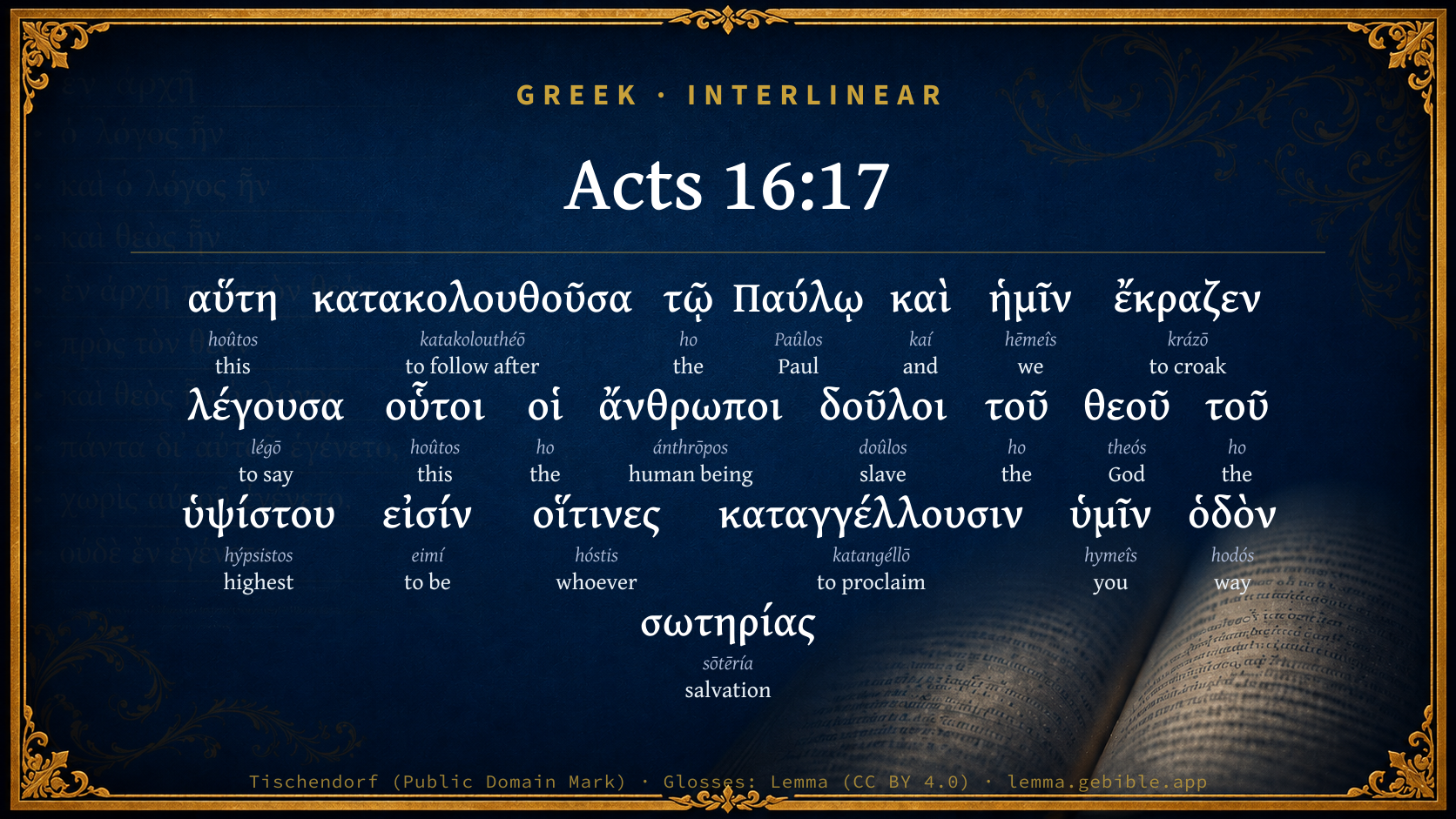
Following Paul and us, she cried out, "These men are servants of the Most High God, who proclaim to us the way of salvation!"
Download a study sheet
One document with this verse’s original text, its word-by-word gloss line, the meaning frame, cross-references with their text, attributed commentary, and full source and license credits — printable, and it pastes into notes with its structure intact.
This verse Autodidact and up
A passage Seminary Student
Up to 50 verses in one chapter. A passage sheet keeps up to 6 commentary sources and 12 cross-references per verse, in the order this page ranks them, and says so on the sheet whenever that leaves anything out. Ask for a single verse and you get the Autodidact verse sheet above.
Everything on this page stays free to read, with no account — the sheet is a download of what is already on screen, not access to it.
Compare translations 3
The same verse in 3 English versions, stacked beneath the original-language interlinear above. Click any original word for its lexicon entry.
Each is an independent rendering of the whole verse — the interlinear is not word-aligned to these translations.
Highlighted words mark where these versions differ — a whole-verse word diff, not a word-by-word alignment.
-
World English Bible Public Domain
Following Paul and us, she cried out, "These men are servants of the Most High God, who proclaim to us the way of salvation!"
-
King James Version Public Domain
The same followed Paul and us, and cried, saying, These men are the servants of the most high God, which shew unto us the way of salvation.
-
unfoldingWord Literal Text CC BY-SA 4.0
She, following after Paul and us, was shouting, saying, “These men are servants of the Most High God who are proclaiming to you the way of salvation.”
unfoldingWord Literal Text — © unfoldingWord, licensed CC BY-SA 4.0. Word-aligned USFM3 via Door43 (git.door43.org/unfoldingWord/en_ult).
Show all 19 translations
Every available English version of this verse, each an independent rendering of the whole verse.
-
World English Bible Public Domain
Following Paul and us, she cried out, "These men are servants of the Most High God, who proclaim to us the way of salvation!"
-
Berean Standard Bible Public Domain
This girl followed Paul and the rest of us, shouting, “These men are servants of the Most High God, who are proclaiming to you the way of salvation!”
-
Majority Standard Bible Public Domain
This girl followed Paul and the rest of us, shouting, “These men are servants of the Most High God, who are proclaiming to us the way of salvation!”
-
King James Version Public Domain
The same followed Paul and us, and cried, saying, These men are the servants of the most high God, which shew unto us the way of salvation.
-
American Standard Version (1901) Public Domain
The same following after Paul and us cried out, saying, These men are servants of the Most High God, who proclaim unto you the way of salvation.
-
Revised Version (1885) Public Domain
The same following after Paul and us cried out, saying, These men are servants of the Most High God, which proclaim unto you the way of salvation.
-
Geneva Bible (1599) Public Domain
She followed Paul and vs, and cryed, saying, These men are the seruants of the most high God, which shewe vnto you the way of saluation.
-
Douay-Rheims (1899) Public Domain
This same following Paul and us, cried out, saying: These men are the servants of the most high God, who preach unto you the way of salvation.
-
Young's Literal Translation Public Domain
she having followed Paul and us, was crying, saying, `These men are servants of the Most High God, who declare to us a way of salvation;'
-
Literal Standard Version CC BY-SA 4.0
she having followed Paul and us, was crying, saying, “These men are servants of the Most High God, who declare to us [the] way of salvation!”
-
Unlocked Literal Bible CC BY-SA 4.0
This woman followed after Paul and us and shouted, saying, “These men are servants of the Most High God. They proclaim to you the way of salvation.”
-
unfoldingWord Literal Text CC BY-SA 4.0
She, following after Paul and us, was shouting, saying, “These men are servants of the Most High God who are proclaiming to you the way of salvation.”
-
Darby Bible Public Domain
She, having followed Paul and us, cried saying, These men are bondmen of the Most High God, who announce to you [the] way of salvation.
-
World Messianic Bible Public Domain
Following Paul and us, she cried out, “These men are servants of the Most High God, who proclaim to us a way of salvation!”
-
Webster's Bible Public Domain
The same followed Paul and us, and cried, saying, These men are the servants of the most high God, who show to us the way of salvation.
-
Free Bible Version CC BY-SA 4.0
This girl followed Paul and the rest of us around, shouting, “These men are the servants of Almighty God. They are telling you how to be saved!”
-
Bible in Basic English Public Domain
She came after Paul and us, crying out and saying, These men are the servants of the Most High God, who are giving you news of the way of salvation.
-
Text-Critical English NT CC BY 4.0
She followed along behind Paul and us and kept crying out, “These men are servants of the Most High God, who proclaim to us a way of salvation.”
-
Tyndale New Testament (1534) Public Domain
The same folowed Paul and vs and cryed sayinge: these men are the servauntes of the most hye God which shewe vnto vs the waye of salvacion.
Literal Standard Version (2020), Covenant Press — licensed CC BY-SA 4.0. Text via the HelloAO Bible API (eBible.org). Unlocked Literal Bible (unfoldingWord) — licensed CC BY-SA 4.0. Text via the HelloAO Bible API (eBible.org). unfoldingWord Literal Text — © unfoldingWord, licensed CC BY-SA 4.0. Word-aligned USFM3 via Door43 (git.door43.org/unfoldingWord/en_ult). Free Bible Version, Dr. Jonathan Gallagher — licensed CC BY-SA 4.0. Text via the HelloAO Bible API (eBible.org).
Word by word
More ways to search: Search by grammar → Find every occurrence → Compare this word →
Practice this passage: Drill this verse → Learn its vocabulary →
- Appears 2× in the Greek New Testament
- First appears at Luke 23:55
- Part of Speech
- Verb
- Tense
- Present
- Voice
- Active
- Mood
- Participle
- Case
- Nominative
- Number
- Singular
- Gender
- Feminine
Full Thayer's Definition
- αὕτη hoûtos G3778 “this” Demonstrative pronoun, Nominative, Singular, Feminine
- κατακολουθοῦσα katakolouthéō G2628 “to follow after” Verb, Present, Active, Participle, Nominative, Singular, Feminine
- τῷ ho G3588 “the” Article, Dative, Singular, Masculine
- Παύλῳ Paûlos G3972 “Paul” Noun, Dative, Singular, Masculine
- καὶ kaí G2532 “and” Conjunction
- ἡμῖν hēmeîs G2249 “we” Personal pronoun, 1st person, Dative, Plural
- ἔκραζεν krázō G2896 “to croak” Verb, Imperfect, Active, Indicative, 3rd person, Singular
- λέγουσα légō G3004 “to say” Verb, Present, Active, Participle, Nominative, Singular, Feminine
- οὗτοι hoûtos G3778 “this” Demonstrative pronoun, Nominative, Plural, Masculine
- οἱ ho G3588 “the” Article, Nominative, Plural, Masculine
- ἄνθρωποι ánthrōpos G444 “human being” Noun, Nominative, Plural, Masculine
- δοῦλοι doûlos G1401 “slave” Noun, Nominative, Plural, Masculine
- τοῦ ho G3588 “the” Article, Genitive, Singular, Masculine
- θεοῦ theós G2316 “God” Noun, Genitive, Singular, Masculine
- τοῦ ho G3588 “the” Article, Genitive, Singular, Masculine
- ὑψίστου hýpsistos G5310 “highest” Adjective, Genitive, Singular, Masculine, Superlative
- εἰσίν eimí G1510 “to be” Verb, Present, Active, Indicative, 3rd person, Plural
- οἵτινες hóstis G3748 “whoever” Relative pronoun, Nominative, Plural, Masculine
- καταγγέλλουσιν katangéllō G2605 “to proclaim” Verb, Present, Active, Indicative, 3rd person, Plural
- ὑμῖν hymeîs G5210 “you” Personal pronoun, 2nd person, Dative, Plural
- ὁδὸν hodós G3598 “way” Noun, Accusative, Singular, Feminine
- σωτηρίας sōtēría G4991 “salvation” Noun, Genitive, Singular, Feminine
About this verse
These counts appear in no published source. They are computed here, from the morphology-tagged text and Lemma’s own curated glosses. What Lemma adds →
- 22
- words
- 18
- distinct lemmas
- Acts
- section
Cross-references
30Topical passages linked to Acts 16:17 in the Treasury of Scripture Knowledge — connected by theme and wording, ordered by reader-vote popularity; previews shown in the World English Bible.
- John 14:6 Jesus said to him, "I am the way, the truth, and the life. No one comes to the Father, except through me.
- 1 Peter 2:16 as free, and not using your freedom for a cloak of wickedness, but as bondservants of God.
- Mark 5:7 and crying out with a loud voice, he said, "What have I to do with you, Jesus, you Son of the Most High God? I adjure you by God, don't torment me."
- Daniel 6:20 When he came near to the den to Daniel, he cried with a lamentable voice; the king spoke and said to Daniel, Daniel, servant of the living God, is your God, whom you serve continually, able to deliver you from the lions?
- Daniel 3:26 Then Nebuchadnezzar came near to the mouth of the burning fiery furnace: he spoke and said, Shadrach, Meshach, and Abednego, you servants of the Most High God, come forth, and come here. Then Shadrach, Meshach, and Abednego came forth out of the midst of the fire.
- Daniel 3:28 Nebuchadnezzar spoke and said, Blessed be the God of Shadrach, Meshach, and Abednego, who has sent his angel, and delivered his servants who trusted in him, and have changed the king's word, and have yielded their bodies, that they might not serve nor worship any god, except their own God.
- Psalms 57:2 I cry out to God Most High, To God who accomplishes my requests for me.
- Jonah 1:9 He said to them, "I am a Hebrew, and I fear Yahweh, the God of heaven, who has made the sea and the dry land."
- Luke 1:79 To shine on those who sit in darkness and the shadow of death; To guide our feet into the way of peace."
- Luke 4:34 saying, "Ah! what have we to do with you, Jesus of Nazareth? Have you come to destroy us? I know you who you are: the Holy One of God!"
- Luke 4:41 Demons also came out from many, crying out, and saying, "You are the Christ, the Son of God!" Rebuking them, he didn't allow them to speak, because they knew that he was the Christ.
- Genesis 14:18–22 Melchizedek king of Salem brought forth bread and wine: and he was priest of God Most High.
- Psalms 78:35 They remembered that God was their rock, The Most High God their redeemer.
- Daniel 4:2 It has seemed good to me to show the signs and wonders that the Most High God has worked toward me.
- Daniel 5:18 You king, the Most High God gave Nebuchadnezzar your father the kingdom, and greatness, and glory, and majesty:
- Daniel 5:21 and he was driven from the sons of men, and his heart was made like the animals', and his dwelling was with the wild donkeys; he was fed with grass like oxen, and his body was wet with the dew of the sky; until he knew that the Most High God rules in the kingdom of men, and that he sets up over it whoever he will.
- Daniel 6:16 Then the king commanded, and they brought Daniel, and cast him into the den of lions. [Now] the king spoke and said to Daniel, Your God whom you serve continually, he will deliver you.
- Micah 6:6 How shall I come before Yahweh, And bow myself before the exalted God? Shall I come before him with burnt offerings, With calves a year old?
- Matthew 7:13–14 "Enter in by the narrow gate; for wide is the gate and broad is the way that leads to destruction, and many are those who enter in by it.
- Matthew 8:29 Behold, they cried out, saying, "What do we have to do with you, Jesus, Son of God? Have you come here to torment us before the time?"
- Matthew 22:16 They sent their disciples to him, along with the Herodians, saying, "Teacher, we know that you are honest, and teach the way of God in truth, no matter who you teach, for you aren't partial to anyone.
- Mark 12:14 When they had come, they asked him, "Teacher, we know that you are honest, and don't defer to anyone; for you aren't partial to anyone, but truly teach the way of God. Is it lawful to pay taxes to Caesar, or not?
- Luke 1:77 To give knowledge of salvation to his people by the remission of their sins,
- Luke 20:21 They asked him, "Teacher, we know that you say and teach what is right, and aren't partial to anyone, but truly teach the way of God.
- Acts 16:30–31 and brought them out and said, "Sirs, what must I do to be saved?"
- Acts 18:26 He began to speak boldly in the synagogue. But when Priscilla and Aquila heard him, they took him aside, and explained to him the way of God more accurately.
- Acts 19:13 But some of the itinerant Jews, exorcists, took on themselves to name over those who had the evil spirits the name of the Lord Jesus, saying, "We adjure you by Jesus whom Paul preaches."
- Hebrews 10:19–22 Having therefore, brothers, boldness to enter into the holy place by the blood of Jesus,
- Mark 1:24 saying, "Ha! What do we have to do with you, Jesus, you Nazarene? Have you come to destroy us? I know you who you are: the Holy One of God!"
- Luke 8:28 When he saw Jesus, he cried out, and fell down before him, and with a loud voice said, "What do I have to do with you, Jesus, you Son of the Most High God? I beg you, don't torment me!"
Cross-references courtesy of OpenBible.info (CC BY 4.0).
Where the printed editions differ
1 variantPlaces in this verse where the major printed Greek editions disagree on the wording in a way that affects the translation — a comparison of editions, not a manuscript-by-manuscript collation. The editions are the modern critical texts (Nestlé-Aland 28/27, SBL, Westcott-Hort, Tregelles, Tyndale House) and the traditional texts behind the KJV (the Textus Receptus and the Byzantine/Majority text). It is not a claim about which reading is original.
-
Different wording
ὑμῖν
“to you”
In NA28NA27TynSBLWHTreg Not in TRByzἡμῖν (hēmin) 'to us' occurs in traditional manuscripts (TR+Byz) instead of ὑμῖν (humin) 'to you' in older manuscripts (NA28+NA27+Tyn+SBL+WH+Treg)
Textual data: Translators Amalgamated Greek New Testament (STEPBible TAGNT) · CC BY 4.0.
Lesson kit
Teaching starters — assembled from the data on this page, not authored interpretation. Every prompt links to the verse data it draws on. Edit before teaching.
Acts, in the Acts, opens this verse with 22 words (18 distinct Greek lemmas). Its most distinctive word is katakolouthéō (“to follow after”). A historical commentator’s framing appears above. Read the whole chapter for the surrounding context.
Discussion questions
- What does “to follow after” (katakolouthéō) contribute to the verse as a whole?
- Luke 23:55 shares the word «to follow after» with this verse. How do the two illuminate each other?
- “the” occurs 4× in this one verse. What is the effect of the repetition?
- The translations on this page render this verse differently — a whole-verse word diff, not a word-by-word alignment. What might account for the different wordings?
- Reading how The Biblical Illustrator and Joseph Benson's Commentary read this verse, where do the two commentators agree and where do they part?
Things to notice
- These translations choose different wording for 14 words in this verse.
- “the” occurs 4× in this single verse.
- 18 distinct Greek lemmas span 22 words in this verse.
Commentary
Notes on Acts 16:17 from classic Christian and Jewish commentators (each source and its license shown beneath its notes). The classic Christian expositions comment on the surrounding passage and are grouped to its opening verse, so a note may address several verses; the Jewish commentaries on the Tanakh (Rashi and others) are per-verse, so they appear only where the commentator wrote on this verse.
Lemma curates 59 commentaries, every one of them public domain or Creative Commons licensed, each selected and text-cleaned for this edition rather than reprinted as found. About our sources →
The Biblical Illustrator
Joseph S. Exell
The Biblical Illustrator, edited by Joseph S. Exell (c. 1880s–1900s) — public domain. Text from a community e-Sword module.
Joseph Benson's Commentary
Joseph Benson's Commentary on the Old and New Testaments (1811–1818) — public domain. Text from a community e-Sword module.
Bengel's Gnomon
Johann Albrecht Bengel
Bengel's Gnomon of the New Testament — English translation (T&T Clark, Edinburgh, 1860) — public domain. Text from a community e-Sword module.
Meyer's Critical & Exegetical Commentary
Heinrich August Wilhelm Meyer
Meyer — Critical and Exegetical Commentary on the New Testament — English translation by Peter Christie, edited by Frederick Crombie (T&T Clark, 1880) — public domain. Text from a community e-Sword module.
Expositor's Greek Testament
ed. W. Robertson Nicoll
The Expositor's Greek Testament, edited by W. Robertson Nicoll (1897–1910) — public domain. Text from a community e-Sword module.
Jamieson, Fausset & Brown
Robert Jamieson, A. R. Fausset & David Brown
Jamieson, Fausset & Brown — Commentary Critical and Explanatory on the Whole Bible (1871) — public domain (CC PDM 1.0). Text via the HelloAO Bible API.
Adam Clarke's Commentary
Adam Clarke's Commentary on the Bible (1810–1826) — public domain. Text from a community e-Sword/MySword module.
Ellicott's Commentary for English Readers
A Bible Commentary for English Readers, edited by Charles John Ellicott (1878–1897) — public domain. Text from a community e-Sword module.
The Cambridge Bible for Schools and Colleges
gen. ed. J. J. S. Perowne
The Cambridge Bible for Schools and Colleges (gen. ed. J. J. S. Perowne; Cambridge University Press, 1878–1918) — public domain. Text from a community e-Sword module.
John Gill's Exposition
John Gill's Exposition of the Whole Bible (1746–1763) — public domain (CC PDM 1.0). Text via the HelloAO Bible API.
Trapp's Complete Commentary
John Trapp
John Trapp, A Commentary or Exposition upon All the Books of the Old and New Testament (1647–1656) — public domain. Text from a community e-Sword module.
Albert Barnes' Notes on the Bible
Albert Barnes' Notes on the Bible (1834–1885) — public domain. Text from a community e-Sword/MySword module.
Haydock's Catholic Bible Commentary
George Leo Haydock (1774–1849), Haydock's Catholic Family Bible and Commentary, 1859 edition — public domain. Excludes Psalms (Douay-Rheims chapter numbering differs from Protestant) and Deuterocanonical books (Catholic canon only).
Matthew Poole's English Annotations
Matthew Poole's English Annotations on the Holy Bible (1683–1685) — public domain. Text from a community e-Sword/MySword module.
Whedon's Commentary on the Bible
Daniel D. Whedon
Daniel D. Whedon (gen. ed.), Commentary on the Old and New Testaments (1874–1909) — public domain. Text from a community e-Sword module.
The Pulpit Commentary
The Pulpit Commentary (1880–1919), ed. H.D.M. Spence-Jones & Joseph S. Exell — public domain. Text from a community e-Sword module.
John Wesley's Explanatory Notes
John Wesley, Explanatory Notes Upon the Whole Bible (1754–1765) — public domain. Text via the GEBible commentary corpus.
Scofield Reference Notes
C. I. Scofield
The Scofield Reference Bible (1917 edition), notes by C. I. Scofield — public domain. Text from a community e-Sword module.
McGarvey & Pendleton's Commentaries
J. W. McGarvey
J. W. McGarvey (with Philip Y. Pendleton), Commentaries on the New Testament (The Fourfold Gospel, 1914; Acts; and the epistles) — public domain. Text from a community e-Sword/MySword module.
Cambridge Greek Testament for Schools and Colleges
Cambridge Greek Testament for Schools and Colleges (Cambridge University Press, 1896; 21 vols, various authors incl. Carr, Maclear, Plummer, Farrar, Lumby, Moule, M. R. James, Simcox) — public domain. Text from a community e-Sword module.
Alford’s Greek Testament
Henry Alford
Henry Alford, The Greek Testament (1849–1861) — public domain. Text from a community e-Sword module.