Numbers 6:7

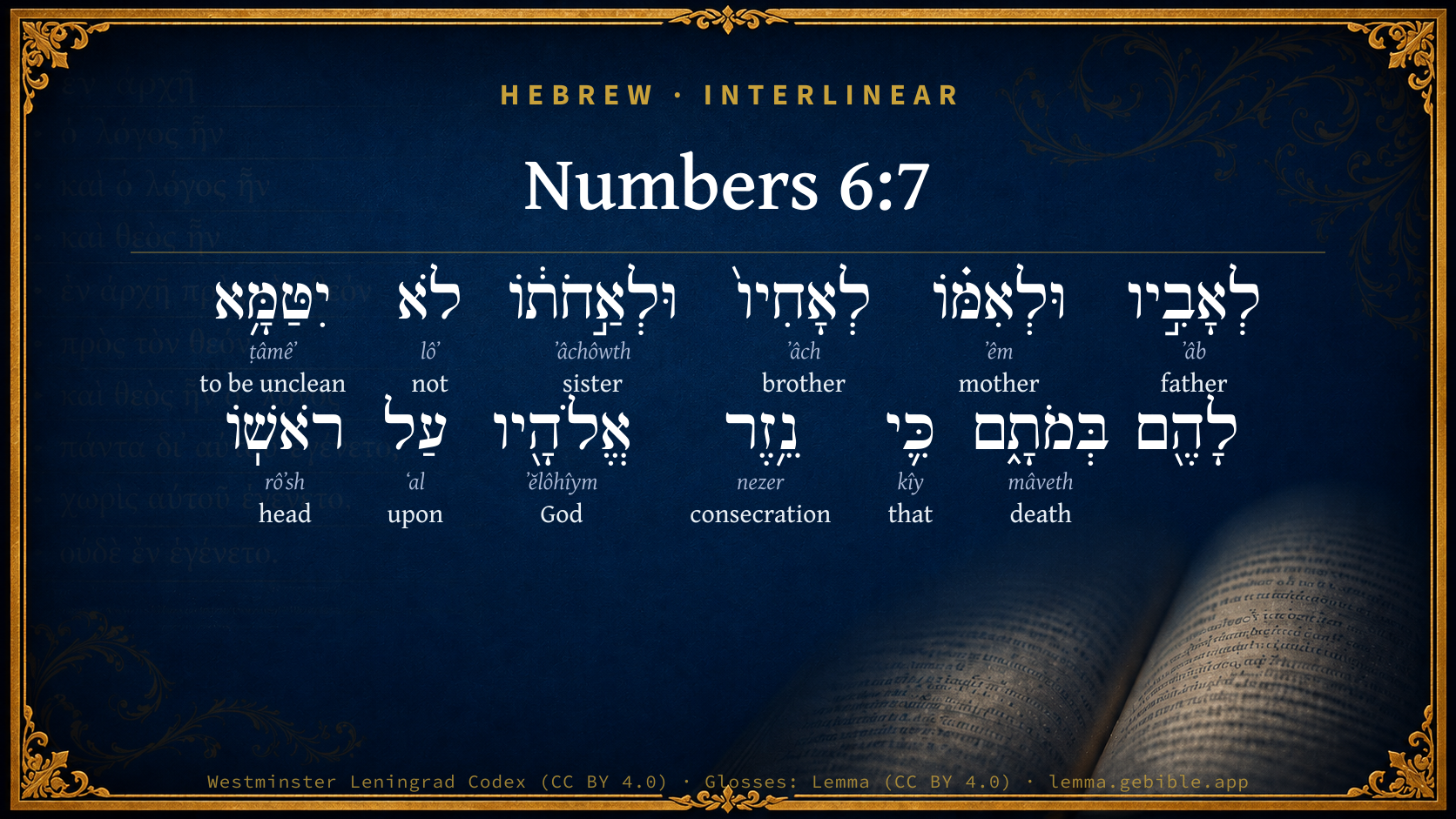
Hebrew (Westminster Leningrad Codex) Numbers 6:7 appears in the Hebrew Old Testament. The text above is from the Westminster Leningrad Codex. Each word links to its Strong’s number, a concise gloss, and parsing drawn from the Open Scriptures Hebrew Bible morphology. Click any word for its full Brown-Driver-Briggs (BDB) entry.
Download image
Cite this verse

Numbers 6:7 (World English Bible). Public Domain. Lemma interlinear Bible study tool, https://lemma.gebible.app/v/numbers/6/7.

Show BibTeX & RIS
BibTeX
RIS
English Translation
He shall not make himself unclean for his father, or for his mother, for his brother, or for his sister, when they die; because his separation to God is on his head.
World English Bible · Public Domain
Download a study sheet

One document with this verse’s original text, its word-by-word gloss line, the meaning frame, cross-references with their text, attributed commentary, and full source and license credits — printable, and it pastes into notes with its structure intact.

This verse Autodidact and up

Study sheet (.html) Plain text (.txt)

A passage Seminary Student

Up to 50 verses in one chapter. A passage sheet keeps up to 6 commentary sources and 12 cross-references per verse, in the order this page ranks them, and says so on the sheet whenever that leaves anything out. Ask for a single verse and you get the Autodidact verse sheet above.

Everything on this page stays free to read, with no account — the sheet is a download of what is already on screen, not access to it.

Want to remove ads? Support Godless Engineer
Compare translations 3

The same verse in 3 English versions, stacked beneath the original-language interlinear above. Click any original word for its lexicon entry.

Each is an independent rendering of the whole verse — the interlinear is not word-aligned to these translations.

Highlighted words mark where these versions differ — a whole-verse word diff, not a word-by-word alignment.

  • World English Bible Public Domain
    He shall not make himself unclean for his father, or for his mother, for his brother, or for his sister, when they die; because his separation to God is on his head.
  • King James Version Public Domain
    He shall not make himself unclean for his father, or for his mother, for his brother, or for his sister, when they die: because the consecration of his God is upon his head.
  • unfoldingWord Literal Text CC BY-SA 4.0
    For his father and for his mother, for his brother and for his sister, he shall not make himself unclean for them in their death, because the separation of his God upon his head.

unfoldingWord Literal Text — © unfoldingWord, licensed CC BY-SA 4.0. Word-aligned USFM3 via Door43 (git.door43.org/unfoldingWord/en_ult).

Versions to compare (up to 4)

3 of 4 selected

Show all 18 translations

Every available English version of this verse, each an independent rendering of the whole verse.

  • World English Bible Public Domain
    He shall not make himself unclean for his father, or for his mother, for his brother, or for his sister, when they die; because his separation to God is on his head.
  • Berean Standard Bible Public Domain
    Even if his father or mother or brother or sister should die, he is not to defile himself, because the crown of consecration to his God is upon his head.
  • Majority Standard Bible Public Domain
    Even if his father or mother or brother or sister should die, he is not to defile himself, because the symbol of consecration to his God is upon his head.
  • King James Version Public Domain
    He shall not make himself unclean for his father, or for his mother, for his brother, or for his sister, when they die: because the consecration of his God is upon his head.
  • American Standard Version (1901) Public Domain
    He shall not make himself unclean for his father, or for his mother, for his brother, or for his sister, when they die; because his separation unto God is upon his head.
  • Revised Version (1885) Public Domain
    He shall not make himself unclean for his father, or for his mother, for his brother, or for his sister, when they die: because his separation unto God is upon his head.
  • Geneva Bible (1599) Public Domain
    Hee shall not make himselfe vncleane at the death of his father, or mother, brother, or sister: for the consecration of his God is vpon his head.
  • Douay-Rheims (1899) Public Domain
    Neither shall he make himself unclean, even for his father, or for his mother, or for his brother, or for his sister, when they die, because the consecration of his God is upon his head.
  • Young's Literal Translation Public Domain
    for his father, or for his mother, for his brother, or for his sister -- he is not unclean for them at their death, for the separation of his God `is' on his head;
  • Literal Standard Version CC BY-SA 4.0
    for his father, or for his mother, for his brother, or for his sister—he does not become unclean for them at their death, for the separation of his God [is] on his head;
  • Unlocked Literal Bible CC BY-SA 4.0
    He must not make himself unclean even for his father, mother, brother, or sister, if they die. This is because he is separated to God, as everyone can see by his long hair.
  • unfoldingWord Literal Text CC BY-SA 4.0
    For his father and for his mother, for his brother and for his sister, he shall not make himself unclean for them in their death, because the separation of his God upon his head.
  • Darby Bible Public Domain
    He shall not make himself unclean for his father, or for his mother, for his brother, or for his sister when they die; for the consecration of his God is upon his head.
  • World Messianic Bible Public Domain
    He shall not make himself unclean for his father, or for his mother, for his brother, or for his sister, when they die, because his separation to God is on his head.
  • Webster's Bible Public Domain
    He shall not make himself unclean for his father, or for his mother, for his brother, or for his sister, when they die: because the consecration of his God is upon his head.
  • Free Bible Version CC BY-SA 4.0
    Even if it's their father, mother, brother or sister who has died, they are not to make themselves unclean, because their uncut hair announces their dedication to God.
  • Bible in Basic English Public Domain
    He may not make himself unclean for his father or his mother, his sister or his brother, if death comes to them; because he is under an oath to keep himself separate for God.
  • JPS Tanakh (1917) Public Domain
    He shall not make himself unclean for his father, or for his mother, for his brother, or for his sister, when they die; because his consecration unto God is upon his head.

Literal Standard Version (2020), Covenant Press — licensed CC BY-SA 4.0. Text via the HelloAO Bible API (eBible.org). Unlocked Literal Bible (unfoldingWord) — licensed CC BY-SA 4.0. Text via the HelloAO Bible API (eBible.org). unfoldingWord Literal Text — © unfoldingWord, licensed CC BY-SA 4.0. Word-aligned USFM3 via Door43 (git.door43.org/unfoldingWord/en_ult). Free Bible Version, Dr. Jonathan Gallagher — licensed CC BY-SA 4.0. Text via the HelloAO Bible API (eBible.org).

Word by word

More ways to search: Search by grammar → Find every occurrence → Compare this word →

Practice this passage: Drill this verse → Learn its vocabulary →

נֵ֥זֶר
nezer
H5145
“consecration of”
Noun, Common, Masculine, Singular, Construct
Part of Speech
Noun
Type
Common
Gender
Masculine
Number
Singular
State
Construct
Full BDB Definition

Origin: from H5144

TWOT: 1340a

consecration, crown, separation, Nazariteship - crown (as sign of consecration), earring - stones of a crown, diadem, stones of charming - woman's hair - consecration - of high priest - of Nazarite
  1. לְאָבִ֣יו ʼâb H1 “to/for · father · his” Preposition + Noun, Common, Masculine, Singular, Construct + Suffix, Personal, 3rd Person, Masculine, Singular
  2. וּלְאִמּ֗וֹ ʼêm H517 “and · to/for · mother · his” Conjunction + Preposition + Noun, Common, Feminine, Singular, Construct + Suffix, Personal, 3rd Person, Masculine, Singular
  3. לְאָחִיו֙ ʼâch H251 “to/for · brother · his” Preposition + Noun, Common, Masculine, Singular, Construct + Suffix, Personal, 3rd Person, Masculine, Singular
  4. וּלְאַ֣חֹת֔וֹ ʼâchôwth H269 “and · to/for · sister · his” Conjunction + Preposition + Noun, Common, Feminine, Singular, Construct + Suffix, Personal, 3rd Person, Masculine, Singular
  5. לֹא lôʼ H3808 “not” Particle, Negative
  6. יִטַּמָּ֥א ṭâmêʼ H2930 “to be unclean” Verb, Hithpael, Imperfect, 3rd Person, Masculine, Singular
  7. בְּמֹתָ֑ם mâveth H4194 “in/at · death · their” Preposition + Noun, Common, Masculine, Singular, Construct + Suffix, Personal, 3rd Person, Masculine, Plural
  8. כִּ֛י kîy H3588 “that” Conjunction
  9. אֱלֹהָ֖יו ʼĕlôhîym H430 “God(s) · his” Noun, Common, Masculine, Plural, Construct + Suffix, Personal, 3rd Person, Masculine, Singular
  10. עַל ʻal H5921 “upon” Preposition
  11. רֹאשֽׁוֹ rôʼsh H7218 “head · his” Noun, Common, Masculine, Singular, Construct + Suffix, Personal, 3rd Person, Masculine, Singular

About this verse

These counts appear in no published source. They are computed here, from the morphology-tagged text and Lemma’s own curated glosses. What Lemma adds →

13
words
12
distinct lemmas
Pentateuch
section

Notable vocabulary

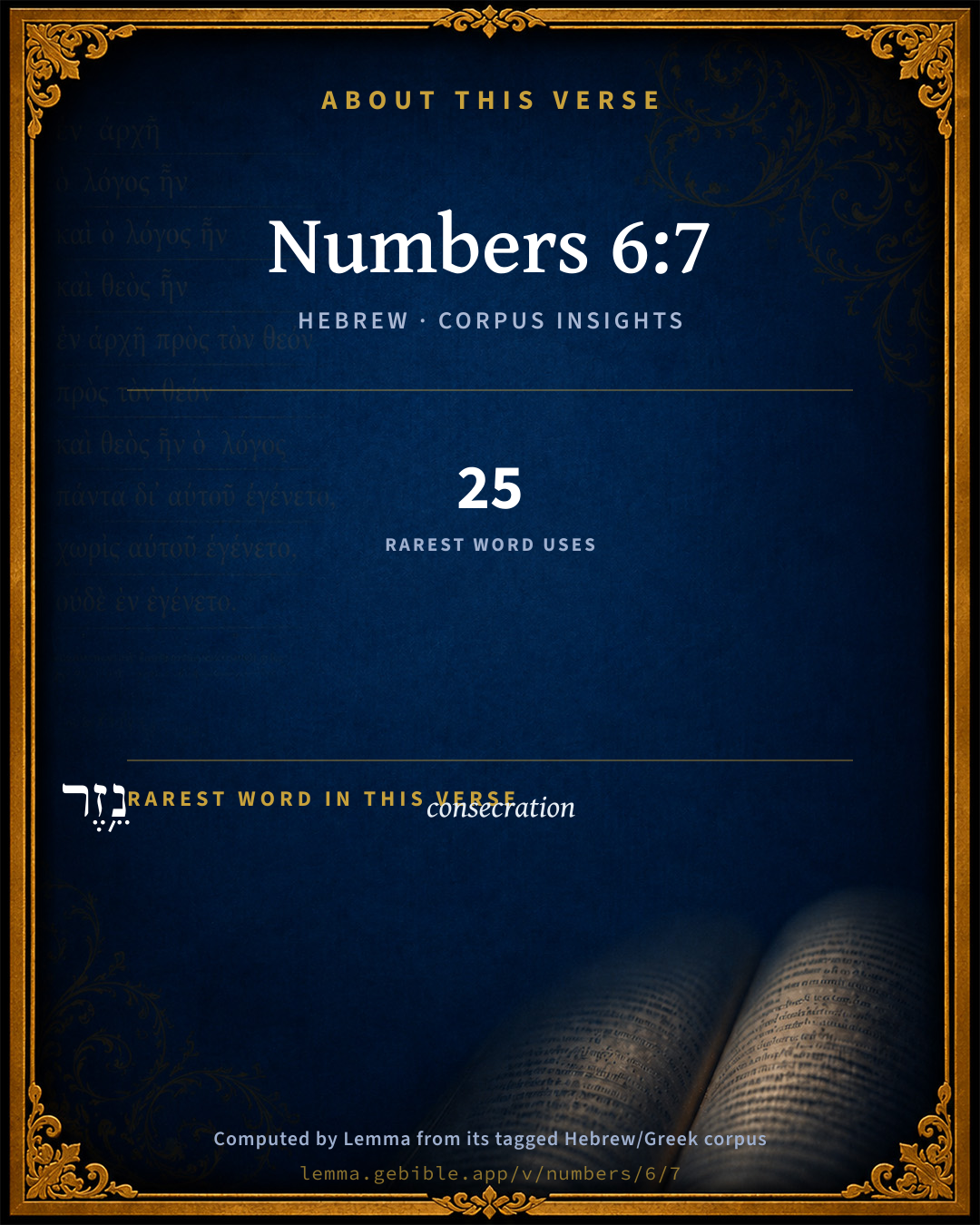
The rarest word here is נֵ֥זֶר consecration H5145 — appearing just 25 times in the whole Hebrew Bible.

Shared distinctive vocabulary

נֵ֥זֶר consecration H5145 occurs in 22 verses of the Hebrew Bible. Also found in:

Grammatical profile

  • 1 verb
  • 8 nouns
  • 2 prepositions
  • 1 conjunction
  • 1 particle

Verb forms

  • יִטַּמָּ֥א Hithpael · Imperfect

Hebrew & Septuagint length

In English translation the verse runs 32 words from the Hebrew and 35 from the Septuagint (LXX English) — closely comparable.

A rough comparison of the two English renderings, which tokenize alike — not a word-level alignment.

Word counts can differ between the Hebrew and the Greek without any difference in meaning — e.g. the Hebrew direct-object marker אֵת has no separate Greek word, and Greek often adds the article ὁ.

Cross-references

4

Topical passages linked to Numbers 6:7 in the Treasury of Scripture Knowledge — connected by theme and wording, ordered by reader-vote popularity; previews shown in the World English Bible.

  • Numbers 9:6 There were certain men, who were unclean because of the dead body of a man, so that they could not keep the Passover on that day, and they came before Moses and before Aaron on that day.
  • Leviticus 21:1–2 Yahweh said to Moses, "Speak to the priests, the sons of Aaron, and say to them, 'A priest shall not defile himself for the dead among his people;
  • Leviticus 21:10–12 "'He who is the high priest among his brothers, upon whose head the anointing oil is poured, and that is consecrated to put on the garments, shall not let the hair of his head hang loose, nor tear his clothes;
  • Ezekiel 44:25 They shall go in to no dead person to defile themselves; but for father, or for mother, or for son, or for daughter, for brother, or for sister who has had no husband, they may defile themselves.

Cross-references courtesy of OpenBible.info (CC BY 4.0).

Hebrew and Greek witnesses Masoretic Hebrew ↔ Greek Septuagint

The same verse in the two great witnesses to the Old Testament, shown verse-for-verse.

These are two independent witnesses, not word-aligned to each other, and the Septuagint is shown in lemma (dictionary) form.

Hebrew Numbers 6:7 Masoretic · Westminster Leningrad Codex

לְאָבִ֣יו וּלְאִמּ֗וֹ לְאָחִיו֙ וּלְאַ֣חֹת֔וֹ לֹא יִטַּמָּ֥א לָהֶ֖ם בְּמֹתָ֑ם כִּ֛י נֵ֥זֶר אֱלֹהָ֖יו עַל רֹאשֽׁוֹ

He shall not make himself unclean for his father, or for his mother, for his brother, or for his sister, when they die; because his separation to God is on his head.

World English Bible · Public Domain

Greek LXX Numbers 6:7 Septuagint · lemma form

ἐπί πατήρ καί ἐπί μήτηρ καί ἐπί ἀδελφός καί ἐπί ἀδελφή οὐ μιαίνω ἐπί αὐτός ἀποθνήσκω αὐτός ὅτι εὐχή θεός αὐτός ἐπί αὐτός ἐπί κεφαλή αὐτός

to his father or his mother, or to his brother or his sister; he shall not defile himself for them, when they have died, because the vow of God is upon him on his head.

LXX2012 (modern English Septuagint) · Public Domain

Hebrew: Westminster Leningrad Codex (CC BY 4.0). Greek: Septuagint (public domain); English from LXX2012 (modern English Septuagint) (Public Domain). How the Septuagint differs from the Hebrew →

Targum (Aramaic paraphrase)

2

The Targum is the ancient Jewish Aramaic paraphrase of the Hebrew Scriptures — an interpretive translation, not the Hebrew text itself. Onkelos (literal) and Pseudo-Jonathan (expansive) render the Torah, and Jonathan the Prophets. Coverage is partial: where no permissively-licensed English translation exists for a verse, only the Aramaic is shown. This is verse-level text, not a word-by-word alignment to the Hebrew.

  1. Targum Onkelos Torah (Genesis–Deuteronomy)
    לְאָבוּהִי וּלְאִמֵהּ לְאַחוֹהִי וּלְאַחָתֵהּ לָא יִסְתָּאַב לְהוֹן בְּמוֹתְהּוֹן אֲרֵי כְּלִילָא דֶאֱלָהֵהּ עַל רֵישֵׁהּ

    (no public-domain English translation for this verse)

    Targum Onkelos — Aramaic: “Onkelos Genesis” (public domain); “Onkelos Exodus” (public domain); “Onkelos Leviticus” (public domain); “Onkelos Numbers” (public domain); “Onkelos Deuteronomy” (public domain). English: “Sefaria Community Translation” (CC0 1.0 (public-domain dedication)); “J.W. Etheridge. The Targums of Onkelos and Jonathan Ben Uzziel on the Pentateuch. London: Longmans, Green, 1862” (public domain). Text via Sefaria.

  2. Targum Pseudo-Jonathan Torah (Genesis–Deuteronomy)
    לְאָבוּי וּלְאִמֵיהּ לְאָחוֹי וּלְאַחְתֵיהּ לָא יִסְתָּאַב לְהוֹן בְּמוֹתְהוֹן אֲרוּם כְּלִילָא דֶאֱלָהֵיהּ עַל רֵישֵׁיהּ

    For his father, or his mother, his brother, or his sister, he shall not make himself unclean through their decease; for the crown of Eloah is upon his head;

    Targum Pseudo-Jonathan — Aramaic: “Targum Jonathan on Genesis” (public domain); “Targum Jonathan on Exodus” (public domain); “Targum Jonathan on Leviticus” (public domain); “Targum Jonathan on Numbers” (public domain); “Targum Jonathan on Deuteronomy” (public domain). English: “The Targum of Jonathan ben Uzziel, trans. J. W. Etheridge, London, 1862” (public domain). Text via Sefaria.

Commentary

Notes on Numbers 6:7 from classic Christian and Jewish commentators (each source and its license shown beneath its notes). The classic Christian expositions comment on the surrounding passage and are grouped to its opening verse, so a note may address several verses; the Jewish commentaries on the Tanakh (Rashi and others) are per-verse, so they appear only where the commentator wrote on this verse.

Lemma curates 59 commentaries, every one of them public domain or Creative Commons licensed, each selected and text-cleaned for this edition rather than reprinted as found. About our sources →

Trapp's Complete Commentary

John Trapp

Num 6:7 He shall not make himself unclean for his father, or for his mother, for his brother, or for his sister, when they die: because the consecration of his God [is] upon his head.

Ver. 7. He shall not make himself uncIean.] In all changes he must be unchangeable; so was Christ, so must we.

John Trapp, A Commentary or Exposition upon All the Books of the Old and New Testament (1647–1656) — public domain. Text from a community e-Sword module.

Geneva Bible (1599)

Geneva Bible translators

In that he suffered his hair to grow, he signified that he was consecrated to God.

Geneva Bible (1599) marginal notes — public domain. Text via Bolls.life.

Adam Clarke's Commentary

Verse 7. The consecration of his God is upon his head.] Literally, The separation of his God is upon his head; meaning his hair, which was the proof and emblem of his separation. Now as the hair of the Nazarite was a token of his subjection to God through all the peculiarities of his nazarate, a woman, who is married, is considered as a Nazarite for life, i. e., separated from all others, and joined to one husband who is her lord; hence St. Paul, probably alluding to this circumstance, says, 1Co 11:10: The woman ought to have power upon her head, i. e., wear her hair and veil; for this hair is a proof of her nazarate, and of her being in subjection to her husband, as the Nazarite was under subjection to the LORD by the rule of his order.

Adam Clarke's Commentary on the Bible (1810–1826) — public domain. Text from a community e-Sword/MySword module.

Ellicott's Commentary for English Readers

(7) He shall not make himself unclean . . . —The law of the Nazirite in this respect was equally stringent with that of the high priest (Lev_21:11), and more stringent than that which was imposed upon the priests generally (Lev_21:2-3).

The consecration.—Better, the separation (Hebrew, nezer). So also in Num_6:9.

A Bible Commentary for English Readers, edited by Charles John Ellicott (1878–1897) — public domain. Text from a community e-Sword module.

The Cambridge Bible for Schools and Colleges

gen. ed. J. J. S. Perowne

7. The stringent rule here laid down was applicable to no one else except the High Priest (Lev_21:11); in the case of the ordinary priest the nearest relatives are expressly excepted. It is to be noticed that Samson did not scruple to come into frequent contact with the dead. The regulation was probably not in force in early days, but was added when the sanctity attributed to a Nazirite had increased.

his separation] Heb. nçzer (connected with nâzîr) denotes either the state of separation (Num_6:4; Num_6:6 R.V. marg. ‘Naziriteship’), or, as here, the symbol of separation, i.e. the long hair. Cf. the similar ellipse in 1Co_11:10, ‘the woman ought to have [the symbol of] authority on her head.’ In Lev_25:5; Lev_25:11 nçzer is even used for an untrimmed vine, with its long tendrils like uncut hair.

The Cambridge Bible for Schools and Colleges (gen. ed. J. J. S. Perowne; Cambridge University Press, 1878–1918) — public domain. Text from a community e-Sword module.

John Gill's Exposition

He shall not make himself unclean for his father or for his mother, for his brother or for his sister, when they die,.... Aben Ezra adds also, for his wife, and for his daughter, and for others; what even the priests of the Lord, the common priests might do, a Nazarite might not, not come near any of his relations when dead, as to touch them, to close their eyes, or wash their bodies, and provide for their funeral, and attend that, or to be where they were; in this respect they were upon a level with the high priest, who was forbid the same, which shows how sacred these persons were; see Lev 21:1; this may instruct spiritual Nazarites to abstain from the company and conversation of sinners, dead in trespasses and sins, and from all dead works and sinful actions, which, as they are deserving of death, are defiling:

because the consecration of his God is upon his head; or that which shows him to be consecrated to God, and separated to his service, is upon his head, namely, his long hair: the Targum of Jonathan renders it, "the crown of his God"; so Aben Ezra observes, that some say that the word "Nazarite" is derived from "Nezer", a crown, in proof of which this passage is produced; and in this respect the Nazarites were not only types of Christ our King and high priest, who is a priest on his throne, and has on his head many crowns, but of the saints who are freed from the power and dominion of sin, and are made kings and priests unto God.

John Gill's Exposition of the Whole Bible (1746–1763) — public domain (CC PDM 1.0). Text via the HelloAO Bible API.

Matthew Poole's English Annotations

For his father, or for his mother; wherein he was equal to the high priest, Lev 21:11, being, in some sort, as sacred a person, and as eminent a type of Christ, Heb 7:26, and therefore justly required to prefer the service of God, to which he had so fully and peculiarly given himself, before the expressions of his affections to his dearest and nearest relations.

The consecration, i.e. the token of his consecration, to wit, his long hair.

Of his God, i.e. whereby he hath devoted himself to his God in an eminent manner. The genitive case of the object.

Matthew Poole's English Annotations on the Holy Bible (1683–1685) — public domain. Text from a community e-Sword/MySword module.

Whedon's Commentary on the Bible

Daniel D. Whedon

7. Unclean for his father — He could not enter the house where his father lay dead. The omission of the wife in the list of near relatives would seem to permit the Nazarite to bury his wife. Others interpret Num_6:6 as excluding him from her funeral except by breaking his vow, contracting ceremonial defilement during seven days, and beginning his vow anew.

The consecration of his God — R.V., “Separation unto his God.” In Exo_29:6, and Lev_21:12, we have the Hebrew nezer, crown. This is its import here, “the diadem of his God upon his head.” As the golden crown upon the turban of the high priest, and the oil of consecration poured upon the priestly head, so the luxuriant growth of the Nazarite’s hair expressed in a similar manner the fact of his consecration to the service of Jehovah and subjection to his authority. To this St. Paul alludes in 1Co_11:7. The application of the word nezer, crown, to the Nazarite is a figure called assonance, a rhetorical beauty especially frequent in Isaiah.

Daniel D. Whedon (gen. ed.), Commentary on the Old and New Testaments (1874–1909) — public domain. Text from a community e-Sword module.

The Pulpit Commentary

He shall not make himself unclean for his father, or for his mother. The same injunction had been given to the priests (Lev_21:12) the crown of the anointing oil of his God is upon him." A similar reason restrained the Nazirite. Because the consecration of his God is upon his head, i.e., because he wears the unshorn locks which are the outward sign of his separation unto God. The hair of the Nazirite was to him just what the diadem on the mitre was to the high priest, what the sacred chrism was to the sons of Aaron. Both of these are called by the word nezer, (Exo_29:6 Lev_21:12) from the same root as nazir. It was thought by some of the Jewish doctors that in these three particulars the untouched growth of the hair, the abstinence from the fruit of the vine, (cf. Gen_9:20) and the seclusion from the dead the separated life of the Nazirite reproduced the unfallen life of man in paradise. This may have had some foundation in fact, but the true explanation of the three rules is rather to be found in the spiritual truth they teach in a simple and forcible way. He who has a holy ambition to please God must

(1) devote to God the whole forces of his being, undiminished by any wont and use of the world;

(2) abstain not only from pleasures which are actually dangerous, but from such as have any savour of moral evil about them;

(3) subordinate his most sacred private feelings to the great purpose of his life.

The Pulpit Commentary (1880–1919), ed. H.D.M. Spence-Jones & Joseph S. Exell — public domain. Text from a community e-Sword module.

John Wesley's Explanatory Notes

His father - Wherein he was equal to the high-priest, being, in some sort, as eminent a type of Christ, and therefore justly required to prefer the service of God, to which he had so fully given himself, before the expressions of his affections to his dearest and nearest relations. The consecration - That is, the token of his consecration, namely, his long hair.

John Wesley, Explanatory Notes Upon the Whole Bible (1754–1765) — public domain. Text via the GEBible commentary corpus.

Lesson kit

Teaching starters — assembled from the data on this page, not authored interpretation. Every prompt links to the verse data it draws on. Edit before teaching.

Numbers, in the Pentateuch, opens this verse with 13 words (12 distinct Hebrew lemmas). Its most distinctive word is nezer (“consecration”). A historical commentator’s framing appears above. Read the whole chapter for the surrounding context.

Discussion questions

  1. What does “consecration” (nezer) contribute to the verse as a whole?
  2. How does Exodus 29:6, which shares the word «consecration», read alongside this verse?
  3. These translations render this verse differently; the difference is in the English rendering, not the original. What questions does that raise?
  4. «יִטַּמָּ֥א» is a Hithpael Imperfect verb. How does that grammatical form shape the action described?
  5. Compare how Trapp's Complete Commentary and Geneva Bible (1599) read this verse. Where do they agree or differ?

Things to notice

Reading settings

Reading text

Shown beneath each verse's original-language words.

Old Testament
Old Testament edition

Read the OT as the Masoretic Hebrew (MT) or the Greek Septuagint (LXX).

English shown for the Greek Septuagint (in the Hebrew ↔ Greek comparison).

Comparing translations? Open the Compare panel on any verse page to stack up to four side by side.